Arts & Culture
About Andrew Cusack
 Writer, web designer, etc.; born in New York; educated in Argentina, Scotland, and South Africa; now based in London.
 read more
News
Blogs
Reviews & Periodicals
Arts & Design
World
France
Mitteleuropa
Knickerbockers
Argentina
The Levant
Africa
Cape of Good Hope
Netherlands
Scandinavia
Québec
India
Muscovy
Germany
Academica
Loriot
Bernhard Victor Christoph Carl von Bülow, one of Germany’s most highly regarded humorists, was born 12 November 1923 and left this world on 22 August 2011. He was better known by his nom de plume of Loriot, the French translation of his surname Bülow, which is German for the oriole bird. Vicco (as his Christian names were shortened to) von Bülow began drawing cartoons for Stern in the 1950s. From cartoons he moved into television in the 1970s and films the following decade. Loriot’s humour focussed on the peculiarities of German people including the awkwardness of everyday situations and miscommunication in human interaction.
Asked in 2007 to describe what his influences were, he said: “I remember that, when I started studying, I was living between a madhouse, a prison and a cemetery. The location alone explains everything, I think.” Lexicographically, he will be remembered for introducing into German the term ‘yodel diploma’ signifying a worthless degree — what in Britain is known as a ‘mickey mouse degree’.
Loriot fans will miss his knowing eyes peering out from behind those familiar reading glasses. R.I.P. (more…)
‘I Have Prussiandom in my Blood’
Loriot on Prussia and Prussianness
 November 2003
The Viennese weekly Falter interviewed Vicco von Bülow — better known as Loriot — in November of 2003. In part of the dialogue, Loriot explored the Prussianness of his family and upbringing, musing upon some aspects of what it is to be Prussian, turning away from the simplistic categorisations. Via Günter Kaindlstorfer.
…
Loriot: I am committed to my Prussian roots. I was born a Prussian, I have Prussian, so to speak, in my blood. That this defines you for yourself is not new. One is born there, so one has to accept it.
Prussian vices have caused too much harm over the past 150 years.
Loriot: That’s right, I will not deny it at all. Nevertheless, I am proud of my native town of Brandenburg; I am also proud of my country of origin. Here I will not deny, however, that I have been occasionally affected by the disaster that this country has done throughout history, time and again. Only: Which country has, over the centuries, not caused many evils? I will not have the Prussian reduced only to its negative sides. (more…)
Visit Denmark
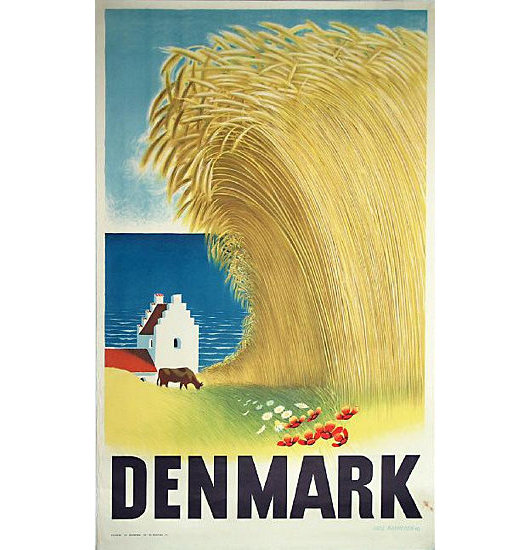
Having previously explored the world of Finnish travel posters, I happened to come across various posters advertising the happy kingdom of Denmark, whose current monarch is a Cambridge-trained classical archeologist, vestment designer, and published Tolkein illustrator. Click the little numbers to view the posters.
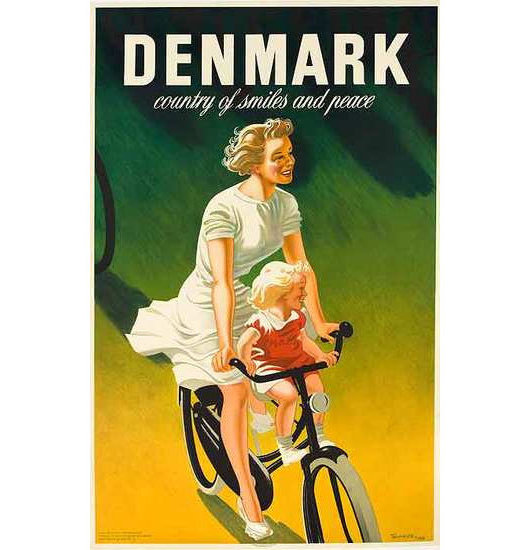
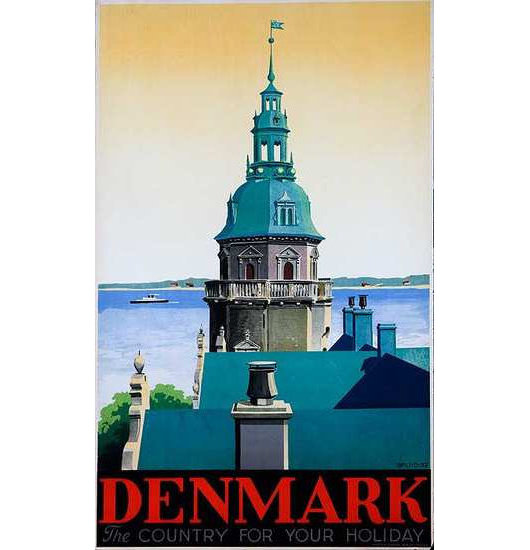
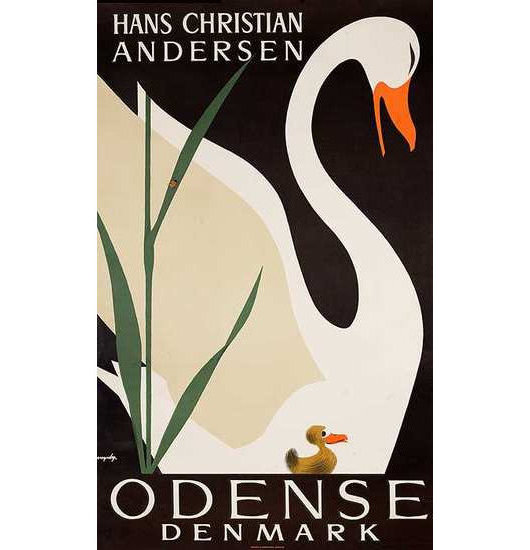
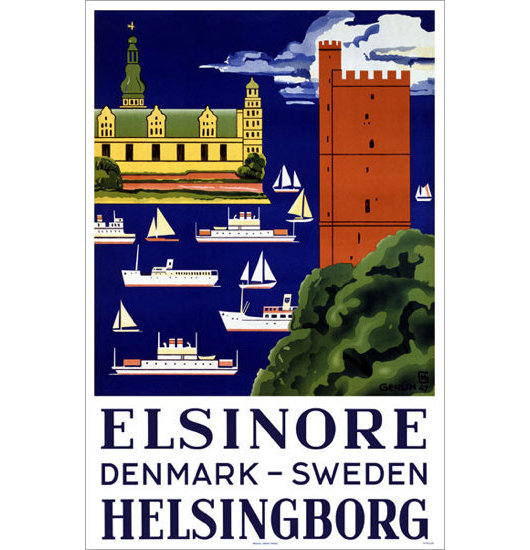
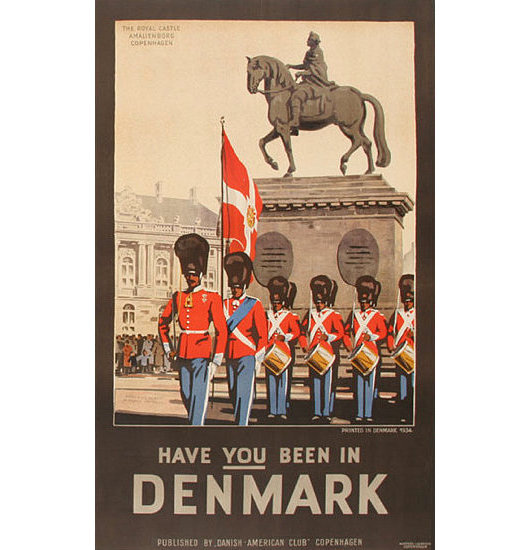
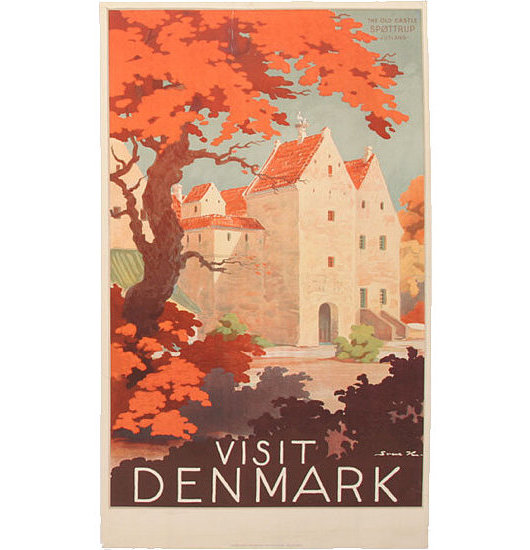
Previously: Come to Finland
Gregor von Rezzori
THE BOOKS OF Gregor von Rezzori, according to the introduction to this interview (found via Three Percent), depict “a world now almost wholly disappeared—Central Europe in the years between the two world wars—through the memories, ruminations, and loves of their narrators, men who have survived into the postwar new Europe but who can never fully detach themselves from that lost world. It is Gregor von Rezzori’s world, too. An Austro-Italian nobleman born in the Bukovina region of Rumania in 1914, von Rezzori was raised there and in Vienna. He lived in Germany during and immediately after the Second World War, and he currently divides his time between Tuscany and New York.”
Bruce Wolmer I’m tempted to begin by asking the question interviewers on French TV like to pose: “Gregor von Rezzori, qui êtes-vous?”—Who are you? Which is immediately funny considering that the enigmas and paradoxes—and humor—of identity is a central concern of your work. But one wouldn’t know that reading the reviews, where you’re almost inevitably conflated with the first-person narrator.
Gregor von Rezzori Absolutely. This is such an old discussion: To what extent are books autobiographic? It’s ridiculous. As Flaubert famously said, Mme. Bovary c’est moi. You can’t eliminate yourself totally unless you’re Shakespeare.
BW That goes against the grain of much contemporary opinion and practice, which claims to be getting down to the truth of the author rather than the truth of the fiction.
GvR The Death of My Brother Abel is narrated by a writer. The narrator, the “I”—and funnily enough he is less my own person than any other first person in any of my other books—the narrator in The Death of My Brother Abel is a totally fictitious character. But, of course, nowadays people have little curiosity about examining such complexities. There is this desire of authenticity and transparency which connects with the curious contemporary belief that everybody is, or should be, an artist.
I must tell you that when I was young I never had the faintest idea that I should ever become a writer. I studied mining engineering, of all things. I came to writing by accident at a rather ripe age. I never thought of really having the urge to express myself, but obviously I had it in some way or other. But without ever having heard the phrase, I had to find my identity. That’s one of those dreadful verbal expressions. A phrase like that becomes fashionable and then becomes a slogan and becomes really a program for people’s lives. Every young man or girl nowadays ponders about his or her identity without even realizing what it is. My identity is “I”. It takes a long time to learn that that much celebrated “I” is never lost, but never really found either.
Anyway, in my case I was having a period in my life in which I didn’t have anything else to do—this was before the war—so one day I sat down and wrote a story. Somebody got hold of it and sent it to a publisher. They instantly wanted me to write another one, which I did. Because I thought, my God, this is a very agreeable way of earning money. How wrong I was I found out later. But by then it was too late.
BW A disagreeable way of not earning much money.
GvR Yes, yes. Somebody with a little bit more intelligence doing the same amount of work, you’ll become an Onassis. Well, who needs that? But it’s in real disproportion. Then when I realized what crap I had been writing, you see, I sat down, and just then the war came. I was fortunate—I didn’t actually have to be a soldier exactly. I was born in Bukovina, Rumania. Before Rumania went into the war it was given to the Russians so I was already more or less a Russian although I still had a Rumanian passport and was living in Vienna at that time. When Bohemia was taken by the Russians I went to our ambassador in Berlin, who was a friend of the family, and I said, “What shall I do, what am I supposed to do?” He said, “Well, you are supposed to go home and find a new identity because you don’t exist. And then you’ll die from Mr. Hitler because within a short time you shall have to join in those struggles. I can’t prolong your passport. How long is it still valid?” I said. “For a year.” He said, “Keep quiet.” Which I did. It lasted for three more years during the war. I had my share of bombing and all that, but in the meantime I had the opportunity to really fill the unbelievable gaps in my knowledge by reading. I must tell you that I read very slowly and I need months to finish a real masterpiece, for example one of Broch’s novels.
BW I too read very slowly, and The Death of My Brother Abel took me a couple of months, which was fine, but it was interesting to see in the reviews how impatient everybody is: “Well, yes, there are wonderful bits here, but we shouldn’t be required to sit and…”
GvR Yes, the chutzpah to offer you 600 pages!
BW If one were to race through it, though, to read for information, one would lose a sense of the sheer intensity of the language. There are sentences in The Death of My Brother Abel so beautiful that they quite literally stopped me for five or ten minutes.
GvR What makes for the beauty of Proust, say, is that each page is a picture in itself. But it seems that to get people to read a thick book you need to offer them a juicy subject. Look at Tom Wolfe’s The Bonfire of the Vanities. People are buying it, people are reading it like mad. For the so-called information, I suppose. A dreadful book.
BW When did you begin to think of yourself seriously as a writer?
GvR In Germany, right after the war, something absolutely absurd happened. You see, I sat down and for the first time I really wrote aggressively and got rid of all my hatred against a particular kind of German. I wrote a book—it wasn’t published until 1954—which the publisher rather ludicrously decided to call Oedipus siegt bei Stalingrad —”Oedipus Triumphs at Stalingrad.” But while I was writing that I was also working for the British-controlled radio in Berlin. One day there was a gap in the program and they said, “You are always telling us your silly stories, Jewish jokes, and God knows what all, now go and tell them on the microphone.” Well, there’s nothing more unbearable than somebody who tells one joke after the other. So I combined them into an invented country, which I called Maghrebinia. To make a long story short, the broadcast became a roaring success and the stories from Maghrebinia came out before the novel. With the consequence that, you know how Germans are, from that moment on I was The Maghrebinian. Tell any cafè waiter in Berlin or Frankfurt that you are a friend of mine and you will be superbly served.
BW Tales from Maghrebinia were lighthearted, popular stories?
GvR Of course. It was a success mainly because it was the first book after the war that you could laugh at. And it was hilarious and rude and whatnot, sort of Rabelaisian. It was also the first book after the war in which, with all the collective guilt then being felt in Germany, you could read a Jewish joke. As I say, it became a great success. I never got rid of that, whatever I wrote afterwards. It was read in the wrong key, so to say; people were always expecting me to be satirical and to make jokes.
BW Why wasn’t Oedipus siegt bei Stalingrad ever translated into English?
GvR It can’t really be translated, because it’s written in sort of German slang as if Ernst Junger were a drunken Prussian officer telling a story in a bar. It’s about German snobbism, about somebody who comes to Berlin in ‘38 in order to conquer the world, a sort of Berlin Rastignac. It pokes fun in a most atrocious way. The next book I wrote after this was a long novel, which has been translated into English as The Hussar. And then came An Idiot’s Guide Through German Society, which also began as a series on the radio. This offended many people because I had my finger in a burning wound. I claimed that in spite of everything that had happened since 1918 in Germany, the social structure had not altered, you still had an aristocracy with enormous prestige and wealth. And I poked fun at all that. But I’m not at all interested in what happens in Germany any longer. My books don’t sell there and my work is not taken seriously.
BW Abel took a very long time to write, yes?
GvR Indeed. More than 15 years. I disappeared for a while, so to say.
BW During that 15 year period while you were working on Abel you went to Italy?
GvR Yes, I was already in Italy. I am in Italy 35 years now.
BW The Death of My Brother Abel is an extremely ambitious book. There are very few contemporary books that have such a level of ambition—in literary terms, intellectually, historically, and even spiritually.
GvR Lady Annan called her piece about it in The New York Review of Books, “Transcendental Chutzpah.” Well I mean, see, it’s a book for writers. It’s not a book for readers. I like to joke that it should be read in creative writing classes. It is not for the normal reader. It took me 15 years to do and was my own attempt to understand what I was doing as a writer.
BW One of the issues explored in The Death of My Brother Abel is the death of Europe. Europe as a culture, as a way of life. That death has been, at least partially, to the benefit of America. You have that extraordinary, almost hallucinatory, passage in which your character Jacob G. Brodny, born in Central Europe but now a fabulously successful American literary agent and wheeler-dealer, is seen to wolf down the masterworks of European culture as if they were patè.
GvR My aggressiveness is not directed against America and Americans, it’s against Americanism, which is mainly a European phenomenon. Brodny is not genuinely an American. He’s an immigrant who came over here. He behaves more American than any other American, which you can see. And personally, if you ask me, I love and admire America. European culture has not been killed by America. It perhaps committed suicide during the First World War. And this is a thing which I also want very much to emphasize in the next volume of mine, which will be called Cain.
BW The idea of a culture committing suicide is right beneath the surface of Memoirs of an Anti-Semite, as well. Reading it, one becomes aware that the killing of the Jews in Europe, the Holocaust, was not only murder, but the suicide of a world, because for all the antagonism and dislike between the aristocratic and the Jewish characters, they existed in some necessary relationship, some vexed sympathy. They both shared a world that has now vanished. Perhaps it was just that that world vanished, but Jews lost something rich and irreplaceable as well. The moral difference being, of course, that nobody gave the Jews a choice in the matter.
GvR You see, first of all, I do believe that the aristocracy as a class never hated the Jews. On the contrary, the Jews were an object of jokes or disdain, in fact, but many other groups were much more so. As for the peasants and the Jews, it’s a somewhat different story. Whatever a peasant produces is by his hands and due to rot away. He slaughters the pig, but he can’t keep it for any more than a week or so. The Jews, on the contrary, had something that increased its value with time: money. That’s why it was easy for the peasants to believe that the Jews were the evil, exploiting ones.
BW Elie Wiesel has described Abel as an elegy, “the story of Europe seen through the eyes of despair.” How would you describe what has been lost from that world?
GvR Ah ha! Let me answer this exactly. What’s been lost is a particular light, a particular quality of air. And pity—the loss of pity is perhaps our greatest loss.
Now we have a completely different feeling for time, for instance. Time itself has changed. This is due to a blind belief in science. The simple fact is that European life nowadays, just like American life, is determined by money, led by money, as let us say a European would have been led by religion in the 14th century. In every aspect of life, money shows the way. It’s not that this loss happened from one day to the next; as a matter of fact, it’s a loss that started with the French Revolution, at least. Well, all this is rather vague. I shall have to find more metaphors for it.
BW Saying this flies right in the face of the optimistic consensus pervading modernity, the belief that most historical change, most technical and social innovations have been, on balance, for the better. You, or at least the narrators of your books, seem on the contrary to regret them.
GvR You see, I’m profoundly distressed, call it skeptical, and I don’t think I’m alone in becoming aware that we’re in a rotten place. We’re a rotten people; our culture is rotten. Deeply rotten. And to me the proof is that whenever we come in contact with another people, they are destroyed. A friend of mine who’s really one of the last really honest dealers in African art told me that he came to tribes which had never before seen a white man. The simple fact is that they look at him, and that he has a knife or lighter or something—it’s already a deadly encounter. You see, it’s lethal for them already. Similarly, I recently came back from China. The Chinese of my time were pig-tailed and Chinese, but nowadays they are exactly like myself, just a little bit more ethnic. It’s not really to their best interest. What I felt there now was that they have gotten rid of political fantasies and are fortunate enough to have had a religion, an early religion, sort of a black beaten-down art, so they can cope with such a loss in a rational way.
BW In your books there are passing references to the futility of revolution and of politics more generally. Were you affected, as were so many of your generation in Europe, by utopian hopes?
GvR Yes, of course, as a young man. Of course. I couldn’t very well escape from this. In the atmosphere of the ‘30s we all believed, even without an articulate ideology. We all believed in a new world that was about to come. The promised technology. Utopia. Look at the paintings of Kupka at that time. You saw Metropolis everywhere. And Metropolis is not thinkable unless a new man and a new woman are created, a new mankind. In the ‘20s and ‘30s we were unbelievable optimists, you see, who were then bitterly disappointed. But my skepticism, my pessimism, is not just the result of political failure. It goes much deeper. Much deeper. And I haven’t found an answer. I mean whenever I think of it, of what’s been lost, it certainly hasn’t been lost by the Americanization of Europe. What I call Americanization would have happened even without America. The greed for money, the power of technocracy and misunderstood science and so on, all that would have happened even without the example of America. What has been lost is pity and the capacity to dream. You Americans still have the capacity to dream even if you are also sleepwalking in a merry way. But we can’t any longer. We’re awake. Too much awake. Europe is silent and exists now in an abstract way, totally according to abstract rules. For instance, when I say we’ve lost pity, you can see just one small example of it in, say, the demonstrations for the victims of Mr. Pinochet or whoever. But you wouldn’t find those vociferous protesters caring about the beggar on the street. That direct relationship between human beings is getting lost due to abstract ideas about humanity.
BW Ideology.
GvR Yes. Ideology. Political ideology.
BW Which, of course, is a major theme of The Death of My Brother Abel: the increasing abstraction of life, the emptying out of experience.
GvR Exactly.
BW Which leads to the question, Pilate’s question, your books pose so often: What is truth?
GvR What is reality?
BW What is reality and what is fiction and what are the transformations and negotiations between them? You plainly dislike the society of information, the society of media, where people think they’re getting reality from newspapers, television, and magazines. Instead, you’ve said that Anna Karenina — now there’s reality!
GvR Do you remember in Abel there is a long, long, perhaps much too long passage on the narrator’s having an affair with a girl who lives in one of those postwar high-rises. He visits her and thinks about the fictitious reality forced on us by the media and how you lose your identity because you don’t know who you are to cope with all these things which are much beyond your reach, beyond your personal sphere. I mean everything in our time is done, is given, to lose your identity. Then, of course, you have to go look for it, to put it primitively.
BW In terms of your own writing, how does that govern your aesthetic? Not to put too fine a point on it: Why do you write?
GvR Yes, yes, yes. Why do I write? “What sin to me unknown/Dipped in ink, my parents or my own?” Listen, I suppose that in fact writing, whether you know it or not, is the attempt to find an identity. Knowing the secret of the “I” that never can be lost in spite of all the changes it undergoes throughout a lifetime, there you have already the secret theme of every fiction writer, don’t you think so?
BW The search for the voice?
GvR The search for the voice. Also the search for the secret of transformation, of living many lives in one life. The possibility of what I do, of writing hypothetical autobiographies endlessly. And, I mean, Anna Karenina is a reality in so far as it is the most dense invention of fiction, the most concrete.
BW You frequently allude to Nabokov’s saying that when we speak of reality we must put it in question marks.
GvR In quotation marks. Which, of course, are also question marks here.
BW What has been Nabokov’s influence on you?
GvR Well, there were many other influences first. I didn’t read Nabokov until late. But when I had started to write Abel in its first version, I got Nabokov’s Pale Fire in my hand and instantly put my pen down because I found that there was the book I wanted to write already in the best possible form. Then I collaborated on the translation of Lolita into German, and I became aware that I shall never achieve the almost medieval craft of Nabokov’s to link fiction with literary allusion and write a book on many layers—of which one is a direct and fictitiously concrete reality, and behind there is the other reality, the literary reality of all the allusions, all the relations of literature with other literature. At the same time that it’s discouraging, it’s very challenging.
BW Other influences?
GvR Everything influences you as a writer, whatever you read. I believe there isn’t any such thing as a bad book, because you take out of any book something by which you learn, even if you throw it away. Then there are writers who encourage me immensely and writers whom I admire so much that I put down my pen and say, “I can’t write.” For instance, I can’t read ten lines of Robert Musil and keep on writing, I stop for a week at least. Even Joyce. He discourages me totally. But then there are others who encourage me. Thomas Mann with his sort of schoolboyish sense of humor challenges me to get a little subtler. Ironic. And so on.
BW Cèline?
GvR Well, yes. Not consciously, but the violence. In literature, particularly at that period, a certain barbarism is necessary. Also for the sake of honesty. You can’t be suave and God knows what in a time like ours. Also there is in him an urge for iconoclastic action which was also very much an aspect of German Expressionism after the First World War.
BW Your narrator says he seeks to write in “a style of barbaric haul gout.” There is anger and disgust beneath the suavity and jaunty, nonchalant elegance of your prose.
GvR I’ve become aware that I can only write well out of either love or hatred. Direct feeling. I need that. When I love it becomes, because I am sentimental to the core, it becomes too sweetish. It’s like playing on the cello. The best things are wrought in hatred. The more the world around myself gets nostalgic, the more furious I become with nostalgic feelings. I know there’s something I deeply mistrust in that. In fashion, in modes of living, people are trying to revive bits of history, the ‘20s and ‘30s particularly, that they don’t understand. Take the German painter Anselm Kiefer, who’s accused by some Germans of being nostalgic for Nazi times, which is absurd. But if he is, he’s doing the same thing as everybody else does. Without realizing that they are nostalgic for the ‘20s and ‘30s they are nostalgic for what formed fascism.
BW Kiefer’s watercolor Winter Landscape was used for the book jacket of The Death of My Brother Abel.
GvR Yes. Kiefer also denounces in sorrow and in anger. I like him very much.
BW In Abel, you talk about the relation between individual literary style and the zeitgeist, that it is not we who write, but the times which write us, so to speak, which demand a style of us.
GvR Whatever we do is not only led by our individual fullness but by trends in the zeitgeist, by things that are far out of the reach of our control. We don’t know what happens to us. I mean the simple proof is that if you take a German newspaper of, say, 1934 and read an article written by Dr. Goebbels, you wouldn’t believe your eyes. The crap he has said. And—I know, I lived through it—people read it as if it were the Bible. Intelligent people, but totally blinded at the time. Or, another example I use, people from a particular epoch all have a more or less similar handwriting. You can recognize it as 18th century, or whatever, at first sight. It means that something happens to us which we don’t even realize, in ideas as well as in our way of perceiving the world. For example, the break between Romanesque and Gothic art or, in our own time, the sudden break into abstract art, you can’t tell me that it’s a logical evolution. That is rationalizing it as historians always do—backwards.
BW You’re not saying, however, that individual style doesn’t exist?
GvR It certainly exists. There are artists who are not great in the sense of a new creation but just because they represent in the utmost possible form the style of their period. Somebody like Seurat, for instance, is not a great genius in painting, but still such artists represent their period and the spirit of their period in the purest form. But nothing more, nothing personal.
BW Which would make them inferior to an artist who’s able to…
GvR Picasso certainly is not in that line. He’s overwhelmingly personal and individual. Those others aren’t.
BW And in terms of your own work, you would aspire to…
GvR Oh my God! It sounds silly, but I am so astonished that I can write a phrase at all that I wouldn’t know, I don’t reflect that much. I don’t put myself in any rank or school or anything of that kind. I believe that I’m rather personal, but as for representing a particular zeitgeist…I may. I’d be very proud if I did. On the other hand, I have written in Abel many times that the tremendous fear of any writer or artist who believes that he has some idea, something to say, is that they know perfectly well that at the same time, the very same time, hundreds of others have already either said it or are about to say it or there’s another chap who says it much better and liquidates you totally.
BW You have been widely criticized for having your narrator in Abel say that the postwar Nuremberg trials were a sham. As you yourself covered the trials for the Hamburg radio, I assume that you feel similarly.
GvR Let us put that straight. First of all. I do not believe that the Nuremberg trials were a complete sham. They were a failure and therefore a great delusion. This was not due to, say, moral failing or any manipulations behind the scenes, it was due to my great enemy, stupidity, overwhelming collective stupidity. Or the impossibility, even on the part of intelligent people, to cope with things established by stupidity. For instance, you know there has been endless discussion about the legal basis of the trials. And I hope that I have the opportunity to expand this a little bit more explicitly in Cain, the book I’m planning to follow Abel. This has something to do with zeitgeist, if you want to put it that way. I think that all the great moral energy which was necessary to fight the Nazis—when finally victory was achieved there was a moment of total exhaustion. And nobody any longer seriously believed in what had encouraged millions to fight the Nazis and even to die. I mean many wars have been undertaken for a certain or just cause but never more so than in the struggle against fascism and Hitler. The trouble was that also you became aware that it wasn’t stamped out, just pulverized. My feeling is that instead of having one wicked Satanic dictator or a group of wicked people—the Nuremberg defendants, many of them—who demoralized a whole nation, nowadays it’s pulverized and each of us carries within himself a little bit of that venom, instead of 18 millions Nazis, nowadays there are in this world 500 million Nazis, if not more.
BW The trials, then, were false because they suggested that evil could be juridically exorcised and the world put right again?
GvR It’s like that famous statue of the chaps planting the American flag after the Battle of Iwo Jima. The good cause was fought for and won, and now we’re going to make a law that will eliminate the possibility of having the horrors repeated forever. That was too much. Too high.
BW You say that your greatest enemy is stupidity?
GvR Not mine only. You can claim that a man is born good and not wicked, but certainly not that all men are born intelligent. There’s a question also of quantity. Put ten people together and the quota of intelligence is brought down to almost zero. And if you put one hundred thousand together, well, it’s all over then. Plant a great idea, a magnificent invention, or a great example into the mass of mankind and it becomes what Jesus Christ became—the Catholic Church. Endless chains of misinterpretations and misunderstandings—that’s what I call stupidity. A really stupid and dull person can be as amiable as anybody else—charming, but not intelligent. The accumulating and progressive stupidity of mankind is something I fear. And it can’t be fought.
BW And it’s much more pronounced in mass societies.
GvR Of course. The very moment you form a mass out of a certain number of people, it necessarily becomes a body of stupidity.
BW What values enable you to keep on, to continue writing and living with evident grace and vivacity of spirit, in spite of such profound pessimism.
GvR You see it’s the secret of the “I”. In spite of all the strange morphologies and transformations of myself during my lifetime, the “I” is something unchanged, something I can’t explain, not even to myself, and it has its destiny. I believe in that. I may be very capable of suicide, certainly, but I believe that the hour has to come for it. The hour has to come for my dying, anyway. As long as there is life, I shall try to cope with the outer world.
BW And other people?
GvR Certainly. The strange thing is that I despise the mass but I love other people. It’s paradoxical, but I really do. I feel friendly towards everybody I meet. Basically. But in the whole I despise them.
BW One last question. You’ve said, “I’m an aesthetic absolutist and an ethical nihilist.” Can you elaborate?
GvR (laughter) Ah, but what is there to add to that?
New Cathedral in Russia
Holy Trinity Cathedral, Magadan, Siberia
In Russia, they build churches that look like churches. (As can be seen from the above video showing the consecration of the new cathedral). Meanwhile, in Los Angeles…
A Rioplatense Kingdom?
New book explores the monarchic projects of the River Plate, 1808–1825
A book recently published in Buenos Aires sheds new light on the difficult transition period between the Spanish Empire on the River Plate and the foundation of the Argentine Republic. The launch party for Bernado Lozier Almazán’s Proyectos monárquicos en el Río de la Plata 1808-1825. Los reyes que no fueron (“Monarchic projects in the River Plate 1808–1825: The kings who weren’t”) was held recently in the Quinta ‘Los Ombúes’, home of the municipal library, museum, and archives of San Isidro, the city in the Provincia de Buenos Aires known as Argentina’s ‘Rugby Capital’.
Proyectos monárquicos highlights the forgotten truth that most of the Argentine ‘patriots’ — San Martín, Belgrano, and Alvear among them — were monarchist, not republican. Proposals involving the courts of Spain, Portugal, France, and even England were proffered, and there was even an interesting proposal to marry a European prince to an Incan princess and offer him the throne of the Río de la Plata. (more…)
Canada’s Royal Standards
In anticipation of the recent visit of the Duke and Duchess of Cambridge to Canada, the government of that dominion unveiled new Canadian personal flags for the Prince of Wales and the Duke of Cambridge. The British Empire started out as a group of states and colonies united in the British crown, but as the Empire evolved into the Commonwealth, dominions were gradually recognised as sovereign entities of their own. Thus when, for example, Elizabeth II visits, say, Vancouver, it is not the ‘Queen of England’ who is visiting but the Queen of Canada exercising her functions in her own country. (This is a point frequently lost upon ideological republicans). Even when Elizabeth remains in London she puts on different ‘hats’ for different occasions. The only time I ever saw the Queen was at a Service for Australia at Westminster Abbey, thus it was the Queen’s Personal Flag for Australia which flew from the tower of the Abbey, not the British Royal Standard.
The Queen’s Personal Flag for Canada (above, top), often informally known as the Canadian Royal Standard, was devised in 1962 (the same year similar banners were created for Australia and New Zealand). Until 2011, the Queen was the only member of the Canadian Royal Family to have a personal flag for Canada, but now she is joined by her son and grandson, the Prince of Wales and the Duke of Cambridge respectively.

Reviving Manhattan’s Parisian Splendour
The new Ralph Lauren building at Madison & 72nd
“PRACTICALLY PERFECT in every way” was how the nanny Mary Poppins described herself in the Disney film, but fashion designer Ralph Lauren has given birth to an architectural grande dame on the Upper East Side that might justifiably make a similar claim. In this age of fashionable-today-dated-tomorrow starchitecture, the Bronx native has swum against the current and delivered for the people of New York a most welcome piece of architecture with his new store on the corner of Madison Avenue and 72nd Street.
Those familiar with the neighbourhood might be a bit confused: doesn’t Ralph Lauren already have a beautiful French chateau on that street corner? Worry not, the old Rhinelander mansion has not been demolished. Rather, its interior was recently given a ‘masculine makeover’ so shoppers can peruse and purchase any of Ralph Lauren’s men’s lines there.
Across the street, meanwhile, with his new women’s store, Ralph Lauren has reinvigorated Manhattan’s faded glory with a new injection of Parisian splendour. The unremarkable “taxpayer” two-storey on the site was razed and a completely new four-storey structure has risen in its place. Two smaller wings flank the middle, which is recessed above the ground floor’s triumvirate of skilfully curved arches. The two central storeys above are topped by a more reserved attic, with the facade clad in American-sourced limestone throughout. (more…)
Winchester Mansions
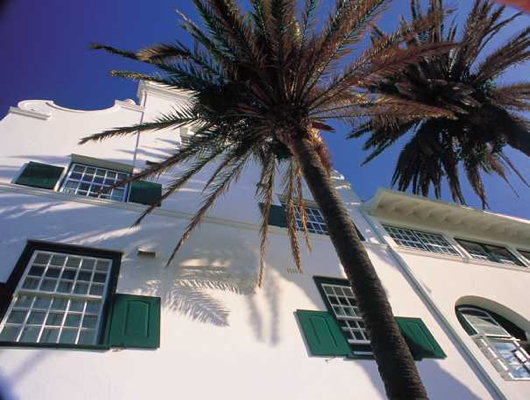
STARING ACROSS Sea Point Promenade towards the waters of the Atlantic in Cape Town, there sits Winchester Mansions. The hotel was built in 1922 in a style emblematic of the period’s revival of interest in the Dutch colonial age at the Cape. People often associate the 1920s with Art Deco, but the style was only just emerging in Paris at the time, and wasn’t even called ‘Art Deco’ until the 1960s. The ‘mother city’ has its fair share of Art-Deco and Moderne buildings, but architectural trends took a while to arrive in South Africa — though they tended to last longer then elsewhere. The Cape Dutch Revival emerged in the 1890s and perhaps reached its high-water mark in the 1900s and 1910s. Curiously, it is not associated with the simultaneous emergence of Afrikaans as a language and the rising consciousness of Afrikaner identity, but rather with a very Anglo and colonialist mindset. It was Dorothea Fairbridge and Milner’s ‘Kindergarten’ — respectively the social and political forces seeking to unite all of South Africa under the British crown — that promoted the adoption of the Cape Dutch as a national style. Thus the years leading up to Union in 1910 and its initial decade or two were the heyday of the Cape Dutch Revival as it was the favoured boustyl for the respectable Cape- and Rand-based imperialists.
The Architecture of Immaturity
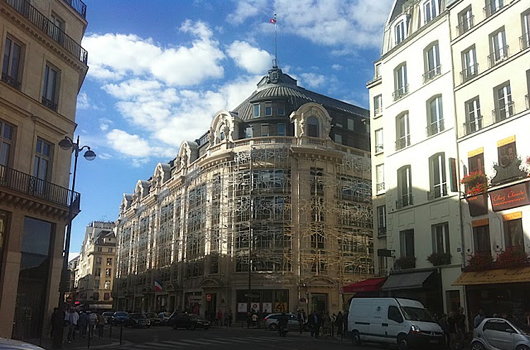
Have you ever come across the French Ministry of Culture on the Rue Saint-Honoré? It’s a perfect example of the architecture of immaturity. The government ministry was formerly strewn across nineteen different sites throughout Paris. The decision was made to consolidate their offices in one place, and the suitably central location near the Palais Royal was chosen.
The main building on the site is a handsome building from the late nineteenth-century or at the latest 1900s, with a modern 1960s office building stuck behind it. The Ministère chose architect Francis Soler to “unify” the buildings into one. At first, this was meant to be done solely through an interior reorganisation, but Soler decided to add a strange grille to the façade. (more…)
Decline of the Herr Professor
The Herr professor has been caught up in a whirlwind of protest, eventually to emerge as a humble guest on a television talk show.
No Nobel prize compensates for this loss of prestige at the apex of a crumbling pyramid.
His desperate references to the false problem of “academic freedom” sound not only hollow, but like the exchanges between pagan Roman priests at magical ceremonies in whose effectiveness they no longer believed.
Modern Age, Spring 1999
The Advent of Virgin Australia
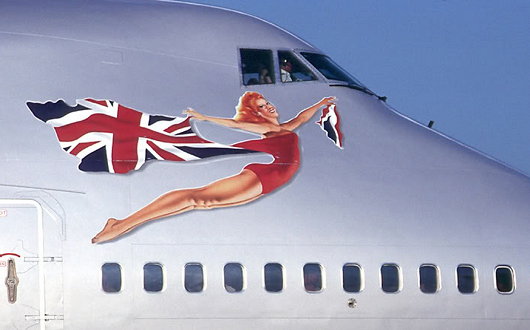
Virgin Atlantic Airways has always inexplicably attempted a fine balance between the crisply modern and the vaguely old-school. It is also unashamedly British. When the lumbering giants at British Airways were busy banishing the Union Jack from their aircraft livery — prompting Baroness Thatcher to cover the model of a BA 747 with a handkerchief — Sir Richard Branson said “We’re British: why don’t we fly the flag?” The Union Jack was added to every Virgin Atlantic plane and a flag design was later added to the wingtips. Virgin Atlantic now has a patriotic red-head (above) bedecked in the Union flag on the nose of each of its aircraft glamourously advertising their national origins in this hyperglobalist age.
Virgin Group has not restrained itself from expanding beyond the trans-Atlantic flightpath. In 2000, they established Virgin Blue in Australia, originally flying only between Brisbane and Sydney, but gradually expanding within the country, especially after the 2001 collapse of the major domestic carrier Ansett Australia. In 2003, Virgin started Pacific Blue Airways out of New Zealand, operating trans-Tasman routes, followed by the founding of Polynesian Blue in 2005 running flights between New Zealand, Australia, and Samoa. Finally, V Australia was started operations in 2009 running long-haul flights out of Australia. (more…)
Dino Takes on Nic & Rem
Dino Marcantonio is on his usual top form when responding to an interview with the “Dutch architect and uber-gobbledegook-meister” Rem Koolhas by Nicolai Ouroussoff, the architecture praiser for the New York Times. Many modernists now find themselves in the role of perverse preservationists, trying to save ugly modernist buildings that are already falling apart because of their inherent conceptual flaws and rejection of inherited architectural wisdom. But while the Mods want to save the crumbling monstrosities, they attack the natural human instinct to preserve what is beautiful (i.e. traditional and vernacular architecture) and to destroy or get rid of what is ugly (their own work, the “ambitious” carbuncles of the past century).
Koolhaas and Ouroussoff pretend to confuse the true spirit of preservation with hoarding. A hoarder makes no value judgments about what should be kept. It all stays, and the result is his home is a dump. If we keep everything, we wind up preserving nothing–and that, my friends, is what Koolhaas is really all about. His endgame is the embalming of our architectural identity. He is suffering from an acute case of cronophobia, the irrational fear that old things might still be alive to us today.
Dino, however, is not having it:
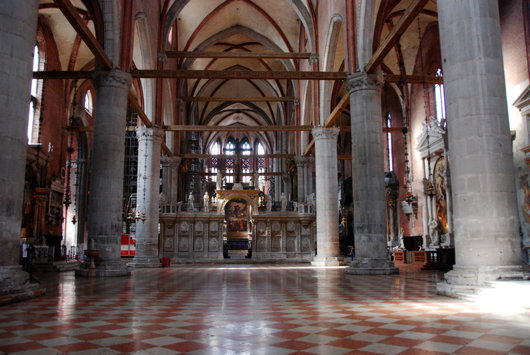
Consider another approach taken by the Venetians toward the beautiful church Santa Maria Gloriosa dei Frari. Completed in the early 14th century, it has been lovingly embellished by generations and generations, all meaningfully, and without any angst about what is authentic and what is not. It has also suffered through suppression, looting, and radical restoration. I Frari has been through it all. It is almost 700 years old, yet because it has been properly cared for, it still looks fresh as a garden daisy. And it is mobbed by visitors year-round who yearn to follow its example, not only in the preservation and handing down of churches, but also our cities, our homes, our culture.
Turning the Book on its side
Books are a central obsession of mine. I’ve a reasonably large and ever-increasing library of my own and wherever I’ve called home there have been larger collections available to tap into: the Society Library in Manhattan, the Gericke-biblioteek in Stellenbosch, and the mostly excellent public libraries dotted around lower Westchester. When you see the wide range and styles of the book — it’s size, proportion, paper, appearance — it’s depressing to see how monotonous contemporary book publishing is today. I have a thousand different ideas on book publishing and the wide gaps in the market that are completely ignored today, but here’s one inventive idea I didn’t have.
According to Le Figaro, Editions Point Deux (a subsidiary of the La Martinière group, the third-largest publishers in France) has begun offering what it calls « le plus portables des livres » . These little books are printed on their side to be read like a flipbook rather than in the more conventional format. The idea, apparently, comes out of Holland and has proved successful in Spain, but I haven’t come across it at all in the English-speaking world.
The first question is: what’s the point? At 4.75 in. x 3.15 in., they’re a handy size, but is anything actually gained by turning the text on its side? I imagine it’d be helpful for commuters, but I think it’d be difficult to judge the concept without actually having one in hand and using it, so I think I’ll refrain from handing down a verdict just yet. Very boring of me, I know, but I’ll admit I’m intrigued by the idea.
Civilised Barbarism, Barbaric Civilisation
“Despite my inclinations to the contrary, I have racial sensitivities. I am Latin. I regard the civilised barbarian in the North with an inherited sense of mistrust. Today [the United States] has become a colossal society, and has adopted the goal of imposing its industry, its commerce, and its imperialism. Each citizen of the Union is a kind of stockholder… [upholding] an ideal of material perfection above moral perfection, and equating civilisation with the triumph of industry and commerce. We, by contrast, descendants of the Latins and educated by the Greeks, regard that person as most civilised who is most morally perfect. … I am proud to say I am bored with railroads and factory chimneys.” – Belisario Montero
ONE OF THE best aspects of Catholicism is the affirmation (for lack of a better word) of absolutely everything that is good throughout the world. All the peoples of the earth, each with their particular genius, eventually descend from the same parents. This gives one, I hope, a certain sympathy towards every nation and every people, and an anticipation that each one will eventually grow into the full flower of a Christian order appropriate to their particular characteristics and personality. Christianity is not oppressive and conformist in its universalism but instead all-embracing.
There is much to be admired in the sentiments expressed by Belisario Montero, an Argentine diplomat, in the comments cited above. To put them in context, they were made after the final collapse of the Spanish Empire following the Spanish-American War of 1898. Argentina, as you already know, is a place that excites me. In her is found so much of the idea of Europe, varyingly perfected and perverted, accidentally demolished in an attempt to save it and then put back together again not precisely as it was before. Marx “travelled” to Buenos Aires, but so did Maurras (and perhaps the Frenchman was more influential). For a time, photographs of Mussolini cut from the illustrated magazines were plastered onto the walls of aspirational working-class porteños trying to keep up with the latest European fad, and the military elite and social aristocracy combined to oppose the vulgar and destructive forces of liberal democracy and unbridled capitalism. Almost every coup in the nation’s history was received with a sigh of relief, especially (and ironically) the coups getting rid of whomever the previous welcome coup put in charge. Argentina has a long history of terrible success and beautiful failure. Perón himself is the very embodiment of this.
Of course, unlike Don Belisario, I am not a Latin. (more…)
Bo Bartlett
THERE IS SOMETHING vigorously American about the art of Bo Bartlett. The modern realist was born in Columbus, Georgia, and studied in Italy under the Arthur Ross Award laureate Ben Long (one of the “greatest draughtsman of the twentieth century” according to Philippe de Montebello) before moving on to the Pennsylvania Academy of Fine Arts. After completing a filmmaking degree at New York University, Bartlett embarked upon a five-year process creating a film covering the life and works of Andrew Wyeth, in collaboration with the artist’s wife Betsy. The artist’s work certainly shows the influence of Wyeth, as well as other American artists like Thomas Eakins, Edward Hopper, and Winslow Homer.
Hopper’s works, I’ve always found, have a particular quality of still abandonment, as if the scenes he depicts are living but just abandoned five minutes ago. Bo Bartlett’s paintings have a similar feel: they often exude a slight air of uncertainty and disquiet. There’s the looming threat of anarchy in The End of the 20th Century, also insinuated in So Far, as well as the reversal of the grounded American flag implied in Cradle. Other paintings, like Calling and Deer are peans to the animal kingdom. Still more are disturbingly quiet odes to the American coast — Bartlett divides his time between Puget Sound on the Pacific and Maine on the Atlantic. Whether beautiful portents of doom or eery celebrations of American life, the viewer suspects that there are stories not being told, and that the artist’s paintings conceal as much as they reveal. (more…)
Branding the Rowing Nation
National Governing Bodies in Rowing and their Logos

THE OTHER DAY I was flipping through some publication and came across a photograph of two people standing in front of a boathouse. Emblazoned upon the building was the above logo, along with the words ‘British Rowing’. As a former member of SARA (the Scottish Amateur Rowing Association), I found this quite intriguing as I’d never heard of any such organisation.  Like many sports, rowing is organised on a country-wide level (i.e. England, Scotland, Wales), not on a union level (the United Kingdom). Ever wary of centralisation, I was relieved, albeit a bit confused, to discover that the group now branding itself as ‘British Rowing’ is actually the Amateur Rowing Association, the ruling body for the sport in England, not Britain. The ARA was founded in 1882, but lamentably decided to end its ban on non-amateurs in 1998. They kept the ARA name regardless until now. Having the word ‘Amateur’ in their name was obviously a bit inaccurate, but if accuracy was the aim, why have they decided to style themselves ‘British Rowing’ when they only speak for England? What’s wrong with ‘English Rowing’? Very odd, if you ask me. (more…)
A Little More Graaff-Reinet

Here’s just a handful more photos of Graaff-Reinet from the blog of Angelika Wohlrab, a South African tour guide, author, and photographer. Above is another Cape Dutch gem, the Urquhart House with its splendid plasterwork design in the gable. (more…)
Graaff-Reinet
The Gem of the Karoo
IF YOU HEAD OUT from Cape Town making for the Valley of Desolation, you take the main road to Johannesburg, breaking ranks at the town of Beaufort-West in the Great Karoo, where you head eastwards on the R61. That road eventually joins up with the N9 (famous for its “Uniondale Ghost”) and, before you reach the Valley, takes you to the pleasant little town of Graaff-Reinet. The town was founded in 1786, making it the fourth-oldest in South Africa, after Cape Town — the “mother city” — Stellenbosch, and Swellendam. Graaff-Reinet was named in deference to the Dutch governor of the day, Cornelis Jacob van de Graeff, and his wife whose maiden name was Reynet, but the burghers earned an early reputation for rebelliousness, proclaiming their own independent republic in 1795, with further uprisings in 1799 and 1801. While now situated in the Xhosa-dominated Eastern Cape, Graaff-Reinet is predominantly Afrikaans.
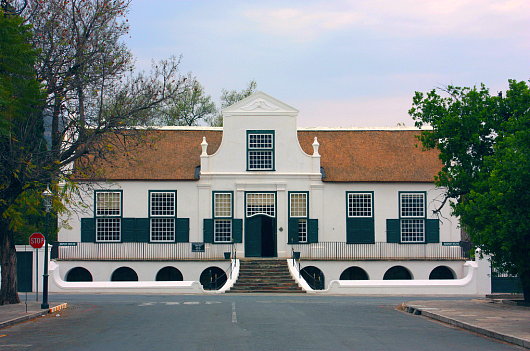
The town, which rests on a bend in the Sunday’s River, has a host of architectural delights, of which my favourite is the Reinet House (below). It was built in 1812 as a parsonage for the Dutch Reformed minister, and was later part of the teacher training college until it fell vacant and was restored as a museum after the Second World War, being opened in 1956 by the Rt. Hon. E.G. Jansen, the Governor-General of the day.

The Modern Baroque: Brasini in Parioli
The Church of the Immaculate Heart of Mary
GOOD ARCHITECTURE requires a combination of willpower, taste, and resources. This nexus used to occur quite often; instances from the Renaissance and the long nineteenth century come most easily to mind. A late twilight of this combination is found in the magnum opus of the Italian architect Armando Brasini: the Church of the Immaculate Heart of Mary in Rome’s swish Parioli neighbourhood.
The 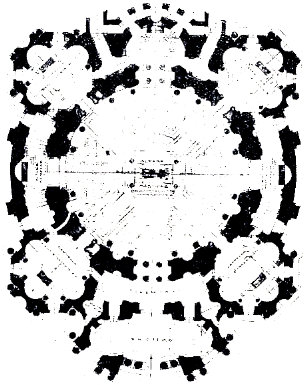 church, a modern expression of the Baroque, has somewhat curious and disjointed origins. Every age has left its imprint on Rome in one way or another: the Rome of the Republic, the Rome of the Empire, the Rome of the Popes, the Rome of the Liberals, the Rome of the Fascists, the Rome of the Italian Republic. In the 1900s, it was realised that the Church had not made a significant contribution to the great architecture of Rome for some time. Worse: the more significant structures of the past century were mostly built by the government of the Sardinian kingdom that conquered Rome and gave itself the fanciful, if geographically correct, name of ‘Italy’. A new church was needed, on a monumental scale, to be the age’s contribution to the great churches of Rome. Originally, the church was to be dedicated to St. James the Greater, but as preparations increased for the International Marian Year of 1924, it was decided the cult of the Immaculate Heart of Mary would take precedence instead. (more…)
Search
Instagram: @andcusack
Click here for my Instagram photos.Most Recent Posts
- Brunel’s Unbuilt Capitol February 3, 2026
- Cricket at Fordham January 27, 2026
- Palacio Barolo Revisted January 14, 2026
- Learning to Love Liguria January 14, 2026
- Crux Alba No. 2 January 13, 2026
Most Recent Comments
Book Wishlist
Monthly Archives
Categories