Arts & Culture
About Andrew Cusack
 Writer, web designer, etc.; born in New York; educated in Argentina, Scotland, and South Africa; now based in London.
 read more
News
Blogs
Reviews & Periodicals
Arts & Design
World
France
Mitteleuropa
Knickerbockers
Argentina
The Levant
Africa
Cape of Good Hope
Netherlands
Scandinavia
Québec
India
Muscovy
Germany
Academica
Football at S. Maria Maggiore
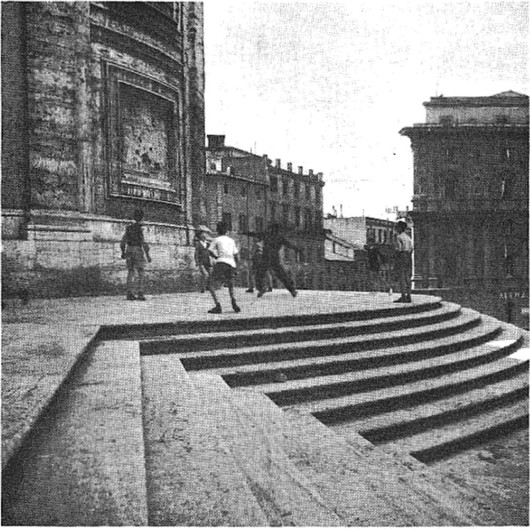
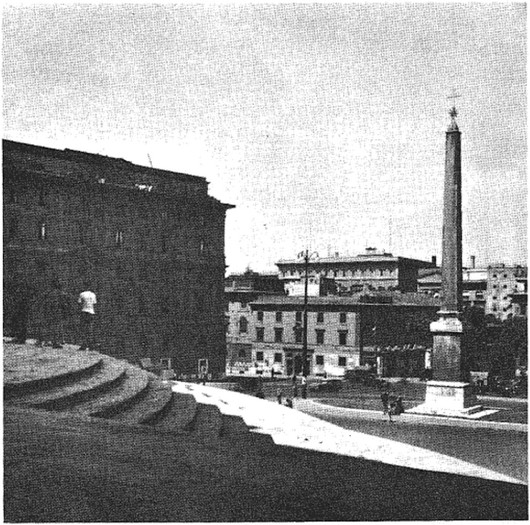
The enormous church of S. Maria Maggiore stands on one of Rome’s seven famous hills. Originally the site was very unkempt, as can be seen in an old fresco painting in the Vatican. Later, the slopes were smoothed and articulated with a flight of steps up to the apse of the basilica. The many tourists who are brought to the church on sight-seeing tours hardly notice the unique character of the surroundings. They simply check off one of the starred numbers in their guide-books and hasten on to the next one. But they do not experience the place in the way some boys I saw there a few years ago did. I imagine they were pupils from a nearby monastery school. They had a recess at eleven o’clock and employed the time playing a very special kind of ball game on the broad terrace at the top of the stairs. It was apparently a kind of football but they also utilised the wall in the game, as in squash — a curved wall, which they played against with great virtuousity. When the ball was out, it was most decidedly out, bouncing down all the steps and rolling several hundred feet further on with an eager boy rushing after it, in and out among motor cars and Vespas down near the great obelisk.
I do not claim that these Italian youngsters learned more about architecture than the tourists did. But quite unconsciously they experienced certain basic elements of architecture: the horizontal planes and the vertical walls above the slopes. And they learned to play on these elements. As I sat in the shade watching them, I sensed the whole three-dimensional composition as never before. At a quarter past eleven the boys dashed off, shouting and laughing. The great basilica stood once more in silent grandeur.
‘Bon Voyage’
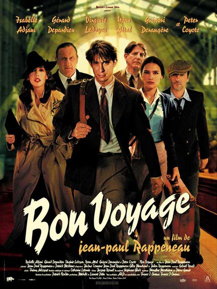
Jean-Paul Rappeneau’s ‘Bon Voyage’ (2003) is one of those superb films that come around all too rarely. It manages to balance perfectly all the elements of drama, comedy, action, and romance, set in a convincing historical context.
Bon Voyage
Jean-Paul Rappeneau
2003, France
1 hour 54 minutes
In 1940, Viviane Denvert (played by Isabelle Adjani) is a fickle, self-promoting film star who enlists her childhood friend, Frédéric Auger (Grégori Derangère), to extract herself from a compromising situation. As war creeps upon France, Auger finds himself behind bars for Viviane’s crime, but in the confusion of battle he manages to escape with the seasoned ne’erdowell Raoul (Yvan Attal). All of Paris is fleeing the German advance, and on the train to Bordeaux the two come across physics student Camille (Virginie Ledoyen) who helps them reach the western city by car when the train is stopped on the line.
In Bordeaux we come across government minister Jean-Étienne Beaufort, Viviane’s lover whom she uses to get Frédéric out of a sticky situation resulting from her own manipulation of him. Meanwhile, with all of Paris in Bordeaux, Viviane comes across another ex-paramour, Alex Winckler (Peter Coyote), keeping an unnatural interest in the affairs of the government, while the physics student Camille and her mentor Professor Kopolski are harbouring an important cargo they are determined must not fall into the hands of the Germans.
For fear of spoilers, that is all I will say about the plot, but it all comes packaged in a score by Gabriel Yared, better known for his scoring of ‘The English Patient’, ‘The Talented Mr. Ripley’, and Florian Henckel von Donnersmarck’s ‘Das Leben der Anderen’. The film was nominated for eight César awards in 2004 — best costumes, best director, best editing, best film, best original score, best sound editing, best supporting actor, and best writing — while it won three Césars that year for photography, best set design, and, for Grégori Derangère, best promising actor. (more…)
Zeitung für Deutschland
Given my total obsession with the Frankfurter Allgemeine Zeitung it will come as no surprise that my favourite advertising installation is the massive logotype for the world’s greatest newspaper which spans the railway tracks at the Frankfurter Hauptbahnhof.
In glorious Teutonic blackletter, it proclaims the newspaper’s ownership of the city to all comers:
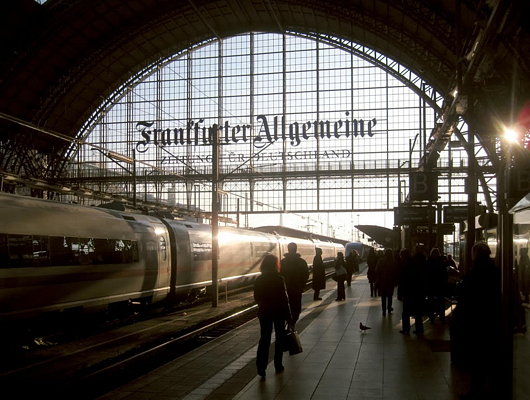
Photo: Erhard Bernstein
And while it looks great in daylight, as the evening descends it is illuminated in neon blue. Like the FAZ itself, old-fashioned and modern all in one.
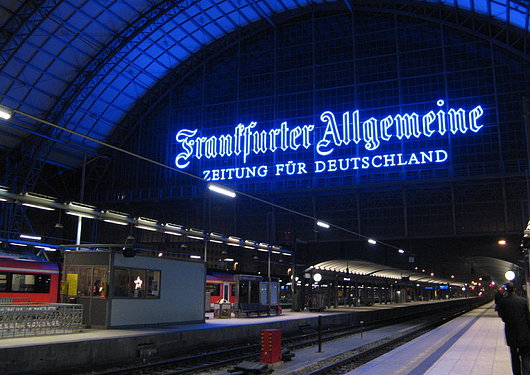
Photo: Otzberg
The Tragedy of Romeo and Rosaline
After an interlude of barely a month, the theatrical troupe of Fentiman returned to the Cathedral precincts with a presentation of Sharon Jennings’ play ‘The Tragedy of Romeo and Rosaline’. With the intriguing tagline of ‘Whatever happened to Romeo’s first love?’, the work explores the most famous love story of all time from the perspective of Rosaline, the niece of Capulet mentioned yet never seen in Shakespeare’s play.
A jaunty mix of ancient and modern, ‘Romeo and Rosaline’ includes some brilliant moments in its dialogue, peppered with occasional drops of the Bard’s own lingo and allusive humour ranging from the religious to the architectural. The action moves back and forth between just two locales: Rosaline’s own bedchamber, from which we view Verona, and Friar Lawrence’s cell, where we explore the meaning of transpired events.
Rachel Voldman as Nurse varies from the matronly to the almost sensuous. Philippa Tathum as Rosaline’s pushy mother exudes the confidence tempered by social-climbing of a minor landowner’s wife in colonial Kenya (Fair city of Verona meets the Happy Valley?). Althea Steven’s Rosaline is of course the crux of the action and capably carries off a teenage mix of coquetteishness and self-conscious over-introspection, finally consumed by the tragic epiphany that crowns the play’s final act. The theatregoer is lured in by fun and intrigue only to be hit suddenly with the full implications of has-been-ness.
In the end, ‘The Tragedy of Romeo and Rosaline’ is an exploration of isolation and ex-importance, displaying for us the furled banners of forgotten hopes and dreams, with all the faded, wasted glory of “You were the future, once.” Sharon Jennings has shined a well-aimed arclight on an unexplored realm and revealed the very essence of cathartic tragedy.
St Paul’s Gothicised
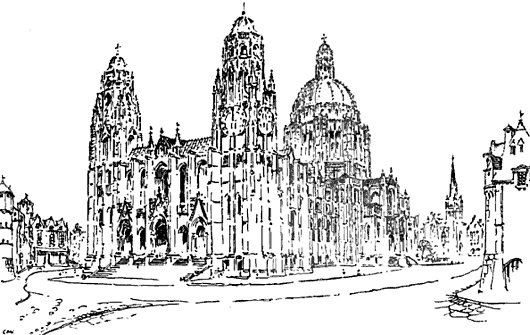
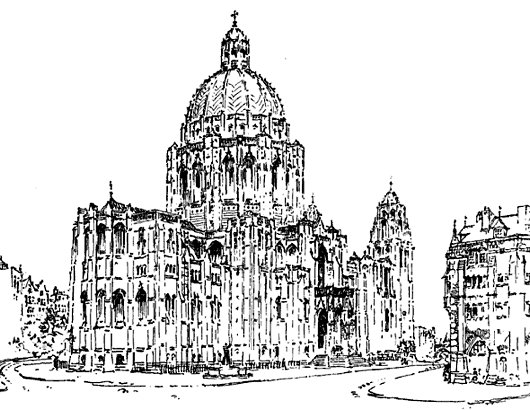
Victorian England went mad for the medieval, often neglecting or destroying buildings and structures of classical design along the way. Wren’s classical rood screen for Westminster Abbey is probably no great loss, but just imagine if his masterpiece, St Paul’s Cathedral, had been gothicised.
Just such was imagined by the architectural sketch artist C.A. Nicholson in two drawings he sent to the Architectural Record (albeit in the 1910s, not the Victorian era). Nicholson was inspired by an image printed in a previous issue of the Record showing the front of Peterborough Cathedral transformed into a classic design.
Of course before the Great Fire, Old St Paul’s was a Gothic cathedral.
The Dome of the Custom House, Dublin
THE MOST RECENT series of the ITV detective drama “Foyle’s War”, though set in London, was filmed entirely in Dublin. (Ah, those Bord Scannán incentives!). I’ve noticed a phenomenon in which something set in England but filmed in Ireland suffers from English stereotype overcompensation. What this entails is unnecessarily sticking noticeably English ‘things’ (double-decker bus, red pillarbox) into the frame when, if filmed in England, the directors might otherwise be satisfied without these subconscious emblems reassuring the viewer that they are not in fact in the country the programme was actually filmed in.
So two characters meeting on a street of Georgian houses will have a red post box shoved into some arbitrary place on the street to remind us we’re in jolly old England. Despite this, any devotées of the Georgian style will recognise the Irishness of the houses because of the subtle yet noticeable difference between the Georgian styles of, say, London, Edinburgh, Bath, and Dublin.

Anyhow, not to reveal too much of the plot of this latest series, but Chief Superintendent Christopher Foyle is recruited into a post-war British intelligence gathering organisation. The exterior shots of the building used as this group’s headquarters is the Custom House on River Liffey in Dublin, only the show’s producers have digitally removed the building’s prominent dome, presumably in order to make it less distinctive and identifiable. (more…)
No. 6, Burlington Gardens
Sir James Pennethorne’s University of London
German university buildings are an (admittedly unusual) obsession of mine, and I’ve often thought that No. 6 Burlington Gardens is London’s closest answer to your typical nineteenth-century Teutonic academy’s Hauptgebäude. And the connection is appropriate enough, as No. 6 was built in 1867-1870 for the University of London in what had once been the back garden of Burlington House (which at the same time became home to the Royal Academy of Arts). Despite the building’s Germanic form, the architect Sir James Pennethorne decorated the structure in Italianate detail, providing the University with a lecture theatre, examination halls, and a head office. Pennethorne died just a year after drafting this design, and his fellow architects described it as his “most complete and most successful design”.
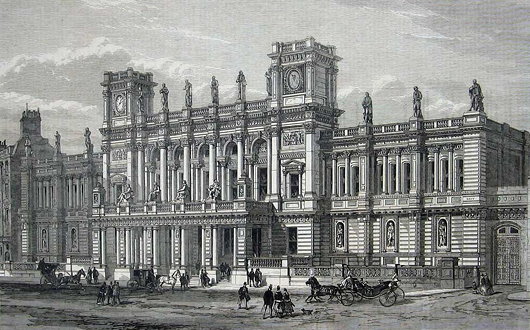
The University of London was founded as a federal entity in 1836 to grant degrees to the students of the secularist, free-thinking University College and its rival, the Anglican royalist King’s College. It now is composed of eighteen colleges, ten institutes, and a number of other ‘central bodies’, with over 135,000 students.
Since its founding, the University had been dependent upon the government’s purse for funding, as well as for housing. Accomodation was provided in Somerset House, then Marlborough House, before evacuating to temporary quarters in Burlington House and elsewhere. It was not until the 1860s that Parliament approved the appropriate grant for a purpose-built home for the University to be erected in the rear garden of Burlington House. (more…)
IHT, RIP
New York Times Kills Off the International Herald-Tribune
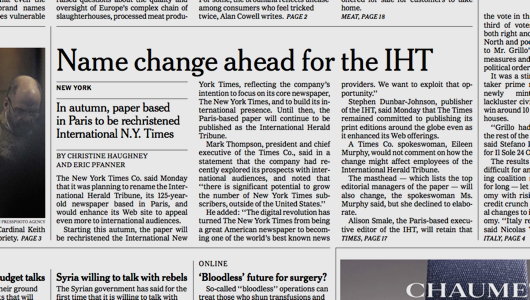
The New York Times Company, owners of the Paris-based International Herald-Tribune, announced recently that they are going to kill off the 126-year-old newspaper. I had predicted back in 2009 that this was precisely what would happen because of the aimless direction the IHT had taken since the New York Times became the sole owners of the title in 2002, after a long period of joint ownership with the Washington Post. The IHT will be merged into the worldwide operations of the Times this autumn and be rebranded as the International New York Times
 Hendrik Hertzberg of the New Yorker bids adieu to the Trib, remembering the first time he left the U.S. in 1960. Crain’s New York Business provides a brief overview of NYTCo’s decision. Margaret Sullivan, the Times’s ‘Public Editor’, reduces any appreciation for the Herald-Tribune as mere emotive romantic nostalgia. Nikki Usher mourns the IHT’s tendency to broaden the Times’s typically American editorial lens. Meanwhile, Ken Layne of The Awl is a bit frank about the decision to drop the Herald-Tribune for The International New York Times: “That’s an incredibly shitty name that makes no sense at all!”
Danzig in Flag & Arms
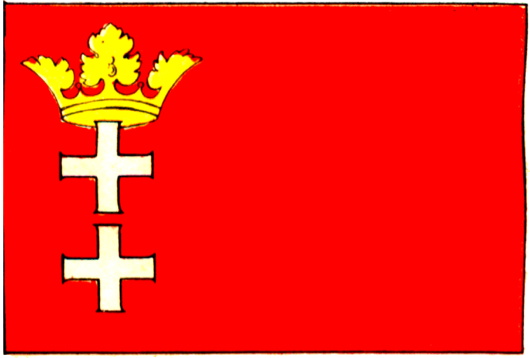
The first time I met my friend Rafal, I noticed his necktie bedecked with a subtle heraldic pattern. “I gather you’re German,” says young Cusack, summoning his Sherlockian deductive genius. “What makes you say that?” “The coat of arms on your tie: it’s Danzig.” “Actually I am Polish, and it’s Gdańsk!”
Well, so much for my deductive powers, (and Rafal is a secret wannabe-German anyhow) but the arms and flag of the Baltic city — once German, now Polish — combine the usual strong characteristics of any design: simplicity and beauty.
An Original Cusack
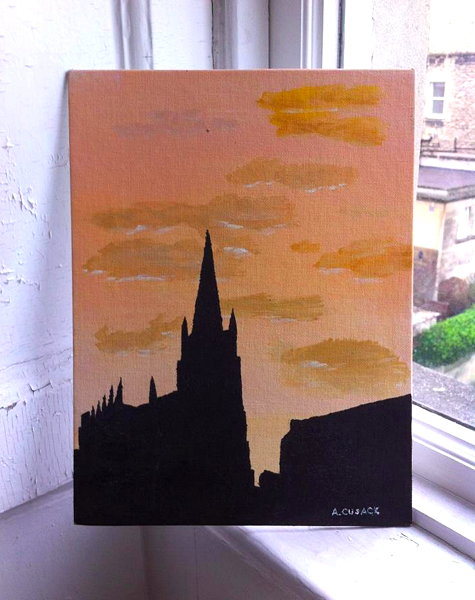
Much to my regret now, I never particularly learned nor pursued artistic skills, but this painting of St Patrick’s Church in Monaghan Town is one of the few fruits of art class from school days we’ve bothered preserving.
I think I was about 15 when this was done; the architecture was from a photo just to have something to stand out against the sunset. Our teacher was very good, but I was a poor student, and inattentive.
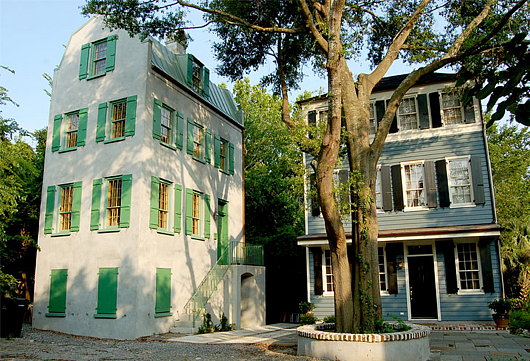
An Eclectic Vernacular in Charleston
Two new alleyways designed by George Holt & Andrew Gould
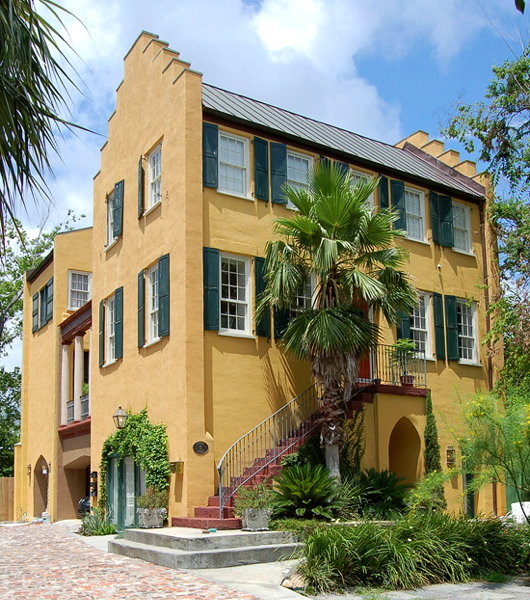
Charleston, the finest city of the American South, boasts two new alleyways designed by the architectural-urbanist partnership of George Holt and Andrew Gould. Holt began buying and restoring old Charleston houses two decades ago, and later expanded his work to building new houses in the traditional style of the town. Recently he’s combined with Andrew Gould, a specialist in the design of Orthodox churches, to craft an “urban infill project” plotting two short alleyways of modern houses built in an eclectic traditional vernacular: Charles Street and Tully Alley. (more…)
The Palace of Holyroodhouse
HOLYROOD IS SUCH a pleasant spot, despite the recent intrusion of an ostentatiously ugly government building designed by a Spanish architect. The other day, while visiting Edinburgh, I heeded the recommendation of the Prettiest Schoolteacher in Clackmannanshire to sample the burger at the Holyrood 9a. It was quite delicious, though not perfect, and was splendidly washed with a pint of Kozel (most un-Caledonian, I concede, but you can get Deuchars in London, you know).
Afterwards, our little party decided to have a little wander down Holyrood Road towards the Palace of Holyroodhouse, the epicentre of the Scottish monarchy.
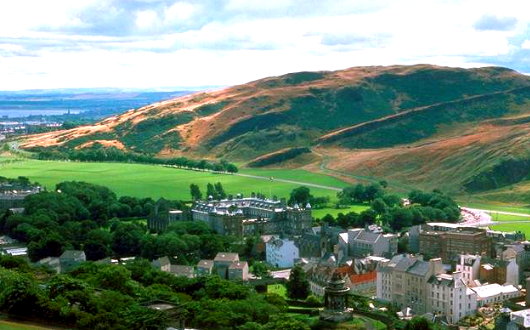
Nestled between Calton Hill and Salisbury Crags, the Palace sits at the end of the Royal Mile that runs between it and Edinburgh Castle. With the Old Town to its west, the expanse of Holyrood Park flows off to the south and east of it. (more…)
The Lady Altar
The Oratory Church of the Immaculate Heart of Mary,
Brompton Road, London
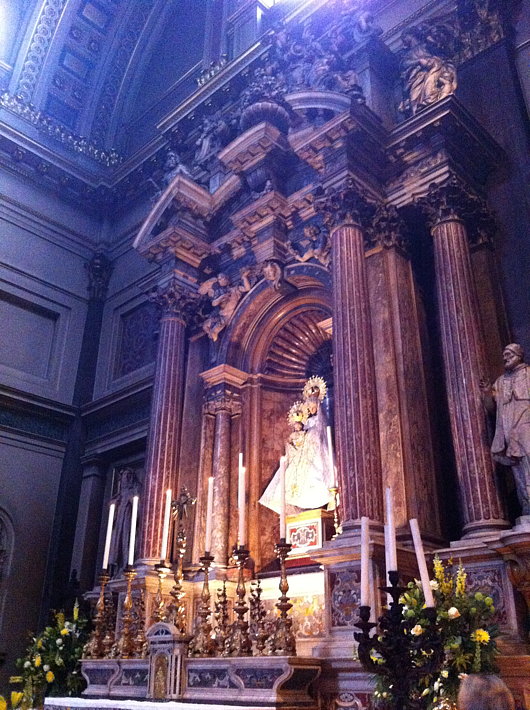
In the south transept of the Brompton Oratory is the altar dedicated to the Blessed Virgin, perhaps the finest altar in the entire church. It is a favourite place for getting in a few prayers and offering a candle or two or three or four. At the end of Solemn Vespers & Benediction on Sunday afternoon (above) it is where the Prayer for England is said and the Marian antiphon sung.
The Lady Altar was designed and built in 1693 by Francesco Corbarelli of Florence and his sons Domenico and Antonio and for nearly two centuries stood in the Chapel of the Rosary in the Church of St Dominic in Brescia. That church was demolished in 1883, and the London Congregation of the Oratory purchased the altar two years beforehand for £1,550.
The statue of Our Lady of Victories holding the Holy Child had previously stood in the old Oratory church in King William Street, and the central space of the reredos was slightly modified to house it. The Old and New Worlds are represented in the flanking statues, which are of St Pius V and St Rose of Lima — both by the Venetian late-baroque sculptor Orazio Marinali. The statues of St Dominic and St Catherine of Siena which now rest in niches facing the altar were previously united to it, and are by the Tyrolean Thomas Ruer.
A Decade of Driehaus
A Carl Laubin capriccio pays tribute to the first decade of Driehaus laureates
THIS YEAR MARKED the tenth anniversary of the Driehaus Prize, the annual award honouring a living architect who has contributed to the field of traditional and classical architecture. To commemorate the first decade of the Prize, the architectural painter Carl Laubin was commissioned to produce a splendid capriccio depicting the works of the first ten Driehaus laureates.
As Witold Rybczynski, a member of the Driehaus panel of jurors, writes:
In the foreground is the Choragic Monument of Lysicrates, a bronze miniature of which is presented to each laureate. It’s fun to try and identify the individual works in this large (5½ by over 8 feet long) painting. But what is more striking is that Laubin has created a convincing urban landscape solely out of landmark buildings.
That, of course, is the advantage of classicism: however it is interpreted, it is a tradition that manages to produce a more or less coherent whole. Even Abdel-Wahed El Wakil’s mosque, standing next to a Seaside beach house by Robert A. M. Stern, doesn’t look too out of place.
The Driehaus Prize was founded in part as a rival to the more publicised Pritzker Prize awarded to modernist architects. But, Mr Rybczynski points out, the fundamental nature of modernist structures is that they thrive only as a visual contrast to buildings constructed in a traditional style.
Can one imagine a similar townscape of Pritzker Prize winners? Well, maybe with the work of some of the early laureates—Pei, Bunshaft, Tange, Siza—but modern buildings need a background of nineteenth and early twentieth century urbanism to shine. A town made up of only signature buildings by our current generation of stars would resemble a carnival or a theme park—Pritzkerland.
I’ve often thought this of the United Nations headquarters in New York, which, when it was first built, must have stood out brilliantly as a bright and fresh harbinger of a better future, but which has been rendered altogether rather boring by the construction of neighbouring buildings of third-rate plate-glass modernist designs.
The UN headquarters on the East River and Lever House on Park Avenue were breakthrough buildings, but the increasing replacement of their traditional stone-clad or brick neighbours by cheap, tawdry modernist structures has exposed how reliant this type of architecture — even when well-conceived and properly executed — is on being surrounded by a contrasting style. (more…)
The Cathedral of the Bronx
The Augustinian Church of St Nicholas of Tolentine
The Church of St Nicholas of Tolentine dominates the busy intersection of University Avenue and West Fordham Road in the Bronx. The parish was erected by the archdiocese in 1906 and has been served by Augustinians ever since then. The present church is a modern gothic creation from 1927, and probably one of the most handsome Catholic churches in the borough — it is often nicknamed “the cathedral of the Bronx”. (Though that style is sometimes also ascribed to St Jerome’s in Mott Haven).
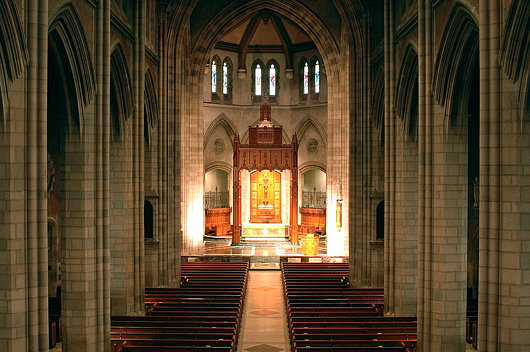
The church is of suitably grand proportions, but the effect is somewhat diminished by the unfortunate use of bulky wooden pews. They are ill-suited to such a large church, and detract from the spaciousness of the interior. This is unfortunately a very frequent problem in the United States, where clumsy pews crowd even great cathedral churches like St Patrick’s in Manhattan or the glorious Cathedral Basilica in St Louis. Regardless, St Nicholas of Tolentine is a splendid ornament in this borough of many churches. (more…)
Scipione Perosini’s Imperial Palace
An ambitious Italian’s mad plan to bulldoze the Roman Forum, destroy Michaelangelo’s Piazza del Campidoglio, and build a Napoleonic palace atop the Capitoline Hill.
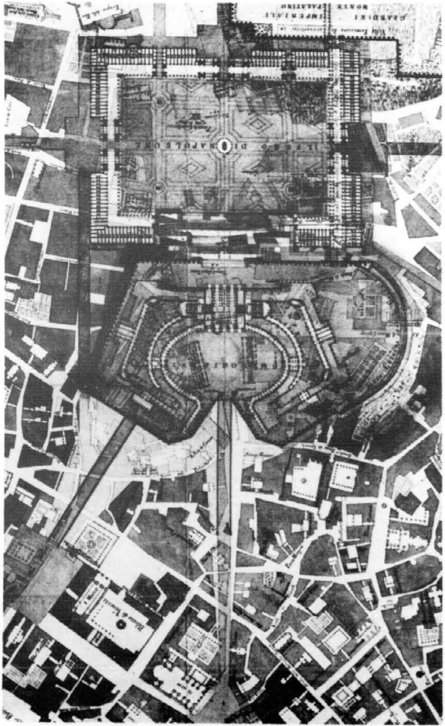 Some architectural projects are just so completely mental and insane that you actually have to doff your cap to the creativity of their inventors. Scipione Perosini’s ‘Projet d’un palais impérial à Rome’ is one such plan.
In the 1800s, with Napoleon the master of Europe, prominent citizens of various Italian cities submitted plans for the architectural aggrandisement of their communities under the beneficent patronage of the revolutionary monarch. In Rome, the architect and hydraulic engineer Scipione Perosini drafted his project for a imperial Napoleonic megapalace.
Atop the Capitoline, Michaelangelo’s Piazza del Campidolgio would be destroyed except for the Palazzo dei Senatori, which would be the central focus of a massive neo-classical palace encompassing the entire Capitoline Hill. From the Hill, a series of terraces would cascade down to the Roman Forum, which would be demolished and paved over to form a new ‘Foro di Napoleone’ celebrating the emperor. Across the Forum, on the Palatine, a new imperial residence circled by gardens would house Napoleon, who proclaimed himself King of Italy, during his prospective stays in the second capital of his empire. (more…)
Hark, the Heralds!

by Jack Carlson
133 pages, hardcover, $15.99
In anticipation of a party in Oriel recently, I enjoyed a pint with some friends by the fire in the King’s Arms and was given a copy of this book, mysteriously shrouded in a plastic bag. Jack Carlson’s Humorous Guide to Heraldry is a welcome addition to the Cusackian library. The author, who wrote the book when he was fourteen, is now an Oxford archaeologist (and rower) but his interests span a broad spectrum. (He is currently researching for a work on rowing blazers, a subject unjustly neglected by academics).
Aficionados of the light-hearted-guide-to-heraldry genre will notice one or two gentle riffs off of Sir Iain Moncrieffe of that Ilk’s Simple Heraldry Cheerfully Illustrated, and, since that book is long out of print, evangelists of heraldry will find A Humorous Guide to Heraldry a useful tool for introducing the uninitiated to the appreciable realms of this field. Godfathers will not want their spiritual charges to grow into adults without being able to distinguish the mêlée from the affronté and every life-long student of the world should be able to recognise a cinquefoil or a pheon.
In short: a worthy purchase for the heraldically inclined.
Jack Carlson’s A Humorous Guide to Heraldry is available here.
Beauty and Revolution
“Schönheit und Revolution: Klassizismus 1770-1820”
Städel Museum, Frankfurt am Main
WHEN IT COMES to styles, I am an omnivore. There are die-hard partisans, like Pugin, but I find the Baroque, the Gothic, the Classical — all are welcome to me. There is always some tiresome bore who, upon hearing any particular style of art or architecture praised, will immediately launch into a tirade against the more negative connotations commonly associated with that style. Gothic is close-minded! Mannerism is affected! The Biedermeier is bourgeois!
Well… ok… to an extent. But, in truth, we brush aside these pedants and appreciate whatever is beautiful wherever it is to be found. Art in its many forms is a giant sponge to squeeze and collect, savor, what comes out of it. (more…)
Search
Instagram: @andcusack
Click here for my Instagram photos.Most Recent Posts
- Brunel’s Unbuilt Capitol February 3, 2026
- Cricket at Fordham January 27, 2026
- Palacio Barolo Revisted January 14, 2026
- Learning to Love Liguria January 14, 2026
- Crux Alba No. 2 January 13, 2026
Most Recent Comments
Book Wishlist
Monthly Archives
Categories