Architecture
About Andrew Cusack
 Writer, web designer, etc.; born in New York; educated in Argentina, Scotland, and South Africa; now based in London.
 read more
News
Blogs
Reviews & Periodicals
Arts & Design
World
France
Mitteleuropa
Knickerbockers
Argentina
The Levant
Africa
Cape of Good Hope
Netherlands
Scandinavia
Québec
India
Muscovy
Germany
Academica
A little dilapidation goes a long way
Chelsea, Muttontown, L.I.
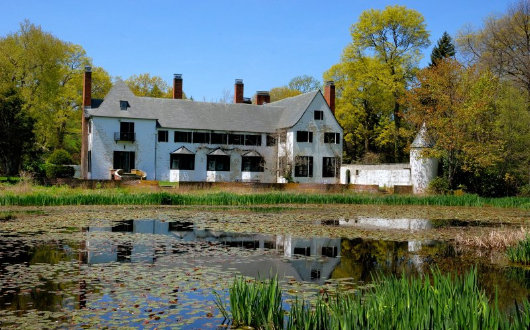
I have commented before about the perils of over-restoration, in which a building’s owner becomes a little too enthusiastic about its preservation and ends up with a building that, except in style, looks almost new. Chelsea sits on a 500-acre preserve in Muttontown, L.I. which has come into the hands of the government of Nassau (the county on Long Island in-between Queens County and Suffolk). The county has managed to maintain the house and its grounds at exactly the appropriate level: not plastering over every crack to make it ‘good-as-new’, nor neglecting it so it becomes structurally unsound, but rather allowing it to develop and age naturally. These photographs from the ever-capable James Robertson admirably display the house and its grounds, including its shallow canal-moat. (more…)
The National Assembly
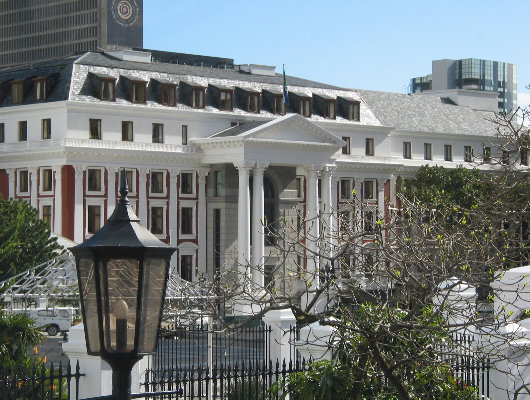
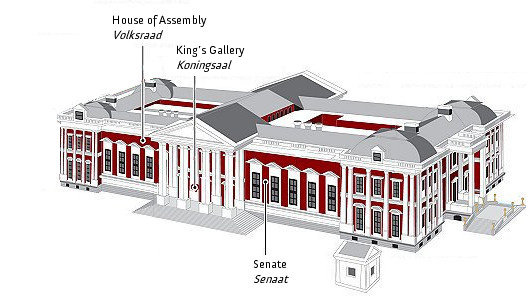
Despite the longer history behind the original wing of South Africa’s Parliament House, when most people think of Parliament today they think of the 1983 wing that currently houses the National Assembly. The wing was designed by the architects Jack van der Lecq and Hannes Meiring in a Cape neo-classical style similar to the rest of the building, and it is actually quite a handsome composition despite the awkwardly proportioned portico, which is too tall for its width or two narrow for its height. (more…)
‘Starchitecture’ Assaults the Stately City
In the Heart of Old Valletta, Architect Renzo Piano Plans a Gate without a Gate, a Theatre with no Roof, and a Parliament on Stilts
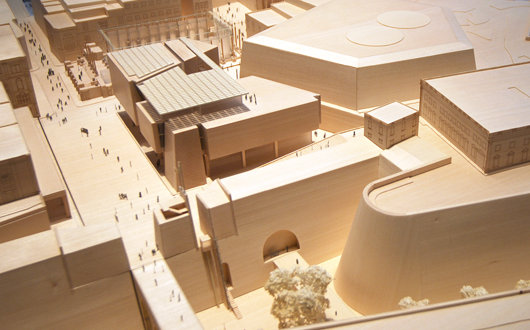
“THE MOST HUMBLE City of Valletta” is the official title of Malta’s capital, which was founded in response to Moorish threats and withstood the onslaught of Nazi bombers. But ‘La Ċittà Umilissima’ is now facing a humiliation brought about by its own rulers, who have commissioned the modernist architect Renzo Piano to reshape the entrance to the oldest quarter of the city. ‘Starchitects’ like Piano are so called because their temporal success lies more on their ability to create hype about their sensational and novel designs than on the quality and timelessness of their work itself. Most notorious for collaborating with Richard Rogers on the despised Pompidou Center in Paris, Piano has re-envisioned Valletta’s city gate without a gate, placed a new Maltese parliament on stilts next to it, and developed plans for a roofless theatre on the bombed-out ruins of the Royal Opera House.
The foundation of the Maltese capital was initiated by the Order of Malta during its rule over the island, not long after the famous Ottoman attack of 1565 was repulsed. The city takes its name from Jean Parisot de Valette, one of the greatest men to have ever served as Prince & Grand Master of the Sovereign Military & Hospitaller Order of St. John of Jerusalem, and the knights’ impact on Valletta’s development have led some to call it “the city designed by gentlemen for gentlemen”. This stateliness led some to give ‘The Most Humble City’ its second moniker of ‘La Superbissima’ — the most proud. (more…)
Rouwkoop: An Old Cape Hodgepodge
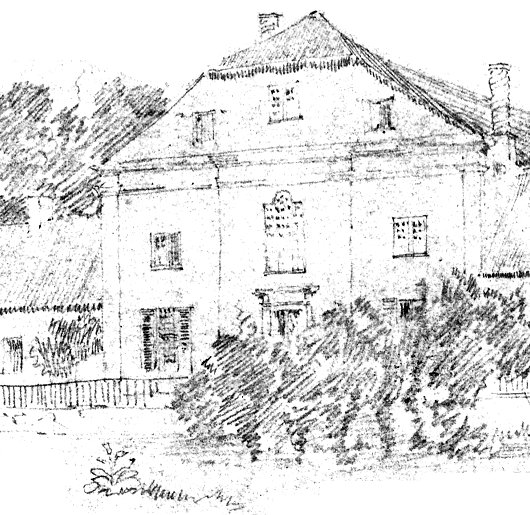
We can deduce a lot about a power by looking at the structures it erects. The return to neo-classicism under Stalin after the earlier Russian deconstructivist architecture of the 1920s is telling, as is the almost universal (and only seemingly contradictory) adoption of socialist Bauhaus architecture for the headquarters of New York corporations in the post-war period, or the turn to Brutalism by the governments of numerous Western liberal countries in the 1960s, 70s, and 80s. While the apartheid government adopted a guise of conservatism, its revolutionary re-ordering of South African society was so radical that, for example, the old Edwardian railway station in Cape Town was demolished and completely rebuilt in order to better accommodate the separation of the races.
When the Afrikaner Nationalist government was elected in 1948, it inherited one of the richest architectural traditions in the world. South African architecture, from the original Cape Dutch so praised by Ruskin, through the Cape Classical of the architect Thibault and the sculptor Anreith, and on to the attempt at a South African national style by Edwardian architects like Herbert Baker, the nation’s legacy of boukuns (building-art) is one of which any nation would be proud.
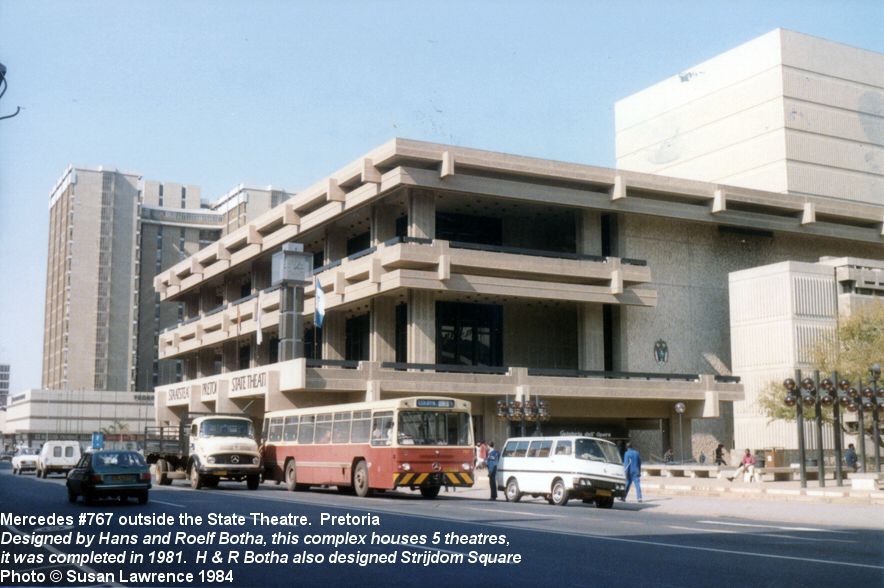
The Cape Dutch style has proved particularly versatile and easily reinterpreted in almost every age of South African history since Jan van Riebeeck planted the oranje-blanje-blou on these shores in 1652. Yet from 1948 until its final electoral demise in 1994 the National Party government erected almost no buildings in the “national style” of Cape Dutch or its aesthetic descendants. Instead, they built in the grim modernist style found everywhere else in the world, both in the liberal-capitalist West and the totalitarian-Marxist East. One need only consider the Nico Malan (now Artscape) in Cape Town, the Staatsteater in Pretoria, or the Theo van Wijk building at Unisa. (more…)


’n Indiese woning in die Moederstad
Kaapstad het ’n bietjie van die Himalajas
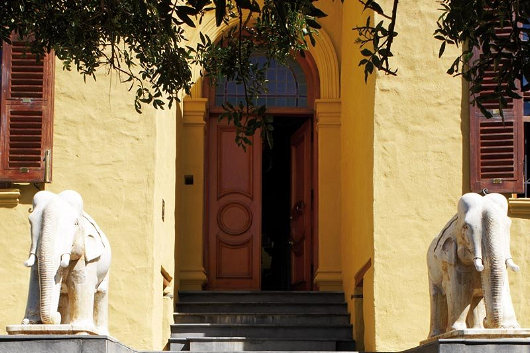
Twee versamelaars van suid-Asiatiese kuns het ’n subkontinentale woning in ’n Kaapstadse meenthuis geskep. Die huis was die onderwerp van ’n artikel deur Johan van Zyl in ’n onlangse uitgawe van Visi-tydskrif met hierdie foto’s van Mark Williams. Die algehele effek is ’n bietjie “over the top” vir my, maar die verleiding van die Oriënt sal nooit ophou. (Bo: ’n Paar van marmer-olifante uit Udaipur wagte by die hoofingang).
“In ’n nou keisteenstraat aan die rand van die Kaapse middestad staan ’n huis met ‘n geskiedenis” Mnr van Zyl skryf. “Toe dit in 1830 vir Britse soldate gebou is, het die branders nog digby die voordeur geklots, en nie lank daarna nie het Lady Anne Barnard hier sit en peusel aan ’n geilsoet vy wat ’n slaaf vir haar gepluk het, stellig van dieselfde boom wat nou in die huis se (nuwe) trippelvolume-glashart staan, ’n knewel met ’n vol lewe agter die blad.”
“’n Dekade of twee gelede het die reeds luisterryke geskiedenis van die huis ’n eksotiese dimensie bygekry toe twee toegewyde versamelaars — selferkende stadsjapies wat destyds in die modebedryf werksaam was — hier kom nesskop met hulle groeiende versameling Indiese oudhede.” (more…)
Government Buildings, Dublin
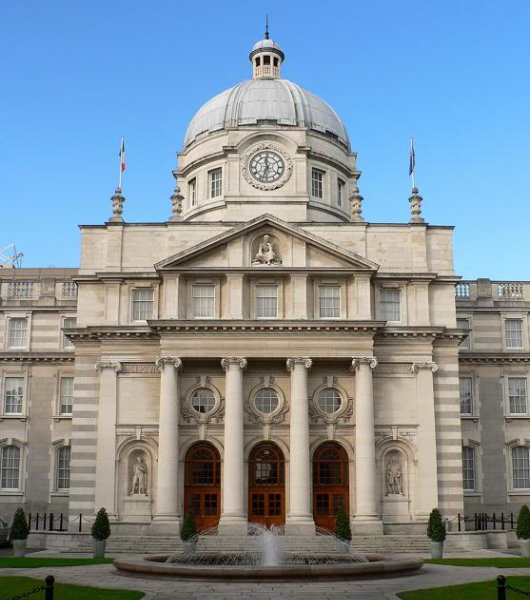
Image: GrahamH
On Upper Merrion Street at the end of Fitzwilliam Lane in Dublin sits a thoroughly Edwardian pile which has been given the thoroughly boring title of ‘Government Buildings’. The city ceased to be a legislative capital in 1800 when the Irish Parliament voted to abolish itself and join the United Kingdom, so government edifices constructed during the nineteenth century lacked the proud stateliness of the Grattan era. The Westminster parliament finally conceded the principle of Irish home rule in 1914 but disastrously suspended its implementation due to the First World War. In stepped the Irish Volunteers, Easter 1916, the IRB, and all that and by the time the Treaty of Versailles ended the conflict on the continent, Britain was up to her neck in troubles in Ireland. Events had intervened and the unimplemented concession of home rule proved insufficient to quell the dire situation.
Even so, the Government of Ireland Act 1920 partitioned the island and created a separate government for ‘Southern Ireland’ and ‘Northern Ireland’, each with its own devolved legislature. The old Irish Parliament House had been sold to the Bank of Ireland so there was a question as to where the two houses of the new Southern Irish body would convene. Eventually the government decided upon this building, the Royal College of Science, and it was commandeered for that purpose. (more…)
The Patriarchal Cathedral Basilica of Saint Mark the Evangelist, Venice
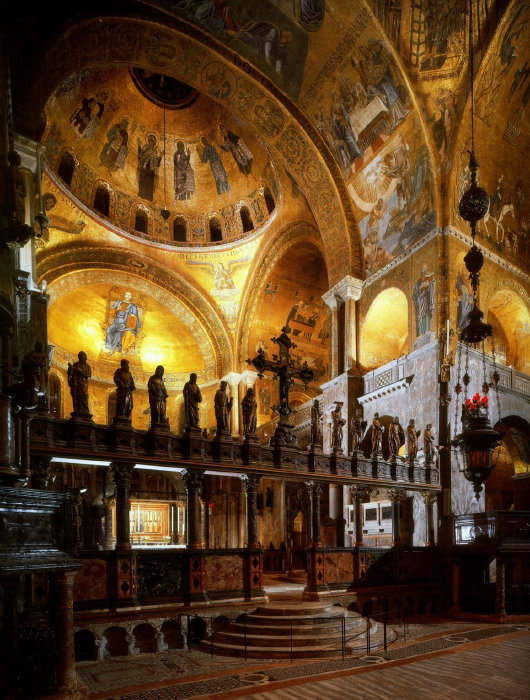
One of the readers over at the NLM sent in these photos of St. Mark’s Basilica in Venice. The reason why St. Mark’s is usually referred to as a mere basilica is because for centuries this was not the seat of the Patriarch of Venice. From the seventh century, the Church of San Pietro di Castello was the cathedral of Venice, while St. Mark’s was the house church of the Doge, the elected duke of the Venetian aristocratic republic. It was only in 1807 that St. Mark’s was made the cathedral of Venice, and San Pietro di Castello reduced to co-cathedral status. But by the time St. Mark’s became a cathedral, everyone had already become accustomed to referring to it as “St. Mark’s Basilica”. (more…)
The Dovecot at Alphen (1989)
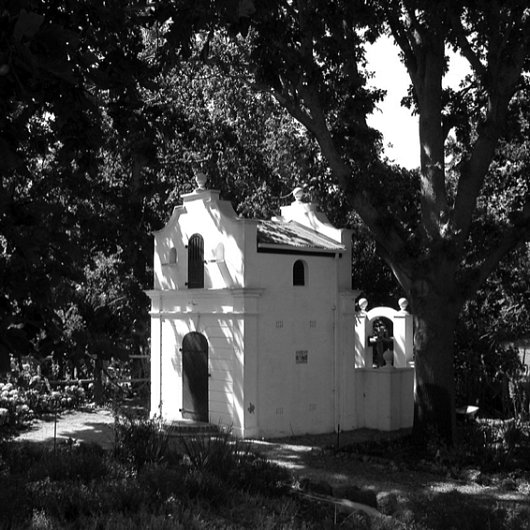
ESTABLISHED in 1714, Alphen is one of the legendary estates of the Cape Peninsula: Dr. James Barry duelled on the south terrace with Josias Cloete, and its guests include the illustrious names of Mark Twain, Cecil Rhodes, Field Marshal Smuts, and many more. While it once covered most of northern Constantia, the estate was much reduced during the twentieth century (and the M3 Simon van der Stel Freeway was built through its vineyards), Alphen, now a country-house hotel, is growing once again in the hands of the latest generation of Cloetes.
In 1989, the council authorities visited Alphen and declared that an electric substation must be built on the site or the hotel be forced to close. The ancient electric supply lines had, it turned out, been constructed illegally, and there was some danger of fire unless a substation was built on the Alphen property itself.
“Horrified we said there must be some other way,” writes Nicky Cloete-Hopkins (in the Journal of the Vernacular Architecture Society of South Africa). “There wasn’t, and Dudley [Cloete-Hopkins] said to Dirk [Visser, architect], who had been working with us for about five years by that time, ‘Disguise it as a folly or something.’”
“The ideal site for ours was … on the banks of the Diep River, at the end of a path leading from the 1772 water mill. It was in line with the strict grid pattern of the farm complex and gardens, much of which had been destroyed in the early and mid part of the twentieth century. We briefed Dirk to have fun, create a ‘folly’ and incorporate the Mitford-Barberton crucifix and family plaques from a Garden of Remembrance, demolished after the farm was subdivided.” Ella Lou O’Meara was later commissioned to do a family tree in tile for the Garden wall.
“Dirk suggested the dovecote — although we have had difficulty in keeping doves there. A little flamboyance has often enhanced the severity of the architecture at Alphen, and Dirk’s sketches for the proposed dovecote delighted us.”
Alphen and its great square of farm buildings had been designated a National Monument — akin to landmarking in the U.S. or listing a building in Britain — and so changes or additions needed to meet with the approval of certain historic advisors. “The builders had nearly completed their work when the then National Monuments Council sent representatives to inspect it. They commented that the design was not ‘honest’ and that we were fooling the public in making it look like a historic building.”
Mrs. Cloete-Hopkins wondered if the NMC wanted them to build something horrifically functional in the middle of a historic site for the sake of “honesty” or whether they wanted them to “erect something ultra-modern” like the new Louvre pyramid that was causing controversy at the time. “In any event it was too late to look at alternatives and I happily satisfied requirements by putting the date and the name of the architect and builder on the side of the building.”
A wise compromise and, like the dovecot/substation itself, informed by precedent.
Dino Marcantonio Hath a Blog!
Dino Marcantonio, habitual luncheon companion of your humble & obedient scribe, not to mention frequent commenter upon this little corner of the web, has entered into the realms of blogging himself. You can find his musings on the theory and practice of architecture here. They make for some pretty good reading so far.
An Old Dutch Holdout
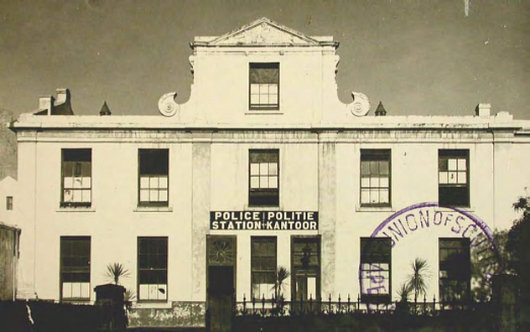
The sign on the façade of No. 7 Wale Street, Cape Town in this 1891 photo informs us of its status as a police station in the two official languages of the day, English and Dutch, not Afrikaans. ‘Politie’ is the Dutch word for Police, while the Afrikaans is ‘Polisie’. Afrikaans only became an official language of South Africa in 1925, but was so alongside Dutch and English until 1961, when Dutch was finally dropped.
This beautiful old Dutch townhouse, with its typical dak-kamer atop, didn’t survive as late as 1961. The Provinsiale-gebou, home to the Western Cape Provincial Parliament, was built on the site in the 1930s. Those who viewed the 2009 AMC/ITV reinterpretation of “The Prisoner” might remember an outdoors nighttime city scene after the main character leaves a diner, with the street sign proclaiming “Madison Ave.” and plenty of yellow New York taxicabs streaming past. The large arches in the background are the front of the Provinsiale-gebou.
From Parking Places to People Spaces
Transforming a Suburban Parish into a Traditional Neighborhood
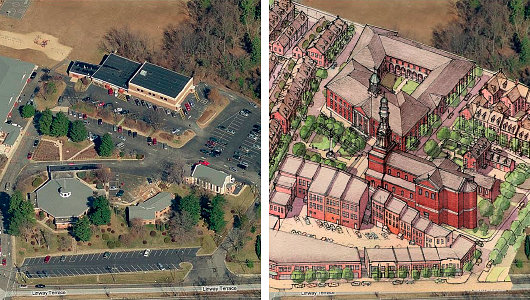
The widespread unsightliness of suburban development in the United States is one of the most significant counts one can hold against the country. The earliest suburbs, or indeed any that are pre-war, came out fairly well by contrast. One of the pleasures of living in Westchester is our system of verdant parkways (from the inter-war period) with arched stone bridges spanning the little creeks and carrying local thoroughfares over the road. The transformation of Long Island, after the Second World War, from countryside to row after row of mass-produced cookie-cutter homes was disastrous. (Levittown is my personal vision of Hell — identical homes completely divorced from any sense of livable social order.) Post-war suburban development combines ugliness, boringness, and an astonishing misuse of available land. Erik Bootsma, however, here presents a model proposal of how to transform the medium-sized property of a modern suburban parish church in Virginia into a small, livable neighborhood. (more…)

The Oratory as It Was Built
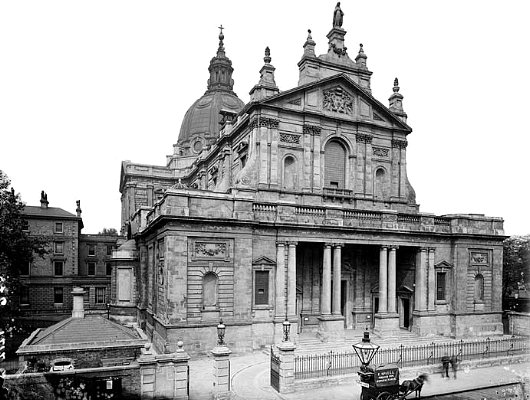
Since we explored Brompton Oratory as it might have been, here is the Oratory as it was built. The façade were finally completed in 1893 to a design by George Sherrin, with the dome following in 1894-95 by Sherrin’s assistant E. A. Rickards. How is the Oratory as depicted above different from the Oratory today? The fence and gates were replaced with a curved design at some date unknown to me, perhaps in response to a road-widening scheme.
The House of Assembly
Die Volksraad
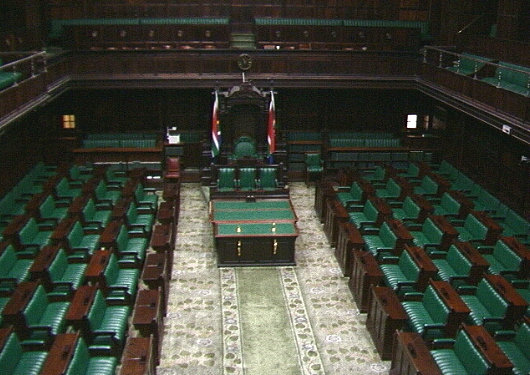
The House of Assembly (always called the Volksraad in Afrikaans, after the legislatures of the Boer republics) was South Africa’s lower chamber, and inherited the Cape House of Assembly’s debating chamber when the Cape Parliament’s home was handed over to the new Parliament of South Africa in 1910. The lower house quite soon decided to build a new addition to the building, and moved its plenary hall to the new wing. (more…)
No. 82, Eaton Square
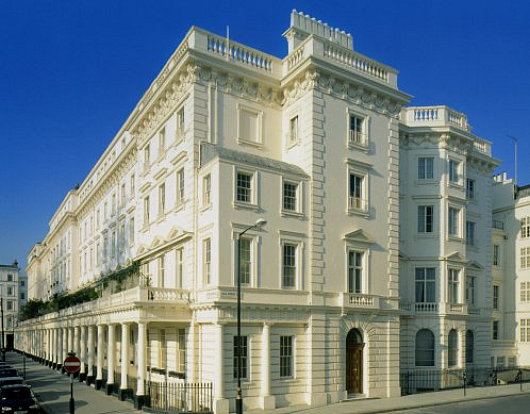
In it’s long history, the address of No. 82 Eaton Square in London has housed a Major-General of the East Indian Cavalry, a Lord Strafford, a Lord Bagot, an Earl of Dalhousie, an Earl of Clare, a Duke of Bedford, and Queen Wilhemina of the Netherlands — thankfully not all at once. It’s probably best know for its half-century as the Irish Club, a much-favoured drinking & smoking spot for the community of Gaels in London. The club was founded in 1947, with a number of pre-existing Irish clubs merging into it. George VI — grateful for the devoted service of the Irish who volunteered for his armed forces during the Second World War — heard that the club was in search of premises and asked the Duke of Westminster, one of the largest landowners in London, if he could help. The Duke provided the leasehold of No. 82 Eaton Square to the Irish Club for a nominal sum. (As it happens, the 4th Duke’s son served as a Unionist MP for Fermanagh & South Tyrone, and later in the Northern Irish Senate). (more…)
How Not to Build a Library
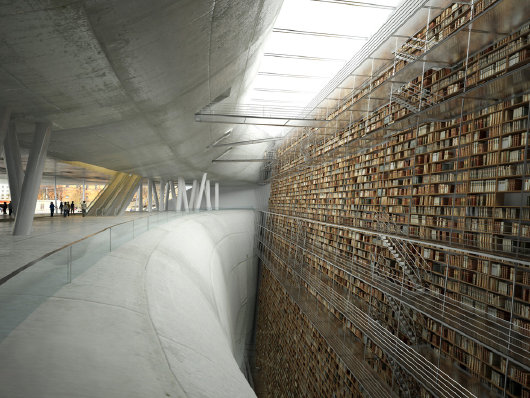
This computer-generated image has been doing the rounds on a variety of blogs across the internet. It depicts one of the numerous proposals for the extension of the Stockholm Public Library, this one drafted by a team from the Paris-Val de Seine architecture school. Over at the Long Now Blog, Alexander Rose calls it “awesome” and says “This design seems like it would lend itself well to a 10,000 year library”. As a monument this design is impressive — perhaps intimidating is the more appropriate word — but as a library it’s hard to conclude it would be anything other than a complete and total failure. And as for lasting 10,000 years, all those walkways to access the books look exceptionally brittle — I doubt they’d last a hundred years let alone ten thousand. (more…)
Baron Bossom’s Bridge
The Unbuilt ‘Victory Bridge’ Crossing the Hudson River at Manhattan
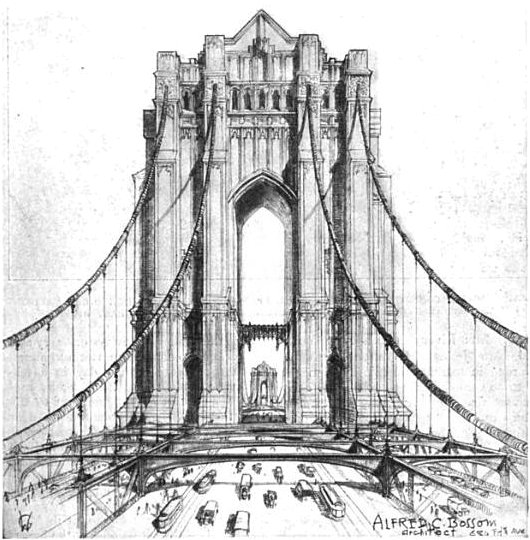
After the victory of America and her “co-belligerents” in the First World War, a temporary victory arch was erected out of wood and plaster to welcome the troops home from Europe. After the arch was dismantled, however, discussions soon arose on how to permanently commemorate the war dead of New York, with a surprising variety of suggestions made. A beautiful water gate for Battery Park was suggested, with a classical arch flanked by Bernini-like curved colonnades, so that a suitable place existed to welcome important dignitaries and visitors to New York. (Little did they know how soon the airlines would replace the ocean lines). Another proposal was for a giant memorial hall located at the site of a shuttered hotel across from Grand Central Terminal, while others suggested a bell tower.
An entirely different proposal, however, was made by the New York architect Alfred C. Bossom (later ennobled as Baron Bossom of Maidstone). Bossom, an Old Carthusian, was an Englishman by birth and eventually returned to his native land, where (in 1953) he gave away the future prime minister Margaret Roberts at her marriage to Denis Thatcher. He himself served in parliament from 1931 until 1959, excepting his wartime Home Guard service. Jokes were often made about his surname resembling both “bottom” and “bosom”. Upon being introduced to Bossom, Churchill jested “Who is this man whose name means neither one thing nor the other?” (more…)
Brompton Oratory as It Might Have Been
Failed Entries of the 1878 London Oratory Architectural Competition
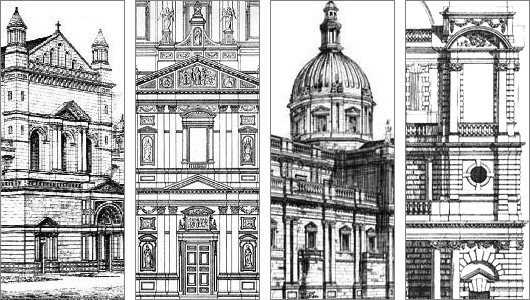
ARCHITECTURAL COMPETITIONS have always fascinated me because they give us the opportunity to glance at multiple executions for a single concept, to see different minds solve a “problem” with their own particular formulas and theorems. The designs of many of the world’s prominent buildings were chosen by competition, perhaps the Palace of Westminster — Britain’s Houses of Parliament — is most famous among them. When the Hungarian Parliament held a competition to design a grand palace to house the body, it found the top three prize designs so compelling that it built the first-prize design as parliament and the second and third places as government ministries nearby. To my surprise, I have only ever come across one book which adequately surveyed the subject of competitive architecture, Hilde de Haan’s Architects in Competition: International Architectural Competitions of the Last 200 Years. Most of the contests covered in the book are, naturally, for government buildings of national importance — private clients usually have a very firm idea of what they want and choose an architect accordingly.
One building not mentioned in the book but nonetheless very dear to me (and no doubt to many readers of this little corner of the web) is the Church of the Immaculate Heart of Mary of the Congregation of the London Oratory, more popularly known to friend and foe alike as the Brompton Oratory. It was the first church in Britain in which I ever heard mass, the summer after kindergarten when I was still but a tiny, blond-haired whippersnapper, in the midst of my first visit ever to the Old World, and the Oratory made quite a strong impression upon my young mind. It is usually one of my very first ports of call whenever I am in the capital, and I once even managed to slip in having just arrived at Heathrow while making my way to King’s Cross and the train to Scotland.
The Brompton Oratory is known for having good priests, traditional liturgy, and beautiful architecture. The final design was by one Herbert Gribble, but there was quite a bit of to-ing and fro-ing before Gribble was selected. The temporary church which had been erected on the site had been condemned by one critic as “almost contemptible” in its exterior design. In 1874, the Congregation of the Oratory (which is to say, the priests) put out an appeal for funds towards the construction of a permanent church. The 15th Duke of Norfolk obliged with £20,000 to get the ball rolling, and the next year a design by F. W. Moody and James Fergusson was agreed upon in principle. But the Reverend Fathers soon began to get creative and hatch ideas and contact other architects and very soon it was claimed that there were as many counter-proposals as there were priests of the Oratory, and perhaps more. A pack of clerics supported a suggested design by Herbert Gribble, but no accord could be reached among the Congregation as a whole.
In January 1878, then, it was announced that a competition would take place to decide the design of the permanent church of the London Oratorians. First prize was £200, with £75 for the runner-up. All entries had to meet the certain requirements drawn up by the Congregation. The style was to be “that of the Italian Renaissance”. The sanctuary, at least sixty feet deep, must be “the most important part of the Church. … Especially the altar and tabernacle should stand out as visibly the great object of the whole Church.” The minimum width of the nave was fifty feet, and maximum length 175 feet. Subsidiary chapels must be “distinct chambers”, not merely side altars. One aspect not mentioned was the projected execution costs of the designs — “an omission criticized by architectural journalists and disgruntled competitors,” the London Survey tells us, “whose designs called for expenditure ranging from £35,000 to £200,000”.
Over thirty entries were submitted to the competition, and Alfred Waterhouse was commissioned by the Fathers to provide comment on the submissions. Significantly, George Gilbert Scott, Jr. submitted a design, though I haven’t been able to get my hands on any depictions of it. Waterhouse praised it as “of no ordinary merit. … I feel that it is impossible to speak too highly of its beauty, its quiet dignity, its absence of all vulgarity and its concentration of effect around the high altar.” (more…)
The Parliament of the Venerable Island
Geoffrey Bawa’s Sri Lankan Parliament at Kotte
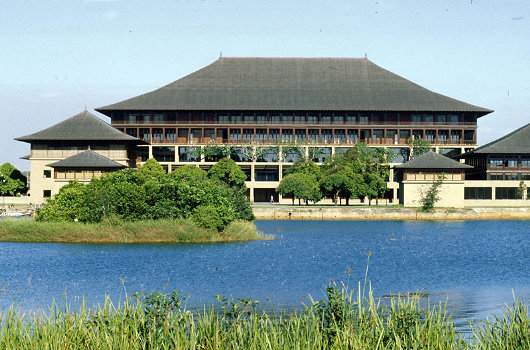
CEYLON IS AN ancient island whose history spans the epochs of human existence: palaeontologists estimate it has been inhabited for over 34,000 years. A series of ancient and medieval native kingdoms have ruled this island over the centuries before foreigners from abroad decided to enter the game. The Portuguese were the first Europeans to stake a claim here, followed by the Dutch Republic. And, yes, as with almost every place of intrigue and tradition, even Ceylon belonged to the Hapsburgs at one point: from 1580 to 1640. Native kingdoms persisted nonetheless, even while European powers bickered over their own portions of the island.
It was in 1815 that the Chiefs of the Kandyan Kingdom agreed to depose their own monarch, Sri Vikrama Rajasinha, and place George III of the House of Hanover on the throne. Ceylon was united at last, and — after the end of the Kandyan Wars — the island enjoyed relative peace and prosperity during one-hundred-and-thirty-three years of British rule.
In 1948, the British granted independence to the Dominion of Ceylon. The island continued as an independent constitutional monarchy for much longer than its neighbours India and Pakistan. The rudiments of a two-party system emerged, with the United National Party bringing together the conservative, traditional element in political society, while the Freedom Party advocated non-revolutionary socialism.
The population of Ceylon, however, are a complete hodgepodge of ethnicities. The largest group are the Sinhalese, a Buddhist people constituting over 70% of the population. But at the northern end of the island, the Tamil people were dominant, even though these were split between “Ceylonian” Tamils native to the island and “Indian” or “Plantation” Tamils brought during British rule to work the large plantations. Then there are the Moors, a multiracial Muslim community of primarily Arab and Malay descent. And, of course, there are the famous Burgher people, descendants of the island’s Portuguese, Dutch, and English mixed with Sinhalese, Tamil, and Creole.
Democratically elected politicans replaced English (the intercommunal lingua franca) with Sinhala (the language of the Sinhalese majority) as the official language, abolished the Senate, severed appeal to the Privy Council and, in 1970, abolished the monarchy. The Dominion of Ceylon was renamed the Republic of Sri Lanka — the name literally means “Venerable Island”. Left-wing nationalists continually stoked tensions with the country’s conservatives, traditional elite, and minorities, and provoked right-wing reactions. Aside from the left-right divide, Tamil extremists began an anti-Sinhalese terror campaign that increased the oppression of the Tamil people and strengthened the country’s divisions. In short, it all became a mess. (more…)
Praga Caput Regni
Prague: Capital & Head of the Bohemian Realm
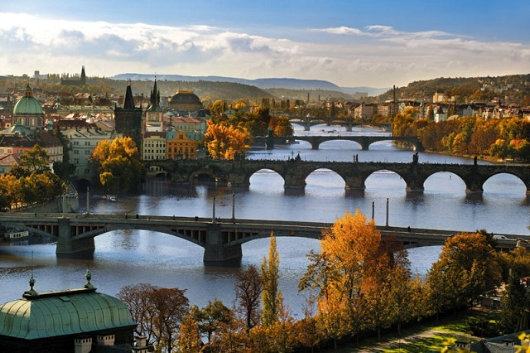
Prague is traditionally known as “Praga Caput Regni” — the capital of the realm, or indeed the head of the Bohemian body. Changing times and a different form of government mean that the arms of this ancient city now bear the motto “Praga Caput Rei Publicae” instead. The photographer Libor Sváček was born in the be-castled city of Krummau, and has a splendid book of photographs of that town, but here are a number of his photographs of Prague, which splendidly exhibit the Old Town at its most beautiful. (more…)
The Senate of South Africa
Die Senaat van Suid-Afrika
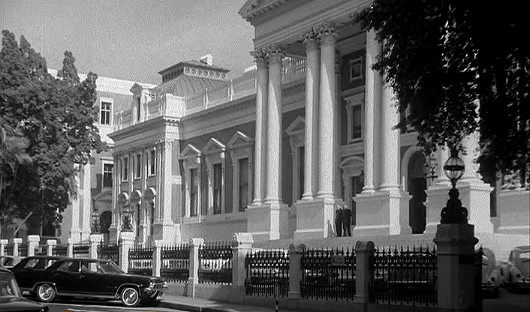
THE SENATE OF South Africa has had something of a tempestuous history, a fact which is attested to by the vicissitudes of the Senate chamber in the House of Parliament in Cape Town. The Senate formed the upper house of South Africa’s parliament from the unification of the country in 1910, in accordance with the proposals agreed to by Briton & Boer at the National Convention of 1908. Its members were originally selected by an electoral college consisting of the Provincial Councils of the Cape, the Transvaal, the Orange Free State, and Natal, and the members of the House of Assembly (the parliament’s lower house), along with a certain number of appointments by the Governor-General on the advice of the Prime Minister. When South Africa abolished its monarchy, the State President took over the appointing role held until then by the Governor-General, but the Senate remained largely intact until 1981, when it was abolished in advance of the foolish introduction of the 1984 constitution with its racial tricameralism.
The Senate made a brief comeback in 1994, when the interim constitution provided for a Senate composed of ninety members, ten elected by each of the provincial legislatures of the new provinces. The 1994 Senate, however, was replaced by the “National Council of Provinces” in the final 1997 constitution. (more…)
Search
Instagram: @andcusack
Click here for my Instagram photos.Most Recent Posts
- Brunel’s Unbuilt Capitol February 3, 2026
- Cricket at Fordham January 27, 2026
- Palacio Barolo Revisted January 14, 2026
- Learning to Love Liguria January 14, 2026
- Crux Alba No. 2 January 13, 2026
Most Recent Comments
Book Wishlist
Monthly Archives
Categories