About Andrew Cusack
 Writer, web designer, etc.; born in New York; educated in Argentina, Scotland, and South Africa; now based in London.
 read more
News
Blogs
Reviews & Periodicals
Arts & Design
World
France
Mitteleuropa
Knickerbockers
Argentina
The Levant
Africa
Cape of Good Hope
Netherlands
Scandinavia
Québec
India
Muscovy
Germany
Academica
The Winding Down of Summer
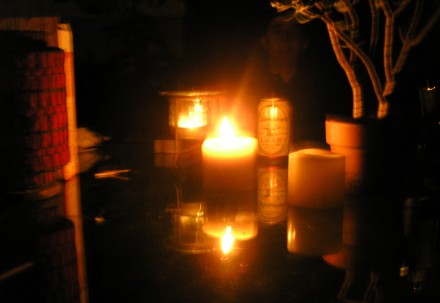
The summer pretty much began in Caroline Gill’s garden, and thus it appropriately played host to a little gathering last night as the season of leisure winds down. The Gills held a splendid little dinner al fresco including Mr. and Mrs. Gill, Caro, Michelle Carroll, yours truly, Mr. and Mrs. Kellogg and their son Doug, who I believe was Caro’s escort when she debuted. (I was unavailable since I was in Scotland at the time, which has been the cause of perennial complaints by Caro). Young Lizzie was absent for the meal but showed up later on in the evening.
Making fun of Caroline is an honored pasttime of mine, and one in which I revel. The Gill household is one in which friendly banter thrives. Last night I also got a chance to inform Mr. Gill that there are innumerable young men in Westchester who consider him something of an icon, and seek to imitate his leisurely lifestyle. Caro complains that I talk to her dad more than to her, which is only half true of course.
Speaking of dads, the aforementioned Michelle Carroll’s pop took her, Helen Clarke, and I out to dinner the night before ‘Hell’s Bells’ (as we sometimes call Helen) fled back to college in Ohio. He took us to a little gem of a place on the New York side of the Byram river in Portchester. Between dinner and dessert, Helen and I walked over the bridge to Connecticut just so I could say as we went back in “sorry we took so long, we went to Connecticut to have a cigarette.”
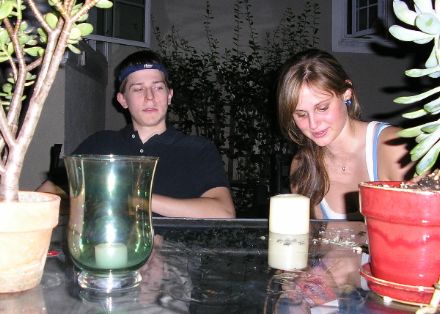
Doug eyes Lizzie’s match-fiddling with suspicion.
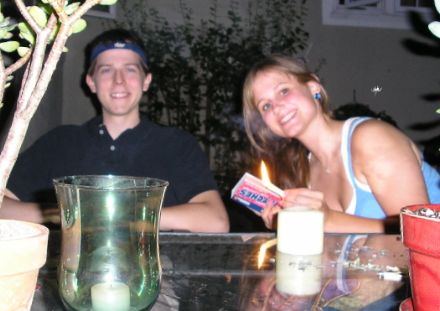
Smiling young Elizabeth about to set her hair alight.

Caroline Gill, brought to you by Poland Spring (“what it means to be from Maine”).
The Mace of the Palmetto State
THE HOUSE OF REPRESENTATIVES OF SOUTH CAROLINA
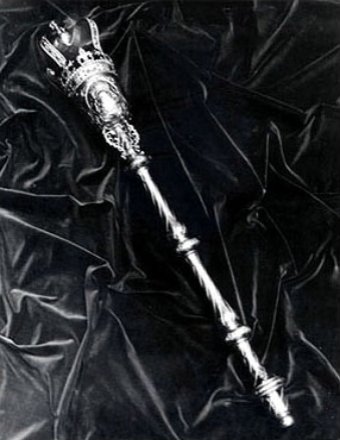
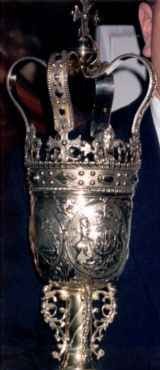 The mace currently used by the lower house of the General Assembly of South Carolina is another fine example of pre-revolutionary legislative regalia. It is a reminder of tradition in a state which takes great pride in its history and heritage. Furthermore, this ancient inheritance is still in everyday use. In 1880 the tradition of the Speaker’s procession was restored and since that year every legislative day has begun with the mace being borne by the Sergeant-at-Arms of the House, followed by the Speaker. When the Speaker reaches his chair in the House chamber, he exchanges bows with the Sergeant-at-Arms, who then places the mace upon its holster before the rostrum, exchanges bows with the Speaker once more, and thence the legislative day is called to commence. Whenever the House and Senate meet in joint session, the Mace is carried at the head of the procession.
When the House is invited by the Senate to ratify passed legislation, the Sergeant-at-Arms bears the mace before the Speaker and the Clerk of the House in a solemn procession through the corridors of the State House, across the rotunda to the Senate chamber. There, it is put in a holding place just below the Sword of State, symbol of authority in the Senate and interesting in its own right, while the Speaker of the House, the President of the Senate, and the Clerks of both houses sign the acts. (more…)
Bisset versus the Banana
My fellow St Andrean Andrew Bisset reports in from auld Caledonia, recently incapacitated by a banana:
Deserved indeed!
Mary Queen of Scots’ Tree
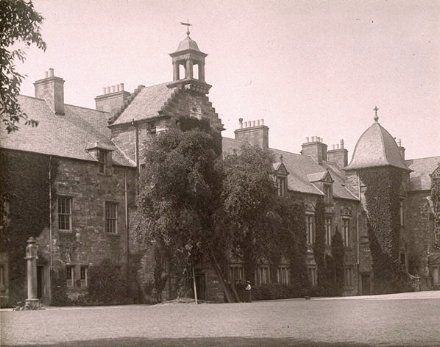
Pursuant to conversations held yesterday afternoon, I give you the thorn tree in the quad of St. Mary’s College, University of St Andrews, planted by Mary Queen of Scots. This photo was taken in the 1930’s, I believe. It looks a little worse for wear these days; rather sickly actually. Wouldn’t be surprised if the University was trying to kill it off as a safety hazard or other such bureaucratic flopdoodle.
Polo

Second international polo match between the United States and the Argentine Republic, 1928.
First Day on the Job

WHA-PSH! WHA-PSH! Behold! The sound of the whip cracking as slavedriver James Panero, associate editor of the New Criterion corrals the newly-minted intern towards his desk. Not even a cubicle! Yes, dear reader, today we started our month-long internship at the venerable institution which the Times Literary Supplement says is “more consistently worth reading than any other magazine in English”.
“File these press clippings!” the seersuckered Mr. Panero commands. “Update the website! Polish the bust of Hilton Kramer! You will KNEEL when Roger Kimball speaks to you!” “Actually, he prefers grovelling,” Dawn Steeves chimes in, ever helpful.
No, no, dear reader, I jest. It is a good office with kindly folk. Roger Kimball even remembered that Russell Kirk went to St Andrews. The building was designed by Stanford White, no less, and is on the same block as the Theodore Roosevelt Birthplace Museum. The office features nice wooden floors, a Persian carpet, and a window specifically designated for Judge Bork to smoke out of when he visits, not to mention a dazzling array of books and periodicals to tempt the studious intern from his internical duties. James Panero and Stefan Beck are apparently working on an anthology of the Dartmouth Review‘s best (TDR is sort of the Neo-Hantonian version of the Mitre, or perhaps vice versa). But we mustn’t turn this into the “weblog” that squeels on the daily habits of todos los Nueva Criterionistas.
The only down side is that I had to pull out of the Leviathan Club trip to Maine. It would be rather nice to spend the days drinking champagne on a rowboat in the middle of a lake pretending to fish, but come on folks, we’ve got high culture to think about here. I hope the other Leviathanonians are enjoying themselves, and spreading the spirit of Gumpus to more northerly climes.
And to think, I used to believe that internships were for suckers. What? Work and not get paid? AH-HAhahaha! Go right ahead, while I take leisurely sips of my gin-and-tonic as I rest salubriously upon the hammock in my garden dabbling in F. Scott Fitzgerald and some Italian detective novels! Well, needless to say, I now realize that internships are not for just suckers. Nay, they are also for charitably-minded individuals who would like to devote some of their free time towards the advancement of Western civilization. Happily, the latter description aptly suits yours truly. I look forward to another day as the lowest rating aboard the S.S. New Criterion. Criterion Nova floreat!
The Church of St Agnes
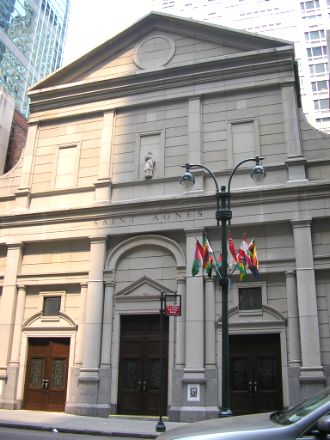
For those who have not seen St Agnes since it was rebuilt in a different style I thought I’d post a few photos I took after the 12:30 mass today. I don’t recall who the architect was; I believe it might be Thomas Gordon Smith. The reason for the vexilla-ed lampost is that East 43rd Street, in addition to being known as “Archbishop Fulton J. Sheen Place”, is also “U.N. Way” since the headquarters of that organisation terminates the vista eastwards. (more…)
Forty-fourth Street

I caught this glimpse of an apartment building on 44th St today, and rather enjoyed the uniform appearance of the glassed-in terraces, later additions I imagine.
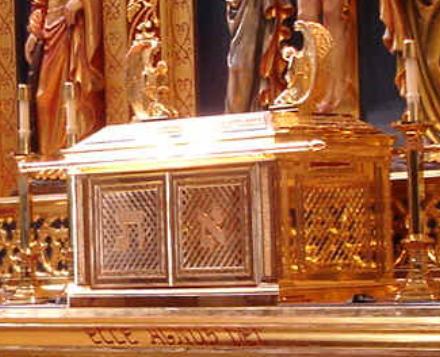
Walsingham Tabernacle

I had not noticed that the tabernacle in the brand new Church of Our Lady of Walsingham in Houston, Texas was a smaller replica of the Ark of the Covenant.
Rather appropriate, considering one of Mary’s titles is ‘Ark of the New Covenant’.
If London Were Like Venice
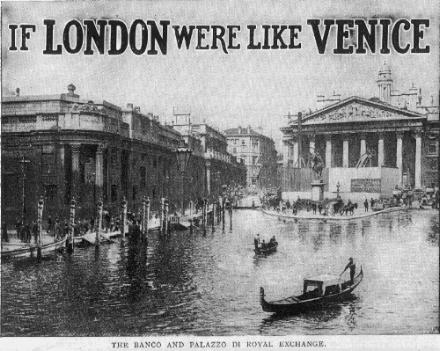
No doubt you remember If London Were Like New York, now we bring you If London Were Like Venice. A rather charming improvement, in my opinion. (more…)
Queens College
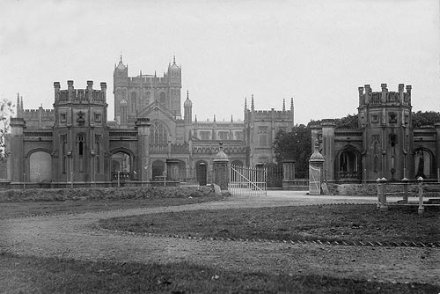
Queens College in Benares, India. Has a rather haunted feel to it in this photo.
St. Edith Stein: Martyr for Truth
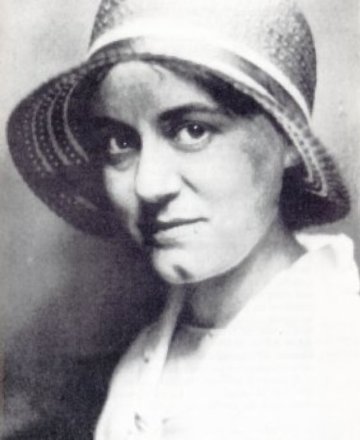
The 20th witnessed great advances in science and medicine. But it was not an era for truth. Research uncovered remarkable facts about the physical world, but philosophers and even average people were gripped by the idea that we cannot know anything for certain. Today, many — especially the most educated — allow that we all have notions of true and false, right and wrong, but that no one can claim anything is really the truth.
It is a hopeful sign, then, is that one 20th-century martyr made an extraordinary journey through modern uncertainties, and not only embraced, but was willing to die for the truth of the Catholic Faith.
Edith Stein was born to a well-off Jewish family in Breslau, Germany. Her father died when she was very young, and her mother was a very devout Jew and powerful woman. Edith early showed exceptional intelligence and, when few women pursued higher education, enrolled at the university. Along the way, she had lost her childhood Jewish faith, but her studies were to lead her to quite an unexpected rediscovery of God. [Continue]
Edith Stein — Convert, Nun, Martyr
Edith Stein is one of those people whose entire life seems to be a sign. She was born on Yom Kippur, the Jewish Day of Atonement, in 1891 in Breslau, Germany (now Wroclaw, Poland), the youngest of eleven children in a devout Jewish family.
When she was not yet two years old her father died suddenly, leaving Edith’s mother to raise the seven remaining children (four had died in childhood) and to manage the family business. Brought up on the Psalms and Proverbs, Stein considered her mother a living example of the strong woman of Proverbs 31, who rises early to care for her family and trade in the marketplace. By her teenage years, Stein no longer practiced her Jewish faith and considered herself an atheist, but she continued to admire her mother’s attitude of total openness toward God. [Continue]
More:
Carmelite Saints – The Life of Edith Stein
Edith Stein: A Brilliant Scholar Called to Share in Both the Virtue and Martyrdom of Christ
Women for Faith and Family – Saint Edith Stein (includes collect prayer, reading, and homily from canonization by John Paul II)
Association of Hebrew Catholics

The Church in China
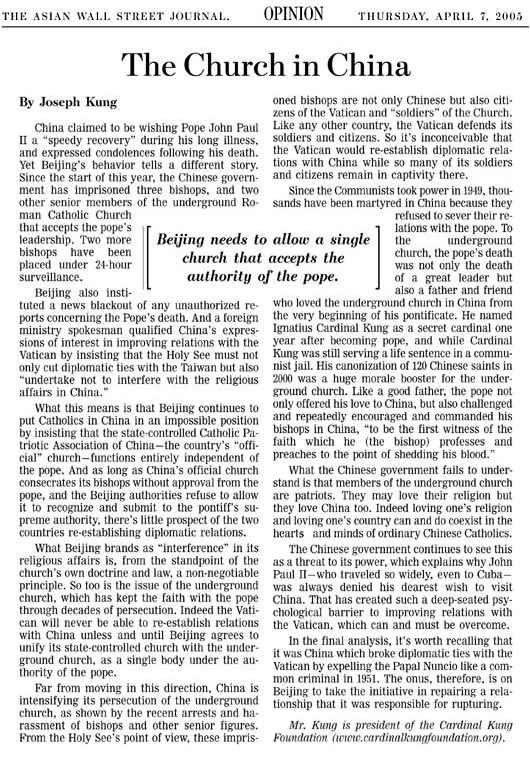
C.f. the Cardinal Kung Foundation.
Crossword Woes
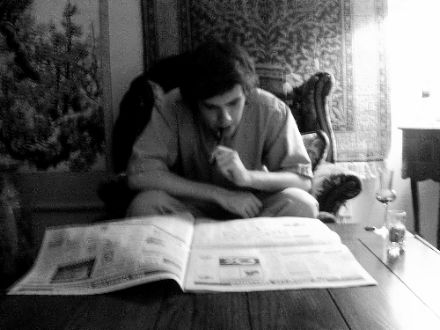
A view of yours truly last night at the Leviathan Club taking a stab at the crossword in the New York Observer. It was a vicious crossword which I found impossible to complete. Vicious, wretched crossword.
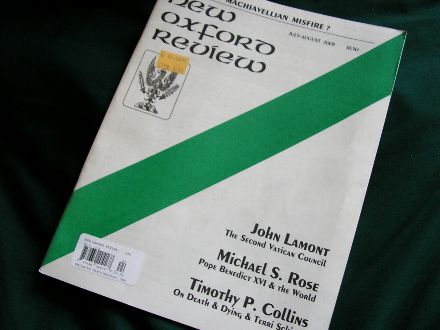
John Lamont in N.O.R.
We had something of a late evening last night at the Leviathan, in which I curiously had the chance to sample – perhaps that word is too modest, imbibe would be more accurate – a port which was, well, not a port. It was a port of New York, and I am not referring to the riparian locus wherein multifarious containers of a universal design speed cheap imported goods from the Orient to our fair city and beyond. Nay, the port was a fortified wine which claimed Long Island as its place of birth. Was it any good? Well, it was a little too fruity for my tastes, but then I’m a man of simple (some would say bland) tastes.
The Leviathan, for those who have not the pleasure of knowing it (which I take to be most of you) is a unique private club open to a select few young gentlemen and their occasional lady guests. It is not so much a club, but a private home which, given the absence of the parents off in foreign climes for rather extended periods of time, has been turned into a private club by the ingenious only child who is its sole permanent inhabitant. The club has a high proportion of members of French Canadian extraction, and features an interesting collection of Russian artifacts, provenance “unknown”.
As I was saying it was a late night, or rather late in Cusack terms as I left at half past one in the morning, and I am told the last members left around the hour of three. I nonetheless awoke this morning and took the train down to Manhattan and heard the resplendent treasure that is the Tridentine mass said in all its glory at the Church of St Agnes.
Whilst jolloping through the Hudson News shop in Grand Central, in the vain hope of being able to flip through a grievously overpriced imported latest edition of Country Life, I stumbled upon the latest issue of the New Oxford Review, the cover of which claimed that an article by John Lamont lay within. Delving into the formerly Anglican now ardent traditionalist Catholic publication I found that indeed it is the John Lamont we know and love. (He is also known as ‘Big John’ owing to his heighth and to differentiate him from the comparitively ‘Little Jon’ Burke).
Anyhow, Big John is the Gifford Research Fellow at St. Mary’s College, the School of Divinity at the University of St Andrews. He and I are seen below in a photo taken by Rebecka Winell at a dinner in the Byre Theatre organized by Miss Victoria Truett in Candlemas term 2004.
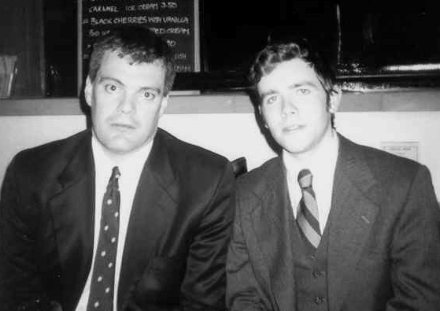
Back in the Day
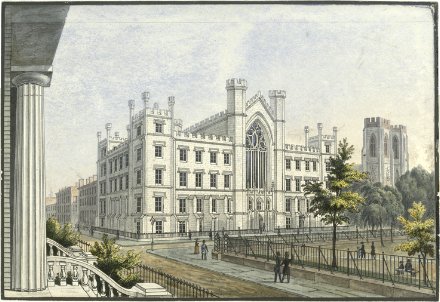
The University of the City of New York (now New York University),
Washington Square, 1850.
‘A Little Madness…’
Our own Professor John Haldane, Scotland’s premier living philosopher (one wonders if he ever tires of hearing that), exhibits his rather wide breadth with an article in the Scotsman, not on his usual topics of heavier import, but rather speaking with Suggs (né Graham MacPherson) of the early-80’s band Madness.
A little Madness is good for you
by JOHN HALDANE
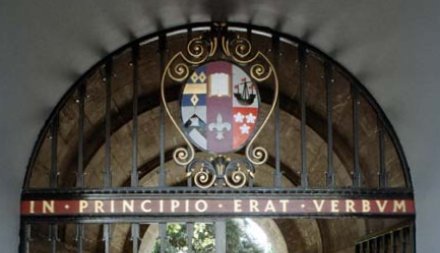
IN PRINCIPIO ERAT VERBUM – The Latin formula translates the opening of the prologue to the Gospel of St John: “In the beginning was the Word”. Cast in iron, the phrase spans the gateway into St Mary’s College, a reminder that a century before its foundation in 1538 the scholars of St Andrews gathered there in a long lost “College of St John”.
Six hundred years later a man in a leather jacket stands in the gateway and passers-by slow down to check that it’s really him: Suggs, lead singer of Madness, the group described as the “missing link” between The Kinks and Blur. A woman with young children stops to shake his hand, a pair of postgrads approach for autographs, even senior academics begin to hover in the background. Earlier, across at St Salvator’s College, it was the same story: seated in a stall of the 15th-century chapel or standing in the cloister, visitors approach; a cleaner makes her way around the quad just to say she thought it was him, and secretarial staff come from their offices.
Public Elitism
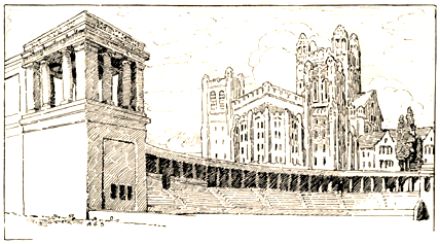
The Manhattan Institute‘s splendid City Journal of Spring 1999 carried an article worth a read entitled ‘How Gotham’s Elite High Schools Escaped the Leveller’s Ax’ on the few quality public schools left in the City of New York and how they managed to stem the tide of egalitarian senselessness.
Egalitarianism is one of the most morally repugnant of all ‘Englightenment’ ideas. To look upon success, label it “unfair” or “racist”, and then demand that, as a sacrifice to the false-goddess Equality, all must fail. It is the typical socialist formula that it is better that all wallow in poverty rather than only some (or even many but not all) succeed.
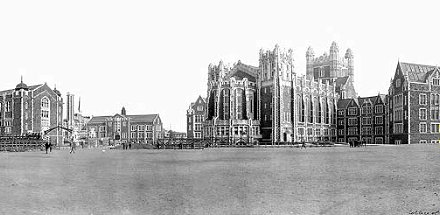
So a number of these high schools have survived. It is perhaps even more of a shame that none of the colleges did. City College was once known as “the poor man’s Columbia”. The quality of education at both City College and Columbia fell as a result of the cultural revolution of the 1960’s and 70’s. Columbia, for the most part free from the fetters of state intervention, never hit rock bottom and in many ways remains a quality institution, despite the highly politicized and racialized nature of many of its students and faculty. City College, however, went into freefall. Admission was thrust open to anyone who had graduated from a New York public high school, which coincided with the lowering of graduation requirements by these high schools. Thus you had students who could barely read and almost certainly could not write attending an institution which prided itself on its many Nobel laureates.
It is testament to the levelling zeal of the angry left that not even one college, not even one, within the entire City University of New York was allowed to maintain high standards of academic achievement. They will tear down with savage avarice the highest ideals of civilization to quench their destructive thirst. And these are colleges which for decades had been the ticket to freedom and success for hundreds and thousands of economically-disadvantaged New Yorkers. (Imagine if they had gotten their hands on the independent places of learning!). No wonder there are so many stupid people in New York these days.
But at least the high schools are still there, and calls for their emasculation are now few and far between. True, they are not ideal, but can we realistically expect a government-tethered school to be as such? Of course not. We should be glad that there remain at least a handful of public academies of high standards in New York available to all – rich, poor, and anywhere in between – based purely on merit.
Search
Instagram: @andcusack
Click here for my Instagram photos.Most Recent Posts
- West Point July 30, 2026
- Brunel’s Unbuilt Capitol February 3, 2026
- Cricket at Fordham January 27, 2026
- Palacio Barolo Revisted January 14, 2026
- Learning to Love Liguria January 14, 2026
Most Recent Comments
Book Wishlist
Monthly Archives
Categories