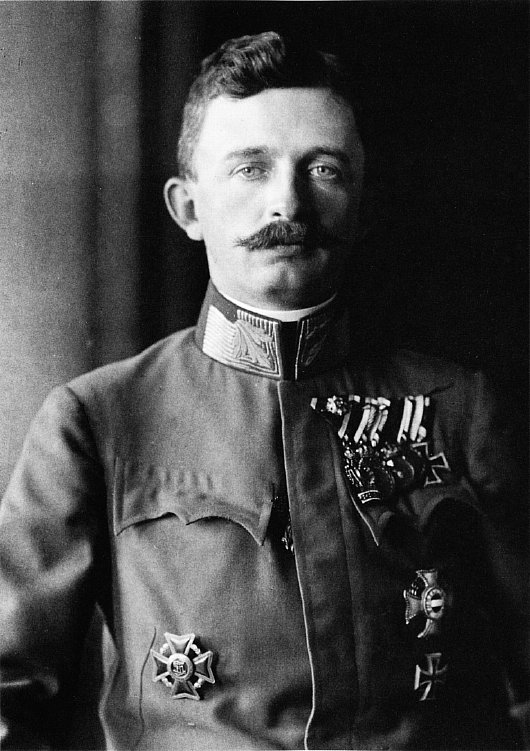
About Andrew Cusack
 Writer, web designer, etc.; born in New York; educated in Argentina, Scotland, and South Africa; now based in London.
 read more
News
Blogs
Reviews & Periodicals
Arts & Design
World
France
Mitteleuropa
Knickerbockers
Argentina
The Levant
Africa
Cape of Good Hope
Netherlands
Scandinavia
Québec
India
Muscovy
Germany
Academica
There’s Nothing Like A Good Fire
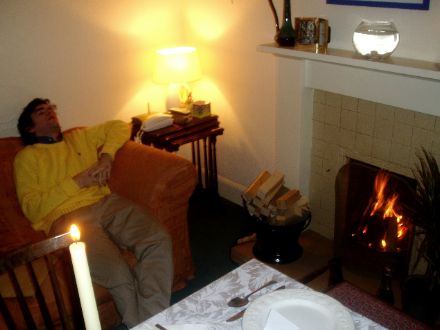
Here we observe the wastrel in his natural habitat: passed out on a sofa in a student flat at the University of St Andrews — the institution with the highest per capita number of wastrels in the British Commonwealth of Nations. In actual fact, Rob & Maria made an official visit up to Andreanopolis this weekend, and Abigail, Adrian, and Pamela graciously through a dinner party in their honour at Step Rock Cottage; Rob and Maria are exiled monarchs of the Catholic dinner party circuit.
The sad thing is this photo was taken before the party even started. I was exhausted from having woken up at 7:00am and spent the entire day rowing at Strathclyde Park that I just dragged myself over to the cottage on Gillespie Wynd at the appointed time in the evening and collapsed on the sofa in front of the crackling fire. It was sublime.
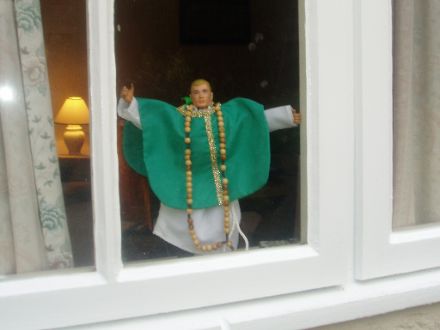
Below you can see Father Freddy, the resident chaplain at Step Rock Cottage, garbed in the appropriate chasuble for the liturgical season. He stands on the window sill blessing the herb garden all day long, or at least he usually does. At the moment he’s on his way to Downside for a retreat.
Old Guardsmen
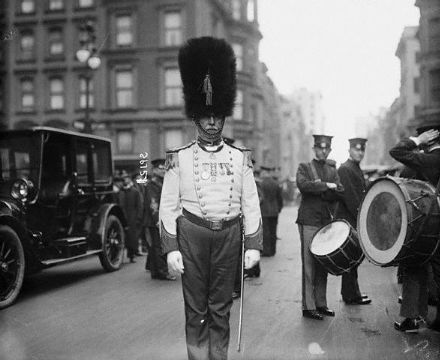
Ardolph Loges Kline, one of my grandfather’s predecessors as Commander of the Old Guard of the City of New York, on the 89th Anniversary of the Old Guard, April 22, 1915. Kline was the acting Mayor of New York who started the annual tradition of lighting the Christmas Tree in City Hall Park (or ‘holiday tree’ as it is now officially called). This ceremony has since been eclipsed in popularity by the Rockefeller Center tree lighting, but still takes place every year.
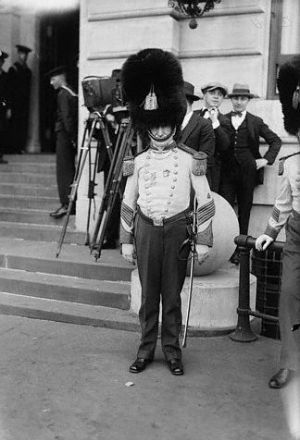
Here we have C.H. Heustis on his 85th birthday in 1922. Heustis served in General Burnside’s brigade during the Civil War, later becoming a broker on Wall Street. He never missed a single meeting or parade of the Old Guard once he joined.
From the Bettmann archive.
Previously: The Old Guard | Grandpa
Chauncey Devereux Stillman
 by Rev. George W. Rutler (via CERC)
Of wealth and war, Chauncey Devereux Stillman (1907-1989) knew much and said little.
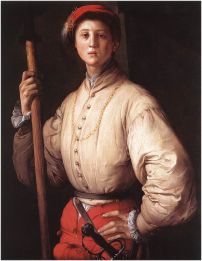
In his country home in Dutchess County, now a museum he endowed, is a youthful portrait that makes it easy to imagine Chauncey in Paris in the Roaring Twenties. In 1942, the future commodore of the New York Yacht Club donated his gorgeous flagship Westerly as a patrol boat on the lookout for German submarines.
Schools and charities flourished by his philanthropy, especially after his embrace of Catholicism. The Gentleman of His Holiness was an efficient cause of many of the Church’s most vigorous new academic and cultural institutions.
The last Mass he heard was in his Madison Avenue apartment, and his whispered request of me was that the sign of peace be omitted “because the butler finds it awkward.” … Continue in full
He’s a Philosopher… and He’s Armed!

Has our former Gifford Research Fellow spent too much time considering jus in bello? Nay, rather John Lamont, aka Big John, sends these photos as proof of his efforts to combat the avian flu business that’s going round.

There’s the culprit! Duly nabbed by JL.
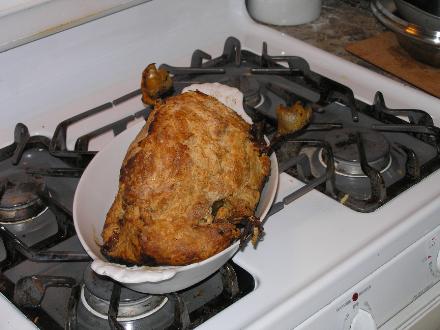
Looks tasty. Rather envious!
Flying the Flag
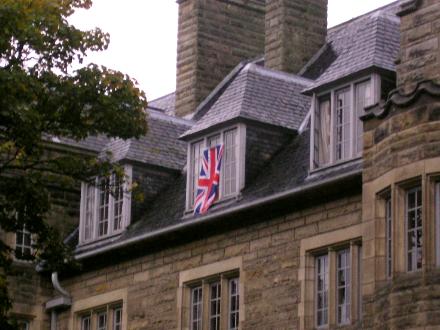
Despite the ban on students flying flags from their windows, I’m happy to say that four students hung Union Jacks out their windows in St Salvator’s Hall today to mark the Battle of Trafalgar. Two were on the front side of hall, two on the back. I took photos of the two on the front side. Mine is above, and the other one below (I don’t know to whom the room belongs).
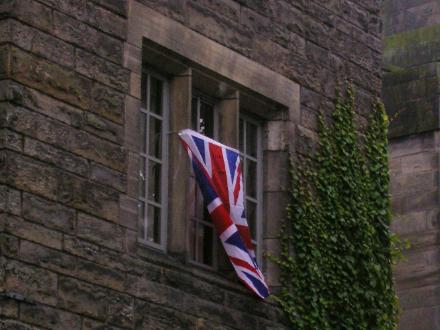
Happy Trafalgar Day!

Twas on this day two centuries ago that the Royal Navy under Lord Nelson gave the combined French and Spanish fleet a right good whalloping, thus ensuring that freedom and responsible constitutional government would flourish and spread for two centuries afterward.
So today we raise a glass to Lord Nelson, and spit on the name Bonaparte! (And Hitler, and Stalin, and Brussels, and any such nastiness the continent dare throw against the English-speaking peoples of the world!).
Arose from out the azure main;
This was the charter of the land,
And guardian angels sang this strain:
Rule, Britannia!
Britannia, rule the waves;
Britons never shall be slaves.
The nations not so blest as thee,
Shall in their turns to tyrants fall;
While thou shalt flourish great and free,
The dread and envy of them all.
Rule, Britannia!
Britannia, rule the waves;
Britons never shall be slaves.
Still mor majestic shalt thou rise,
More dreadful from each foreign stroke;
As the loud blast that tears the skies,
Serves but to root thy native oak.
Rule, Britannia!
Britannia, rule the waves;
Britons never shall be slaves.
Thee haughty tyrants ne’er shall tame,
All their attempts to bend thee down;
Will but arouse thy generous flame,
But work their woe, and thy renown.
Rule, Britannia!
Britannia, rule the waves;
Britons never shall be slaves.
To thee belongs the rural reign,
They cities shall with commerce shine;
All thine shall be the subject main,
And every shore it circles thine.
Rule, Britannia!
Britannia, rule the waves;
Britons never shall be slaves.
The Muses, still with freedom found,
Shall to thy happy coast repair;
Blest Isle! With matchless beauty crowned,
And manly hearts to guide the fair.
Rule, Britannia!
Britannia, rule the waves;
Britons never shall be slaves.
Message from Iraq
George, Cockburn the Younger, and yours truly were sitting in the pub this evening when George got a text message on his phone from none other than 2Lt. W. Calderhead, currently serving in Iraq. It read something like
Very non-chalant. Very Calderhead. Anyhow, a package of goodies shall be heading Bill’s way quite soon.
Is Andrew Cusack a Wastrel?
Tonight a very intelligent friend of mine informed me that she believes I am a wastrel and that I have squandered my university years. I found this very interesting (and a tad funny), considering that it is my firm belief that I have gotten more out of my years at St Andrews than I had ever expected I would. Are there regrets, should’ves, and why-didn’t-I’s? Of course. Hindsight, after all, is 20/20, but I do not regret my relative inattention to grades.
It all comes down to standards. By whose standards does one judge a quartet of university years? I believe that there are a number of ways to measure success, or the lack thereof, during one’s time at university. I myself have never found the pursuit of academic achievement particularly fulfilling. This is not to say I think it is a bad thing; by no means. I have the utmost respect for my friends who excel academically. I always found, for example, David Taylor’s record of achievement particularly worthy of respect and admiration, especially considering he was neither a recluse nor socially awkward. But I think excellence in academics should not be the only way to judge a university career. Whether this is self-serving because I have not excelled academically I leave up to the reader to decide.
In my St Andrews years, so far, I’ve founded, edited, and managed a successful newspaper which has earned high accolades, I’ve co-founded a literary review, I’ve donated my time to committees for multiple terms despite finding it particularly distasteful and unenjoyable, I’ve been president of a private club (which involves not only working with a committee but coördinating and directing it while also having to maintain continuity with the traditions of the group and not peeve the members), I’ve had some pretty good nights on the town, I’ve made friendships that I know will last a lifetime, I’ve (lately) taken up a sporting activity conscienciously, most importantly I’ve done my utmost to be a good Christian as well as to note when, where, and how I have fallen short of that ideal in order to prevent future failings, and on top of all these non-academic things, I have learnt a great deal of knowledge. I don’t have the grades to show for it because I never felt the need to justify what I have learnt and how I have learnt it to an external examiner, besides which much (if not most) of my learning of history, philosophy, and culture during my university years to date has been outside the framework of my courses.
In my view, what I have managed to do in my years is worthwhile and should not be discounted. In comparison to getting 17s, 18s, and 19s in every course, while being social and doing just a few extracurriculur things on the side, I prefer my track record instead. I nonetheless think that both are admirable and worthwhile approaches to university. Contrarily, the young lady in question believes that the academic must be the only important yardstick used to judge these years, and consequently she thinks I a wastrel and strongly disapproves.
(I hope, dear reader, that you will not regard this entry as an exercise in ‘navel-gazing’, as they say. I am not a very self-reflecting, overanalytical person. I am not highly critical of myself, nor do I let myself off easily. It did not particularly irritate, offend, or wound me that I am thought by at least one intelligent person to be a wastrel, but I found it a good opportunity for debate and discussion and so have put forth my view accordingly.)
The Old Guard
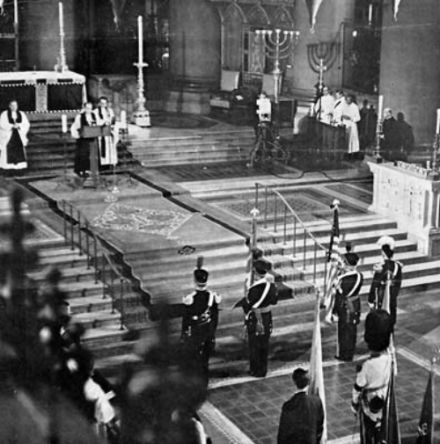
The above photograph shows a 1963 service in the Cathedral of St. John the Divine, New York. Closest to the sanctuary are four members of the Veteran Corps of Artillery, State of New York, but behind them can be scene a member of the Old Guard of the City of New York. The VCA, of which my Uncle Matt (a frequent commenter upon this site) is a member, is older, being founded in 1790. The Old Guard dates from 1826, and Uncle Matt’s father (my grandpa) was Commadant of that august group. There’s a great photo of my father as a small child gazing up at his father in Old Guard uniform including the tall bearskin busby. Perhaps Pop will scan it sometime, else I will get around to it when I’m back in the States.
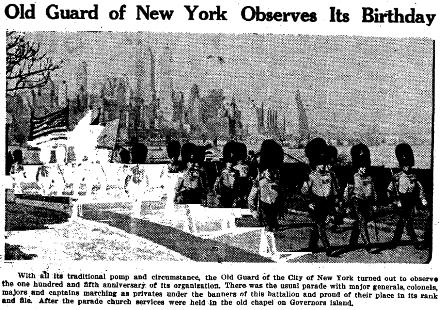
With all its traditional pomp and circumstance, the Old Guard of the City of New York turned out to observe the one hundred and fifth anniversary of its organization. There was the usual parade with major generals, colonels, majors, and captains marching as privates under the banners of this battalion and proud of their place in its rank and file. After the parade church services were held in the old chapel on Governors Island.
(A bad copy from The Sun, Fort Covington, NY, 1931)
Some Exceptionally Random Photos
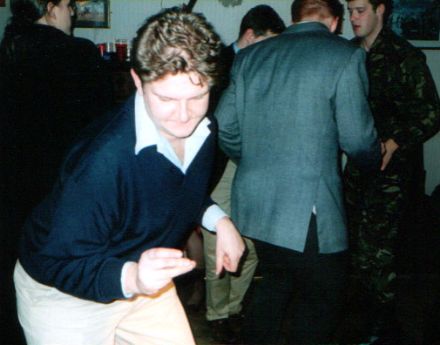
Clive jiving in the Mess.
A Ground-floor Flat in Greyfriars Gardens
I THINK IT WAS Cousin Jasper in Brideshead Revisited who told Charles Ryder to switch his ground-floor rooms for a more suitable arrangement. Charles, of course, failed to heed his elder cousin’s advice, and last night I couldn’t help but wonder if the inhabitants of a ground floor flat on Greyfriars Gardens wished they had been given a similar recommendation. An assemblage of young gentlemen, having moved from one pub to another and then making their way down Greyfriars stumbled upon an open window and, discovering that merriment was ongoing within, took it upon themselves to use that very portal as a mode of entrance. Quite succesfully, I might add, for it was a very wide window and not terribly high up. Upon gaining entrance, they proceeded to join in the merriment, which chiefly revolved around a triumvirate of good conversation, bad wine, and pretty young ladies. (I managed to inculcate one in the history of the Order of Malta). I ran into fellow oarsman Rory Mcdonald (who, despite his Scottish name, is from Norfolk) with his academic mother who dropped a coin in my beverage and told me I had to save the Queen from drowning by downing my glass right then and there. I took my time (God bless Her Majesty, but she’s only a Saxe-Coburg).
The evening had begun a few hours previous in the Chariots bar with yours truly, George, J.E.B., Ben, Tom Marshall, Rorie, Cockburn the Younger (worse for wear having been dealt a dirty pint in the Mess the night previous to celebrate his birthday), a rather confused ‘Dougal’ in black tie, Jon Burke (legend), Manuel, Cameron (President of Fin Fur & Feather), a chap named Will, and someone else I’m quite sure. Apparently J.E.B.’s going to reconquer India and I’ll be made Viceroy. This was decided as some sort of recompense for India going republican before Enoch Powell could be appointed to the viceregal throne. A brilliant linguist, it was his life’s ambition until ’47, and he was heartbroken when it became impossible. Ego sum linguiste très mal, but I don’t think I’d mind the job. Surely it just involves officially opening schools and hospitals and such, spending the rest of the time napping through cricket matches and sitting in a club sipping G&T’s and saying in a firm, authoritative voice “The sun never sets on the British Empire”. Comes with nice digs as well, designed by Lutyens. There are worse jobs, no doubt. Anyhow there was some bloody good chat, excellent banter.
Intelligence reports indicating that 1 Golf Place was overcrowded we decided not to make our way there to enjoy their two-pint steins, and so headed to the Tudor Inn (a rather townie pub) instead. There we ran into some Germans (Hamburgers, even) in town for the golf and spoke with them. Ed tried to speak to them in his broken German; somehow the term ‘Britischer Wehrmacht’ doesn’t seem quite the right translation. We tried to give them a bit of British culture by singing “I Vow To Thee, My Country” but it literally drove half the punters out of the pub, and the barman asked us to desist. It was then we sought out proposals for further enjoyment in alternative locations, and decided to move the forces southward accordingly. Twas then, of course, we discovered the open window in Greyfriars Gardens and good times ensued.
Stanford White Palazzo
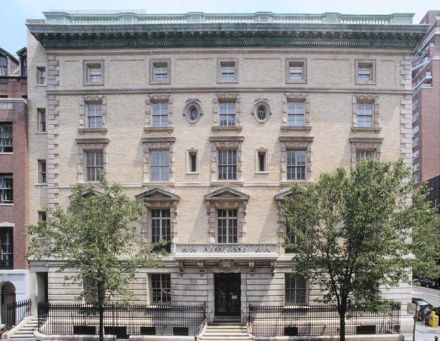
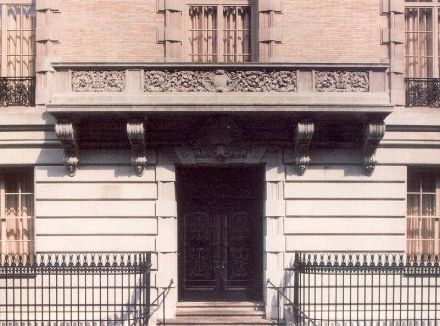
Got $50,000,000 to spare? Why not buy this Stanford White original on East 78th Street in Manhattan? Would be suitable for residence, offices, or club quarters. Even includes balcony from which fearless leader can make inspiring demagogic speeches. Who can resist? Contact Sotheby’s International Realty for details.
A Tower of Tradition in Suffolk
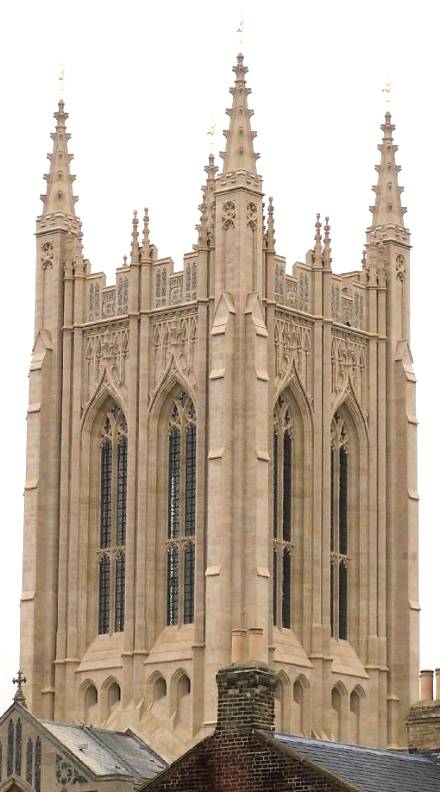
THE LAST UNFINISHED cathedral in the Church of England was finally finished this year with the completion of the crossing tower of St. Edmundsbury Cathedral. The tower was not only designed in the Suffolk perpindicular style but also constructed using traditional techniques. The brick and masonry spire is held together by lime mortar, without an inch of steel or concrete.
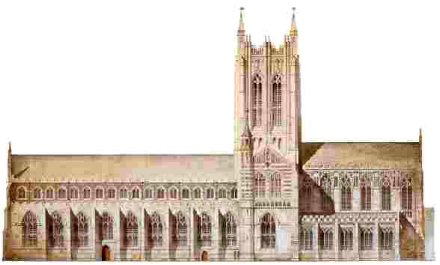
The Cathedral is built on the grounds which still contain the ruins of the great abbey of Bury St Edmunds. The site of the current cathedral has held a church since 1065, completely rebuilt on three or four occasions. The current chancel dated from 1865, while the nave was begun centuries before in 1503. (more…)
A Wednesday Night in St Andrews
LAST NIGHT WAS, shall we say, a doozy. It began about half past eight when I sauntered over to the flat of George Ronald Valentine Hastings Irwin in Southgait Hall. (Astute followers of the Cossack will recall that I lived in the same building last year). George Ronald Valentine Hastings Irwin wasn’t in, as he was busy instructing young’uns how to kill, but C. was in since he’s been up visiting for the past few days. We cracked open some beers and watched the second half of an episode of Law and Order before heading over to Wyvern (HQ A Sqd, TUOTC) for some Wednesday evening revelry in the Mess.
The Mess, as we all know, is an oasis of old-school fun in our ever-changing world. Eventually a poker game broke out in the anteroom; an entertaining little melée involving yours truly, the Infamous C., George Ronald Valentine Hastings Irwin, Phil Evans, Cockburn the Younger, Alex Findlay, and a chap named Will. Now, I am a rubbish poker player and so accordingly am I a rare poker player, even more so if money is involved. Nonetheless, the buy-in was cheap so I gave it a go, failed miserably but bought in again and twas then that Fortuna began to smile upon my adventures. C. is quite proud of his poker-playing abilities, but I managed to bluff him into betting everything he had then hit him with the nasty surprise of my triumvirate of aces. Kicked out of the game by Cusack – that’s got to be embarassing. The man looked as if he’d just been told his prize-winning horse had just been eaten by an erstwhile Chechen terrorist who mistook it for one of the King’s Troop. He went back into the Mess in hopes of elevating the chat there (a handfull of souls had wandered into the anteroom informing us of the poor state of chat next door). A little while afterwards I managed to goad George into a large stake and deprived him of it quite readily. There was nothing on the table but I had ace-9, he had ace-2. Bummer for him!
There I was, drunk as a lord and rich as a Russian oligarch (or would’ve been if the chips were oil company shares). The others slowly ran out of capital and it was finally down to George, Alex (or was it Phil?), and yours truly. I was in the lead and decided to play it safe, but Phil (I think it was Phil, Alex was out earlier) went all in against George and lost, putting Georgie boy in the lead. (No, actually it was Alex, not Phil). We agreed to end at a quarter to 12:00, and so did, splitting the meagre winnings proportionally betwixt the two of us. Cockburn the Younger was quite upset with my victory and kept grunting “bloody colonial!” much in the same vein as Cockburn the Elder would were he present. Fine game, fine game.
We crossed the hall to return to the last few minutes of Mess time and witnessed some forfeits in process and joined in some bawdy singing. Now at midnight the bell’s rung, the glasses are put down, the Sergeant Major yells and the fun’s over. And had that been the end of the evening it still would’ve been a splendid one… were it not for those two words: after party. Now, that after parties can be splendid things I will certainly concede. But in my old age I prefer to be in bed reading E. Digby Baltzell by 11:00 and here it was, past midnight, and I was still out. Nonetheless, being taken by the festive spirit and with C. being up I thought to myself “After party? What the hey! Why not…” And thus a procession of students varyingly attired in camoflouge uniforms, blue blazers, or tweed jackets snaked its way towards the flat in Wallace Street shared by OCDT Charlie Hazlerigg and WOCDT Jen Stewart.
We were greeted by a little white terrier named Helen I think, though I referred to it constantly as Mackintosh for reasons no longer contained within my knowledge. It was a good after-party with some good chat and I’m not quite sure what time it was when I left, but I think it may have been nearly two in the morning. Somewhere in this equation I ran into a gaggle of gowned debaters, Miss Jennings among them in her gown of office as Education Officer of the Students Association. I confiscated the gown, donned it myself, and apparently, flailing my arms about and running around, announced to all of South Street that I was the Education Officer until Henry Evans (sometime head of the Conservative and Unionist Association) re-requisitioned it and returned it to its rightful bearer. We also ran into some Australians who agreed with me that Boston is a very silly place. I’m told that was around 2:00am.
Curiously as I finally made my way back to Sallies, I ran into Dr. Jens Timmerman. He had only just left Edgecliffe (the home of the School of Philosophy) and was on his way home. Dr. Timmerman is absolutely brilliant. One half wonders what he was up to in his office, with his 1925 Triumph typewriter, Keble College straw boater, and deep crimson doctoral cap and gown from the University of Göttingen. Musing on Kant, no doubt. (Dr. Timmerman is an expert on and devotée of Kant). I’m sure I’ll see him at the Kens club dinner on Saturday.
And then, finally, home, sleep, and the comfort of one’s own bed. There are few things as priceless as that.
A Hop Over to Cusack’s Room
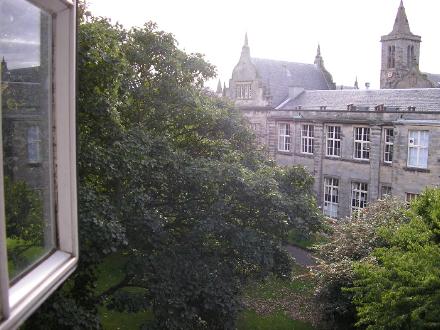
Dear friends, I have been absent from the “world wide web” of late owing to technological discrepancies. Rest assured by health and faith are still strong. No doubt you have felt a distinct lack during the past few days, which I hope to remedy by showing you a few photos of the locus in which my quotidian adventures take place.
Above is the view from the reading ledge by my window. A rather nifty thing, which obliges the requirements for some occasional fresh air along with an advantageous location from which to glance down upon the Principal’s Lawn (There’s a fine if he catches you treading on his little green patch).
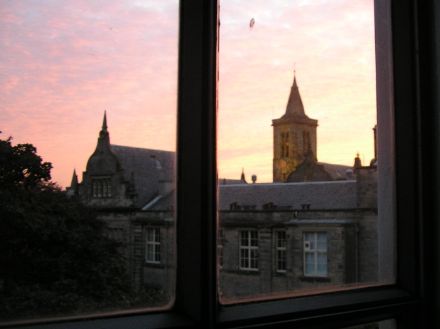
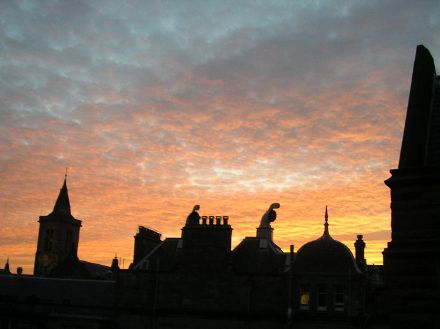
Sunset from the Cusack chamber. (more…)
‘The City of Golf’
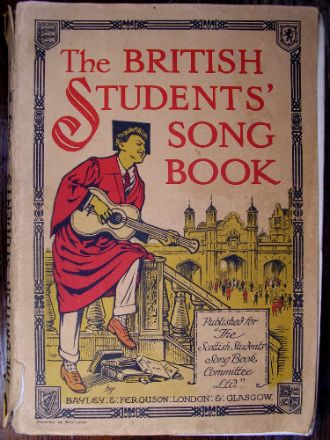
From the British Students Song Book:
Soul and body, to a tyrannising game?
If you would, there’s little need to be a rover,
For St Andrews is the abject city’s name.
It is surely quite superfluous to mention,
To a person who has been here half an hour,
That Golf is what engrosses the attention
Of the people, with an all absorbing power.
Rich and poor alike are smitten with the fever;
Their business and religion is to play;
And a man is scarcely deemed a true believer,
Unless he goes at least a round a day.
The city boasts an old and learned college,
Where you’d think the leading industry was Greek;
Even there the favoured instruments of knowledge
Are a driver and a putter and a cleek.
Golf, golf, golf – is all the story!
In despair my overburdened spirit sinks,
Till I wish that every golfer was in glory,
And I pray the sea may overflow the links.
One slender, straggling ray of consolation
Sustains me, very feeble though it be:
There are two who still escape infatuation,
My friend M’Foozle’s one, the other’s me.
As I write the words, M’Foozle enters blushing,
With a brassy and an iron in his hand…
This blow, so unexpected and so crushing,
Is more than I am able to withstand.
So now it but remains for me to die, sir.
Stay! There is another course I may pursue–
And perhaps upon the whole it would be wiser–
I will yield to fate and be a golfer too!
Dartmouth Craziness
The New Criterion‘s Stefan Beck (black iced coffee, no sugar) has an excellent little ditty in National Review on a little brouhaha up in Hanover, New Hampshire. It makes me somewhat glad that I go to a university where religion is generally met with the rolling of the eyes or a quick nap rather than modernist ire and indignation.
The First Sunday of Martinmas Term
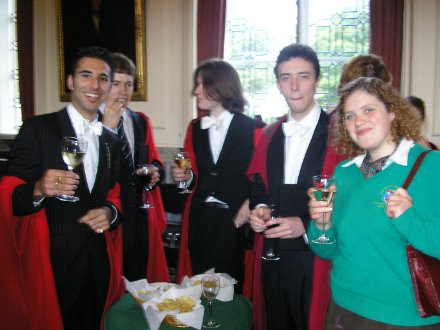
Today is the first Sunday and term and so after breakfasting in hall (a modest meal of bacon, hash-brown, and apple juice) I donned the old three-piece and gown and hopped over to Chapel for the first service of term. Chapel was packed to the brim almost, a very good showing, and as the Principal entered the Chapel following the mace-bearing Bedellus he had a very self-satisfied chagrin on, and nodded to himself no doubt reflecting upon the ancient glories of our university.
We were sadly informed that a student had died over the summer, killed in a car crash in France. Strangely enough, the same thing happened the summer before last when a very popular student died in a crash in Provence.
Other than that sad news, the service was of the usual feel-good traditional mainline psuedo-Protestant ilk that they are at St Andrews, the most interesting interesting part of which was when the University Chaplain, the Rev. Dr. James Walker, announced that our new hymnals had yet to arrive owing to a strike at the plant in Finland where they’re printed. I ran into J.E.B. tweeded and gowned, as we were exiting the service and he inquired as to whether I was “seeking religious inspiration when I had my eyes closed during the sermon or whether I was just nodding off.” I will leave our readers to guess.
Afterwards, instead of the usual post-chapel sherry in the Hebdomadar’s Chamber, the Principal hosted a little reception in Lower College Hall (from which, photographs above and below). (more…)
A Gothic Abbey in Virginia
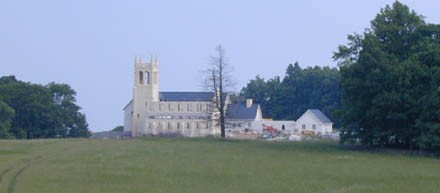
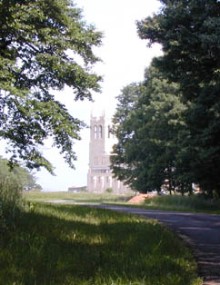
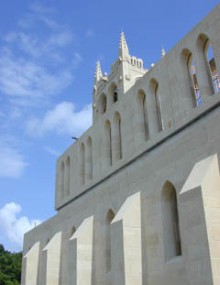
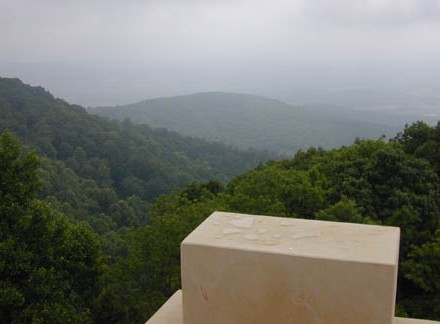
HDB/Cram and Ferguson has designed a Gothic abbey for an apparently schismatic Benedictine congregation in the mists of the Blue Ridge mountains of Virginia. It looks as if it will be very beautiful when finished but, alas, will not be open to the public as these Benedictines seem to greatly value their privacy. See the article, ‘In Virginia, a monastery rises in the mountains‘ (Associated Press, 2004).
Search
Instagram: @andcusack
Click here for my Instagram photos.Most Recent Posts
- West Point July 30, 2026
- Brunel’s Unbuilt Capitol February 3, 2026
- Cricket at Fordham January 27, 2026
- Palacio Barolo Revisted January 14, 2026
- Learning to Love Liguria January 14, 2026
Most Recent Comments
Book Wishlist
Monthly Archives
Categories