About Andrew Cusack
 Writer, web designer, etc.; born in New York; educated in Argentina, Scotland, and South Africa; now based in London.
 read more
News
Blogs
Reviews & Periodicals
Arts & Design
World
France
Mitteleuropa
Knickerbockers
Argentina
The Levant
Africa
Cape of Good Hope
Netherlands
Scandinavia
Québec
India
Muscovy
Germany
Academica
Archduke Carl Ludwig, 1918-2007
Son of Blessed Charles, U.S. Army Veteran, Fought at Normandy
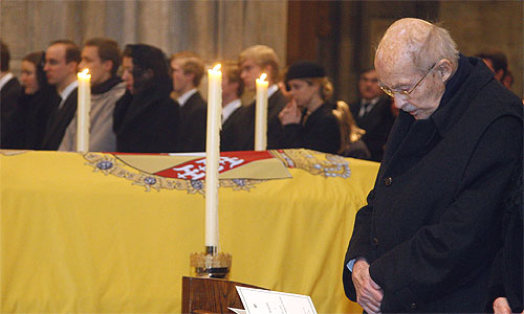
A READER WAS kind enough to bring to my attention the recent death of His Imperial & Royal Highness, Archduke Carl Ludwig Maria Franz Joseph Michael Gabriel Antonius Robert Stephan Pius Gregor Ignatius Markus d’Aviano of Austria, one of the sons of Blessed Charles, the last (up to this point) Emperor of Austria, Apostolic King of Hungary, King of Bohemia, etc. Carl Ludwig’s birth in 1918 was hailed with a 101-gun salute from the imperial field artillery, but the Habsburgs were soon overthrown by a republican element in Vienna and forced into exile. The Archduke studied at the University of Louvain until the outbreak of the Second World War, when the Habsburgs fled to the safety of Quebec.
There, the family were so poor they sometimes had to survive off a soup the Empress Zita cheerfully prepared from dandelions picked in the park. Carl Ludwig, however, was able to complete his studies at the Université Laval, the oldest university in Canada, before being allowed to join the United States Army in 1943. On June 6, 1944, he took part in the D-Day landings in Normandy, and later became aide-de-camp to the Comte de Hauteclocque, a general in the Free French Forces (later known as Maréchal Leclerc), and served with the Algerian spahis. He was discharged from the U.S. Army with the rank of Major in 1947, and in 1950 married Princess Yolande de Ligne.
Christological Vexillology in Louisiana
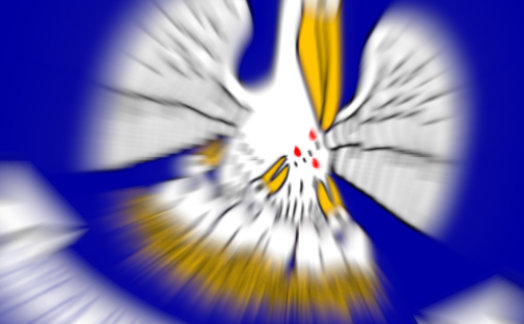
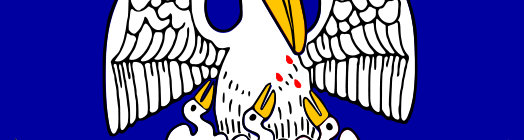
SINCE BOBBY JINDAL, a traditional Catholic and sometime New Oxford Review contributor, today became the eighty-fourth Governor of Louisiana (sixty-first of the republican era), we decided to share with you the interesting development regarding the Louisiana state flag. Louisiana’s flag consists of a pelican displayed with a scroll bearing the state motto of “Union, Justice, and Confidence”. Heraldically, the pelican is known as a “pelican-in-her-piety” depicting the mother pelican piercing her breast to offer her own blood as sustenance to her children. The “pelican-in-her-piety” is a traditionally Christian symbol meant to parallel Christ’s sacrifice, and so this is why you sometimes see representations of pelicans in churches.

It seems that from about the 1900s onwards, the droplets of blood on the pelican’s breast gradually ceased to be displayed, somewhat diminishing the Christological nature of the state emblem. However, one astute eighth-grader at Vandebilt Catholic High School in Houma, the parish seat of Terrebonne Parish (remember that in la Louisiane counties are called parishes), noticed this problem and informed his representative in the state’s lower house. In April 2006, the Louisiana State Legislature passed an act requiring three drops of blood to be depicted on the pelican, both in the flag and the state seal, and so the significance of the the pelican-in-her-piety is now restored.
The long and the short of it
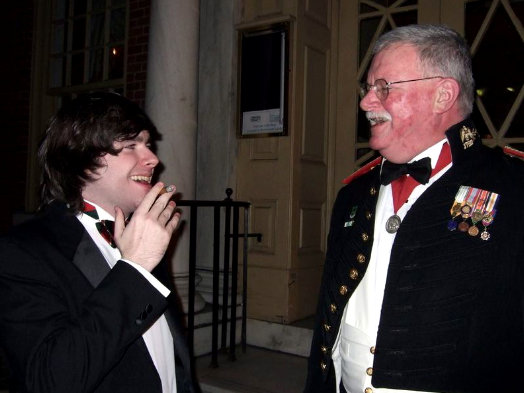
My Uncle Matt and I share a joke outside Fraunces Tavern while the 218th Annual Mess Dinner of the Veteran Corps of Artillery takes place inside.
And before anyone comments, yes I know I need a haircut! (Photo courtesy of Mike Leventhal)
Boullée’s Opera
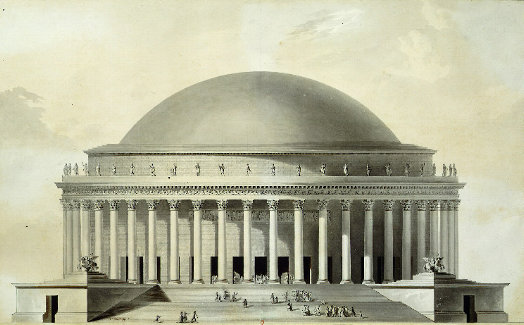
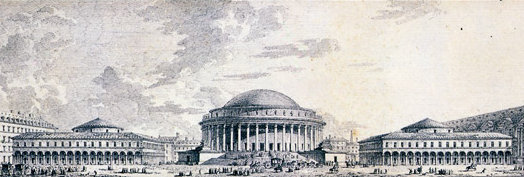
ÉTIENNE-LOUIS BOULLÉE was an architect whose great influence can chiefly be attributed more to his unexecuted designs than to those that were actually constructed. His most famous creation is the Cenotaph to Isaac Newton of 1784, conceived but never built. Many of his designs — especially his plan for a metropolitan basilica — exude a certain feeling as cold and soulless as can be expressed within the welcome restraints of classicism. One of his museum designs is almost proto-secessionist. But I am rather fond of his design for an opera house.
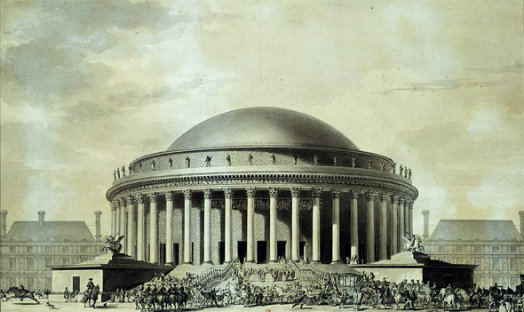
The perennial problem with opera house design is the flyspace: the large area above the stage into which elements of the set design can be lifted to change scenes during a performance. Garnier’s Paris Opera House uses a recessed pediment for its flyspace, while the Teatro Colon has a consistent sloped roof the length of the building tall enough to conceal the space. The modernist Metropolitan Opera House at Lincoln Center here in New York has a bland rectangular box stuck on top. At first, you glance at the exterior of Boullée’s design and think “Where’s the flyspace?” Boullée’s solution was simply to design on a scale large enough to encase the entire auditorium, stage, and flyspace in a single unified domed structure.
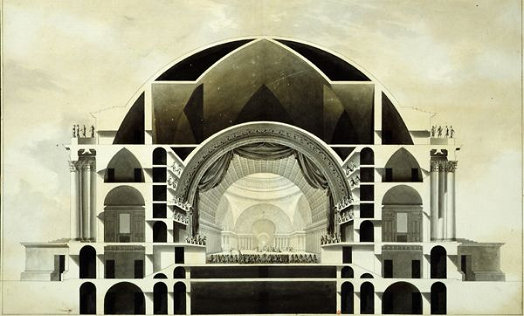
A sectional view towards the proscenium.
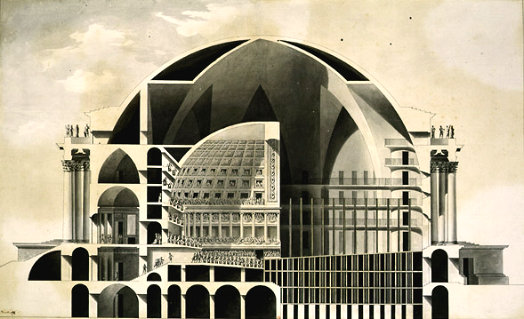
A cross-section from the side showing the auditorium on the left and the stage on the right.
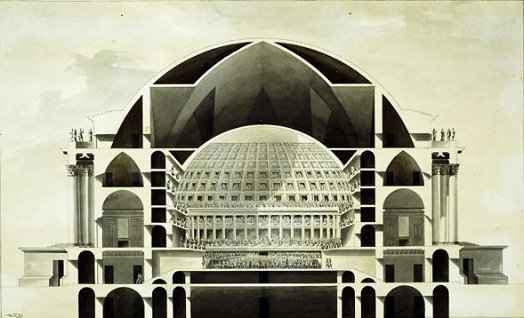
A sectional view looking from the stage towards the auditorium.

While Boullée’s opera was never built, I’ve often thought it had something of an imitator in the opera house of Novosibirsk, Russia’s third-largest city. The Novosibirsk State Academic Opera and Ballet Theatre is the largest theater in all of Russia and is located right at the center of the Siberian capital (which, founded in 1893, had originally been known as Novonikolayevsk, after Czar St. Nicholas II).
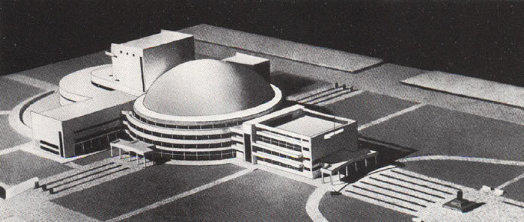
The first scheme for the Novosibirsk opera house was a modernist design drawn up in the 1930’s.
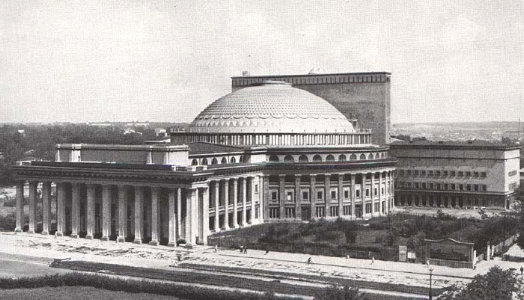
A classical design won the day, however, and the building was completed in 1945. As you can see, the Novosibirsk structure fails to follow Boullée in unifying the entire opera house under a single dome, but rather opts for the more pragmatic if less handsome separate flyspace. (Interestingly, the ratio of its dome’s thickness to its radius is less than that of a typical chicken egg). I still hope someone comes around and fulfills Boullée’s plan.
The Victory That Conquers
the World is Our Faith
BACK IN SCOTLAND, there is a cinema I once attended often that served from its snack bar the most watered-down soda in the world. It was still recognizable as cola of some kind, but was watered down to such an extent that, while one wanted a cool refreshing Coke, that was not what was on offer. Consequently, few people took advantage of it. And so it is with the Faith (no, really!). In the past half-century there have been many who have sought to water down Christianity. Sometimes inauspicious clerics (and others) hoped that if we just dumped or ignored this or that part of Christ’s teaching we would be able to win so many more souls for Christ. Sometimes it was an evil attempt to sow the seeds of doubt among the faithful. Sometimes it was an hubristic attempt by the created to overcome the Creator.
The watering down of the Faith, nonetheless, has never produced a more fruitful and more holy church. Everywhere it has been attempted, the result has been confusion and dissension, instead of the concord and unity which God brings to His people. Christ himself taught that “not one iota” — to put it in modern terms, not one cell, not one atom — of God’s teaching would be changed (Mt 5:18).
It is heartening, then, though not at all surprising, to see throughout much of the world a certain reinvigoration in the Church, under the guidance of our Holy Father, Pope Benedict XVI. Hearts once thought to be cold as stone have warmed, and fields which once produced only chaff have yielded wheat. From surprising quarters, we hear more and more good news, and the root cause is the unashamed and unabashed proclamation of the Gospel. Pope Benedict is not interested in scolding sinners, but rather in encouraging their repentance and bringing them closer to our Divine Saviour. First and foremost is our love of God, a love which grows stronger and deeper when we live in accordance with that love. Then there is our natural love for one another, which results in our zeal that our friends, family and loved ones should share in that wonderful love of God.
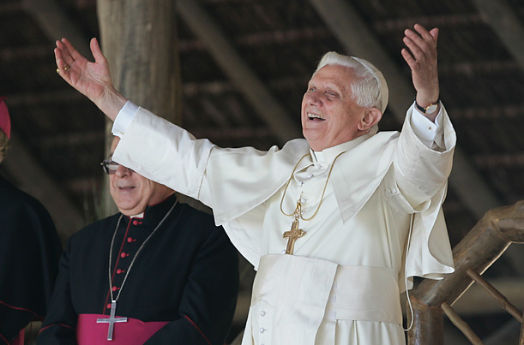
John Allen, the veteran Rome correspondent, has termed this Benedict’s “affirmative orthodoxy”:
Wherever this affirmative orthodoxy has been maintained, or reintroduced, it has borne fruit.
Grand Central in the Good Old Days
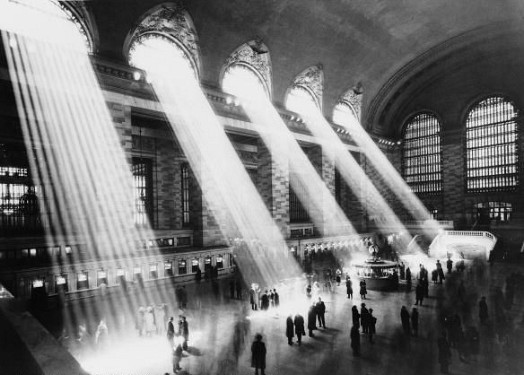
“Give me rail travel, trans-Atlantic liners, and electric cars and you will have Taki on your side,” writes our favorite Greek philosopher over on his online magazine. The invocation of rail transportation prompted one reader, Mr. Roland Maruska, to send in his response to Taki’s call:
I worked in the Central’s General Claims Attorney’s office at 466 Lexington Avenue in 1967 and 1968 and had enormous respect for my boss, Mr. J.T. Lynch, a fine man and World War II veteran. I learned first hand about sleazy lawyers and outrageous lawsuits, my favorite being the one brought by a woman who tried to commit suicide by jumping off a moving train, then, having failed, sued the railroad for not keeping the coach doors locked.
After work on Friday nights it was off to The Cattleman with friends for a small glass of brandy on the house (if one had to wait too long to be seated), a steak, and last a cigar, again on the house, then to the Railroad Enthusiasts club, which had its own room in Grand Central Terminal, in perpetuity due to the generosity of the railroad. Later some of us would head over to the Oyster Bar for a late night cocktail and hors d’oeuvres ( I hope I didn’t shock Taki with that one.), the latter courtesy of the excellent manager Mr. Drummond.
Ah, memories.
Previously: Grand Central Station at Night
Christ the King in Chicago
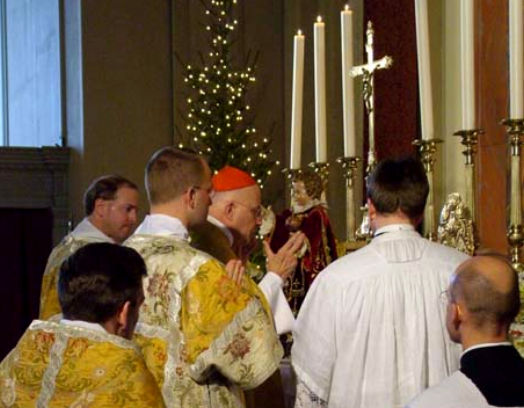
Francis Cardinal George, the Archbishop of Chicago, has participated in the coronation and enthronement of a statue of the Holy Child at the new Shrine of Christ the King in that city. The church, formerly dedicated to St. Gelasius and St. Clara, was entrusted to the Institute of Christ the King Sovereign Priest, a group of priests dedicated to offering the traditional Latin Mass. The church had been shut down many years ago and the Institute received it in a dilapidated condition, immediately embarking upon essential repairs for the physical integrity of the building. While the renovations are by no means complete, a fine temporary trompe l’oeil reredos has been erected, and Cardinal George was invited to crown the centuries-old statue of the Infant Jesus which the Institute purchased for the Shrine.
St. George Guards India’s Fleet Once More
In a return to tradition, the old Indian naval ensign is reinstated.

AFTER AN EXPERIMENT with an allegedly more ‘indigenous’ design, India’s traditional naval ensign has been restored, and so the Cross of St George once again snaps from the sterns of the Union’s warships. The old Indian Naval Ensign dated to 1950, when the Indian Union became a republic, three years after achieving dominion status as a wholly self-governing member of the British Commonwealth. The Royal Indian Navy had flown the unaltered White Ensign but with the changeover to a republic it was decided to simply exchange the Union jack in the canton with the national flag of India, retaining the red St. George’s cross on a white field. (more…)
Fra Andrew in Loreto
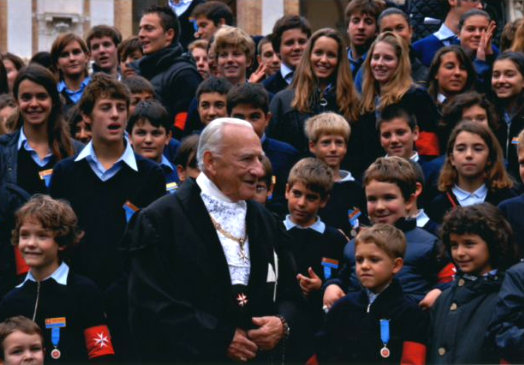
The Prince & Grand Master of the Order of Malta, Fra Andrew Bertie, meets with young pilgrims during the Order’s annual pilgrimage to the Marian shrine of Loreto in the Italian Marches.
Category: The Order of Malta
A Tribute to Cockerell
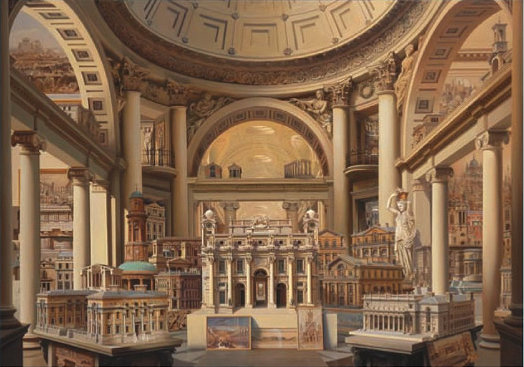
Carl Laubin, A Tribute to Charles Robert Cockerell, RA
Oil on canvas, 39′ 11″ x 60′
2005, Private collection
Ave Maria, Plena Gratia!
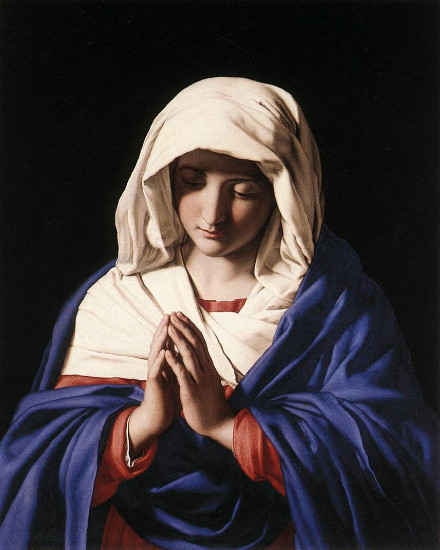
In thanksgiving for many petitions granted.
The Feast of St. Sylvester
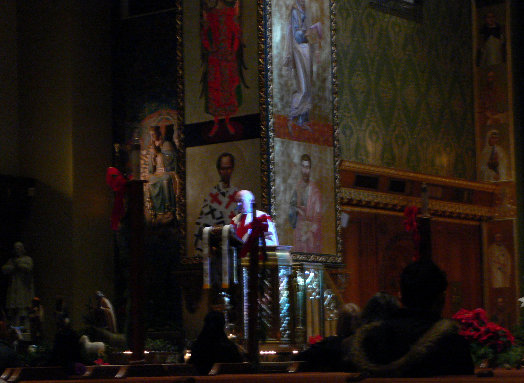
Fr. Rutler preaches, illuminated by the midday winter sun, at the Church of Our Saviour on the Feast of St. Sylvester. And a fine sermon it was, too.
For unto us, a Child is born…
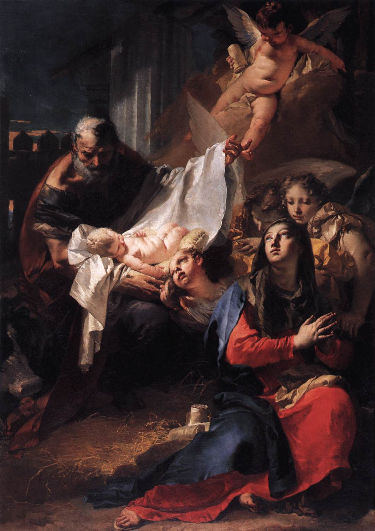
a very happy and blessed
Christmas
The Queen’s Christmas Message 2007
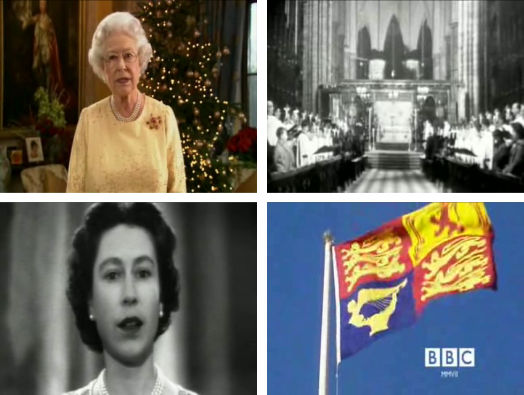
Available here at YouTube.
Britain: a ‘Catholic country’
The Original Church of England Overtakes the New One?

Catholics have overtaken Anglicans as the country’s dominant religious group, according to the Sunday Telegraph, as more people attend Mass every Sunday than worship with the (Anglican) Church of England. “This means that the established Church has lost its place as the nation’s most popular Christian denomination,” Jonathan Wynne-Jones reports, “after more than four centuries of unrivalled influence following the Reformation”. Sunday attendance at Anglican services has dropped a whopping 20% since the year 2000. Catholic Mass attendance in the past six years, however, has also dropped a dramatic 13%, a decline assuaged by the arrival of thousands of Polish immigrants since Poland joined the European Union.
Obaysch the Hippo
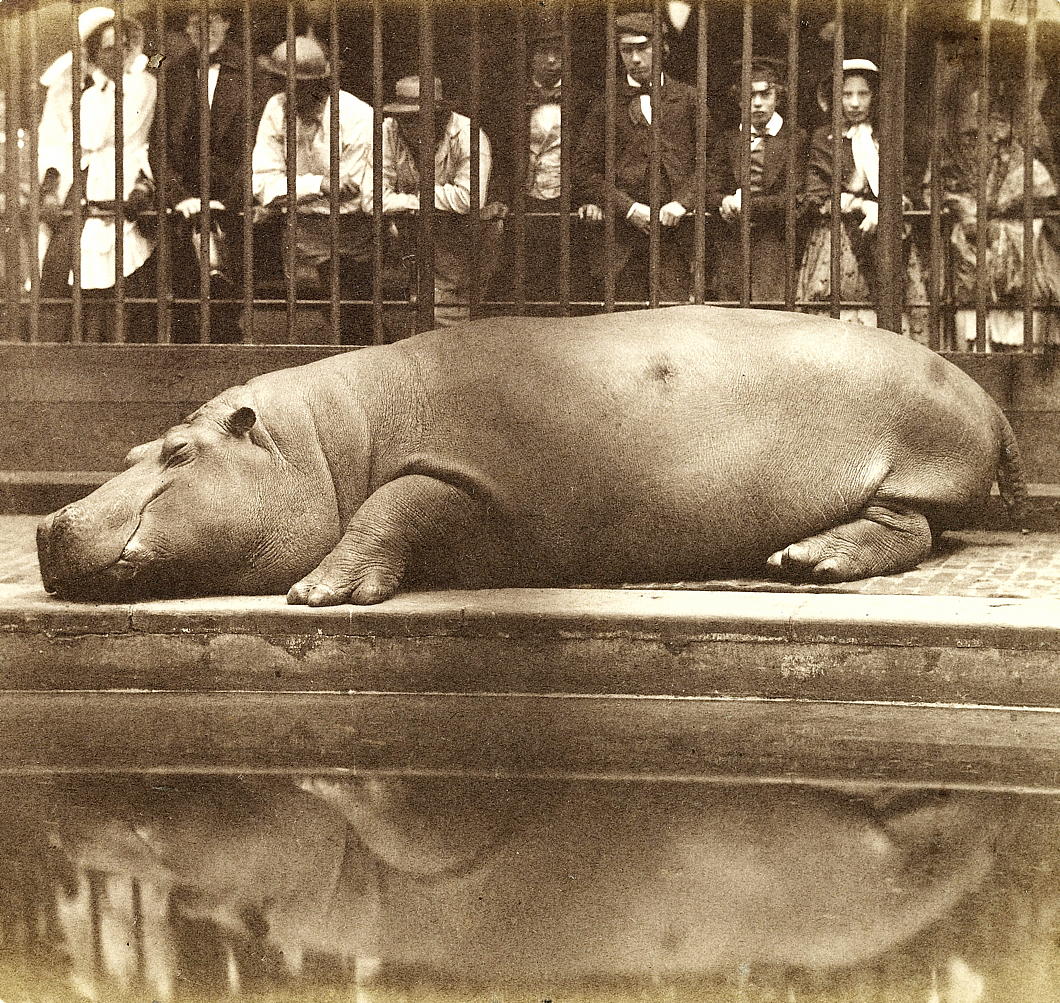
Obaysch was the first hippopotamus in Britain since prehistoric times.
The Ottoman Viceroy of Egypt agreed with the British Consul General to exchange Obaysch for some greyhounds and deerhounds, and the hippo arrived at London Zoo in May of 1850.
The above photograph was taken in 1852 by Juan, Count of Montizón, later the Legitimist Bourbon claimant to the thrones of France and Spain.

Gerald Warner Axed
Scotland’s Voice of Reason Silenced
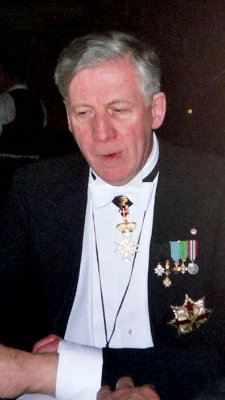 I WAS MUCH disheartened when I was told that Gerald Warner’s weekly column in Scotland on Sunday has been axed. Gerald’s writing is a refreshing Caledonian tonic in contrast to the usual second-rate rants from second-rate minds the exemplifies most newspaper columns today. Gerald Warner refuses to allow the heresiarchs of our age to lay waste to our civilization unchallenged. He is (err… was) the only substantial reason for paying for a copy of Scotland on Sunday. Of course, S-o-S is not available here in New York, so every Saturday night I would wait until after midnight GMT (7:00pm New York time) to read Gerald’s column online. Often enough, I would dutifully tell all the folks on the sidewalk after Mass on Sunday that they had to read Gerald’s column this week. Sometimes I’d even print the damn thing out and read it aloud for the enjoyment of all. But alas! No more…
Some Gerald Warner highlights on this site:
• Martyrs of Spain, Pray for Us!
• The Knights of Malta Ball 2006
• Warner on the Gotha
The Café Society of Ferenc Molnár
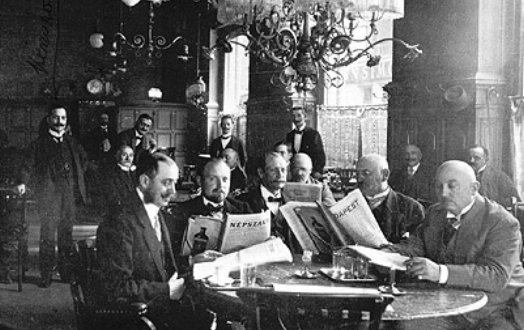
FROM 1887, the Café Central (or Centrál Kávéház, in Magyar) has been a meeting place for artists, intellectuals, professionals, and others located on Budapest’s Károlyi Mihály street. One of its most famous patrons was the novelist and dramatist Ferenc Molnár (born Ferenc Neumann and often anglicized as Franz Molnar), whose 1906 book The Paul Street Boys is perhaps the most widely-read Hungarian novel. His 1909 play “Liliom” was later adapted by Rodgers and Hammerstein into the musical “Carousel”. Both his plays “The Guardsman” and “The Swan” were later made into films (the latter being Grace Kelly’s final appearance on the silver screen), while “The Play at the Castle” was adapted by P.G. Wodehouse into “The Play’s the Thing” and by Tom Stoppard into “Rough Crossing”. (more…)
Krummau on the Moldau
Český Krumlov Revisited
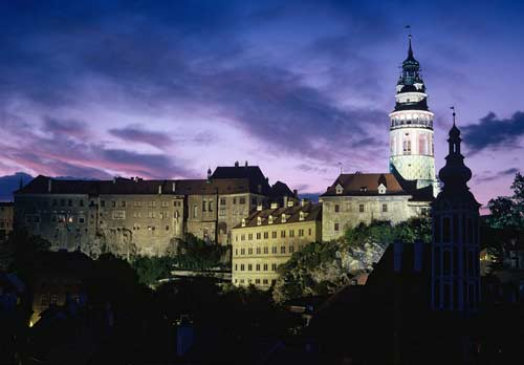
THE CASTLE OF Krummau in Bohemia stands majestically on its crag in a bend of the Moldau river, presiding confidently over the town below. Český Krumlov, as the town is known in the currently-reigning Czech language, began in the thirteenth century under the Rosenberg family and was purchased by the Emperor Rudolf II in 1602. Yet it was under the princely house of Schwarzenberg (proprietors of Krumau from 1719 to 1945) that the castle flourished. The name Český Krumlov means Bohemian Krummau, to differentiate it from a Moravian town of the same name. (It is also often rendered as Krumau or Krumau-an-der-Moldau).
While the advent of Communism deprived the Schwarzenbergs of this great castle and numerous other vast properties of theirs behind the Iron Curtain, the Schwarzenbergs have since regained their natural prominence in Bohemia. His Serene Highness Prince Karl VII of Schwarzenberg, Duke of Krummau, Count of Sulz, Princely Landgrave of Kelttgau currently serves his country as Minister of Foreign Affairs of the Czech Republic, as well as being a member of the Czech Senate which convenes in the Wallenstein Palace in Prague. For the sake of convenience, however, His Serene Highness goes by ‘Karel Schwarzenberg’. (more…)
Search
Instagram: @andcusack
Click here for my Instagram photos.Most Recent Posts
- West Point July 30, 2026
- Brunel’s Unbuilt Capitol February 3, 2026
- Cricket at Fordham January 27, 2026
- Palacio Barolo Revisted January 14, 2026
- Learning to Love Liguria January 14, 2026
Most Recent Comments
Book Wishlist
Monthly Archives
Categories