About Andrew Cusack
 Writer, web designer, etc.; born in New York; educated in Argentina, Scotland, and South Africa; now based in London.
 read more
News
Blogs
Reviews & Periodicals
Arts & Design
World
France
Mitteleuropa
Knickerbockers
Argentina
The Levant
Africa
Cape of Good Hope
Netherlands
Scandinavia
Québec
India
Muscovy
Germany
Academica
Allies Day, May 1917
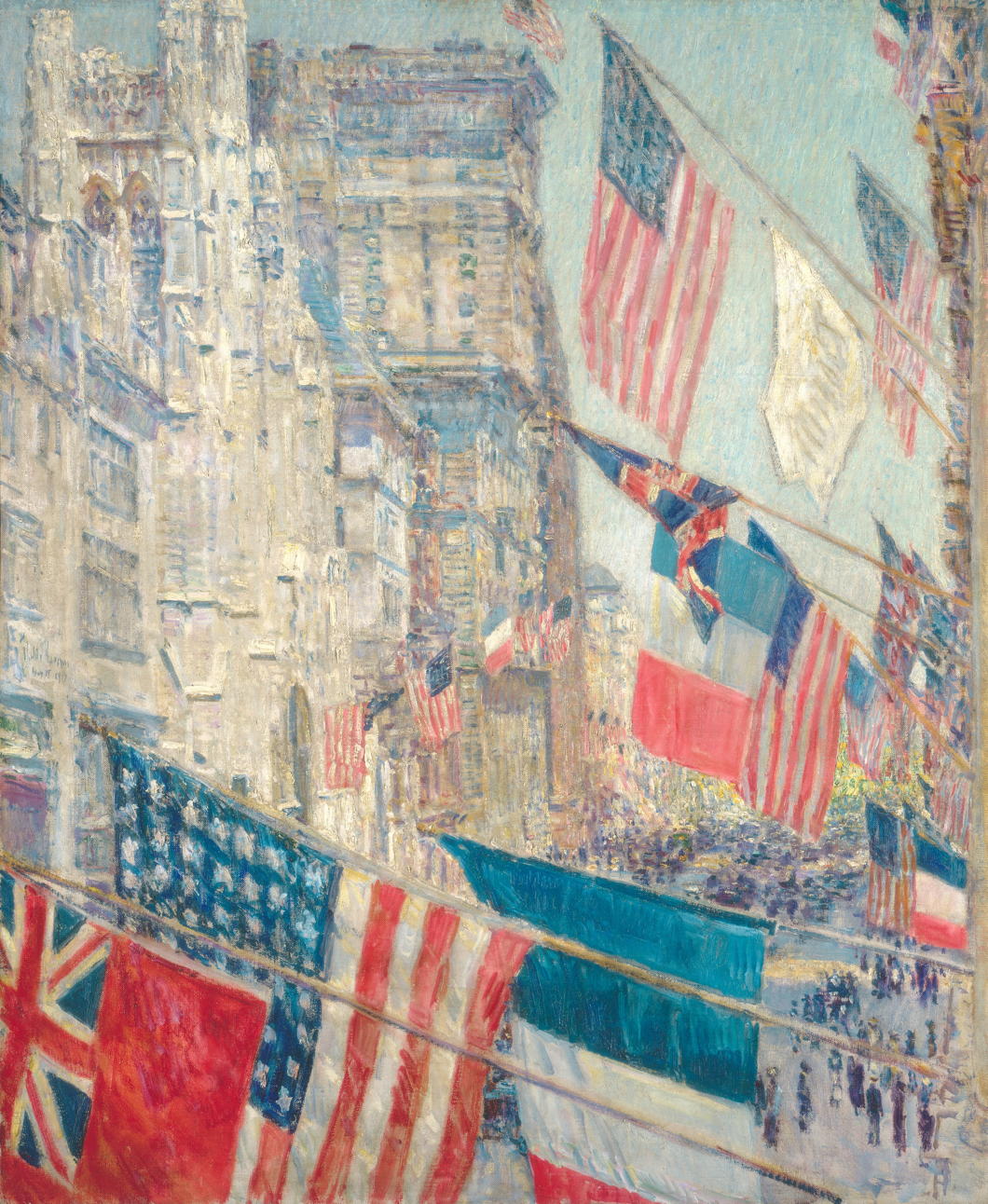
Childe Hassam, Allies Day, May 1917
Oil on canvas, 36½ in. x 30¼ in.
1917, National Gallery of Art (U.S.)
This has long been one of my favourite paintings, ever since I first saw it one day when I was very young while it was on loan to the Metropolitan. On a May day in 1917, Fifth Avenue was temporarily proclaimed “the Avenue of the Allies” and the British and French commissioners paraded down the boulevard with great ceremony. Childe Hassam set his easel on a balcony on the corner of Fifth Avenue and 52nd Street and took in the splendid scene towards the Church of St. Thomas and the University Club. Patriotic displays were much more lively then, involving bursts of flags and banners, than the rather dull and monotonous display of the single Stars-and-Stripes that became widespread after the World Trade Center attacks.
Interestingly, “Avenue of the Allies” aside, the United States was not actually allied to France and Great Britain during the First World War. President Wilson thought the United States was not so lowly as to merely intervene in a biased manner on the side of those it had lent money, but rather for the high-minded goal of establishing justice (or, as we might honestly call it, the destruction of Catholic Europe). The U.S., then, was merely a “co-belligerent” rather than an “ally”, though obviously this high-minded euphemism was lost on most people. During the Second World War, Finland found itself invaded by the Soviet Union and abandoned by the West, so — having no taste for Hitler and his Nazi charades — they became “co-belligerents” with Germany, rather than concluding a more distasteful alliance.
Hassam, who died in 1935, had little time for the avant-garde schools of art that came after the Impressionism he practised, and described modernist painters, critics, and art dealers as a cabal of “art boobys”. He was almost forgotten in the decades after his death, but the rising tide of interest in Impressionism from the 1970s onwards lifted even the boats of American Impressionists, and his Flags series of paintings are widely-known and much-loved today.
Zuma’s Day
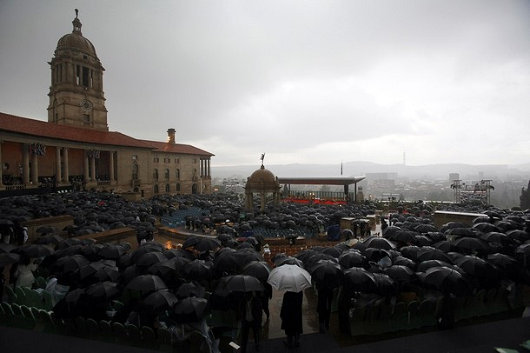
“PRAETORIA PHILADELPHIA” — Pretoria of Brotherly Love — was the formal name for the paramount of South Africa’s three capital cities. Pretoria, the jacarandastad, is home to the Executive; Cape Town, die moederstad, is home to the Parliament, and Bloemfontein, the “City of Roses”, is home to the High Court of Appeal. While the politics of government take place in Cape Town, its actual administration takes place in Pretoria, and all that flows forth from the stately Union Buildings that preside over the city from atop Meintjieskop. The Uniegebou is composed of two wings that come together in a semicircular amphiteatre, symbolizing the coming-together of Briton & Boer in the Union of South Africa. Designed by Sir Herbert Baker, Lutyens’ lieutenant in the building of New Delhi, some believe it to be his finest work.
Victory Day in Moscow
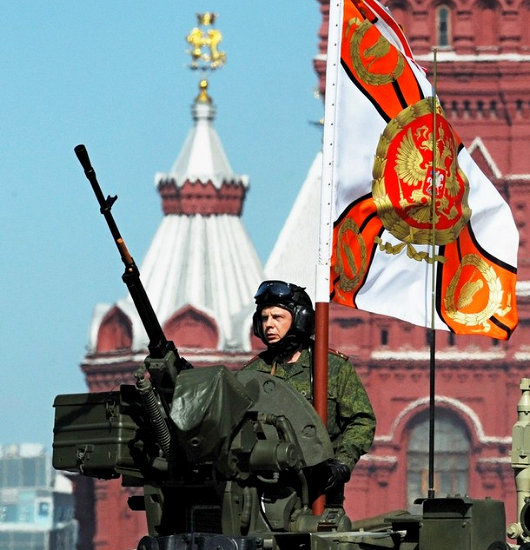
I recently discovered that we receive the television channel Russia Today in our humble little flat here in Stellenbosch, and have spent the past few days enjoying it. They are shockingly truthful (almost nasty) in their reporting of international relations, in so far as the truth — for the moment — tends to favour the Russian case in world affairs, and make NATO look like a bunch of ninnies. Saturday — May 9 — was Victory Day in Russia, in which the defeat of Nazi Germany in the Second World War is commemorated and celebrated. RT showed many minutes of splendid highlights from the great parade in Red Square, and I just sat and enjoyed it.
Some Words from Doorn on the Present Crisis
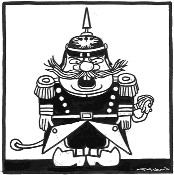 Loyal commenter Steve M. sends word that Kaiser Wilhelm II (currently of Doorn, the Netherlands) has written an open letter to His Excellency President Barack Obama of the United States.
His Imperial Majesty objects to the current practice of appointing “czars” to deal with the various crises at hand, and offers a few alternative suggestions of his own.
Our readers will, no doubt, recall the Kaiser from his previous appearances on his blog here, here, and here.
De Volkskrant
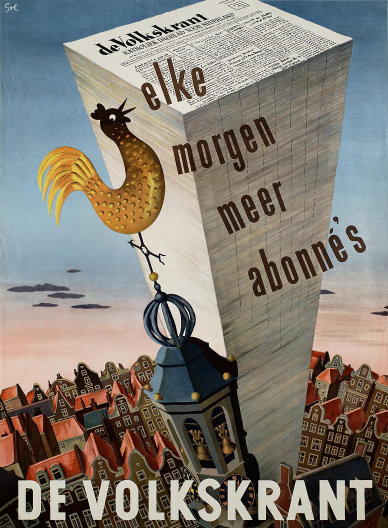
A FAVOURITE POSTER of mine combines a number of the things I love: newspapers, architecture, and the Netherlands. Arthur Goldsteen designed this handsome poster to advertise the daily newspaper De Volkskrant in 1950.
Boers, Peter Simple, and Pith Helmets
Sometimes something rather interesting is right under your nose and you never even notice it. I read the Catholic Herald — the premier Catholic newspaper in the English-speaking world — every week and have been reading it since university days, but I have rarely read Stuart Reid’s “Charterhouse” column on the back page. A few recent perusals have exposed my foolishness for neglecting it. They are presented for your reading here.
(Of course, there has never been a columnist as brilliant as Peter Simple, whose works we have shown you in a series of installments.)
Charterhouse
by STUART REID
Everyone needs a secular hero or two, and one of mine is Rian Malan. In the Sunday Times at the weekend he had a very nice diary, in which he said that he liked Jacob Zuma, because the president-elect of South Africa had “old-fashioned views on stuff like law and order”.
Malan also said that it was a good time to be a Boer: “…as South Africa staggers towards its destiny, it’s white Left-liberals who are wailing about our government’s shortcomings. The Boers never expected any better, so we are generally immune to the gloom.”
The diary made my heart go out, once again, to the Boers. They are brave, honest, hard-working, courteous, old-fashioned and often God-fearing, with a weakness for the bottle. Plus they were on the right side in the Boer War and their women – sometimes their men too – are beautiful.
High Church Dutch Reformed
Not even the peaceful hills and dales of the Hudson Valley were left untouched by the liturgicalism of the Oxford Movement
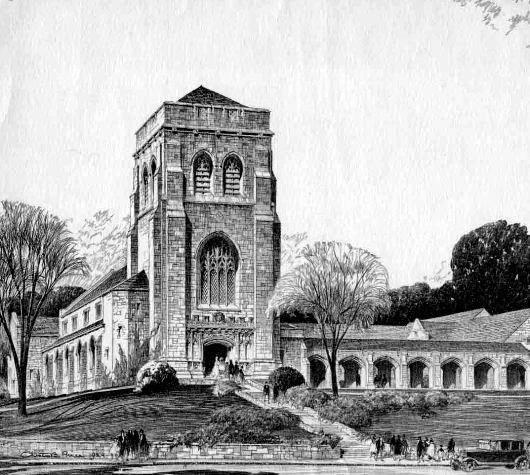
SUCH WAS THE influence of the nineteenth-century “Oxford Movement” in the Church of England that it engulfed the great preponderance of the Anglican Communion. It is surprising when you consider that Anglican priests and even a bishop were jailed in England for such scandalous acts as calling the Communion service “the Mass”, wearing vestments, and putting candles on the altar; these are now so widespread in the Church of England to be commonplace. But the Oxford movement also spilled out into other Protestant groups as well. The liturgical movement changed the Church of Scotland in the 1900s, and many of the Kirk’s medieval church buildings that had been converted into pulpit-centered preaching halls were reordered in a way emphasizing the “Communion table” that was an altar in all but name. (Those who can find before & after shots of the ‘Toon Kirk’ of Holy Trinity in St Andrews, Fife will notice this marked contrast).
Cuban Army Polo
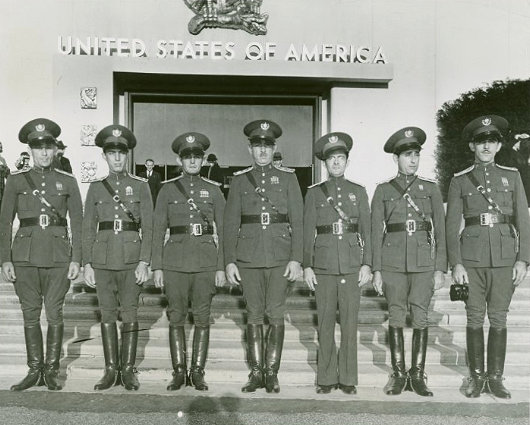
The Cuban Army polo team visits New York in 1939. How different the Americas might be had Fidel Castro preferred the polo of his patrician background to the baseball he is known to be fond of. If only he had attended the Cavalry School instead of the Universidad de la Habana!
Fake Newspapers: “Bright Young Things”
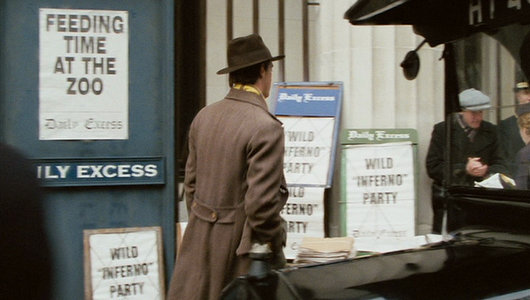
When it comes to newspapers, the visual element is all-important to an extent that shockingly few in the powerful parts of the industry comprehend. In the county of Westchester — my home turf — there is a monopoly when it comes to the newspaper as a means of local information delivery, and that monopoly belongs to the Gannett chain. Gannett newspapers are among the ugliest in the country, but then most American newspapers are abominations when it comes to design. The glory days of newspapers were, of course, the 1920s & 30s, and Stephen Fry’s film “Bright Young Things” — a rejigged dramatisation of Waugh’s Vile Bodies — highlights, as many Waughvian tales do, newspapers as a central plot instrument.
Peter Hitchens on America
On returning from America
I have spent the past two weeks in the United States, not working but travelling on my own account, revisiting some favourite places and coming up for air. It remains an exhilarating and beautiful place, wrongly sneered at by too many British people who simply haven’t experienced enough of it to know how good it can be, and how much worse off we would be if it weren’t there. But it is also a foreign country, not some kind of special friend – but a foreign country to which we have unique access because we speak a similar language. Only fluent French or German speakers could ever know as much about those countries as any British visitor can swiftly learn about the USA – if he wants to.
Rather than re-immerse myself in the small-scale squalor of British politics, which seems even less appealing or interesting than it was when I set out, I thought I would muse a little on what an English person experiences in the great republic, and what it means (or might mean) for us.
It’s good to be Prime Minister
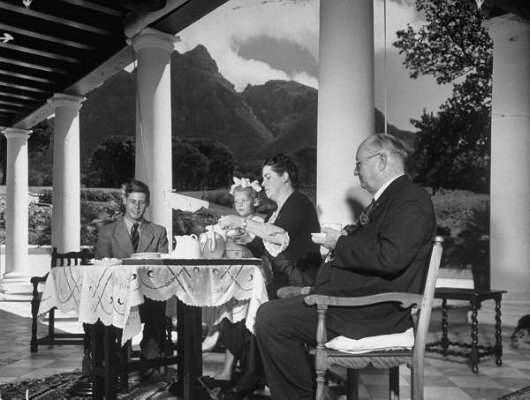
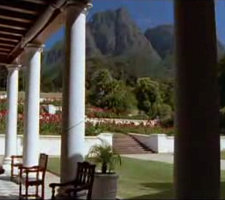 Daniel François Malan, fourth Prime Minister of South Africa, is seen here taking breakfast with his family on the verandah at Groote Schuur, the official residence of the PM. (At right, the same view today). Groote Schuur — literally “great barn” — was purchased by Cecil Rhodes and transformed into the paragon of the South African style of architecture by his architect Sir Herbert Baker. Foolishly, the office of Prime Minister was abolished in 1984, when the ridiculous 1984 tricameral constitution was adopted. Groote Schuur continued as the Cape residence of the State President of South Africa under P.W. Botha and F.W. De Klerk but when Nelson Mandela was elected he decided to make the neighbouring Westbrooke his official residence, renaming it Genadendal (“Valley of Grace”) after the oldest Moravian mission in South Africa. Groote Schuur is now a museum open by appointment, and unlived in.

IHT Follow-up
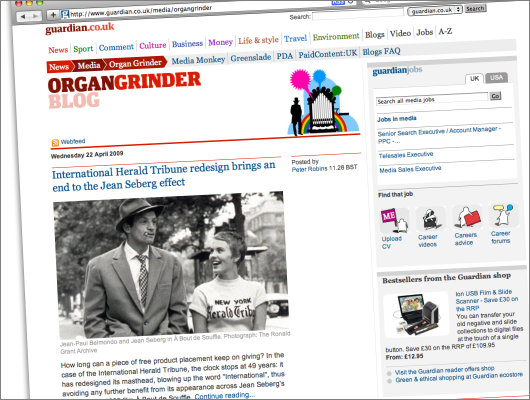
Writing about the latest changes over at the International Herald Tribune, the Guardian‘s media blog “Organgrinder” linked to our “remarkably comprehensive” post covering the subject in depth. I’m slightly embarrassed to say I’ve never seen any of Jean-Luc Godard’s films, something I will have to rectify through the DVD collection at the French Institute’s Haskell Library when I’m back in New York.
Meanwhile, Erik Zenhausern, the IHT’s former Operations Director for the Americas, corrects some errors on my part and gives us an inside look at NYT-IHT operations [boldface mine]:
Some things in the article may not be 100% accurate. The dingbat, along with the whole paper (it does mention the switch to Poynter type)was redesigned in 2002-2003.
Also, the New York Times does not own the print sites around the world where the IHT is printed. These are contract printers. Of course the entire supply chain is already set up so it will be easy to pump NYT lite throughout Europe and Asia and NYT doesn’t have the cost of maintaining these facilities.
I sat in on early strategy meetings when the NYT forced out the WP. Even in the first few months of owning the newspaper, many people at the NYT were ready to call the newspaper New York Times International. If it wasn’t for focus groups saying they thought anything that says “New York” on it won’t sell in europe.
While in the early days the tread lightly, heavier footsteps are coming. The IHT will definitely be folded into the NYT at some point.
Guinness: Advertising with Imagination
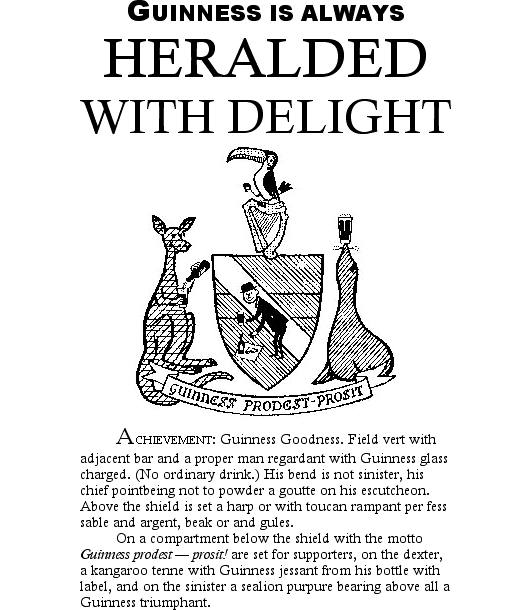
Cheshire heraldry expert Martin Goldstraw stumbled upon this creative ad for Guinness while stumbling through some old copies of The Coat of Arms, the journal of the Heraldry Society. [Mr. Goldstraw’s image modified by yours truly].
Among the heraldic terms employed in the text:
field
vert
bar
proper
regardant
charged
ordinary
bend
sinister
chief
goutte
escutcheon
rampant
sable
argent
or
gules
compartment
shield
motto
supporters
dexter
tenne
jessant
purpure
triumphant
Old Guard Ball, 1949
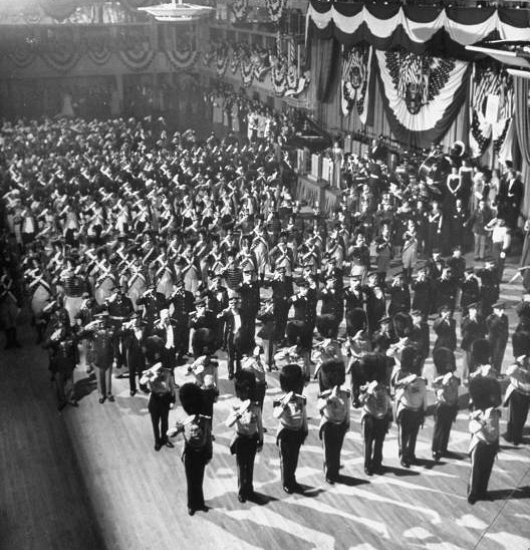
The Annual Ball of the Old Guard of the City of New York, Commodore Hotel, 1949.
200 Years was an Empty Anniversary for New York’s ‘Gallant Seventh’
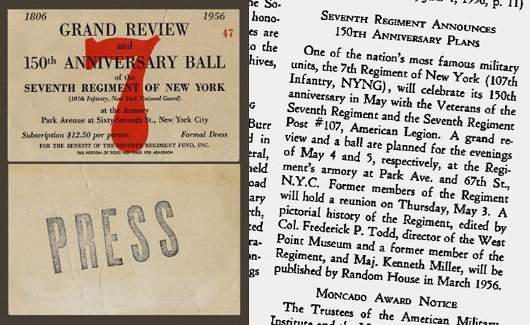
Flipping through a military journal from early 1956, I stumbled upon a rather depressing note announcing the Seventh Regiment’s plans for celebrating its 150th anniversary. A reunion of old comrades on Thursday May 3, then a grand review the following day, and topped off by a formal ball on the evening of Saturday May 5 at the regiment’s beautiful armory on Park Avenue at 67th Street.
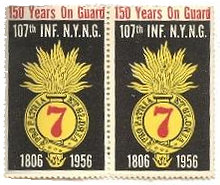 Why should such a splendid celebration spark dour thoughts? Chiefly because, having survived over a century and a half since the unit was founded amidst pints of ale in the Shakespeare Tavern on the corner of Nassau and Fulton, the Seventh Regiment was abolished before it could celebrate its 200th anniversary in 2006. The Seventh was deactivated as a regiment in 1993, though its “lineage” was transferred to the 107th Corps Support Group, which in 2006 was “consolidated” into the 53rd Army Liaison Team. The regiment’s unique collection of historical artifacts — the legal property of the Veterans of the Seventh Regiment — was seized by the State in an act of highly dubious constitutionality and its armory, built without a cent of public money from the pockets of the regiment’s members in the 1880s, was also taken and transferred to a conservancy to run it as an events & performing arts venue, over protests from both veterans groups and the local community.
The Scottish Executive, 1999-2007

While naturally relieved that Labour are no longer in charge, one of the few objections I have to the current SNP government in Scotland is that they changed the name of the Scottish Executive to “the Scottish Government”. The new name is just so damned boring. Every country, region, town, and borough has a “government”; it’s the dullest word you can come up with. But “the Scottish Executive” had such a nice ring to it. Listening to the evening news on Radio Scotland, one heard the newsreader speak of “the Scottish Executive” and immediately thought “Ah yes, that’s our part of the government!” Now one hears the sultry phrase “The Scottish Government today announced new measures…” and thinks “Oh, the government. Nobody likes the government.”
To add to this lamentable change, they even dumped the Scottish coat of arms as the visual identity of Scotland’s authority (as seen above, in the Executive days) and replaced it with an exceptionally dull saltire-flag logo that can be seen on the Scottish Government’s website.
Premier Salmond, give Scotland back her heraldry!
Meet the new boss
The Pope sends New York a genial, beer-swilling man of an archbishop
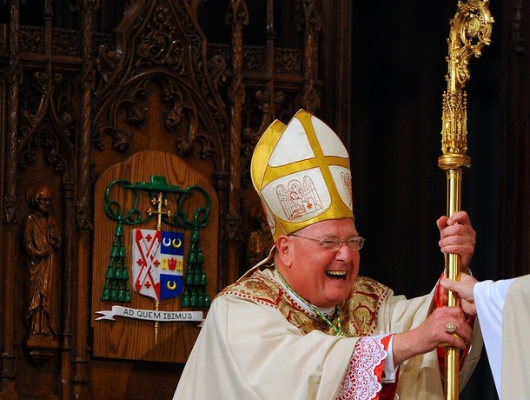
The Most Rev. Timothy Michael Dolan, the newly installed Archbishop of New York, has a reputation as a genial beer-swilling giant that will doubtless serve him well as he takes possession of his new see. With a Ph.D. in Church History, Archbishop Dolan formerly served as Secretary to the Nuncio in Washington, D.C. before becoming Rector of the Pontifical North American College in Rome — the “West Point” of the Catholic Church in Anglo-America. Having improved the NAC’s reputation both in studies and in orthodoxy, Msgr. Dolan was then sent by the Holy Father to be an Auxiliary Bishop in the Archdiocese of St. Louis. From there, our man was given the charge of see himself, that of Milwaukee.
The Arms of the Archbishop
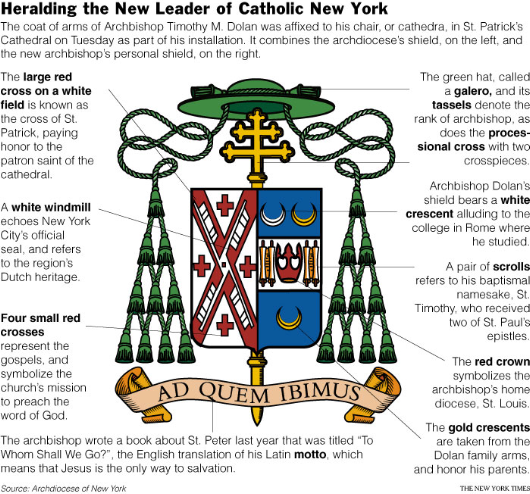
The New York Times offered a little sidebar on the heraldry of our new ecclesiastical boss in its coverage of Archbishop Dolan’s installation, and Fr. Selvester offers his commentary as well.
Search
Instagram: @andcusack
Click here for my Instagram photos.Most Recent Posts
- West Point July 30, 2026
- Brunel’s Unbuilt Capitol February 3, 2026
- Cricket at Fordham January 27, 2026
- Palacio Barolo Revisted January 14, 2026
- Learning to Love Liguria January 14, 2026
Most Recent Comments
Book Wishlist
Monthly Archives
Categories