About Andrew Cusack
 Writer, web designer, etc.; born in New York; educated in Argentina, Scotland, and South Africa; now based in London.
 read more
News
Blogs
Reviews & Periodicals
Arts & Design
World
France
Mitteleuropa
Knickerbockers
Argentina
The Levant
Africa
Cape of Good Hope
Netherlands
Scandinavia
Québec
India
Muscovy
Germany
Academica
Preservation is Not Enough
A Proposal for Enhancement
IT IS COMMONLY said of St Andrews that it is a place of beauty. This is often a compliment to its natural setting, with open skies arcing over the reaches of the bay, and ancient rock and cliff yielding to the changing rhythms of the waves. At the same time visitors are generally struck by the pleasing combination of natural and built environments: the ruined grandeur of the Cathedral and Priory standing bare to the elements; crowstep-gabled cottages gathered in against the wind; the broad thoroughfares interlinked with narrow cobbled lanes; and the church towers etched against the sky. There is also the scholarly dignity of Deans Court, the quizzical posture of the Roundel, the charm of the courtyards to the south of South Street, the sad ruination of Blackfriars juxtaposed with the aspiring frontage of Madras College, and other evocative sights besides.
Here and there within the midst of all of this stands, physically, historically, and socially, the University. Its contributions to the architectural distinction of the old town are obvious enough. They are, principally, the harmonious South Street complex of St Mary’s College (1593-41) to the west, Parliament Hall (1612-43) to the north, and the Library extension (1889-1959) – now the Psychology wing – to the east; and the North Street set of the Collegiate Church of St Salvator, Gate Tower and tenement (1450-60), and beyond it the west block (1683-90) containing the Hebdomadar’s Room, and to the east and north the College buildings (1829-31 and 1845-6, respectively). There are other smaller and oft-reworked jewels associated within the University: St John’s House in South Street (15th, 17th, 18th, 19th, and 20th centuries), St Leonard’s Chapel (remodelled c. 1512), and the ‘Admirable Crichton’s House’ (16th century), but the principal architectural benefactions of the University to the town are the North and South Street college complexes. I have not mentioned the Younger Graduation Hall (1923-9) and the Student Union (1972) and prefer to leave it for readers to determine what might be said of these.
It could hardly have passed unnoticed that the list of contributions dates mostly from the late middle-ages to the nineteenth century, and this fact raises two questions: first, whether in the second half of the twentieth century the University was sufficiently attentive to its role as principal architectural patron; and second, how it might now hope to enhance the built environment of St Andrews. (more…)
Fellowes Prynne in Johannesburg
A Rejected Proposal for St. Mary’s Anglican Church
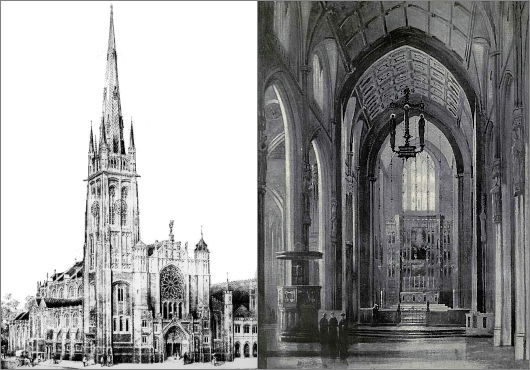
We rarely mention Johannesburg on this little corner of the web because our mother taught us that if you don’t have anything nice to say, don’t say anything at all. While ruffling through the archives the other day, however, I came across this design for the Johannesburg cathedral of the Church of the Province of South Africa. George Halford Fellowes Prynne (1853–1927) was an accomplished Gothic architect whose work is mostly found in the south of England. He’s notable for his rood screens in particular, worked in a variety of forms and materials (wood, stone, and metal), though this design employs a hanging rood. (more…)
Unbuilt St. Thomas
Lord & Hewlett’s Competition Entry for the Church of St. Thomas
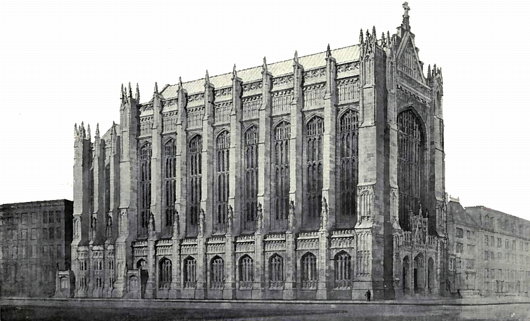
THE CHURCH OF Saint Thomas on the corner of Fifty-third Street and Fifth Avenue in New York is one of the artistic gems of the city: both as an architectural marvel designed by Ralph Adams Cram & Bertram Grosvenor Goodhue and as a musical paradise with its renowned choir of men & boys formerly under the tutelage of Gerre Hancock. (It’s foolish for anyone in the city during Advent to miss the Service of Lessons & Carols). The parish of the Episcopal Diocese of New York was established in 1834, and its first building was erected in the Gothic style on the corner of Broadway and Houston.
In 1870, after that neck of the woods became less fashionable, the congregation moved to its current location at 53rd & Fifth, to a new Gothic edifice by Richard Upjohn. That church hosted the marriage of Consuelo Vanderbilt to the 9th Duke of Marlborough. When it burned down in 1905, a competition was held to select the design of the new Church of St. Thomas, then perhaps at the peak of its high social status among Manhattan’s Protestant congregations. (more…)
‘The greatest and most successful pseudoscientific fraud I have seen in my long life’
Harold Lewis, eminent American physicist, resigns from learned society which has helped stifle the scientific debate over global warming
The physicist Harold Lewis has resigned from the American Physical Society over the learned group’s efforts to suppress scientific inquiry and debate into global warming and climate change. Prof. Lewis, who is Emeritus Professor of Physics at the University of California Santa Barbara, cited the leaked ‘ClimateGate’ e-mails as proof of scientific fraud. His resignation letter (reproduced below) speaks of ‘the money flood’ and alludes to President Eisenhower’s warning in his farewell address of 1961 to guard against ‘the unwarranted influence, whether sought or unsought, [of] the military-industrial complex’.
While he has refrained from coining the phrase, Prof. Lewis’s remarks suggests the massive amount of funding available for climate research has created a climate-industrial complex pressuring and perverting the scientific profession and leading it away from an environment of free inquiry.
“[T]he global warming scam, with the (literally) trillions of dollars driving it,” Prof. Lewis wrote, “has corrupted so many scientists, and has carried APS before it like a rogue wave. It is the greatest and most successful pseudoscientific fraud I have seen in my long life as a physicist.” (more…)
The End of the Antilles
The Netherlands Antilles is Dissolved
THIS MORNING, one 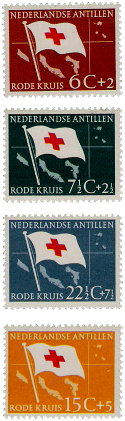 country disappeared, two more were born, a fourth was expanded, and all are part of a single kingdom. The Netherlands Antilles, the collective islands of the Dutch West Indies which since 1954 has formed a constituent country of the Kingdom of the Netherlands, was dissolved. Two of the islands in the archipelago, Curaçao and Sint Maarten, have become full constituent countries of the Kingdom (alongside Aruba, which was separated from the Antilles in 1986, and the Netherlands proper), while the islands of Bonaire, Sint Eustatius, and Saba (the ‘B.E.S.’ islands) have been merged into the Netherlands proper as special municipalities.
The government of North Holland has invited the B.E.S. islands to join the province, but this has not yet been agreed to. With a combined population of just 17,000, Bonaire, Sint Eustatius, and Saba do not have enough inhabitants to justify forming a single province of their own — the province with the lowest population at the moment is Flevoland at 356,000. North Holland’s offer may be turned down if it entails the complication of the three island-municipalities becoming part of the European Union. Currently all the islands of the Netherlands Antilles are outside the E.U., but all their citizens are E.U. citizens by virtue of being Dutch citizens. (more…)
Fated
WHETHER Parliament approves “therapeutic cloning” or not, will it make any difference in the long run? Whatever scientists can do, that will be done. Public opinion, at first aghast at artificial insemination and other landmarks on this infernal road, has largely come to accept them. So it is likely to be with this latest triumph.
 “Science has put into our hands innumerable gifts that we can use either for good or ill.” This mantra, once regularly intoned, has become less popular now that many of these gifts are plainly seen to be used for ill.
A new palliative has appeared instead: it says that we must be kept well informed about the latest scientific developments, as well as learning more about science and scientific methods, so that we can decide for ourselves whether we want these gifts or not.
But who are “we”? Would it make any difference if we said we did not want them? Would it make any difference if some scientists themselves decided they were too dangerous to proceed with? Others would somehow, somewhere, carry on the work. The progress of science and technology which has seized upon our world seems irreversible, even fated.
Will it, as in some environmentalist fantasy, gradually diminish in strength and become humanly manageable in a new, green and “sustainable” world? Or will it, as seems more likely, proceed to a catastrophic end?
‘Today It Feels Good to be An African’
I REMEMBER, shortly after President Mbeki’s resignation, conversing with a friend of mine, an Afrikaner vrou more advanced in years & experience than I. In response to my expression of ‘good riddance’ to an administration marked mostly by a detached aloofness and a willingness to abuse the prosecutorial system, this creature of the soil replied calmly, “Ah, but we will learn to miss Mr. Mbeki.” And, while I trust the instincts of Mr. Zuma more than the education of Mr. Mbeki, listening to the 1996 speech in which the latter commended the Constitution Bill to the National Assembly I can at least concede readily the eloquence of the former president.
The excerpt above was produced by South African Tourism, and ably displays the beauty of the country — “the hills and the valleys, the mountains and the glades, the rivers, the deserts, the trees, the flowers, the seas, and the ever changing seasons” as Mr. Mbeki put it — and its people: the riders on Noordhoek strand, the Dutch Reformed predikant, the proud Coloured fisherman, the Xhosa women with their pipes, a Zionist baptism on the shore, the Durban party girls driving down the boulevard. South Africa is a country that sells itself; when it’s bloody, it’s bloody, but when it’s beautiful, it’s beautiful.
Alan Dershowitz Defends Pope Benedict
Benedict XVI has “Done More to Protect Young Children” Than Any Other Pope According to Harvard Law Professor
The Harvard Law School professor & criminal appellant attorney Alan Dershowitz has defended Pope Benedict XVI while speaking to a television news programme in Australia. Dershowitz travelled to the continent to take part in a debate with the lawyer & activist Geoffrey Robinson QC who has waged a campaign to have the Pope tried under international law as culpable for the abuse of children by Catholic priests.
Robinson (a dual citizen of Australia and Great Britain) is well-known in legal and intellectual circles, where he has defended the use of kangaroo courts to try and convict alleged perpetrators of great crimes: his 2005 book The Tyrannicide Brief defended John Cooke, the solicitor general who prosecuted Charles I of England for treason. The Australian academic has also defended the practice of more powerful nations waging war against smaller ones to prevent the latter from committing crimes against humanity, and has argued in favour of the bombings of Hiroshima and Nagasaki.
Dershowitz told the Australina Broadcasting Corporarion’s Tony Jones that Robertson’s attempt to have Pope Benedict tried before under international law was “wrong”.
International law deals with war crimes, it deals with systematic efforts by governments to do what happened, for example, in the former Yugoslavia and Rwanda, in Darfur and Cambodia. This is not in any way related to that. … This is not a crime against humanity, this is a series of crimes by individual priests and others throughout the world and failures by institutions to come to grips with it quickly enough.
Prof. Dershowitz said he thought Benedict has “probably done more to protect young children since becoming Pope than any previous Pope”. (more…)
Journowatch: Headline vs. Story
In an article about the soon-to-be-canonised Australian nun, Mary McKillop, the Daily Telegraph exhibits a peculiar example of the lows of newspaper journalism today.
The headline boldly states “Australian nun ‘to be made patron saint of abuse victims'” only for the sub-headline — “An Australian nun who will be canonised by the Pope next month should be made the patron saint of clerical sex abuse victims, Catholics have suggested.” — to directly contradict this.
Is Mary McKillop “to be” the patron saint of the abused or has it merely been “suggested”? The headline-writer put the ‘to be’ in quotation marks, but the article doesn’t supply a single quotation or piece of evidence showing this decision has been reached, only a quotation suggesting it would be a wise course of action.
I’ve read numerous examples of newspaper articles offering contradictory facts unreconciled, but to do so before the article has even started seems particularly bizarre.
The Daisy Wheel
Among the most well-known works of modern Scottish design, besides the ‘Clootie Dumpling’ of the Scottish National Party, there is the logo of the Royal Bank of Scotland: the Daisy Wheel. Now one of the most well-known financial brands in the world, the Royal Bank of Scotland was founded in Edinburgh in 1727, thirty-two years after its rival, the Bank of Scotland. (The Bank of Scotland, as it happens, was founded by an Englishman, John Holland — just as the Bank of England was founded by a Scot, Sir William Paterson).
The Scottish Parliament had declared in 1689 that King James VII had, by his absence, forfeited the throne, and handed the Crown to his Dutch rival William of Orange, who had already seized the throne in England. The House of Hanover succeeded to the throne of the new United Kingdom which had been created in 1707, but the Bank of Scotland was suspected of harbouring Jacobite sympathies. The London government was keen to help out Scottish merchants loyal to the Hanoverians and so, in 1727, King George granted a royal charter to the new Royal Bank of Scotland. (more…)
Antipodean Heraldic Philately
One of my favourite series of stamps comes from New Zealand. In 1929, the New Zealand Post Office commissioned the Englishman H. L. Richardson, an artist and teacher at the Wellington Technical College, to design a series of fiscal revenue stamps, or duty stamps. The design employed the New Zealand coat of arms in a variety of colours depending on the value of the stamp. Richardson erroneously had the lion in the crest of the arms hold aloft a New Zealand flag instead of the Union Jack that he was supposed to carry. The crest was changed to a crown in 1956 (along with a series of other changes) to signify that New Zealand had by then become a sovereign realm of its own. Richardson’s stamps were withdrawn from use in 1967 when New Zealand’s currency was decimalised. (more…)
Six to One Offered Against Xandover
The Late, Lamented Sporting Life, Daily Newspaper of the Queen Mum
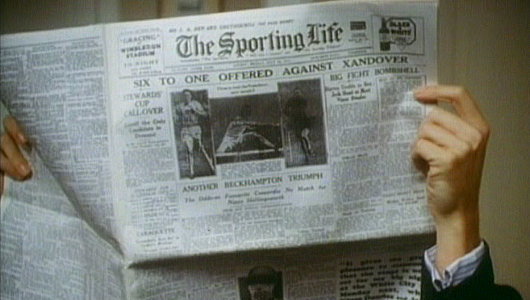
THE MOST FAVOURED daily reading material of the late Queen Mother, The Sporting Life did not survive into the twenty-first century, unlike the beloved former consort (who died 102 years of age in 2002). It was first printed in 1859, but through its 1886 acquisition of Bell’s Life in London, and Sporting Chronicle had a heritage dating back to 1822. Throughout the twentieth century, aside from being the racing newspaper of record, reading it gave a certain connotation of leisureliness, spiviness, or both. By the 1980s, it was thought the Life was getting a bit staid, and it was challenged when Sheikh Mohammed bin Rashid Al Maktoum founded the Racing Post as a daily competitor.
“The advent of the Racing Post in the 1980s was good for the Life,” Jamie Reid wrote after the older journal shut. “The old paper was in danger of becoming tired. What makes the Life’s closure so hard to take is that in the last few years it was better than ever.”
“The Post‘s editorial style was often a bit dry whereas the Life’s top writers… were clearly not good for you at all. They were basted in alcohol, toasted in tobacco and in constant desperate need of a winning tip.”
That the long tradition of The Sporting Life didn’t have to end is one of the more frustrating aspects: it was the Life’s owners, Trinity Mirror, that bought the Post in 1998 and decided to keep the title of the twelve-year-old paper instead of the one with one-hundred-and-forty-nine years of history behind it. Go figure.
Philippe Séguin
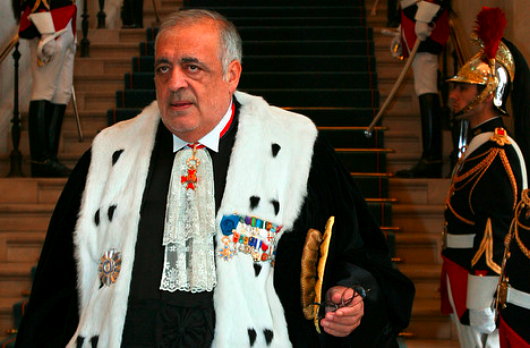
If you can possibly ignore its blood-soaked foundation and its disregard for the freedom of the Church, one can appreciate that the French Republic does republicanism with a dash of pizzazz, as evidenced by the late Philippe Séguin’s official robes as President of the Cour des comptes. Of course, most of this panache it inherited from its intermittent monarchic and (even more so) imperial past. It also inherited from Louis XIV an ever-present spirit of centralisation — the Republic frowns upon the principle of subsidiarity.
Monsieur Séguin was a decent sort. (more…)
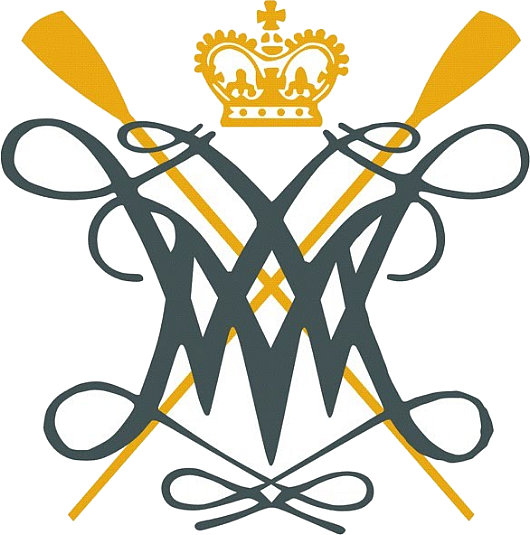
The William & Mary Cypher

In addition to its coat of arms, the College of William & Mary makes good use of the royal cypher of its eponymous monarchs, as seen above, in a version used by the whole university (it is a ‘college’ only in name), and below in a variant used by the William & Mary Rowing Club.
The East Neuk of Fife
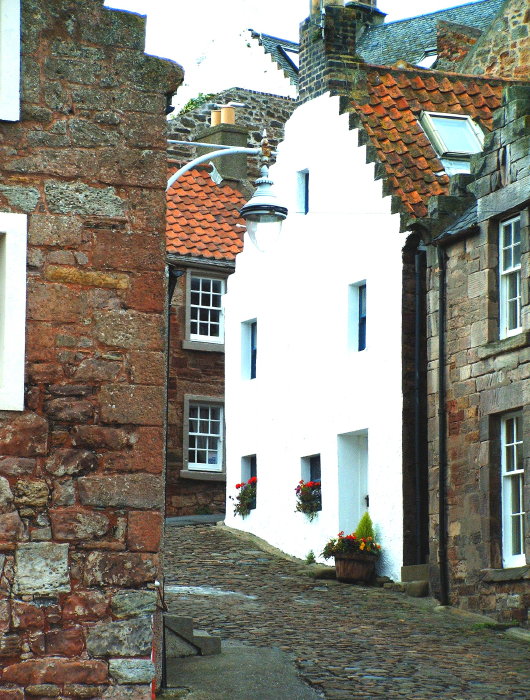
THE 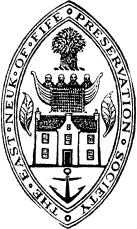 EAST NEUK of Fife is one of my favourite little corners of the globe, in what is definitely my favourite country in the world. Here are a set of almost unspoilt little fishing villages with a quite localised architectural style that makes them instantly recognisable. The name of this little regionlet signifies its location as the east ‘nook’ of the Kingdom of Fife, that juts out into the North Sea.
Those concerned for this part of the world might be interested in signing up for the East Neuk of Fife Preservation Society, which has completed admirable work all over the East Neuk, and is currently considering the restoration of the gatehouse of Pittenweem Priory.
Interesting Things Elsewhere
Benedict and Britain
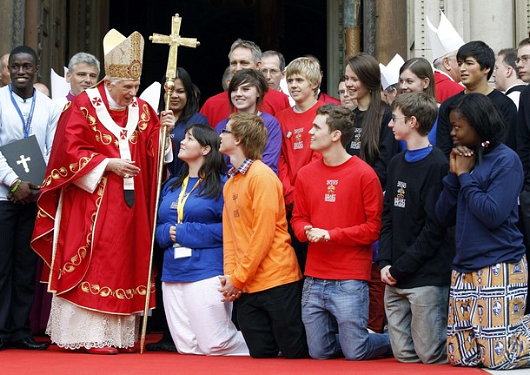
The papal visit began in Scotland, and the smaller setting (Scotland has just five million people, fewer than London alone) proved a wiser starting point of the pontiff’s trip to Great Britain. “Would the first day have been the success it was if it had taken place in England?” asked William Oddie. “Would the papal chemistry have worked so soon in London, that vast and engulfing megalopolis, if the reception by Her Majesty had taken place in the impersonal splendours of Buckingham palace rather than in that ancient architectural wonder Holyrood house (whose very stones are a testimony to its Catholic origins) and if the Popemobile ride through the streets afterwards had been down the Mall?”
Damian Thompson has argued that the papal visit has proved a triumph for Benedict and a humiliation for the secular-humanist crowd. The Daily Telegraph blogs editor and Catholic Herald editor-in-chief says that the Pope’s natural shyness has worked to his advantage, while the former Spectator editor Dominic Lawson argued in the Independent that Benedict’s unpolitical nature gives him a popular appeal.
The volume and biliousness of the media’s campaign against Benedict XVI has actually backfired and turned the lukewarm into pope-welcomers (like Kate Hoey MP, reports Christina Odone). Another blogger reported the influence a television programme produced by the gay activist and sometime paedophilia sympathiser Peter Tatchell that was broadcast just before the Pope’s arrival:
‘Are you going tomorrow?’ I asked. ‘Yes, I am,’ she replied. ‘I wasn’t going to at first, because it’s a long day, but when I saw that rubbish last night on the telly, I changed my mind. I’m don’t care if I die there; I’m going.’
Meanwhile Mark Dowd, another homosexual, was determined to be even-handed in his documentary “Benedict: Trials of a Pope”, and his broadcast was well-received. The filmmaker wrote in the Catholic Herald “when you have to make a one-hour programme on one of the most clever and gifted people on the planet you have to look behind the headlines and the angry rants on the blogosphere. In short, you have to do justice to the man as best as you can.”
Hilary White had a chat with barrister and Catholic Union chairman Jamie Bogle, who argued that the visit has taken the wind out of the sails of Benedict’s enemies.
“Jamie also pointed out that the protesters were having a bit of fun with the numbers,” Hilary writes. “A friend in Vancouver said that 25,000 turned out for the demonstration. The National Secular Society said it was ‘between 10 and 12,000’. But Jamie told me he had spoken with some of the cops present, and they said it was no more than 2,000.”
It was like a scene from 1984
Atheist Brendan O’Neill reported being disturbed by the anti-papal demonstrators, reporting that there is “a sharp authoritarian edge” to the radical pope-haters. “Things turned ugly outside Downing Street when Terry Sanderson of the National Secular Society branded the pope an ‘enemy of the state’, giving rise to the cacophonous chant: ‘GO HOME POPE, GO HOME POPE.’ It was like a scene from 1984. I have been on many a radical demo that has challenged the branding of some group or individual as ‘enemies of the state’; but this is the first radical demo I’ve been on where the protesters themselves demanded the silencing and even expulsion from Britain of someone they decreed to be an ‘enemy of the state’. Even one-time ‘enemies of the state’ – the so-called queers and the old left – were using that criminalising phrase, that piece of political demonology, to chastise the pope. It was the world turned utterly upside down.”read more
Also: The campaigners against the pope’s visit have more in common with the fanatical Inquisitors of old than with Enlightened liberal humanists, says Frank Furedi.
The conservative case for rail
File this one under “things we always knew and are glad someone agrees”: the dissident conservative fortnightly The American Conservative presents a symposium of articles about getting the USA back on the rails. William Lind attempts to destroy the myth of public-transport-hating conservatives while attacking the rampant subsidisation of federal highways. Former Milwaukee mayor John Norquist says the Right shouldn’t surrender the cities to the Left. Glen Bottoms does the numbers on the return to rail and tries to figure out how much it will cost. Finally, John Robert Smith argues that there’s still some life in America’s Main Streets. Christopher Leinberger discusses how private development can fund public infrastructure. read more
The Thomist constitution
St. Thomas Aquinas, the “Dumb Ox”, stated that “all should take some share in the government: for this form of constitution ensures peace among the people, commends itself to all, and is most enduring”. Aelianus muses on a Thomistic view of government, explores the pros and cons of monarchy, aristocracy, democracy, and ponders the political position of the family in society. read more
Swedish under threat in Finland
Swedish was historically the language of Finland’s nobility and intelligentsia, as well as of the country’s ethnic Swedish minority — Finland’s first president and greatest hero, Field Marshal Mannerheim, could barely even speak Finnish. But while the Scandinavian land is still officially bilingual in education and government, the 5.5% of the population who are Swedish-Finns is increasingly viewed as “the world’s most pampered minority”. read more
The Südtirol success story
Amid the warnings of doom and gloom ahead for the Italian economy, one province has almost full employment and a healthy economy, not to mention a governor who has ruled for over twenty years. “We are living in the promised land,” — Südtirol. read more
Europe According to Stereotype
A London-based graphic designer has created a series of maps depicting Europe according to the national stereotypes in the minds of various peoples. Yanko Tsvetkov, a Bulgarian living in Great Britain, created the first one in 2009 in the midst of the energy dispute between Russia and the Ukraine. Russia was labelled “Paranoid Oil Empire”, the Ukraine “Gas Stealers”, and the E.U. as “Union of Subsidized Farmers”. Switzerland was simply “Bank”.
“I created the first one in 2009 because at that time there was an energy crisis in Europe,” Mr. Tsvetkov said. “I just created it to amuse my friends but when I put it up on my website so many people liked it that I decided to really focus on the project of mapping the stereotypes based on different places in Europe. I was surprised by the reaction because I never really expected it to take off like this.” (more…)
When Newspapers Were Newspapers
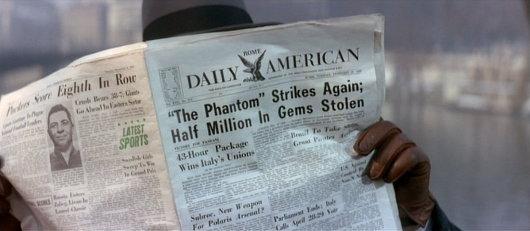
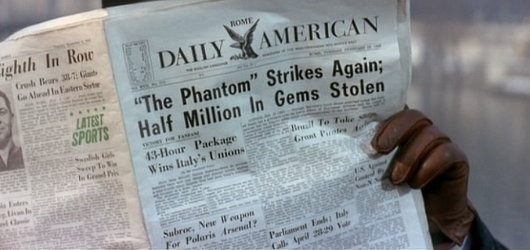
One of the things I enjoy about watching older movies is seeing the newspapers they mocked up for them. “The Pink Panther” (1963) featured this shot of an underworld figure reading the Rome Daily American on a Paris bridge or quayside.
Often these are mockups of newspapers that never existed, but the Rome Daily American was real. A handful of GIs started it in 1945 when the European edition of Stars and Stripes ceased publication. It took the Herald-Tribune two days to reach Rome from Paris in those days, and the CIA held an arms-length 40% stake of the ownership until the 1970s.
The paper was made famous by the 1953 flick Roman Holiday — there was a charming film. Its offices were in the Via di Santa Maria in via, parallel to the Corso, until the paper went bankrupt in 1984.
Follow the Pope’s Visit
What are the best ways of following the Pope’s visit to Great Britain? The official website is offering a live webcast of all events, with highlights from the day interspersed between events. The Daily Telegraph is live-blogging the papal events each day, with frequent updates; today can be found here. The Catholic Herald is also live-blogging the Papal Visit, and updates on today’s events can be found here.
Check catholicherald.co.uk and telegraph.co.uk for more throughout the visit.
Search
Instagram: @andcusack
Click here for my Instagram photos.Most Recent Posts
- Brunel’s Unbuilt Capitol February 3, 2026
- Cricket at Fordham January 27, 2026
- Palacio Barolo Revisted January 14, 2026
- Learning to Love Liguria January 14, 2026
- Crux Alba No. 2 January 13, 2026
Most Recent Comments
Book Wishlist
Monthly Archives
Categories