2007 October
About Andrew Cusack
 Writer, web designer, etc.; born in New York; educated in Argentina, Scotland, and South Africa; now based in London.
 read more
News
Blogs
Reviews & Periodicals
Arts & Design
World
France
Mitteleuropa
Knickerbockers
Argentina
The Levant
Africa
Cape of Good Hope
Netherlands
Scandinavia
Québec
India
Muscovy
Germany
Academica
Republicanism is a traitor’s game
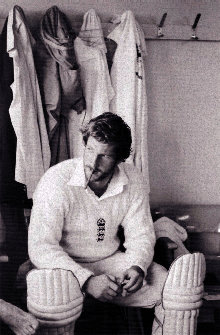
I listen to all these republicans…
If it was down to me I’d hang ’em! I honestly would. It’s a traitor’s game for me.”
SO SPEAKETH Sir Ian Botham, on this occasion to the Guardian, the newspaper of the British ruling class. It’s always reassuring when a public figure speaks out in support of the few remnants of tradition the metropolitan elites allow us to retain, so Sir Ian deserves a firm handshake, a pat on the back, and a pint on the house. Still, there are others (poor souls!) who disagree with the goodly knight. Herein the British Republican movement lists its supporters. They are mostly relative unknowns, except for the former Viscount Stansgate and the rather vulgar Peter Tatchell.
Leanne Wood, a member of the Welsh Assembly, states “I am a republican because I am opposed to the hereditary system”. Opposed to the hereditary system? We presume, therefore, that when she reaches the evening of her years (after a long life sucking off the taxpayer teat) she will not leave her comfortable residence and all her earthly possessions to her offspring, but instead donate them to the Fabian Society. Pity her poor children!
“I believe,” Ms. Wood continues, “in equality not patronage”. To my mind, party politics is more often a source of patronage than the limited constitutional monarchy. As for equality, doesn’t being a member of the Welsh Assembly give her more power and influence than others? Not very egalitarian, but then there are no true egalitarians. Only some who, rather than appreciating the heights of Western civilization, prefer to topple it to the ground in order to establish greater “equality”.
The former Viscount Stansgate, who currently styles himself “Tony” Benn, proclaims that “In a democracy people must be able to elect their own head of state”. The demos beg to differ. The Crown has consulted the people in forty-four different general elections since the enactment of the Reform Act of 1832, and yet the voters have curiously neglected to ever vote a republican party into government.
Mr. Tatchell, meanwhile — whom the Republican movement identifies as a “gay rights and human rights campaigner” (I am glad they concede the dissimilarity in the two concepts) — tells us that “Britain remains a partial, incomplete democracy, steeped in aristocratic privilege.” Hear! Hear! “Why can’t we have a complete, mature democracy,” Mr. Tatchell asks, “where the people elect our Head of State?” Perhaps because democracies which elect their head of state are rarely mature. It seems entirely more mature to keep those institutions which have stood the test of time rather than to arbitrarily destroy them based on what amounts to little more than modish management concepts.
Curiously, at least three people on the Republican movement’s list of supporters are Queen’s Counsel (QCs, or “silks”). They are not so opposed to the monarchy as to refuse the fruits of its munificence, and for that we should praise their pragmatism. Even more curiously, however, nineteen on the list are Members of Parliament. Surely MPs are required to take an Oath of Loyalty to the Crown in order to take their seats? But then perhaps these nineteen are abstentionists along the lines of the Sinn Féiners. While one hesitates to presume to advise the Crown, it might be useful every so often to inquire among the members of Parliament as to which would lend their votes to the abolition of the monarchy, and then deal with them in the manner Sir Ian Botham profers.
“If it was down to me I’d hang ’em!”
Category: Monarchy | Hat tip: The Monarchist.
Bring Back the Broadsheet!
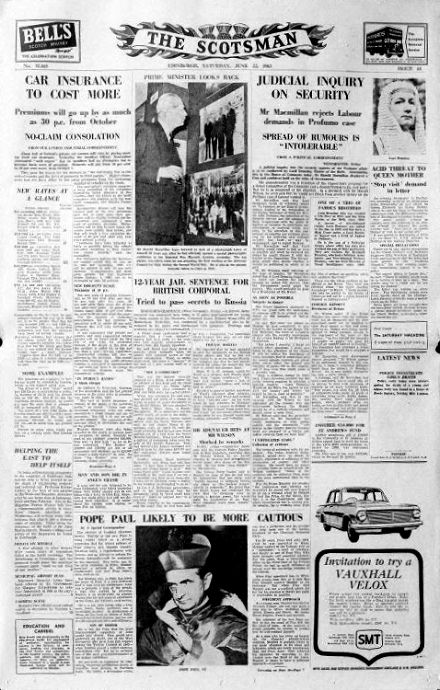
THE DECLINE OF Scotland’s nation newspaper is marked and lamentable. Once exhibiting a certain grace and dignity, the Scotsman was the most respected of Caledonian dailies. It was the only to have bureaus overseas, and it presided as king of the newspaper realm from stately offices on the heights of North Bridge. All of that, of course, is all gone. It’s all about cost-cutting and driving up circulation instead of maintaining the role as Scotland’s newspaper of record. (more…)
The Light Guard
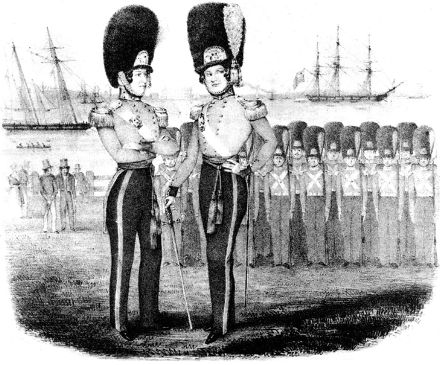
Officers of the New-York Light Guard, an antecedent of the Old Guard of the City of New York. The City Guard and the Light Guard combined in 1826 to form the Old Guard.
Categories: The Old Guard | Militaria
Irish Parliament House
Please see the updated article of the Irish Houses of Parliament, College Green, Dublin here.
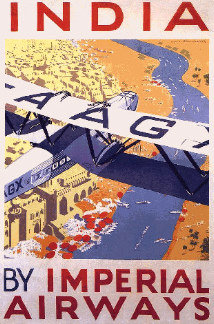
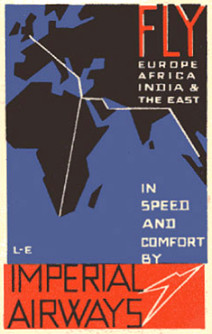
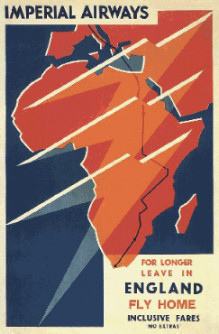
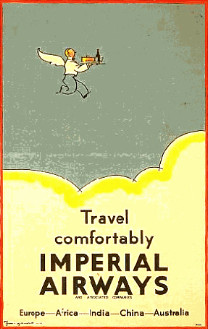
Imperial Airways
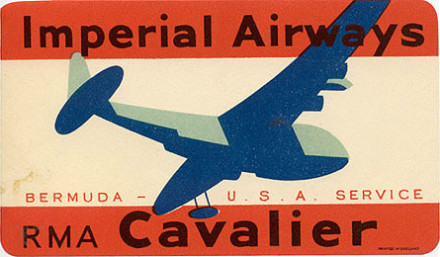
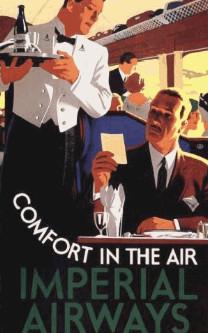

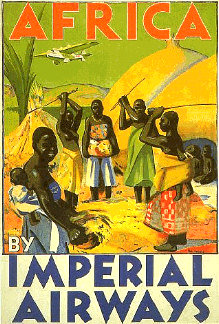



Previously: Bayerische Volkspartei | Lwow (Lvov/Lviv) | Empire State | Municipal Airports | Crêpes à Dentelles
Upcoming Events
Tradition in New York
November 1, 2007 (Thursday)
The Feast of All Saints
Holy Day of Obligation
Latin Mass (Extraordinary Form)
7:30 pm
Church of Our Lady of Good Counsel
230 East 90th Street
(between 2nd & 3rd)
November 2, 2007 (Friday)
The Commemoration of All Souls
& First Friday
Latin Mass (Extraordinary Form)
6:30 pm
Church of St. Vincent de Paul
123 West 23rd Street
(between Avenue of the Americas & 7th Avenue)
November 5, 2007 (Monday)
Annual Solemn Requiem
of the New York Purgatorial Society
Latin Mass (Extraordinary Form)
6:15pm
Church of St. Agnes
143 East 43rd Street
(between 3rd & Lexington)
November 17, 2007 (Saturday)
The Sleep of Reason
Part one of the Roman Forum’s Modern Image & Catholic Truth series
9:00am – 4:00pm
Church of Our Lady of Good Counsel
230 East 90th Street
(between 2nd & 3rd)
Modern man has a positive image of himself that has been shaped and very effectively propagandized since the time of the Renaissance. In three conferences between November and May, the Roman Forum’s Modern Image and Catholic Truth series will explore the gap between this image and the true predicament in which the individual and contemporary society now find themselves trapped.
Part One: The Sleep of Reason
Modernity speaks of the eighteenth century Enlightenment as the “Age of Reason”. But proponents of the Enlightenment were often dubious about the ability of the human mind to understand man and nature and more interested in limiting the scope of rational activity than increasing it. Much of their labor ended by declaring the universe to be the mere plaything of the human will and passion, while practical backing for many of the Enlightenment’s goals came from strange combinations of mystical speculation and calls for the exercise of Machtpolitik.
9:00am
Holy Mass
(Latin, Extraordinary Form)
9:45am – 10:30am
Registration
10:30am – 11:30am
Pietism, Jansenism, Enlightenment
& the Victory of Power over Reason
Dr. John Rao
11:45am – 12:45pm
Adam Smith and Karl Marx:
A Study in the Logic of the Enlightenment
Dr. Jeffrey Bond
12:45pm – 2:15pm
Lunch
(A second Mass is also available in the Church)
2:15pm- 3:15pm
The Scientific Revolution & the Social Contract
Theory of Hobbes, Locke & Rousseau
Rev. Dr. Richard Munkelt
3:15pm – 4:00pm
Panel Discussion
For further information please contact the Roman Forum (dvhinstitute@aol.com or call 212-645-2971).
COST
$30: Reserve by November 10th
$40: Pay at the door, entrance and lunch
$10: Pay at the door, entrance alone
Checks payable to:
The Roman Forum
11 Carmine Street, 2C
New York, NY, 10014
Some recent additions to the blogroll:
What Does the Prayer Really Say? by Fr. Zuhlsdorf of The Wanderer.
Damian Thompson of the Daily Telegraph and the Catholic Herald (both indispensable reading during post-Rosary teas at St Andrews).
A Conservative Blog for Peace by one Serge, a traditional Christian of the conservative persuasion.
Tea at Trianon is choc-a-bloc with the defense of Marie-Antoinette as well as other interesting items by Elena Maria Vidal.
As well as Western Confucian, Gravissimum Educationis, and the lushly-illustrated Hallowed Ground.
A Monastery Rises in Oklahoma

I REMEMBER HEARING about the foundation of Clear Creek Monastery some years ago. A small handful of monks from Fontgombault in France, the king of the traditionalist abbeys, were sent to found a Benedictine community in the hills of Oklahoma, devoted to the Old Mass. I saw the splendid and very traditional plan drawn up for a church and residence and thought to myself: “Wouldn’t it be nice if that actually came to fruition”. Well, I’m happy to say it actually did, and the handful of traditional Benedictines (completely in communion with Rome and the Bishop of Tulsa) have grown and are apparently thriving. They’ve even completed the crypt of their church and the monastery building. (more…)
The Red Mass
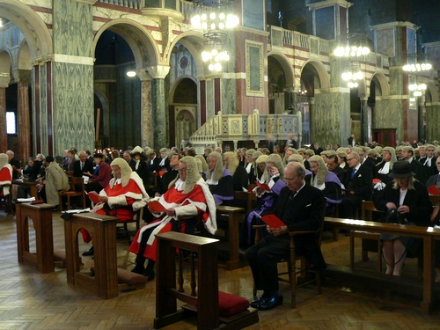
THE RED MASS is an ancient tradition which marks the beginning of the legal session every year. It takes its name from the red vestments used for a Mass of the Holy Ghost, invoking God’s protection over the judges, lawyers, and officials as they duly practice the law. Msgr. Langham, the Administrator of Westminster Cathedral, was kind enough to post a few pictures of the Red Mass offered at the Mother Church of Catholic England on the splendid cathedral weblog. A similar service is held at Westminster Abbey for the Protestant officials of the law.
Clarendon Court
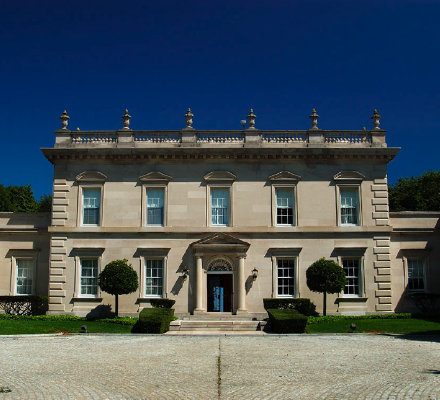
CLARENDON COURT IS one of the more comely of the Newport “cottages”. Built a little later than most, it avoids the Mediterranean gallimaufry of the Breakers and the French frilliness of many of the other Newport mansions (The Elms, Marble House, etc.). Its chief fame, however, comes not from its architectural excellence but rather as the family home where Sunny von Bülow fell into a permanent vegetative state, leading to the arrest and conviction for attempted murder of her husband Claus von Bülow. Von Bülow’s conviction was overturned on appeal, when he was represented by the famous Alan Dershowitz.
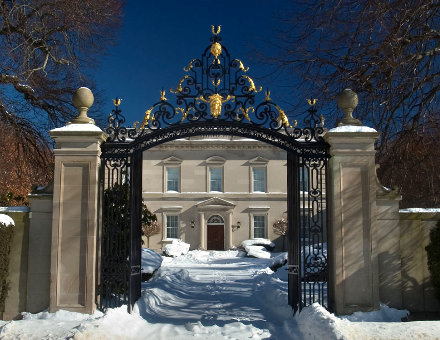

Previously: Salve Regina University
Insiginia of the Society of Colonial Wars
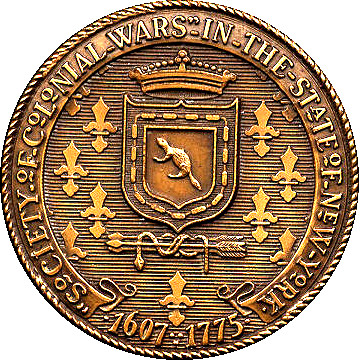
DEPRIVED OF THE hereditary principle by the lamentable break with Great Britain in 1783, Americans were eventually driven to inventing a hereditary social hierarchy, even more stringent than that of the mother country. Blood is the only qualification for membership of the numerous hereditary societies that dot the United States, unquestionably foremost among which is the Society of the Cincinnati. The Society of Colonial Wars, however, is one of the more prominent of the dozens of hereditary societies, and each state organization has devised its own seal or emblem. Below are exhibited a handful of examples.
Mythbusting on Facebook
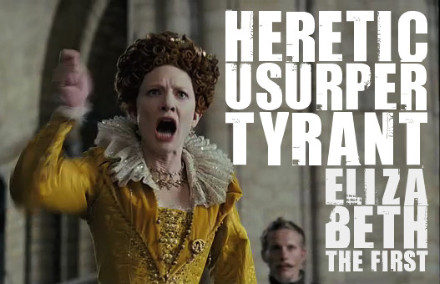
Anyone who’s on Facebook and has all the right ideas must join the group “Elizabeth I: Heretic, Usurper, Tyrant”.
The Church Resurgent
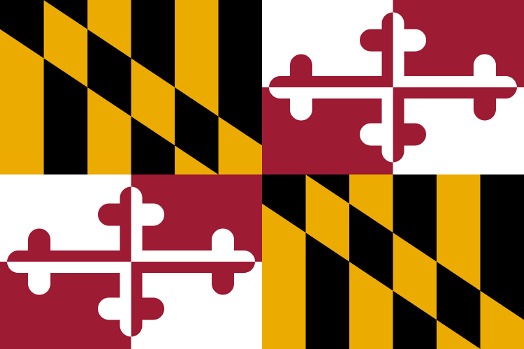
THE CATHOLIC COLONY of Maryland was first planted in 1634 at St. Mary’s, which became the first capital city of the Calvert family’s palatinate. The attempt to run Terra Mariae as a Catholic feudal state was continually frustrated by a number of fiery Protestant settlers, who eventually broke out into open rebellion in the 1650s while the Civil Wars raged back in England. Happily, Cecil Calvert, 2nd Baron Baltimore, sent out an army under Gov. William Stone to restore order to the colony, but was defeated by the Puritan force in March, 1655 at the Battle of the Severn. During the Puritans’ persecution of the Church, all the Catholic churches in Maryland were destroyed, and in 1667 a new ecclesiastical edifice was raised in St. Mary’s: the Brick Chapel.
The Rapalje Children
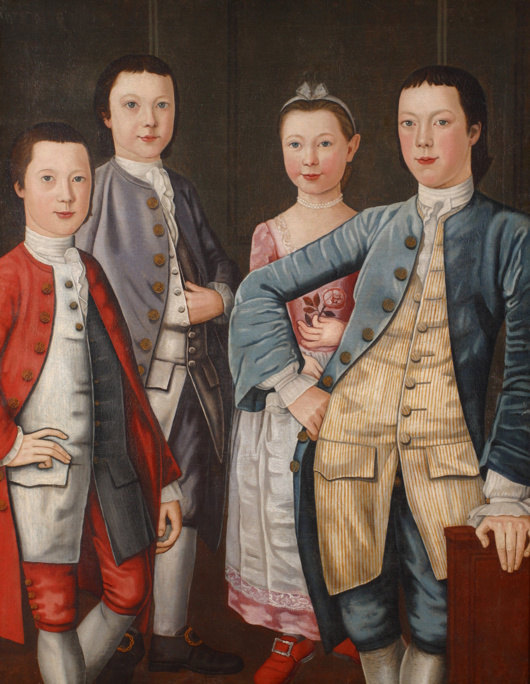
Oil on canvas, 50¾″ x 40″
1768, New-York Historical Society
Durand’s painting of the four children of this prominent mercantile family of Manhattan is one of the finest examples of group portraiture from the colonial period in America. From left to right are Garret (b. 1757), George (b. 1759), Anne (b. 1762), and Jacques (b. 1752).
The painter had come to New York from Virginia two years previous to paint individual portraits of the children of the Beekman family. Art historians suspect he was born or trained in France. Durand later returned to Virginia, where he continued to paint until his death in 1805.
Corpus Christi Church
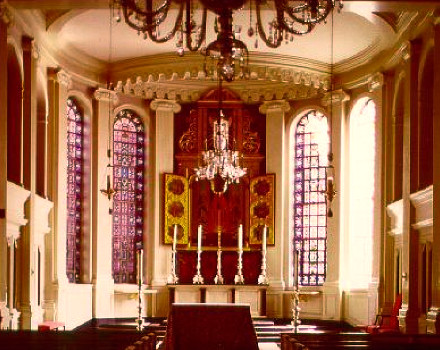
Corpus Christi Church, West 121st Street, New York: perhaps my favorite Catholic church interior in all New York, and one which simply cries out for a traditional Mass. (more…)
The Crown in British Columbia

TO VICTORIA, the capital of British Columbia, where the sun never sets on the British Empire. As the Monarchist blog has reported, the Queen of Canada has appointed a new Lieutenant Governor to represent the Crown in her province on the Pacific. In the sumptuous Parliament Buildings of British Columbia, the Chief Justice of the province read the Royal Proclamation, weighted with the Great Seal of Canada, in both native English and appallingly-pronounced French before administering the Oath of Loyalty and the Oath of Office to the Honourable Steven Point, British Columbia’s twenty-eighth Lieutenant Governor. (more…)
Only the Church stood
Being a lover of freedom, when the revolution came in Germany, I looked to the universities to defend it, knowing that they had always boasted of their devotion to the cause of truth; but, no, the universities immediately were silenced. Then I looked to the great editors of the newspapers whose flaming editorials in days gone by had proclaimed their love of freedom; but they, like the universities, were silenced in a few short weeks. …
Only the Church stood squarely across the path of Hitler’s campaign for suppressing truth. I never had any special interest in the Church before, but now I feel a great affection and admiration because the Church alone has had the courage and persistence to stand for intellectual truth and moral freedom. I am forced thus to confess that what I once despised I now praise unreservedly.
The Assay Office
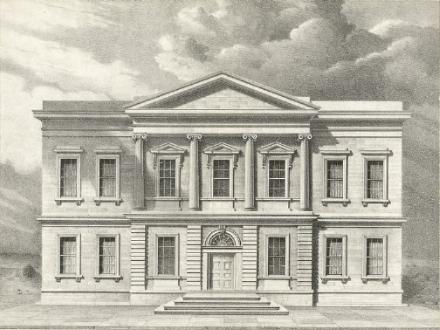
THE ASSAY OFFICE was built in 1822 as the New York branch of the Bank of the United States, located at 15½ Wall Street. The (Second) Bank of the United States was the second attempt at a central bank for this country. Eventually, the central bank grew too powerful, trying to manipulate politics and master the economy itself, and so it was abolished in 1836. The building later became the Assay Office, an adjunct to the Customs House and Sub-Treasury next door, which itself is now known as Federal Hall National Monument. When the Assay Office was torn down, the façade was preserved and donated to the Metropolitan Museum of Art by Robert W. de Forest in 1924. It is now presented in the glass-covered courtyard of the American Wing of the greatest museum of art in the New World. (more…)
Search
Instagram: @andcusack
Click here for my Instagram photos.Most Recent Posts
- West Point July 30, 2026
- Brunel’s Unbuilt Capitol February 3, 2026
- Cricket at Fordham January 27, 2026
- Palacio Barolo Revisted January 14, 2026
- Learning to Love Liguria January 14, 2026
Most Recent Comments
Book Wishlist
Monthly Archives
Categories