2006 May
About Andrew Cusack
 Writer, web designer, etc.; born in New York; educated in Argentina, Scotland, and South Africa; now based in London.
 read more
News
Blogs
Reviews & Periodicals
Arts & Design
World
France
Mitteleuropa
Knickerbockers
Argentina
The Levant
Africa
Cape of Good Hope
Netherlands
Scandinavia
Québec
India
Muscovy
Germany
Academica
Tom Grant, 1986-2006
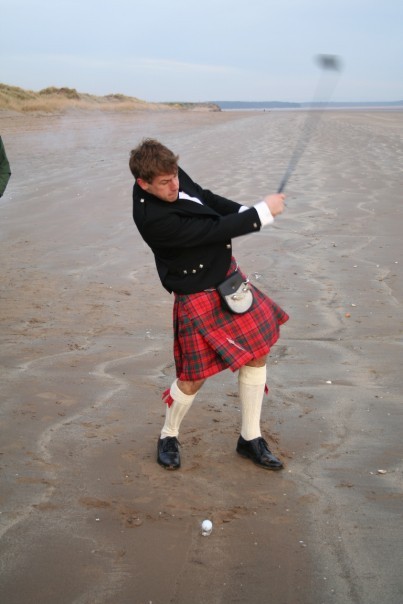
A good man and a brave man. May he rest in peace.
Brave student had heart set on Sandhurst (The Telegraph)
Cadet killed on train was role model for friends (The Times)
Stab victim, 19, died doing the right thing (The Daily Mail)
Tributes to train stabbing victim (BBC News)
The student who was stabbed for trying to break up a fight (The Independent)
Tributes to Hero Stabbed to Death on Train (The Daily Record)
Tributes for ‘joker’ Tom (The Sun)
The Perils of Over-Restoration
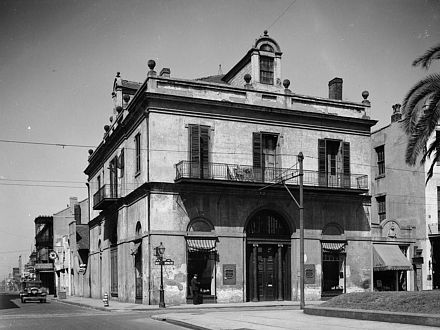
A rather good article I was reading in the Oxford American (via V&V) reminded me of a building I stumbled upon in the Historic American Buildings Survey, digitized at the Library of Congress. No. 403 Royal Street in the French Quarter of New Orleans was designed by one of the first master architects in America, Benjamin Latrobe, who also designed the Baltimore Basilica, the Mother Church of the United States. Resting at the corner of Royal and Conti streets, the building was constructed by the Louisiana State Bank (later subsumed into la Banque de la Louisiane) and features a domed banking hall in the center. After having outlived its usefulness under its original purpose, it became a private residence, with the central banking hall turned into a living room, before being turned into an events venue as it remains today. (more…)
My American English
|
Your Linguistic Profile:: |
| 50% General American English |
| 30% Yankee |
| 15% Dixie |
| 0% Midwestern |
| 0% Upper Midwestern |
I generally concur with the results of this quiz.
The Fife Show

This past Saturday we went on a little expedition to the neighbouring town of Cupar for the annual Fife Show put on by the Fife Agricultural Association. It was an excellent day which provided much joviality. The venison hamburgers were especially enjoyed; I hadn’t had one since I was in Vermont years ago. And naturally there were plenty of animals; sheep, cattle, horses, dogs, but sadly no pigs. (more…)
Forgotten New York in Print
 I look forward with excitement to the publication of ‘Forgotten New York: Views of a Lost Metropolis’, by Kevin Walsh of the brilliant Forgotten New York site and due out this October from Harper Collins. (Click here for the Amazon link). Forgotten New York is one of my favorite sites and an excellent way of exploring the myriad of neglected and underappreciated nooks and crannies which pepper the great metropolis. My personal favorite of all the sections of the site is ‘You’d Never Believe You’re in NYC‘ highlighting the somewhat rustic nature of some parts of the city. The site also exhibits some of the ongoing tragedies of the Big Apple, including historic buildings which have been destroyed even in the space of time since the site began, and the ongoing over-development of Staten Island, which contains some of the last tranquil places in New York.
Another great site for New York City virtual exploration is Bridge and Tunnel Club. The most recent additions are shown on the main page, and the total contents can be accessed via the Big Map. Perhaps you’d like to take a peek at Columbus Circle, or explore the Public Library, remember the dead of the Great War at the Victory Column, or maybe visit the cricket grounds of Van Cortlandt Park in the Bronx.
What of Montenegro?
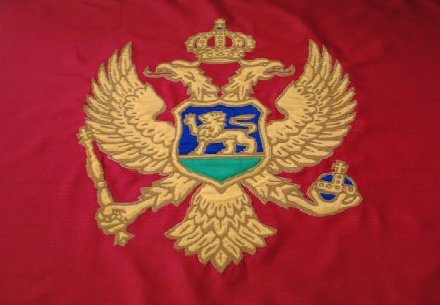
SO IT APPEARS that the electorate of Montenegro have chosen to end their confederation with Serbia (c.f. BBC News, “Montenegro ‘chooses independence’“). It is my firm belief that the more local a government, the better it is, and that decisions ought to made at the level closest to those they affect. This is more or less the idea of subsidiarity so enshrined in Catholic social teaching, especially in Leo XIII’s Rerum Novarum and Pius XI’s Quadragesimo Anno, and rather implicit in the Tenth Admendment of the U.S. Constitution (which, to my mind, has proved to be the greatest component of the Bill of Rights).
 Believing in subsidiarity, I am also inclined to believe that (up to a certain point) the smaller a state the better. (The ideal of government, after all, lies in hereditary principalities and kingdoms under a superceding imperial monarch, akin to the Holy Roman Empire). So does this mean that Montenegrin independence would be a good thing? Not necessarily. Essentially, the only disagreement between the governments of Montenegro and Serbia is that Montenegro wants to stomp out its own traditional culture and become an other outpost of boring liberal capitalism very very quickly. Serbia wants to do the same, but only quickly instead of very quickly. Look at the leadership of any European country today and you will see leaders who, despite their ritually professed anti-Americanism, want to erase their own traditional cultures and turn their countries into little cookie-cutter states slavishly beholden to American “popular culture”. (Regional differences in architecture are all that will be allowed to remain, as they encourage tourism, which itself is another destroyer of genuine organic culture). The governments of both Serbia and Montenegro certainly subscribe to this vision of a bright liberal, corporate future so Montenegro’s proposed separation is merely an exercise in trying to join the country club before the family next door.
Both countries aim to meet the same doom, so whether they go together or not is largely an irrelevance. Of course, if they had any sense in Belgrade and Podgorica, they’d restore their monarchies and take a peek into the ideas of Christian Democracy, a philosophy which is rather neglected these days (most especially by Christian Democratic parties, naturally). But we will lament the neglect of Christian democratic ideas (which, despite the name, are not necessarily democratic) on some other day.
Some New York Coinage
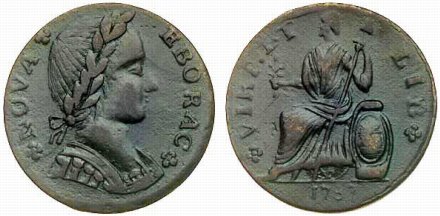
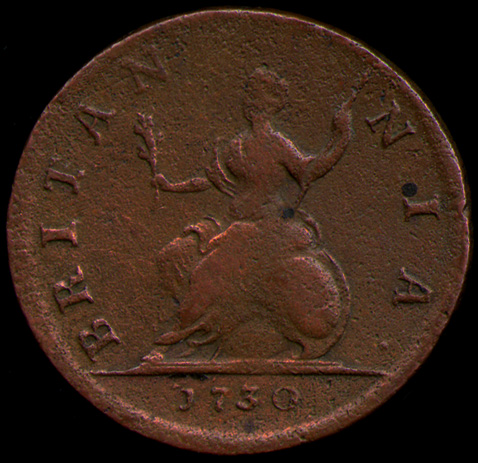
IT MAY INTEREST our readers to know that before the Feddle Gummint started throwing its weight around, the Great State of New York was in the habit of minting its own coinage. One of the most famous of the coins produced during the era is the 1787 ‘Nova Eborac’, so called for its abbreviation of Nova Eboracum; that’s ‘New York’ in the language of our ancient Roman forbearers.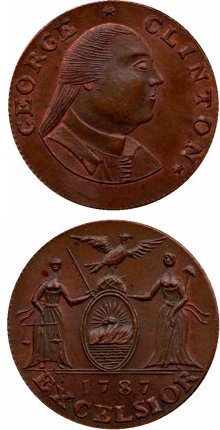 All decent people being lovers of monarchy, the New Yorkers of yore found themselves in a slight predicament. Their king had granted them independence four years earlier, but George III (the forgetful man!) neglected to indicate who would be king once he relinquished the sacred office. Every country must have a king — if not, then whose face would go on coins and such? “Not to worry,” saith the designer of the Nova Eborac. “We’ll stick a king on and just not say who he is.” And so they did, as seen on the obverse of the above Nova Eborac. The reverse depicts a figure who looks suspiciously like the Britannia on the old British coins. Old habits die hard. Around this Britannia-esque figure is the inscription VIRT. ET LIB for Virtus et Libertas – Virtue and Liberty.
One Thomas Machin, however, clearly thought this was a bit silly and so decided to simply put the Governor on the coins he produced. His coins (seen on the right) show Gov. George Clinton on the obverse and a depiction of the arms of the Empire State on the reverse (they also grace the banner of this webpage). A chap named Ephraim Brasher went a little further and depicted neither the anony-king nor the governor but instead put depictions of heraldic arms on both side of the coin; New York on the obverse and the United States on the reverse. These coins are known as ‘Brasher’s Dubloons’ and the front and back can be seen below.
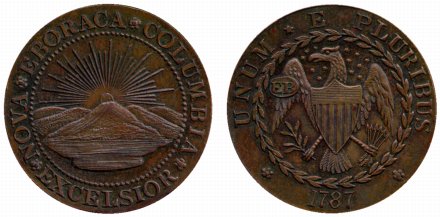
Previously: New York Currency
Whither Cusack?
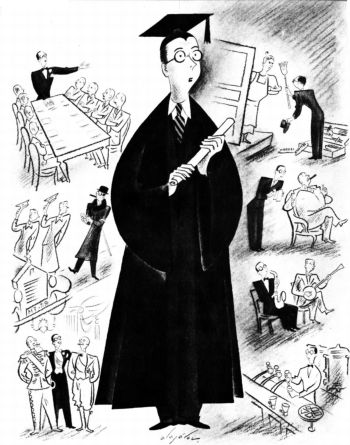
Today in Younger Hall I completed my very last university examination ever. Now all I need to do is graduate in the very same hall in June, and, of course, find some source of income. Thankfully, everyone’s been very helpful, realistic, and practical with career advice: they all see me as editor of the New Yorker. “Furry ’nuff,” I thought to myself, and dabbled into the realm of research by ‘logging on’ to that weekly’s internet presence wherein I discovered that the New Yorker not only already has an editor but it seems he has no intentions of relinquishing the position in the near future. Outrageous!
Well folks, what’s a lad to do?
Columbus Circle and the Human Scale
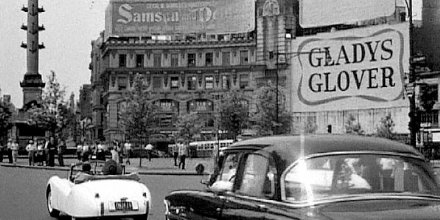
Meandering through the internet yesterday, I came across the above image from the 1954 film ‘It Should Happen to You!’ (via a New York Times article). The film capture shows Columbus Circle in 1954 and was I immediately struck by the superiority of the scale of the buildings to the street, especially compared to today when the Columbus Column is rather overshadowed by the AOL Time Warner Center. It’s not that I don’t like tall buildings; after all New York has some of the most beautiful skyscrapers in the world (though I can’t think of a single great one built after the second war). I don’t even object to the residential apartment buildings lining Central Park on Fifth Avenue and Central Park West, except for the fact that on Fifth Avenue they almost always replaced superior, smaller buildings. However, with a public square as small as Columbus Circle, it somehow seems as if lower buildings of only 3-10 storeys would be more appropriate.
The latest brouhaha concerns No. 2 Columbus Circle (the shorter, white building in the photo on the right), designed in the early 1960’s by Edward Durell Stone to house the art collection of Huntington Hartford. The current owners want to chic-ify the building by taking off the façade and recladding No. 2 in the more fashionable glass, akin to the neighboring Time Warner Center, and this has roused the ire of many of New York’s preservationist crowd. Though No. 2 has its charms, I’m not a huge fan of the building myself, but the redesign would only make it worse. The chief value of the building is its comparitively low height which, when viewed from the northwest, contributes to the feeling as if the midtown buildings are gradually lowering in height to meet the scale of Columbus Circle. Unfortunately the Time Warner Center doesn’t comply well with this lessening scale, though it at leasts goes through the motions by have a consistent, low base from which its two towers rise. The stone cladding of the Center, however, is rather too dark and gives a slightly gloomy feel to what ought to be a lovely, bright place. (more…)
A New York Funeral
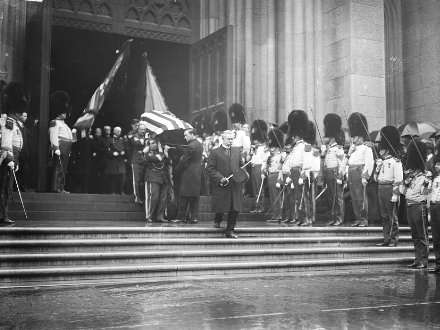
These photos are from the funeral procession of Gen. Daniel Sickles in 1914. Above, the General’s coffin leaves St. Patrick’s Cathedral. Below, the procession down an avenue (I can’t tell which one), eventually to be transported to Washington and buried at Arlington National Cemetery. The Old Guard of the City of New York provides the Guard of Honor.
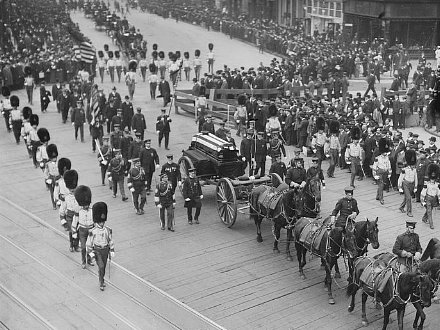
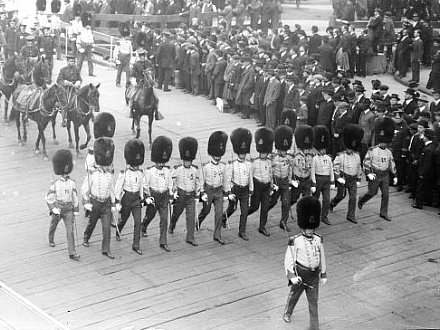
Previously: Old Guardsmen | The Old Guard | Grandpa
Torchlit Procession
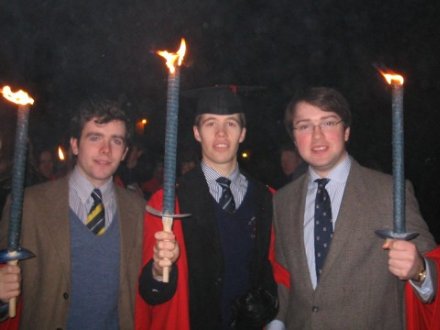
Yours truly, Mr. J. Dunn, and Mr. H. Evans, taking part in the traditional torchlit procession which is part of the rectorial festivities.
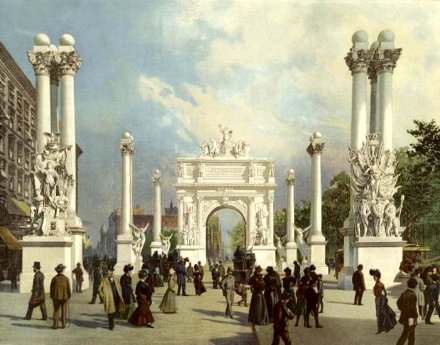
What A Difference A Line Doth Make
I have always considered myself a patriotic New Yorker as well as being rather partial to the County of Westchester; the former being the greater whole to which I owe my loyalty, and the latter being the more familiar portion of which I am very fond. Yet a mere eight miles northeast of my place of birth, growth, and residence there lies a foreign land by the name of Connecticut. Now Connecticut is a fine little land in its own right, possessing natural beauty, some pretty towns and villages, and an ancient seat of learning. Living in Connecticut, one imagines, would not be a bad thing. The Connecticutian even enjoys the privilege of being able to serve in either company of the Governor’s Foot Guard or Horse Guards. Could I ever be a Connecticutian, then? No, I think not. It may just be an imaginary line separating Westchester in New York from Fairfield County in Connecticut, but no, I don’t think I could ever tear myself from the Empire State (nor would I want to!). Imaginary line perhaps, but a damned important one if you ask me.
At any rate, both my patriotism for New York and my suspicion of Connecticut suitably affirmed, I’ve decided to share with you a little amusing snippet I discovered while flipping through an edition of the William and Mary Quarterly, the premier scholarly journal on early American history published at the College of the same name. I must admit that reading it filled my heart with not a little admiration for Lewis Morris, despite scandalous support for and signature of the Declaration of Independence.
“It is my desire that my son Gouverneur Morris may have the best education that is to be had in England or America but my express will and directions are that he be never sent for that purpose to the Colony of Connecticut least he should imbibe in his youth that low craft and cunning so incident in the people of that Country which is so interwoven in their constitutions that all their art cannot disguise it from the world tho’ many of them under the sanctified garb of religion have endeavoured to impose themselves on the world for honest men.”
— Will of Lewis Morris of Morrisania, Westchester County, New York, November 19, 1760, Wills of New York County, Vol. 23, p. 430.
It also reminded me of that quip of Chesterton’s that God tells us to love our enemies and our neighbors, probably because they’re usually the same people.
Roma – Caput Mundi
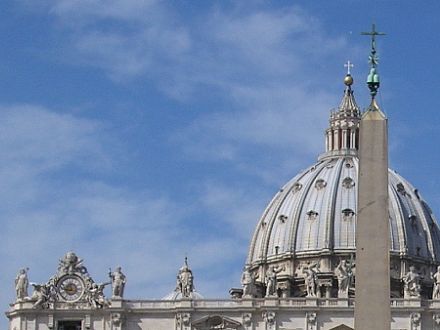
Well I’ve finally got around to putting up my report of our pilgrimage to Rome in March, with a plethora of accompanying photographs. It was an amazing time; Easter excepted, it was the jewel in the crown of our penetential season. Read about it all here.
The Sad State of the Modern Newspaper
…and the heroism of an Anglo-Hungarian countess.
IT IS ONE OF THE more saddening facts of life that British newspapers have suffered an inexorable decline in the past few years. The great Times of London – once the most respected newspaper in the world – has been reduced to a boring mid-brow tabloid, the once-solid Scotsman idiotified and, again, tabloided, and of course the Daily Telegraph, which has gone from staunchly conservative (as in worldview) to merely Conservative (as in the tribe of Britons who prefer blue to red).
The Telegraph, like the Conservative party itself, doesn’t seem to know what it’s there for. It has at least remained a broadsheet; going tabloid would be a disaster and would probably be considered the last straw for all the die-hards for whom loyalty to one’s newspaper is a point of pride. And, to its credit, it finally seems to have realised the damage done by constant front-page photos of “Posh” and “Becks” and other “celebrity” partisans of the Anti-Culture, for they seem fewer and far between these days (as compared to a year or two ago, when they were frequent). The Telegraph‘s base are old folk who want a quality newspaper. They are loyal to the Tele and, despite its decline, would be too embarrassed to jump ship to the Guardian, which is written better but which nonetheless expones a nefarious ideology.
As for myself, the last straw came one morning in the Common Room of St. Salvator’s Hall when, flipping through the Telegraph, I reached the page which normally displays the Court Circular but found it missing, replaced by a curt statement advising that should I desire information about the activities of the Royal Family I should direct myself to http://www.royal.gov.uk. Outrageous! As it happens, this is not a permanent loss but rather an occasional one, as the editors at the Telegraph seem to decide whether or not to print the Court Circular each day on a whim. Fair enough, but I came to the realisation that the producers of the Telegraph are not aiming at me – the reasonably educated young man who seeks in his daily read a newspaper that is well-written, right-thinking, and properly presented – and so I have ceased to be a Telegraph regular.
What to read then? We have already dismissed the Times, the Scotsman, and the Guardian. The Daily Mail is always readable but arguably aimed at a different demographic; the Daily Mirror, bonkers; the Sun, no thank you!; the Financial Times is too boring, though the Weekend edition is actually worth buying most of the time; the Independent has a good layout for a tabloid, but is rather of a Lib-Dem persuasion; the Glasgow Herald is just rather dull and has only recently repented of its long-held anti-Catholicism. Not wanting to support the nefarious New York Times, enemy of Western civilization and the last word in liberal elitism, its wholly-owned subsidiary the International Herald-Tribune is ruled out. Which pretty much rules out every English language daily newspaper available in St Andrews.
 So, abandonné par ma langue, I have outsourced my daily read to the Continent (of all places!) and am now a partisan of Le Figaro. While by no means fluent in the language, I can comprehend written French with greater ability than I speak it. And while I still prefer the feel of a broadsheet, the Berliner size of Le Figaro has its advantages, being very easy to read in the confined space of my regular chair in the corner of the little coffee shop down the street. More importantly, I find it much more engaging mentally, which I put down to the fact that (not being a native or fluent French speaker) I am forced to read every word. Reading the Telegraph one unthinkingly only actually reads every third or so word; articles of particular interest excepted, naturally. The day’s Figaro usually arrives in the middle of the day or the afternoon, but I buy my paper in the morning so actually I’m usually reading the previous day’s Figaro. I don’t mind, it suits my current routine. (Mornings are for reading the newspaper in a coffee shop, afternoons are for reading books with a slow pint in the pub.)
The chief deficit of reading a French newspaper is that naturally the news is oriented towards France, and thus I don’t get the usual transatlantic focus of the British papers (which can be an advantage as well as a deficit, I’ll concede). Nonetheless, it does happen to have articles of interest to any trad.
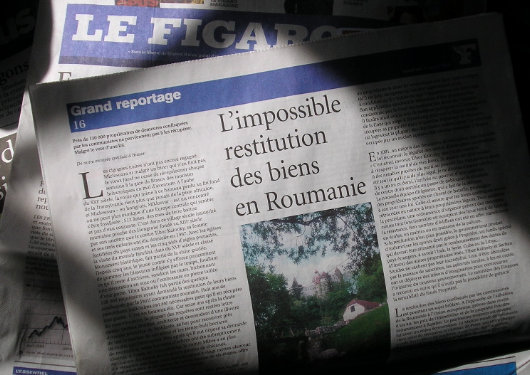
A few weeks ago, Le Figaro reported on the restitution of Romanian castles to their original, pre-Communist owners (‘L’impossible restitution des biens en Roumanie’, Le Figaro, 21 April 2006). The New York Sun rather amusingly and provincially headlined the story “Westchester Man To Take Possesion of Dracula’s Castle” — the New York Post characteristically used the headline “VLAD TIDINGS“. (FTD also reported on the restitution of Bran). When I wrote my previous post on the subject I was under the impression that Bran was one of the castles which would be restituted and then purchased back by the Romanian government, but most sources imply that this is not the case and Dominic von Habsburg (of North Salem, New York) will actually take possesion of the castle, I’m glad to hear.
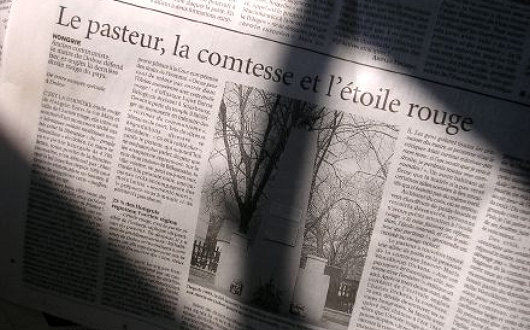
This morning, then, I read in Le Figaro of the controversy surrounding a red star which remains on a Soviet war memorial in a small town in Hungary, a country which has banned all Communist and Nazi emblems (‘Hongrie: Le pasteur, la comtesse et l’étoile rouge’, Le Figaro, 6 May 2006). The local Protestant minister has been fighting to replace the red star, and has found an ally in Countess Jeanne-Marie Wenckheim-Dickens. The Countess, aged 70 and a descendant of Charles Dickens, returned to Hungary a few years ago after her husband died. The family had fled the country in 1944 just escaping the conquering Red Army. “I return home,” the Countess says (‘with a delicious British accent’, Le Figaro reports), “and what do I find? My castle transformed into an elementary school with, right in front of the gate, a red star! To me, this star is the Antichrist.”
The Countess funded the restoration of her former castle, now a school, and obtained permission from the town to live in the old presbytery, an ancillary building of the old castle. But when, in 2004, she proposed to mark the accession of Hungary to the European Union by replacing the red star on the monument with a European flag, the ex-Communists in the town hall told her she “should not be afraid of the red star, but of the Cross!” With fighting spirit, “I placed a large cross on my entryway,” the Countess says, “then I painted it gold so that the Mayor, whose window is opposite, can see it all the better.”
“Crosses? She can build a hundred of them!” the Mayor said. “It doesn’t disturb me!” But in return the Mayor had a house on what was the domain of the Wenckheim family renovated for the use of unemployed local gypsies. “It was clearly to annoy me,” the Countess said. “They thought the gypsies were going to make the area around the nearby church, built by my grandfather, filthy. But not at all! They respect the place, and I, I love their music very much.” The Countess also gives weekly catechism lessons to the local gypsies. In her window, she displays a letter to the people of the town inviting them to vote for the conservative Fidesz party. “In December,” the Countess continues, “before Christmas, I add little angels and holy pictures; they don’t like that much across the way, since they’re aimed at the town hall. Because I, too, have a star: but is the star of the Shepherd”.
‘Voltaire’s Castle’ Up For Sale

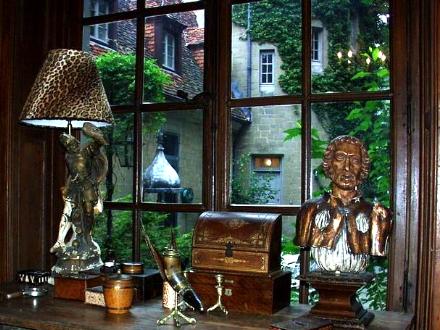
Want to live in a French philosophe’s petit chateau but don’t want to put up with high taxes, soaring unemployment, and immigrant neighborhoods in a permanent state of rebellion? Then boy have I got the house for you! The seventeenth-century Château des Thons, which tradition claims is where the dastardly ‘Enlightenment’ thinker Voltaire carried out his affair with Madame de Chatelet, was shipped during the 1920’s to the peaceful village of Upper Brookville, L.I. in the Great State of New York and is currently on the market. The house features Louis XIV panelling, a sweeping staircase, a tower, and a good few fireplaces.
One of my favorite Voltaire anecdotes is his confident claim – hilarious in hindsight – that “One hundred years from my day there will not be a Bible in the earth except one that is looked upon by an antiquarian curiosity seeker.” Two hundred and twenty eight years after his death, the Bible is still a best-seller and the most widely-read book in the world.
St Andrews on the Beeb
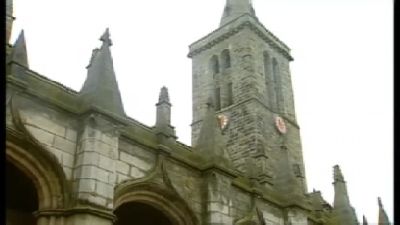
Here at good old St Andrews we find ourselves thrust into the lens of the news camera, this time thanks to the Association of University Teachers strike. Basically, the AUT are on partial-strike (they won’t set exams and won’t grade papers) in hopes of better pay. The idea is that by the time exams come around in June the whole thing will be settled. Unfortunately, here in Scotland our exams our a month earlier in May, so there’s a good chance that the strike will disrupt some students’ exams.
To solve the quandary, the University decided to negotiate locally with the AUT chapter in St Andrews. After all, why should our superb institution be cast in with all the others? Well, the University administration made a good offer and the local chapter voted 94% in favor of the deal. Swell! At least it was until the national AUT came in and said “Sorry chaps, we’re invalidating your ballot. How many times do we have to tell you: don’t think for yourselves, just do as Union says!”
So BBC Scotland sent out their intrepid reporter to interview a few folks, and if you watch the video you can see the Younger Hall where I will be graduating in June. I will be graduating because not all the teachers are on strike. In fact, I think most St Andrews lecturers and tutors aren’t in the union. But it’ll still cause a right ruckus for some if the whole thing isn’t sorted out. The University will stick to the agreed pay deal nonetheless.
Local lecturer pay deals rejected, BBC News, click ‘ Views on the lecturers’ pay deal impasse’ on the right for the video.
March against exam papers action, BBC News, (same video link).
Clerics of the Old School
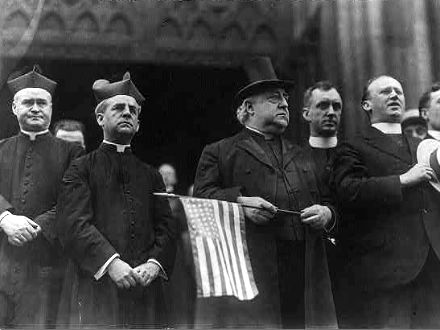
Msgr. Lavelle and others review the 69th N.Y. Regiment from the steps of St. Patrick’s Cathedral, 21 June 1916.
Previously: Your Royal Highness, Caed Mile Failte | Fighting 69th: Home for St. Patrick’s Day
Words of Wisdom
I’d like to thank Field Marshal Rommel for vindicating my life.
The End of Canada Dry?

AH, GINGER ALE, one of the finer things in life if you ask me, and of course the finest ginger ale of all is good old Canada Dry. I was disturbed therefore when I recently saw a bottle of the “champagne of ginger ales” defaced with the name of Schweppes. (Schweppes ginger ale is tangier and much less enjoyable than Canada Dry). It turns out that the Cadbury Schweppes corporation now owns Canada Dry, which would not necessarily be a bad thing were it for the fact that I immediately suspected the ginger ale was Schweppes but the packaging was Canada Dry.
This would be a true abomination, the equivalent of selling some modern “pop art” and advertising it as the work of an old master. At the time I believed it actually was Schweppes, but my tastebuds having returned as my illness retreated, I’m not quite sure anymore. If the Cadbury Schweppes corporation has destroyed our favourite ginger ale, then let them be anathema!
Search
Instagram: @andcusack
Click here for my Instagram photos.Most Recent Posts
- West Point July 30, 2026
- Brunel’s Unbuilt Capitol February 3, 2026
- Cricket at Fordham January 27, 2026
- Palacio Barolo Revisted January 14, 2026
- Learning to Love Liguria January 14, 2026
Most Recent Comments
Book Wishlist
Monthly Archives
Categories