Sport
About Andrew Cusack
 Writer, web designer, etc.; born in New York; educated in Argentina, Scotland, and South Africa; now based in London.
 read more
News
Blogs
Reviews & Periodicals
Arts & Design
World
France
Mitteleuropa
Knickerbockers
Argentina
The Levant
Africa
Cape of Good Hope
Netherlands
Scandinavia
Québec
India
Muscovy
Germany
Academica
Cricket at Fordham
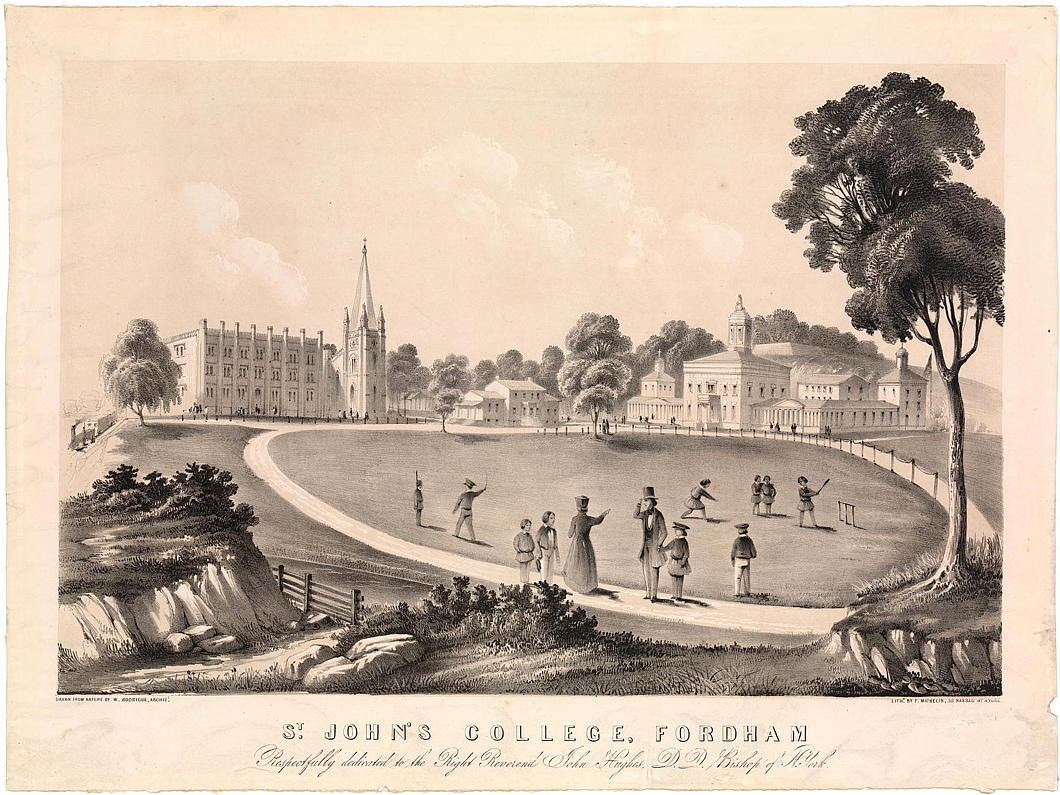
Because it was eclipsed by baseball, an infinitely more indigenous pastime, people often forget that cricket was quite a widespread and popular sport in the United States. It wasn’t until the Civil War that baseball really took over, aided by its shorter play time and the wider national mood. (Doubtless someone has, or will, write a scholarly article on this.)
It survived a few generations more as something of an elite sport, more strongly in Philadelphia and its environs, as well as in colleges and universities. The interwar period pretty much killed it off, only to be revived in interest amongst Americans by seeing it played by urban immigrant communities from the West Indies and the Subcontinent. The last time I checked there was even a cricket oval being laid out on the banks of the Mohawk river, across from the farm Jan Pieterse Mabee purchased from Daniel Janse Van Antwerpen in 1705.
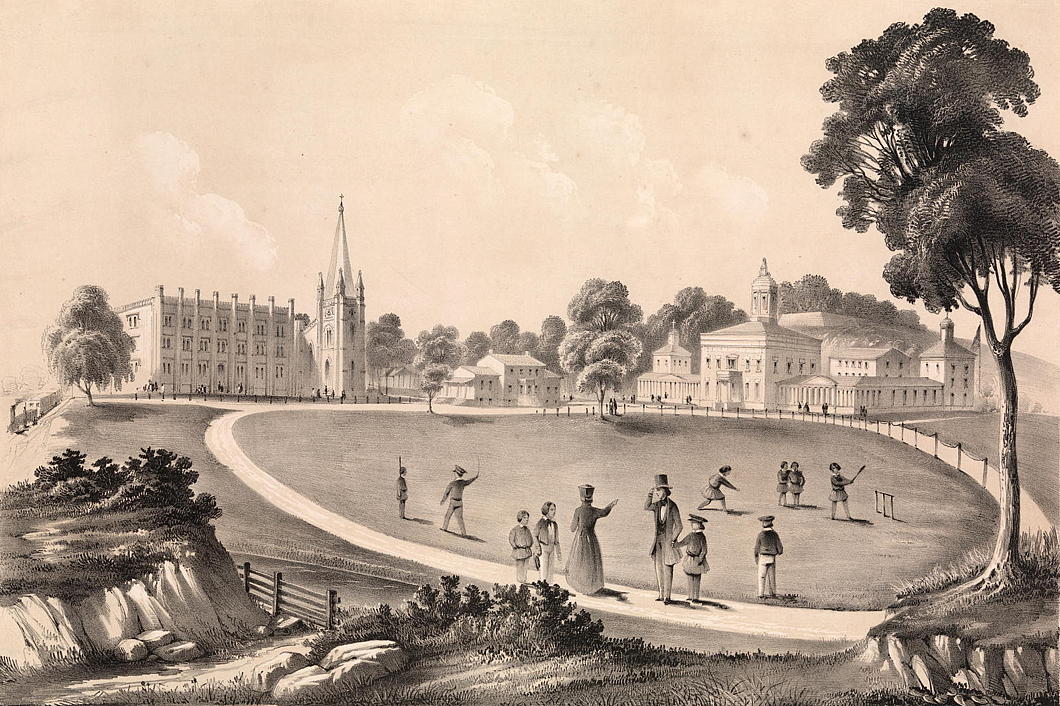
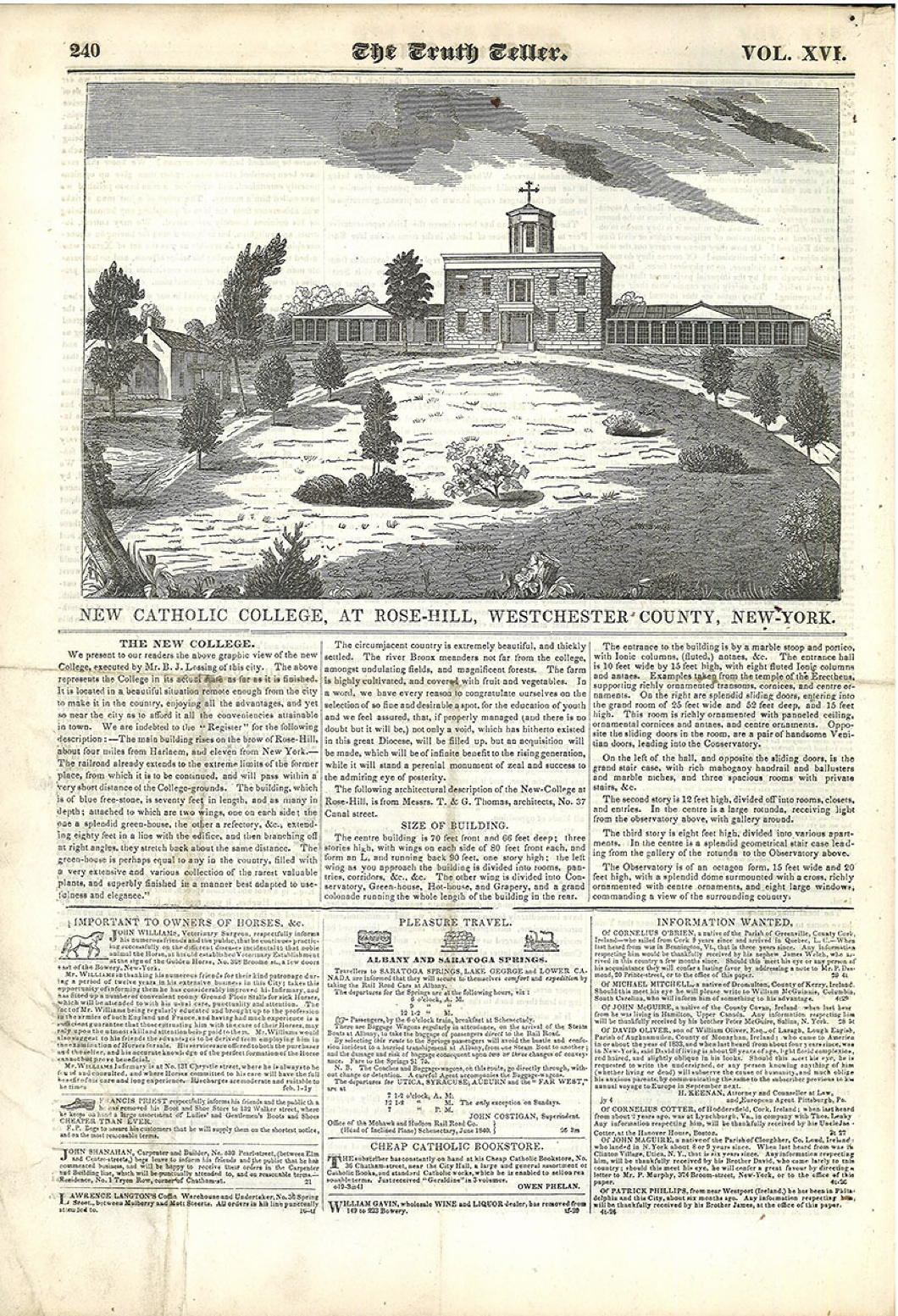
This charming rustic scene shows children playing cricket on the grounds of St John’s College, Fordham, with a priest speaking to a gentleman out on a constitutional with his son. As the college advertised itself in an early prospectus:
This institution, incorporated with the privileges of a university by an act of the Legislature, is situated near the village of Fordham, in a most picturesque and healthy part of the county of Westchester, at a distance of about eleven miles from the city of New York and three from Harlem. It is of easy access at any season of the year, by private conveyance or by the railroad, which passes immediately along the borders of the beautiful lawn in front of the college. The buildings are large, elegant and commodious; the grounds extensive and tastefully laid out.
This part of the Bronx remained within Westchester until 1874, when the parts west of the Bronx River were added to New York County. The remainder of the Bronx was ceded in 1895 and was created a borough of the consolidated City of New York in 1898, though only erected as its own county in 1914 (minus Marble Hill, which is another story entirely).
The engraving was drawn by William Rodrigue, a Philadelphia architect who later became associated with New York’s James Renwick, the designer of Grace Church and St Patrick’s Cathedral. Rodrigue auspiciously married the sister of one Fr John Hughes, who became Bishop of New York in 1842 — and the first Archbishop when the see was raised to metropolitan status in 1850.
St John’s College, now Fordham University, was one of Hughes’ pet projects, and perhaps unsurprisingly Rodrigue was chosen to design many of the earliest college buildings on the former Rose Hill estate, in addition to teaching mathematics, geometry, and drawing. He lived with his family in an outbuilding on the estate that now houses a coffee shop named “Rod’s” in his honour and his sons were among the earliest students of St John’s.
The first buildings Rodrigue completed were the chapel and the residence, the latter of which is still known as St John’s and forms one of the three sides of Queen’s Court, now a residential college within the university. The chapel benefited from stained-glass windows donated by the King of France for the (currently flourishing) old St Patrick’s Cathedral but which were found to be the wrong size and so incorporated into what is now the University Church.
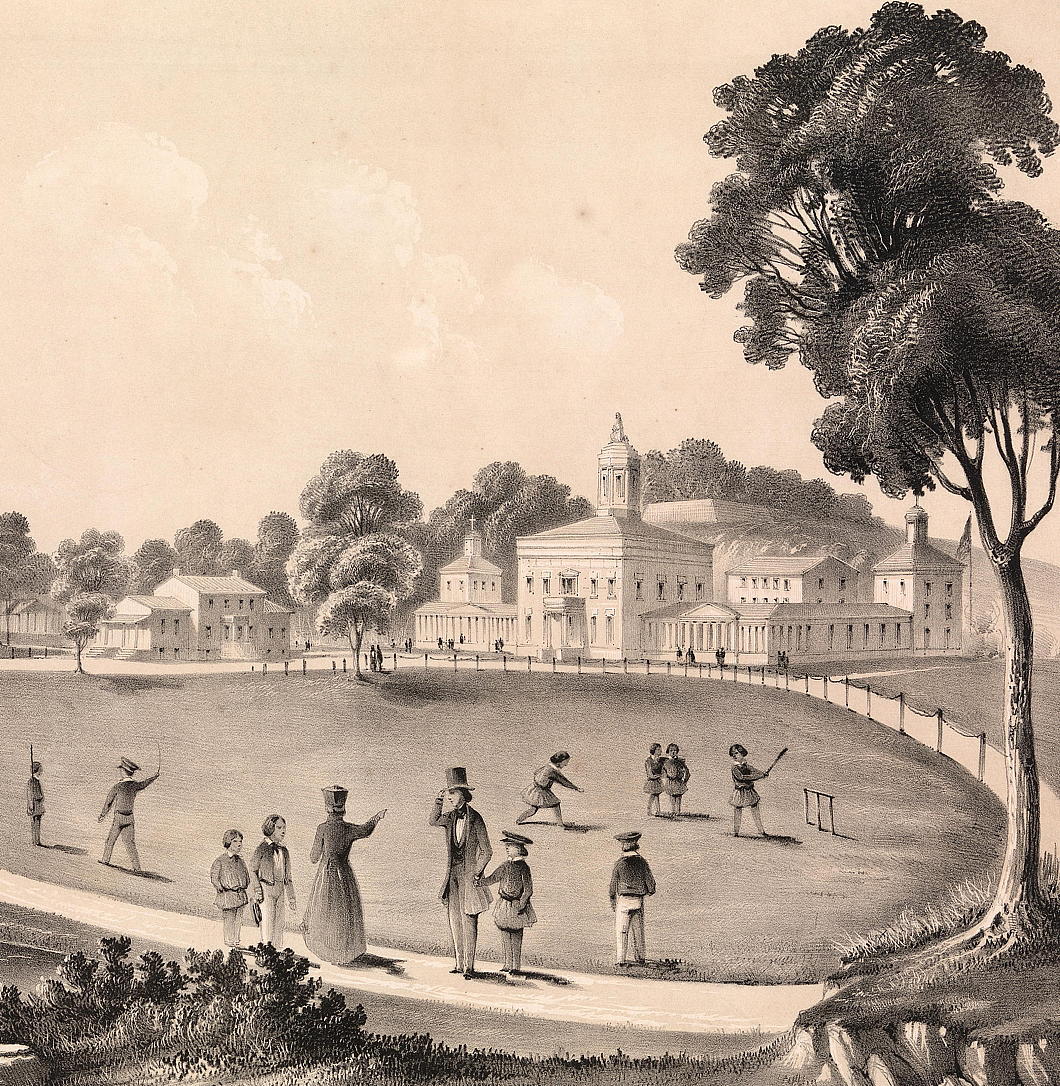
The building in the right background of the view was the main house of the Rose Hill estate purchased by Bishop Hughes. For a long time it was known as the Administration Building or the Manor House, though as it dates from the 1830s it has no direct connection to the Manor of Fordham granted to Jan Arcer by Governor Lovelace in 1671 (other than sitting on the land of it). More recently it was renamed Cunniffe House thanks to the generosity of Maurice J. “Mo” Cunniffe, Fordham Class of 1954. The wings have been much altered but the central block of the house remains largely intact.
In 2019, the university’s emeritus professor of history, Dr Roger Wines, discovered the earliest known image of the institution while sifting through periodicals at the Philadelphia archdiocese’s research centre.
“It is located in a beautiful situation remote enough from the city to make it in the country,” the accompanying text in The Truth Teller, an early Catholic newspaper of New York, explained, “enjoying all the advantages, and yet so near the city as to afford it all the conveniences attainable in town.”
“The circumjacent country is extremely beautiful,” it continues. “The river Bronx meanders not far from the college, amongst undulating fields, and magnificent forests. […] We have every reason to congratulate ourselves on the selection of so fine and desirable a spot for the education of youth.”
The writer assures the college “will stand a perennial monument of zeal and success to the admiring eye of posterity”.
Scoring the Hales
One of the great Northumbrian traditions is the yearly Scoring the Hales, a mediaeval football match between the parishes of St Michael and St Paul in Alnwick. The first records of this match are from 1762 but it almost certainly began many, many generations earlier. This year’s match marked a return after a two-year absence thanks to the virus.
The match takes place every Shrove Tuesday but this is football as seen long before the modern rules of the sport were codified into ‘soccer’ (association football) and ‘rugger’ (rugby football).
The day begins with the Duke of Northumberland dropping the ball from the barbican of his seat, Alnwick Castle. Led by the Duke’s piper, the two teams are led down the Peth to the furlong-deep pitch beside the River Aln called the Pastures.
Rules are very few but the match consists of two teams of usually about 150 players from their respective parishes, battling it out over two halves of half-an-hour each. The goal posts are covered with greenery and stand 400 yards apart. Whoever scores two ‘hales’ first is deemed the winner. If the score is even after two periods, a further 45-minute period decides the match.
Once the match is over, the football is then thrown in the River Aln and all the players scramble to capture it and whoever gets it through the river to the other bank is allowed to keep it.
Like golf, Scoring the Hales used to be played in the streets but its destructive potential has seen it moved to an open space — here in Alnwick’s case since the 1820s.
The Newcastle Chronicle (founded 1764) sent a photographer along to this year’s match, duly won by the denizens of St Paul’s parish. (more…)
Branding the Rowing Nation
National Governing Bodies in Rowing and their Logos

THE OTHER DAY I was flipping through some publication and came across a photograph of two people standing in front of a boathouse. Emblazoned upon the building was the above logo, along with the words ‘British Rowing’. As a former member of SARA (the Scottish Amateur Rowing Association), I found this quite intriguing as I’d never heard of any such organisation.  Like many sports, rowing is organised on a country-wide level (i.e. England, Scotland, Wales), not on a union level (the United Kingdom). Ever wary of centralisation, I was relieved, albeit a bit confused, to discover that the group now branding itself as ‘British Rowing’ is actually the Amateur Rowing Association, the ruling body for the sport in England, not Britain. The ARA was founded in 1882, but lamentably decided to end its ban on non-amateurs in 1998. They kept the ARA name regardless until now. Having the word ‘Amateur’ in their name was obviously a bit inaccurate, but if accuracy was the aim, why have they decided to style themselves ‘British Rowing’ when they only speak for England? What’s wrong with ‘English Rowing’? Very odd, if you ask me. (more…)
The End of the Antilles
The Netherlands Antilles is Dissolved
THIS MORNING, one 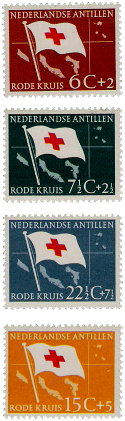 country disappeared, two more were born, a fourth was expanded, and all are part of a single kingdom. The Netherlands Antilles, the collective islands of the Dutch West Indies which since 1954 has formed a constituent country of the Kingdom of the Netherlands, was dissolved. Two of the islands in the archipelago, Curaçao and Sint Maarten, have become full constituent countries of the Kingdom (alongside Aruba, which was separated from the Antilles in 1986, and the Netherlands proper), while the islands of Bonaire, Sint Eustatius, and Saba (the ‘B.E.S.’ islands) have been merged into the Netherlands proper as special municipalities.
The government of North Holland has invited the B.E.S. islands to join the province, but this has not yet been agreed to. With a combined population of just 17,000, Bonaire, Sint Eustatius, and Saba do not have enough inhabitants to justify forming a single province of their own — the province with the lowest population at the moment is Flevoland at 356,000. North Holland’s offer may be turned down if it entails the complication of the three island-municipalities becoming part of the European Union. Currently all the islands of the Netherlands Antilles are outside the E.U., but all their citizens are E.U. citizens by virtue of being Dutch citizens. (more…)
Olympic Teams of Yesteryear
The vanished lands and failed alliances of the Modern Olympiad
THE GAMES OF THE Modern Olympiad are events which are meant to bring the peoples of the world together in peace and harmony and all those good and heartening things, but from the very beginning they have gotten bogged down in the petty particularities of rival nations, which altogether makes them rather more fun and interesting, if perhaps a touch less high-minded. The story of the ancient gathering’s revival in 1896 through the efforts of Pierre Frédy, Baron de Coubertin is well-known. Athletes from at least fourteen countries participated in those first modern games in Athens over a century ago, though the concept of national teams was not introduced until the 1906 games (the Intercalated Games, which have since been de-recognised by the IOC). But since those first games towards the end of the nineteenth century, the fortunes of many lands have waxed and waned, and likewise the spirit of unity amongst various peoples vied with the spirit of distinctiveness. Here, then, are but a small sample of Olympic teams which once vied for gold but which can no longer be found among the Olympic competitors of today. (more…)
Hup Holland Hup
Laat de leeuw niet in z’n hempie staan
Hup Holland Hup
Trek het beestje geen pantoffels aan
Hup Holland Hup
Laat je uit het veld niet slaan
Want een leeuw op voetbalschoenen,
kan de hele wereld aan
Want een leeuw op voetbalschoenen,
kan de hele wereld aan.
Don’t let the lion stand in his undershirt
Go Holland Go
Don’t make the beast wear his slippers
Go Holland Go
Don’t get played off the field
Because a lion wearing football shoes
Can take on the whole word.
Because a lion wearing football shoes
Can take on the whole word.
The World Cup Preserves Something America is Losing
The drama of sport is being systematically attacked by the bloated American Pro-Sports-Statistical-Media Complex. I can name for you three specific ways that this is happening, but there are doubtless more. First, a universal obsession with statistics. A common criticism of American culture is that it is so technological and empirical that you can’t say anything without backing it with numbers. But I have come to the darker conclusion that most sports broadcasters talk about numbers only because they have nothing else to say. I really don’t care, I really think it is meaningless, that the Chiefs have not succeeded in making a two-point conversion during the third quarter of a post-season game in the last five years. The quintessence of this obsession was illustrated this week by Bob Ley of ESPN, in the halftime analysis during the Argentina-Nigeria World Cup match. “The last time Argentina gave up a halftime lead was in the 1930 World Cup,” he said. “It just doesn’t happen.” This baffled the Spaniard Roberto Martinez, an ESPN commentator and former professional soccer player, who responded: “That was a different team, Bob.” Sports teach us that the possible is greater than the probable; statistics applied to sports is probability’s revenge on possibility.
The second destructive force is the delusion of the Instant Replay. We appeal to the camera when we become afraid of the human element in sport. We think that the precision and justice that the replay can provide for us will defuse the pain that is intrinsic to any competitive sport. In games we see that the best-trained can’t always play their best, and that those with the best eyes don’t always make the right call; the imprecision and the deficiency are also elements in the drama. The Instant Replay is an attempt to quell the drama, as if sports would be better without it. All it actually does is stir confusion about what a game really is, and every time we interrupt a game to watch a video, we strike a blow at the soul that keeps the game moving.
Interruptions, also, are what television commercials are. That basketball and [American] football are structured in such a way as to accommodate for television commercials is a scandal. Who enjoys watching “The Godfather Part II” when it is sliced and diced by ads for sitcoms and acne medication? The interruptions wake us up from the dream of the drama; basketball and football lose something in this constant interruption.
All of this may sound bleak, but the answer to it is flickering in a billion television screens worldwide this month. As we watch the World Cup this summer, we should be conscious that we are witnessing a sport that is resisting. It resists, if nothing else, the tyranny of television commercials. No commercials interrupt the 45 minute flow of a half of soccer—there are no “TV time outs.” The narrative builds and is resolved within continuous time, and it demands that we reclaim the patience and the attention spans most of my generation lost sometime in the late 1990s.
Moreover, even though every now and then somebody within FIFA complains that Instant Replay should be introduced into the game, most fans accept that the game includes injustices. We suffer through them, and we play again the next day. Geoff Hurst scored a “goal” for England in the 1966 Final which actually did not cross the line. Maradona scored a “goal” with his hand against England in the quarterfinals of 1986 (he attributed it to God; five minutes later, he scored the greatest goal in World Cup history). France would not be in the World Cup this year, and Ireland would be, had Thierry Henry not handled the ball during a qualifying match. What can you do? Better to make a sacrifice than to kill the sport.
As for statistics—American soccer broadcasters, too, are beholden to them. But one could always learn Spanish and switch to Univision.
The World Cup this year has its own set of stories which will congeal into the dramatic. The Brazilian squad has betrayed its principles of jogo bonito (beautiful play) and has adopted a pragmatic approach which yields victories without flair. Ironically, the German side looks more playful and creative in attack than Brazil does. Lionel Messi of Argentina will be trying to live up to his reputation of being the greatest Argentine player since Maradona. And there is a tough Paraguayan side you will not want to miss.
Most importantly, there is a drama that you will not want to miss—one that retains certain human elements which are besieged in our hyperactive media age.
Victory on the Fields of Coetzenburg
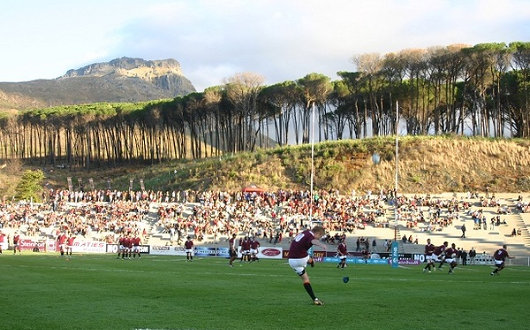
In anticipation of the annual commemoration of my birth, the University of Stellenbosch Rugby Football Club yesterday sailed to yet another victory in the FNB-sponsored Varsity Cup. Of course, a Maties victory is not exactly news — Stellenbosch is accustomed to victory, especially on the home turf at Coetzenburg (seen above). Indeed, Stellenbosch have won every Varsity Cup since the competition’s incarnation, which seems much less impressive when one points out this is only the third year of its existence. Nonetheless, to defeat the traditional rivals of the University of Cape Town — Maties and Ikeys are like Hatfields & McCoys — particularly warms the cockles of the heart. 17-14, not a bad score — the Ikey Tigers put in a good effort, but I am told UCT hasn’t beaten Stellenbosch in rugby for nearly 20 years. Impressive, considering that — despite being Ikeys — UCT manages to put up a good quad and make it to the final. (more…)
Revolution’s loss is counter-revolution’s gain
 As Christian de Lisle reports in the latest Catholic Herald, Chase Hilgenbrinck, the 26-year-old defense player for the New England Revolution, is leaving the world of professional soccer to pursue a vocation to the priesthood. “Playing professional soccer has been my passion for a long time,” Hilgenbrinck told the press, “and I feel blessed to have successfully lived out this dream. My passion now is to do the will of God, which is wanting only what He wants for me. Though I will miss the game of soccer, I know that I am moving on to something much greater.”
Earlier, Hilgenbrinck, who had a four-year career in Chile before returning this year to play professionally in the States, considered waiting until the end of his soccer-playing days. “Delayed obedience is disobedience,” he told the Associated Press. “We are all called to do something. I feel like my specific call is to the priesthood. So, no, it was not possible to continue with soccer. It’s absolutely inevitable.”
Hilgenbrinck will enter the seminary at Mount St. Mary’s University, one of the oldest Catholic institutions in the United States.
Search
Instagram: @andcusack
Click here for my Instagram photos.Most Recent Posts
- Brunel’s Unbuilt Capitol February 3, 2026
- Cricket at Fordham January 27, 2026
- Palacio Barolo Revisted January 14, 2026
- Learning to Love Liguria January 14, 2026
- Crux Alba No. 2 January 13, 2026
Most Recent Comments
Book Wishlist
Monthly Archives
Categories