Parliament
About Andrew Cusack
 Writer, web designer, etc.; born in New York; educated in Argentina, Scotland, and South Africa; now based in London.
 read more
News
Blogs
Reviews & Periodicals
Arts & Design
World
France
Mitteleuropa
Knickerbockers
Argentina
The Levant
Africa
Cape of Good Hope
Netherlands
Scandinavia
Québec
India
Muscovy
Germany
Academica
Proportionality Destroys Representation
After the Jenkins Commission on the voting system presented its report to Parliament in 1998, the House of Commons had a chance to debate its findings and proposals.
In his contribution to the debate, Benn attacked the modish support for proportional representation, arguing instead that “direct representation is the delicate thread that links the people with their government”:
When we discussed the subject in the Labour party’s national executive a few years ago, when Neil Kinnock was leader, I said to Neil that I had a feeling that if we had a party list system my hon. Friend the Member for Bolsover (Mr. Skinner) and I would be at the bottom of the list. He laughed, but in a funny sort of way. That is the direction in which politics is going.
No doubt, all hon. Members will go to their constituencies this weekend. Every person whom we meet in our constituencies is our employer — the bus driver, the street sweeper, the home help, the policeman — and has the power to remove us. Our constituents expect to be represented. They decide whether they agree with our views and whether we have done a decent job.
Any element of proportionality, which destroys that link, could lead to people being governed by a Government whom nobody had voted for, because nobody would know the basis of the coalition on polling day. At least the coalitions of the parties are transparent: people can see them developing and know what they are voting for and what their own Member thinks.
I do not intend to waste much time on the Jenkins report because, candidly, I do not think that it has a cat in hell’s chance of succeeding. The idea that the parliamentary Labour party would go through the Lobby to destroy fifty of its own Members, to redraw all the constituencies and to introduce a new group of piggy-back Members is ludicrous. I heard it said by one cynic that the Labour party is so loyal that, if chimney boys were brought back in the name of modernisation, we would all go through the Lobby; but turkeys do not vote for Christmas. I do not honestly think that this is a serious plan.
The real issue is one that Jenkins neither considered nor was asked to consider the power that people have over the government of their country. This is the beginning of a debate about democracy generally. Unlike almost every other country, we have no vote over the head of state. We have no vote over the second Chamber. If my right hon. Friend the Prime Minister reintroduces Edward I’s method of appointing peers — when peers began in 1295, they were not hereditary — we will be modernising ourselves back to the feudal period. There will be absolutely no popular control.
The House of Commons has very limited power. After all, the Prime Minister derives his legislative majority from the people, but most of his executive power from the Crown. That is why the Prime Minister has put a spin doctor into Buckingham palace. If the Crown is not popular, the Prime Minister might lose the power to appoint bishops, judges, commissioners, peers and so on. That is how the system works.
It amazes me that the British people put up with that system. What is it about our training and breeding that makes us think that we are not fit to elect the second Chamber or the head of state? Jenkins does not deal with that, because he is an Asquithian Liberal. We have to be very careful.
People ask whether the proposals would lead to a coalition; but they are all about getting a coalition. Those who advocate the proposals favour a coalition. I do not want to be too political in a debate of this character, but it is worth noting that there is a big Labour majority and the leader of the Liberal party is on a Cabinet Committee, but I am not. I met him voting against the lone parents provisions last December. I was threatened with disciplinary action, but he knew that he would be at the Cabinet Committee the next day. There is already a broad perspective of views. For example, the right hon. Member for Henley (Mr. Heseltine), the former Deputy Prime Minister, has been given a job and the former Chancellor has been given a job. The former chairman of the Conservative party is in Northern Ireland, clearing up the RUC and David Mellor is in charge of football. When we talk about inclusiveness, I just wish some of us were part of it.
In future, unless we are clear about stopping it, all candidates will be vetted by the party machines. That is not about the power of the Prime Minister, but the power of the party leader. All the European candidates have been vetted and put on a list, as have all the Scottish candidates. My hon. Friend the Member for Falkirk, West (Mr. Canavan) was left off, because he was thought less suitable to be a Scottish candidate, although the hon. Member for Leominster (Mr. Temple-Morris) has suddenly given the Labour voters there a Member of Parliament by changing sides. Candidates for the Welsh Assembly will also be vetted. So the language of devolution is accompanied by the centralisation of power.
I do not wish to overdo the point, but as a Minister I visited the Soviet Union and Brussels many times. In the Soviet Union, we used to meet the central committee, which had not been elected. We met the commissars, and they had not been elected. I went to Brussels and met representatives of the central bank, and that had not been elected. I met the commissioners, and they had not been elected. The truth is that capitalism and communism have one thing in common: they do not want the people to have a choice of system, only a choice of management. That is the problem that we face. I have not heard anybody suggest that it would be a good idea for the Governor of the Bank of England to be elected, even by first past the post, and he has more power than any of us here. He is appointed, so he depends, like the bishops and the judges, on patronage.
We must face the problem that government now is less about representation and more about management. I get my fax from the party headquarters every morning, with quotations already attributed to me — “Mr. Tony Benn welcomes compulsory homework for pensioners”, or whatever it is, and I am supposed to put it back in the fax machine to send to the Derbyshire Times. I feel less and less like a representative and more and more like an Avon lady, who is told what to say when she knocks at the door. If the Liberals had joined the right end of the Labour party, we might have had a progressive party, but the trouble is that they joined the wrong end of the Labour party. I will not go into that now.
Direct representation is the delicate thread that links the people with their Government and the basis of it is that they elect a man or woman they know, can argue with and can get rid of. Do not think that minorities remain minorities for ever. After all, ten years ago, the environmentalists were bearded weirdos, but it will not be long before Swampy is in the House of Lords. The Dunblane massacre led to the previous Government changing their policy and apartheid ended by popular pressure. Democracy is not what somebody does to us if we vote for them but what we do where we live and work, and Parliament then gets the message. After forty-eight years here, I can say that Parliament usually gets the message last. We must listen to the people and not try to impose on them a pattern that will provide a permanent coalition and remove real choice from the electors.
Rising on a point of order, the hon. Member for Aldershot (Mr Gerald Howarth), inquired:
On a point of order, Mr. Deputy Speaker. The right hon. Member for Chesterfield (Mr. Benn) was so interesting and entertaining. May we vote for extra time for him?
Mr Deputy Speaker instead called upon the hon. Member for South Norfolk to continue to the debate. …
The Lithe Efficiency of the Old Constitution
There is a wonderful glimpse of the old days in the memoirs of the late Lord Waddington (1929-2017).
David Waddington was a Lancashire man who became a lawyer, Member of Parliament, Government Chief Whip, Home Secretary, peer of the realm, and eventually Governor of Bermuda. (In that final role, he was the last of the big dogs — all the ones since have been civil servants.)
The old British constitution — before New Labour’s ill-judged reforms — had a lithe efficiency in those days aptly reflected in quite how few people were employed by the highest court in the realm — and how unfussedly they were officed:
I had only been in the House for two days when I received a telephone call from the clerk of my Manchester chambers asking me if later in the week I was prepared to sit as a deputy County Court judge somewhere in London. This would allow my colleague Bob Hardy, who had contracted with the Lord Chancellor’s Department, to sit as a judge on that day, to take over a brief of mine, a libel action in Leeds.
At the eleventh hour someone pointed out that if I were to sit, my career as an MP would come to an abrupt end because as a result of the House of Commons Disqualification Act I would have disqualified myself from membership of the House, thereby precipitating another by-election. I was then begged by Bob to go and explain to the lady in the Lord Chancellor’s Department why he could not sit and why I had turned out to be an inappropriate replacement.
I set off and, after journeying along many corridors and ascending and descending many staircases, I eventually found a little old lady sitting alone in a tiny office at the bottom of a gloomy stairwell somewhere in the bowels of the House of Lords.
I apologised for troubling her and she said: ‘I can assure you it is no trouble. In fact I am delighted to see you. I have been in this office for thirty-five years and you are the first person who has ever visited me.’
Patrick in Parliament
The Mosaic of Saint Patrick in the Palace of Westminster
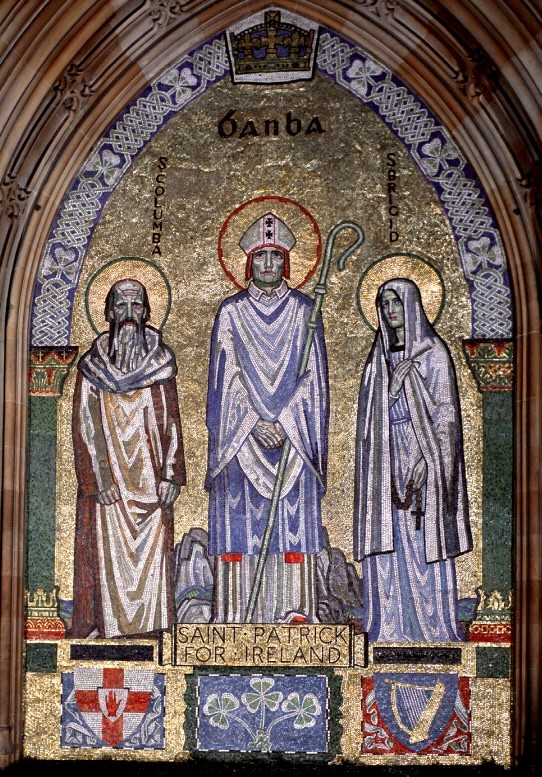
This feast of St Patrick marks the hundredth anniversary of the mosaic of Saint Patrick in the Central Lobby of the Houses of Parliament. At the heart of the Palace of Westminster, four great arches include mosaic representations of the patron saints of the home nations: George, David, Andrew, and Patrick.
The joke offered about these saints and their positioning is that St George stands over the entrance to the House of Lords, because the English all think they’re lords. St David guards the route to the House of Commons because, according to the Welsh, that is the house of great oratory and the Welsh are great orators. (The English, snobbishly, claim St David is there because the Welsh are all common.) St Andrew wisely guards the way to the bar (a place where many Scots are found), while St Patrick stands atop the exit, since most of Ireland has left the Union.
The mosaic of Saint Patrick came about thanks to the munificence of Patrick Ford, the sometime Edinburgh MP, in honour of his name-saint. Saint George had been completed in 1870 with Saint David following in 1898.
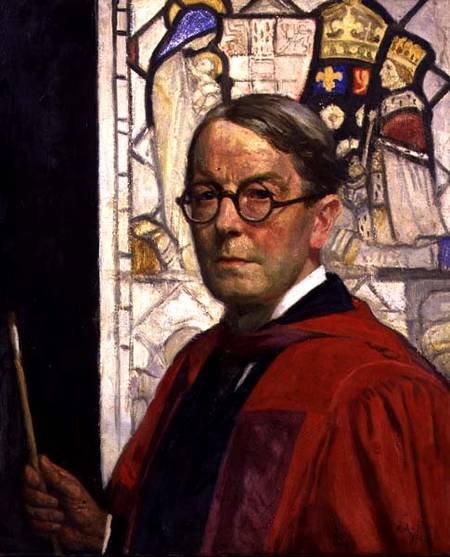 Sir William Raeburn MP commissioned the artist Robert Anning Bell (depicted right) to design the mosaic of Saint Andrew in 1922, which so impressed Patrick Ford that he decided to commission the same artist to depict the patron saint of Ireland.
Anning Bell had earlier completed the mosaic on the tympanum of Westminster Cathedral from a sketch by the architect J.F. Bentley. Following his work in Central Lobby he also did a mosaic of Saint Stephen, King Stephen, and Saint Edward the Confessor in Saint Stephen’s Hall — the former House of Commons chamber.
In the mosaic, Saint Patrick is flanked by saints Columba and Brigid, with the Rock of Cashel behind him. As by this point Ireland had been partitioned, heraldic devices representing both Northern Ireland and the Irish Free State are present.
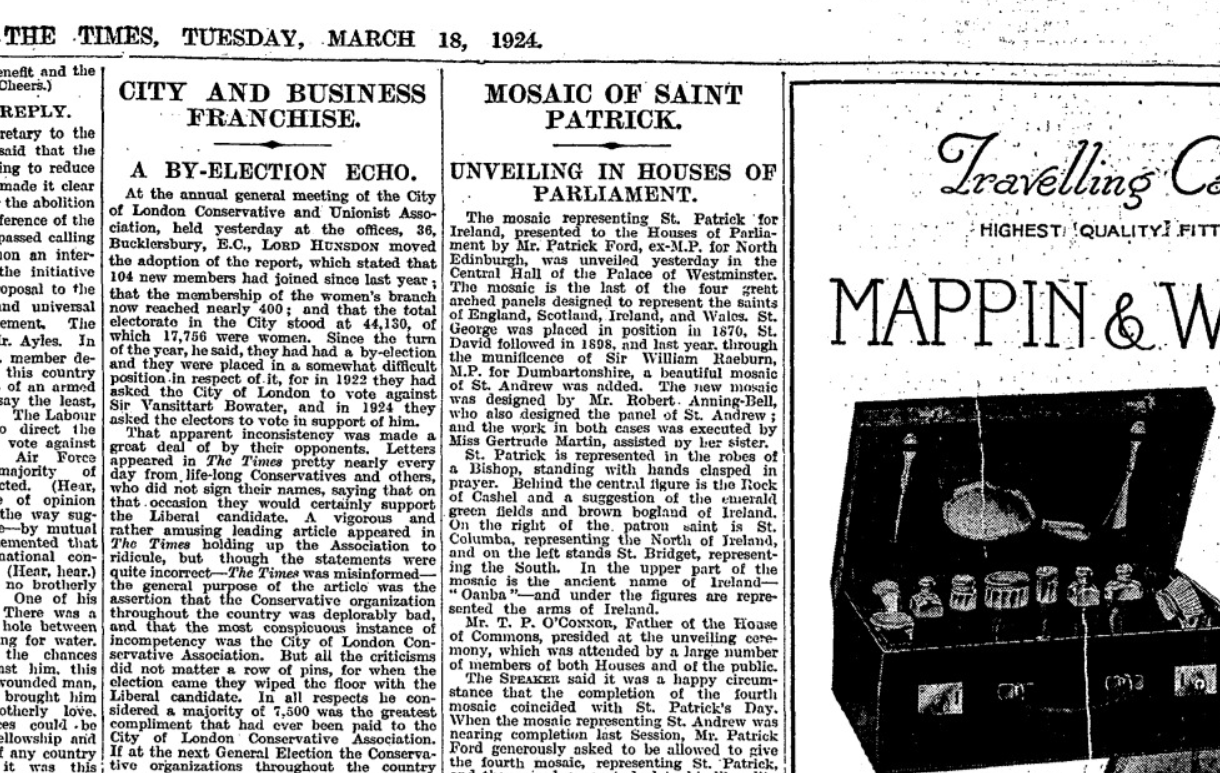
On St Patrick’s Day in 1924, the honour of the unveiling went to the Father of the House of Commons, who happened to be the great Irish nationalist politician T.P. O’Connor, then representing the English constituency of Liverpool Scotland (the only seat in Great Britain ever held by an Irish nationalist MP).
“That day,” The Times reported T.P.’s words at the unveiling, “in quite a thousand cities in the English-speaking world, Saint Patrick’s name and fame were being celebrated by gatherings of Irishmen and Irishwomen. Certainly he was the greatest unifying force in Ireland.”
“All questions of great rival nationalities were forgotten in that ceremony. From that sacred spot, the centre of the British Empire, there went forth a message of reconciliation and of peace between all parts of the great Commonwealth — none higher than the other, all coequal, and all, he hoped, to be joined in the bonds of common weal and common loyalty.”
T.P.’s remarks were greeting with cheers.
The Most Honourable the Marquess of Lincolnshire, Lord Great Chamberlain, accepted the ornamental addition to the royal palace of Westminster on behalf of His Majesty the King.
The Steps of the Throne
Who may sit on the steps of the throne in the House of Lords?
Much was made of the Prime Minister’s decision to sit in the House of Lords when they were going through stages of the bill to invoke Article 50 last year. Theresa May had the right to sit on the steps of the throne in the Lords chamber by virtue of being sworn to the Privy Council, as all holders of the four Great Offices of State are (and usually their opposition Shadows as well).
But who else is granted the privilege of lodging their posterior in such a prominent locale?
The Companion to the Standing Orders and Guide to the Proceedings of the House of Lords provides some guidance:
1.59 The following may sit on the steps of the Throne:
· members of the House of Lords in receipt of a writ of summons, including those who have not taken their seat or the oath and those who have leave of absence;
· members of the House of Lords who are disqualified from sitting or voting in the House as Members of the European Parliament or as holders of disqualifying judicial office;
· hereditary peers who were formerly members of the House and who were excluded from the House by the House of Lords Act 1999;
· the eldest child (which includes an adopted child) of a member of the House (or the eldest son where the right was exercised before 27 March 2000);
· peers of Ireland;
· diocesan bishops of the Church of England who do not yet have seats in the House of Lords;
· retired bishops who have had seats in the House of Lords;
· Privy Counsellors;
· Clerk of the Crown in Chancery;
· Black Rod and his Deputy;
· the Dean of Westminster.
Justice in the Royal Gallery
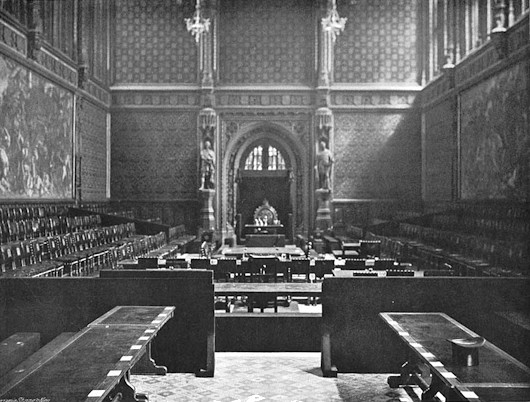
One of the great triumphs of Magna Carta was the assertion of the right of those accused of crimes to trial by one’s peers, or per legale judicium parium suorum if you insist on the Latin. For commoners this meant trial by other commoners, but for peers it meant just that: trial by other peers of the realm. It was a bit murkier for peeresses, though after the conviction for witchcraft of Eleanor, Duchess of Gloucester, (sentence: banishment to the Isle of Man) statute was passed including them in the judicial privilege of peerage.
Thanks to the ’15 and the ’45, there were a number of trials in the House of Lords in the eighteenth century, including that of the Catholic martyr Earl of Derwentwater. The whole of the nineteenth century, however, witnessed but one: the 7th Earl of Cardigan was acquitted of duelling by a jury of 120 peers. In 1901 the 2nd Earl Russell was found guilty of bigamy, and the last ever trial came in 1935 when the 26th Baron de Clifford was found not guilty of manslaughter.
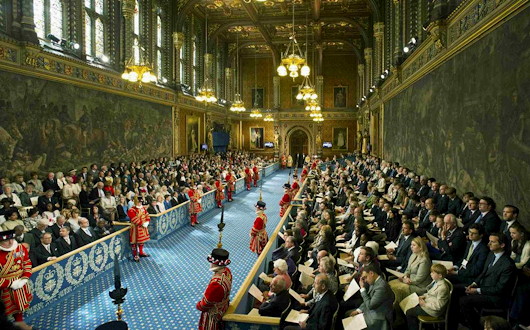
Cardigan’s trial was in the temporary Lords chamber while the last two trials took place in the Royal Gallery of the Palace of Westminster (central to current debates over renovation plans). For Cardigan’s trial the Lord Chief Justice of the Queen’s Bench was appointed Lord High Steward for the occasion, while for the final two the Lord Chancellor was likewise appointed to the role in order to be presiding judge with the Attorney General prosecuting the case.
The Royal Gallery is primarily used for the State Opening of Parliament (as above) and for the occasional address to both Houses of Parliament when important figures are invited to do so. De Gaulle was famously invited to speak here to both houses rather than in the larger Westminster Hall. It is thought that this is because the walls of the Royal Gallery feature two large murals, one of the Battle of Trafalgar, the other of the Battle of Waterloo – both British victories over the French.
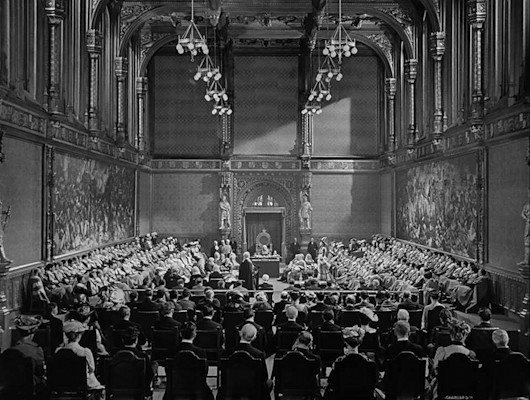
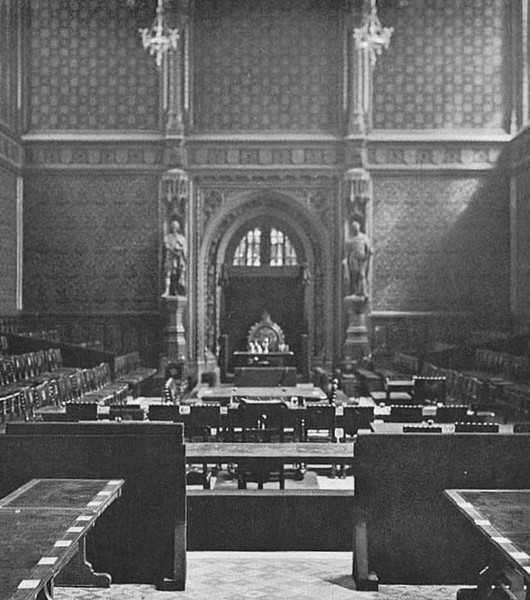
The most famous trial in the Royal Gallery was fictional. In the 1949 Ealing comedy “Kind Hearts and Coronets”, the 10th Duke of Chalfont is tried for the one murder in the film’s plotline he didn’t actually commit. Ealing Studios did a mock-up of the chamber for the occasion (above), which compares reasonably accurately with the Royal Gallery as set up for the Baron de Clifford’s trial in 1936 (below).
The Lords, however, were uncomfortable with exercising this judicial function and passed a bill to abolish the privilege in 1937. The Commons, facing more serious tasks, declined to give it any attention. In 1948, the Criminal Justice Act abolished trials of peers in the House of Lords, along with penal servitude, hard labour, and whipping.
The Delarue Proposal for Parliament
Peers & MPs could still convene in the Palace during renovations
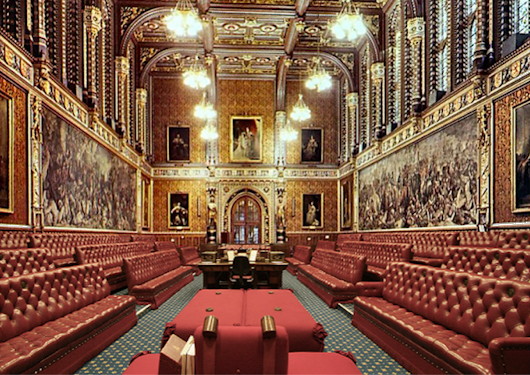
The Royal Gallery set up for temporary use as the House of Lords chamber
Credit: Anthony Delarue Associates
MPs are kicking up a fuss about the controversial proposals to shut down the entire Palace of Westminster for perhaps as long as eight or nine years. (Previously mentioned here.) The building is completely structurally sound, and on solid foundations, but the accumulation of mechanical, electrical, and technological systems over the course of the past 150 years has created a confused mess within the walls of the palace. Electrical lines compete with fibre-optic cables, telephone wires, not to mention various heating and cooling pipes, and even some lingering telegraph wires. No one’s quite sure what is what and all of it is getting older. Even just accessing it to figure out what to do requires taking the building apart — removing wood panelling, drilling through walls, etc.
Parliamentary authorities commissioned management consultants from Deloitte to come up with a number of options on how to tackle this problem, but in their Independent Options Appraisal they treated this merely as an ordinary engineering job, rather than recognising the Palace as one of the most important places in British history both medieval and modern and, importantly, one still in constant daily use.
The Joint Committee formed of members of both the Lords and Commons perhaps unsurprisingly endorsed the option Deloitte claimed was the quickest and cheapest: that the Lords, Commons, and everyone else be chucked out of the Palace entirely and that temporary accommodation be found nearby.
Further investigation by respected former minister Shailesh Vara MP suggested that Deloitte had failed to take into account that any VAT costs on this major project go back into the Treasury anyhow, and that there was a failure to account for the loss of revenue if the Lords are moved into the government-owned Queen Elizabeth II Conference Centre nearby. The QE2 is a profit-making venue popular with private clients, after all, and deploying it towards full-time legislative use will mean another significant loss for the Treasury. Meanwhile, in the courtyard of Richmond House on Whitehall, £59 million would be spent on building a new chamber for the House of Commons. This would be a permanent ‘legacy’ structure even though once the renovations to the Palace are complete there would be no use for it whatsoever.
The architect Anthony Delarue, having been taken on a tour of the Palace’s working underbelly by the engineers from the Restoration and Renewal programme, came up with an alternative proposal. Looking at the structure of the House of Lords chamber and the adjacent Royal Gallery, he realised that these two rooms could be maintained and occupied, with temporary services (electricity, heating, etc.) run from external sources. This would allow the renovation team to shut down the Palace’s systems entirely and re-do them completely, while the spaces in mind would still be able to be put to use. The Commons could then meet in the Lords chamber (as the wartime precedent suggested) and the Lords could meet in the Royal Gallery. Or indeed vice versa depending on the wishes of both Houses.
The advantages of this are no need for taking up the QE2 conference centre (with consequent loss of revenue for the Treasury) and no need to waste tens of millions on a temporary-but-permanent Commons chamber in the courtyard of Richmond House. In addition, both houses would be allowed to maintain their presence in the Palace of Westminster, in accommodation suitable to the traditions of the “Mother of Parliaments”.
Of course, the Restoration and Renewal programme ran a “high level review” of Delarue’s proposals and pooh-poohed the whole idea, amazingly claiming that it would probably cost £900 million more than the Deloitte option the Joint Committee preferred. Anthony Delarue has now written some comments responding to this review, pointing out that it relies on outrageously pessimistic estimates of timing, assumptions that are beyond the worst-case scenarios of project management.
MPs were expected to debate the matter last month, but the campaign organised by Sir Edward Leigh MP and Shailesh Vara MP has found considerable support among other Members of Parliament and it is believed the powers that be are looking for a delay. The Government have promised a free vote on the issue when it comes up for debate, which may very well be before the end of February.
● Anthony Delarue Proposal
● Deloitte Independent Options Appraisal
● Joint Committee Report
● High Level Review of Delarue Proposal
● Anthony Delarue Response to High Level Review
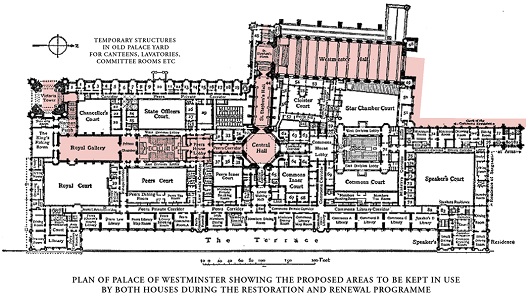
Credit: Anthony Delarue Associates
Search
Instagram: @andcusack
Click here for my Instagram photos.Most Recent Posts
- Brunel’s Unbuilt Capitol February 3, 2026
- Cricket at Fordham January 27, 2026
- Palacio Barolo Revisted January 14, 2026
- Learning to Love Liguria January 14, 2026
- Crux Alba No. 2 January 13, 2026
Most Recent Comments
Book Wishlist
Monthly Archives
Categories