France
About Andrew Cusack
 Writer, web designer, etc.; born in New York; educated in Argentina, Scotland, and South Africa; now based in London.
 read more
News
Blogs
Reviews & Periodicals
Arts & Design
World
France
Mitteleuropa
Knickerbockers
Argentina
The Levant
Africa
Cape of Good Hope
Netherlands
Scandinavia
Québec
India
Muscovy
Germany
Academica
Fire at St. Jodard
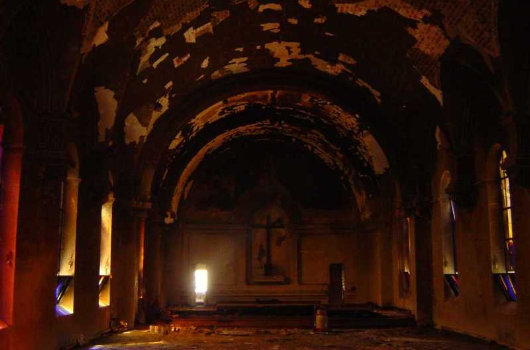
The chapel of the Community of St. Jean’s novitiate at Saint-Jodard in France was tragically consumed by an accidental fire late last month. The brothers give thanks that no one was harmed in the fire and look upon the event as “a favorable occasion to learn how to live together in the Great Hope and to redouble fraternal charity”.
Contributions can be sent to:
Prieuré Saint Joseph
42590 St Jodard
FRANCE
What was that you were saying about “cheese-eating surrender monkeys”?
Yann Baly writes:
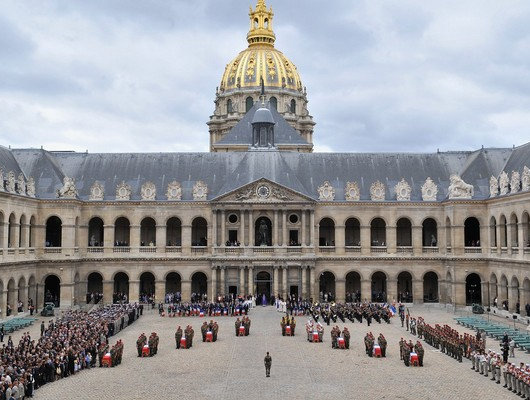
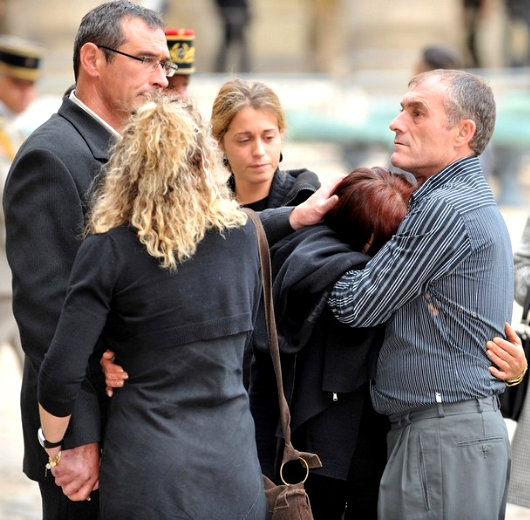
“Regarding the sacrifice of the 10 young French soldiers killed in combat in Afghanistan, we have heard many voices, including those of the families of the young parachutists, saying that they died for nothing.
“Politicians are duty-bound to question the timeliness of our engagement in Afghanistan under NATO command, in a war desired by the United States. We cannot remain silent when France, and French youth have, in the past, paid too heavy a price because of “sacred” unions in wars that diplomacy and sensible politics could have avoided.
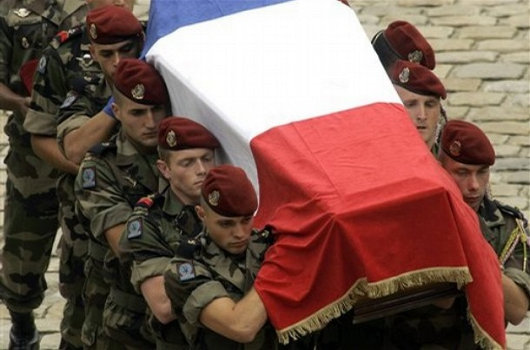
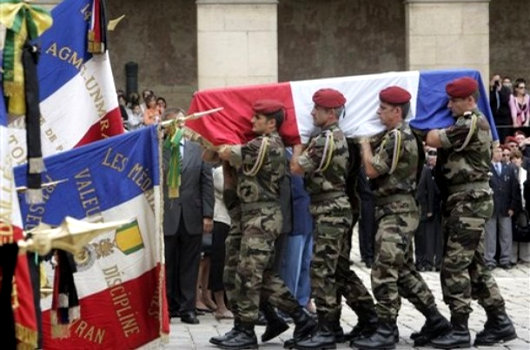
“Yesterday, in the majestic courtyard of les Invalides, the French people were able to recall that certain political errors are paid for in blood. It is therefore legitimate to wonder if Jacques Chirac (who was not present yesterday) and Lionel Jospin were right to send the French army into Afghanistan in 2001 and if Nicolas Sarkozy was not wrong to reenforce the contingent with the inadequate means we are all aware of. As Bernard Antony has reminded us, the United States has committed so many errors of foreign policy, so many criminal mistakes in its diplomatic and military actions, that one can doubt the need to be present in Afghanistan. History shows us that economic and oil interests have often been a decisive element in the American involvement in military conflicts. Fight efficiently against terrorism? There too, there are questions to be asked.
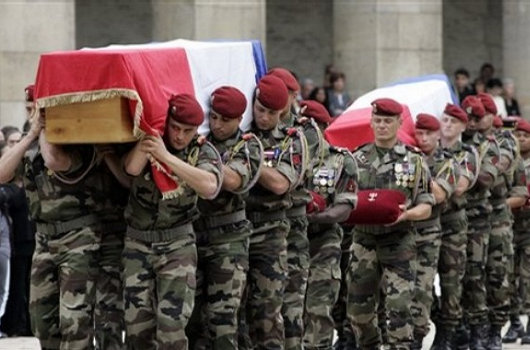
“Nonetheless, it is false to say that our young parachutists died for nothing. First of all, the French people have become conscious once again that they had an army. A month and a half after the tragedy in Carcassonne, the blood of these soldiers has washed away the lies, insults and spite, some of it coming from the head of State himself, heaped on the French army. But most of all, in our society where egoism and individualism are the rule, for a people who seem to have forgotten the meaning of sacrifice, their death in combat, at the age of 20 for most of them, is no doubt a sign of an imminent resurrection of the spirit of French resistance. In the current international and national context, this dimension is not insignificant. France, like the rest of the world, is entering into a period of uncertainties and grave risks. To be conscious of that and to prepare for it is not nothing.”
Ingrid Betancourt Goes to Lourdes
Ex-hostage gives thanks at Marian shrine during its 150th year

Ingrid Betancourt has travelled to the Shrine of the Blessed Virgin at Lourdes in France to give thanks for her liberation from years of captivity as a hostage of the FARC. Alongside her mother, son, and daughter, Ms. Betancourt also offered prayers on behalf of those prisoners who are still held hostage by the FARC guerrillas.
Chartres 2008

It’s that time of year again. This Pentecost weekend, 10,000 traditional Catholic pilgrims walked en masse over the space of three days from Paris to Chartres. The annual “Notre Dame de Chrétienté” (Our Lady of Christendom) pilgrimage is mostly French but with a healthy spattering of Britons, Americans, and others to add to their happy numbers. It begins in the Cathedral of Notre-Dame de Paris on the vigil of Pentecost and ends up at the Cathedral of Notre-Dame de Chartres on Pentecost Monday, which is traditionally a day off in France. Traditional Masses are said each day (with confessions heard beforehand) along the route.
The Sad State of the Modern Newspaper
…and the heroism of an Anglo-Hungarian countess.
IT IS ONE OF THE more saddening facts of life that British newspapers have suffered an inexorable decline in the past few years. The great Times of London – once the most respected newspaper in the world – has been reduced to a boring mid-brow tabloid, the once-solid Scotsman idiotified and, again, tabloided, and of course the Daily Telegraph, which has gone from staunchly conservative (as in worldview) to merely Conservative (as in the tribe of Britons who prefer blue to red).
The Telegraph, like the Conservative party itself, doesn’t seem to know what it’s there for. It has at least remained a broadsheet; going tabloid would be a disaster and would probably be considered the last straw for all the die-hards for whom loyalty to one’s newspaper is a point of pride. And, to its credit, it finally seems to have realised the damage done by constant front-page photos of “Posh” and “Becks” and other “celebrity” partisans of the Anti-Culture, for they seem fewer and far between these days (as compared to a year or two ago, when they were frequent). The Telegraph‘s base are old folk who want a quality newspaper. They are loyal to the Tele and, despite its decline, would be too embarrassed to jump ship to the Guardian, which is written better but which nonetheless expones a nefarious ideology.
As for myself, the last straw came one morning in the Common Room of St. Salvator’s Hall when, flipping through the Telegraph, I reached the page which normally displays the Court Circular but found it missing, replaced by a curt statement advising that should I desire information about the activities of the Royal Family I should direct myself to http://www.royal.gov.uk. Outrageous! As it happens, this is not a permanent loss but rather an occasional one, as the editors at the Telegraph seem to decide whether or not to print the Court Circular each day on a whim. Fair enough, but I came to the realisation that the producers of the Telegraph are not aiming at me – the reasonably educated young man who seeks in his daily read a newspaper that is well-written, right-thinking, and properly presented – and so I have ceased to be a Telegraph regular.
What to read then? We have already dismissed the Times, the Scotsman, and the Guardian. The Daily Mail is always readable but arguably aimed at a different demographic; the Daily Mirror, bonkers; the Sun, no thank you!; the Financial Times is too boring, though the Weekend edition is actually worth buying most of the time; the Independent has a good layout for a tabloid, but is rather of a Lib-Dem persuasion; the Glasgow Herald is just rather dull and has only recently repented of its long-held anti-Catholicism. Not wanting to support the nefarious New York Times, enemy of Western civilization and the last word in liberal elitism, its wholly-owned subsidiary the International Herald-Tribune is ruled out. Which pretty much rules out every English language daily newspaper available in St Andrews.
 So, abandonné par ma langue, I have outsourced my daily read to the Continent (of all places!) and am now a partisan of Le Figaro. While by no means fluent in the language, I can comprehend written French with greater ability than I speak it. And while I still prefer the feel of a broadsheet, the Berliner size of Le Figaro has its advantages, being very easy to read in the confined space of my regular chair in the corner of the little coffee shop down the street. More importantly, I find it much more engaging mentally, which I put down to the fact that (not being a native or fluent French speaker) I am forced to read every word. Reading the Telegraph one unthinkingly only actually reads every third or so word; articles of particular interest excepted, naturally. The day’s Figaro usually arrives in the middle of the day or the afternoon, but I buy my paper in the morning so actually I’m usually reading the previous day’s Figaro. I don’t mind, it suits my current routine. (Mornings are for reading the newspaper in a coffee shop, afternoons are for reading books with a slow pint in the pub.)
The chief deficit of reading a French newspaper is that naturally the news is oriented towards France, and thus I don’t get the usual transatlantic focus of the British papers (which can be an advantage as well as a deficit, I’ll concede). Nonetheless, it does happen to have articles of interest to any trad.
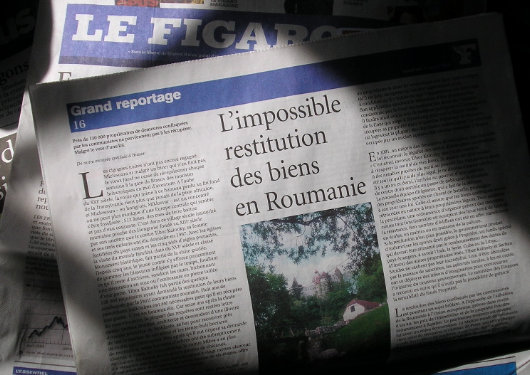
A few weeks ago, Le Figaro reported on the restitution of Romanian castles to their original, pre-Communist owners (‘L’impossible restitution des biens en Roumanie’, Le Figaro, 21 April 2006). The New York Sun rather amusingly and provincially headlined the story “Westchester Man To Take Possesion of Dracula’s Castle” — the New York Post characteristically used the headline “VLAD TIDINGS“. (FTD also reported on the restitution of Bran). When I wrote my previous post on the subject I was under the impression that Bran was one of the castles which would be restituted and then purchased back by the Romanian government, but most sources imply that this is not the case and Dominic von Habsburg (of North Salem, New York) will actually take possesion of the castle, I’m glad to hear.
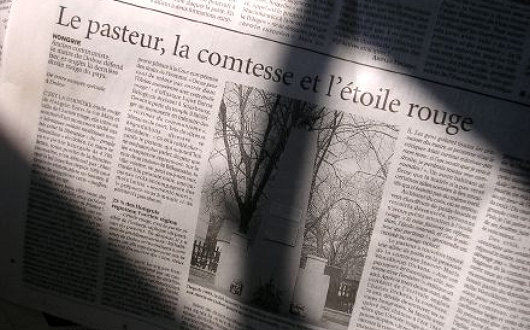
This morning, then, I read in Le Figaro of the controversy surrounding a red star which remains on a Soviet war memorial in a small town in Hungary, a country which has banned all Communist and Nazi emblems (‘Hongrie: Le pasteur, la comtesse et l’étoile rouge’, Le Figaro, 6 May 2006). The local Protestant minister has been fighting to replace the red star, and has found an ally in Countess Jeanne-Marie Wenckheim-Dickens. The Countess, aged 70 and a descendant of Charles Dickens, returned to Hungary a few years ago after her husband died. The family had fled the country in 1944 just escaping the conquering Red Army. “I return home,” the Countess says (‘with a delicious British accent’, Le Figaro reports), “and what do I find? My castle transformed into an elementary school with, right in front of the gate, a red star! To me, this star is the Antichrist.”
The Countess funded the restoration of her former castle, now a school, and obtained permission from the town to live in the old presbytery, an ancillary building of the old castle. But when, in 2004, she proposed to mark the accession of Hungary to the European Union by replacing the red star on the monument with a European flag, the ex-Communists in the town hall told her she “should not be afraid of the red star, but of the Cross!” With fighting spirit, “I placed a large cross on my entryway,” the Countess says, “then I painted it gold so that the Mayor, whose window is opposite, can see it all the better.”
“Crosses? She can build a hundred of them!” the Mayor said. “It doesn’t disturb me!” But in return the Mayor had a house on what was the domain of the Wenckheim family renovated for the use of unemployed local gypsies. “It was clearly to annoy me,” the Countess said. “They thought the gypsies were going to make the area around the nearby church, built by my grandfather, filthy. But not at all! They respect the place, and I, I love their music very much.” The Countess also gives weekly catechism lessons to the local gypsies. In her window, she displays a letter to the people of the town inviting them to vote for the conservative Fidesz party. “In December,” the Countess continues, “before Christmas, I add little angels and holy pictures; they don’t like that much across the way, since they’re aimed at the town hall. Because I, too, have a star: but is the star of the Shepherd”.
Chartres 2005
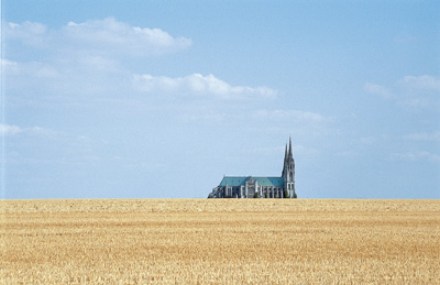
Various sites have put up photos from this year’s annual traditionalist Pentecost pilgrimage to Chartres, and I thought, as I did last year, I would gather a few of them and present them to you. (more…)
Thierry d’Argenlieu
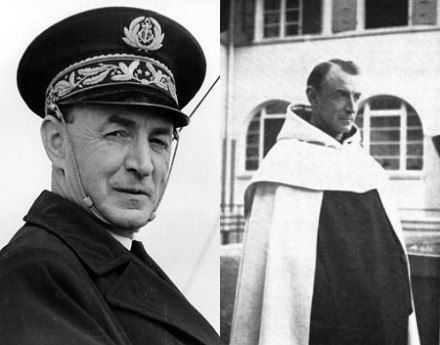
Today we bring you the story of a man known as both Brother Louis of the Trinity, OCD, and Admiral Georges Thierry d’Argenlieu.
D’Argenlieu graduated from the Ecole Navale in Brest and was awarded the Legion d’Honneur for his actions in the Great War. After the war, he became a Carmelite friar, taking the name of Louis de la Trinité. As the Second World War commenced, he once again put on the uniform and partook in the defence of France from the pagan Nazis. Once France was vanquished, he escaped to London where he allied himself with General de Gaulle and the Free French Forces, eventually becoming the commander of the Free French Naval Forces. At the Liberation of the Paris, he strode down the Champs Elysée with de Gaulle and Leclerc and attended the Te Deum at Notre-Dame.
Incidentally, he was also the one who suggested the adoption of the Croix de Lorraine as the symbol to differentiate the Free French Forces from those of Vichy France.
In 1947 however, while Governor-General of Indochina, his request to leave the Armed Forces was granted, and he returned to life as a Carmelite, dying at the Priory of Avon in 1964.
More about Admiral d’Argenlieu/Father Louis here, here, and here.
Chartres 2004
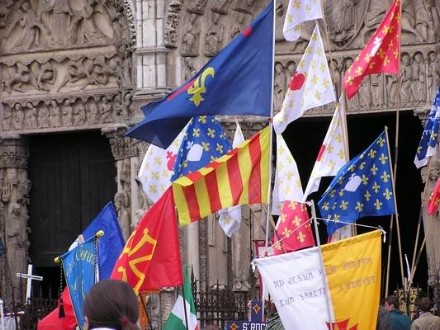
Here are some photos from this years Pentecost Paris-Chartres Pilgrimage. (more…)
The Death of Marat
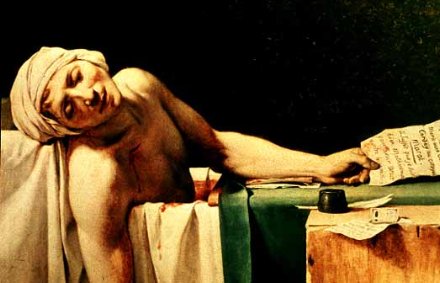
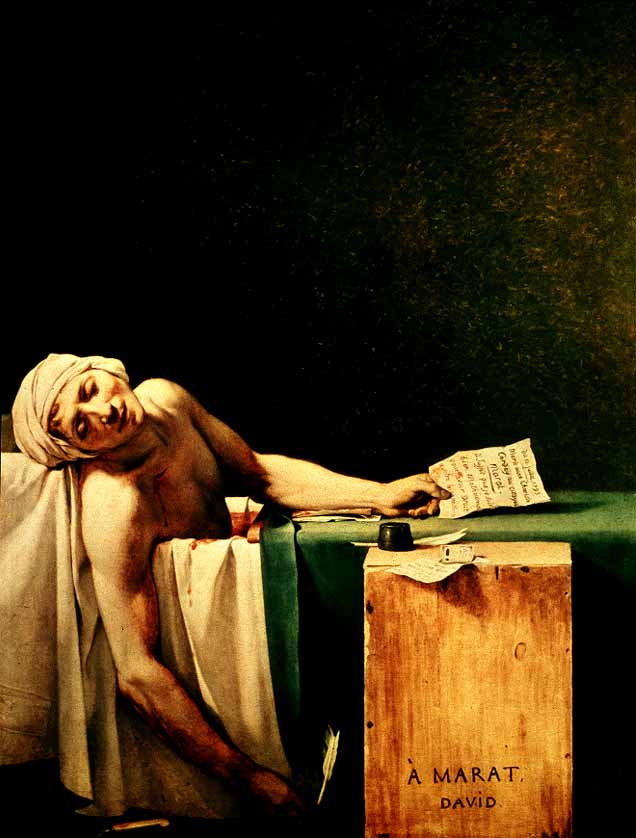
The thirteenth of July is also the day that the brave heroine of France, Charlotte Corday, killed the murderous revolutionary swine Jean-Paul Marat. Marat received his M.D. from St Andrews, and his villainy is remembered in the annual Kate Kennedy Procession, in which he is rightfully described as a “paranoid demagogue.”

The assasination inspired David to paint his famous depiction of the event. It is one of my favourite paintings, and a brilliant piece of propaganda portraying a bloodthirsty hatemonger as an angelic martyr.
Remembrance via the great Irish Elk.
Search
Instagram: @andcusack
Click here for my Instagram photos.Most Recent Posts
- Brunel’s Unbuilt Capitol February 3, 2026
- Cricket at Fordham January 27, 2026
- Palacio Barolo Revisted January 14, 2026
- Learning to Love Liguria January 14, 2026
- Crux Alba No. 2 January 13, 2026
Most Recent Comments
Book Wishlist
Monthly Archives
Categories