Art
About Andrew Cusack
 Writer, web designer, etc.; born in New York; educated in Argentina, Scotland, and South Africa; now based in London.
 read more
News
Blogs
Reviews & Periodicals
Arts & Design
World
France
Mitteleuropa
Knickerbockers
Argentina
The Levant
Africa
Cape of Good Hope
Netherlands
Scandinavia
Québec
India
Muscovy
Germany
Academica
A Turbaned Pasha with an Elephant
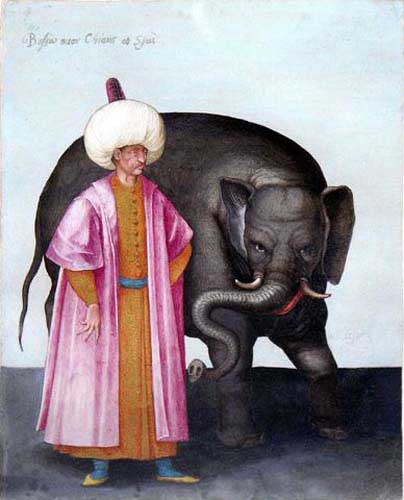
Tempera and shell gold on paper, 10.0 in. x 8.8 in.
c. 1580-1585, Private collection (now for sale)
While known as a painter of large-scale works, a draftsman, and a printmaker, Jacopo Ligozzi — the court painter to the Grand Dukes Francesco I, Ferdinando I, Cosimo II, and Ferdinando II — also completed a series of drawings depicting Turkish traditional dress and costume. Interest in the Ottoman empire and its people increased after the great victory over the Turks at Lepanto in 1571, commemorated as a Christian feast to this day. Ligozzi never visited the Turkish realm himself but derived his inspiration for this particular illustration from the drawings accompanying the Venetian edition of Nicolas de Nicolay’s chronicle of the 1551 embassy of Henri II to the court of Suleyman the Magnificent.
That, at any rate, is the source of the Pasha; the inspiration for the elephant (of the African variety) remains undetermined. Suleyman gave an African elephant accompanied by a turbaned mahout and a staff of thirty to the future Holy Roman Emperor Maximilian II, and it’s probable that Ligozzi used a printed depiction of this as a source for the picture here. (Earlier, in 1514, the King of Portugal gave an elephant named Hanno to Pope Leo X, a Medici).
This charming work, available from the Arader gallery of New York, is one from the series of tempera depictions of Turkish costume by Ligozzi, twenty of which are in the Uffizi, one in the Metropolitan Museum of Art, and another in the Getty Museum of Los Angeles. It was probably painted between 1580 and 1585 while the artist was in the service of Grand Duke Francesco I de Medici. Ligozzi’s depictions were first bound in a single volume in the possession of the Gaddi family before, in 1740, the manuscript reached the hands of the Manifattura Ginori de Doccia, the porcelain factory founded outside Florence in 1735 by Marchese Carlo Ginori. There, it inspired a number of porcelain platters which are today dispersed around collections worldwide. The principal group of these illustrations were donated to the Uffizi in 1867.
Russia’s Treasures on the Banks of the Amstel
Seventeenth-century Amsterdam building will, from June, be home to collections from St. Petersburg’s Imperial Hermitage Museum
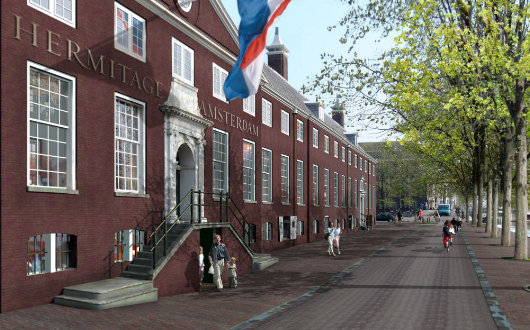
A new 100,000-square-foot space displaying works from the Hermitage Museum in St. Petersburg will open in Amsterdam this June. The Hermitage Amsterdam will be located in the Amstelhof, a former home for the elderly built in 1683 by the Dutch Reformed Church and transformed into a modern exhibition space by Hans van Heeswijk Architects. The opening exhibition, “At the Russian Court” — a “a deeply researched exploration of the opulent material culture, elaborate social hierarchy and richly layered traditions of the Tsarist court at its height in the nineteenth century” — will display 1,800 works from the massive collection in St. Petersburg and continue until the end of January 2010.
First Troop, Philadelphia City Cavalry
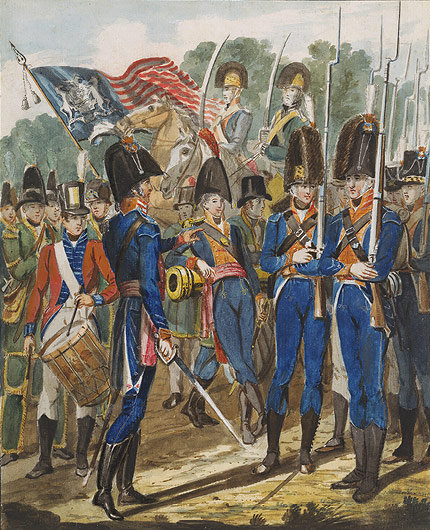
Watercolor, gouache, and graphite on white laid paper, 9 in. x 7 1/4 in.
c. 1811-1813, Rogers Fund
Previously: The Prince of Wales in Philadelphia
Some Afrikaners
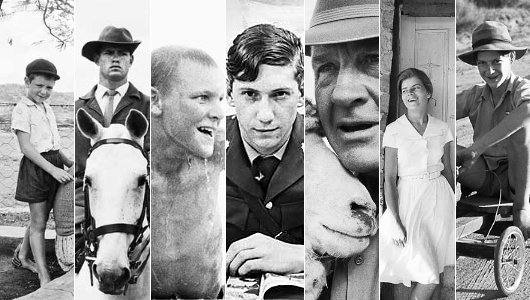
“In my father’s shop,” writes the photographer David Goldblatt, “serving Afrikaners, I found, almost in spite of myself, that I liked many of them and, to my surprise, that I was beginning to enjoy the language. There was a warm straightforwardness and an earthiness in many of these people that was richly and idiomatically expressed in their speech. And, although I have never advanced beyond being able to speak a sort of kombuistaal, I delighted in our conversations. Yet, withal, I was very aware that not only were most of these people Nationalists, strong supporters of the Party and its policies, but that many were racist in their very blood. Although anti-Semitism was now seldom overt, they made no secret of their attitude to blacks, who at best were children in need of guidance and correction, at worst sub-human. I was much troubled by the contradictory feelings of liking, revulsion, and fear that these Afrikaner encounters aroused in me and felt the need somehow to come closer to these lives and to probe their meaning for me. I wanted to do this with the camera.
“I had begun to use the camera long before this in a socially conscious way. And so I began to explore working-class Afrikaner life in our district. I drove out to the kleinhoewes around the town. I would stop and ask people if I might do some portraits of them or spend time with them while they went about whatever they were doing. In this way I became intimate with some of the qualities of everyday Afrikaner life in these places, and with some of its deeply embedded contradictions.
“An old man sits for me. A black child comes and stands next to him, looking at me with curiosity. The man turns and says to the child, ‘Ja, wat maak jy hier, jou swart vuilgoed?‘ (Yes, what are you doing here, you black rubbish?), the insult meant and yet said with affection. How is this possible? I don’t know. But the contradiction was eloquent of much that I found in the relationship between rural and working-class Afrikaners and blacks: an often comfortable, affectionate, even physical intimacy seldom seen in the ‘liberal’ circles in which I moved, and yet, simultaneously, a deep contempt and fear of blacks. …
“Travelling through vast, sparsely populated parts of the country with my camera became a major part of my life at that time. I think that our landscape is an essential ingredient in any attempt at understanding not just the Afrikaner but all of us here. We have shaped the land and the land has shaped us. Often the land was unforgivingly harsh. Yet, the harsher the landscape the stronger the Afrikaners’ sense of belonging seemed to be. Many of the people whom I met in the course of those trips had a rootedness in the land of which I was very envious. Envious in the sense that I couldn’t claim 300 years of ancestry in this country. Yet, increasingly, I felt viscerally bonded to it.”
The Bad Shepherd
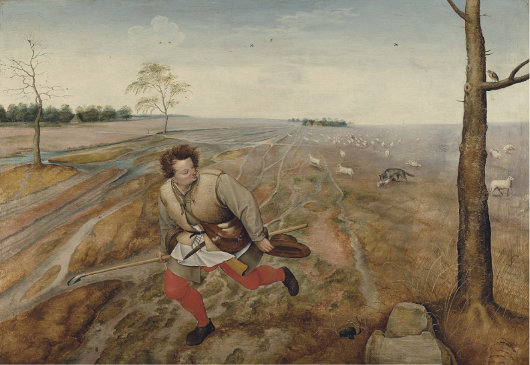
Pieter Brueghel II, The Bad Shepherd
Oil on panel, 29 in. x 41¼ in.
c. 1616, Private collection
With an original estimate of £1,000,000–£1,500,000, Pieter Brueghel the Younger’s The Bad Shepherd sold at a final hammer price of £2,505,250 at Christie’s in London this July. As the house lot notes state, it is “one of the most original and visually arresting of all images within the Brueghelian corpus of paintings”.
I am the good shepherd. The good shepherd lays down his life for the sheep. He who is a hireling and not a shepherd, whose own the sheep are not, sees the wolf coming and leaves the sheep and flees; and the wolf snatches them and scatters them. He flees because he is a hireling and cares nothing for the sheep.
It is significant that the distant horizon behind the sheep is broken only by a solitary church spire and a small farmstead. They seem to suggest that in abandoning his responsiblities the shepherd also rejects both the church and the community as he rushes headlong in the opposite direction. The mental anguish experienced by the shepherd is mirrored in a remarkable way by the barren landscape, shown from a dizzying bird’s eye perspective, stretching back into infinity. Interwoven only by vein-like tracks and ditches that lead the eye into the distance, the landscape is one of the artist’s most extraordinary achievements and very much a precursor to the psychological landscapes of the 20th century.
There is something arrestingly modern about this painting that fascinates me.
A Tribute to Cockerell
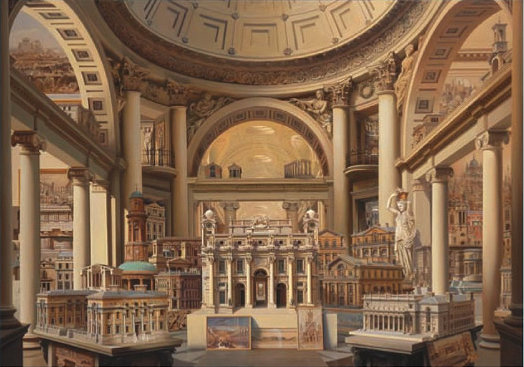
Carl Laubin, A Tribute to Charles Robert Cockerell, RA
Oil on canvas, 39′ 11″ x 60′
2005, Private collection
The Neue Galerie
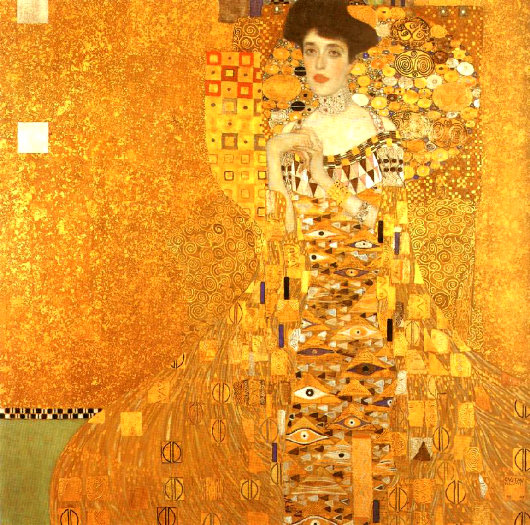
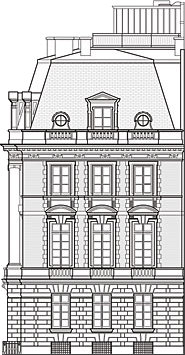 THE RECENT PURCHASE for the Neue Galerie of Gustav Klimt’s 1907 ‘Adele Bloch-Bauer I’ (above), alledgedly for a record-breaking price of $135,000,000, gives me the perfect opportunity to write a post on the eponymously recent addition to New York’s coterie of art museums. Since its 2001 opening, the Neue Galerie has resided in the handsome 1914 beaux-arts mansion on the corner of Fifth Avenue and 86th Street, designed by Carrère and Hastings (of New York Public Library fame) for industrialist William Starr Miller and later inhabited by Mrs. Cornelius Vanderbilt III. In the time since the construction of No. 1048, the rest of Fifth Avenue has undergone a lamentable transformation from a boulevard of beautiful townhouses and mansions to an avenue predominantly consisting of apartment buildings. While one appreciates the inoffensive design of the pre-war buildings on Fifth, there remain a number of thoroughly opprobrious modern interlopers which offend the graceful avenue. One can’t help but pine for Fifth Avenue before the mansions came down, but we can at least give thanks for holdouts like the Neue Galerie. (more…)
The Dream of Christopher Columbus
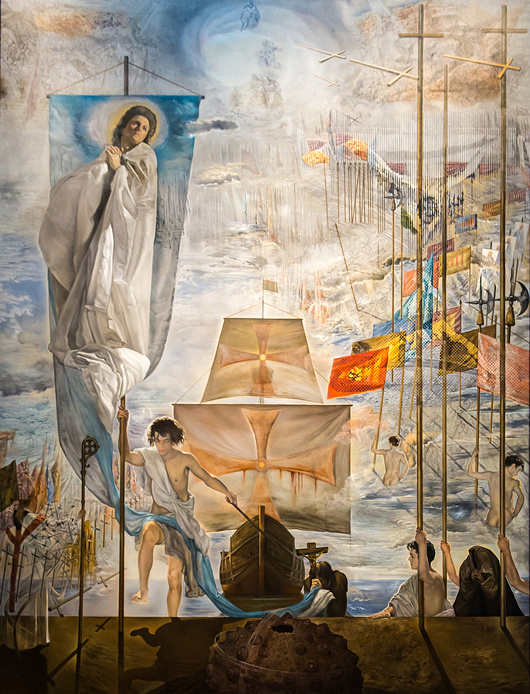
The Dream of Christopher Columbus, sometimes known as “Christopher Columbus Bringing Christianity to America”, by Dalí.
The two orbital paths in an armillary-like fashion around the sea urchin are taken to be a symbol for Man’s conquest of the Moon, which took place some years after the painting was finished.
Huntington Hartford commissioned the painting from Dalí for his Gallery of Modern Art which once stood in New York’s Columbus Circle.
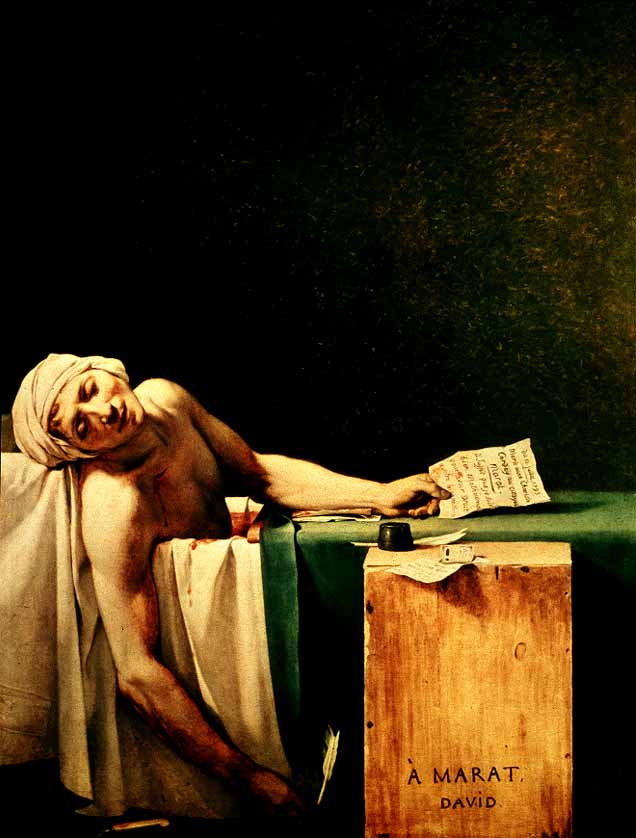
The Death of Marat
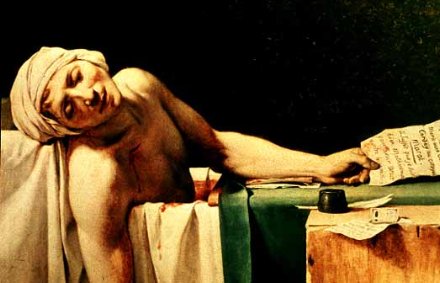
The thirteenth of July is also the day that the brave heroine of France, Charlotte Corday, killed the murderous revolutionary swine Jean-Paul Marat. Marat received his M.D. from St Andrews, and his villainy is remembered in the annual Kate Kennedy Procession, in which he is rightfully described as a “paranoid demagogue.”
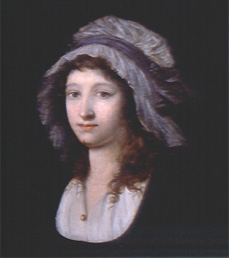
The assasination inspired David to paint his famous depiction of the event. It is one of my favourite paintings, and a brilliant piece of propaganda portraying a bloodthirsty hatemonger as an angelic martyr.
Remembrance via the great Irish Elk.
Bo Bartlett, The Bride
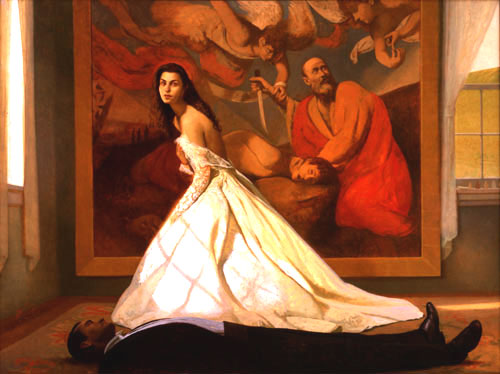
Bo Bartlett, The Bride
Oil on linen, 80″ x 100″
Private collection
Bo Bartlett, Leviathan
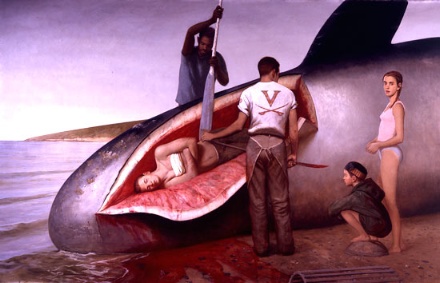
Bo Bartlett, Leviathan
Oil on linen, 89″ x 138″
Private Collection
Search
Instagram: @andcusack
Click here for my Instagram photos.Most Recent Posts
- Brunel’s Unbuilt Capitol February 3, 2026
- Cricket at Fordham January 27, 2026
- Palacio Barolo Revisted January 14, 2026
- Learning to Love Liguria January 14, 2026
- Crux Alba No. 2 January 13, 2026
Most Recent Comments
Book Wishlist
Monthly Archives
Categories