Art
About Andrew Cusack
 Writer, web designer, etc.; born in New York; educated in Argentina, Scotland, and South Africa; now based in London.
 read more
News
Blogs
Reviews & Periodicals
Arts & Design
World
France
Mitteleuropa
Knickerbockers
Argentina
The Levant
Africa
Cape of Good Hope
Netherlands
Scandinavia
Québec
India
Muscovy
Germany
Academica
‘Handmade’ by Xavi García
‘A reaction to the soullessness of digital design’
Not many artists or designers have a business degree from Salamanca or studied management in Gothenburg. Xavi García has, though, and it’s obvious his grounding in the financial realm had an influence on his personal art project ‘Handmade’ — a banknote meticulously created by hand using drypoint, screenprinting, and stamps on newsprint. García describes the project as “a reaction to the soullessness of digital design”. (more…)
Christen Købke in London
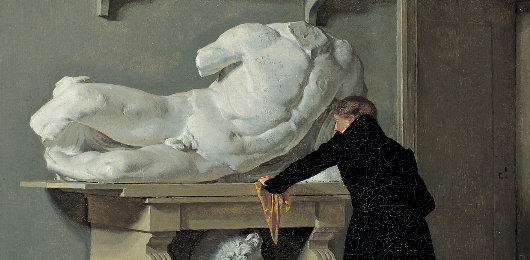
THROUGH JUNE 13, the National Gallery in London is exhibiting “Christen Købke: Danish Master of Light”, a small show of the neglected Danish Golden Age painter but the first exhibition exclusively of his works outside of Denmark. “Kobke generally chooses the quietest corner, or a view from the side,” writes Waldemar Januszczak in The Times. “What fascinates him is the way light falls on the old stones, or the tufts of grass growing between the cracks. Throughout his art, whether he is painting landscapes or people, Købke seems always to be noticing the decay of the world he grew up in.” Januszczak suggests that the warmth of Købke’s work is in reaction to the turbulence of his country’s position in Europe at the time — Denmark backed the wrong horse in the Napoleonic wars and turned to neutrality, only to face a pre-emptive attack by the British in which Copenhagen was ferociously bombarded. The painter was born three years after this humiliation, and at age 12 began his studies at the Royal Danish Academy, where he studied under Christoffer Wilhelm Eckersberg, the ‘Father of Danish painting’.
The talented Købke painted portraits, landscapes, and other scenes. The show at the National Gallery includes my favourite Købke portrait, that of his friend and fellow artist, the landscape painter Frederik Hansen Sødring, on loan from Copenhagen’s Hirschsprung Collection.
His capability aside, what I like about Købke is that he is a certifiable local boy, rarely straying from the vicinity of his native Copenhagen except for the period of study in Italy required of the academically trained artist. His portraits are of his family and his friends, his landscapes of nearby rustic lanes and royal castles. A shame he died of pneumonia just 37 years old.
I haven’t had the chance to view any of his works in the flesh, but Londoners might want to avail themselves of this rare chance to see most of Købke’s capable work while on show in the metropolis. (more…)
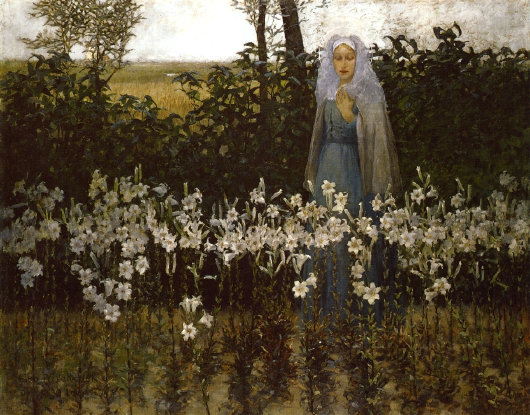
Hans Laagland
Oil on wood, 1980
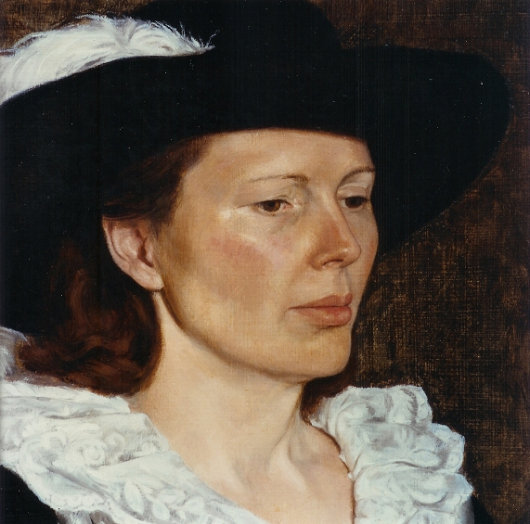
“It does not matter what the artist paints, but how he paints it,” proclaims the painter Hans Laagland. “That is why Rubens is a genius while Picasso’s work is passable.” Laagland, a Fleming himself, is one of the scant few artists in our day who paint in the grand style of the Flemish baroque master. He was born in Belgium’s Dutch province in 1965 and took up the brush and easel when ten years old. The young boy quickly developed a fascination with Rubens, considering and absorbing his works in the neighbouring city of Antwerp. Laagland’s emphasis is on traditional craftsmanship, painting in oils on wood panel, investigating and recreating the Old-Dutch lead white used by Rembrandt and the vermilion of Rubens. With a particularly capable hand at portraits, his work can be seen everywhere from the Norbertine abbey at Postel to the Belgian parliament in Brussels.
“It has been downhill ever since Rubens,” the painter says. Rembrandt — “Rubens’s disabled cousin” according to Laagland — was the last great painter; “What comes after him no longer has any significance.” Those versed in the Netherlandic tongue can read Mr. Laagland expounding upon his artistic ideas in De Kunstverduistering (“The Eclipse of Art”), his extended essay on art and painting now published as a book by KEI Zutphen. (more…)
A Wander Through the V&A
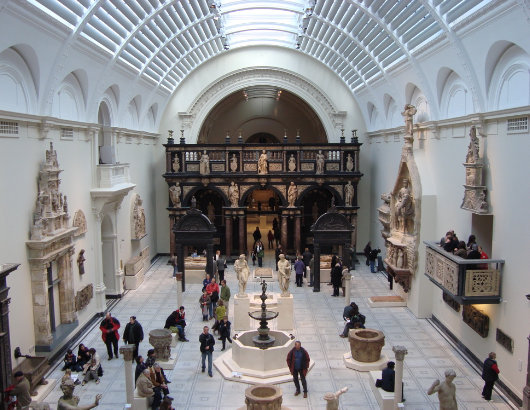
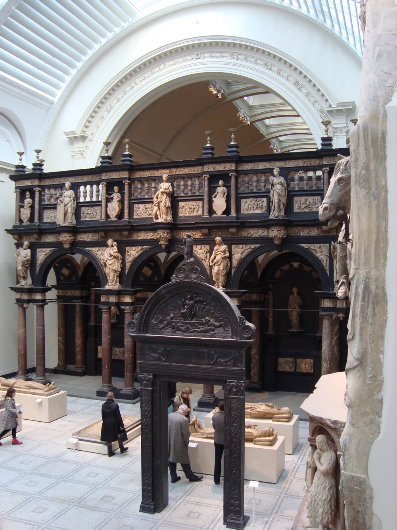 When on earth was the last time I was in the V&A? To be honest, I’ve no idea, though I’m certain my first visit was (like that of many others) as a wee one, the summer after kindergarten to be precise. It’s a stonking great place with tons of stuff in it, and one of the startling few that deal with architecture as a subject in its own right. (A fact which wins admiration in the heart of this architecture fan).
Of course the Victoria & Albert Museum has been fresh in the minds of many most recently for the re-opening of its Medieval & Renaissance sculpture galleries. The new arrangement cost over £30 million, took seven years to complete, and includes ten new display rooms displaying, as the Guardian put it, “a world of ravishing luxury”. So it seemed silly not to have a little wander round the South Ken institution yesterday, especially since it was a rainy afternoon. (more…)
Old Master & 19th Century at Christie’s
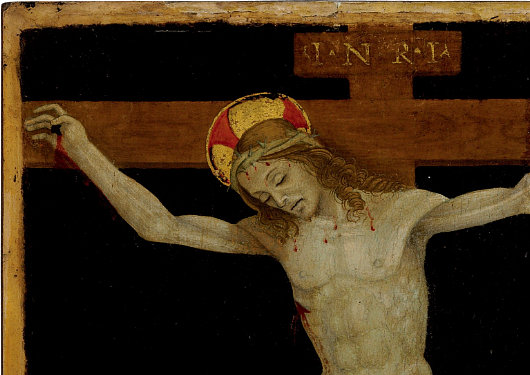
Being something of an auction-house dilettante — I last brought you a virtual update from the Dublin bidding chambers — there are a number of works up for grabs in tomorrow’s Old Master & 19th Century Paintings, Drawings, and Watercolors auction at Christie’s here in New York that caught my eye. A few other items sold in recent auctions follow at the bottom. (more…)
Stoddart’s Ode to Ossian
The Queen’s Sculptor Plans Great Literary Monument in the West of Scotland
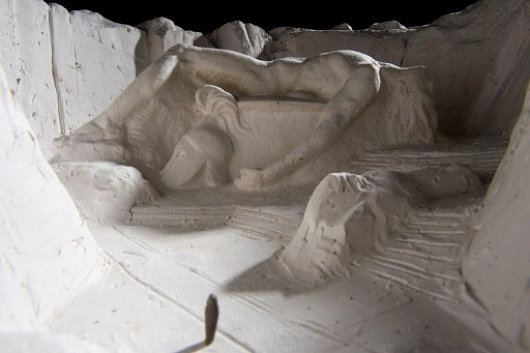
Word reaches me that Alexander Stoddart, the Queen’s Sculptor in Ordinary for Scotland, has dreamed up a massive monument to Ossian. “For fifteen years Stoddart has planned ‘a national Ossianic monument’ on the west coast of Scotland,” writes Ian Jack in The Guardian. “The scale is immense. Stoddart wants a great amphitheatre cut into the rock with Ossian’s dead son, Oscar, also cut from rock, prone on his shield on the amphitheatre’s floor.” The project would be the biggest literary monument in the world, surpassing the Scott Monument on Princes Street in Edinburgh. It could be the project of a lifetime for Stoddart.
“He says a lot of people are keen, including Scottish government ministers, landowners and historians, and that a site has been identified in Morvern and a preliminary survey completed by the engineers Ove Arup. There is also environmental opposition: the kind of people, according to Stoddart, who will ‘always find two mating ptarmigan no matter where we choose’ and haven’t taken into account Schopenhauer’s view that ‘the sound of nature is the sound of perpetual screaming’. It may account for the two death threats he says he has received.”
“The Ossian poems, especially ‘Fingal’, took Europe by storm,” the journalist continues, “and gave it a new notion of the savage and sublime. A cave on Staffa became ‘Fingal’s Cave’. Goethe incorporated Ossian into The Sorrows of Young Werther and Schubert used passages of Goethe’s translation in his lieder. By Stoddart’s estimate, nothing, not even the work of Burns, has made a larger Scottish contribution to European culture. Ossian established the Scottish wilderness as a destination for Europe’s earliest tourists. Also, by ennobling Celtic antiquity, it changed Scotland’s sense of itself.”
The traditional style of Alexander Stoddart, an avowed neo-classicist, has provoked foaming at the mouth in the rather dull arts establishment, but his works — such as the David Hume statue on the Royal Mile and the frieze on the Sackler Library at Oxford — have proven popular. Scotland’s greatest living sculptor has completed a bust of Scotland’s greatest living composer, James Macmillan, as well as of Britain’s greatest living philosopher Roger Scruton. (The old-school lefty Tony Benn — another living national institution — is the subject of a Stoddard bust as well).
“The paradox is that, by revering and understanding abandoned traditions, [Stoddart] has emerged as one of the most original artists in Britain: a stranger to his times.”
Early Morning, Madison Square
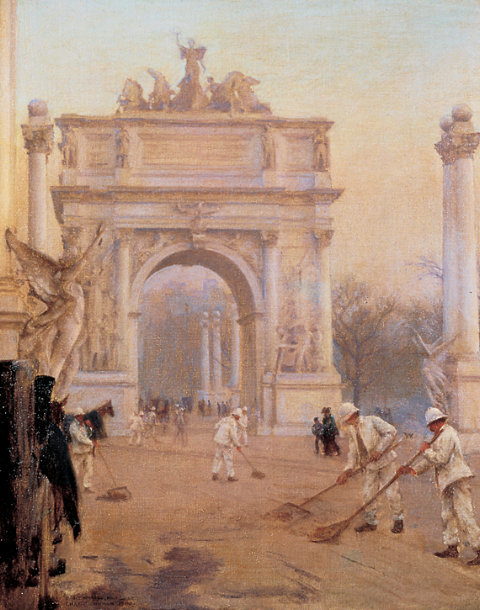
Charles Courtney Curran, Early Morning, Madison Square
Oil on canvas, 22 in. x 18 in.
1900, National Arts Club, New York
In the Dublin auction houses
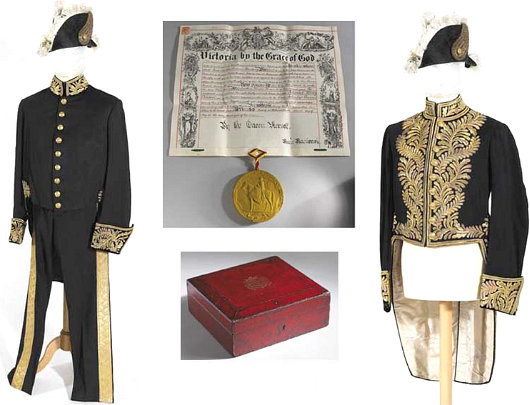
THOUGH THE BORING brains of tawdry metropolitan Londoners are all too quick at relegating Dublin to the provincial periphery of the mind, the Irish capital is a perpetual treasure trove for the old-fashioned and right-minded. A number of items of interests have recently been sold at the auction houses of the fair city, including two ceremonial uniforms (above) of that famous Dubliner, Sir Edward Carson QC. Carson was the lawyer and statesmen who passionately, but without bigotry, opposed the cause of Irish home rule. He was the defending barrister in the Archer-Shee case and led the Marquess of Queensberry’s team in Oscar Wilde’s doomed libel action. Carson and Wilde had been at Trinity together (where — little known fact! — Carson was a keen hurler), and the famous wit quipped of Carson “I trust he will conduct his cross-examination with all the added bitterness of an old friend.”
Having a fine mind for the law and being politically active meant that Carson moved through several layers of British government, holding numerous offices and positions. He was a Privy Counsellor twice over (of both Ireland and the United Kingdom), a Queen’s Counsel, served in the House of Commons as leader of the Irish Unionists, and held portfolios in the British Cabinet. The two ceremonial uniforms auctioned at Whyte’s of Molesworth Street are from his appointment as Solicitor General for England & Wales in 1900. (He had been Solicitor-General for Ireland in 1892, and was later Attorney General for England & Wales, in which position he was succeeded by the F.E. Smith of Chesterton’s famous poem).
The two black wool morning coats feature gold bullion trimming and buttons, and are sold with a pair of trousers with gold filigree stripe matching the lesser uniform, and knee breeches & silk stockings for the greater uniform. The vellum appointment as Solicitor General was also included, in a red leather box with a gilt impression of the royal arms. Whyte’s estimated a sale of €50,000-€70,000, but the lot’s realised price was €42,000. (more…)
A Message from the Minister of Culture
I’ve sometimes thought that the Director of the Metropolitan Museum is New York’s unofficial Minister of Culture. Concerned New Yorkers were at the edge of their seats with anticipation to discover who would be chosen to direct this great museum once it was announced that the legendary Philippe de Montebello was relinquishing the throne. As The New Criterion put it “Few events have been awaited with more trepidation in the world of culture — we were going to say ‘the art world,’ but it embraces much more than that — than the appointment of the next director of the Metropolitan Museum of Art.”
The massive sigh of relief when Thomas Campbell was announced as the successor could probably be heard as far as the Louvre (or even the Hermitage), even though Campbell’s name was on none of the supposed shortlists for the job. Judging by his past as curator of tapestries, Campbell is widely believed to be utterly reliable at continuing the high standard maintained during de Montebello’s reign. May God guide him well in his task! (more…)
Richard Demarco
“We didn’t know quite how to take this, but we sat there entranced.”
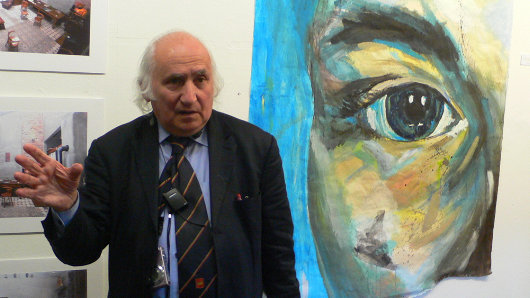
ONE OF THE markedly few deficiencies of the English language is coming up with a word to describe Richard Demarco. The Scottish press have generally settled upon “impresario” but even that somewhat-ambiguous word fails to do the man justice. Ricky was born in Edinburgh in 1930, grew up in Portobello, and remembers the day when his mother held him back from school because Italy — from whence he stock came — had just declared war on Great Britain. He’s attended every Edinburgh Festival since the very first one began in 1947 — as the founders put it, to “provide a platform for the flowering of the human spirit” in the grim aftermath of the Second World War.
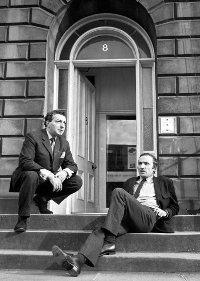 Richard Demarco, couchant, with noted Scots caricaturist Emilio Coia.
In 1963, he cofounded the Traverse Theatre, Scotland’s theatre for new writing, and three years after that founded the Richard Demarco Gallery which promoted Scotland’s cultural interchange with artists across Europe including — very importantly to Richard — from behind the Iron Curtain that divided the continent into free and captive halves. This was during an age when many in the arts world were too busy sympathizing with the murderous totalitarianism that had subjugated half of Europe. Richard has been a deep critic of the choices made by the British government as patron of the arts throughout the decades of his life, but not too long ago he finally patched things up with the Scottish Arts Council.
Readers of Alexander McCall Smith’s 44 Scotland Street might recall the man who comes to speak to the Scottish Police College. The “really important person from the art world in Edinburgh”, as Mr. McCall Smith puts it, comes and tells the trainee constables about the gorgeousness of Italian carabinieri uniforms and how the Scottish psyche still suffers from the iconoclasm of the Reformation, and even suggests architectural alterations and more sympathetic decoration of the Police College. “We didn’t know quite how to take this, but we sat there entranced,” the character admits in 44 Scotland Street. Anyone who either knows Ricky or has been to one of his lectures would immediately recognize the unnamed subject of the passage.
I first met the man when I was a first-year student at St Andrews and he had come up from the capital to give a lecture. I can’t remember what the stated subject was but this is entirely irrelevant as so vast and wide-ranging is the mind & experience of Richard Demarco that he is known for (some would say “notorious for”) never keeping within the bounds of the stated subject. Those who invite Richard to speak shouldn’t bother with a subject, just make posters stating “RICHARD DEMARCO SPEAKS”, giving the date, time, and place, and a crowd of interested characters is bound to turn up. (more…)
Diary
I have been spending the past few days in a flat at the corner of Holland Park Avenue and Portland Road, in this verdant corner of the capital. The flat is clean, capacious, and handsome, but terribly modern. Indeed, it is so modern that it will soon be old; it will not exhibit the old age of the time-honoured and true, but rather the tawdry oldness of what had only recently been new. Pedantic students of interior design will study photos of it and discern “2008 I’d say… no! 2009!” But for now, it is still new, still fresh, and so, like a tomato fresh for the plucking, we will enjoy it while its moment is precisely appropriate.
Until now, I hadn’t much knowledge of this part of London, but find it a happy place to be in August. The weather has been mild and kind, and I spent part of the afternoon reading de Maistre — the St. Petersburg Dialogues — in the formal garden in Holland Park. The avenue itself is tree-lined, or rather tree-engulfed, such is the plentiful shade, and has a small selection of cafés: the Paul boulangerie which is becoming omnipresent, and the Valerie patisserie, both chains. Cyrano, at No. 108 Holland Park Avenue, is much preferred, and I decamped there for a light breakfast with a copy of the Scotsman from the local newsstand (the one on Ladbroke Grove, rather than the smaller one by the tube stop) while avoiding the miserable Irish cleaning lady who returns the modern flat to its pristine whiteness every Thursday morning.
Then to the Royal Academy, for the Waterhouse show. What an interesting artist! His earlier works so precise in detail and, for lack of a better word, academic. Yet in his later pieces, you can find a certain willingness to obfuscate, perhaps an admission that reality is not quite so precise and that the most accurate portrayal of reality requires a few lines to be blurred. Faces, and indeed all forms, remain clear throughout, but the architectural coldness of the earlier works on display gradually evolves to a more fluid depiction of Greek mythos and Keatsian tales. Waterhouse can vary in his details from the almost photographic to verging on impressionism in a single painting. Was that his intention? It was certainly the result.
My viewing companion — an old university friend — and I agreed that throughout all the themes portrayed by the artist one can’t help but feel an overwhelming Victorian-ness. Is this ex post facto because we know Waterhouse to be an High Victorian artist, or is there actually some inherent quality in the works that calls to mind that era? Very difficult to say, but those in London should not miss this exhibition of a popular yet under-appreciated artist — the Jack Vettriano of his day.
Who is in London in August anyhow? The text messages sent out, and their replies promptly received. “I’m in Geneva! Will be in Luxembourg next week if you’re on the continent.” I am not and will not be on the continent. “I have been unexpectedly called to Africa.” Well I’ve just come from there, though not the Sudan thank God. “You’re welcome to come to Gozo between the 5th and 15th for a pleasant, quiet holiday.” I will have returned to New York by then, alas. “Am up north in Lancashire; you’re welcome to come and visit, sample our recusant history!” Just haven’t got the time, alas.
But while many have escaped for the month, many yet remain. An afternoon drink at Rafe’s, with Fr. Rupert and Alex Williams. The Carlton is being refitted, so it was drinks at the East India Club instead with another university friend, during which we concur that office jobs are the absolute pits and we should have studied agriculture with the country girls at Cirencester rather than getting tawdry MAs in Scotland. There is no greater affirmation of the consequences of original sin than the omnipresence of the 9-to-5 office job.
Astute observers of this little corner of the web (if indeed we can use the plural for such a subset of the earth’s population) will recall an incident over two years ago now in which a certain Jack Russell terrier became rather more involved with my lower leg than I had envisioned was ideal. The dog, which goes by the name of Cicio Stinkiman, had noticed me playing with the only seeing-eye-dog in Scotland that knows how to genuflect and resented the attention I was paying to the bitch, to whom he obviously professed some attachment, ran up, and bit me in the calf.
You can imagine my surprise when I learnt that the beast in question is actually now not only living in London but actually residing in the Oratory. Indeed I saw the beast from a distance while waiting on Brompton Road for the Friday evening mass last week. His owner graduated from university (in Scotland, like all the wisest people) two years ago now but his mother banned poor Cicio Stinkiman from the German palace he might otherwise call home, perhaps informed along the voluptuous grapevines of Europe of the horrendous incident in which the beast had taken an unwelcome interest in my lower leg.
I am being far too unfair to poor Cicio, for he did apologise, and looked up at me with terribly apologetic eyes. Admittedly, that might’ve been because his master stood nearby holding a rolled-up copy of the Catholic Herald most threateningly. Still, pity the poor ignorant beasts. They have no conscience, and thus no real malice. Only we humans, with the freedom we abuse so easily, can claim that dubious achievement.
Austin Reed
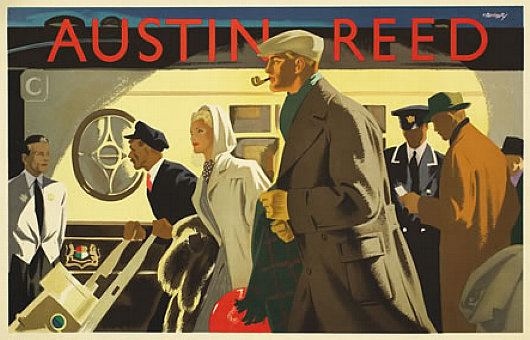
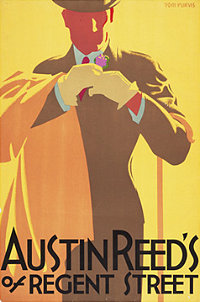 The London mens’ clothier Austin Reed was founded in 1900 and set up shop in Regent Street in 1926 as the first men’s department store. The clothes were aimed at the upper middle class male, and the firm commissioned some of the best illustrator-designers of the day to promote its brand. The above poster, “Wagon-Lits”, is by a designer named Bomarry, about whom I can find absolutely nothing — surprising in this Age of Google.
The remaining posters presented here are from the Bristol-born Tom Purvis, one of the finest commercial artists of the twentieth century. Purvis came from an artistic family, being the son of the sailor & nautical artist T. G. Purvis. Much of his output was work for LNER — the London & North Eastern Railway — producing posters advertising the various attractions to be found along the LNER’s routes from London to Edinburgh (via York & Newcastle) and on to Aberdeen and Inverness; the railway also had an extensive coverage of East Anglia. In 1936 he was among the first to be given the title of Royal Designer for Industry, but he gave up poster design after the Second World War to concentrate on portraits and religious themes. (more…)
Cropsey in the City
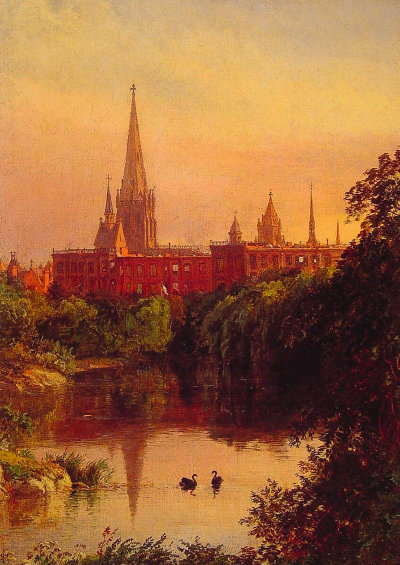
Jasper Francis Cropsey, A View in Central Park — The Spire of Dr. Hall’s Church in the Distance
Oil on canvas, 17⅛ in. x 12⅛ in.
1880, Private collection
THE HUDSON RIVER SCHOOL artist Jasper Francis Cropsey has obtained of late an almost cult-like following, the kool-aid being distributed from the well-oiled machinery of the Newington-Cropsey Foundation in Hastings-on-Hudson, New York. Whether the object of worship is worthy of the faithful’s adulation is a matter of some speculation, but it’s admittedly refreshing to see a fan base surrounding a painter of the old school rather than one of the numerous gimmicky hacks floating around the New York art scene these days. Cropsey (like most Hudson River painters) is known for his luscious landscapes, so I thought it markedly unusual when I stumbled upon this painting, a cityscape. The artist’s vantage point is from The Pond in Central Park, looking over Fifty-ninth Street (Central Park South) towards where the old Plaza Hotel now stands. (more…)
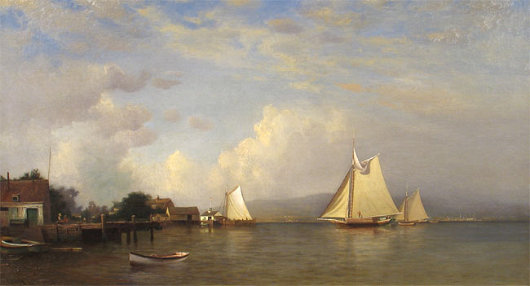
The Tappan Zee in the Age of Rig & Sail
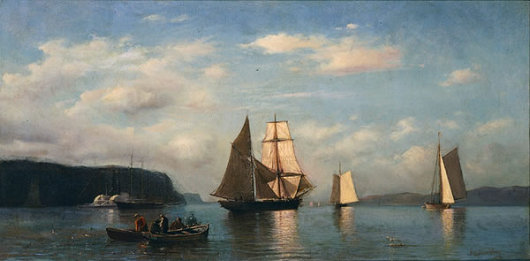
Julian Oliver Davidson, The Hudson River from the Tappan Zee
Oil on canvas, (size not on record)
1871, Private collection
Francis Augustus Silva, On the Hudson near Tappan Zee
Oil on canvas, 20 in. x 36 in.
1880, Private collection
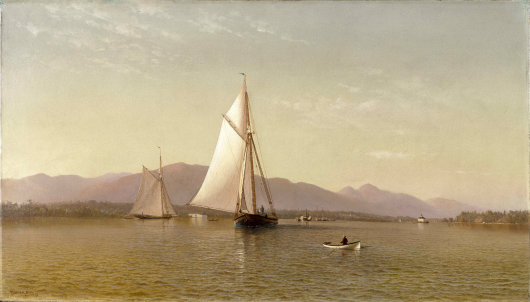
Francis Augustus Silva, The Hudson at the Tappan Zee
Oil on canvas, 24 in. x 42 3/16 in.
1876, Brooklyn Museum
Allies Day, May 1917
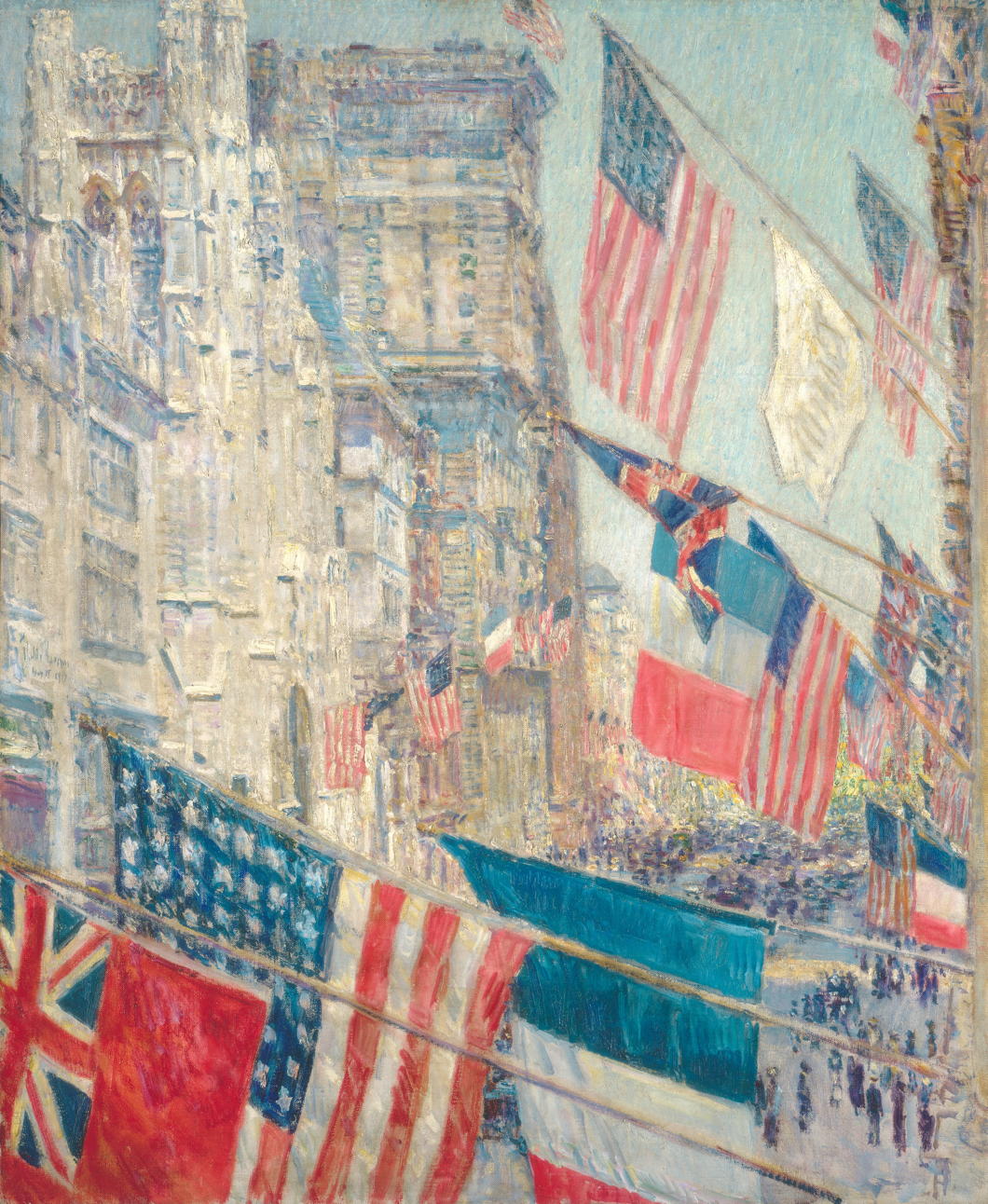
Childe Hassam, Allies Day, May 1917
Oil on canvas, 36½ in. x 30¼ in.
1917, National Gallery of Art (U.S.)
This has long been one of my favourite paintings, ever since I first saw it one day when I was very young while it was on loan to the Metropolitan. On a May day in 1917, Fifth Avenue was temporarily proclaimed “the Avenue of the Allies” and the British and French commissioners paraded down the boulevard with great ceremony. Childe Hassam set his easel on a balcony on the corner of Fifth Avenue and 52nd Street and took in the splendid scene towards the Church of St. Thomas and the University Club. Patriotic displays were much more lively then, involving bursts of flags and banners, than the rather dull and monotonous display of the single Stars-and-Stripes that became widespread after the World Trade Center attacks.
Interestingly, “Avenue of the Allies” aside, the United States was not actually allied to France and Great Britain during the First World War. President Wilson thought the United States was not so lowly as to merely intervene in a biased manner on the side of those it had lent money, but rather for the high-minded goal of establishing justice (or, as we might honestly call it, the destruction of Catholic Europe). The U.S., then, was merely a “co-belligerent” rather than an “ally”, though obviously this high-minded euphemism was lost on most people. During the Second World War, Finland found itself invaded by the Soviet Union and abandoned by the West, so — having no taste for Hitler and his Nazi charades — they became “co-belligerents” with Germany, rather than concluding a more distasteful alliance.
Hassam, who died in 1935, had little time for the avant-garde schools of art that came after the Impressionism he practised, and described modernist painters, critics, and art dealers as a cabal of “art boobys”. He was almost forgotten in the decades after his death, but the rising tide of interest in Impressionism from the 1970s onwards lifted even the boats of American Impressionists, and his Flags series of paintings are widely-known and much-loved today.
De Volkskrant
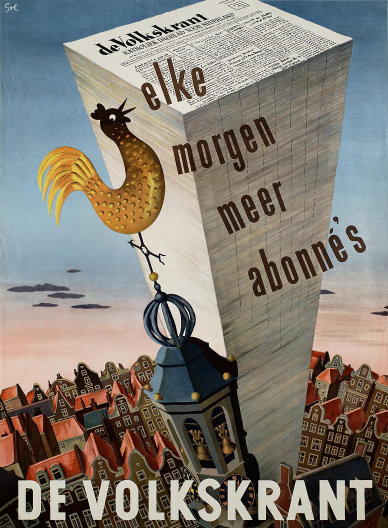
A FAVOURITE POSTER of mine combines a number of the things I love: newspapers, architecture, and the Netherlands. Arthur Goldsteen designed this handsome poster to advertise the daily newspaper De Volkskrant in 1950.
Paris Arts & American Arms
Maj. T. L. Johnson’s Cartographic Mural on Governors Island
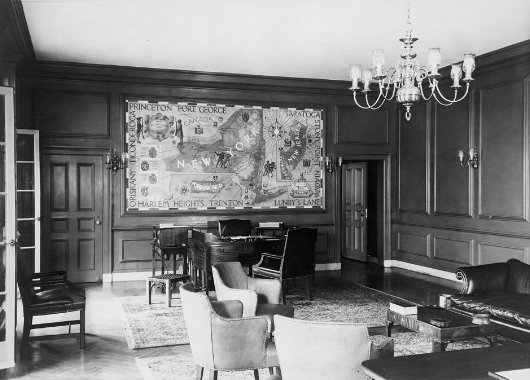
One of the best aspects of the inter-war construction of Governors Island is that the refinement of McKim Mead & White’s architecture is matched inside by a series of interior murals painted under the auspices of the WPA. These murals often veered towards the refreshingly jocular, as can be seen in the War of 1812 mural in Pershing Hall (a corner of which is captured here by photographer Andrew Moore). The mural by Major Tom Loftin Johnson (educated at the Ecole des Beaux-Arts in Paris) depicted here, however, is a map of the area under the purview of the Second Corps, U.S. Army headquartered at Governors Island; namely the states of New York, New Jersey, and Delaware, and the then-territory of Puerto Rico.
A new bookplate for the NYG&B
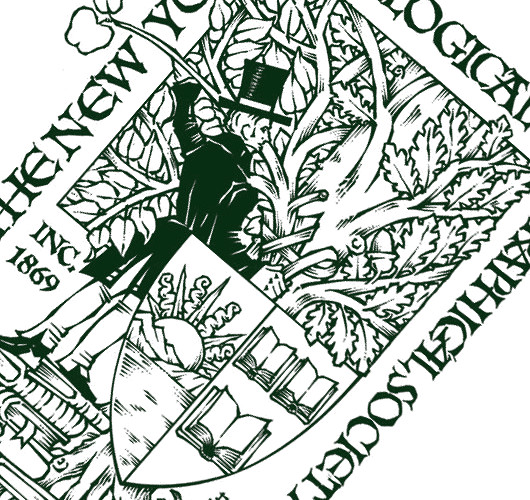
Fr. Guy Selvester reports on his resurrected Shouts in the Piazza blog that the great Marco Foppoli has designed a new bookplate for the New York Genealogical & Biographical Society. Mr. Foppoli is the most highly-regarded heraldic artist of our day, and the influence of the style of his mentor, the late Archbishop Bruno Heim, is apparent in his work.
Search
Instagram: @andcusack
Click here for my Instagram photos.Most Recent Posts
- Brunel’s Unbuilt Capitol February 3, 2026
- Cricket at Fordham January 27, 2026
- Palacio Barolo Revisted January 14, 2026
- Learning to Love Liguria January 14, 2026
- Crux Alba No. 2 January 13, 2026
Most Recent Comments
Book Wishlist
Monthly Archives
Categories