Art
About Andrew Cusack
 Writer, web designer, etc.; born in New York; educated in Argentina, Scotland, and South Africa; now based in London.
 read more
News
Blogs
Reviews & Periodicals
Arts & Design
World
France
Mitteleuropa
Knickerbockers
Argentina
The Levant
Africa
Cape of Good Hope
Netherlands
Scandinavia
Québec
India
Muscovy
Germany
Academica
Mauritz de Haas
Stormcloud and moonlight — these were the preferred settings of the marine paintings of Mauritz Frederik Hendrik de Haas.
Born in Rotterdam in 1832, he studied at the academy there as well as in the Hague under Bosboom and Meijer.
At the age of twenty-five, de Haas accepted an artist’s commission in the Dutch Royal Navy, carrying on for two years until the Rhenish-Sephardic financier August Belmont (a former American ambassador to the Netherlands) persuaded him to come to America in 1859.
By 1867 de Haas was an academician of the National Academy and a founding member of the American Society of Painters in Water Colors.
His brother, Willem Frederik de Haas, was also a marine painter, but Mauritz’s scenes are much more atmospheric — especially as one moves from day through dusk and into the light of the moon.
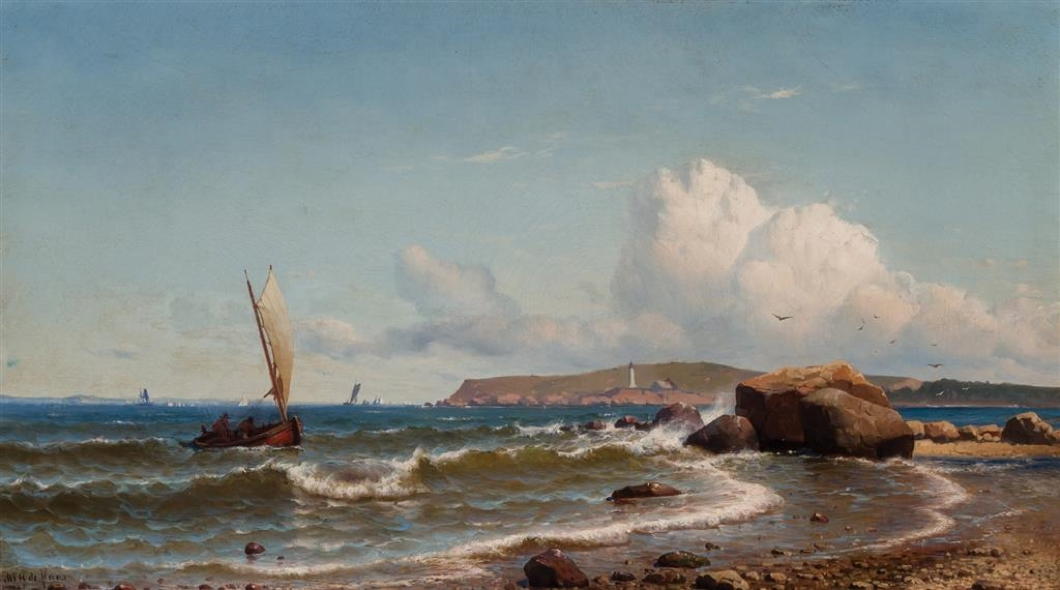
oil on canvas, 17 in. x 30 in.
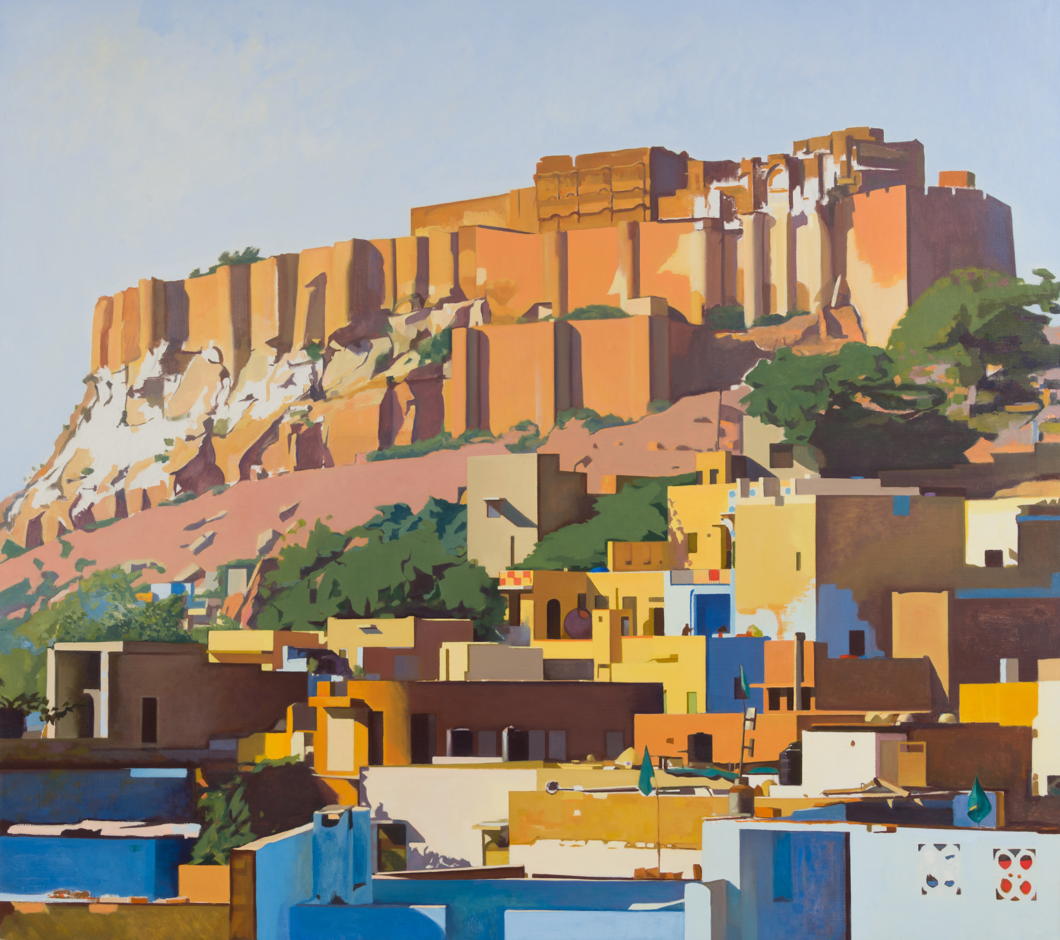
Doom in Bloom
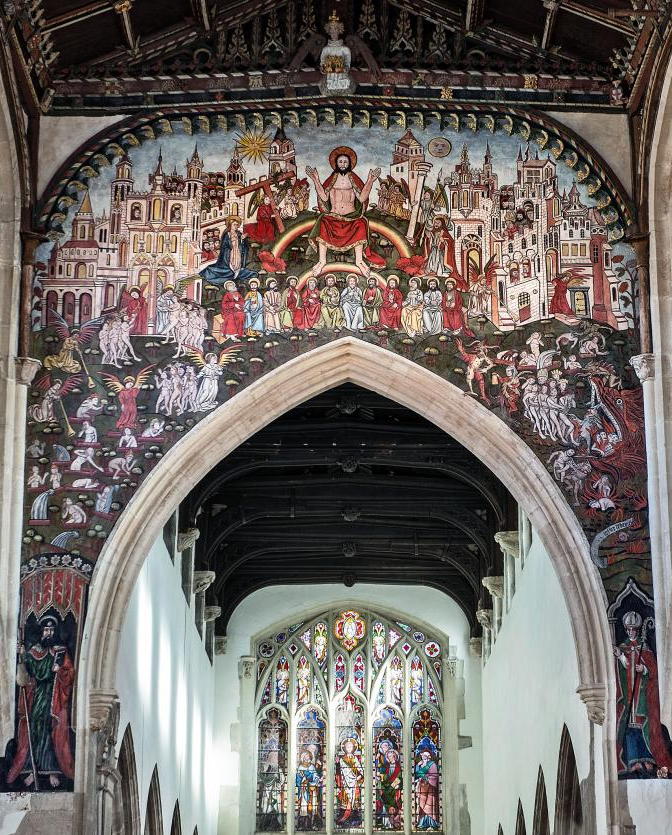
Such paintings were widespread in Catholic England where they served as a vital reminder to the faithful worshipping below of not just the torments of Hell but also the joys of Heaven. In the aftermath of the Protestant revolt, however, such vivid imagery was frowned upon, and the Salisbury Doom was painted over with limewash in 1593. Christ in Majesty was replaced by the royal arms of the usurper queen, Elizabeth I.
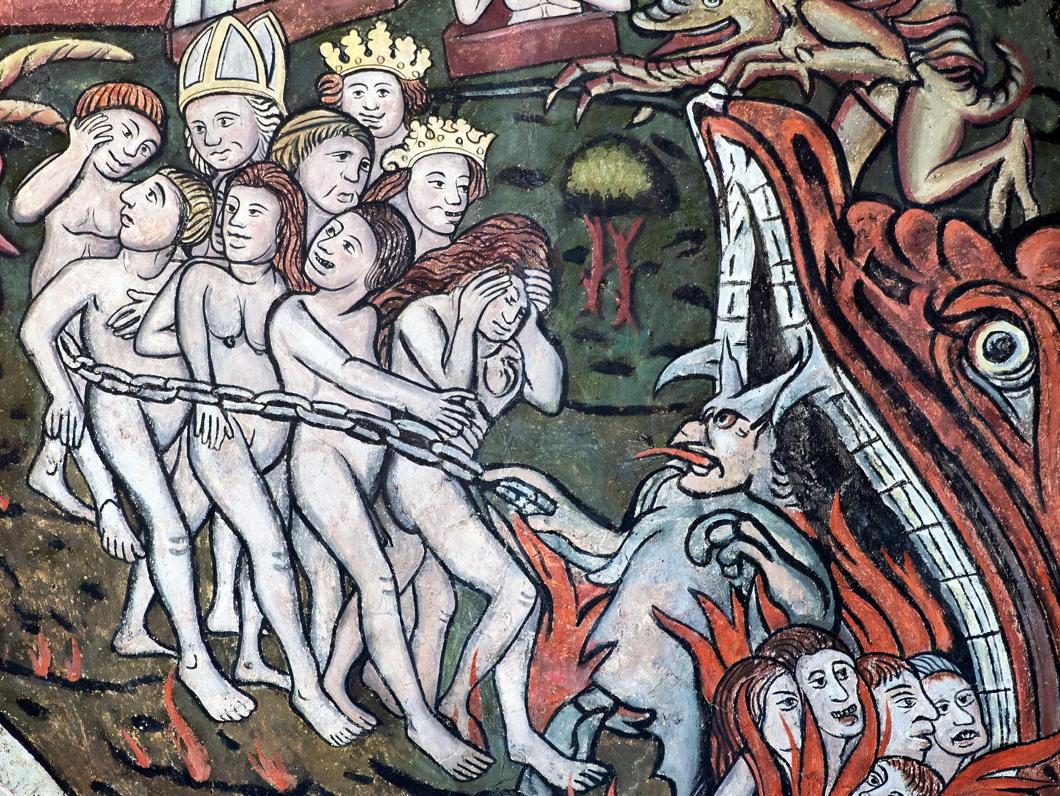
It was then forgotten about til its rediscovery in 1819 when hints of colour were discovered behind the royal arms. The limewash was removed, the remnants of the painting were revealed, recorded by a local artist, and then covered over yet again in white. Finally in 1881 the Doom was revealed to the world and subject to a Victorian attempt at restoration with mixed results.
Work on the church’s ceiling in the 1990s allowed experts to better examine the Doom which determined that, while there was a bit of fading, dirt was hanging loosely to the painting and it would be ripe for restoration. It has only been more recently, however, that money has been raised to restore the Doom.
There are other glories in this church yet to be restored, about which more information can be found on the parish’s website.
.jpg)
The Salisbury Doom before restoration (above) and after (below).
Lady Day
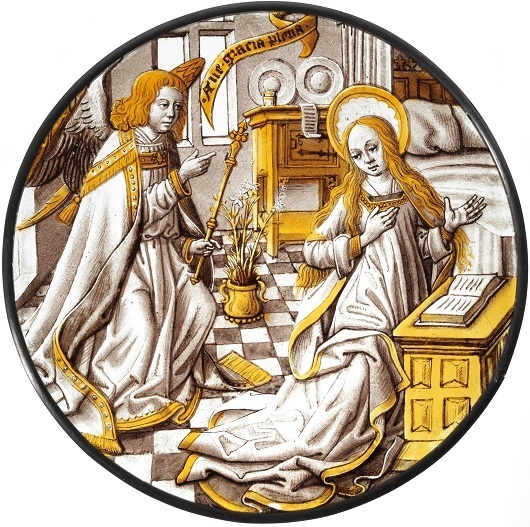
Today is Lady Day, the Feast of the Annunciation when the Archangel Gabriel appeared to the Blessed Virgin Mary and announced that she would conceive and bear the child Jesus.
The angelic salutation – “Hail Mary, full of grace, the Lord is with thee… Blessed art thou amongst women, and blessed is the fruit of thy womb, Jesus” – forms the basis of the Ave Maria, one of the most widely uttered prayers in Christendom.
Traditionally this has been one of the greatest of devotions to the Virgin amongst the English, which is why there are so many pubs across England named ‘The Salutation’.
For centuries in England and Scotland (as well as elsewhere), Lady Day was the first day of the calendar year. Scotland moved this to 1 January in 1600 and England did likewise in 1750.
Nonetheless, the English tax year is still based on this date as it commences on 6 April, which is the Annunciation plus twelve days to mark the difference between the old Julian calendar and the modern Gregorian one.
In the realms of fiction, 25 March is the day Tolkien chose for when Frodo destroyed the Ring in Mount Doom, securing the fall of Sauron – with obvious parallels to Christ’s Incarnation securing the defeat of Satan.
This stained glass roundel above is not English, however, but from the Southern Netherlands around 1500-1510.
Elsewhere, A Clerk of Oxford has a good section on the Annunciation.
Sir John Soane
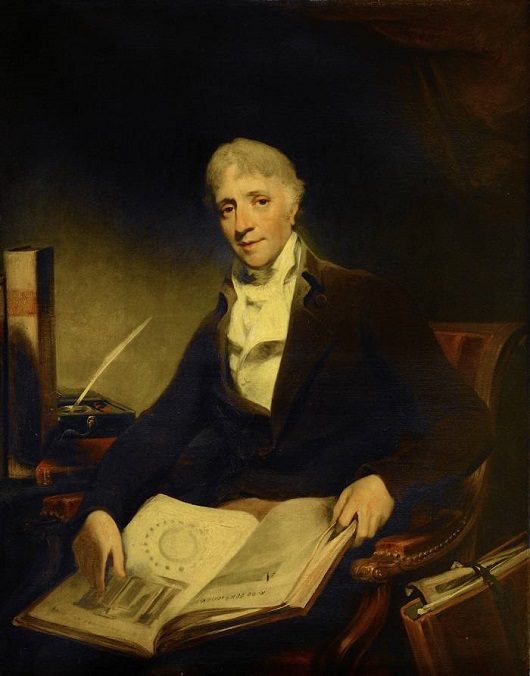
Sir John Soane still looms over the intervening centuries of architecture and design in Great Britain, but I’ve never actually known what he looked like. Apparently this is him, in an 1804 portrait by William Owen.
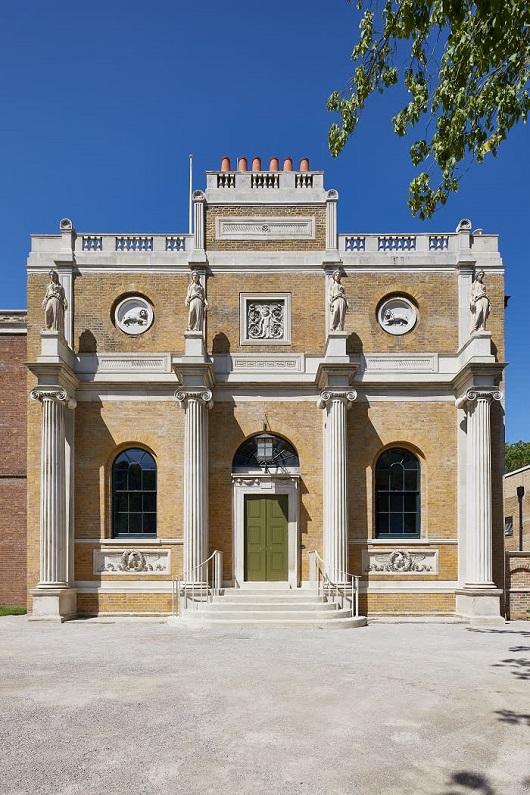
Everyone’s been to his house in Lincoln’s Inn Fields, but Pitzhanger Manor, his place in the country (though Ealing hardly seems rural today) was recently reopened after serious conservation works ongoing since 2015.
Hope to pay it a visit soon.
Secret Splendor
by Andrew Cusack (Weekly Standard, 13 September 2010)
Paintings for the Catholic Church in the Dutch Republic
by Xander van Eck
Waanders, 368 pp., $100
This book is the first major overview and exploration of the art of the clandestine Roman Catholic churches in the Netherlands. It is not a study of paintings so much as a history in which art is like the evidence in a detective story, or perhaps even the characters in a play. It might seem extraordinary that there was a place for large-scale Catholic art during the Dutch Republic: Pre-Reformation churches had been confiscated and were being used for Calvinist services, while priests offered the Mass secretly in makeshift accommodations. Eventually a bargain between Dutch Catholics and the civil authorities emerged, trading Catholic nonprovocation in exchange for private toleration of the practice of the faith. Catholics began to purchase properties which, for all outward appearances, maintained the look of ordinary residences but whose interiors were transformed into resplendent chapels and churches.
Xander van Eck provides verbal portraits (often accompanied by contemporaneous painted ones) of several of the important clerics of the Dutch church during this period: Sasbout Vosmeer, the Delft priest influenced by St. Charles Borromeo; Philippus Rovenus, the vicar-apostolic who placed greater emphasis on clandestine parishes having specially dedicated churches, even while they kept an outward unecclesiastical appearance; and Leonardus Marius, the priest who promoted devotion to the 14th-century Eucharistic “Miracle of Amsterdam.” Marius was of such prominence that, after his death, shopkeepers rented out places on their awnings for punters to view his funeral procession. Van Eck includes a handful of amusing asides, such as the expulsion of the Jesuits from the Netherlands as a result of their constant discord with the secular clergy. Mass continued to be offered at the Jesuit church of De Krijtberg in Amsterdam “in the profoundest secrecy” — thus creating a clandestine church within a clandestine church!
The role of the clergy in sustaining the Dutch Church is unsurprising, but it is instructive to learn how instrumental laity were to keeping alive the light of Catholic faith in the Netherlands at the time. Clandestine churches relied on the generosity of Catholic families. Prominent families often provided their own kin as consecrated virgins who brought large dowries into the church, or as priests with suitable inheritances to maintain or endow clandestine parishes. The clandestine church of ’t Hart in Amsterdam, built by the merchant Jan Hartman for his son studying for the priesthood, is still open today as the Amstelkring Museum and Chapel of “Our Lord in the Attic.”
While van Eck explores the extent to which Dutch art from the period followed European norms, an emphasis on the particularity of the art of the clandestine church is to be expected. The sheer volume of art produced during this period — for just three Amsterdam churches alone there were 16 altarpieces — is partly explained by the phenomenon of “rotating altarpieces.” The paintings above the altar would be changed according to the feast or season — a practice sometimes seen in Flanders or parts of Germany but never nearly so widespread as in the Netherlands proper.
Constrained as clandestine churches were on the narrow plots typical of Dutch cities, there was no room for side chapels that might include the large funerary monuments prominent families would construct. This left altarpieces as the most convenient way for munificent Catholics to provide art for their churches: Rotating the altarpieces provided a handy way of displaying numerous commissions rather than just the donation of whoever had been generous most recently, and the themes of these commissions tended to vary in appropriateness to different feasts and seasons.
Some found fault with this method: Jean-Baptiste Descamps, visiting Antwerp in 1769, complained that the most interesting altarpieces were not permanently displayed and were more likely to be damaged in the process of being moved so often.
While the accomplishment and ingenuity of Dutch Catholics in keeping their faith during the Republic was striking, the ill-defined administrative structure of the persecuted church allowed conflicts between clerics to thrive, and doctrinal disputes emerged and festered. The disputes over Jansenism that swept over France and the Netherlands, for example, only exacerbated the administrative problems of the clandestine church. Like their Calvinist compatriots, the Jansenists tended to frown on indulgences, the veneration of saints, recital of the rosary, and private acts of worship, putting greater emphasis on the Scriptures and a more rigorous asceticism. As van Eck points out, this difference in emphasis was not exclusive to the Jansenists, but their novelty (and their heresy) was in preaching the exclusivity of their approach above all others.
Numerous vicars-apostolic had written to Rome arguing for the re-establishment of the episcopacy in the Netherlands to solve the disputes over authority, but their appeals fell on deaf ears. In 1723 a large portion of the Jansenist clergy reinstituted the episcopacy by electing an archbishop of Utrecht from their number — and were subsequently excommunicated, splitting the clandestine church and its clergy in two. (This excommunicated rump united with the opponents of papal infallibility in the following century to form a body that still calls itself the Old Catholic Church.)
When one looks at all this glorious art, not to mention the lives and pious ingenuity of the persecuted, it’s difficult not to feel a little poorer, considering the fruits of our churches in an ostensibly free era. Why does the church today commission painters who are either mediocre or trendy — or both? Artists like Hans Laagland and Leonard Porter show that good art — good liturgical art, even — is possible today, but commissions from the church for traditional artists are sadly few.
Marian Chashuble
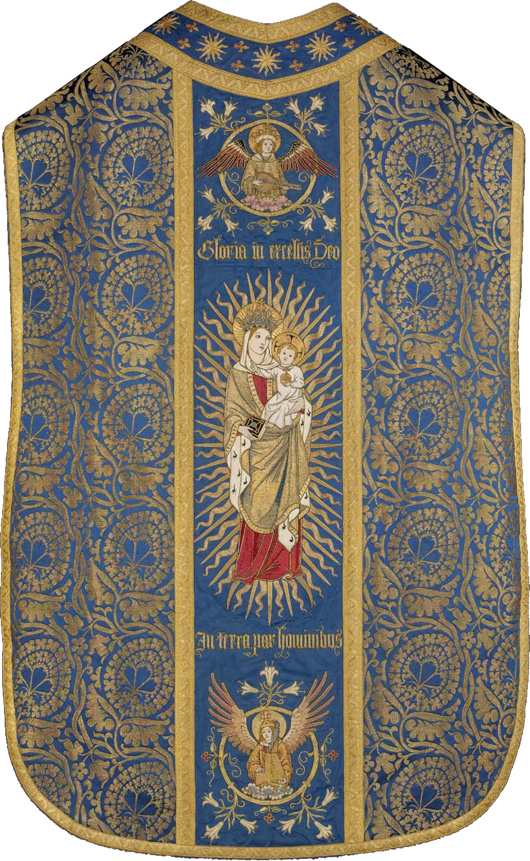
Now in the collection of the Museum of Fine Arts in Boston, it was embroidered by the Sisters of Bethany, a Protestant order of nuns based in Clerkenwell. The Sisters specialised in church vestments and embroidery, and this object is believed to have been produced between 1909 and 1912.
Fr Anthony Symondson SJ has written in greater depth about Comper and the Sisters of Bethany here.
Albert Power & Arthur Griffith
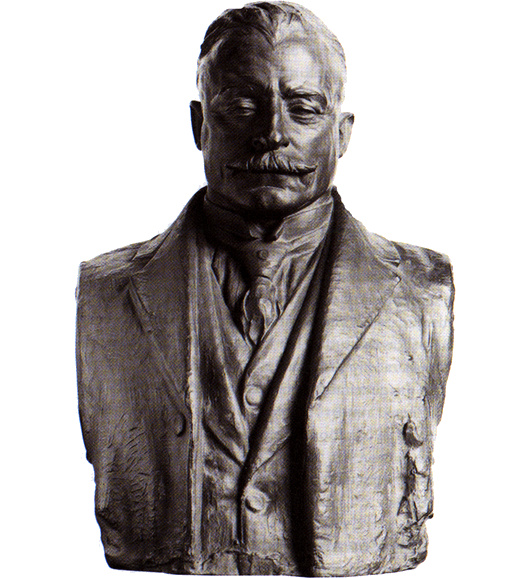
These days the Irish sculptor Albert Power is very rarely spoken of, and I can’t claim to know much about this bronze bust he did of the founder of the original Sinn Féin, Arthur Griffith.
It might be in the National Gallery in Dublin, though I didn’t notice it when I nipped in there with my sister the other day. More likely it is in Leinster House, where there are other busts of prominent figures of 1916-1921 by Albert Power and the better-known Oliver Sheppard.
Unlike Sheppard, Power was a Catholic, which is probably why he was chosen to sculpt the funerary monument of Archbishop Walsh of Dublin who died in 1921. He submitted designs for the new Irish coinage but the Free State wisely chose the far superior set designed by the English sculptor Percy Metcalfe.
As for the subject of this work of art, the Royal Irish Academy’s Dictionary of Irish Biography describes Griffith as “a lucid writer with a vivid turn of phrase”.
The first newspaper he edited was in South Africa where he took the helm of the Middelburg Courant in 1897, attempting to persuade the English-speaking readers with his Boer-friendly views. “I eventually managed to kill the paper,” Griffith wrote, “as the British withdrew their support, and the Dutchmen didn’t bother reading a journal printed in English – the Dutch were quite right.”
Griffith founded Sinn Féin more as a pressure group to support his pet project of reviving the “King, Lords, and Commons” of Ireland, influenced by the Austro-Hungarian Ausgleich of 1867. Independence, he argued, would satisfy the nationalists, while the shared monarchy would keep the unionists happy. In the event, neither half were much enthused by the prospect.
In the aftermath of 1916, Griffith came into his own as a leader and statesman rather than an agitating journalist. His role in the War of Independence and the Treaty negotiations is well known. Without his persuasive arguments in debates, it is highly unlikely the Dáil would have approved the Treaty.
Gloomy civil war soon overshadowed everything, but Griffith died of a cerebral haemorrhage on 12 August 1922 – just ten days before Collins was killed in ambush at Béal na Bláth.
Lionel Smit
Suid-Afrikaanse portretskilder
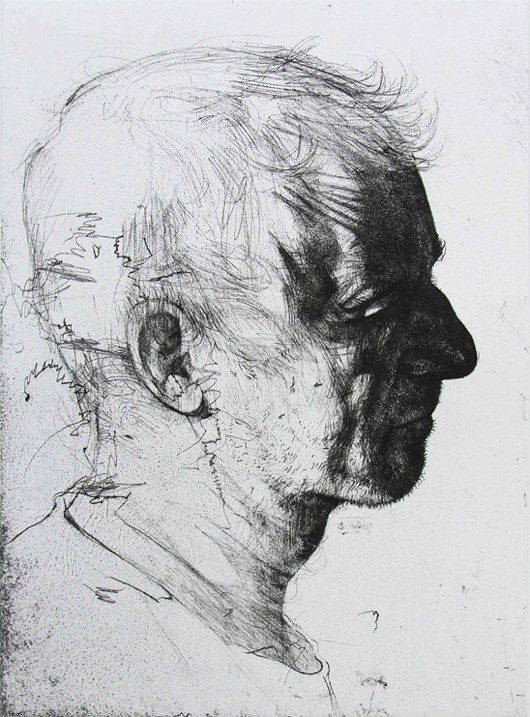
Een van die mees geskoolde portretskilders vandag is die Pretoriaanse kunstenaar Lionel Smit (geb. 1982).
’n Skilder en beeldhouer, Mnr Smit woon en werk in Kaapstad en is die wenner van ’n ministeriële toekenning vir bydrae tot visuele kuns van die Wes-Kaapse regering. Sy werk is reeds ingesluit in die visuele kunste eksamen vir die Nasionale Senior Sertifikaat. Nie sleg vir ’n kêrel in sy dertigerjare!
Smit se skilderye herriner my aan die werk van die Engelse skilder Catherine Goodman. Hier is net sommige van sy portrette.
Physical Energy
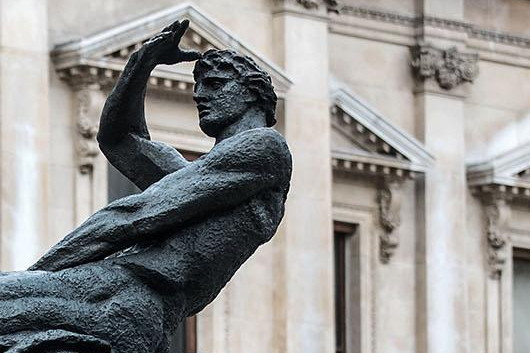
I came across it by surprise one day, walking through the park. It was almost eerie — all the more so for being unexpected. George Frederic Watts’s sculpture “Physical Energy” was well known to me when I lived in South Africa as it graces the Rhodes Memorial in Cape Town — a rough Greek temple staring out northwards into the vast continent of Africa, as Rhodes himself liked to do.
Unknown to me, another cast of the statue was made and given to the British government, which placed it in Kensington Gardens. It was this copy I stumbled upon while traversing the park to Lily H’s drinks party in the garden of Leinster Square.
It is one of the most aptly named sculptures I can think of, as there is a raw brutish physicality to it, and somehow a sense of tremendous force, power, and energy. Watts was primarily a painter, so that he achieved this great work of sculpture is all the more remarkable. I don’t actually like it: there is something uncomforting and almost vulgar about it, or perhaps just taboo. (Like Rhodes himself.) But it is amazing all the same.
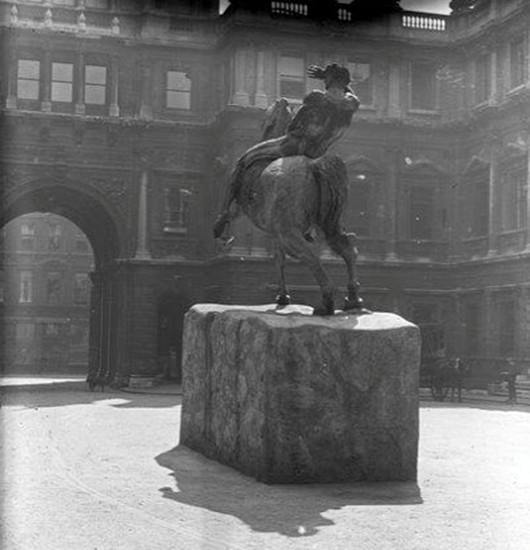
While “Physical Energy” is primarily associated with Cecil Rhodes it was not commissioned in his honour. Watts conceived it in 1886 after having done an equestrian statue for the Duke of Westminster. The first cast wasn’t made until 1902 and was exhibited at the Royal Academy for the first time in 1904 (above).
From there it made its way to Cape Town where it stands today a vital component of the monument to Rhodes. (It even features as the crest on Rhodes University’s coat of arms.) The second cast from 1907 is this one that sits in Kensington Gardens, while a third cast from 1959 now sits beside the National Archives of Zimbabwe in Harare.
This year the Watts Gallery in Surrey commissioned a fourth cast to commemorate the two-hundredth anniversary of the artist’s birth — and that cast now flaunts its bronze in the courtyard of the Royal Academy. It remains on view until the Cusackian birthday in March 2018.
Gallen-Kallela at the National Gallery
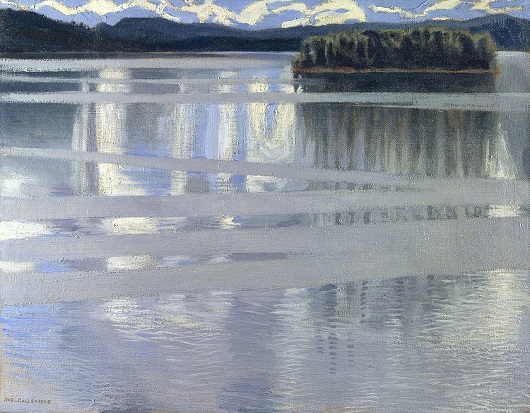
From November 15 until February of next year, the National Gallery here in London will mark the centenary of Finnish independence with a showing of the works of Akseli Gallen-Kallela. The Finnish painter is best known for his depictions of the Kalevala, the national epic compiled by Lönnrot and an influence on Tolkien.
The National Gallery, however, has focused on bringing together all four versions of Gallen-Kallela’s painting of Lake Keitele (alongside similar works by the artist). As a Swedish-speaking Finn, he signed the painting with his original Swedish name, Axel Waldemar Gallén, which he later Finnicised in 1907.
During Finland’s Civil War, Gallen-Kallela and his son Jorma both took up arms on the side of the Whites, who defended the country from the Soviet-backed Reds. The artist (below) served as adjutant to the regent of the kingdom, Gen Mannerheim, who asked him to design the flag, uniforms, and decorations of the new state. His student Eric O. Ehrström designed a crown for the kingdom, but eventually a republican form of government was decided upon and it wasn’t til the 1980s that a mock-up of the crown was actually crafted.
Having lived in Berlin and Kenya as well as having toured the United States, Gallen-Kallela’s influences were varied but he found the story and scenery of his homeland the most compelling of all. A fitting tribute to Finland in her hundredth year of statehood.
The Queen
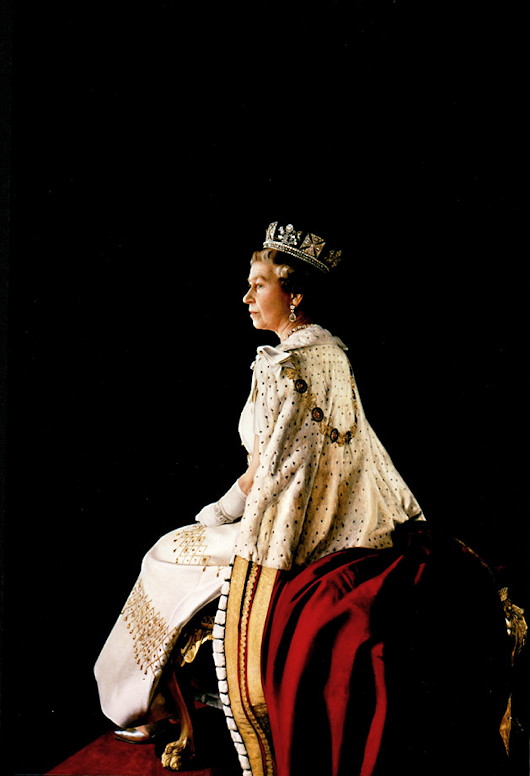
1992; Oil on canvas, 96 in. x 60 in.
Marinus Willett
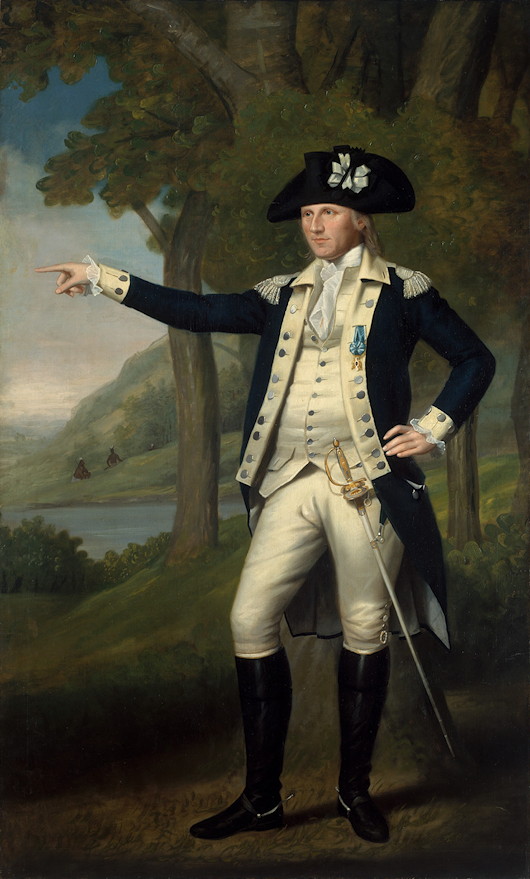
In one of the galleries of the Metropolitan Museum’s American wing, behind the Tuckahoe-marble façade of the old Assay Office (moved here from Wall Street), hangs this portrait of Col. Marinus Willett of the Continental Army’s 5th New York Regiment.
Born in 1740, the second of thirteen children, Willett attended King’s College before being commissioned a lieutenant in a New York provincial regiment during the Seven Years’ War (or French and Indian War as it’s known more locally). (more…)
The Death of God the Father
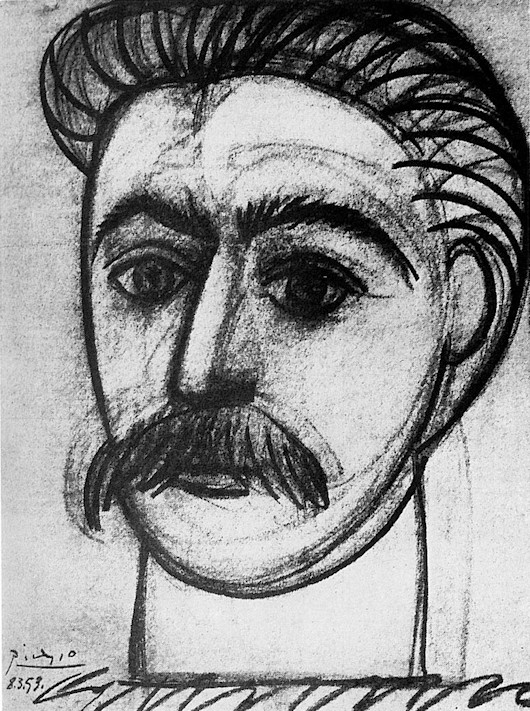
When Stalin’s death was announced on Friday, 7 March 1953, Aragon called in Pierre Daix and rattled off a shopping list of features to honour Stalin in a special issue of Les Lettres françaises. […] Since Picasso had always refused to do a portrait of Stalin from a photograph, Daix sent a telegram to him at Vallauris saying, ‘Do whatever you want,’ and signed it ‘Aragon’.
Picasso’s drawing of Stalin, which depicted him as a curiously open-eyed young man, arrived at the very moment Les Lettres françaises went to press. Daix took the picture to Aragon. He admired it and said that the party would appreciate the gesture. While it was being set into the front page, office boys and typists crowded round the picture. Everyone thought it ‘worthy of Stalin’.
Daix was overjoyed to be the one who had commissioned Picasso’s first portrait of the Soviet leader and rushed it down to the printers. But a few hours later, when the edition had been run off, the mood in the building had completely changed to one of fear. Journalists from L’Humanité, passing by, spotted the drawing and cried out that it was unthinkable that any Communist publication should consider such a representation of ‘le Grand Staline’.
Pierre Daix promptly rang Aragon at his apartment; Elsa Triolet answered. She told him angrily that he was mad to have even thought of asking Picasso for such a drawing.
‘But really, Elsa,’ Daix broke in, ‘Stalin isn’t God the Father!’
‘Yes, he is, Pierre. Nobody’s going to reflect much about what this drawing of Picasso signifies. He hasn’t even deformed Stalin’s face. He’s even respected it. But he has dared to touch it. He has actually dared, Pierre, don’t you understand?’ […]
Antony Beevor & Artemis Cooper (1994, London)
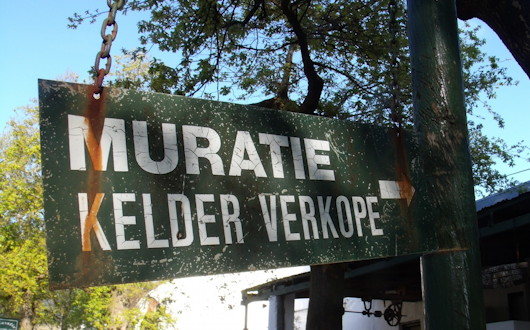
Muratie
The Stellenbosch estate of the artist Georg Paul Canitz
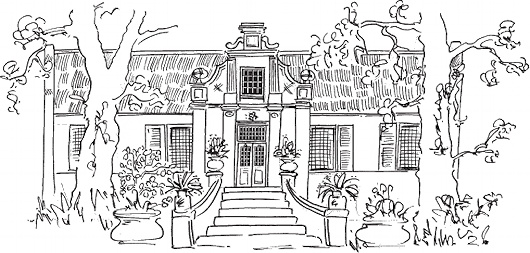
We had supper with Mr. Canitz, the painter, one Sunday night, by the light of candles in a fine Dutch candelabra, and drove back to Stellenbosch in moon light which had transformed the countryside into the most entrancing fairyland imaginable.
Great clumps of trees in unexpected places gave an eeriness to the white ribbon of road which stretched across the valley. The soft evening breeze of magic scents lulled us, and we drowsed to the hum of the car bearing us homeward.
That memory is still vivid to me so I shall turn from our Golden Road, and “…muse awhile, entoil’d in woofed phantasies.”
So the architect Rex Martienssen described a visit to Muratie, the home of the artist Georg Paul Canitz, in 1928. Canitz was a Saxon, born in Leipzig, where his parents had hoped he would pursue a military career. Both his zeal and talent as an artist appeared early on, and so he ended up at the Dresden Academy of Fine Arts. After further studies in Italy, Paris, and the Netherlands, a chest ailment drove him to the interior of Südwestafrika in 1907.
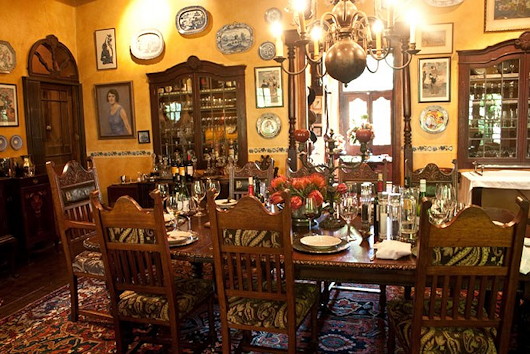
Canitz healed quickly in the dry air but could not find a cure for the striking beauty of the new world around him. His wife and children were summoned from Germany, and three years later he moved to Stellenbosch after falling in love with the “City of Oaks”.
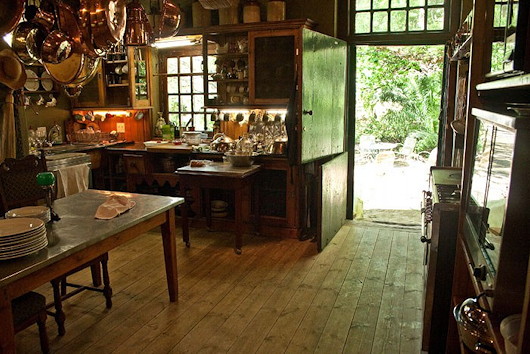
Canitz devoted himself to his passions: riding, painting, and teaching (both at his own art school and at the University). Riding to a party at Knorhoek one day he stumbled upon the little house and farm at Muratie and was quickly enamored of the place. It wasn’t long before he had purchased it and moved his family there.
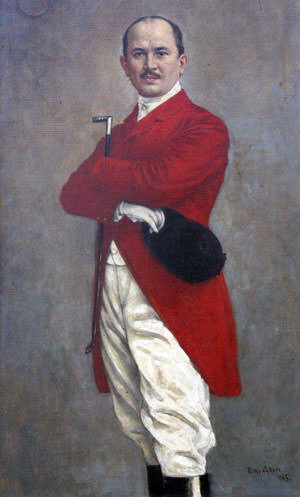
G P Canitz
At Muratie, the painter developed a further art: that of winemaking. In this he was assisted by the legendary Dr Perold — first chair of viticulture at Stellenbosch. Canitz became a pioneer of the pinot noir grapes which have since become a South African staple. Perhaps even more he developed the skills of a kind and generous host, for which he was well reputed throughout South Africa. He would welcome friends and guests — among them Martienssen and his architectural students as cited above — throughout the year. In warmer months they came for the swimming pool and the breezy stoep, while in winter a fire awaited, or perhaps a few rounds of strong drink in the Kneipzimmer.
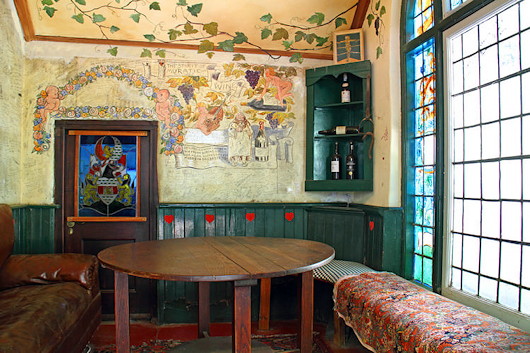
I like to think this was Canitz’s favourite room at Muratie: bedecked with benches, the light streaming in through a stained-glass windows, and the walls covered in naturalistic painting as well as graffitied signatures and sayings in German, Afrikaans, French, and Greek.
The painter died in 1958, leaving Muratie to his daughter, who in 1987 sold it to members of the Melck family who had owned it from 1763 to 1897. (The house was first built in 1685.) I suspect Canitz would have greatly appreciated his handiwork being passed back to those who had looked after the place for many generations before him. The Melcks, unsurprisingly, have a great reverance for the history of the estate. They even go so far as to leave the cobwebs which have accrued go undisturbed and ask visitors to do likewise.
And, even today, the wine still flows!

Master Mitsui’s Ink Garden
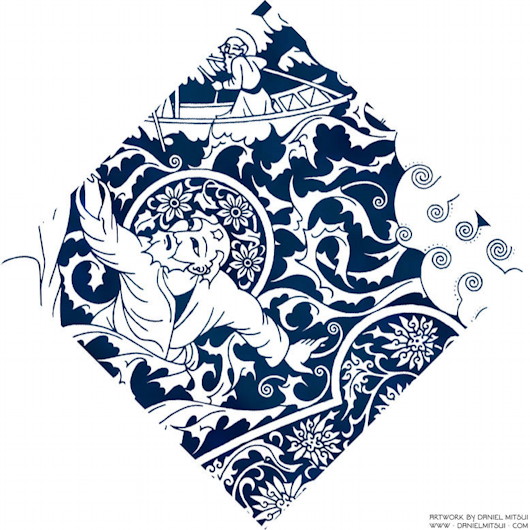
Daniel Mitsui is one of the most interesting artists out there, exhibiting a wide range of influences from the Celtic to the Oriental. Among his latest works is an ink drawing on a Catholic theme. As Daniel explains:
I received a commission to create a Catholic religious drawing in a Chinese style. These explorations into artistic traditions outside of European Christendom are always exciting, and China was new territory for me. When developing the concept for the project, I looked to one of the early missionaries to China, the Italian Jesuit Matteo Ricci.
Some time in the very early 17th century, Ricci gifted four European prints to the Chinese publisher Cheng Dayue: two engravings by Anthony Wierix from a series illustrating the Passion and Resurrection of Christ, another by the same artist reproducing the painting of the Virgin of Antigua in Seville Cathedral, and one by Crispin De Pas the Elder from a series illustrating the life of Lot.
Master Cheng copied these images into his Ink Garden, a model book of illustrations and calligraphy. The missionary saw this as a good opportunity to disseminate lessons in Christian doctrine and morality among the Chinese population.
Continue reading here.
Alles Sal Reg Kom
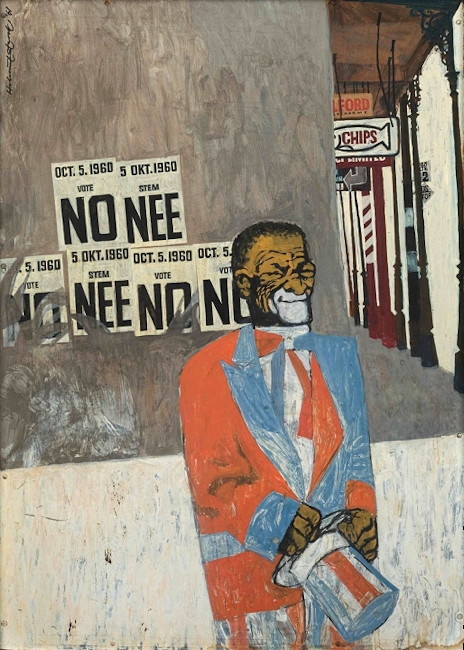
1961; Acrylic on board, 34.8 in. x 24.8 in.
A man festively attired in a Tweede Nuwejaar outfit in patriotic colours (orange, white, and blue) stands in front of a side wall in Cape Town bearing monarchist posters urging voters to vote ‘No’ in the 1960 republic referendum.
The painting’s title – Alles Sal Reg Kom – means “everything will be alright”.
Wednesday 27 January
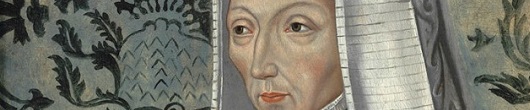
– Margaret Beaufort was one of the greatest women England ever produced, but her legacy has been plagued by misogyny combined with Protestant suspicion of her Catholic piety. Leanda de Lisle delves into the question of whether she was a hero or a villain.
– Speaking of powerful women, James Panero’s examines the monument to Joan of Arc on New York’s Riverside Drive. The artist was a female sculptor, Anna Hyatt Huntington, whose statue of El Cid in the forecourt of the Hispanic Society on Audubon Terrace is one of the finest sculptural arrangements in the New World.
– Lent is about to stare us in the face, but so far as I am concerned we are allowed to wallow in Christmas cheer until Candlemas comes on 2 February. Dr John C Rao (of St John’s University and the Roman Forum) offers us a reflection on the Christmas Crèche and its origins as Saint Francis’s giant “F.U.” to Cathar heretics, while putting the thinking behind that great saint’s actions in a modern context.
– It’s good to see neglected favourites receive a bit of unexpected attention. One such is the Irish writer George Russell, more often known by his pen name ‘Æ’. The Irish Ambassador to Great Britain, Dan Mulhall, begins a series on Irish writers and 1916 by looking at Æ in the context of the Rising.
One project that TCD or UCD – or anyone for that matter – needs to take on is digitising the entirety of The Irish Statesman, the journal mostly edited by Russell which presented a fascinating counterpoint to the more common narratives, first in 1919/20 and then from 1922 to 1930.
– And finally, some Goethe love from The New Yorker’s Adam Kirsch.
The Accession
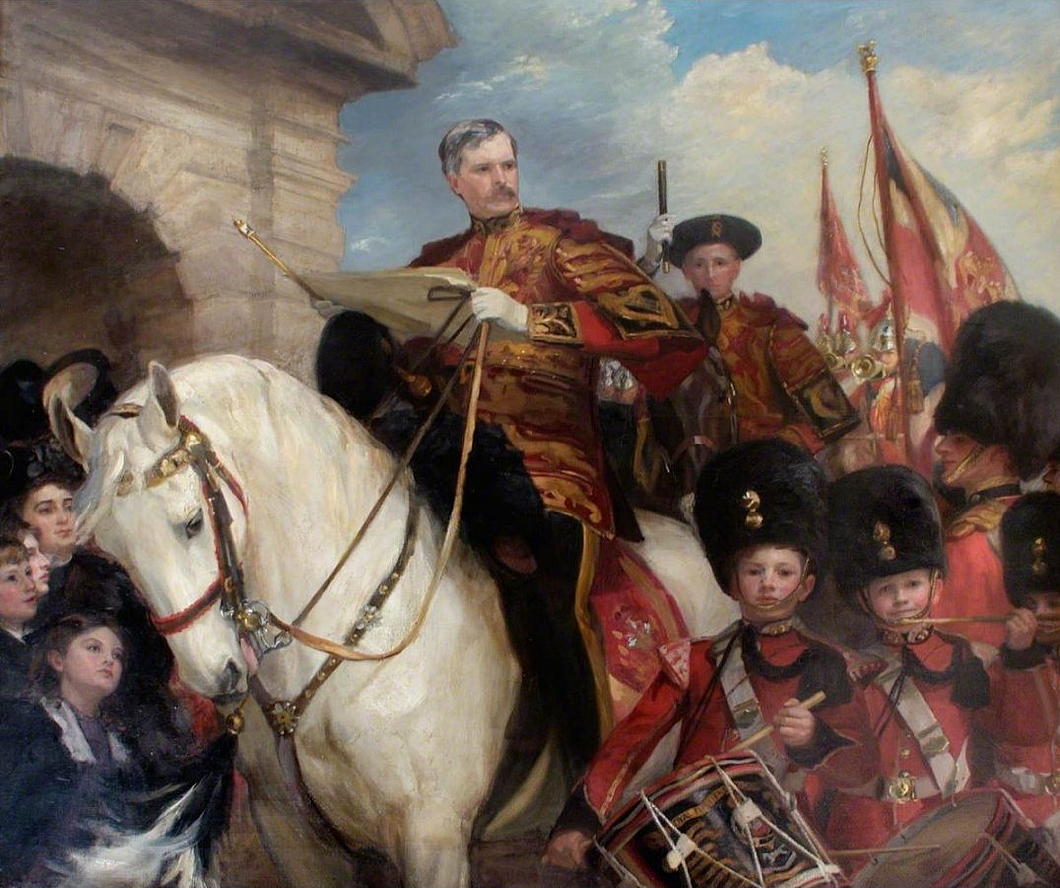
c. 1911; Oil on canvas, 68 in. x 76.9 in.
A triumphant painting, but a last hurrah. The central figure is Sir Nevile Wilkinson, the last ever Ulster King of Arms & Principal Herald of Ireland, exercising the duties of his office by proclaiming the accession of the new king at Dublin Castle.
The Anglo-Irish Treaty and its legislative acts neglected to make provision for transferring this ancient office to the new Irish Free State, but Sir Nevile carried on regardless for nearly two decades, even issuing two dozen grants of arms on the day before his death in 1940.
After his death, the Oireachtas created the office of the Chief Herald of Ireland to continue the granting of arms, and in some sense the Chief Herald is a spiritual successor to the Ulster King of Arms.
Search
Instagram: @andcusack
Click here for my Instagram photos.Most Recent Posts
- Brunel’s Unbuilt Capitol February 3, 2026
- Cricket at Fordham January 27, 2026
- Palacio Barolo Revisted January 14, 2026
- Learning to Love Liguria January 14, 2026
- Crux Alba No. 2 January 13, 2026
Most Recent Comments
Book Wishlist
Monthly Archives
Categories