Art
About Andrew Cusack
 Writer, web designer, etc.; born in New York; educated in Argentina, Scotland, and South Africa; now based in London.
 read more
News
Blogs
Reviews & Periodicals
Arts & Design
World
France
Mitteleuropa
Knickerbockers
Argentina
The Levant
Africa
Cape of Good Hope
Netherlands
Scandinavia
Québec
India
Muscovy
Germany
Academica
Village Street, Winter
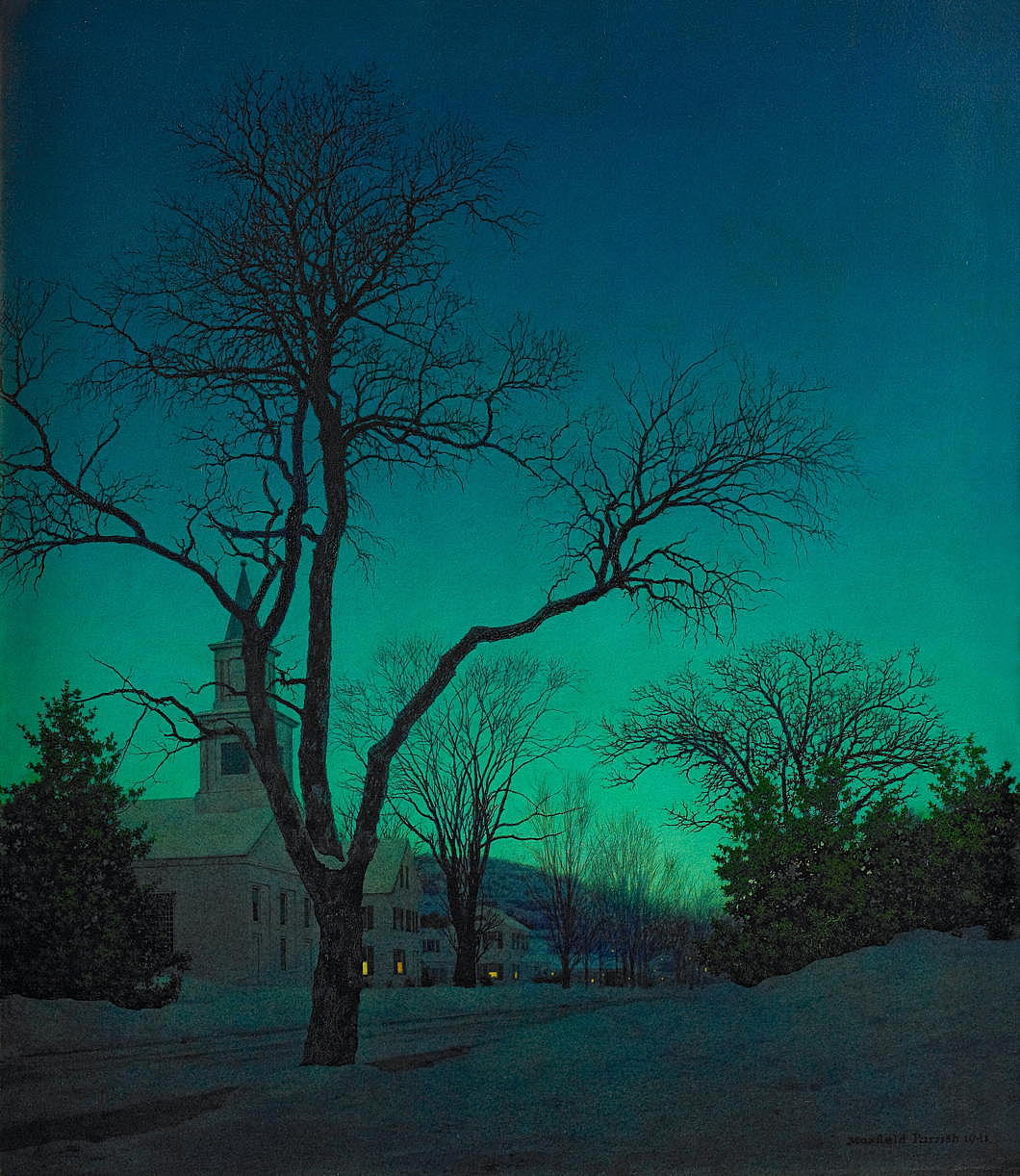
Maxfield Parrish was the king of middlebrow. More of an illustrator rather than a practitioner of high art, he was at least a painter through and through. Norman Rockwell — widely rated as more important — referred to him as his ‘idol’. His 1900s visions of blousy clouds and flowing garments are significant for the time but perhaps best forgotten. By 1931 he had pronounced to the press that he was ‘done with girls on rocks’.
As he gained in years, Parrish moved more towards the observed, inhabited landscapes of his adopted New England. He set up his studio in Plainfield, New Hampshire, where he painted Village Street, Winter.
A leaf-barren tree stands dark against the winter dusklight, partly obscuring the village church. Ground-floor windows of wood clapboard houses emit a warm glow — suppertime isn’t long away now.
No idyll lasts forever: this scene was painted in 1941, the last winter of New England’s peace before the Japanese attack on Pearl Harbor thrust the United States into the great conflagration. Many sons of the Granite State must have thought of still scenes like this as they fixed bayonets in Europe and the Pacific.
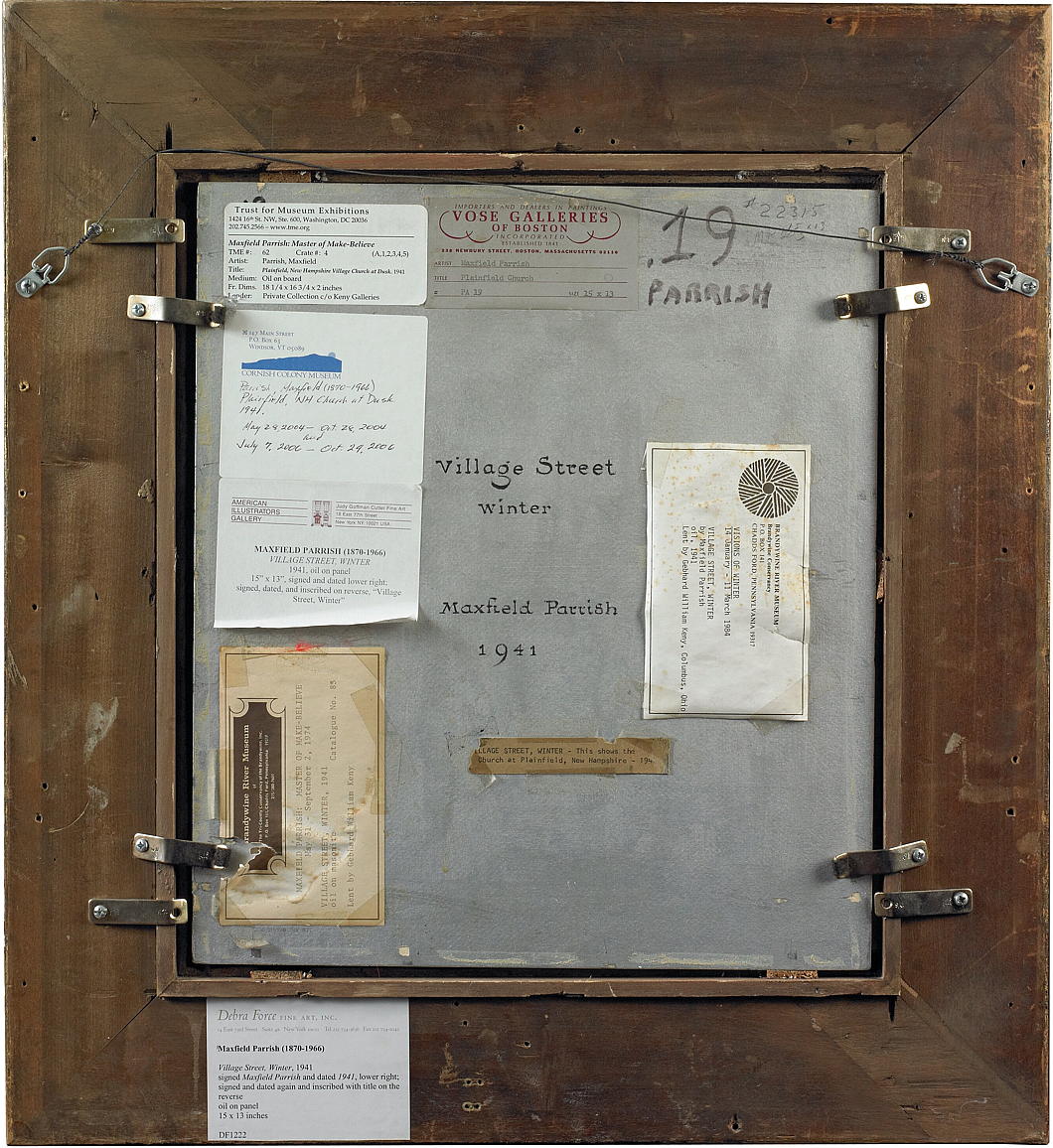
Parrish painted the picture for his own pleasure, but such an artist with such a long commercial career was not unwise to the potentials of profit: even painters must eat. The reproduction rights to the image were licensed to Brown & Bigelow to feature in calendars, prints, and other materials which made Parrish a pretty penny. He was the Jack Vettriano of his day.
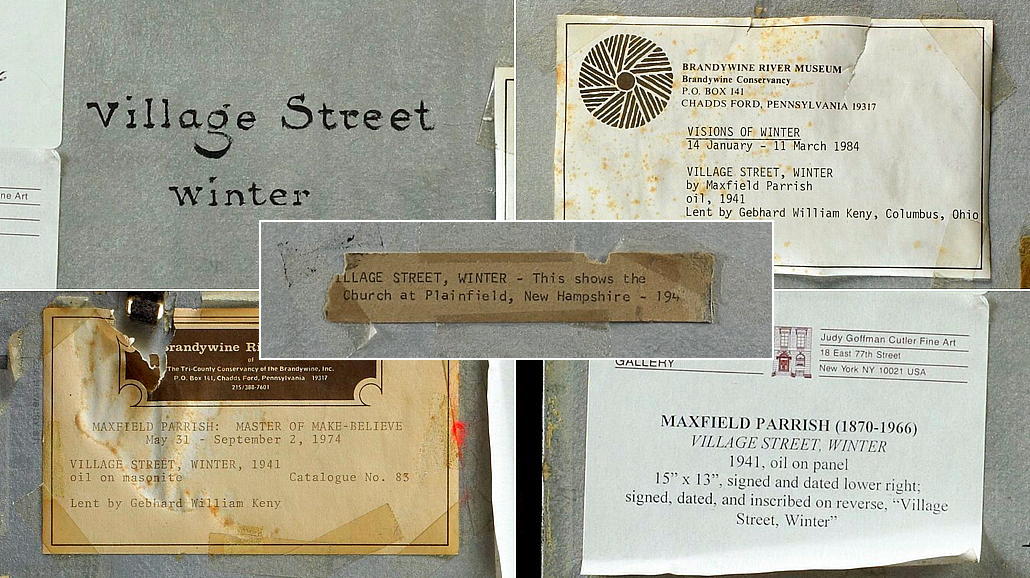
Brown & Bigeloow renamed it ‘At Close of Day’, and the back of the original painting shows a fascinating array of names for the work, including ‘Plainfield Church’, ‘Plainfield New Hampshire Church at Dusk’, and ‘Plainfield New Hampshire Village Church at Dusk’.
The most mentions, however, go to the name the artist himself gave it: ‘Village Street, Winter’.
Churchill’s Beguinage

The last beguine Marcella Pattyn was born in Thysstad, the Belgian Congo, in 1920 and died in the beguinage of Kortrijk in West Flanders in 2013.
At the time many were tempted to mark this as the final chapter in a legacy dating back eight-hundred years, but I would not be surprised if the beguines made at least a partial comeback.
One can easily imagine a town like Oxford hosting a beguinage for the many pious ladies pursuing lifelong academic interests but seeking some sense of Christian life in common. (And the perfect property for it has just come on the market if a patron with deep pockets can be found).
Who were the beguines? As The Economist explains:
Appearing around 1200 in the Low Countries, the Beguines’ semi-religious lifestyle forged a third way for women. Though its chaste sisters, of all ranks and fortunes, prayed together, they were not bound by permanent vows. Beguines belonged to no religious order, so made their own rules.
They lived apart from society in beguinages — self-sufficient clusters of individual houses grouped around a church—but could enter the town at will (though they had to return at dusk). That allowed for an exceptional degree of independence, unknown by their medieval sisters, whether wives or nuns. Even a married woman could become a Beguine (though few did: celibacy was prized).
Most Flemish beguinages were built in urban communities, near hospitals and leper houses. The sisters ministered to the poor and sick in their own infirmaries or at nearby hospitals. But they also washed raw wool and laundered sheets, earning their livelihood through Europe’s booming cloth industry; and, later, by making lace and weaving. Others worked on farms and in gardens.
No visit to Amsterdam is complete without an exploration of its Begijnhof. Somehow, the beguines of the city miraculously survived “The Alteration” of 1578, when Amsterdam’s Catholic city fathers were overthrown, seized, and expelled by a group of Calvinists.
The old chapel was given over to the city’s English Reformed community and many of the founders of New England worshipped there before heading off to land at Plymouth Rock. The Catholic beguines made do with a clandestine chapel built in one of the houses and the last beguine of Amsterdam died in 1971.
The Great Begijnhof of Leuven is likewise well worth a wander: it is an entire quarter covering ten streets. Having fallen into disrepair while owned by the state as alms-houses, it was purchased by the University in the 1960s and restored under the guidance of Professor (and Baron) Raymond Lemaire to house students and academics.
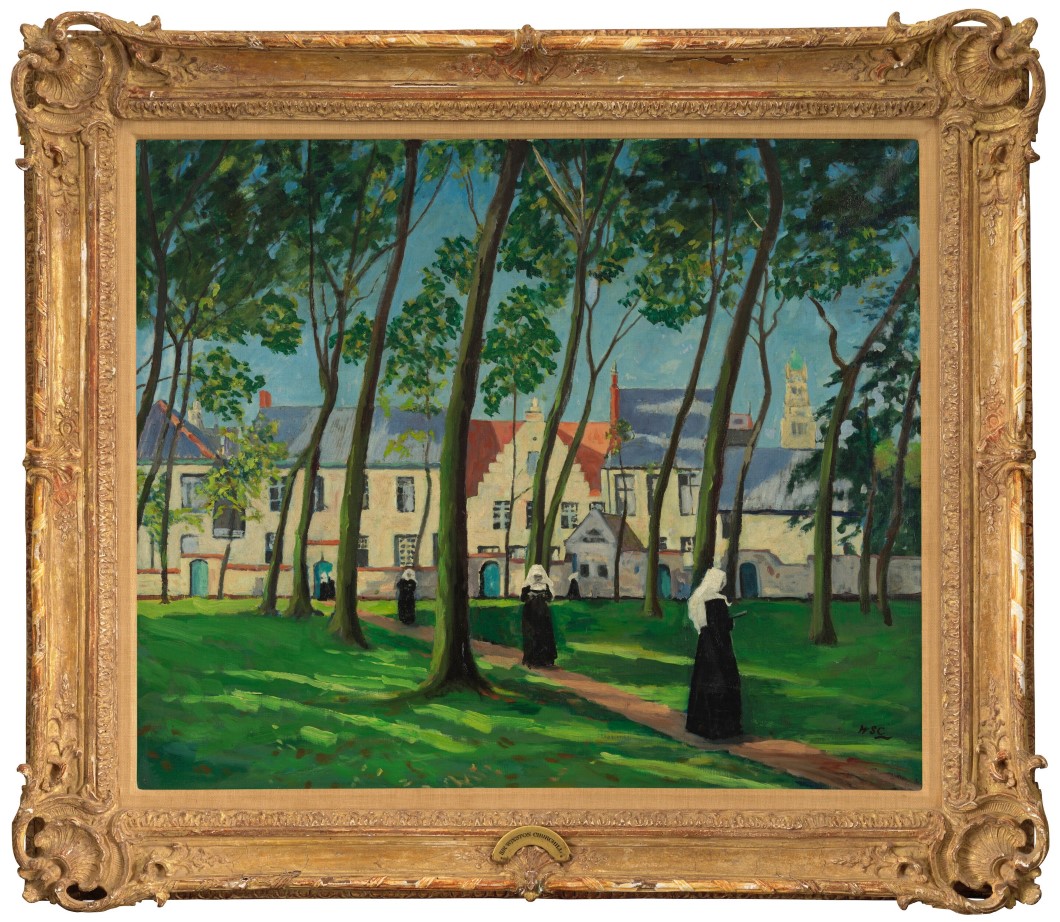
That inescapable man Sir Winston Spencer Churchill KG OM CH &c. counted painting amongst his many pastimes. A year after the British voter gave him the boot and expelled him from Downing Street, Churchill was amidst his typically extensive travels when he found time to visit Belgium and paint the beguinage of Bruges.
The sisters depicted are not actually beguines but Benedictines. They arrived at the Princely Beguinage Ten Wijngaerde in 1927 when the Grand Mistress’s house and adjacent quarters were converted into a convent. The overall site is now owned by the city of Bruges, but four Benedictine sisters remain. The other houses are run as secular alms-houses and sheltering for single women.
Churchill’s ‘Le Béguinage, Bruges’ is up for auction at Bonham’s later this month and the auctioneers provide Churchill’s secretary Grace Hamblin’s explanation of how she came to own it:
He put [a different painting] up and then he said, ‘What do you think of it?’ It was one of his most terrible paintings. And he must have seen my expression, because I wouldn’t dare to criticise it, I promise you, I know nothing about painting.
I said ‘Well, it’s not my favourite.’ And he said, ‘Which is your favourite?’ And I said, ‘Well, I love the Béguinage.’ So he said, ‘Oh, well, we’ll put that here.’
Some years later it went on exhibition with others to New York. When it came back and I was helping him unpack it, he said, ‘This is yours. Take it home.’ That’s all there was to it. Just like that… enough to kill anybody. I couldn’t believe it… to receive one of his paintings, and from him!’
The secretary had good taste.
My own collection of art by a parliamentarian — still just one item — started in a similarly haphazard manner.
I was walking down a street in Westminster one day when I came across a certain poet-painter-politician who shall remain nameless. He was parked in front of his house and packing one of his sons’ possessions into the back of his car to head off to university but was making an absolute hash of it.
I intervened saying “No, no, no: that’s no way to do it at all” and promptly re-organised the assembled items into a much more efficient arrangement. He thanked me and, as recompense for my small service, handed me a painting he had done of Santa Maria della Salute in Venice which still hangs in my somewhat meagre collection.
If you’d like to start your own collection of art by parliamentary painters, Churchill’s beguinage is going for a guide price of £300,000 to £500,000.
Articles of Note: 5 June 2025
Depending on which writer you are speaking to, this can be an insular and tiresome subject — but Vargas Llosa does not disappoint.
The full list of Paris Review interviews can be found here.
■ At school my Latin teacher Dr Kernell used to describe a certain caste of individuals who cannot stand anything being different, fun, interesting, or enjoyable. He ascribed these people the moniker of “the Monotony Monitors”.
Amongst the many things the Monotony Monitors writhe in seething hatred of is Easter, primarily because it is the feast of Christ’s resurrection but also because its date is determined according to a formula based on the lunar calendar. This means it (and its dependent feasts) float through the year rather than being standardised in a monotonous way.
Eliot Wilson writes about the Easter Act 1928 which attempted to overthrow all the work of the Synod of Whitby and fasten the date of Easter in England’s civil calendar.
(It’s bad enough the Pagan English under their genial leader Harold Wilson effectively abolished the Whitsun holiday in 1965 by moving the Whit Monday day-off to the last Monday in May. This now bears the prosaic name of ‘Second May Bank Holiday’ or ‘Spring Bank Holiday’; not to be confused with the first Monday in May which is the ‘Early May Bank Holiday’.)
■ Lebanon is a beautiful land with ingenious inhabitants. Yasin Atlassi reports on how a divided country not much larger than Delaware managed to start its own space programme.
■ On the centenary of his birth, The Spectator recalls Ian Hamilton Finlay: the poet, sculptor, and gardener who maintained a private militia.
■ In Modern Age, Prof. Robert Whaples examines the dichotomy between David Copperfield and Holden Caulfield and concludes we are — alas — living in the age of the latter.
■ The United States of America does not have an honours system — except it does. Elijah Granet and I share many of the same obsessions, and he has penned an engrossing read on the quest for an American honours system.

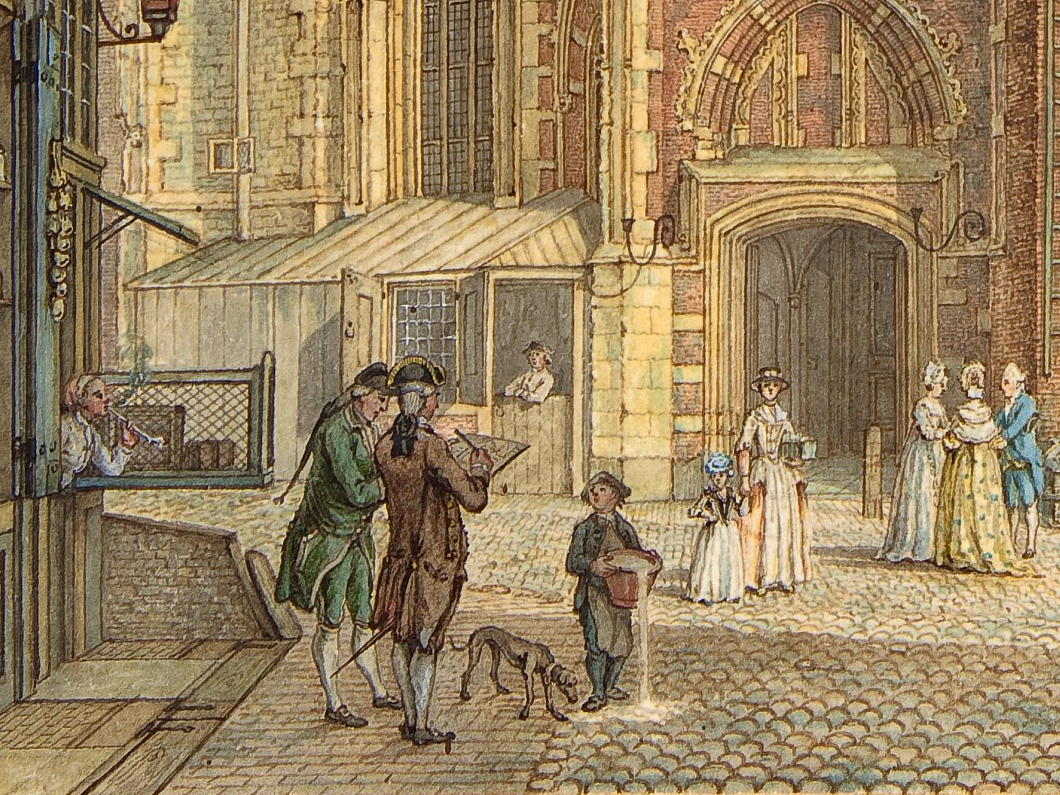
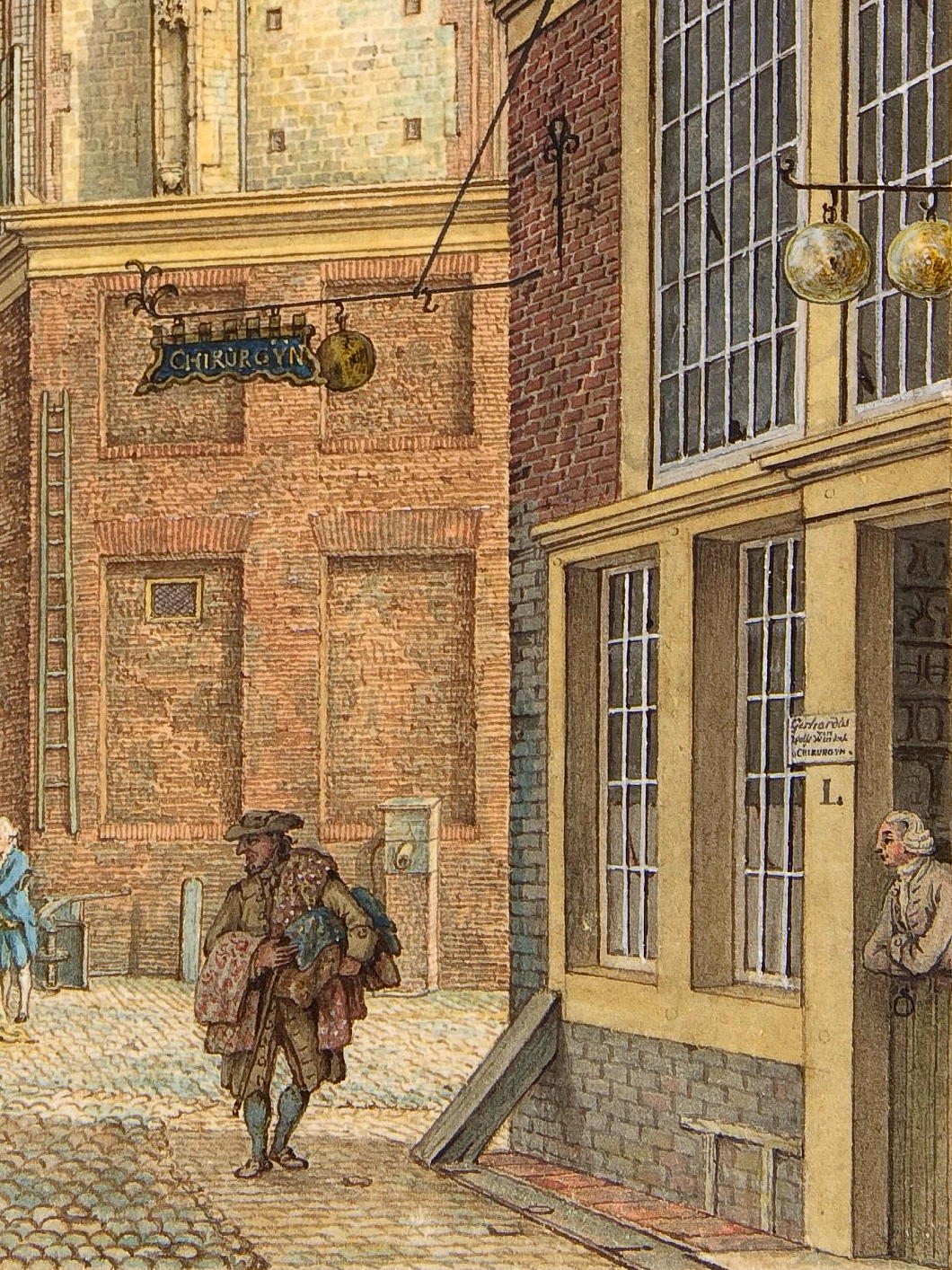
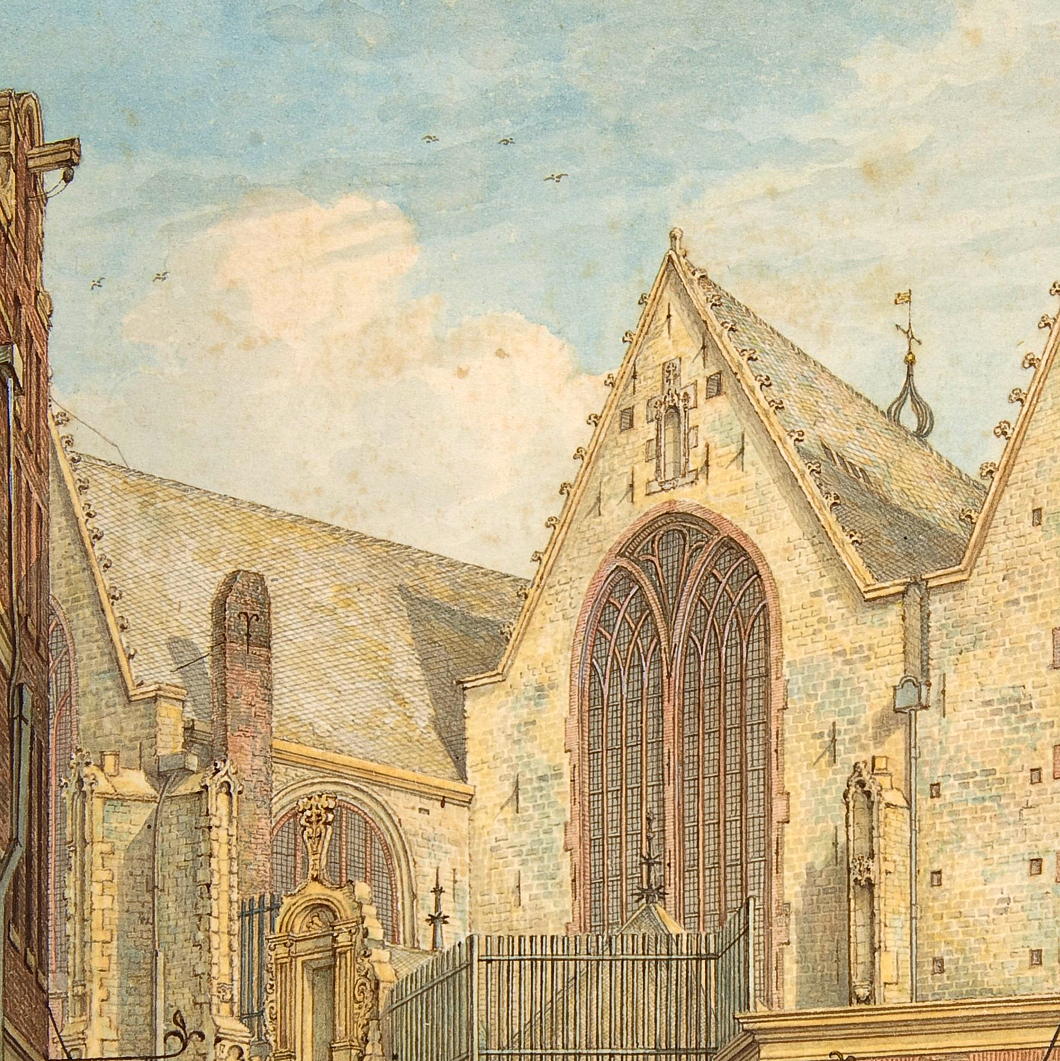
Dempsey Heiner, Art Critic
Dempsey Heiner was neither coward nor fool: he lied about his age to join the U.S. Navy during the Second World War and later studied at Harvard, Yale, and the Sorbonne. His schoolmate from St Bernard’s days, the Paris Review founder George Plimpton, described him as “the brightest boy in the class, a genius”.
In addition to his wide reading and erudition (which he wore very lightly), Dempsey was also one of the kindest, gentlest creatures the world has ever known. He spent most of his life uncomplainingly caring for his disabled wife day in and day out for decades. By the end, she was immobile, blind, and nearly comatose.
As his parish priest put it, “Not once did I ever hear him speak of her as anything but a blessing… and he seemed never so joyful as when he tried to make her drink through a straw.”
He died in 2008 and I still think it was one of the greatest privileges in my life to have counted him amongst my friends.
Dempsey’s most famous act — one would be tempted to use a bit of New York tabloid hyperbole and say most notorious act — occurred on this week in 1999. It is might best be described as the nexus between filial piety and art criticism.
In the late 1990s, Charles Saatchi put on an exhibition at the Royal Academy entitled ‘Sensation’ displaying works from his own collection produced by ‘Young British Artists’ or YBAs. The show was largely an act of self-promotion and the Royal Academy was accused of collaborating with Saatchi to increase the value of his own collection for eventual re-sale.
Among the works on display was a depiction of the Blessed Virgin which was surrounded by pictures cut out of pornographic magazines, although the press tended to centre in on the artist’s use of cow dung in the painting.
By 1999, Saatchi’s exhibition had crossed the Atlantic where it found a temporary home at the Brooklyn Museum. Despite being one of the best collections of art in the United States, the Brooklyn Museum has suffered somewhat from its borough’s perception as something of a bag-carrier for the more glamorous neighbouring isle of Manhattan.
Dempsey, a convert to Catholicism, had a profound devotion to the Blessed Virgin. He wasn’t keen on the idea of some art-market scheme profaning the image of the Mother God, so in December 1999 the 72-year-old New Yorker bought a bottle of latex paint, smuggled it into the Brooklyn Museum, and daubed the paint on the insulting artwork.
As luck would have it, the Magnum photographer Phillip Jones Griffiths was visiting the museum with his daughter and was in the room when Dempsey began his rather pro-active work of art criticism. Jones Griffiths caught Dempsey in the act with his camera and the next day the image was splayed on the front page of the New York Post.

The security guards detained him pending the arrived of New York’s finest, but Dempsey told me that once his police escort was out of view of museum officials they each patted him on the back and congratulated him for his deed.
Dempsey’s act of defiance was almost certainly a felony-level offense but, as the Museum did not want to put a value to the artwork, the Brooklyn DA’s office felt obliged to reduce the charge to a misdemeanour — still carrying the possibility of up to two years in prison.
At trial, Dempsey said the exhibition’s gravest sin was neither blasphemy nor profanation but its “suggestion that there is no beauty in the world.”
“It’s like what Jean-Paul Sartre said: ‘L’enfer, c’est les autres’,” he told the court. “I reject Sartre’s view of humanity. Art is also supposed to be about skill. There was none of that in ‘Sensation.’”
A spokeswoman for the Brooklyn Museum deployed almost comical de haut en bas at the trial: “I don’t think we’ll respond formally to Mr. Heiner, beyond pondering what in his background makes him an expert on artistic skill.” (His Yale degree was in law and his Sorbonne degree in medicine, so I’m not sure if Dempsey ever formally studied art.)
One of the museumgoers in the room at the time told the Post that, while he disagreed with the vandalism, he “understood” Dempsey’s reaction: “Someone had to stand up and say, ‘This is not right.’”
“I think it was heroic,” our own Irene Callaghan (who died this year) told the Post. “He did it for all the Christians. I’m sure if he smeared paint on the window of a fur shop everyone would think it was marvellous.”
In the end, as the Post reported, Dempsey escaped a prison sentence:
Calling it a “crime not of hate, but of love,” a Brooklyn judge slapped a $250 fine on the man who defaced a dung-daubed image of the Virgin Mary, instead of tougher penalties prosecutors sought.
State Supreme Court Justice Thomas Farber released Dennis Heiner with the fine on the condition that “so long as he has paint in his hands, he’s required to stay away from the Brooklyn Museum.”
Farber, who has called the Heiner case one of the most difficult of his career, said the frail, gentlemanly Roman Catholic advocate had taught him something new.
“I had assumed that an act like this would always be committed by an angry man motivated by hate,” Farber said. “But this was a crime committed not out of hate but out of love for the Virgin Mary.”
“When the row eventually fades,” the then-editor of Art & Auction magazine, Bruce Wolmer, wrote, “the only smile will be on the face of Charles Saatchi, a master self-promoter.”
Saatchi made a mint off the artworks he sold, sparking criticism of museum institutions’ alleged complicity in inflating the prices of YBA works.
What happened to the offensive painting? Heavily insured, it was lost unto the ages in a warehouse fire. None of the art world figures who chimed in to praise it at the time mourned its passing. Sic transit opprobrium mundi.
Dempsey himself had no regrets, but he said he wouldn’t engage in any more public acts of paint smearing.
“I’m too old,” he told the press, chuckling. “I’ve said my piece.”
May he rest in peace.

Simon Verity: An Englishman in New York
An Englishman in New York
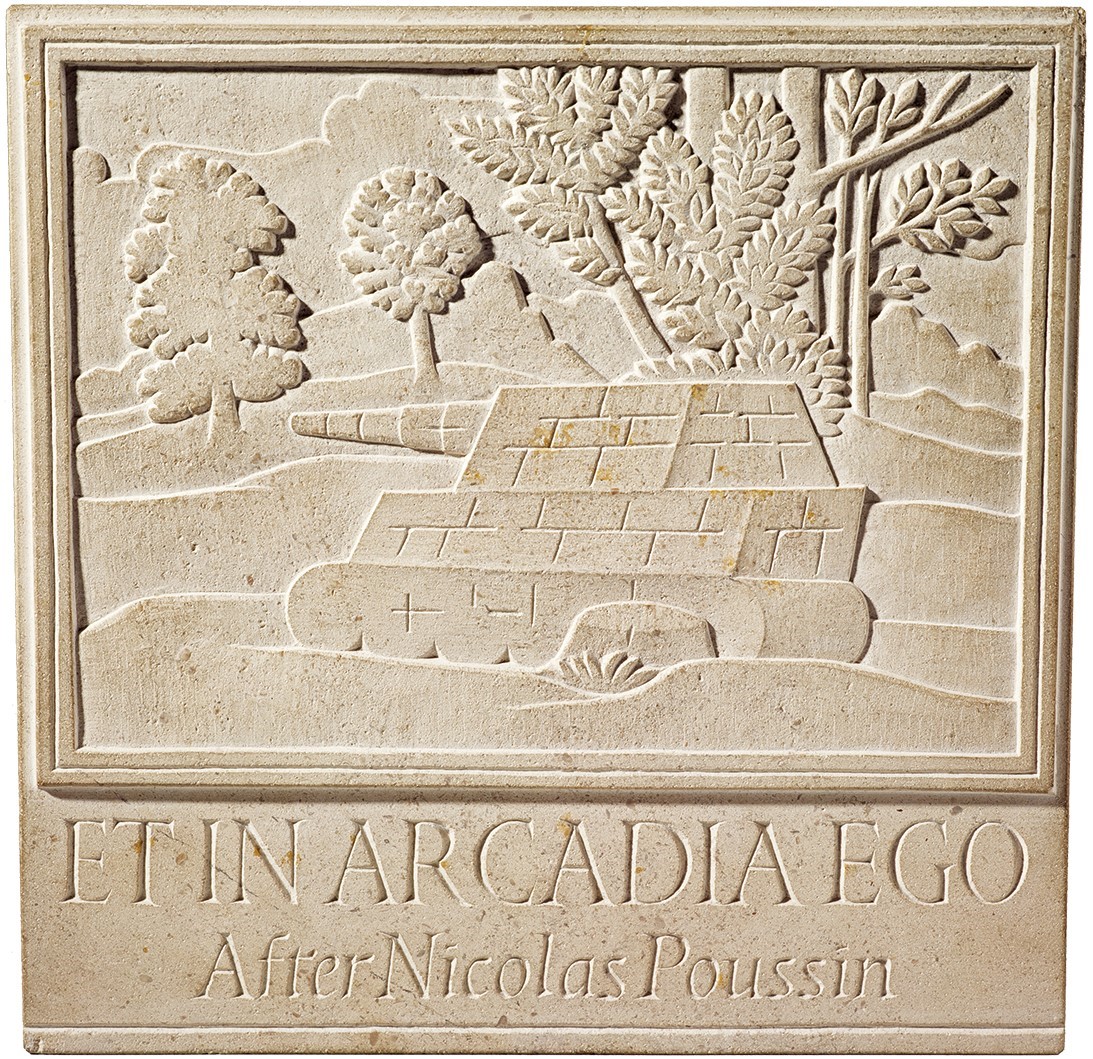
Not many people can claim with any accuracy to have crafted a Portal to Paradise, but Simon Verity was one. The master carver was born and raised in Buckinghamshire but made a significant contribution to the stones of New York.
At the Protestant Cathedral of St John the Divine in Morningside Heights — “St John the Unfinished” to many — tools had been downed following the Japanese attack on Pearl Harbor in 1941. When the Very Rev’d James Parks Morton became Dean in the 1980s he decided it was time to re-start work on the gothic hulk — one of the largest cathedrals in the world.
Morton commissioned the Englishman to come and become Master Mason at the New York cathedral based on his experience on the other side of the Atlantic. Verity tackled the main task of finishing the carvings on the great west portal of St John the Divine — the “Portal of Paradise” — training up a team of local youths in stonecarving to help with the job.
“Mr. Verity took the long-dead worthies of the Hebrew and Christian traditions and made them things of wonder for people in our own day,” the current Dean said following Verity’s death earlier this year.
Most memorable was his ostensible depiction of the destruction of the First Temple, which actually showed the Twin Towers and other familiar New York skyscrapers collapsing into ruin and fire.
Late in 2018 — after the collapse of the actual World Trade Center — an unknown vandal took it upon himself to smash the stone towers off the facade, but the Cathedral has since had them restored by Joseph Kincannon who carved the original depiction under Simon Verity.
Eventually the money ran out and the stonecarvers at St John’s had to down tools yet again so Verity returned to England, but he maintained close connections with New York. He was responsible for the carving and lettering in the British & Commonwealth 9/11 Memorial Garden in Hanover Square, for example.
When the trustees of the New York Public Library proposed clearing out the stacks from their glorious Bryant Park main building and moving the books to New Jersey — a truly criminal plan since, thankfully, abandoned — Verity drew a series of doodles in opposition, many depicting the iconic lions Patience and Fortitude who guard the Library’s entrance.
A few of the mentions of his death this summer are gathered here:
The Daily Telegraph — Obituary: Simon Verity
The Economist — Simon Verity Believed in Working the Medieval Way
The Guardian — Obituary: Simon Verity
Cathedral of St John the Divine — A Message from the Dean on Simon Verity

Patrick in Parliament
The Mosaic of Saint Patrick in the Palace of Westminster
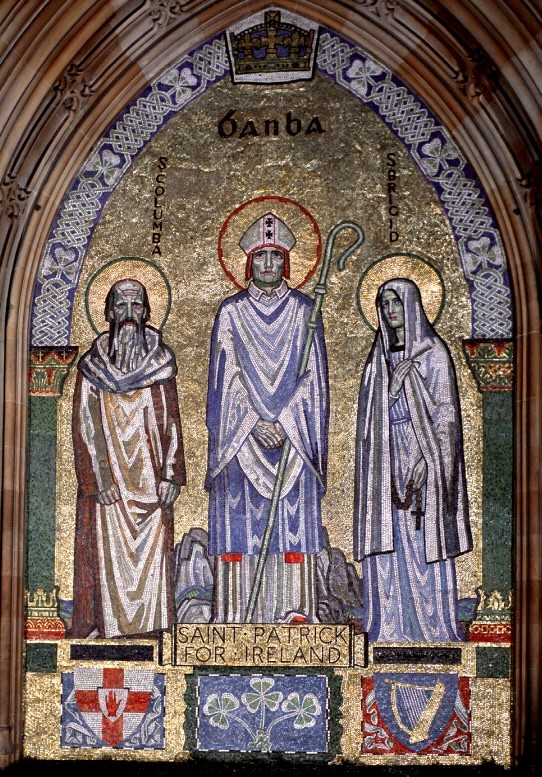
This feast of St Patrick marks the hundredth anniversary of the mosaic of Saint Patrick in the Central Lobby of the Houses of Parliament. At the heart of the Palace of Westminster, four great arches include mosaic representations of the patron saints of the home nations: George, David, Andrew, and Patrick.
The joke offered about these saints and their positioning is that St George stands over the entrance to the House of Lords, because the English all think they’re lords. St David guards the route to the House of Commons because, according to the Welsh, that is the house of great oratory and the Welsh are great orators. (The English, snobbishly, claim St David is there because the Welsh are all common.) St Andrew wisely guards the way to the bar (a place where many Scots are found), while St Patrick stands atop the exit, since most of Ireland has left the Union.
The mosaic of Saint Patrick came about thanks to the munificence of Patrick Ford, the sometime Edinburgh MP, in honour of his name-saint. Saint George had been completed in 1870 with Saint David following in 1898.
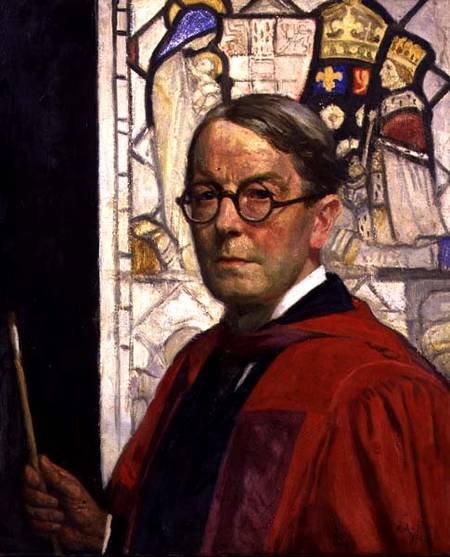 Sir William Raeburn MP commissioned the artist Robert Anning Bell (depicted right) to design the mosaic of Saint Andrew in 1922, which so impressed Patrick Ford that he decided to commission the same artist to depict the patron saint of Ireland.
Anning Bell had earlier completed the mosaic on the tympanum of Westminster Cathedral from a sketch by the architect J.F. Bentley. Following his work in Central Lobby he also did a mosaic of Saint Stephen, King Stephen, and Saint Edward the Confessor in Saint Stephen’s Hall — the former House of Commons chamber.
In the mosaic, Saint Patrick is flanked by saints Columba and Brigid, with the Rock of Cashel behind him. As by this point Ireland had been partitioned, heraldic devices representing both Northern Ireland and the Irish Free State are present.
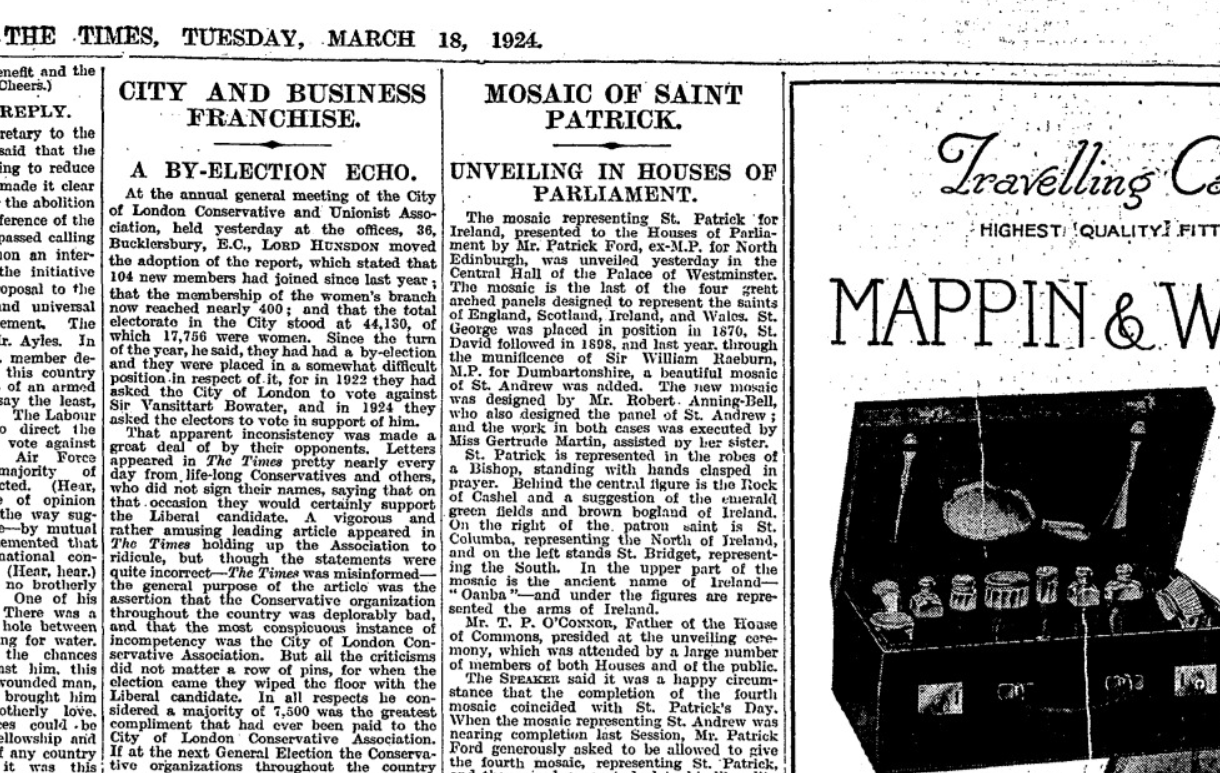
On St Patrick’s Day in 1924, the honour of the unveiling went to the Father of the House of Commons, who happened to be the great Irish nationalist politician T.P. O’Connor, then representing the English constituency of Liverpool Scotland (the only seat in Great Britain ever held by an Irish nationalist MP).
“That day,” The Times reported T.P.’s words at the unveiling, “in quite a thousand cities in the English-speaking world, Saint Patrick’s name and fame were being celebrated by gatherings of Irishmen and Irishwomen. Certainly he was the greatest unifying force in Ireland.”
“All questions of great rival nationalities were forgotten in that ceremony. From that sacred spot, the centre of the British Empire, there went forth a message of reconciliation and of peace between all parts of the great Commonwealth — none higher than the other, all coequal, and all, he hoped, to be joined in the bonds of common weal and common loyalty.”
T.P.’s remarks were greeting with cheers.
The Most Honourable the Marquess of Lincolnshire, Lord Great Chamberlain, accepted the ornamental addition to the royal palace of Westminster on behalf of His Majesty the King.
Hawksmoor’s Dream
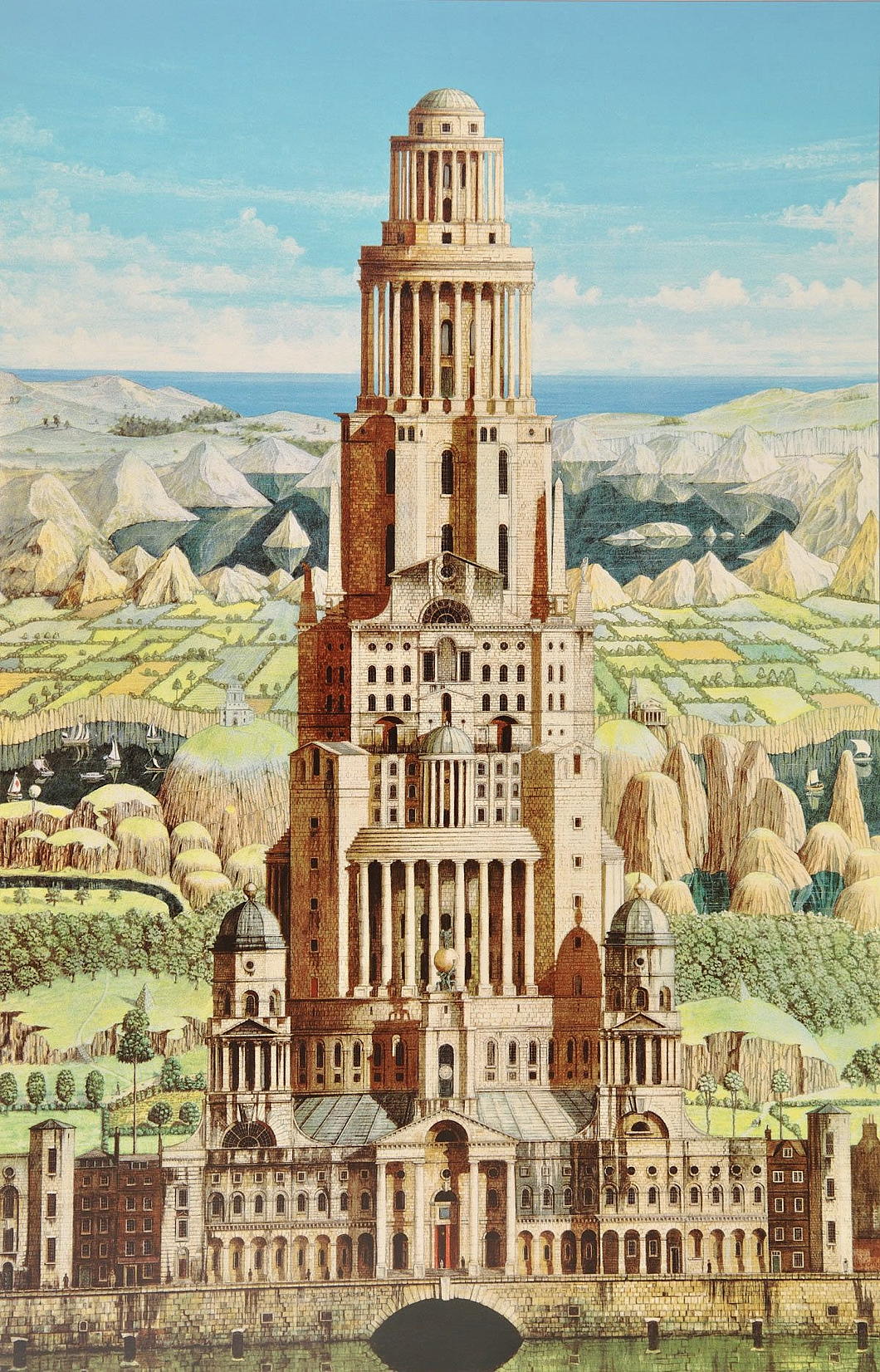
27½ in. x 17¾ in.; 1987-1991
Andrew Ingamells is an excellent draughtsman who is probably the finest architectural artist in Britain today.
His depictions of Westminster Cathedral and the Brompton Oratory (amongst others) are in the Parliamentary Art Collection, and he has done Loggan-style portrayals of the colleges of Oxford and Cambridge as well as three of the four Inns of Court in London.
The above capriccio is a wonderful treat. I think someone should build it.
Canterbury Gate
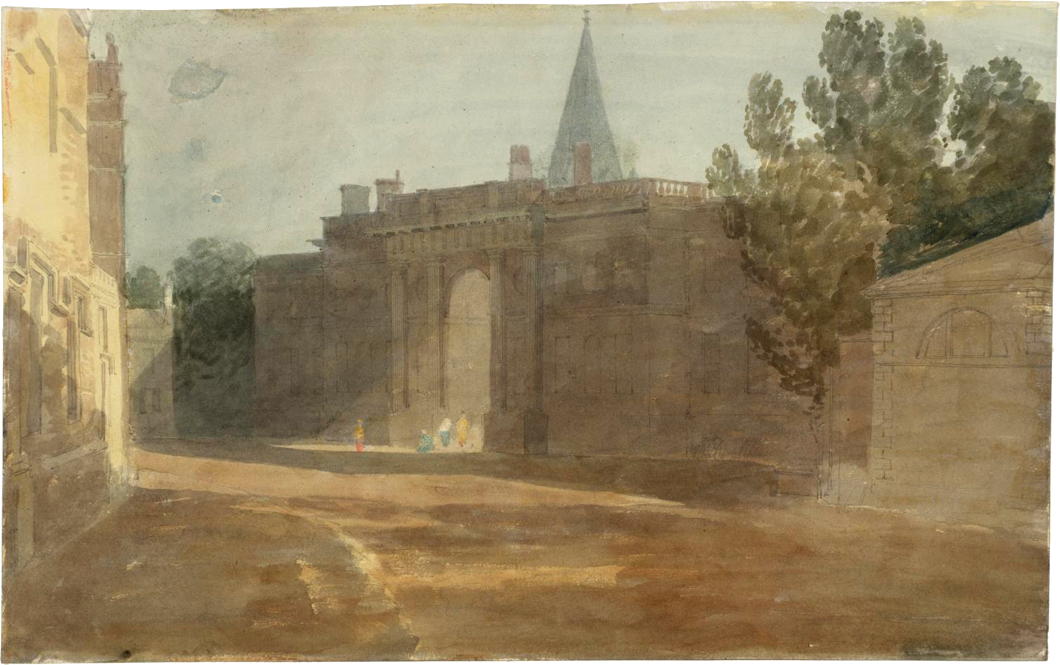
10 in. x 16¼ in., 1799; Tate Collection
Turner’s painting captures Christ Church’s Canterbury Gate from Oriel Square. (As it happens, this is Canterbury Gate at Christ Church in Oxford and, conversely, there is a Christ Church Gate at Canterbury in Kent.)
Given the greenery of the vegetation, this is almost certainly not the work that inspired Betjeman to write his winter poem ‘On an Old-Fashioned Water-Colour of Oxford’:
A winter sunset on wet cobbles, where
By Canterbury Gate the fishtails flare.
Someone in Corpus reading for a first
Pulls down red blinds and flounders on, immers’d
In Hegel, heedless of the yellow glare
On porch and pinnacle and window square,
The brown stone crumbling where the skin has burst.
A late, last luncheon staggers out of Peck
And hires a hansom: from half-flooded grass
Returning athletes bark at what they see.
But we will mount the horse-tram’s upper deck
And wave salute to Buols’, as we pass
Bound for the Banbury Road in time for tea.
Articles of Note: 29 January 2024
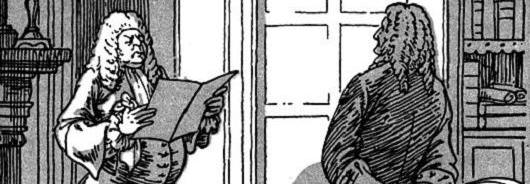
A lively Doubleyoo-Ess once took me to lunch at the New Club and, in whispered tones, pointed out a gentleman sitting at another table.
“He is the world’s leading expert on the Scots tongue,” my friend explained.
“But he was excommunicated by all the other experts on Scots when he pointed out that eighty per cent of Scots words are interchangeable with Northumbrian English.”
Scots is fascinating for its closeness to English and its distinction. Those who’ve had the pleasure of tarrying awhile in the Netherlandic world (whether in Europe, the Cape of Good Hope, or elsewhere) can detect the odd affinities to Dutch and Afrikaans — reminding you that the North Sea was once a highway, not a barrier.
Luka Ivan Jukic has written an enlightening exploration of how and why Scotland lost its tongue.
Jukic contends there are no signs of revival, which I dispute. There is a much increased interest in the use of Scots, but it feels contrived and falls somewhat flat. If you take a look at the Scots column in The National newspaper, it comes across as the ravings of a kook something akin to Anglish.
■ Amongst the many of Scotland’s joys is the pleasure of just looking at its buildings.
Witold Rybczynski pleads “Give us something to look at!” in his account of why ornament matters in architecture.

■ The New York Post — founded by Alexander Hamilton in 1801 and thus the Empire State’s oldest and most venerable newspaper — reports that the world’s oldest and most venerable forest has been discovered right in the heart of the Catskill Mountains.
This is one of the most beautiful places in America, especially when the leaves begin to turn in autumn, and features widely in the old stories transcribed by Washington Irving and others.
The name of the Catskills is believed to be from the catamounts that used to roam the woods and bergs when our Dutch forefathers of old first arrived in the valley of the Hudson. Our earliest record of it is on a map by Nicolaes Visscher père from 1656 — and pleasingly the local magazine retains the old spelling in its name of Kaatskill Life.
This fossilised forest within the Catskills is believed to date from 385 million years ago (for those who doubt the Ussher chronology — and we remain open-minded ourselves) and was discovered at the bottom of an old quarry.
■ As a precocious teenager I remember a visit to the maritime museum in Rochefort on France’s Atlantic coast that included a fascinating display of the intricacies and accomplishments of global shipping, housed in the long old ropeworks that kept France’s navy afloat in the era of sail.
It’s all been kicking off in the Red Sea, which inspired Wessie du Toit to write that the shipping container is an uncanny symbol of modern life
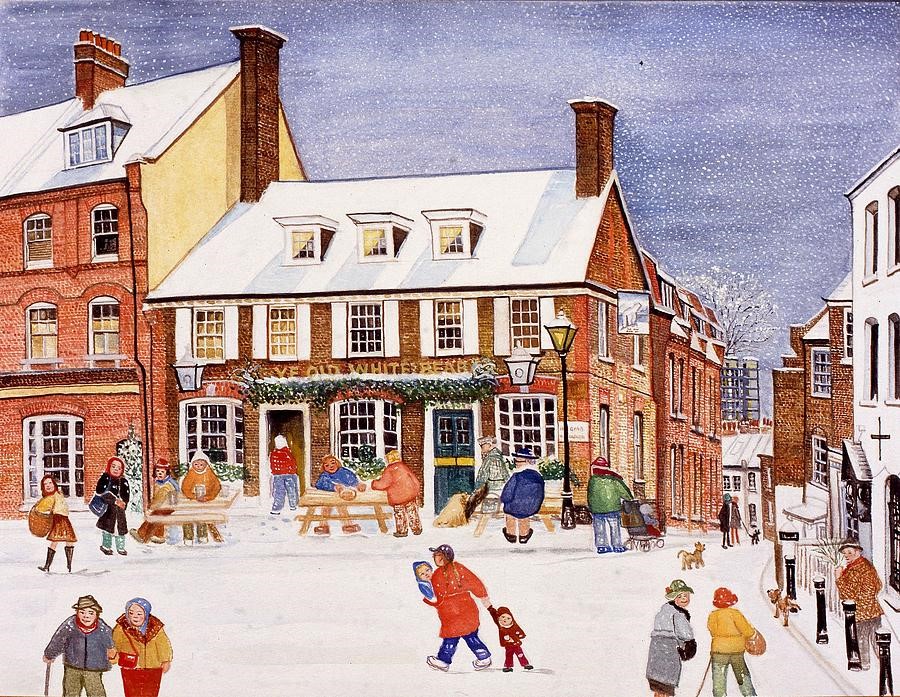
■ Some people claim there is no life outside of NW3, but as much a fan of Hampstead as I am, my first loyalty in London neighbourhoods is firmly lodged in Southwark. (Pimlico is high on the list, too.)
Many will pine for those precious late summer afternoons idly dawdling on the Heath, but Hampstead in winter has its distinct pleasures. For me, it’s curdling up with a pile of books beside the coal fire in the Old White Bear.
In the Christmas issue of The Oldie, Peter York wrote about the rise and fall of arty Hampstead.
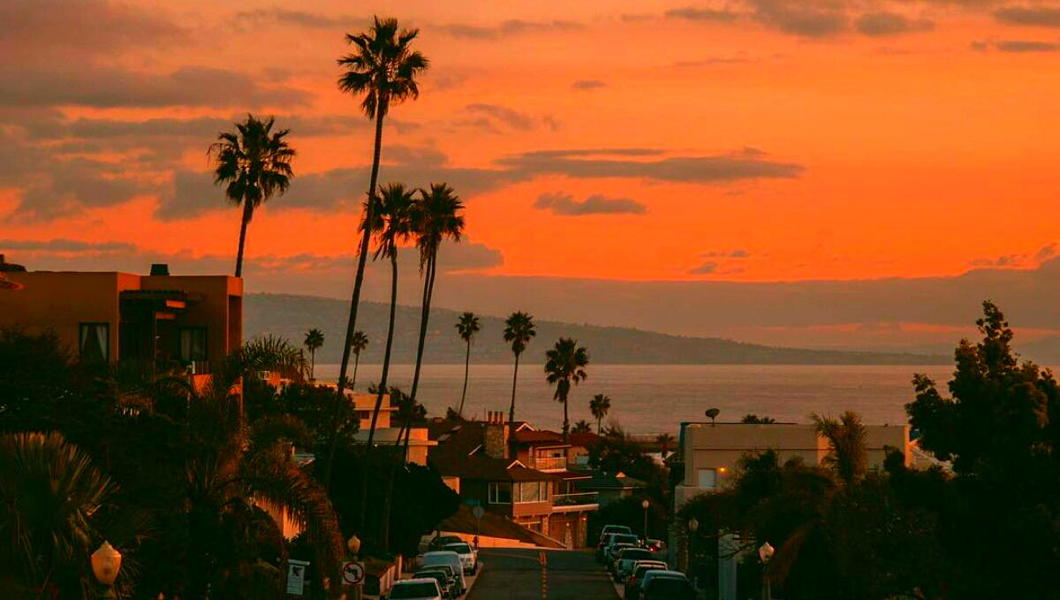
■ One of our Hampstead mates is originally a West Country man and now finds himself even further west, studying law in California.
For a New Yorker, California is The Great Other. If not quite a rival, then certainly something we are always being compared against.
Naturally, one looks down on California, but also with a certain envy. If ever America had a golden moment when imperial might was combined with the simple goodness of life, it must have been coastal California from the 1930s to 1960s — with a hint of survival into the 1980s.
California’s decline is evident to all, though its power and influence is still vast (as the iPhone in your pocket proves). The Manhattan Institute recently devoted an entire issue to the question of Can California Be Golden Again?
I haven’t had a chance to read much of it, but I did enjoy Jordan McGillis’s article on how San Diego retains many of the qualities that once made California the envy of the world.
■ Peter Viereck ranks amongst the names of slightly neglected thinkers in the agora of American conservatism. Reading him always brings some insight, but I never knew much about the man himself.
Samuel Rubinstein supplies a fascinating account of the man and his thinking in Peter Viereck: Psychoanalyst of Nazism.
■ National treasure Peter Hitchens has spent his life hating the ogre Ted Heath, destroyer of worlds. I will never forgive him for what he did to England’s ancient counties and boroughs.
But Hitchens the Heath Hater, with his typically thoughtful approach, offers a reconsideration of the man.
■ All politics is local: Fred de Fossard writes about how EU-obsessed Lib Dems are ruining Bath rather than guarding one of the most precious jewels of English cities.
■ We leave you with this six-colour lithograph from the Pretoria-based artist Nina Torr entitled ‘Here we go again’ (an edition of thirty, available from the Artists’ Press):

Old Church, Paarl
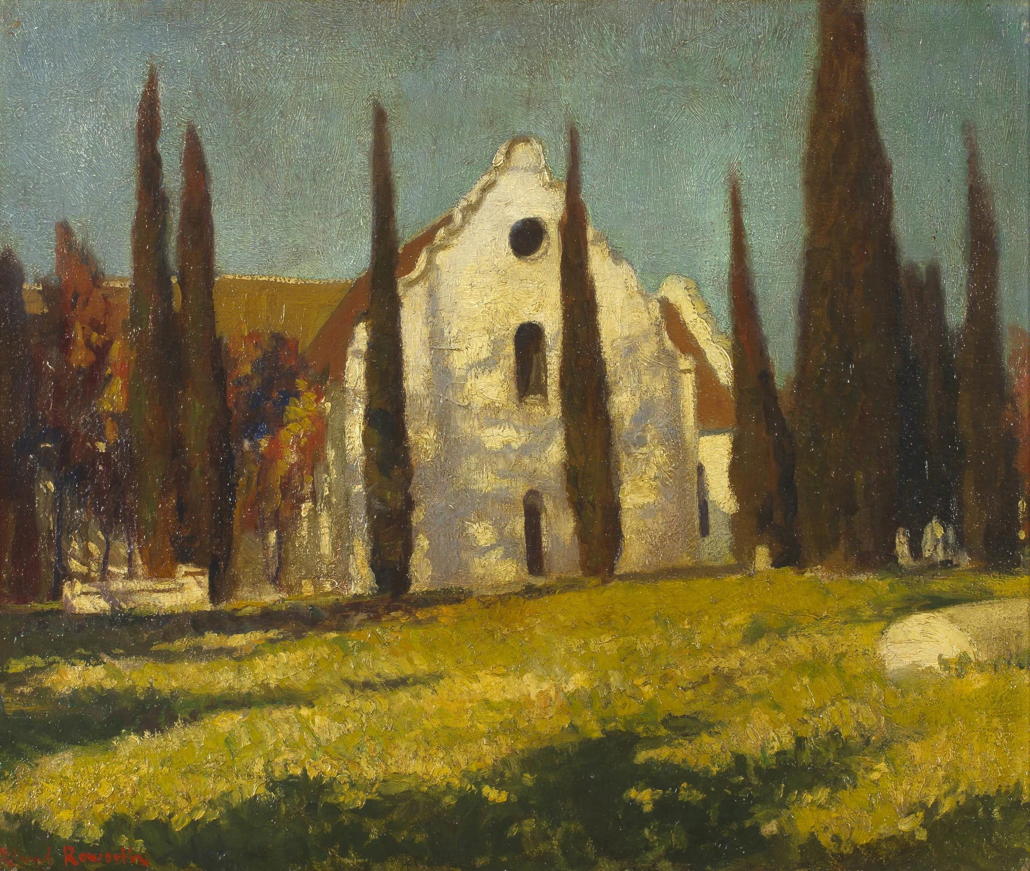
The church in die Paarl is the third-oldest NGK congregation in South Africa, after the Groote Kerk in Cape Town and the Moederkerk in Stellenbosch. It is often known as the Strooidakkerk (straw-roof church) for obvious reasons.
This part of the Drakenstein was first settled by Huguenots, where the dominee Pierre Simond preached in French from the foundation of the church in 1691 until he returned to Europe in 1702.
Dom Miguel de Castro
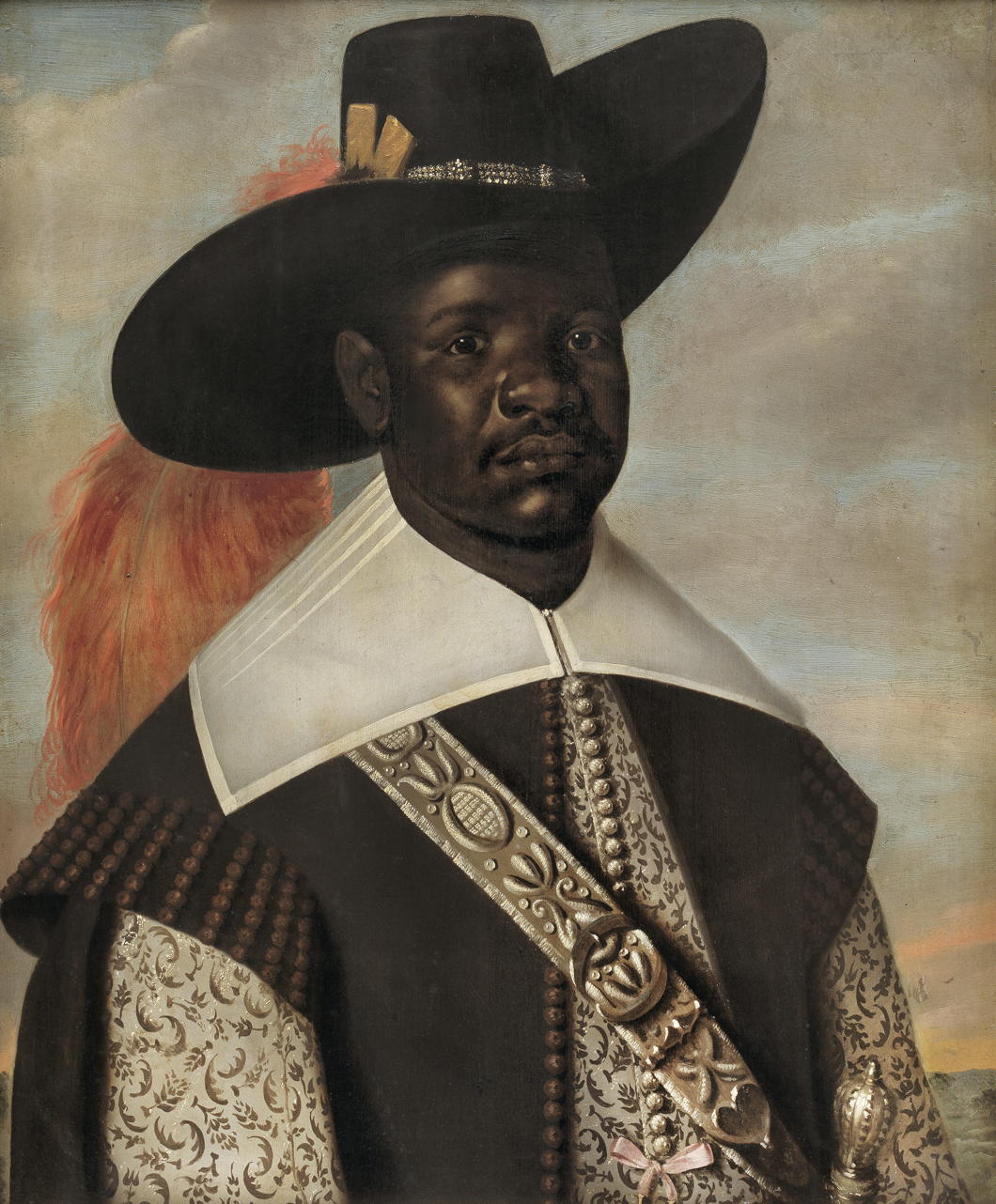
During the 1640s, a conflict arose between Kongo’s pious and militarily successful King Garcia II and his vassal, the Count of Sonho. Seeking the help of the Dutch Republic and its stadtholder, the Count sent his cousin, Dom Miguel de Castro, to the Netherlands as an emissary.
Dom Miguel arrived at Flushing in June 1643 and proceeded to Middelburg where he was received by the Zealand chamber of the Dutch West India Company.
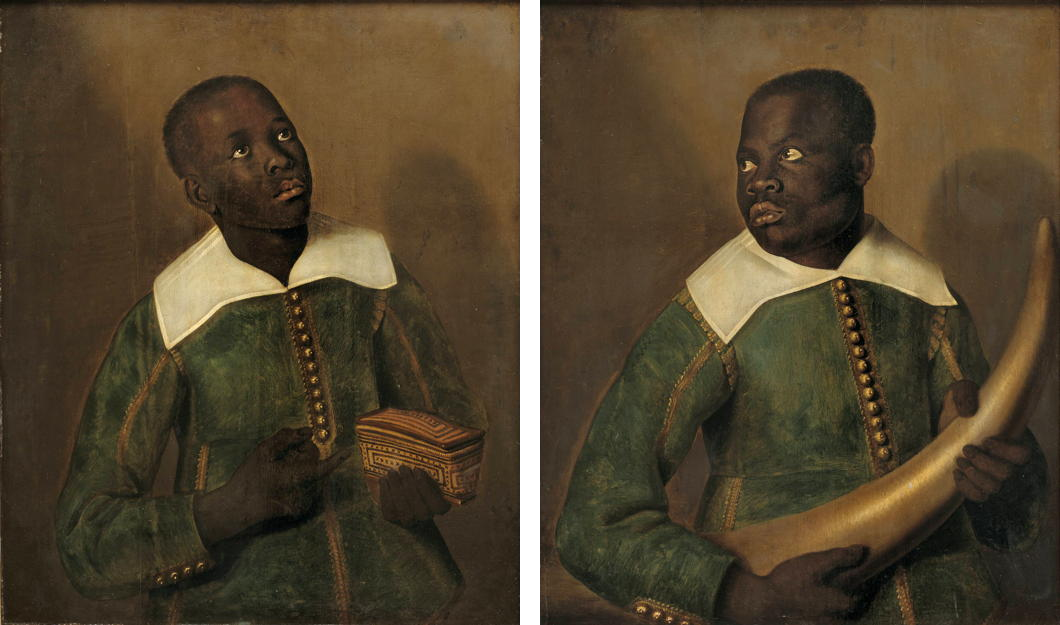
During the Kongo nobleman’s fortnight in Middelburg, the chamber commissioned these portraits of Dom Miguel and his two servants painted by Jasper Becx — or possibly by his brother Jeronimus.
The Zealand chamber gave the trio of portraits to Johan Maurits — Prince of Nassau-Siegen, governor of Dutch Brazil, and originator of the Mauritshuis — who in 1654 gave them to Frederik III of Denmark, along with twenty Brazilian paintings by Albert Eckhout.
A full-length portrait of Dom Miguel was taken back to Africa by him and, alas, is now lost.
Dom Miguel de Castro
Jaspar Beckx, c. 1643;
Statens Museum for Kunst, Copenhagen
Dom Miguel de Castro
Jaspar Beckx, c. 1643;
Statens Museum for Kunst, Copenhagen
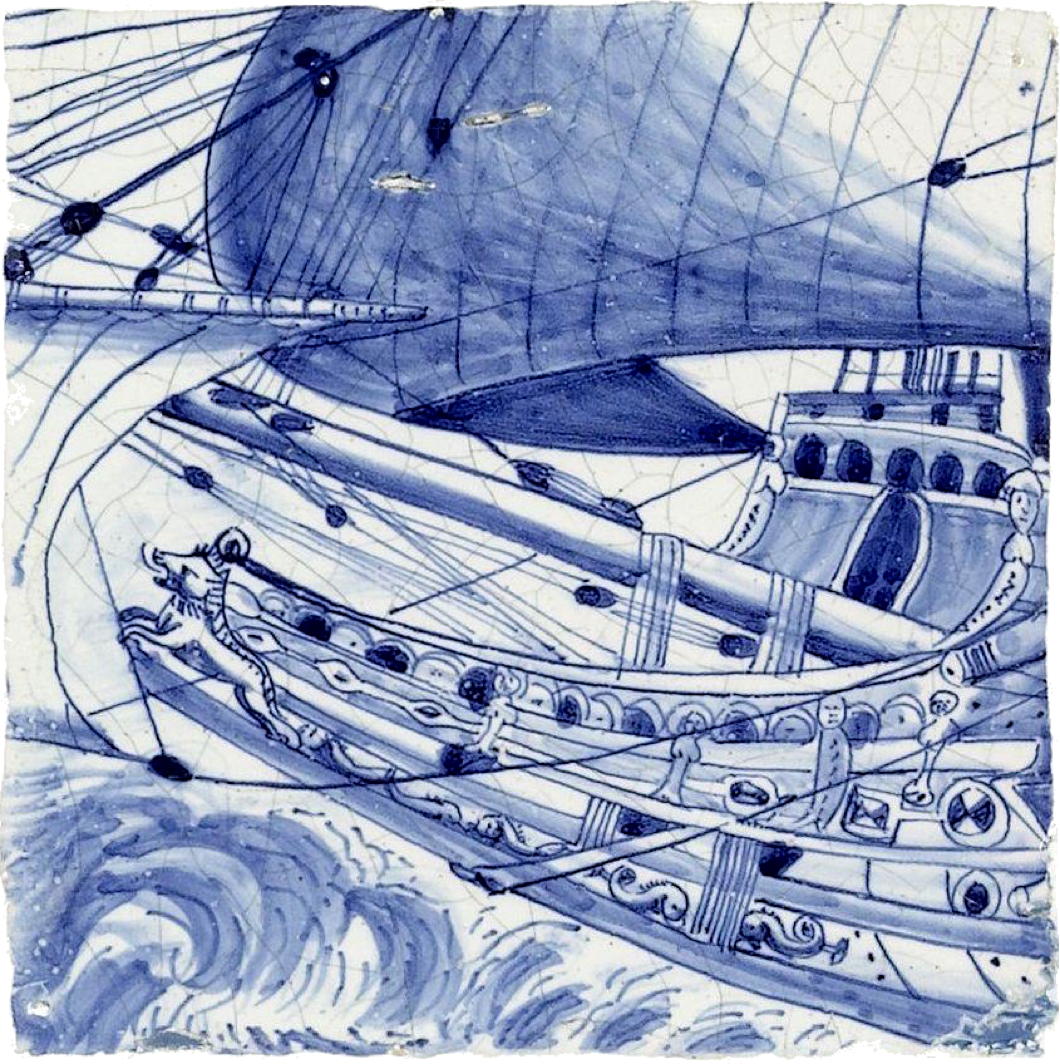
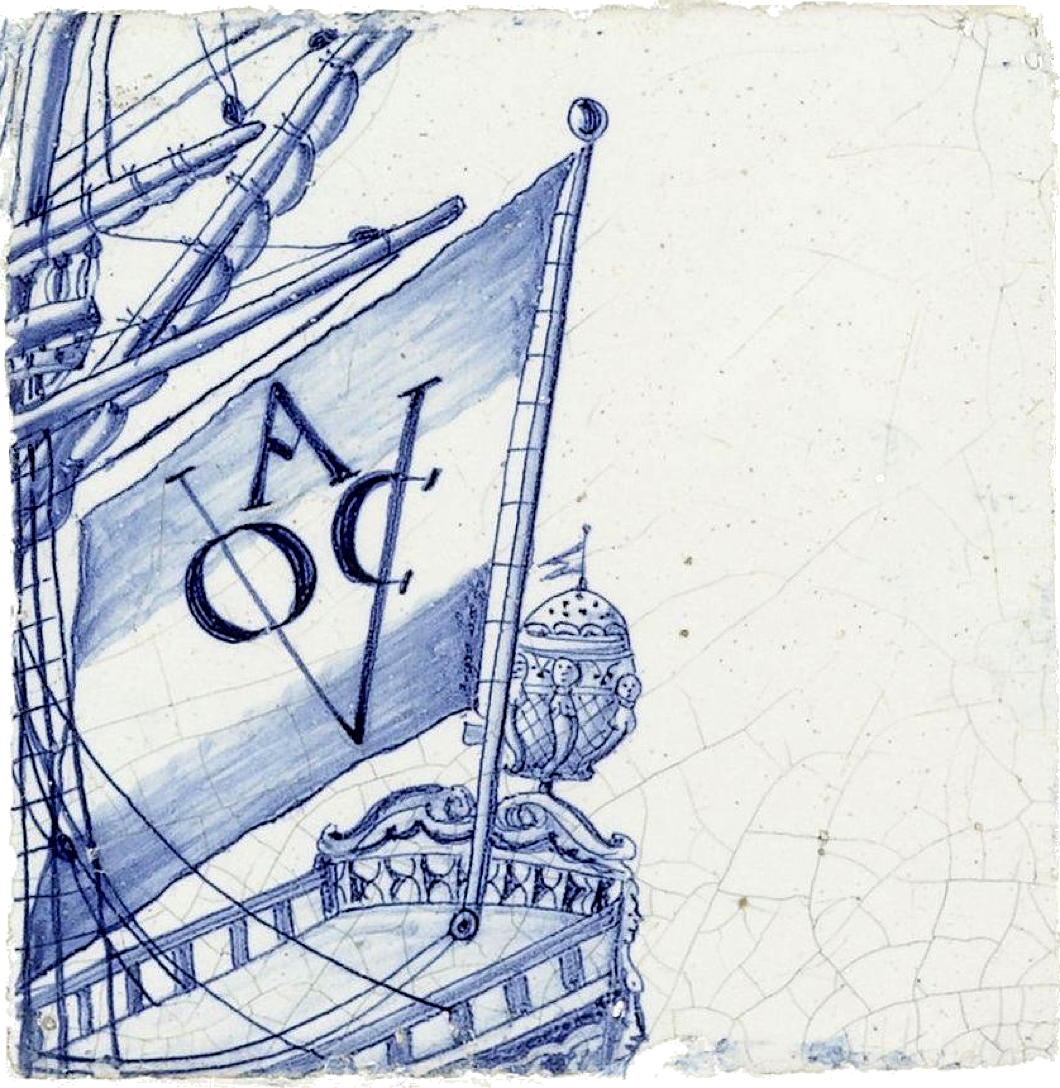
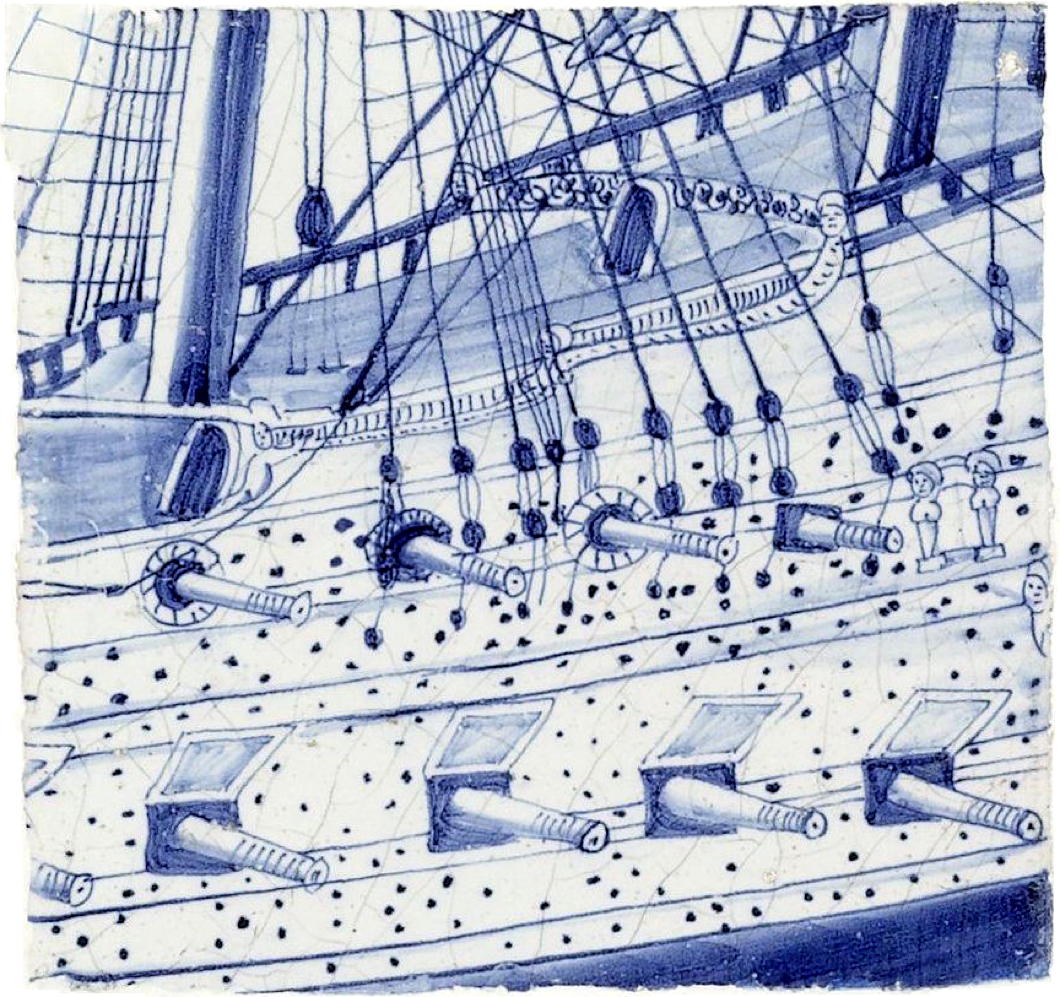
An East Indiaman
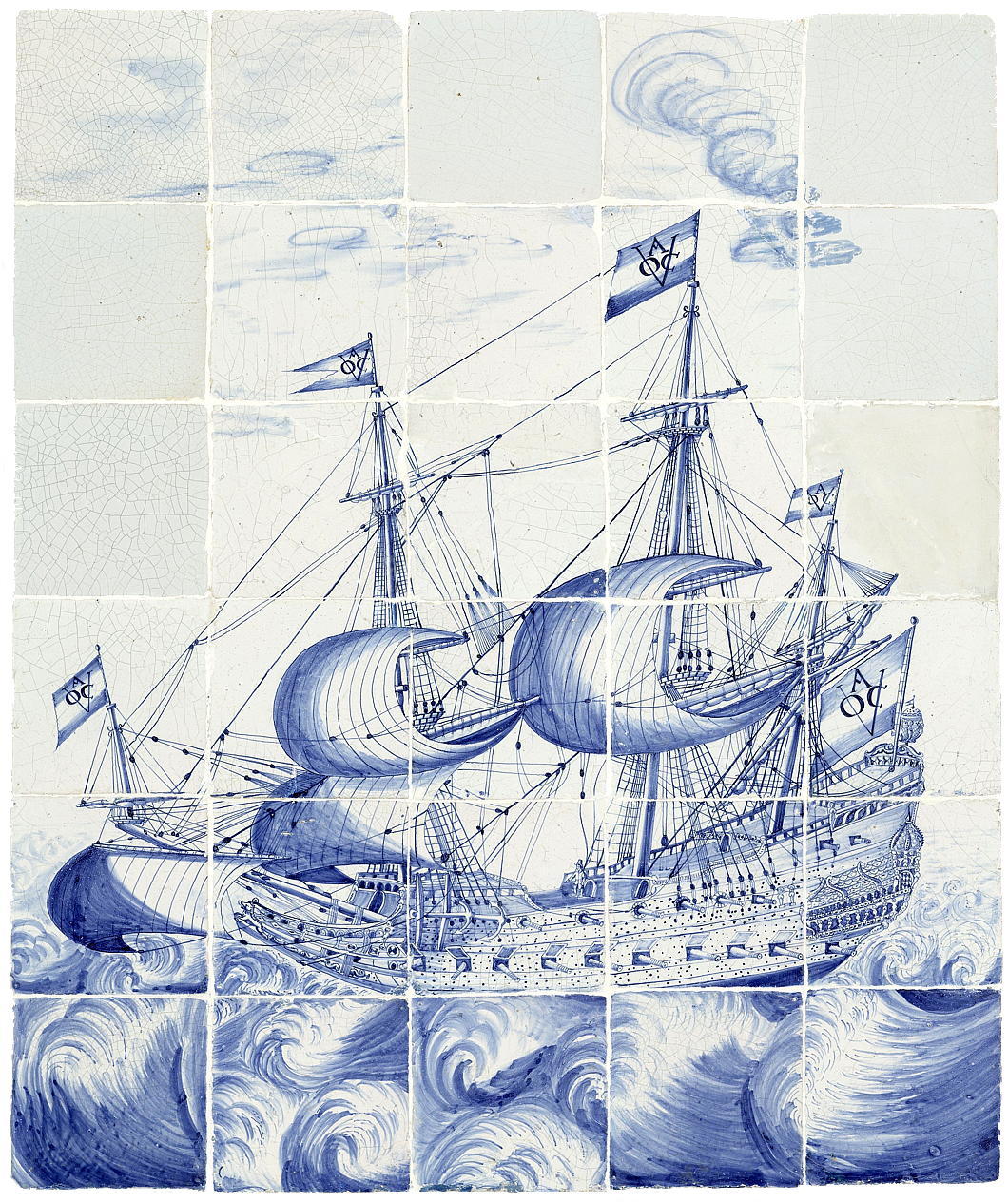
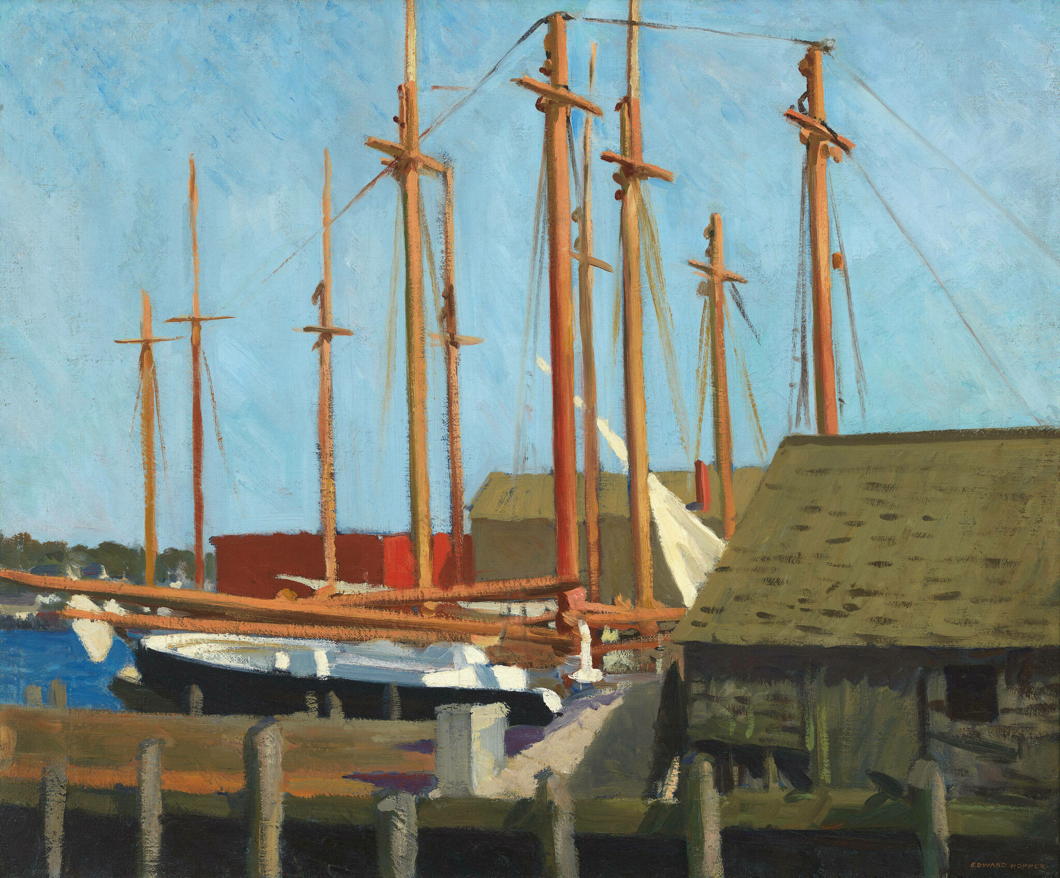
English sea-goers and merchants commonly referred to any ship of the Dutch VOC (or of other similar companies) as an ‘East Indiaman’.
Corpus Christi
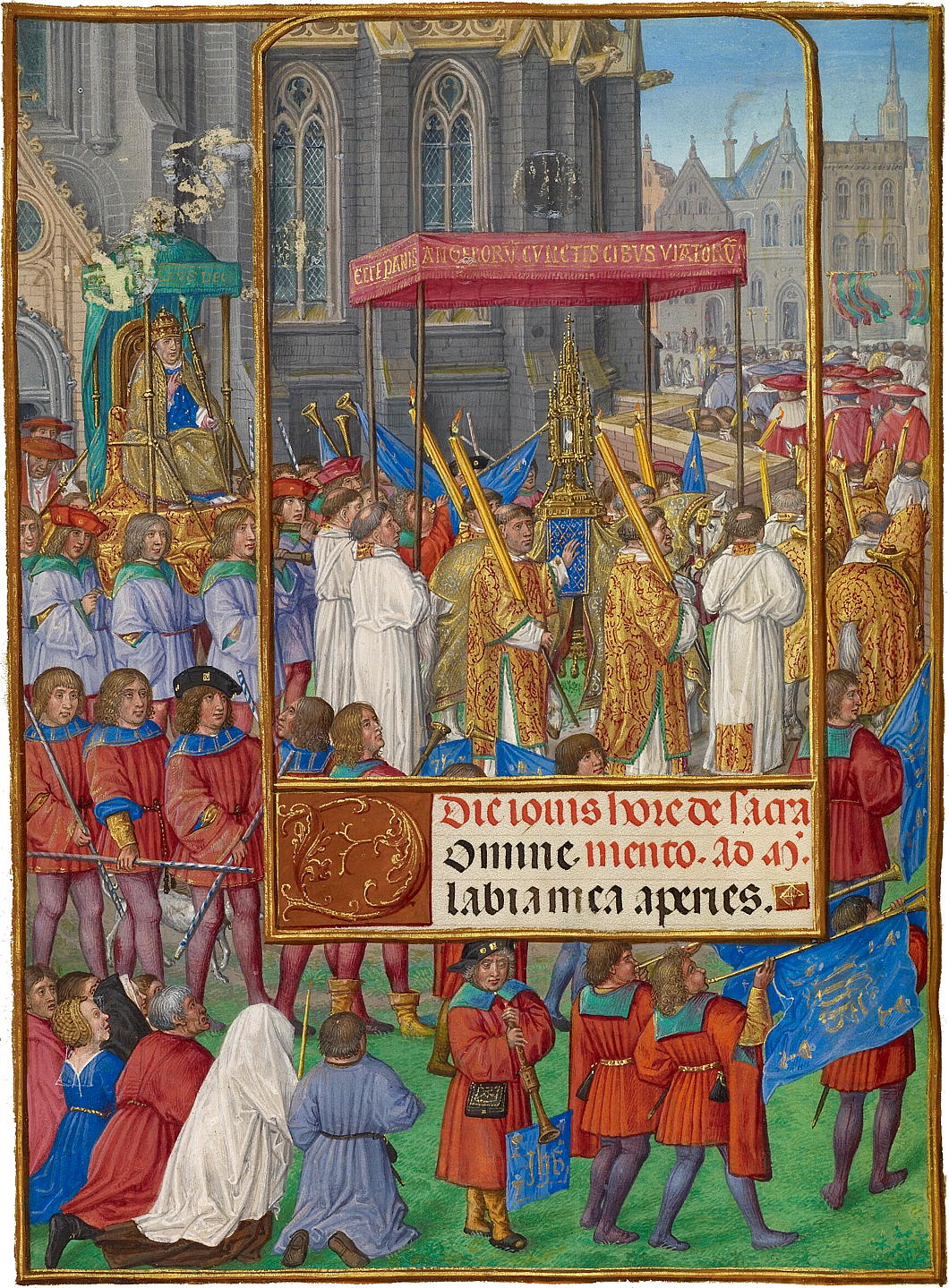
The Master of James IV of Scotland, Flemish c. 1541; Getty Museum
Safavid Pottery Tile
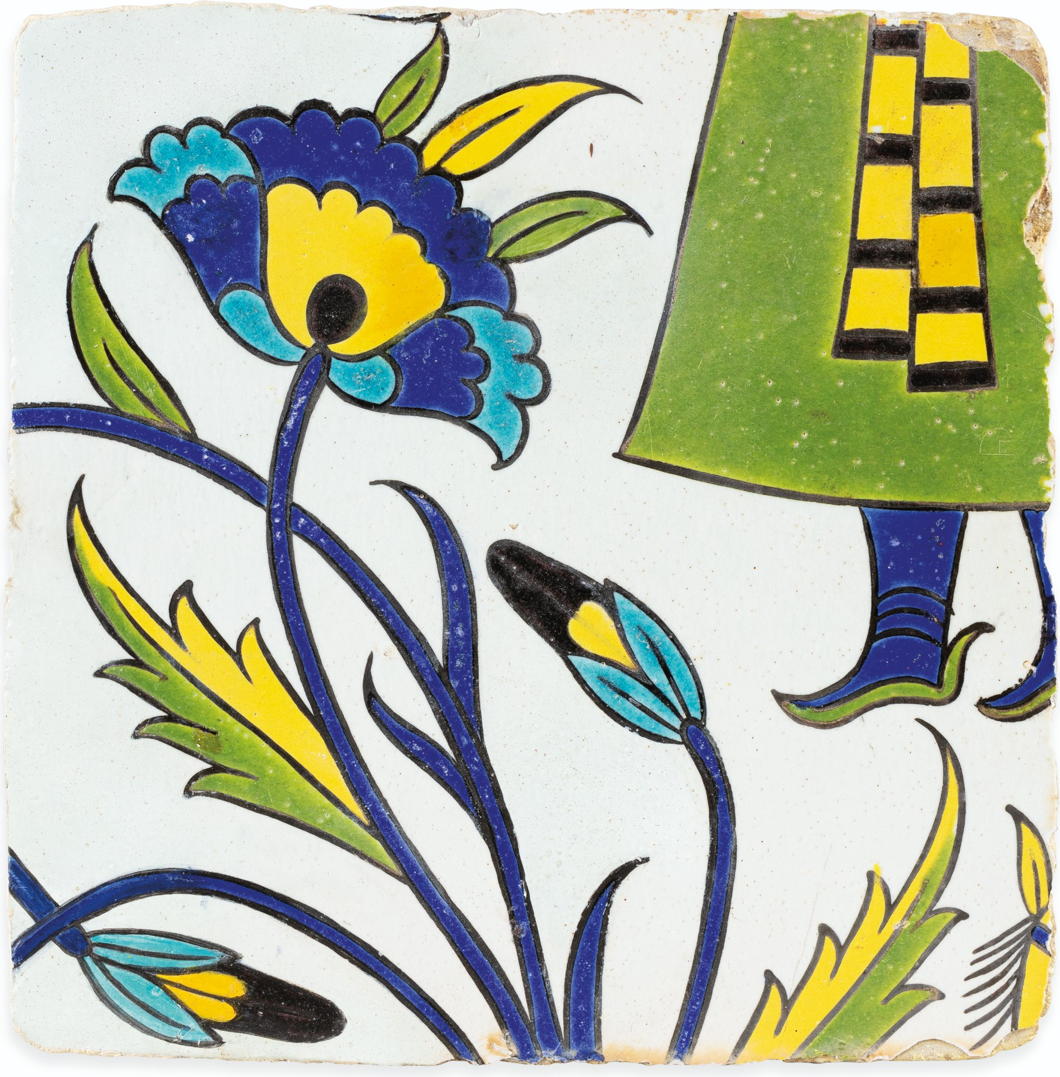
A seventeenth-century pottery tile from Safavid Persia — from the collection of the late Pierre Le-Tan.
Merton
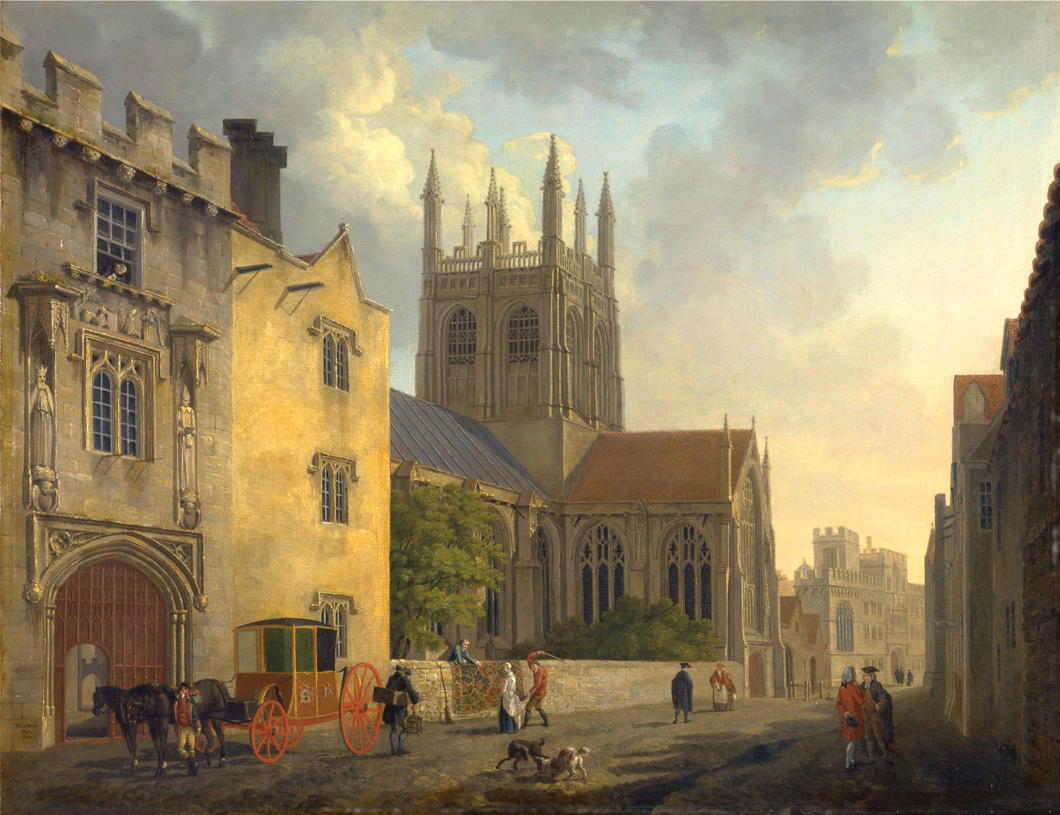
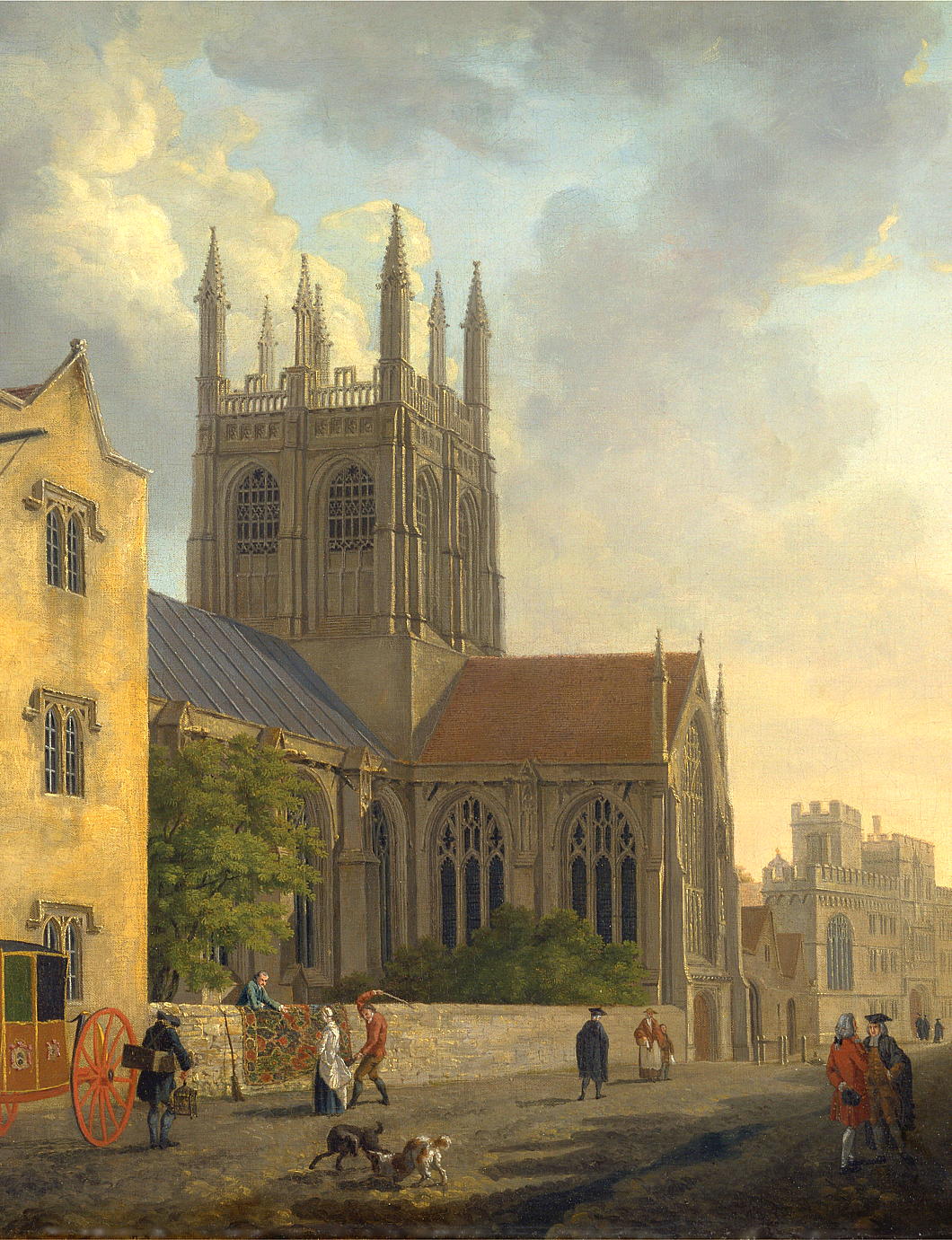
The ‘House or College of Scholars of Merton in the University of Oxford’ — more commonly called Merton College — is one of the smaller colleges in Oxford, located right next door to lovely little Corpus.
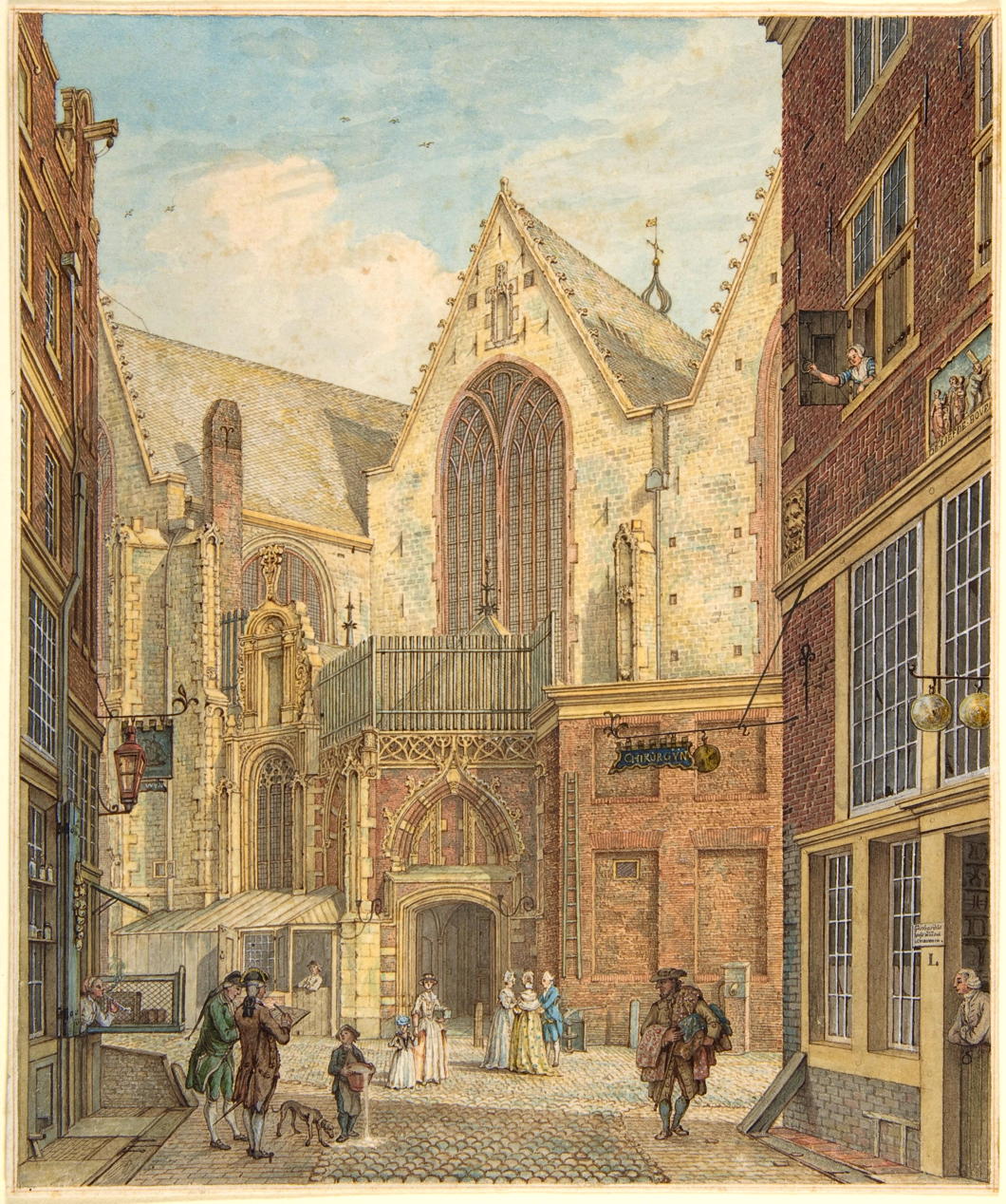
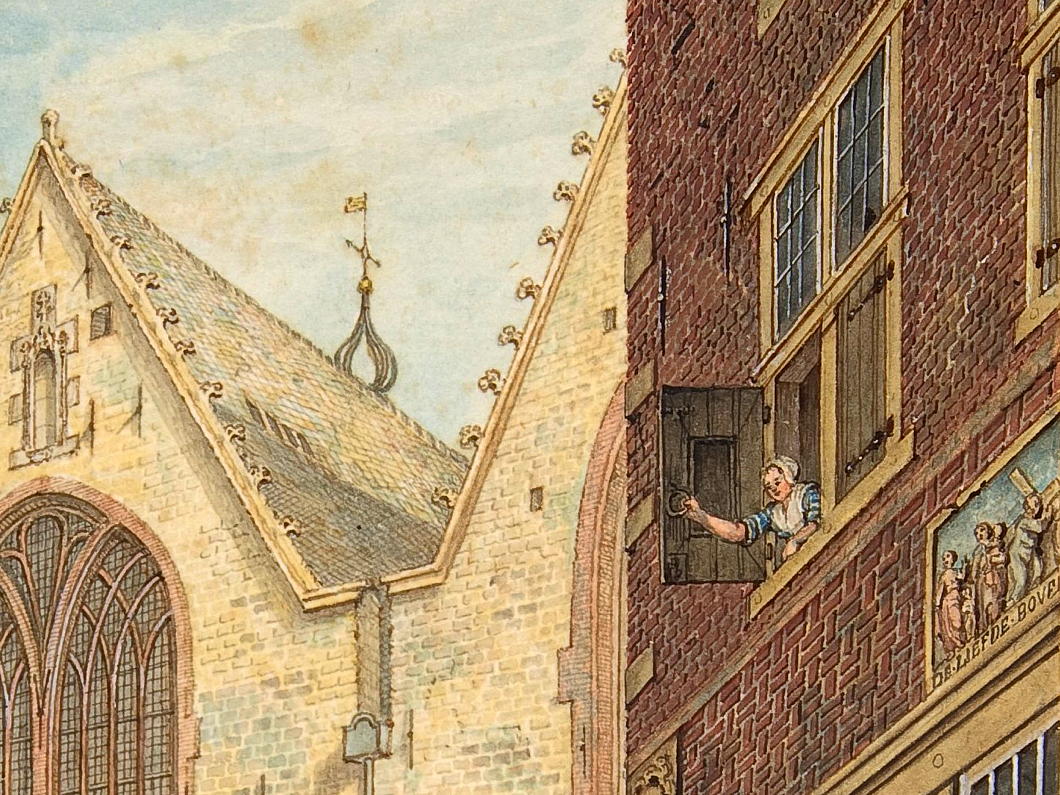
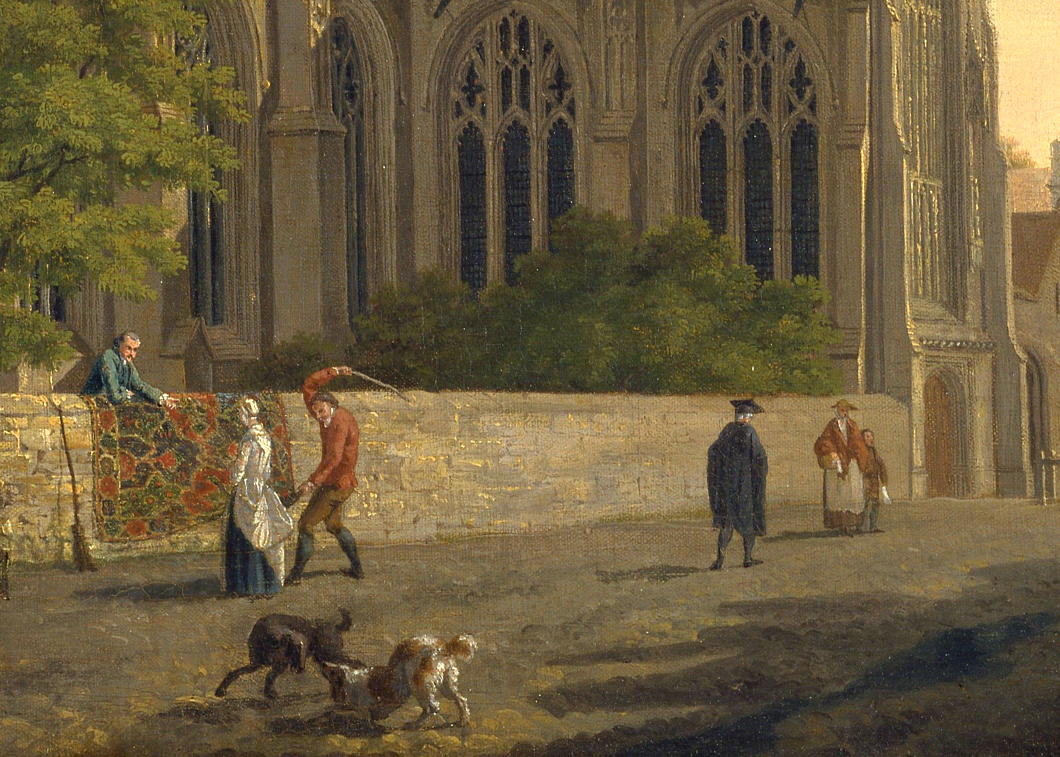
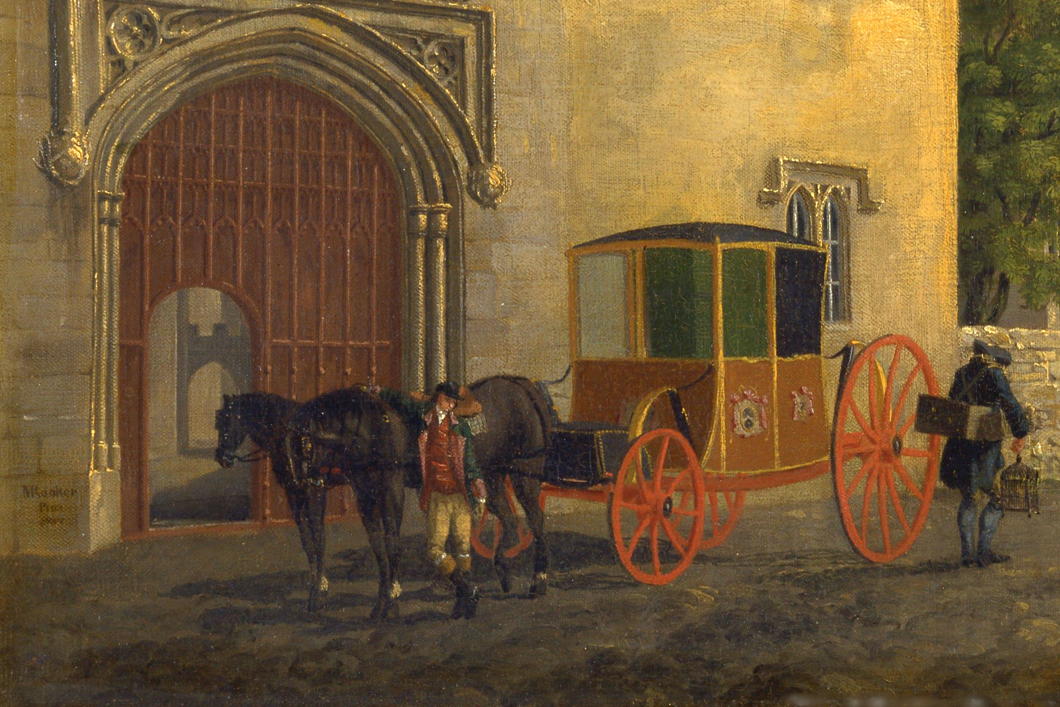
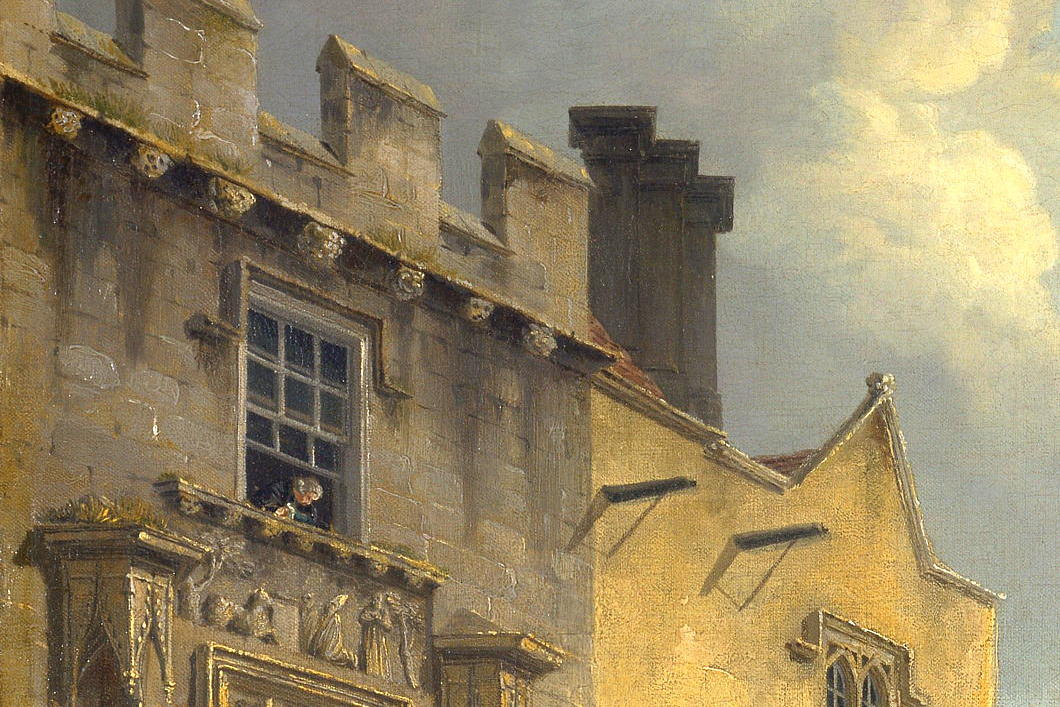
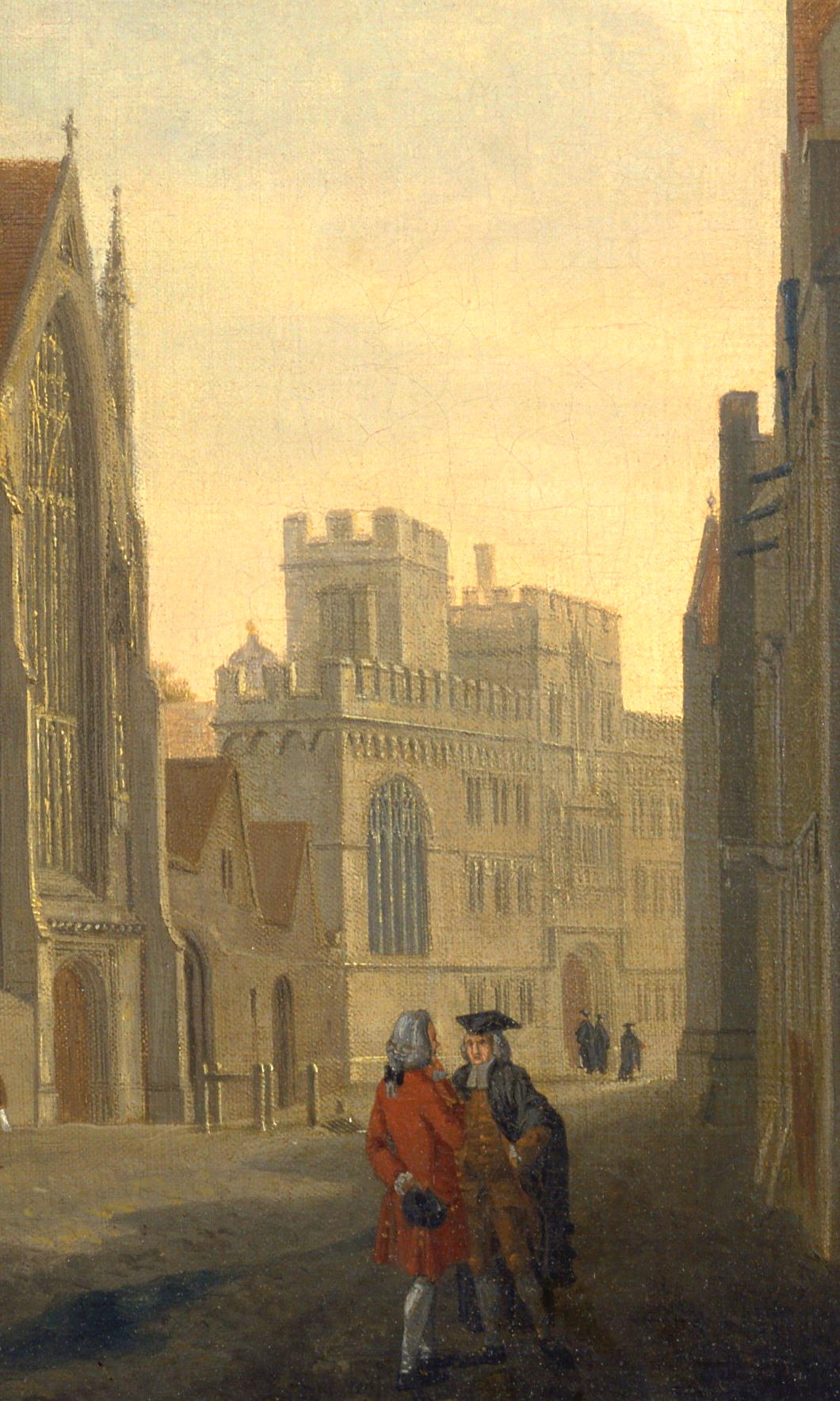
Aside from rendering the architecture well, townscapes from the eighteenth century often give delightful little hints of city life. Michael Rooker (1746–1801) painted this scene of Merton College from its eponymous street in 1771, and the view today is hardly changed at all.
One of my favourite cityscapes is Canaletto’s view of the back end of Downing Street looking towards the old Horse Guards which you can pop into the Tate and see thanks to the generosity of Lord Lloyd-Webber. Incidentally, both scenes depict carpets being hung out for beating.
If you love the capital of the Netherlandosphere I recommended adding to your library Kijk Amsterdam 1700-1800: De mooiste stadsgezichten (‘See Amsterdam 1700-1800: The Most Beautiful Cityscapes’), the well-produced catalogue of the 2017 exhibition of the same name at the Amsterdam City Archives which includes 300 illustrations in full colour.
It’s high time the Museum of Oxford or the Ashmolean — or anyone really — put together a similar exhibition of Oxford cityscapes from the same century.
Incidentally, it was in Merton Field as a teenager that I played my first game of cricket. Who would have guessed then that eighteen years later your humble and obedient scribe would be facing the Vatican on the field of battle in the same sport? (We lost.)
London Visitors
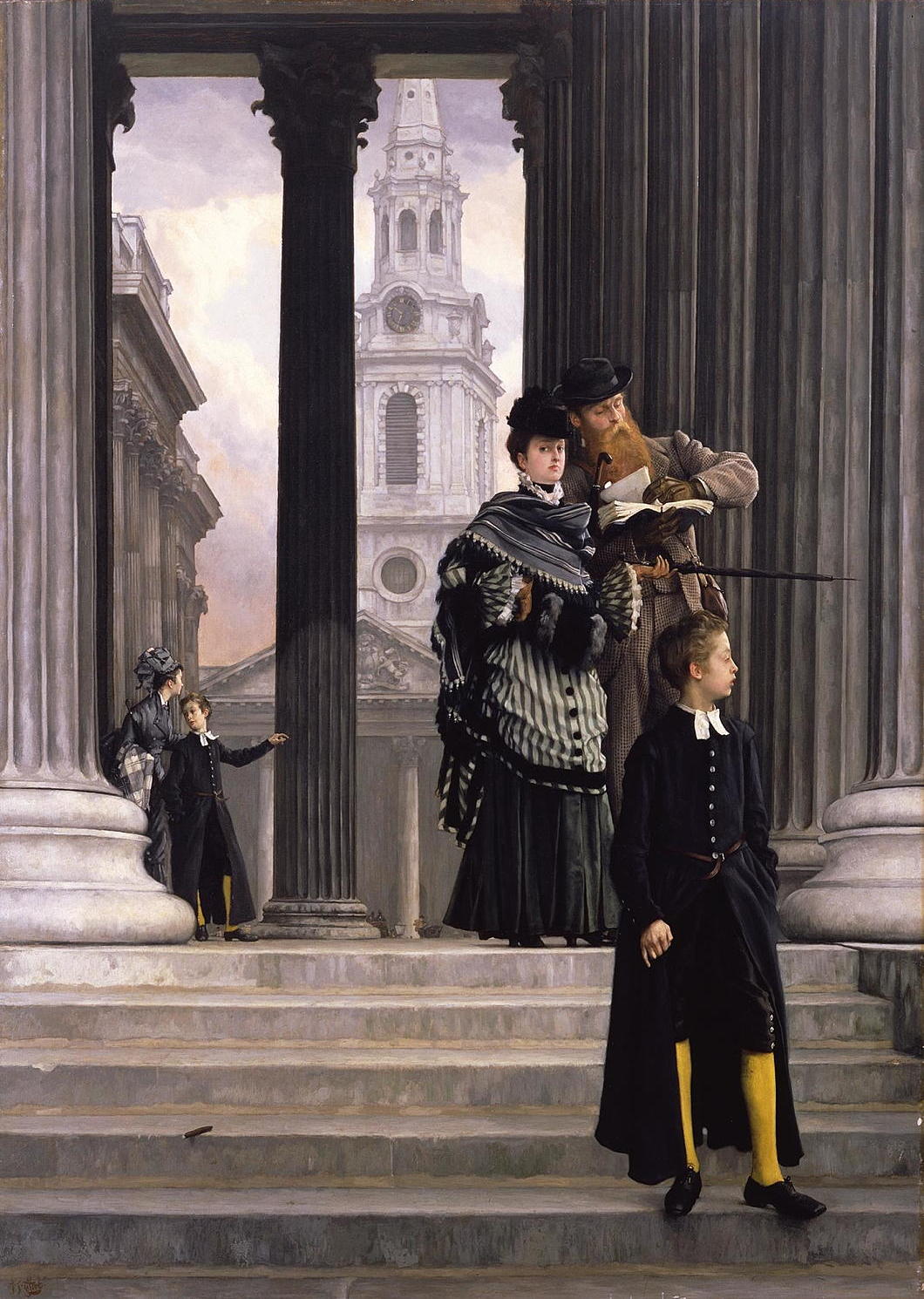
1874, oil on canvas, 63 x 45 in.
Happily, the Tudor-era uniforms are still in use there and are the hallmark of the school to this day.
The visiting couple are obviously in from the provinces, and the woman gazes daringly at the viewer.
I wonder if the cigar on the steps was left for a moment by the artist as he dashed to take this snapshot.
The Galloway Cross
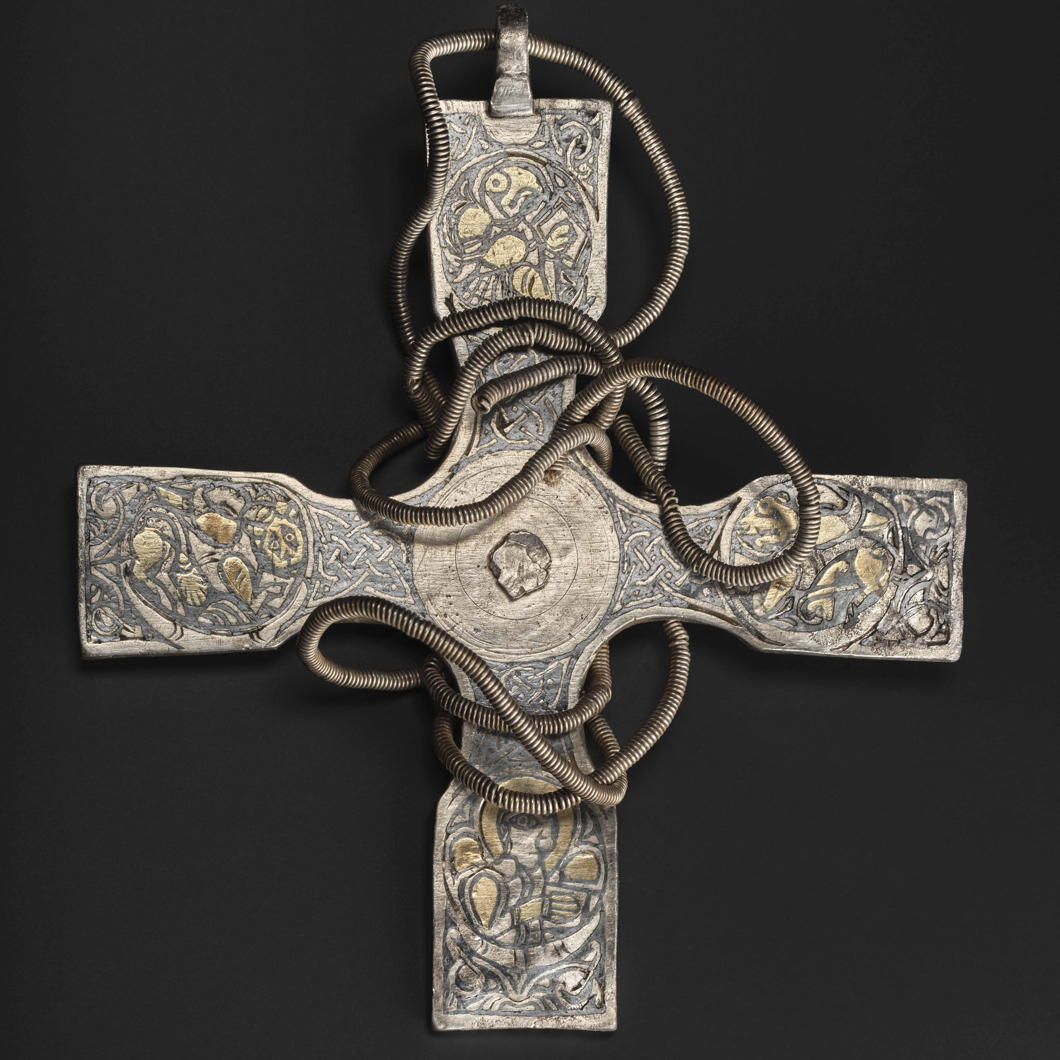
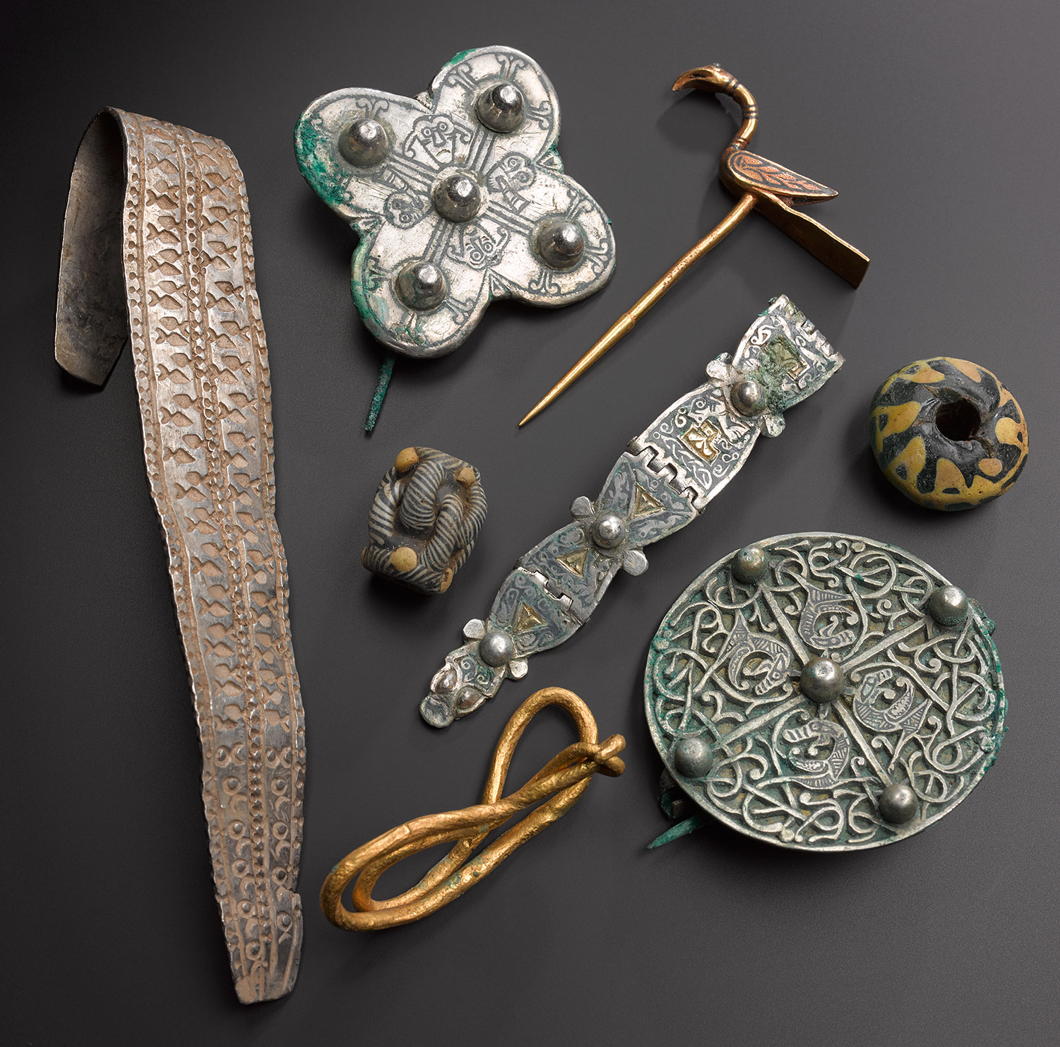
What could be better than a hoard — and a Kircudbrightshire hoard at that? Sometime during the tenth century, a gentleman decided to deposit an interesting array of objects in Galloway only for them to be rediscovered by a metal detectorist in 2014.
Thus have come to us the Galloway Hoard, a collection of objects the most important of which is this pectoral cross made of silver and decorated with symbols of the four evangelists: the eagle of John, the ox of Luke, the angel of Matthew, and the lion of Mark.
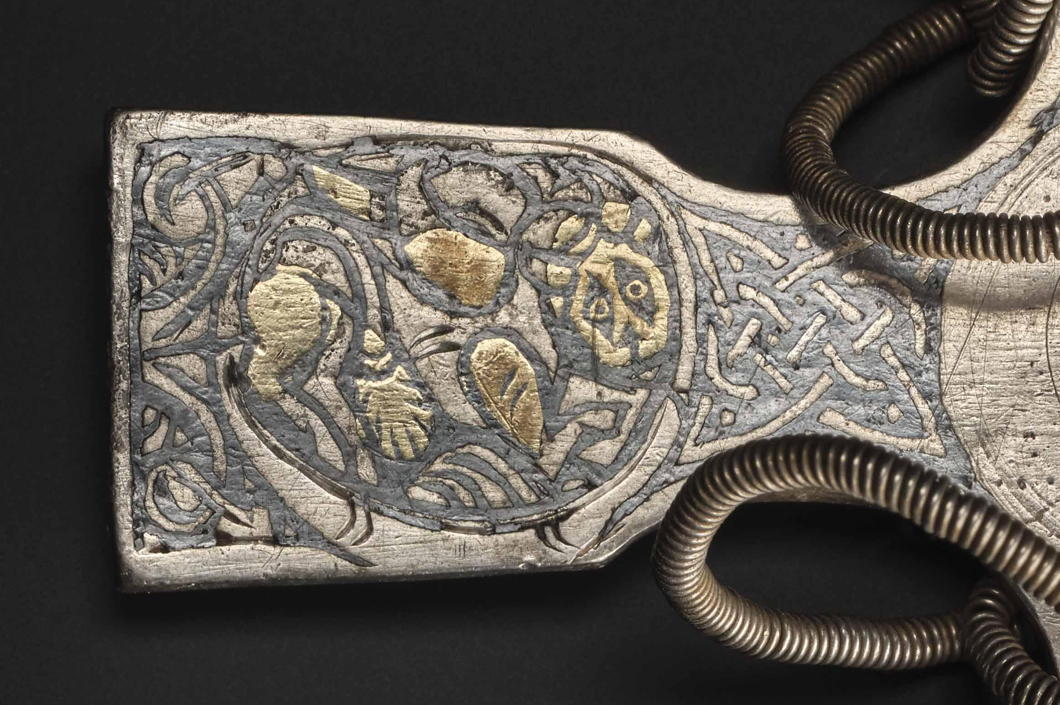
As the hoard was buried when Kircudbrightshire was part of Northumbria — before the area became Scottish — the art has been identified as Anglo-Saxon from the age of the Vikings. My theory is an expert thief was at work, nicking precious objects from hapless victims — an armband gives the name of one poor Egbert in runes.
“The pectoral cross, with its subtle decoration of evangelist symbols and foliage, glittering gold and black inlays, and its delicately coiled chain, is an outstanding example of the Anglo-Saxon goldsmith’s art,” Dr Leslie Webster, an expert, said. “It was made in Northumbria in the later ninth century for a high-ranking cleric, as the distinctive form of the cross suggests.”
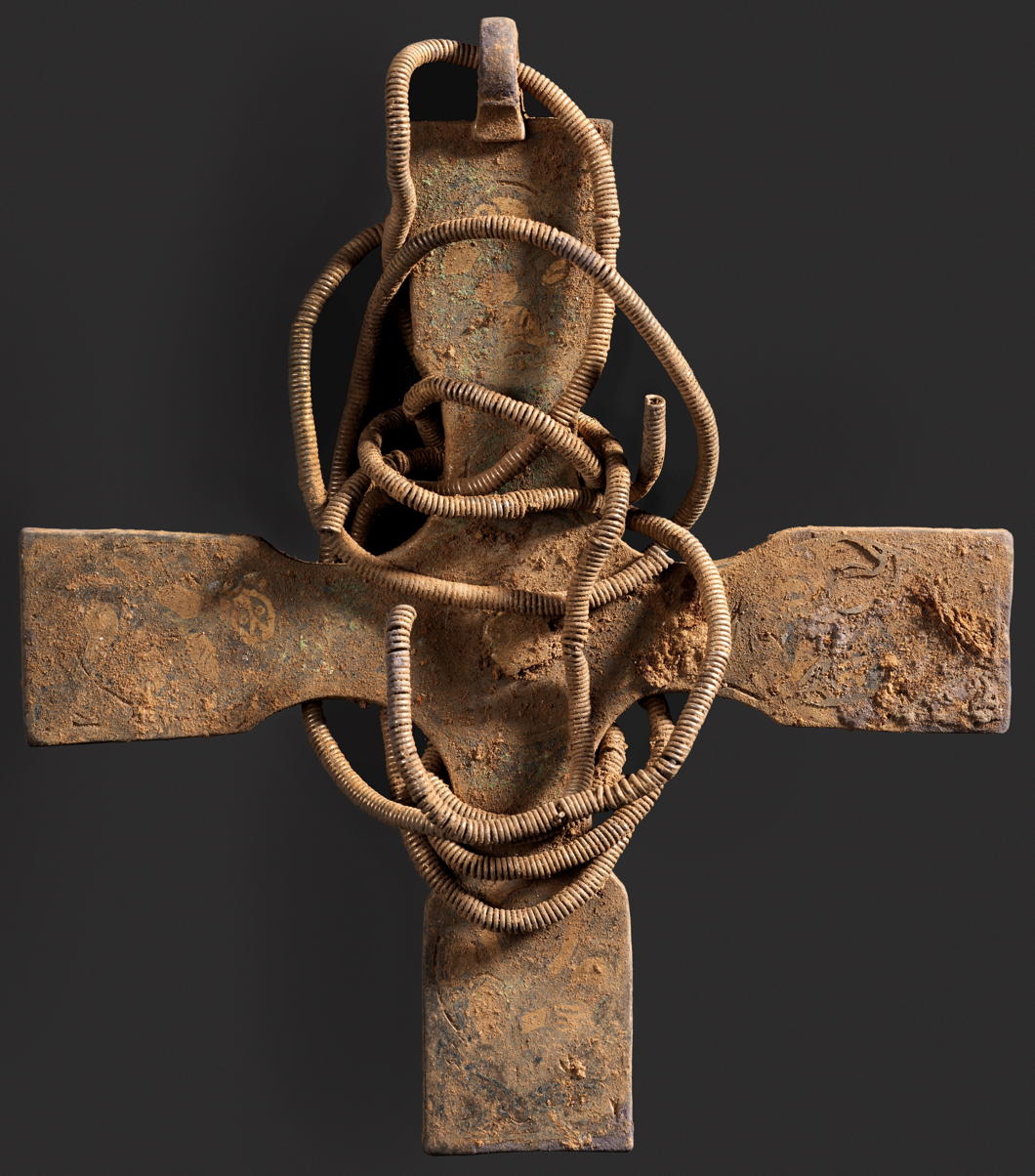
The Galloway Cross, before cleaning and conservation
All treasure found in Scotland must be reported to the Queen’s and Lord Treasurer’s Remembrancer who in 2017 determined the hoard’s value at £1.8 million. Scots law allows the discoverer to keep the full value of the hoard if there is no owner, though as it was found on glebelands belonging to the Church of Scotland that body’s General Trustees demanded a cut as well.
The objects themselves have found a home in the National Museum of Scotland who will be exhibiting them from February until May when they will go on tour to Aberdeen and Dundee.
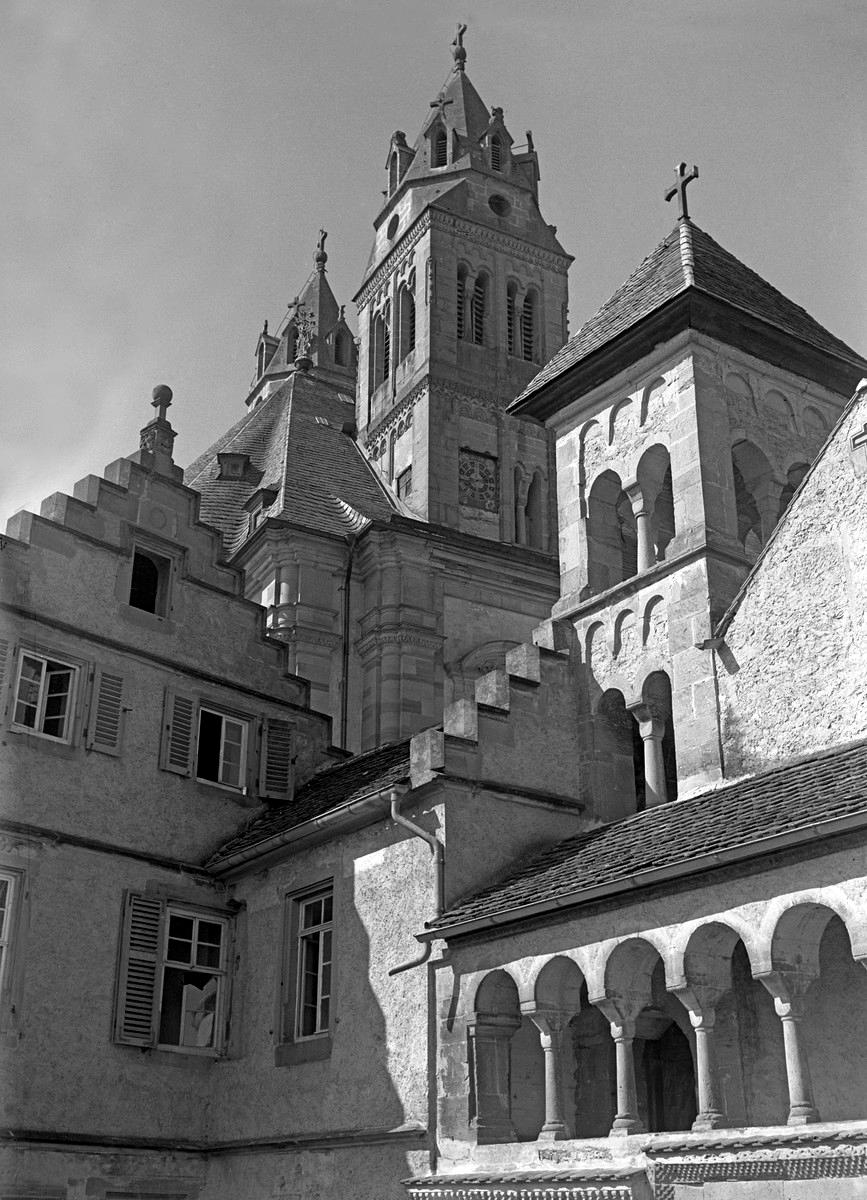
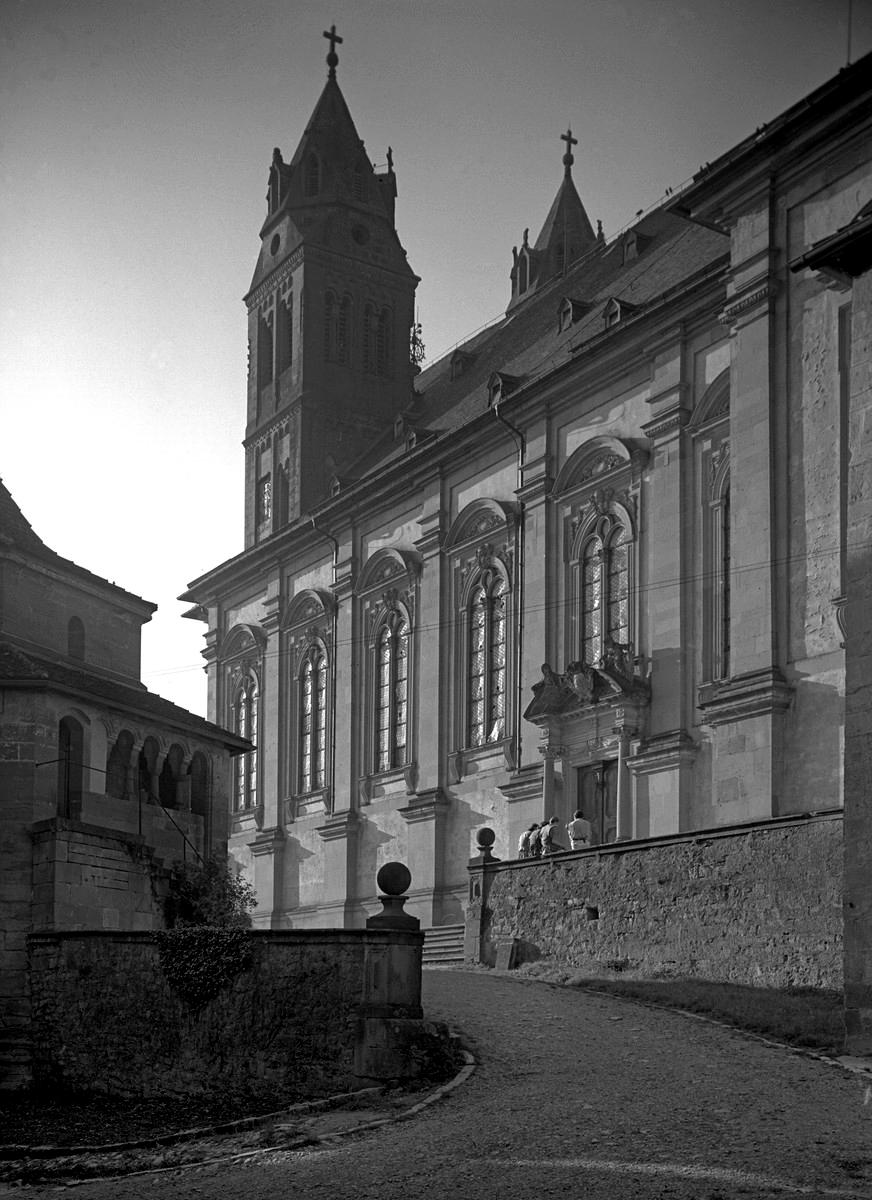
Großcomburg
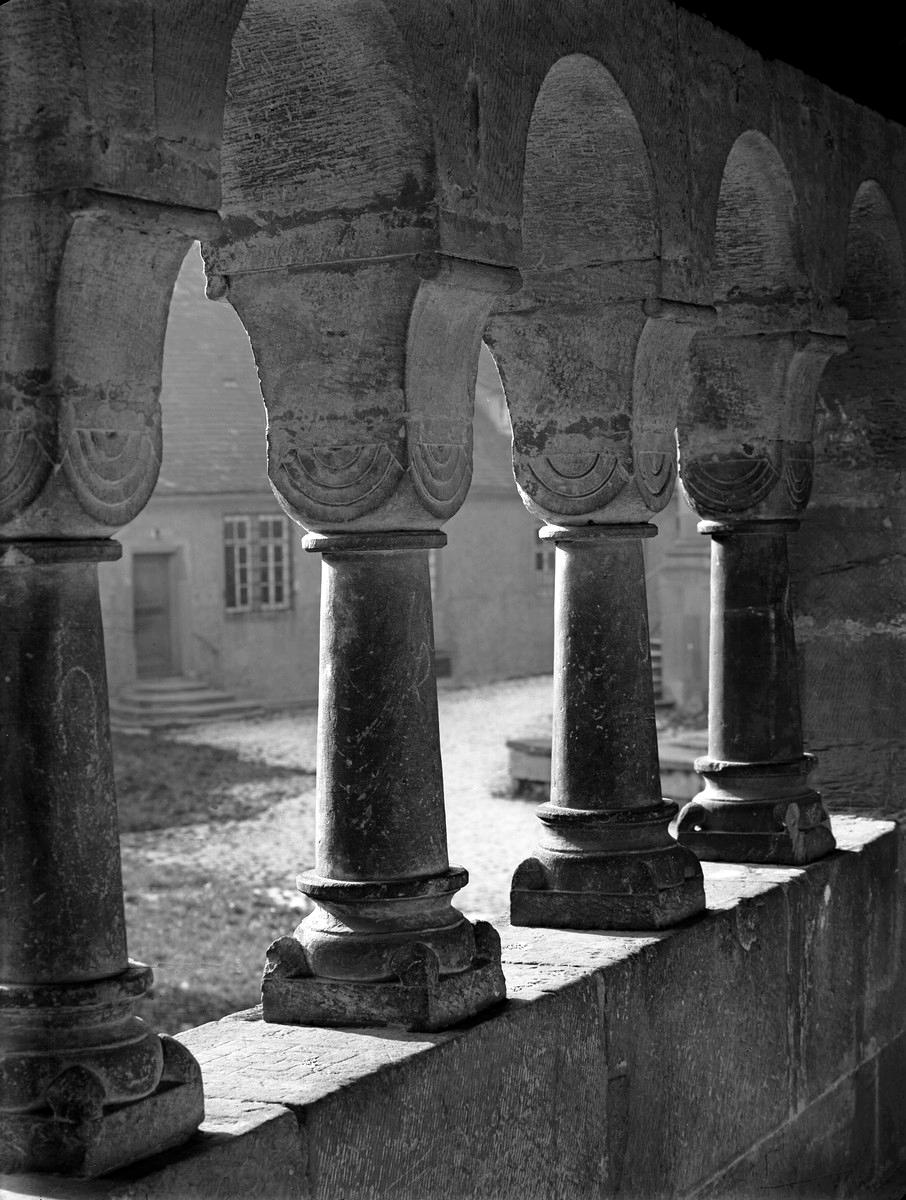
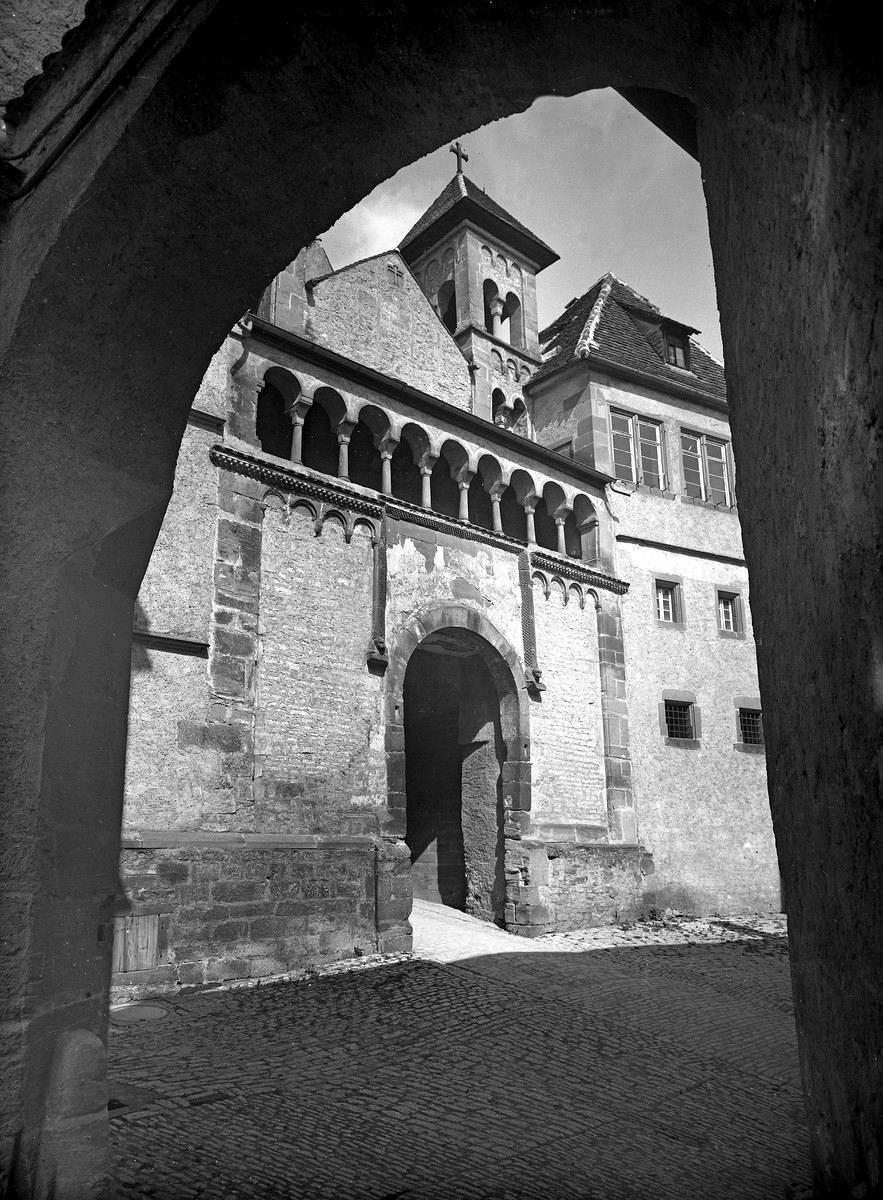
While the old basilica was demolished in the 1700s and replaced with a baroque creation there is still plenty of Romanesque abiding at Großcomburg in Swabia. The monastery was founded in 1078 and the original three-aisled, double-choired church was consecrated a decade later. Its community experienced many ups and downs before the Protestant Duke of Württemberg, Frederick III, decided to suppress the abbey and secularise it. Many of its treasures were melted down and its library transferred to the ducal one in Stuttgart where its mediæval manuscripts remain today.
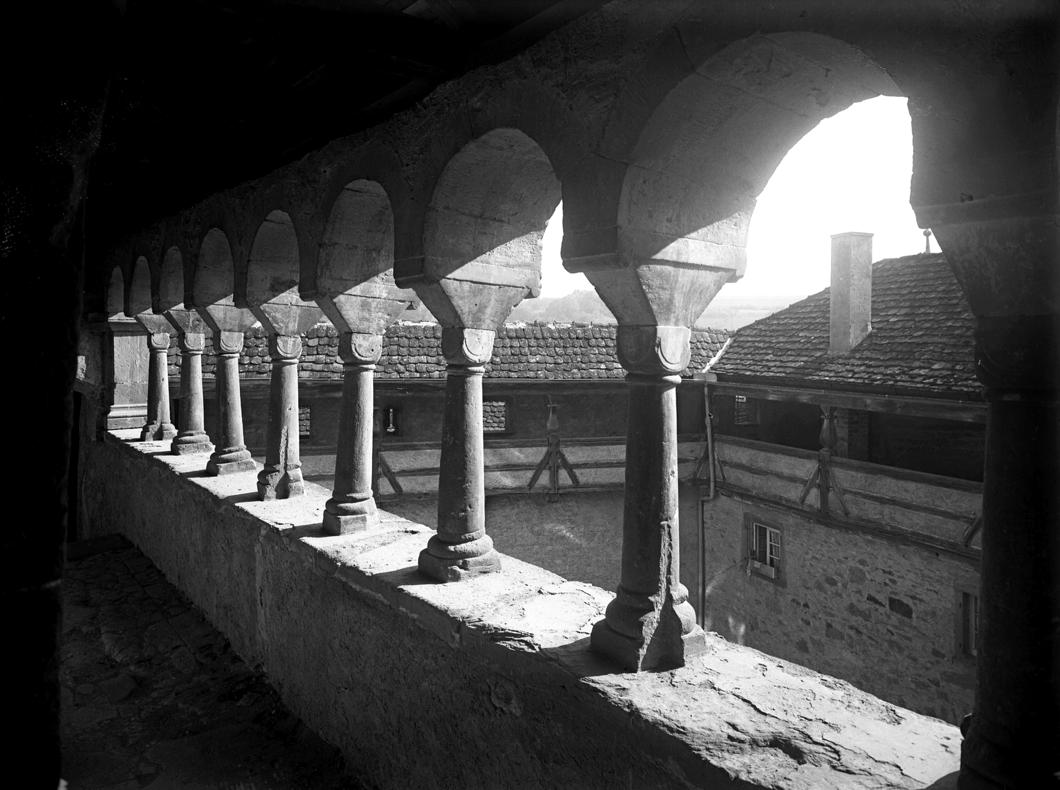
From 1817 until 1909 the abbey buildings were occupied by a corps of honourable invalids, a uniformed group of old and wounded soldiers who made their home at Comburg.
In 1926 one of the first progressive schools in Württemberg was established there, only to be closed in 1936. Under the National Socialists it went through a variety of uses: a building trades school, a Hitler Youth camp, a labour service depot, and prisoner of war camp.
With the war’s end it housed displaced persons and liberated forced-labourers until it became a state teacher training college in 1947, which it remains to this day.
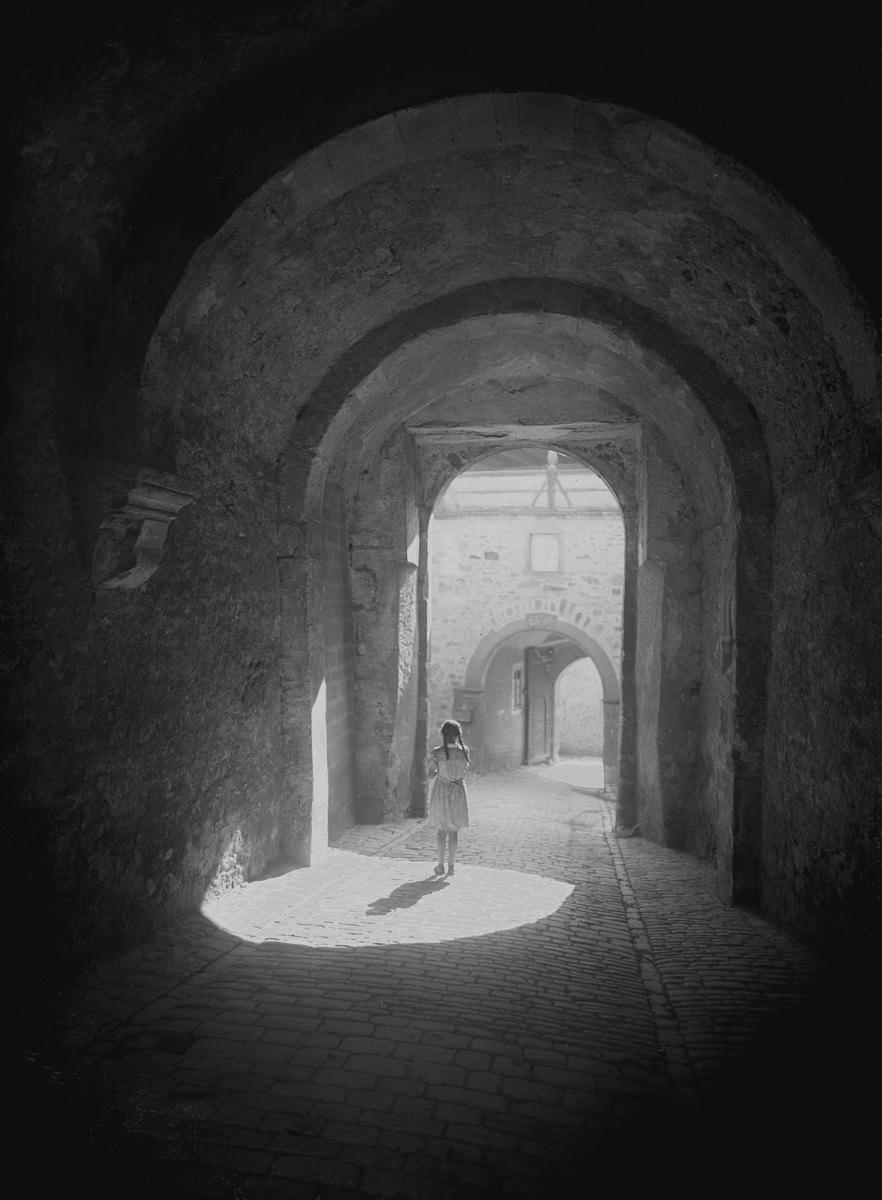
Black-and-white photography is particular suitable for capturing the beauty and the mystery of the Romanesque.
These images of Großcomburg are by Helga Schmidt-Glaßner, who was responsible for many volumes of art and architectural photography in the decades after the war.
Search
Instagram: @andcusack
Click here for my Instagram photos.Most Recent Posts
- Brunel’s Unbuilt Capitol February 3, 2026
- Cricket at Fordham January 27, 2026
- Palacio Barolo Revisted January 14, 2026
- Learning to Love Liguria January 14, 2026
- Crux Alba No. 2 January 13, 2026
Most Recent Comments
Book Wishlist
Monthly Archives
Categories