About Andrew Cusack
 Writer, web designer, etc.; born in New York; educated in Argentina, Scotland, and South Africa; now based in London.
 read more
News
Blogs
Reviews & Periodicals
Arts & Design
World
France
Mitteleuropa
Knickerbockers
Argentina
The Levant
Africa
Cape of Good Hope
Netherlands
Scandinavia
Québec
India
Muscovy
Germany
Academica
Druze Stirrings
The secretive sect that helped topple Assad
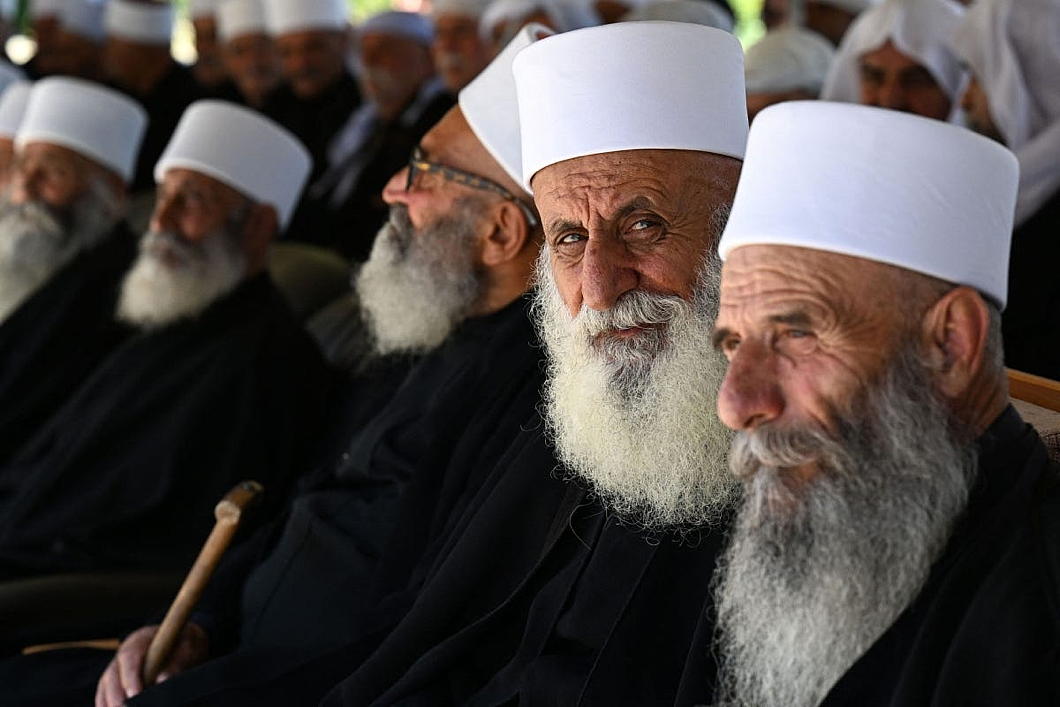
The Druze are an elusive people. During the few summers I spent in Lebanon I met Maronites, Melkites, Sunni, Shi’a, Armenians, and many others but I only recall knowingly meeting one Druze — and that’s a story for another day.
Druze beliefs are as secretive as they are distinct. Most file them as (for lack of a less judgemental word) a schismatic branch of Islam that emerged out of Isma’ilism; others argue that they are gnostics who took up the Islamic mantle to avoid oppression. Naturally they do not call themselves Druze, but muwaḥidūn, which more or less means ‘monotheists’ or ‘singularists’ — believers in the singularity of God. Ethnically, they are Arab, and migrated to the Lebanese mountains and Jabal al-Druze from south Arabia before the advent of Islam.
Christians have traversed the four corners of the globe in order to share the Gospel, but the Druze are completely at odds with this mentality. They are not bothered if you are uninterested in their religion: In fact, altogether they very much prefer you don’t ask too many questions because, frankly, they don’t want you to know. Since the closing of the daʿwa — the call to belief — in AD 1043, no converts may be accepted, nor can rituals or worship take place in public, and all marriage outside the community is prohibited.
There is only one famous Druze in the world: the perennial survivor of Lebanese politics, Walid Joumblatt. He ascended to the political headship of Lebanon’s Druze in 1977, succeeding his father Kamal as the leader of the Progressive Socialist Party — whose name elides the sectarian tribal nature of the entity as the outlet for political Druzism in the Lebanon — and maintained his leadership throughout the devastation of the fifteen-year civil war.
Joumblatt is an educated and entertaining fellow, sharing his holiday snaps on the Nile with pith helmet and parasol, mockingly comparing himself to Hercules Poirot.
Search
Instagram: @andcusack
Click here for my Instagram photos.Most Recent Posts
- Brunel’s Unbuilt Capitol February 3, 2026
- Cricket at Fordham January 27, 2026
- Palacio Barolo Revisted January 14, 2026
- Learning to Love Liguria January 14, 2026
- Crux Alba No. 2 January 13, 2026
Most Recent Comments
Book Wishlist
Monthly Archives
Categories