
About Andrew Cusack
 Writer, web designer, etc.; born in New York; educated in Argentina, Scotland, and South Africa; now based in London.
 read more
News
Blogs
Reviews & Periodicals
Arts & Design
World
France
Mitteleuropa
Knickerbockers
Argentina
The Levant
Africa
Cape of Good Hope
Netherlands
Scandinavia
Québec
India
Muscovy
Germany
Academica
Cricket at Fordham
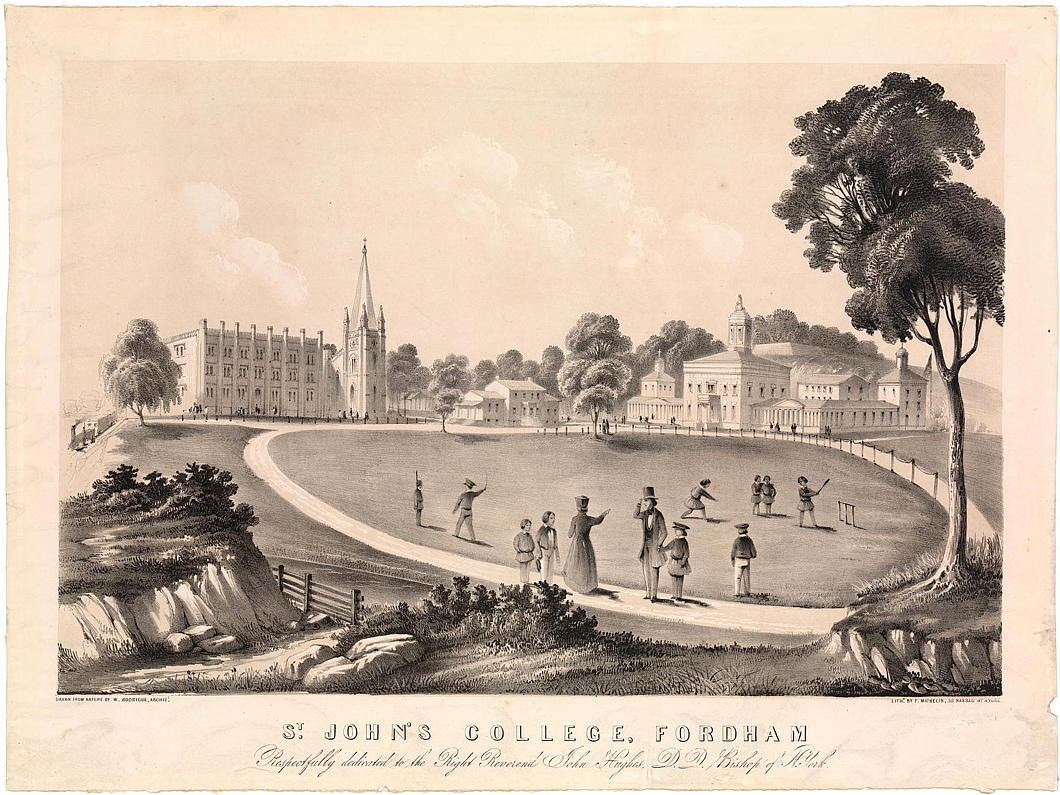
Because it was eclipsed by baseball, an infinitely more indigenous pastime, people often forget that cricket was quite a widespread and popular sport in the United States. It wasn’t until the Civil War that baseball really took over, aided by its shorter play time and the wider national mood. (Doubtless someone has, or will, write a scholarly article on this.)
It survived a few generations more as something of an elite sport, more strongly in Philadelphia and its environs, as well as in colleges and universities. The interwar period pretty much killed it off, only to be revived in interest amongst Americans by seeing it played by urban immigrant communities from the West Indies and the Subcontinent. The last time I checked there was even a cricket oval being laid out on the banks of the Mohawk river, across from the farm Jan Pieterse Mabee purchased from Daniel Janse Van Antwerpen in 1705.
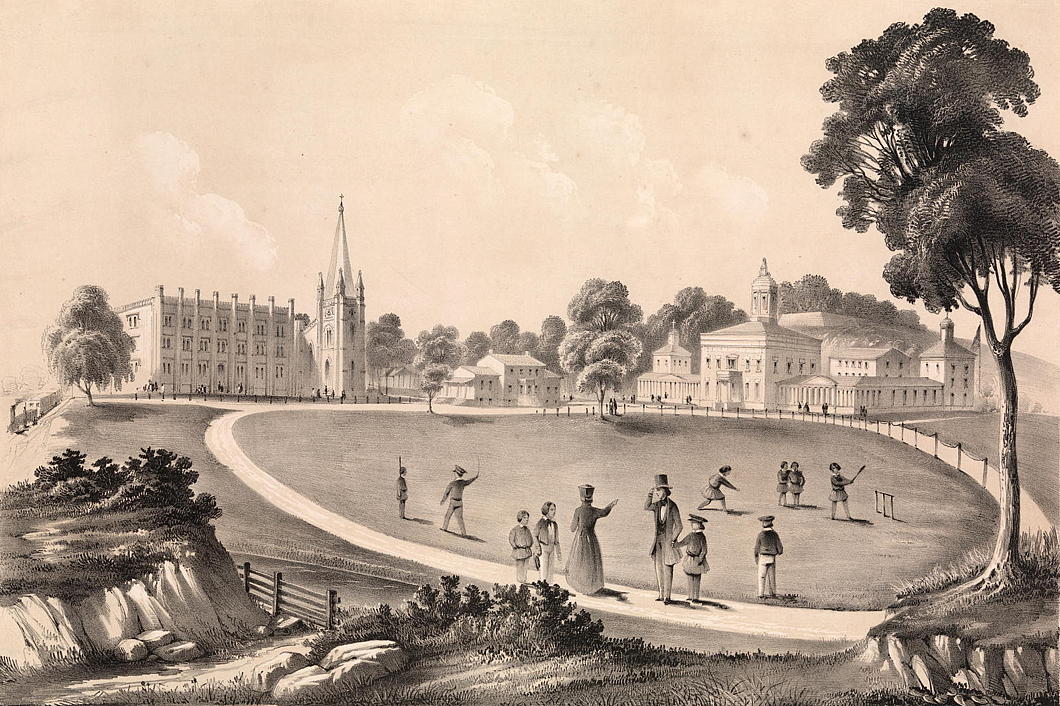
This charming rustic scene shows children playing cricket on the grounds of St John’s College, Fordham, with a priest speaking to a gentleman out on a constitutional with his son. As the college advertised itself in an early prospectus:
This institution, incorporated with the privileges of a university by an act of the Legislature, is situated near the village of Fordham, in a most picturesque and healthy part of the county of Westchester, at a distance of about eleven miles from the city of New York and three from Harlem. It is of easy access at any season of the year, by private conveyance or by the railroad, which passes immediately along the borders of the beautiful lawn in front of the college. The buildings are large, elegant and commodious; the grounds extensive and tastefully laid out.
This part of the Bronx remained within Westchester until 1874, when the parts west of the Bronx River were added to New York County. The remainder of the Bronx was ceded in 1895 and was created a borough of the consolidated City of New York in 1898, though only erected as its own county in 1914 (minus Marble Hill, which is another story entirely).
The engraving was drawn by William Rodrigue, a Philadelphia architect who later became associated with New York’s James Renwick, the designer of Grace Church and St Patrick’s Cathedral. Rodrigue auspiciously married the sister of one Fr John Hughes, who became Bishop of New York in 1842 — and the first Archbishop when the see was raised to metropolitan status in 1850.
St John’s College, now Fordham University, was one of Hughes’ pet projects, and perhaps unsurprisingly Rodrigue was chosen to design many of the earliest college buildings on the former Rose Hill estate, in addition to teaching mathematics, geometry, and drawing. He lived with his family in an outbuilding on the estate that now houses a coffee shop named “Rod’s” in his honour and his sons were among the earliest students of St John’s.
The first buildings Rodrigue completed were the chapel and the residence, the latter of which is still known as St John’s and forms one of the three sides of Queen’s Court, now a residential college within the university. The chapel benefited from stained-glass windows donated by the King of France for the (currently flourishing) old St Patrick’s Cathedral but which were found to be the wrong size and so incorporated into what is now the University Church.
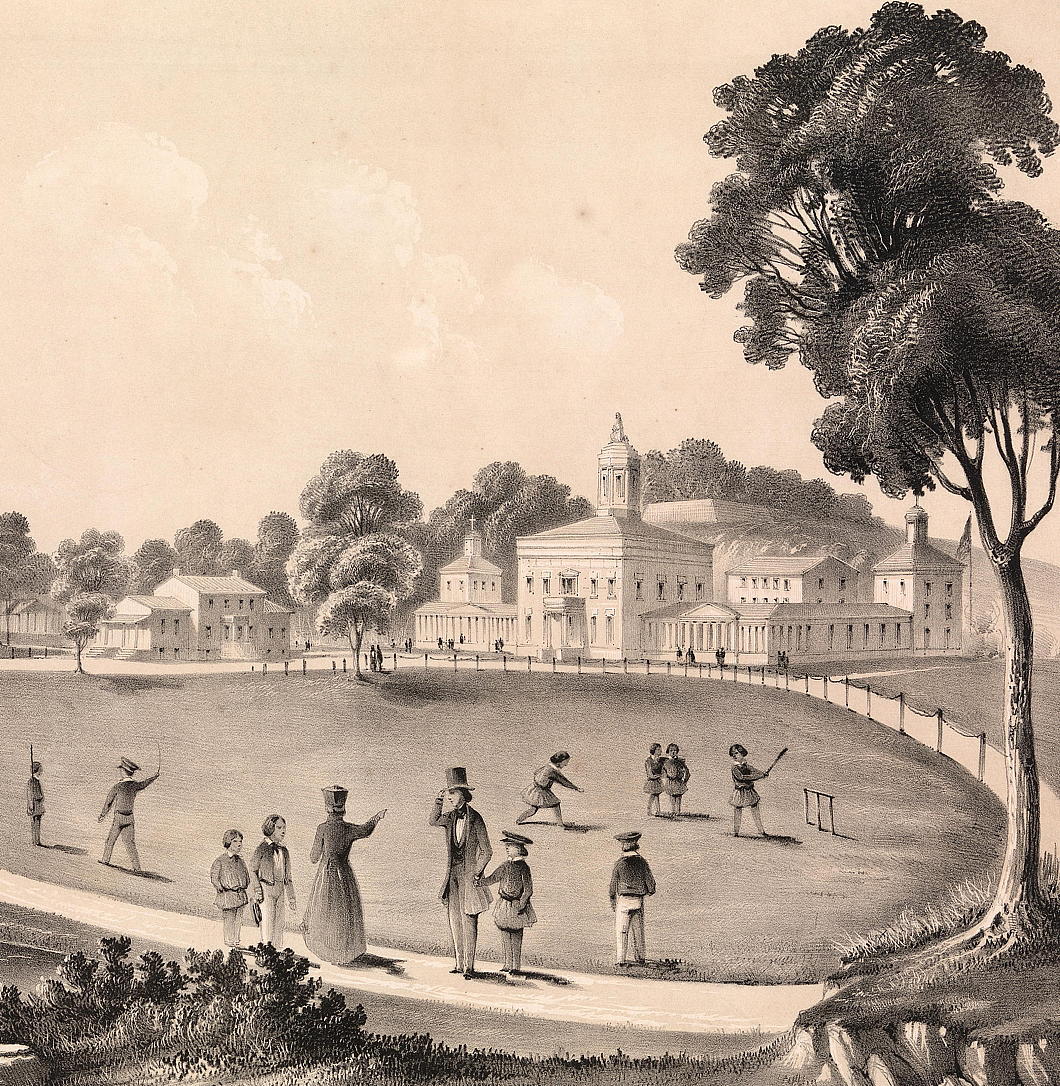
The building in the right background of the view was the main house of the Rose Hill estate purchased by Bishop Hughes. For a long time it was known as the Administration Building or the Manor House, though as it dates from the 1830s it has no direct connection to the Manor of Fordham granted to Jan Arcer by Governor Lovelace in 1671 (other than sitting on the land of it). More recently it was renamed Cunniffe House thanks to the generosity of Maurice J. “Mo” Cunniffe, Fordham Class of 1954. The wings have been much altered but the central block of the house remains largely intact.
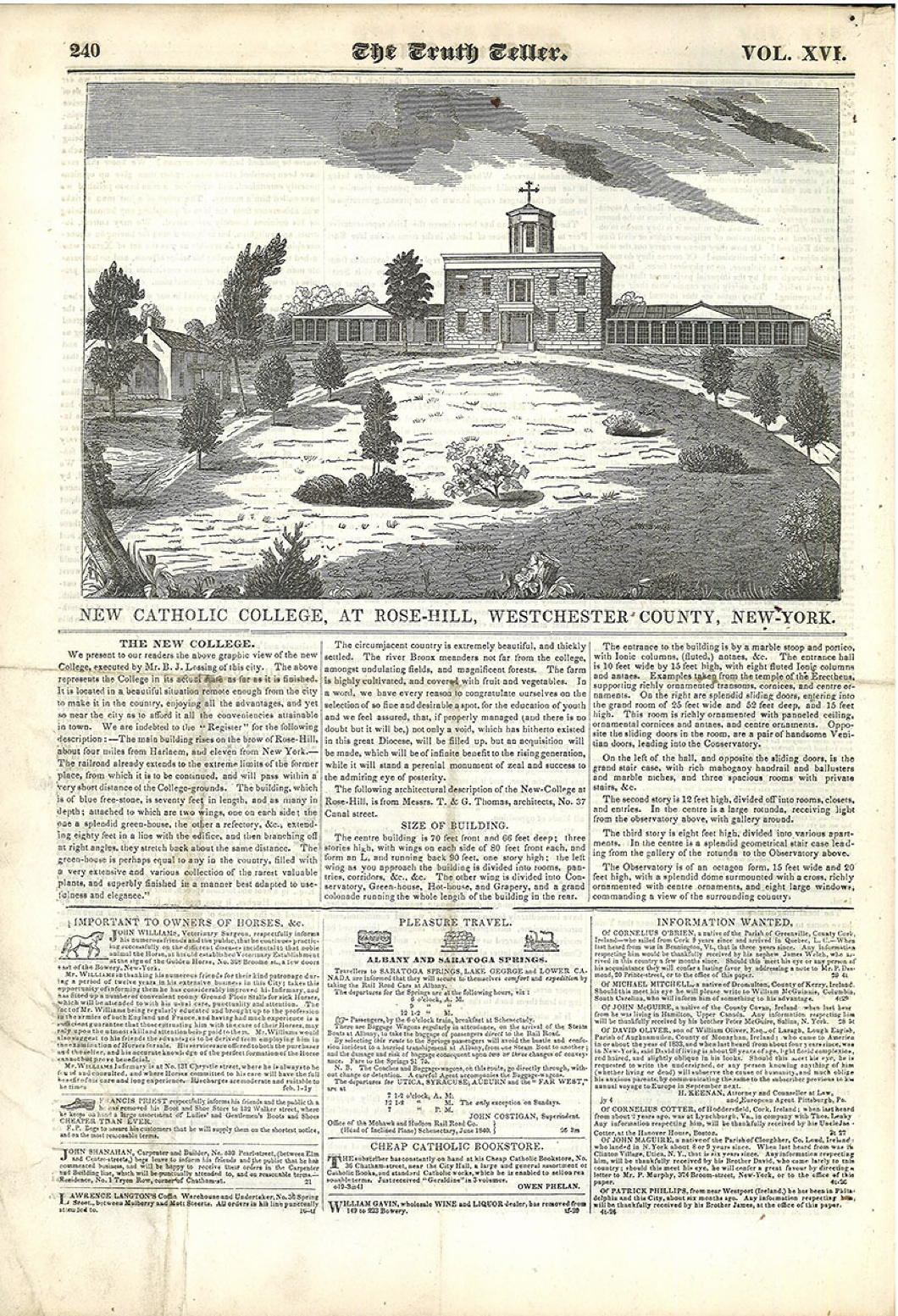
In 2019, the university’s emeritus professor of history, Dr Roger Wines, discovered the earliest known image of the institution while sifting through periodicals at the Philadelphia archdiocese’s research centre.
“It is located in a beautiful situation remote enough from the city to make it in the country,” the accompanying text in The Truth Teller, an early Catholic newspaper of New York, explained, “enjoying all the advantages, and yet so near the city as to afford it all the conveniences attainable in town.”
“The circumjacent country is extremely beautiful,” it continues. “The river Bronx meanders not far from the college, amongst undulating fields, and magnificent forests. […] We have every reason to congratulate ourselves on the selection of so fine and desirable a spot for the education of youth.”
The writer assures the college “will stand a perennial monument of zeal and success to the admiring eye of posterity”.
Search
Instagram: @andcusack
Click here for my Instagram photos.Most Recent Posts
- Brunel’s Unbuilt Capitol February 3, 2026
- Cricket at Fordham January 27, 2026
- Palacio Barolo Revisted January 14, 2026
- Learning to Love Liguria January 14, 2026
- Crux Alba No. 2 January 13, 2026
Most Recent Comments
Book Wishlist
Monthly Archives
Categories

This is an extremely interesting article, Andrew. I only visited the attractive campus once- in order to answer phones for a pledge drive for the Fordham radio station WFUV (90.7 FM).
Elderly Jesuits spend their last years in retirement at the Murray Weigel house on Campus. One of my former teachers at St. Peter’s Prep in Jersey City, Fr. Anthony Azzarto S.J., spent his last years at Murray Weigel Hall.
I graduated from Fordham in 1972. Part of its appeal was its location–easy access to Manhattan, but anchored in that section of the Bronx. I had the benefit of some excellent teachers–none of them Jesuits–during those years of tumultuous political upheaval.