2026 February
About Andrew Cusack
 Writer, web designer, etc.; born in New York; educated in Argentina, Scotland, and South Africa; now based in London.
 read more
News
Blogs
Reviews & Periodicals
Arts & Design
World
France
Mitteleuropa
Knickerbockers
Argentina
The Levant
Africa
Cape of Good Hope
Netherlands
Scandinavia
Québec
India
Muscovy
Germany
Academica
Brunel’s Unbuilt Capitol
Marc Isambard Brunel was raised in the ambience of the late ‘Enlightenment’ just as the cold yet optimistic certainties it proclaimed were descending into bloodshed and terror. Born in Normandy in 1769, Brunel père (we should distinguish him from his illustrious son) was originally destined for the priesthood.
Instead, he joined the French navy and served on a corvette that took him as far as the West Indies. By the time his ship returned in 1792 and its officers and men were paid off, the kingdom was in tumult.
Ostensibly, France was intoxicated by reason, mechanics, and geometry: the idea that society itself might be rationally engineered was only on the cusp of being discredited by the horrors of the French Revolution.
Brunel was living in Rouen but in January 1793, while Louis XVI was on trial for his life, he made a visit to Paris. An astute observer of human affairs, Marc was unwise enough to enunciate his — accurate, it turned out — prediction that Robespierre and his gang would soon meet a bloody downfall. His comments were reported to the network of spies serving the Terror, leaving Brunel a marked man.
He returned to Rouen and lived in some level of danger until he finally managed to obtain an exit permit from the revolutionary authorities. On 7 July 1793 he boarded a ship that arrived in New York harbour on 6 September.
The United States of America offered safety, novelty, and the promise (perhaps exaggerated) that talent alone might be all a young engineer needed to succeed. Marc Isambard Brunel taught drawing, proposed inventions, advised on naval matters, and tried (with some limited success) to attach himself to government patronage. He was restless, ambitious, and acutely aware that the republic was inventing itself in real time.
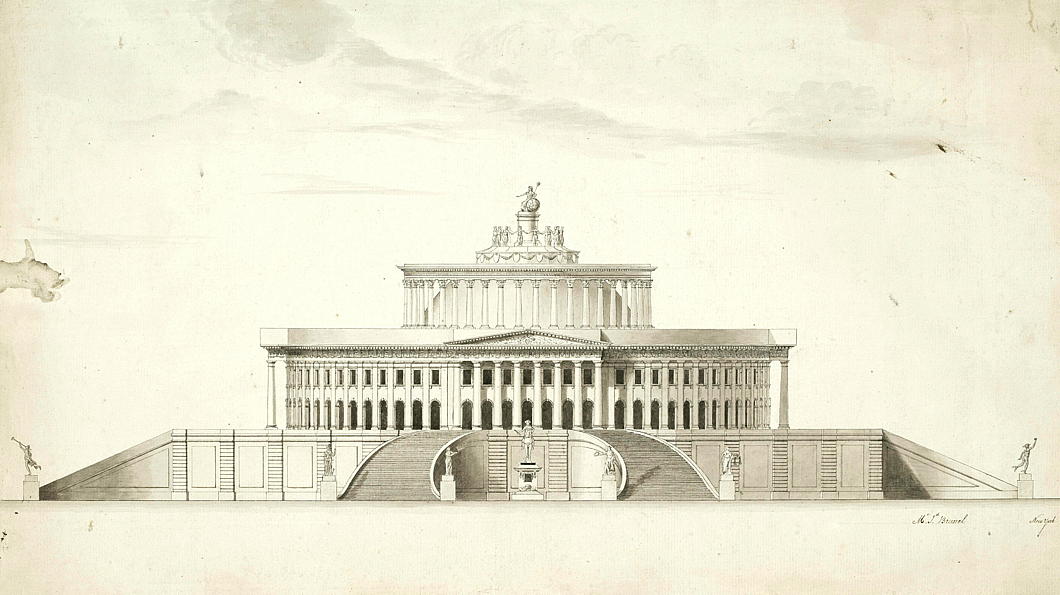
Just before Brunel’s arrival in America, the government put out a request for proposals for a permanent legislative building in the new federal city on the banks of the Potomac. Though the final schemes were already being worked upon, Brunel nonetheless decided to create his own proposal.
Washington in the 1790s was not yet the city of neoclassical monuments we know today — it was barely a city at all at that point — and the architectural language of the young nation had not yet been settled. Republican symbolism was valued, but no one quite agreed how it should look. The Atlantic colonies, in their domestic and public architecture, inherited a style of classicism from England that had developed into its own distinctive Anglo-American tradition.
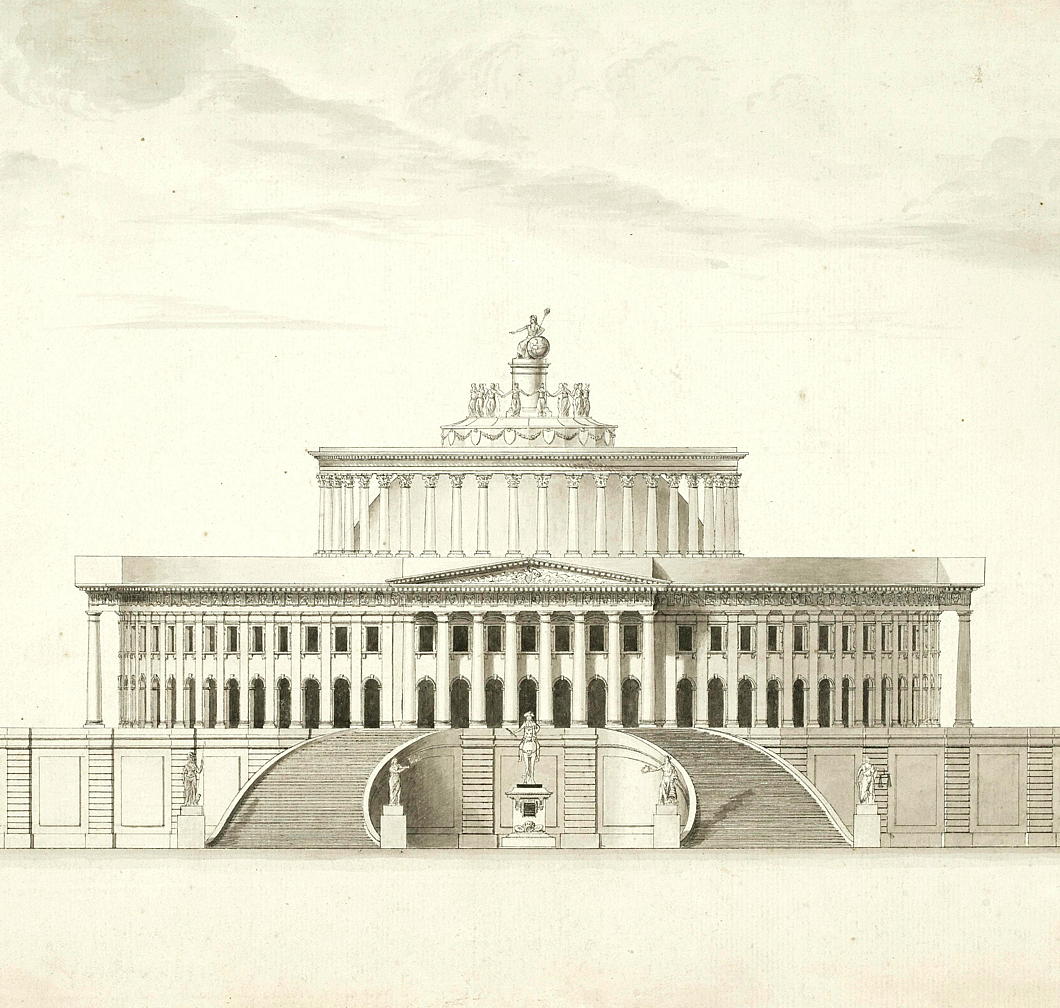
Into this uncertainty, Brunel offered a proposal that introduced something much more European. His proposal — only known to us through this sole surviving rendering later descriptions — centred on a vast circular form, a single dominant geometry intended to enclose the government within one unified space.
This was not the classicism of America’s recognised tradition but something else entirely. It owed little to the Georgian and less to Palladio. Its lineage ran instead through the paper architecture of Étienne-Louis Boullée, and, at an arm’s length, the built legacy of Claude-Nicolas Ledoux.
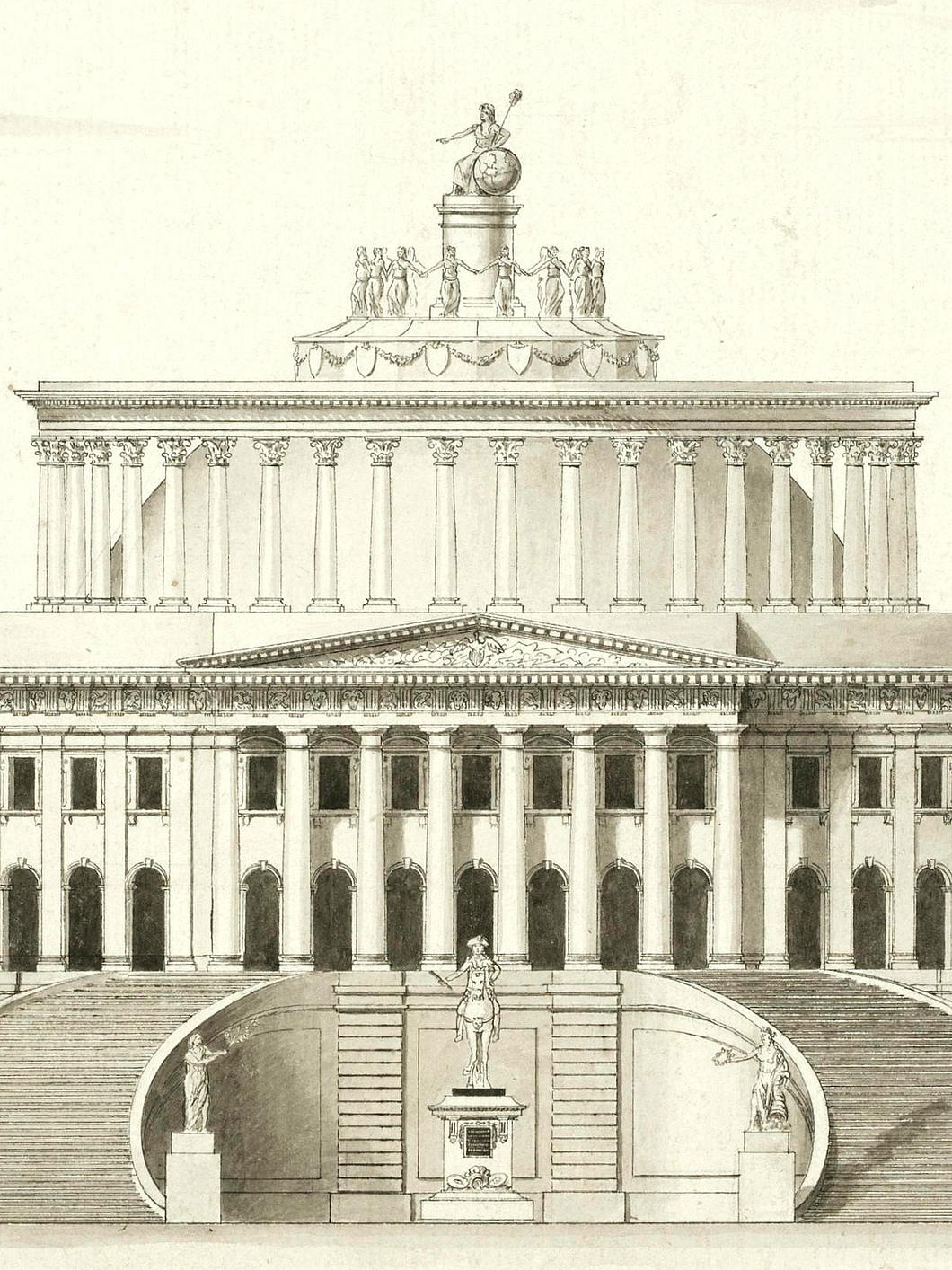
The influence is not subtle. Boullée’s great obsession was pure form — spheres, cubes, cylinders — deployed at overwhelming scale and laden with moral meaning. For Boullée, geometry was not decorative but ethical. The sphere promised unity, order, and universality. Brunel’s Capitol sits entirely within this tradition.
Without any surviving plans of the project we have no idea how Brunel proposed to arrange the House and Senate chambers and other aspects of the interior.
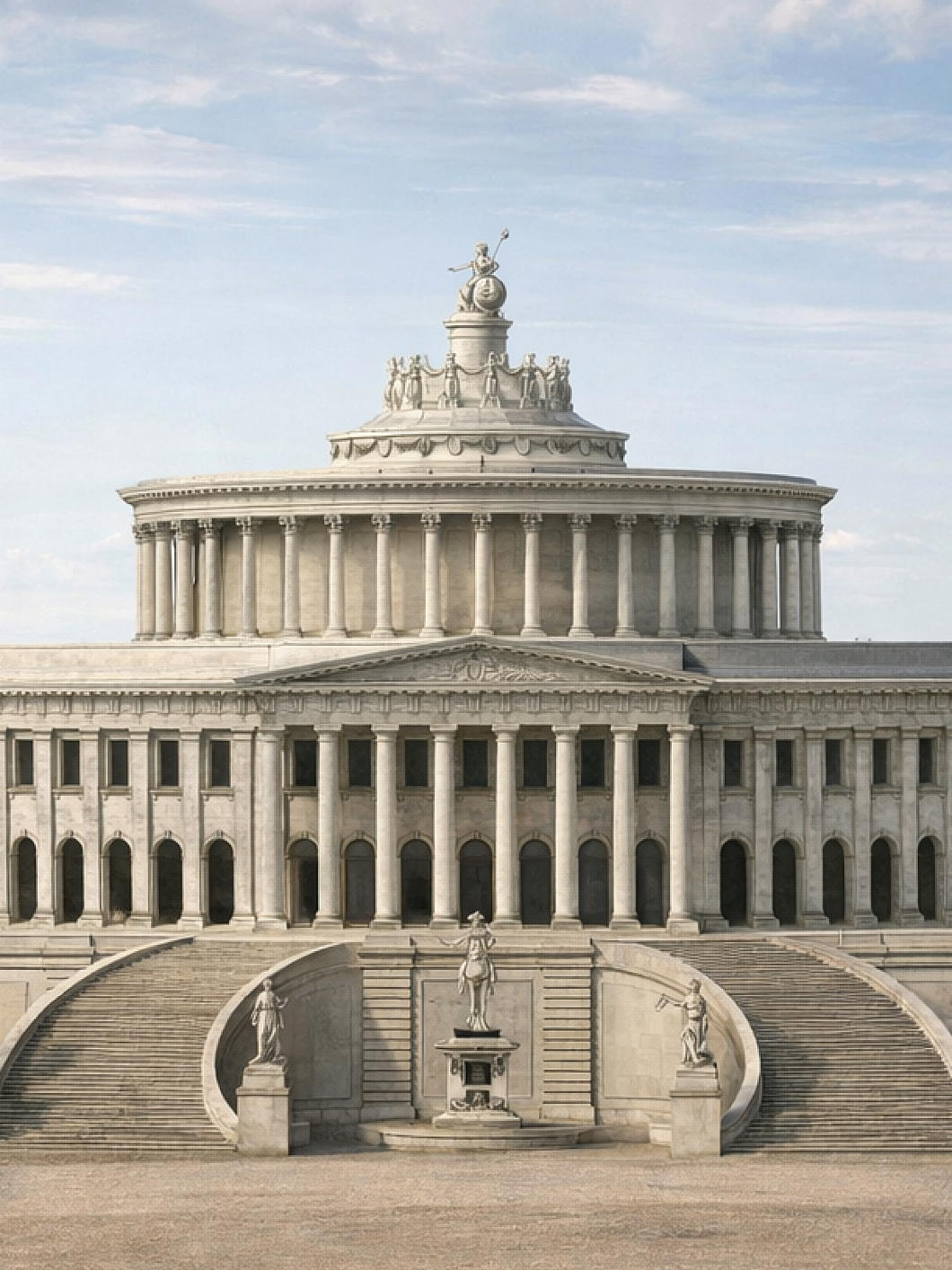
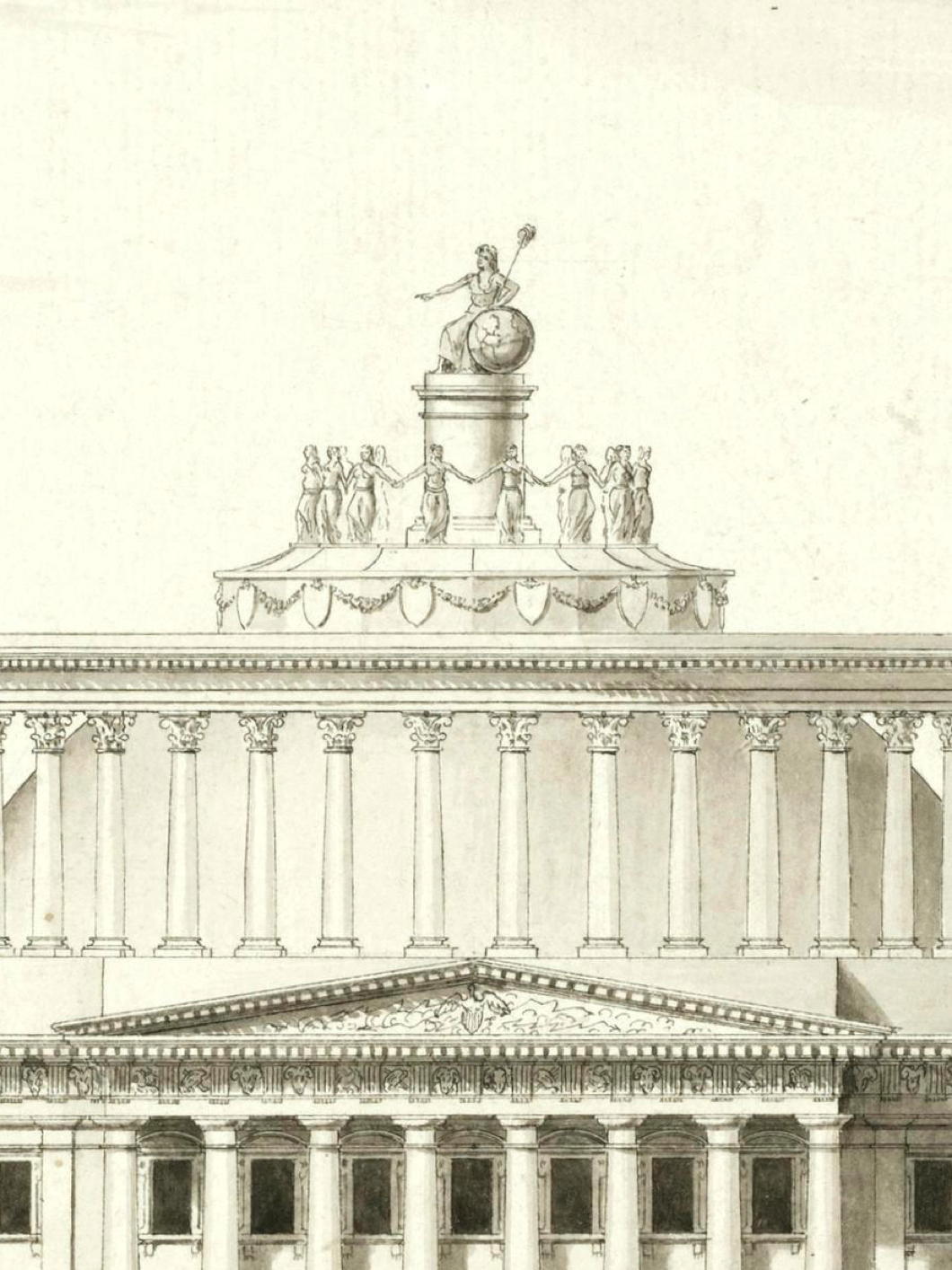
“It may seem surprising that a little-known twenty-seven-year-old alien could contend for the national shrine,” Paul Clements wrote in his biography of Marc Isambard Brunel, “but America was young, and the contestant was no brash backwoodsman.”
After all (Clements continues) Brunel “had sketched with minute detail the châteaux of Normandy, the civic buildings of Rouen, and much of the best Parisian architecture. He had, behind the artist’s eye, the brain of a mathematician, which could calculate the fit proportions of any buttress and subject visions to cold analysis. Above all, he had the craftsman’s innate understanding of materials.”
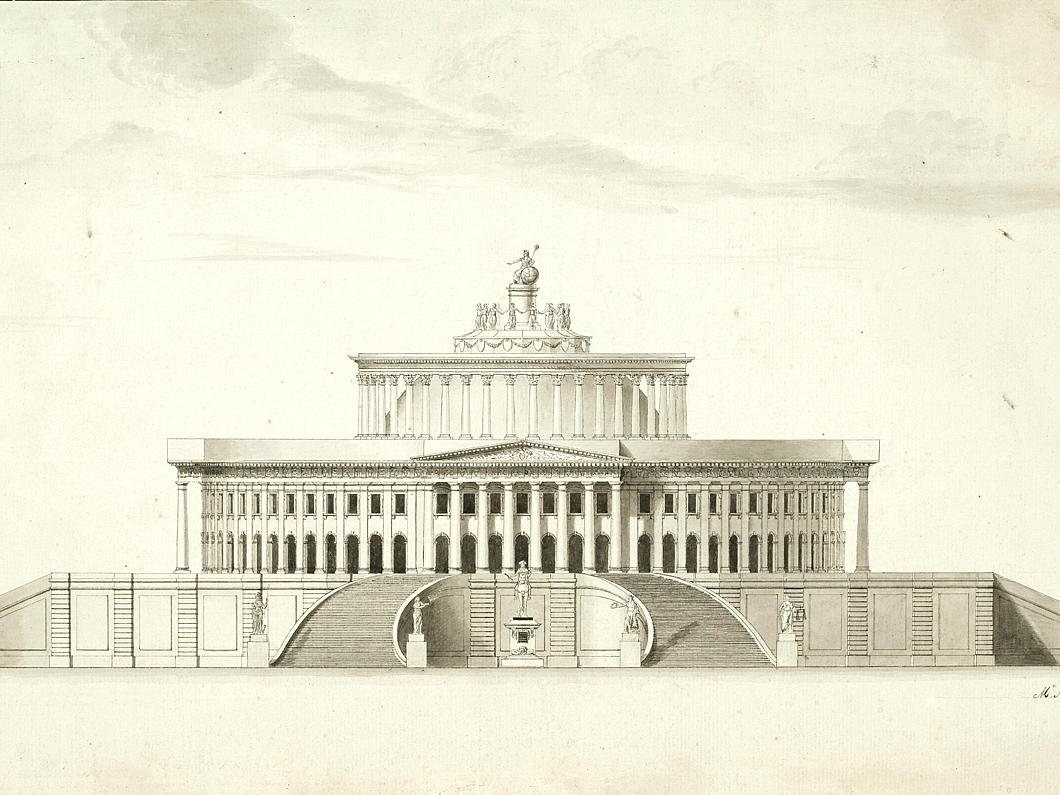
But what did the Americans make of it? “The judges pronounced it outstanding,” according to Clements, “and the intelligentsia of New York and Washington buzzed with delight. Unhappily the cost proved too high, even for Congress, and the plan was passed over.”
I am a little sceptical of these claims. Washington could hardly be described as having an ‘intelligentsia’ at this point and, despite his biographer’s assertion of accolades, the early American republic was wary of abstraction. It preferred architecture that could be read at a glance, that reassured by familiarity but with a sense of republican simplicity. The winning scheme by William Thornton (below), with Latrobe’s later refinements, wrapped the republic in an English interpretation of Roman dress.
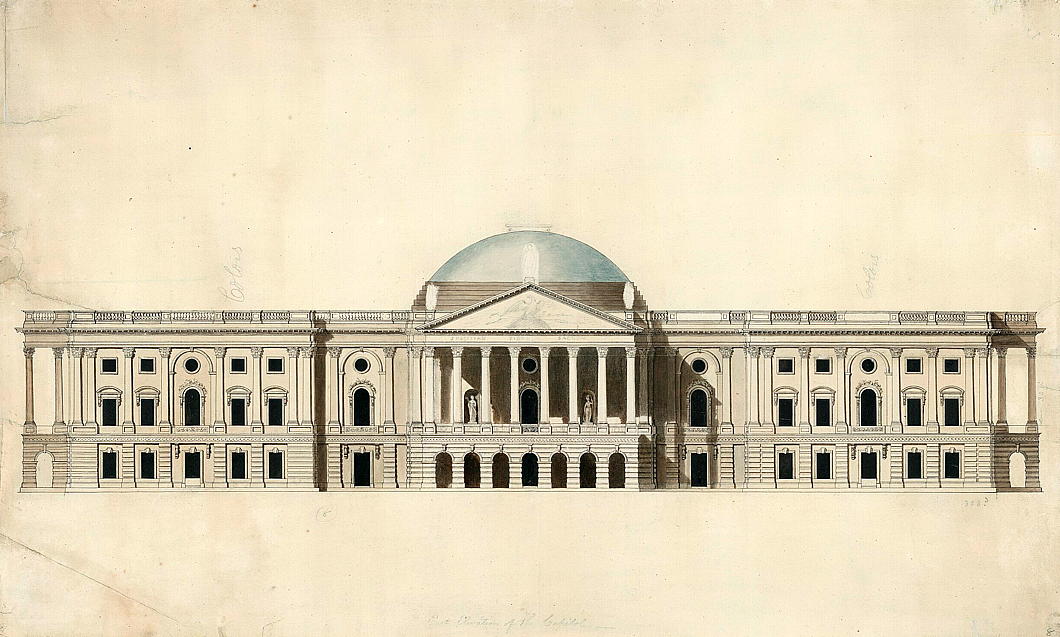
What’s more, no evidence has yet been discovered that Brunel even submitted his proposal to the deciding authorities. Researchers believe that most of the entries survive in the records of the Library of Congress and the Maryland Historical Society. As Brunel’s scheme is never mentioned in histories of the Capitol and the competition, it seems likely that the proposal lay forgotten for some time. This elevation was sold at auction in London for £10,625 in 2017 but the description makes no mention of its provenance.
That Brunel’s excellence lay elsewhere became clear soon enough. When he moved to Britain, it was engineering that he transformed rather than architecture, leaving behind docks, machinery, and tunnelling technologies that reshaped the industrial world. His son, Isambard Kingdom Brunel, took that inheritance and amplified it, building bridges, ships, and railways on a scale that matched the elder Brunel’s youthful appetite for grandeur.
Brunel had asked for the young republic to see itself not as ancient Rome reborn but as the Enlightenment rendered in stone. Congress’s decision to root itself in America’s inherited traditions, rather than pursue an ambitious experiment in geometric rationalism, proved a wiser course to set its future by.
Search
Instagram: @andcusack
Click here for my Instagram photos.Most Recent Posts
- Brunel’s Unbuilt Capitol February 3, 2026
- Cricket at Fordham January 27, 2026
- Palacio Barolo Revisted January 14, 2026
- Learning to Love Liguria January 14, 2026
- Crux Alba No. 2 January 13, 2026
Most Recent Comments
Book Wishlist
Monthly Archives
Categories