2026 January
About Andrew Cusack
 Writer, web designer, etc.; born in New York; educated in Argentina, Scotland, and South Africa; now based in London.
 read more
News
Blogs
Reviews & Periodicals
Arts & Design
World
France
Mitteleuropa
Knickerbockers
Argentina
The Levant
Africa
Cape of Good Hope
Netherlands
Scandinavia
Québec
India
Muscovy
Germany
Academica
Cricket at Fordham
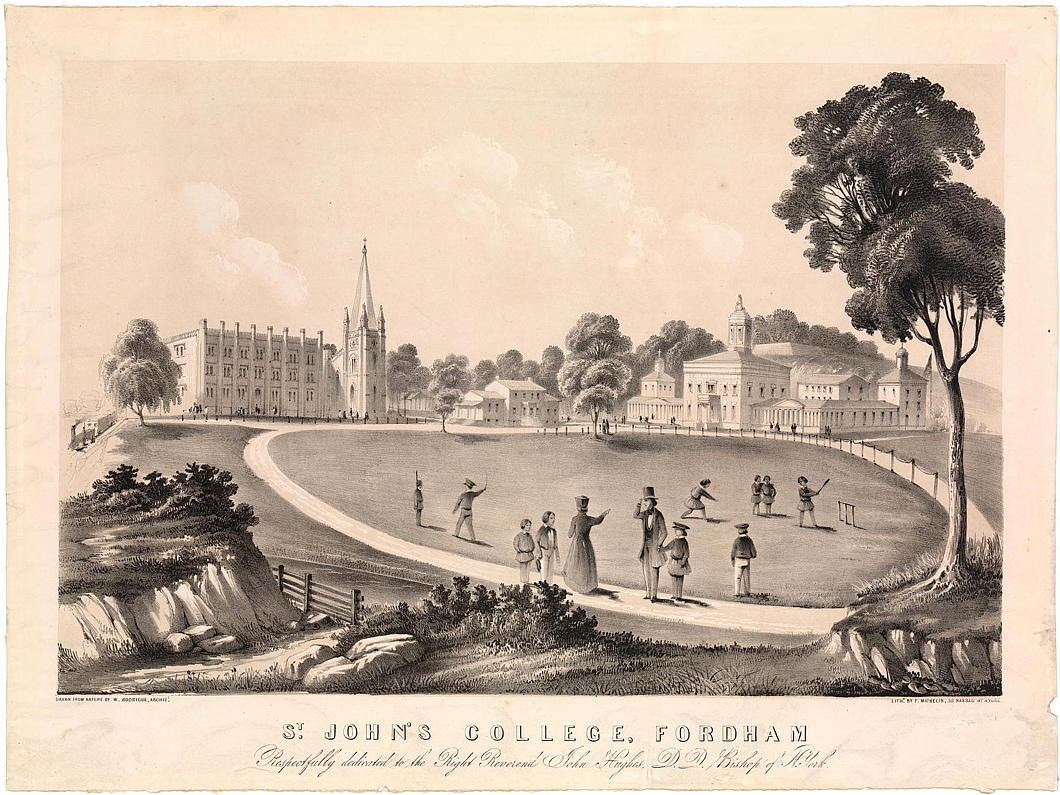
Because it was eclipsed by baseball, an infinitely more indigenous pastime, people often forget that cricket was quite a widespread and popular sport in the United States. It wasn’t until the Civil War that baseball really took over, aided by its shorter play time and the wider national mood. (Doubtless someone has, or will, write a scholarly article on this.)
It survived a few generations more as something of an elite sport, more strongly in Philadelphia and its environs, as well as in colleges and universities. The interwar period pretty much killed it off, only to be revived in interest amongst Americans by seeing it played by urban immigrant communities from the West Indies and the Subcontinent. The last time I checked there was even a cricket oval being laid out on the banks of the Mohawk river, across from the farm Jan Pieterse Mabee purchased from Daniel Janse Van Antwerpen in 1705.
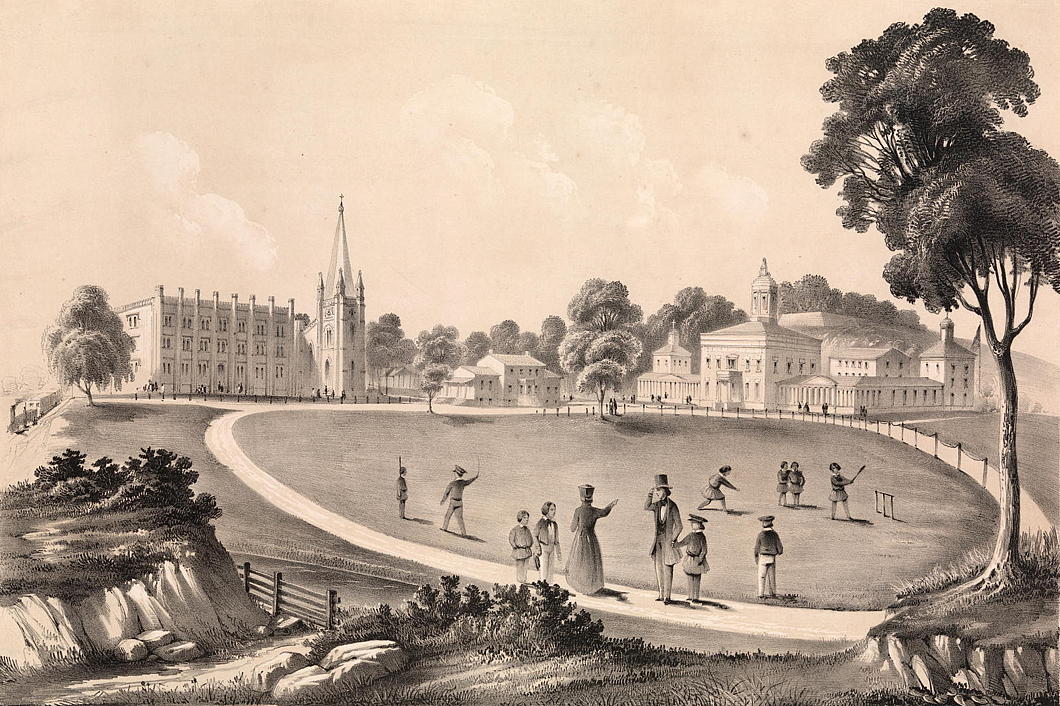
This charming rustic scene shows children playing cricket on the grounds of St John’s College, Fordham, with a priest speaking to a gentleman out on a constitutional with his son. As the college advertised itself in an early prospectus:
This institution, incorporated with the privileges of a university by an act of the Legislature, is situated near the village of Fordham, in a most picturesque and healthy part of the county of Westchester, at a distance of about eleven miles from the city of New York and three from Harlem. It is of easy access at any season of the year, by private conveyance or by the railroad, which passes immediately along the borders of the beautiful lawn in front of the college. The buildings are large, elegant and commodious; the grounds extensive and tastefully laid out.
This part of the Bronx remained within Westchester until 1874, when the parts west of the Bronx River were added to New York County. The remainder of the Bronx was ceded in 1895 and was created a borough of the consolidated City of New York in 1898, though only erected as its own county in 1914 (minus Marble Hill, which is another story entirely).
The engraving was drawn by William Rodrigue, a Philadelphia architect who later became associated with New York’s James Renwick, the designer of Grace Church and St Patrick’s Cathedral. Rodrigue auspiciously married the sister of one Fr John Hughes, who became Bishop of New York in 1842 — and the first Archbishop when the see was raised to metropolitan status in 1850.
St John’s College, now Fordham University, was one of Hughes’ pet projects, and perhaps unsurprisingly Rodrigue was chosen to design many of the earliest college buildings on the former Rose Hill estate, in addition to teaching mathematics, geometry, and drawing. He lived with his family in an outbuilding on the estate that now houses a coffee shop named “Rod’s” in his honour and his sons were among the earliest students of St John’s.
The first buildings Rodrigue completed were the chapel and the residence, the latter of which is still known as St John’s and forms one of the three sides of Queen’s Court, now a residential college within the university. The chapel benefited from stained-glass windows donated by the King of France for the (currently flourishing) old St Patrick’s Cathedral but which were found to be the wrong size and so incorporated into what is now the University Church.
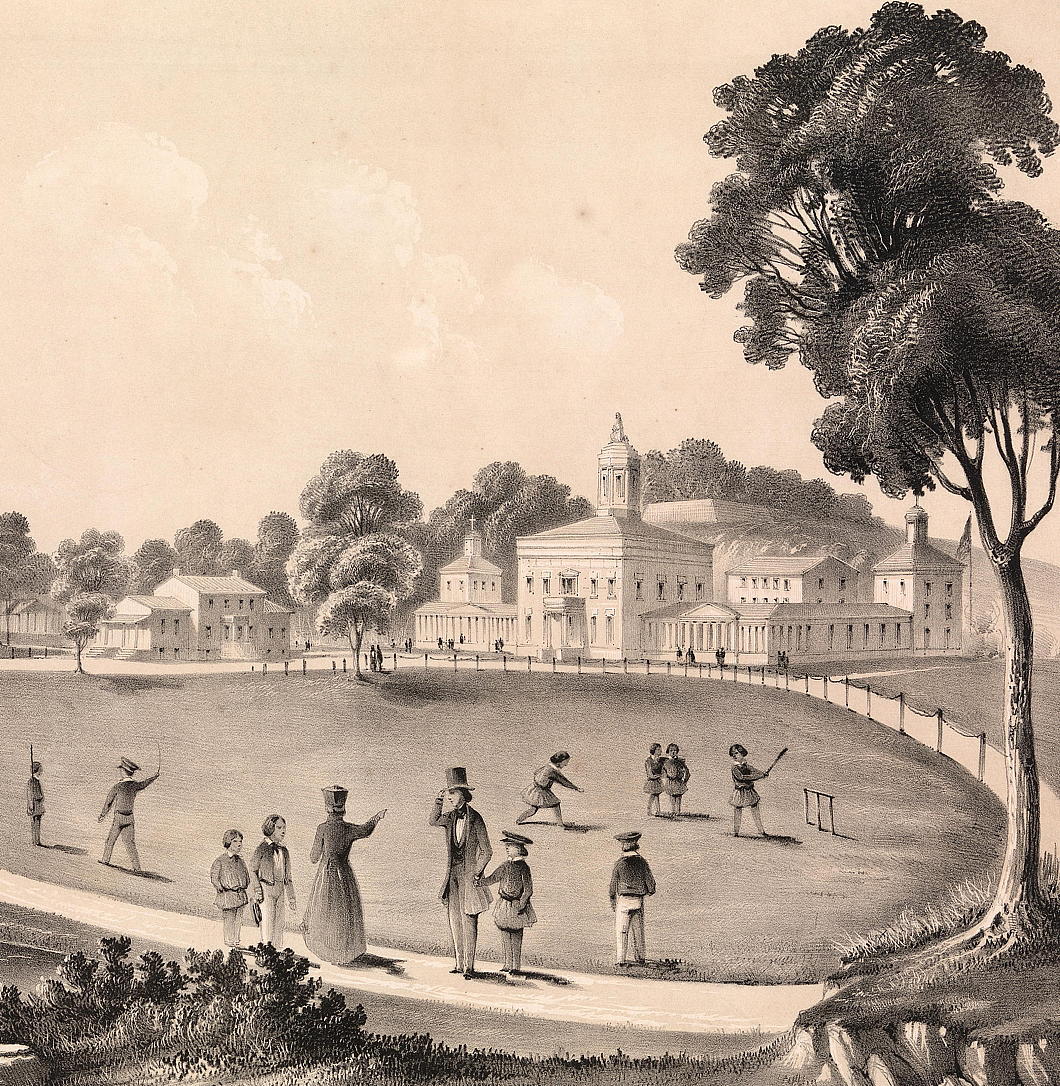
The building in the right background of the view was the main house of the Rose Hill estate purchased by Bishop Hughes. For a long time it was known as the Administration Building or the Manor House, though as it dates from the 1830s it has no direct connection to the Manor of Fordham granted to Jan Arcer by Governor Lovelace in 1671 (other than sitting on the land of it). More recently it was renamed Cunniffe House thanks to the generosity of Maurice J. “Mo” Cunniffe, Fordham Class of 1954. The wings have been much altered but the central block of the house remains largely intact.
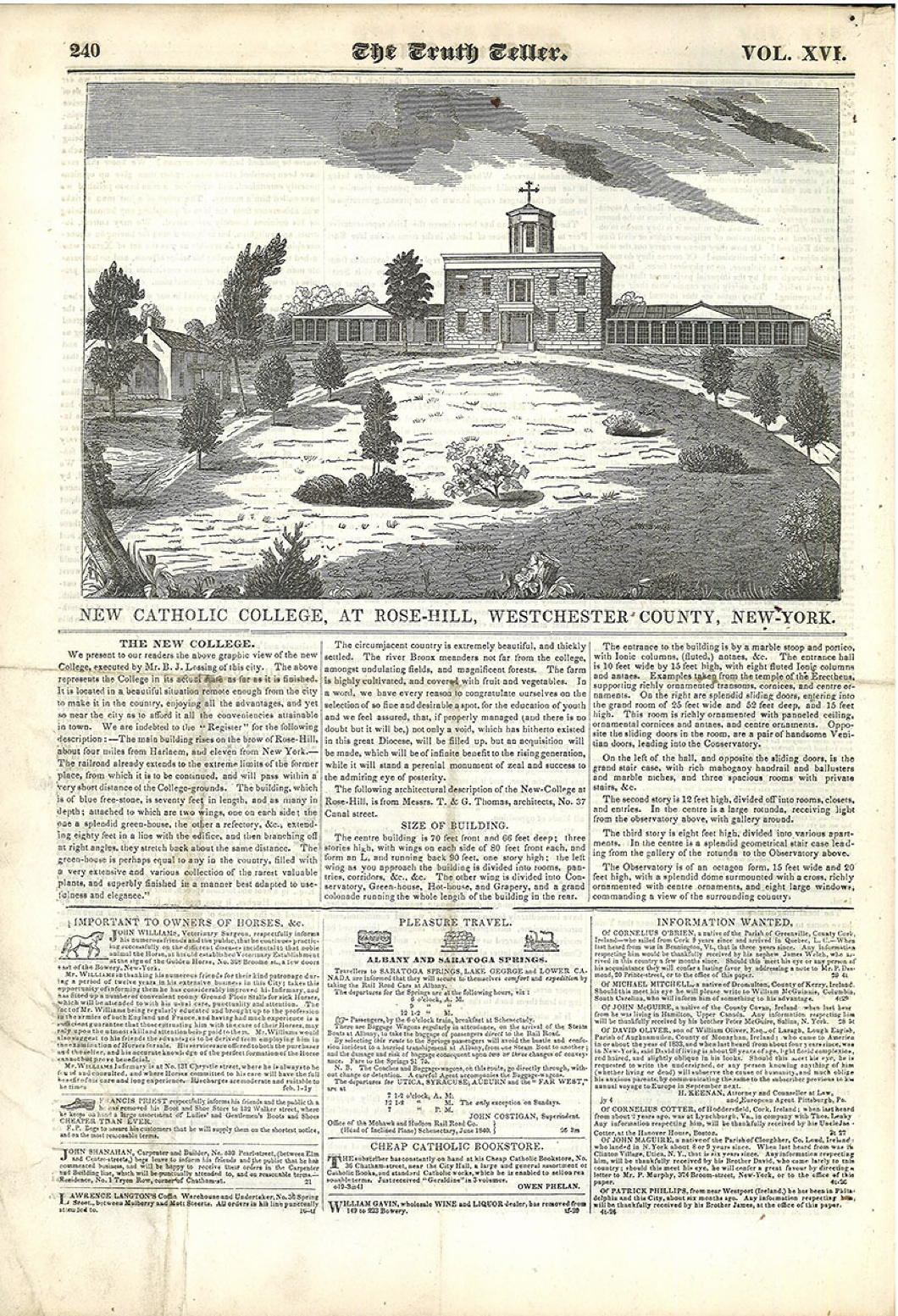
In 2019, the university’s emeritus professor of history, Dr Roger Wines, discovered the earliest known image of the institution while sifting through periodicals at the Philadelphia archdiocese’s research centre.
“It is located in a beautiful situation remote enough from the city to make it in the country,” the accompanying text in The Truth Teller, an early Catholic newspaper of New York, explained, “enjoying all the advantages, and yet so near the city as to afford it all the conveniences attainable in town.”
“The circumjacent country is extremely beautiful,” it continues. “The river Bronx meanders not far from the college, amongst undulating fields, and magnificent forests. […] We have every reason to congratulate ourselves on the selection of so fine and desirable a spot for the education of youth.”
The writer assures the college “will stand a perennial monument of zeal and success to the admiring eye of posterity”.
Palacio Barolo Revisted
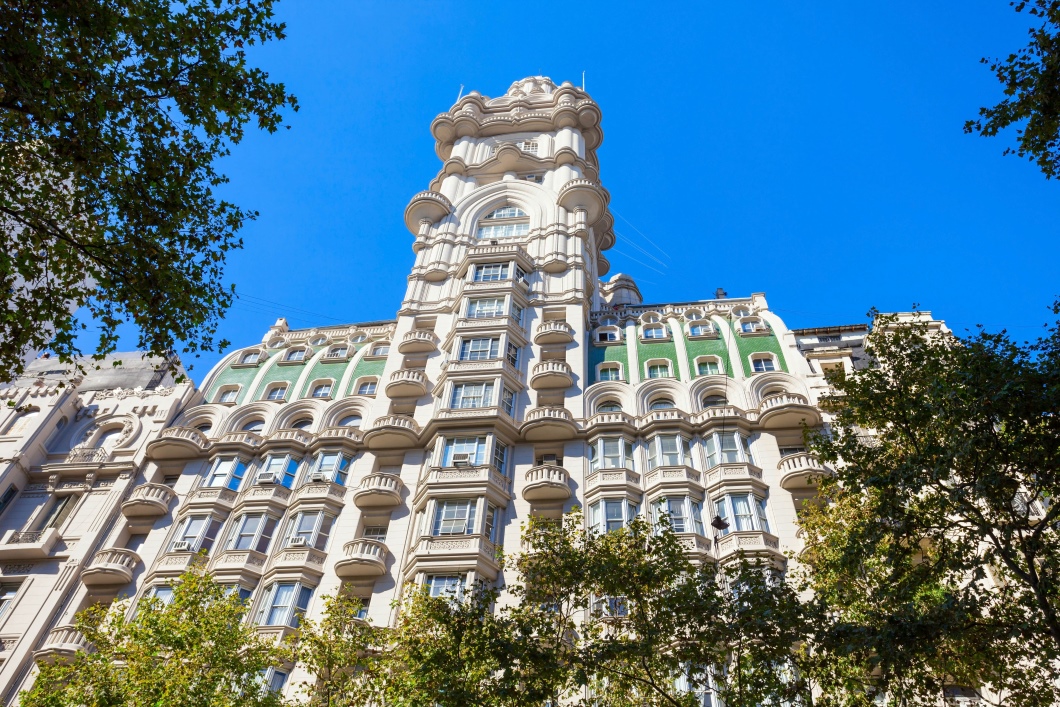
Assiduous readers may recall my posting about the Palacio Barolo, the mad Buenos Aires skyscraper that was conceived as a monument to the genius of Dante.
In a recent entry of Kit Wilson’s excellent Eclectic Letters, novelist (and recent ‘Foidcast’ guest) Thomas Peermohamed Lambert recalls this eccentric edifice:
Palacio Barolo is not my favourite building aesthetically — depending on my mood, that accolade might go to one of Le Corbusier’s Assembly building Chandigarh, or Westminster Cathedral, or the Duomo di Monreale, or the Nakagin Capsule tower — but no other building has lodged itself quite so firmly in my soul. I first visited it in 2018, while I was living in Buenos Aires. Someone mentioned to me that a few blocks from the drab neoclassical Congressional Palace resided the former tallest building in South America, designed by a mad Italian architect to accord with the cosmology of Dante’s Divine Comedy. I had to go.
Palacio Barolo is wonderful enough from the outside: it has a mad, Art Nouveau energy that reminds me, bizarrely, of Brussels. But its interior is even better. Its lobby is lit by orange-glowing pits that are meant to look like Hell’s lowest circles; there are statues of monsters, gargoyles, and pretty much every doorway has some kind of masonic symbol on it. Because labour is cheap in Buenos Aires, the place is also massively and confusingly over-staffed: there are uniformed people buzzing around you, ushering you into clanking iron lifts and up astonishingly decorated staircases whether you ask them to or not. At the top of the building is a completely pointless lighthouse beacon, included for the sole purpose of seeming divine and celestial, and one of the best views of Buenos Aires you’ll ever see.
Learning to Love Liguria
I’d never been until my friends — a married couple previously living in Fulham with their three children — moved there over two years ago. F. had lived in Milan previously so he speaks excellent Italian and his wife M. was born in London to Italian parents. For them, the move made sense with international schools, work, and a better everyday quality of life. Finding a place to live isn’t always transparent but their local links (including, once he noticed they’d turned up enough Sundays in a row, the parish priest) gave them a leg up. Now they’ve bought a place in Rapallo they’re renovating.
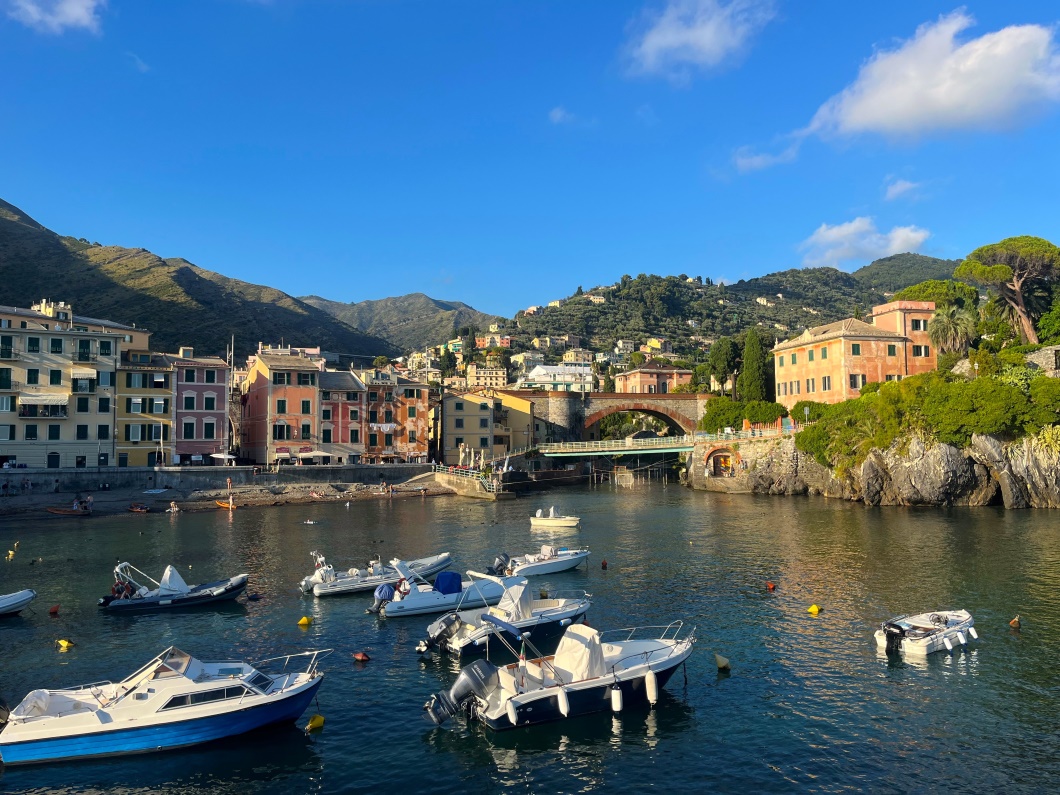
I usually stay in Nervi, the last borough of Genoa proper down the coast, but the last time I stayed in Quinto just around the corner from them. Having previously always been a sandy beach guy – it’s all we have on the Sound – I now have to concede the superior status of rocky beaches. Perhaps that descriptor doesn’t give the right impression: stony might be a better word. The beach in the tiny old fishing port of Nervi is sand, but Quinto’s is composed of small stones made smooth by centuries of Mediterranean tides. It is immensely less fuss than the perpetual struggle against the pervasive remnants of sand. So now I am a spiaggia di Quinto devotee rather than a spiaggia di Nervi fan – though the old fishing village remains delightful.
On pilgrimage to Walsingham recently I ran into newly married friends from New York (he’s half Virginian, half Italian; she’s full Italian). I told them I’d been going to Liguria a lot lately and he mentioned the Italian side of his family came from originally. I said it was Genoa I was mostly visiting but staying in Nervi and it turns out the villa I usually book myself a tiny room in was, many moons ago, the ancestral shack of his family. Small world.
What’s to like about Genoa? I am a coastal person, and ever since the period I spent many of my summers in Lebanon I have pretentiously designated myself as spiritually Mediterranean. I don’t think I could abide living anywhere too far from the sea. London at least has Old Father Thames (a respectable if sometimes paltry substitute) and of course is a port city. Oxford I could just about manage because what it lacks in coastal proximity it more than compensates for in architectural beauty.
Genoa has it all. Even better: it is inoculated against Monaco-lite Eurotrash vibe so much of the Riviera suffers from by having a full working port right at its heart. Like my beloved Kaapstad – I still read Brian Ingpen’s port and shipping column every Wednesday in the Cape Times – there is something reassuring about these earthy functional spaces not being banished to the fringes as we in New York did, and indeed as London has done too. It’s a reminder of the real foundations of Genoa’s greatness as a maritime republic that traded across the seas and discovered the New World. (“In this house, Columbus is a hero.”) The cross of Saint George is everywhere and the Genoese proudly tell you they had it before England did. There may be some truth to that, if the vexillologists are to be believed.
The port is not just functioning, but thriving. In the 1970s, Fincantieri threatened to close down its shipyard at Sestri Ponente. Cardinal Siri – Genoa’s arch-conservative archbishop – moved heaven and earth to keep it open, urging his priests to preach on the subject and coordinating the efforts of trade union leaders and elected representatives to halt the closure.
The Cardinal won, and today Fincantieri is the largest shipbuilder in Europe. Railway improvements nearing completion will soon link up Genoa’s ports with the industrial corridor of the Rhineland, cutting shipping times to the Middle East and Asia by days (and freeing up capacity at Rotterdam, one of the busiest ports in the world).
Genoa is far from mere industry. It is chockablock with palaces, the most sumptuous of which made it onto the Rolli di Genova, which meant they were obliged to host official visitors to the maritime republic. Forty-two out of the 163 palaces on the rolls have now been recognised by UNESCO as a World Heritage Site, along with the Strade Nuove constructed during the peak of Genoa’s prosperity.
These beautiful palaces dot the city: some of them are museums, other civic or government offices, hotels, and of course some still private homes. Meanwhile the University preserves the life of the mind — they recently held a day-long conference on Cardinal Siri “pastor and prophet”. As you stroll down the via Balbi from the Palazzo dell’Università you will encounter impeccably well-dressed communist students hawking their Marxist newspapers. (Which reminds me: I must augment my academic mug collection by adding an UniGe example.)

Most important of all, the life of the soul: Genoa has an Oratory of St Philip Neri. I happened to be in town last St Philip’s Day and the church was packed for the High Mass. The Oratory Fathers – who maintain links with our own here in London – clearly have a good rapport with the faithful, and without fail whenever I am in Genoa I run into the delightful Fr Mauro of this community.
Liguria is not just Genoa. Up and down the coast there are innumerable towns and cities worth exploring: Camogli, Santa Margeherita, Rapallo, the ubiquitous Portofino, Sestri Levante. That’s just the Riviera di Levante – the east side the sun rises from. The Riviera di Ponente – the west – has the old republic of Noli, the Bay of the Saracens, astounding cliffsides, and the Maghreb-tinged homes of Varigotti.
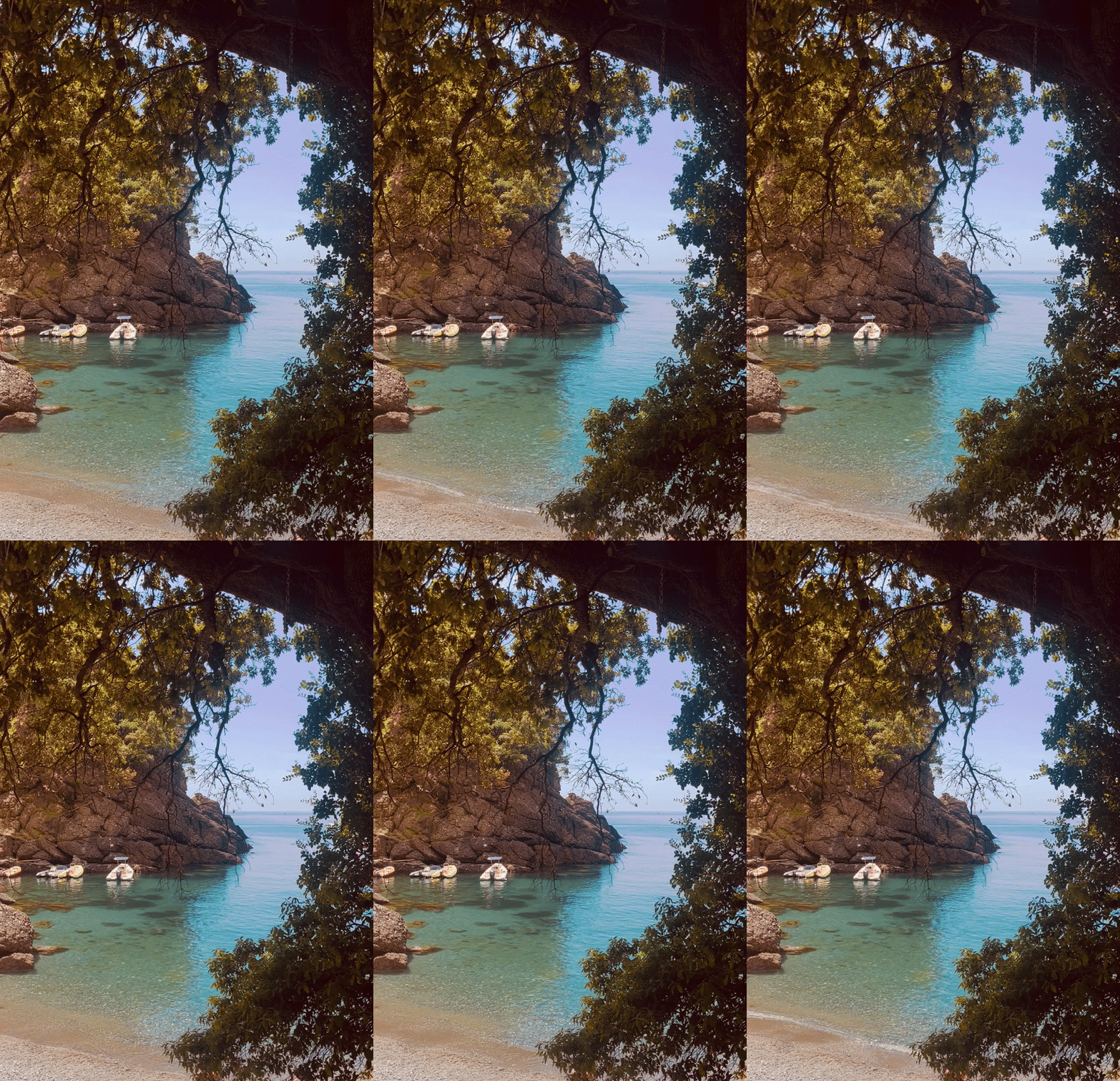
There are almost infinite hiking routes as well, including a glorious one to the almost-hidden bay of San Fruttuoso. This tiny former abbey with its beach and handful of houses was owned by the Doria Pamphilj family for centuries until donated to the FAI, Italy’s national trust, in 1983. It is an immensely beautiful spot to enjoy some trofie and recover from an arduous hike over the mountain from Santa Margharita.
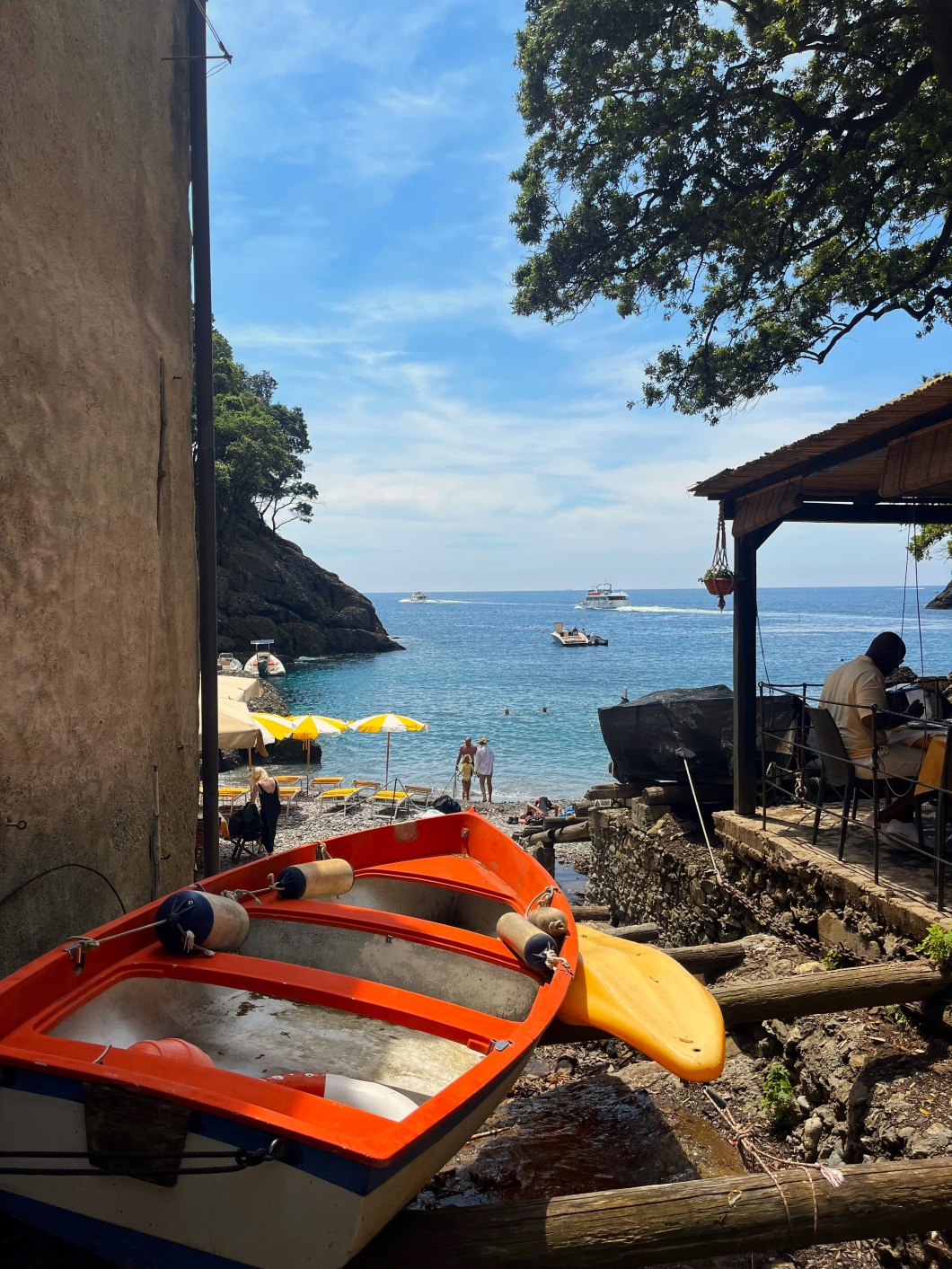
There are no roads to San Fruttuoso. You have only two ways to get there: over the hills (2,000 feet at the highest point) or by the sea. For the faint of heart and breath, the ferry back to Santa is a welcome friend… but you can hike back up the hills and pick the ferry up in Portofino instead, after a sufficiently satisfying gelato and cigarette. Monte Castello offers some excellent hiking territory as well. The Cinque Terre is best avoided — beautiful, but mobbed with Germans, Americans, and Japanese. You will find no peace there. (In Vernazza, a wealthy rooinek spotted my veldskoene and asked if I was from South Africa.)
ligurian winter is so so wonderful pic.twitter.com/dA9AgUB6Ez
— paola (@paolalien) December 29, 2025
As for Genoa, unfortunately everyone’s getting in on it. “With its winding, crowd-free streets, baroque palazzos, and exquisite Ligurian cuisine,” British Vogue proclaimed in June, “this underrated Italian seaside city is a stylish alternative to Marseille”. Meanwhile the FT declared Genoa “one of the magnificent cities in Europe, yet hardly anyone ever goes there”. Keep it that way!
“Long overshadowed by its better-known neighbours,” Condé Nast Traveller says that Genoa now has “an inspired set of patrons intent on putting it back in the frame”. Mrs & Mrs Smith hails it and now the New York Times has put Genoa on its list of 52 Places to go in 2026. (Please don’t!)
Monocle says Genoa is undergoing a rebirth “thanks to visionary locals and fresh talent”. The Spectator was just glad not to hear a single English accent.
I still have much to explore, whether in Genoa itself or across Liguria. One of the Italians at the British Embassy in Rome is a local patriot and has made the case for his native La Spezia. As it happens, there is a brutalist cathedral there I’d like to see. (Not everyone’s cup of tea, I’ll admit.) I am tempted by a production of Tristan at Teatro Carlo Felice next month.
But please: do not spread the word. Don’t go to Genoa. Give Liguria the cold shoulder. I want all the focaccia for myself.
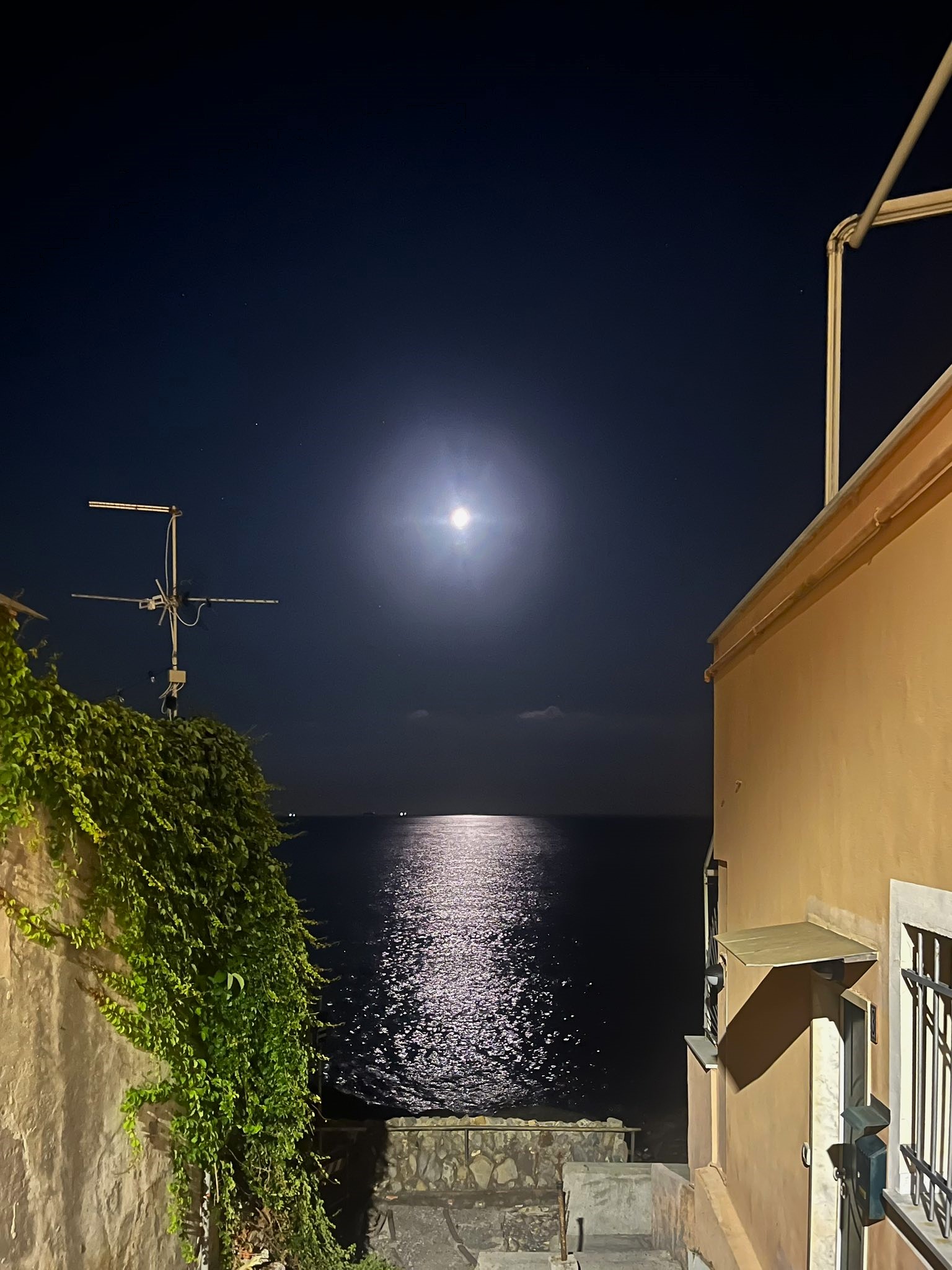
Crux Alba No. 2

You can purchase a copy via the Grand Priory’s shop or find out how to subscribe.
The lead article by Gregory Goodrich explores the Order’s search to purchase land from the early United States and includes previously unpublished correspondence between the Grand Master and James Monroe.
Simone Monti examines a beautiful illuminated sixteenth-century missal from the Order’s period on Rhodes. Dr Anna K Dulska spoke with the last Hospitaller nun of Sijena before her death late last year and explores the artistic and historical legacy of the monastery there.
Clemens von Mirbach-Harff relays news of the Order’s humanitarian efforts to deal with the crisis in Gaza, including the opening of two new medical clinics. Henry Sire pens an expert review of Marcus Bull’s recent book about the Great Siege of Malta.
The issue also includes a report of the Latin Patriarch of Jerusalem’s visit to London, and more. Click here the full contents here.
Village Street, Winter
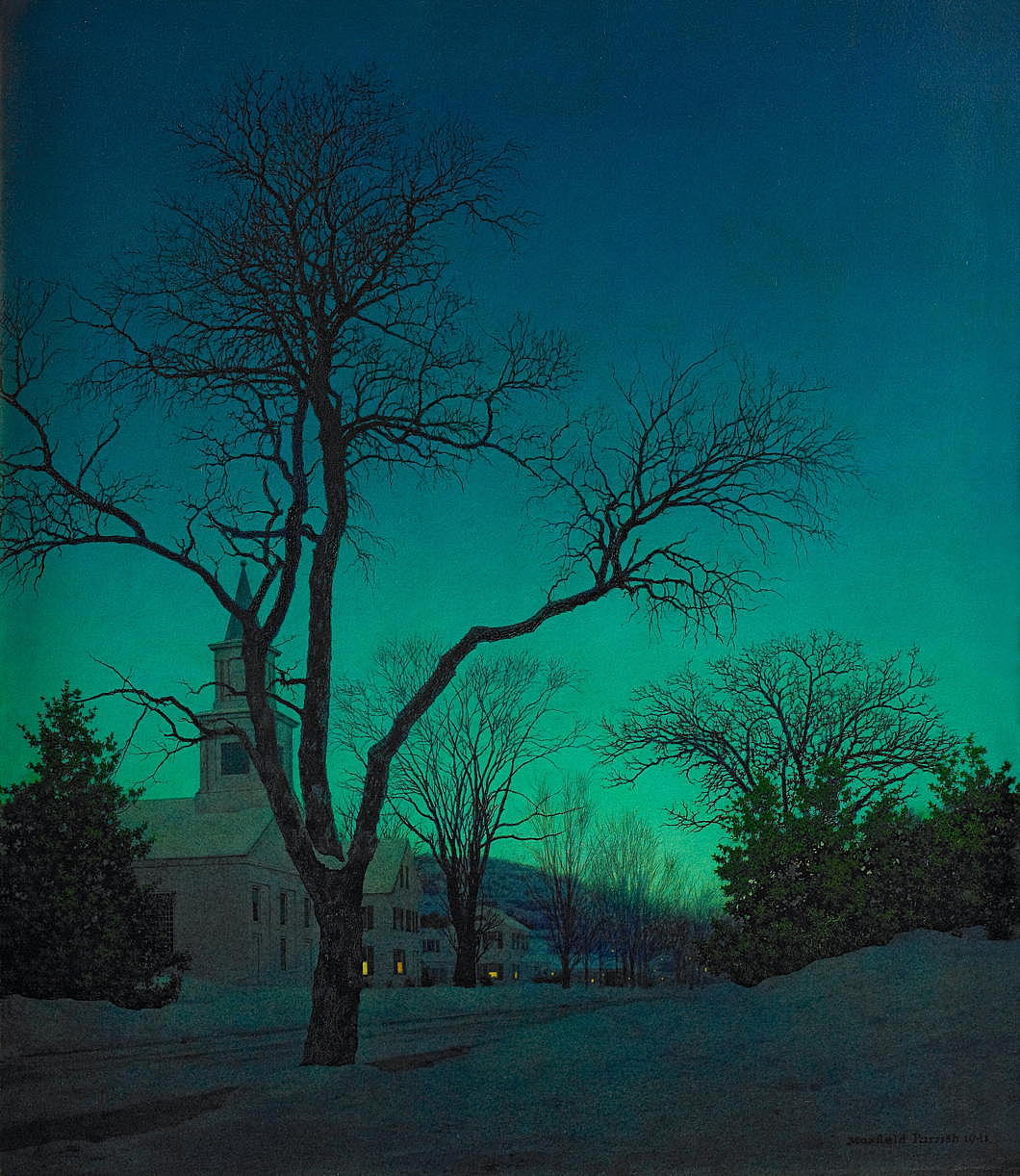
Maxfield Parrish was the king of middlebrow. More of an illustrator rather than a practitioner of high art, he was at least a painter through and through. Norman Rockwell — widely rated as more important — referred to him as his ‘idol’. His 1900s visions of blousy clouds and flowing garments are significant for the time but perhaps best forgotten. By 1931 he had pronounced to the press that he was ‘done with girls on rocks’.
As he gained in years, Parrish moved more towards the observed, inhabited landscapes of his adopted New England. He set up his studio in Plainfield, New Hampshire, where he painted Village Street, Winter.
A leaf-barren tree stands dark against the winter dusklight, partly obscuring the village church. Ground-floor windows of wood clapboard houses emit a warm glow — suppertime isn’t long away now.
No idyll lasts forever: this scene was painted in 1941, the last winter of New England’s peace before the Japanese attack on Pearl Harbor thrust the United States into the great conflagration. Many sons of the Granite State must have thought of still scenes like this as they fixed bayonets in Europe and the Pacific.
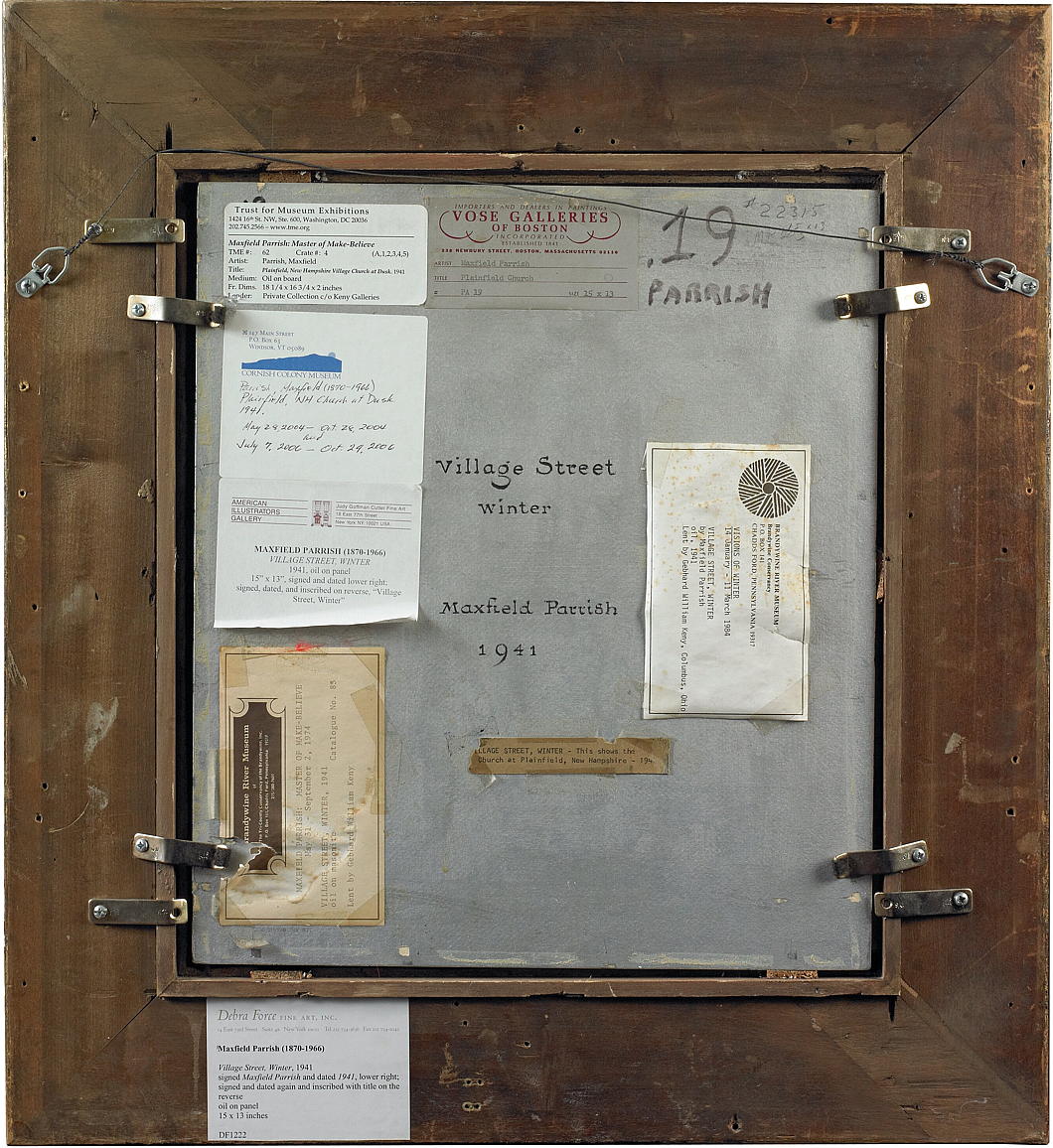
Parrish painted the picture for his own pleasure, but such an artist with such a long commercial career was not unwise to the potentials of profit: even painters must eat. The reproduction rights to the image were licensed to Brown & Bigelow to feature in calendars, prints, and other materials which made Parrish a pretty penny. He was the Jack Vettriano of his day.
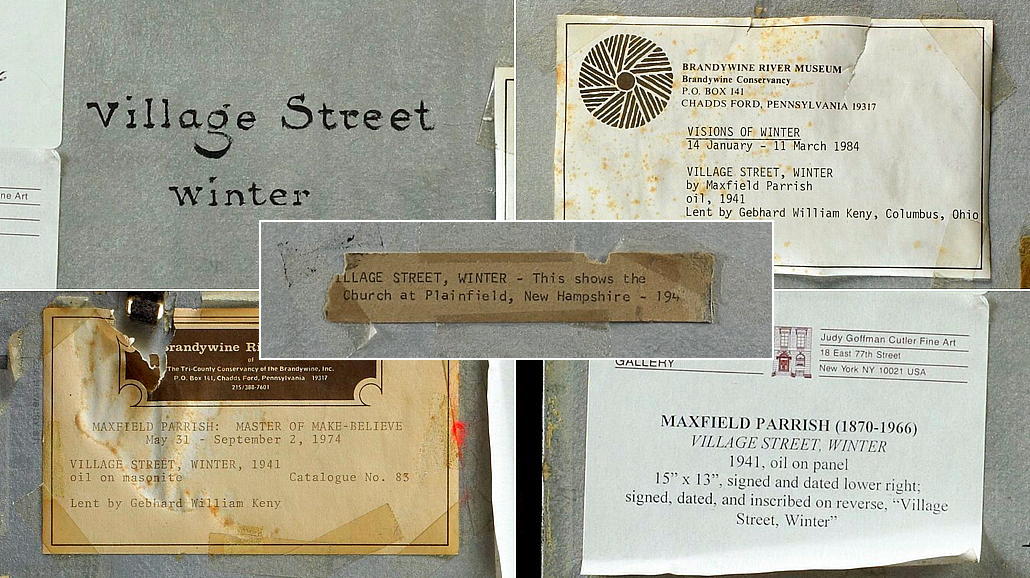
Brown & Bigeloow renamed it ‘At Close of Day’, and the back of the original painting shows a fascinating array of names for the work, including ‘Plainfield Church’, ‘Plainfield New Hampshire Church at Dusk’, and ‘Plainfield New Hampshire Village Church at Dusk’.
The most mentions, however, go to the name the artist himself gave it: ‘Village Street, Winter’.
Search
Instagram: @andcusack
Click here for my Instagram photos.Most Recent Posts
- Brunel’s Unbuilt Capitol February 3, 2026
- Cricket at Fordham January 27, 2026
- Palacio Barolo Revisted January 14, 2026
- Learning to Love Liguria January 14, 2026
- Crux Alba No. 2 January 13, 2026
Most Recent Comments
Book Wishlist
Monthly Archives
Categories