2025 November
About Andrew Cusack
 Writer, web designer, etc.; born in New York; educated in Argentina, Scotland, and South Africa; now based in London.
 read more
News
Blogs
Reviews & Periodicals
Arts & Design
World
France
Mitteleuropa
Knickerbockers
Argentina
The Levant
Africa
Cape of Good Hope
Netherlands
Scandinavia
Québec
India
Muscovy
Germany
Academica
Churchill’s Beguinage

The last beguine Marcella Pattyn was born in Thysstad, the Belgian Congo, in 1920 and died in the beguinage of Kortrijk in West Flanders in 2013.
At the time many were tempted to mark this as the final chapter in a legacy dating back eight-hundred years, but I would not be surprised if the beguines made at least a partial comeback.
One can easily imagine a town like Oxford hosting a beguinage for the many pious ladies pursuing lifelong academic interests but seeking some sense of Christian life in common. (And the perfect property for it has just come on the market if a patron with deep pockets can be found).
Who were the beguines? As The Economist explains:
Appearing around 1200 in the Low Countries, the Beguines’ semi-religious lifestyle forged a third way for women. Though its chaste sisters, of all ranks and fortunes, prayed together, they were not bound by permanent vows. Beguines belonged to no religious order, so made their own rules.
They lived apart from society in beguinages — self-sufficient clusters of individual houses grouped around a church—but could enter the town at will (though they had to return at dusk). That allowed for an exceptional degree of independence, unknown by their medieval sisters, whether wives or nuns. Even a married woman could become a Beguine (though few did: celibacy was prized).
Most Flemish beguinages were built in urban communities, near hospitals and leper houses. The sisters ministered to the poor and sick in their own infirmaries or at nearby hospitals. But they also washed raw wool and laundered sheets, earning their livelihood through Europe’s booming cloth industry; and, later, by making lace and weaving. Others worked on farms and in gardens.
No visit to Amsterdam is complete without an exploration of its Begijnhof. Somehow, the beguines of the city miraculously survived “The Alteration” of 1578, when Amsterdam’s Catholic city fathers were overthrown, seized, and expelled by a group of Calvinists.
The old chapel was given over to the city’s English Reformed community and many of the founders of New England worshipped there before heading off to land at Plymouth Rock. The Catholic beguines made do with a clandestine chapel built in one of the houses and the last beguine of Amsterdam died in 1971.
The Great Begijnhof of Leuven is likewise well worth a wander: it is an entire quarter covering ten streets. Having fallen into disrepair while owned by the state as alms-houses, it was purchased by the University in the 1960s and restored under the guidance of Professor (and Baron) Raymond Lemaire to house students and academics.
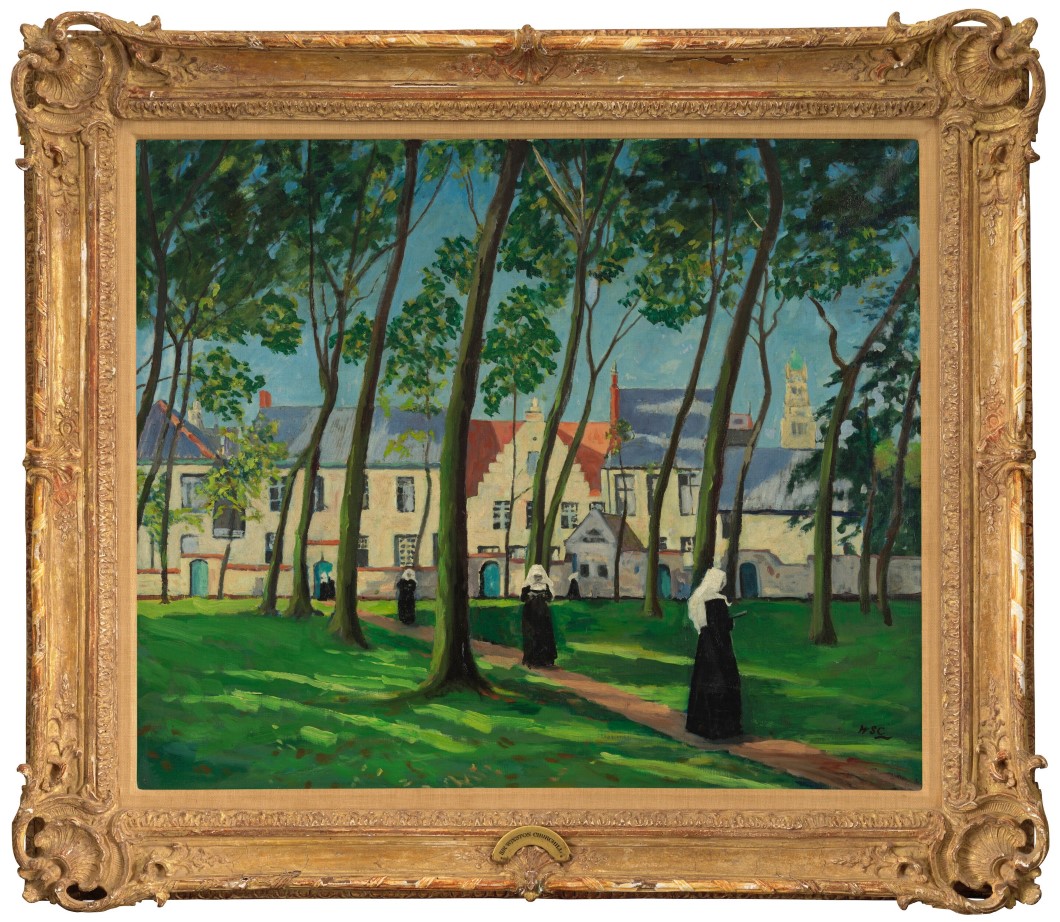
That inescapable man Sir Winston Spencer Churchill KG OM CH &c. counted painting amongst his many pastimes. A year after the British voter gave him the boot and expelled him from Downing Street, Churchill was amidst his typically extensive travels when he found time to visit Belgium and paint the beguinage of Bruges.
The sisters depicted are not actually beguines but Benedictines. They arrived at the Princely Beguinage Ten Wijngaerde in 1927 when the Grand Mistress’s house and adjacent quarters were converted into a convent. The overall site is now owned by the city of Bruges, but four Benedictine sisters remain. The other houses are run as secular alms-houses and sheltering for single women.
Churchill’s ‘Le Béguinage, Bruges’ is up for auction at Bonham’s later this month and the auctioneers provide Churchill’s secretary Grace Hamblin’s explanation of how she came to own it:
He put [a different painting] up and then he said, ‘What do you think of it?’ It was one of his most terrible paintings. And he must have seen my expression, because I wouldn’t dare to criticise it, I promise you, I know nothing about painting.
I said ‘Well, it’s not my favourite.’ And he said, ‘Which is your favourite?’ And I said, ‘Well, I love the Béguinage.’ So he said, ‘Oh, well, we’ll put that here.’
Some years later it went on exhibition with others to New York. When it came back and I was helping him unpack it, he said, ‘This is yours. Take it home.’ That’s all there was to it. Just like that… enough to kill anybody. I couldn’t believe it… to receive one of his paintings, and from him!’
The secretary had good taste.
My own collection of art by a parliamentarian — still just one item — started in a similarly haphazard manner.
I was walking down a street in Westminster one day when I came across a certain poet-painter-politician who shall remain nameless. He was parked in front of his house and packing one of his sons’ possessions into the back of his car to head off to university but was making an absolute hash of it.
I intervened saying “No, no, no: that’s no way to do it at all” and promptly re-organised the assembled items into a much more efficient arrangement. He thanked me and, as recompense for my small service, handed me a painting he had done of Santa Maria della Salute in Venice which still hangs in my somewhat meagre collection.
If you’d like to start your own collection of art by parliamentary painters, Churchill’s beguinage is going for a guide price of £300,000 to £500,000.
An Old Election in New Utrecht
In the 28 November 1868 issue of The Spectator, this account of an American village election was printed. The village in question was New Utrecht, founded in 1652 by our Dutch forefathers of old.
In 1868 it was still a village; today it is very much a neighbourhood of the Borough of Brooklyn, King’s County, in the City and State of New York.
Closer to home in Westchester, there are plenty of local offices up for the determination by citizens. It might be rather fun to stand for Town Clerk or Village Justice or Receiver of Taxes…
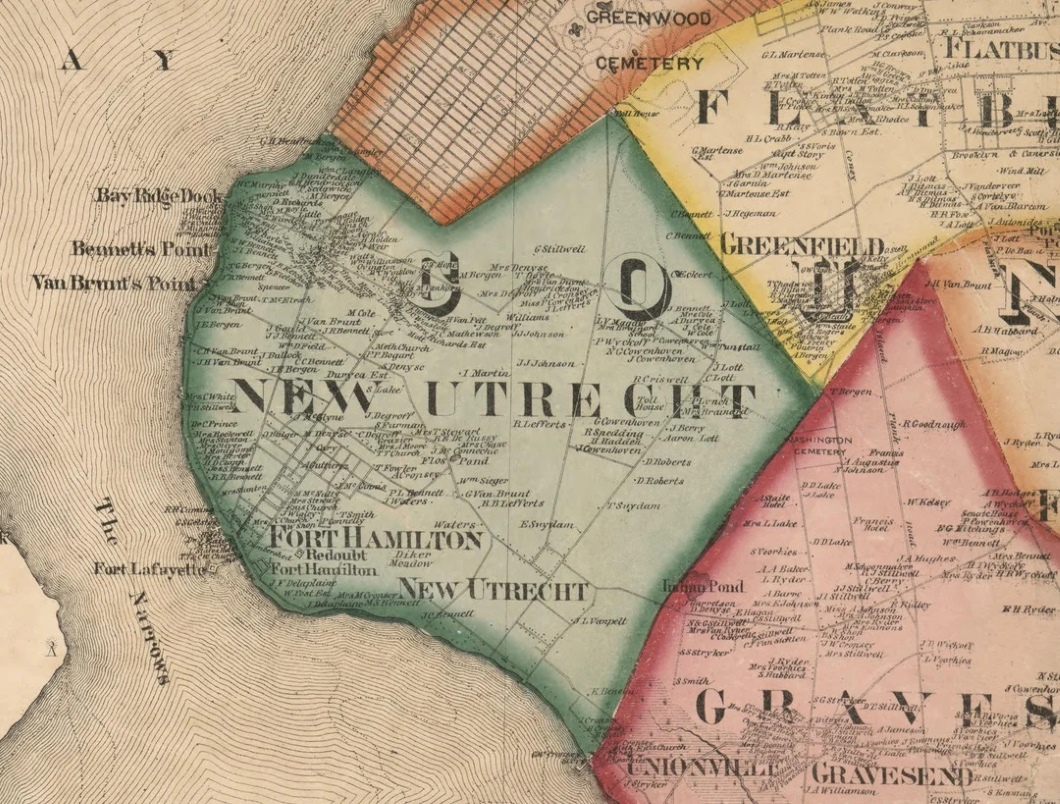
The polling-place was at the village of New Utrecht, from which the township takes its name. A township here is a sub-division of a county which manages its own local affairs by town meeting. It commonly includes several villages, from the oldest of which it takes its name; and at this all its public business is transacted, although in wealth it may be of all of them the least important.
New Utrecht was first settled by the Dutch, as its name bears witness, about two hundred years ago. Until within some thirty years a few Holland families, to which were added one or two of Huguenot origin, owned nearly all the land for many miles around; and even now, when you find yourself here in a company of farmers, it is safe to address two men in three as Van Brunt, Bergen, Cortelyon, or Bennet.
The Yankees have taken but little hold of this soil, but within the last twenty years there has been a great dispensation of Irishmen, owing to the nearness of New York and the cheapness of land, much of which, although it has owners, lies open and neglected in what are called commons, upon which shanties are huddled in little groups. After driving down the beautiful shore road, which is lined with small villa residences, and passing Fort Lafayette, the famous “Bastille” of the Rebellion, we struck across one of these commons to the road which leads to New Utrecht.
Half a mile from the shore we topped the highest point of ground in an area of many miles, and looked straight off upon the ocean. The blue above bent over a blue below; no dark, deep blue, but cold, bright, steely; the water looked like a flat sky bent back over the earth from the horizon. The road, which we soon struck, was good enough, but although the main road, it was so narrow that there was barely room for two waggons to pass each other. It is just the same little road that the Dutch farmers made when they settled the country. There has been no need for its enlargement or for any change in its direction; and it winds around little knolls and through deep cuts from this to that old farmhouse down to the village and thence to the water. Pleasant enough now, although rather desolate; in the winter it is often impassable, for the snow drifts into the deep cuts until it lies level with the laud on either side; and then sometimes these farmers do not for days go five hundred yards from their houses. And yet New York is but twelve miles away, and clear in sight pass the ships and the steamers that bear the greater part of the commerce between two hemispheres.
The village is a dead-and-alive little place, with its dead part very dead and its life sinking slowly into the salt ooze that borders the township seaward. The larger farmhouses along the road are lapsing languidly to ruin. Almost all of them are wooden buildings, but some of them were evidently the homes of men who lived handsomely as well as comfortably, and they have an Old-World look of gentility in their structure and their surroundings. But they have not been painted within the memory of this generation, the fences are broken, the gates unhinged, the grass and the walks neglected, and nothing has been done to keep up the groves of trees with which many of them are surrounded. A few of them are roofed with tiles that were brought from Amsterdam; and it is plain that there has long been an end to that importation.
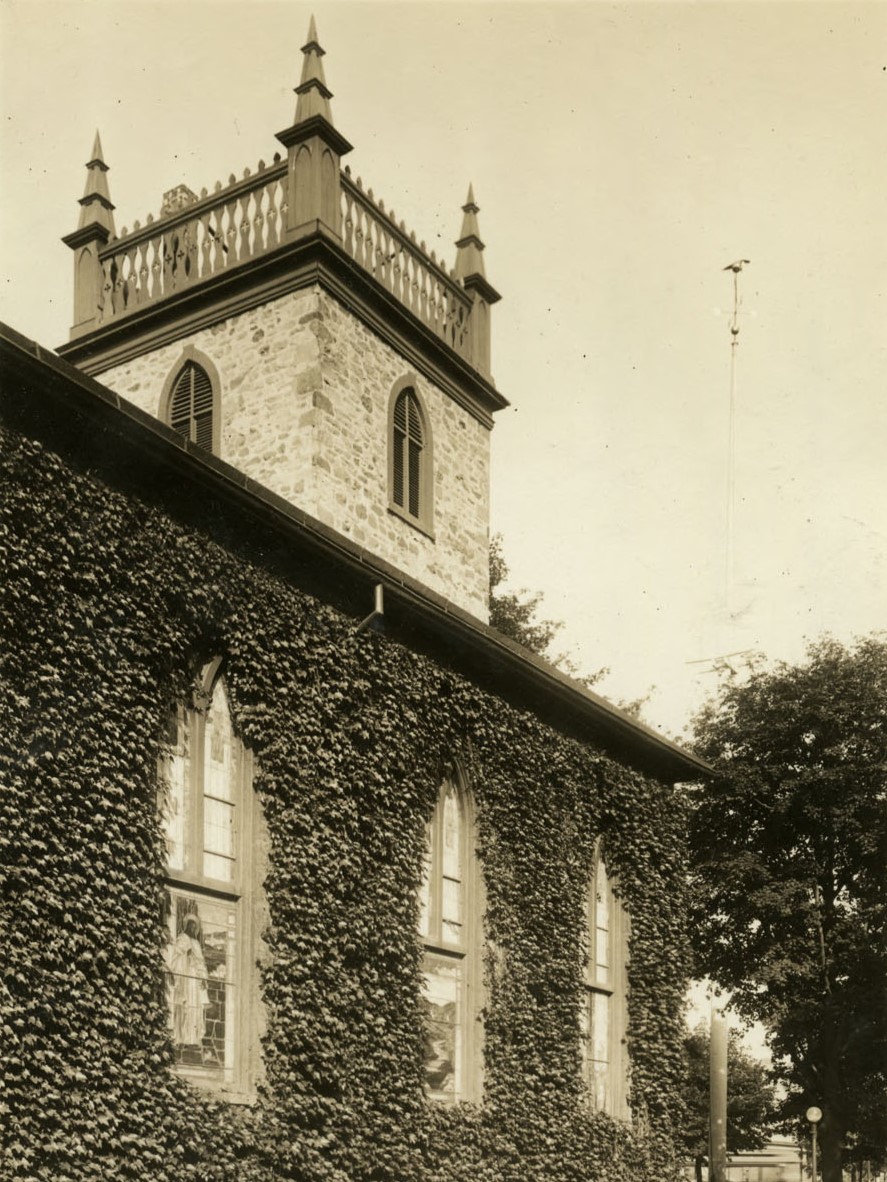
As we near the centre of the village, where two roads meet at right angles, the one in which we are not crossing the other, we see a pretty stone church with a square tower. It has some of the charm which age bestows upon buildings, but takes from man; but I am told by those who have entered it that within it is the most doleful and barn-like of all religious structures. Of course the faith preached here is that of the Dutch Reformed religion. There are Episcopal (Church of England) and Roman Catholic churches not far away; but they are in the parts of the township which are chiefly occupied by new comers. This church would have seemed more venerable to me if there had not arisen directly in front of it in the middle of the road a tall white flagstaff, topped by a gilt spread eagle, and from which on this occasion floated a spick-and-span new specimen of the flaming banner of the Union. The church and the flag are both good things in their way; but 1 like to take them separate it à la Russe as I do certain viands which some people mingle on one plate.
On the road we have met and overtaken carriages of all sorts, loaded well with voters. The most noticeable of these are the large farm waggons in which the people around here send their cabbages and turnips to the New York market. These have been hired by the political committees, or volunteered by their owners to bring voters from the remote parts of the township – voters who otherwise would hardly cast their ballots. They are almost all of them filled with Irishmen, no small proportion of whom are raw emigrants made into “American citizens” for the nonce, at the expense of the Democratic committee, who hunt them up and pay their fees of naturalization. For these men always vote the Democratic ticket, and “go it blind.” I have learned, however, that some of them down here, led by their more experienced and intelligent countrymen, have formed a society or club, the members of which vote on local questions for the man or the committee that pays the most money.
Treating here has little or no influence in elections; for whiskey and money are so plenty that the former does little for the spread of Democratic principles, except in the way of daily training. Filled although these waggons are with Irishmen going to or coming from the polls, there is no jollity in them, hardly a word spoken. The men ride along silently crouched together in the piercing wind.
Perhaps they may be chilled by our approach as well as by the stiff nor’-wester; for although the country around is a very hot-bed of Democracy, “a perfect Sodom and Gomorrah of Copperheadism,” as the gentleman who drove us said, we are all well known as staunch Republicans. I am soon confirmed in this conclusion; for one farm-waggon load of Irishmen as it passes us sets up a cheer, “Hurrah for Grant!” We are astonished. The physiognomy and the accent of the cheerers are unmistakable; and yet—Irishmen voting against the Democratic candidate! The thing is unheard of. And yet another waggon comes, and as it passes, up goes the same “Hur-r-rah for Grant!” Is the world coming to an end? Is ours a moral earthquake? I learned, too, that the gardener here, an intelligent North of Ireland man who has been in the country for fifteen years, walked the five miles to vote the whole Republican ticket. He declined an invitation to ride to the polls with the master of the house because, as he confessed in secret to one of the young gentlemen, he feared it might be thought that he had sold his vote.
As it was, he subjected himself to being called “a barrel of flour” by his Hibernian friends who voted against him, but being a powerful fellow he “polished off” one of them and settled that matter. The present of a barrel of flour (worth about twelve or fifteen dollars) to the “ould woman” seems to be one of the ways of bribery, and hence the reproach. Now, not one of these Irishmen is a Republican, and not one of them would have voted the Republican ticket if a War Democrat had been nominated instead of Mr. Seymour. But many of them had been in the Army, and most of them believe very heartily in the Union, although exactly what that Union is they seem to be almost as ignorant as some native “Americans.”
The polls are at the village tavern, which is the largest house in the neighbourhood, and has evidently been one of those fine old country taverns, rich in unpretending comfort and simple good cheer, which the railways are fast improving off the face of the earth. It is surrounded with vehicles of all sorts, most of them very humble and very much neglected; but a few of them the equipages of gentlemen of wealth who, like Dogberry, have two gowns and everything handsome. The stable-yard and the horse-shed are so full that we find a place with difficulty, under the guidance of two negro helpers. […] The steps and porch of the old tavern are filled with men, and so is the bar-room, where, however, no liquor is sold to-day. It is dismantled, and here are the ballot-boxes. They stand upon a board that rests on trestles, and behind them sit four or five men. They are the Inspectors of Election and a Justice of the Peace.
The voting is so quickly done, and with so little ceremony or fuss of any kind, that it seems strange that so trifling a matter should bring so many people together. A registered voter steps up, gives his name, it is found on the register, checked, he hands his ballots to an inspector, who announces that he votes for all, i.e., President, Governor, and Members of the Legislature, or for two or one of these tickets, the ballots are dropped into the box, and the voter gives place to another. The unregistered voter answers, under oath, a question as to his place of residence, gives a reason for not having registered himself, produces a known witness to the fact of his residence, and his ballots are also then received. In and around the tavern there is no more noise than if it were Sunday, and we were all at the old church opposite.
My friend’s wife, who did not want to come too near the poll, and who left us to wander about among the old grave stones, found the tenants of the churchyard hardly more quiet than these sober, silent farmers and labourers, who seem to do their little talking almost under breath. Outside, the only excitement is caused by a jackanapes, the fool of the village, who has rigged himself up in an old Zouave uniform, and is going through the manual with a rifle, at the command of some boys, little less silly than himself. We exchange a word or two with some friends, and then take up our fair companion, and drive home shivering through the crystal air, under overcoats and rugs, comforted but not warmed by the consciousness of having performed a duty at some sacrifice.
You will have learned long ere you see this letter that, Irishmen and all, we could not save the State for Grant, as well as that he could do without the State. The Democratic majority in the Metropolitan district (a part of which is this Bœotia) was too great to be overcome. It was increased by fraud without a doubt, but the votes thus cast were not numerous enough to materially affect the result, and Mr. Hoffman, the Democratic governor elect, is sure of his office. The important fact is that with all the enthusiasm for Grant and the disgust with Seymour, the Democratic vote was larger than ever before, and that the increase has been steady through the past twelve years. The Tribune vaunts the following increase in the Republican vote as “a record of which we have a right to be proud!”-1856, 17,771 ; 1860, 33,290 ; 1864, 36,681 ; 1868, 47,778: a notable increase truly, were it not for the suppressed fact that this (according to the Tribune Almanac) has been the increase of the Democratic vote: 1856, 41,913; 1860, 59,890; 1864, 73,709; 1868, 108,025. It is by such disingenuous fetches as this that political managers disgust people with politics.
Search
Instagram: @andcusack
Click here for my Instagram photos.Most Recent Posts
- Brunel’s Unbuilt Capitol February 3, 2026
- Cricket at Fordham January 27, 2026
- Palacio Barolo Revisted January 14, 2026
- Learning to Love Liguria January 14, 2026
- Crux Alba No. 2 January 13, 2026
Most Recent Comments
Book Wishlist
Monthly Archives
Categories