New York
About Andrew Cusack
 Writer, web designer, etc.; born in New York; educated in Argentina, Scotland, and South Africa; now based in London.
 read more
News
Blogs
Reviews & Periodicals
Arts & Design
World
France
Mitteleuropa
Knickerbockers
Argentina
The Levant
Africa
Cape of Good Hope
Netherlands
Scandinavia
Québec
India
Muscovy
Germany
Academica
Diary

EARLY YESTERDAY EVENING I found myself on the West Side and with a bit of free time, so I sauntered down Broadway to Columbus Circle to finally investigate in the flesh this great public place after its complete rehabilitation some two years ago. I am happy to report that the Circle’s refurbishment is quite a successful one. My only reservations were minor details, but as these were all done in an extremely simple and smooth modern style, they are much less objectional, and perhaps serve to focus attention on the sculptor Gaetano Russo’s splendid monumental column from which Cristóbal Colón, Admiral of the Ocean Sea, Viceroy and Governor of the New World presides over the grand plaza consecrated to his memory.
Colón’s name is rendered on the monument as ‘Cristoforo Colombo’, which seems appropriate since the monument was paid for by public subscription raised by Italian-Americans, and it is commonly assumed that Columbus was Italian. He may have been Genoese, Catalan, Portuguese, or Corsican, but he described himself as being from lands under the rule of Genoa, which lends significant credence to the Genoese and Corsican theories. In Spain, however, he is apparently Spanish, or so one daughter of Iberia, the wife of a frequent reader of this little corner of the web, informs us. The happy couple were strolling through Columbus Circle recently and the good lady was shocked to discover the purported Italian origin of the man who brought Christianity to the New World. After all, Spain’s national day — the Día de la Hispanidad — is October 12, the day in 1492 that Columbus first set foot in the New World. (In woebegone Venezuela, the vulgar socialist dictator has proclaimed October 12 as the Día de la Resistencia Indígena, or Day of Indigenous Resistance, and the Columbus Column in their capital city of Caracas was toppled on that day in 2004).
Anyhow, not only was the good lady was shocked at our monument’s proclamation of the Discoverer’s Italian-ness but the combination of that with the presence in Columbus Circle of the beautiful U.S.S. Maine Monument led the observer to conclude that the public plaza should be instead be named “Anti-Spain Square”. It was the disastrous sinking of the Maine, after all, which led to the Spanish-American War, the result of which was America’s most unfortunate and regretful act of taking Spain’s empire off her hands. (Contrary to Mr. Kipling’s idealistic urging of America to take up the imperial mantle in his poem ‘White Man’s Burden’, this turned out to be a fairly good deal for the Spaniards, and a very poor deal for the peoples of the United States).
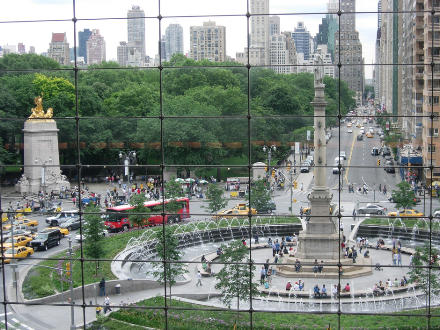
Politics aside, I enjoyed the few minutes during which I ruminated in the square (or circle, if ye be pedants). I recall many years ago the debate surrounding how to improve Columbus Circle that there was a near-universal desire for there to be more trees but that the very shallow depth between the street surface and the subway below presented difficulties in this regard. The redesigners have solved this problem by encircling the center of the circle with a raised ridge, on which are planted a number of trees which, we trust, will be even more appreciated as they mature. The raised ridge, which features jets of flowing water around the inner circle, also serves to innoculate the center from the noise of the traffic which, the Circle being situated at the confluence of Broadway, Central Park West, Central Park South, and Eigth Avenue, is considerable.
And so, I judge the new Columbus Circle a success, and I am happy to the report that the American Society of Landscape Architects concur, having awarded it their General Design Award of Honor. Another random fact which surprisingly few people know is that Columbus Circle is the spot from which distances to New York are numerated, akin to Moscow’s Red Square and London’s Trafalgar Square (if I recall correctly).
LEAVING COLUMBUS CIRCLE, I sauntered back up Broadway to another of Manhattan’s engaging places, Lincoln Center. Critics accused the architects of the performing arts complex of cribbing off of Rome’s E.U.R., but one wishes the three halls facing Lincoln Center’s plaza had the same crispness of those modern Roman structures. The thirty years between the E.U.R. of 1930s Italy and the Lincoln Center of 1960s New York were years in which the quality of modernism declined just as greatly as its supremacy increased. Despite this, the plaza of Lincoln Center is one of the most successful public places in Manhattan. I have often lamented the absence from New York of the open piazza so common on the Continent. This plaza competes with Central Park’s Bethesda Terrace as the best example of the type in Manhattan.
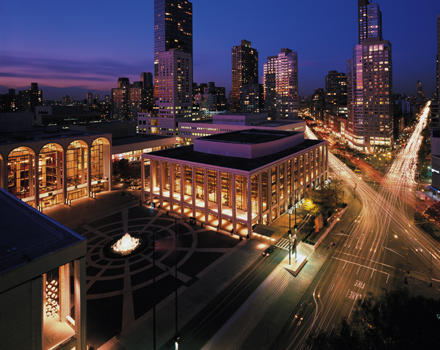
The plaza is raised above the neighboring Lincoln Square (one of the many triangular squares created by Broadway’s healthy disregard for the grid) and is reached by a gentle rise of stairs. Viewed from the square it appropriately seems like a stage upon which all our great dramas are played. The dance of the New York City Ballet in the State Theatre on the left, the music of the New York Philharmonic in Avery Fisher Hall on the left, and in the center, the Metropolitan Opera in the Metropolitan Opera House; the greatest opera company in the Americas, not to mention one of the best in the entire world. And from the hour of seven or so on the evening of performances, the three arts mix and mingle in the plaza as attendées wait to meet their companions and enter whichever of the respective halls they are to spend the evening. Some jealously preserve a seat of honor on the rim of the central fountain, while others hide from the elements (the beating sun, the heaving rain) in the shelter of the arcades, while still more meander slowly to and fro around this piazza dell’arte.
It’s unfortunate, then, that the elders of Lincoln Center insist on erecting temporary stage structures in the middle of the plaza, partially obstructing the fountain, during the warmer months when, above all other times, it should be open for all to enjoy. The creators of Lincoln Center conceived of the obvious desire for outdoor performances during the summer, and so they built the bandshell in Damrosch Park in between the Opera House and Avery Fisher Hall, just diagonally adjacent to the plaza. Surely the plaza is meant to be an open space where all the events can mix, blend, interact, influence, before finally separating into their appropriate places. If there are to be outdoor performances, hold them where they were meant to be, and if that place suffers from some malfunction of design, then redesign that place rather than rudely interjecting a particular event into what was meant to be the public square for all.
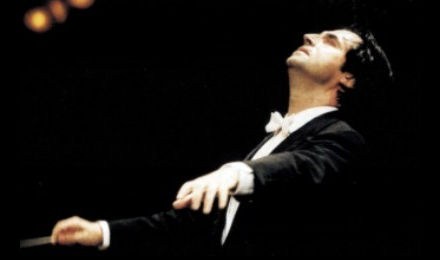
THIS PARTICULAR EVENING it was into Avery Fisher Hall for a performance of the New York Philharmonic, now in its 165th year. The program was Rossini’s overture to Semiramide and Schubert’s Symphony No. 3 in D major (D.500), with Dvořák’s Symphony No. 5 in F major (Op. 76). Riccardo Muti wielded the conductor’s baton and the result was definitely less than was expected. I had only heard Muti’s conducting on the radio in passing and, while admittedly not devoting much thought to it, he seemed a fairly capable conductor. In person, however, he left much to be desired. Rossini’s overture was merely lackluster but Schubert’s symphony was actually surprisingly poor. Perhaps the worst thing was observing Muti in action, for the man looked like an utter fool. His conducting seemed unnatural, choreographed, even foppish. And those ridiculous jestures towards the first violins! I wanted to slap the man, and I shouldn’t be surprised if the violins wanted to themselves. Towards the middle of the Schubert symphony, I began to think of the man as a proper ass, the tails of his evening jacket acting the part of hind legs. My only solution to the St. Vitus’s dance on the conductor’s dais was to shut my eyes and imagine that I was there in the Austrian capital in that autumn of 1815, after the chancellors and ministers of the crowned heads of Europe had departed the Congress of Vienna when peace and order were plotted, in the home of Otto Hatwig where (scholars posit) the work was premiered.
The friend I accompanied that evening actually knows about the inner workings of music (I am actually an ignoramus on the subject, and simply like what sounds good to me) and agreed completely with me on the subject during the intermission. Luckily, the Dvořák fared better, but one had the niggling suspicion that this was the Philharmonic working its magic in spite of Mr. Muti, rather than at the command of his baton. My knowledge and appreciation of Dvořák has slowly grown, from that first passing fondness we all have for his Symphony No. 9 “From the New World”. My appreciation for the Philharmonic grows, when I see they have printed in the program that Mr. Dvořák was born in Mühlhausen, Bohemia, rather than the more modish style of “Nelahozeves, Czech Republic” that would find favor elsewhere.
Perhaps I am too hard on Mr. Muti. Perhaps he and the Philharmonic were simply not a good fit for eachother. At any rate, I shouldn’t complain as one doesn’t often get box seats to a sold-out performance with every seat in the hall occupied (though, to be honest, the sound is better down in the orchestra seats). But how I wish I could have seen von Karajan while he was alive!
After the baton had finally fallen for the night, my friend and I had the same stroke of genius at exactly the same moment and decided to head up to good old Café Lalo, but unfortunately everyone else had the same idea (Saturday night? Lalo’s? What did we expect?) so we comforted ourselves with a pint or two at the Parlour instead.
The Knickerbocker Greys
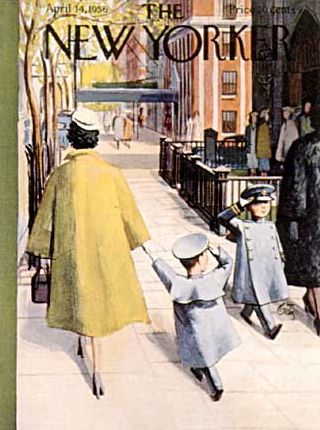
The Knickerbocker Greys, the Upper East Side corps of cadets, is celebrating its 125th year in existence. Both the Times and the Sun have featured articles on the Greys:
‘Celebrating 125 With the Knickerbocker Greys‘ by Gary Shapiro (The New York Sun)
‘Manhattan’s Littlest Soldiers‘ by Eric Königsberg (The New York Times)
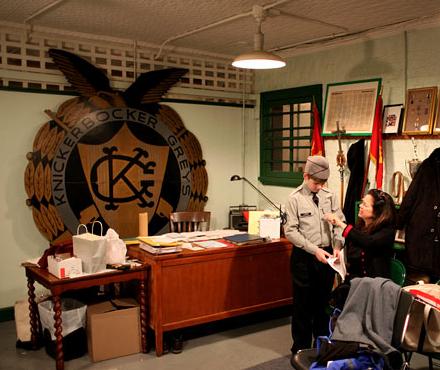
Above: A mother mends a cadet’s uniform.
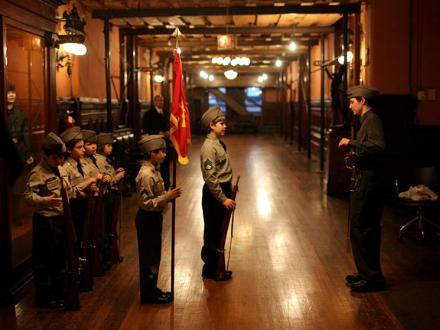
Below: Cadets assembled in an Armory corridor. (Note the interior scaffolding due to the State’s grievous neglect of the Armory).
A Morning’s Journey
I crossed the Harlem River into Manhattan today just as Patrick Leigh Fermor traversed the Danube in his brilliant book, A Time of Gifts, which has immediately become one of my favorite reads of all time. Settling into my seat on the train yesterday, I opened my knapsack to utter shock and surprise—I had left my reading at home. The Leigh Fermor and P.G.W.’s Cocktail Time were resting somewhere in my bedchamber while I stared into the compartment of my bag, bare but for a photocopied page from the Art Newspaper and two (already-read) issues of the Hungarian Quarterly. These are the times that try men’s souls. Getting out of the city late in the evening proved even harder, as the bridge carrying the railway over the river was actually up for once (“First time in my life, folks,” the conductor informed us), leaving a steady backlog of trains awaiting their northerly destinations.
But this morning there were no bridge-raising complications, and the sky was a delightful, clear blue (soon to change) as we entered Manhattan. Thankfully, I had my two books; a bit of Wodehouse while waiting in Bronxville station and then Paddy Leigh Fermor on the train. After crossing the river, the train stops at 125th Street (Harlem) before submerging at 96th, taking the passenger down to Grand Central, that well-kept remnant on 42nd Street, reminding us that we too were once civilized. There, after taking a stroll through the market (Nürnburger sausage! Kaiser ham! Norwegian salmon!) you switch to the subway and hop down just one express stop on the 5 train.
Just half a dozen steps after emerging from Union Square station I saw a speck of white fall from the sky, and then another, and another. So it began: the first snowfall of the year. And, I might add, a New York record for the latest snowfall. (January 10th? No, there was no white Christmas for us this year). Two children on the swings in the playground ecstatically proclaimed their approval at the opening of the heavens. Wandering through the farmer’s market in the square, I picked up an herb focaccia bread I thought might be particularly enjoyable, and it complimented the exceptionally tasty Tuscan vegetable soup I had for lunch. The snowflakes swirled above the square and fell down on all the market-goers and the folks walking on Broadway as I marched up to work. And yet, how fleeting! In the few steps from the front door to the elevator, the white snow had already melted and merged into the green of my loden coat. Very well, Mother Nature. Very well.
Governors Island Revisited
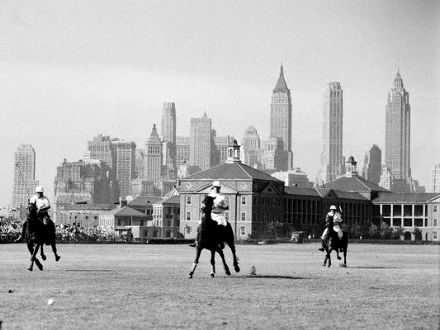
EVERY ONE OF THE myriad plans put forth for the ‘redevelopment’ of the venerable old Governors Island in New York Harbor has so far either stalled, been neglected, or otherwise poo-pooed. In this, we have something to rejoice. As I have often said, realistically speaking there is little that can be done to it which will not neglect or disgrace the island’s long military heritage. The officially-approved ideas put forth so far have been horrific: an amusement park, a casino, a ‘technology park’, as well as a number of other vapid proposals.
Naturally, we’d be enthused if it returned to its former role as swankiest post in the entire Army and the home of Army polo, but don’t hold your breath. West Point being the single exception, if it has even a touch of history, tradition, or class, Congress and the Department of Defense will do their best to get rid of it. After all, the National Guard has been pulled out of the Seventh Regiment Armory, the Navy has withdrawn all but a few institutions from Newport, and the Army has left the ancient Presidio of San Francisco; how long will it be until Fort Leavenworth’s foxhounds are brought out back and shot by the Monotony Monitors? (more…)
Old Guard on Governors Island

A photo of the Old Guard of the City of New York on Governors Island, with Manhattan in the background, taken on St. George’s Day, 1933. [Click here for larger photo]
Previously: Evacuation Day | Marshal Foch and the Old Guard | A New York Funeral | Old Guardsmen | The Old Guard | Grandpa
Category: New York Militaria
Empire State Beauty
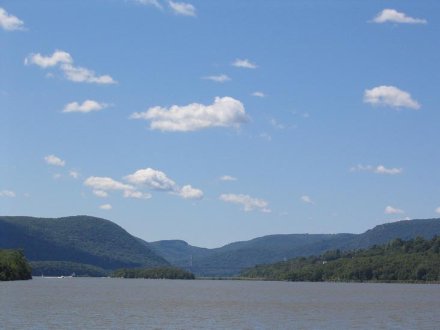
THE BRIDGE AND TUNNEL CLUB site often features photographs of myriad places, scenes, and things all around New York and beyond. Recently, the Bridge-and-Tunneller made a sojourn to various sites up the Hudson, and thankfully decided to share his photos. We bring you a selection of them, which you can find in their original form on the B&TC website. (more…)
Poor Old Bram
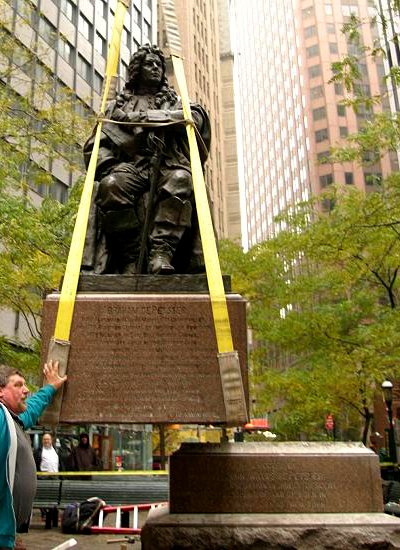
ONE HAS TO FEEL A certain amount of sympathy poor old Abraham de Peyster. The city fathers, in their infinite and unending wisdom, sought fit to erect a statue of Bram in Bowling Green, the old town square of New York down at the beginning of Broadway, many moons ago. However, having set Bram very nicely upon that green, the first public park in all New York, the city fathers have of late refused to let old Heer de Peyster rest. In 1972, the park was ‘renovated’ which entailed the statue’s forced removal. He ended up four years later in Hanover Square, a quite suitable though less prominent location, where he gazed across the square towards India House. It was then that old rivalries flared anew. (more…)
Old Dutch Gable
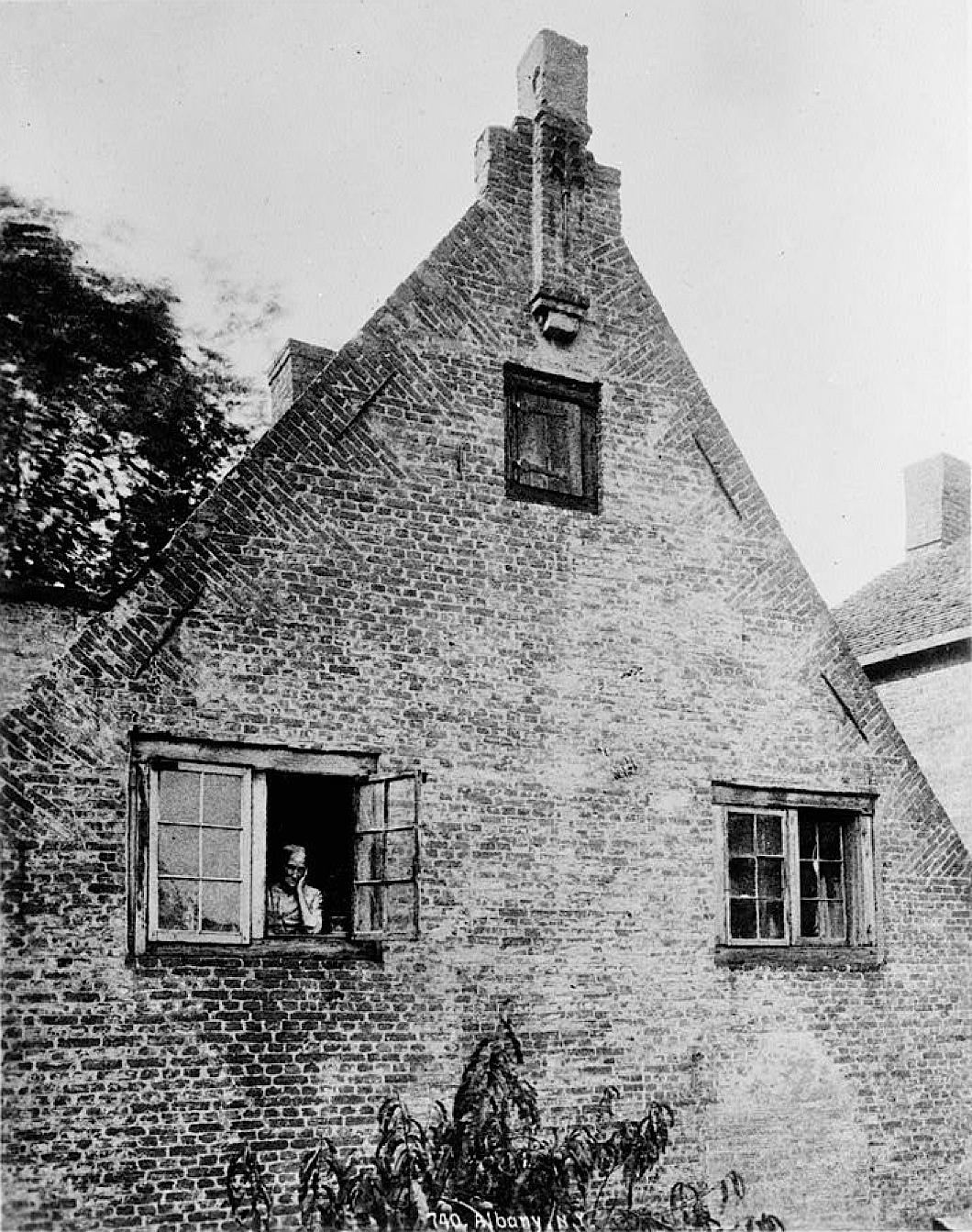
An old Dutch gable complete with old Dutch vrouw gazing miserably from the window. Albany County, New York, 1930’s.
The form of brick course on the gable is known as ‘mouse-tooth’ and is found primarily in Holland, East Anglia, and the Hudson Valley of New York, though also here and there in the American South.
The Jefferson Guards
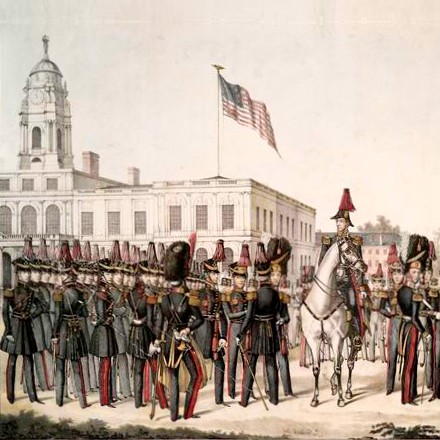
I recently stumbled upon this image depicting a militia regiment gathered in front of New York’s City Hall. The unit in question is the Jefferson Guards, 38th Regiment, New York State Artillery, amassed in bearskin caps and red-plumed shakos (red being the traditional color of the artillery). I confess I’d never heard of the Jefferson Guards before, but this is not entirely surprising. The Armed Forces of the State of New York – today composed of the New York Army National Guard, the New York Air National Guard, the New York Guard, and the New York Naval Militia – was once composed of a vast array of assorted regiments, battalions, and companies (a quite literal example of the ‘little platoons’ praised by Burke). These militia companies varied greatly in form, from little more than glorified social clubs to the crack units of the day.
As strange as it may seem, considered as a whole they were an almost completely organic military and, while they would be ill-suited to the armed exigencies of today, I refuse to believe that our little realm is better off for their general disappearance. Certainly the V.C.A. and the Old Guard, among others, survive to this day (in a somewhat different form, naturally), but what of the Empire Light Cavalry and the German Horse Guards? The Ulster Guard, the Weschester Chasseurs, and the New York Highlanders? The gallant Seventh Regiment of New York survived even into the 1990’s before its dissolution was ensured by the monotony monitors who now, fifteen years later, seek to destroy the great and blessed monument of an armory on Park Avenue which the Seventh built and guarded for over a century. We mourn their disappearance, just as we detest the continued and increasing disdain for the proud military heritage of the City and State of New York, but the entire culture which created and sustained them is gone, too.
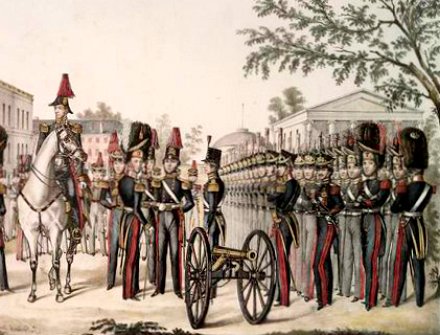
Category: Militaria – New York
The Neue Galerie
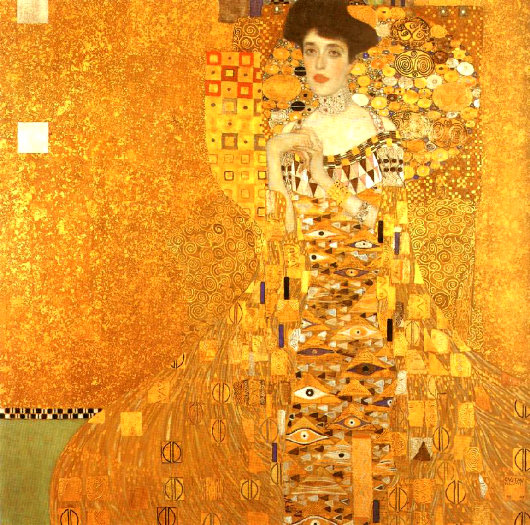
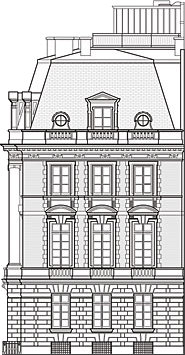 THE RECENT PURCHASE for the Neue Galerie of Gustav Klimt’s 1907 ‘Adele Bloch-Bauer I’ (above), alledgedly for a record-breaking price of $135,000,000, gives me the perfect opportunity to write a post on the eponymously recent addition to New York’s coterie of art museums. Since its 2001 opening, the Neue Galerie has resided in the handsome 1914 beaux-arts mansion on the corner of Fifth Avenue and 86th Street, designed by Carrère and Hastings (of New York Public Library fame) for industrialist William Starr Miller and later inhabited by Mrs. Cornelius Vanderbilt III. In the time since the construction of No. 1048, the rest of Fifth Avenue has undergone a lamentable transformation from a boulevard of beautiful townhouses and mansions to an avenue predominantly consisting of apartment buildings. While one appreciates the inoffensive design of the pre-war buildings on Fifth, there remain a number of thoroughly opprobrious modern interlopers which offend the graceful avenue. One can’t help but pine for Fifth Avenue before the mansions came down, but we can at least give thanks for holdouts like the Neue Galerie. (more…)
New York in Philately
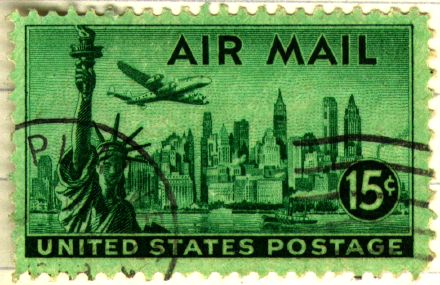
Wandering around the merry old world wide web I stumbled upon these stamps, which I bring to you for your own enjoyment. Above we have the Great Metropolis itself, the island of Manhattan in its swankier days. Below we have a view of the Crown of the Hudson, West Point, with the beautiful Cadet Chapel designed by that American Master, Bertram Grosvenor Goodhue himself, presiding over the campus of the United States Military Academy.
The postage stamp was once a thing of beauty and composition, but it’s heartening to see that some still design beautiful stamps. Just examine Elliott Banfield’s stamp of General Washington, based upon the staute in Union Square. Mr. Banfield believes that the decline in the design of postage stamps is due to a “moral void” most readily shown when the Postal Service unveiled its famous ‘Elvis Stamp’ a few years back.
“Elvis was important in the popular culture, yes,” writes Mr. Banfield. “But how important is the pop culture? Important only to those who can’t see anything higher or better. It’s scary to think that people like that are in charge of public policy. But they are, and the Elvis stamp proves it.”
Hear! Hear!
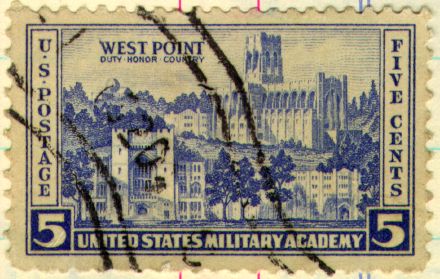
An irrelevant stamp, after the jump.
An Old Boathouse in Spuyten Duyvil
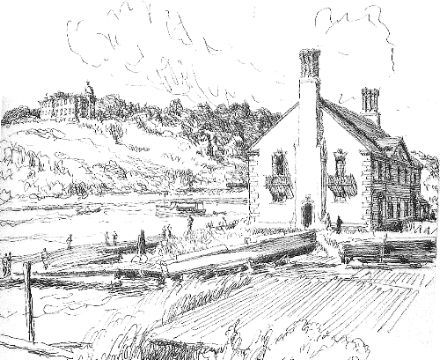
Flipping through an old book called ‘Magical City: Intimate Sketches of New York’, I came upon this sketch of the Gould Boathouse of Columbia University on the Harlem River by Spuyten Duyvil. I had never come across this little building before and had significant doubts as to whether it was still there, but to my pleasant surprise it does. I’m afraid I don’t know much about the boathouse nor its history, but here follows a number of photos and images of it, and of various Columbia boathouses of the past. (more…)
Empire State
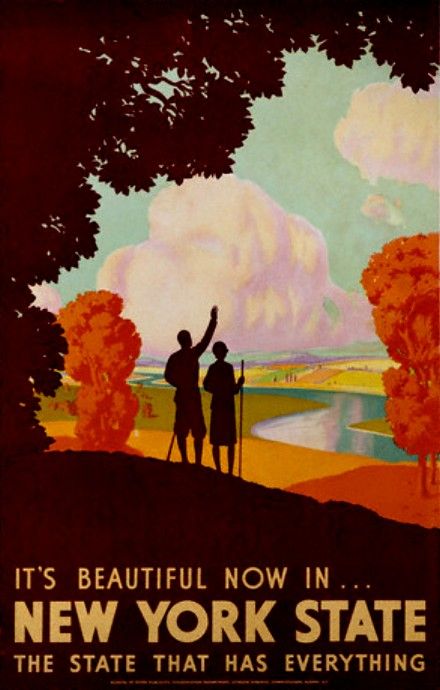
Having been duly capped on the head by the Rt. Hon. Menzies Campbell QC MP with John Knox’s breeks last Thursday I have returned to the land of my birth a Master of the Arts. Details of the various rites and festivities are forthcoming, but in the mean time I share with you these three travel posters from back in the day when they made proper travel posters. All three advertise our blessed Empire State, two of them West Point, the glorious gothic crown of the Hudson. Excelsior!
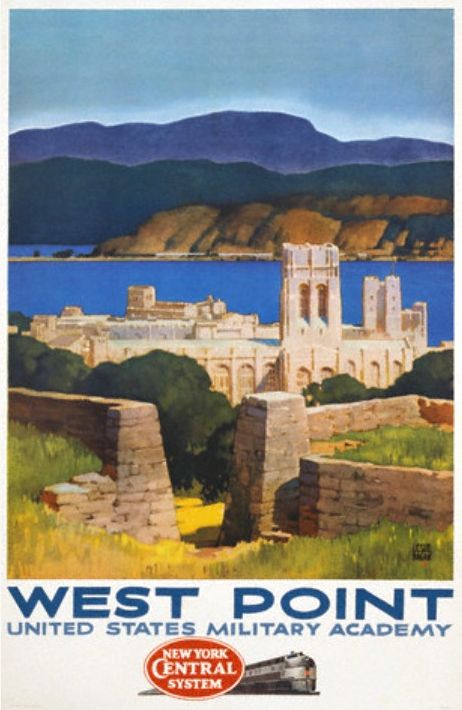
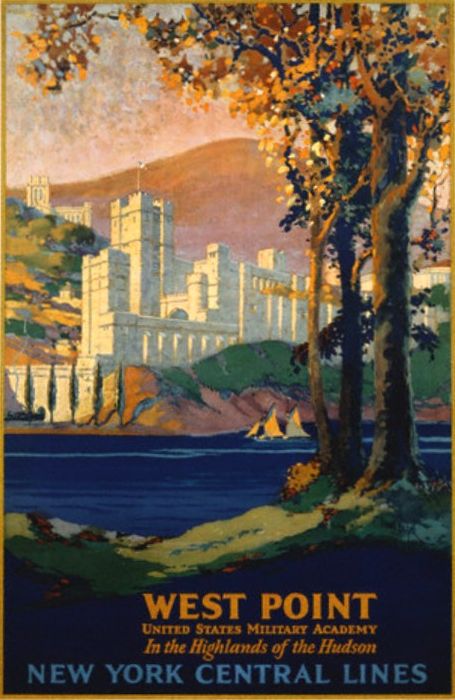
Click on the images for the full posters.
Columbus Circle and the Human Scale
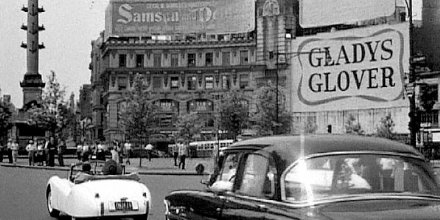
Meandering through the internet yesterday, I came across the above image from the 1954 film ‘It Should Happen to You!’ (via a New York Times article). The film capture shows Columbus Circle in 1954 and was I immediately struck by the superiority of the scale of the buildings to the street, especially compared to today when the Columbus Column is rather overshadowed by the AOL Time Warner Center. It’s not that I don’t like tall buildings; after all New York has some of the most beautiful skyscrapers in the world (though I can’t think of a single great one built after the second war).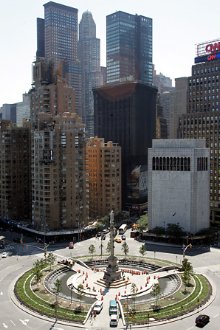 I don’t even object to the residential apartment buildings lining Central Park on Fifth Avenue and Central Park West, except for the fact that on Fifth Avenue they almost always replaced superior, smaller buildings. However, with a public square as small as Columbus Circle, it somehow seems as if lower buildings of only 3-10 storeys would be more appropriate.
The latest brouhaha concerns No. 2 Columbus Circle (the shorter, white building in the photo on the right), designed in the early 1960’s by Edward Durell Stone to house the art collection of Huntington Hartford. The current owners want to chic-ify the building by taking off the façade and recladding No. 2 in the more fashionable glass, akin to the neighboring Time Warner Center, and this has roused the ire of many of New York’s preservationist crowd. Though No. 2 has its charms, I’m not a huge fan of the building myself, but the redesign would only make it worse. The chief value of the building is its comparitively low height which, when viewed from the northwest, contributes to the feeling as if the midtown buildings are gradually lowering in height to meet the scale of Columbus Circle. Unfortunately the Time Warner Center doesn’t comply well with this lessening scale, though it at leasts goes through the motions by have a consistent, low base from which its two towers rise. The stone cladding of the Center, however, is rather too dark and gives a slightly gloomy feel to what ought to be a lovely, bright place. (more…)
Your Royal Highness, Cead Mile Failte
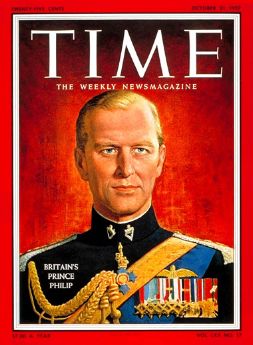
Thus wrote Francis Finnegan of the Ancient Order of Hibernians to H.R.H. Prince Philip, the Duke of Edinburgh, (above, in the uniform of the Queen’s Royal Irish Hussars) inviting him to partake in New York’s St. Patrick’s Day festivities in 1966 during his visit to North America. The invitation was made in recompense for the opprobrious breach of propriety in 1861 when Col. Michael Corcoran, Commanding Officer of the New York 69th committed an act of insubordination when he refused to order his troops to take part in the official festivities welcoming the Prince of Wales to New York. Corcoran was dropped from the Officers Roll of the New York State Militia for the offense, and was to be court-martialled but for the outbreak of the Civil War.
Finnegan, the public relations director of the New York St. Patrick’s Day Parade organised by the Ancient Order of Hibernians every year, assured the Duke of Edinburgh that he would not be mistreated as the Prince of Wales had been one hundred and five years previous. “Alas,” TIME magazine reported, “he arrived in Manhattan too late on St. Patrick’s Day to march in the Fifth Avenue parade, even though he did sport a fine green tie. Britain’s Prince Philip, 44, in a green tie? ‘Just a coincidence,’ chuckled the consort.” (TIME, 25 March, 1966).
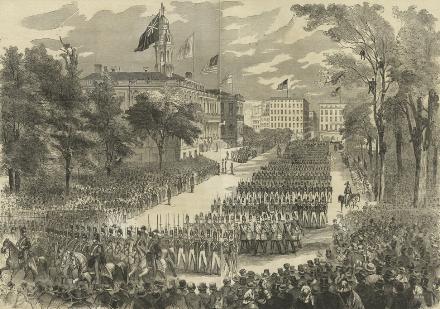
The 1861 visit of the Prince of Wales to New York was a spectacular event, despite the insults of Col. Corcoran. A ball was held, just as for the Queen Mother during her 1954 visit to New York, as well as a parade and pass-in-review.
The Governor’s Suite, City Hall
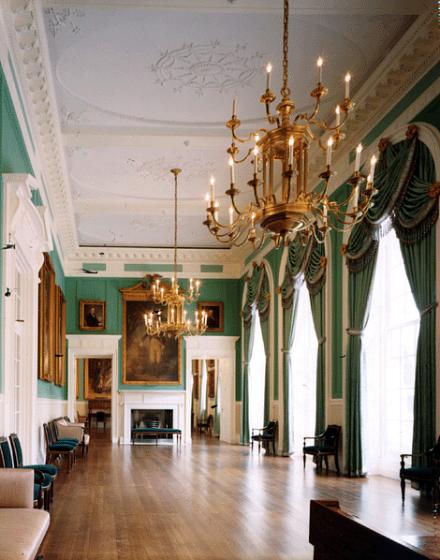
I HAVE NEVER been inside New York’s City Hall, though I have walked or driven past it on a number of occasions. With tall skyscrapers of various ilks towering over it, it always seemed rather small and inconsequential, and I knew nothing of the interiors save the Blue Room in which the Mayor usually gives press conferences and the rotunda which is fairly well-known as well.
I was delighted, therefore, to stumble upon the above photo of the recently-restored Governor’s Suite in City Hall, which shows it to have a rather handsome interior. Since the state government embarked upon an up-river journey to Albany, I presume the purpose of the Governor’s Suite is to provide a place for New York’s head of state to receive and entertain important dignitaries visiting the Big Apple. The current green color of the walls seems much preferable to the previous and rather dull white. I must endeavour to visit City Hall when I next return to the metropolis. (more…)
The Queen Mother in New York, 1954
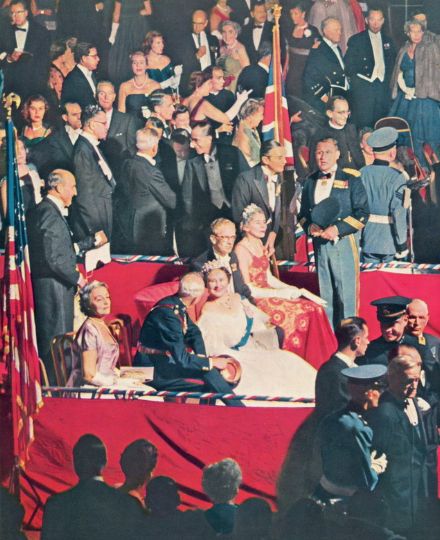
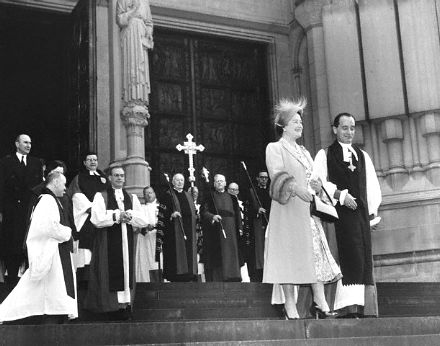
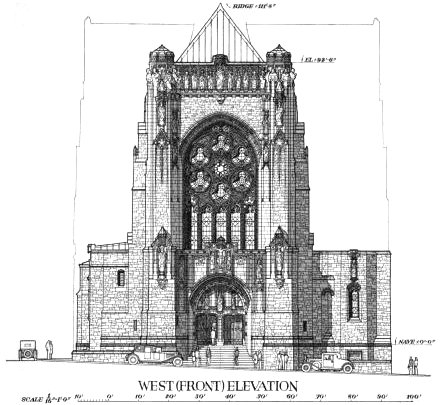
In 1954 Queen Elizabeth, the Queen Mother (n.1900, m.2002) visited New York to accept an educational fund raised by Americans in memory of the late King George VI. On the evening of November 1 of that year, the Seventh Regiment entertained Her Majesty with a special ball held in her honor at the Armory on Park Avenue (view above). Her Majesty also visited the Cathedral of St. John the Divine where she was received by the (Episcopal) Bishop of New York, the Dean, and the clergy of the Cathedral. The three stone blocks on the façade seen in the view below have since been sculpted.
Governors Island
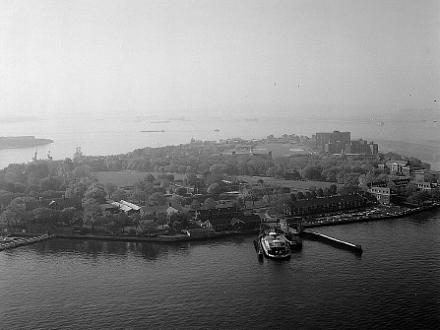
GOVERNORS ISLAND IS one of New York’s hidden gems. Not only is it a place which has a long and storied history, but it remains, however underappreciated, a place of great beauty, not to mention a place of great potential. The fact that this island in New York Harbor has been the property of the government for the preponderance of its existence has shielded it from the destructive forces of commerce which have savaged so much of what is beautiful and historic in the remainder of the city.
Let us explore this intriguing isle… (more…)

Search
Instagram: @andcusack
Click here for my Instagram photos.Most Recent Posts
- Brunel’s Unbuilt Capitol February 3, 2026
- Cricket at Fordham January 27, 2026
- Palacio Barolo Revisted January 14, 2026
- Learning to Love Liguria January 14, 2026
- Crux Alba No. 2 January 13, 2026
Most Recent Comments
Book Wishlist
Monthly Archives
Categories