New York
About Andrew Cusack
 Writer, web designer, etc.; born in New York; educated in Argentina, Scotland, and South Africa; now based in London.
 read more
News
Blogs
Reviews & Periodicals
Arts & Design
World
France
Mitteleuropa
Knickerbockers
Argentina
The Levant
Africa
Cape of Good Hope
Netherlands
Scandinavia
Québec
India
Muscovy
Germany
Academica
The New York Central Building
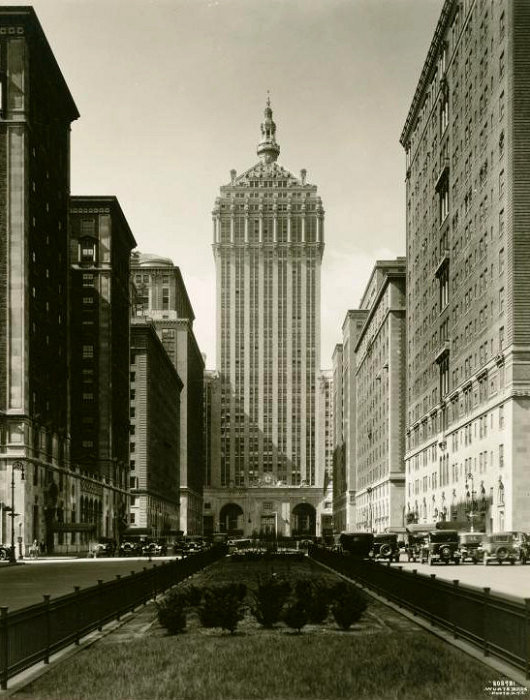
The New York Central building once presided majestically over an equally elegant Park Avenue, which is cleverly directed through the building from the south, emerging through the double arches on the north side. Sadly, while the tower (now known as the Helmsley Building) still stands, the view of it has been marred since 1963 when the Pan Am building was built between it and Grand Central Terminal. When it opened, the Pan Am building was the largest commercial office building in the world, and it was certainly one of the least graceful. The 1960s and 70s were not kind to Park Avenue on either side of Grand Central, and many of the traditional-style buildings have been demolished or re-clad in glass.
The Hanover Bank: A Classical Gem
No. 35, East Seventy-second Street
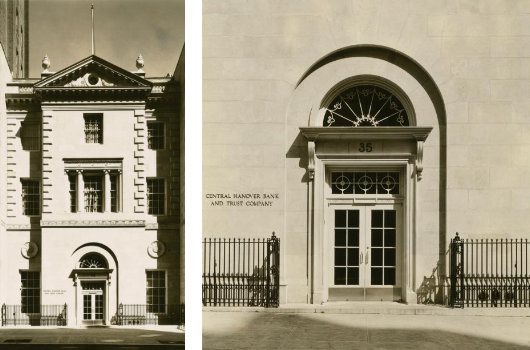
Passing by, as I sometimes do, the Chase branch bank at East 72nd St., I think to myself “There’s a fine establishment, in which I should keep my money”. The thought never jumps from theory to practice, however, as I am a patriot in everything but finance, and keep my florins safe with the Hongkong & Shanghai Bank instead. Nonetheless, it’s a handsome building, and the Central Hanover Bank & Trust Company should be commended for erecting it. Central Hanover merged with the Manufacturers Trust Company in 1961 to form Manufacturers Hanover (“Manny Hanny”), which was taken over by Chemical Bank in 1991, which was acquired by Chase Manhattan Bank in 1995, which merged with J.P. Morgan in 2000, and the consumer & commercial banking arm of J.P. Morgan Chase & Co. is now simply known as “Chase”.
While the original Chase National Bank was only formed in 1877, with all these mergers and acquisitions, “Chase” can now trace its lineage back to the foundation of the Bank of the Manhattan Company in 1799, the second oldest bank after the Bank of New York. But — would you believe it? — “Chase” is now headquartered not in the hallowed caverns of Wall Street but — wait for it — Chicago, Illinois!
Let Louis XVI Rest in Peace; A Funeral Mass in Manhattan
By PETER STEINFELS | The New York Times | July 17, 1989
They came not to praise the French Revolution but to bury it.
In the place of tricolor bunting, there were the black vestments of an old-fashioned Roman Catholic funeral Mass. Instead of fireworks, there were the flickering candles of a Manhattan church. Instead of the “Marseillaise,” there was the rise and fall of Gregorian chant.
They came not to praise the French Revolution but to bury it. In the place of tricolor bunting, there were the black vestments of an old-fashioned Roman Catholic funeral Mass. Instead of fireworks, there were the flickering candles of a Manhattan church. Instead of the “Marseillaise,” there was the rise and fall of Gregorian chant.
Subway riders, New York City, 1914
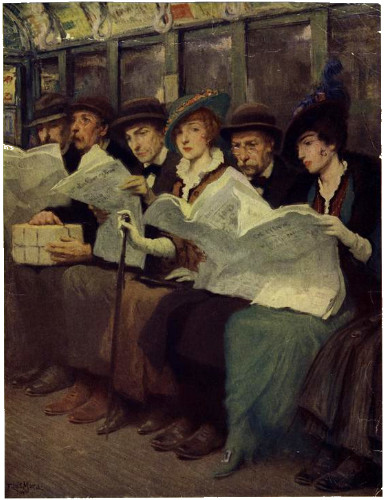
Francis Luis Mora, Subway riders, New York City, 1914
Print, 12½” x 9¼”
1914, New York Public Library
The Great Club Revolution
What with all this democracy things will never be the same
 The Union Club |
By Cleveland Amory
American Heritage, December 1954, Vol. 6, Issue 1
In 1936 in New York City there occurred the 100th anniversary of the Union Club, oldest and most socially sacrosanct of New York’s gentlemen’s clubs. From all parts of this country and even from abroad there arrived, from lesser clubs, congratulatory messages, impressive gifts and particularly large offerings of floral tributes.
At the actual anniversary banquet, however, as so often happens in gentlemen’s clubs, there was, despite the dignity of the occasion, the severe speeches and the general sentimental atmosphere, a little over-drinking. And one member over-drank a little more than a little. Shortly before dessert he decided he had had enough, at least of the food, and he disappeared. Furthermore, he did not reappear.
Worried, some friends of his decided, after the banquet, to conduct a search. The faithful doorman in the hooded hallporter’s chair gave the news that no gentleman of that description had passed out, or rather by, him, and the friends redoubled their efforts. High and low they combed the missing member’s favorite haunts—the bar, the lounge, the card room, the billiard room, the locker room, the steam room, etc. One even tried, on an off-chance, the library. There, as usual, there was nothing but a seniority list of the Union’s ten oldest living members and a huge sign reading “SILENCE.”
Finally, in one of the upstairs bedrooms, they found the gentleman. He was lying on a bed, stretched out full length in his faultless white tie and tails, dead to this world.
A Rundbogenstil Library in New York
The handsome former Astor Library on Lafayette Street

One of my favorite buildings in all New York is the former Astor Library on Lafayette Street in Greenwich Village. Now the Public Theater, it is a superb example of the nineteenth-century German neo-romantic Rundbogenstil (“round-arch-style”) and one of the few remnants of that style in New York. The Astor Library was the legacy of John Jacob Astor, whose will provided for its establishment. Late in the nineteenth century, the Astor Library agreed to merge with the Lenox Library and the Tilden Trust to form the New York Public Library, one of the greatest libraries in the history of civilization. The building was bought by the Hebrew Immigrant Aid Society who tore out the book stacks and used it as a processing station for needy newcomers. In 1965, the HIAS sold it on to a developer who planned to demolish it, but, through a massive civic effort, Joseph Papp and his New York Shakespeare Festival purchased the building and turned it into the Public Theater.
Hic mihi patria est

The Fourth of July, we are told, is a day for celebrating the love of one’s country. Robert Harrington and I were sitting around one evening when we decided to found a guerrilla group. First, it needed a name; Front pour la libération de notre terre sacrée Amérique (or the FLNTSA) was a runner-up but we settled on the Village Green Preservation Society. Frowning upon the camouflage fatigues of most groups of this nature, we decided that our uniform would consist of tweed jackets, flat caps, and balaclavas.
But as our conversation continued we discovered, to our chagrin, that though we thought we were both from the United States of America, we were actually from entirely different countries. Robbo’s country is the nicer, rather horsey part of New Jersey near Princeton, whereas my homeland is mostly the part of New York between the Hudson and the Sound. We discovered we were fighting for the preservation of entirely different Village Greens, and that ma terre sacrée Amérique was entirely different from sa terre sacrée Amérique.
This is one of the problems of a “country” as large as the United States. I love my country, but what do I care about Montana or Texas or Alaska? I wish them well, to be sure, but they hardly seem to have much to do with my country. I once started to read a scaremongering article about the growing Mexicanization of California but I had to put it down after a few paragraphs because it didn’t seem to be anything I had to worry about. If southern California secedes and tries to join Mexico, well good for them! I’ll send them a bottle of champagne and get back in my hammock.
In The Napoleon of Notting Hill, Chesterton wrote:
In that spirit, I present to you below a map of my country, from Sleepy Hollow in the north, to Governors Island in the south. It is a mere approximation, as the borders are both indefinite and ever-shifting. Though highly populated, it is a bit on the small side, and I think I agree with Chesterton that that’s a good thing.

Abomination
This act of willful cultural vandalism is noxious in the sight of both God and Man and is a complete and utter abomination. Whoever is responsible for this should be hanged, drawn, and quartered, and buried at a crossroads with a stake through his heart.
Observe the beauty of this building at the corner of Harrison & Penn in Williamsburg, Brooklyn: its classic composition, its complete vernacular ease. And look at the cheap, tawdry, wrongly-colored brick used to hide and ultimately destroy this ordinary gem.
How can the perpetrator of this act sleep at night? It boggles the mind…
From “A Suburban Country Place”
Claremont, at the end of Riverside Drive, near the tomb of General Grant, suggests in a rather humble way what these mansions were, and in a very magnificent way what their outlooks were. Others linger, desecrated, here and there, closely pressed by new-laid brick and stone. And away up at the extreme tip of Manhattan there are still a few quiet, shady places which may call themselves suburban in the old and honorable sense. But everywhere else around the outskirts of Manhattan the term has gained an unattractive, hybrid meaning. To speak it with pleasure, New-Yorkers must apply it to those remoter regions which can be reached only by a railway journey of considerable length. And then it is incorrectly applied, for a real suburban place is rural in aspect, but urban in convenience — private, green, and peaceful in itself, yet close in touch with the true self of the town. …
“A Suburban Country Place”
The Century Magazine,
May 1897
Glass-plating the Coliseum
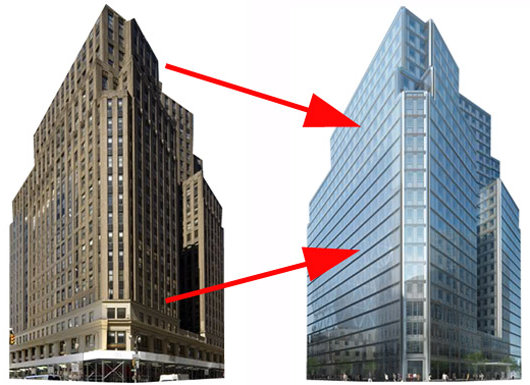
1775 Broadway, formerly the home of Coliseum Books (which I believe got its name from the splendid columns ringing the first two floors, as well as from the nearby now-demolished New York Coliseum), is to be glass-plated and re-addressed as “3 Columbus Circle”. As John Massengale commented, “Because if there’s anything New York City needs it’s another glass-covered office building…”.
New Yorker Elected Mayor of London

Congratulations to that most-honoured son of the Empire State, Mr. Alexander Boris de Pfeffel Johnson MP, more commonly known as Boris, on his election to the mayoralty of Greater London. Mr. Johnson was born on these sacred shores some forty-four years ago on a pleasant June day. Boris has politics in the blood as his father Stanley is a former Conservative MEP, but let us hope he does not take after his great-grandfather, Ali Kemal Bey, who made enough unfortunate decisions during his brief tenure as interior minister of the Ottoman Empire that he was knicked from the barber shop of the rather-smart Tokatlian Hotel in Constantinople and lynched shortly thereafter.
Strangely enough, this is not exactly the closest connection New York and London have ever had. Sir Gilbert Heathcote, 1st Baronet was Lord Mayor of London in 1710 while his brother Caleb Heathcote was Mayor of the City of New York, exhibiting how interconnected our transatlantic British world was in those days. Caleb Heathcote was also Lord of the Manor of Scarsdale, which is just five minutes north of here on the train. Created in 1703, Scarsdale was the last manor granted in the entire British Empire. There were about a dozen manorial lordships here in New York, bringing the proud heritage of feudalism to the New World. The Manor of Gardiner’s Island survives to this day as the only manor in America in which the land is still entirely owned by the descendants.
The bulk of manorial privileges (incorporating the pre-existing patroonships from the olden Dutch days) were, alas, abolished in the 1840s, with the final holdouts taken care of in some legislation of 1911, but the Lord of the Manor of Pelham was presented with a fatted calf each St. John’s Day from the City Council of New Rochelle (honoring the Huguenots’ agreement purchasing the land from the Pells) well into the twentieth century.
The Heathcote name survives, in Derbyshire I believe, but not in America. Caleb Heathcote married the daughter of Col. William Smith, Chief Justice of the Province of New York, but had only daughters.
And you thought subsidising the poor was bad…
Millions of tax dollars taken from hard-working Americans are going to subsidise one of the wealthiest school districts in the country
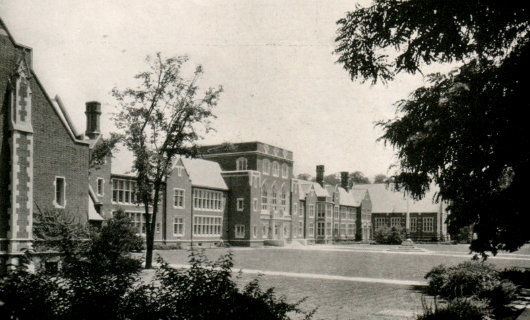
The Bronxville School (as it is called, since all grades from kindergarten to 12th are in the same building) ostensibly has a number of things going for it. It has a rather splendid collegiate gothic building in an excellent setting in one of the handsomest villages in all of the Empire State. Its school district is a mere square-mile, meaning most students can walk to school and it doesn’t even have a bus system. It has a private foundation funded independently by parents and alumni to support the school. What more could a public school possibly need?
Well, according to the geniuses down in Washington, D.C., $5.4 million in federal grants. The school, you see, is built on a site which frequently floods. Our main street in Bronxville is called Pondfield Road for a reason: the field with the pond is the open space where the school now stands. It’s been flooding for decades and so floods should come as no surprise. The nor’easter that blew through town a year ago flooded the school severely, closing it for over a week. The flooding was particularly bad during the last nor’easter because the school had spent a great deal of money (privately-raised, not from the public purse) to replace its natural football field with a lower-maintenance fake turf alternative. They did this instead of saving the money for, oh, say, one of those floods that happens every so often.
The money has been secured from the Federal Emergency Management Agency by our congresswoman, Nita Lowey (D). “When a natural disaster occurs, the federal government has a responsibility to help communities recover,” said Lowey, who neglected to provide any legal or moral backing for such an untruthful and baseless claim.
The school district of one of the wealthiest communities in the country is filching off the hard-working people of America in order to clean up the mess that is a direct result of its own poor spending decisions and inability to plan properly. Is there no shame?
Our Lady of Esperanza
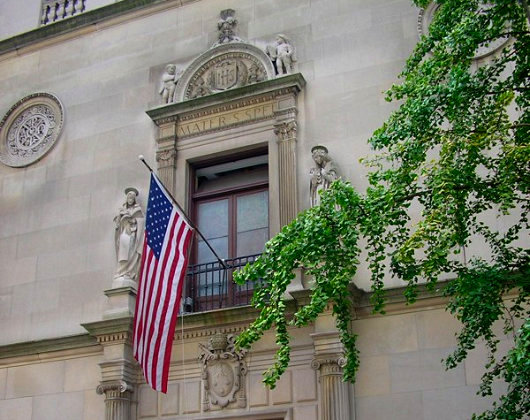
The Church of Our Lady of Esperanza, 156th Street & Broadway. The Church was built by Archer Huntington at the urging of Doña Manuela de Laverrerie de Barril and designed by Huntington’s brother Charles. The sanctuary lamp was a gift from King Alfonso XIII of Spain. The present façade dates from 1924, when the Church was expanded under the direction of Lawrence G. White, the son of Stanford White of McKim Mead & White and himself a partner in his father’s firm.
The right direction

What’s this? A building built from the ground up by a developer in New York, and designed to look like a New York building? Something to look forward to at 211 Elizabeth Street.
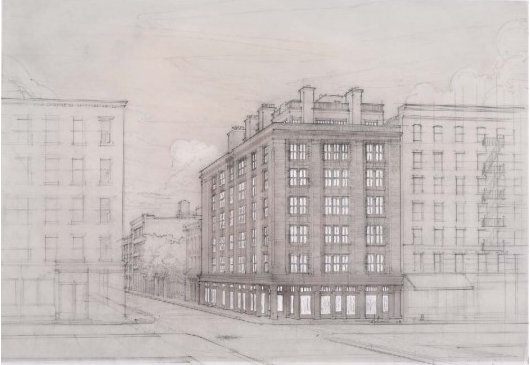
(more…)
The Late Great Bank of New York

Doesn’t it often seem that as soon as something you actually like comes along, it’s only a short amount of time before it’s gone again? This is how I feel about the latest, and indeed last, logo and general visual identity of the Bank of New York. Readers are no doubt aware that the Bank of New York is the oldest bank in America (founded by Alexander Hamilton) and that its was the first share traded on the New York Stock Exchange when that great financial market was founded beneath a buttonwood tree in 1792.
In 2005, the Bank of New York finally dumped their 1980’s-feel, dated-but-traditional logo in favor of a new design put together by the New York brand house of Lippincott (then still known as Lippincott Mercer). The logo suggested an old stock or bank note but its polychromatic scheme gave it a modern vibrancy. The adjacent logotype was along similar lines: “Bank” and “New York” in a tasteful, restrained modern with “The” and “of” in a delightfully traditional fluid colonial script.

But on July 1, 2007, the ancient Bank of New York merged with a foreign interloper, the Mellon Financial Corporation of Pennsylvania and the disgusting hybrid child of the marriage is cumbersomely monikered: “The Bank of New York Mellon”. How awkward and ungainly! Along with the merger came a new logo, also designed by Lippincott, which you can see on the BNYM website. This pitiful modern arrowhead design says little, other than one might suffer bodily harm at its handling.
The 2005 Bank of New York logo evoked a sense of solidity. “I have deep roots and firm foundations,” it seemed to say, “but am nonetheless modern and adapting to change”. Think of the feel, the smell, of a worn bank note and then compare it to the dull, prickly arrowhead which threatens injury. The old logo you stick in you pocket and gain a sense of security from. The new logo you worry a ninja might hurl at you.
It was an error even to change the name, if you ask me. “The Bank of New York” has such a simplicity and a solidity to it, which the new name rather lacks. It is just like the old New York law firm of Dewey Ballantine, which suffered a takeover recently and is now known as “Dewey and LeBoeuf”. Rather sounds like a pair of huckster Louisiana lawyers hoping to make a few off the innocent inhabitants of the Bayou. So stick to the tried and the true, folks. It usually works.
Spring hath duly sprung
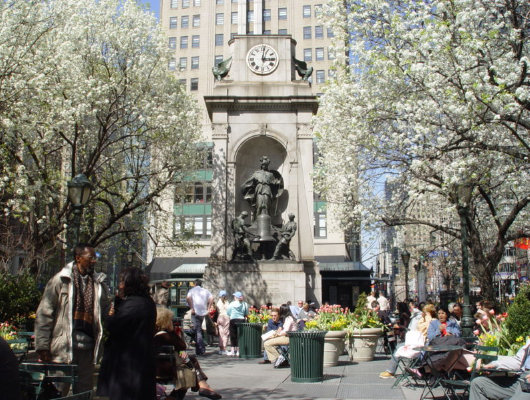
Herald Square, at the confluence of Broadway and the Avenue of the Americas.
Columbus Circle: A Wider View
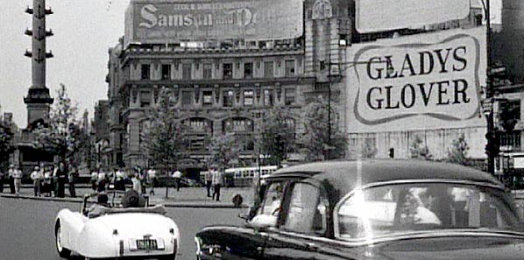
I THOUGHT THAT since we widened our window of opportunity, I ought to give you a wider view of this capture from the 1954 film ‘It Should Happen to You!’, previously displayed in our exposition on Columbus Circle and the Human Scale. The more recent rehabilitation of this grand public place was discussed in one of my diary entries. (more…)
Rip van Winkle
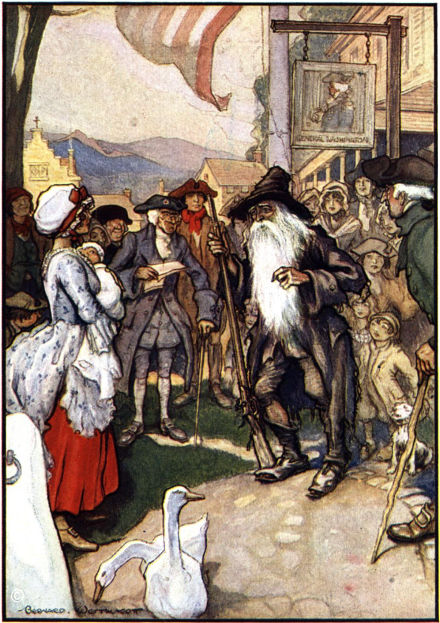
POOR RIP van Winkle; I always felt bad for him. He falls asleep for twenty years, and returns to his own native village where is now unknown and taken for some strange vagrant. “I am a poor quiet man, a native of the place, and a loyal subject of the king, God bless him!” he exclaims, in blissful ignorance of the Revolution which took place during his slumber. “A tory! a tory! a spy! a refugee! hustle him! away with him!” cry the by-standers.
I have long thought that Washington Irving was trying to make a subtle traditionalist point here: the definition of a good citizen has been arbitrarily changed. If a man was a good New Yorker in 1765 and hasn’t changed, why is he a traitor in 1785? It’s clearly ridiculous, except to proto-Jacobins and ideologues.
Anyhow, the lesson of the story: drink not from the flagons of odd-looking personages playing nine-pins amidst the Hudson Highlands.
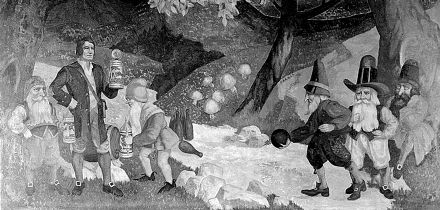
Previously: Rip van Winkle
New Netherland Medal
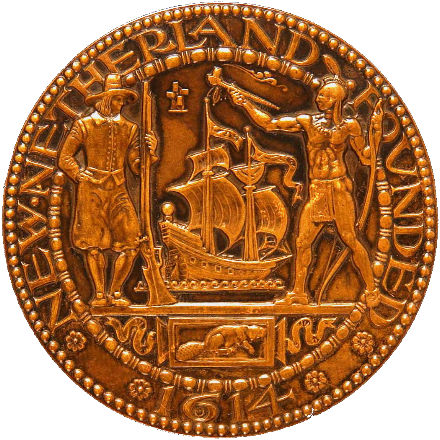
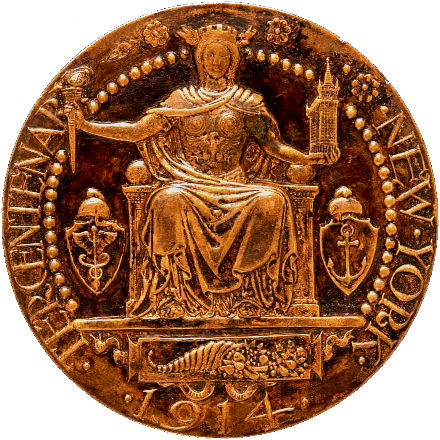
Paul Manship, New York Tercentenary Medal
Bronze, 2 3/4 inch diameter
1914, Smithsonian American Art Museum
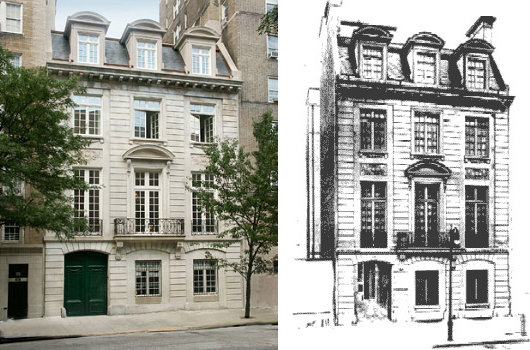
The Dahlgren Residence
No. 15 East Ninety-Sixth Street, New York
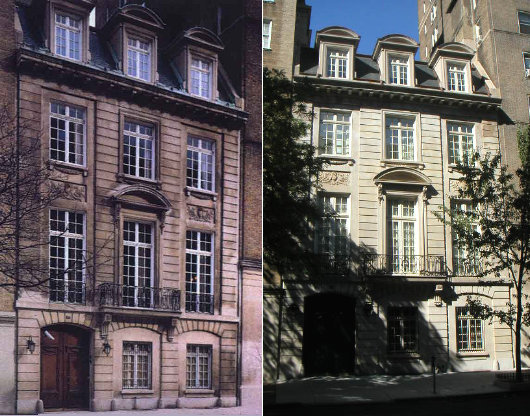
THE UPPER EAST SIDE is crossed by a number of wider cross-streets, of which 96th Street has long been agreed as the northern boundary of the neighborhood. (Overeager real estate agents have recently taken to advertising properties above that boundary as being located in the “Upper Upper East Side”). At number 15 on East 96th Street sits a splendid townhouse of superb design and execution often known as the Dahlgren residence. (Seen above, before and after complete restoration).
Lucy Wharton Drexel was of the Philadelphia Drexels, from which also came Saint Katharine Drexel, the founder of the Sisters of the Blessed Sacrament, as well as the initiators of Drexel University in that Pennsylvanian city. Young Miss Drexel married Mr. Eric B. Dahlgren, son of Admiral John A. Dahlgren, inventor of the Dahlgren Gun used during the Civil War at a ceremony in the Philadelphia cathedral officiated by Archbishop Corrigan of that see, and the couple soon moved to Manhattan where Mr. Dahlgren had a seat on the New York Stock Exchange. The Dahlgrens themselves were a prominent Catholic family, with Eric and his brothers attending Georgetown University, where to this day the main chapel bears the Dahlgren name. (Well-to-do Catholics must have been in short supply at the time, because after Lucy and Eric’s marriage, Lucy’s sister Elizabeth was married to Eric’s brother John).
Search
Instagram: @andcusack
Click here for my Instagram photos.Most Recent Posts
- Brunel’s Unbuilt Capitol February 3, 2026
- Cricket at Fordham January 27, 2026
- Palacio Barolo Revisted January 14, 2026
- Learning to Love Liguria January 14, 2026
- Crux Alba No. 2 January 13, 2026
Most Recent Comments
Book Wishlist
Monthly Archives
Categories