History
About Andrew Cusack
 Writer, web designer, etc.; born in New York; educated in Argentina, Scotland, and South Africa; now based in London.
 read more
News
Blogs
Reviews & Periodicals
Arts & Design
World
France
Mitteleuropa
Knickerbockers
Argentina
The Levant
Africa
Cape of Good Hope
Netherlands
Scandinavia
Québec
India
Muscovy
Germany
Academica
Eric Seddon on Washington Irving
Alongside Miklos Banffy, Washington Irving is probably my favourite author. I have two sets of his complete works, and will obtain at least a third — my favourite printing of the complete Irving, in an excellent handy size — when I can find it for the right price. It is curious, but by no means suprising, that Irving’s genius is nearly forgotten today even though he was the first American to be an international superstar, famed on both sides of the Atlantic. He is mostly known only through his authorship of Rip van Winkel and The Legend of Sleepy Hollow, both of which works are rarely presented in their original written form, but almost always in shortened illustrated versions for schoolchildren from publishers convinced of their audience’s stupidity.
Irving is rarely in the limelight these days, but First Things Online recently published an informative article, “Washington Irving and the Specter of Cultural Continuity” by one Eric Seddon, that is well worth reading.
His first book, Dietrich Knickerbocker’s History of New York, capitalized on the amnesia of New Yorkers by a mix of biting satire and real history of the Dutch reign in Manhattan. The book is foundational to any study in American humor. It is wild, free, self-deprecatory, and merciless to the public figures of his day, and by turns lyrically funny, absurd, and reflective. Without it, we might wonder whether American humor, from Twain to the Marx brothers to Seinfeld, would have taken the particular shape it did.
When Americans, always prone to utopian daydreams, were in danger of taking themselves far too seriously, when the term “manifest destiny” was embryonic, Dietrich Knickerbocker rolled his bugged-out eyes, chuckled gruffly, and whispered into the ear of a young nation, “Remember thou art mortal.” […]
Irving’s two most famous stories are to be found in The Sketch Book, virtually bookending the text: “Rip Van Winkle” and “The Legend of Sleepy Hollow.” In “Rip Van Winkle,” Irving whimsically pointed out the hazards of the new Republic, that a once humble acceptance of life under monarchy could easily give way to arrogant corruption, vice, and the nauseating specter of being governed by village idiots with a gift for demagoguery. […]
The final warning of the book comes in the form of a Headless Horseman, who is either a real ghost of the Revolution or the town bully in disguise, and who targets, of all people, the schoolmaster (even small towns have their intelligentsia). Is it history chasing Icabod Crane, the puritanical teacher obsessed with stories of witch hunts, or just Brom Bones scaring him out of town? Irving doesn’t say, and perhaps our answers tell more about ourselves than about him.
Washington Irving spent his last days in Tarrytown, near the setting of his most famous story. He was a member of the local Episcopal Church, tried to revive the old Dutch festivities on St. Nicholas Day, and was moved to tears by singing the Gloria. In particular he loved to repeat the words “Glory to God in the highest, and on earth peace, and good-will to men.” Though his era was in many ways a bigoted one, he resisted and thereby helped to shape a better future. One of his last revisions to Knickerbocker came late, removing the anti-Catholic references its youthful version contained. He was a man who had seen his share of specters, to be sure, but who didn’t believe they were the strongest reality.
Debating Stauffenberg
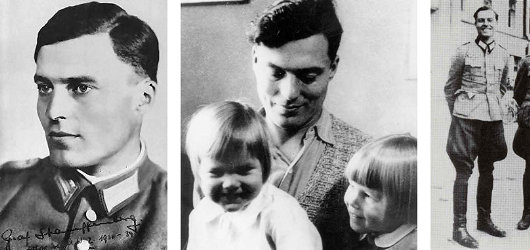
The recent release of the Hollywood film “Valkyrie” has brought the July ’44 plot back into the limelight. Much debate has focussed on the central figure of Count von Stauffenberg, especially the motivation and inspiration for his attempt to overthrow the Nazi regime. Writing in Süddeutsche Zeitung, Richard Evans (Regius Professor of Modern History at Cambridge) asks “Why did Stauffenberg plant the bomb?” Prof. Evans argues that the Count’s contempt for liberalism combined with his (Stefan George-influenced) romantic nostalgia « make him ill-fitted to serve as a model for the conduct and ideas of future generations » .
A week later, the Süddeutsche Zeitung published “Unmasking the July 20 plot“, a response to Evans by Karl Heinz Bohrer, the publisher of Merkur and a visiting professor at Stanford. Bohrer counters Evans on two fronts. « Firstly Evans’s lesson consisted of historical half truths, contradictory theses and slanderous allusions to Stauffenberg’s character; and secondly, such distortions differ very little from the view held by West German intelligentsia regarding the events of July 20th 1944 and the conspirators who were, for the most part, of aristocratic Prussian stock. … For a proper understanding of the how the plot against Hitler of 1944 is seen and judged today, one should bear in mind that today’s horizon has shifted. »
« There is no question that like Ernst Jünger and Gottfried Benn, Stauffenberg’s first spiritual influence, Stefan George, entertained pre-fascist fantasies. And there is also no question that the young Stauffenberg’s reverence for the medieval ‘reich’ was reactionary – in a similar vein to Novalis’s ideas in ‘Die Christenheit oder Europa’. But what does that mean? Neither of them had political ideas that could in any way have served as a model for democratic European societies in the second half of the twentieth century. But to fundamentalise this tautological insight to effectively deny the conspirators any moral or cultural relevance is blinkered and constitutes intellectual bigotry. George, Jünger and Benn’s pre-fascist fantasies contained important modernist symbols which mean they cannot be judged by political moralist criteria, alone. The same goes for Stauffenberg and his friends who – in a different way to the “idealistic” Scholl siblings and their circle – represented a calibre of ethics, character and culture class of which today’s politicians and other bureaucratic elites can only dream. »
In that same week, Bernard-Henri Lévy — the omnipresent French man of letters — waddled into the debate with “Beyond the war hero” in the pages of Le Point. BHL proclaims the release of “Valkyrie” is unquestionably good, for it is inherently good for the world to honour its heroes. « Riveting as it is however, this film poses certain questions that are too complex and too delicate to be resolved solely within the logic of the Hollywood film industry. »
In a moment of pure irony, Lévy attacks the lack of accuracy in the film while making a gross historical error himself. The philosopher asks whether « raising someone to hero status does not always happen, alas, to the detriment of precision, nuance and history itself. The film shows Stauffenberg’s integrity very well. It shows his courage, the nobility of his views, his firmness of spirit. But what does it tell us of his thoughts? What does it teach us about why he enthusiastically joined the Nazi Party in 1933? » In actual fact, while Stauffenberg’s family members were concerned that he was “turning brown” the Count never joined the Nazi Party; not in 1933, not ever.
In a sense, Lévy has answered his own question in that Stauffenberg’s elevation has apparently taken place to the detriment of precision and history in that Lévy is apparently unaware of quite central historical facts of the case.
Previously: Stauffenberg
First Troop, Philadelphia City Cavalry
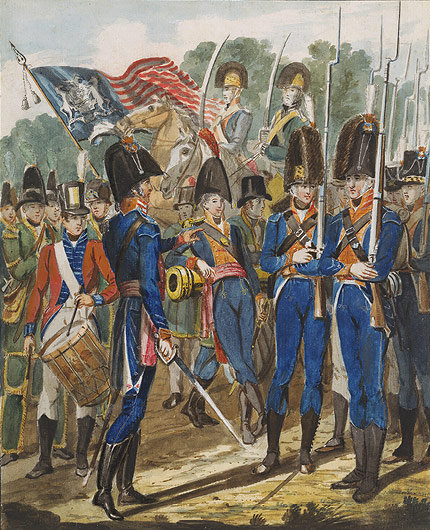
Watercolor, gouache, and graphite on white laid paper, 9 in. x 7 1/4 in.
c. 1811-1813, Rogers Fund
Previously: The Prince of Wales in Philadelphia
The Victory Parade, Dublin 1919
UPDATED Peter Henry’s article from Trinity News corrects my errors.
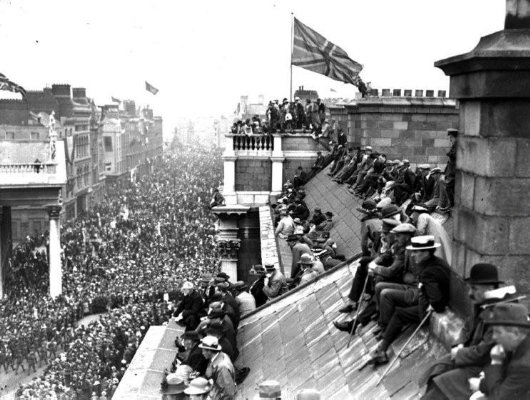
Persuant to our previous photograph of the Union Jack proudly snapping from Dublin’s General Post Office, one of our dear friends & loyal readers, a former editor of Trinity College’s newspaper, sends this photo of the 1919 Victory Parade through the streets of Dublin after the end of the Great War. The red, white, and blue here flies from the top of Trinity College, and the view looks down D’Olier Street (if I recall correctly) towards O’Connell Street in the distance. The classical portico on the left marks the entrance to the Irish House of Lords.
It is worth remembering that a great deal more Irish served in the forces of the Crown than in any republican armed forces or groups. The memory of Ireland’s great sacrifice during the First World War was shamefully neglected from the 1930s until about ten or fifteen years ago. It was a pity that the famous old Irish regiments were disbanded when independence came in 1921, rather than being continued under a native Irish command. Gone the Connaught Rangers and Dublin Fusiliers, and all the great battle honours won by Irishmen from Waterloo to far off India. (Two Irish regiments still exist in the British Army, the Royal Irish and the Irish Guards). Still, in remembrance of the dead of the First World War, one can visit the War Memorial Gardens by the banks of the Liffey, beautifully designed by Lutyens and completed after independence. The cost was split between the Irish and British governments, and, in the post-war downturn, half the workers were Irish veterans of the British Army and half were veterans of the formerly rebel forces.
Ireland remained neutral during the Second World War but declared a state of emergency, which is why the time of the war is often known in Ireland as “the Emergency”. Allied and Axis soldiers who washed up or crash-landed in Ireland found themselves interned in camps, but the Irish soldiers guarding them were only armed with blank ammunition. (Allied internees were often allowed to escape). The law of the day forbade any Irish citizen from joining a foreign military, but many soldiers of the Irish Army, policemen of an Garda Siochana, and many Irish civilians left for Britain to join the Allies in the fight, and were not punished on their return. When the port of Belfast suffered a German bombardment, fire brigades from Dundalk to Dublin were sent north irrespective of the border in order to help quell the flames.
Returning to Trinity, flying the Union Jack in 1919 would not have proved controversial in the slightest (after all, it was still the official flag of the land), but the crowds gathered again on College Green in 1945 to spontaneously celebrate the news of Germany’s surrender. The flag of Ireland with those of all the Allied nations were flown from the flagpole of Trinity, but some tactless student had placed the Union Jack at the top and the Irish Tricolour at the very bottom, below even the Soviet hammer-and-sickle. The crowd noticed this and began to howl, but some more thoughtful Trinity man swiftly took the colours down and raised them again with the Tricolour to the fore. The joyful spirit resumed.
The Prime Minister & His Wife
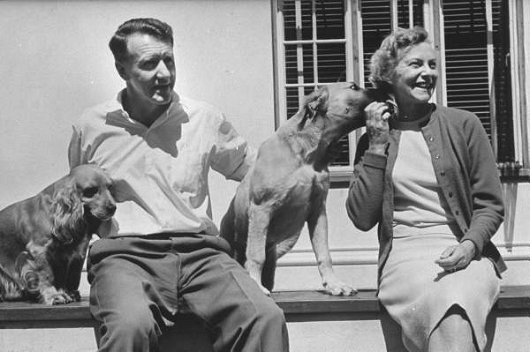
The Rt Hon Ian Douglas Smith & Mrs Smith, at home in Salisbury, Rhodesia.
New York’s Dutch Cathedral
The Collegiate Church of St. Nicholas, Fifth Avenue
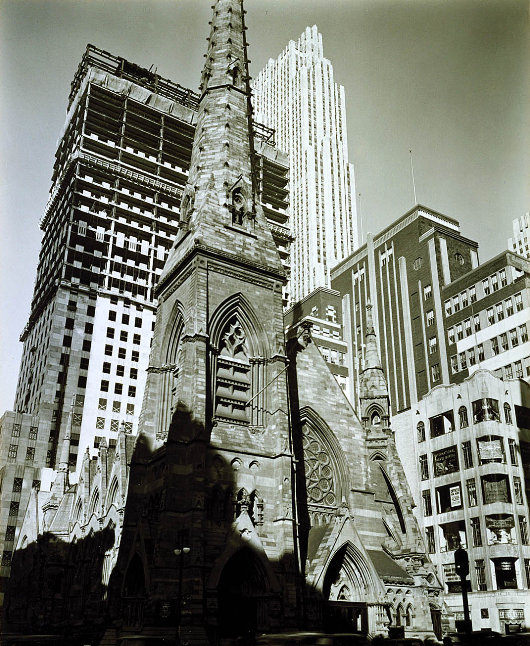
Dedicated a hundred-and-thirty-six years ago, the Collegiate Reformed Protestant Dutch Church of Saint Nicholas on the corner of Forty-eight Street & Fifth Avenue (photographed above by Berenice Abbott) was for many years regarded as the most eminent Protestant church in New York. The Collegiate Reformed Protestant Dutch Church is the oldest corporate body in what is now the United States, having been founded at the bottom of Manhattan in 1628 and receiving its royal charter from William & Mary in 1696. Now part of the Reformed Church of America, the Collegiate Reformed Protestant Dutch Church is actually a denomination within a denomination, and the remaining Collegiate Churches of New York tend to preach a sort of “Christianity Lite”. (The famous Norman Vincent Peale, author of The Power of Positive Thinking and one of the paragons of the “finding a religion that doesn’t interfere with your lifestyle” school of thought, was the pastor of Marble Collegiate Church at Twenty-ninth & Fifth, where Donald Trump is a member of the congregation).
Remembering the Seventh
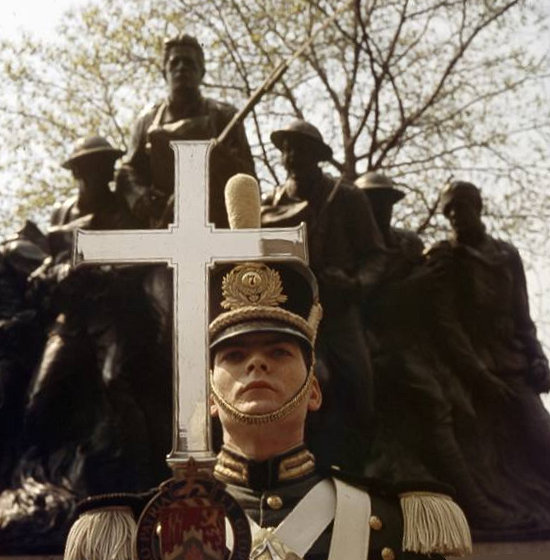
It is entirely appropriate that November 11 — Armistice Day — both falls during the month of the Holy Souls and on the feast of St. Martin of Tours. It’s not unlikely that the souls in Purgatory added their voices to plead for peace that November of 1918, and St. Martin, who had himself been a Roman soldier, was no doubt leading the cause from Heaven. (Indeed, his father having been in the Imperial Horse Guards, St. Martin was born into a military family).
67th & Fifth
One of the most remarkable things about these photos from a 1956 Seventh Regiment ceremony are how traditional the buildings in the background are.
God and the Emperor
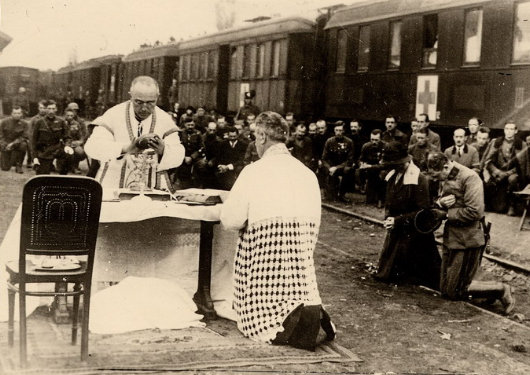
The Pester Lloyd
The Hungarian capital’s German-language newspaper has been “independent, pluralistic, steeped in tradition” since 1854
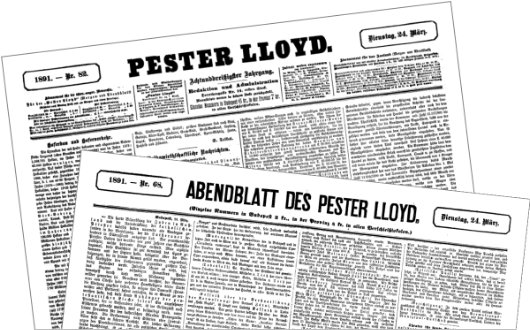
The fall of the Iron Curtain nearly twenty years ago after a half-century of Communist domination in Eastern Europe afforded an opportunity to revive many of the traditions and institutions which — while they had survived monarchy, republicanism, and fascism — were annihilated by the all-consuming Red totalitarianism. One such institution that has risen from the ashes is Hungary’s once-revered German-language newspaper, the Pester Lloyd.
 First appearing in 1854, when Buda and Pest were still two cities flanking the banks of the Danube, the Pester Lloyd was the leading German journal in Hungary. Printed daily with morning and evening editions, the “Pester” in the paper’s name refers to Pest, while “Lloyd” is in imitation of Lloyd’s List (the London shipping & commercial newspaper founded in 1692 by the eponymous properitor of Lloyd’s Coffee Shop and still going strong today). The paper first gained prominence under the editorial leadership of Dr. Miksa (Max) Falk, who had famously tutored the Empress Elisabeth in Hungarian and instilled in the consort a particular love for the Hungarian kingdom.
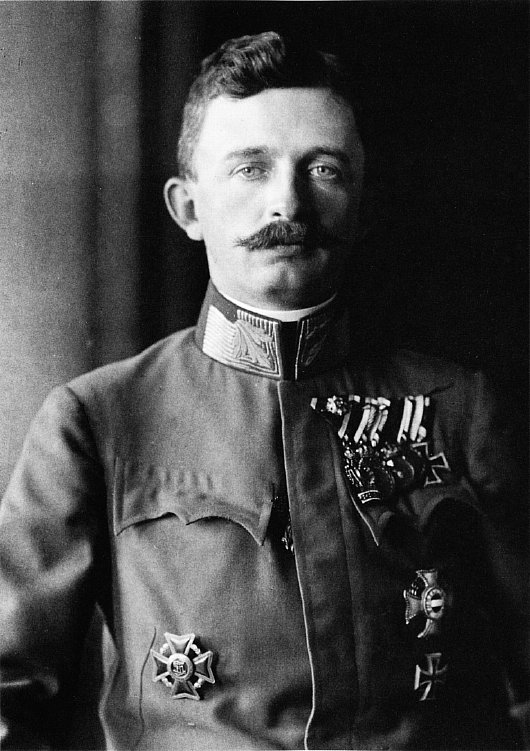
Charles & Zita
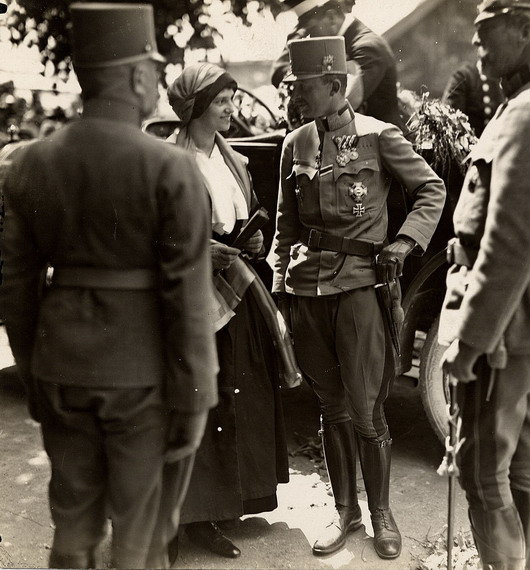
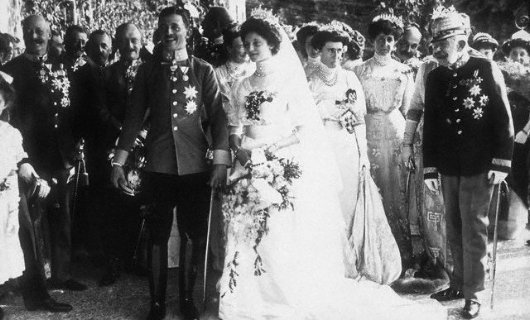
October 21 was chosen as the Feast of the Blessed Emperor Charles not because it is the date of his death — which is 1 April 1922 — but rather to commemorate the marriage (photo, below) between Archduke Charles of Austria (as he was then) and Princess Zita of Bourbon-Parma in 1911. While Charles died a mere thirty-four years of age, Zita lived on to ninety-six before passing away in 1989 (when I myself was four).
Not very long ago I was in Quebec City, which was where the Empress Zita and the Imperial Family spent their exile during the Second World War. The Hapsburgs, dispossessed first by the Socialists and then by the Nazis, were then so poor they had to collect dandelions from which to make a soup, but they took poverty in their stride. Passing a grassy bit near the Chateau Frontenac, I wondered “Did Crown Prince Otto once pluck weeds from this plot to feed his hungry mother and siblings?”
Also in that ancient Canadian city is La Citadelle, that great hunk of stone and earthworks, perhaps the oldest operational military installation in the New World. There we were lucky enough to be granted access to the tomb of the greatest Canadian, Major General the Rt. Hon. Georges-Philéas Vanier, Governor-General of Canada from 1959 until his death in 1967. General Vanier and his wife had such a reputation for Christian charity and piety that the Vatican is collecting evidence towards their eventual recognition as saints. Their son is Jean Vanier, the founder of the famous l’Arche communities that care for the handicapped and the disabled. I wonder if the Hapsburgs and the Vaniers ever crossed paths in wartime Quebec…
pray for us!
From the memoirs of Miklos Banffy
« After getting home I must admit that I slept soundly, although occasionally, when still half-asleep, I seemed to hear more rumbling of heavy lorries passing under my windows than on previous nights. However, since the street outside was the habitual route for deliveries to the market halls nearby, and the market cars had always rattled past noisily long before dawn, it did not seem to be different from any other night in the year.
It was only later that I heard what had happened early that morning. When my old valet called me he announced three things: my bath had been prepared, revolution had broken out, and Count Mihály Károlyi was now Minister-President. »
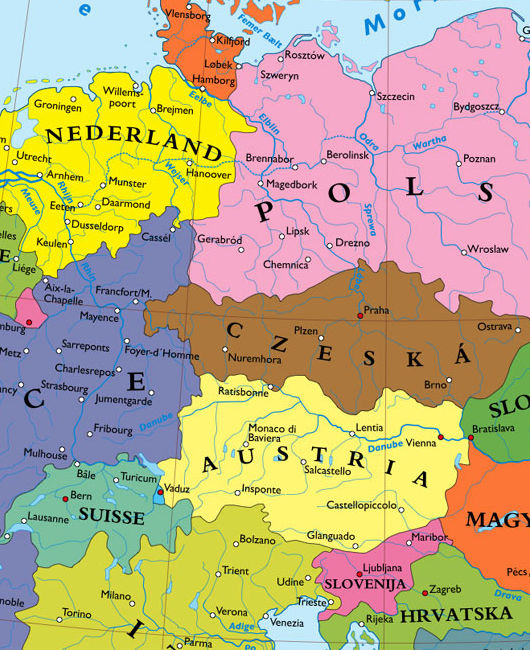
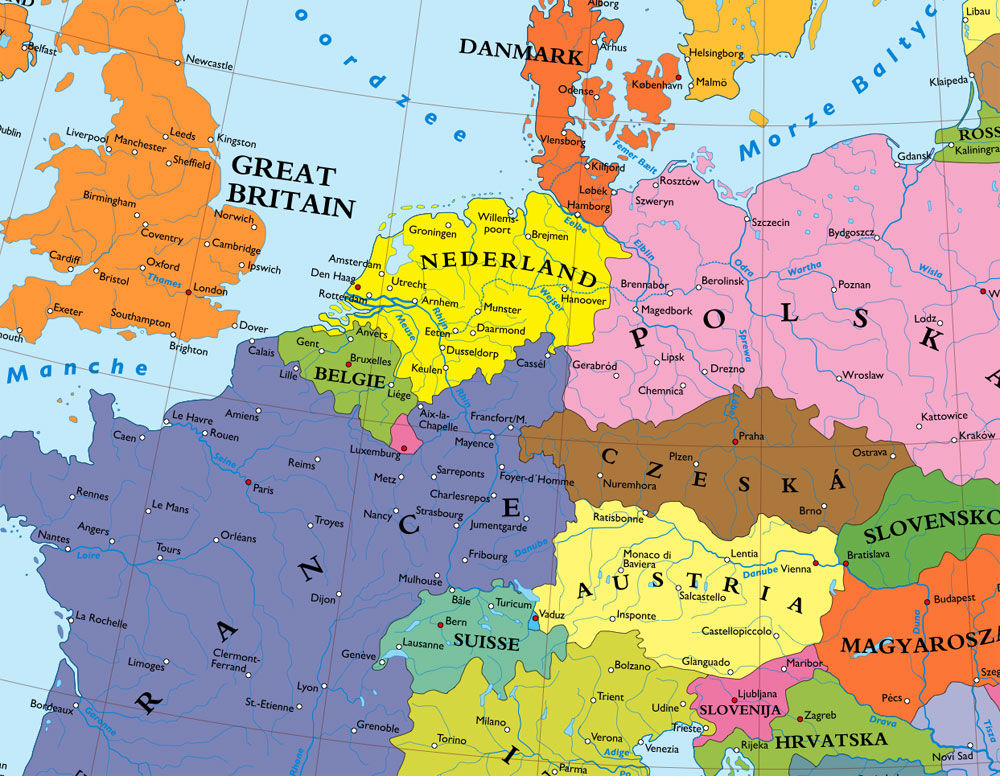
Germany carved amongst her neighbours
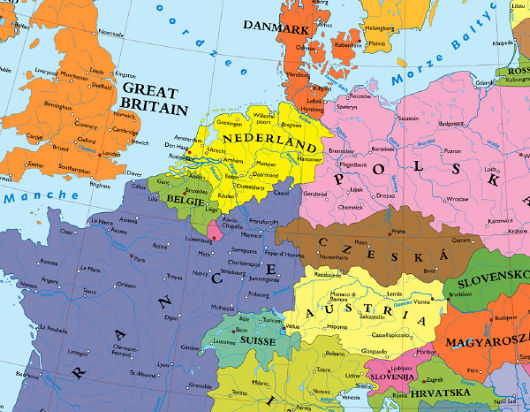
What is this cartographic madness? Hanover part of the Netherlands? Kassel ruled by France? Nuremburg part of a Bohemia that reaches to the Frankfurt suburbs? Hamburg in Denmark? Regensburg on the Austro-Czech border? I came across the company Kalimedia in an article from Die Zeit a month or two ago and discovered their map of a Europe without a Germany. Believe it or not, there were plans of one sort or another to achieve similar results at the end of the Second World War. The major plan for the dissection of Germany was merely a creation of Nazi propaganda, and while the vaguely similar Morgenthau Plan did exist, it was soon shelved once its impracticality became obvious.
The Bakker-Schut Plan, meanwhile, was a Dutch proposal for the annexation of several German towns, and perhaps even a number of German cities. German natives would be expelled, except for those who spoke the Low Franconian dialect, who would be forcibly dutchified. They even came up with a list of new Dutch names for German cities: c.f. the post at Strange Maps on “Eastland, Our Land: Dutch Dreams of Expansion at Germany’s Expense”.
The Holy Saints of Russia
Russia remembers the murdered Tsar St. Nicholas II & his family

Christians in Russia yesterday solemnly remembered the brutal killing of the country’s Imperial Family by the Bolshevik revolutionaries 90 years earlier. Tsar Nicholas II, the Tsarina Alexandra, their daughters the Grand Duchesses Olga, Tatiana, Maria, and Anastasia, and the Tsarevich Alexei have all been added to the canon of saints of the Russian Orthodox Church. The Imperial Family were first officially recognized as saints by the Russian Orthodox Church outside the Soviet Union in 1981, and the Moscow patriarchate extended the same recognition in 2000.
Castro on Franco
Argentina’s Voice: La Prensa
TIME magazine, 26 October 1942
 In the ornate Paz family crypt in Buenos Aires’ comfortable La Recoleta cemetery, honors came thick last week to the late José Clemente Paz, founder of Argentina’s La Prensa. The Argentine Government issued a special commemorative postage stamp. Nationwide collections were taken to erect a monument. U.S. Secretary of State Cordell Hull sent a laudatory cable, as did many another foreign notable. It was the 100th anniversary of the birth of Argentina’s most famous journalist.
Although Don José has been dead for 30 years, the newspaper he founded 73 years ago has not changed much. La Prensa is THE Argentine newspaper, is one of the world’s ten greatest papers.
Polish, Curiosity, Comics.
A cross between the London Times and James Gordon Bennett’s old New York Herald, La Prensa is unlike any other newspaper anywhere. In its fine old building the rooms are lofty and spiced with the odor of wax polish, long accumulated. Liveried flunkies pass memoranda and letters from floor to floor on an old pulley and string contraption. But high-speed hydraulic tubes whip copy one mile from the editorial room to one of the world’s most modern printing plants—more than adequate to turn out La Prensa’s 280,000 daily, 430,000 Sunday copies.
Argentines are minutely curious about the world. Although newsprint (from the U.S.) is scarce, La Prensa usually carries 32 columns of foreign news—more than any other paper in the world. Four years ago most was European—today New York or Washington has as many datelines as London.
La Prensa’s front page is solid (save for a small box for important headlines) with classified ads. So, usually, are the following six pages—one reason the paper nets a million dollars or more annually. Lately La Prensa has made some concessions to modernity: it now carries two comic strips, occasional news pictures.
Deliveries, Duels, Discussions.
La Prensa will not deliver the paper to a politician’s office; he must have it sent to his home. It will not call for advertising copy. No local staffman has ever had a byline.
South American journalism is more hazardous than the North American brand. La Prensa’s publisher and principal owner, Ezequiel Pedro Paz, Don José’s son, has twice been challenged to a duel. Because he is a crack pistol shot, neither duel was fought. Now over 70, Don Ezequiel shows up at the paper punctually at 5 p.m. for the daily editorial conference with Editor-in-Chief Dr. Rodolfo N. Luque. Present also is his nephew and heir-apparent, handsome Alberto Gainza (“Tito”) Paz, 43, father of eight and ex-Argentine open golf champion. Significantly, La Prensa’s owner-publishers visit their editor-in-chief and not vice versa.
La Prensa’s foreign affairs editorials often wield great influence, but have not budged the isolationism of President Ramón Castillo. The paper has supported Franklin Roosevelt’s New Deal, pumped for the United Nations, denounced the totalitarians. But it speaks softly. When Argentina’s President Castillo gagged the press with a decree forbidding editorial discussions of foreign events, admirers of Don José recalled how he once suspended publication in protest at another Argentine President’s like decree. If old Don José were now alive, declared they, he would again have stopped La Prensa’s presses rather than submit to Castillo’s regulations. — TIME, Oct. 26, 1942

TIME magazine, 16 July 1934
Prensa Presses
On the roof of the imposing La Prensa building in Buenos Aires’ wide Avenida de Mayo is a large siren. Its piercing screech, audible for miles, heralds the break of hot news. Long ago a city ordinance was passed forbidding use of the siren and the publishers rarely sound it nowadays. But when some world-shaking event takes place, La Prensa’s horn shrills and a Prensa office boy trots downtown to pay the fine before its echo has died away.
Last week the fingers of La Prensa’s acting publisher, Dr. Alberto Gainza Paz, itched to push the siren button. There was much to celebrate. Not only was it Nueve de Julio, Argentina’s Independence Day, but potent old La Prensa was formally inaugurating a new $3,000,000 printing plant, finest in South America. Its holiday edition ran to 725,000 copies— 150,000 more than its previous record.
The plant is housed in a new building a half mile from the main office, in the rent-cheap industrial district. It is linked to the editorial rooms by pneumatic tubes. The installation includes a 21-unit Hoe press similar to that of the New York World-Telegram. The press is driven by 56 motors, is fed by 63 rolls of newsprint and two six-ton tanks of ink. A normal edition of 250,000 copies (400,000 Sunday) is spewed out in considerably less than an hour. Since Buenos Aires is so far from the Canadian pulp market, La Prensa keeps on hand up to 7,500 tons of newsprint, enough to supply its needs for three months or, in emergency, to produce a smaller paper for a year.
Completion of the new plant marked the almost complete retirement of La Prensa’s publisher and principal owner, Don Ezequiel P. Paz. Son of the late Dr. José C. Paz, who turned out the first copy of La Prensa 65 years ago on a tiny hand press, Don Ezequiel started to work around the shop as a youngster in 1896, took full charge while still a young man. He devoted his life completely to his newspaper, spent nearly all his waking hours in his incredibly ornate office, denied himself to practically all callers except his editors. Past 60, of nervous temperament, he lives nearly half the year at his French estate near Biarritz. On his transatlantic trips he customarily takes a large party of relatives, and for the sake of his diet, a cow. The cow makes the round trip but must be sacrificed in sight of her native land because of Argentina’s rigid quarantine against all imported cattle. Don Ezequiel sailed for Biarritz last month, regarding the new plant as perhaps the last important milestone in his publishing career. Childless, he turned his responsibilities over to his nephew, youthful Dr. Alberto Gainza Paz, whom he carefully tutored as he himself had been trained by Founder José. So puny in boyhood that he was not expected to live. Dr. Gainza made of himself one of the foremost amateur athletes in Buenos Aires.
Beyond dispute La Prensa is the leading newspaper in South America, is read throughout the continent. Sternly independent, it truckles to no political party, even refuses to accept political advertising on the ground that if any politician is really as good as he claims, he is legitimate news and will be reported accordingly.
To U. S. newsreaders, a typical copy of La Prensa is a curious sight. Prime headlines are massed in a six-column box on the front page, which is otherwise filled with classified advertisements. The “classifieds” run through the next six pages and supply the wherewithal for Publisher Paz’s proud boast that La Prensa is independent of large commercial advertisers. The news pages begin with a lengthy, learned article which most readers skip, but which is supposed to wield strong influence in high places. The news columns proper are top-heavy with foreign news. Probably no other newspaper in the world spends so much money on cable tolls—a fact partly due to Argentina’s cosmopolitan population. La Prensa demands important political speeches in full. It “discovered” Albert Einstein for the world press by first requesting United Press to interview him on his theory of relativity 15 years ago. After La Prensa printed it, U. P. decided to try Einstein on its U. S. clients. La Prensa gives any amount of space to amateur sports, demands play-by-play coverage on important chess matches, but refused Argentina’s Prizefighter Luis Firpo more than the barest mention even at the height of his popularity. It prints voluminous market news, lottery drawings, crossword puzzles, no comics except on Sunday. Its newsphotos are rare and inferior. On Sunday it offers rotogravure in color.
Employing no advertising salesmen, La Prensa never solicited an advertisement. Until a few years ago it would not permit advertisers to use large display type. It rejected a substantial Wrigley campaign because it hesitated to introduce the gum-chewing habit to Argentina. It saw no sense in a Quaker Oats breakfast food advertising program because Argentinians do not eat breakfast. However, La Prensa does print many an advertisement of doctors specializing in venereal diseases. La Prensa is one of the wealthiest newspapers in the world. The Paz family took from it enough to live in ease, plowed back huge sums for improvements and. notably, social services. One of the oldest services is a general delivery postal service, begun after the great immigration of the 1860’s when the Argentine post office proved hopelessly inadequate. To this day a letter addressed care of La Prensa will reach any Argentinian of known residence. Also La Prensa maintains free medical and surgical clinics for the poor, free legal service, and a free three-year music school. Its building houses banquet rooms, lecture halls, library, gymnasium.
The Paz family likes to regard La Prensa as Argentina’s property, themselves as hired managers. — TIME, July 16, 1934

CUSACK’S NOTE: La Prensa was confiscated by Peron’s dictatorship and its assets given to the Peronist CGT trade union. The family’s assets were restituted in 1988 and the newspaper refounded, but its readers had by then moved elsewhere and the La Prensa continues to this day in a much reduced form; its old headquarters on the Avenida de Mayo is now the Casa de la Cultura. The conservative La Nacion is now the only broadsheet in Argentina.

Yet another reason to love the Boers
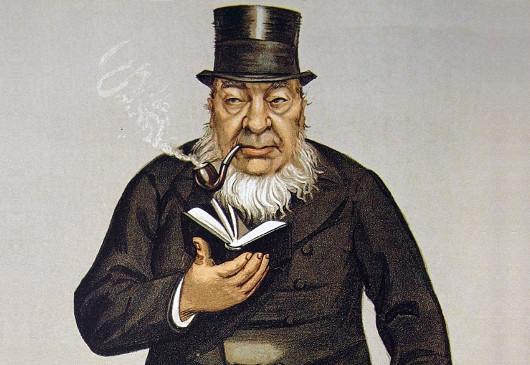
“Oom Paul” Kruger’s thoughts on the circumnavigation of the globe
Joshua Slocum was a native of Nova Scotia who became an adventurer, seaman, and writer of some reknown in his time, and is perhaps best known both for his mysterious death and for being the first person to single-handedly circumnavigate the planet. Capt. Slocum published his memoirs of this trip in his 1899 book, Sailing Alone Across the World and one of the delightful little tales relayed is of the Captain’s docking at Durban in Natal and his journey inland to Pretoria in the Transvaal:
At Pretoria I met Mr. Kruger, the Transvaal president. His Excellency received me cordially enough; but my friend Judge Beyers, the gentleman who presented me, by mentioning that I was on a voyage around the world, unwittingly gave great offense to the venerable statesman, which we both regretted deeply.
Mr. Kruger corrected the judge rather sharply, reminding him that the world is flat. “You don’t mean round the world,” said the president; “it is impossible! You mean in the world. Impossible!” he said, “impossible!” and not another word did he utter either to the judge or to me. The judge looked at me and I looked at the judge, who should have known his ground, so to speak, and Mr. Kruger glowered at us both.
My friend the judge seemed embarrassed, but I was delighted; the incident pleased me more than anything else that could have happened. It was a nugget of information quarried out of Oom Paul, some of whose sayings are famous. Of the English he said, “They took first my coat and then my trousers.” He also said, “Dynamite is the corner-stone of the South African Republic.” Only unthinking people call President Kruger dull.
— Chapter XVIII, Sailing Alone Around the World, by Joshua Slocum
I agree entirely with Capt. Slocum’s conclusion.
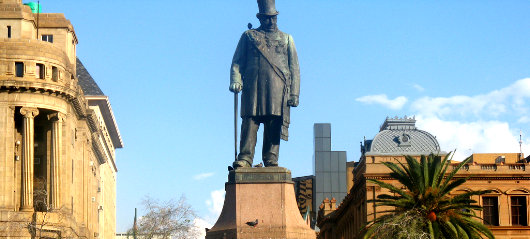
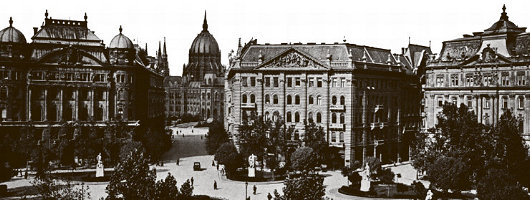
While his views on geography may not have been strictly orthodox, President Kruger is honored with an imposing monument in the Kerkplein, the central square of Pretoria, now the capital of all South Africa, not just the Transvaal. The President’s statue rests in an enviable position between two of the most handsome edifices in all of South Africa:
Search
Instagram: @andcusack
Click here for my Instagram photos.Most Recent Posts
- Brunel’s Unbuilt Capitol February 3, 2026
- Cricket at Fordham January 27, 2026
- Palacio Barolo Revisted January 14, 2026
- Learning to Love Liguria January 14, 2026
- Crux Alba No. 2 January 13, 2026
Most Recent Comments
Book Wishlist
Monthly Archives
Categories