History
About Andrew Cusack
 Writer, web designer, etc.; born in New York; educated in Argentina, Scotland, and South Africa; now based in London.
 read more
News
Blogs
Reviews & Periodicals
Arts & Design
World
France
Mitteleuropa
Knickerbockers
Argentina
The Levant
Africa
Cape of Good Hope
Netherlands
Scandinavia
Québec
India
Muscovy
Germany
Academica
Secret Splendor
by Andrew Cusack (Weekly Standard, 13 September 2010)
Paintings for the Catholic Church in the Dutch Republic
by Xander van Eck
Waanders, 368 pp., $100
This book is the first major overview and exploration of the art of the clandestine Roman Catholic churches in the Netherlands. It is not a study of paintings so much as a history in which art is like the evidence in a detective story, or perhaps even the characters in a play. It might seem extraordinary that there was a place for large-scale Catholic art during the Dutch Republic: Pre-Reformation churches had been confiscated and were being used for Calvinist services, while priests offered the Mass secretly in makeshift accommodations. Eventually a bargain between Dutch Catholics and the civil authorities emerged, trading Catholic nonprovocation in exchange for private toleration of the practice of the faith. Catholics began to purchase properties which, for all outward appearances, maintained the look of ordinary residences but whose interiors were transformed into resplendent chapels and churches.
Xander van Eck provides verbal portraits (often accompanied by contemporaneous painted ones) of several of the important clerics of the Dutch church during this period: Sasbout Vosmeer, the Delft priest influenced by St. Charles Borromeo; Philippus Rovenus, the vicar-apostolic who placed greater emphasis on clandestine parishes having specially dedicated churches, even while they kept an outward unecclesiastical appearance; and Leonardus Marius, the priest who promoted devotion to the 14th-century Eucharistic “Miracle of Amsterdam.” Marius was of such prominence that, after his death, shopkeepers rented out places on their awnings for punters to view his funeral procession. Van Eck includes a handful of amusing asides, such as the expulsion of the Jesuits from the Netherlands as a result of their constant discord with the secular clergy. Mass continued to be offered at the Jesuit church of De Krijtberg in Amsterdam “in the profoundest secrecy” — thus creating a clandestine church within a clandestine church!
The role of the clergy in sustaining the Dutch Church is unsurprising, but it is instructive to learn how instrumental laity were to keeping alive the light of Catholic faith in the Netherlands at the time. Clandestine churches relied on the generosity of Catholic families. Prominent families often provided their own kin as consecrated virgins who brought large dowries into the church, or as priests with suitable inheritances to maintain or endow clandestine parishes. The clandestine church of ’t Hart in Amsterdam, built by the merchant Jan Hartman for his son studying for the priesthood, is still open today as the Amstelkring Museum and Chapel of “Our Lord in the Attic.”
While van Eck explores the extent to which Dutch art from the period followed European norms, an emphasis on the particularity of the art of the clandestine church is to be expected. The sheer volume of art produced during this period — for just three Amsterdam churches alone there were 16 altarpieces — is partly explained by the phenomenon of “rotating altarpieces.” The paintings above the altar would be changed according to the feast or season — a practice sometimes seen in Flanders or parts of Germany but never nearly so widespread as in the Netherlands proper.
Constrained as clandestine churches were on the narrow plots typical of Dutch cities, there was no room for side chapels that might include the large funerary monuments prominent families would construct. This left altarpieces as the most convenient way for munificent Catholics to provide art for their churches: Rotating the altarpieces provided a handy way of displaying numerous commissions rather than just the donation of whoever had been generous most recently, and the themes of these commissions tended to vary in appropriateness to different feasts and seasons.
Some found fault with this method: Jean-Baptiste Descamps, visiting Antwerp in 1769, complained that the most interesting altarpieces were not permanently displayed and were more likely to be damaged in the process of being moved so often.
While the accomplishment and ingenuity of Dutch Catholics in keeping their faith during the Republic was striking, the ill-defined administrative structure of the persecuted church allowed conflicts between clerics to thrive, and doctrinal disputes emerged and festered. The disputes over Jansenism that swept over France and the Netherlands, for example, only exacerbated the administrative problems of the clandestine church. Like their Calvinist compatriots, the Jansenists tended to frown on indulgences, the veneration of saints, recital of the rosary, and private acts of worship, putting greater emphasis on the Scriptures and a more rigorous asceticism. As van Eck points out, this difference in emphasis was not exclusive to the Jansenists, but their novelty (and their heresy) was in preaching the exclusivity of their approach above all others.
Numerous vicars-apostolic had written to Rome arguing for the re-establishment of the episcopacy in the Netherlands to solve the disputes over authority, but their appeals fell on deaf ears. In 1723 a large portion of the Jansenist clergy reinstituted the episcopacy by electing an archbishop of Utrecht from their number — and were subsequently excommunicated, splitting the clandestine church and its clergy in two. (This excommunicated rump united with the opponents of papal infallibility in the following century to form a body that still calls itself the Old Catholic Church.)
When one looks at all this glorious art, not to mention the lives and pious ingenuity of the persecuted, it’s difficult not to feel a little poorer, considering the fruits of our churches in an ostensibly free era. Why does the church today commission painters who are either mediocre or trendy — or both? Artists like Hans Laagland and Leonard Porter show that good art — good liturgical art, even — is possible today, but commissions from the church for traditional artists are sadly few.
Roots and Permanent Interests
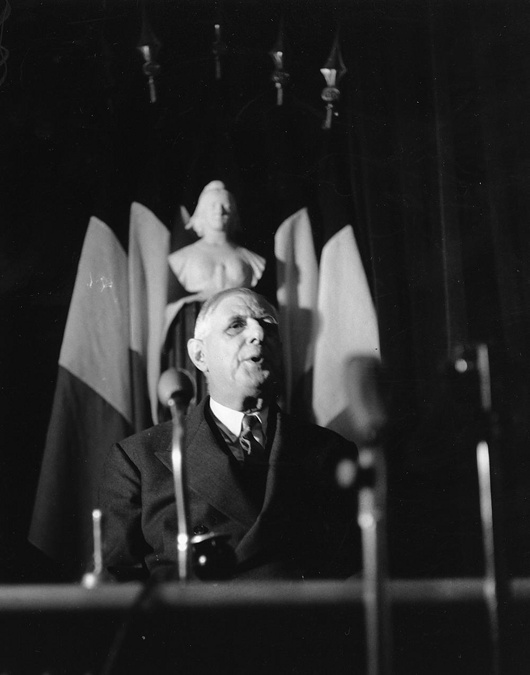
Carson at Stormont
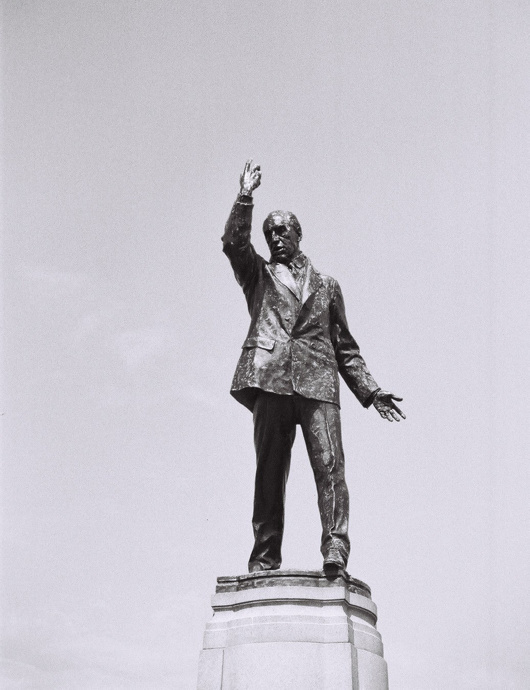
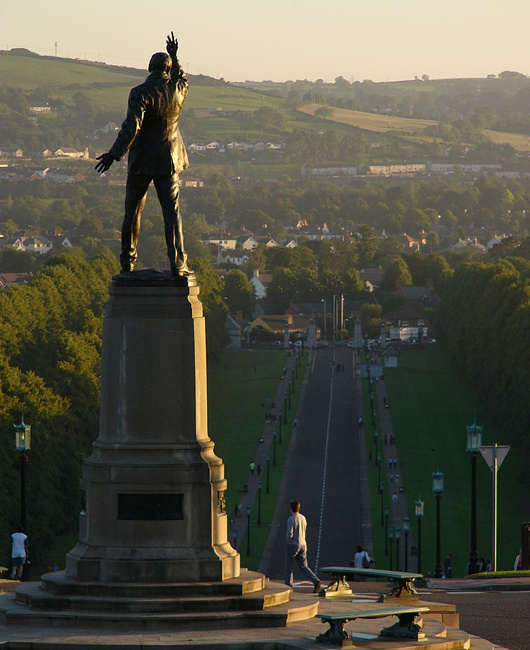
Few statues in Ireland are as dramatic as that of Edward Carson at Stormont. The unionist leader is depicted in amidst an oratorical flourish, doubtless in one of his speeches to mass meetings condemning home rule.
In the 1910s as the rebirth of an Irish parliament looked more likely, Carson took up the cause of fighting home rule on behalf of Ireland’s large Protestant minority who feared Catholic domination. When the anti-home rulers realised the cause was losing, they retreated from Irish unionism to Ulster unionism. If home rule was to be granted, Ulster must be exempted. In the end this meant home rule was granted to a parliament covering two-thirds of the Irish province of Ulster — six counties that would henceforth be known as Northern Ireland.
“His larger than life-size statue,” one historian wrote, “erected in his own lifetime in front of the Northern Ireland parliament at Stormont, symbolizes the widely held perception that Northern Ireland is Carson’s creation.”
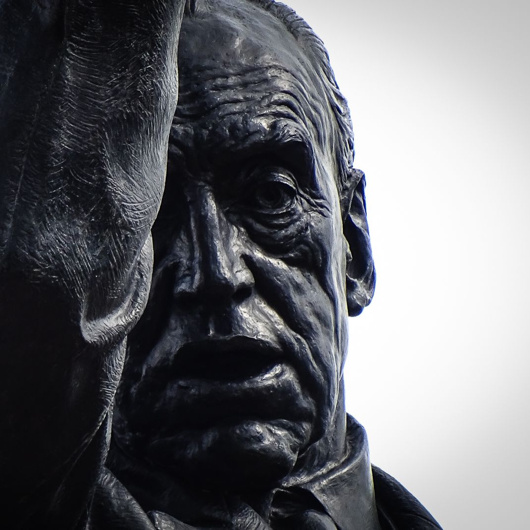
This is of course the great irony, given that Edward Carson was a Dublin boy through and through. While instrumental in ensuring northeastern Ireland’s exemption from an Irish parliament, Carson actually had little to do with the entity thereby created. When offered the premiership of Northern Ireland he declined it on the grounds of having no real connection with the place.
Craig, not Carson, is the true father of Northern Ireland; he imbued the new statelet with a sense of bigotry and tribal hatred that Carson lacked. The Dubliner urged Ulster’s new leaders to treat the province’s Catholics well.
“We used to say that we could not trust an Irish parliament in Dublin to do justice to the Protestant minority,” Carson said. “Let us take care that that reproach can no longer be made against your parliament, and from the outset let them see that the Catholic minority have nothing to fear from a Protestant majority.”
Alas, it became apparent to Carson that discrimination and inequality were becoming in-built within Northern Ireland’s government, from the Parliament at Stormont down to the lowest forms of local government. He confided to a Catholic friend in London that rather than being an integral part of the United Kingdom, Northern Ireland was turning into “a second-class dominion”.
After partition Carson was created a British judge and accordingly ennobled. (Disappointingly the plaque on his Dublin birthplace next to Conradh na Gaeilge refers to him by the incorrect style of ‘Lord Edward Carson’.) He settled at Clever Court near Minster-in-Thanet, Kent, and never lived in his native Ireland again.
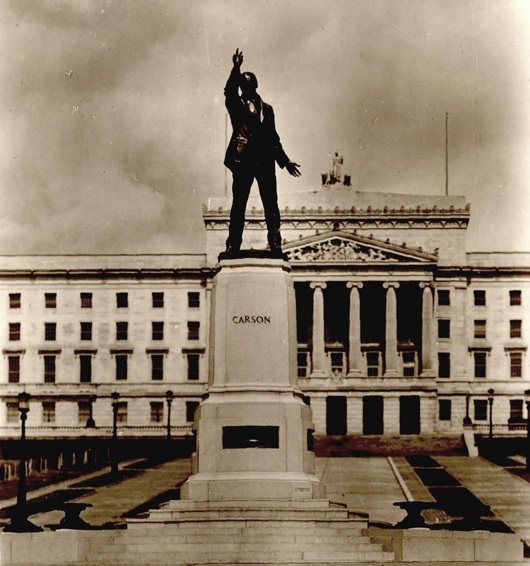
Nonetheless he was held in awe and reverence by the Protestant Unionists of Ulster, who commissioned the striking statue by Leonard Stanford Merrifield that stands in front of Parliament Buildings, Stormont — now home to the Northern Ireland Assembly. It was unveiled by Craig, by then ennobled as Lord Craigavon, while Carson was alive and present in July 1932, joined by a crowd of 40,000 well-wishers.
Carson died in 1935 and was given the rare honour of a state funeral. HMS Broke brought his Union-Jack-draped coffin back to Ireland — albeit to Belfast — and he was interred in the Anglican Cathedral of St Anne. Northern Ireland claimed him even in his final burial: soil from each of its six counties was scattered on his coffin when laid to rest in the tomb.
Still his statue stands at Stormont, gesturing stridently as if to challenge an entire province — a province he by his own description had little to do with. Calls for it to be removed emanate occasionally from typically boring quarters and have so far been rebuffed — wisely. Carson, unlike many of those who cherished his memory, was an honourable man, and it is a pity it took so long for the Protestants of Ulster to heed the advice of their confrère from Dublin.
Knickerbocker Spires
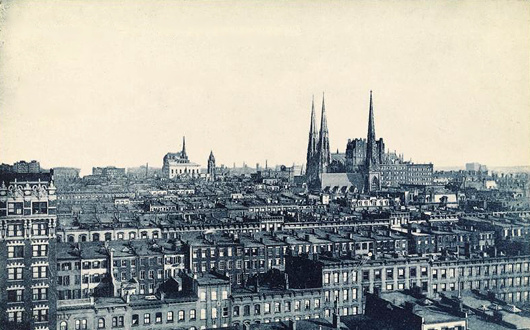
Before the age of the skyscrapers, New York’s church spires dominated the horizon and dwarfed their neighbours just like in the medieval towns and cities of the old world — as this photo from the 1900s shows.
Here St Patrick’s Cathedral holds court, with the St. Nicholas Collegiate Reformed Protestant Dutch Church poking up a few blocks down Fifth Avenue.
Slightly north on that same boulevard sits the grand renaissance palazzo of the University Club, with the spire of the Fifth Avenue Presbyterian Church poking up behind it.
Hollandic Fever
Adapted from the Deborah Moggach novel of the same name, ‘Tulip Fever’ is a curious concoction. Some of the plot holes are so big you could drive a coach and horses through them. For example, how is it that – in Calvinist-controlled seventeenth-century Amsterdam – there is a massive Catholic convent perfectly accepted by everyone and operating as if nothing is out of place? It’s the size of Norwich Cathedral! (In fact, it is Norwich Cathedral – this entire production was filmed in Great Britain.)
The often excellent Chrisoph Waltz is curiously mismatched with his role here: a little bit too much of a parody of the proud, pious Amsterdam merchant in the start, which makes his eventual transformation a little unconvincing. The plot also shows little of the brilliance of its co-writer Sir Tom Stoppard. (In fact, there’s a bit too much plot.) At least Dame Judi Dench is effortless in her role as the unnamed Abbess of St Ursula. Tom Hollander is thrown in for a laugh, in a role suited to his abilities.
For curiosity’s sake the most interesting casting choice was Joanna Scanlan, known as the useless press officer at DOSAC in ‘The Thick of It’. Here she is the dressmaker Mrs Overvalt, but she was Vermeer’s cook Tanneke in ‘Girl with the Pearl Earring’. If my rudimentary calculations are correct, this means she has been in two-thirds of twenty-first-century films set in the Dutch seventeenth century.
It is, however, a beautifully shot production, for which I suspect we have the cinematographer Eigil Bryld to thank. (He’s worked on one seventeenth-century film before, and on another set in the Low Countries.) Bookended by scenes of Friedrichian romanticism (I’m into that) the film encourages me in my deeply felt belief that we need to revive seventeenth-century Dutch domestic architecture as a style.
Observations
All those interested in the history of the workers’ struggle would have enjoyed a letter to the editor printed in last week’s Observer.
Floreat Etona, left and right
Alex Renton is correct when he points out that the 20 old Etonian MPs currently sitting are all Tories, but this is far from usually the case (“Our educational apartheid laid bare”, Books, New Review). The first OE to be elected a Labour MP was in 1923, and the party consistently had OE representation on its benches from then all the way to 2010. Even Clement Attlee’s transformative postwar Labour government included two old Etonians: Hugh Dalton as chancellor of the exchequer and Frederick Pethick-Lawrence as India secretary.
Andrew Cusack (Conservative, non-OE)
London SE1
Of course, no one actually reads the Observer, so it went entirely unnoticed.
I have acquired a dangerously successful rate of my pedantic missives being printed in periodicals. The editors of the Irish Times, Times Literary Supplement, Catholic Herald, and even the Tablet have all been guilty of lapses in judgement in this regard.
The Governor’s Room
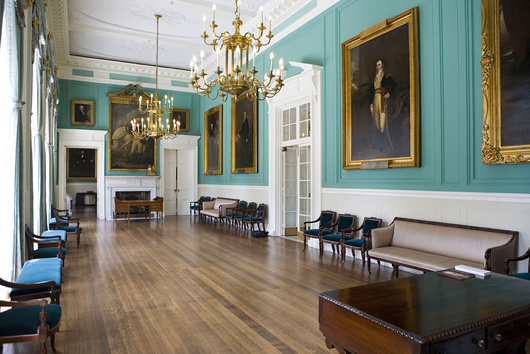
Pursuant to my post of John Bartlestone’s photographs of City Hall, I came across this photo the other day and it reminded me that this is still one of my favourite rooms in all New York. There’s something about that particular shade of green. I previously wrote about this suite of three rooms in 2006.
The above photo is by Ramin Talaie while below, in 2010, Mayor Bloomberg inspects a city flag being sent to a New Yorker serving in Afghanistan as reported by the Daily News.
The late & much-missed New York Sun also reported on the portraits hanging in City Hall in 2008.

Eton College Chapel
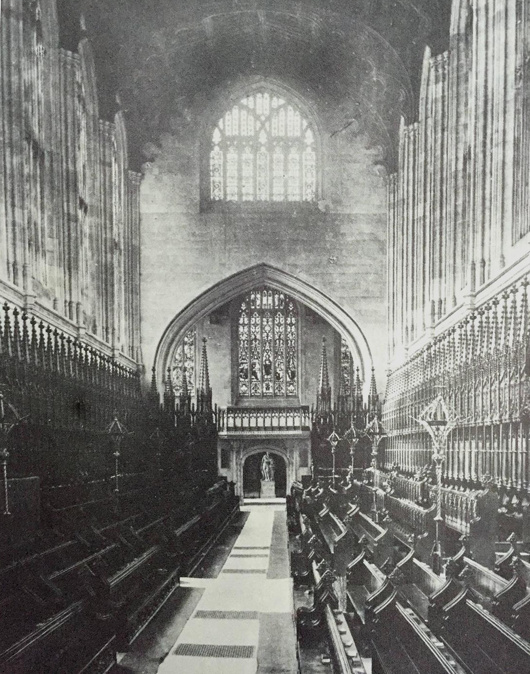
The interior of Eton’s chapel has changed markedly over the past hundred or so years, mostly so thanks to the rediscovery of the priceless medieval wall paintings which had been hidden for centuries by the choir stalls. Painted in the Flemish style in 1479–87, they were whitewashed over by the college barber in 1560 on orders from the wicked new Protestant authorities who had taken over this Catholic school.
The wall paintings were rediscovered in 1847 but it wasn’t until 1923 that the stall canopies in the photograph above were permanently removed, allowing the medieval paintings to be cleaned, restored, and permanently viewed.
In addition to this, in the 1880s (after this photograph was taken) the Great Organ was installed in the broad entrance arch between the narthex and the body of the chapel. The Victorians very handsomely painted it in the medieval fashion and it fits in rather well.
More recently, most of the stained glass was blown out by a German bomb landing in the adjacent Upper School in 1940. A decade later, deathwatch beetles claimed the wooden roof, which was then replaced by fan vaulting (of stone-fronted concrete) in line with the original intentions of Eton’s holy founder, King Henry VI.
Earls, Shires, Hides, and Hundreds
What the Practice of ‘Pricking the Lites’ Tells Us About Territorial Division in Anglo-Saxon England
As cheekily noted by Ned Donovan on his Twitter feed, HM the Q has recently engaged in the old practice of ‘pricking the lites’ to appoint High Sheriffs for the three ceremonial counties of Lancashire, Greater Manchester, and Merseyside. But in order to know what ‘pricking the lites’ is it’s worth looking at the territorial division of Anglo-Saxon England and the old offices that emerged therefrom.
In those days, the land was divided into hides, a hide being the amount of land on which a family lived and supported itself. Ten hides together were known as a tithing, and ten tithings were collectively a hundred.
As hundreds go, the best-known today are the Chiltern Hundreds because of the parliamentary role they play. Members of Parliament are not allowed to resign, but nor are they allowed to hold an office of profit under the Crown.
So whenever an MP wants to resign, he or she is appointed Crown Steward and Bailiff of the three Chiltern Hundreds of Stoke, Desborough, and Burnham and, having accepted such office, is deemed to have disqualified themselves from continuing to sit in the House of Commons. (The Manor of Northstead is also used alternately with the Chiltern Hundreds.)
Anyhow, each hundred was supervised by a constable, and groups of hundreds were collected into shires. Each shire was overseen by an earl, of whom the French equivalent is a count, so after the Normans turned up shires became more often known as counties. These now divvy up territory across the English-speaking world, from Kenya to California.
Each level of these Anglo-Saxon divisions had a relevant court for decision-making, and the officer who administered or enforced these decisions was known as the reeve. Amongst these titles – town-reeve and reeve of the manor, etc. – there was the shire-reeve, or sheriff as it was contracted.
In the 1970s, for reasons unknown to me, all the sheriffs in England & Wales were elevated to high shrievalties.
Every February or March, a parchment is prepared for the Queen in her capacity as Duke of Lancaster with three names of candidates for high sheriff in the three current ceremonial counties covered by the old duchy. This parchment is known as the lites (a cognate of ‘list’, I believe).
At a meeting of the Privy Council, the Queen takes a silver bodkin and pricks the parchment next to the name of the candidate she chooses to be high sheriff. In practice, this is always the first name on the list, and customarily the following names move up a notch and serve in later years.
A similar process takes place for the Duke of Cornwall to appoint their high sherriff but without the aid of the Privy Council.
Supermac and the Sarduana
Macmillan’s Attitude to Class and Race in the Late Empire
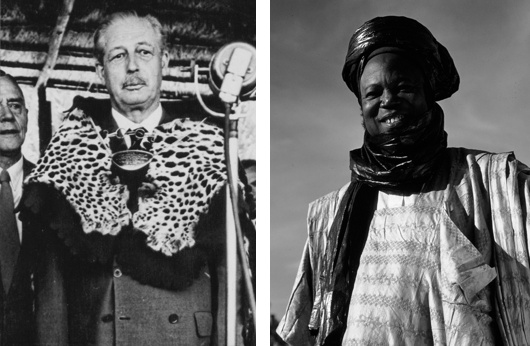
Left: Harold Macmillan touring Africa in 1960; Right: Sir Ahmadu Bello, the Sarduana of Sokoto.
Staying over with some Kenyan friends in Wiltshire the other day, the old observation came up that, after the war, the officers settled in Kenya while the sergeants went to Rhodesia. While some of the leading lights of UDI had, in fact, been officers — Ian Smith an obvious case — it’s interesting to note that most of them came from humble backgrounds.
“Smithie” was born well-off in Rhodesia but his father had been a butcher’s son who went out to Africa and made good. Clifford Dupont, the first president of the Rhodesian republic, was born in London of poor East End Huguenot stock. His father had done well in the rag trade and got his son to Cambridge; Clifford became an artillery officer before emigrating to Africa.
Rhodesian Prime Minister Roy Welensky’s father was a Russian Jewish horse smuggler who married a ninth-generation Afrikaner. Roy was the couple’s thirteenth son, and left school at 14 to work on the railways and found success through the trade union movement.
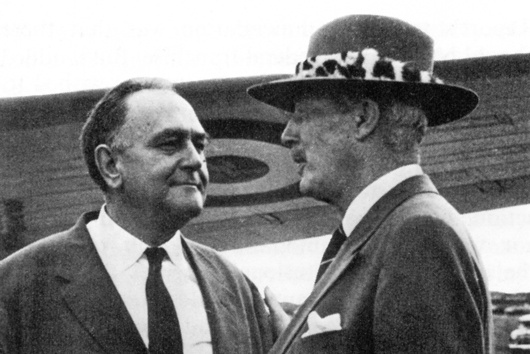
Harold Macmillan, meanwhile, was a Guards officer and Old Etonian who had studied at Oxford. His famous ‘Wind of Change’ speech was just part of the British prime minister’s grand tour of Africa. “Supermac” started in Nigeria, where — unlike in some other parts of the continent — much of the native aristocracy had been preserved and coopted throughout colonial rule.
Proving Orwell’s observation that the English are the most class-ridden nation on earth, the PM felt comfortable amongst black African patricians in a way he couldn’t amongst members of the ruling white African elite from humble backgrounds.
In one of the ICBH’s oral history group discussions, Perry Worsthorne relates:
Somebody at some point has to mention, in any discussion of British politics, snobbery and class. I remember travelling and reporting on the ‘Wind of Change’ speech. We went to stay on the last bit, just before going on to Salisbury, was it the Sardauna of Sokoto who was he the premier of the Northern Nigerian region. Macmillan talked to us after he had seen him, he was flying on to Welensky the next day.
Macmillan used to have a sundowner with the correspondents covering his trip, and over whisky and sodas he told us how much more at home he felt with the Sardauna, who reminded him of the Duke of Argyll – ‘a kind of black highland chieftain’ – than he would feel in Salisbury as the guest of a former railwayman, Sir Roy Welensky. Snobbery, pure snobbery.
The British metropole was always ready to make racial distinctions and discriminate accordingly, yet it still tended to look upon outright racism with an air of disdain, as something slightly unsporting (or worse: foreign).
In the imperial periphery, racial attitudes amongst whites often differed greatly from Britain. This was most obviously so in South Africa, which for all intents and purposes embarked upon a radical revolutionary rejection of the British model of governance from 1948 with the implementation of apartheid. Rhodesia, needless to say, was another exception, if arguably more mild. “How different it would all have been,” Worsthorne somewhat patronisingly wondered, “if Ian Smith had been a gentleman.”
Meanwhile Nigeria’s Sir Ahmadu Bello — the Sarduana of Sokoto — was a statesman of cautious action, and his refusal to become Nigerian prime minister upon independence (he preferred sticking to his existing role as the powerful premier of the northern province) sadly deprived the federal state of the wisdom and experience which may have prevented its later descent into disarray. He was murdered by Major Nzeogwu during the 1966 coup d’état.
Differences of race or class aside, it’s telling that both the white low-born railwayman Welensky and the black patrician Bello ended up as knights of the realm.
St Paul’s Survives
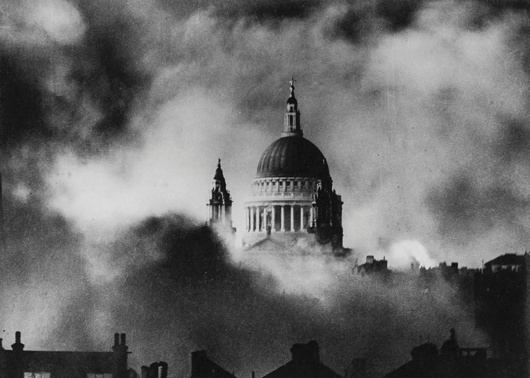
Crossing the Thames as I walked home from the pub last night, I looked down the river and saw the sturdy dome of St Paul’s standing out, illuminated in the winter night.
As it happens, it was exactly seventy-seven years ago last night — on the 29th of December 1940 — that the iconic photograph often called ‘St Paul’s Survives’ (above) was captured.
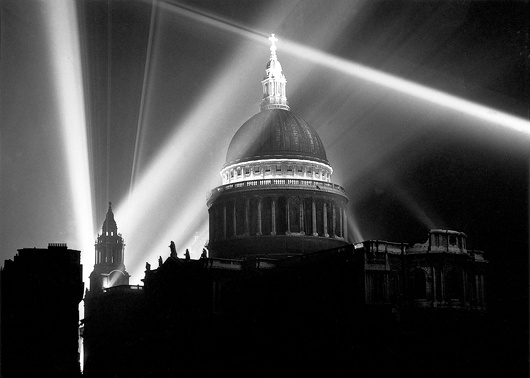
Hopeful as that sight must have been, it was a pretty grim time. But four and a half years later (below) the cathedral was illuminated not by the lights of enemy firebombs but by great searchlights forming a massive ‘V’ in the sky: it was 8 May 1945 — Victory in Europe.
Another year gone. We’ve survived.
“Events did not choose the terrorists; powerful white people did.”
Helen Andrews on Zimbabwe
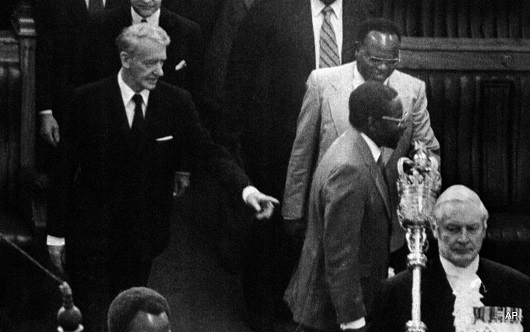
Robert Mugabe leading Ian Smith into the Zimbabwean parliament, 1980.
It is rare to find journalism as informed and insightful as this piece on Zimbabwe by Helen Andrews in National Review. In the aftermath of Mugabe’s clumsy downfall and his succession by a powerful apparatchik and experienced political operator, Helen explores the Rhodesian crisis and attempts to answer the question: could it really have gone any other way?
Any idea that liberal reform on the part of the Rhodesian state could have saved it is a non-starter, because the anti-imperialists were implacable and — I do not know a gentle way to put this — they were quite happy to lie. I do not mean just the professional liars of the Soviet propaganda shop, or the pundits who lazily referred to the Rhodesian system as “apartheid,” or the guerrillas who told Shona villagers that ZANU had successfully dynamited the Kariba Dam, or the foreign journalist who scattered candy around a garbage bin and captioned the resulting photo “Starving children searching for food in Salisbury.” Ralph Bunche had a doctorate from Harvard, a Nobel Peace Prize, and a co-author credit on the Universal Declaration of Human Rights, and when it came to imperialism, he lied.
“Colonial authorities like the noted Englishman, Lord Lugard, doubt that the African race, whether in Africa or America, can develop capability for self-government.” When I first read that in Bunche’s 1936 pamphlet “A World View of Race,” I felt a lurking suspicion that I had read a sentence of Lord Lugard’s beginning with the very words “The method of their progress toward self-government lies…” I had. His next words are “along the same path as that of Europeans.” Even making allowances for CTRL-F’s not having been invented yet, Bunche’s remark is plain slander. With Harvard Ph.D.s pulling stunts like this, it is hard to summon much indignation at a garden-variety diplomatic lie like the U.N. claim, by which sanctions were justified, that Rhodesia had committed an act of aggression by maintaining its status quo.
She does go a little easy on Smith, who despite his many strengths was just as willing to play fast and easy with the truth. (He was a politician, after all.) But then as we are so used to hearing that Smithie was a little Hitler it’s a welcome restorative.
When I moved to South Africa, I did so at least in part because I wanted to see it before it became “the next Zimbabwe”. Having come back, I was impressed by the relative robustness of many of its institutions, and the certain robustness of many of its people. Rather than a Zimbabwe-style collapse, South Africa seemed destined for a slow, ungainly descent into perpetual malaise.
The recent ascent of Cyril Ramaphosa – who on behalf of the ANC ran rings round the NP negotiators during the transition talks of the early ’90s – gives hope to many. I’m too cautious to be optimistic, but Mr Ramaphosa is clever, intelligent, skilful, and more likelier to keep the unions on side.
“Get me ze Führer!”
Stereotypes of Nazi generals in British war films
“The reason for my uniform being a slightly different colour to yours
is never explained.”
The British are, of course, obsessed with the Nazis. There are many reasons for this, amongst which we must include the large number of really quite good war films produced during the 1950s and 1960s.
For some indiscernible reason these movies have the virtue of being eternally rewatchable and many a cloudy Saturday afternoon has been occupied by Sink the Bismarck!, Where Eagles Dare, or The Colditz Story.
The genre also deploys with a remarkable regularity a number of familiar tropes of ze Germans which the above clip from a British comedy sketch programme (introduced to me by the indomitable Jack Smith) aptly mocks.
Nahum Effendi and Cairo’s Lost World
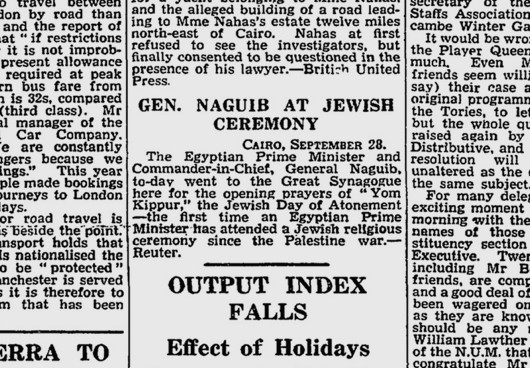
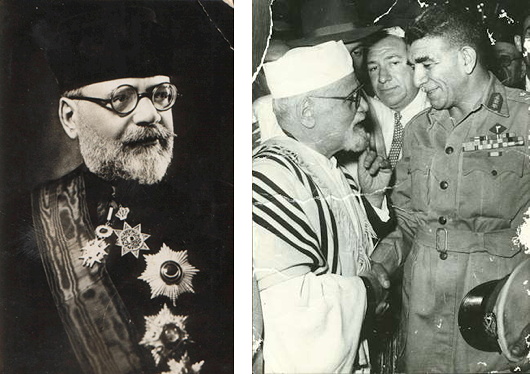
Stumbling across the newspaper clipping above was a sad reminder of a lost world. Taken from the front page of the Manchester Guardian of Monday 29 September 1952, it describes the Egyptian leader General Naguib attending a Yom Kippur service just two months after the coup that overthrew the country’s monarchy. None of the Jewish places of worship in Cairo are known as the “Great Synagogue”, so I presume this must have been the Adly Street Synagogue (Sha’ar Hashamayim).
The Chief Rabbi of the Sephardic community in Egypt at the time would have been Senator Rabbi Chaim Nahum Effendi. A creature of the Ottoman world, Rabbi Nahum was born in Smyrna in Anatolia, went to yeshiva in Tiberias on the Sea of Galilee, and finished his secondary education in a French lycée.
After earning a degree in Islamic law in Constantinople, he started his rabbinic studies in Paris while also studying at the Sorbonne’s School of Oriental Languages. Returning to Anatolia he was appointed the Hakham Bashi, or Chief Rabbi, of the Ottoman empire in 1908 and honoured with the title of effendi.
After that empire collapsed, Rabbi Nahum was invited to take up the helm of the Sephardic community in Egypt in 1923. A natural linguist and a gifted scholar, the chief rabbi’s talents were apparent to all, and he was appointed to the Egyptian senate as well as being a founding member of the Royal Academy of the Arabic Language created to standardise Egyptian Arabic.
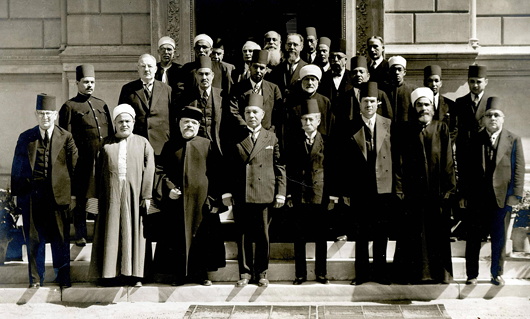
Rabbi Nahum (front row, third from left) at the foundation of Egypt’s Arabic academy.
The foundation of the State of Israel was a godsend for many Jews but spelled the beginning of the end for Egypt’s community. Zionists were a distinct minority among Egyptian Jews — many of whom were part of Egypt’s (primarily anti-British) nationalist movement — but Israel’s defeat of the Arab League in the 1948 War embarrassed Egypt’s ruling classes and stoked anti-semitism amongst the populace. Violent attacks against Jewish businesses were tolerated by the authorities and went uninvestigated by the police. Unfounded allegations of both Zionism and treason were rife, and discriminatory employment laws were introduced.
The 1952 Revolution did not improve things, as the tolerant but decaying monarchy was replaced by a vigorous but nationalist and pan-Arabist military government. Faced with such continuing depredations, the overwhelming majority of Jewish Egyptians fled — to Israel, Europe, and the United States. Rabbi Nahum eventually died in 1960, by then something of a broken man I imagine.
Cairo was once a thriving cosmopolitan city of Muslims, Christians, and Jews — and many communities of outside origin. The Greeks, who first arrived twenty-seven centuries ago and in 1940 still numbered tens of thousands, have all left. The futurist Marinetti was the most famous of the Italian Egyptians, whose numbers in the 1930s were numerous enough to warrant several branches of the Fascist party. Since the 1952 Revolution they are all gone too. Some Armenians remain, but not many. As for Jews, there are six left in Egypt.
Sic transit gloria mundi.
F.C. Kolbe and the Tulbagh Drostdy
the Tulbagh Drostdy
Poet, Polemicist, Polymath, and Priest
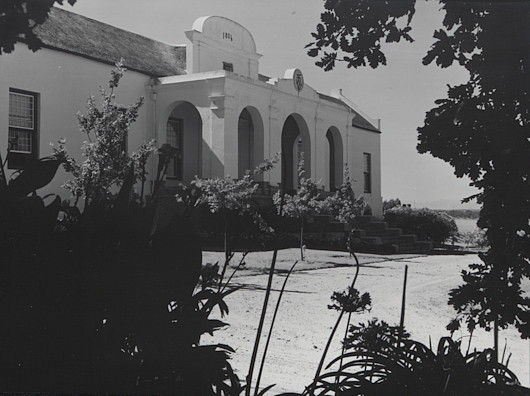
Relic and emblem of a storied past.
Thrice happy they whose lines in thee are cast
Thy records summon all in thy embrace
To emulate the virtues of the race.
Thy stately halls of courtly manners tell,
Where only Ladies Bountiful should dwell.
Thy solid frame is pledge of future glory,
And links our doings with our country’s story.
Work on the Drostdy (magistrate’s house) at Tulbagh in the Western Cape began late in 1804 but progressed rather slowly and expensively. This is probably because — after construction commenced — the plans by Bletterman, the landdrost at Stellenbosch, were torn up by the architect Louis Michel Thibault and replaced by his own design.
This meant part of the work already completed had to be demolished and re-done, which Bletterman only went along with assuming Thibault’s plan had the approval of the Batavian Republic’s governor of the Cape, Jan Willem Janssens. As it happens, they did not, and when Bletterman found out he was none too pleased.
Francis Masey, a partner at Herbert Baker’s firm, noted that “[w]hilst it proved to be the last building begun upon Dutch soil in South Africa, it was destined to be the first completed upon the passing of the Cape into the hands of the British.”
This 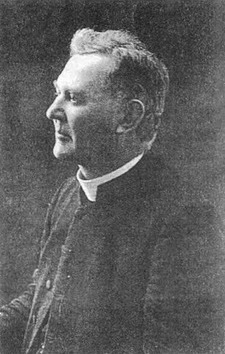 brief ode was written by Frederick Charles Kolbe (right) in 1909. The great-great-grandson of the magistrate (or landdrost) at Stellenbosch, F.C. Kolbe was the son of a Congregational missionary in Paarl who studied law at the Inner Temple in London. There, in 1876, he was received into the Catholic Church and continued on to study in Rome where he was ordained a priest in 1882.
While his poetry was tended towards the middling, Kolbe was a distinctive polymath. In addition to catechetical writings, he published a number of works on Shakespeare, and lectured on Socrates not long after his 1882 return to the Cape. Eventually he was appointed Reader in Aesthetics at the University of Cape Town.
Kolbe also wrote a Catholic criticism of the 1926 book Holism and Evolution by the statesman General Smuts. (Not many people realise that the word ‘holistic’ was donated to the English language by a son of Stellenbosch.) The general and the priest had corresponded as early as 1915 when Smuts was Minister for Defence, and Smuts was so taken with Kolbe’s critique that he wrote a foreword to a later edition of it.
In a 1935 letter to “Dr. Kolbe”, the General wrote:
Although I am not acquainted with the Catholic prayers, I am deeply versed in the Psalms of the Old Testament, which seem to me the greatest and noblest outpourings of the human spirit ever put into language. The inexpressible finds expression there. Emotions almost too deep for utterance somehow find an outlet there. …
I also agree with you as to the nobility of the language which Catholic Christianity has evolved. What could match the beauty of De Imitatione Christi? Somehow it breathes a spirit which is beyond all language. It is curious how in such a case the human soul sets on fire its own earthly vesture, and language becomes a blaze of glory…
From Smuts’ letters to others we know that he actually read more works by Kolbe, in particular his Up the slopes of Mount Sion: or, A progress from Puritanism to Catholicism.
Disputation and discussion were also among Kolbe’s talents. He used the pages of South Africa’s Catholic Magazine to counter the accusations of what he called a “narrow clique” of anti-Romish ministers of the Dutch Reformed Church.
One of Kolbe’s most lasting legacies was the effect of his writing on the young Afrikaner philosopher Marthinus Versfeld (1909–1995) who converted to Catholicism under the late Monsignor’s influence. (Kolbe had died in 1936.) Versfeld’s familiarity with Augustine and Aquinas helped him launch intellectual attacks against the so-called “Christian-national” thinking behind apartheid, particularly in his first book Oor gode en afgode (“Of Gods and Idols”, 1948 & republished 2010).
Kolbe, according to Versfeld, “lived out a certain apprehension of the presence of the universal in the particular, just as Newman lived out his vision of the Catholic Church in the material of English circumstances.”
An Afrikaner Newman, perhaps? Worth reading more about.
The French Way of War
I’ve  been reading Lartéguy recently so was intrigued to hear of another French writer formed by his military experience, Pierre Schoendoerffer (right).
In a tweet, the cigarette-smoking Helen Andrews shared an article called What a 1963 Novel Tells Us About the French Army, Mission Command, and the Romance of the Indochina War.
I dislike the romanticism surrounding the magnificent losers vs. ugly victors dichotomy – a magnificent victory is infinitely preferably to both. Hence why my natural Jacobite sympathies are highly qualified by complete and utter disdain for Charlie’s unwillingness to see the task through. (An easy judgement when made from centuries of hindsight, I’ll concede.)
Anyhow, I sent the article to The Major and he proffered this reply:
I was going to say something snide about the French army but to be quite honest I have thought for some time that it is rather better than ours [Ed.: the British]. Their officers are tougher, harder, and more professional than ours – those I encountered professionally certainly were. They are also not infected by the political correctness which is wrecking/has wrecked our army (among other factors).
The distinction between the colonial army and the large conscript army at home is valid. It was the conscript army which was defeated in 1870, 1914, and 1940… not the colonial army to which the modern French army now looks.
It is also true that the US Army don’t do Mission Command well. The Marines on the other hand…
Meanwhile back in the States the prolific Ken Burns has done an eighteen-hour documentary on the Vietnam conflict which allegedly ignores all the scholarly input of the past two decades. Nevermind, we just regret it won’t feature the late great Shelby Foote, who (in Burns’s ‘The Civil War’) spoke with such assurance you imagined he was there.
From Realm to Republic
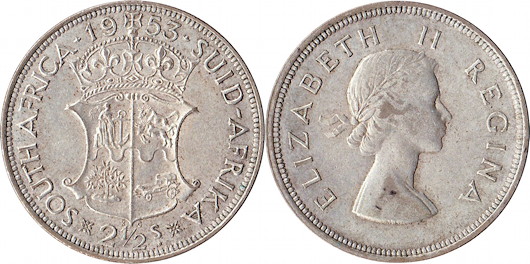
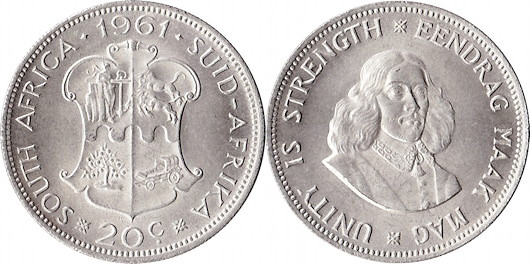
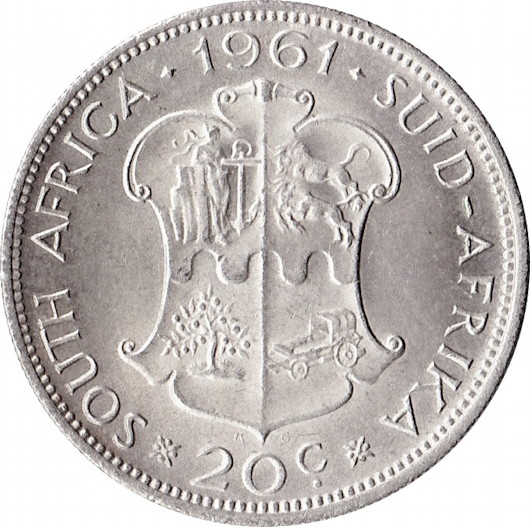
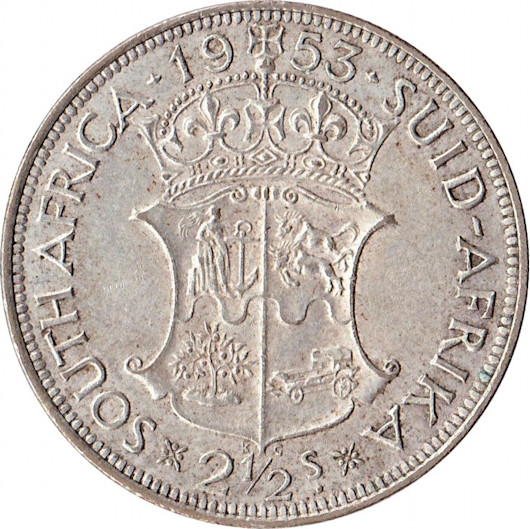
South Africa’s transition from a monarchy to a republic coincided with a change of currency. Out went the old South African pound (with its shillings and pence) and in came the decimilised rand.
Luckily the republican government had the good taste to commission George Kruger Gray, responsible for the country’s most beautiful coinage, to design the new coins. HM the Queen was replaced by old Jan van Riebeeck, and the country’s arms were deprived of their crown.
Champagne and the World
Champagne can provoke a great deal of philosophy. I’ve often said that champagne and the Catholic faith are the only two universally applicable things in the universe – appropriate for births, deaths, good times and bad, early, late, or a mundane afternoon.
Iain Martin has a brief but excellent piece ‘On Wine’ discussing Churchill’s drinking habits, and wondering whether he really was permanently pissed during the war (unlike the teetotal vegetarian Mr Hitler).
Interesting in itself, but Mr Martin relates a trip to Épernay where he blind tastes a Margaux from 1873. By that time it should have tasted like vinegar but instead it was “beautifully balances and perfectly drinkable”.
Looked after carefully, not shaken about or disturbed unnecessarily, it evolved and endured. It retained its essential characteristics, giving pleasure to later generations. If only we nurtured political institutions and good government according to the same principle.
Nothing could better show the essence of a sound worldview.
Borges’s Biblioteca
The old National Library on Calle Mexico in Buenos Aires
The intellectual Alberto Manguel grew up amidst the library of the Argentine diplomatic compound in Tel Aviv, as he recalls in this piece for Britain’s strangely underappreciated Literary Review.
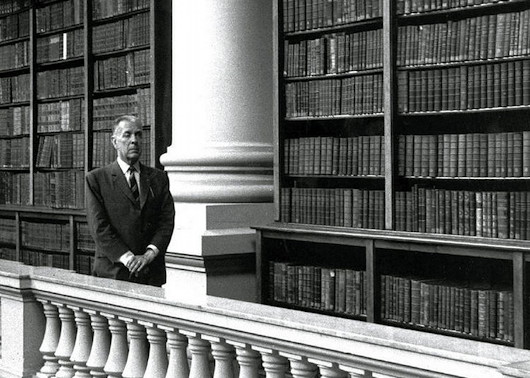
At the end of 2015 Señor Manguel was appointed director of Argentina’s National Library, taking up his position in the middle of last year. In this role he steps into the shoes of Jorge Luis Borges who led the institution from 1955 until he resigned upon Peron’s return in 1973.
Returning to the ‘Queen of the Plata’ after a long career in exile was not a simple affair. As Señor Manguel writes:
The city, of course, was different. I found it difficult to look at the actual streets and houses without remembering the ghosts of what had been there before, or what I imagined had been there before. Buenos Aires felt now like one of those places seen in dreams, the geography of which you think you know but which keeps changing or drifting away as you try to make your way through it.
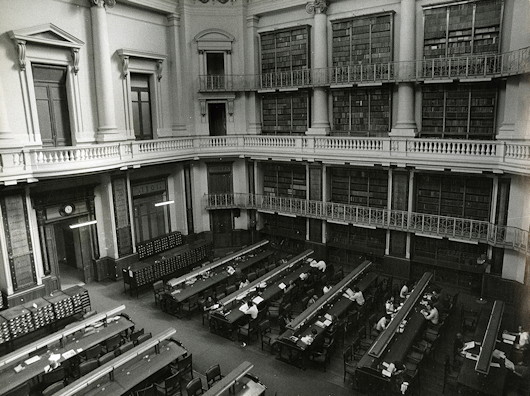
The National Library I had known during my adolescence was a different one. It stood on Mexico Street in the colonial neighbourhood of Montserrat. The building was an elegant 19th-century palazzo originally built to house the state lottery but almost immediately converted into a library. Borges had kept his office there when he was appointed director in 1955, when ‘God’s irony’, he said, had granted him in a single stroke ‘the books and the night’. Borges was the fourth blind director of the library, a curse I’m intent on avoiding. It was to this building, during the 1960s, that I used to go to meet Borges after school and walk him back to his flat, where I would read stories by Kipling, Henry James and Robert Louis Stevenson to him. After he became blind, Borges decided not to write anything except verse, which he could compose in his head and then dictate. But some ten years later he went back on his resolution and decided to try his hand again at a few new stories. Before starting, Borges wanted to study how the great masters had gone about writing their own. The result was two of his best collections, Doctor Brodie’s Report and The Book of Sand.
The library I discovered half a century later was lodged in a gigantic tower designed in the brutalist style of the 1960s. Borges, passing his hands over the architect’s model, dismissed it as ‘a hideous sewing machine’. The building is supposed to represent a book lying on a tall cement table, but people call it the UFO, an alien thing landed among pretty gardens and blue jacaranda trees. […]

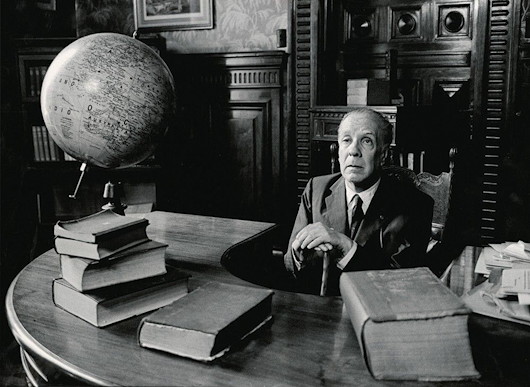
In my adolescence, I tried to write, no doubt under the influence of Borges, a few fantastical stories, now fortunately lost. One of them was about an unbearable know-it-all to whom the devil, in exchange for I don’t recall what, entrusted the overseeing of the world. Suddenly, this oaf realises that he has to deal with everything at once, from the rising of the sun to the turning of every page of every book, and the falling of every leaf, and the coursing of every drop of blood in every vein, and he is crushed by the inconceivable immensity of the task.
I had wanted to try to put my ideas about reading and libraries into action ever since I received my first books. Now I have got my wish with a vengeance. I have never in my life done anything as demanding and overwhelming as directing the National Library of Argentina. I have become, from one day to the next, an accountant, technician, lawyer, architect, electrician, psychologist, diplomat, sociologist, specialist on union politics, technocrat, cultural programmer and, of course, librarian. I hope that, time and Argentinian politics permitting, I’ll be able to start a few things that may allow us to have, in the not too distant future, a national library we can be proud of.
South Africa in the Old Days
This historical film about the early days of the Cape was probably produced for the van Riebeeck tercentenary festival of 1952.
The clip here covers the days of Governor Willem Adriaan van der Stel, depicting them as carefree days of harmony and merriment in South Africa – in contrast to Europe where war and persecution reigned. Doubtless this was how the apartheid government sought to portray South Africa at the time: a haven of peace and prosperity in contrast to a Europe still recovering from war, with half the continent now under the Soviet boot.
Simplistic propaganda of course, but the film conveys a certain charm regardless, as does almost every depiction of the Cape before the British. The sight of geese flocking before an old Cape Dutch homestead (circa 7:00) never fails to touch the Cusackian heart…
Search
Instagram: @andcusack
Click here for my Instagram photos.Most Recent Posts
- Brunel’s Unbuilt Capitol February 3, 2026
- Cricket at Fordham January 27, 2026
- Palacio Barolo Revisted January 14, 2026
- Learning to Love Liguria January 14, 2026
- Crux Alba No. 2 January 13, 2026
Most Recent Comments
Book Wishlist
Monthly Archives
Categories