Australia
About Andrew Cusack
 Writer, web designer, etc.; born in New York; educated in Argentina, Scotland, and South Africa; now based in London.
 read more
News
Blogs
Reviews & Periodicals
Arts & Design
World
France
Mitteleuropa
Knickerbockers
Argentina
The Levant
Africa
Cape of Good Hope
Netherlands
Scandinavia
Québec
India
Muscovy
Germany
Academica
The most beautiful city never built
Ernest Gimson’s Canberra
Whenever I’m in in Westminster Cathedral, I feel obliged to nip in to and say a prayer in the chapel dedicated to St Andrew. The apostle is my patron many times over: in addition to being my name-saint, he is the patron of the university, the town, and the country in which I spent four luxurious years. His is one of the most finely decorated chapels in the cathedral, and boasts a beautiful mosaic depiction of the ‘Auld Grey Toun’ above the arms of the donor, the 4th Marquess of Bute. (His father, the eccentric 3rd Marquess, had been Lord Rector of the University of St Andrews.)
Stumbling upon the genial Cathedral Historian, Patrick Rogers, the other day, he shared with me that the stalls and kneelers in St Andrew’s Chapel are widely considered the finest works of arts-and-crafts furniture design in all of Great Britain. They are the creation of a man I had never heard of: the craftsman, designer, and architect Ernest Gimson.
An unfamiliar name is always a potential new avenue of knowledge down which to saunter, and so it proved with Ernest Gimson. His talent at furniture is undoubted but, given my obsession with architecture, it was instead that field of his expertise which particularly drew me in. It was then that I discovered his submission for the 1911-1912 Australian Federal Capital Competition.
The British colonies in Australia federated in 1901, and the dispute between Sydney and Melbourne as to which would be the capital of the youthful nation was settled by agreeing to build a new planned city within New South Wales (the state Sydney is in) but not more than 200 miles from Melbourne.
Ten years later, an international competition was announced to determine the design for this new capital being created ex nihilo on the banks of the Molonglo river, which was given the name of Canberra.
Of the 137 entries received, many of them were very handsome, but some of them were frankly awful. Rather than have a team of architects, artists, or urbanists choose the winning design, the Minister for Home Affairs, Mr King O’Malley, was the sole decision-maker.
He eventually chose the plan submitted by the Chicago architect Walter Burley Griffin, awarding a second prize to Eliel Saarinen of Finland, with third prize going to Alfred Agache of Paris.
The design I would have chosen, however, was Ernest Gimson’s.
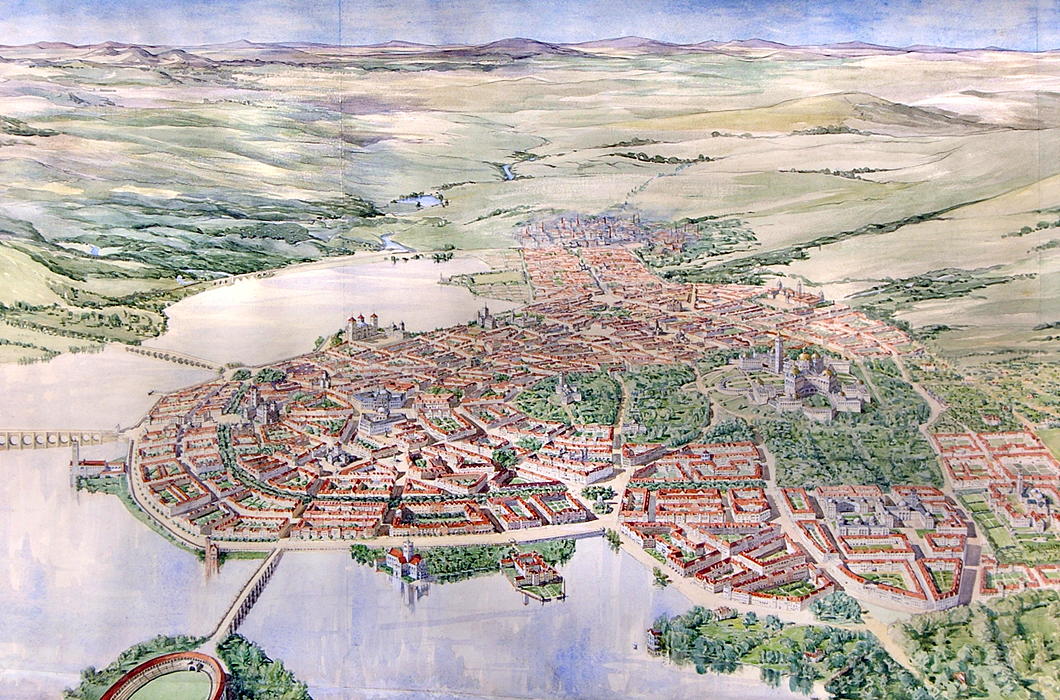
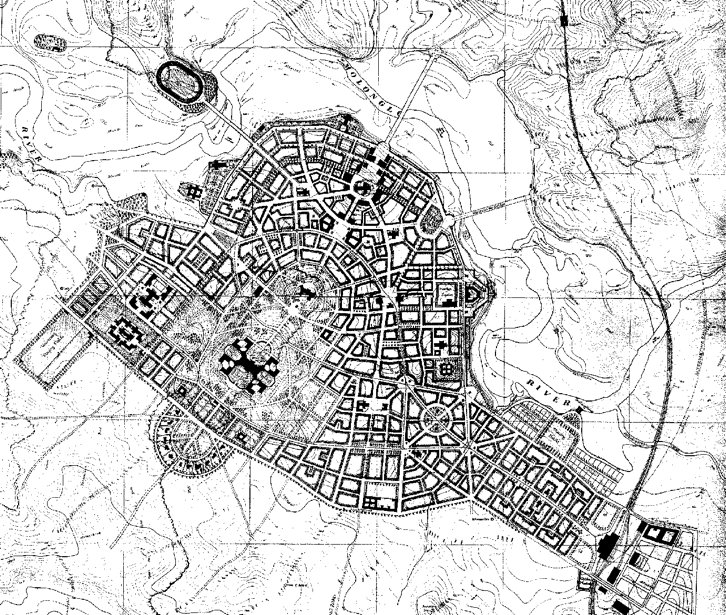
Gimson designed a compact capital city of 25,000 inhabitants that would be able to support itself based on neighbouring farms and small-scale industry.
The city is entirely concentrated along the south bank of an artificial lake and centred on a wooded park containing Kurrajong Hill and Camp Hill, with the streets of the city radiating down from there toward the lakeside.
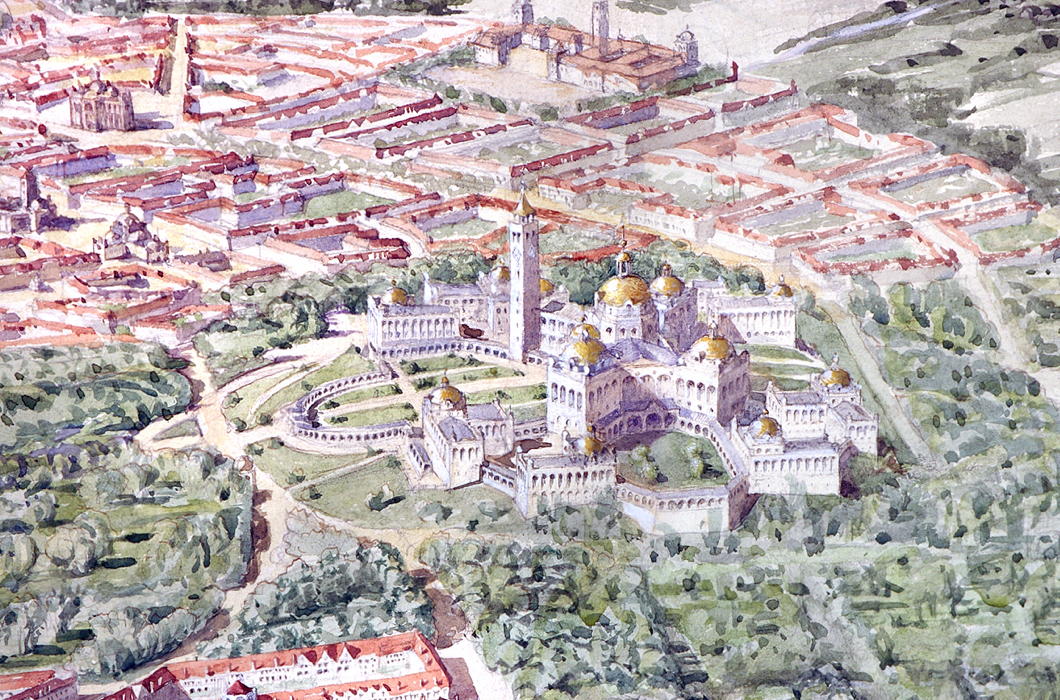
Kurrajong Hill, with its dominating position over the city, was selected for the Houses of Parliament, with eight departmental buildings surrounding it on a lower terrace.
Official residences for the Governor-General and Prime Minister are located nearby, each with six acres of private grounds.
The State Hall is located atop the adjacent, slightly lower, Camp Hill, with the Printing Office and Mint located at either side, where the park ends.
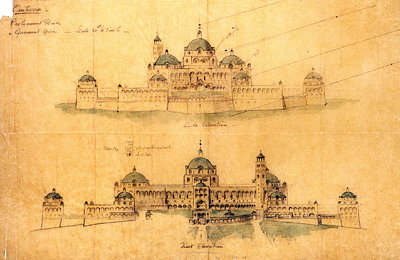
North-west of Kurrajong is the City Hall, flanked by the Courts of Justice, with its main entrance facing towards the central park.
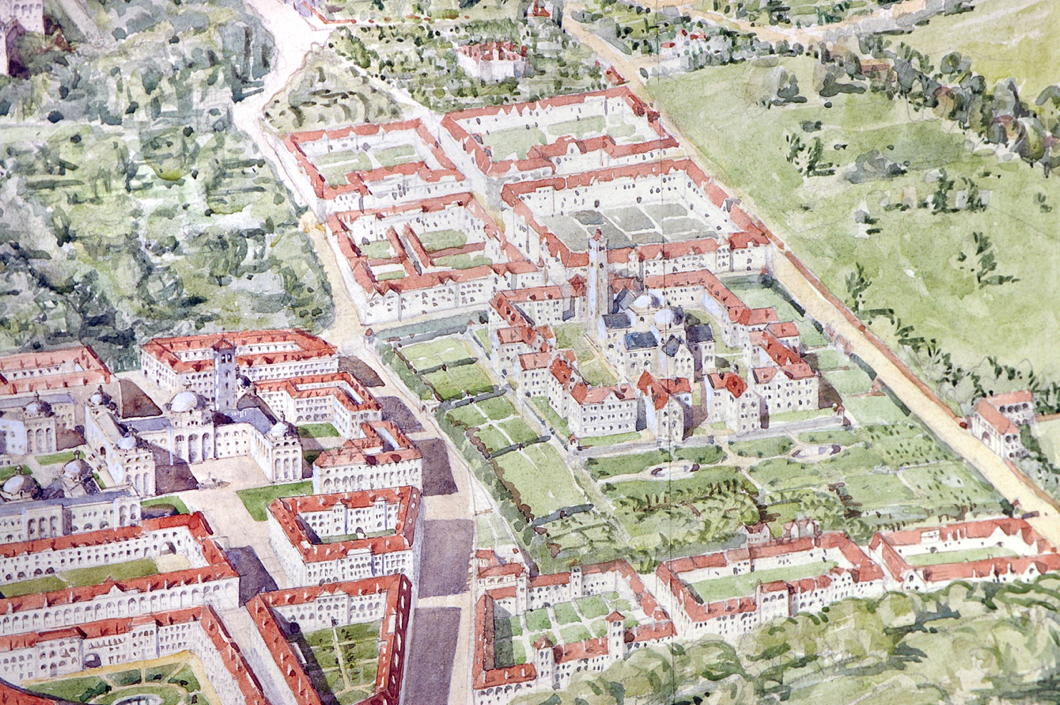
On a small hill nearby is the University, its double-domed central block surrounded again by ancillary buildings on a lower terrace. Playing fields are allotted nearby.
The market is located on the east side “with a covered arcade for the stalls enclosing an open square”, alongside a market house and technical colleges.
The Cathedral rises from the center of the city proper and forms an axis with the State Hall on Camp Hill and the Houses of Parliament atop Kurrajong.
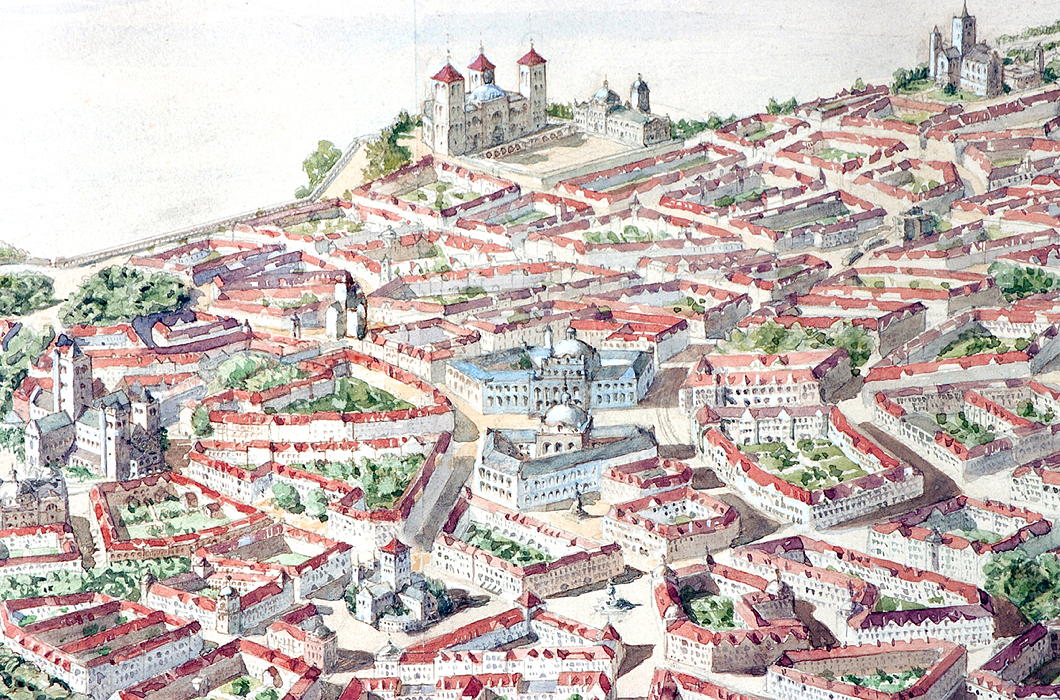
At the near-midpoint of the street connecting the Cathedral to the State Hall, a public square is flanked by a National Art Gallery and Library. Around the Cathedral itself are the National Theatre and the General Post Office.
A stadium is located on the north side of the lake, connected to the city by a bridge, and further provision is made for siting barracks, gas works, a power station, cattle market, and other necessities.
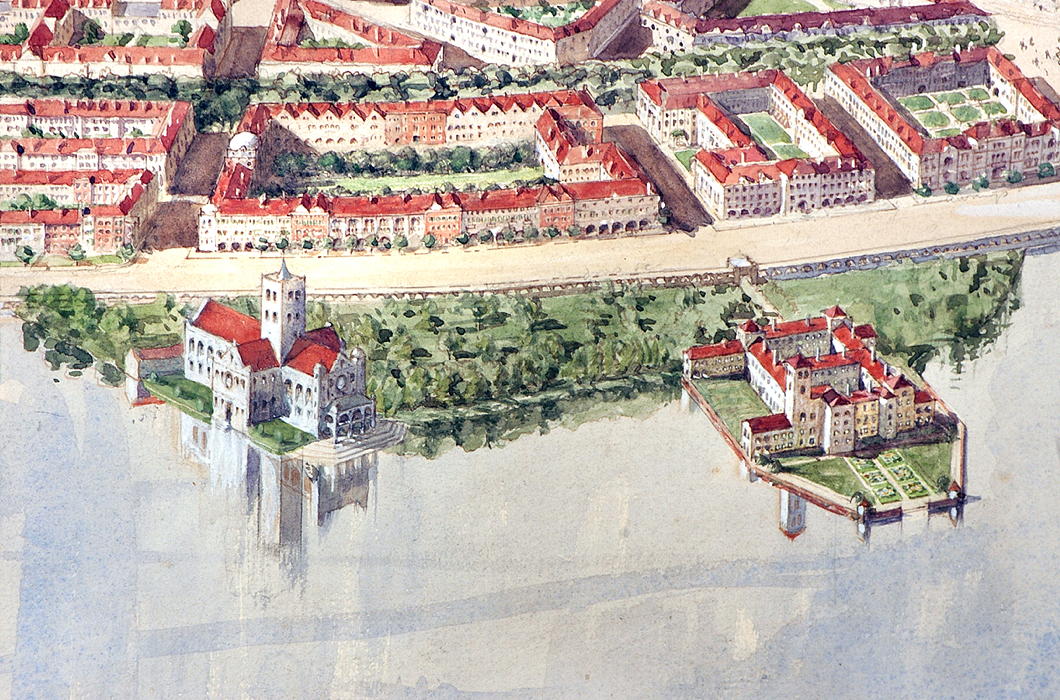
Buildings would chiefly be faced in a light-coloured local stone which gives the plan, deeply influenced by tradition, both a brightness and a more vernacular feel.
To discuss the design of the buildings is tricky: this proposal is an initial plan and, had it been selected, the architect would have had more time to then further refine what he was proposing.
The Houses of Parliament, with their eccentric X-footprint, are a curious conglomeration and not quite right. There seem to be a surfeit of towers that look too similar to one other.
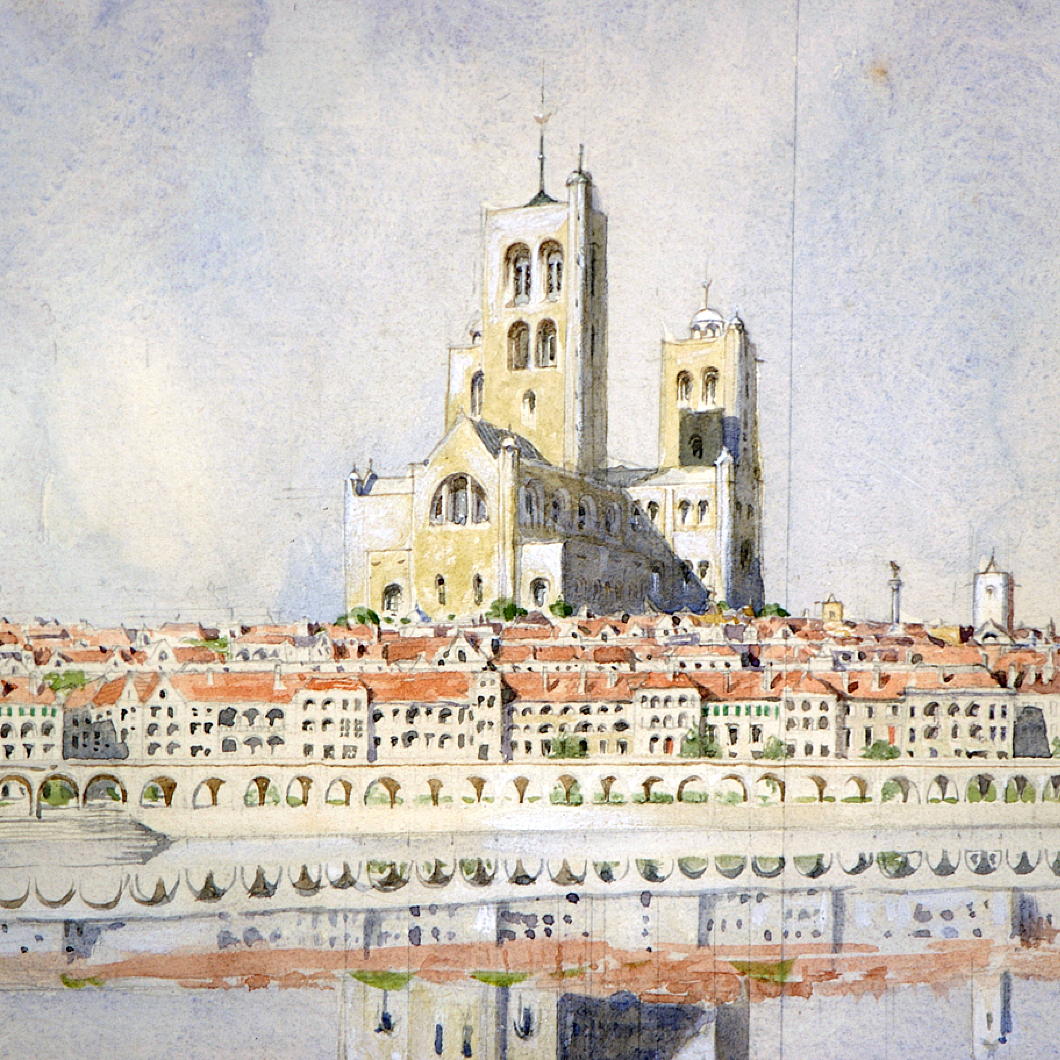
But the Cathedral — my favourite part of Gimson’s plan — is a magnificent creation with an assertive central crossing tower that doubtless would become the visual focus of the city.
The embankment, with its long, generous, 20-foot-deep arcade providing “sheltered walk in hot and wet weather”, is both picturesque and useful.
“While screening in some measure the near part of the lake from the ground floor windows of the houses opposite,” the arcade, Gimson notes, “would enhance rather than diminish, the interest of the wider views.”
Indeed, it provides a useful transition point from lakeside to the rise of the buildings.
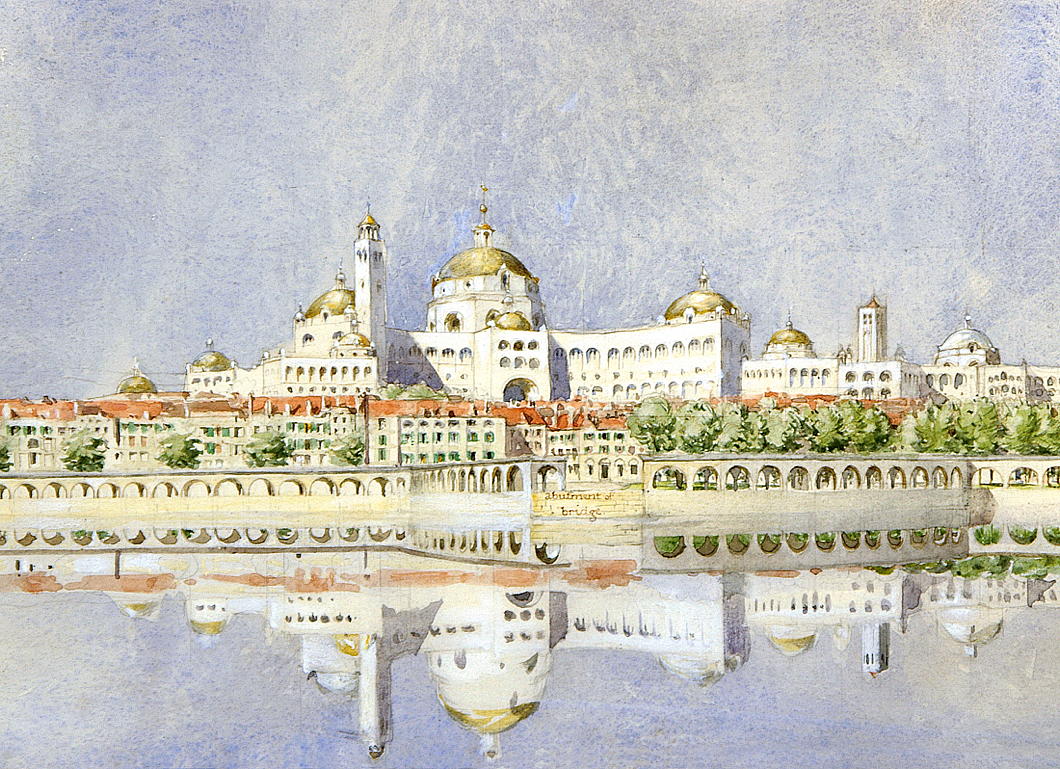
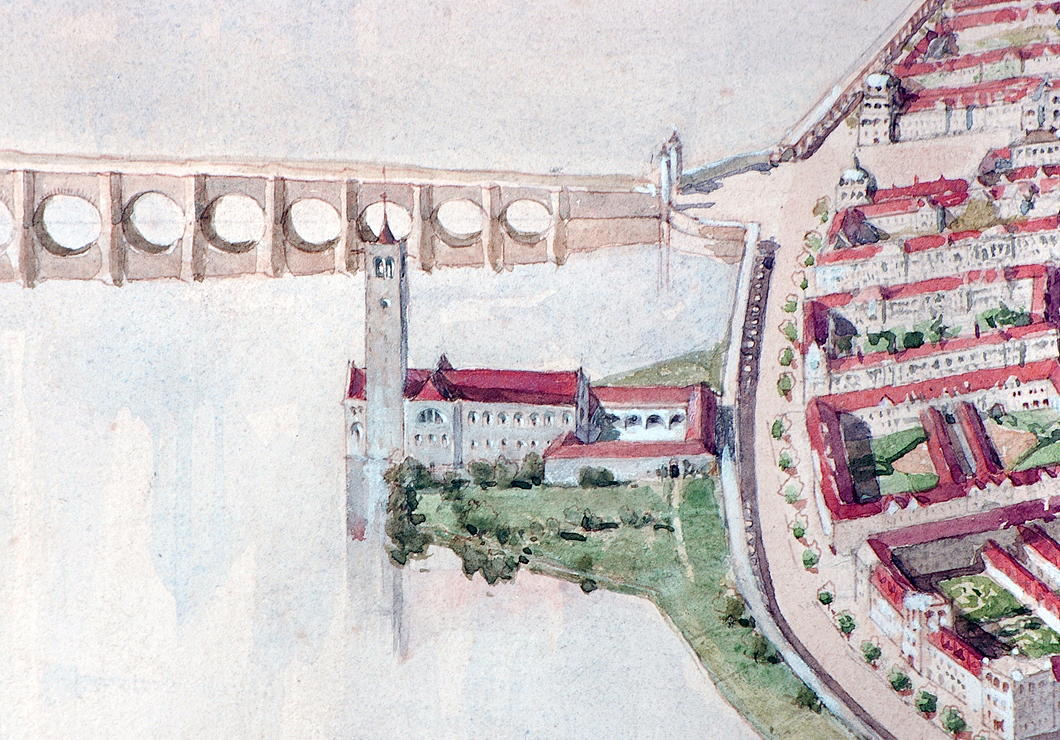
The architect’s layout of streets, public spaces, and important buildings, meanwhile, shows the influence of the aesthetic principles of the Austrian urbanist Camillo Sitte, now unjustly neglected since being contemptuously derided by Le Corbusier and other leading modernists.
Gimson’s Canberra is an unpretentious city: its lack of grandeur is what most likely secured its rejection by the fathers of the young and vigorous nation, who were keen to impress. Burley Griffin provided them with a plan redolent of modernity and progress, but marred by fading modishness.
The Gimson plan would have provided Australia a beautiful modern capital city with a design deeply rooted in tradition, and with appropriate consideration of locality and climate. One can imagine that, as the course of history continued, ‘Old Canberra’ would have formed a handsome and much-loved heart of an ever-growing city.
The humane, natural traditionalism of Gimson’s Canberra would have made it much more popular with ordinary people than the sprawling, overly spacious modern city that Canberra is today. Still, it provides a model that urbanists of the future should be mindful of and take inspiration from.

Return of La Rittelmeyer
One of our favourite fellow cigarette-smokers has finally returned to the web following what we hope will be the last of her episodic periods of absence therefrom. Miss Rittelmeyer has fled to Australia, that southerly kingdom of sunshine and good feeling, and from there she even includes in one of her pieces a kind remark about your humble and obedient servant. [Though I would pedantically clarify that, while I do drink port, as a Catholic (not an Anglican) I am not “high church”, I do not dress like a dandy (this is being written in RL khakis and an Ireland rugby top), and while I have an appreciation for monarchy I would not really call myself a monarchist; but then I tend to disdain all -isms.]
In her post Welcome she gives a brief overview of recent events and motivations, though I am confused by her concern over bad coffee in Australia, as the most celebrated coffee-merchants in London are Antipodean. I would have put Australian television in the ‘Pro’ column, as I am the most committed propagandist for the cause of Australian television in the British Isles. “Home & Away” is a favourite in our riparian London flat, “Sea Patrol” is a ridiculous enjoyment, “Packed to the Rafters” worth watching, and “Round the Twist” and “Spellbinder” are childhood favourites, alongside other random productions like “The Wayne Manifesto” and “Sky Trackers”. (I won’t admit to having seen “H2O: Just Add Water”). If Helen is allowed her in-depth knowledge of Maldivian heavy metal, I am allowed my Australian television.
Anyhow, pop over and have a read. As one American inhabitant of the Queen’s realms to another, I wish her the best of luck under the Southern Cross.
The Advent of Virgin Australia

Virgin Atlantic Airways has always inexplicably attempted a fine balance between the crisply modern and the vaguely old-school. It is also unashamedly British. When the lumbering giants at British Airways were busy banishing the Union Jack from their aircraft livery — prompting Baroness Thatcher to cover the model of a BA 747 with a handkerchief — Sir Richard Branson said “We’re British: why don’t we fly the flag?” The Union Jack was added to every Virgin Atlantic plane and a flag design was later added to the wingtips. Virgin Atlantic now has a patriotic red-head (above) bedecked in the Union flag on the nose of each of its aircraft glamourously advertising their national origins in this hyperglobalist age.
Virgin Group has not restrained itself from expanding beyond the trans-Atlantic flightpath. In 2000, they established Virgin Blue in Australia, originally flying only between Brisbane and Sydney, but gradually expanding within the country, especially after the 2001 collapse of the major domestic carrier Ansett Australia. In 2003, Virgin started Pacific Blue Airways out of New Zealand, operating trans-Tasman routes, followed by the founding of Polynesian Blue in 2005 running flights between New Zealand, Australia, and Samoa. Finally, V Australia was started operations in 2009 running long-haul flights out of Australia. (more…)
Olympic Teams of Yesteryear
The vanished lands and failed alliances of the Modern Olympiad
THE GAMES OF THE Modern Olympiad are events which are meant to bring the peoples of the world together in peace and harmony and all those good and heartening things, but from the very beginning they have gotten bogged down in the petty particularities of rival nations, which altogether makes them rather more fun and interesting, if perhaps a touch less high-minded. The story of the ancient gathering’s revival in 1896 through the efforts of Pierre Frédy, Baron de Coubertin is well-known. Athletes from at least fourteen countries participated in those first modern games in Athens over a century ago, though the concept of national teams was not introduced until the 1906 games (the Intercalated Games, which have since been de-recognised by the IOC). But since those first games towards the end of the nineteenth century, the fortunes of many lands have waxed and waned, and likewise the spirit of unity amongst various peoples vied with the spirit of distinctiveness. Here, then, are but a small sample of Olympic teams which once vied for gold but which can no longer be found among the Olympic competitors of today. (more…)
The Australian
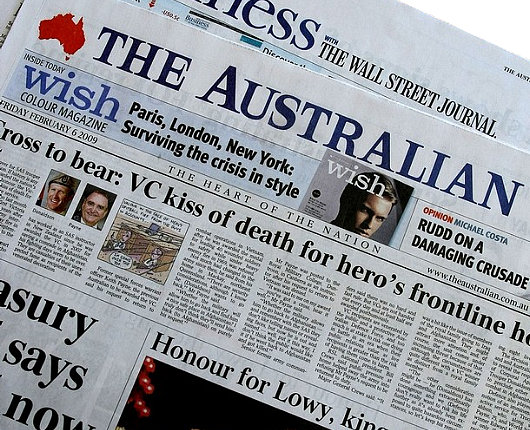
A surprisingly handsome newspaper, especially considering it is owned by (and, indeed, was founded by) Rupert Murdoch. Reminds me of The Scotsman in its broadsheet days.
The Evolving Heraldry of the Dominions
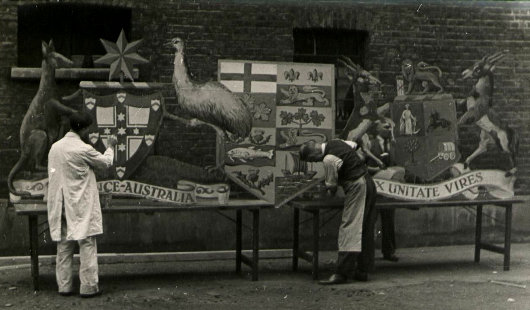
WHAT DO THESE three coats of arms, their representations produced for the 1910 coronation, have in common? The first thing that might come to the mind of most of the heraldically-inclined is that all three are the arms of British dominions; from left to right, of Australia, Canada, and South Africa. Aside from this commonality, however, each of these three arms have been superseded.
The Australian arms above were granted in 1908, and superseded by a new grant in 1912, though the old arms survived on the Australian sixpenny piece as late as 1963. The kangaroo and emu were retained as the shield’s supporters in the new grant of arms which remains in use today.
The Confederation of Canada took place in 1867, but no arms were granted to the dominion so it used a shield with the arms of its four original provinces — Ontario, Québec, Nova Scotia, and New Brunswick — quartered. As the remaining colonies of British North America were admitted to Canada as provinces, their arms were added to the unofficial dominion arms, which became quite cumbersome as the number of provinces grew. A better-designed coat of arms was officially granted in 1921, and modified only slightly a number of times since then.
South Africa‘s heraldic achievement, meanwhile, was divided into quarters, each quarter representing one of the Union’s four provinces: the Cape of Good Hope, Natal, the Transvaal, and the Orange Free State. While South Africa is (like Scotland, England, Ireland, and Canada) one of the few countries to have an official heraldic authority — the Buro vir Heraldiek in Pretoria — the country’s new arms were designed by a graphic designer with little knowledge of the rules & traditions of heraldry. As a result, the design produced is unattractive and very unpopular, unlike the new South African national flag, introduced in 1994, which was designed by the State Herald, Frederick Brownell, which enjoys wide popularity and universal acceptance.
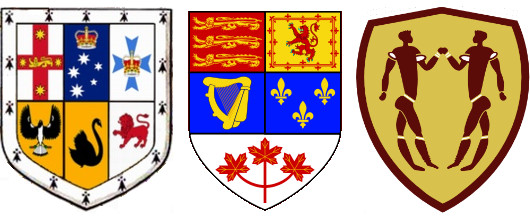
The current arms of Australia, Canada, and South Africa are represented below.
Her Excellency
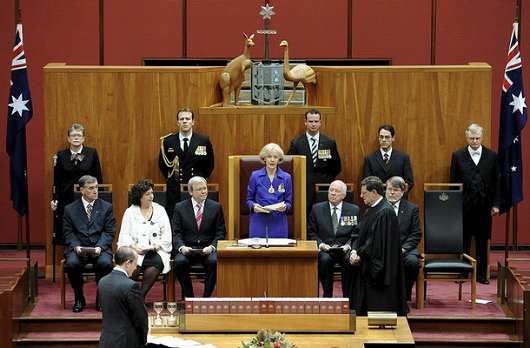
Quentin Bryce was yesterday sworn in as the Queen of Australia’s representative in her kingdom spanning that southerly continent.
The Pope at Government House

Pope Benedict XVI reviews the guard after being received by Maj. Gen. Jeffery, the Governor-General of Australia.
The Crown of Disenchantment
Over in Great Britain, the House of Commons recently passed the Human Fertilisation and Embryology Bill which, among other things, keeps the time limit on abortions at twenty-four weeks (in spite a hope that it would be lowered), authorizes the creation of “savior siblings (brothers and sisters deliberately created in a lab solely for their organs to be harvested for use by the already-born), and allows for the creation of animal-human hybrids. The British human rights activist James Mawdsley, famously jailed for over a year by the military junta in Burma, has asked opponents of the HFE Bill to sign a petition to Queen Elizabeth II imploring her to withhold the royal assent necessary for the Bill to become law.
Under the British constitution, a bill only becomes a law when it has received the assent of all three components of the British Parliament: the Commons, the Lords, and the Crown. The last time the Crown withheld consent was in 1708 when Queen Anne refused to sign the Scottish Militia Bill. Since that time, it has been an unspoken convention that should the Crown object to a piece of legislation, it should privately inform its ministers before the legislation is voted upon in order for it to be withdrawn, thus preventing the scandal of the Crown and the Commons appearing to be in disagreement. Despite this convention, however, the Crown still has the right to withhold consent, but merely neglects to exercise that right.
While the Crown has faded to near-irrelevance in the everyday workings of the British government, this was certainly not always the case, and the Crown has intervened in politics several times since Queen Anne’s refusal of assent in 1708. What follows are but a few twentieth-century examples.
In 1925, William Mackenzie King was Prime Minister of Canada with 99 Liberal MPs to the Conservative opposition’s 116. He was able to do this by forming a minority government with the support of the 24 MPs of the Progressive Party. A year later, Liberal MPs were implicated in a bribery scandal and so the Progressives having withdrawn their support for the minority government. As parliament debated a motion to censure the MPs involved, the Prime Minister asked Lord Byng, the Governor-General of Canada (and thus the direct representative of the Crown), to dissolve parliament and call a general election.
Lord Byng did not want it to appear that the Crown was allowing parliament to be dissolved in order to prevent the censure of government MPs and so used the royal prerogative and refused to call an election. The Conservatives, as the largest party in parliament (Lord Byng argued), should have a chance at forming a government instead. The Governor-General invited Arthur Meighen, leader of the Conservatives, to form a government instead, and Meighen agreed. This, in turn, infuriated not only the Liberals but also the Progressives, throwing the middle-man back into the Liberal camp. Meighen put his government up to a vote of confidence, lost it by one vote, and so resigned and asked the Governor-General to dissolve parliament and call an election, which Lord Byng duly did.
“I have to await the verdict of history to prove my having adopted a wrong course,” Lord Byng wrote, “and this I do with an easy conscience that, right or wrong, I have acted in the interests of Canada and implicated no one else in my decision.”
In 1931, when the Labour Prime Minister Ramsay MacDonald submitted his resignation to the King, George V took the unprecedented step of asking MacDonald to form a national government with the support of Conservatives and Liberal Members of Parliament. MacDonald lasted as Prime Minister until 1935, but Great Britain would not be governed by a single-party government again until 1945.
More recently, the Crown controversially intervened in Australian politics in 1975. Gough Whitlam’s Labor government commanded a majority in the House of Representatives but the opposition coalition of the Liberals and the National Country Party held sway in the Senate. It is traditional in Westminster-style systems that if a money supply bill fails to pass, the government falls with it. The Senate refused to vote on the annual Budget, in hopes of provoking Whitlam into calling a new election. Whitlam stubbornly refused, and the impasse grew as the weeks passed and, with no budget approved, it looked like the government of Australia would not be able to meet its financial obligations for the year.
Finally, the Governor-General of Australia, Sir John Kerr, used the royal prerogative to dismiss Whitlam as Prime Minister, asked the opposition leader Malcolm Fraser to take the job. Fraser formed a caretaker government solely to pass the appropriations bill then immediately called a new election which his own Liberal/National Country coalition won handily.
Such royal interventions, however, are not limited to the English-speaking world. Belgium’s King Baudouin I, a Charismatic Catholic and friend of Francisco Franco, famously refused to give assent to a bill liberalizing the kingdom’s abortion laws. The Prime Minister, Wilfred Martens, simply had the King declared temporarily unable to reign and the Government signed the Bill in place of the King (as is provided in the Belgian Constitution). Two days later, the Government declared the King able to reign once more, and all was back to normal (except for the unborn children killed thereafter, of course).
One of the great benefits of a monarchy is this: that the Crown act as a source of authority, free from democratic accountability, who is capable of blocking any egregious acts which the government of the day may attempt. The HFE Bill is the perfect example of a bill the Crown ought to reject, for the benefit of all the kingdom, most especially the unborn. Yet we can reasonably assume that Elizabeth II will grant her assent to this travesty of law nonetheless, as the current occupant of the throne has (ironically) so thoroughly and woefully imbibed the democratic spirit that she knows not how to fulfill her purpose and duty as Queen. (It is important to note that in neither the King-Byng affair nor the Whitlam-Kerr affair was the Governor General acting on the orders of the actual person who was the Crown at the time, but rather on their dutiful instinct as the local incarnation thereof). It is disappointing to those who are unflinching in their attempts to defend the British Monarchy that the British Monarchy insists on participating in, and sometimes urging on, the very sort of wickedness which we look to the Crown to protect us from. Alas, so far we have looked in vain.
Search
Instagram: @andcusack
Click here for my Instagram photos.Most Recent Posts
- Brunel’s Unbuilt Capitol February 3, 2026
- Cricket at Fordham January 27, 2026
- Palacio Barolo Revisted January 14, 2026
- Learning to Love Liguria January 14, 2026
- Crux Alba No. 2 January 13, 2026
Most Recent Comments
Book Wishlist
Monthly Archives
Categories