Architecture
About Andrew Cusack
 Writer, web designer, etc.; born in New York; educated in Argentina, Scotland, and South Africa; now based in London.
 read more
News
Blogs
Reviews & Periodicals
Arts & Design
World
France
Mitteleuropa
Knickerbockers
Argentina
The Levant
Africa
Cape of Good Hope
Netherlands
Scandinavia
Québec
India
Muscovy
Germany
Academica
It’s good to be Prime Minister
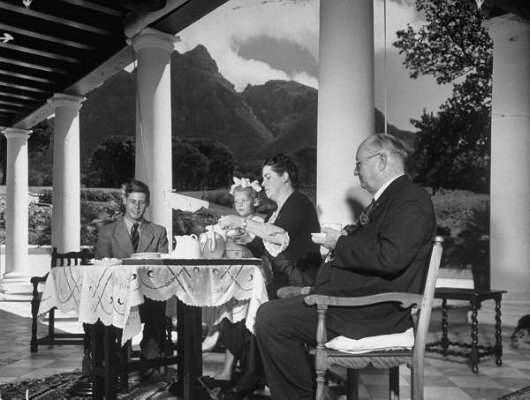
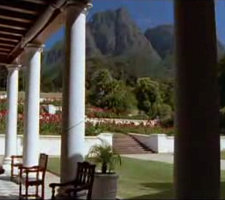 Daniel François Malan, fourth Prime Minister of South Africa, is seen here taking breakfast with his family on the verandah at Groote Schuur, the official residence of the PM. (At right, the same view today). Groote Schuur — literally “great barn” — was purchased by Cecil Rhodes and transformed into the paragon of the South African style of architecture by his architect Sir Herbert Baker. Foolishly, the office of Prime Minister was abolished in 1984, when the ridiculous 1984 tricameral constitution was adopted. Groote Schuur continued as the Cape residence of the State President of South Africa under P.W. Botha and F.W. De Klerk but when Nelson Mandela was elected he decided to make the neighbouring Westbrooke his official residence, renaming it Genadendal (“Valley of Grace”) after the oldest Moravian mission in South Africa. Groote Schuur is now a museum open by appointment, and unlived in.
Riparian Architecture
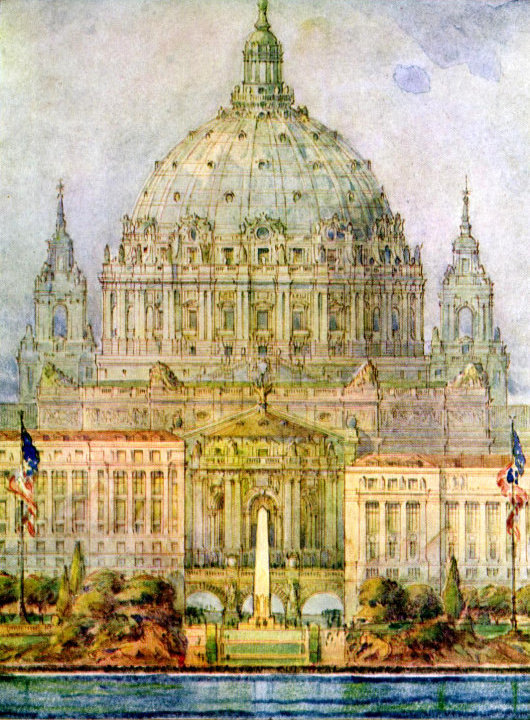
I’m not entirely sure of what project this is an architectural rendering, but I suspect it is an unbuilt project designed by Cass Gilbert for Blackwell’s Island in the East River, later known as Welfare Island and now Roosevelt Island. There were a number of schemes before the First World War (Thomas J. George was the author of one) for the construction of a new civic center for New York on the island, which is located right in the middle of the five boroughs.
Matt Alderman’s at it again
The king of counter-proposals sets eyes on Divine Mercy shrine
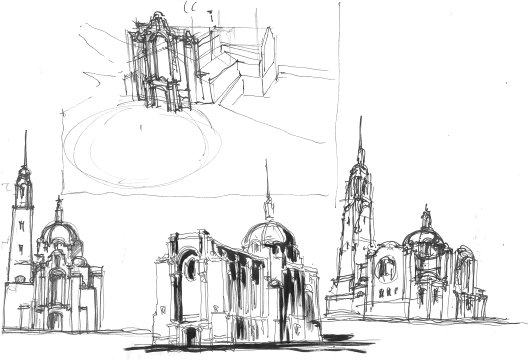
Young architect Matt Alderman presents his counter-proposal to a horrifyingly kitsch proposal for a West-Coast U.S. shrine to the Divine Mercy. Why, given that the recovery of skill & talent in architecture in the past few decades, are most new churches still revoltingly ugly? “The problem is not that it is hard to get beautiful churches built, but that the wrong people seem to end up getting the commissions,” Matt writes. “Oakland and Los Angeles were, of course, going to go modernistic no matter what, but Houston Cathedral could have been a masterpiece if handled by someone with a greater openness to traditional design, rather than settling for a mediocre pseudo-traditionalism.”
The Finest Library in All New York
Or is it in all the New World?
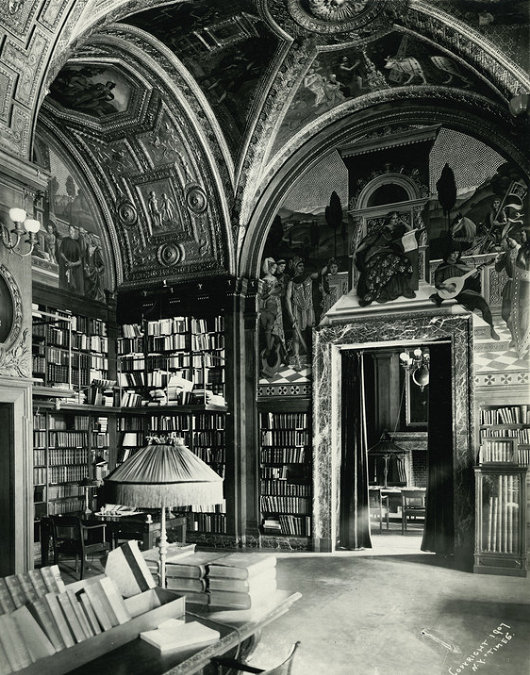
I do miss my two libraries in Manhattan, the Society Library on 79th Street and the Haskell Library at the French Institute on 60th. Neither of them, however, are fit to shine the boots of the library of the University Club on 54th & Fifth. Architecturally and artistically, it is undoubtedly the finest library in New York. But does it have an equal or a better in all the New World? The BN in BA certainly isn’t a competitor.

Old Radders
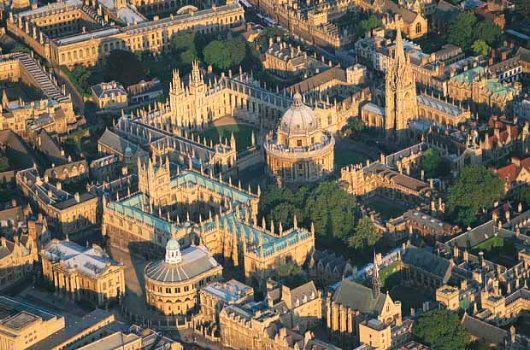
The devil in me, while entirely appreciative of the beauty of Radcliffe Camera, sometimes wonders if the handsome square it is in might be better off without it. What would it look like?
Wupperthal in die Wes-Kaap
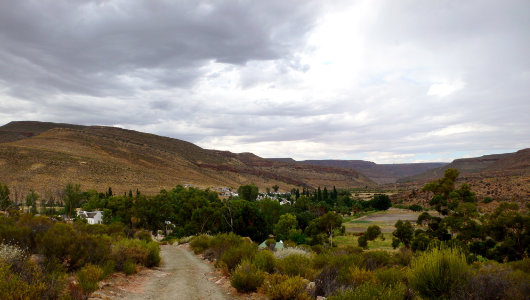
Deep in the Cedarberg, in the northern reaches of the Western Cape, there is a lovely little Moravian mission in a valley called Wupperthal. Unless you have a 4×4, there is just one road in and out of the valley, and even that road can be a bit tricky for conventional vehicles. Barefoot children, smiling and carefree, play in the streets beneath the avenue of eucalyptus that perfectly frames the beautiful church. Genadendal is the most famous of the Moravian missions, but Wupperthal was actually founded by Rhenish missionaries, before briefly becoming Dutch Reformed in the middle of the last century, and then taken over by the Moravians, or Herrnhuters as they are called in Afrikaans, after the Sorbian stronghold of the Unitas Fratrum.
Russia’s Treasures on the Banks of the Amstel
Seventeenth-century Amsterdam building will, from June, be home to collections from St. Petersburg’s Imperial Hermitage Museum
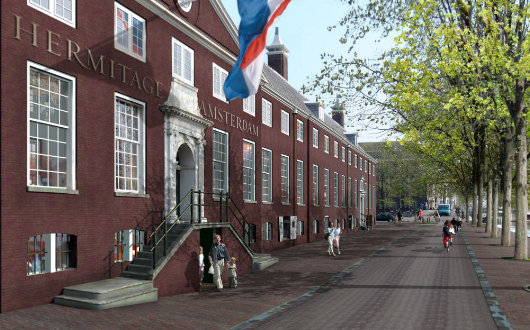
A new 100,000-square-foot space displaying works from the Hermitage Museum in St. Petersburg will open in Amsterdam this June. The Hermitage Amsterdam will be located in the Amstelhof, a former home for the elderly built in 1683 by the Dutch Reformed Church and transformed into a modern exhibition space by Hans van Heeswijk Architects. The opening exhibition, “At the Russian Court” — a “a deeply researched exploration of the opulent material culture, elaborate social hierarchy and richly layered traditions of the Tsarist court at its height in the nineteenth century” — will display 1,800 works from the massive collection in St. Petersburg and continue until the end of January 2010.
New York Firm Tapped for Restoration of Budapest Landmark
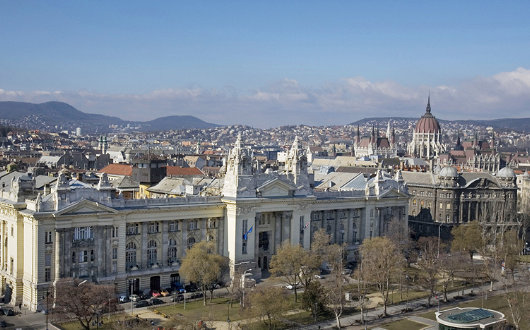
The New York firm of Beyer Blinder Belle, responsible for the restoration of Grand Central Terminal, has been selected to develop “an adaptive reuse and restoration plan” for Exchange Place, a historic building on Budapest’s Freedom Square (Szabadság tér). Exchange Place was built in 1905 for the Budapest Stock and Commodities Exchange, and includes a number of ornamental details in the Hungarian style of the Secession architectural movement. After the Soviet conquest of Hungary, the building became the Lenin Institute before being given over to the state television broadcaster.
The Groote Kerk
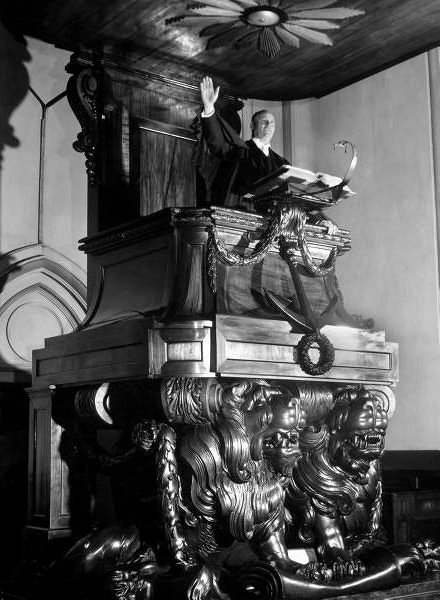
Dr. van der Merwe, moderator of the Dutch Reformed Church, poses in the splendidly carved pulpit of the Groote Kerk in Cape Town.
Passenger Ship Chapels
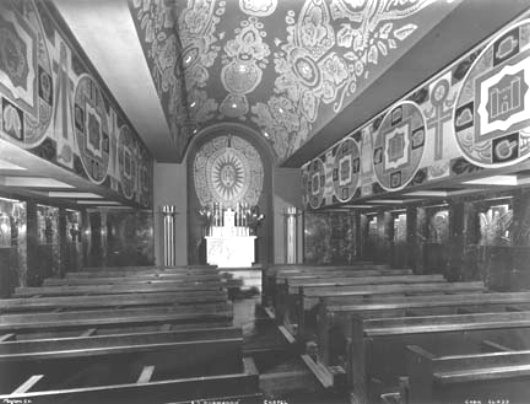
Above & below: the SS Normandie. The Normandie was seized by the U.S. government and renamed the USS Lafayette but burned in New York harbor before she could be put to good use in the war effort. The bronze doors to the chapel were salvaged and now grace the Church of Our Lady of Lebanon in Brooklyn.
Berlin to build ersatz Stadtschloß
Afraid of celebrating glorious past, a horrible future is created instead
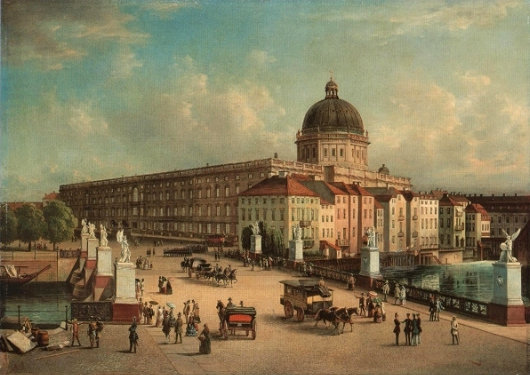
Fresh from the glories of Dresden’s rebuilt Lutheran Frauenkirche, the city fathers of Berlin have decided to reconstruct the old Stadtschloß (“City Palace”) at the heart of the German capital, only not quite. Largely ignored by the anti-monarchist Nazis, the original Stadtschloß was damaged by Allied bombing and by shelling during the Battle of Berlin before the Communist government of East Germany demolished it entirely and built the horrendously ugly Palast der Republik (housing the Soviet satellite’s faux parliament) on the site. The Communist monstrosity has finally been demolished, but the authorities decided that, rather than restore the beautiful royal palace that once stood on the site, they will instead merely replicate three of the old structure’s façades, leaving one of the façades and most of the interior in a modern style.
Dublin (In the Rare Old Times)
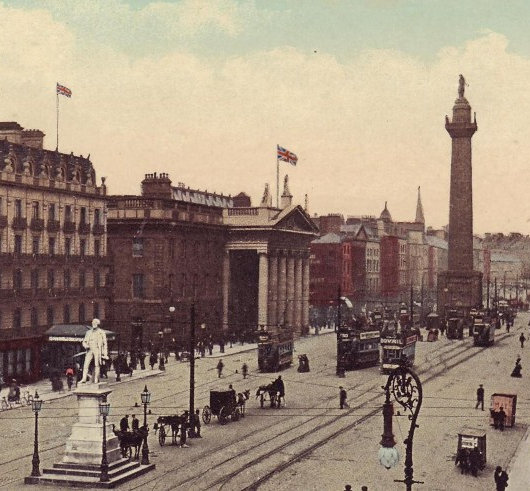
O’Connell Street, Dublin, United Kingdom of Great Britain & Ireland.
West End Collegiate Church
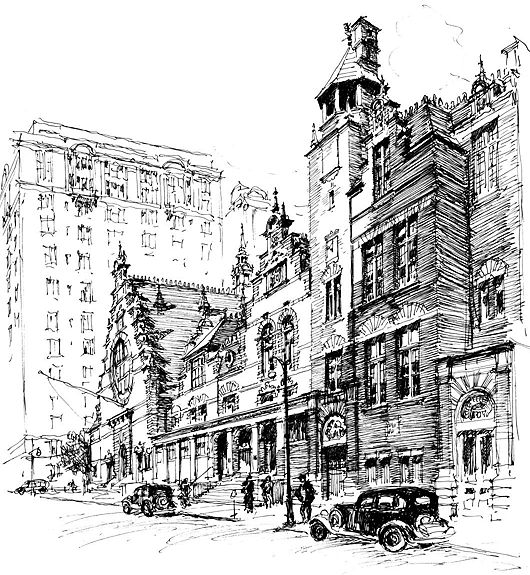
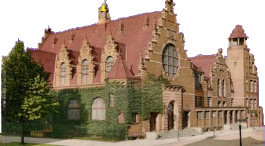 One of my good friends, who is amongst the most loyal denizens of this little corner of the web, found our post on St. Nicholas Collegiate Church of great interest because his son attended the Collegiate School, the oldest school in North America (founded in 1628, and formally incorporated ten years later). The Collegiate School is part of the same complex as the West End Collegiate Church on the corner of West End Avenue & 77th Street on the Upper West Side. The church & school buildings were designed by McKim Mead & White in a Dutch Renaissance Revival style, and handsomely executed.
THE ARCHITECTS modelled the church after the seventeenth-century Vleeshal (meat market) of Haarlem in the Netherlands. The story goes that, during the Second World War, a handful of Collegiate grads serving together in the U.S. Army participated in the liberation of Haarlem, stumbled upon the Vleeshal and said “Hey, that’s our school!”
New York’s Dutch Cathedral
The Collegiate Church of St. Nicholas, Fifth Avenue
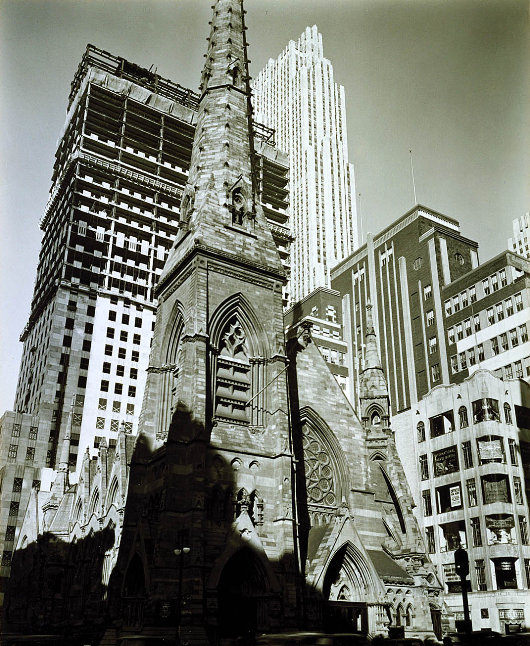
Dedicated a hundred-and-thirty-six years ago, the Collegiate Reformed Protestant Dutch Church of Saint Nicholas on the corner of Forty-eight Street & Fifth Avenue (photographed above by Berenice Abbott) was for many years regarded as the most eminent Protestant church in New York. The Collegiate Reformed Protestant Dutch Church is the oldest corporate body in what is now the United States, having been founded at the bottom of Manhattan in 1628 and receiving its royal charter from William & Mary in 1696. Now part of the Reformed Church of America, the Collegiate Reformed Protestant Dutch Church is actually a denomination within a denomination, and the remaining Collegiate Churches of New York tend to preach a sort of “Christianity Lite”. (The famous Norman Vincent Peale, author of The Power of Positive Thinking and one of the paragons of the “finding a religion that doesn’t interfere with your lifestyle” school of thought, was the pastor of Marble Collegiate Church at Twenty-ninth & Fifth, where Donald Trump is a member of the congregation).
67th & Fifth
One of the most remarkable things about these photos from a 1956 Seventh Regiment ceremony are how traditional the buildings in the background are.
The Kaiser Karl Soldiers’ Homes
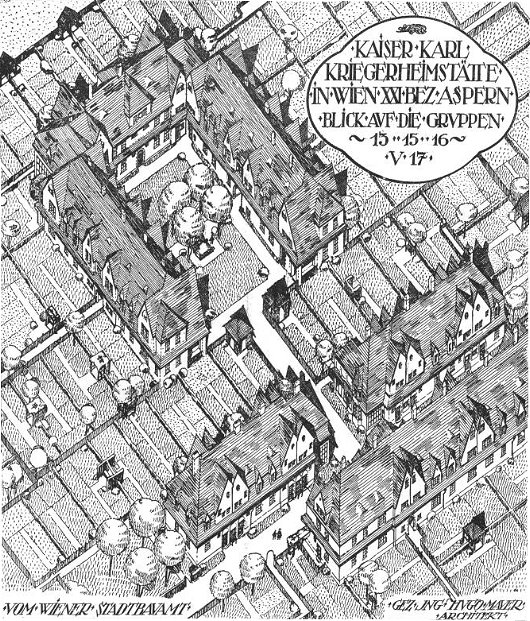
An unexecuted design. The architect later designed a number of housing projects during the First Austrian Republic.
The New York Central Building
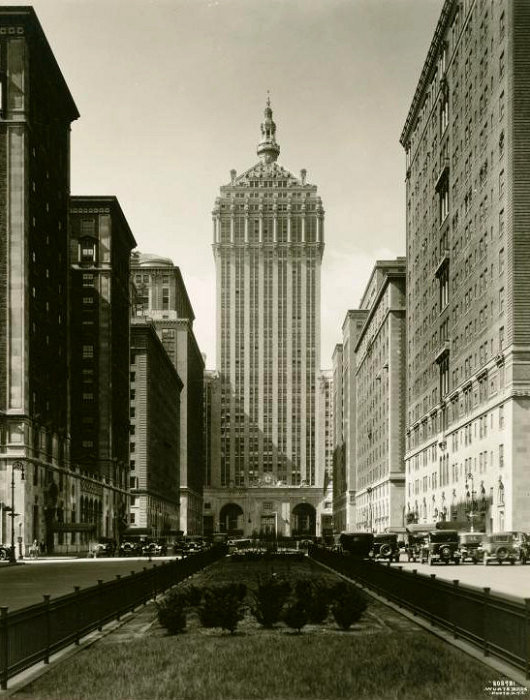
The New York Central building once presided majestically over an equally elegant Park Avenue, which is cleverly directed through the building from the south, emerging through the double arches on the north side. Sadly, while the tower (now known as the Helmsley Building) still stands, the view of it has been marred since 1963 when the Pan Am building was built between it and Grand Central Terminal. When it opened, the Pan Am building was the largest commercial office building in the world, and it was certainly one of the least graceful. The 1960s and 70s were not kind to Park Avenue on either side of Grand Central, and many of the traditional-style buildings have been demolished or re-clad in glass.
The Hanover Bank: A Classical Gem
No. 35, East Seventy-second Street
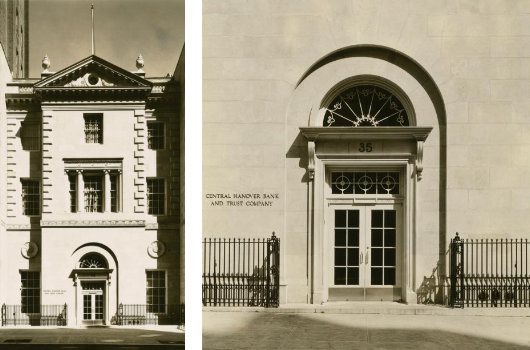
Passing by, as I sometimes do, the Chase branch bank at East 72nd St., I think to myself “There’s a fine establishment, in which I should keep my money”. The thought never jumps from theory to practice, however, as I am a patriot in everything but finance, and keep my florins safe with the Hongkong & Shanghai Bank instead. Nonetheless, it’s a handsome building, and the Central Hanover Bank & Trust Company should be commended for erecting it. Central Hanover merged with the Manufacturers Trust Company in 1961 to form Manufacturers Hanover (“Manny Hanny”), which was taken over by Chemical Bank in 1991, which was acquired by Chase Manhattan Bank in 1995, which merged with J.P. Morgan in 2000, and the consumer & commercial banking arm of J.P. Morgan Chase & Co. is now simply known as “Chase”.
While the original Chase National Bank was only formed in 1877, with all these mergers and acquisitions, “Chase” can now trace its lineage back to the foundation of the Bank of the Manhattan Company in 1799, the second oldest bank after the Bank of New York. But — would you believe it? — “Chase” is now headquartered not in the hallowed caverns of Wall Street but — wait for it — Chicago, Illinois!
The Petit Séminaire de Québec
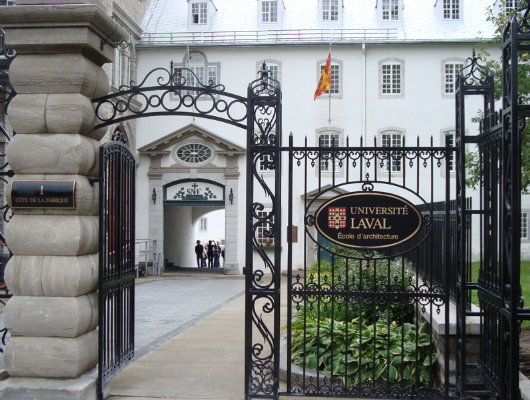
Adjoined to the ancient Cathedral Basilica of Notre-Dame in Quebec City is the Petit Séminaire. The Séminaire de Québec was founded in 1663 by the Blessed François Laval to train priests for the Vicariate Apostolic of New France, and the Petit Séminaire, its secondary school, was founded just five years later to teach both colonial French and native Indian youths. Among the school’s former pupils are four prime ministers of Québec, two lieutenant-governors (as the Queen’s viceregal representative in the province is known), and many other writers, politicians, and important figures of history. The Petit Séminaire survives today as a private Catholic secondary school.
The Municipalidad
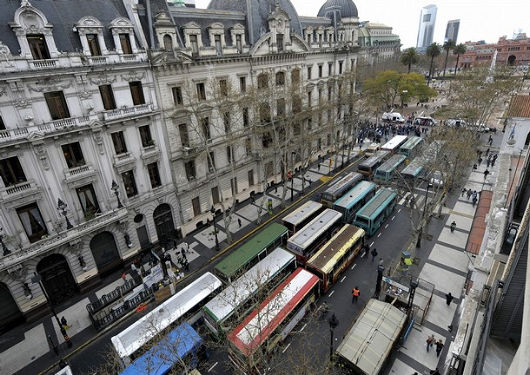
This news photo showing a protest (what else?) of bus drivers on the Avenida de Mayo in Buenos Aires gives a good view of the capital’s city hall. The municipal headquarters is located between the Plaza de Mayo and the former home of the newspaper La Prensa; the Casa Rosada, Argentina’s presidential palace (officially called Government House, Casa del Gobierno) can be seen in the distance at the end of the square.
I’ve long thought they should reduce the auto space by two lanes, one on each side, and double the width of the sidewalks — but that would probably make the bus drivers even more irate.
Search
Instagram: @andcusack
Click here for my Instagram photos.Most Recent Posts
- Brunel’s Unbuilt Capitol February 3, 2026
- Cricket at Fordham January 27, 2026
- Palacio Barolo Revisted January 14, 2026
- Learning to Love Liguria January 14, 2026
- Crux Alba No. 2 January 13, 2026
Most Recent Comments
Book Wishlist
Monthly Archives
Categories