World
About Andrew Cusack
 Writer, web designer, etc.; born in New York; educated in Argentina, Scotland, and South Africa; now based in London.
 read more
News
Blogs
Reviews & Periodicals
Arts & Design
World
France
Mitteleuropa
Knickerbockers
Argentina
The Levant
Africa
Cape of Good Hope
Netherlands
Scandinavia
Québec
India
Muscovy
Germany
Academica
Pining for Andreanopolis
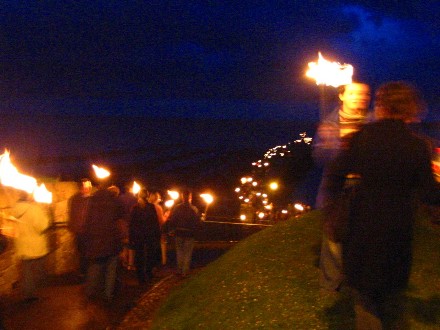
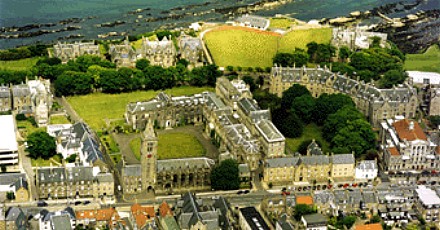
Photo: Peter Tweed
Just over a fortnight to go, but a number of things I miss about St Andrews:
The people (too many to mention), wearing academic gowns, torchlit processions, dinner parties, St. Salvator’s Chapel, three-piece suits at Chapel, lady preachers making fools of themselves at Chapel, the after-Chapel bit of sherry, tweed, the Kensington Club, tweed, the ruins of the Cathedral, tweed, the Pier, the East Sands, the West Sands, Castle Sands, the Castle, the Castle Tavern, the Central, Broon’s, Ma Bell’s, not so much the Westport but their beer garden instead, eating at the Golf Hotel, reading the magazines in the common room of Canmore, reading everything else in the library of Canmore, big dinner thursdays, avoiding the Students Union at all costs, Queens Gardens, the Quarto, the Bouquiniste, chips, the late movie on Wednesday nights, anything and everything Richard Demarco is involved in, plotting reaction, writing the Mitre, reading the Mitre, reactions to the Mitre, St. Leonard’s Chapel, candlelit compline, the Scores, Boots’ meal deal, the evangelists in the streets, Parliament Hall, St. Mary’s Quad, St. Katharine’s Lodge, St. John’s House, the King James Library, the Bunk Room in St. Mary’s, Professor Haldane’s house, the hallway chat after the daily Rosary, the Parish garden, Fr. Halloran’s black vestments and the fact that he still uses them, the Latin Mass in Edinburgh and everything that goes with it, the Telegraph, the Spectator, making fun of people, being made fun of, evensong at Holy Trinity, the Renaissance Group, St. Salvator’s Hall, Hamilton Hall, University Hall, Lower College Hall, the Old Union Diner, Butts Wynd, St. Salvator’s Quad, North Street, Market Street, South Street, the Pends, the Cemetary, the cloister, the chapter house, driving up and down the Fife coast, awkward people, the Whiskey-tasting Society (oh boy!), unapologetic support for the monarchy, international diplomacy, an appreciation for Chesterton, representing New York abroad, beautiful and charming South African tutors, Dean’s Court, champagne, the Royal & Ancient, innocent decadence, Kinburn Park and the lawn bowling club, Bishop Kennedy’s tomb, the Buchanan, falling asleep in lectures, doing the crossword in lectures, inscribing the Sacred Heart of Jesus, monarchist slogans, or anachronistic pro-Rhodesian graffiti onto lecture hall desktops, tea after Mass, Country Life, the Kate Kennedy Procession, buying the papers at J+G Innes, formal events, wearing the old school tie, the Annual Boules Match in St. Mary’s College, the Younger Hall, plotting to start a croquet club, people willing to sacrifice their lives for their country, my complete inability to write an essay without Jameson’s, paninis from Cherries, Luvian’s wine shop, all the alleyways, the Byre Theatre, the bar at the Byre, Pimm’s on the lawn, Christianity being taken seriously, incessantly amusing people, life in St Andrews. Life in St Andrews!
The Mass Returns to York Minster
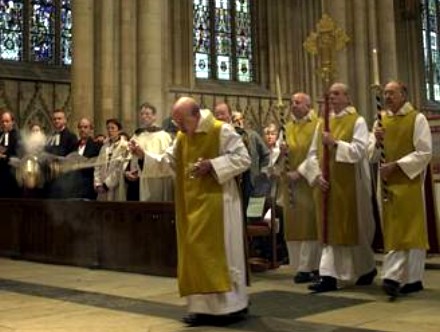
On Friday, May 16 of 2003, the Carmelites offered a mass in York Minster to commemorate the 550th anniversary of the Papal bull ‘Cum Nulla’ allowing the Order to enroll nuns and the laity. York Minster used to be home to a Carmelite congregation, kicked out when the Minster – the largest Gothic cathedral in northern Europe – was appropriated by the government. It survives today as the cathedral for the Archdiocese and ecclesiastical province of York. The official website conveniently makes no mention of the great church being nicked from the Carmelites, but at least they let them offer the Holy Sacrifice of the Mass in their old home.
York Minster was in the news not too long ago, when Canon Professor Edward Norman – one of their clerics and supposedly one of Anglicanism’s leading intellectuals – decided to swim the Tiber (so to speak). (more…)
Parliament House
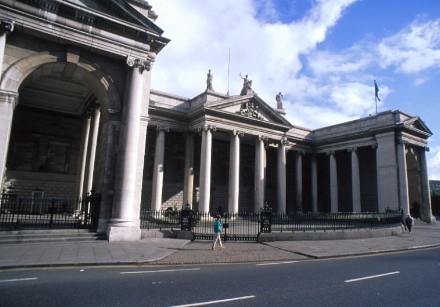
The Irish Parliament House, now the Bank of Ireland, on College Green in Dublin, is one of my favourite buildings in the world. You can go there and visit the House of Lords chamber. Unfortunately, the House of Commons chamber burned down shortly after the Irish Parliament was merged into the British one in 1800. It is supposedly the first purpose-built parliament building in the world, though no longer in use.
Another Broadsheet Bites the Dust
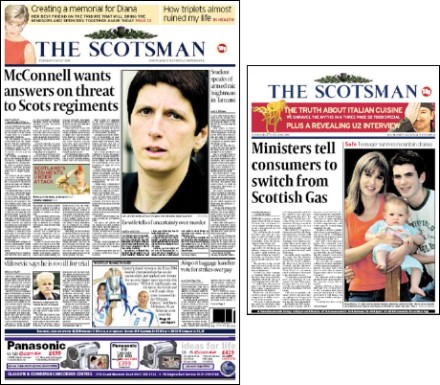
The Scotsman has given in to the current Fleet Street mania and become a tabloid. The newspaper had experimented with the tabloid size for its Saturday edition and then just a few days ago converted the weekday editions as well.
For my fellow Americans in the audience, a little explanation. Going tab is all the rage amongst respectable newspapers in Britain over the past year. The ancient Times of London comes in both broadsheet and tabloid format. The Independent was the first broadsheet to publish both a broadsheet and tabloid edition, and then decided to become a permanent tabloid. The Guardian, to my knowledge, has kept out of the tabloid fray, and the venerable Daily Telegraph remains commited to broadsheetism.
The benefits of publishing in tabloid size are that the newspaper is easier to handle and read. Financially, however, it means page size, and thus potential advertising space, is reduced by half.
I am not a fan of this tabloid revolution. I fantasize periodically about the Mitre being published in broadsheet format instead of A4. Perhaps my anti-tabloidism is culturally ingrained. After all, we Anglophones are used to the formula of broadsheet = trustworthy. This formula is not true, for example, in France, where the two main respectable newspapers, le Figaro and le Monde, are printed in a format slightly smaller than the standard US/UK tabloid.
Nonetheless, one of the aspects of broadsheets that I enjoy is that they aren’t easy to read on subways and whatnot. It’s best to sit down in a comfortable chair in a well-lit location and peruse the goings-on and thoughts of New York, the nation, and the world in the New York Sun than to get tiny bits of news in a “convenient” format.
New York’s Three-Way Senate Race
 “As this new nation grew from weakness to strength to world power, the hand of Divine providence was always humbly sought and thankfully acknowledged. But today, we meekly watch as cultural revolutionaries try to destroy the purest of our traditions… It’s time to tame the liberal elite.”
Dr. Marilyn O’Grady, Conservative Party candidate for the United States Senate
This November, New York will face its first serious three-way U.S. Senate race in (my) living memory. Liberal incumbent Chuck Schumer is being challenged by fellow liberal Howard Mills as well as by a conservative, Dr. Marilyn O’Grady.
The politicos among the audience will remember that a similar situation in the 1970’s resulted in the Conservative Party candidate Jim Buckley defeating both the liberal Democrat and liberal Republican candidates to capture one of the Empire State’s two Senate seats.
I think the chances of this happening again are somewhat smaller today. Unfortunately, this time around the two-liberals-and-a-conservative model will likely split the block of voters who normally vote Republican rather than split voters that are doctrinally liberal. Shame on the NYGOP for having so many willy-nillies among its ranks!
A number of commentators have weighed in on the printed page about the “end of the electoral alliance” between the Republican and Conservative Parties. It hasn’t really ended, per se. The Conservative Party is just refusing to endorse Republican candidates that aren’t conservative, which is one of its founding purposes, and something it should have done in the recent gubernatorial election.
Check out Marilyn’s website here, and the Conservative Party’s rather lacklustre site here. (Both links are also on the sidebar at left).
Le Cinema: C’est Pas Mort
Bon Voyage has to be one of the best films I’ve seen ever. A true classic. Cinema at its most magnificent and magnetic. Bon Voyage is entertaining, thrilling, amusing, beautiful, and full of intrigue. Hollywood hasn’t made a film that could even approach its quality in years.
Alright, alright, I’ll admit its a film that appeals especially to me. It is, after all, French, and depicts a period of French history of which I am particularly interested in: the advent of the Vichy regime. But this is no history film. It is certainly not a “romantic comedy” as described on the back of the DVD box. It was a pleasure in every way. Certainly not the usual claptrap you get from Los Angeles designed to appeal to the lowest common denominator. This is a film where all the contributing factors (beautiful women, gunfire, and intrigue) are in proportion.
Well I could go on for ages. Just see it! Rent it, buy it, confiscate it, see it!
The official Bon Voyage website from Sony Pictures Classic.
Greetings from Andrewland
Well folks, another entry is long overdue, and it will surprise you not that my computer is still out. As such, the unanswered emails are piling high, but I promise they will be taken care of.
Reading.
I’ve finished Buckley’s Miles Gone By and I have to say I found it immensely enjoyable. It is a collection of biographical musings from across the years, akin to his previous Nearer, My God. The former, I’m glad to report, avoids the slight haphazardness of the latter, perhaps because it is much longer and the selections included are well grouped. One of the tales which I particularly enjoyed was of WFB and Brent Bozell (whose brother is in Solesmes) at Yale. WFB and some cronies had piled there money together to purchase an aircraft, which Buckley and Bozell one day landed on the great lawn of the Ethel Walker School, where Buckley’s younger sister was studying. Upon disembarking the aircraft, they were promptly invited to tea with the headmistress. The audio CD which accompanies the book is a mere fancy.
Of Paradise and Power was particularly enlightening. Though Mr. Kagan’s general supposition about the difference in American and European worldviews (as well as Europe achieving a Kantian perpetual peace only by existing under the wing of the United States, a Hobbesian leviathan) seems quite well thought out, I did find myself disagreeing with one or two of his conclusions. Plus it irritated me when he referred to Britons as Europeans. Such silliness.
Speaking of silliness, I’ve started reading Wodehouse. Bought Young Men in Spats, a collection of tales from the Drones Club, and a volume of three of the Jeeves-and-Wooster novels. So far, both are thoroughly enjoyable.
et cetera…
I was very pleased to catch up with Mr. Nicholas Merrick last night, via whom I also ran into Mssrs. Simon Tuchman and Steven Lagotte. Good old Nicholas, I’m very pleased to say, is not a Buddhist as was previously thought for some unknown reason, and Deo gratias Simon is no longer of the Marxian persuasion in terms of economic thought and whatnot. Floreat Thorntona!
Michael Ulsterman (as he is known to me), our favourite Oirishman, was in town recently and I was very pleased enough to take him out for a bite at Café Lalo, one of Manhattan’s finest eateries (as well as the locale where I inadvertently stood up Brearley girl Buffy Breed on accounts of my not knowing what day of the week it was). Michael, though a liberal, is a Unionist through-and-through, and has a very sharp, sardonic wit that I hope will soon grace the pages of the Mitre. I think the first time I went to Lalo’s was with Jessy Lewis, Jessie Smyth, and Peter Scott (and was the other Peter there as well?). Jessy is now at Brown, which I’m informed she is enjoying much more than her premier year at Barnard; I just spoke to young lady Smyth (Univ. of Penn.) a week or so ago; and last I heard of Peter Scott he was on the May Ball committee at King’s College Cambridge. Not bad, not bad at all.
Particularly enjoyed the recent Kens Club correspondence.
Got to chat with Nicholas Vincent on his birthday (Aug 1) whilst he was minding Japanese children in Oxford with the indefatigable D. P. Atheist Mr. Vincent threatened to don shorts to evensong at Christ Church Cathedral, but Mr. Prior threatened a walloping and Nicholas was brought into line. (I know! Shorts at evensong! What will they think of next?)
Lastly, and mournfully…
Our prayers go out to Lindsay Mucka, whose father died only a few days ago. Eternal rest grant unto him, O Lord, and let perpetual light shine upon him. May he rest in peace. Amen.
A Saint Returns Home
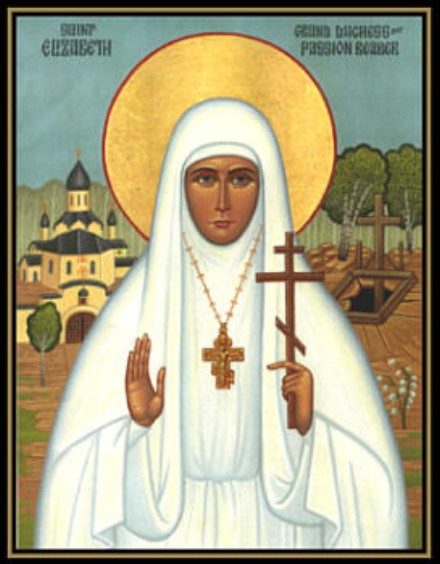
Relics of Saint Elizabeth Romanoff have been greeted enthusiastically by Muscovite crowds, according to Russia’s state-run ITAR-TASS news agency.
To discover the beautiful witness to Christ of Saint Elizabeth, read more about her at the Orthodox Christian Information Center and on the site of Fr. Demetrios Serfes. A statue of the holy Grand Duchess now graces the front of Westminster Abbey.
More Andreanic Fun
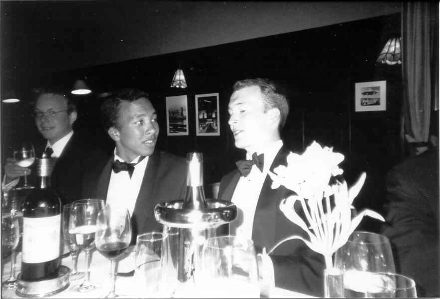
Behold, the only photo ever smuggled out of a Kensington Club dinner. Alright, I’ll admit it’s not a terribly interesting photo, but it’s the only one, so you’ll pardon that. I’m actually somewhat surprised I wasn’t fined a bottle of port or two for this, but I felt as a historian there ought to be some proof that the Kensington Club actually exists.
Here Ed Jackson turns to Rob Cockburn who explained some point about something. On the peripheral left is Michael Phillips, and on the dexter, Michael Gaster’s right arm (if my knowledge of the seating that evening is correct, which is doubtful).
Kens Club dinners are good fun, usually lasting from about seven-thirty until midnight, and they would be longer if only the Golf Hotel would oblige to keep its dining room open.
Harknessiana
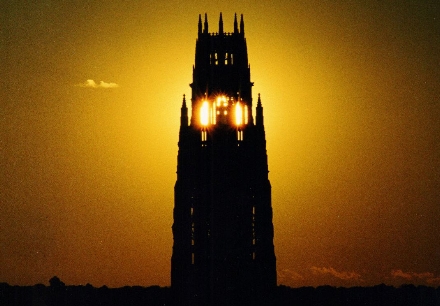
A beautiful shot of sunset through the Harkness Tower at Yale. Edward Harkness paid for the Harkness Memorial Quadrangle to be built in memory of his brother Charles, who died during the Great War. In addition to being a significant benefactor of Yale and St. Paul’s School, both of which he graduated from, he was also a patron of the University of St Andrews, where he was good friends with Principal Sir James Irvine.
At St Andrews, he built St. Salvator’s Hall, the first hall of residence for men since the end of the residential aspect of the colleges, as well as funding the renovation of the St. Salvator’s Chapel. His generosity is commemorated by a window in the chapel.
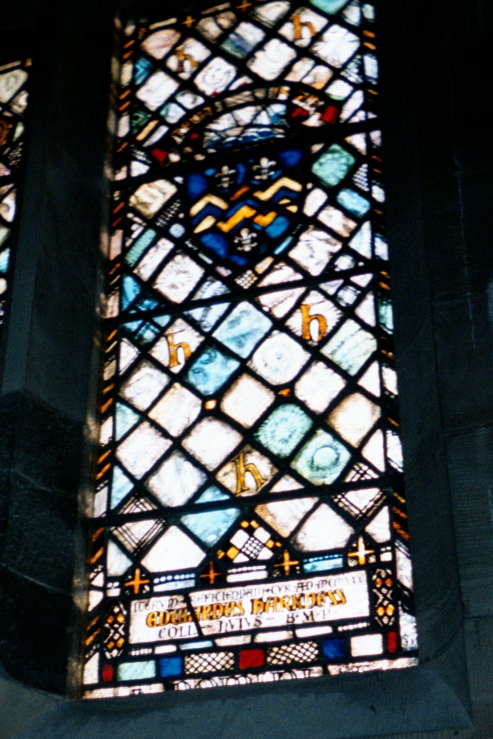
The trust he established also later paid for the restoration of St. Leonard’s Chapel, which had been abandoned in the middle of the nineteenth century.
Who’s still afraid of Keith Windschuttle?
Published in

By Ean Higgins
July 22, 2004
AS the elite of the nation’s academic historians met in the stately rooms of the Newcastle Town Hall, fear and loathing lurked the corridors.
The Australian Historical Association spent virtually an entire day trying to work out strategies to deal with the menace. Would there be safety in numbers if academics stood together? What should be done when the terror struck again? How could anyone survive when the mass media was in on the conspiracy?
Over 18 months after Keith Windschuttle published his book The Fabrication of Aboriginal History, the academic world is still anguishing over its impact. It is terrified of what he will do next. Windschuttle struck at the heart of the accepted view of Australian colonial history in the past 30 years – that the settler society had engaged in a pattern of conquest, dispossession and killing of the indigenous inhabitants. The facts, he said, did not stack up.
The Sydney-based writer, among other things, questioned the references used by academic historian Lyndall Ryan to justify her claims that the British massacred large numbers of Aborigines in Van Diemen’s Land in the early 1800s. Her footnotes supporting the claims did not do so, he wrote.
He also took on Henry Reynolds, the venerable historian of the Left, whose depiction of a brutal British conquest of Tasmania had been the accepted norm.
Reynolds’s work on the concept of terra nullius — that the British seized Aboriginal land based on a policy that it was owned by no one — developed such currency that it is believed to have influenced critical High Court judgments on land rights, including the Mabo decision. The thrust of Windschuttle’s thesis was that political correctness had triumphed over historical fact.
With the passage of time, the academic history profession is far from over the history wars. An extraordinary number in its ranks believe they have been been damaged by populist history propounded by Windschuttle. They are searching for a way out. Only a few seem brave enough to speak up, arguing that freedom of expression is the primary issue.
At the recent conference, Ryan made some effort, though ultimately unsuccessful, to avoid media coverage for a talk she gave entitled How the Print Media Marketed Keith Windschuttle’s The Fabrication of Aboriginal History: Implications for Academic Historians.
She said the media had taken up Windschuttle as representing the real history of colonists’ relations with Aborigines, grabbing the view that Australians had been hoodwinked by the academic left-wing historians’ version. “I don’t think the media owns free speech,” Ryan said. She had also been shocked, she said, that Stuart Macintyre, the influential left-leaning University of Melbourne historian, had appeared to criticise her over footnote inaccuracies.
She did admit to five footnote errors, but said the primary sources verified her thesis and “the simple fact is that footnote errors do occur”.
Her abstract said: “The AHA and universities need strategies and protocols in place to address future assaults on academic historians.”
Ryan was not alone in promoting the Windschuttle-media conspiracy. The AHA president, David Carment, said the The Australian had deliberately timed the publication of its review of Windschuttle’s work for the summer of 2002. During holidays more academics were on leave, Carment said, and “less able to defend themselves,” and it was “a time when people were reading newspapers”. (In fact, newspaper circulations fall away over summer holidays.)
It might be time, Carment said, for the association to “defend its people on the basis of their professional integrity” while not taking sides in the debate.
Carment also raised, though he did not fully support, the concept put forward by West Australian historian Cathie Clement for a code of ethics that would gag historians from criticising the integrity of their peers in public. Several in the audience said everyone had to be ready to counter-attack when Windschuttle came out with his next book.
Richard Waterhouse from the University of Sydney, said academics took Windschuttle too seriously. “Sometimes we have tended to treat him as an intellectual equal,” Waterhouse said, adding that sarcasm might be more appropriate. (Windschuttle earned a first-class honours degree in history from the University of Sydney in the 1960s, lectured in the subject, earned a masters in politics and left Macquarie University in 1992 when he set up a publishing house.)
There were a couple of muted mutterings from the audience about how it would be necessary to learn media skills, and not attempt to look like academics defending their own cabal. But nobody at the session publicly asked the key question which was in some of their minds: was the academic historians’ fear of Windschuttle and newspaper opinion pages absolutely paranoid?
Greg Melleuish, from the University of Wollongong, says he is intimidated by the pack mentality of the Newcastle meeting. “I was quite astonished,” he says. “It was like ‘let’s get a group of people together to ambush Windschuttle’. I think they feel under threat and that’s why they concoct these conspiracy theories.”
Other historians have expressed alarm at the attitude of their peers, including classical studies historian Ronald Ridley at the University of Melbourne. “The way they have shut down the debate, if they have made some errors, is really appalling,” he says.
“I don’t think any historians of Greek or Roman history would make these mistakes. And when you deal with issues such as indigenous history, the politics are red hot. You don’t just have to be a competent historian, you have to be top class.”
The question is why academic historians are so concerned about the impact of Windschuttle.
Macintyre, while he does not accept Windschuttle’s suggestion of a fabrication, does warn that mistakes can have a broader effect.
“There is an understandable public concern about the accuracy of historians’ work,” he says. At the same time, Macintyre maintains, Windschuttle fits with a conservative agenda to lift a burden of national shame from Australian shoulders over the Aboriginal issue.
Macintyre told the conference the history wars fitted in with broader “political dimensions” of the Howard Government’s “abandonment of reconciliation, denial of the stolen generations, its retreat from multiculturalism and creation of a refugee crisis”.
“Windschuttle was the first conservative intellectual to base his case on substantial historical research,” he says.
Windschuttle says this is precisely why the academic community is still so scared of him. “There is a whole generation who have invested not just their academic capital but also their political capital in the Henry Reynolds view,” he says. And, says Windschuttle, he has made Australian history interesting again for high school students who are more likely to go on to study it in universities.
While not referring to the Windschuttle debate, NSW Premier Bob Carr, a longstanding history buff, said much the same thing at the conference.
“History is an argument and the more argument there is in it the more young people will read it,” he said.
Ah, St Andrews!
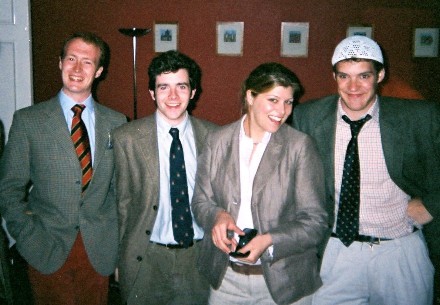
Was feeling a bit nostalgic for St Andrews. Won’t be heading back until Sept. 20, so I figured I’d put up a photo of fellow St Andreans and me with jovial countenances.
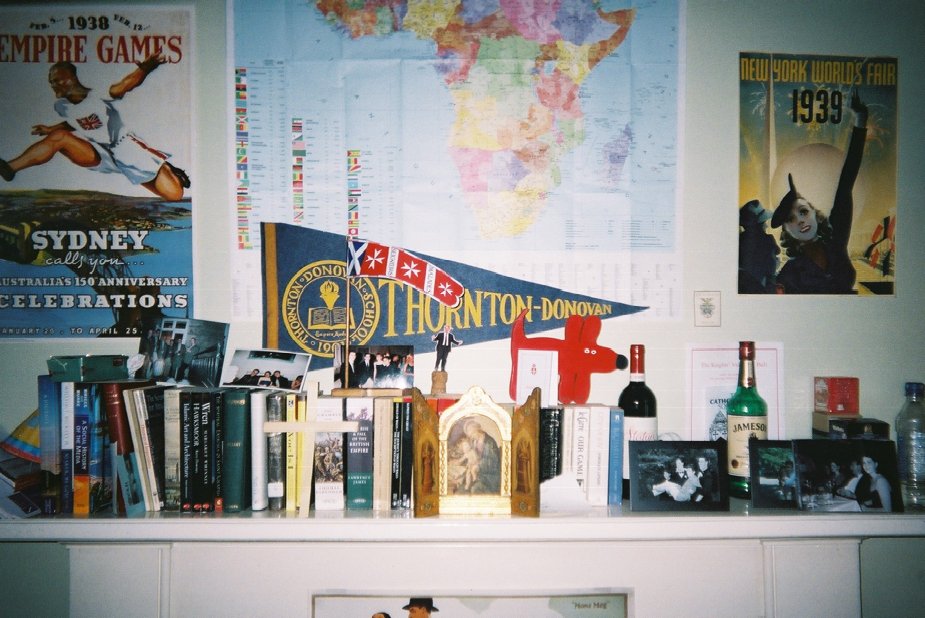
And the mantle from my room the past year. For a closer up look at the random items including architectural books, John le Carré novels, the program from the Knights of Malta ball, a bottle of cheap red, the Penguin editions of Gerald of Wales, and Alfred the Great, and R.G. Cant’s history of St. Salvator’s College, click here.
Long Live Our Holy Germany!
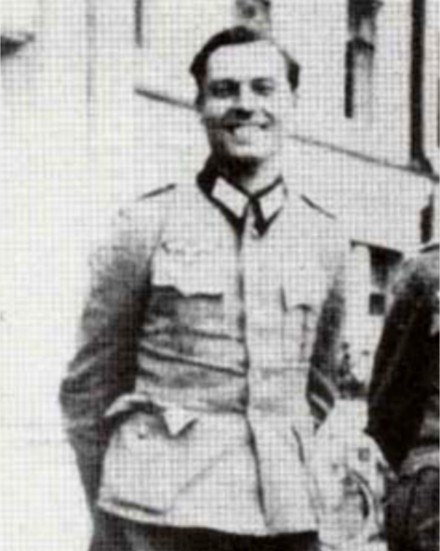
It was July 20, 1944, sixty years ago today, that Col. Claus Schenk Graf von Stauffenberg was executed for his masterminding the plot to kill Adolf Hitler. Stauffenberg was a devout Catholic who became convinced that Hitler was an Antichrist.
“Fate has offered us this opportunity, and I would not refuse it for anything in the world. I have examined myself before God and my conscience. It must be done because this man is evil personified.”
His uncle, Graf (Count) Nikolaus von Üxküll, recruited him into the resistance movement after the Polish campaign in 1939. After a series of missed opportunities, Stauffenberg finally placed a bomb to kill Hitler. Unfortunately, it was moved to the other side of a strong oak table supporter, shielding Hitler from the full force of the blast. Claus Philip Maria Shenck Graf von Stauffenberg was shot by the Gestapo at half past midnight that same evening.
His dying words were “Es lebe unser heiliges Deutschland!” – Long live our holy Germany.

Vive le Roi!
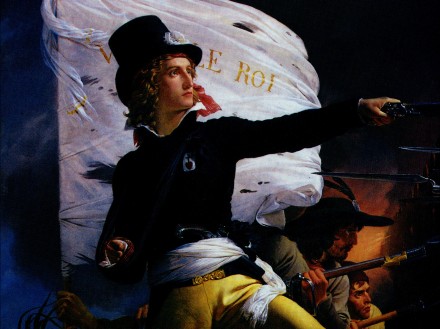
Today we should remember the victims of the French Revolution: the 4,000 prisoners drowned in the Loire by the Republic; the 2,000 Vendéens shot at Angers, half of them women; the 1,500 on the Ile de Noirmoutier; the 1,500 killed in the forest of Vezins; the 800 in the quarries of Gigant; and of course the King, his Queen, and their young son.
The Death of Marat
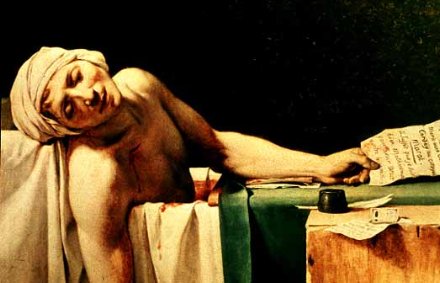
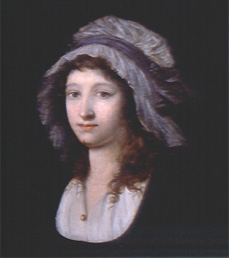
The thirteenth of July is also the day that the brave heroine of France, Charlotte Corday, killed the murderous revolutionary swine Jean-Paul Marat. Marat received his M.D. from St Andrews, and his villainy is remembered in the annual Kate Kennedy Procession, in which he is rightfully described as a “paranoid demagogue.”
The assasination inspired David to paint his famous depiction of the event. It is one of my favourite paintings, and a brilliant piece of propaganda portraying a bloodthirsty hatemonger as an angelic martyr.
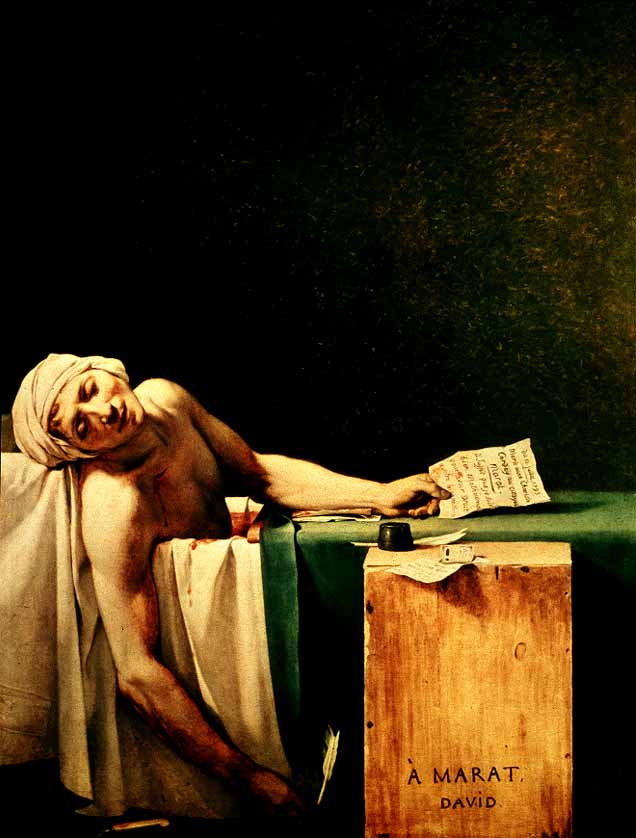
Remembrance via the great Irish Elk.
Hamilton Hall Will Be Sold
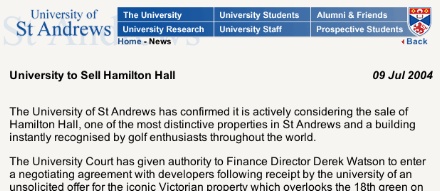
 Yesterday, the University officially announced that it has decided to sell Hamilton Hall, the iconic red-brick residence hall that overlooks the Royal and Ancient Golf Club and the 18th hole of the Old Course.
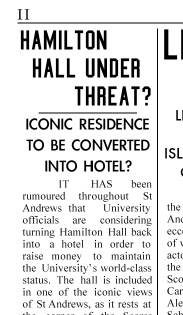
No surprise to Mitre-readers, as we reported this possibility before any other newspaper (university or otherwise) over four months ago, in our edition of March 2, 2004 (see at right).
I have to admit, losing Hamilton is slightly saddening, but having only been acquired in 1949 it is not an historic part of the University, as Finance Derek Watson points out in the press release. Nonetheless, if it does become a hotel, old students coming back years from now will be able to stay in their old rooms.
It’s a good move by the university, and the developers who want to buy it have guaranteed to provide newly-built accomodation before the sale goes through. The only trouble with this is that it seems unlikely this accomodation will be in town. Thus we may have another Fife Park/DRH situation on our hands. University Hall was far enough for me when I lived there!
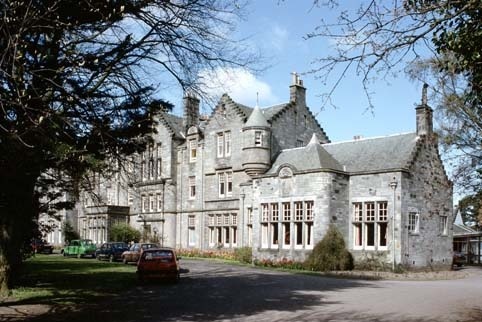
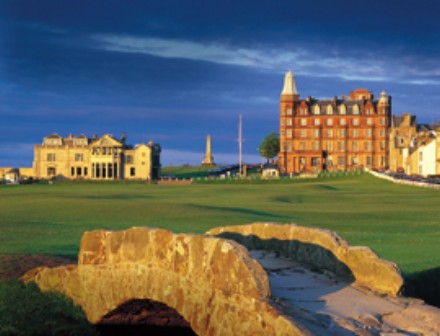
The Royal & Ancient on the left, and Hamilton Hall on the right.
Pensées des Journaux
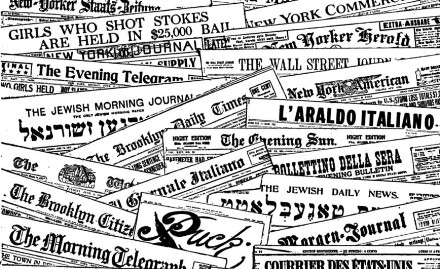
TODAY I WAS wondering how many daily newspapers there actually are in New York. I thought I knew all the English ones, the Spanish ones, and that there were a few Chinese ones as well. So my vague idea was somewhere around seven or eight.
After turning to the Encyclopedia of New York and the internet, by my count there are thirty-five dailies in New York, printed in nine different languages!
Eighteen English, five Chinese, three Korean, three Spanish, two Greek, one Italian, one Polish, one Russian, and one Ukrainian. That’s a very large number of newspapers for one city to sustain, though it ought to be remembered many of the language papers are purchased widely in other areas. Still, I wonder if Tokyo, Mexico, Seoul, Sao Paolo, Mumbai, and the other megacities out there have as many daily newspapers.
The eighteen English dailies by founding date are: (more…)
“…the Laws of Nature and of Nature’s God…”
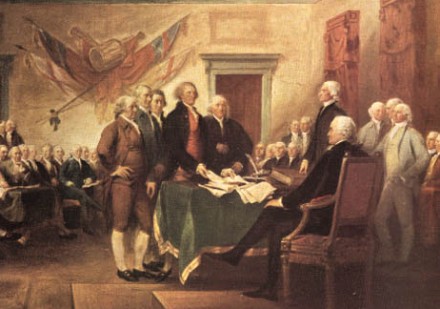
Detail from John Trumbull’s ‘Signing of the Declaration of Independence‘.
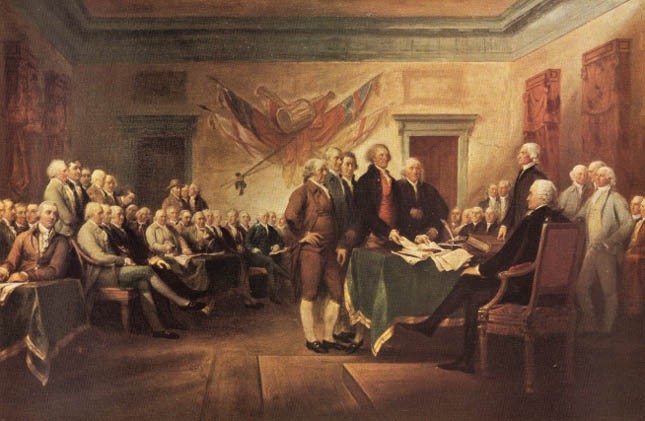
“When in the Course of human events, it becomes necessary for one people to dissolve the political bands which have connected them with another, and to assume among the powers of the earth, the separate and equal station to which the Laws of Nature and of Nature’s God entitle them, a decent respect to the opinions of mankind requires that they should declare the causes which impel them to the separation.
We hold these truths to be self-evident, that all men are created equal, that they are endowed by their Creator with certain unalienable rights, that among these are Life, Liberty and the pursuit of Happiness.”
Two-hundred-and-twenty-eight years ago today, three men with degrees from St Andrews signed the Declaration of Independence, and thus the United States were born (or so the story goes; their independence was only properly established in 1783). Those three were Mr. Benjamin Franklin (Hon. LLD, 1759), Mr. James Wilson (M.A., 1762), and the Rev. John Witherspoon (D.Div., 1764). Rev. Witherspoon was President of Princeton University from 1768 to his death in 1794, whereas Wilson became a justice of the Supreme Court after it was established. Both Franklin and Wilson went on to sign the Constitution as well, two of only eight people who signed both.
Shoot!
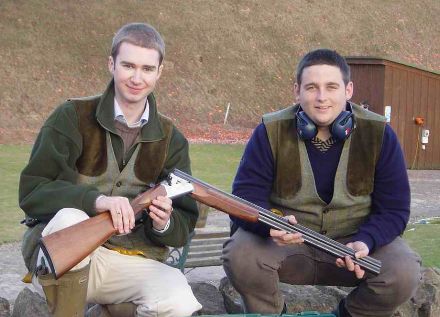
Well they always get a mention in the Mitre so I reckoned it was time the University of St Andrews Clay Pigeon Club got a mention on andrewcusack.com. Seen here are Grant Thomson and Jonny Armstrong displaying the new gun purchased with a grant from the Rector’s Fund.
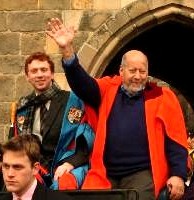 The Rector, of course, is Sir Clement Freud, OBE, who during his long life has been a soldier, restauranteur, dog-food promoter, Member of Parliament, ‘relative of most other people named Freud’, and of course, the Honorary Chairman of a certain St Andrews secret society that shall not be named.
Jonny, above on the right, is an all-around nice guy and was a source of good conversation at a recent Dashwood Club luncheon, along with the legend of all legends C. L. whose graduation a few days ago marks a tremendous loss to la société des amusantes in St Andrews.
Among Charlie’s efforts are his attempts to have Queen Victoria disinterred. Lush thinks she had a bastard child after dear Albert died, I think. Charlie’s not the only one who wants to dig up the Imperatrix. Apparently some Hannoverians think she may have been illegitimate herself, which would mean that they are still the rightful heirs to the crown of the United Kingdom. Germans coming over to take the throne of England, again? That thought alone may keep Victoria in the ground.
Life in Black and White
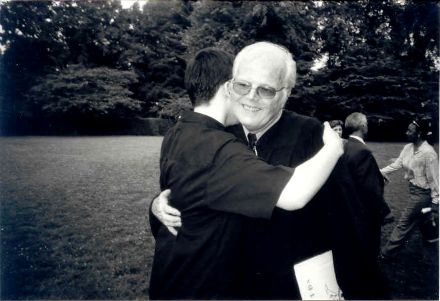
Mr. James Feddeck ’01 and Headmaster Douglas E. Fleming, Jr. at the 103rd annual commencement exercises of the Thornton-Donovan School.
Search
Instagram: @andcusack
Click here for my Instagram photos.Most Recent Posts
- Brunel’s Unbuilt Capitol February 3, 2026
- Cricket at Fordham January 27, 2026
- Palacio Barolo Revisted January 14, 2026
- Learning to Love Liguria January 14, 2026
- Crux Alba No. 2 January 13, 2026
Most Recent Comments
Book Wishlist
Monthly Archives
Categories