New York
About Andrew Cusack
 Writer, web designer, etc.; born in New York; educated in Argentina, Scotland, and South Africa; now based in London.
 read more
News
Blogs
Reviews & Periodicals
Arts & Design
World
France
Mitteleuropa
Knickerbockers
Argentina
The Levant
Africa
Cape of Good Hope
Netherlands
Scandinavia
Québec
India
Muscovy
Germany
Academica
The Architects: They Really Hate Us
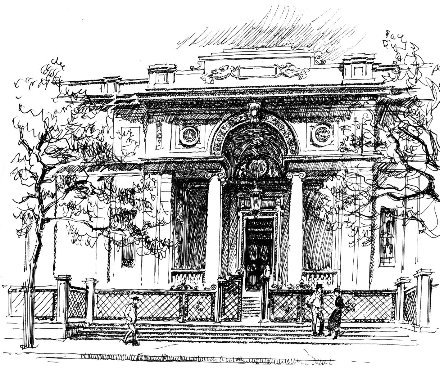
ONE OF THE GREAT things about the Morgan Library on 36th and Madison was that it used to reflect (and indeed protect) the glories of European civilization. Since its recent renovation, however, it merely expresses the post-civilization status of the mother continent. One cannot help but feel bad for poor Mr. Morgan, who would surely frown upon the vulgarity which has been thrust upon his life’s achievement: one of the finest collections of manuscripts, rare books, and drawings in the entire world. (more…)
Ludlow Street
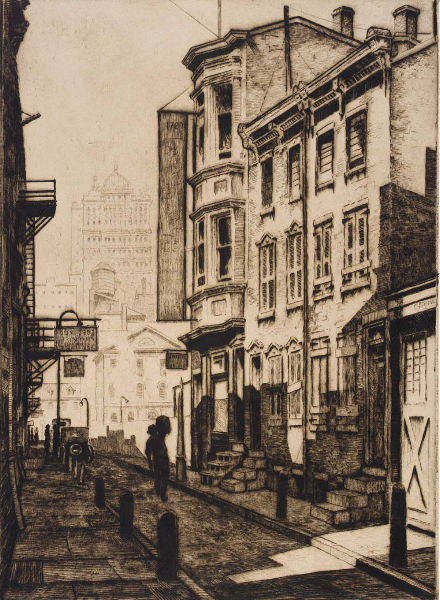
George A. Bradshaw, Ludlow Street
Drypoint on paper, 8 7/8 ” x 6 3/8 ”
1935, Smithsonian American Art Museum
Ludlow Street is the home of the world-famous Katz’s Delicatessen.
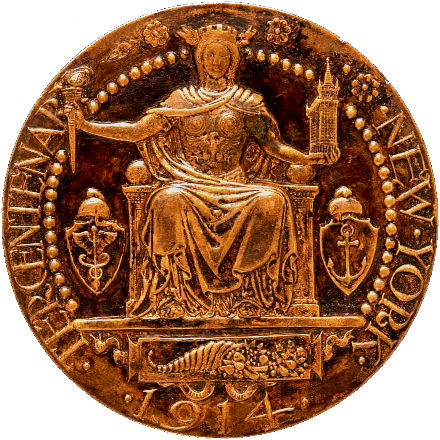
New Netherland Medal
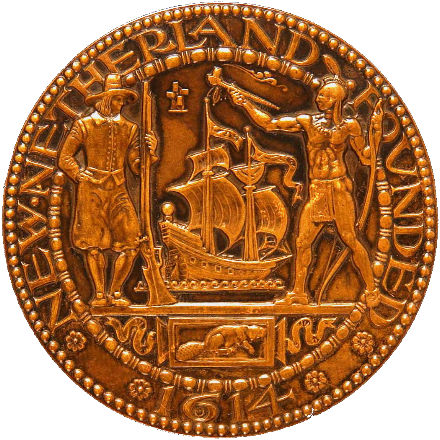
Paul Manship, New York Tercentenary Medal
Bronze, 2 3/4 inch diameter
1914, Smithsonian American Art Museum
A Walk in the Country

In need of a little fresh air this morning, I went for a walk amidst the lush greenery of our fair county, and took a few snapshots to show you my explorations. Shall we? (more…)
The Dahlgren Residence
No. 15 East Ninety-Sixth Street, New York
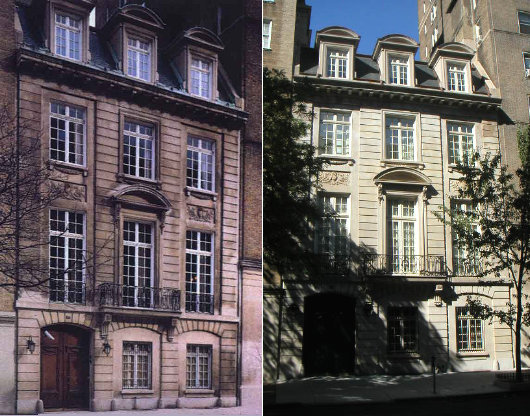
THE UPPER EAST SIDE is crossed by a number of wider cross-streets, of which 96th Street has long been agreed as the northern boundary of the neighborhood. (Overeager real estate agents have recently taken to advertising properties above that boundary as being located in the “Upper Upper East Side”). At number 15 on East 96th Street sits a splendid townhouse of superb design and execution often known as the Dahlgren residence. (Seen above, before and after complete restoration).
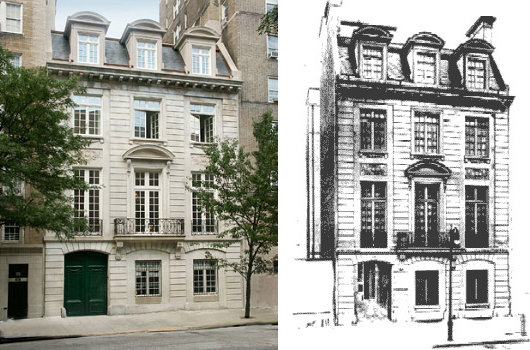
Lucy Wharton Drexel was of the Philadelphia Drexels, from which also came Saint Katharine Drexel, the founder of the Sisters of the Blessed Sacrament, as well as the initiators of Drexel University in that Pennsylvanian city. Young Miss Drexel married Mr. Eric B. Dahlgren, son of Admiral John A. Dahlgren, inventor of the Dahlgren Gun used during the Civil War at a ceremony in the Philadelphia cathedral officiated by Archbishop Corrigan of that see, and the couple soon moved to Manhattan where Mr. Dahlgren had a seat on the New York Stock Exchange. The Dahlgrens themselves were a prominent Catholic family, with Eric and his brothers attending Georgetown University, where to this day the main chapel bears the Dahlgren name. (Well-to-do Catholics must have been in short supply at the time, because after Lucy and Eric’s marriage, Lucy’s sister Elizabeth was married to Eric’s brother John).
Diary

EARLY YESTERDAY EVENING I found myself on the West Side and with a bit of free time, so I sauntered down Broadway to Columbus Circle to finally investigate in the flesh this great public place after its complete rehabilitation some two years ago. I am happy to report that the Circle’s refurbishment is quite a successful one. My only reservations were minor details, but as these were all done in an extremely simple and smooth modern style, they are much less objectional, and perhaps serve to focus attention on the sculptor Gaetano Russo’s splendid monumental column from which Cristóbal Colón, Admiral of the Ocean Sea, Viceroy and Governor of the New World presides over the grand plaza consecrated to his memory.
Colón’s name is rendered on the monument as ‘Cristoforo Colombo’, which seems appropriate since the monument was paid for by public subscription raised by Italian-Americans, and it is commonly assumed that Columbus was Italian. He may have been Genoese, Catalan, Portuguese, or Corsican, but he described himself as being from lands under the rule of Genoa, which lends significant credence to the Genoese and Corsican theories. In Spain, however, he is apparently Spanish, or so one daughter of Iberia, the wife of a frequent reader of this little corner of the web, informs us. The happy couple were strolling through Columbus Circle recently and the good lady was shocked to discover the purported Italian origin of the man who brought Christianity to the New World. After all, Spain’s national day — the Día de la Hispanidad — is October 12, the day in 1492 that Columbus first set foot in the New World. (In woebegone Venezuela, the vulgar socialist dictator has proclaimed October 12 as the Día de la Resistencia Indígena, or Day of Indigenous Resistance, and the Columbus Column in their capital city of Caracas was toppled on that day in 2004).
Anyhow, not only was the good lady was shocked at our monument’s proclamation of the Discoverer’s Italian-ness but the combination of that with the presence in Columbus Circle of the beautiful U.S.S. Maine Monument led the observer to conclude that the public plaza should be instead be named “Anti-Spain Square”. It was the disastrous sinking of the Maine, after all, which led to the Spanish-American War, the result of which was America’s most unfortunate and regretful act of taking Spain’s empire off her hands. (Contrary to Mr. Kipling’s idealistic urging of America to take up the imperial mantle in his poem ‘White Man’s Burden’, this turned out to be a fairly good deal for the Spaniards, and a very poor deal for the peoples of the United States).
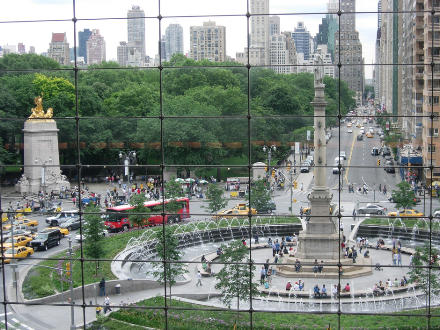
Politics aside, I enjoyed the few minutes during which I ruminated in the square (or circle, if ye be pedants). I recall many years ago the debate surrounding how to improve Columbus Circle that there was a near-universal desire for there to be more trees but that the very shallow depth between the street surface and the subway below presented difficulties in this regard. The redesigners have solved this problem by encircling the center of the circle with a raised ridge, on which are planted a number of trees which, we trust, will be even more appreciated as they mature. The raised ridge, which features jets of flowing water around the inner circle, also serves to innoculate the center from the noise of the traffic which, the Circle being situated at the confluence of Broadway, Central Park West, Central Park South, and Eigth Avenue, is considerable.
And so, I judge the new Columbus Circle a success, and I am happy to the report that the American Society of Landscape Architects concur, having awarded it their General Design Award of Honor. Another random fact which surprisingly few people know is that Columbus Circle is the spot from which distances to New York are numerated, akin to Moscow’s Red Square and London’s Trafalgar Square (if I recall correctly).
LEAVING COLUMBUS CIRCLE, I sauntered back up Broadway to another of Manhattan’s engaging places, Lincoln Center. Critics accused the architects of the performing arts complex of cribbing off of Rome’s E.U.R., but one wishes the three halls facing Lincoln Center’s plaza had the same crispness of those modern Roman structures. The thirty years between the E.U.R. of 1930s Italy and the Lincoln Center of 1960s New York were years in which the quality of modernism declined just as greatly as its supremacy increased. Despite this, the plaza of Lincoln Center is one of the most successful public places in Manhattan. I have often lamented the absence from New York of the open piazza so common on the Continent. This plaza competes with Central Park’s Bethesda Terrace as the best example of the type in Manhattan.
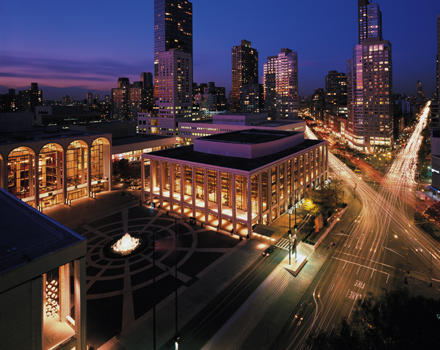
The plaza is raised above the neighboring Lincoln Square (one of the many triangular squares created by Broadway’s healthy disregard for the grid) and is reached by a gentle rise of stairs. Viewed from the square it appropriately seems like a stage upon which all our great dramas are played. The dance of the New York City Ballet in the State Theatre on the left, the music of the New York Philharmonic in Avery Fisher Hall on the left, and in the center, the Metropolitan Opera in the Metropolitan Opera House; the greatest opera company in the Americas, not to mention one of the best in the entire world. And from the hour of seven or so on the evening of performances, the three arts mix and mingle in the plaza as attendées wait to meet their companions and enter whichever of the respective halls they are to spend the evening. Some jealously preserve a seat of honor on the rim of the central fountain, while others hide from the elements (the beating sun, the heaving rain) in the shelter of the arcades, while still more meander slowly to and fro around this piazza dell’arte.
It’s unfortunate, then, that the elders of Lincoln Center insist on erecting temporary stage structures in the middle of the plaza, partially obstructing the fountain, during the warmer months when, above all other times, it should be open for all to enjoy. The creators of Lincoln Center conceived of the obvious desire for outdoor performances during the summer, and so they built the bandshell in Damrosch Park in between the Opera House and Avery Fisher Hall, just diagonally adjacent to the plaza. Surely the plaza is meant to be an open space where all the events can mix, blend, interact, influence, before finally separating into their appropriate places. If there are to be outdoor performances, hold them where they were meant to be, and if that place suffers from some malfunction of design, then redesign that place rather than rudely interjecting a particular event into what was meant to be the public square for all.
THIS PARTICULAR EVENING it was into Avery Fisher Hall for a performance of the New York Philharmonic, now in its 165th year. The program was Rossini’s overture to Semiramide and Schubert’s Symphony No. 3 in D major (D.500), with Dvořák’s Symphony No. 5 in F major (Op. 76). Riccardo Muti wielded the conductor’s baton and the result was definitely less than was expected. I had only heard Muti’s conducting on the radio in passing and, while admittedly not devoting much thought to it, he seemed a fairly capable conductor. In person, however, he left much to be desired. Rossini’s overture was merely lackluster but Schubert’s symphony was actually surprisingly poor. Perhaps the worst thing was observing Muti in action, for the man looked like an utter fool. His conducting seemed unnatural, choreographed, even foppish. And those ridiculous jestures towards the first violins! I wanted to slap the man, and I shouldn’t be surprised if the violins wanted to themselves. Towards the middle of the Schubert symphony, I began to think of the man as a proper ass, the tails of his evening jacket acting the part of hind legs. My only solution to the St. Vitus’s dance on the conductor’s dais was to shut my eyes and imagine that I was there in the Austrian capital in that autumn of 1815, after the chancellors and ministers of the crowned heads of Europe had departed the Congress of Vienna when peace and order were plotted, in the home of Otto Hatwig where (scholars posit) the work was premiered.
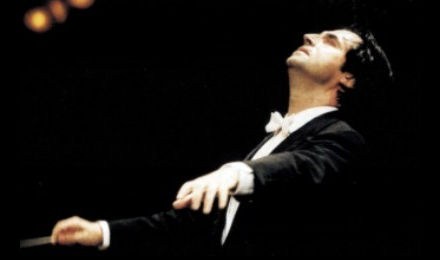
The friend I accompanied that evening actually knows about the inner workings of music (I am actually an ignoramus on the subject, and simply like what sounds good to me) and agreed completely with me on the subject during the intermission. Luckily, the Dvořák fared better, but one had the niggling suspicion that this was the Philharmonic working its magic in spite of Mr. Muti, rather than at the command of his baton. My knowledge and appreciation of Dvořák has slowly grown, from that first passing fondness we all have for his Symphony No. 9 “From the New World”. My appreciation for the Philharmonic grows, when I see they have printed in the program that Mr. Dvořák was born in Mühlhausen, Bohemia, rather than the more modish style of “Nelahozeves, Czech Republic” that would find favor elsewhere.
Perhaps I am too hard on Mr. Muti. Perhaps he and the Philharmonic were simply not a good fit for eachother. At any rate, I shouldn’t complain as one doesn’t often get box seats to a sold-out performance with every seat in the hall occupied (though, to be honest, the sound is better down in the orchestra seats). But how I wish I could have seen von Karajan while he was alive!
After the baton had finally fallen for the night, my friend and I had the same stroke of genius at exactly the same moment and decided to head up to good old Café Lalo, but unfortunately everyone else had the same idea (Saturday night? Lalo’s? What did we expect?) so we comforted ourselves with a pint or two at the Parlour instead.
New York Needs a Monarchy
 In the business section of today’s New York Sun, of all places, Liz Peek gives us another reason why we need a monarchy. In ‘Why America Needs Its Own Queen’s Award‘, Ms. Peek profiles the Queen’s Award for Enterprise, initiated by Royal Warrant in 1966 as the Queen’s Award for Industry and awarded to British companies for excellence in international trade, innovation, and sustainable development.
Of course, Ms. Peek attempts to offer some possible solutions to our detrimental lack of monarchy with regard to this particular aspect, but none of them have quite the appeal of restoring the monarchy. All that would really be necessary would be to pass an amendment removing fourteen words from Article IV, Section 4 of the U.S. Constitution. This is the part that requires the member states of the United States to have republican forms of government. This removal would at least give states the option of becoming monarchies, which is only fair, after all.
Category: Monarchy
The Knickerbocker Greys
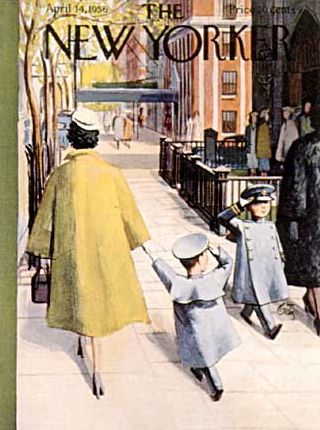
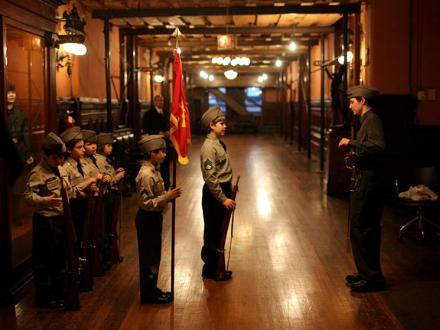
The Knickerbocker Greys, the Upper East Side corps of cadets, is celebrating its 125th year in existence. Both the Times and the Sun have featured articles on the Greys:
‘Celebrating 125 With the Knickerbocker Greys‘ by Gary Shapiro (The New York Sun)
‘Manhattan’s Littlest Soldiers‘ by Eric Königsberg (The New York Times)
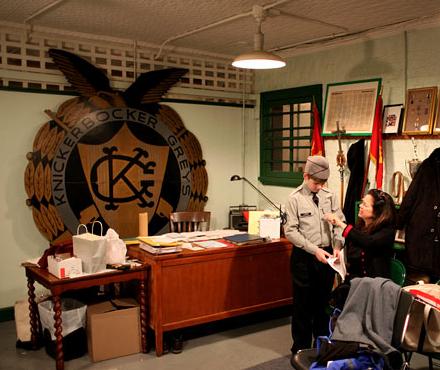
Above: A mother mends a cadet’s uniform.
Below: Cadets assembled in an Armory corridor. (Note the interior scaffolding due to the State’s grievous neglect of the Armory).
A Sienese Gem Lost
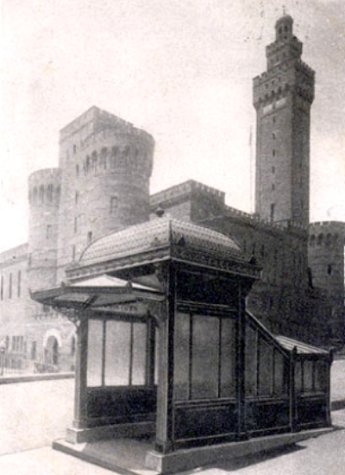
STEALING A GLANCE at the photo above, the viewer would easily be forgiven for mistaking the vista for that of a subway entrance in turn-of-the-century Siena, Italy. The proud medieval tower lurks over a comely metal-and-glass structure of continental flavor. However the city fathers of that ancient Italian municipality never deigned to erect an underground railway. The precise locus of the vista is far removed: it is the corner of Park Avenue and 33rd Street, and the building behind the subway entrance is not the town hall of Siena, but rather the armory of the 71st Regiment, New York National Guard.
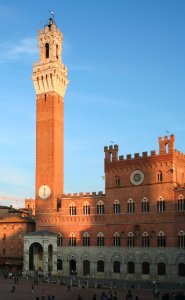 When the earlier Romanesque Revival armory of the Seventy-First Regiment burnt down in 1902, it was decided to build the new armory on the same, though slightly enlarged, site. The 1905 construction was built to the design of the architectural firm of Clinton and Russell, and was clearly inspired by the Palazzo Pubblico (the town hall, photo at right) of Siena, on that city’s Piazza de Campo. While the Seventh Regiment Armory contains the finest interiors of any military building in City, and probably the entire Empire State, the exterior of the Seventy-First’s armory was far superior. Even though the interior was not to the same lofty standard as the Seventh, it was by no means lacking, for it had all the wood-panelled rooms filled with military regalia from times gone by which one expects of New York’s armories from the period. (more…)
King Jagiello of Poland
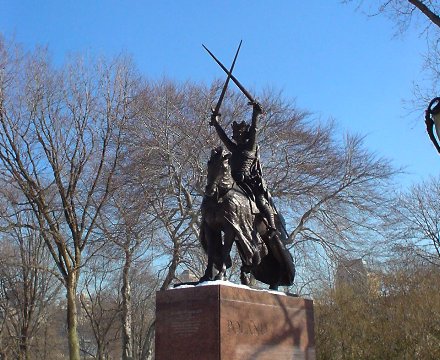
My favorite statue in Central Park is that of King Władysław II Jagiełło of Poland, by the Turtle Pond. (more…)
A Morning’s Journey
I crossed the Harlem River into Manhattan today just as Patrick Leigh Fermor traversed the Danube in his brilliant book, A Time of Gifts, which has immediately become one of my favorite reads of all time. Settling into my seat on the train yesterday, I opened my knapsack to utter shock and surprise—I had left my reading at home. The Leigh Fermor and P.G.W.’s Cocktail Time were resting somewhere in my bedchamber while I stared into the compartment of my bag, bare but for a photocopied page from the Art Newspaper and two (already-read) issues of the Hungarian Quarterly. These are the times that try men’s souls. Getting out of the city late in the evening proved even harder, as the bridge carrying the railway over the river was actually up for once (“First time in my life, folks,” the conductor informed us), leaving a steady backlog of trains awaiting their northerly destinations.
But this morning there were no bridge-raising complications, and the sky was a delightful, clear blue (soon to change) as we entered Manhattan. Thankfully, I had my two books; a bit of Wodehouse while waiting in Bronxville station and then Paddy Leigh Fermor on the train. After crossing the river, the train stops at 125th Street (Harlem) before submerging at 96th, taking the passenger down to Grand Central, that well-kept remnant on 42nd Street, reminding us that we too were once civilized. There, after taking a stroll through the market (Nürnburger sausage! Kaiser ham! Norwegian salmon!) you switch to the subway and hop down just one express stop on the 5 train.
Just half a dozen steps after emerging from Union Square station I saw a speck of white fall from the sky, and then another, and another. So it began: the first snowfall of the year. And, I might add, a New York record for the latest snowfall. (January 10th? No, there was no white Christmas for us this year). Two children on the swings in the playground ecstatically proclaimed their approval at the opening of the heavens. Wandering through the farmer’s market in the square, I picked up an herb focaccia bread I thought might be particularly enjoyable, and it complimented the exceptionally tasty Tuscan vegetable soup I had for lunch. The snowflakes swirled above the square and fell down on all the market-goers and the folks walking on Broadway as I marched up to work. And yet, how fleeting! In the few steps from the front door to the elevator, the white snow had already melted and merged into the green of my loden coat. Very well, Mother Nature. Very well.
Governors Island Revisited
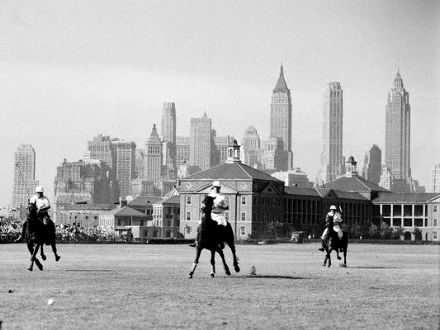
EVERY ONE OF THE myriad plans put forth for the ‘redevelopment’ of the venerable old Governors Island in New York Harbor has so far either stalled, been neglected, or otherwise poo-pooed. In this, we have something to rejoice. As I have often said, realistically speaking there is little that can be done to it which will not neglect or disgrace the island’s long military heritage. The officially-approved ideas put forth so far have been horrific: an amusement park, a casino, a ‘technology park’, as well as a number of other vapid proposals.
Naturally, we’d be enthused if it returned to its former role as swankiest post in the entire Army and the home of Army polo, but don’t hold your breath. West Point being the single exception, if it has even a touch of history, tradition, or class, Congress and the Department of Defense will do their best to get rid of it. After all, the National Guard has been pulled out of the Seventh Regiment Armory, the Navy has withdrawn all but a few institutions from Newport, and the Army has left the ancient Presidio of San Francisco; how long will it be until Fort Leavenworth’s foxhounds are brought out back and shot by the Monotony Monitors? (more…)
New York in November

Old Guard on Governors Island

A photo of the Old Guard of the City of New York on Governors Island, with Manhattan in the background, taken on St. George’s Day, 1933. [Click here for larger photo]
Previously: Evacuation Day | Marshal Foch and the Old Guard | A New York Funeral | Old Guardsmen | The Old Guard | Grandpa
Category: New York Militaria
An Evening at the Old Whitney
TO THE OLD Whitney Museum down on 8th Street, now home to the New York Studio School, which held a panel discussion to mark the twenty-fifth anniversary of the New Criterion. An interesting chat between Hilton Kramer, who left the New York Times to found the magazine in 1982, Karen Wilkin, one of our regular art critics, and James Panero, managing editor and art critic, all moderated by Michael J. Lewis of Williams College. The panel discussion covered myriad subjects related to art, from art criticism to the impossibility of an avant-garde in today’s culture of anything-goes to whether the New Criterion‘s ‘view’ of art can be considered part of any particular school of thought. Hilton had some particularly choice moments.
The building is a particularly nebulous one with many strange nooks and crannies, which can perhaps be explained by the fact that it is actually four townhouses gradually combined over a period of time. The Whitney Museum of American Art, of course, was founded in the 1930s by Gertrude Vanderbilt Whitney and was housed in these merged townhouses until moving to the specially-designed home at Madison and 75th in 1966 — widely agreed to be the ugliest building on the entire Upper East Side.
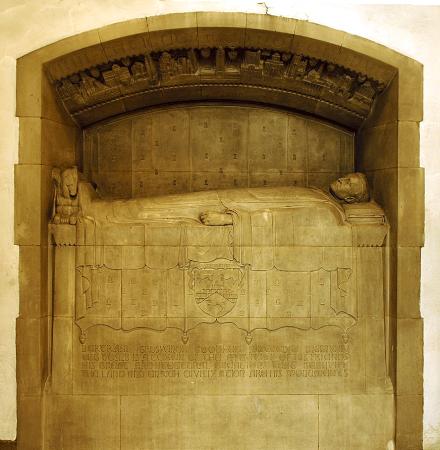
Among the nooks and crannies previously mentioned, Gertrude Vanderbilt Whitney’s former studio in the old mews building provided an excellent location for the dinner held afterwards, to which the participants, organizers, and a number of hangers-on (including yours truly) were invited. I sat between Gabbe, the New Criterion‘s former Editorial Assistant now working for the Studio School, and Joseph, an art student from outside Canterbury in Kent whose grandmother and grandfather both taught at the Studio School. Joseph and I discussed the beauty of the Somerset countryside, and I confessed I’d buy a cottage and move there in a second were it possible. The inimitable David Yezzi sat across the table and guided much of the conversation on our leg of the three tables, which had been arranged in a U-formation. A little later, I chatted with the artist seated to Gabbe’s left, who had been born in Latvia, with childhood spent in Baghdad, Italy, and England, before settling down in New York at the age of seven. We discussed the glories of Eastern Europe and the linguistic intricacies thereof. During dessert, however, I got on to architecture with the amiable Michael J. Lewis. I sung the praises of Audubon Terrace, one of my favorite spaces in all New York, which he (a Philadelphian) had only stumbled upon for the first time a month ago, and also of the nearby sculpted tomb of Bertram Grosvenor Goodhue, the greatest of all American architects.
Time waits for no man, however, and I managed to catch a late train back home from Grand Central. Alighting at Bronxville, I walked through the misty streets where the spherical streetlamps cast an eerie glow against the limestone façades of the shops. Home before midnight, and time for rest. Tommorrow, aside from being the feast of Saint Andrew, is Stefan Beck’s last day at the New Criterion. Needless to say, commemorative festivities are in order, and an alcoholic concoction known as ‘batch’ is to be brewed. It will not, I imagine, be for the faint of heart.
Elsewhere, the Austrian navy is no more.
Evacuation Day
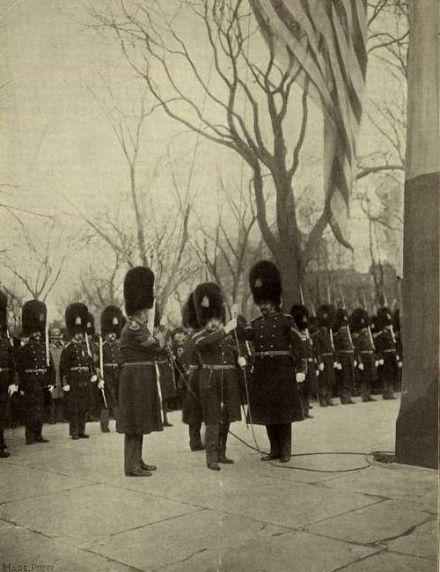
The Old Guard of the City of New York, raising the flag at the Battery on Evacuation Day, 1897. The day commemorates November 25, 1783, when the last royal troops left New York in accordance with the terms of the Treaty of Paris.
Empire State Beauty
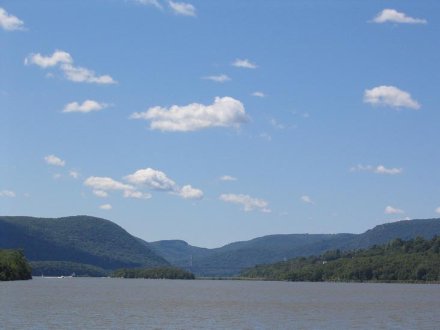
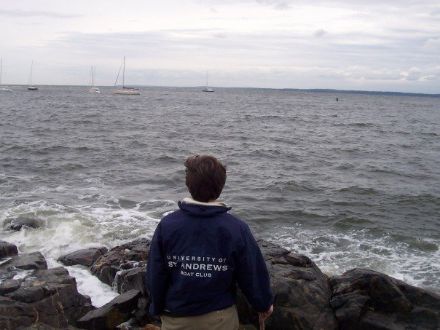
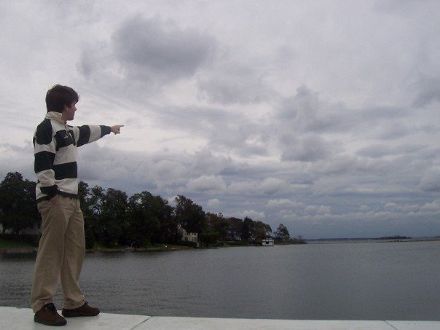
THE BRIDGE AND TUNNEL CLUB site often features photographs of myriad places, scenes, and things all around New York and beyond. Recently, the Bridge-and-Tunneller made a sojourn to various sites up the Hudson, and thankfully decided to share his photos. We bring you a selection of them, which you can find in their original form on the B&TC website. (more…)
Poor Old Bram
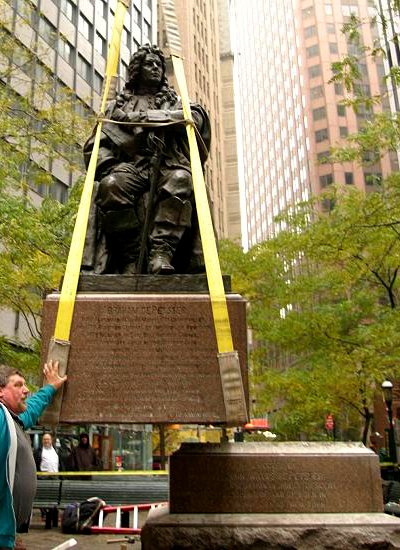
ONE HAS TO FEEL A certain amount of sympathy poor old Abraham de Peyster. The city fathers, in their infinite and unending wisdom, sought fit to erect a statue of Bram in Bowling Green, the old town square of New York down at the beginning of Broadway, many moons ago. However, having set Bram very nicely upon that green, the first public park in all New York, the city fathers have of late refused to let old Heer de Peyster rest. In 1972, the park was ‘renovated’ which entailed the statue’s forced removal. He ended up four years later in Hanover Square, a quite suitable though less prominent location, where he gazed across the square towards India House. It was then that old rivalries flared anew. (more…)
The Duke of York in New York
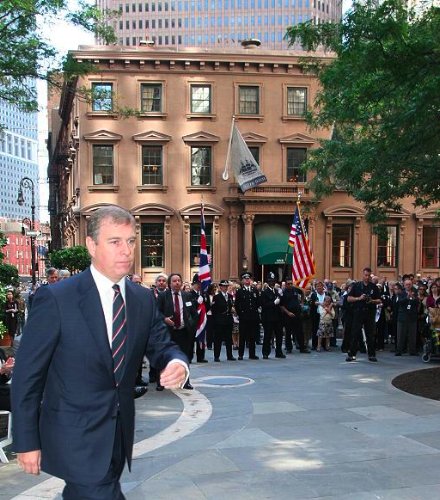
We neglected to mention Prince Andrew’s recent visit to New York in commemoration of the anniversary of the attacks on the World Trade Center. Sixty-seven British subjects died in the September 11, 2001 attacks, and eleven more were non-citizens with British ties. A ceremony was held in Hanover Square, where the British Memorial Garden is being built, followed by a reception at India House, which is located at No. 1 Hanover Square (the brown edifice in the photos above and below). (more…)
Search
Instagram: @andcusack
Click here for my Instagram photos.Most Recent Posts
- Brunel’s Unbuilt Capitol February 3, 2026
- Cricket at Fordham January 27, 2026
- Palacio Barolo Revisted January 14, 2026
- Learning to Love Liguria January 14, 2026
- Crux Alba No. 2 January 13, 2026
Most Recent Comments
Book Wishlist
Monthly Archives
Categories