Great Britain
About Andrew Cusack
 Writer, web designer, etc.; born in New York; educated in Argentina, Scotland, and South Africa; now based in London.
 read more
News
Blogs
Reviews & Periodicals
Arts & Design
World
France
Mitteleuropa
Knickerbockers
Argentina
The Levant
Africa
Cape of Good Hope
Netherlands
Scandinavia
Québec
India
Muscovy
Germany
Academica
David Kerr for Glasgow North East
 While the baggage-handler and much-celebrated hero of the Glasgow Airport attacks, Mr. John Smeaton QGM (“This is Glasgow; we’ll set aboot ye. … You’re no’ hitting the Polis mate, there’s nae chance.”) has announced he is going to contest the Glasgow North East by-election for some fringe electoral outfit, this blog is happy to report that there is already a perfectly laudable candidate who is seeking the privilege of serving the constituents of that district at Westminster.
Mr. David Kerr, a Catholic graduate of the University of St Andrews and until recently a senior editor of BBC Scotland’s “Reporting Scotland” programme, is the Scottish Nationalist candidate for Glasgow North East. The Labourite newspapers have already set David Kerr as the target of their sleaze machine, first for a derogatory comment about Glasgow Caledonian University “not having a reputation to tarnish” made in a jocular spirit of inter-academic rivalry, then over a television investigation into the availability of weaponry in which Mr. Kerr was pictured with… well, weapons! (Oh, the horror! Vote Labour!)
Mr. Kerr is believed to be a favourite of SNP leader Alex Salmond, the First Minister of Scotland. The SNP are currently the only major party in mainland Britain who are actively pursuing the Catholic vote. While SNP members tend to be vaguely left-wing and pro-independence (as is the official party policy), SNP voters are often more traditional or conservative and in favour of preserving some form of union. (The Conservative Party, meanwhile, is frequently perceived as a party for liberal English toffs; a perception reinforced by David Cameron’s leadership). The Nationalists are doubtless trying to repeat their victory over Labour in last year’s Glasgow East by-election, in which ethical issues are believed to have played a significant role in Labour’s defeat.
The bookmakers Ladbrokes are currently giving David odds of 5/4 in winning the seat, against 4/6 for Labour’s Willie Bain.
‘Dim Tim’ & Chick-lit Bagshawe go twit for tat over “slobbering” devotees of Thérèse
Tim Cheetham, a Labourite councillor in the legendary south Yorkshire town of Barnsley, has expressed his disdain for the enthusiasm his fellow countrymen and women have shown for the beloved Saint Thérèse of Liseux via the medium of Twitter: “With all those slobbering zealots kissing that glass case, I hope it has some mystical power to prevent swine flu.” As Catholic Herald editor Damian Thompson states, “That’s the authentic voice of 21st-century Labour.”
Louise Bagshaw, a “chick-lit” novelist, prospective Tory party candidate, and Woldingham old girl, wasted no time in responding. “Nice to describe faithful Catholics venerating a relic as slobbering zealots. Would you use such bigoted language about Muslims?”
Cheetham’s rather lame retort: “As the church has issued new guidlines [sic] about the conduct of ceremonies to protect against spreading disease, it needed saying.”
Bagshawe: “Labour’s anti-Catholicism is breathtaking sometimes.”
Damian Thompson continues:
Another tweet from Cheetham: “It’s not Bigotry to highlight the lunacy of dark age mysticism in the modern world.” Really? OK, then let me put you on the spot, councillor.
You say: “I will decry any faith that denies my right to question it in whatever form I wish.” Well, Muslims in Barnsley do object to the slightest criticism of their Prophet (who lived during the dark ages, as it happens) with his child wives and message of violence. But you’re a brave man, it seems. So go on: speak fearlessly and with your trademark withering disdain about the zealots in your own town.
Dim Tim later tried to backtrack by blaming the medium of Twitter for his own idiotic remarks.
To my knowledge, Barnsley’s not a town short on Catholics. Let’s hope those “slobbering zealots” make it to the polling place the next time the council’s up for election.
Over There
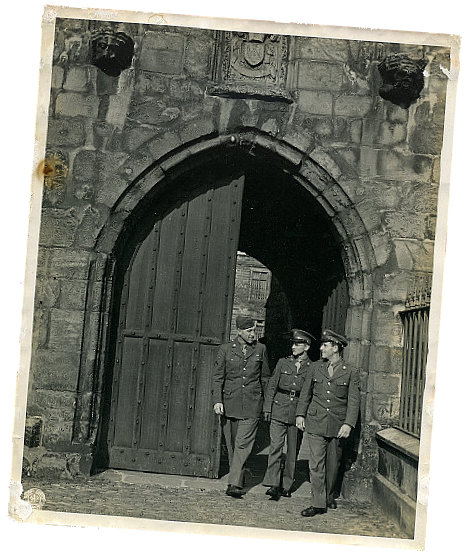
American GIs in St Andrews, 1943.
Thérèse Takes Britain by Storm
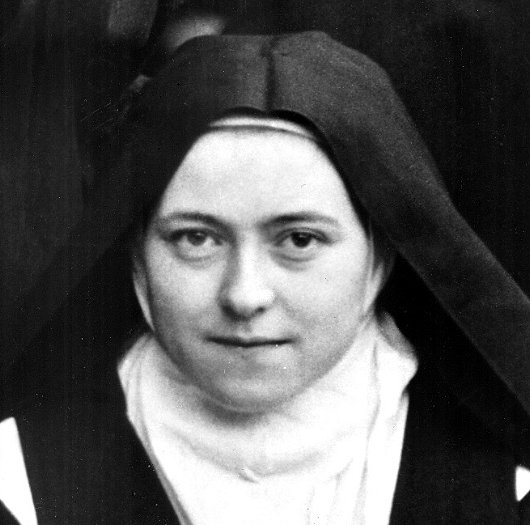
Relics of St Thérèse of Lisieux arrive in Britain for tour
The Guardian: Thousands wait at Portsmouth cathedral to see remains of St Thérèse
The Catholic Herald: The greatest saint of modern times
Thérèse of Lisieux portal
The Daily Telegraph: Relics of Carmelite nun St Thérèse on tour
St Thérèse of Liseux: who was she?
The relics and bones that bring us closer to God
BBC News: Saint’s remains arrive for tour
Reuters: Saint’s relics heading for Wormwood Scrubs
The Independent: Why are the relics of St Thérèse such a holy hit?
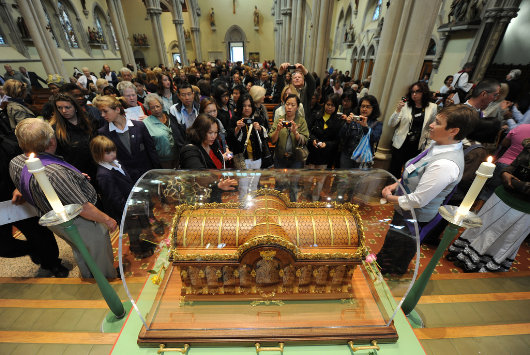
catholicrelics.co.uk
pray for us!
Diary
I have been spending the past few days in a flat at the corner of Holland Park Avenue and Portland Road, in this verdant corner of the capital. The flat is clean, capacious, and handsome, but terribly modern. Indeed, it is so modern that it will soon be old; it will not exhibit the old age of the time-honoured and true, but rather the tawdry oldness of what had only recently been new. Pedantic students of interior design will study photos of it and discern “2008 I’d say… no! 2009!” But for now, it is still new, still fresh, and so, like a tomato fresh for the plucking, we will enjoy it while its moment is precisely appropriate.
Until now, I hadn’t much knowledge of this part of London, but find it a happy place to be in August. The weather has been mild and kind, and I spent part of the afternoon reading de Maistre — the St. Petersburg Dialogues — in the formal garden in Holland Park. The avenue itself is tree-lined, or rather tree-engulfed, such is the plentiful shade, and has a small selection of cafés: the Paul boulangerie which is becoming omnipresent, and the Valerie patisserie, both chains. Cyrano, at No. 108 Holland Park Avenue, is much preferred, and I decamped there for a light breakfast with a copy of the Scotsman from the local newsstand (the one on Ladbroke Grove, rather than the smaller one by the tube stop) while avoiding the miserable Irish cleaning lady who returns the modern flat to its pristine whiteness every Thursday morning.
Then to the Royal Academy, for the Waterhouse show. What an interesting artist! His earlier works so precise in detail and, for lack of a better word, academic. Yet in his later pieces, you can find a certain willingness to obfuscate, perhaps an admission that reality is not quite so precise and that the most accurate portrayal of reality requires a few lines to be blurred. Faces, and indeed all forms, remain clear throughout, but the architectural coldness of the earlier works on display gradually evolves to a more fluid depiction of Greek mythos and Keatsian tales. Waterhouse can vary in his details from the almost photographic to verging on impressionism in a single painting. Was that his intention? It was certainly the result.
My viewing companion — an old university friend — and I agreed that throughout all the themes portrayed by the artist one can’t help but feel an overwhelming Victorian-ness. Is this ex post facto because we know Waterhouse to be an High Victorian artist, or is there actually some inherent quality in the works that calls to mind that era? Very difficult to say, but those in London should not miss this exhibition of a popular yet under-appreciated artist — the Jack Vettriano of his day.
Who is in London in August anyhow? The text messages sent out, and their replies promptly received. “I’m in Geneva! Will be in Luxembourg next week if you’re on the continent.” I am not and will not be on the continent. “I have been unexpectedly called to Africa.” Well I’ve just come from there, though not the Sudan thank God. “You’re welcome to come to Gozo between the 5th and 15th for a pleasant, quiet holiday.” I will have returned to New York by then, alas. “Am up north in Lancashire; you’re welcome to come and visit, sample our recusant history!” Just haven’t got the time, alas.
But while many have escaped for the month, many yet remain. An afternoon drink at Rafe’s, with Fr. Rupert and Alex Williams. The Carlton is being refitted, so it was drinks at the East India Club instead with another university friend, during which we concur that office jobs are the absolute pits and we should have studied agriculture with the country girls at Cirencester rather than getting tawdry MAs in Scotland. There is no greater affirmation of the consequences of original sin than the omnipresence of the 9-to-5 office job.
Astute observers of this little corner of the web (if indeed we can use the plural for such a subset of the earth’s population) will recall an incident over two years ago now in which a certain Jack Russell terrier became rather more involved with my lower leg than I had envisioned was ideal. The dog, which goes by the name of Cicio Stinkiman, had noticed me playing with the only seeing-eye-dog in Scotland that knows how to genuflect and resented the attention I was paying to the bitch, to whom he obviously professed some attachment, ran up, and bit me in the calf.
You can imagine my surprise when I learnt that the beast in question is actually now not only living in London but actually residing in the Oratory. Indeed I saw the beast from a distance while waiting on Brompton Road for the Friday evening mass last week. His owner graduated from university (in Scotland, like all the wisest people) two years ago now but his mother banned poor Cicio Stinkiman from the German palace he might otherwise call home, perhaps informed along the voluptuous grapevines of Europe of the horrendous incident in which the beast had taken an unwelcome interest in my lower leg.
I am being far too unfair to poor Cicio, for he did apologise, and looked up at me with terribly apologetic eyes. Admittedly, that might’ve been because his master stood nearby holding a rolled-up copy of the Catholic Herald most threateningly. Still, pity the poor ignorant beasts. They have no conscience, and thus no real malice. Only we humans, with the freedom we abuse so easily, can claim that dubious achievement.
Good to be back
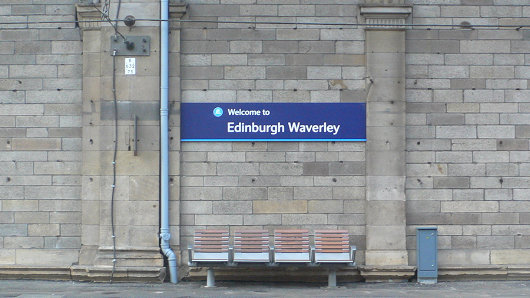
Sad to leave it. (I’m in London now).
From the Number 23 Bus
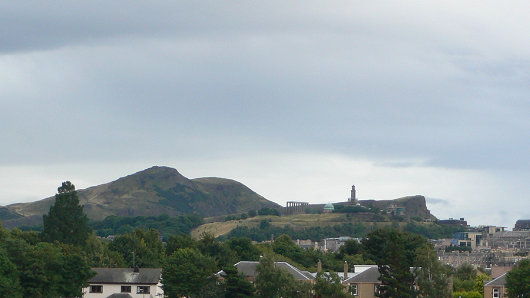
A view of Edinburgh from the top of the no. 23 bus. (more…)
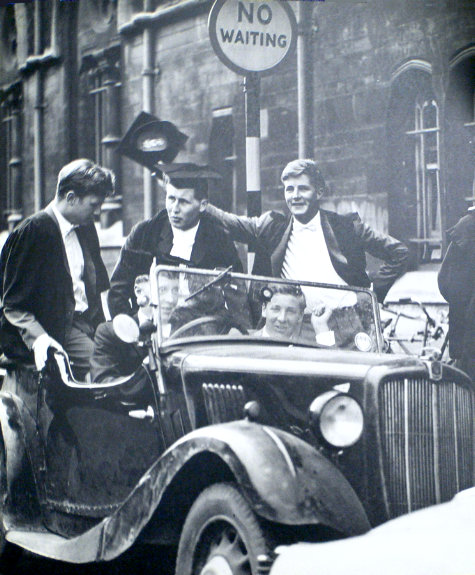
Celebrating a Great Scot: David Lumsden
I can’t tell you how often I come across something and think to myself “I must ask Lumsden about that”, and then suddenly realise that no such thing is possible anymore. I only had the privilege of knowing this gentle giant of a man towards the end of his life, but am grateful even for that relatively short friendship. Below is the address given by Hugh Macpherson at the Thanksgiving Service for the Life of David Lumsden of Cushnie that took place at St. Mary’s Church, Cadogan St., London on Monday, 27th April 2009. May he rest in peace.
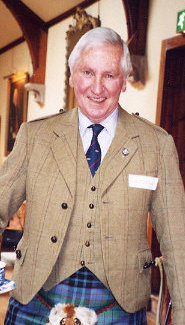 It is difficult to mark the passing of such a remarkable personality as David Lumsden. We have done with the requiems and the pibrochs and must now look forward to celebrate an extraordinary life lived to the full.
David was a man of many parts and passions. He was a renaissance man with a wide variety of interests, and if he did not know the answer to any particular question, he certainly knew where to look it up, and in a few days there would be an informative card in the post. He had a lively curiosity and sense of adventure.
Perhaps the ruling passion in his younger life was that of rowing. He rowed at Bedford School and when he went up to Jesus College Cambridge, he joined the boat club, eventually becoming Captain of Boats. There were, I think, eventually eight “oars” on the walls of his various houses. I think that David was one of the few people I know who went to Henley to actually watch the racing, and when one went into the trophy tent his name could be found on some of the trophys. The expedition to Henley was one of the fixed points of David’s year.
He travelled round the country rather like the “progress” of a monarch of old. This progress encompassed the Boat Race, Henley, the Royal Stuart Society Dinner, the Russian Ball, spring and autumn trips to Egypt, the Aboyne Games, the 1745 Commemoration, the Edinburgh Festival, and numerous balls and dinners, including of course the Sublime Society of Beef Steaks.
Rather like clubs, David and I had a “reciprocal” arrangement: When I was in Scotland I lodged with him, and when he was in London he lodged with me, and I can tell you that there were many times when I simply could not keep up with his social whirl, in fact once or twice I distinctly fell off! I remember one particularly splendid and bibulous dinner at the House of Lords at which we were decked in evening dress and clanking with all sorts of nonsense — after many attempts to hail a taxi, David turned and said to me “You know we are so drunk they won’t pick us up. We’ll have to stagger back.” And so we wound a very unsteady path back to Pimlico, shedding the odd miniature en route.
At Cambridge, David also formed a lasting friendship with Mgr. Alfred Gilbey, Catholic Chaplain to the University, who was to have a lasting influence on David’s faith and life, and, I think, introducing him to the Sovereign Military Order of Malta, where he eventually became a Knight of Honour & Devotion.
David’s faith was an important part of his life. When he was in London he would attend this church on a Sunday morning to hear the 11.30 Latin Mass, which finished conveniently near to the opening time at one of his favourite watering holes in the Kings Road. (more…)
Heaven in Herefordshire
In the weekly South African edition of the Telegraph, I came across a brief note marking the death of England’s oldest publican, Flossie Lane of ancient Leintwardine in Herefordshire. From the internet, I find the full version of her obituary, which is reproduced below. The Sun Inn, with its “Aldermen of the Red-Brick Bar” sounds like a splendid haven.
Flossie Lane, who died on June 13 aged 94, was reputedly the oldest publican in Britain, and ran one of the last genuine country inns
For 74 years she had kept the tiny Sun Inn, the pub where she was born in the pre-Roman village of Leintwardine on the Shropshire-Herefordshire border.
As the area’s last remaining parlour pub, and one of only a handful left in Britain, the Sun is as resolutely old-fashioned and unreconstructed today as it was in the mid-1930s when she and her brother took it over.
According to beer connoisseurs, Flossie Lane’s parlour pub is one of the last five remaining “Classic Pubs” in England, listed by English Heritage for its historical interest, and the only one with five stars, awarded by the Classic Basic Unspoilt Pubs of Great Britain.
She held a licence to sell only beer – there was no hard liquor – and was only recently persuaded to serve wine as a gesture towards modern drinking habits.
With its wooden trestle tables, pictures of whiskery past locals on the walls, alcoves and a roaring open fire, the Sun is listed in the CAMRA Good Beer Guide as “a pub of outstanding national interest”. Although acclaimed as “a proper pub”, it is actually Flossie Lane’s 18th-century vernacular stone cottage, tucked away in a side road opposite the village fire station.
There is no conventional bar, and no counter. Customers sit on hard wooden benches in her unadorned quarry-tiled front room. Beer – formerly Ansell’s, latterly Hobson’s Best at £2 a pint – is served from barrels on Flossie Lane’s kitchen floor. (more…)
Our Cardinal at the Oratory
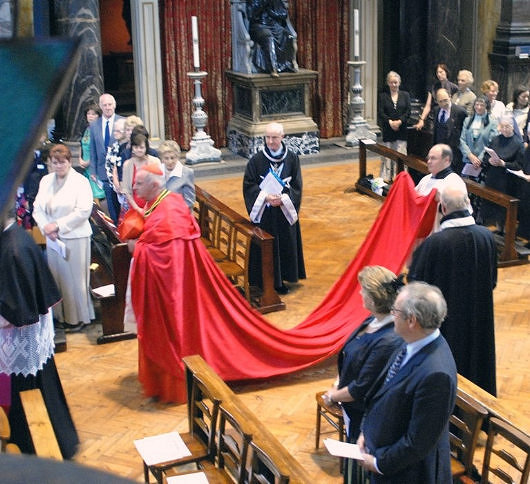
His Eminence Keith Patrick O’Brien, Cardinal Archbishop of St Andrews & Edinburgh, at the Brompton Oratory for the Feast of St. John the Baptist this year.
(From the NLM)
First Things, Three Songs
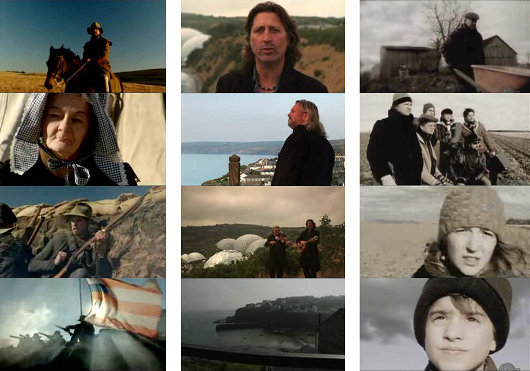
Through an interesting post by Joseph Bottum on the First Things blog, I discover that R. R. Reno posted all three of the songs I elaborated upon in my June 2007 post “We’ve Lost More Than We’ll Ever Know”, though (so far as I can tell) he arrived at the same three without stumbling across my entry on them. I always read First Things in New York (it’s one of my favourites, and simply a must-read), but it’s sadly not available in South Africa (bar actually scraping one’s pennies together for a subscription) so I’ll just have to wade through friends’ archives when I return to the Empire State. (Or does the Society Library have a subscription? And if not, why not?).
While it has a reputation among some Catholics as being a bit too liberal & democratist, I suspect the whiff of Americanism one finds in the pages of First Things is akin to the aroma of tobacco in an old bar: the smell lingers but that doesn’t mean anyone’s actually still smoking. Nonetheless, they often feature top-notch articles and writing that are of interest to Catholics & other traditionalists.
S.R.E. & S.R.I.
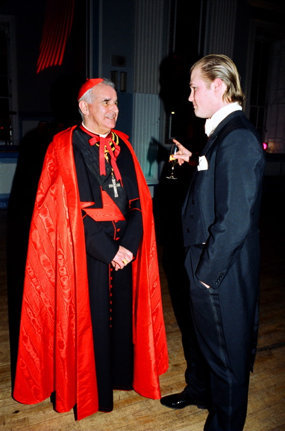
Left, a prince of the Holy Roman Church and right, a prince of the Holy Roman Empire.
Credit: I think this is one of Zygmunt’s photos.
The Tele-tab

The Daily Telegraph prides itself on being Britain’s top-selling quality daily newspaper, but the dear old Telly has being playing tabloid of late. Compare this 2004 front page (left) to one of just a few days ago (right).
The point of a headline in a quality newspaper should be to inform the reader of what the article is about, as well as to impart information quickly to those who are scanning the page. “Payback time” the Telegraph boldy asserts, but what on earth does that tell us? Nothing; we have to go to the subheadline to find out “Cameron orders Tories to refund excessive expenses; Hazel Blears to meet £13,332 tax bill on second home”.
There is an art in creating a headline that is both punchy and informative without being vulgar, but the Telegraph seems to have abandoned this art — for now, at least.
Peter Hitchens on America
On returning from America
I have spent the past two weeks in the United States, not working but travelling on my own account, revisiting some favourite places and coming up for air. It remains an exhilarating and beautiful place, wrongly sneered at by too many British people who simply haven’t experienced enough of it to know how good it can be, and how much worse off we would be if it weren’t there. But it is also a foreign country, not some kind of special friend – but a foreign country to which we have unique access because we speak a similar language. Only fluent French or German speakers could ever know as much about those countries as any British visitor can swiftly learn about the USA – if he wants to.
Rather than re-immerse myself in the small-scale squalor of British politics, which seems even less appealing or interesting than it was when I set out, I thought I would muse a little on what an English person experiences in the great republic, and what it means (or might mean) for us.
The Scottish Executive, 1999-2007

While naturally relieved that Labour are no longer in charge, one of the few objections I have to the current SNP government in Scotland is that they changed the name of the Scottish Executive to “the Scottish Government”. The new name is just so damned boring. Every country, region, town, and borough has a “government”; it’s the dullest word you can come up with. But “the Scottish Executive” had such a nice ring to it. Listening to the evening news on Radio Scotland, one heard the newsreader speak of “the Scottish Executive” and immediately thought “Ah yes, that’s our part of the government!” Now one hears the sultry phrase “The Scottish Government today announced new measures…” and thinks “Oh, the government. Nobody likes the government.”
To add to this lamentable change, they even dumped the Scottish coat of arms as the visual identity of Scotland’s authority (as seen above, in the Executive days) and replaced it with an exceptionally dull saltire-flag logo that can be seen on the Scottish Government’s website.
Premier Salmond, give Scotland back her heraldry!
Ursus Oxoniensis
Brother Ursus of Blackfriars Hall, Oxford
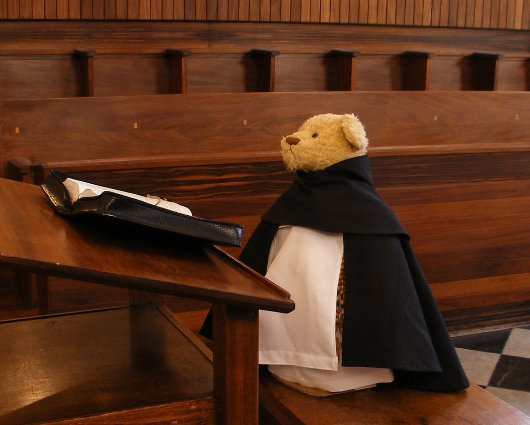
Godzdogz, the blog of the English Dominicans, informs us of the following:
The Dominican order is very inclusive with brothers and sisters from a wide variety of backgrounds. One of the friars who lives in Oxford, Br Ursus, describes what day to day life is like for a Dominican bear.
“I get up at 7.43 every morning for Lauds. This is always a great challenge, especially in winter. Before joining the order, I used to hibernate for 6 months of the year, so it has taken me quite a while to adapt to getting up every day. It’s one of the sacrifices I have to make, but I receive many consolations. As it says in psalm 118 ‘Your promise is sweeter to my taste than honey in the mouth.’ As someone who very much loves honey, I find this imagery delightful, and it’s also very true.
From the provinces to power
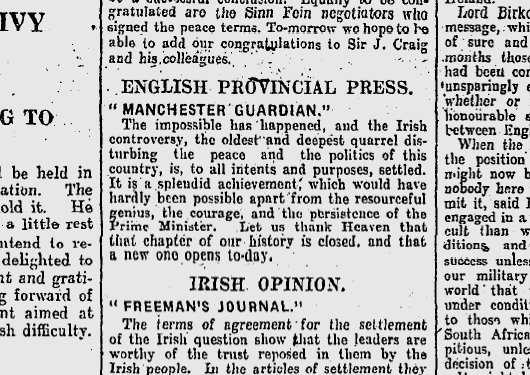
What a change eighty years makes! What was once filed under “English Provincial Press” is now the voice, mouthpiece, and all-but-official organ of the British establishment.
Old Radders
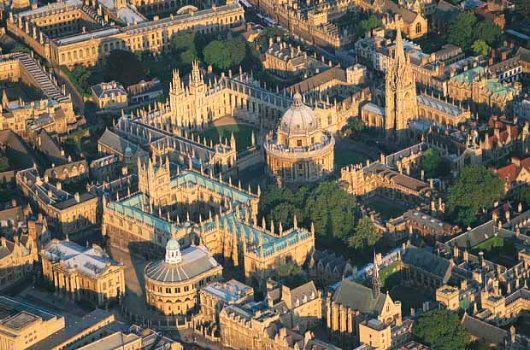
The devil in me, while entirely appreciative of the beauty of Radcliffe Camera, sometimes wonders if the handsome square it is in might be better off without it. What would it look like?
The Victory Parade, Dublin 1919
UPDATED Peter Henry’s article from Trinity News corrects my errors.
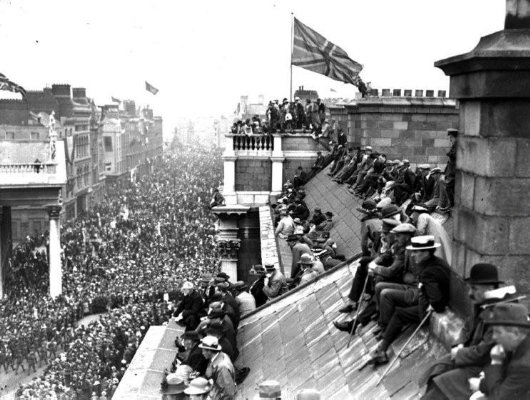
Persuant to our previous photograph of the Union Jack proudly snapping from Dublin’s General Post Office, one of our dear friends & loyal readers, a former editor of Trinity College’s newspaper, sends this photo of the 1919 Victory Parade through the streets of Dublin after the end of the Great War. The red, white, and blue here flies from the top of Trinity College, and the view looks down D’Olier Street (if I recall correctly) towards O’Connell Street in the distance. The classical portico on the left marks the entrance to the Irish House of Lords.
It is worth remembering that a great deal more Irish served in the forces of the Crown than in any republican armed forces or groups. The memory of Ireland’s great sacrifice during the First World War was shamefully neglected from the 1930s until about ten or fifteen years ago. It was a pity that the famous old Irish regiments were disbanded when independence came in 1921, rather than being continued under a native Irish command. Gone the Connaught Rangers and Dublin Fusiliers, and all the great battle honours won by Irishmen from Waterloo to far off India. (Two Irish regiments still exist in the British Army, the Royal Irish and the Irish Guards). Still, in remembrance of the dead of the First World War, one can visit the War Memorial Gardens by the banks of the Liffey, beautifully designed by Lutyens and completed after independence. The cost was split between the Irish and British governments, and, in the post-war downturn, half the workers were Irish veterans of the British Army and half were veterans of the formerly rebel forces.
Ireland remained neutral during the Second World War but declared a state of emergency, which is why the time of the war is often known in Ireland as “the Emergency”. Allied and Axis soldiers who washed up or crash-landed in Ireland found themselves interned in camps, but the Irish soldiers guarding them were only armed with blank ammunition. (Allied internees were often allowed to escape). The law of the day forbade any Irish citizen from joining a foreign military, but many soldiers of the Irish Army, policemen of an Garda Siochana, and many Irish civilians left for Britain to join the Allies in the fight, and were not punished on their return. When the port of Belfast suffered a German bombardment, fire brigades from Dundalk to Dublin were sent north irrespective of the border in order to help quell the flames.
Returning to Trinity, flying the Union Jack in 1919 would not have proved controversial in the slightest (after all, it was still the official flag of the land), but the crowds gathered again on College Green in 1945 to spontaneously celebrate the news of Germany’s surrender. The flag of Ireland with those of all the Allied nations were flown from the flagpole of Trinity, but some tactless student had placed the Union Jack at the top and the Irish Tricolour at the very bottom, below even the Soviet hammer-and-sickle. The crowd noticed this and began to howl, but some more thoughtful Trinity man swiftly took the colours down and raised them again with the Tricolour to the fore. The joyful spirit resumed.
Search
Instagram: @andcusack
Click here for my Instagram photos.Most Recent Posts
- Brunel’s Unbuilt Capitol February 3, 2026
- Cricket at Fordham January 27, 2026
- Palacio Barolo Revisted January 14, 2026
- Learning to Love Liguria January 14, 2026
- Crux Alba No. 2 January 13, 2026
Most Recent Comments
Book Wishlist
Monthly Archives
Categories