Great Britain
About Andrew Cusack
 Writer, web designer, etc.; born in New York; educated in Argentina, Scotland, and South Africa; now based in London.
 read more
News
Blogs
Reviews & Periodicals
Arts & Design
World
France
Mitteleuropa
Knickerbockers
Argentina
The Levant
Africa
Cape of Good Hope
Netherlands
Scandinavia
Québec
India
Muscovy
Germany
Academica
The Mass Returns to York Minster
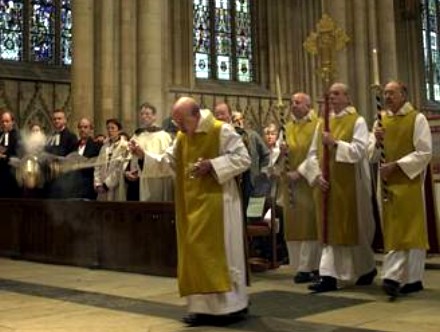
On Friday, May 16 of 2003, the Carmelites offered a mass in York Minster to commemorate the 550th anniversary of the Papal bull ‘Cum Nulla’ allowing the Order to enroll nuns and the laity. York Minster used to be home to a Carmelite congregation, kicked out when the Minster – the largest Gothic cathedral in northern Europe – was appropriated by the government. It survives today as the cathedral for the Archdiocese and ecclesiastical province of York. The official website conveniently makes no mention of the great church being nicked from the Carmelites, but at least they let them offer the Holy Sacrifice of the Mass in their old home.
York Minster was in the news not too long ago, when Canon Professor Edward Norman – one of their clerics and supposedly one of Anglicanism’s leading intellectuals – decided to swim the Tiber (so to speak). (more…)
Another Broadsheet Bites the Dust
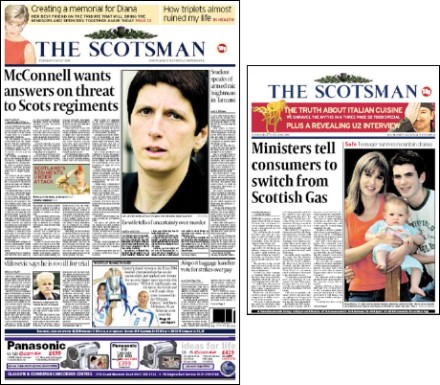
The Scotsman has given in to the current Fleet Street mania and become a tabloid. The newspaper had experimented with the tabloid size for its Saturday edition and then just a few days ago converted the weekday editions as well.
For my fellow Americans in the audience, a little explanation. Going tab is all the rage amongst respectable newspapers in Britain over the past year. The ancient Times of London comes in both broadsheet and tabloid format. The Independent was the first broadsheet to publish both a broadsheet and tabloid edition, and then decided to become a permanent tabloid. The Guardian, to my knowledge, has kept out of the tabloid fray, and the venerable Daily Telegraph remains commited to broadsheetism.
The benefits of publishing in tabloid size are that the newspaper is easier to handle and read. Financially, however, it means page size, and thus potential advertising space, is reduced by half.
I am not a fan of this tabloid revolution. I fantasize periodically about the Mitre being published in broadsheet format instead of A4. Perhaps my anti-tabloidism is culturally ingrained. After all, we Anglophones are used to the formula of broadsheet = trustworthy. This formula is not true, for example, in France, where the two main respectable newspapers, le Figaro and le Monde, are printed in a format slightly smaller than the standard US/UK tabloid.
Nonetheless, one of the aspects of broadsheets that I enjoy is that they aren’t easy to read on subways and whatnot. It’s best to sit down in a comfortable chair in a well-lit location and peruse the goings-on and thoughts of New York, the nation, and the world in the New York Sun than to get tiny bits of news in a “convenient” format.
More Andreanic Fun
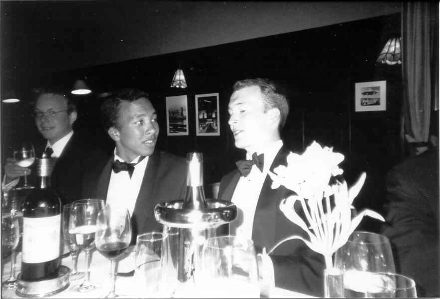
Behold, the only photo ever smuggled out of a Kensington Club dinner. Alright, I’ll admit it’s not a terribly interesting photo, but it’s the only one, so you’ll pardon that. I’m actually somewhat surprised I wasn’t fined a bottle of port or two for this, but I felt as a historian there ought to be some proof that the Kensington Club actually exists.
Here Ed Jackson turns to Rob Cockburn who explained some point about something. On the peripheral left is Michael Phillips, and on the dexter, Michael Gaster’s right arm (if my knowledge of the seating that evening is correct, which is doubtful).
Kens Club dinners are good fun, usually lasting from about seven-thirty until midnight, and they would be longer if only the Golf Hotel would oblige to keep its dining room open.
Harknessiana
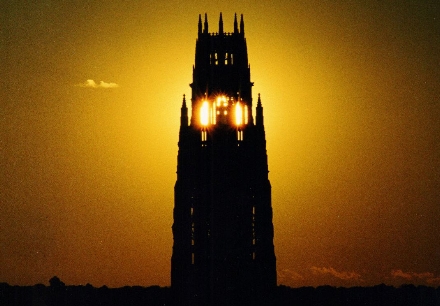
A beautiful shot of sunset through the Harkness Tower at Yale. Edward Harkness paid for the Harkness Memorial Quadrangle to be built in memory of his brother Charles, who died during the Great War. In addition to being a significant benefactor of Yale and St. Paul’s School, both of which he graduated from, he was also a patron of the University of St Andrews, where he was good friends with Principal Sir James Irvine.
At St Andrews, he built St. Salvator’s Hall, the first hall of residence for men since the end of the residential aspect of the colleges, as well as funding the renovation of the St. Salvator’s Chapel. His generosity is commemorated by a window in the chapel.
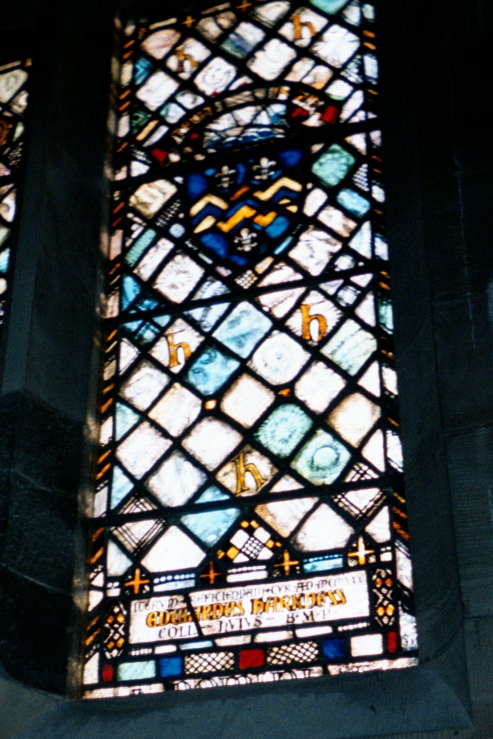
The trust he established also later paid for the restoration of St. Leonard’s Chapel, which had been abandoned in the middle of the nineteenth century.
Ah, St Andrews!
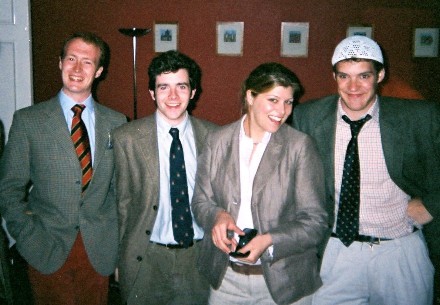
Was feeling a bit nostalgic for St Andrews. Won’t be heading back until Sept. 20, so I figured I’d put up a photo of fellow St Andreans and me with jovial countenances.
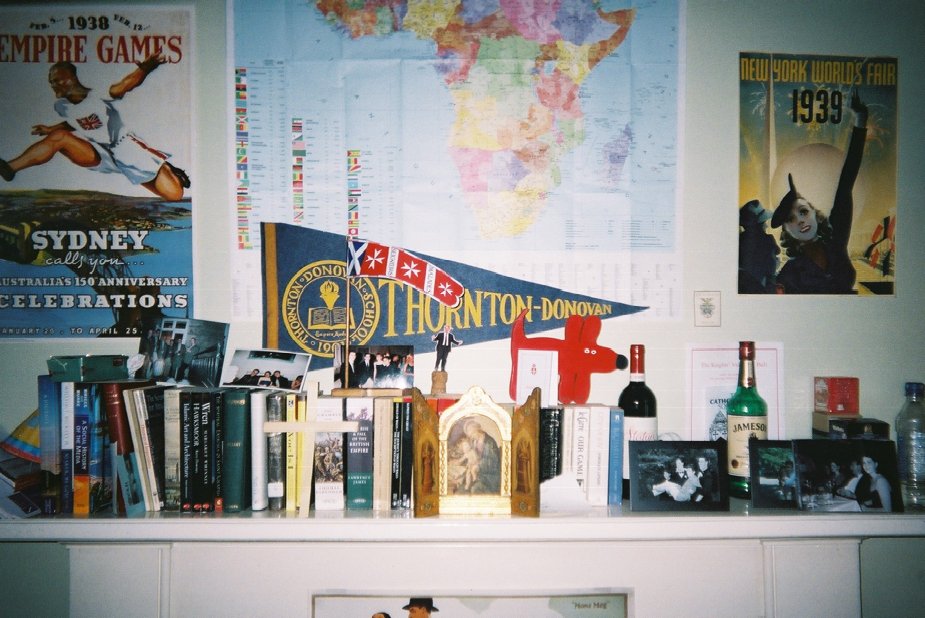
And the mantle from my room the past year. For a closer up look at the random items including architectural books, John le Carré novels, the program from the Knights of Malta ball, a bottle of cheap red, the Penguin editions of Gerald of Wales, and Alfred the Great, and R.G. Cant’s history of St. Salvator’s College, click here.
Hamilton Hall Will Be Sold
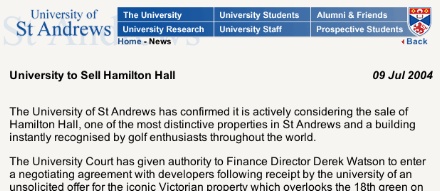
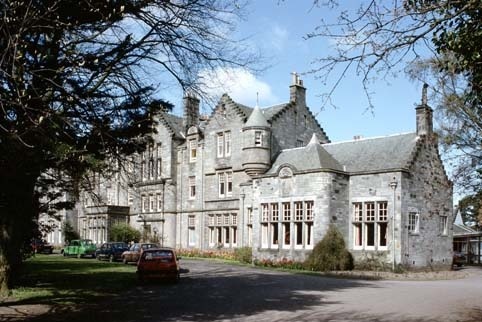
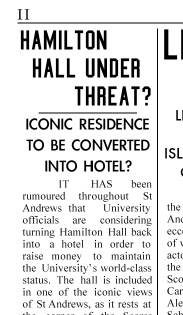 Yesterday, the University officially announced that it has decided to sell Hamilton Hall, the iconic red-brick residence hall that overlooks the Royal and Ancient Golf Club and the 18th hole of the Old Course.
No surprise to Mitre-readers, as we reported this possibility before any other newspaper (university or otherwise) over four months ago, in our edition of March 2, 2004 (see at right).
I have to admit, losing Hamilton is slightly saddening, but having only been acquired in 1949 it is not an historic part of the University, as Finance Derek Watson points out in the press release. Nonetheless, if it does become a hotel, old students coming back years from now will be able to stay in their old rooms.
It’s a good move by the university, and the developers who want to buy it have guaranteed to provide newly-built accomodation before the sale goes through. The only trouble with this is that it seems unlikely this accomodation will be in town. Thus we may have another Fife Park/DRH situation on our hands. University Hall was far enough for me when I lived there!
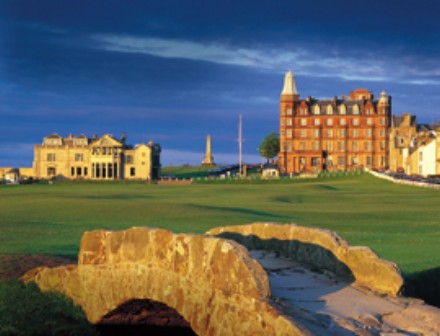
The Royal & Ancient on the left, and Hamilton Hall on the right.
“…the Laws of Nature and of Nature’s God…”
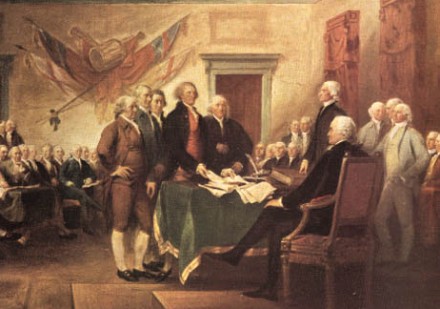
Detail from John Trumbull’s ‘Signing of the Declaration of Independence‘.
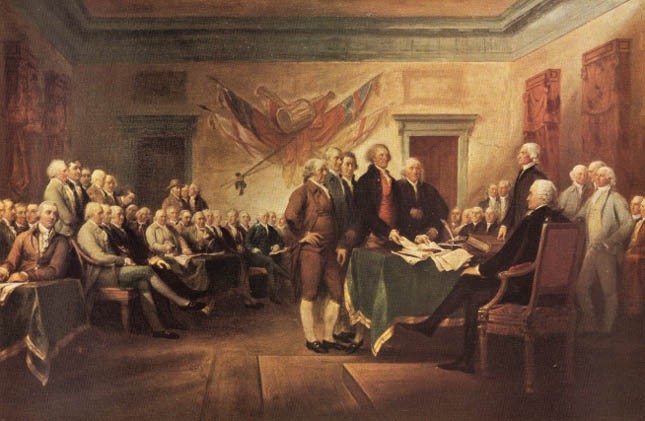
“When in the Course of human events, it becomes necessary for one people to dissolve the political bands which have connected them with another, and to assume among the powers of the earth, the separate and equal station to which the Laws of Nature and of Nature’s God entitle them, a decent respect to the opinions of mankind requires that they should declare the causes which impel them to the separation.
We hold these truths to be self-evident, that all men are created equal, that they are endowed by their Creator with certain unalienable rights, that among these are Life, Liberty and the pursuit of Happiness.”
Two-hundred-and-twenty-eight years ago today, three men with degrees from St Andrews signed the Declaration of Independence, and thus the United States were born (or so the story goes; their independence was only properly established in 1783). Those three were Mr. Benjamin Franklin (Hon. LLD, 1759), Mr. James Wilson (M.A., 1762), and the Rev. John Witherspoon (D.Div., 1764). Rev. Witherspoon was President of Princeton University from 1768 to his death in 1794, whereas Wilson became a justice of the Supreme Court after it was established. Both Franklin and Wilson went on to sign the Constitution as well, two of only eight people who signed both.
Shoot!
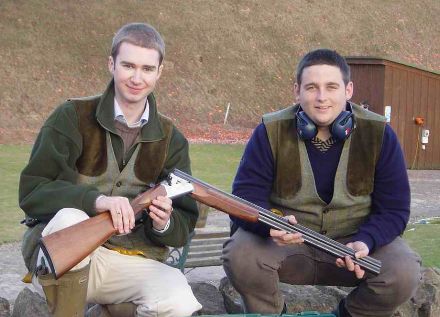
Well they always get a mention in the Mitre so I reckoned it was time the University of St Andrews Clay Pigeon Club got a mention on andrewcusack.com. Seen here are Grant Thomson and Jonny Armstrong displaying the new gun purchased with a grant from the Rector’s Fund.
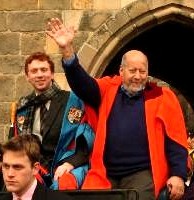 The Rector, of course, is Sir Clement Freud, OBE, who during his long life has been a soldier, restauranteur, dog-food promoter, Member of Parliament, ‘relative of most other people named Freud’, and of course, the Honorary Chairman of a certain St Andrews secret society that shall not be named.
Jonny, above on the right, is an all-around nice guy and was a source of good conversation at a recent Dashwood Club luncheon, along with the legend of all legends C. L. whose graduation a few days ago marks a tremendous loss to la société des amusantes in St Andrews.
Among Charlie’s efforts are his attempts to have Queen Victoria disinterred. Lush thinks she had a bastard child after dear Albert died, I think. Charlie’s not the only one who wants to dig up the Imperatrix. Apparently some Hannoverians think she may have been illegitimate herself, which would mean that they are still the rightful heirs to the crown of the United Kingdom. Germans coming over to take the throne of England, again? That thought alone may keep Victoria in the ground.
Life in Black and White
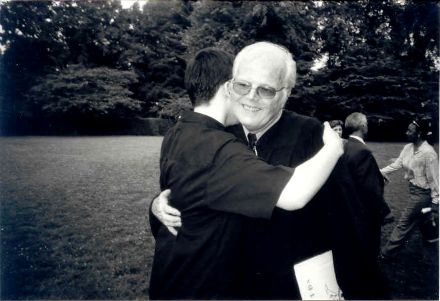
Mr. James Feddeck ’01 and Headmaster Douglas E. Fleming, Jr. at the 103rd annual commencement exercises of the Thornton-Donovan School.
In the news…
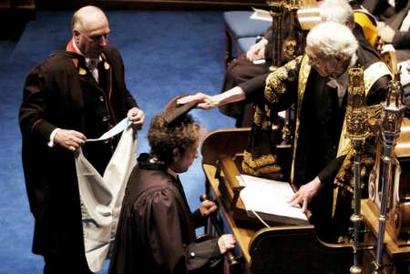
The greatest university in the world finally gets recognition in American news for granting Bob Dylan an honorary doctorate, of all things. It’s only the second honorary degree he’s accepted, the other being from Princeton (one of those newfangled schools here in the New World). Nonetheless, there’s Sir Ken capping the new Dr. Dylan and Jim Douglas, one of the nicest people I’ve met, about to give him his doctoral hood. Huzzah for St Andrews. And huzzah for Dr. Bob Dylan, even though I don’t like his music. Here is the AP’s take on events.
Into Honours!
I have just checked my results on the Student Portal and it turns out that I have passed every single course this term. “Big deal!” you cry? Well it is a big deal for we, the generally disinclined to work. Especially since I took one more course than usual each term this academic year to make up for the failures of my first year.
This means that I have passed my first two years of university and am now into honours. Thus, God willing, in two years time I shall be Andrew K.B. Cusack, M.A. (Hons) St Andrews.
I’d like to thank all my staff, most especially my secretary, Miss Alexandra Jennings, and my cook, Miss Jocelyn Archer, for selflessly contributing to the Cusack effort and ensuring that Candlemas Term 2004 was a resounding success.
The University Maces
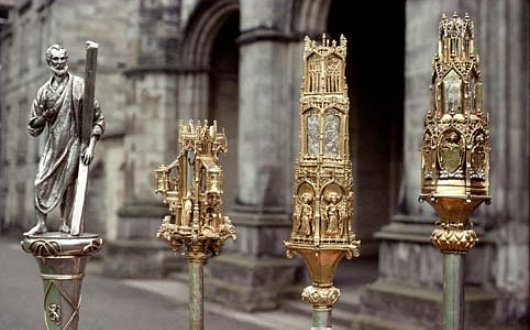
On my last day in St Andrews before summer break, Michelle Romero and I were lucky enough to finagle our way into a private showing of the University’s maces to the Kate Kennedy Club, organized by the Head Janitor & Bedellus, Jim Douglas, M.A. It was amazing. The metalwork on these maces (six in total) is so intricate and beautiful.
The late R.G. Cant said that if he had to put a value to the maces, Bishop Kennedy’s mace (made in 1461 in Paris) would be worth £10 million, and the mace of the Faculty of Arts would be £5 million, though in effect they are priceless. I have to admit it was nearly frightening to hold £10 million pounds in your hands.
It’s such a shame that the modern mace for the whole of the University (furtherst left in the photo) pales in comparison to the others, especially since it is the mace used at Chapel and thus the mace used most often. Mr. Douglas told us that the rod of the Rector’s mace (not pictured) is actually a broomstick painted black. Apparently, the Principal and Vice-Chancellor, Dr. Brian Lang, is going to have it replaced with a lengthened ebony rod.
Search
Instagram: @andcusack
Click here for my Instagram photos.Most Recent Posts
- Brunel’s Unbuilt Capitol February 3, 2026
- Cricket at Fordham January 27, 2026
- Palacio Barolo Revisted January 14, 2026
- Learning to Love Liguria January 14, 2026
- Crux Alba No. 2 January 13, 2026
Most Recent Comments
Book Wishlist
Monthly Archives
Categories