Great Britain
About Andrew Cusack
 Writer, web designer, etc.; born in New York; educated in Argentina, Scotland, and South Africa; now based in London.
 read more
News
Blogs
Reviews & Periodicals
Arts & Design
World
France
Mitteleuropa
Knickerbockers
Argentina
The Levant
Africa
Cape of Good Hope
Netherlands
Scandinavia
Québec
India
Muscovy
Germany
Academica
Journey to Scotland
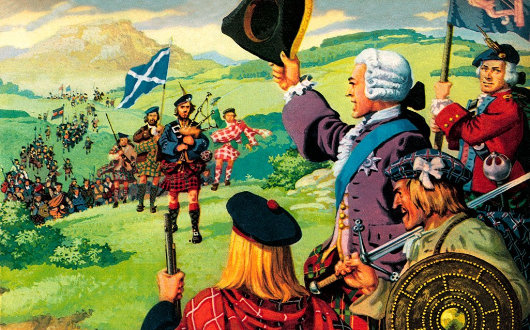
Perhaps foolish to title this entry ‘Journey to Scotland’ as I’ve already crossed the border into England, and indeed my train has just crawled past the beautiful towers of York Minster. I arrived in Scotland on Saturday and neglected to make the pilgrimage to my alma mater of St Andrews but instead spent all of my time in the elegant confines of Edinburgh. Saturday night beheld a splendid repast, including salmon freshly arrived from Ireland, champagne, and brandy cake. After the glories of an old-rite Mass on Sunday morning there was tea aplenty (and brief chats with Gerald Warner and Fra Freddy) before enjoying tankards of champagne near Queen Street Gardens, followed by an excellent late lunch in one of Auld Reekie’s best Italian restaurants, topped off with hot apple pie and a bit of Bas Laubade armagnac (1946).
On Monday I took a break from eating and called at one of my favourite paintings in the National Gallery on the Mound (Pas Mèche by Jules Bastien-Lepage) before a pub lunch with very good friends. A few pints in the Guildford Arms next to New Register House (home to the Court of the Lord Lyon, for those heraldically inclined) led to the standard student dinner of spag bol in a flat off Morningside Road. Yesterday, however, my old friend Richard Demarco led me on a personal tour of Arthur’s Seat and Salisbury Crags in Holyrood Park. A most remarkable guide, with a flair for the dramatic, Richard adeptly explained the ancient significance of the stunning site and declared it a monument even greater than the Pyramids because, unlike those Egyptian constructs, these crags and hills were made not by man but by God.
One of the false conveniences of the modern internet lifestyle is that global websites often redirect themselves to the local version when one is outside the United States. In Montreal just a few weeks ago, I put in “google.com” and automatically got “google.ca”. Similarly, in Scotland, logging out of YahooMail, one is redirected to “yahoo.co.uk” rather than “yahoo.com” regardless of your actual email address. More curiously, however, while passing through Northumberland, I logged on to “google.com” and was redirected to “google.se — Google Sverige”, the Swedish version of Google. Have the Northmen returned, albeit electronically, to claim back the lands that once were theirs?
I am now off to London. My aforementioned friend Richard Demarco is, for lack of a better phrase, big in the arts world of Scotland; this is so despite his strident opposition to much of the arts establishment. Richard believes that divine veneration must be the animating spirit of great art, and that the current reign of nonsense and malarchy in art stems from its divorce from the reality of the Incarnation. For veneration, then, tonight’s eve of the New Year will be commemorated at Brompton Oratory with a Holy Hour and Benediction starting at 11:00pm. Tomorrow’s feast will be marked by yours truly at Spanish Place, where a Solemn High Mass in the Extraordinary Form will be celebrated.
Arrivederci, then, to 2008, and a very happy and blessed new year to all the denizens of this little corner of the web.
Dublin (In the Rare Old Times)
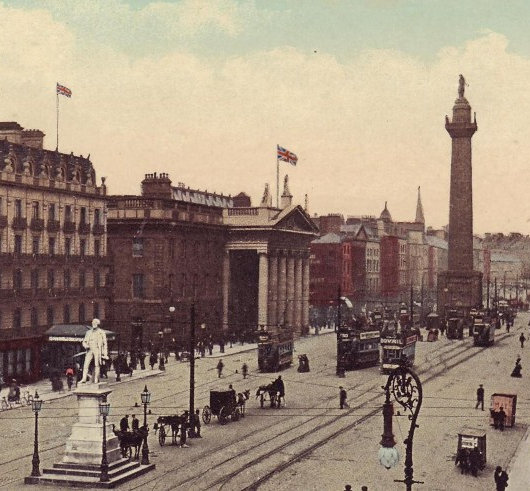
O’Connell Street, Dublin, United Kingdom of Great Britain & Ireland.
Lumsden Requiem in Edinburgh
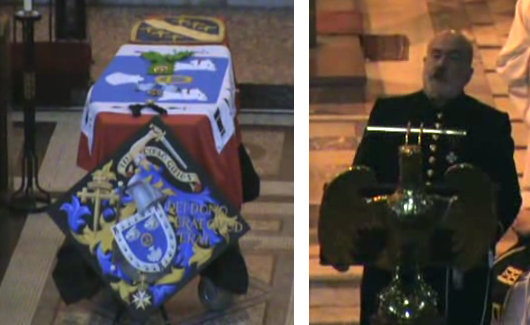
Some good Christian soul was kind enough to put most of our friend David Lumsden‘s funeral at St. Mary’s (Catholic) Cathedral in Edinburgh on YouTube. It was the first Latin requiem in the extraordinary form of the Mass held in the Cathedral for many decades — a fact which David would have particularly enjoyed. Of note is the address given by Robin Angus, embedded below, and of course Gerald Warner’s previously mentioned report should not be missed either.
‘Feudal pomp and Latin Mass at funeral of a Scottish laird’
Gerald Warner reports on the funeral of David Lumsden of Cushnie:
Thursday, September 11, 2008
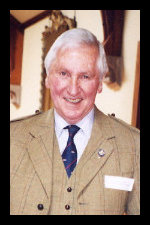 To Edinburgh yesterday, for a melancholy but magnificent and uplifting occasion: the funeral of David Lumsden of Cushnie, Garioch Pursuivant of Arms, restorer of ancient castles and Jacobite romantic. It was held in the Catholic cathedral where, for the first time since Vatican II, the Latin Tridentine Mass was sung, thanks to the permissive rules of Benedict XVI in his motuproprio Summorum Pontificum.
The coffin was draped in the banners of the Order of Malta and the deceased’s arms, with an heraldic hatchment and the decorations of the orders of chivalry to which he belonged. Knights of Malta and of the Constantinian Order processed behind their banner in mediaeval robes. The congregation was filled with peers, chieftains, lairds and splendid eccentrics, the pews awash with tartan. One of the tail-coated ushers was the grandson of a papal marquis. Robin Angus, whose day job is venture capitalist, dressed in the uniform of a papal Knight of St Sylvester, delivered a moving panegyric.
This occasion was a potent reminder of an alternative Scotland, a different pulse from the vulgar, mean-minded, politically correct clones in the abysmal Scottish parliament at Holyrood. It was shamelessly feudal, aristocratic and colourful. Evelyn Waugh would have loved it; Harriet Harridan would have burst her stays. It was reminiscent of the scene in Waugh’s Sword of Honour when, at the funeral of old Mr Crouchback, the members of ancient Catholic Recusant families murmur their sonorous names while the narrator, parodying a wartime poster, concludes: “Their journey was really necessary.”
At the subsequent reception, Lady Mar, whose personal herald David was and who came top of the ballot for the 92 surviving hereditary peers in the House of Lords, was pointedly addressed by Jacobites as “Your Grace”. This was because, although the British state recognises her as 30th Countess of Mar, her ancestor who led the Jacobite Rising of 1715 was created Duke of Mar by the exiled Stuart King James VIII.
Only a few of these Jacobite peerages created by the Stuarts in exile have heirs today. Now that such hereditary peerages no longer bestow an automatic seat in Parliament, it would be a gracious gesture for the Crown to recognise them and so heal old historical wounds. There is a precedent: Spain has recognised the titles of nobility created by the Carlist claimants in exile – Carlism being the Spanish equivalent of Jacobitism.
The dry-as-dust forms issued by government departments are normally very boring; but the most romantic document available online is issued by the Spanish Ministry of Justice, entitled Solicitud de Titulo Nobiliario por: Rehabilitacion/Reconocimiento de Titulo Carlista. It is the formal application for recognition of a title of nobility conferred by the Carlist kings in exile from 1833 to 1936. David Lumsden of Cushnie (RIP) would have appreciated it.
Swan Upping
The Palace has released this YouTube video on the ancient practice of swan upping.
A Colonel Inspects His Regiment
Nils Olav and the King of Norway’s Guards
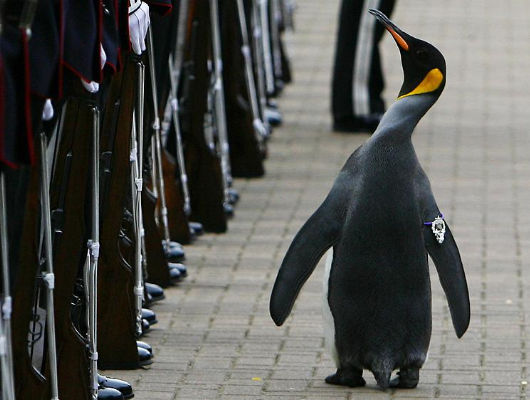
The King of Norway’s Guards is the household regiment of that Scandinavian sovereign, but their honorary colonel resides in Edinburgh, where the regimental band often performs in the famous Military Tattoo held each summer. This year, the Colonel was honored with no less than a knighthood and took the opportunity of the unit’s presence in Edinburgh to inspect the regiment. Ordinarily, this would be an unremarkable event were it not for the fact that the Colonel is Nils Olav, a penguin currently in residence at the Edinburgh Zoo.
David Lumsden of Cushnie, 1933-2008
Garioch Pursuivant of Arms, sometime Baron of Cushnie-Lumsden, Knight of Malta, Patron of the Aboyne Highland Games

It was with great sadness that I learned this morning of the death of David Lumsden. He was an exceptionally genial and affable man, and was relied on to provide good company at many events, from balls to Sunday lunches and everything in between. But David was generous not only with his good company but with his patronage, as is attested to by the countless organizations he helped and guided. Here was a man who was generous of spirit. David’s death came very suddenly yesterday afternoon in his hotel room at the annual conference of the 1745 Association, of which he was president. Just last Sunday he had attended the traditional Mass at St. Andrew’s, Ravelston in Edinburgh, where a friend described him as “looking as hale and hearty as ever”.
David Gordon Allen d’Aldecamb Lumsden of Cushnie, sometime Baron of Cushnie-Lumsden, was born on 25 May in 1933 in Quetta, Baluchistan in the Empire of India. He was the son of Henry Gordon Strange Lumsden, a Major in the Royal Scots, of Nocton Hall, Lincolnshire and Sydney Mary, only child of Brigadier-General Charles Allen Elliot.
He was educated at Allhallows, Devon, Bedford School, and at Jesus College, Cambridge before serving in the Territorial Army with the London Scottish while working at British American Tobacco. He was a Knight of the Order of Malta, as well as of the Constantinian Order, and was Patron of the Aboyne Highland Games. David enthusiastically served as Garioch Pursuivant to the Chief of the Name and Arms of Mar (presently Margaret of Mar, the 30th Countess of Mar), one of the four surviving private officers of arms in Scotland recognised by the Court of the Lord Lyon.

Lumsden with friends, at the Aboyne Highland Games.
David co-founded the Castles of Scotland Preservation Trust and the Scottish Historic Organs Trust and was President of the Scottish Military History Society. In addition to his Magister Artium from Cambridge, he was a Fellow of the Society of Antiquaries of Scotland. He was on the council of The Admiral the Viscount Keppel Association and was one of the patrons of the famous Russian Summer Ball in London. He was Convenor of the Monarchist League of Scotland and was on the council of the Royal Stuart Society.
In the realm of sport, he was a keen shot and had rowed at Cambridge, in addition to his interest in sailing and riding.
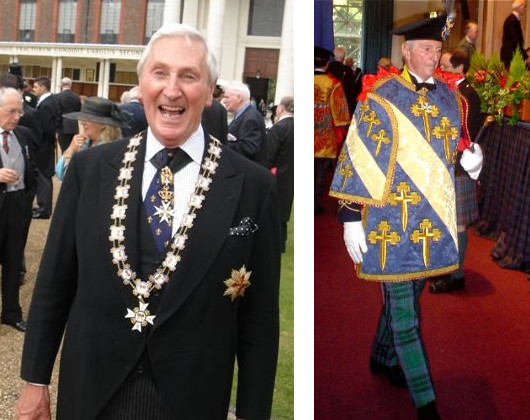
Left: Representing the Royal Stuart Society at the Henry IX commemoration at the Royal Hospital Chelsea. Right: In his capacity as Garioch Pursuivant of Arms, at the XXVIIth International Congress of Genealogical and Heraldic Sciences in 2006.
David had a passion for architecture, and especially that of his native Scotland. Returning in 1970 after a spell in Africa, he undertook the restoration of two family properties: Cushnie House, built in 1688 by Alexander Lumsden and Tillycairn Castle, built in 1540 by Matthew Lumsden. He later went on to restore Leithen Lodge at Innerleithen, an 1880s shooting lodge built in a distinctly Scottish take on the Arts & Crafts tradition. Under the auspices of the Castles of Scotland Preservation Trust, in 1994 he oversaw the restoration of Liberton Tower just south of the Royal Observatory in Edinburgh.
“David was a unique man possessed of an insatiable love of life and learning,” his friend Rafe Heydel-Mankoo said. “He will be deeply missed and fondly remembered by those fortunate enough to have met him.”
“David was at the centre of so many things, and brought together so many different people,” said Lorna Angus, the wife of Robin Angus. “He could bring life to any gathering and he made so many good things possible.”
Robin Angus, meanwhile, said that David Lumsden “personified a world of precious things — things which are imperilled, but which never seemed imperilled when he was there.”
“David no longer visibly with us is unimaginable,” Robin continued. “What his friends must now do is keep the flame, and — as he did — pass it on to others with the same generous wisdom. He was the soul of old Scotland. I hope that, in Heaven, Raeburn will make amends for what the centuries did not allow, and paint his portrait.”
While I wholeheartedly agree with Robin, it must be said that those who were blessed to know David are left with a portrait of him in our hearts and minds far greater than even the brush of Raeburn could achieve.
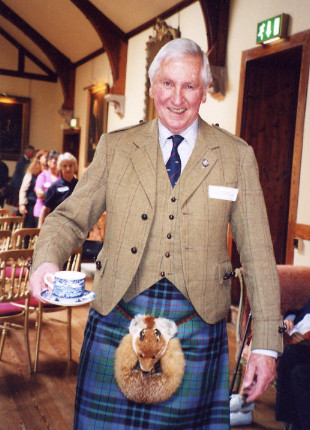
David Gordon Allen d’Aldecamb Lumsden
of Cushnie
1933–2008
“… hold fast to that which is good.”
— 1.Thess 5:21
Requiem aeternum dona eis Domine:
et lux perpetua luceat eis.
Requiescat in pace.
The Kingston Lacy Massacre
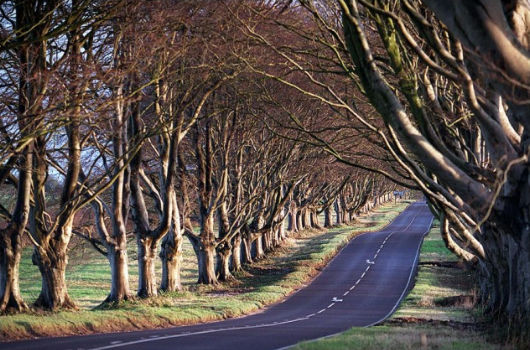
Look at this majestic avenue of trees on the Kingston Lacy estate in deepest dearest Dorset. The allee was planted by the art collector, architect, Egyptologist, MP, and adventurer William John Bankes, inheritor of the estate, as a gift for his mother. There are 365 trees on one side and 366 on the other, symbolizing a regular year and a leap year. The estate is now owned by National Trust, which has decided, to the protests of old tree experts (which is to say, experts on the subject of old trees), that twenty-one of them will have to be savagely cut down on the grounds of “health and safety”.

“We don’t want to fell these trees but we have a duty,” says a spokesman for the estate. “It’s a very busy B-road and the trees are only metres from the road. We’re following good Health and Safety practice.” Pity the poor fool, and weep for the beeches of Kingston Lacy.
The Catholic Herald

First Christian de Lisle, now Jennifer Roche: at this rate within a year everyone I know will have contributed to the Catholic Herald! (And, incidentally, I did have a brief chat in the Travellers Club once with the chap who wrote the piece on the Assumption).
I might just have to take out a subscription, though an electronic one — probably the most convenient for we across the seas — is still a hefty £38: at today’s exchange rate that’s seventy good ole American smackeroons! Probably worth it, though.
Humiliating Defeat in the Heart of Labour

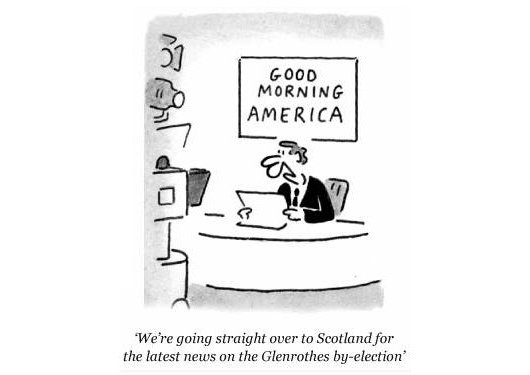
Well, it looks like they’ve done it: the SNP have slashed a Labour majority of over 13,000 to win the parliamentary seat of Glasgow East with a new Nationalist majority of just 365 votes. The Conservatives and the Liberal Democrats came third and fourth, but with 1,693 and 915 votes respectively, this was very much a two-pony race between Labour’s Margaret Curran (above, left) and the SNP’s John Mason (above, right).
While Glasgow East is deep in the heart of Labour territory, pundits were saying this was going to be a close one. The defection of Catholics is likely to have played a significant role in Labour’s defeat. In the past year, Labour have legalized the creation of animal-human hybrids as well as siblings designed solely for the harvesting of their organs, and this campaign has been vociferously opposed by Catholics around the Union. Mr. Mason made sure to thank those who had prayed for him in his victory speech.
“This is an absolutely remarkable result,” said Angus Robertson, SNP leader at Westminster, “it’s Labour’s third-safest seat — rock-solid territory. Now it’s over. People have had enough and Gordon Brown had better listen because at the next Westminster election the SNP is coming.”
This is the second “safe” Labour seat lost in a by-election in just three months.

Catholic backlash sinks Labour in Glasgow East
Cranmer:
SNP victory in Glasgow East – the Christians won it
the Daily Telegraph:
Labour suffers humiliating defeat as SNP celebrates
the Times:
Nightmare result for Gordon Brown as SNP triumph over Labour in Glasgow East
the Guardian:
Glasgow East byelection victory adds remarkable new chapter to SNP history
Google News:
Glasgow East
Trooping the Colour

At the Queen’s Birthday Parade on Saturday, the colour was trooped by none other than a friend of mine and fellow St. Andrean who is now an officer in the Welsh Guards. He is seen here, at right, in the costume of Field Marshal the Earl Haig (sometime Lord Rector and then Chancellor of the University of St Andrews) for the annual Kate Kennedy Procession.
Buckham’s Britain

 The Daily Telegraph shows us a number of photos taken by Alfred Buckham, an aerial photographer of the 1920s. Buckham was introduced to the art during his time with the aerial reconnaissance branch of the Royal Naval Air Service in the First World War.
The images themselves are composite photographs combining actual aerial views of cities and landmarks throughout Great Britain with views of the aircraft of the day flying through the skies.
As the Telegraph notes, Buckham “eschewed safety devices, saying: ‘I have used a safety belt only once, and then it was thrust upon me. I always stand up to make an exposure and, taking the precaution to tie my right leg to the seat, I am free to move about rapidly'”.
A new book on Buckham, A Vision of Flight: The Aerial Photography of Alfred G. Buckham, has just been written by Celia Ferguson, and is published by The History Press.
Return of the Warner!
 Gerald Warner of Craigenmaddie, one of Britain’s greatest living journalists, now has a splendid blog over at the Daily Telegraph called Is It Just Me? I am sure you will all want to take a look at it. Already he has an appreciation of the recently deceased Franz Künstler, until his death the last living soldier of the Hapsburg army, a brief missive pointing out how terribly un-British the idea of a “Britishness Day” is, and a forthright post on the value of the stiff upper lip in times of crisis.
Much of what Gerald says is, to sensible people, simply obvious. But one of the great dangers of our modern age is that what ought to be simply obvious is becoming less and less so due to deliberate obfuscation by the political and media classes. Gerald’s talent is that he tells you what’s what and that he manages to do it with a graceful alacrity, and often wit, that are a welcome — and, sadly, rare — treat. Go, read, enjoy!
Warneriana: Gerald Warner Axed | ‘The Mass of All Time answers that need’ | Martyrs of Spain, Pray for Us! | Warner on the Gotha
Professor Haldane in the Catholic Herald

The Catholic Herald talks to Professor Haldane about the Church’s failure to halt the revolting HFE bill that recently passed (the one authorizing animal-human hybrids and the creation of human “saviour siblings” in labs for organ harvesting) and they have a nice picture of the Good Professor in his sitting room at St Andrews. Prof. & Mrs. Haldane were always very welcoming to students and had a whole bunch of us over a number of times. As I wrote before:
He has a library to be envied as well.
In my very first year at St Andrews, I had the privilege of shaking the hand of none other than Mr. James Macmillan (Greatest Living Scotsman!) at Professor Haldane’s. Certainly one to remember.
The Crown of Disenchantment
Over in Great Britain, the House of Commons recently passed the Human Fertilisation and Embryology Bill which, among other things, keeps the time limit on abortions at twenty-four weeks (in spite a hope that it would be lowered), authorizes the creation of “savior siblings (brothers and sisters deliberately created in a lab solely for their organs to be harvested for use by the already-born), and allows for the creation of animal-human hybrids. The British human rights activist James Mawdsley, famously jailed for over a year by the military junta in Burma, has asked opponents of the HFE Bill to sign a petition to Queen Elizabeth II imploring her to withhold the royal assent necessary for the Bill to become law.
Under the British constitution, a bill only becomes a law when it has received the assent of all three components of the British Parliament: the Commons, the Lords, and the Crown. The last time the Crown withheld consent was in 1708 when Queen Anne refused to sign the Scottish Militia Bill. Since that time, it has been an unspoken convention that should the Crown object to a piece of legislation, it should privately inform its ministers before the legislation is voted upon in order for it to be withdrawn, thus preventing the scandal of the Crown and the Commons appearing to be in disagreement. Despite this convention, however, the Crown still has the right to withhold consent, but merely neglects to exercise that right.
While the Crown has faded to near-irrelevance in the everyday workings of the British government, this was certainly not always the case, and the Crown has intervened in politics several times since Queen Anne’s refusal of assent in 1708. What follows are but a few twentieth-century examples.
In 1925, William Mackenzie King was Prime Minister of Canada with 99 Liberal MPs to the Conservative opposition’s 116. He was able to do this by forming a minority government with the support of the 24 MPs of the Progressive Party. A year later, Liberal MPs were implicated in a bribery scandal and so the Progressives having withdrawn their support for the minority government. As parliament debated a motion to censure the MPs involved, the Prime Minister asked Lord Byng, the Governor-General of Canada (and thus the direct representative of the Crown), to dissolve parliament and call a general election.
Lord Byng did not want it to appear that the Crown was allowing parliament to be dissolved in order to prevent the censure of government MPs and so used the royal prerogative and refused to call an election. The Conservatives, as the largest party in parliament (Lord Byng argued), should have a chance at forming a government instead. The Governor-General invited Arthur Meighen, leader of the Conservatives, to form a government instead, and Meighen agreed. This, in turn, infuriated not only the Liberals but also the Progressives, throwing the middle-man back into the Liberal camp. Meighen put his government up to a vote of confidence, lost it by one vote, and so resigned and asked the Governor-General to dissolve parliament and call an election, which Lord Byng duly did.
“I have to await the verdict of history to prove my having adopted a wrong course,” Lord Byng wrote, “and this I do with an easy conscience that, right or wrong, I have acted in the interests of Canada and implicated no one else in my decision.”
In 1931, when the Labour Prime Minister Ramsay MacDonald submitted his resignation to the King, George V took the unprecedented step of asking MacDonald to form a national government with the support of Conservatives and Liberal Members of Parliament. MacDonald lasted as Prime Minister until 1935, but Great Britain would not be governed by a single-party government again until 1945.
More recently, the Crown controversially intervened in Australian politics in 1975. Gough Whitlam’s Labor government commanded a majority in the House of Representatives but the opposition coalition of the Liberals and the National Country Party held sway in the Senate. It is traditional in Westminster-style systems that if a money supply bill fails to pass, the government falls with it. The Senate refused to vote on the annual Budget, in hopes of provoking Whitlam into calling a new election. Whitlam stubbornly refused, and the impasse grew as the weeks passed and, with no budget approved, it looked like the government of Australia would not be able to meet its financial obligations for the year.
Finally, the Governor-General of Australia, Sir John Kerr, used the royal prerogative to dismiss Whitlam as Prime Minister, asked the opposition leader Malcolm Fraser to take the job. Fraser formed a caretaker government solely to pass the appropriations bill then immediately called a new election which his own Liberal/National Country coalition won handily.
Such royal interventions, however, are not limited to the English-speaking world. Belgium’s King Baudouin I, a Charismatic Catholic and friend of Francisco Franco, famously refused to give assent to a bill liberalizing the kingdom’s abortion laws. The Prime Minister, Wilfred Martens, simply had the King declared temporarily unable to reign and the Government signed the Bill in place of the King (as is provided in the Belgian Constitution). Two days later, the Government declared the King able to reign once more, and all was back to normal (except for the unborn children killed thereafter, of course).
One of the great benefits of a monarchy is this: that the Crown act as a source of authority, free from democratic accountability, who is capable of blocking any egregious acts which the government of the day may attempt. The HFE Bill is the perfect example of a bill the Crown ought to reject, for the benefit of all the kingdom, most especially the unborn. Yet we can reasonably assume that Elizabeth II will grant her assent to this travesty of law nonetheless, as the current occupant of the throne has (ironically) so thoroughly and woefully imbibed the democratic spirit that she knows not how to fulfill her purpose and duty as Queen. (It is important to note that in neither the King-Byng affair nor the Whitlam-Kerr affair was the Governor General acting on the orders of the actual person who was the Crown at the time, but rather on their dutiful instinct as the local incarnation thereof). It is disappointing to those who are unflinching in their attempts to defend the British Monarchy that the British Monarchy insists on participating in, and sometimes urging on, the very sort of wickedness which we look to the Crown to protect us from. Alas, so far we have looked in vain.
Athens of the North
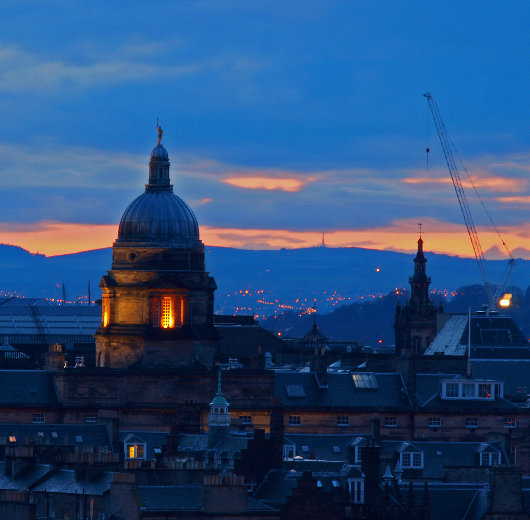
Photo: Steven Lees
Which Scots conservatism?
FOR THOSE WHO haven’t been keeping up with Caledonian affairs, Scottish independence has been brought onto the agenda by the victory of the anti-unionist, pro-independence Scottish National Party in the general election for the Scottish Parliament last year. The SNP victory comes after about half a century of solid domination of Scottish politics by the Labour party (now in regional opposition in Edinburgh, but still in power at the British parliament in Westminster). Yet an important portion of the electorate, while willing to vote the SNP into power — or at least to vote Scottish Labour out of power — have proved more reticent when it comes to the actual matter of ending the 300-year union between England and Scotland. While the SNP is riding high in Holyrood (the seat of the Scottish Parliament), support for Scottish independence is at its lowest since the discovery of North Sea oil.
This may seem like something of a contradiction, but Scottish voters are just trying to make the best of a tricky situation. Labour have proved unpopular both for national reasons (the war in Iraq particularly and Tony Blair in general) and for local reasons (Scottish Labour’s mismanagement during ten years in power at Holyrood and the presumption the Labour clique have that they are Scotland’s natural rulers and how dare anyone think otherwise). Of the five parties in the Scottish Parliament, the Nationalists are the only purely Scottish party — with Labour, the Conservatives, the Liberal Democrats, and the Greens all having either superior (or in the Greens’ case, co-equal) bodies in London. The best way of kicking out Labour was to vote SNP, and enough Scots thought it was worthwhile this time around.
That the Nationalists are a broad-based party has proved a great advantage. Beyond the central issue of their proposal to make Scotland independent, the SNP’s policies are, roughly-speaking, pro-business center-left. At the same time, their student federation is officially socialist, and they receive a fair amount of conservative support because conservatives tend to of a somewhat nationalist strain — and because the Scottish Conservatives give the appearance that they are more than comfortable to simply sit in Holyrood, collect their parliamentary salaries, and twiddle their thumbs. The Conservatives have always been a London-centric party anyhow, and under David Cameron it has become even more clear that it is a rural conservative party which exists in the hope of placing respectable metropolitan liberals in power. Faced with the choice of three liberal parties — the SNP, the Lib Dems, and the Conservatives — and pseudo-socialist Labour, Scots have made a sensible decision by choosing the liberal party which cares most for Scotland: the Nationalists.
But what, again, of this divergence: a party in government for which independence is its foremost purpose and a people who still seem content on (in some shape or form) maintaining the Union? Some in the opposition parties have seen an opportunity in this contradiction and have called for a referendum on independence to be held now; independence would almost (but only almost) certainly be defeated. Wendy Alexander, the Scottish Labour leader, surprisingly lent her support this idea before being forced by her superiors in London to issue a “clarification” opposing the idea. Those who support the continued union between Scotland and England, Wales & Northern Ireland would be wise to push for a referendum at the nearest moment and pull the rug from beneath the independence lobby.
But is the Union worth preserving? Ought conservative Scots to support the continuation of the Union or a move to independence? A unionist conservative might claim that by our very nature as conservatives we ought to support the status-quo and be wary of such far-reaching radical ideas such as ending three centuries of union. To which, of course, the nationalist conservative replies by asking why Scotland should be ruled by a London-based government intent on social and cultural revolution and the overthrow of all tradition. To which the unionist conservative replies that an independent Scottish government is just as likely to be the enemy of all that is good and holy as the London government. And so on and so forth.
Right-thinking Scots who condescend to involve themselves in politics are currently divided between two political parties — the Scottish Nationalists and the Scottish Conservatives — and that this hampers the cause of tradition, order, and liberty in Scotland.
What, then, should be done? The Scottish Conservative party is an inherently flawed vehicle for the advancement of conservatism in Scotland. The party itself only dates to 1965; before then there was a loose association of unionist elected officials who ran under various banners — Liberal Unionist, Scottish Unionist, Progressive, Independent, National Liberal, etc. It was only in that year that the Scottish Unionist Association decided to become the Scottish Conservative & Unionist Party, the official Scottish branch of the (traditionally English) Conservative & Unionist party. The fortunes of the Scottish Conservatives have gone downhill ever since, and there is a very strong cultural bias (sometimes even hatred) of “the Tories” in general that hurts the Scottish party.
There are two main options at hand. The first is that the Scottish Conservatives completely divorce themselves from the English & Welsh party, undergo a complete “re-branding” and transformation. The Conservative name will have to be dumped and there must be a clear indication that the party’s officials are willing to put Scotland’s interest first and foremost both at Westminster and in Holyrood. The disadvantage is that any new identity will still be tarred with the Tory brush and be denigrated as English lackeys.
The second option is for the party simply to be dissolved and for unionist conservatives to join their nationalist conservative confrères in the Scottish Nationalist Party to form a united bloc of sensible people in the party. The disadvantage of this option is that the center-left leadership of the SNP will have an obvious advantage in being able to shut out any former Tories from party positions. The anti-Tory cultural bias is so strong that expulsion may even be considered.
Still, if the SNP wants to be both the party of the Scottish people and the party of Scottish government it would be wise to fulfill two tasks: wooing Scottish Conservatives and reacting to the electorate’s reticence towards full independence. Despite the SNP having 47 seats in Holyrood to the Conservatives’ 17, the Scottish Conservatives are believed to have a larger membership than the Nationalists. Feet on the ground are one of the more important factors in winning elections, and the end of the Scottish Conservative Party could shift a great number of party activists into the SNP camp. On the second point, polls show the Scots voting down independence but being nonetheless dissatisfied with the state of the Union. Rather than the current process of revisiting which powers are “reserved” (kept in London) and which are “devolved” (decided at Holyrood) every few years, it might be better to seek a new concept of union altogether, with the preponderance of governmental power shifted from Whitehall to Belfast, Edinburgh, Cardiff, and English MPs voting on English affairs at Westminster (though some have suggested creating a new English parliament).
The danger here is that any significant reappraisal of the constitutional framework of the Union at this moment might result in any or all of the following: 1) even more power for the government; 2) a step towards the total dissolution of the Union; 3) republican moves towards the abolition of the monarchy. Unionist conservatives ought to oppose all three and nationalist conservatives should at least join in opposing further centralization and the abolition of the Crown, both of which would result in removing any checks on the power of Britain’s political class.
Indeed, perhaps that is the cause around which conservatives of all stripes should unite: opposition to the political class which has seized control of almost all the major institutions of public life in Great Britain and which guards its power jealously. The current political class, which replaced a more multifaceted Establishment (consisting of the commercial class, aristocrats, bishops, do-gooding campaigners, skillful parliamentarians, trade unionists, and the British officer corps) consists almost wholly of boring people who are carbon copies of one another. The fact that no political party currently opposes this political class and its consensus is likely the reason why Britons are so apathetic and unlikely to vote in elections. Peter Hitchens has suggested the first thing that must happen for this situation to change is for the Conservative Party to self-destruct and cease to exist. There are still in Britain today many deeply-conservative people who nonetheless vote Labour (or Lib Dem or SNP) because they feel culturally obliged to, or because they have inherited the bias against the Conservatives. Hitchens posits that the existence of the Conservative Party and the cultural hatred of it are the only factors which keep Labour going as a single party. If the Conservatives collapse, then Labour is soon to follow it (in this hypothesis) and once these two deep-seated “brands” are destroyed, there is finally the possibility of a truly conservative political force emerging; union-wide, not just in Scotland.
[First published in Taki’s Magazine]
Search
Instagram: @andcusack
Click here for my Instagram photos.Most Recent Posts
- Brunel’s Unbuilt Capitol February 3, 2026
- Cricket at Fordham January 27, 2026
- Palacio Barolo Revisted January 14, 2026
- Learning to Love Liguria January 14, 2026
- Crux Alba No. 2 January 13, 2026
Most Recent Comments
Book Wishlist
Monthly Archives
Categories