History
About Andrew Cusack
 Writer, web designer, etc.; born in New York; educated in Argentina, Scotland, and South Africa; now based in London.
 read more
News
Blogs
Reviews & Periodicals
Arts & Design
World
France
Mitteleuropa
Knickerbockers
Argentina
The Levant
Africa
Cape of Good Hope
Netherlands
Scandinavia
Québec
India
Muscovy
Germany
Academica
Muggeridge on Orwell
Read this interesting piece on George Orwell by none other than Malcolm Muggeridge.
“…the Laws of Nature and of Nature’s God…”
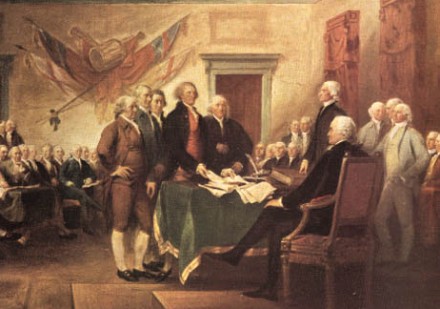
Detail from John Trumbull’s ‘Signing of the Declaration of Independence‘.
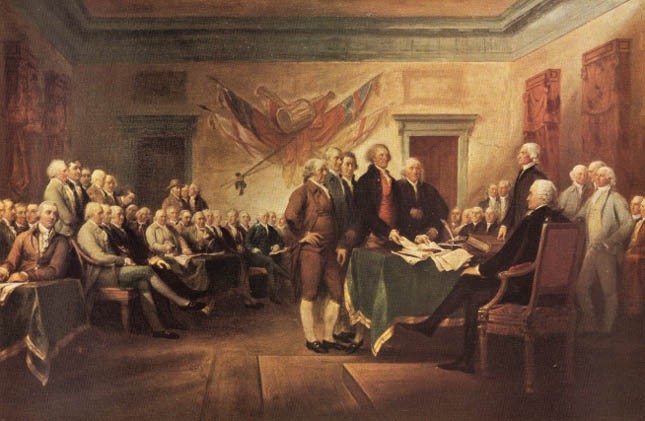
“When in the Course of human events, it becomes necessary for one people to dissolve the political bands which have connected them with another, and to assume among the powers of the earth, the separate and equal station to which the Laws of Nature and of Nature’s God entitle them, a decent respect to the opinions of mankind requires that they should declare the causes which impel them to the separation.
We hold these truths to be self-evident, that all men are created equal, that they are endowed by their Creator with certain unalienable rights, that among these are Life, Liberty and the pursuit of Happiness.”
Two-hundred-and-twenty-eight years ago today, three men with degrees from St Andrews signed the Declaration of Independence, and thus the United States were born (or so the story goes; their independence was only properly established in 1783). Those three were Mr. Benjamin Franklin (Hon. LLD, 1759), Mr. James Wilson (M.A., 1762), and the Rev. John Witherspoon (D.Div., 1764). Rev. Witherspoon was President of Princeton University from 1768 to his death in 1794, whereas Wilson became a justice of the Supreme Court after it was established. Both Franklin and Wilson went on to sign the Constitution as well, two of only eight people who signed both.
Totalitarian Pacifism
George Orwell: a man of remarkable prescience.
Via In Pectore.
On Reagan
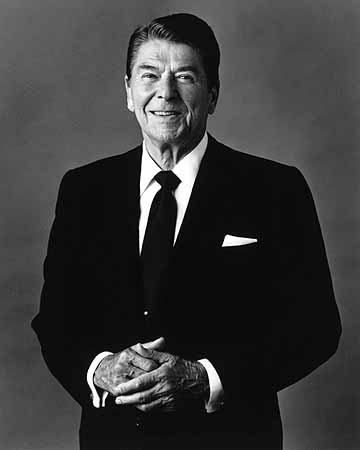
Those in the United States who think the Soviet Union is on the verge of economic and social collapse [are] wishful thinkers who are only kidding themselves.
Arthur Schlesinger, Jr., the famous historian, said these words two years into the Reagan presidency, reflecting the general attitude of the liberal establishment in America.
One year later, in March of 1983, Reagan made his famous speech in which he called a spade a spade. The Soviet Union was “an evil empire” and “the focus of evil in the modern world.”
Roger Kimball notes Anthony Lewis of the New York Times described the speech varyingly as “primitive — the only word for it,” “simplistic,” “sectarian,” “terribly dangerous.” Anthony Lewis sitting in the comfort of Manhattan could afford to make such judgements.
Natan Sharansky couldn’t:
In 1983, I was confined to an eight-by-ten-foot prison cell on the border of Siberia. My Soviet jailers gave me the privilege of reading the latest copy of Pravda. Splashed across the front page was a condemnation of President Ronald Reagan for having the temerity to call the Soviet Union an “evil empire.” Tapping on walls and talking through toilets, word of Reagan’s “provocation” quickly spread throughout the prison. We dissidents were ecstatic. Finally, the leader of the free world had spoken the truth – a truth that burned inside the heart of each and every one of us.
And it was only a few years later that the whole impressive edifice of communism came crashing down.
Lech Walesa:
When talking about Ronald Reagan, I have to be personal. We in Poland took him so personally. Why? Because we owe him our liberty. This can’t be said often enough by people who lived under oppression for half a century, until communism fell in 1989.
An Acceptable Marseillaise
It’s a tune we all know and love. And who can deny getting a bit sentimental during the scene in Casablanca when they sing it? But as all good traditionalists know, the lyrics to le Marseillaise are downright vulgar, republican, and revolutionary. So here we have reproduced the thoroughly-acceptable lyrics used in the die-hard Catholic region of la Vendée, and supposedly still sung today:
catholique,
Le jour de gloire est arrive.
Contre-nous de la République,
L’étendard sanglant est levé,
L’étendard sanglant est levé!
Ontondez-vous dans tchiés campagnes
Les cris impurs diaux scélérats?
Le venant duchque dans vous bras
Prendre vous feuilles et vous femmes.
Aux armes Vendéens! Formez vous bataillons!
Marchons! Marchons!
Le sang daux Bieux rougira nos seillons!
Perhaps this could be a marching tune for the annual Paris-Chartres pilgrimage?
Louis XVII, requiescat in pace…
An interesting story for all my fellow traditionalists.
PARIS – 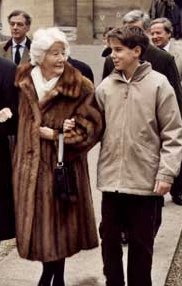 France laid to rest one of its most intriguing mysteries on Tuesday when it installed the tiny heart of Louis XVII – the son of beheaded king Louis XVI and queen Marie-Antoinette – in a royal crypt outside Paris.
European aristocrats were among the 2,500 people who packed into the Saint-Denis Basilica north of Paris to watch the 209-year-old heart in its crystal vase given a final burial after spending a long period as a much-traded curiosity in the wake of the French Revolution.
A 12-year-old descendant of France’s former royal family, Amaury de Bourbon-Parme, handed over the heart in a formal Mass broadcast to another 1,000 people watching outside. The presiding priest, Archbishop Jean Honore, paid homage to the “lost child who knew nothing of what he was and of what he is”.
Louis-Charles, 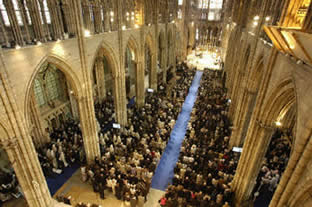 the so-called “lost dauphin” who would have reigned as Louis XVII, died of tuberculosis at the age of 10 on June 8 1795 in a windowless cell in the French capital’s Temple Prison, where he had been incarcerated with his parents before they were guillotined.
“This is a way to give this child-martyr, who passed away in tragic circumstances and around whom mystery swirled for more than 200 years, a proper death,” said Charles-Emmanuel de Bourbon-Parme, one of Louis XVII’s relatives.
(Agence France Presse)
Search
Instagram: @andcusack
Click here for my Instagram photos.Most Recent Posts
- Brunel’s Unbuilt Capitol February 3, 2026
- Cricket at Fordham January 27, 2026
- Palacio Barolo Revisted January 14, 2026
- Learning to Love Liguria January 14, 2026
- Crux Alba No. 2 January 13, 2026
Most Recent Comments
Book Wishlist
Monthly Archives
Categories