Cusack’s Diary
About Andrew Cusack
 Writer, web designer, etc.; born in New York; educated in Argentina, Scotland, and South Africa; now based in London.
 read more
News
Blogs
Reviews & Periodicals
Arts & Design
World
France
Mitteleuropa
Knickerbockers
Argentina
The Levant
Africa
Cape of Good Hope
Netherlands
Scandinavia
Québec
India
Muscovy
Germany
Academica
Back in the Swing of Things
Tonight at dinner we frightened the bejants and bejantines (first years) with our knowledge of random facts and history and the Ik tribe of Africa and even managed to engage one of the more comely new maidens in a plot to kidnap the Principal in order to reverse the creation of the new ‘Film Studies’ department and to get a smoking room for Sallies (St. Salvator’s, our hall). After dinner wound to a close we exited our splendid stained-glass-laden wood-panelled dining hall and headed to Jason Dunn’s room for some sherry. He has a very nice decanter and set he picked up dirt cheap from a charity shop. I’ll have to give them a browse sometime soon.
I also got a chance to catch up with Nicholas Vincent at his new abode on Greyfriars Gardens. It’s a beautiful and spacious place, “Victorian design but Georgian proportions” as Nicholas said, and I’ve actually been there before. Under the previous residents it twice acted as a sort of final locus for continued drinking after all the pubs and such had closed. I remember one night I ended up there with a small crowd including one of the wardens here at Sallies who I told I would buy two pints if he got me a place in hall (it worked), while Yaa’ra Barnoon was strumming a tune on the guitar, that most inferior of instruments, the exact opposite of the organ.
Tonight, after catching up via telephone with Rob who’s now teaching at Downside, the indomitable George Irwin, the most endearingly unpleasant person in all of St Andrews, had a little drinks party at which there were a number of usual faces; Phil Evans, Tom Kerr (PMC of the OTC), and Manuel Garces (Greco-Spaniard president of the Boxing Club), now shorn of his iconic sable locks, who spent his long vac cruising the Greek isles and lounging about (not bad). George begrudgingly allowed us access to a desirable bottle of whiskey which was left over from his sister’s recent wedding. (Apparently they were left with over 400 containers of orange juice, for the bucks fizz, and about 100 extra bottles of champagne, amongst other extras). I got a call from Jon Burke inquiring as to whether I was up for more fun and games, but alas the train for London tommorrow morning has encouraged me to call it an early night. Hoping to see a few old faces while I’m down in London, so it should be fun.
Room with a View
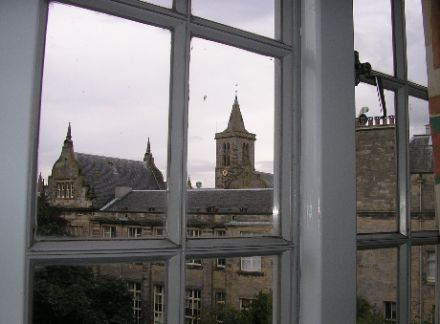
My room faces the Garden Quad (there’s a fine for walking on the Principal’s Lawn), and there is a good view of the college tower from the window.
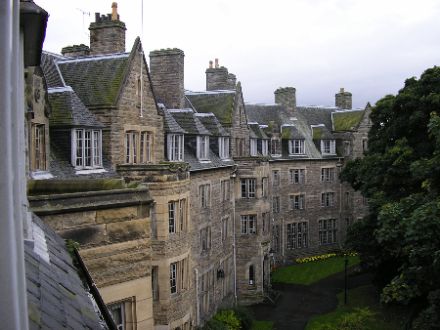
The view out the window towards the rest of the Hall. More later on, now I must rest!
Last Night in the Metropolis
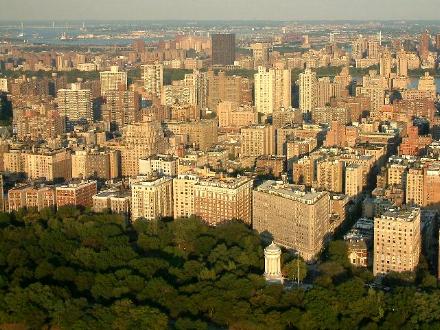
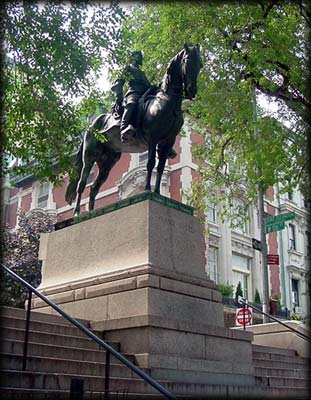
Last night I stumbled down into the city for the last time before I fly back to Britain tomorrow evening. I had the immense pleasure of taking a coffee with Adam Brenner and Dr. Nathaniel Kernell at Edgar’s Café on West 84th Street. Dr. Kernell, known varyingly as “the Good Doctor”, “Newbury”, “Mistah Lassitah”, and “the Genius of the Carpathians”, is the inimitable man who, in schooldays since past, had the task of teaching me Latin. (Our man Brenner is not a Thorntonian, but rather a Riverdale grad who had Dr. Kernell as a Greek and Latin tutor). His knowledge of subjects as varying as etymology, architecture, crime, and Jai alai is both profound and illuminating. Furthermore, he is gifted with a manner that is warm and inviting, if perhaps tempered by a tendency to ramble. The wandering tangents of Dr. Kernell, however, are not ad infinitum irritations but rather intriguing paths along which one picks up much more information, learning, and amusement than one would ever imagine. School would not have been the same without him, nor the quotations he bestowed upon our ears like priceless pearls. I foolishly only recorded a few in a little notebook I can’t find, but I believe Clara de Soto preserved more for posterity. I will have to get her to send me a few of the jewels.
Nonetheless dear readers, I’m back off to Caledonia tommorrow evening and thus of course it may be a few days before I settle in and get things organised enough to post again. I am, to boot, heading down to London pretty soon for the U.K. launch of the New Criterion as well. Fun shall be had by all!
Cassock Pursuivant
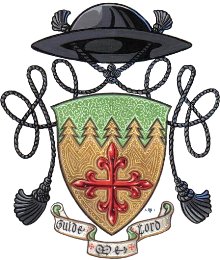 Last night the G&B played host to a lecture by one Fr. Guy Selvester, America’s ecclesiastical heraldist extraordinaire (arms at right). The good Reverend clearly has an unadulterated and unaffected love for heraldry, which, as he was very keen to point out, is unquestionably both an art and a science. He also has flaming red sideburns which give one the vague impression that he was a Civil War chaplain in a past life. After a brief introduction from a member of the G&B’s heraldry committee, the cassocked Father Guy gave a very clear and well-delivered talk, amply displaying his broad and deep knowledge of the subject, especially when responding to off-the-cuff inquiries from the audience.
Of course no talk on ecclesiastical heraldry would be complete without mentioning the late Bruno Heim, the expert on church heraldry as well as Grand Prior of the Constantinian Order and the first full papal nuncio to the Court of St. James since the Reformation. Heim’s book Heraldry in the Catholic Church (available in the St Andrews University Library) is the essential work on the subject. Fr. Selvester interestingly pointed out that Blessed Pope John XXIII intended to found a heraldic authority for the Church. He was dissuaded from this task by none other than Archbishop Heim, who believed the Church covered too far broad a swathe to effectively and appropriately constitute its own heraldic authority mindful of the vernacular traditions. (more…)
What To Do When You Find a Hohenzollern in Your Study

The man of letters, of course, needs a place in which to withdraw from his various dalliances in the social realm and to concentrate on the dominion of learning; a private place in which to enjoy a book, broadsheet or other periodical, or perhaps to brood in a comfortable chair with a dram of scotch and some sound music. The ladyfolk, needless to say, have no place in such a bailiwick, not even to clean, for the wise gentleman knows that a study which accumulates in dust likewise accumulates in a certain intangible value. After all, what man of letters does not relish in removing his 1928 Burns and Oates edition of Martyrs of the Upper Volta from the shelves, blowing the dust from the cover, and charging inwards to read of some blessed soul who met his end in a steamy cauldron?
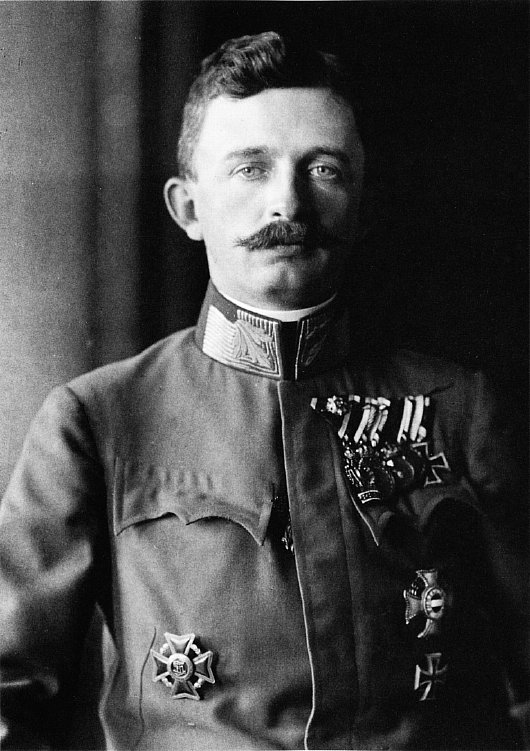
What then could throw arcadian bliss into disarray quite as much as the sudden appearance of Kaiser Wilhelm? A Hapsburg? You may as well have invited! A Bourbon? Well, fair enough, they have been known to lose their heads. But a Hohenzollern? You’ve got your work cut out for you.
Once considered the seminal work on dealing with Spontaneous Hohenzollern Appearances (or ‘SHA’), Dr. Leo von Fulbreck’s Treatise on the Treatment of Hohenzollernitosicity (to use the old, politically-incorrect term for SHA), has since been discredited, perhaps unjustly due to the Sparticist leanings of the Thuringian professor. The 1919 U.S. War Department guide War Department Field Guide 24-R: Recommended Courses of Action in Event of Hohenzollern Situation (and its appendix 24-R(II) dealing with the Hohenzollern-Sigmaringen branch) perpetuated the essence of von Fulbreck’s theories shorn of their ideological slant. The Second-World-War-era Your Enemy: the Sudden Hun-henzollern released by the British Department of Information, however, is generally considered unreliable. Combing through all this mess, I have endeavoured to deliver as part of my contribution to learning the most well-researched, as well as concise, recommended course of action regarding the spontaneous appearence of Hohenzollerns in one’s study:
1. Give the man a stern, intense, but unprovocative stare (as exemplified in above illustration) and he will eventually be moved to tears, mourning the loss of Tanganyika.
2. Simultaneously ring the bell (or, if one’s home is electrically-equipped, press the buzzer) and ask one of your staff to contact the Doorn Home for the Dethroned and Bewildered to inform them that one of their patients is on the loose.
3. Offer a stiff drink and wait for the men from the Doorn Home to arrive.
With any luck that should suffice, and unfortunate mishaps will hopefully be avoided.
The Winding Down of Summer
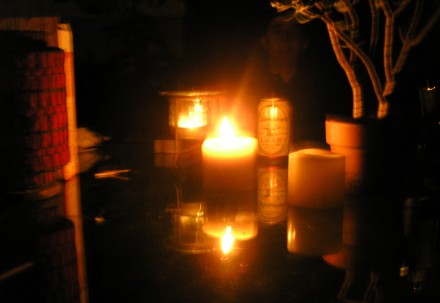
The summer pretty much began in Caroline Gill’s garden, and thus it appropriately played host to a little gathering last night as the season of leisure winds down. The Gills held a splendid little dinner al fresco including Mr. and Mrs. Gill, Caro, Michelle Carroll, yours truly, Mr. and Mrs. Kellogg and their son Doug, who I believe was Caro’s escort when she debuted. (I was unavailable since I was in Scotland at the time, which has been the cause of perennial complaints by Caro). Young Lizzie was absent for the meal but showed up later on in the evening.
Making fun of Caroline is an honored pasttime of mine, and one in which I revel. The Gill household is one in which friendly banter thrives. Last night I also got a chance to inform Mr. Gill that there are innumerable young men in Westchester who consider him something of an icon, and seek to imitate his leisurely lifestyle. Caro complains that I talk to her dad more than to her, which is only half true of course.
Speaking of dads, the aforementioned Michelle Carroll’s pop took her, Helen Clarke, and I out to dinner the night before ‘Hell’s Bells’ (as we sometimes call Helen) fled back to college in Ohio. He took us to a little gem of a place on the New York side of the Byram river in Portchester. Between dinner and dessert, Helen and I walked over the bridge to Connecticut just so I could say as we went back in “sorry we took so long, we went to Connecticut to have a cigarette.”
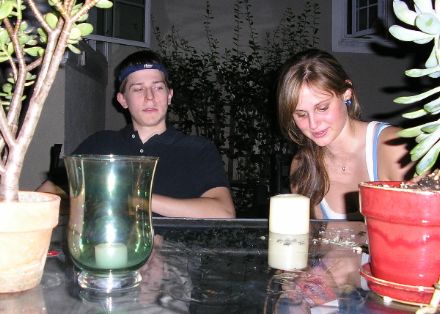
Doug eyes Lizzie’s match-fiddling with suspicion.
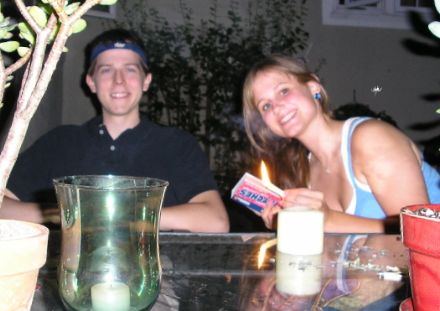
Smiling young Elizabeth about to set her hair alight.

Caroline Gill, brought to you by Poland Spring (“what it means to be from Maine”).
Bisset versus the Banana
My fellow St Andrean Andrew Bisset reports in from auld Caledonia, recently incapacitated by a banana:
Deserved indeed!
First Day on the Job

WHA-PSH! WHA-PSH! Behold! The sound of the whip cracking as slavedriver James Panero, associate editor of the New Criterion corrals the newly-minted intern towards his desk. Not even a cubicle! Yes, dear reader, today we started our month-long internship at the venerable institution which the Times Literary Supplement says is “more consistently worth reading than any other magazine in English”.
“File these press clippings!” the seersuckered Mr. Panero commands. “Update the website! Polish the bust of Hilton Kramer! You will KNEEL when Roger Kimball speaks to you!” “Actually, he prefers grovelling,” Dawn Steeves chimes in, ever helpful.
No, no, dear reader, I jest. It is a good office with kindly folk. Roger Kimball even remembered that Russell Kirk went to St Andrews. The building was designed by Stanford White, no less, and is on the same block as the Theodore Roosevelt Birthplace Museum. The office features nice wooden floors, a Persian carpet, and a window specifically designated for Judge Bork to smoke out of when he visits, not to mention a dazzling array of books and periodicals to tempt the studious intern from his internical duties. James Panero and Stefan Beck are apparently working on an anthology of the Dartmouth Review‘s best (TDR is sort of the Neo-Hantonian version of the Mitre, or perhaps vice versa). But we mustn’t turn this into the “weblog” that squeels on the daily habits of todos los Nueva Criterionistas.
The only down side is that I had to pull out of the Leviathan Club trip to Maine. It would be rather nice to spend the days drinking champagne on a rowboat in the middle of a lake pretending to fish, but come on folks, we’ve got high culture to think about here. I hope the other Leviathanonians are enjoying themselves, and spreading the spirit of Gumpus to more northerly climes.
And to think, I used to believe that internships were for suckers. What? Work and not get paid? AH-HAhahaha! Go right ahead, while I take leisurely sips of my gin-and-tonic as I rest salubriously upon the hammock in my garden dabbling in F. Scott Fitzgerald and some Italian detective novels! Well, needless to say, I now realize that internships are not for just suckers. Nay, they are also for charitably-minded individuals who would like to devote some of their free time towards the advancement of Western civilization. Happily, the latter description aptly suits yours truly. I look forward to another day as the lowest rating aboard the S.S. New Criterion. Criterion Nova floreat!
Forty-fourth Street
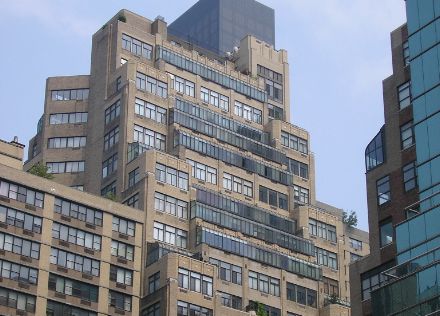
I caught this glimpse of an apartment building on 44th St today, and rather enjoyed the uniform appearance of the glassed-in terraces, later additions I imagine.
Crossword Woes
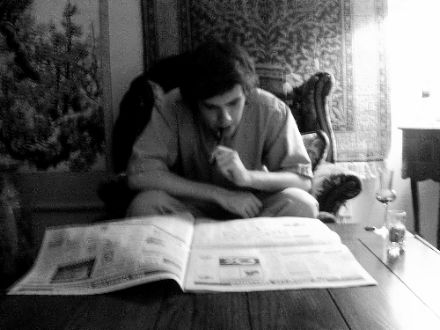
A view of yours truly last night at the Leviathan Club taking a stab at the crossword in the New York Observer. It was a vicious crossword which I found impossible to complete. Vicious, wretched crossword.
John Lamont in N.O.R.
We had something of a late evening last night at the Leviathan, in which I curiously had the chance to sample – perhaps that word is too modest, imbibe would be more accurate – a port which was, well, not a port. It was a port of New York, and I am not referring to the riparian locus wherein multifarious containers of a universal design speed cheap imported goods from the Orient to our fair city and beyond. Nay, the port was a fortified wine which claimed Long Island as its place of birth. Was it any good? Well, it was a little too fruity for my tastes, but then I’m a man of simple (some would say bland) tastes.
The Leviathan, for those who have not the pleasure of knowing it (which I take to be most of you) is a unique private club open to a select few young gentlemen and their occasional lady guests. It is not so much a club, but a private home which, given the absence of the parents off in foreign climes for rather extended periods of time, has been turned into a private club by the ingenious only child who is its sole permanent inhabitant. The club has a high proportion of members of French Canadian extraction, and features an interesting collection of Russian artifacts, provenance “unknown”.
As I was saying it was a late night, or rather late in Cusack terms as I left at half past one in the morning, and I am told the last members left around the hour of three. I nonetheless awoke this morning and took the train down to Manhattan and heard the resplendent treasure that is the Tridentine mass said in all its glory at the Church of St Agnes.
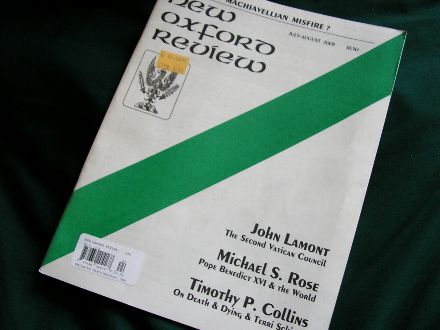
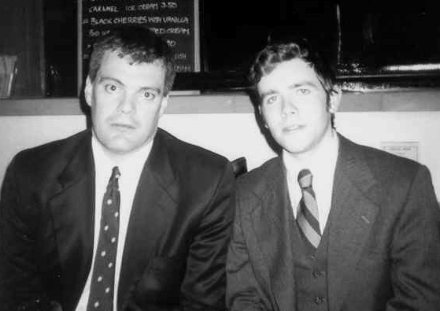
Whilst jolloping through the Hudson News shop in Grand Central, in the vain hope of being able to flip through a grievously overpriced imported latest edition of Country Life, I stumbled upon the latest issue of the New Oxford Review, the cover of which claimed that an article by John Lamont lay within. Delving into the formerly Anglican now ardent traditionalist Catholic publication I found that indeed it is the John Lamont we know and love. (He is also known as ‘Big John’ owing to his heighth and to differentiate him from the comparitively ‘Little Jon’ Burke).
Anyhow, Big John is the Gifford Research Fellow at St. Mary’s College, the School of Divinity at the University of St Andrews. He and I are seen below in a photo taken by Rebecka Winell at a dinner in the Byre Theatre organized by Miss Victoria Truett in Candlemas term 2004.
Public Elitism
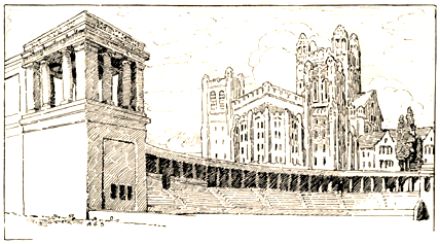
The Manhattan Institute‘s splendid City Journal of Spring 1999 carried an article worth a read entitled ‘How Gotham’s Elite High Schools Escaped the Leveller’s Ax’ on the few quality public schools left in the City of New York and how they managed to stem the tide of egalitarian senselessness.
Egalitarianism is one of the most morally repugnant of all ‘Englightenment’ ideas. To look upon success, label it “unfair” or “racist”, and then demand that, as a sacrifice to the false-goddess Equality, all must fail. It is the typical socialist formula that it is better that all wallow in poverty rather than only some (or even many but not all) succeed.
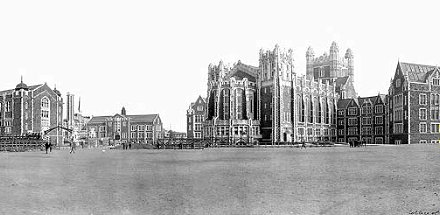
So a number of these high schools have survived. It is perhaps even more of a shame that none of the colleges did. City College was once known as “the poor man’s Columbia”. The quality of education at both City College and Columbia fell as a result of the cultural revolution of the 1960’s and 70’s. Columbia, for the most part free from the fetters of state intervention, never hit rock bottom and in many ways remains a quality institution, despite the highly politicized and racialized nature of many of its students and faculty. City College, however, went into freefall. Admission was thrust open to anyone who had graduated from a New York public high school, which coincided with the lowering of graduation requirements by these high schools. Thus you had students who could barely read and almost certainly could not write attending an institution which prided itself on its many Nobel laureates.
It is testament to the levelling zeal of the angry left that not even one college, not even one, within the entire City University of New York was allowed to maintain high standards of academic achievement. They will tear down with savage avarice the highest ideals of civilization to quench their destructive thirst. And these are colleges which for decades had been the ticket to freedom and success for hundreds and thousands of economically-disadvantaged New Yorkers. (Imagine if they had gotten their hands on the independent places of learning!). No wonder there are so many stupid people in New York these days.
But at least the high schools are still there, and calls for their emasculation are now few and far between. True, they are not ideal, but can we realistically expect a government-tethered school to be as such? Of course not. We should be glad that there remain at least a handful of public academies of high standards in New York available to all – rich, poor, and anywhere in between – based purely on merit.
Scruton to America
 No sooner had I read in the Independent that the eminent philosopher Roger Scruton is moving to America than Mrs. Peperium sends me this article from the local paper about the historic home the Scrutons are moving into.
I am sure Professor Scruton, a keen huntsman, will enjoy the Virginia hunt country. In Britain, of course, the traditional English pasttime of foxhunting is illegal and thus the police must take time from fighting and preventing terrorism to try to enforce ridiculous class-warfare laws.
Dr. Scruton, America welcomes you with open arms!
Rowing in Pelham Bay

During the past fortnight, I have been learning to row on the lagoon in Pelham Bay Park, a body of water with which I had no previous aquaintance. “Learning to row?” you ask. “But weren’t you in the University of St Andrews Boat Club during your bejant year?” Yes, dear reader, I was a full paid-up member of said body, but I was too busy avoiding lectures, failing courses, and other such frivolities of one’s first year at university to actually row, and only went to circuit training when Ezra Pierce irritated me enough that I felt obliged to give in and head on over. Nonetheless, at the suggestion of a good friend I decided to enroll in this program and have not regretted it at all. Rowing, in short, is addictive, and it is a grand shame that I shall have to wait until at least September in Scotland to get back on the water. (Above, the Travers Island clubhouse of the A.C. can be seen from the far end of the lagoon). (more…)
Films Recently Viewed
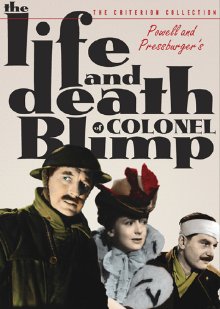
| The Life and Death of Colonel Blimp 1943 Directed by Michael Powell and Emeric Pressburger. A fine film, worth seeing. I’ve spied a few Blimps-in-training at the Mess in Wyvern. Also, Theo Kretschmar-Schuldorff is a heck of a good name for a character. |
 |
| La Grande Illusion 1937 Directed by Jean Renoir. I enjoyed this film greatly. It made me wish I had been a WWI pilot shot down by the Huns just so I could be invited to luncheon with the German officers. Everyone comported themselves well in those days (or at least in the cinema version of those days). According to IMDB, the Viennese Erich von Stroheim had spent so much time in America that he could barely speak German when the film was made. |

|
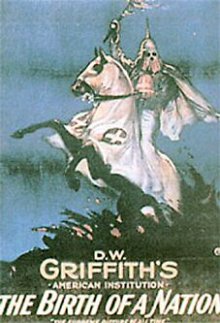
| The Birth of a Nation 1915 Directed by D.W. Griffith. Disturbing. The film’s basic premise that the United States was forged as a nation by the white knights of the Ku Klux Klan is balderdash, pure and simple. Still, a powerful and remarkable propaganda film. “It is like writing history with lightning, and my only regret is that it is all so terribly true,” said Woodrow Wilson, whose Southern racism most modern liberals like to ignore. |
|
| Alexander Nevsky 1938 Directed by Sergei M. Eisenstein, score by Sergei Prokofiev. More brilliant propaganda, this time for the USSR, not the KKK. Beautifully shot, but the battle scene is a tad too long. Though very nationalistic, it is not hard to see the communism behind the film in a number of scenes. Found the only slightly veiled swastikas on the mitre of the Teutonic bishop rather droll. |

|
| The Battle of Algiers 1965 Directed by Gillo Pontecorvo, score by Ennio Morricone. My second viewing of this splendid film. Colonel Mathieu: “There are 80,000 Arabs in the Casbah. Are they all against us? We know they’re not. In reality, it’s only a small minority that dominates with terror and violence. That minority is our adversary; we must isolate it and destroy it.” And they did. Still managed to lose Algeria though – which was a damn shame for the Algerians. |

|
The Carbuncle Responds
Well our favorite Jewess-turned-evangelical-turning-Catholic, Miss Dawn Eden, picked up on the complaints yours truly had about the Brooklyn Museum in her weekly Daily News column (scroll down, “A Boil Grows in Brooklyn”, NY Daily News, July 10, 2005). Well folks, someone at the B.M. must’ve been reading because later in the week upon collecting our mail I received an envelope from none other than the Brooklyn Museum itself.
The contents? Four free guest passes and a brief missive:
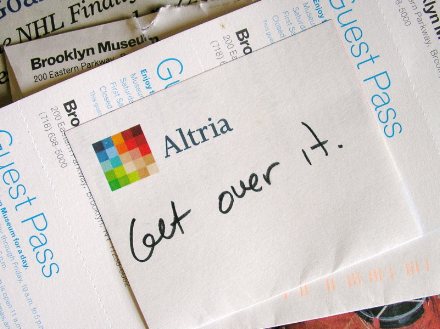
I laughed out loud when I read it. I’m glad they have a sense of humor, though it doesn’t make up for the new entrance. Nonetheless, I shall take them up on their offer. Perhaps the carbuncle is not quite as grievous in the flesh. Perhaps it’s worse. It remains to be seen.
The last time I went to Brooklyn (so far as I can remember) was to Fort Hamilton, one of the few remaining military installations in the city, back in 2000. It was Independence Day and my uncle was leading the artillery battery firing the salutes at the incoming tall ships for OpSail 2000.
Shenorock
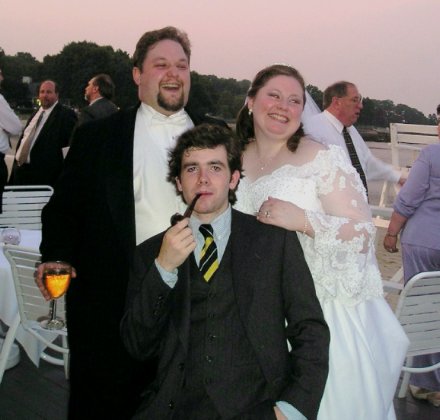
The more deductively inclined amongst you, dear readers, shall of course have extrapolated two conclusions from the above photograph. First, there has been a wedding. Second, I have obtained a pipe. Huzzahs all around.
I have known the young lady formerly known as Katie Lennon as long as I can remember, and I’ve known Brendan Daly more or less as long as they’ve been an item. The twain were joined in a happy and blessed union on Saturday afternoon at the Church of St. Joseph in Bronxville, and we all wish Mr. and Mrs. Brendan Daly a fruitful and happy marriage. The reception followed shortly afterwards at the Shenorock Shore Club on Milton Point in Rye, New York.
I had not really been to Shenorock in a number of years but many a day in the Cusack childhood was spent there, especially during the summers. We kids generally found it disagreeable while our parents found it an ideal place to unwind. Some summers my mother worked the 7:00pm to 7:00am shift at Lawrence Hospital in Bronxville. She would come home from work in the morning, wake my brother, sister, and I, pile us into the car, pick up the Lennon children and the McKegney children and head to Shenorock. We were kept busy at the club’s day camp while Mum slept on the beach for a five or six hours, read when awake, then collected us all again, dropped us off at our homes, fed us Cusacks dinner, and headed off to work.
For some reason I never liked going to Shenorock as a kid but nonetheless the place is a fountain of fond memories as I grow older. Just the other day a few of us were sitting in Scott Bennett’s back garden; Scott and I reminisced about summers at Shenorock, kickaboo juice, and crazy Mr. A (the summer camp’s director). Tommy Lennon (who’s my age, the younger brother to Mrs. Daly) and I would built forts and castles on the beach and man them with those little green plastic army men. Barbecues in the wooded Bowery were frequent, and of course the magnificent fireworks display for the Fourth of July was an annual obligation (who can forget the grand finale!). Strangely, we kids also had a pronounced hatred for Coveleigh, the neighboring club. (For some reason there was no similar disliking of the American Yacht Club, also on Milton Point on the other side of Shenorock). They were the France to our Germany and for some reason amongst us young’ins the rivalry was passionate. Of course now that I’m an old man Coveleigh’s bowling green grows more and more attractive.
Shenorock’s home on Milton Point is easily the most beautiful spot on the Westchester coast (only Red Bridge and Manor Park come close to challenging it). A seemingly permament breeze rolls off the Long Island Sound and keeps the Summer Clubhouse with its long, awninged deck overlooking the sandy strand at a comfortable temperature. The Winter Clubhouse across the street overlooks Milton Harbor and the dining room once afforded an excellent prospect of the Twin Towers all the way down in Manhattan. A happy place with happy memories.

The large beach in the center belongs to Shenorock, with the large summer clubhouse on it with flanking cabanas. The winter clubhouse and dock are on the other side of Milton Point, on Milton Harbor. Coveleigh is at the top right, and the American Yacht Club at the bottom left, covering the end of the point.
From Google Maps
And the pipe, dear reader? What a felicitous gift! It was a present from my old school friend Lev Trubkovich (aka Leviathan), who even chucked in some tobacco from Nat Sherman. The last time I had enjoyed the pleasures of the smoking pipe was deepest winter amongst our friends in New Haven. Places where we have smoked our pipe so far: on Red Bridge, watching the world (and the geese, and the swans) pass by; in my hammock in the back garden whilst reading; in Pelham enjoying the company of Nick Merrick, Panda, Simon (also called ‘Generalinnimo’ owing to his short stature), and Miss McGarry; and finally, planted in a deck chair at Shenorock on Saturday evening. We hope we shall find many more places to enjoy our pipe.
Brownson on the Scholar
Behold, the Power of Myth
“Live 8 Hype Recalls Triumph of Live Aid” sounds forth the headline of a recent Associated Press article. Read the article, if you dare. It is exhibitive of the decline (or is it death?) of modern journalism. It is completely lacking in any inquisitive or challenging spirit and one would not be terribly foolish to mistake it for a press release of Live 8’s public relations department.
Now, arguably Live Aid may have been a triumph in the sense of it being a highly-sucessful rock concert, but as a humanitarian endeavour it was far from anything approaching a ‘triumph’. Much of the money raised, after all, merely lined the pockets of Ethiopia’s evil dictator Mengistu who, it should be recalled, pretty much started the famine in the first place. (A starving populace is much easier to control). Yet the only negative thing the article has to say is mentioning the few fumblings of the hastily-organised 1985 shindigs. The writer – ‘journalist’ if flattery is your wont – merely adopts a commonly-accepted myth and accepts it unreservedly as fact. Journalism? Balderdash!
A Note on St Andrews
St Andrews is, in many ways, a little oasis which we have been blessed with the pleasure of enjoying. Edinburgh is close enough to make journeying there feasibly, yet far enough to make it still a slight effort to go there. We have a library which, though not comparable to Alexandria of old nor Bodley’s or Congress’s of late, has a wide and deep breadth and enough to keep us occupied. We have beautiful beaches, divine strands on which to saunter, rest a while, exascerbate ourselves, paddle in the waves, or converse with a friend. We have a number of good bookshops in which to peruse ancient volumes. We have myriad cafés in which to read our books, and pubs in which to stir our minds over pints of bitter. We have a style of teaching which allows ample time to wander the library, ambulate down the sands, explore the booksellers, enjoy our drinks. We have, most thankfully, a community of orthodox Catholics and fellow travellers, saints and sinners, which provides sufficient good times and fellowship that one imagines we’d be happy even without our beaches, libraries, cafés, et cetera. We have an entire lifestyle of tradition, thought, worship, and enjoyment. It was ever thus, we are told, and ever thus it shall be, God willing.
Search
Instagram: @andcusack
Click here for my Instagram photos.Most Recent Posts
- Brunel’s Unbuilt Capitol February 3, 2026
- Cricket at Fordham January 27, 2026
- Palacio Barolo Revisted January 14, 2026
- Learning to Love Liguria January 14, 2026
- Crux Alba No. 2 January 13, 2026
Most Recent Comments
Book Wishlist
Monthly Archives
Categories