Church
About Andrew Cusack
 Writer, web designer, etc.; born in New York; educated in Argentina, Scotland, and South Africa; now based in London.
 read more
News
Blogs
Reviews & Periodicals
Arts & Design
World
France
Mitteleuropa
Knickerbockers
Argentina
The Levant
Africa
Cape of Good Hope
Netherlands
Scandinavia
Québec
India
Muscovy
Germany
Academica
‘The Feast of St Nicholas’, Jan Steen
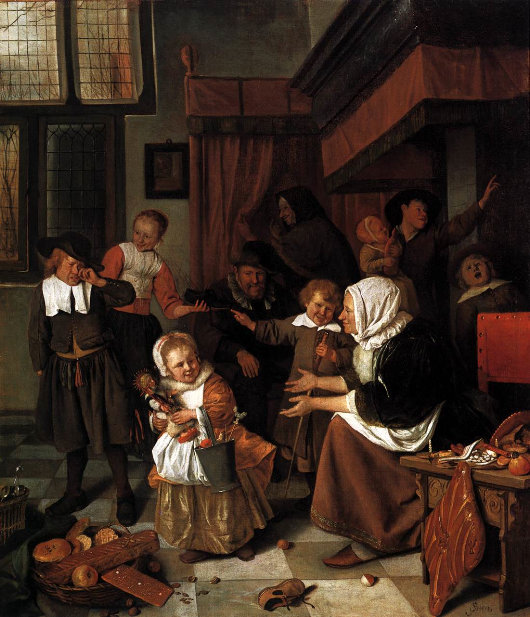
1665-68, Rijksmuseum
Patron of the Knickerbockers, pray for us
The Sovereign Scotch Order of Whisky
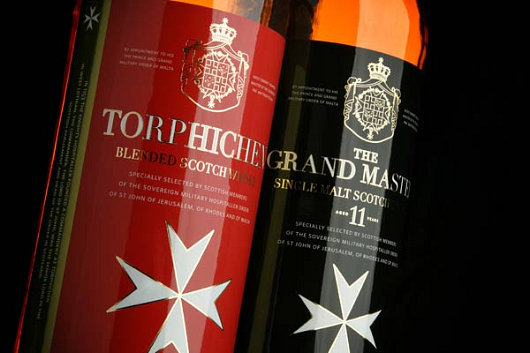
The Order of Malta recently paired up with Scotland’s own Adelphi Distillery to produce two variants of Scotch, proceeds from the sale of which support the Order’s worldwide charitable efforts. Adelphi produced a single malt called ‘The Grand Master’ and a blend named ‘Torphichen’, after Torphicen Preceptory, the headquarters of the Order in Scotland until the Reformation.
The last Preceptor of the Order in Scotland lamentably converted to Calvinism, surrendered the Order’s lands to the Crown (which were then re-granted to him specifically), and received the title Lord Torphichen (pronounced Tor-fikken).
Unlike most peerages, that of Lord Torphichen can be inherited by any assigned heir. In practice, it has descended through the Chiefs of Clan Sandilands, but in principle the holder could decide to designate any old Tom, Dick, or Harry as the next Lord Torphichen. (more…)
Notes of the Netherlandic Church II
Archbishop Eijk chooses tradition-friendly priest as his cathedral rector
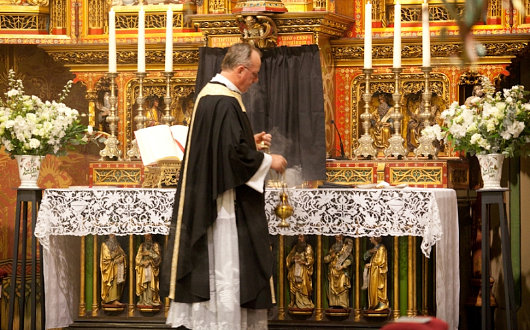
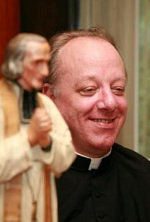
Fr. Harry Van der Vegt
The Archbishop of Utrecht & Primate of the Netherlands, Wim Eijk, has chosen a priest well-known for friendliness to traditional Catholics as the rector of his own cathedral. It was announced recently that Father Harry Van der Vegt is to be appointed rector of the Cathedral Church of St. Catherine in Utrecht, effective January 1, 2010. The priest will also be pastor of the Augustinuskerk and of St. Willibrord’s (which was the subject of the last Dutch church update).
Erik van Goor, of the Dutch periodical Bitterlemon, describes Fr. Van der Vegt as a “quiet but sturdy peasant’s son”. In the face of opposition from Modernist clergy and laity, Fr. Van der Vegt has been known to keep his cool, van Goor says. “Without making a political game of it, without showing any sign of reduced loyalty to the Church as it exists in the Netherlands, he remained quietly loyal to the tradition of the Church.”
“The appointment of Van der Vegt is actually a bit of a surprise”, notes one Dutch blogger, “because Archbishop Eijk is not really known as a major supporter of the old rite.” His Excellency was nonetheless responsible for normalizing the situation of the traditionalists of St. Willibrord’s Church in his diocese, mentioned previously.
Fr. Van der Vegt is currently serving the traditional faithful of Deventer in the province of Overijssel, and his new appointment will likely leave those people without a traditional mass for the time being. However, as Fr. Van der Vegt will be assuming control of St. Willibrord’s, the two FSSP priests currently there will probably be reassigned. The two currently travel all across the Low Countries, offering masses in Amsterdam, Bruges, Rotterdam, and elsewhere.
Parishioners at St. Willibrord’s, meanwhile, hope the new priest will say the extraordinary form at a more advantageous hour; it is currently said each Sunday at 5:30 in the evening.
Foundation ‘Ecclesia Dei’ Delft Releases 2009 Report
The Foundation ‘Ecclesia Dei’ Delft has released its latest report on the state of tradition in the Netherlandic church. ‘Ecclesia Dei’ is a group of Catholic faithful attached to the traditional liturgy as codified in the 1962 missal, and exists for the promotion of Catholic orthodoxy and specifically the liturgical tradition of the Church. In gauging the response to Benedict XVI’s motu proprio Summorum Pontificium, the report finds that “the Dutch Bishops Conference did not define a common policy concerning the implementation of the motu proprio.” The general attitude of the bishops is described as one of extreme passivity, “discouraging requests, ignoring the traditional liturgy, and keeping the faithful in ignorance of the motu proprio by a lack of information combined with disinformation about the traditional Latin liturgy.”
The report posits that bishops are primarily “afraid of the opposition by the modernist-infected priests and/or parish boards.” Many ordinary orthodox Catholics in the Netherlands are disillusioned with the strident Modernism that has infected much of the local church, and the bishops are said to fear “polemics” and “discord” even though, the report states, “they have not undertaken any measures to solve these problems for many years”.
On the teaching of the traditional liturgy in Dutch seminaries, the report confirms that instruction about the extraordinary form is almost nonexistent.
“However, since March 2009 and against the opposition of a number of priestly staff members at the seminary of St. Jan in ‘s-Hertogenbosch, a course about the theology of the traditional Latin liturgy has been given, but only because some of the seminarians claimed to have the right to it and showed a letter from the Pontifical Commission Ecclesia Dei.”
“As a result, 8 of the 12 seminarians now attend a private traditional Latin Mass three days a week at that seminary, despite the opposition.”
“In some diocese the situation has been improved in the first year of the motu proprio only by the initiatives of individual, relatively young priests.”
Some priests have attended German-organised training sessions, while others have received instruction from the FSSP priests in Amsterdam.
“Most of these priests are celebrating the traditional Latin liturgy in private and some even weekly in public now.”
As for the news of the specific dioceses of the Netherlands, much has already been written about the primatial see of Utrecht. In the Diocese of Haarlem-Amsterdam, Bishop Punt is prepared to grant FSSP a personal parish, from which the priests can work all over his diocese. Talks are ongoing. In other dioceses, however, foot-dragging, lip service, or ignorance of requests have been the norm.
Our Cardinal & Our Seminarians
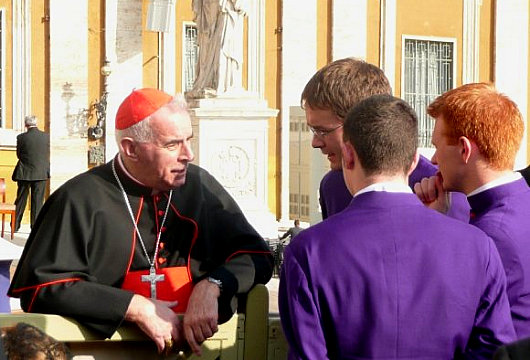
His Eminence Keith Patrick O’Brien, Cardinal Archbishop of St Andrews & Edinburgh, Primate of Scotland, has a wee chat with a triumvirate of seminarians from the Pontifical Scots College, Rome at the Holy Father’s weekly general audience. St Andreans (or at least Old Canmoreans) will recognize the ginger chap at right, attentively listening to the Cardinal’s words. I caught up with him in August when he had just a week to go before heading to seminary.
Argentines Recall Blessed Emperor
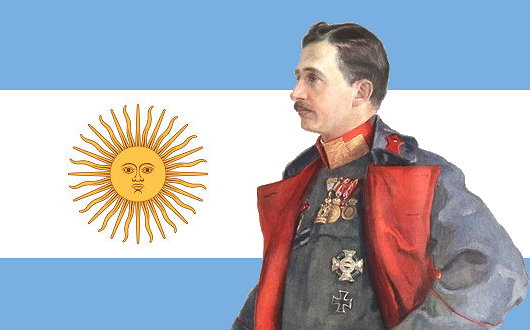
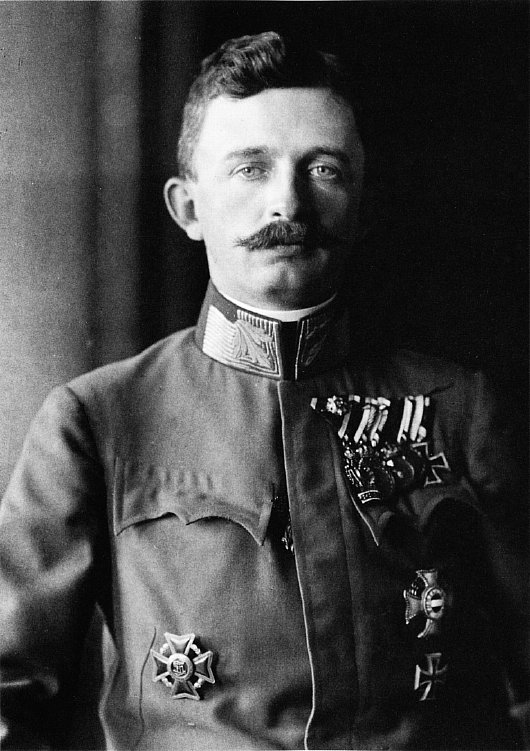
An Argentine correspondent informs us that the Holy Sacrifice of the Mass was offered on October 28th at the Church of St. Boniface, the German-speaking parish of the Archdiocese of Buenos Aires, to commemorate the fifth anniversary of the beatification of Blessed Charles, Emperor of Austria and Apostolic King of Hungary. The mass was organized by Viscountess Huges Stier de Saint Jean (née Princess Isabelle Auersperg-Breunner), whose mother was a descendant of the Emperor Franz Joseph through his daughter Valerie. The Mass was offered in Spanish and German, with the prayers of intention read in those languages as well as Hungarian, Slovak, Ukrainian, Croatian, and Italian.
Category: Charles of Austria
The World Turned Upside Down
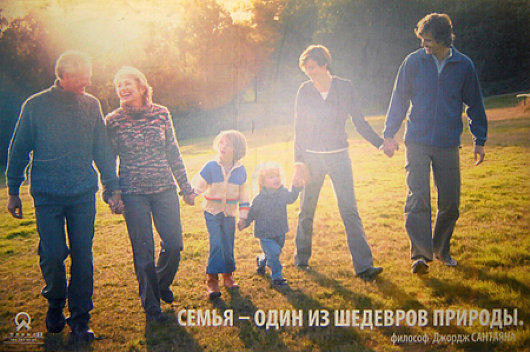
— philosopher George Santayana
I can’t remember who it was that, watching the fall of the Berlin Wall and the collapse of the Iron Curtain, said never in his right mind did he expect that within just a decade Washington would be the chief propagator of worldwide revolution and the Kremlin would be a relatively conservative power, guarding jealously its local sphere of influence. What could add more of a dash of the absurd (and yet, eminently sensible) than the Russian government, facing the worst crisis of population decline of any major power, promoting larger families with a poster campaign quoting the conservative American philosopher George Santayana.
Bertie Monument Unveiled in Malta
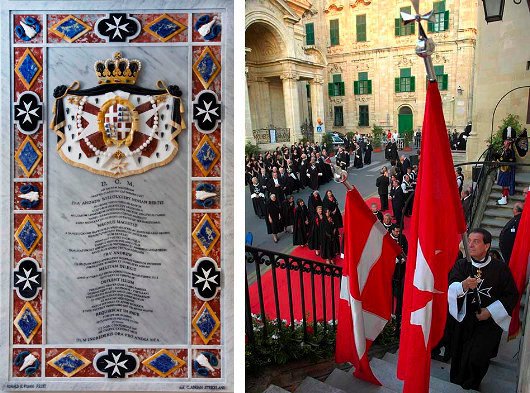
During Fra’ Andrew Bertie’s reign as Guardian of the Poor of Jesus Christ, the “of Malta” at the end of “the Sovereign Military Hospitaller Order of Saint John of Jerusalem of Rhodes and of Malta” was not a mere historical anachronism. The Prince & Grand Master had a house in Malta where he attended to his cultivation of oranges (the old Grand Master’s Palace in Valetta is now the Presidential Palace of the Maltese Republic). “A friend of Malta,” a recent statement from the Maltese knights of the Order states of Fra’ Andrew Bertie, “his love for Malta and the Maltese peoples’ affection for him originated the inspiration to this wonderful project, to erect a befitting marble lapidary in his memory.” This summer Fra’ Matthew Festing, successor to Fra’ Andrew as head of the Order of Malta, travelled to the Mediterranean island to unveil the Bertie Monument at Casa Lanfreducci, the Order’s Maltese seat. (more…)
Troubadour
A musical about Saint Francis of Assisi for people who don’t like musicals about Saint Francis of Assisi
For those who are interested, “Troubadour”, a new musical about Saint Francis of Assisi, is being produced in a limited run here in New York. The show’s lyrics are by the local Catholic playwright John Martin (often seen at St. Agnes on Sundays), with music by Bert Draesel.
The show runs until November 2nd at the Theater at the Church of the Epiphany, 1394 York Avenue (at E. 74th Street):
Fridays at 8:00pm, Saturdays at 8:00pm, Sundays at 3:00pm, and Mondays at 8:00pm.
For tickets, visit www.smarttix.com or call 212.868.4444. Tickets are $18 for adults and $15 for children.
For more information call 212.737.2720 ext. 56, or see here.
Benedict in Bohemia and Moravia
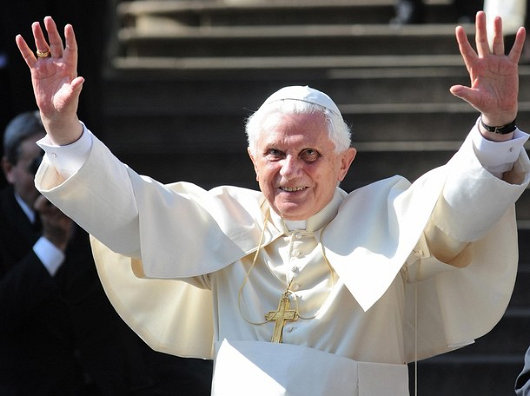
THE HOLY FATHER, Pope Benedict XVI, recently travelled to the Czech Republic in a journey he described as “both a pilgrimage and a mission.” The ancient land of Bohemia was once at the very center of Christian civilization. It was from here that the brother saints Cyril and Methodius launched their mission to convert the Slavic world. From Prague, the realms of the Přemyslid and then Luxembourg dynasties were ruled, followed by the most illustrious house of Hapsburg. Oh to have been in Prague under the reign of the Emperor Rudolf II! With his mysterious court of astrologers and magicians and his cabinet of curiosities. With Arcimboldo, Spranger, Heintz, and Hans von Aachen putting paint to canvas, Giambologna and de Vries sculpting, while Kepler and Tycho Brahe searched the night skies. Centuries later, long after the nucleus of Hapsburg power had moved to Vienna, it was to Prague that the Emperor Ferdinand came following his abdication and remained until his death in 1875.
But of course there is the other Prague — the city of heresy, rebellion, and warfare. (more…)
Notes of the Netherlandic Church
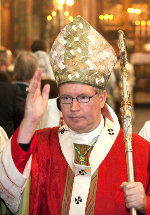
Willem Jacobus Eijk, Primate of the Netherlands
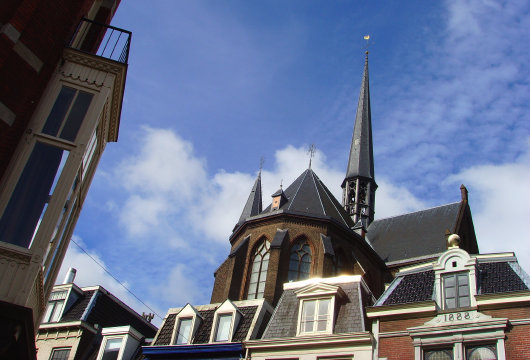
THE ANCIENT FORM of the Roman rite has returned to weekly use in Utrecht, the primatial see of the Netherlands. Under the guidance of Wim Eijk, Archbishop of Utrecht, the Church of St. Willibrord has introduced a weekly Tridentine liturgy each Sunday at 5:30 pm, to complement the 10:30 am Mass in Latin in the Ordinary Form. (Previously the old rite was offered only once monthly). The Extraordinary Form will be offered by Fr. A. Komorowski & Fr. M. Kromann Knudsen, both of the Priestly Fraternity of Saint Peter (FSSP, or Priesterbroederschap Sint Petrus in Dutch). St. Willibrord’s is a brilliant example of the nineteenth-century revival of gothic architecture, and the concurrent revival of Dutch Catholicism. Yet the parish was also emblematic of the Dutch church’s implosion in the 1960s & 70s. This beautiful, polychromatic monument to God was deconsecrated in 1967, and the diocese planned on demolishing the building. It was later sold, however, and occupied by an Assumptionist priest who continued saying the older form of mass. Joseph Luns, sometime NATO secretary-general and Dutch foreign minister, was a supporter of the apostolate at St. Willibrord’s.
The recently installed archbishop was keen to regularize the former parish’s situation, and erected it as a non-territorial parish under the auspices of the Vereniging voor Latijnse Liturgie (Association for Latin Liturgy) which promotes Latin in both the ordinary & extraordinary forms of the liturgy. The parish newsletter now proclaims that, at St. Willibrord’s, “all masses are once again celebrated ‘ad orientem'”, and both Sunday masses are accompanied by Gregorian chant. The church also revived, starting in 2002, the Procession of the Relics of St. Willibrord, which is held during the annual festival that opens the cultural season in Utrecht, in order to expose the tradition to a wider audience. (more…)
Life of St. Hildegard Hits the Silver Screen
But is it the Hildegard of historical fact or modern fantasy?

THE LIFE OF Saint Hildegard von Bingen — the Benedictine nun, writer, scientist, physician, and poet perhaps best known as a composer — has been brought to the screen in a new German-produced film. “Vision – Aus dem Leben der Hildegard von Bingen” was released in Germany & Austria in September and may receive a wider European release in 2010. From the voluntary confinement of the cloister, this woman corresponded with the Emperors Lothair II and Frederick Barbarossa, the popes Eugene III and Anastasius IV, the great patron of art Abbot Suger, and of course the great Cistercian reformer St. Bernard of Clairvaux. Hildegard was authorised to go on four preaching tours, and her Ordo Virtutum was the first allegorical morality play of the medieval period. She even invented a demi-language, Lingua Ignota (“unknown language”), and created an alternative alphabet in which to write it. (more…)
A Wanderer Anecdote
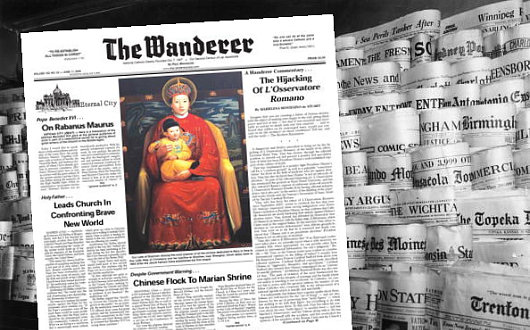
“It’s too easy for theological writers to sling around Abstractions with Capital Letters, as if with each stroke of the pen they’re tapping into Plato’s realm of changeless, ineffable Forms. Or at least that they’re writing in German, where all nouns start with caps.”
So begins John Zmirak, who tells a delightful story about one of America’s premier Catholic newspapers.
“A friend of mine used to write weekly for the estimable investigatory journal The Wanderer. Founded by German-Catholic immigrants, it was published auf Deutsch well into the twentieth century.
As my friend recalled, ‘The editors were, I think, waiting for the rest of the country to catch up with them. At last they admitted that this was unlikely, and agreed to translate the paper. But they kept on as their typesetter someone named Uncle Otto, who for years insisted on capitalizing every noun.’”
The He/She/It Whatnot
Seraphic Spouse held a poll on what pronouns people prefer using when referring to God: 1) He/Him/Himself, 2) he/him/himself, or 3) avoiding male pronouns. The unsurprising results were 89% for the traditional He/Him/Himself, 9% for the New York Times option of he/him/himself, and just over 1% for the radical choice of avoiding male pronouns altogether.
“Some readers may be wondering why this matters so much,” saith Lady Seraphic. “The answer is that people do care about these things, and I don’t want any reader of the book to feel alienated. I want everyone who might read such a book to feel embraced. And just as a now-elderly generation of Catholic women felt alienated by masculine language for God, younger generation of Catholics want to conserve the great respect for God now lacking in secular society.”
Over at Epigone’s Eloquence, meanwhile, Turgonian watched a biased BBC documentary (those three words go together so often!) on Gnosticism and was inspired to write ‘Why God is a He’, looking to the Monologion of St. Anselm for the answer.
“St. Anselm has previously established that God is Spirit, not a body, and that it is therefore nonsensical to say that He is a man or a woman. He has also shown that it is reasonable to believe that God exists as Father and Son (the Holy Spirit will come later in the book). But, he asks, why Father and Son, rather than Mother and Daughter? Why not call them by feminine names?” Read on to find out.
Unbuilt Pugin in Boston
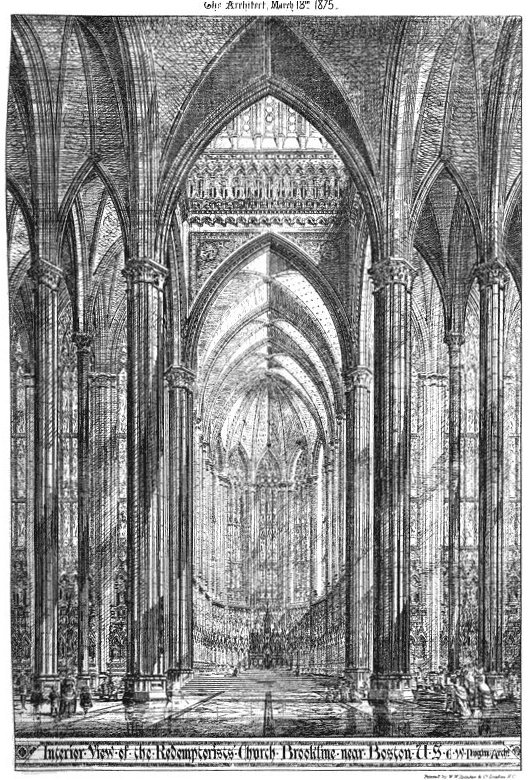
Unbuilt proposal for a Redemptorist church in Boston by Edward Welby Pugin, eldest son of Augustus Welby Northmore Pugin.
‘Dim Tim’ & Chick-lit Bagshawe go twit for tat over “slobbering” devotees of Thérèse
Tim Cheetham, a Labourite councillor in the legendary south Yorkshire town of Barnsley, has expressed his disdain for the enthusiasm his fellow countrymen and women have shown for the beloved Saint Thérèse of Liseux via the medium of Twitter: “With all those slobbering zealots kissing that glass case, I hope it has some mystical power to prevent swine flu.” As Catholic Herald editor Damian Thompson states, “That’s the authentic voice of 21st-century Labour.”
Louise Bagshaw, a “chick-lit” novelist, prospective Tory party candidate, and Woldingham old girl, wasted no time in responding. “Nice to describe faithful Catholics venerating a relic as slobbering zealots. Would you use such bigoted language about Muslims?”
Cheetham’s rather lame retort: “As the church has issued new guidlines [sic] about the conduct of ceremonies to protect against spreading disease, it needed saying.”
Bagshawe: “Labour’s anti-Catholicism is breathtaking sometimes.”
Damian Thompson continues:
Another tweet from Cheetham: “It’s not Bigotry to highlight the lunacy of dark age mysticism in the modern world.” Really? OK, then let me put you on the spot, councillor.
You say: “I will decry any faith that denies my right to question it in whatever form I wish.” Well, Muslims in Barnsley do object to the slightest criticism of their Prophet (who lived during the dark ages, as it happens) with his child wives and message of violence. But you’re a brave man, it seems. So go on: speak fearlessly and with your trademark withering disdain about the zealots in your own town.
Dim Tim later tried to backtrack by blaming the medium of Twitter for his own idiotic remarks.
To my knowledge, Barnsley’s not a town short on Catholics. Let’s hope those “slobbering zealots” make it to the polling place the next time the council’s up for election.
Thérèse Takes Britain by Storm
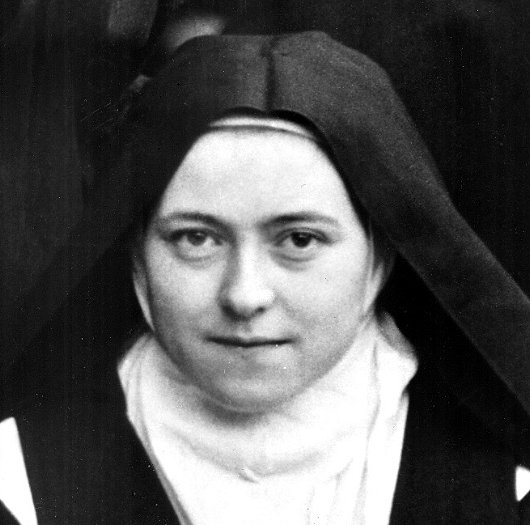
Relics of St Thérèse of Lisieux arrive in Britain for tour
The Guardian: Thousands wait at Portsmouth cathedral to see remains of St Thérèse
The Catholic Herald: The greatest saint of modern times
Thérèse of Lisieux portal
The Daily Telegraph: Relics of Carmelite nun St Thérèse on tour
St Thérèse of Liseux: who was she?
The relics and bones that bring us closer to God
BBC News: Saint’s remains arrive for tour
Reuters: Saint’s relics heading for Wormwood Scrubs
The Independent: Why are the relics of St Thérèse such a holy hit?
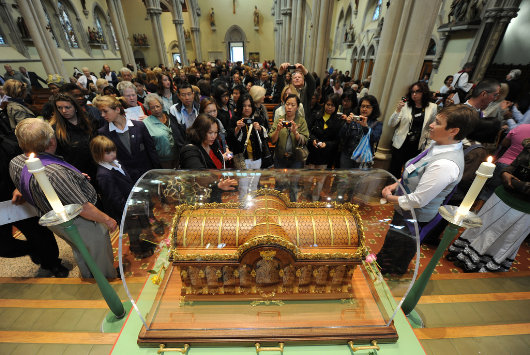
catholicrelics.co.uk
pray for us!
St. Nicholas of the Seven Seas
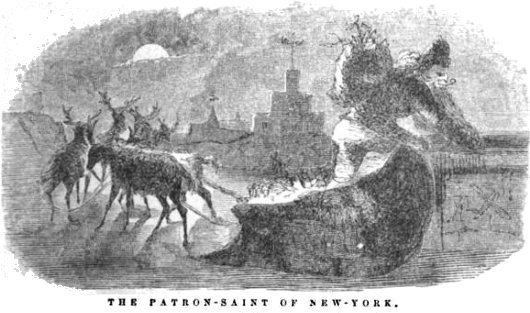
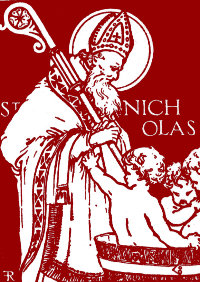 ONE OF OUR correspondents sends word that Russia is to name the fourth of her Borei-class ballistic missile submarines Николай Чудотворец, which is to say “Saint Nicholas”. The Borei-class vessels are the first series of Russian strategic submarines to be launched in the post-Soviet era. The previous subs in the class have been named the Yuri Dolgoruki (after Prince Yuri I, founder of Moscow), the Alexander Nevsky (after the Grand Prince of Vladimir & Novgorod venerated as a saint in the Eastern churches), and the Vladimir Monomakh (after the Grand Prince of Kievan Rus). The Saint Nicholas is of course not the first boat or ship to bear the name of New York’s patron saint. There was HMS St. Nicholas as well as a Spanish naval ship San Nicolas in the 1790s, eventually captured by the Royal Navy and commissioned as HMS San Nicolas. A Sealink (later Stena) ferry named St. Nicholas traversed the Harwich/Hook-of-Holland route from 1983 until it was renamed Stena Normandy in 1991 and transferred to the Southampton/Cherbourg route. Numerous merchant vessels took the saint’s name and patronage throughout the nineteenth century.
Sounds like America
I attended Orthodox Divine Liturgy yesterday at the Russian Orthodox Church of St. Nicholas, about a 20-minute walk from Central Station. The liturgy was mostly in Dutch. The church is a former Franciscan priory church. A parishioner, a Dutch convert, told me that in Holland you are either a Protestant Calvinist, a Catholic Calvinist, or an atheist Calvinist. He was pretty sure that most of the (tiny) Orthodox minority were Calvinists, too.
Search
Instagram: @andcusack
Click here for my Instagram photos.Most Recent Posts
- Brunel’s Unbuilt Capitol February 3, 2026
- Cricket at Fordham January 27, 2026
- Palacio Barolo Revisted January 14, 2026
- Learning to Love Liguria January 14, 2026
- Crux Alba No. 2 January 13, 2026
Most Recent Comments
Book Wishlist
Monthly Archives
Categories