Church
About Andrew Cusack
 Writer, web designer, etc.; born in New York; educated in Argentina, Scotland, and South Africa; now based in London.
 read more
News
Blogs
Reviews & Periodicals
Arts & Design
World
France
Mitteleuropa
Knickerbockers
Argentina
The Levant
Africa
Cape of Good Hope
Netherlands
Scandinavia
Québec
India
Muscovy
Germany
Academica
Debating Hiroshima
Christian morality versus modern relativism
THREE YEARS AGO over on the New Criterion’s blog, Armavirumque, my friend and then-colleague & boss Roger Kimball and I had an interesting exchange on the morality of the bombing of Hiroshima. The debate began when Roger wrote a blog entry citing an opinion piece from Oliver Kamm of the Guardian supporting President Truman’s decision to drop the Bomb. I then responded with a post of my own pointing out that the conservative reaction at the time was one of horror at the moral depravity to which we had descended, and that the it-would-have-been-worse-if-we-didn’t school of thought essentially can be reduced to an ends-justifies-the-means argument. Roger then responded with a post arguing that, well, sometimes the ends do justify the means.
Regardless of one’s thoughts on the Hiroshima bombing, arguing that the ends justifies the means is one of the cornerstones of relativism. Christians believe that we are not allowed to do evil, even if that evil may serve a good cause. It is not simply a matter of choosing something bad over something worse. Evacuating the British Army from Dunkirk, for example, was bad, but leaving it there was worse. Yet, both were morally licit options for Churchill to make, though the prudential evidence supported the former option rather than the latter.
Innocent people inevitably die in most wars, but that cannot excuse the deliberate and intentional targeting of an entire city for destruction by a military force. That so many American Christians still excuse the bombing of Hiroshima and Nagasaki is frightening evidence that America has convinced Christians to be Americanised rather than Christianity convincing America to be Christianised. (more…)
Interesting Things Elsewhere
This determined Celt is gunning for Thabo
Kevin Bloom | The Daily Maverick
Ireland’s  Paul O’Sullivan took over as head of security at South Africa’s airport authority in 2001, and discovered something was wrong from the start: why didn’t the policeman on duty want to take a statement about the attempted theft of his baggage? Since then, his life has been a series of bizarre events leading him ever deeper into the most complex criminal network of the post-apartheid era, including the recent the trial and conviction of former national police chief Jackie Selebi. But O’Sullivan’s determined quest to expose crookedness isn’t over yet, and he now has former president Thabo Mbeki in his sights. read more
The apparatus of state will simply ignore the government
‘Inspector Gadget’ | Police Inspector Blog
Police across England were told by the responsible minister of the democratically elected government that they must not chase performance targets any longer. “I can also announce today that I am also scrapping the confidence target,” said the Home Secretary, Theresa May, “and the policing pledge with immediate effect”. But the ‘senior management team’ of the West Yorkshire Police have stated they will go on no matter what the government says. read more
Has Christian Democracy reached a dead end?
Jan-Werner Mueller | Guardian.co.uk
The commentator completes a brief survey of the struggles of Christian Democracy in Germany and Europe today. The French leader Georges Bidault claimed that Christian Democracy meant “to govern in the centre, and pursue, by the methods of the right, the policies of the left”. But Christian Democracy’s brief French moment in the 1950s didn’t survive the return of de Gaulle, and Christian Democratic parties on the continent today face an existential crisis. read more
Also: Monsignor Ignacio Barreiro’s talk at the Roman Forum’s 2010 Summer Symposium, entitled The Problem of Christian Democracy will be made available online in audio form sometime in the coming months.
Deep in Shanxi, the most Catholic village in China
Anthony E. Clark | Ignatius Insight
Church after church dot the landscape and high steeples rise above small villages as they do in southern France. Passing through a narrow side road one arrives and is welcomed by three great statues at the village entrance: St. Peter holding his keys is flanked by Saints Simon and Paul. Thirty minutes before Mass the village loudspeakers, once airing the revolutionary voice of Mao and Party slogans, now broadcasts the rosary. Welcome to Liuhecun, the most Catholic village in China. read more
Look for me in the Cotswolds.
Dino Marcantonio
The apologists for modernist architecture have tried for a century to gain public acceptance of and appreciation for their horrors. While the elites have almost overwhelmingly been converted, the general populace around the world still sees that the Emperor has no clothes, and almost always prefers architecture that reflects the tried and true, the local and the natural. Alain de Botton, the Swiss essayist, ‘pop philosopher’, and former ‘writer-in-residence’ at Heathrow Airport, is the latest to give it a go, this time in the pages of the modernist Architectural Record. Dino Marcantonio provides a most useful fisking. read more
Canada is a French country
Andrew Coyne | Maclean’s
At the recent Canada Day celebrations on Parliament Hill, Canadian PM Stephen Harper spoke of “the steadfast determination and continental ambition of our French pioneers, who were the first to call themselves ‘Canadians.’” At other times he has spoken of Canada as having been “born in French,” of French as “Canada’s first language,” and, most famously, of Quebec City as “Canada’s first city,” its founding in 1608 as marking “the founding of the Canadian state.” While the sentiment may seen anodyne, moreover, the implications are radical. read more
A School Chapel on Long Island
St. Anthony’s High School, South Huntington, L.I.
“I have a general disgust for Catholic architecture since the 1950s,” says Brother Gary Cregan, the Franciscan friar who is principal of St. Anthony’s High School in South Huntington. The friar was quoted by the once-great New York Times in a 2008 article on the new chapel built by the Catholic school on Long Island, recently featured on the NLM blog. The Franciscans, according to the Times, “believe that the new chapel, with its soaring 30-foot ceilings, will teach teenagers that they are ‘worshiping God, not each other.'” Many of the chapel’s furnishings were bargain finds on eBay including the confessionals, the pews, a 110-year-old stained-glass window, and a century-old statue of St. Anthony. A new bell for the chapel’s tower would’ve cost $20,000, but Brother Gary (or “Mr. Cregan” as the newspaper referred to him) found an old one for $4,000. (more…)
Rod Dreher is Profoundly Mistaken
Rod Dreher, a normally interesting commentator and incisive thinker, is profoundly mistaken in his response to the Pope’s handling of the Schönborn-Sodano spat, and betrays a fundamental misunderstanding of what’s gone on.
In April, Cardinal Schönborn, the Archbishop of Vienna, publicly and by name criticised Cardinal Sodano, the former Vatican Secretary of State, accusing him of having frustrated attempts to investigate abuse by clerics and further criticising his dismissal of some claims of abuse as “petty gossip”. These criticisms were largely seen as justified in their substance but were note-worthy as it is not customary for cardinals to attack one another publicly and by name.
The Pope then oversaw a meeting between Cardinal Schönborn and Cardinal Sodano (who, since 2006, is no longer Secretary of State) as an act of reconciliation. Alongside this meeting, a statement was released which included a gentle reminder that authority over the College of Cardinals is reserved to the Holy Father, and that likewise the supervision and criticism of cardinals is reserved to him, in consultation with others.
The reservation of this right to the Pope is both wise and justified. The basic idea is that cardinals are not to waste their time criticising one another, lest they, being human, be tempted into continual criticism which would interfere with and impede the work of their fellow cardinals.
The gentle reminder in this statement has, unfortunately, been blown completely out of proportion by the media. Rod Dreher has only augmented this with his commentary, but in doing so betrays a fundamental error that he made: his comments cite an Associated Press report of the supposed “unprecedented public rebuke”.
It is no surprise that Dreher found the AP report “both heartbreaking and infuriating”, as that is generally what AP reports related to the Church are designed to do. The Associated Press has fairly consistently and over a long period of time demonstrated their lack of reliability or journalistic credibility owing to their complete lack of understanding of how the Church operates and their undercurrent of antagonism to Christianity in general.
It is more “heartbreaking and infuriating” that a man as smart as Rod Dreher has had such a lapse of judgement as to allow the Associated Press to be the informer of his thoughts and guide of his heart. Dreher’s claim that Pope Benedict has “humiliated” Schönborn is complete nonsense, which is the result of Dreher’s unfortunate trust in the sham journalism of wire services. Dreher is also simplistic in his treatment of Cardinal Schönborn, who has been known to have gone a bit loopy of late, even to the extent of expressing reserved support for the ridiculous “apparitions” at Medjugorje, and even suggesting the Pope might visit the town some day.
The Archbishop of Vienna’s stringent stand against clerical abuse is nonetheless a most welcome counterpoint to the lackadaisical approach of the John Paul II-era curia. Small wonder the Pope spent the beginning of his pontificate making very wise replacements of questionable JP2 appointments, and continues to have a good eye for decent churchmen and for appropriate roles for them to exercise in the Vatican.
“This action by the pope is not a sign of strength,” writes Dreher, “but its opposite.” Does Dreher really think that allowing a cardinalatial free-for-all would be a sign of strength, while taking steps to remind cardinals of their obligations is a sign of weakness? Rather, Benedict has, as has been the mark of his pontificate, taken the route of gentleness and reconciliation while simultaneously stressing the need for order and unity.
Alice von Hildebrand on Life
This superb lecture to a high-school audience by Alice von Hildebrand, the retired Professor of Philosophy at Hunter College of the City University of New York, was sent to me by an acquaintance at the University of Caen in Normandy (a town I had the pleasure of visiting some years ago).
The speaker is the widow of the famous Prof. Dietrich von Hildebrand, and speaks with a fascinating insight tempered by good humour. I thought I’d just listen to a bit of it but became entranced and couldn’t tear myself away from it.
Mrs. von Hildebrand covers an astonishing variety of subjects but the animating focus of the lecture is the relationship between body and soul, and how that is reflected in the relationship between man and woman.
“It’s a privilege for an elderly person to share her experience with young people,” Mrs. von Hildebrand says. “It’s a very special joy to share with you the gifts I have received.” However privileged the speaker feels, I’ve no doubt it is rather the listeners who are privileged to hear so a woman of such great wisdom speak to them at so young an age.
I know one of the most memorable interactions I ever had was with the Polish freedom fighter and Auschwitz survivor Jozef Garlinski when I was just sixteen years old — the late Mr. Garlinski’s most important lesson continues to exert a profound influence over me, and was one that I have always remembered at the more trying times in life since then.
These students are blessed to receive such an important life lesson.
Our Cardinal Strikes Again
Cardinal O’Brien, Scottish Primate, Preaches at Newly Ordained Priest’s First Mass in the Extraordinary Form at St. Mary’s Cathedral Edinburgh
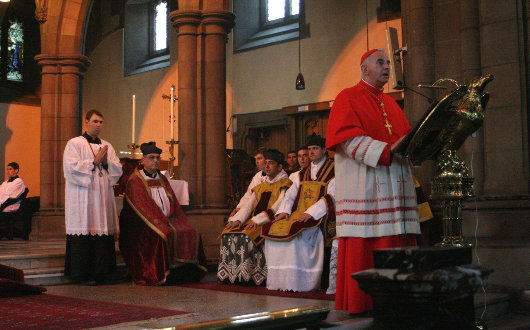
Keith Patrick O’Brien, the Primate of Scotland and Cardinal Archbishop of St Andrews & Edinburgh, this weekend preached at the first mass offered by the recently ordained Fr. Simon Harkins of the Priestly Fraternity of St. Peter. The mass was offered in the Cardinal’s own Cathedral of St. Mary in Edinburgh, Fr. Harkins’s own home town. The Very Rev. Fr Josef Bisig FSSP and the Very Rev. Fr. Franz-Karl Banauch FSSP assisted, and monks from the Transalpine Redemptorists of Papa Stronsay (who provided these photos) were also present, in addition to a number of diocesan priests.
I’ve spent the past eight years of my life divided between three (arch-) dioceses and I have to admit that Cardinal O’Brien is still the one I feel the greatest affection for. He’s an affable, uncomplicated fellow, and can be relied upon to defend what’s right in the media — unquestionably one of the best prelates in Britain today.
“I find him a much more approachable figure than other Scots prelates,” writes Damian Thompson, “less inclined to stand on his dignity despite (or perhaps because of) his red hat. I met him once at a party to relaunch the Scottish Catholic Observer, to whom he’s been a good friend; he didn’t sweep in surrounded by flunkeys, but hung around chatting in ordinary priest’s dress, reminding me a bit of Basil Hume in that respect.”
As it happens, I’m head of Cardinal O’Brien’s fan club on Facebook, which I encourage any Facebook users out there to join.
God bless our cardinal, and many congratulations to Fr. Hawkins! (more…)
Clarity on Torture
Those who see abortion as an evil are often frustrated by those who attempt to justify abortion by vague arguments about “choice” or even more practical arguments about exceptions for rape or incest, or the health of the mother. But many of these same people lose their moral clarity when the subject is torture. Suddenly they are the ones bringing up exceptions and parsing definitions.
There is so much confusion over this issue that in a recent TV interview, a prominent Catholic journalist let a former Bush Administration speechwriter, also a Catholic, grossly misrepresent Catholic teaching in a shameful apologia for torture.
Let us re-establish clarity. Torture, whether physical or psychological, is a barbaric, savage act, not justifiable under any circumstances, and unworthy of a civilized society.
But don’t take our word for it. For those readers who are religious, the Evangelical Lutheran Church in America began calling for America to cease torturing prisoners more than a year ago. American Episcopal bishops agree, as do other Protestant denominations. For our Catholic readers, Pope Benedict XVI wrote, “I reiterate that the prohibition against torture cannot be contravened under any circumstances.” The Catholic Church draws no distinction between physical and psychological torture.
For those readers who aren’t religious, we turn to U.S. law and international law, where torture is, without exception, condemned. Not one state or municipal law enforcement agency permits it. The Army Field Manual, which regulates interrogations by the U.S. military, prohibits torture. So does the Geneva Convention—a treaty to which both the Holy See and the United States are signatories. None of these institutions or documents draws any distinction between physical and psychological torture either. For all, torture is torture.
When Catholics and Protestants agree, and when religious and secular institutions agree, that torture is an offense against human dignity and that those guilty of it should be thrown in jail, may we not agree that perhaps it is immoral? Do we really need to get into the nuts and bolts of what constitutes torture?
Yes, we do. Most will agree that taking a power drill to a man’s shoulder or pulling out his fingernails with pliers for punishment or to extract information is torture. But when the subject is waterboarding, clarity vanishes again. Some consider waterboarding to be mere psychological torture—which, as we’ve already established, is morally indistinguishable from physical torture.
But waterboarding is not a harmless dunk in the tub, as former Vice President Dick Cheney once likened it, and it is not psychological torture. In waterboarding, a subject is strapped to a gurney. His feet are elevated slightly above his head. A cloth is draped over his face. And water is poured on his face so that it enters his nose and mouth and flows into his lungs. CIA interrogators are instructed to pour the water immediately after a detainee exhales, to ensure he inhales water, not air. They use their hands to “dam the flow” of excess water from a detainee’s mouth. And detainees who are scheduled for waterboarding are put on a liquid diet, to minimize the risk of death should they inhale their own vomit.
This procedure became official American policy in our so-called War on Terror, but it was not always so. Waterboarding has been condemned by the United States government since at least 1898, when American soldiers were court marshaled for waterboarding prisoners during our occupation of the Philippines following the Spanish-American War. In World War II, we hanged Japanese war criminals for waterboarding American and Allied troops. In the 1980s in Texas, a sheriff and three of his deputies were convicted by the Justice Department for waterboarding prisoners to extract confessions.
And yet, there are those exceptions: American security is at stake. If waterboarding saves even one life, isn’t it worth it?
If torturing a terrorist suspect saved a city from destruction, or if it saved even one life, it would still be a barbaric, savage act, unworthy of a civilized society. If expediency were enough to justify an immoral act, then abortion would be justifiable.
G.K. Chesterton wrote in 1916 that people who purport to defend civilization against barbarians undermine their cause when they resort to barbaric tactics. “The more we insist that the terms must be our terms, the more do we weaken ourselves if the methods are their methods.”
During World War I, when some in England demanded that German soldiers captured on English soil be denied humane treatment, Chesterton countered, “Such small revenges are unworthy of the dignity of indignation. They are also futile and inconsequent.”
Our whole hope of getting a monster killed and not scotched depends upon our keeping fresh the original human horror at its monstrosity. It may be illogical, but it will certainly be natural, if that horror is somewhat dulled if, by the end of the war, everybody seems to be fighting with pretty much the same weapons.
When you torture, you turn the victim into a hero, for there is more honor in defying a torturer than in being a torturer.
“A kind of courage can exist in a merciless and unmagnaminous soldier, as it can exist in a merciless and unmagnaminous wild pig,” Chesterton wrote. “But it does not happen to be the kind of courage that our brethren have died to keep alive.”
Reese Still Doesn’t Get It
“Reform movements need an enemy to organize against,” Fr. Thomas Reese, the former editor of America magazine tells TIME (which I stumbled upon at Conservative Blog for Peace). “As most bishops have gotten their acts together on sex abuse, they have looked less like the enemy and more like part of the solution. Enthusiasm for reform declined. With the Pope’s forthright response, it will decline even more.”
Bishops “getting their acts together” is reform! But of course, Fr. Reese is using the word “reform” in an Orwellian manner, meaning not reform, but in fact revolt. His use would be disingenuous, except that I suspect Fr. Reese has actually convinced himself it is appropriate: as the saying goes, “never attribute to malice that which can be adequately explained by …” well, let’s remain charitable and say “credulity”.
As bishops institute genuine reform, the sympathy — never more than limited — for progressive change-for-change’s sake unsurprisingly disappears except among the old die-hards like Fr. Reese. Enthusiasm for reform — genuine reform that is — only grows, especially in those places where it has been implemented, in accordance with the Pope’s clearly stated desires. If he is anything, Benedict XVI is a pope of reform, of putting the house back in order.
One almost feels a tinge of pity for the Fr. Reeses of this world as their hopes and dreams slip further and further away, but then one remembers it is entirely their own fault. He who marries himself to the Spirit of the Age is soon widowed. Attach yourself to the permanent things and you will never end up like poor Fr. Reese.
“The Reality is Love”
“The doom and gloom conveyed by the media is not the full picture.”
by HILARY WHITE
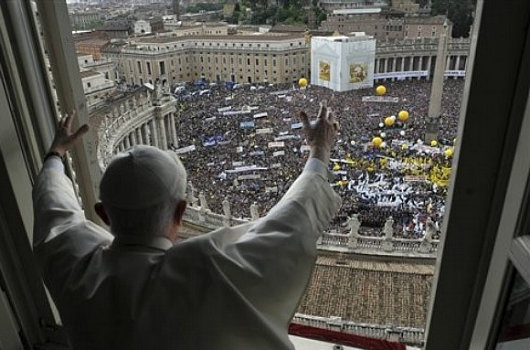
ROME, May 17, 2010 (LifeSiteNews.com) – There is one thing that still surprises me about Italy: the Italians love the pope. Even when they don’t necessarily listen to or obey him on every point, even when he is not an Italian, the Italians have a genuine and very warm paternal relationship with the holder of the Keys. This Sunday, 150,000 people packed into St. Peter’s Piazza to hear Benedict XVI give an address after reciting the Regina Caeli, and to show their Holy Father their love and support after the trying period of the last few months.
I suppose coming from the Anglo world, imbued with its perpetually simmering anti-Catholicism inherited from the Elizabethans and the Glorious Revolution, it will always come as a pleasant surprise to see that, whatever vitriol the mainstream media of the anglosphere continues to pour onto this papacy, that vitriol is not the reality. Whatever Reuters or the New York Times or even Ansa will tell you, the crowd of over 150,000 people gathered in St. Peter’s Piazza on Sunday were nearly beside themselves with joy to see their Papa.
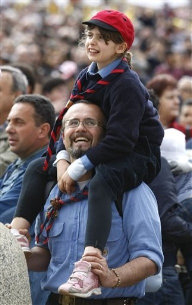 It has been unseasonably cold and raining more or less steadily for weeks, and being still something of a newbie around here, I had not expected to have to hurry on Sunday. Still thinking like an Anglo and not expecting the Italian enthusiasm for their pope, I had planned to make my way over to St. Peter’s Piazza about 11:30, and thought I could take a leisurely 9:30 train into the City and take the bus down to the Campo di Fiori to have a sandwich and a cup of awful Roman tea first. But in the café a television was playing live coverage of the Piazza and I could see the crowd was already, at 10:45, starting to fill the huge space. I took my panino di pollo to go.
I had read that the Piazza could hold about 100,000 people, and remembered the day a couple of years ago when the Italians gathered to give a collective two-fingers-up to Rome’s heavily secularist Sapienza University, who had insulted their Holy Father by rescinding his invitation to speak. The English-language press was most reluctant to report that thousands of happy, shouting, smiling Sapienza students filled the square at the General Audience that week.
Today they are admitting that the Piazza held over 150,000 on Sunday, called together from all over Italy by a coalition of Italian lay associations – and that seems about right. What they don’t seem to want to report is the spell of joy that held them, many of whom waited for hours to see and hear and shout cheers to the pope. (more…)
Nuns!

The author of Kansas Catholic was gracious enough to provide his readers with numerous photos of the recent profession of vows of the Benedictines of Mary, Queen of the Apostles that took place recently at Old St. Patrick’s in Kansas City, Mo. The Benedictines of Mary, Queen of the Apostles are a “traditional monastic community of women who desire to imitate the Blessed Virgin Mary in the giving of herself to God to fulfill His Will, especially in her role of assistance by prayer and work to the Apostles, first priests of the Catholic Church”.
Founded fifteen years ago in Pennsylvania, they accepted the invitation of the Most Rev. Robert W. Finn, the Bishop of Kansas City-St. Joseph, to move to his diocese in 2006. You can find out more about this relatively young community at their website here. (more…)
It helps to be a 92-year-old D-Day veteran
Daniel Hannan, the whiggish MEP representing South East England, relays a story about His Excellency Philip Hannan, the 92-year-old former Archbishop of New Orleans:
When Hurricane Katrina wrecked the city, the old prelate went to the diocesan office to help. He found his successor wracked with concern about the fate of a parish priest who was lost in the storm. Seeing that anxiety had left the poor man paralysed, my 92-year-old kinsman called the military authorities.
“This is Phil Hannan. I jumped with the 82nd Airborne at Normandy. I need a helicopter”.
A helicopter duly arrived, and carried the former army padre to the home of the missing cleric, which had been turned to matchwood. Returning to the archiepiscopal residence, Hannan announced without ceremony, “He’s dead, may he rest in peace. Let’s move on to the next problem”.
Cape Town’s Other St. George’s
The Greek Orthodox Cathedral of Saint George
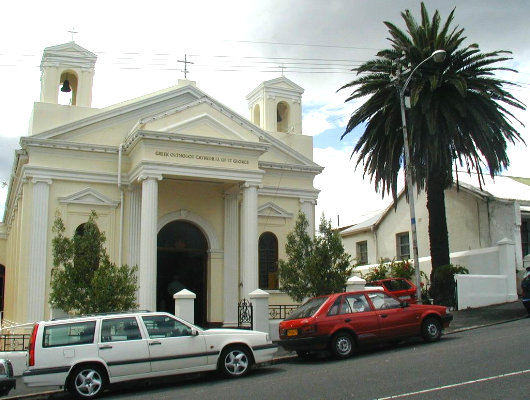
If you hear of “St. George’s Cathedral” in Cape Town, you naturally think of the big stone colossus at the bottom end of the Company’s Garden smack dab in the middle of the Mother City. There is, however, another St. George’s Cathedral, the Greek Orthodox Cathedral of St. George on Mountain Road in Woodstock. The Greek Cathedral was built in 1903–04, just a few years after Cape Town received its first Greek Orthodox priest, and expanded in 1983. Liturgies tend to be either in Greek or English, though there is an Afrikaans monastery at Robertson.
The Holy Archdiocese of the Cape of Good Hope was established in 1968 under the (Greek Orthodox) Patriarch of Alexandria and All Africa. The archdiocese covers the Western, Northern, and Eastern Cape provinces, the Orange Free State, KwaZulu-Natal, Namibia, Lesotho, and Swaziland.
I only ever knew one South African of Greek extraction (Dimitri! Not just a good egg, but a top-notch chef as well), but I assume that folks of Hellenic extraction enjoy the Mediterranean climate of Cape Town and its environs.
Dabbling in Freemasonry at Downside
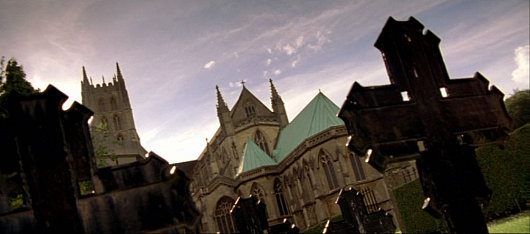
One of Britain’s most prominent Catholic schools, Downside Abbey in Somerset, has a friendship with Freemasonry that Catholics might find rather troubling. As recently brought to light in a report on the Curated Secrets blog, Downside invited “Spenny” Compton, 7th Marquess of Northampton (as well as Britain’s wealthiest Buddhist and sometime Pro-Grand Master of the United Grand Lodge of England) to talk about Freemasonry to students at the Benedictine boarding school. “I was invited two years ago to address some of the senior boys and monks at Downside, the Roman Catholic boarding school,” the Marquess wrote in 2005. (more…)
“There is no Generation Benedict”
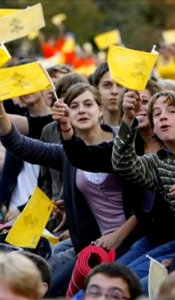 So claims Germany’s Catholic youth leader Dirk Tänzler, who is ‘reserved’ & ‘ambivalent’ about the Pope. Is Tänzler right?
AMIDST THE MEDIA’S attempts to sling mud at Pope Benedict XVI, one of the most prominent Catholic youth leaders in Germany has chimed in with lackluster words about the reigning pontiff. Dirk Tänzler, the head of the BDKJ, the umbrella group of German Catholic youth organizations, gave an interview to Der Spiegel, the prominent weekly news magazine with a circulation of over one million. Asked his verdict of the so-far five years of Pope Benedict’s reign, Tänzler responded with the word “ambivalent”. Contrasting Benedict XVI with John Paul II — a “showmaster” — the BDKJ head said that, despite some good points, “a lot of young people often simply don’t understand him”. “Most have a different idea of how to live their lives than the pope might imagine for them. There is no ‘Generation Benedict.'”
But are Tänzler’s thoughts an accurate reflection of the state of Catholic youth in Germany or elsewhere? Over a million young people travelled to Cologne to experience World Youth Day with the new pontiff in 2005. (The following WYD held in Sydney in 2008, unfortunately offers little comparison given the relative isolation of Australia). Everywhere the Pope has travelled, such as to the Czech Republic last year, or France and the United States in 2008, vast multitudes of youth have greeted him, often waiting hours for the privilege. (more…)
The Legacy of von Hildebrand
Over at InsideCatholic, John Burger talks to John Henry Crosby, the founder of the Dietrich von Hildebrand Legacy Project. Readers will recall we attended a “festive evening” organised by the Legacy Project in 2008.
Prof. von Hildebrand was also involved in founding the Roman Forum, and places are still available for the Forum’s 2010 Summer Symposium in Gardone, Italy — about which everyone whose ever been raves unceasingly. The lectures and discussions on quite an array of subjects are listed in the daily program.
Some Stocks Fall, Others Rise
In the first quarter of 2010, CNN’s flagship news anchors ratings dropped by fifty percent — half their entire viewership! The New York Times continues to slide towards bankruptcy and irrelevance (who wants to pay two dollars a day to be lied to?). Exhibiting a tremendous amount of cheek, the Times Company (which owns both the Times and the Boston Globe) threatened to shut the Boston Globe unless the staff agreed to $20 million in cuts. This year, the $20 million made by salary and benefits cuts across the board at the Globe were awarded in compensation to just two Times Company employees, Chairman Arthur Sulzberger and Chief Executive Janet L. Robinson. Meanwhile, the Company’s profits are collapsing along with its circulation and ad revenue, while its debt increases.
Not everyone’s stock is going down, however. Anna Arco reports a greater-than-usual surge in Mass attendance during Holy Week at the Stefansdom in Vienna, as well as at Westminster Cathedral and the Brompton Oratory in London.
The only advice one could dispense to CNN, the Times, et al. is the aphorism that he who marries the spirit of the age is soon widowed.
French Intellectuals Pen ‘Appeal to Truth’ In Support of Benedict XVI
A number of prominent French men & women have written a ‘call to truth’ supporting Pope Benedict XVI in the current media storm and pedophilia scandal. As the Appeal’s about page says, Pope Benedict XVI “is the first pope to address head-on, without compromise, the problem. Paradoxically, he is the subject of undermining and personal attacks, attacks relayed with a certain complacency on the part of the press”.
The list of original signatories includes writers, essayists, literary critics, bloggers, professors, philosophers, businessmen, senators, members of parliament, mayors, publishers, actors, a Protestant minister, a Fields medal winner, and even a sexologist.
The ‘Appel à la Vérité’ is reproduced, in an unofficial English translation, below:
The cases of pedophilia in the Church are, for all Catholics, a source of profound grief and great sorrow. From members of the Church hierarchy were, in some cases, serious deficiencies and failures, and we welcome the Pope’s wish to shed light on these cases.
With the bishops, and as members of the Church, lay Catholics bear the brunt of the crimes of certain priests and failures of their superiors; they fall firmly, as Christ taught, on the side of those who suffer most from these crimes, the victims, while praying for the culprits.
As for us, we hope with all our hearts that the whole truth comes out and all in the Catholic Church that could enable these offenses brought to Christ should be discussed calmly and amicably amongst all men and women of good will.
At the same time, we regret the runaway and provocative press that accompany these cases. Beyond the legitimate & democratic right to information, we can only note with sadness, as Christians but also as citizens, that many media in our country (and in the West in general) treat these cases with bias, ignorance, or delight. Shourtcuts in generalizations, the portrait of the Church which is currently done in the press does not match the experiences of Catholic Christians.
While reiterating our horror at the crime of pedophile priests and our solidarity with the victims, we urge the media to an ethic of responsibility that would undertake a more ethical treatment of these cases. The effects of runaway media are, by far, reserved to the Church, but we are tired of and battered by this thrashing. We think of so many priests who courageously, and sometimes in solitude, bear the message of Christ.
We are with them.
We welcome the letter from the bishops of France to Pope Benedict XVI, and wish to see the Catholic Church, with serenity and responsibility, through this painful ordeal.
This appeal was launched at the initiative of François Taillandier (writer), Frigide Barjot (humourist), Natalia Trouiller (journalist & blogger), Koz (blogger & lawyer), and Francis Miclo (philosopher).
Original signatories (31 March 2010):
Jacques Arènes (pyschoanalyst and writer)
Denis Badré (senator)
Frigide Barjot (humourist)
Jean-Marc Bastière (journalist and writer)
Claude Bébéar (honorary president of AXA)
Michel Boyancé (Dean of the Institut de France and comparative philosopher)
Rémi Brague (philosopher, member of the Institut de France)
Alexis Brézet (journalist)
Jean des Cars (writer)
François Cassingena-Trévedy (Benedictine monk, liturgist and writer)
Jean Chélini (historian, permanent secretary of the Académie de Marseille)
Ghislain du Chéné (international coordinator of Foi et Lumière)
Colette Combe (pscyhoanalyst and writer),
François Content (Director-General of the Fondation d’Auteuil)
Philippe Delaroche (writer, journalist)
Chantal Delsol (writer and philosopher)
Patrick Demouy (historian, university professor)
Bernadette Dupont (senator)
Bertrand d’Esparron (corporate communications manager)
Emmanuel Falque (philosophee and writer)
Olivier Florant (sexologist)
Jean-Christophe Fromantin (mayor of Neuilly-sur-Seine, businessman)
Réginald Gaillard (Editions de Corlevour)
Patrick de Gméline (historian)
Samuel Grzybowski (President/founder of the association Coexister)
Fabrice Hadjadj (essayist and playwright)
Rona Hartner (singer, actress)
François Huguenin (writer)
Vincent Hervouët (journalist)
Yvon Jacob (chief executive, former member of parliament)
Gaspard-Marie Janvier (writer)
Pasteur Alain Joly (Lutheran Church)
Patrick Kéchichian (writer and literary critic)
Koz (blogger and lawyer)
Louis-Etienne de Labarthe (editor-in-chief, Il est vivant)
Philippe de Lachapelle (director of the OCH)
Laurent Lafforgue (mathematician, winner of the Fields medal)
Gérard Leclerc (essayist, journalist)
Henrik Lindell (journalist)
Michael Lonsdale (actor)
Victor Loupan (editor, La Pensée Russe)
Jean-Baptiste Maillard (journalist, essayist)
Bruno Maillé (teacher, essayist)
François Maillot (Director-General, La Procure)
Jean-Luc Marion (philosopher, member of the Académie Française)
Jean-Pierre Marcon (member of parliament)
Nicolas Mathey (Professor of Law, Université de Paris V)
Jean-Pierre Machelon (Professor of Law, Université de Paris V)
Marc Mennessier (journalist)
François Miclo (philosopher)
Jean-Marc Nesme (member of parliament & mayor)
Philippe Oswald (journalist)
Xavier Patier (writer)
Patrice de Plunkett (writer and blogger)
Hugues Portelli (senator)
Jean-Frédéric Poisson (member of parliament)
Aymeric Pourbaix (journalist)
Guillaume de Prémare (communications consultant, Médias & Evangile)
Edmond Prochain (blogger, journalist)
Samuel Pruvot (journalist)
Jacques Rémiller (member of parliament & mayor)
Alina Reyes (writer)
Damien Ricour (actor)
Ivan Rioufol (essayist, journalist)
Catherine Rouvier (jurist, political scientist)
Jean Sévillia (journalist, writer)
Grégory Solari (editor)
Raphaël Stainville (journalist)
Denis Sureau (editor, theologian)
François Taillandier (writer)
Denis Tillinac (writer)
Henri Tincq (journalist and writer)
Hubert de Torcy (editor-in-chief, L’1visible)
Vincent Trémolet de Villers (journalist)
Natalia Trouiller (blogger, journalist)
Didier Truchet (Professor of Law, Université de Paris II)
Patrick Tudoret (writer)
Christian Vanneste (member of parliament)
François de Wendel (business executive)
The Passion of Pope Benedict: Six Accusations, One Question
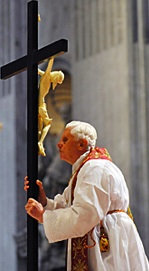 Pedophilia is only the latest weapon aimed against Joseph Ratzinger. And each time, he is attacked where he most exercises his leadership role. One by one, the critical points of this pontificate.
NOTE: For its combination of succinctness and clarity of thought, this piece by the most indispensable of Vatican-watchers, Sandro Magister of L’Espresso, deserves reproduction in full.
ROME, April 7, 2010 – The attack striking pope Joseph Ratzinger with the weapon of the scandal posed by priests of his Church is a constant of this pontificate.
It is a constant because every time, on different terrain, striking Benedict XVI means striking the very man who has worked and is working, on that same terrain, with the greatest foresight, resolve, and success. (more…)
“Lourdes”
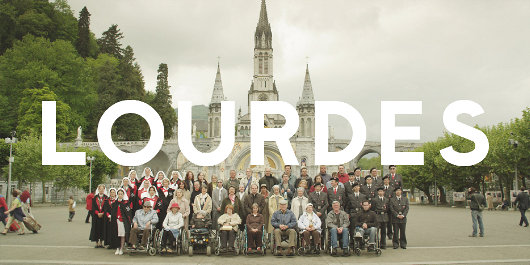
Various sources have brought to light the new film “Lourdes” by the Austrian director Jessica Hausner. The film depicts the pilgrimage to Lourdes of a non-particularly religious woman (played by Sylvie Testud) suffering from Mutiple Sclerosis who is healed of her illness. The film by a non-believing director has met with both praise and suspicion from Catholic quarters, and has been compared, at least stylistically, to the work of Michael Haneke (whose latest, “The White Ribbon” is currently showing in New York). Latest to weigh in is the Catholic Herald‘s indispensable Anna Arco, who writes:
I saw it as an exercise in theodicy where God loses. In a quiet dispassionate way, Jessica Hausner, the film’s Austrian director, paints a bleak picture of a world where fate is a blind, arbitrary force and human beings clutch at the straws of faith, half-truths in their cowardly despair. The suffering are not healed, human nature is selfish and the problem of pain is not solved. God can’t exist because he isn’t fair. Christianity offers a web of half-truths obscuring a nihilistic reality.
Miss Arco recently spoke with the director, and the interview will be published in the next Catholic Herald. (more…)

Search
Instagram: @andcusack
Click here for my Instagram photos.Most Recent Posts
- Brunel’s Unbuilt Capitol February 3, 2026
- Cricket at Fordham January 27, 2026
- Palacio Barolo Revisted January 14, 2026
- Learning to Love Liguria January 14, 2026
- Crux Alba No. 2 January 13, 2026
Most Recent Comments
Book Wishlist
Monthly Archives
Categories