Church
About Andrew Cusack
 Writer, web designer, etc.; born in New York; educated in Argentina, Scotland, and South Africa; now based in London.
 read more
News
Blogs
Reviews & Periodicals
Arts & Design
World
France
Mitteleuropa
Knickerbockers
Argentina
The Levant
Africa
Cape of Good Hope
Netherlands
Scandinavia
Québec
India
Muscovy
Germany
Academica
Quo Vadis, Benedicte?
Roman Forum and Una Voce New York Event
October 19, 2008: 1:30—6:00 P.M.
Since the Catholic revival of the nineteenth century, the Papacy has found itself facing dangers on all fronts in its efforts to transform the world in Christ. On the one hand, this work has involved a need for protecting and deepening knowledge of the Deposit of Faith. On the other, it has entailed developing strategies for dealing with a globe filled with hostile visions of life that have nevertheless proven seductive to many Catholics. John Rao, Associate Professor of History at St. John’s University, discusses the historical development of the problem from the reign of Blessed Pius IX (1846-1878) until the near present; Christopher Ferrara, President of the American Catholic Lawyers Association, treats of it with respect to the specific difficulties of Pope Benedict XVI.
Let Louis XVI Rest in Peace; A Funeral Mass in Manhattan
By PETER STEINFELS | The New York Times | July 17, 1989
They came not to praise the French Revolution but to bury it.
In the place of tricolor bunting, there were the black vestments of an old-fashioned Roman Catholic funeral Mass. Instead of fireworks, there were the flickering candles of a Manhattan church. Instead of the “Marseillaise,” there was the rise and fall of Gregorian chant.
They came not to praise the French Revolution but to bury it. In the place of tricolor bunting, there were the black vestments of an old-fashioned Roman Catholic funeral Mass. Instead of fireworks, there were the flickering candles of a Manhattan church. Instead of the “Marseillaise,” there was the rise and fall of Gregorian chant.
Lumsden Requiem in Edinburgh
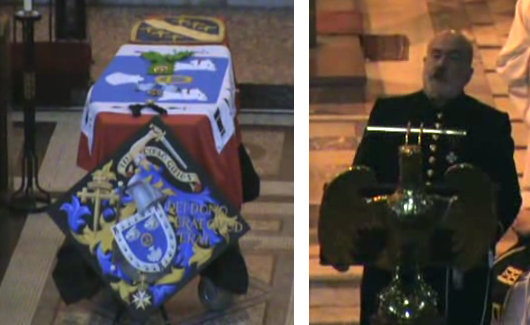
Some good Christian soul was kind enough to put most of our friend David Lumsden‘s funeral at St. Mary’s (Catholic) Cathedral in Edinburgh on YouTube. It was the first Latin requiem in the extraordinary form of the Mass held in the Cathedral for many decades — a fact which David would have particularly enjoyed. Of note is the address given by Robin Angus, embedded below, and of course Gerald Warner’s previously mentioned report should not be missed either.
The Petit Séminaire de Québec
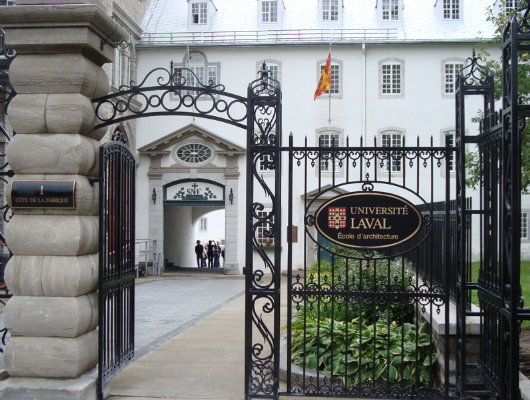
Adjoined to the ancient Cathedral Basilica of Notre-Dame in Quebec City is the Petit Séminaire. The Séminaire de Québec was founded in 1663 by the Blessed François Laval to train priests for the Vicariate Apostolic of New France, and the Petit Séminaire, its secondary school, was founded just five years later to teach both colonial French and native Indian youths. Among the school’s former pupils are four prime ministers of Québec, two lieutenant-governors (as the Queen’s viceregal representative in the province is known), and many other writers, politicians, and important figures of history. The Petit Séminaire survives today as a private Catholic secondary school.
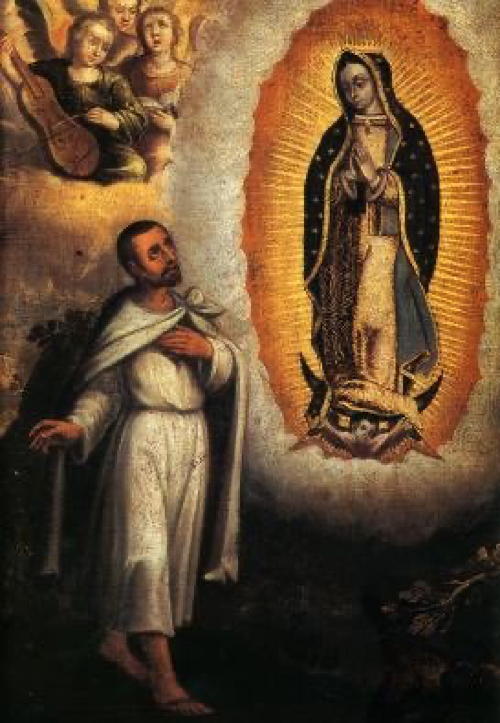
St. Juan Macias
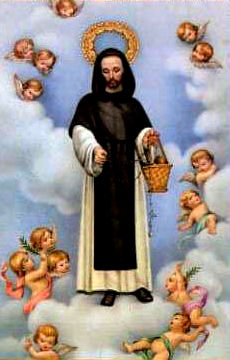
Posted in aid of a friend’s intention.
The Pope in Paris
Benedict XVI brings a message of love & hope to the City of Light
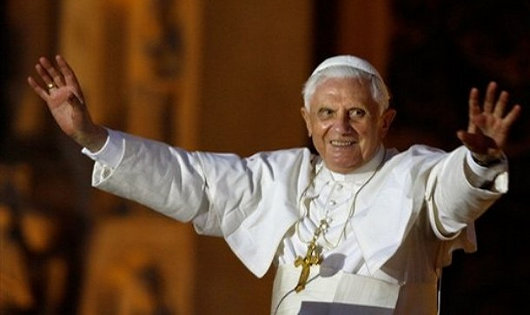
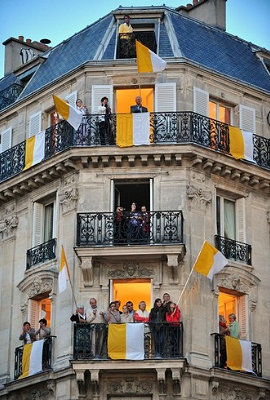 It is wholly appropriate that the motto of the city of Paris is Fluctuat nec mergitur: “Tossed by waves, she does not sink”. It would be hard to find better words to describe the Barque of Peter, whose Holy Father the Pope has spent the past two days in the French capital. From time immemorial, France has been described as “the eldest daughter of the Church”, its primatial see of Lyons established in the second century and Clovis, its first Christian king, receiving baptism in 498. But alongside the 1,500 years of Christianity, France has, for the past two centuries, also been a font of revolution and disruption — the very spirit of that first “non serviam“.
It was the French thinker Charles Maurras — not himself a Catholic until the very end of his life — who conceived of the notion that (since the Revolution) there was not one France but two: le pays réel and le pays legal; The real France, Catholic and true, versus the official France, irreligious and contrived. Just as Maurras differentiated the two visions of France, we in the English-speaking world know that England is truly a Catholic country that is suffering from a four-century interregnum (and so with Scotland, and Ireland, and America, and Canada, and Australia…). We love our homes but we know they are not truly themselves — they do not truly reflect that idea of their essence — until they enjoy the fullness of Christian communion.
‘Feudal pomp and Latin Mass at funeral of a Scottish laird’
Gerald Warner reports on the funeral of David Lumsden of Cushnie:
Thursday, September 11, 2008
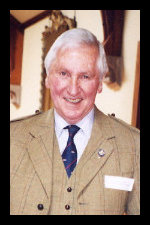 To Edinburgh yesterday, for a melancholy but magnificent and uplifting occasion: the funeral of David Lumsden of Cushnie, Garioch Pursuivant of Arms, restorer of ancient castles and Jacobite romantic. It was held in the Catholic cathedral where, for the first time since Vatican II, the Latin Tridentine Mass was sung, thanks to the permissive rules of Benedict XVI in his motuproprio Summorum Pontificum.
The coffin was draped in the banners of the Order of Malta and the deceased’s arms, with an heraldic hatchment and the decorations of the orders of chivalry to which he belonged. Knights of Malta and of the Constantinian Order processed behind their banner in mediaeval robes. The congregation was filled with peers, chieftains, lairds and splendid eccentrics, the pews awash with tartan. One of the tail-coated ushers was the grandson of a papal marquis. Robin Angus, whose day job is venture capitalist, dressed in the uniform of a papal Knight of St Sylvester, delivered a moving panegyric.
This occasion was a potent reminder of an alternative Scotland, a different pulse from the vulgar, mean-minded, politically correct clones in the abysmal Scottish parliament at Holyrood. It was shamelessly feudal, aristocratic and colourful. Evelyn Waugh would have loved it; Harriet Harridan would have burst her stays. It was reminiscent of the scene in Waugh’s Sword of Honour when, at the funeral of old Mr Crouchback, the members of ancient Catholic Recusant families murmur their sonorous names while the narrator, parodying a wartime poster, concludes: “Their journey was really necessary.”
At the subsequent reception, Lady Mar, whose personal herald David was and who came top of the ballot for the 92 surviving hereditary peers in the House of Lords, was pointedly addressed by Jacobites as “Your Grace”. This was because, although the British state recognises her as 30th Countess of Mar, her ancestor who led the Jacobite Rising of 1715 was created Duke of Mar by the exiled Stuart King James VIII.
Only a few of these Jacobite peerages created by the Stuarts in exile have heirs today. Now that such hereditary peerages no longer bestow an automatic seat in Parliament, it would be a gracious gesture for the Crown to recognise them and so heal old historical wounds. There is a precedent: Spain has recognised the titles of nobility created by the Carlist claimants in exile – Carlism being the Spanish equivalent of Jacobitism.
The dry-as-dust forms issued by government departments are normally very boring; but the most romantic document available online is issued by the Spanish Ministry of Justice, entitled Solicitud de Titulo Nobiliario por: Rehabilitacion/Reconocimiento de Titulo Carlista. It is the formal application for recognition of a title of nobility conferred by the Carlist kings in exile from 1833 to 1936. David Lumsden of Cushnie (RIP) would have appreciated it.
Fire at St. Jodard
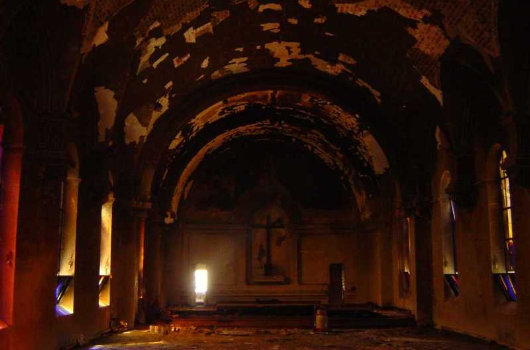
The chapel of the Community of St. Jean’s novitiate at Saint-Jodard in France was tragically consumed by an accidental fire late last month. The brothers give thanks that no one was harmed in the fire and look upon the event as “a favorable occasion to learn how to live together in the Great Hope and to redouble fraternal charity”.
Contributions can be sent to:
Prieuré Saint Joseph
42590 St Jodard
FRANCE
Ingrid Betancourt at Castel Gandolfo
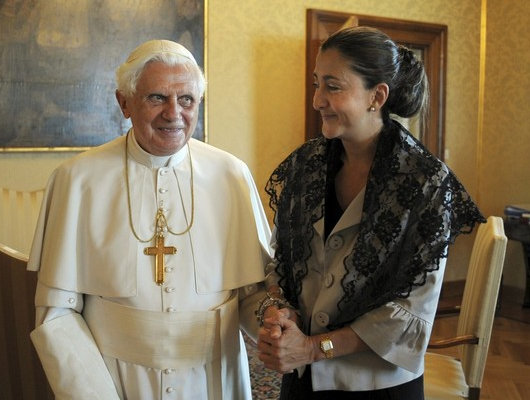
Ingrid Betancourt was welcomed by Pope Benedict XVI at the papal retreat of Castel Gandolfo this week. The Franco-Colombian politician was freed from the communist FARC guerrillas in July by a stealth operation of the Colombian Army in which not a single shot was fired. Betancourt had been held hostage for over six years in the South American jungle. After being reunited with her family, she made a pilgrimage to Lourdes to give thanks for the intercession of the Blessed Virgin in sustaining her during her capitivity.
Church music by the unchurched: Saint-Saëns
“No thoughtful Catholic will have difficulty distinguishing Mozart’s music from his Freemasonry, any more, for example, than separating Bach’s work from his Lutheranism. If we were to dismiss every human work that had been created by a sinner there might not be much left standing. I was once taken to task for leading a congregation in a ‘Protestant tune’, to which I replied, ‘Which note was Protestant?’. Let us move on.”
So begins a delightful appreciation of the sacred music of Camille Saint-Saëns written by R. J. Stove and printed in the latest issue of Oriens, an Australian publication devoted to traditional Catholic culture. It is but the first of a series discussing eminent composers who spent most of their lives outside orthodox Catholicism, but who made notable contributions to sacred music. Mr. Stove is also a contributor to The New Criterion and was kind enough to send me a copy of his article, which was both comprehensive and concise while remaining interesting throughout. More information on Oriens can be found at their website.
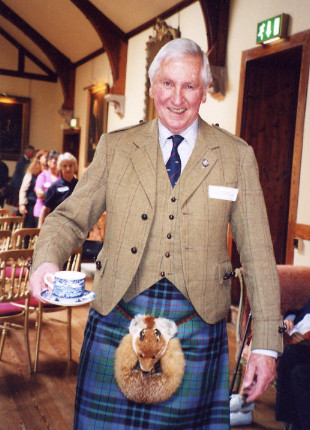
David Lumsden of Cushnie, 1933-2008
Garioch Pursuivant of Arms, sometime Baron of Cushnie-Lumsden, Knight of Malta, Patron of the Aboyne Highland Games

It was with great sadness that I learned this morning of the death of David Lumsden. He was an exceptionally genial and affable man, and was relied on to provide good company at many events, from balls to Sunday lunches and everything in between. But David was generous not only with his good company but with his patronage, as is attested to by the countless organizations he helped and guided. Here was a man who was generous of spirit. David’s death came very suddenly yesterday afternoon in his hotel room at the annual conference of the 1745 Association, of which he was president. Just last Sunday he had attended the traditional Mass at St. Andrew’s, Ravelston in Edinburgh, where a friend described him as “looking as hale and hearty as ever”.
David Gordon Allen d’Aldecamb Lumsden of Cushnie, sometime Baron of Cushnie-Lumsden, was born on 25 May in 1933 in Quetta, Baluchistan in the Empire of India. He was the son of Henry Gordon Strange Lumsden, a Major in the Royal Scots, of Nocton Hall, Lincolnshire and Sydney Mary, only child of Brigadier-General Charles Allen Elliot.
He was educated at Allhallows, Devon, Bedford School, and at Jesus College, Cambridge before serving in the Territorial Army with the London Scottish while working at British American Tobacco. He was a Knight of the Order of Malta, as well as of the Constantinian Order, and was Patron of the Aboyne Highland Games. David enthusiastically served as Garioch Pursuivant to the Chief of the Name and Arms of Mar (presently Margaret of Mar, the 30th Countess of Mar), one of the four surviving private officers of arms in Scotland recognised by the Court of the Lord Lyon.

Lumsden with friends, at the Aboyne Highland Games.
David co-founded the Castles of Scotland Preservation Trust and the Scottish Historic Organs Trust and was President of the Scottish Military History Society. In addition to his Magister Artium from Cambridge, he was a Fellow of the Society of Antiquaries of Scotland. He was on the council of The Admiral the Viscount Keppel Association and was one of the patrons of the famous Russian Summer Ball in London. He was Convenor of the Monarchist League of Scotland and was on the council of the Royal Stuart Society.
In the realm of sport, he was a keen shot and had rowed at Cambridge, in addition to his interest in sailing and riding.
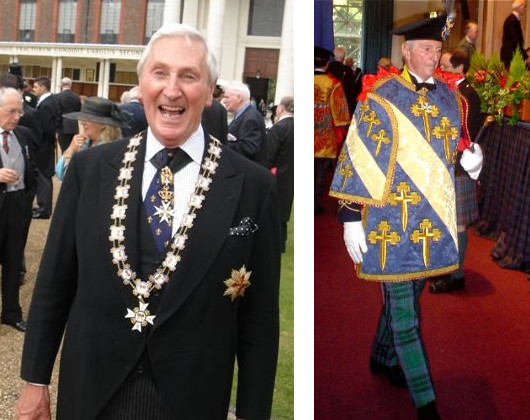
Left: Representing the Royal Stuart Society at the Henry IX commemoration at the Royal Hospital Chelsea. Right: In his capacity as Garioch Pursuivant of Arms, at the XXVIIth International Congress of Genealogical and Heraldic Sciences in 2006.
David had a passion for architecture, and especially that of his native Scotland. Returning in 1970 after a spell in Africa, he undertook the restoration of two family properties: Cushnie House, built in 1688 by Alexander Lumsden and Tillycairn Castle, built in 1540 by Matthew Lumsden. He later went on to restore Leithen Lodge at Innerleithen, an 1880s shooting lodge built in a distinctly Scottish take on the Arts & Crafts tradition. Under the auspices of the Castles of Scotland Preservation Trust, in 1994 he oversaw the restoration of Liberton Tower just south of the Royal Observatory in Edinburgh.
“David was a unique man possessed of an insatiable love of life and learning,” his friend Rafe Heydel-Mankoo said. “He will be deeply missed and fondly remembered by those fortunate enough to have met him.”
“David was at the centre of so many things, and brought together so many different people,” said Lorna Angus, the wife of Robin Angus. “He could bring life to any gathering and he made so many good things possible.”
Robin Angus, meanwhile, said that David Lumsden “personified a world of precious things — things which are imperilled, but which never seemed imperilled when he was there.”
“David no longer visibly with us is unimaginable,” Robin continued. “What his friends must now do is keep the flame, and — as he did — pass it on to others with the same generous wisdom. He was the soul of old Scotland. I hope that, in Heaven, Raeburn will make amends for what the centuries did not allow, and paint his portrait.”
While I wholeheartedly agree with Robin, it must be said that those who were blessed to know David are left with a portrait of him in our hearts and minds far greater than even the brush of Raeburn could achieve.
David Gordon Allen d’Aldecamb Lumsden
of Cushnie
1933–2008
“… hold fast to that which is good.”
— 1.Thess 5:21
Requiem aeternum dona eis Domine:
et lux perpetua luceat eis.
Requiescat in pace.
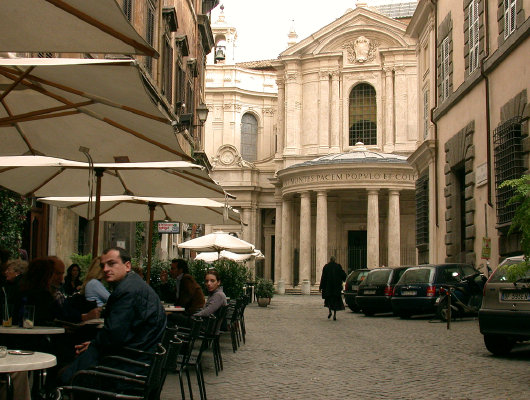
Santa Maria della Pace
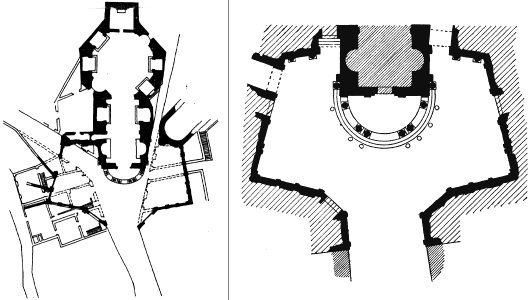
One of my favourite churches in all of Rome is that of Santa Maria della Pace. The best approach is from the alley leading out of the northwest corner of the Piazza Navona, crossing the Via di Santa Maria dell’Anima and making sure to turn left into the smaller alleyway when the little street itself swerves north. Moving forward, the perambulator suddenly emerges into a tiny trapezoidal piazza and having continued for a few paces realizes, almost as an afterthought, that there is something over your right shoulder. There is the Church of Santa Maria della Pace.
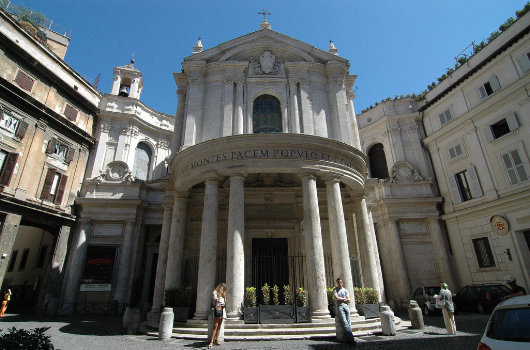
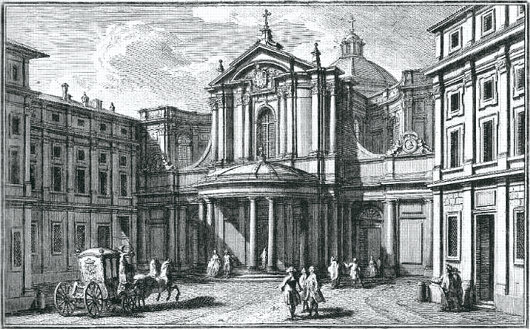
Like so many Roman edifices the Church is the work of many centuries. A church dedicated to the Apostle Andrew once stood on the site, and it was on the foundations of that church in 1482 that work on Santa Maria della Pace commenced. Sixtus IV, praying for peace in the Italian peninsula, vowed to build a church dedicated to Our Lady of Peace, and hence the Apostle’s patronage was superseded. While Baccio Pontelli deserves the credit for the church proper, Pietro da Cortona’s splendidly theatrical façade and its enveloping piazza were commissioned Alexander VII in the 1650s.
Santa Maria della Pace has a number of connections to the Chigi dynasty. The first prominent member of the Chigi family was Agostino (1465–1520), a wealthy banker and builder of the Villa Farnesina in Trastevere. Here at Santa Maria della Pace, Agostino commissioned the Capella Chigi (not to be confused with the Capella Chigi in Santa Maria del Popolo). Alexander VII himself was a Chigi, and perhaps this explains his patronage of Cortona’s façade and piazza. Among the later Chigi clan, there were a number of cardinals, some of whom were even nuncios, and more recently Ludovico Chigi Albani della Rovere was Prince & Grand Master of the Order of Malta from 1931 to 1951. Anyhow, the Chigi chapel features a fresco initiated by Raphael (and completed by his school), while the adjacent chapel includes sculptural decoration by Michelangelo.
In addition to greats such as Raphael, Michelangelo, and Cortona, the cloister of the church is by none other than Bramante, and indeed was his first work in the Eternal City. Somewhat exhaustively, it doesn’t end there. Santa Maria della Pace has a high altar by Carlo Maderno, a sculpture of the Deposition by Cosimo Fancelli, two small frescoes by il Rosso Fiorentino, and another fresco by Baldassarre Peruzzi who, shall we say in kindness, was a much better architect than painter. There are further works by Maratta and Gentileschi (Orazio, that is — not Artemisia).

The Catholic Herald

First Christian de Lisle, now Jennifer Roche: at this rate within a year everyone I know will have contributed to the Catholic Herald! (And, incidentally, I did have a brief chat in the Travellers Club once with the chap who wrote the piece on the Assumption).
I might just have to take out a subscription, though an electronic one — probably the most convenient for we across the seas — is still a hefty £38: at today’s exchange rate that’s seventy good ole American smackeroons! Probably worth it, though.
Propaganda Fide

Cheers to the unknown wag who created this delightful poster, parodying the Obama “HOPE” posters.
Alexander Solzhenitsyn, 1918–2008
Russian traditionalist, Nobel laureate, feted in the West for criticism of Soviet Communism, then spurned for rejecting liberal materialism

Alexander Isayevich Solzhenitsyn, the most famous Russian writer and historian of our age, has died at eighty-nine years of age. Solzhenitsyn was the earliest to bring first-hand knowledge of the Gulag, the Soviet system of prison colonies and labour camps, to wider Western attention. For this noble task, he was awarded the Nobel Prize for Literature in 1970 and expelled from the Soviet Union four years later, returning in 1994. After the fall of the Soviet regime, he despised Boris Yeltsin’s incompetence, identifying 1998 as the low point of Russia’s recent history. “Yeltsin decreed I be honored the highest state order,” Solzhenitsyn explained. “I replied that I was unable to receive an award from a government that had led Russia into such dire straits.”
He gave cautious support to the presidency of Vladimir Putin, and was pleased that while, in his words, “Moscow is still communist”, there was a growing readiness under Putin to admit (and even broadcast on state television) the crimes and outrages of the Soviet regime.
“Putin inherited a ransacked and bewildered country, with a poor and demoralized people. And he started to do what was possible — a slow and gradual restoration. These efforts were not noticed, nor appreciated, immediately. In any case, one is hard pressed to find examples in history when steps by one country to restore its strength were met favorably by other governments.”
Influenced by his experience in exile in both Switzerland and New England, Solzhenitsyn insisted on the need for local self-government in Russia. “Today I continue to be extremely worried by the slow and inefficient development of local self-government. But it has finally started to take place. In Yeltsin’s time, local self-government was actually barred on the regulatory level, whereas the state’s ‘vertical of power’ (i.e. Putin’s centralized and top-down administration) is delegating more and more decisions to the local population. Unfortunately, this process is still not systematic in character.”
Solzhenitsyn expressed further disappointment with the new Western imperialism being waged against Russia, embodied in the 1999 War against Serbia which turned so many Russian minds against the Western powers they had previously been quite friendly to.
In a recent interview with Der Spiegel, Solzhenitsyn was asked whether he was afraid of death:
“No, I am not afraid of death any more. When I was young the early death of my father cast a shadow over me — he died at the age of 27 — and I was afraid to die before all my literary plans came true. But between 30 and 40 years of age my attitude to death became quite calm and balanced. I feel it is a natural, but no means the final, milestone of one’s existence.”
When the interviewer from Der Spiegel wished him many more years of “creative life”, Solzhenitsyn calmly responded “No, no. Don’t. It’s enough.”
Revolution’s loss is counter-revolution’s gain
 As Christian de Lisle reports in the latest Catholic Herald, Chase Hilgenbrinck, the 26-year-old defense player for the New England Revolution, is leaving the world of professional soccer to pursue a vocation to the priesthood. “Playing professional soccer has been my passion for a long time,” Hilgenbrinck told the press, “and I feel blessed to have successfully lived out this dream. My passion now is to do the will of God, which is wanting only what He wants for me. Though I will miss the game of soccer, I know that I am moving on to something much greater.”
Earlier, Hilgenbrinck, who had a four-year career in Chile before returning this year to play professionally in the States, considered waiting until the end of his soccer-playing days. “Delayed obedience is disobedience,” he told the Associated Press. “We are all called to do something. I feel like my specific call is to the priesthood. So, no, it was not possible to continue with soccer. It’s absolutely inevitable.”
Hilgenbrinck will enter the seminary at Mount St. Mary’s University, one of the oldest Catholic institutions in the United States.
The Pope at Government House

Pope Benedict XVI reviews the guard after being received by Maj. Gen. Jeffery, the Governor-General of Australia.
The Holy Saints of Russia
Russia remembers the murdered Tsar St. Nicholas II & his family

Christians in Russia yesterday solemnly remembered the brutal killing of the country’s Imperial Family by the Bolshevik revolutionaries 90 years earlier. Tsar Nicholas II, the Tsarina Alexandra, their daughters the Grand Duchesses Olga, Tatiana, Maria, and Anastasia, and the Tsarevich Alexei have all been added to the canon of saints of the Russian Orthodox Church. The Imperial Family were first officially recognized as saints by the Russian Orthodox Church outside the Soviet Union in 1981, and the Moscow patriarchate extended the same recognition in 2000.
Ingrid Betancourt Goes to Lourdes
Ex-hostage gives thanks at Marian shrine during its 150th year

Ingrid Betancourt has travelled to the Shrine of the Blessed Virgin at Lourdes in France to give thanks for her liberation from years of captivity as a hostage of the FARC. Alongside her mother, son, and daughter, Ms. Betancourt also offered prayers on behalf of those prisoners who are still held hostage by the FARC guerrillas.
Saskatoon Cathedral
Matthew Alderman’s hypothetical counter-proposal

Matthew Alderman has designed a hypothetical counter-proposal for the new Catholic cathedral in Saskatoon, Saskatchewan which is infinitely more beautiful than the ugly modernist thingamajig that the diocese is actually building. Matt elaborates upon the problematic nature of the modernist design here and here.

Search
Instagram: @andcusack
Click here for my Instagram photos.Most Recent Posts
- Brunel’s Unbuilt Capitol February 3, 2026
- Cricket at Fordham January 27, 2026
- Palacio Barolo Revisted January 14, 2026
- Learning to Love Liguria January 14, 2026
- Crux Alba No. 2 January 13, 2026
Most Recent Comments
Book Wishlist
Monthly Archives
Categories