Church
About Andrew Cusack
 Writer, web designer, etc.; born in New York; educated in Argentina, Scotland, and South Africa; now based in London.
 read more
News
Blogs
Reviews & Periodicals
Arts & Design
World
France
Mitteleuropa
Knickerbockers
Argentina
The Levant
Africa
Cape of Good Hope
Netherlands
Scandinavia
Québec
India
Muscovy
Germany
Academica
Ursus Oxoniensis
Brother Ursus of Blackfriars Hall, Oxford
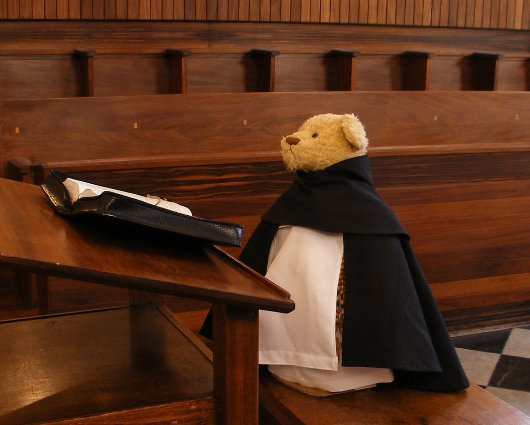
Godzdogz, the blog of the English Dominicans, informs us of the following:
The Dominican order is very inclusive with brothers and sisters from a wide variety of backgrounds. One of the friars who lives in Oxford, Br Ursus, describes what day to day life is like for a Dominican bear.
“I get up at 7.43 every morning for Lauds. This is always a great challenge, especially in winter. Before joining the order, I used to hibernate for 6 months of the year, so it has taken me quite a while to adapt to getting up every day. It’s one of the sacrifices I have to make, but I receive many consolations. As it says in psalm 118 ‘Your promise is sweeter to my taste than honey in the mouth.’ As someone who very much loves honey, I find this imagery delightful, and it’s also very true.
Paul Comtois of Québec
Farmer, Politician, Hero, Saint

FROM TIME TO TIME there are men in history whose heroism runs so counter to the spirit of the age that the arbiters of passing fashion must simply ignore him rather than run the risk of acknowledging his embarrassing greatness and goodness. God has graced the New World with many of His saints, some of whom — Rose of Lima, Martin de Porres, Mother Seton — have already been raised to the altar, others — Fulton Sheen, Fr. Solanus Casey — are certainly on their way. Yet more remain unsung and almost forgotten: Paul Comtois (1895–1966), Lieutenant-Governor of Québec until his heroic death, is just one of these saints.
Matt Alderman’s at it again
The king of counter-proposals sets eyes on Divine Mercy shrine

Young architect Matt Alderman presents his counter-proposal to a horrifyingly kitsch proposal for a West-Coast U.S. shrine to the Divine Mercy. Why, given that the recovery of skill & talent in architecture in the past few decades, are most new churches still revoltingly ugly? “The problem is not that it is hard to get beautiful churches built, but that the wrong people seem to end up getting the commissions,” Matt writes. “Oakland and Los Angeles were, of course, going to go modernistic no matter what, but Houston Cathedral could have been a masterpiece if handled by someone with a greater openness to traditional design, rather than settling for a mediocre pseudo-traditionalism.”
The Grand Master in Hungary
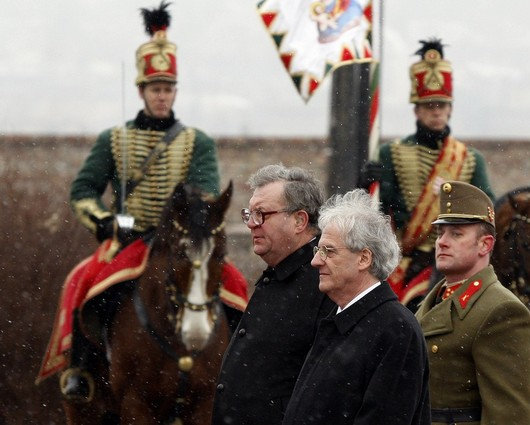
His Most Eminent Highness, Fra’ Matthew Festing, the Prince & Grand Master of the Sovereign Military Order of Malta made a four-day visit to Hungary last month, from 8-11 of February. The Grand Master was invited to Hungary by the President of the Republic, Mr. László Sólyom, who met with Fra’ Matthew at the Sándor Palace in Budapest. The President and the Grand Master discussed the various collaborative efforts between Hungary and the Order of Malta in health and social fields and discussed the possibility of further developing those projects.
How bad journalism infects religion reporting
Tom Kington & Jamie Doward of The Observer lead the way
“Pope stirs up Jewish fury over bishop: The Vatican is reinstating a British priest who denies millions died at the hands of the Nazis. … Tension between the Vatican and Jewish groups looked set to explode yesterday after Pope Benedict XVI rehabilitated a British bishop who has claimed no Jews died in gas chambers during the second world war.”
Or rather, not. All the Holy Father has done is lift Bishop Williamson’s excommunication. Bishop Williamson’s excommunication had nothing to do with his holocaust denial, but rather with his willful disobedience to authority. Thus the lifting of his excommunication is in no way a “rehabilitation”, nor an endorsement of his dodgy views on history, but merely to do with the offense or state which brought about excommunication.
For some reason, this kind of misleading disinformation (whether out of malicious intent or just not being very good at one’s job) infects religion reporting more than any other field in the British media. You would think people would study or learn about the institutions they report about, but that no longer seems a requirement of the job as it presumably once was. Go figure.
Passenger Ship Chapels
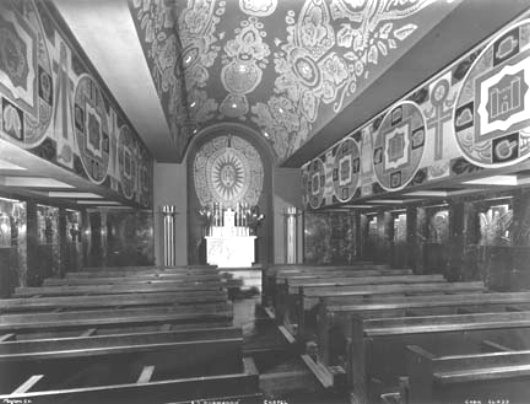
Above & below: the SS Normandie. The Normandie was seized by the U.S. government and renamed the USS Lafayette but burned in New York harbor before she could be put to good use in the war effort. The bronze doors to the chapel were salvaged and now grace the Church of Our Lady of Lebanon in Brooklyn.
Chigi
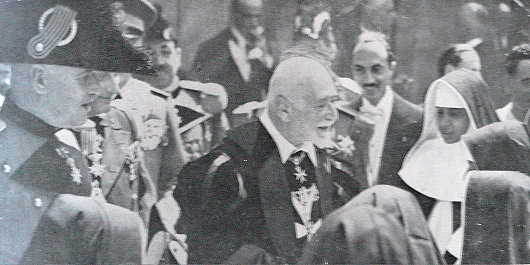
This is my favourite photo of Ludovico Chigi della Rovere Albani (Prince & Grand Master of the Order of Malta, Prince of the Holy Roman Empire, 8th Prince of Farnese and Campagnano, 4th Prince of Soriano, 8th Duke of Ariccia and of Formello, Marquess of Magliana Pecorareci, Hereditary Marshall of the Holy Roman Church and Guardian of the Conclave) who oversaw the rebuilding of Monte Cassino. Here, he distributes prizes to medical students at the International Missionary School of Medicine and Surgery.
In the footsteps of an illustrious predecessor
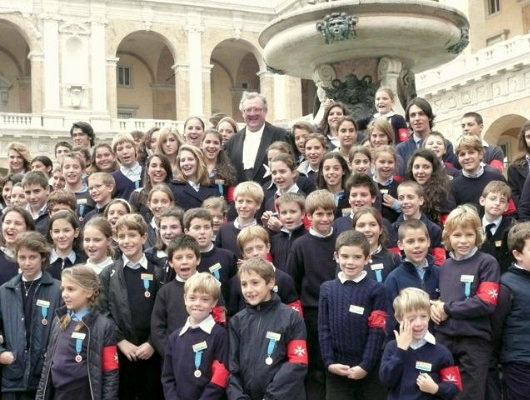
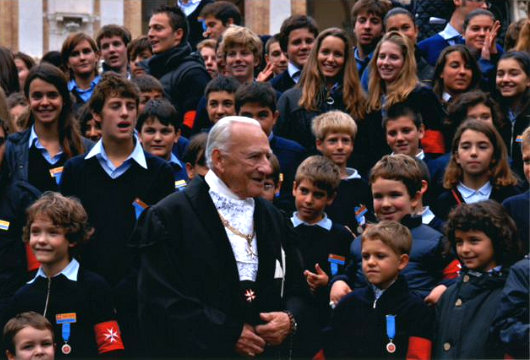
This past November His Most Eminent Highness Fra’ Matthew Festing, the Prince & Grand Master of the Order of Malta, led the order’s annual pilgrimage of Italian youth to the Marian shrine of Loreto, which last year had been led by his predecessor the late Fra’ Andrew Bertie.

God and the Emperor
Thanksgiving Collect
Victory in Uruguay
Leftist president defies his own coalition, vetoes bill to legalize abortion.
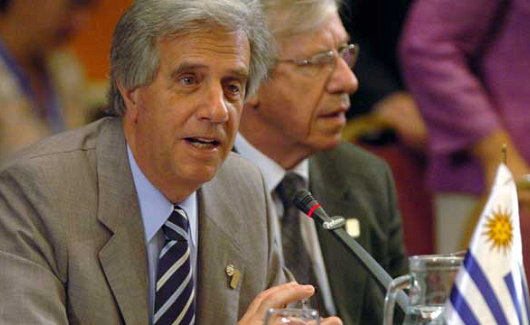
The President of Uruguay, Dr. Tabaré Vázquez, has vetoed a bill passed by the two chambers of the country’s congress that would overturn the ban on abortion. Pre-natal infanticide has been illegal in Uruguay since 1938, and the left-wing Frente Amplio coalition that has a congressional majority sought to enact one of the most permissive abortion laws in Latin America. While President Vázquez, an oncologist by training, is a member of the Frente Amplio party, his constituent group in the alliance is the Christian-Democratic Party which proclaims as part of its platform an “absolute respect for human rights”. The veto sends the bill back to the congress, where the Frente does not have the two-thirds majority necessary to override the veto.
Aquinas Visited Yugoslav Abortionist in Dream, Now Defender of the Unborn
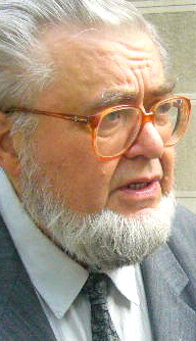 Madrid, Nov 12, 2008 / 09:21 pm (CNA). — The Spanish daily “La Razon” has published an article on the pro-life conversion of a former “champion of abortion.” Stojan Adasevic (pictured, right), who performed 48,000 abortions, sometimes up to 35 per day, is now the most important pro-life leader in Serbia, after 26 years as the most renowned abortion doctor in the country.
“The medical textbooks of the Communist regime said abortion was simply the removal of a blob of tissue,” the newspaper reported. “Ultrasounds allowing the fetus to be seen did not arrive until the 80s, but they did not change his opinion. Nevertheless, he began to have nightmares.”
In describing his conversion, Adasevic “dreamed about a beautiful field full of children and young people who were playing and laughing, from 4 to 24 years of age, but who ran away from him in fear. A man dressed in a black and white habit stared at him in silence. The dream was repeated each night and he would wake up in a cold sweat. One night he asked the man in black and white who he was. ‘My name is Thomas Aquinas,’ the man in his dream responded. Adasevic, educated in communist schools, had never heard of the Dominican genius saint. He didn’t recognize the name”
“Why don’t you ask me who these children are?” St. Thomas asked Adasevic in his dream.
“They are the ones you killed with your abortions,’ St. Thomas told him.
“Adasevic awoke in amazement and decided not to perform any more abortions,” the article stated.
“That same day a cousin came to the hospital with his four months-pregnant girlfriend, who wanted to get her ninth abortion—something quite frequent in the countries of the Soviet bloc. The doctor agreed. Instead of removing the fetus piece by piece, he decided to chop it up and remove it as a mass. However, the baby’s heart came out still beating. Adasevic realized then that he had killed a human being,”
After this experience, Adasevic “told the hospital he would no longer perform abortions. Never before had a doctor in Communist Yugoslavia refused to do so. They cut his salary in half, fired his daughter from her job, and did not allow his son to enter the university.”
After years of pressure and on the verge of giving up, he had another dream about St. Thomas.
“You are my good friend, keep going,’ the man in black and white told him. Adasevic became involved in the pro-life movement and was able to get Yugoslav television to air the film ‘The Silent Scream,’ by Doctor Bernard Nathanson, two times.”
Adasevic has told his story in magazines and newspapers throughout Eastern Europe. He has returned to the Orthodox faith of his childhood and has studied the writings of St. Thomas Aquinas.
“Influenced by Aristotle, Thomas wrote that human life begins forty days after fertilization,” Adasevic wrote in one article. La Razon commented that Adasevic “suggests that perhaps the saint wanted to make amends for that error.” Today the Serbian doctor continues to fight for the lives of the unborn.
Diary
Nothing ever happens in New York, or at least nothing when compared to Edinburgh, London, or Paris; this is my perpetual complaint. But when it rains, it pours, and so it was last night. Not only was it press day, the busiest day of the month-long cycle of creating each issue of The New Criterion, but then the evening beheld both “A Festive Evening Celebrating the Mission of the von Hildebrand Project” at the University Club and “The Reception and Dinner to Present the Medal for Heraldic Achievement” at the Racquet & Tennis Club. The simultaneous events were organized by the Dietrich von Hildebrand Legacy Project and the Committee on Heraldry of the New York Genealogical & Biographical Society, respectively.
A rarely-assembled fun crowd was promised at the von Hildebrand event, but nor was the presentation of the G&B’s medal a common occurrence (there have been only three awarded to date) so I simply resolved that I would do my best to attend both. (more…)
Bless!

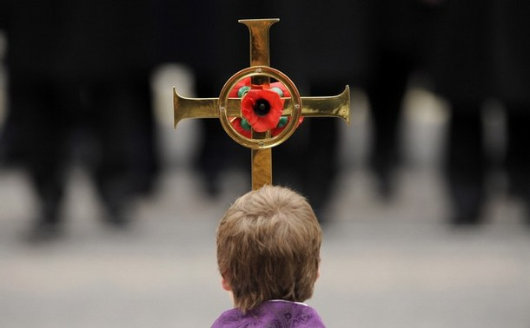
From a Louisiana newspaper:
The Coronation of Blessed Charles
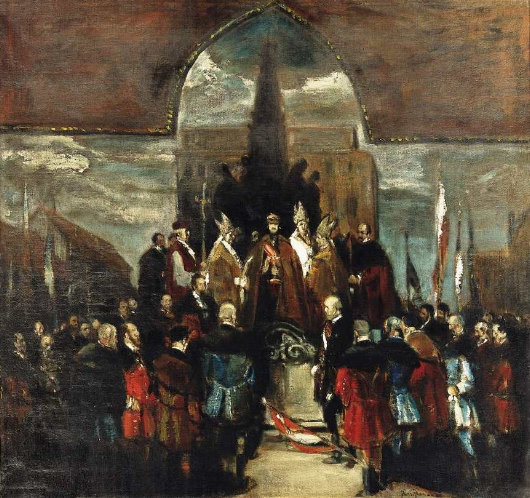
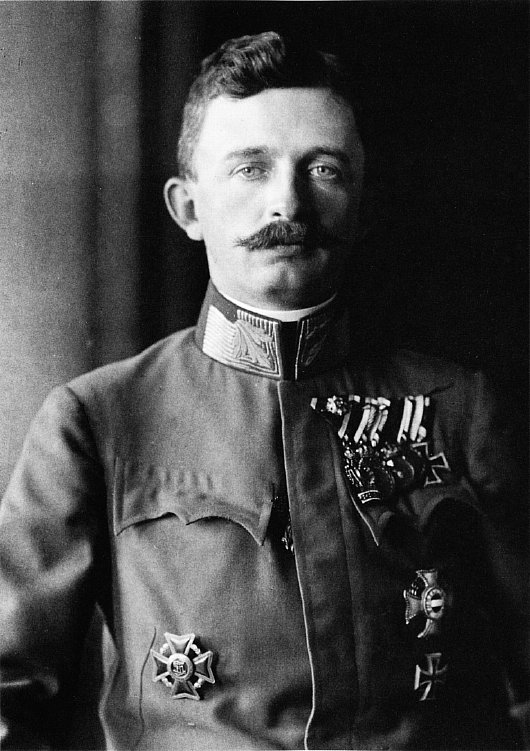
Blessed Emperor Charles was crowned as Apostolic King of Hungary on the 30th of December in 1916. It was the last Hapsburg coronation to this day. For those interested there are two accounts which do justice to the sacred rites. One is by that most devoted admirer of the Hapsburgs, Gordon Brook-Shepherd, in his excellent biography of Charles, The Last Hapsburg. (Brook-Shepherd also wrote excellent and quite readable biographies of the Empress Zita, of Crown Prince Otto, of Chancellor Dollfuß, and Baron Sir Rudolf von Slatin Pasha).
Charles & Zita
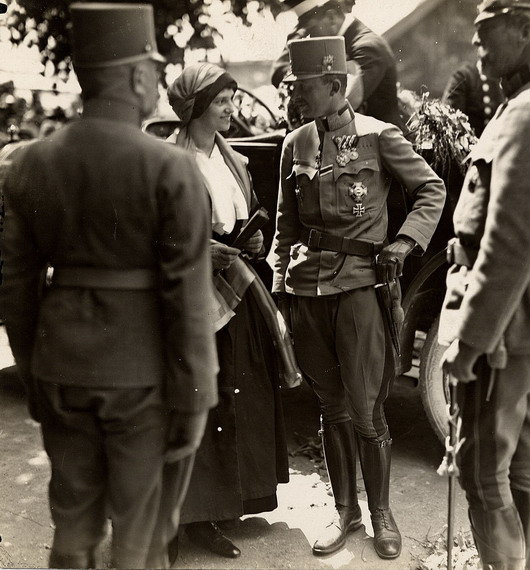
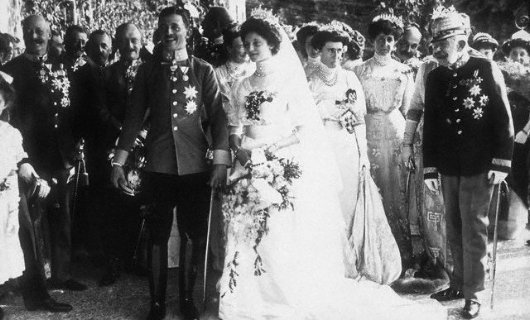
October 21 was chosen as the Feast of the Blessed Emperor Charles not because it is the date of his death — which is 1 April 1922 — but rather to commemorate the marriage (photo, below) between Archduke Charles of Austria (as he was then) and Princess Zita of Bourbon-Parma in 1911. While Charles died a mere thirty-four years of age, Zita lived on to ninety-six before passing away in 1989 (when I myself was four).
Not very long ago I was in Quebec City, which was where the Empress Zita and the Imperial Family spent their exile during the Second World War. The Hapsburgs, dispossessed first by the Socialists and then by the Nazis, were then so poor they had to collect dandelions from which to make a soup, but they took poverty in their stride. Passing a grassy bit near the Chateau Frontenac, I wondered “Did Crown Prince Otto once pluck weeds from this plot to feed his hungry mother and siblings?”
Also in that ancient Canadian city is La Citadelle, that great hunk of stone and earthworks, perhaps the oldest operational military installation in the New World. There we were lucky enough to be granted access to the tomb of the greatest Canadian, Major General the Rt. Hon. Georges-Philéas Vanier, Governor-General of Canada from 1959 until his death in 1967. General Vanier and his wife had such a reputation for Christian charity and piety that the Vatican is collecting evidence towards their eventual recognition as saints. Their son is Jean Vanier, the founder of the famous l’Arche communities that care for the handicapped and the disabled. I wonder if the Hapsburgs and the Vaniers ever crossed paths in wartime Quebec…
pray for us!
Our Lady of Luján
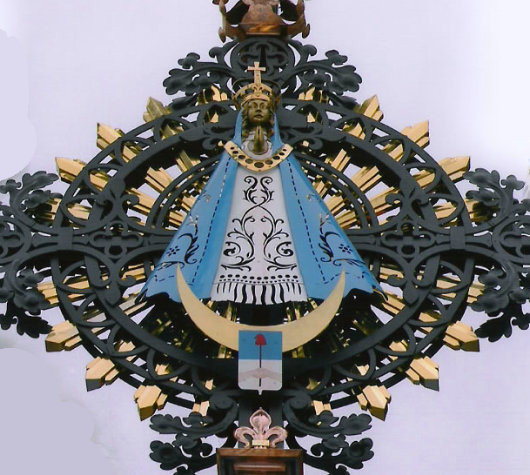
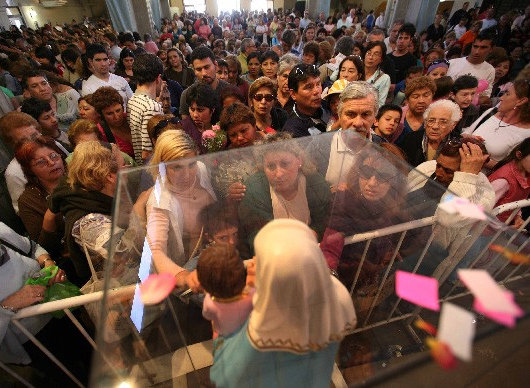
Fr. Finigan tells us that a million young people joined a recent pilgrimage to the Shrine of Our Lady of Luján, forty miles west of Buenos Aires. I had the privilege of being a pilgrim there myself on the Feast of the Assumption of the Blessed Virgin in the summer (or rather winter) of 2001.
The Good Priest of Blackfen also recently pointed out an article from La Nacion about the twenty-fifth anniversary of the apparitions at San Nicolas (below).
Search
Instagram: @andcusack
Click here for my Instagram photos.Most Recent Posts
- Brunel’s Unbuilt Capitol February 3, 2026
- Cricket at Fordham January 27, 2026
- Palacio Barolo Revisted January 14, 2026
- Learning to Love Liguria January 14, 2026
- Crux Alba No. 2 January 13, 2026
Most Recent Comments
Book Wishlist
Monthly Archives
Categories