Arts & Culture
About Andrew Cusack
 Writer, web designer, etc.; born in New York; educated in Argentina, Scotland, and South Africa; now based in London.
 read more
News
Blogs
Reviews & Periodicals
Arts & Design
World
France
Mitteleuropa
Knickerbockers
Argentina
The Levant
Africa
Cape of Good Hope
Netherlands
Scandinavia
Québec
India
Muscovy
Germany
Academica
A Chapel for Chernobyl
The Belarusian Church in London
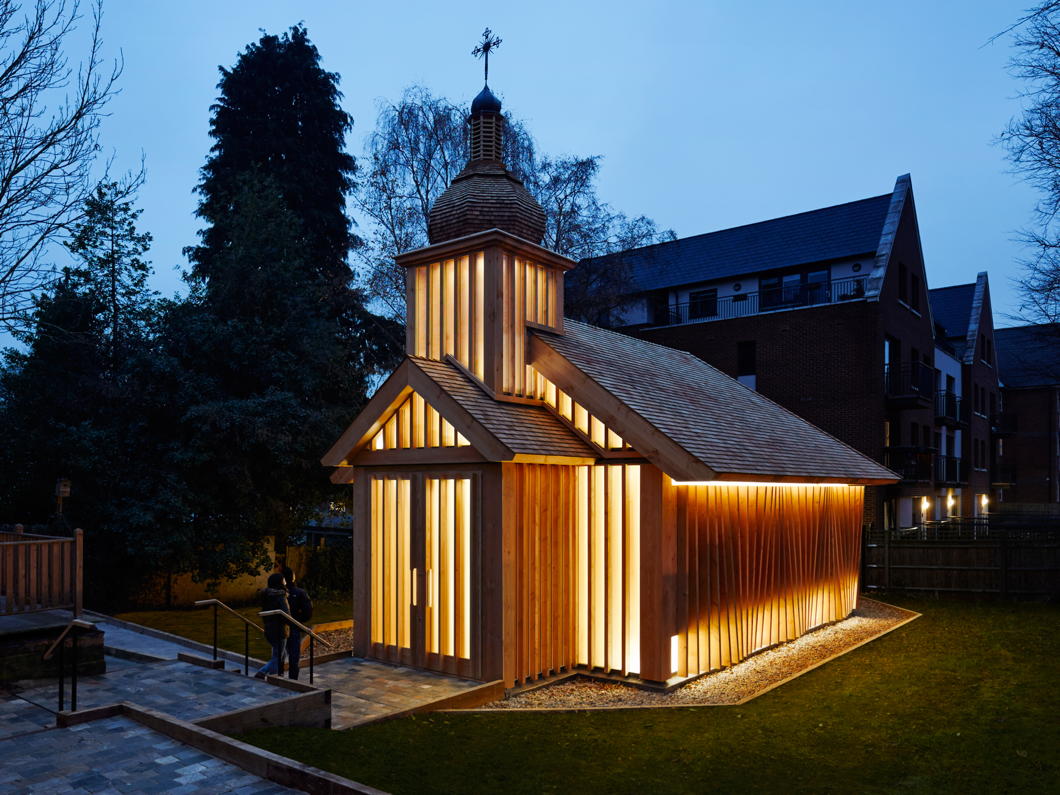
Belarus was heavily affected by the disaster at the Chernobyl nuclear power plant in the neighbouring Ukraine back in 1986 when both countries were part of the Soviet Union. In the thirtieth anniversary year of that event, the Belarusian Catholic community in London dedicated a new chapel built to a striking modern design but evoking the folk churches of the old country.
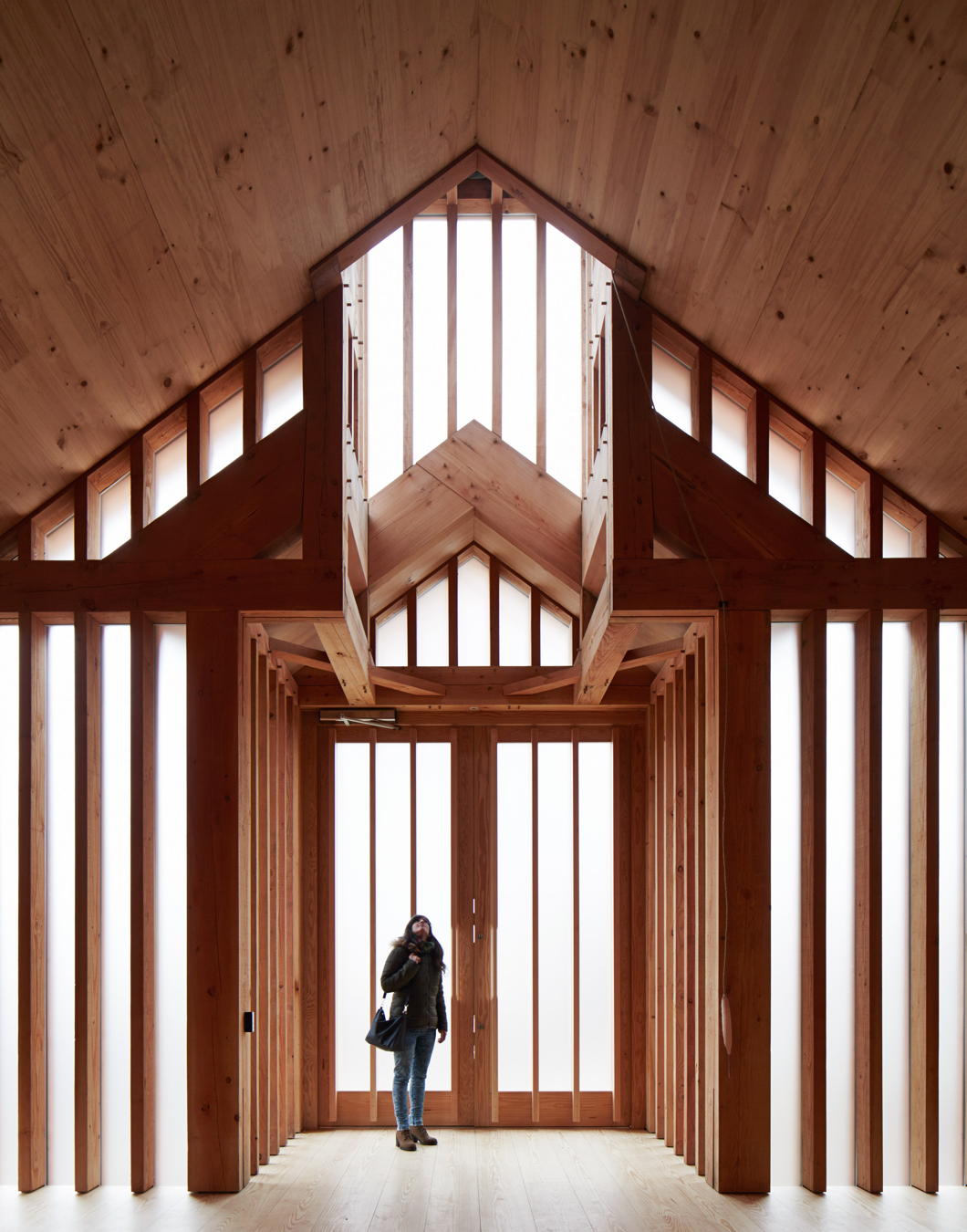
Founded in 1947 as the White-Ruthenian Catholic Mission of the Byzantine-Slavonic Rite, the church grew out of the postwar migration to London of Belarusians who had served with the Polish army during the Second World War.
Succeeding the chapel of Sts Peter & Paul in Marian House, the new chapel is dedicated to St Cyril of Turau and All the Patron Saints of the Belarusian People.
In terms of church hierarchy, this mission is under the wing of the Ukrainian Catholic eparchy in Great Britain, part of the eastern-rite Ukrainian Greek Catholic Church which is in union with Rome. (more…)
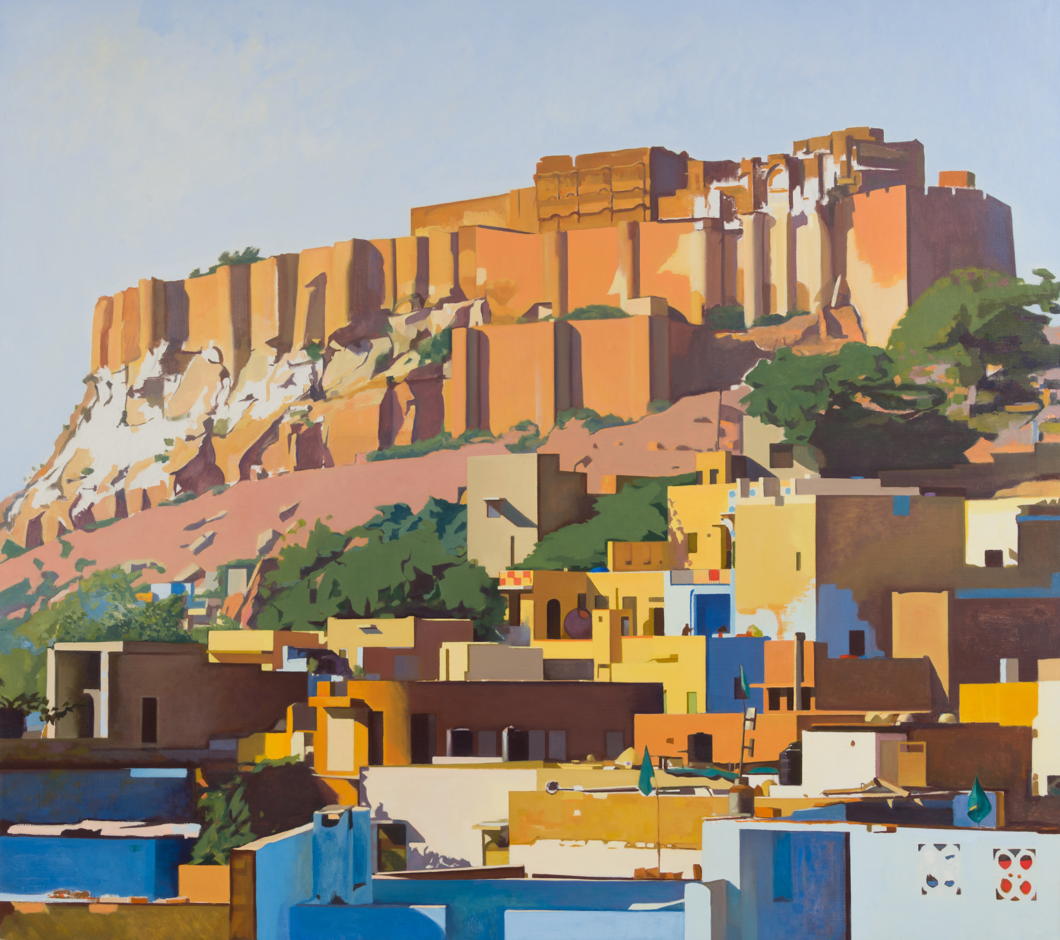
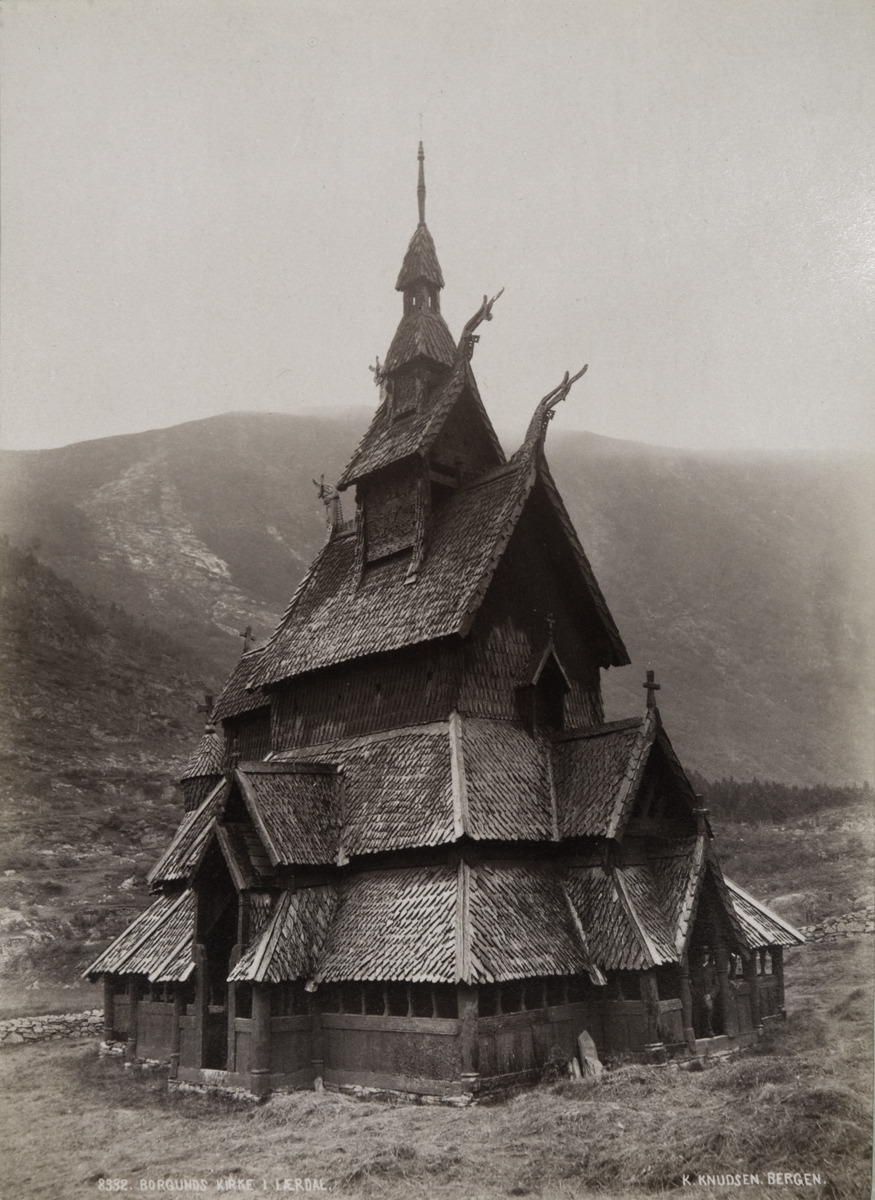
Stave Churches
The category of the Stave Church is the only great Norwegian contribution to architecture.
Sigrid Undset attempts to explain why other contributions are scant:
As one of the most extensive and thinly settled countries in Europe, Norway possesses only a few architectural monuments.
There is a good reason for this.
In the Middle Ages Norway belonged to a united, Christian Europe. At that time art flourished here, though the artists themselves are nameless because their work was deeply rooted in the people. Their power of expression streamed from the people through them. This creative power left its imprint on us in the form of buildings and pictures, poems and music.
Then came the spiritual earthquake of the sixteenth century, the Renaissance and the Reformation. Norway was cut off. It became a land apart, and lost touch with the spiritual life of Europe. Much later our increasing world trade again brought us into contact with other countries.
Pester Lloyd, 1932
But at least we have the stave churches.
How Our Ancestors Built
The Hudson River Day Line Building in Albany
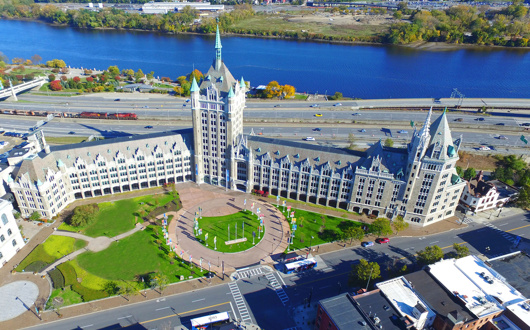
The visitor arriving at Albany, the capital of the Empire State, might be forgiven for presuming the riparian French gothic mock-chateau he first views is the most important building in town.
Built as the headquarters of the Delaware & Hudson, a canal company founded in 1823 that successfully transitioned into the railways, the chateau now houses the administration of the State University of New York. (Indeed, the Chancellor once had a suitably grandiose apartment in the southern tower.) That building, with its pinnacle topped by Halve Maen weathervane, is worthy of examination in its own right.
But next to this towering edifice is an altogether smaller charming little holdout: the ticket office of the Hudson River Day Line.
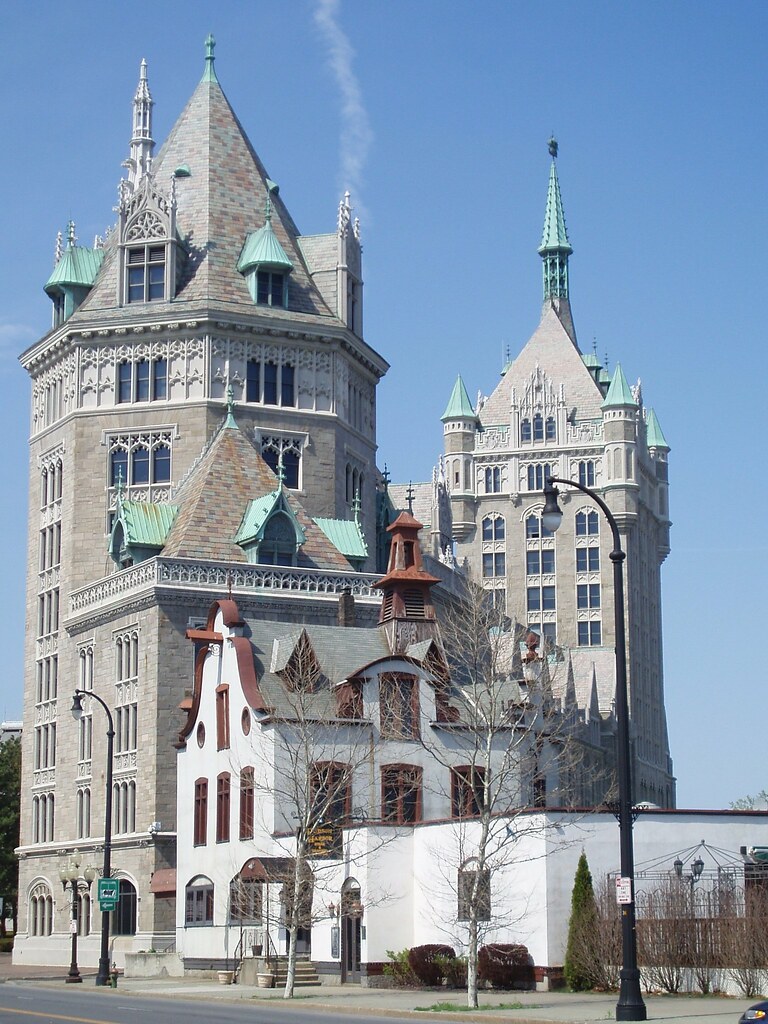
In the nineteenth century the Hudson River Valley was often known as “America’s Rhineland” and travel up and down the river was not just for business but also for the aesthetic-spiritual searching that inspired the Hudson River School of painters.
The Day Line’s origins date to 1826 when its founder Abraham van Santvoord began work as an agent for the New York Steam Navigation Company. Van Santvoord’s company merged with others under his son Alfred’s guidance in 1879 to form the Day Line. (more…)
The greatest church architect you’ve never heard of
The greatest church architect
you’ve never heard of
Ludwig Becker and His Churches
For such a prolific church architect of such high quality, not much is known about Ludwig Becker and, alas, he seems to be little studied. Born the son of the master craftsman and inspector of Cologne Cathedral, Becker had church building in his blood. He studied at the Technische Hochschule in Aachen from 1873 and trained as a stone mason as well.
In 1884 Becker moved to Mainz where he became a church architect and in 1909 he was appointed the head of works at Mainz Cathedral, a position he held until his death in 1940. His son Hugo followed him into the profession of church architecture.
That’s about all I can find out about Becker. But here are a selection of some of his churches, to get a sense of his agility in a wide variety of styles.
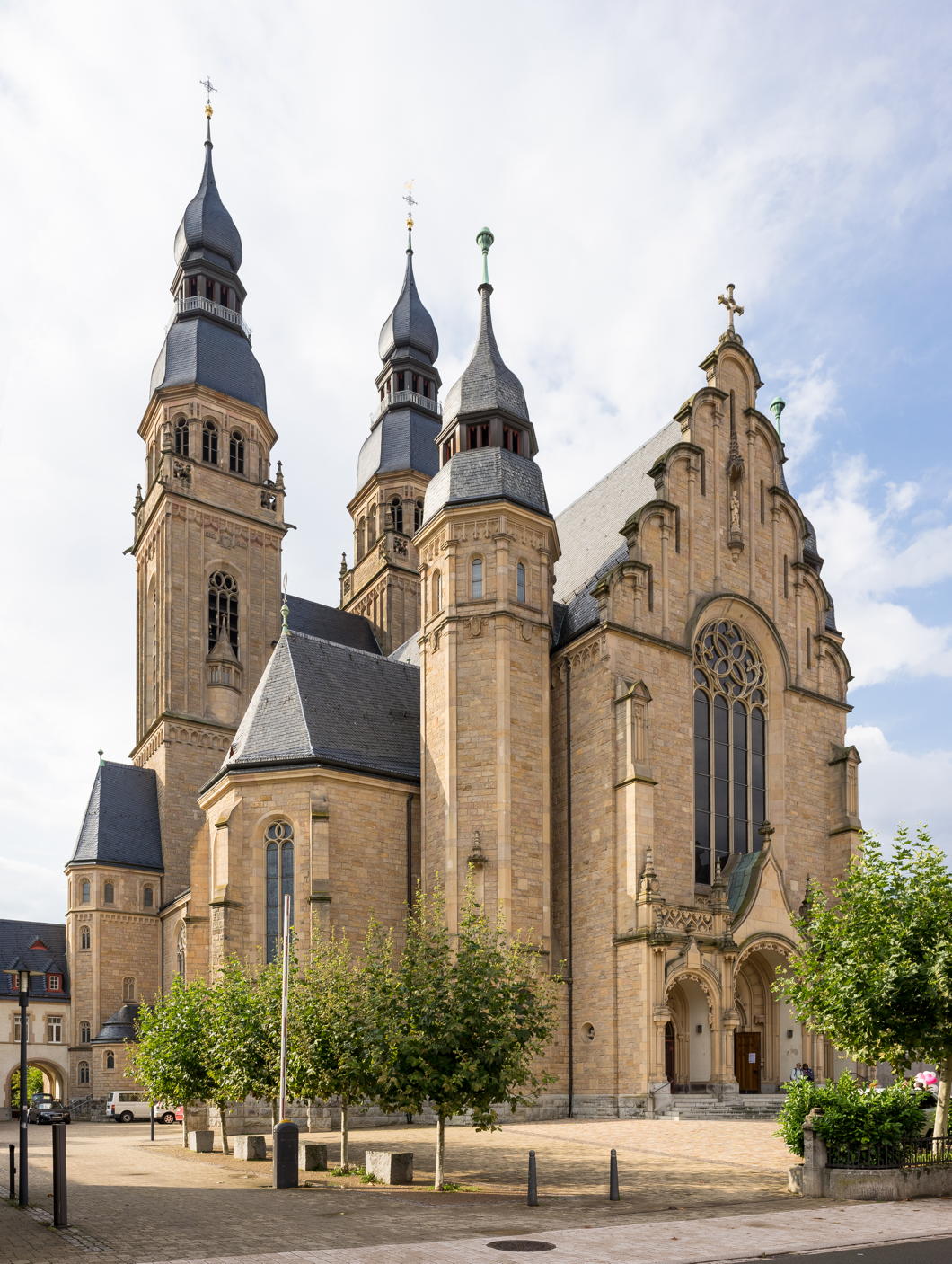
St Joseph, Speyer, is my favourite of Becker’s churches for the beautiful organic fluidity of its style. Here Art Nouveau, Gothic, and Baroque are mixed somehow without affectation. Rather enjoyably, it was built as a riposte to a nearby monumental Protestant church commemorating the Protestant Revolt. These two rival churches are the largest in the city after its famous cathedral. (more…)
Rashtrapati Bhavan
Debates rage in the trad community as to whether, in the context of India, it is more sound to support the Congress Party or to take some relief in the policies of Mr Modi and his Indian People’s Party (curiously always known in English as the BJP).
Presented with the choice of left-leaning instability with Congress or Hindutva-oriented instability with the BJP, one recalls Hofrat Kissinger’s comment about the Iran-Iraq War: “Isn’t it a shame they can’t both lose?”
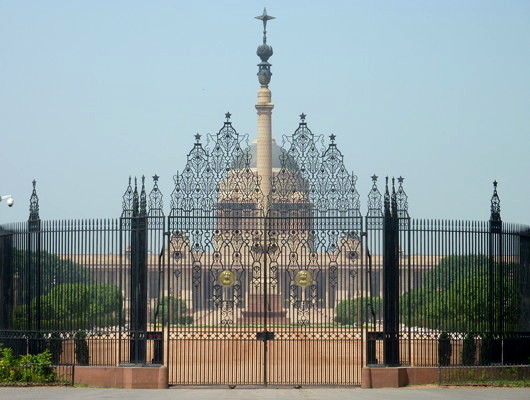
But the recent visit to India of my fellow New Yorker, His Excellency the President of the United States, necessitated his calling in to one of the grandest residences of any head of state the world over: Rashtrapati Bhavan, the residence of the President of India.
Originally called Viceroy’s House, it was designed by Lutyens as the palace of one of the most powerful men on the face of the planet: the Viceroy of India.
But the building of this magnificent structure was an imperial swansong. Opened in 1931, just sixteen years later the subcontinent was partitioned, the Indian Empire and its Viceroy abolished. The Union of India took its place, with a Governor General instead of a Viceroy.
In 1950, this too was abolished as the Union became a republic, and the office of governor general was given a republican whitewash and renamed as President of India.
This head of state is not elected by the voters of the world’s largest democracy except indirectly through a combined college of the national parliament and the state legislative assemblies. Like a governor general, he does have some power but the real force lies in the prime minister — today Mr Modi.
Nevertheless, this building reflects the glory, power, and influence of one of the greatest nations of the earth.
Notre-Dame de Paris
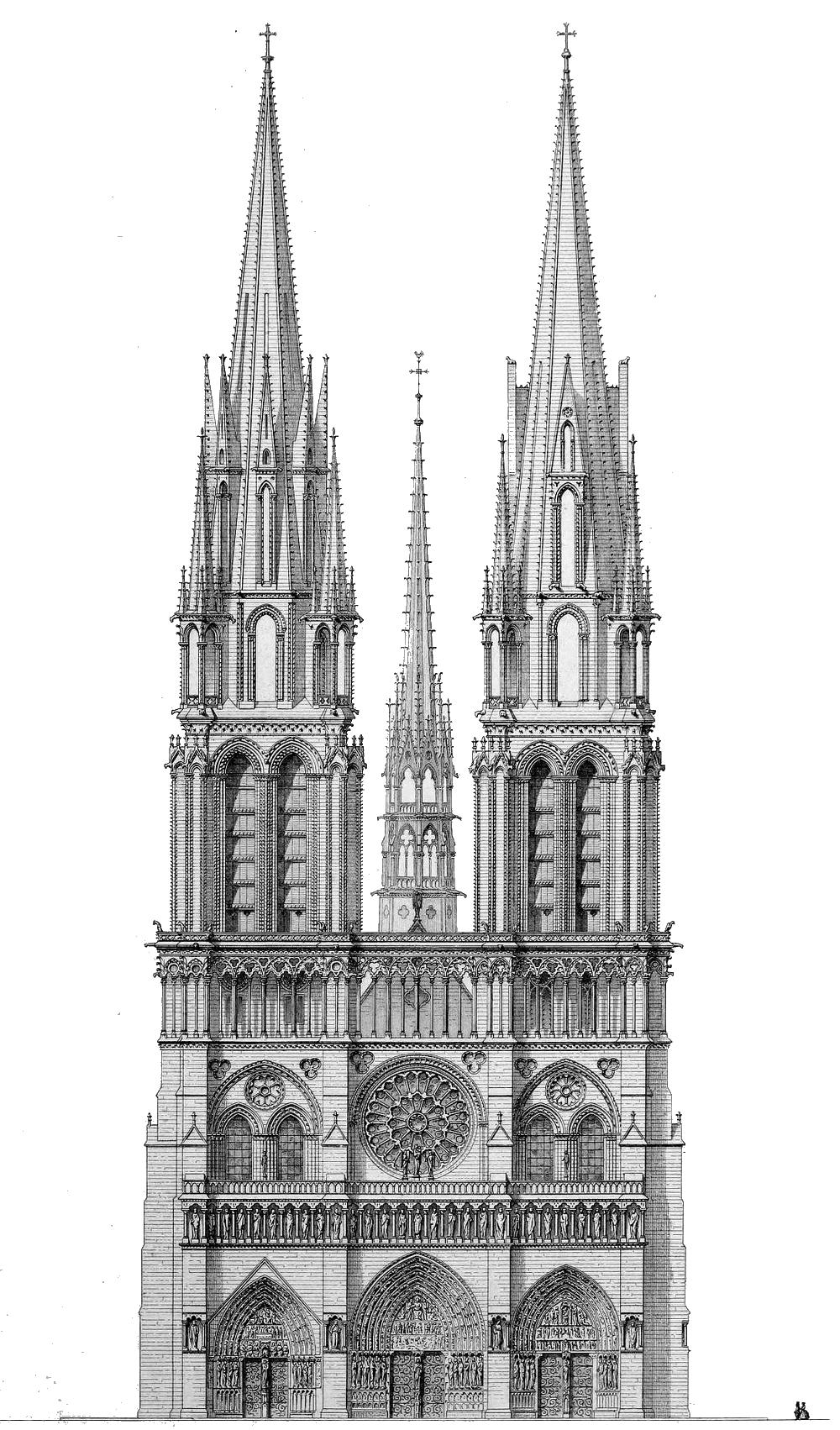
Eugène Viollet-le-Duc
1844
Doom in Bloom
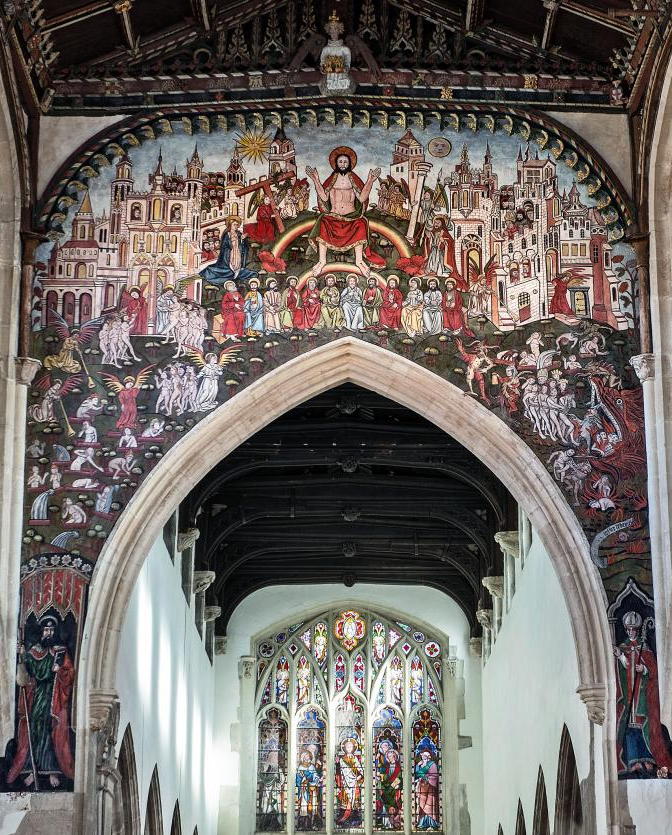
Such paintings were widespread in Catholic England where they served as a vital reminder to the faithful worshipping below of not just the torments of Hell but also the joys of Heaven. In the aftermath of the Protestant revolt, however, such vivid imagery was frowned upon, and the Salisbury Doom was painted over with limewash in 1593. Christ in Majesty was replaced by the royal arms of the usurper queen, Elizabeth I.
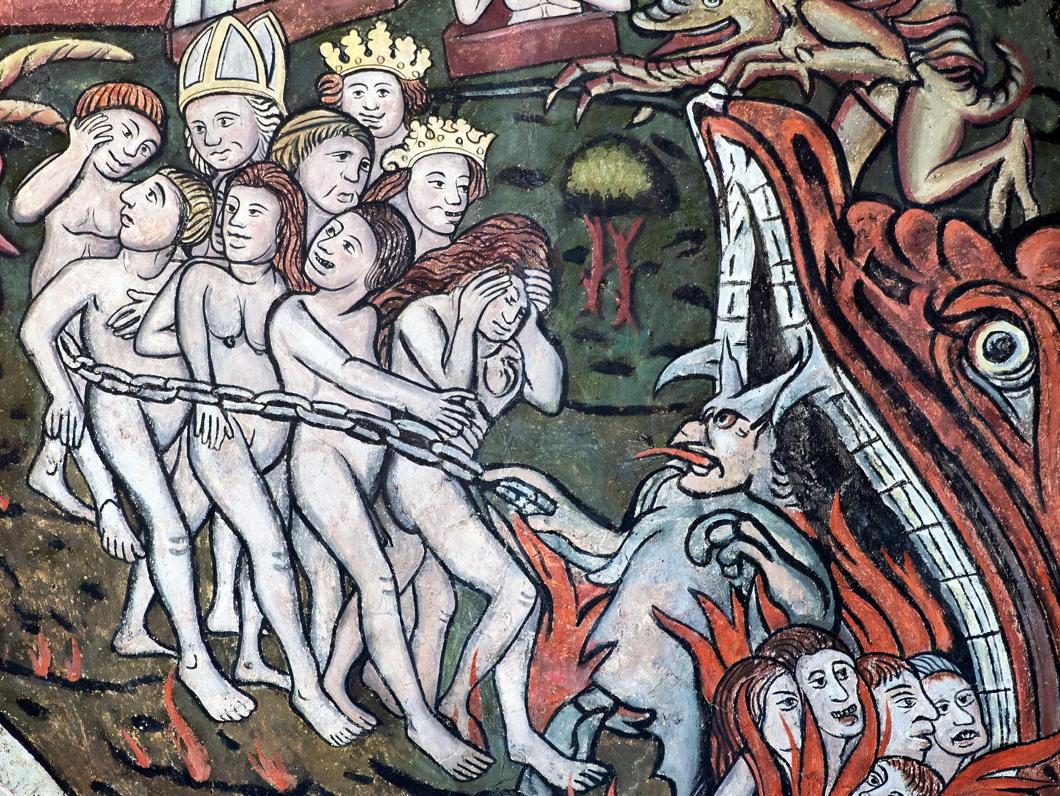
It was then forgotten about til its rediscovery in 1819 when hints of colour were discovered behind the royal arms. The limewash was removed, the remnants of the painting were revealed, recorded by a local artist, and then covered over yet again in white. Finally in 1881 the Doom was revealed to the world and subject to a Victorian attempt at restoration with mixed results.
Work on the church’s ceiling in the 1990s allowed experts to better examine the Doom which determined that, while there was a bit of fading, dirt was hanging loosely to the painting and it would be ripe for restoration. It has only been more recently, however, that money has been raised to restore the Doom.
There are other glories in this church yet to be restored, about which more information can be found on the parish’s website.
.jpg)
The Salisbury Doom before restoration (above) and after (below).
A Corner in Camberwell
4a-6 Grove Lane by MATT Architecture
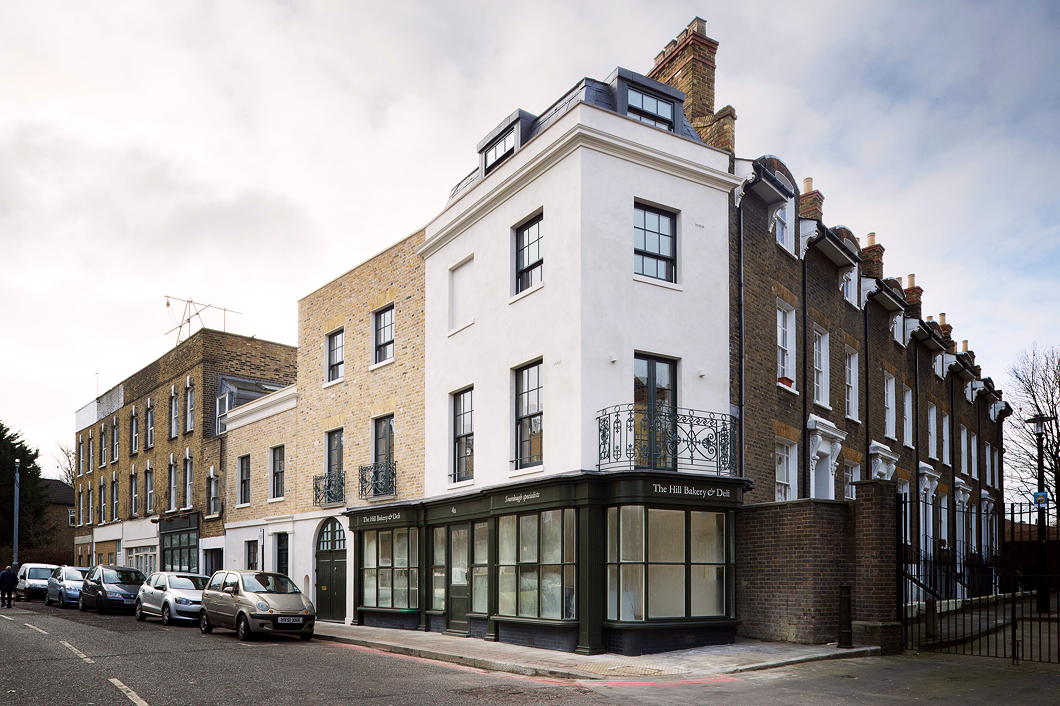
Alongside some of its neighbouring streets in Camberwell, Grove Lane has some of the best preserved rows of Georgian houses in south London, interspersed with a few buildings of a more recent vintage. The latest addition to this street is no ostentatious interloper but a contextual classic showing admirable humility and good manners.
Designed by Leicester Square-based MATT Architecture, it’s easy to see why the Georgian Group deemed 4a-6 Grove Lane worthy of a Giles Worsley Award for a New Building in a Georgian Context in 2015.
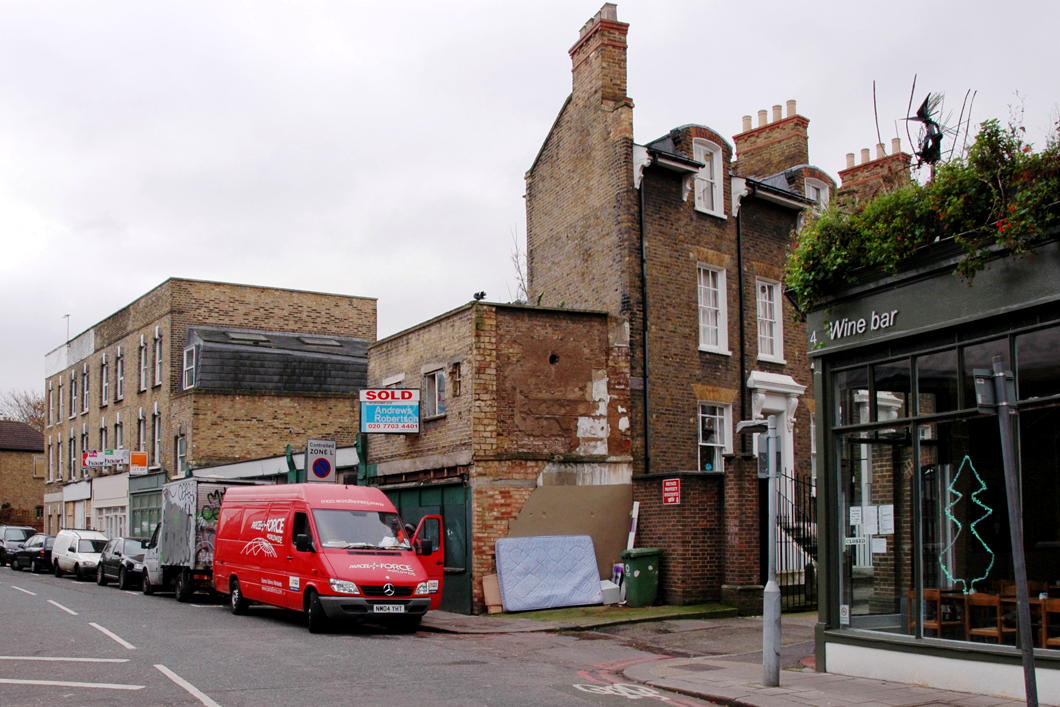
“The long, thin, wedge–shaped site had lain derelict for decades before being purchased by the current owner,” the architects note.
“The elevation is deliberately split into three to echo the plot width of neighbouring terraces and relies heavily on high quality detailing to lift it beyond pastiche.”
The Manor House
 Image: © HughJLF
For devoted fanatics of Netherlandic architecture — I’m sure you’d count yourself as one as much as I do — a curious example of Dutch revival architecture can be found at No. 316 Green Lanes in the Borough of Hackney. Alighting from Manor House tube station the other day I was surprised to find myself confronted by a fine building which, it turns out, used to be the pub that gave its name to the Underground station.
The first ‘public house and tea-gardens’ of that name was built in the 1830s, and in 1843 Queen Victoria and Prince Albert stopped there for a change of horses. This tavern soldiered on until the arrival of the Piccadilly line which necessitated street widening and the demolition of the pub in 1930.
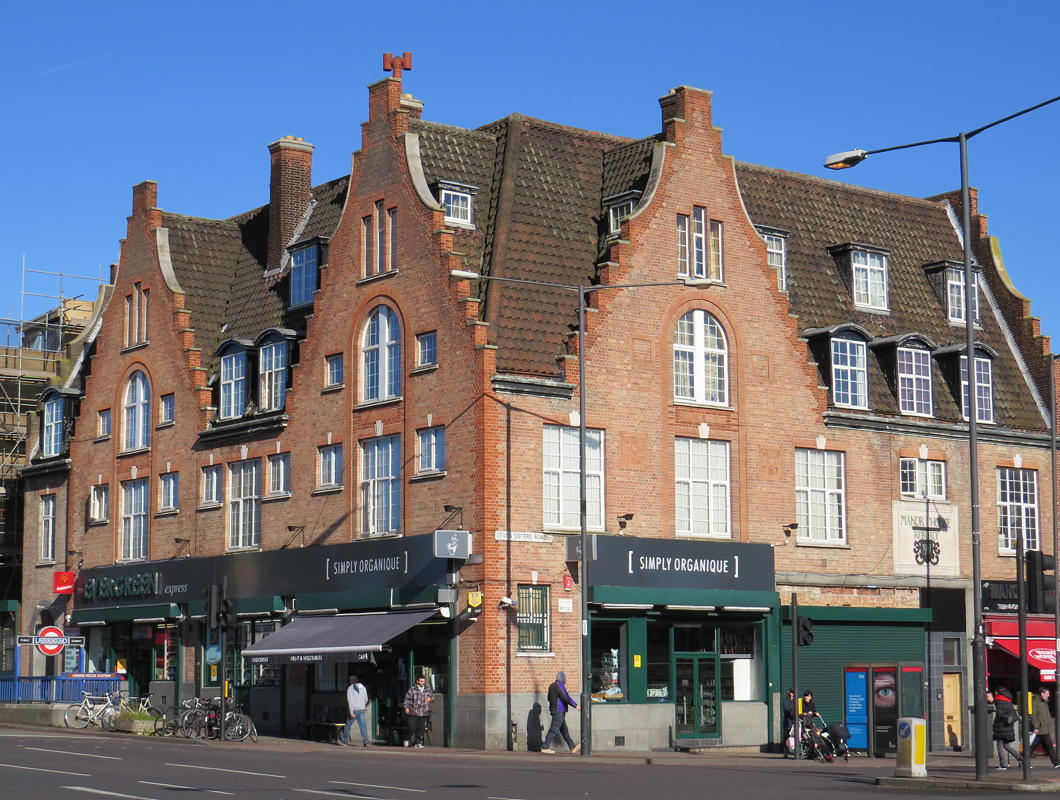 Image: © Stephen Benton
It was rebuilt in a very handsome brick Netherlandic revival in 1931 and continued on as a pub supplied by the London brewers Watneys.
A purist would object that the style of windows on the gables suggests a vulgar pakhuis (warehouse) on the Amstel while the stepped gable itself is more informed by domestic architecture. But is the privilege of architectural revivals to mix and match, so I don’t think we should complain.
Evidence suggests the pub shut in 2004 and the building was converted to its current retail use.
Alas, I can find no record of the architect, and the building remains un-listed, but I’m glad Hackney is home to this happy Hollandic interloper.
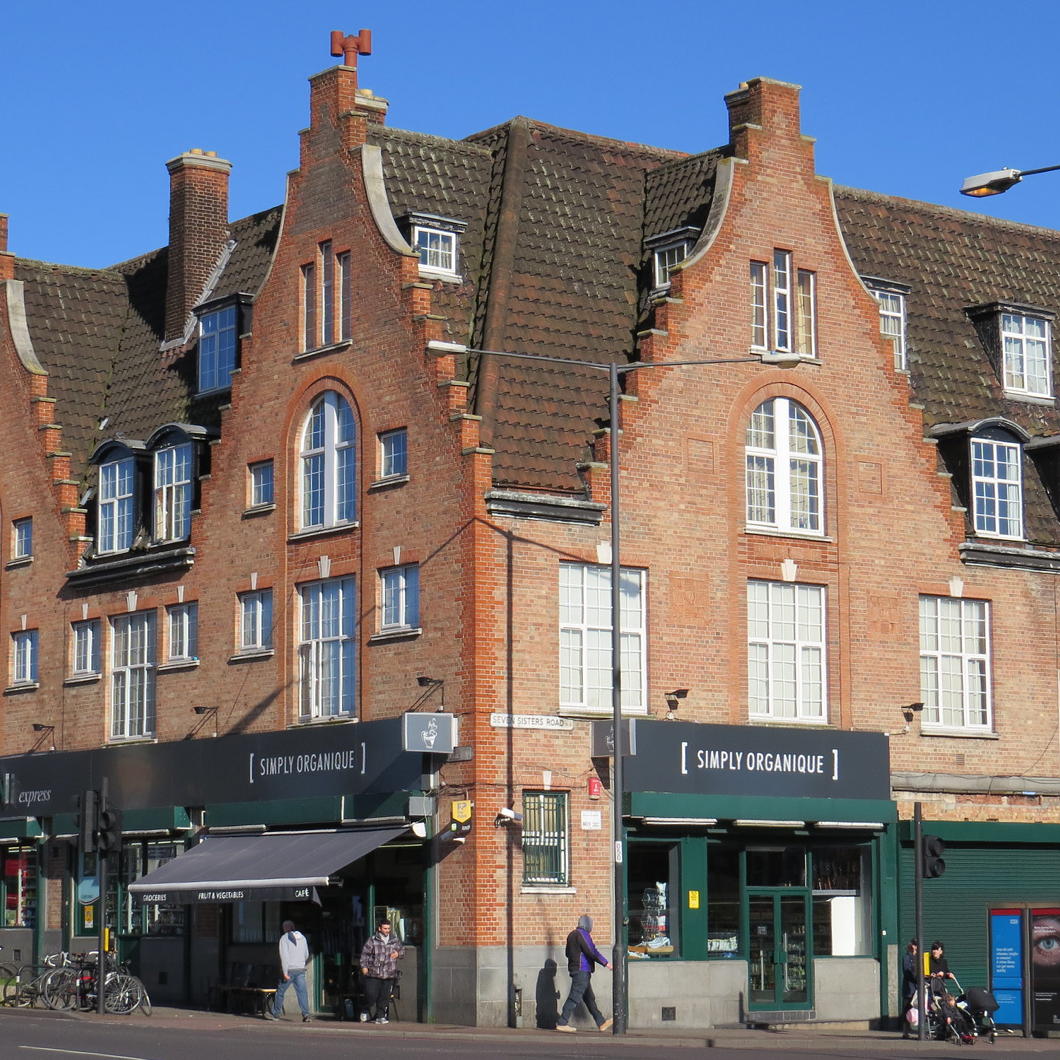 Image: © Stephen Benton
British Columbia in London
Colonial Agents & Provincial Agents-General in the Imperial Capital
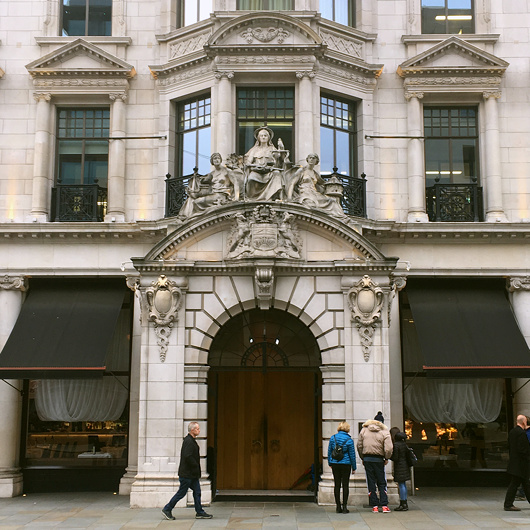
JUST WHERE THE elegant Edwardian urbanity of Waterloo Place turns into Regent Street there is an edifice that announces itself as home to the “Agent General for British Columbia”. Built in 1914-1915, it was designed by a not particularly prominent architect named Alfred Burr who did a lot of work for the Metropolitan Police and is also responsible for designing the charming little curator’s lodgings next to Dr Johnson’s House (which he restored 1911-1912).
The listing that protects British Columbia House, at 1-3 Regent Street, describes its style as “rich Baroque with both Roman and Genoese palazzo features composed on a large scale”.
The main entrance is on Regent Street with the province’s delightfully sunny coat of arms carved above the portal, guarded by allegorical figures of Justice and the like above. On the corner with Charles II Street, the inscription on the foundation stone proclaims its laying at the hands of Prince Arthur, Duke of Connaught on the sixteenth day of July in 1914.
But who or what on earth was the Agent General for British Columbia? (more…)
The politics of parliamentary colour
When Quebec’s « Salon bleu » was the « Salon vert »
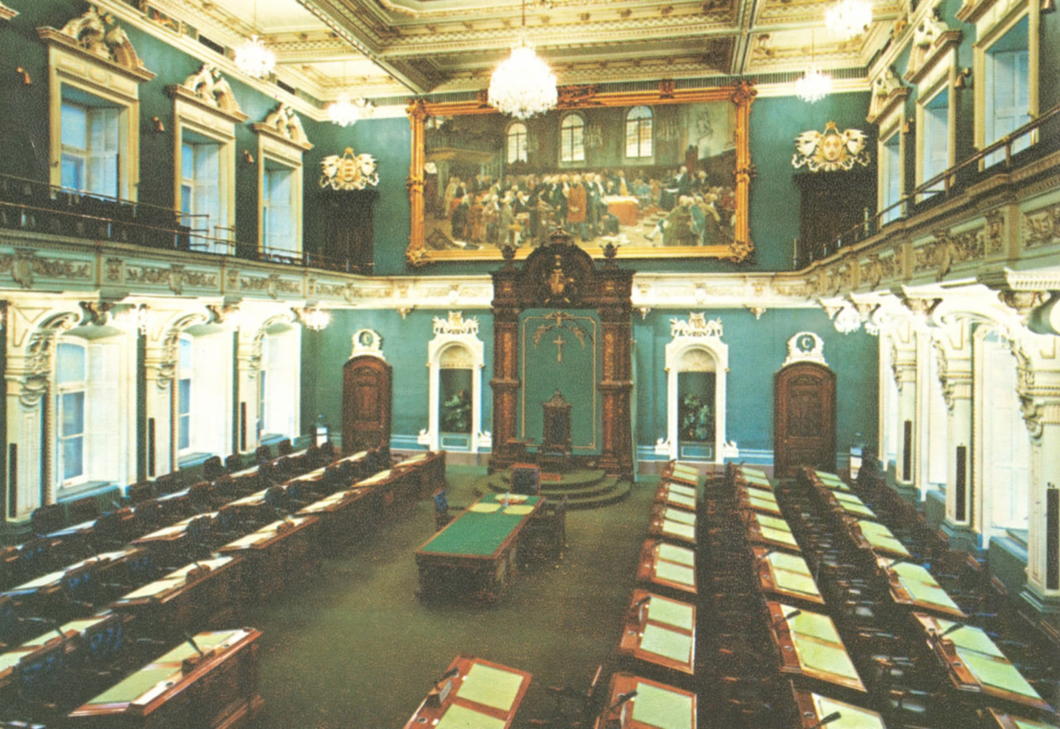
One Westminster tradition replicated in many times and places across the Commonwealth is a convention of colour: the lower house of a parliament is decorated in green, while the upper chamber is decorated in red. This reflects the green benches of the House of Commons and the red ones of the House of Lords.
Officially the plenary chamber of Quebec’s unicameral parliament is boringly the salle de l’Assemblée nationale but because of the colour of its walls it is more often known as the Salon bleu. One’s never surprised when Quebec bucks a trend or (more specifically) rejects an Anglo convention but it turns out the province’s plenary chamber did in fact used to be green until relatively recently.
When the members of the Legislative Assembly (as it then was) first convened in the Hôtel du Parlement in 1886 the walls were actually white. By the opening of the 1895 session the desks had been reappointed in green, but Le Soleil still made reference to the room as the “chambre blanche”. It was only in 1901 that the room was painted a “soft green” and the carpets and other furnishings changed accordingly. It even made an appearance in Alfred Hitchcock’s 1953 film “I Confess”.
From then the chamber was a Salon vert until 1978, when the decision was taken to begin broadcasting the proceedings of the Assemblée nationale.
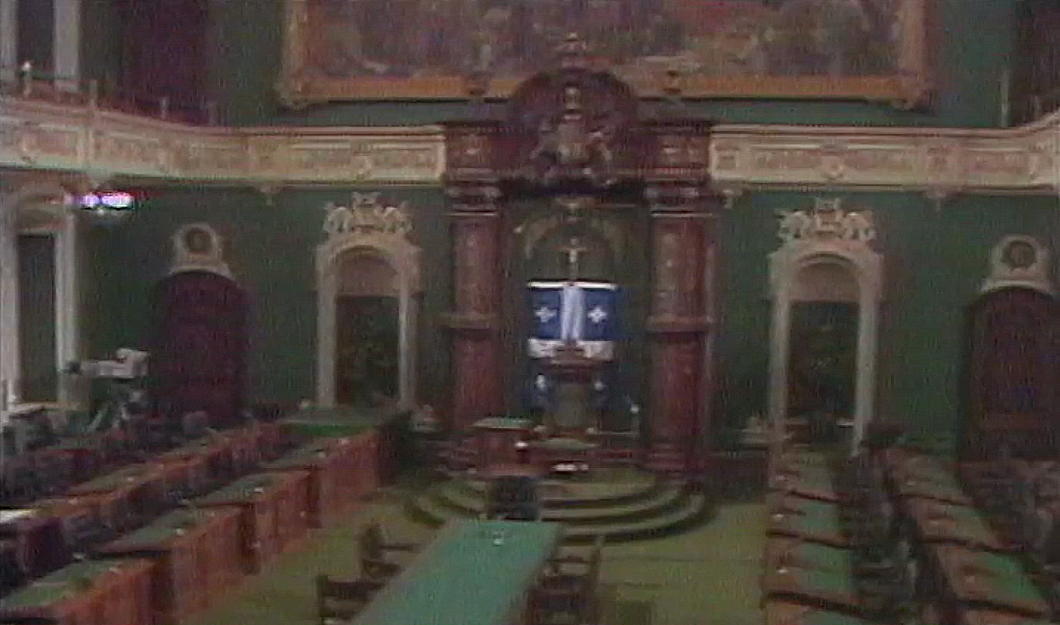
The television specialists complained that the dark green of the chamber was not visually conducive to the TV cameras available at the time and, looking at the evidence from the 1977 test session (above), one can see their point. Walls of either beige or blue were the options recommended in an official report, and unsurprisingly the national colour was chosen.
The historian Gaston Deschênes has mentioned the technical requirements of broadcasting also coincided with a desire to break with a “British” tradition. Certainly the government of the day, René Lévesque’s Parti Québécois, didn’t mind the change, while Maurice Bellemare — “the old lion of Quebec politics” and sometime leader of the old Union nationale — was deeply pleased that the chamber adopted the colour of Quebec’s flag.
So the walls were repainted sky blue and the furnishings changed accordingly, resulting in the Salon bleu we know today (below).
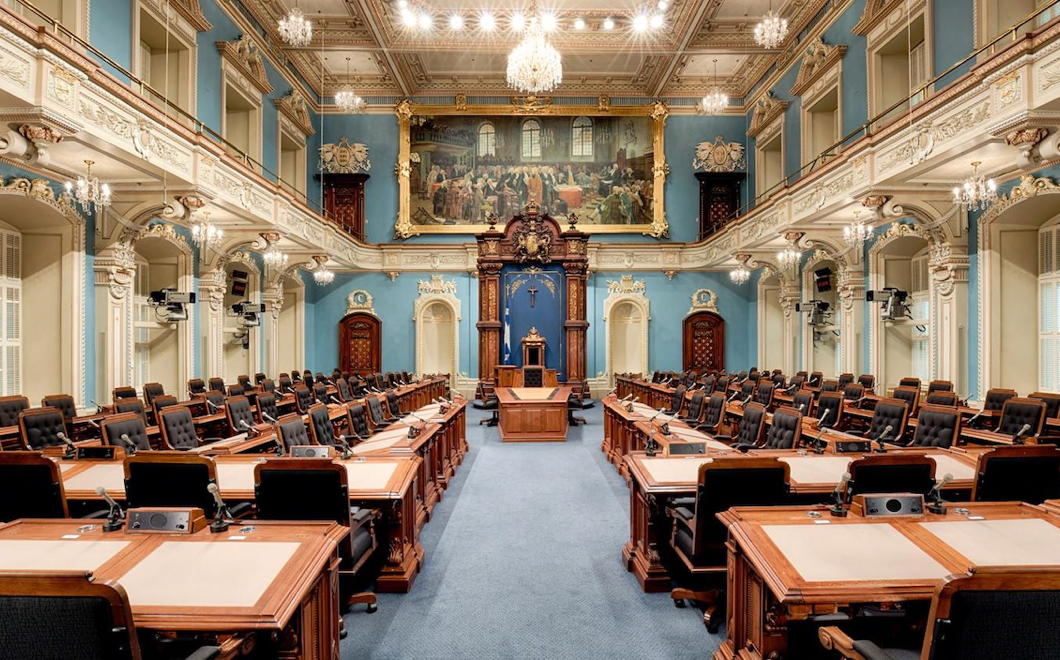
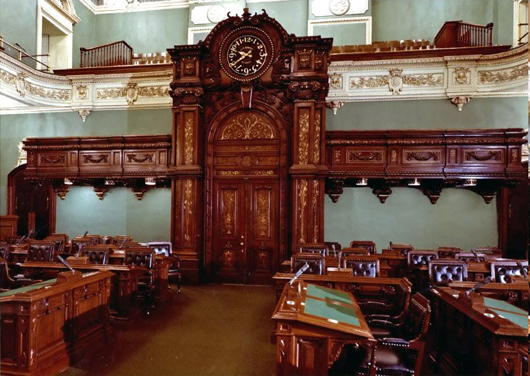
A tweet from the Assemblée’s official account shows two photos looking towards the chamber’s entrance from before (above) and after (below) it was made ready for television.
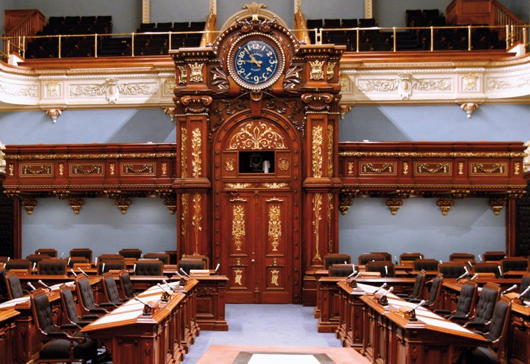
All the same, green is not universal amongst Commonwealth lower (or only) chambers. It’s not even universal in Canada: Manitoba joins Quebec in its azure tones while British Columbia’s is red-dominated.
Quebec was the last of Canada’s provinces to abolish its upper house, the Legislative Council, in 1968 (at the same time the lower house was renamed the National Assembly). The Legislative Council’s former meeting place is, of course, red, and the Salon rouge is used for important occasions like inductions into the Ordre national du Québec or the lying-in-state of the late Jacques Parizeau.
The Palais de Tokyo
In the early 1930s the City of Paris decided the Musée de Luxembourg had become too small to continue as the city’s gallery of contemporary art. At the same time, the French Republic was beginning to think it needed a proper museum of modern art to display its own collections as well. The City and the Republic joined forces to build a new palace of art in time for the 1937 International Exposition.
While the City and the Republic would house their collections at a single site the museums were to remain separate, so in May 1937 the Palace of the Museums (plural) of Modern Art was inaugurated by President Lebrun.
Because of its riparian location on the Avenue de Tokio (renamed to Avenue de New-York in 1945) the building quickly became known as the Palais de Tokyo. (more…)
Andrew Graham-Yooll
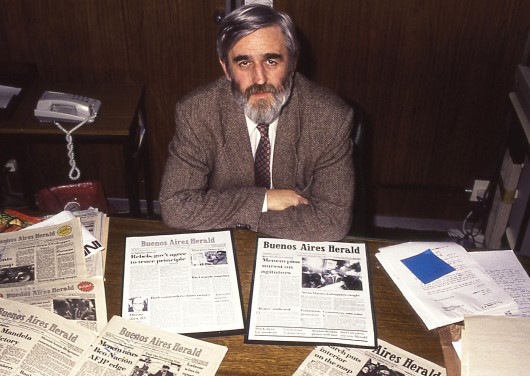
A giant of Argentine journalism died this summer: Andrew Graham-Yooll.
Born in Buenos Aires early in 1944 to a Scottish father and an English mother, Graham-Yooll made his name at the premier institution of Anglo-Argentina, the now-defunct daily Buenos Aires Herald which he joined aged 22 in 1966.
“The Herald newsdesk supped for Dutch courage a local brandy,” the Times notes, “supplemented with a pâté that Graham-Yooll made of goose livers lashed with gin. A chain-smoker, he would construct tiny houses from matchsticks.”
As the Herald’s news editor during Isabel Perón’s presidency he published the names of dissidents who had gone missing or “disappeared” and, more bravely, continued to do so after Señora Perón was succeeded by a military junta.
The new rulers, who Borges warmly welcomed as “gentlemen”, put Graham-Yooll on trial for publishing interviews with the guerrillas who were terrorising the country. He was acquitted, but accepted the gentle advice of the judge who suggested he might find existence more comfortable outside the borders of the Argentine Republic.
Graham-Yooll continued writing for the Daily Telegraph and Guardian in Great Britain but made a brief foray home in 1982 during the Falklands War before being permanently welcomed home by a democratic government in 1984. Ten years later he was appointed editor of the Herald.
“Things you think you can rely on and trust are just not there,” Graham-Yooll said in Edinburgh when picking up his OBE in 2002.
“You can’t trust the bank, you can’t trust the post office or the people who sell you a house. You can’t trust the politicians, obviously. It’s a friendly society but it lacks strict rules. It’s evil, but it is also attractive to live in a place where you don’t have to live by rules.”
“I don’t know where I could go now. It was always home, even in the worst days, and it still is.”
Understanding Undset
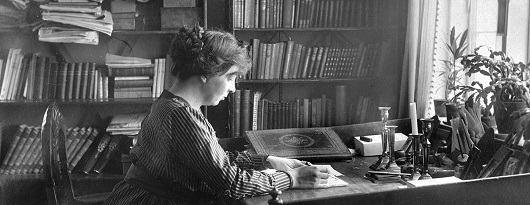
Sigrid Undset’s is doubtlessly among the twentieth century’s greatest writers, even though Kristin Lavransdatter, her main works of literature, is set in the fourteenth century. At the ceremony awarding Undset the 1928 Nobel Prize for Literature, Per Hallström described the writer’s narrative as “vigorous, sweeping, and at times heavy”:
It rolls on like a river, ceaselessly receiving new tributaries whose course the author also describes, at the risk of overtaxing the reader’s memory. […] And the vast river, whose course is difficult to embrace comprehensively, rolls its powerful waves which carry along the reader, plunged into a sort of torpor. But the roaring of its waters has the eternal freshness of nature. In the rapids and in the falls, the reader finds the enchantment which emanates from the power of the elements, as in the vast mirror of the lakes he notices a reflection of immensity, with the vision there of all possible greatness in human nature. Then, when the river reaches the sea, when Kristin Lavransdatter has fought to the end the battle of her life, no one complains of the length of the course which accumulated so overwhelming a depth and profundity in her destiny. In the poetry of all times, there are few scenes of comparable excellence.
Obviously Kristin Lavransdatter must be read for itself. I started reading it in the Stellenbosch University library a decade ago and was able to finish it thanks to being given a copy by a kindly Premonstratensian.
But the woman behind Kristin wrote more: her biographical essays and other works (like the one describing a visit to Glastonbury) are just as enjoyable and insightful.
At First Things, Elizabeth Scalia describes Undset’s lives of saints and holy men and women in Sigrid Undset’s Essays for Our Time.
Stephen Sparrow reveals much of Undset’s own biographical detail and how this influenced her writing in Sigrid Undset: Catholic Viking.
But the best essay I’ve read on Sigrid Undset so far is David Warren’s meditation on womanhood, motherhood, and Kristin Lavransdatter. I don’t agree with everything he says (I rather enjoyed the new translation but am thinking I might have to give the old one a go), but David gets Kristin the character, gets Kristin the novel, and gets the way that life is refracted through both.
Read David Warren, then read Sigrid Undset.
Lady Day
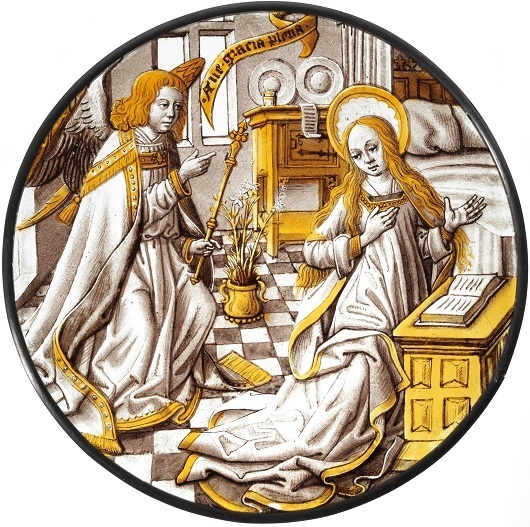
Today is Lady Day, the Feast of the Annunciation when the Archangel Gabriel appeared to the Blessed Virgin Mary and announced that she would conceive and bear the child Jesus.
The angelic salutation – “Hail Mary, full of grace, the Lord is with thee… Blessed art thou amongst women, and blessed is the fruit of thy womb, Jesus” – forms the basis of the Ave Maria, one of the most widely uttered prayers in Christendom.
Traditionally this has been one of the greatest of devotions to the Virgin amongst the English, which is why there are so many pubs across England named ‘The Salutation’.
For centuries in England and Scotland (as well as elsewhere), Lady Day was the first day of the calendar year. Scotland moved this to 1 January in 1600 and England did likewise in 1750.
Nonetheless, the English tax year is still based on this date as it commences on 6 April, which is the Annunciation plus twelve days to mark the difference between the old Julian calendar and the modern Gregorian one.
In the realms of fiction, 25 March is the day Tolkien chose for when Frodo destroyed the Ring in Mount Doom, securing the fall of Sauron – with obvious parallels to Christ’s Incarnation securing the defeat of Satan.
This stained glass roundel above is not English, however, but from the Southern Netherlands around 1500-1510.
Elsewhere, A Clerk of Oxford has a good section on the Annunciation.
Haussmanhattan
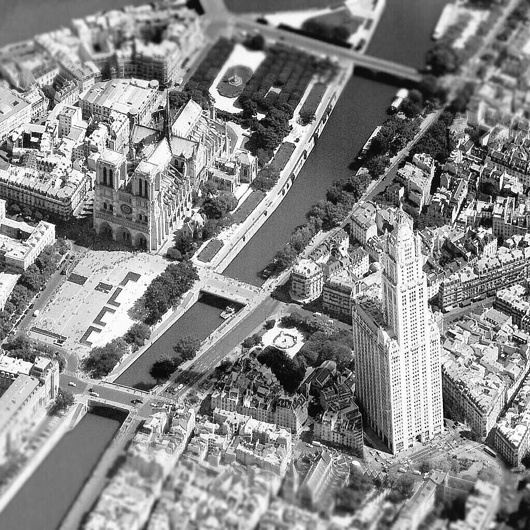
Paris and New York are two cities radically different in design and character, but they are smashed together in this little project from architect Luis Fernandes.
‘Haussmanhattan’ is a portmanteau of Baron Haussmann, the Prefect of the Seine whose reconfiguration of the French capital made it the Paris we know today, and Manhattan, the most renowned of New York City’s five boroughs.
Haussmann’s plan of broad boulevards and radial avenues is a far cry from the artless Commissioners’ Plan of 1811 which created the unforgiving city blocks that colonised the entire island of Manhattan ad infinitum.
The contrast only makes the pick-and-mix Fernandes has confected all the more fun/ridiculous/interesting.
Sir John Soane
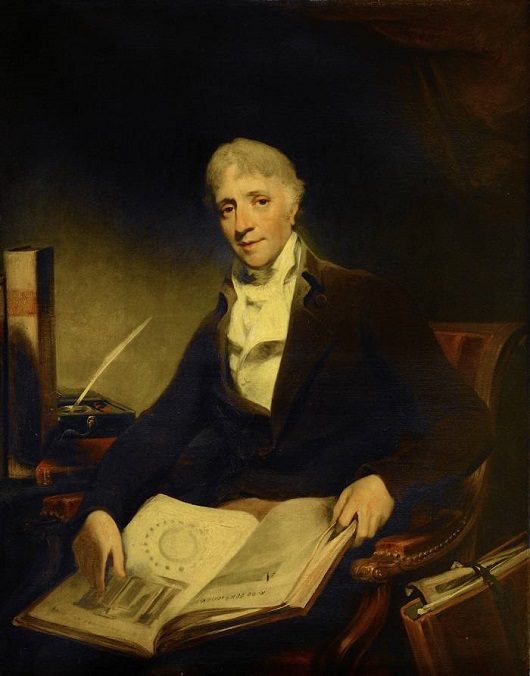
Sir John Soane still looms over the intervening centuries of architecture and design in Great Britain, but I’ve never actually known what he looked like. Apparently this is him, in an 1804 portrait by William Owen.
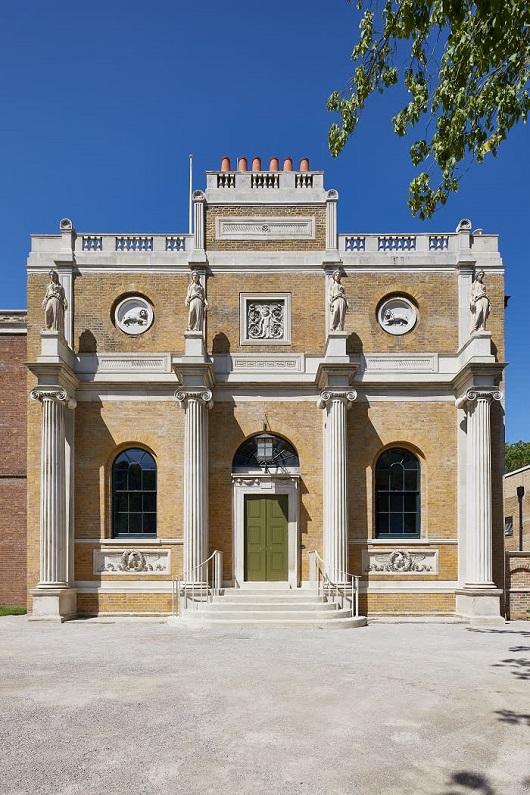
Everyone’s been to his house in Lincoln’s Inn Fields, but Pitzhanger Manor, his place in the country (though Ealing hardly seems rural today) was recently reopened after serious conservation works ongoing since 2015.
Hope to pay it a visit soon.
The Rensselaer Window
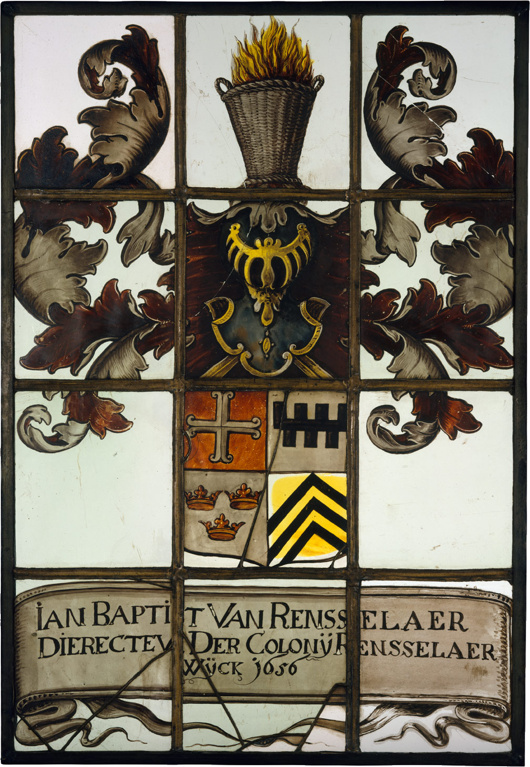
The patroonship of Rensselaerswyck was erected in 1630 giving its patroon, Kiliaen van Rensselaer, feudal powers over a large parcel of land on the banks of the Hudson River. Despite exercising a strong influence on the growth and development of New Netherland and the Hudson Valley, Kiliaen never actually stepped foot in the new world but kept close control of his domain from across the ocean in Amsterdam.
Jan Baptist was Kiliaen’s second surviving son, and served as director at the ‘colony’ as it was often known from 1652 to 1658. He commissioned Evert Duyckinck to make this painted-glass window displaying his coat of arms in 1656 and gave it to the Dutch Reformed Church in Beverwyck (today’s Albany).
While the congregation still exists — and celebrated its 375th anniversary in 2017 — the original church was demolished in 1805 and the window moved to the Van Rensselaer Manor House which itself survived til 1890 before facing the wrecking ball. The window was preserved and was left to the Metropolitan Museum of Art through the 1951 bequest of Mrs J. Insley Blair and while well documented it does not appear to be on display at the moment.
The patroonship itself was converted into a manorial lordship by the English authorities after they took over and survived until it was broken up amongst relatives after the death of Stephen van Rensselaer III in 1839.
This last great patroon had proved an indulgent lord and the efforts of his inheritors to claim uncollected back rents led to the 1839-1845 “Helderberg War” or “Anti-Rent War” of tenants revolting against the system. The great landholders, seeing the end was nigh, were convinced to sell up and in 1846 the state of New York adopted a new constitution abolishing feudal tenure. The era of patroonships and manors in the Hudson Valley had come to an end.
The Dawn of Da’esh
Patrick Cockburn, 192 pages, £9.99 (Verso Books, London)
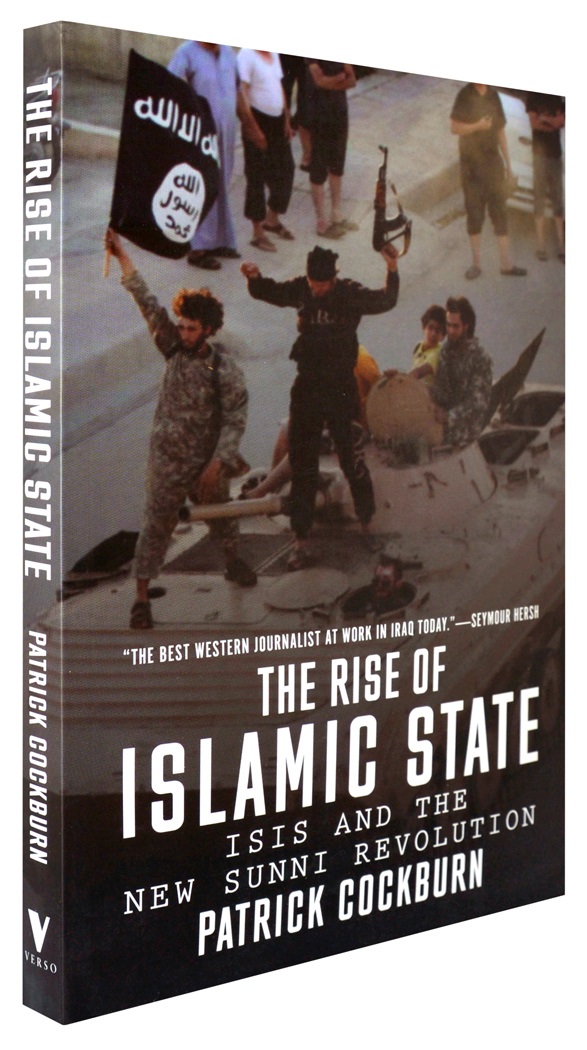 words that flow confidently off the page and exude a sense of first-hand knowledge and on-the-ground insight, it’s easy to see how Patrick Cockburn has attained his reputation amongst those in the know as the foremost and most authoritative Western correspondent in the Middle East today. The Rise of Islamic State: ISIS and the New Sunni Revolution (Verso Books, February 2015) attempts to sketch out the meteoric rise of the soi-disant caliphate’s black-clad gunmen and the factors which have facilitated it. This is no easy task, and while Cockburn does not quite achieve it, his effort is deeply informative—it is hard to imagine anyone could do better than he has in relaying the astounding complexity of the situation in Iraq and Syria today.
Much of the novelty of ISIS lies in the suddenness of their appearance and the continuous string of victories they have amassed. Cockburn is quick to point out that much of this is propaganda: ISIS has been a player in the region for years, but mostly as an authorised bin Laden franchise founded by the Jordanian Abu Musab al-Zarqawi and under the name of Al-Qaeda in Iraq. Following al-Zarqawi’s death, the Sunni jihadist group transformed into the Islamic State in Iraq and proclaimed its new leader Abu Bakr al-Baghdadi the ‘emir’, expanding operations into Syria by 2013.
Despite numerous successful terrorist attacks and assassinations, it is the capture of Mosul in June 2014 which Cockburn singles out as the start of ISIS as the phenomenon we are experiencing today. This stellar rise has yet to prove fully meteoric in the sense that, while their onward march has ground to a halt at Kobane, ISIS has stubbornly refused to burn out and fade away. This has been contingent upon an alignment of factors which might be oversimplified into three: the endemic corruption of the Iraqi state, the astounding stupidity of Western powers, and the entrenched sectarianism of Iraqi society.
As one of the most central institutions of the state, the melting-away of the Iraqi Army’s resistance to ISIS has been crucial. It is difficult to overestimate the vast scale of corruption in the Army. Military units often include large numbers of troops that exist only on paper. Command of a division comes with a high pricetag. Having borrowed the money to pay for it, divisional commanders then require steady income streams to pay back the loan. Setting up roadblocks to extort money from travellers is an easy task for an armed force, but the possibilities are numerous.
A retired Iraqi general tells Cockburn the rot first set in when, in 2005, the Americans demanded the Iraqi Army outsource food and logistical supply:
“A battalion commander was paid for a unit of 600 soldiers, but had only 200 men under arms and pocketed the difference, which meant enormous profits.”
In Mosul, Cockburn points out, only one in three of the soldiers meant to be there were physically present, the rest having payed up to half their salaries to be on permanent leave.
Endemic corruption of this kind has been fostered by the complacency of the governing elite. A Turkish businessman was ruffled when a local ISIS leader demanded $500,000 per month in protection money. “I complained again and again to the government in Baghdad,” he relates to Cockburn, “but they would do nothing about it except to say that I should add the money I paid to al-Qaeda to the contract price.” Such an attitude hardly inspires confidence in the state.
As ISIS gained ground across Iraq, the Baghdad elite seemed only to increase its insularity, acting as if nothing was wrong. “When you speak to any political leader in Baghdad,” an ex-minister says, “they talk as if they had not just lost the country.”
“ISIS,” Cockburn points out, “are experts in fear.” YouTube has been deployed with a methodical exactness towards this end. The talking heads who’ve preached the gospel of new media as breaking down barriers and leading to an immanent global liberation have plainly failed to grasp that these new forms of communication can be expertly employed by forces intrinsically opposed to their vision of a liberal utopia.
While the Shi’ites have long been in the majority, the Sunnis were top-dog under Saddam, widely favoured and occupying places of power and authority. With Saddam toppled and democratic elections now forming the basis of the state’s legitimacy, the numerical strength of the Shia has handed the state to Shi’ite political forces fearful of a return to the old days. When Sunnis complain of violence, intimidation, and discrimination at the hands of the Shia-dominated government in Baghdad, Shi’ites don’t see the Sunnis as reacting to oppression but as plotting a return to their former dominance.
This de-legitimisation of the official state in the eyes of Sunni Iraqis has provided the space in which the zealous ISIS has come to the fore. Where ISIS rules it is widely unpopular – in a country of smokers, Cockburn notes, they have demanded bonfires of cigarettes in captured towns – but too many of ISIS’s enemies are opposed to all Sunnis, not just ISIS. This means Sunnis opposed to ISIS have no one to turn to for protection or support. All too many have calculated that enforced piety and oppression from ISIS are preferable to being murdered by Shia militiamen in police uniforms just for being Sunni.
But one of the most influential factors in the rise of the Islamic State in Iraq has been events in neighbouring Syria. Shifting his aim westwards, Cockburn provides analysis of events that is both illuminating and frustrating. The interference of external powers in Syria, whether Middle-Eastern or Western, has had catastrophic and usually counter-productive effect. In the midst of a supposed ‘global war’ on Islamic terror, the logic of toppling yet another bastion of Ba’athist-style dictatorial secularism in the region is murky. Encouraging a Sunni uprising in Syria without foreseeing a knock-on effect in neighbouring Iraq also strikes Cockburn as particularly naive.
The vitality of continued opposition to Assad by the US-led Western powers and by states in the region is astonishing – almost satanic. The United States happily allied itself with the most murderous force in the twentieth century – the USSR – in order to defeat the more pressing evil of Nazi Germany. And yet the exponentially milder Assad regime is somehow considered totally untouchable – or ‘haram’ as the locals of the region might say. It was only twenty-odd years ago Syrian troops were fighting as part of the US-led coalition in the First Gulf War. The transformation since then is inexplicable (and, with his hands already full, Cockburn does not attempt to offer any insight into this).
Despite the severity of the civil war being waged in Syria, the West has demonstrated openly and brazenly that it is more interested in eliminating Assad than ending the war. As Cockburn frequently points out, Assad has continuously been in control of all but two regional capitals in Syria, yet the United States says he can’t even have a place at the negotiating table unless he agrees to give up power. That’s not a pre-condition: it’s a repudiation. Failed politicians in this part of the world don’t retire to bank boards and book deals like in the West – more often their bloodied corpses are dragged from their palaces by a mob of well-orchestrated ferocity. (The victors’ justice of Saddam’s execution is a rare example that tests the rule.)
Laying the Assad-must-go precondition is a bold statement by Western powers that they grant zero priority to ending the war. Despite all their high-minded liberal humanitarian cover talk, it’s simply not on the agenda: Power is the only thing.
Despite the unsurprisingly depressing subject matter, the author is persuasive in his clear and cogent writing. This book—and Cockburn’s reporting more generally—is helpful both to those with some familiarity with the region and total novices in deepening one’s understanding of a situation that defies adjectives.
As bombs were falling on Libya, Cockburn pointed out the jihadist nature of many of the rebel groups in the north African country, only to be confronted by an American reporter: “Just remember who the good guys are.” For those looking to avoid the Manichean oversimplifications we are too often fed, this book is a welcome and insightful reprieve.
Search
Instagram: @andcusack
Click here for my Instagram photos.Most Recent Posts
- Brunel’s Unbuilt Capitol February 3, 2026
- Cricket at Fordham January 27, 2026
- Palacio Barolo Revisted January 14, 2026
- Learning to Love Liguria January 14, 2026
- Crux Alba No. 2 January 13, 2026
Most Recent Comments
Book Wishlist
Monthly Archives
Categories