Arts & Culture
About Andrew Cusack
 Writer, web designer, etc.; born in New York; educated in Argentina, Scotland, and South Africa; now based in London.
 read more
News
Blogs
Reviews & Periodicals
Arts & Design
World
France
Mitteleuropa
Knickerbockers
Argentina
The Levant
Africa
Cape of Good Hope
Netherlands
Scandinavia
Québec
India
Muscovy
Germany
Academica
Merton
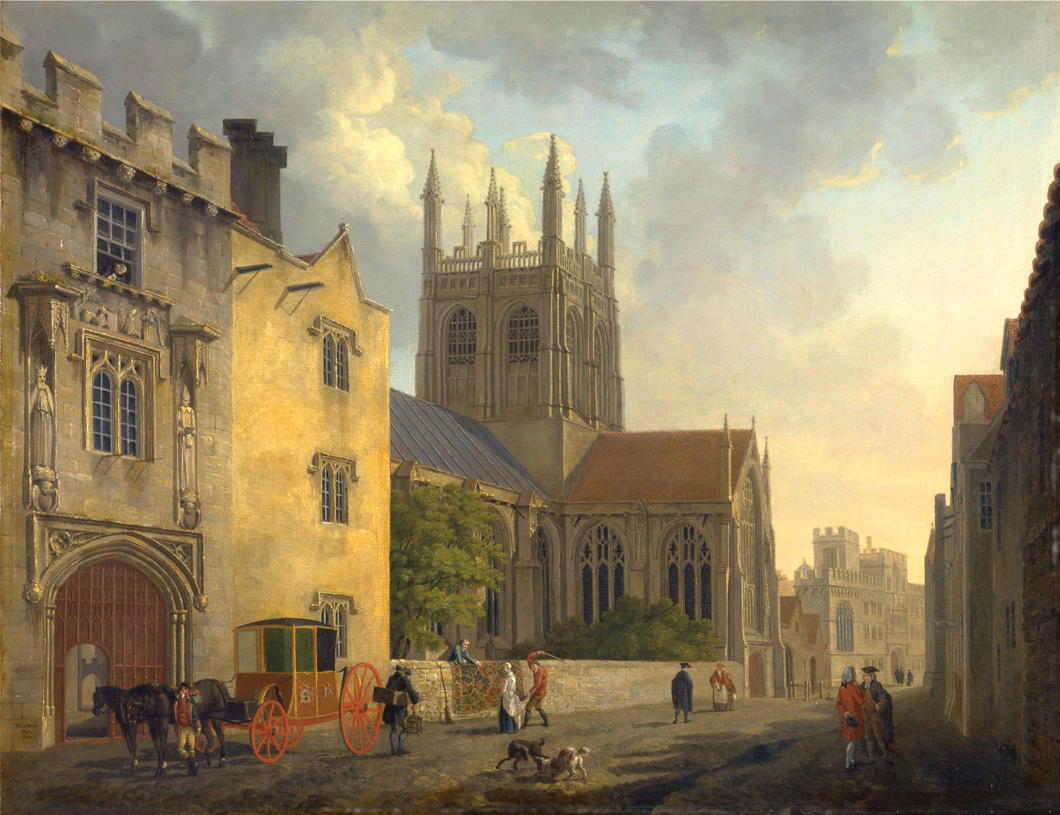
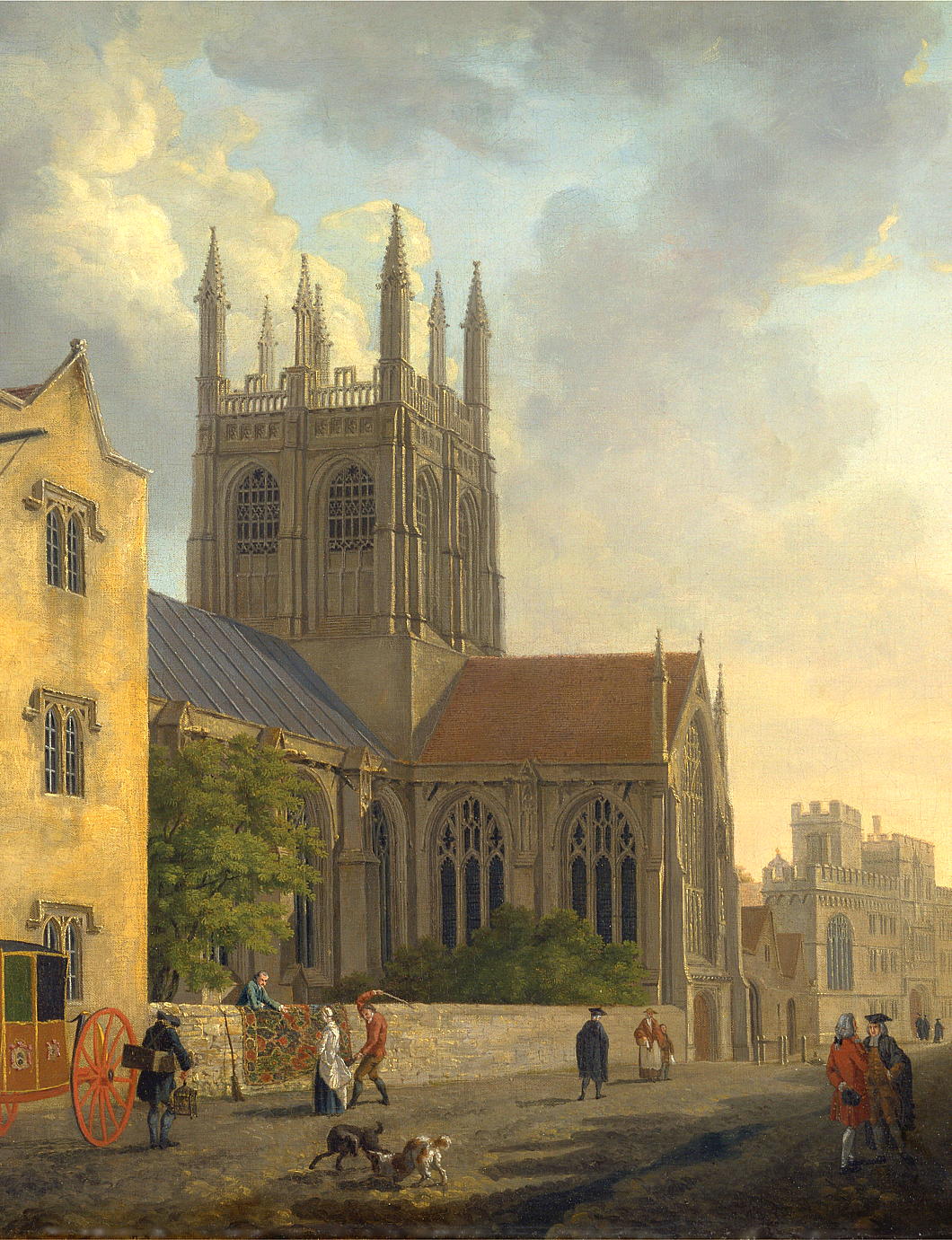
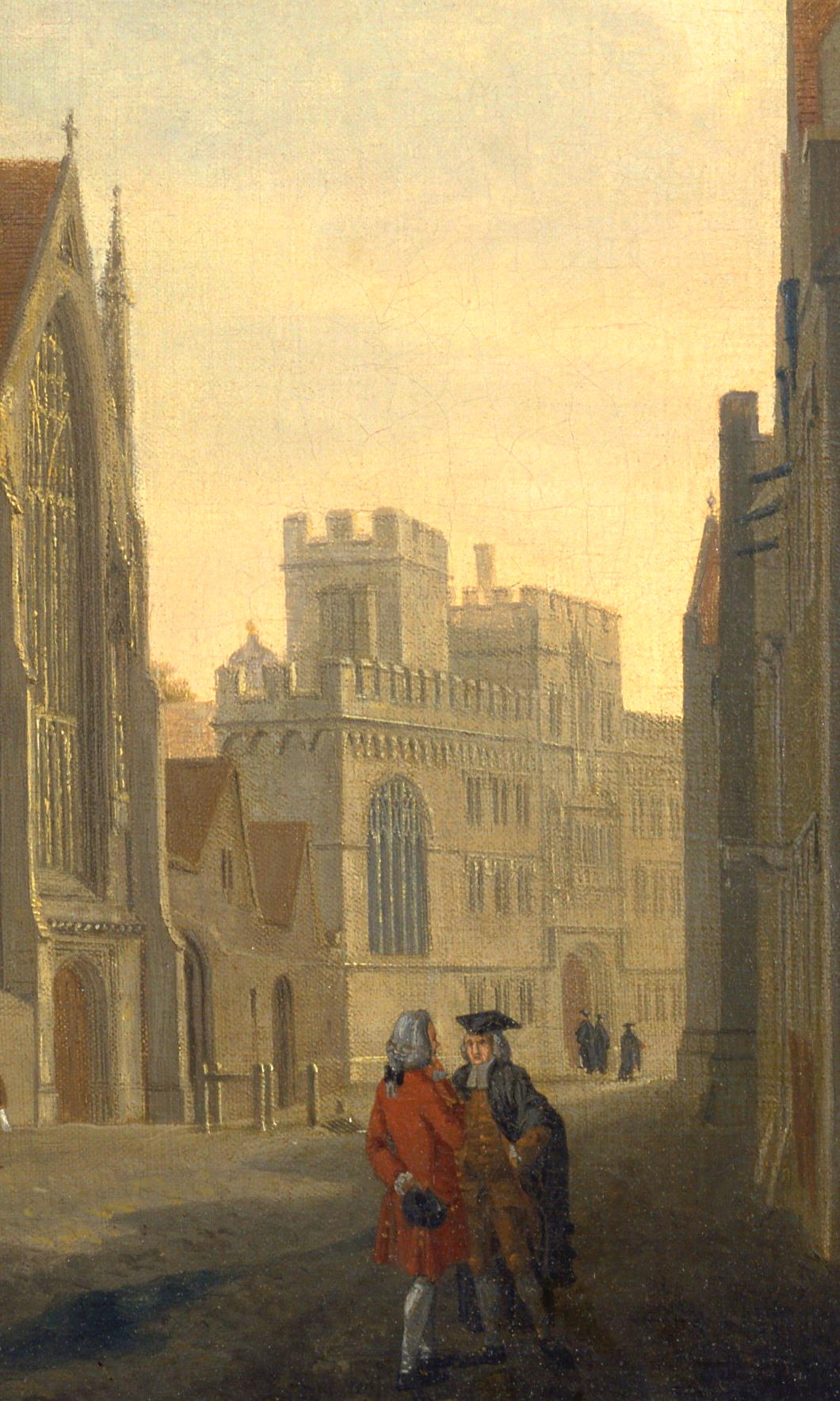
The ‘House or College of Scholars of Merton in the University of Oxford’ — more commonly called Merton College — is one of the smaller colleges in Oxford, located right next door to lovely little Corpus.
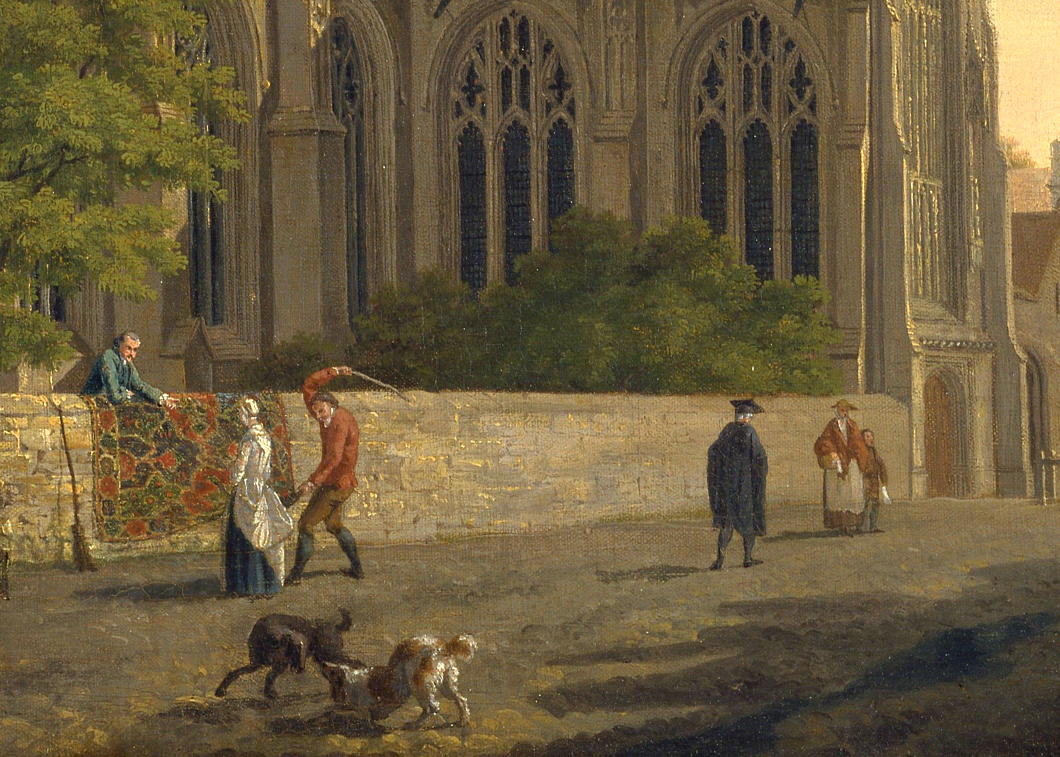
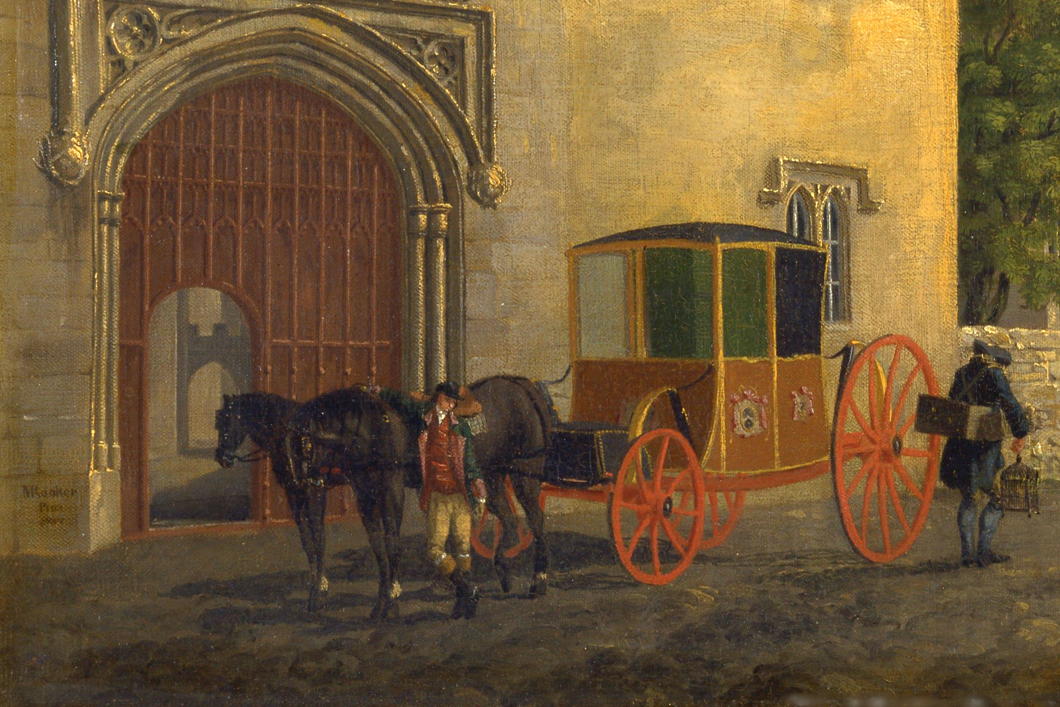
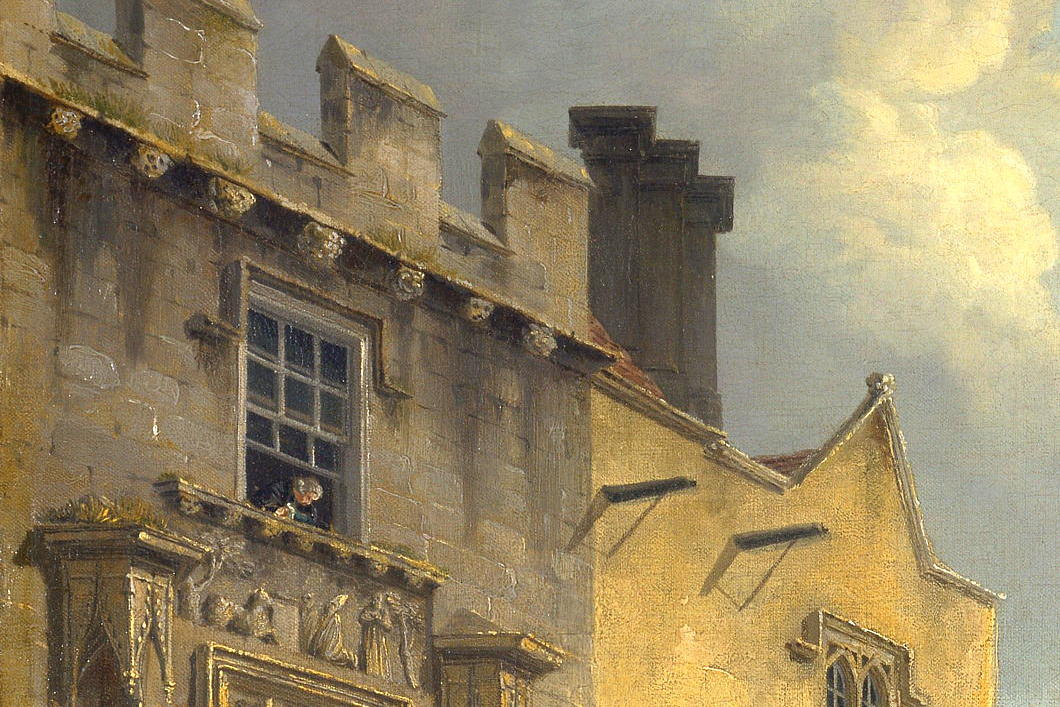
Aside from rendering the architecture well, townscapes from the eighteenth century often give delightful little hints of city life. Michael Rooker (1746–1801) painted this scene of Merton College from its eponymous street in 1771, and the view today is hardly changed at all.
One of my favourite cityscapes is Canaletto’s view of the back end of Downing Street looking towards the old Horse Guards which you can pop into the Tate and see thanks to the generosity of Lord Lloyd-Webber. Incidentally, both scenes depict carpets being hung out for beating.
If you love the capital of the Netherlandosphere I recommended adding to your library Kijk Amsterdam 1700-1800: De mooiste stadsgezichten (‘See Amsterdam 1700-1800: The Most Beautiful Cityscapes’), the well-produced catalogue of the 2017 exhibition of the same name at the Amsterdam City Archives which includes 300 illustrations in full colour.
It’s high time the Museum of Oxford or the Ashmolean — or anyone really — put together a similar exhibition of Oxford cityscapes from the same century.
Incidentally, it was in Merton Field as a teenager that I played my first game of cricket. Who would have guessed then that eighteen years later your humble and obedient scribe would be facing the Vatican on the field of battle in the same sport? (We lost.)
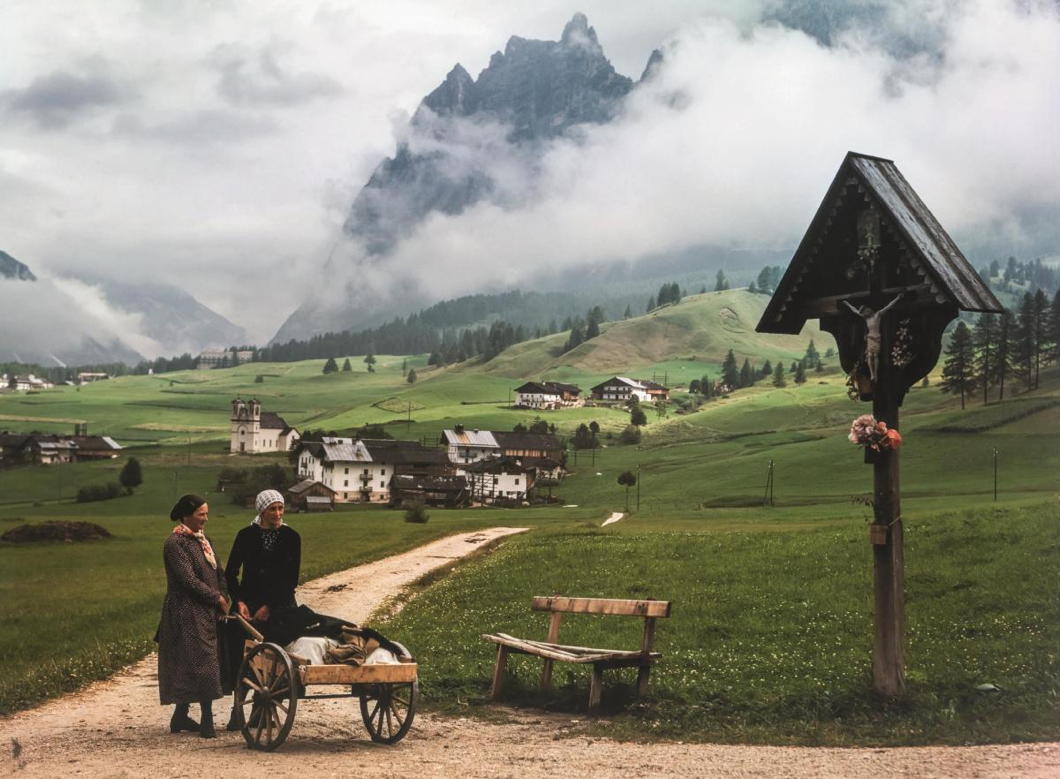
In the Dolomites
Helena at Bethlehem
He sent along this passage from Waugh’s novel Helena in which the saint (and mother of the Emperor Constantine) arrives at Bethlehem, the city of Our Saviour’s birth, on the very feast of the Epiphany. She addresses the Magi in prayer.
“Like me,” she said to them, “you were late in coming. The shepherds were here long before; even the cattle. They had joined the chorus of angels before you were on your way. For you the primordial discipline of the heavens was relaxed and a new defiant light blazed among the disconcerted stars.
“How laboriously you came, taking sights and calculations, where the shepherds had run barefoot! How odd you looked on the road, attended by what outlandish liveries, laden with such preposterous gifts!
“You came at length to the final stage of your pilgrimage and the great star stood still above you. What did you do? You stopped to call on King Herod. Deadly exchange of compliments in which there began that unended war of mobs and magistrates against the innocent!
“Yet you came, and were not turned away. You too found room at the manger. Your gifts were not needed, but they were accepted and put carefully by, for they were brought with love. In that new order of charity that had just come to life there was room for you too. You were not lower in the eyes of the holy family than the ox or the ass.
“You are my especial patrons,” said Helena, “and patrons of all late-comers, of all who have had a tedious journey to make to the truth, of all who are confused with knowledge and speculation, of all who through politeness make themselves partners in guilt, of all who stand in danger by reason of their talents.
“Dear cousins, pray for me,” said Helena, “and for [the generally believed still unbaptized Emperor Constantine] my poor overloaded son. May he, too, before the end find kneeling-space in the straw. Pray for the great, lest they perish utterly. And pray for… the souls of my wild, blind ancestors…
“For His sake who did not reject your curious gifts, pray always for the learned, the oblique, the delicate. Let them not be quite forgotten at the Throne of God when the simple come into their kingdom.”
Watts Chapel
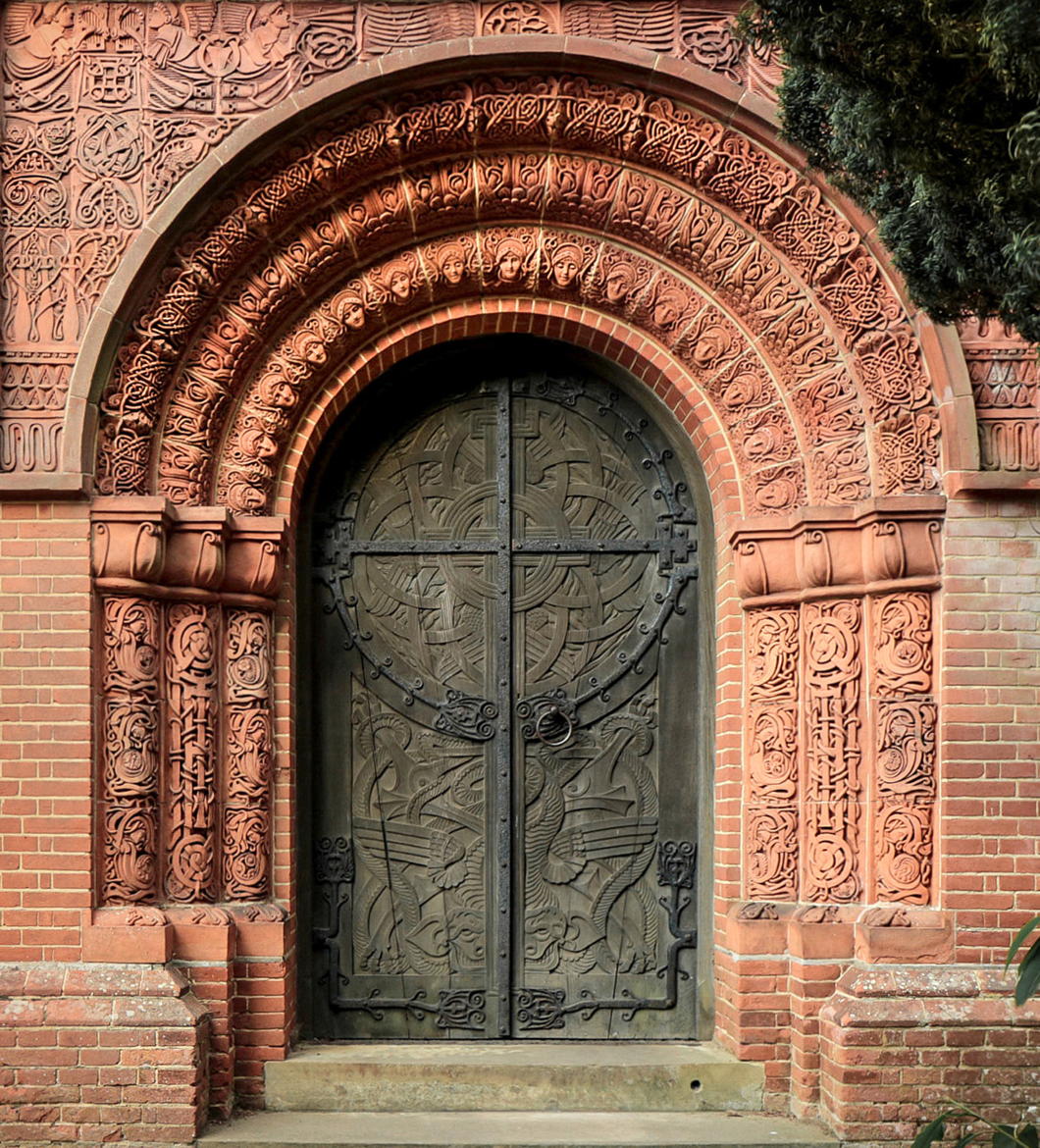
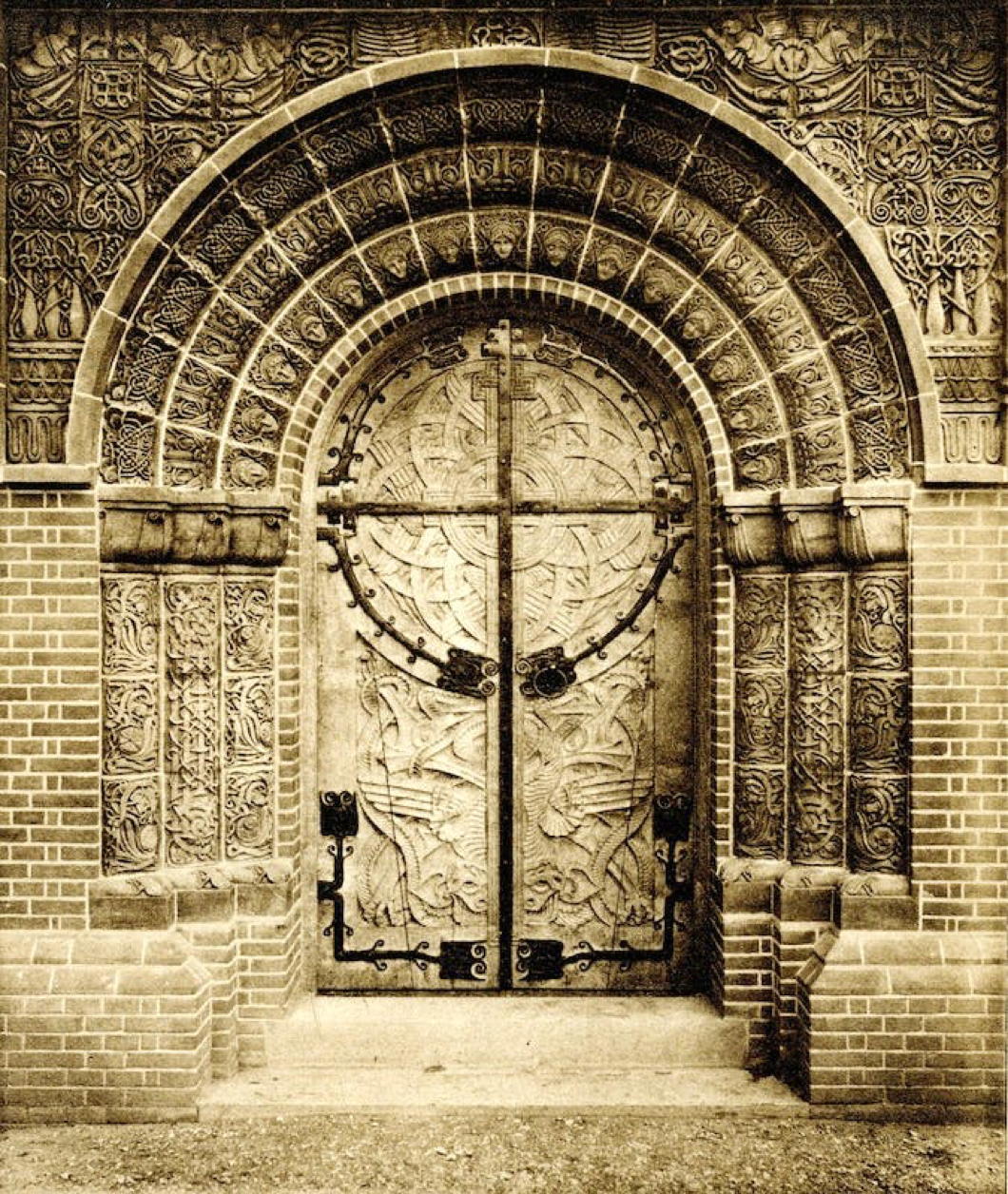
IS THIS the most beautiful door in England? The Watts Chapel in the village cemetery of Compton in Surrey is certainly one of the most remarkable buildings in the land.
I have to admit it completely escaped my notice until a friend of mine founded a distillery a few years ago and based the logo on the seraphs depicted within the chapel. While the interior is indescribable it is also curiously incapable of being captured by photography to any satisfactory degree.
Being a Celt with a Norman surname who loves the Romanesque, it’s the entry portal that captures my imagination. It beams at the very same frequency as my heart.
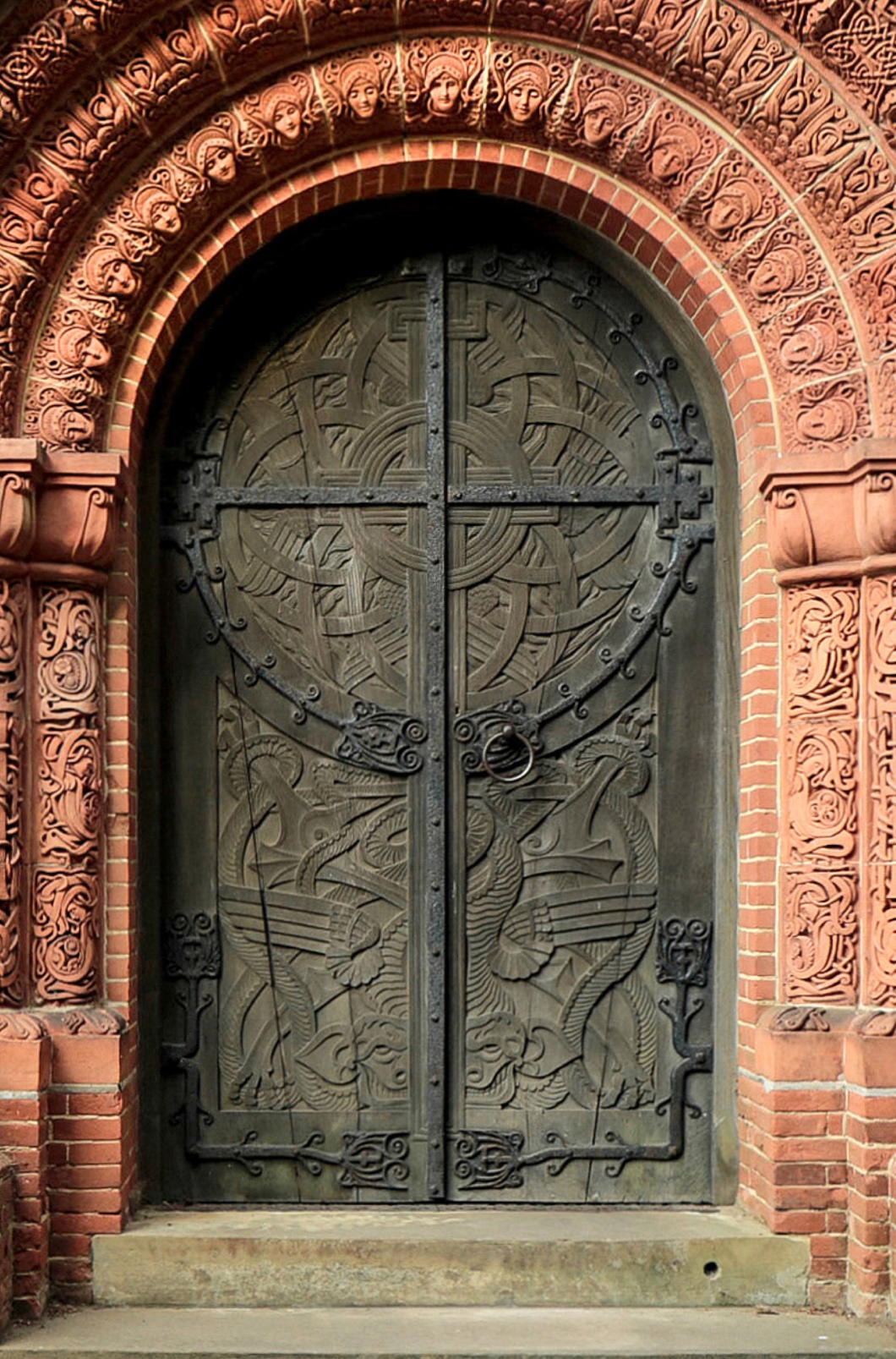
What a wonderful melange of elements — Celtic, Saxon, Romanesque, and Nordic — are combined here with blithe ease.
Incessant stylistic purity is the realm of the boorishly tiresome, as Ninian Comper knew well, and here the eclectic blend works well.
As architects are incapable of learning the proportion required by Georgian and neo-classical styles, I’ve long believed the Romanesque (or ‘Norman’ as the English often call it) must be the starting point for the recovery of good solid modern architecture.
I, for one, welcome our Norman-Romanesque future with open arms — while prizing this late Victorian gem.
An Approach Not Taken
John Russell Pope’s Unexecuted ‘Museum Walk’
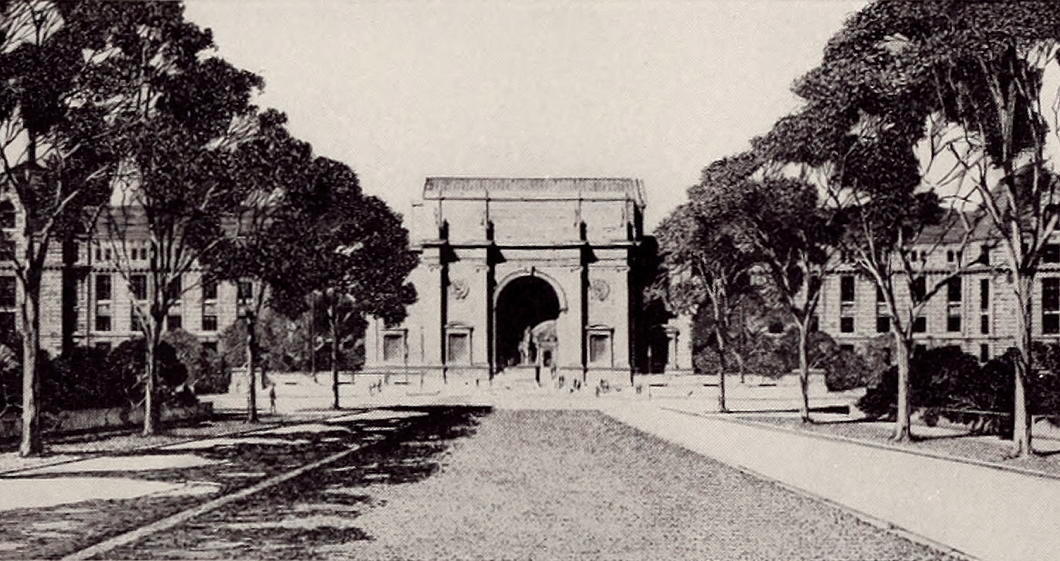
While John Russell Pope won the competition to design the New York State Theodore Roosevelt Memorial currently under attack, not every aspect of his design was executed.
The architect planned for an avenue to be built in Central Park to provide a suitable approach to the American Museum of Natural History and his memorial to the twenty-sixth president.
160 feet wide and 500 feet long, it would feature a broad central lawn flanked by drives and forming an allée of trees. Other versions of the plan have a roadway heading down the middle of the approach.
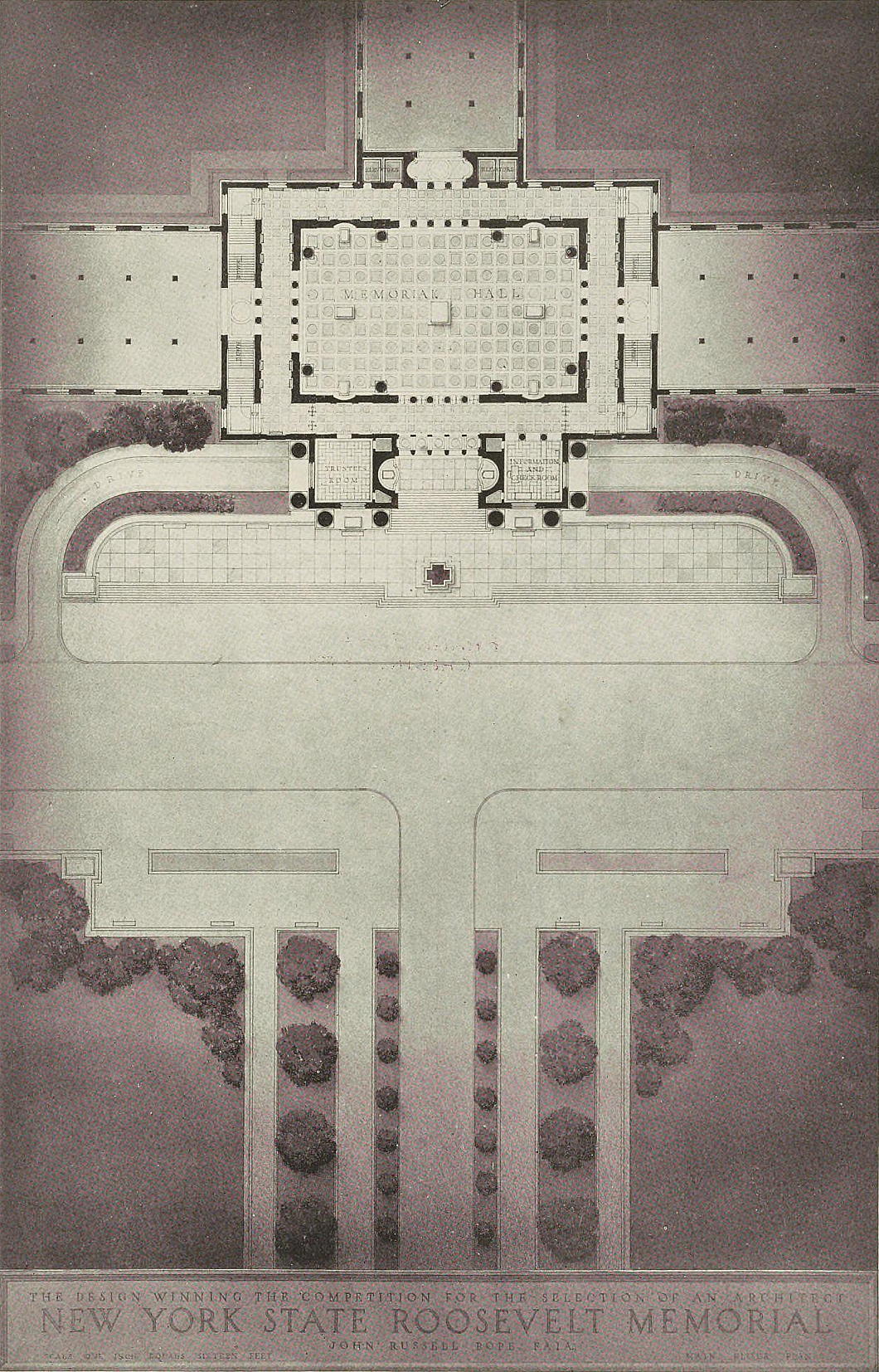
The idea of this ‘museum walk’ was originally that of Henry Fairfield Osborn, for a quarter-century president of the American Museum of Natural History.
Osborn was also president of the New York Zoological Society — they who run the Bronx Zoo — while his brother was president of the Metropolitan Museum across Central Park.
His son Fairfield also led the NYZS (renamed the Wildlife Conservation Society in 1993) and both père et fils held dodgy pseudoscientific Malthusian views about race and eugenics.
Their family house, Castle Rock, has one of the finest views of West Point across the Hudson and is still in private hands.
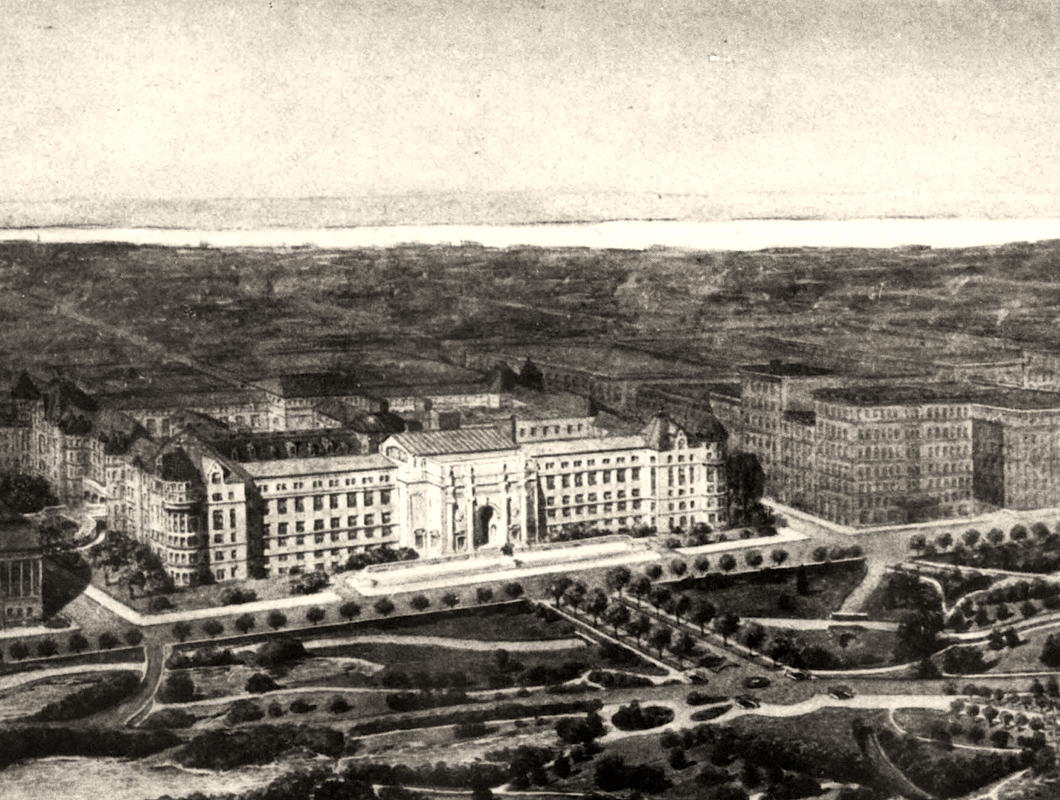
For whatever reason — possibly not wanting to redirect the 79th Street Transverse Road through the park that was in the way — Obsborn/Pope’s approach was never built.
It’s a shame as, aside from augmenting the impact of Theodore Roosevelt Memorial, it also would have provided a better vista from the steps of Museum itself.
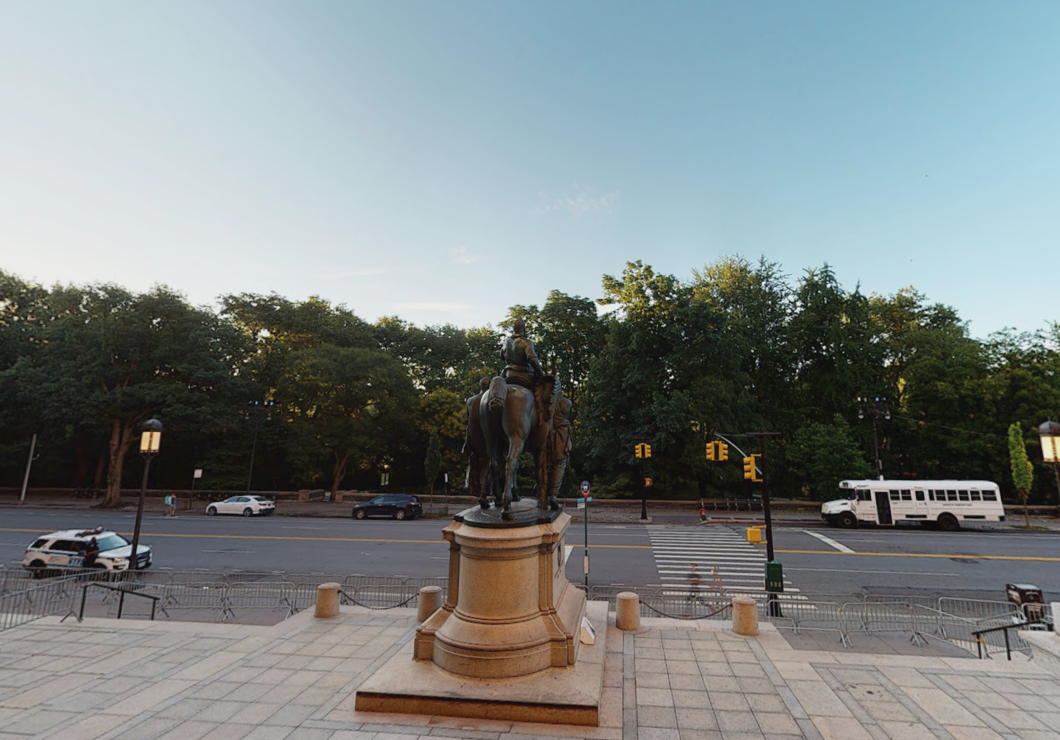
Theodore Roosevelt
The ancient heresy of iconoclasm claimed a new victim this week: The statue of Theodore Roosevelt which graced the Manhattan memorial dedicated to him at the American Museum of Natural History has been removed at a cost of two million dollars.
The sculpture had attracted the ire of protestors who objected to the inclusion of a Native American and an African by the side of twenty-sixth President of the United States and sometime Governor of New York, which they claimed glorified colonialism and racism.
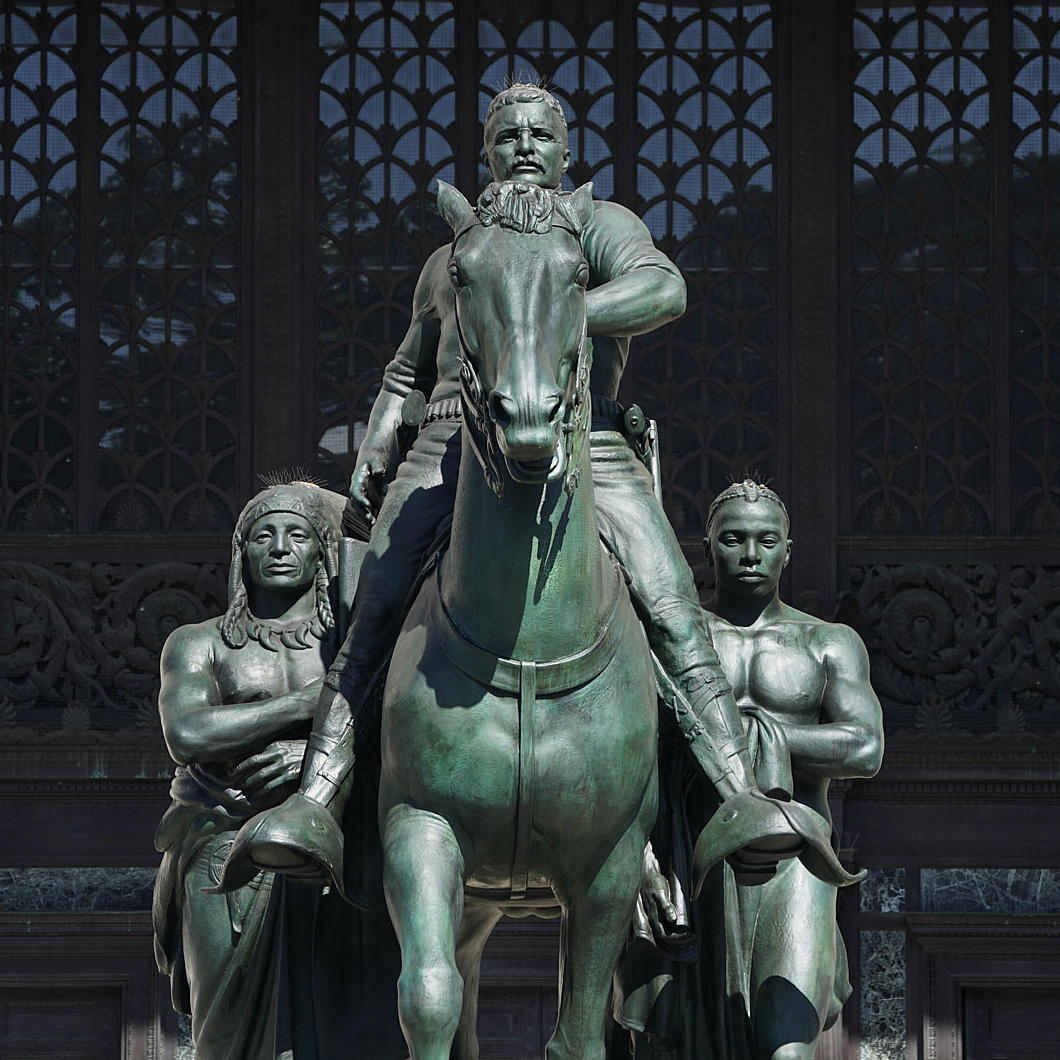
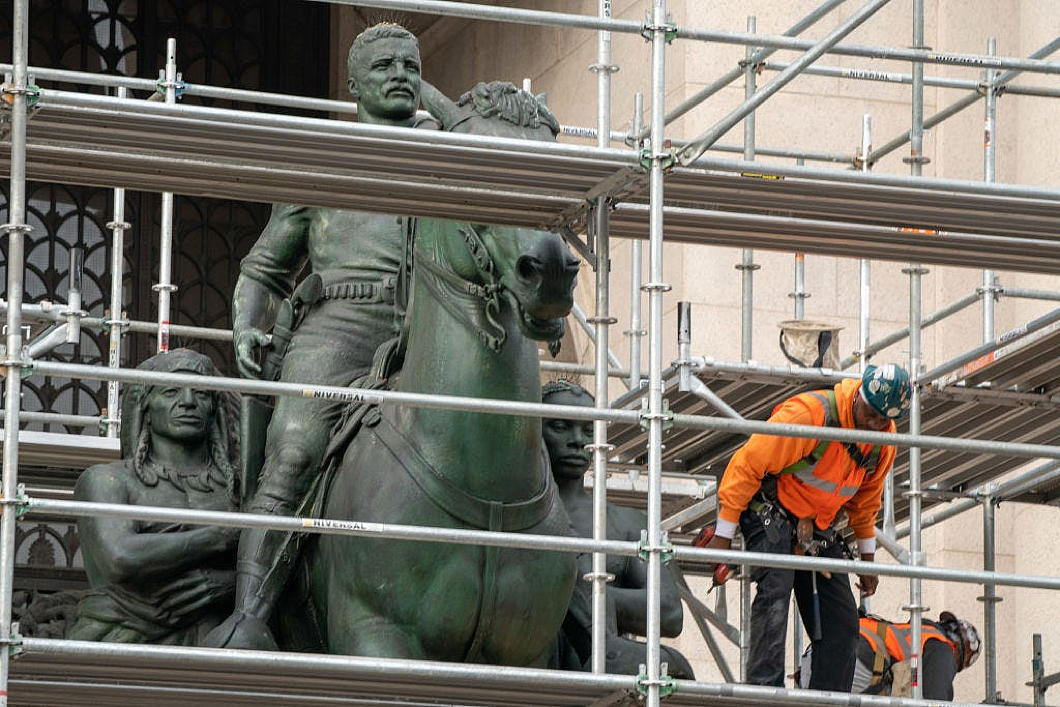
While the American Museum of Natural History is a private institution, it sits on land owned by the City, and the statue was paid for by the State.
The statue was doomed in June of last year when the New York City Public Design Commission voted unanimously to rip Teddy down.
As the New York Post put it, “He’s going on a rough ride!”
The statue was severed in two this week, with the top half removed and the bottom half following shortly after.
It will be shipped to the Badlands of North Dakota to be displayed as an object in a museum under construction there. (more…)
On the coast of Arabia
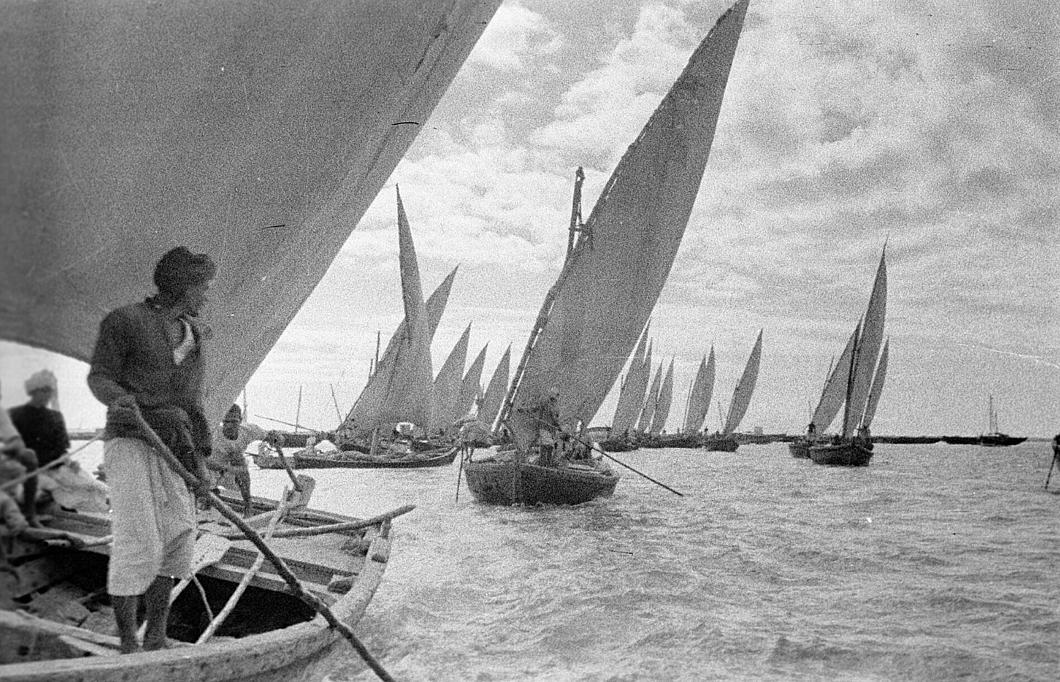
With 231 million Muslims, Indonesia today has the largest Islamic population of any country. The obligation of all Muslims who are capable to perform the Hajj — the annual pilgrimage to Mecca — at least once in their life meant that there was a continual flow of travel and traffic between the Arabian peninsula and the Dutch East Indies (as they once were).
The writer, photographer, and explorer Daniël van der Meulen was appointed the Dutch consul in Jeddah in 1923. Then followed three full years of intensive study of Arabic and Islam under the tutelage of the great Hollandic arabist Christiaan Snouck Hurgronje before van der Meulen arrived in Arabia in 1926, just as the Sultan of Nejd, Ibn Saud, was securing his hold over the Hejaz.
The primary role of the Dutch consul at Jeddah was to look after the interests of the Netherlands-Indies pilgrims on the Hajj but, as that only took place once a year for several days, van der Meulen took full advantage of the down time to explore the Arabian peninsula.
Hadhramaut in Yemen was of particular interest to him and he completed several expeditions there between 1931 and 1944, forming strong friendships with many Hadhrami people along the way.
In 2003, the Koninklijk Instituut voor de Tropen (KIT, or Royal Tropical Institute) in Amsterdam published Daniel van der Meulen in Arabia Felix: Travels and Photographs of a Dutch Diplomat in Yemen, 1931–1944 by Steven Vink, the photographic curator of the Tropical Museum.
It was published in cooperation with the Yemeni Embassy in the Hague and the Royal Netherlands Embassy in Sana’a. William Facey of the British-Yemeni Society gives it a strong review here, but hard copies are tricky to get hold of.
Not all European journeys to South Arabia have proved as fruitful as van der Meulen’s. Thorkild Hansen wrote a book about the Danish expedition of 1761 to 1767, a ‘spellbinding true story of a scientific expedition gone disastrously awry’.
This 1962 book has happily been brought back to life in a recent printing from the ever-estimable New York Review Books.
Sighișoara
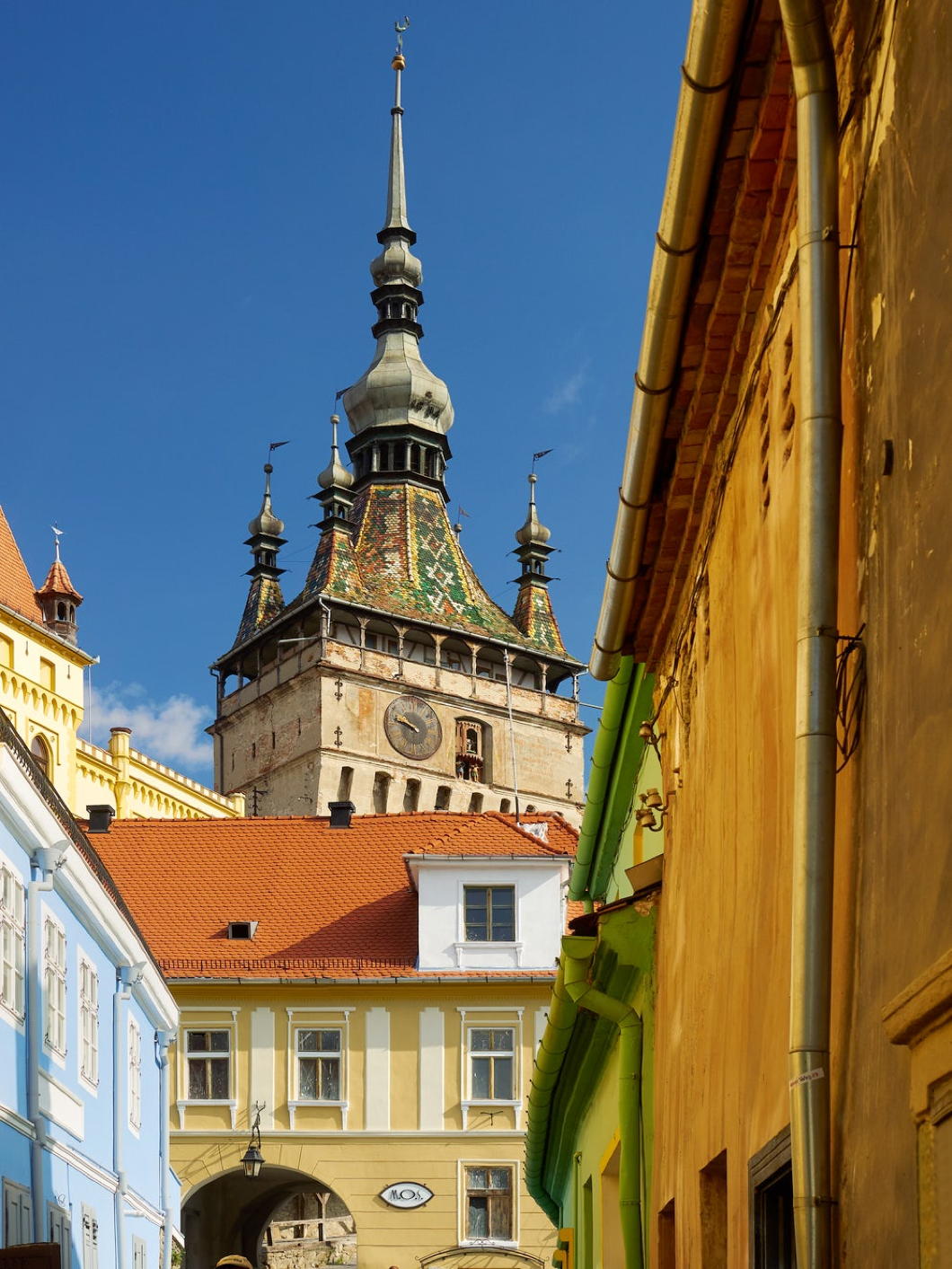 Photo: Source
Placenames can be tricky things in Transylvania. The city of Sighișoara in Romania is known as Segesvár to its Hungarian residents and Schäßburg in German — or even Schäsbrich in the dialect of the local Saxons.
Vlad Țepeș ‘the Impaler’ — who later entered legend as ‘Dracula’ — was probably born here in 1428 and the town survived the urbanistic depredations wreaked elsewhere by the tyrant Ceaușescu, perhaps more out of neglect than anything else.
The fortified middle of the town is still a real place inhabited by real people, centred around its clock tower begun in the thirteenth century and rebuilt in the seventeenth.
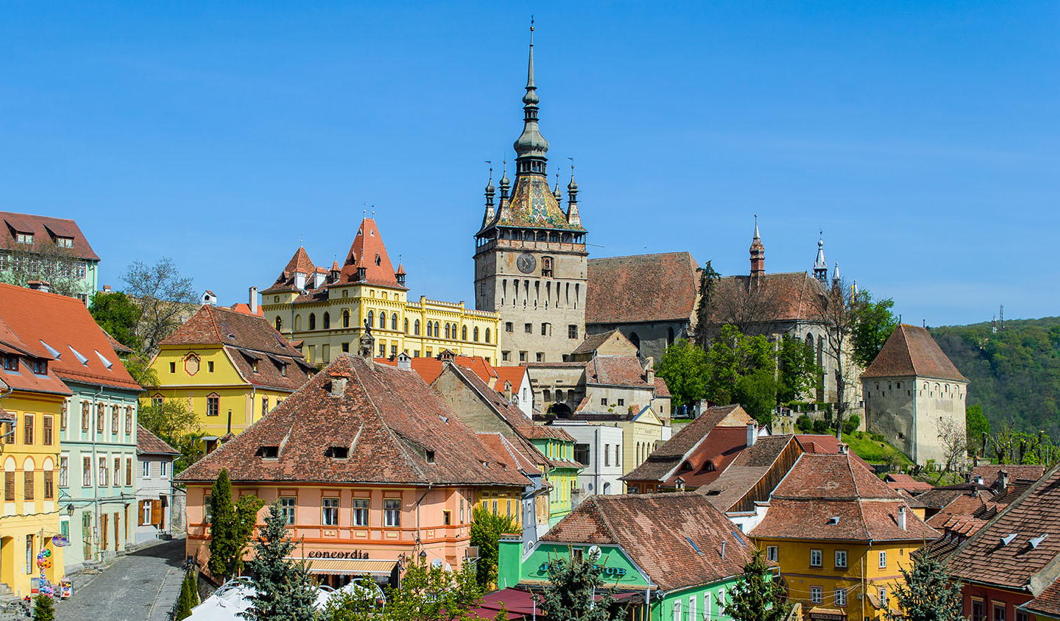
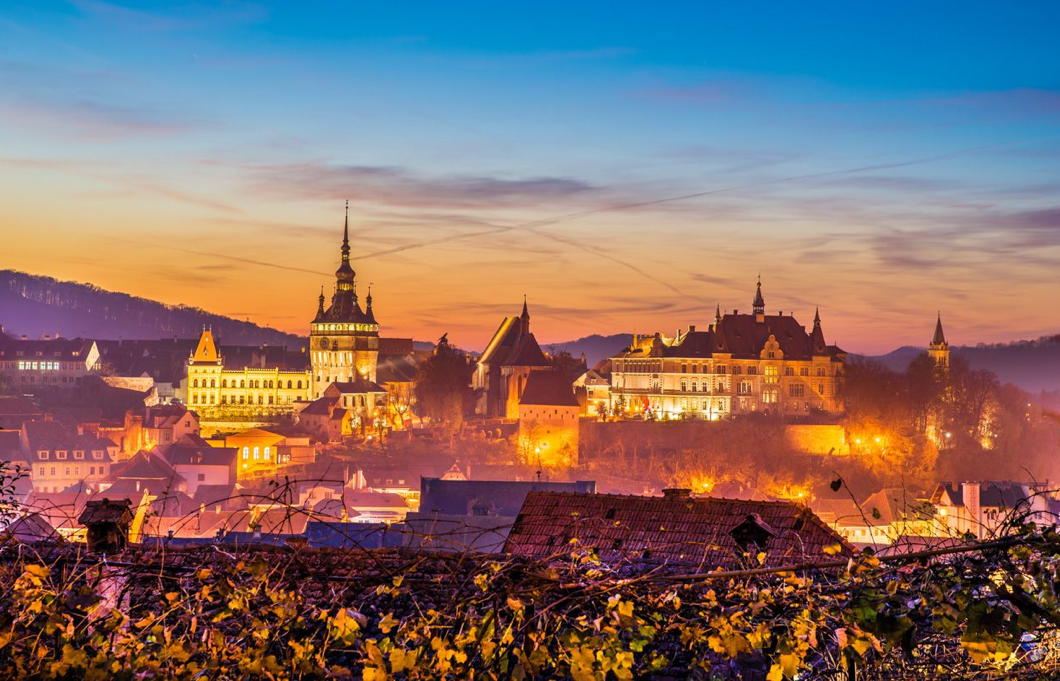
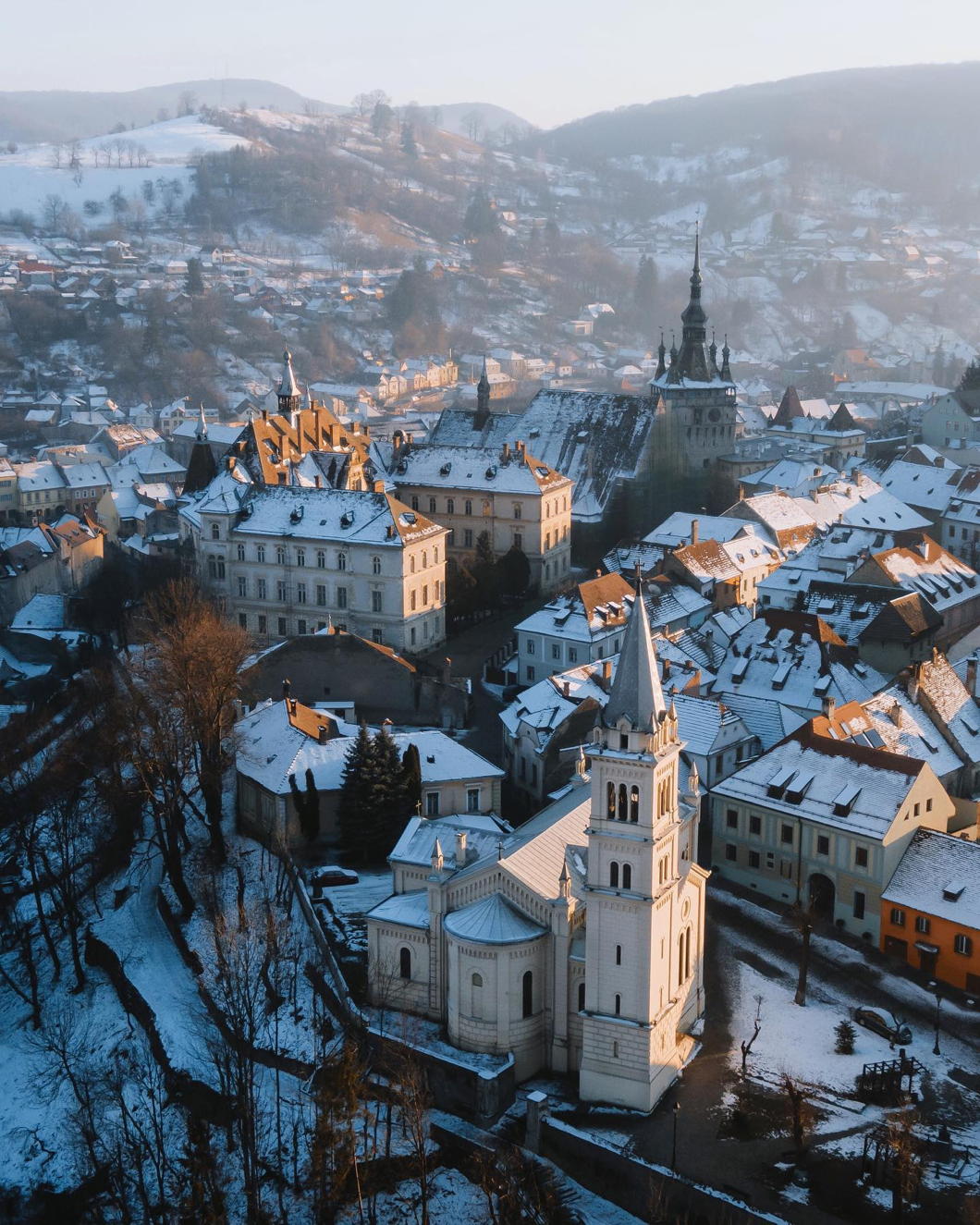 Photo: Johannes Hulsch
The Borough Synagogue
AS THE MOST ANCIENT of boroughs — and right across the bridge from the City of London itself — Southwark is presumed to have had at least a small Jewish community before the Edict of Expulsion in 1290. Records show the existence of a merchant and moneylender named ‘Isaac of Southwark’ who defended fellow Jews before the Exchequer of the Jews, the special court that dealt with Jewish taxes, fines, and legal cases.
Before 1290, it seems likely any Jews in the Borough would have crossed London Bridge to worship in the Great Synagogue in Old Jewry. After the Edict was rescinded in the seventeenth century, Jewish communities sprang up slowly. Pepys in his diary records a visit to the small Sephardic synagogue in Creechurch Lane in 1663, and by 1690 a new Great Synagogue had opened in the City for Ashkenazi Jews.
Jews in the Borough had their first known place of worship thanks to Mr Nathan Henry (born c. 1764). As a boy, Henry heard the mad Lord George Gordon speak in St George’s Fields (where your humble and obedient scribe is currently situated typing this) which provoked the anti-Catholic Gordon Riots. By a strange twist of fate, that Scottish nobleman ended up converting to Judaism and died in Newgate Prison styling himself Yisrael bar Avraham.
Around 1799, Nathan Henry fitted out a room as a synagogue in his house at No. 2, Market Street near the junction with Newington Causeway. (Market Street was later renamed Dantzic Street after the Baltic city, and is now Keyworth Street after a First World War winner of the Victoria Cross.) Later he roofed over the whole of the yard behind the house with entry gained through the shop at the front, and two rows of gallery seating above for ladies (entered through a bedroom).
Henry’s house-synagogue was small and crowded: it could fit a hundred people in uncomfortable circumstances, but those hundred were not always happy. The proprietor, having built the synagogue, considered himself the sole authority with the right to appoint wardens and office-holders. In 1823 a group of worshippers seceded and found new premises in which to worship in Prospect Place, the south side of what is now St George’s Road. The two synagogues continued in friendly relations and Nathan Henry was largely considered the head of the Jews of the Borough until his death in 1853, after which his house-synagogue shut up shop.
But by the 1860s the need for a new place of worship was apparent. For one thing, the lease on Prospect Place was coming up, and as Rabbi Rosenbaum put it the building was “incommodious, dilapidated, and unsightly, and was not even protection against inclement weather, for the roof admitted the rain and the raising of umbrellas during divine worship was no unusual occurrence”.
A building committee was put together, funds raised (more slowly than anticipated), and a site found in Albion Place, Walworth — soon to become Heygate Street. On 7 April 1867, the Borough New Synagogue was consecrated in a ceremony attended by almost all the Jewish clergy of London. In the evening, many of the congregation repaired to Radley’s Hotel in Bridge Street for a great big hooley to celebrate. The synagogue was accompanied by a boys’ school and a girls’ school both located next door. (more…)
Abbott’s Gun
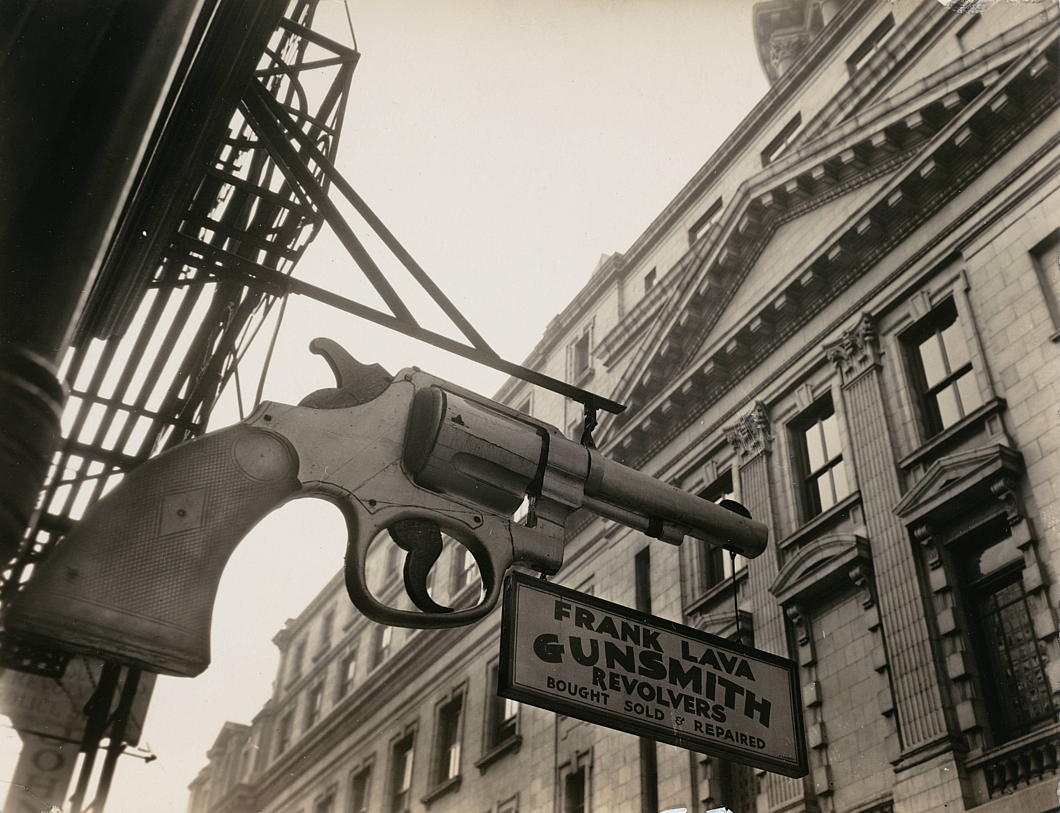
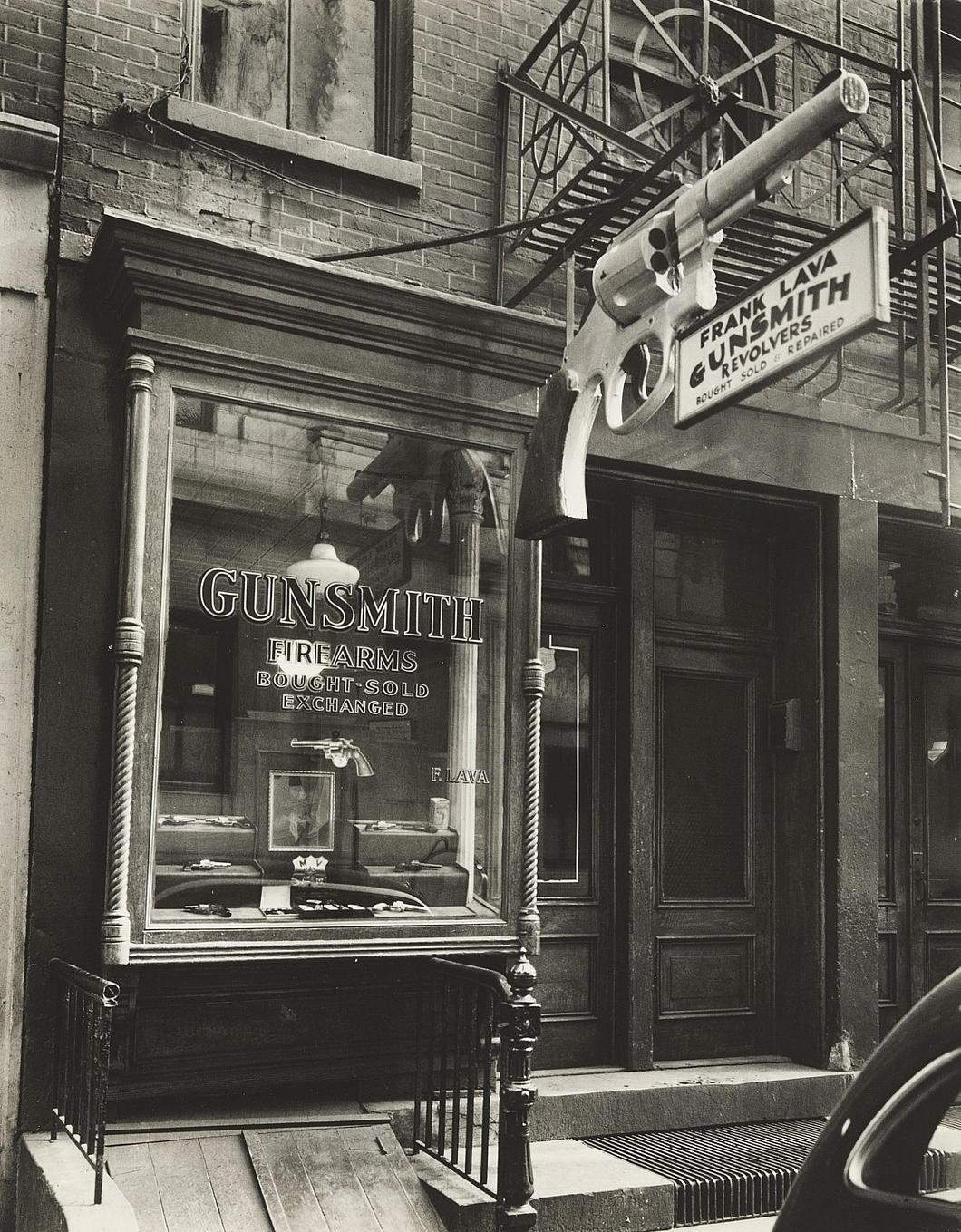
Berenice Abbott took a few photographs of New York’s old Police Headquarters viewed from one of the gunsmiths across Centre Market Place.
This street behind the NYPD HQ (which fronts on to Centre Street) became the gunsmiths’ district of Manhattan — policemen being one of the best customers for many of these businesses. (Criminals being another.)
There is something almost mediæval about the giant gun hanging outside, advertising to one and all what the shop had to offer.
Frank Lava, the gunsmith photographed, shut decades ago, but the John Jovino Gun Shop was originally next door before moving around the corner into Grand Street.
Like Lava’s, Jovino’s continued the tradition of hanging a giant gun outside the shop like in Abbott’s photograph.
The John Jovino Gun Shop, founded 1911, chucked in the towel last year when “Gun King Charlie” — owner Charlie Yu — decided the rent was too damn high.
A Metropolitan Christmas
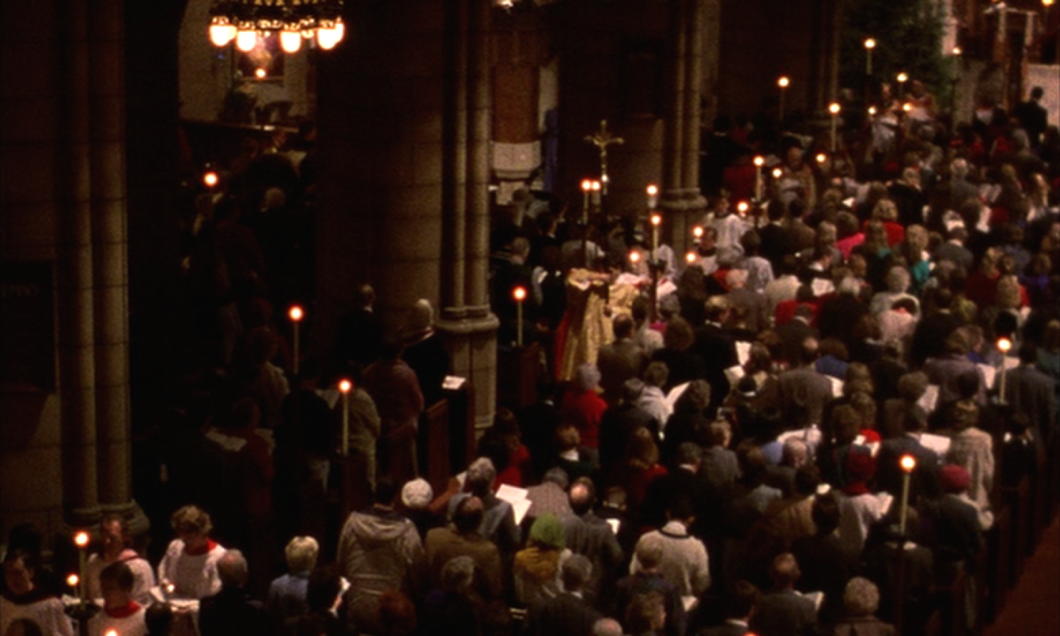
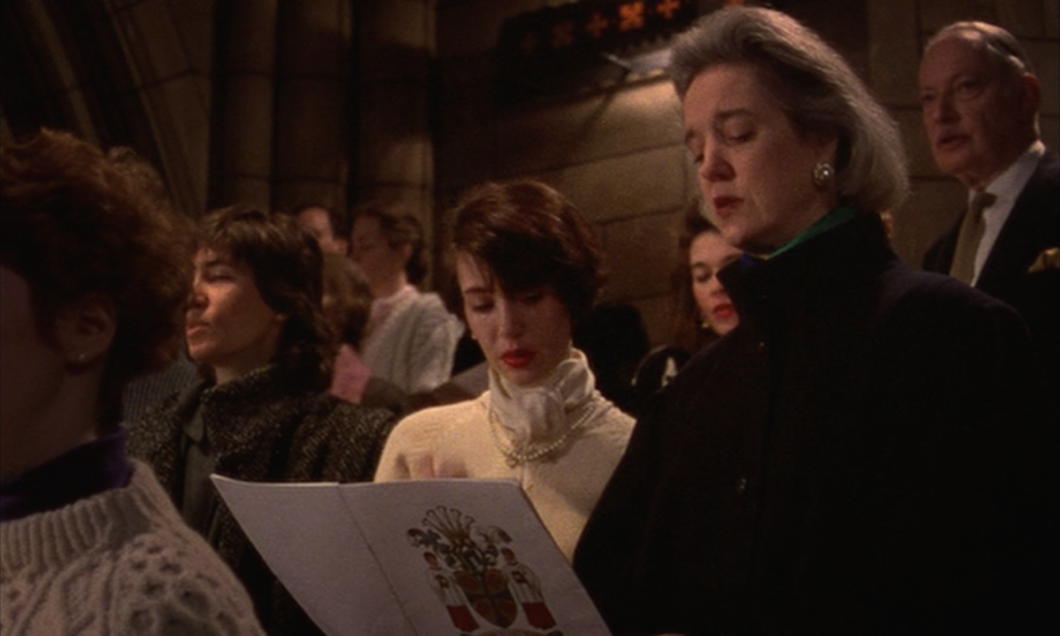
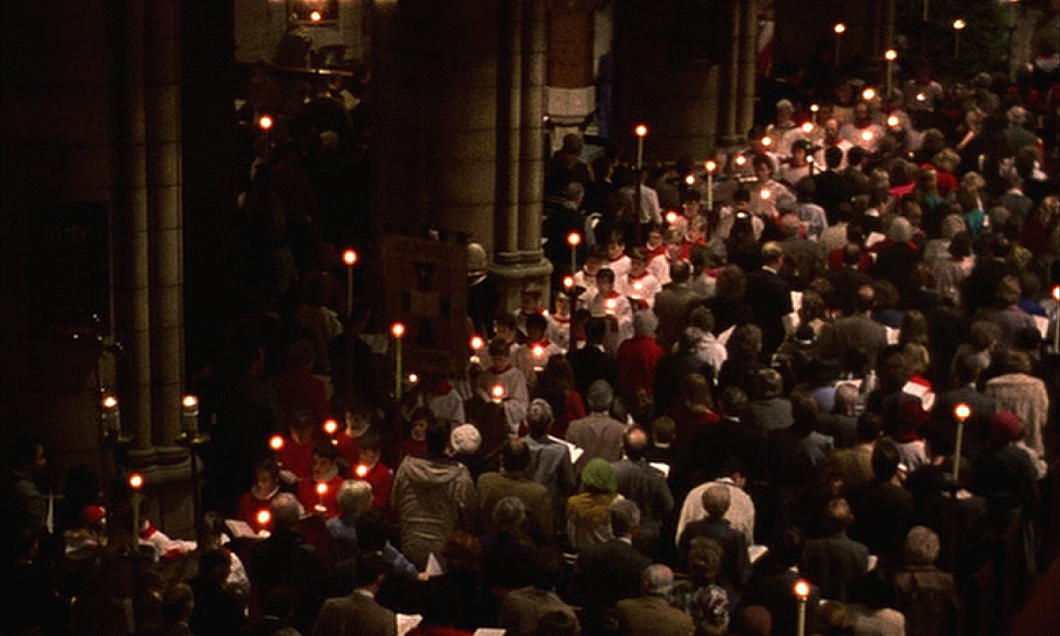
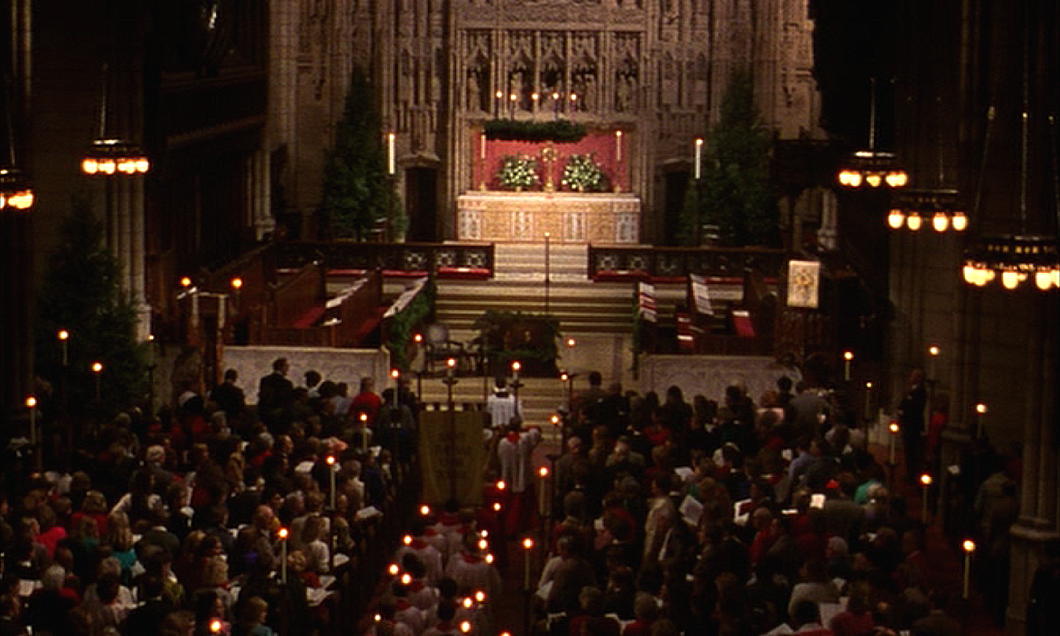
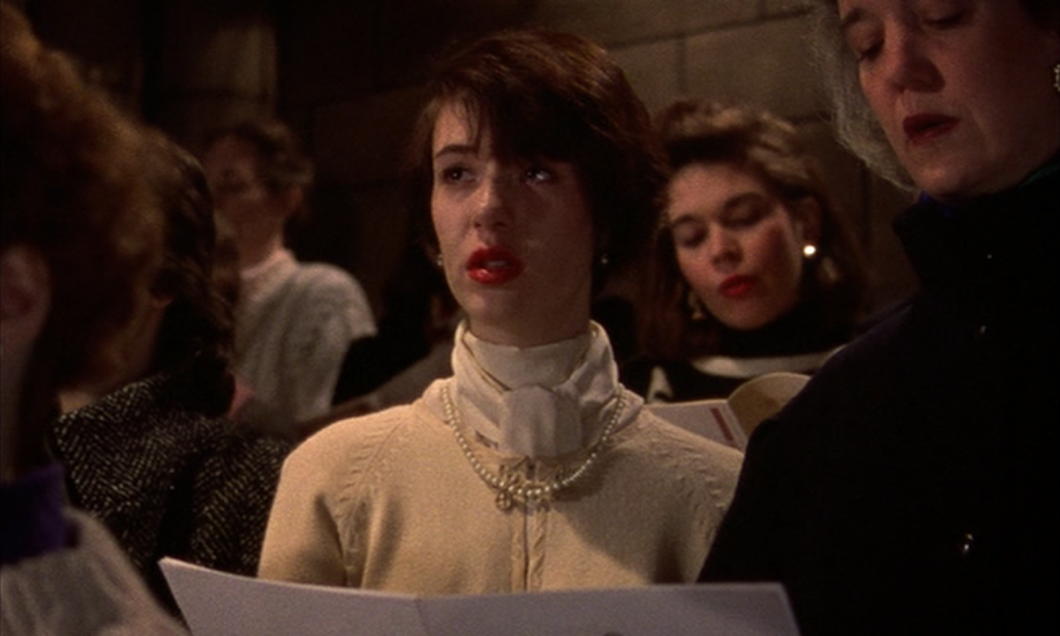
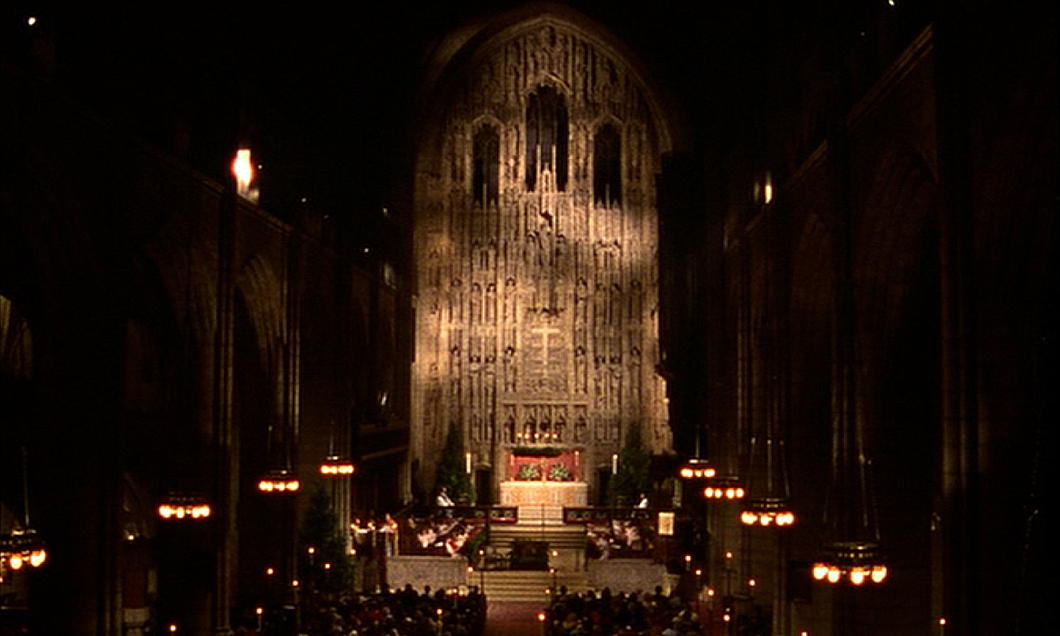
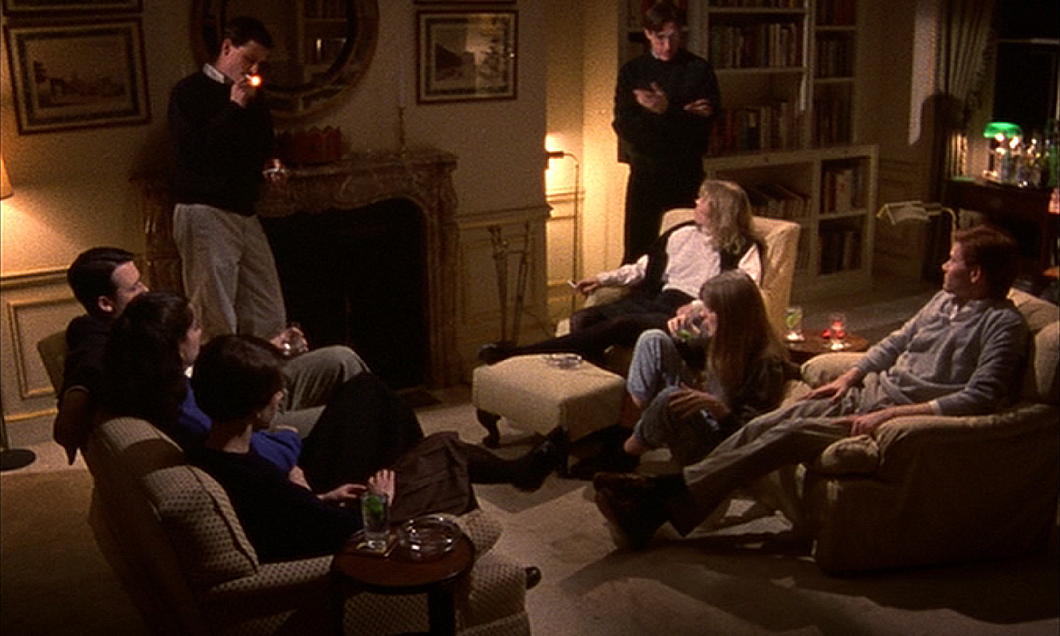
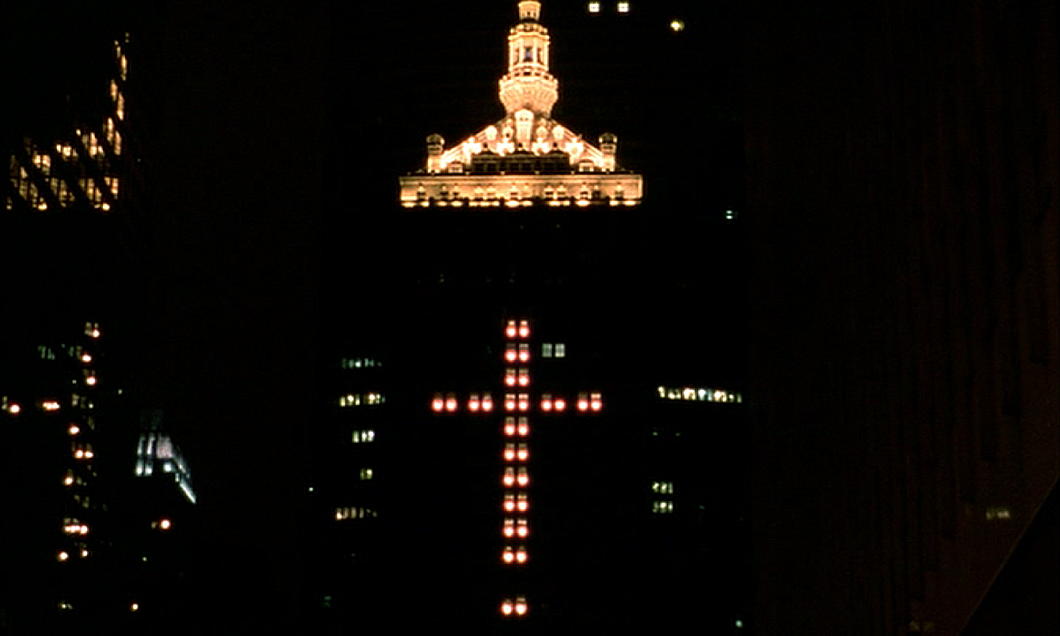
I suppose Whit Stillman’s ‘Metropolitan’ is not strictly speaking a Christmas film but Yuletide is as good a time as any to watch the most Upper-East-Side movie ever to make the silver screen.
It includes a scene (clip above) from the Service of Nine Lessons and Carols at St Thomas, Fifth Avenue, which to my mind is the best carol service in New York. It’s even better when followed by a few drinks at the University Club one block up.
St Birinus
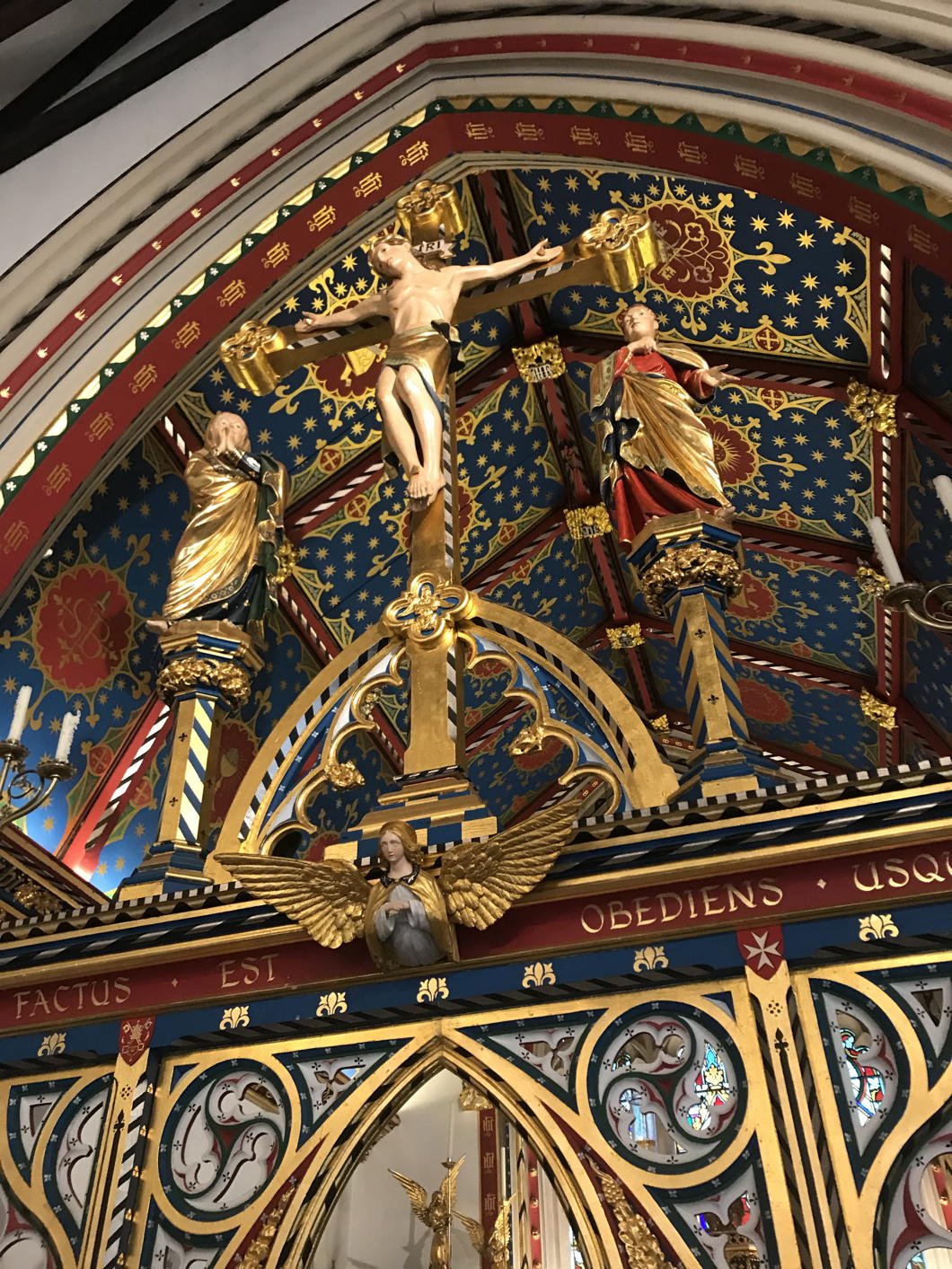
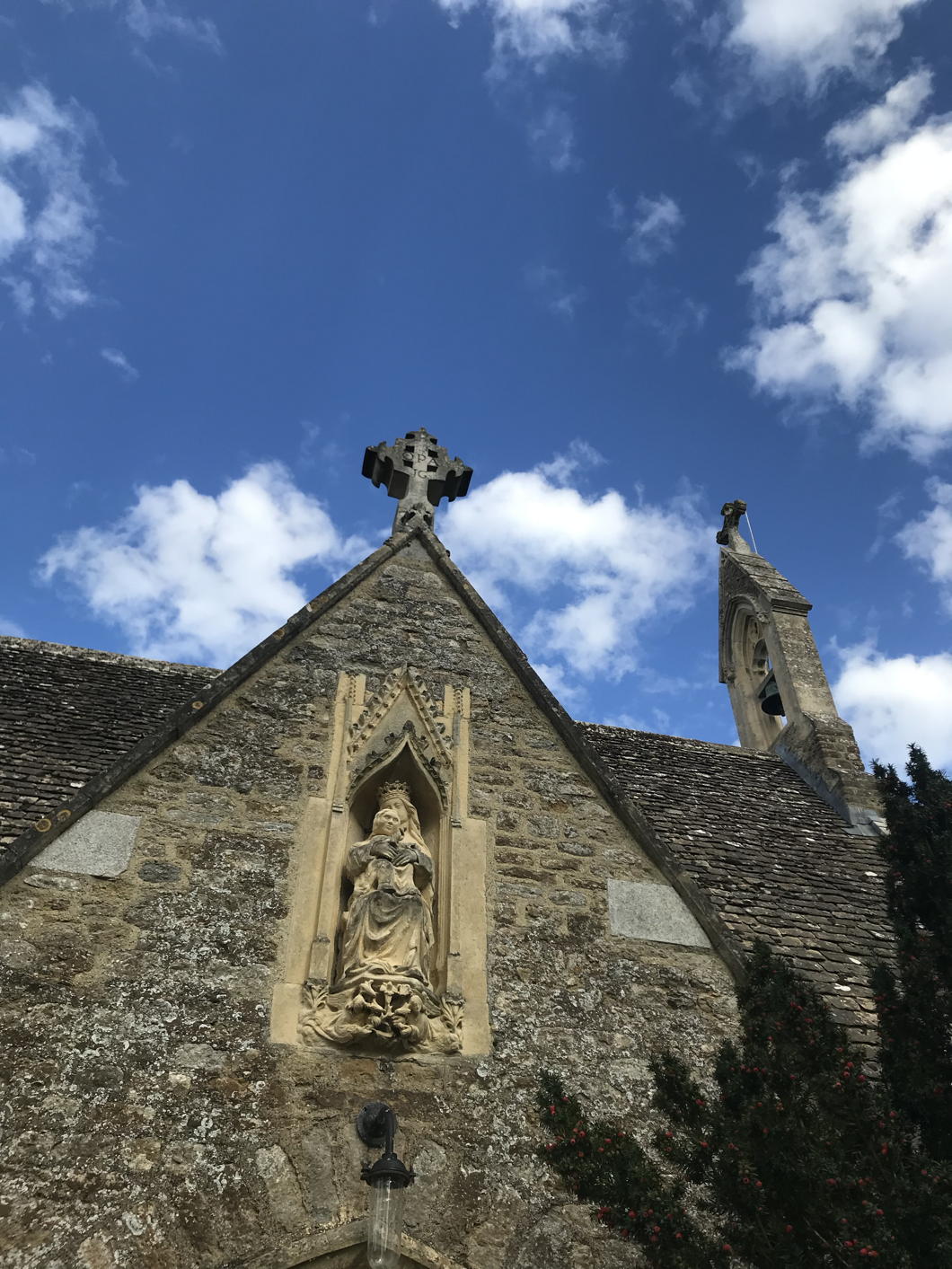
Staying with friends in Oxford a few weeks ago meant that Sunday Mass was heard at the church of St Birinus in Dorchester-on-Thames.
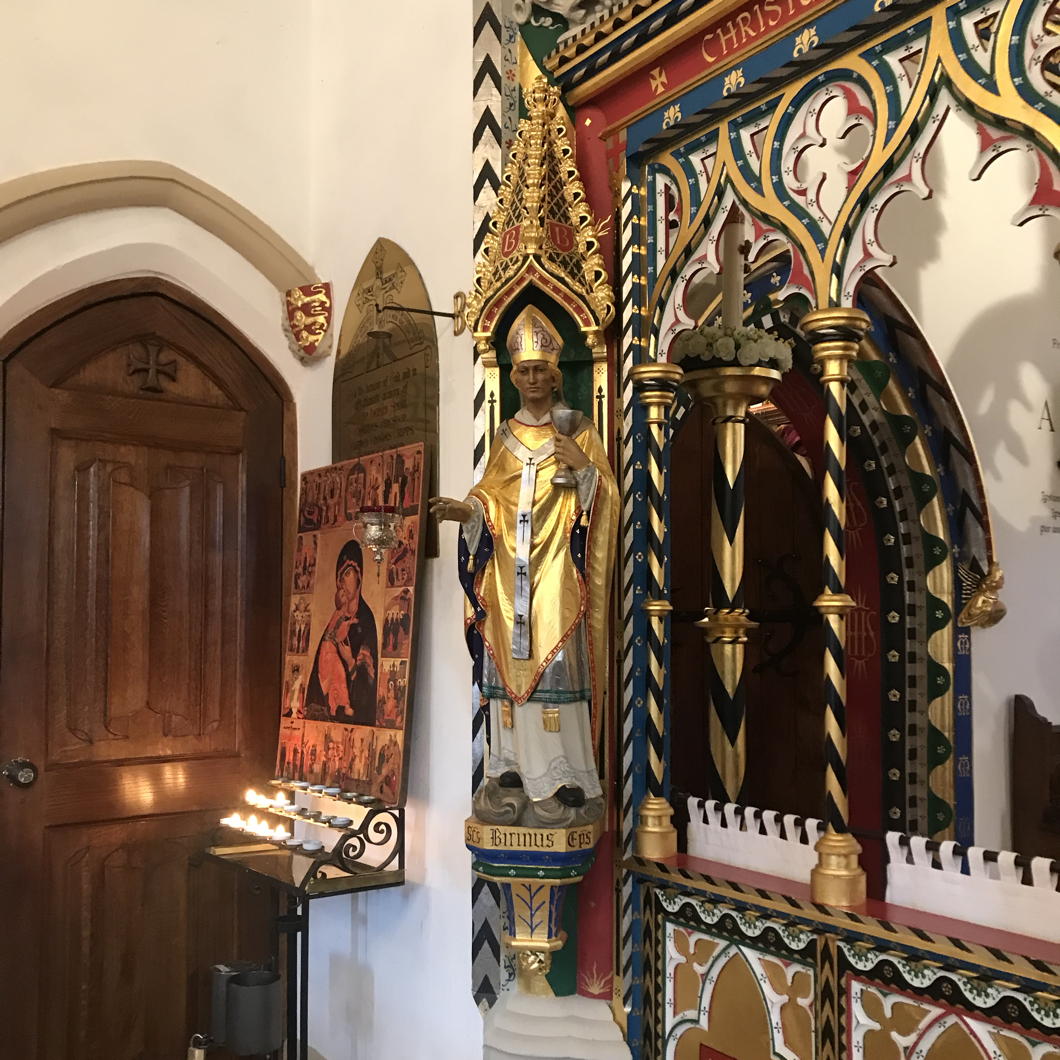
This church was built in 1849 by the local Davey family and dedicated to the priest who converted the king and people of Wessex whose relics were venerated at Dorchester Abbey.
For more than the past quarter-century St Birinus has been restored and improved by the parish priest, Fr John Osman. Mass is offered here with great reverence, and accompanied by excellent music. They are currently raising money for a new organ.
Auspiciously the architectural historian Michael Hodges wrote an article about the church in the October 2021 Catholic Herald.
St Birinus is undoubtedly one of the most beautiful village Catholic churches in all England. It is a visual feast best experienced in the flesh.
From Buda towards Pest
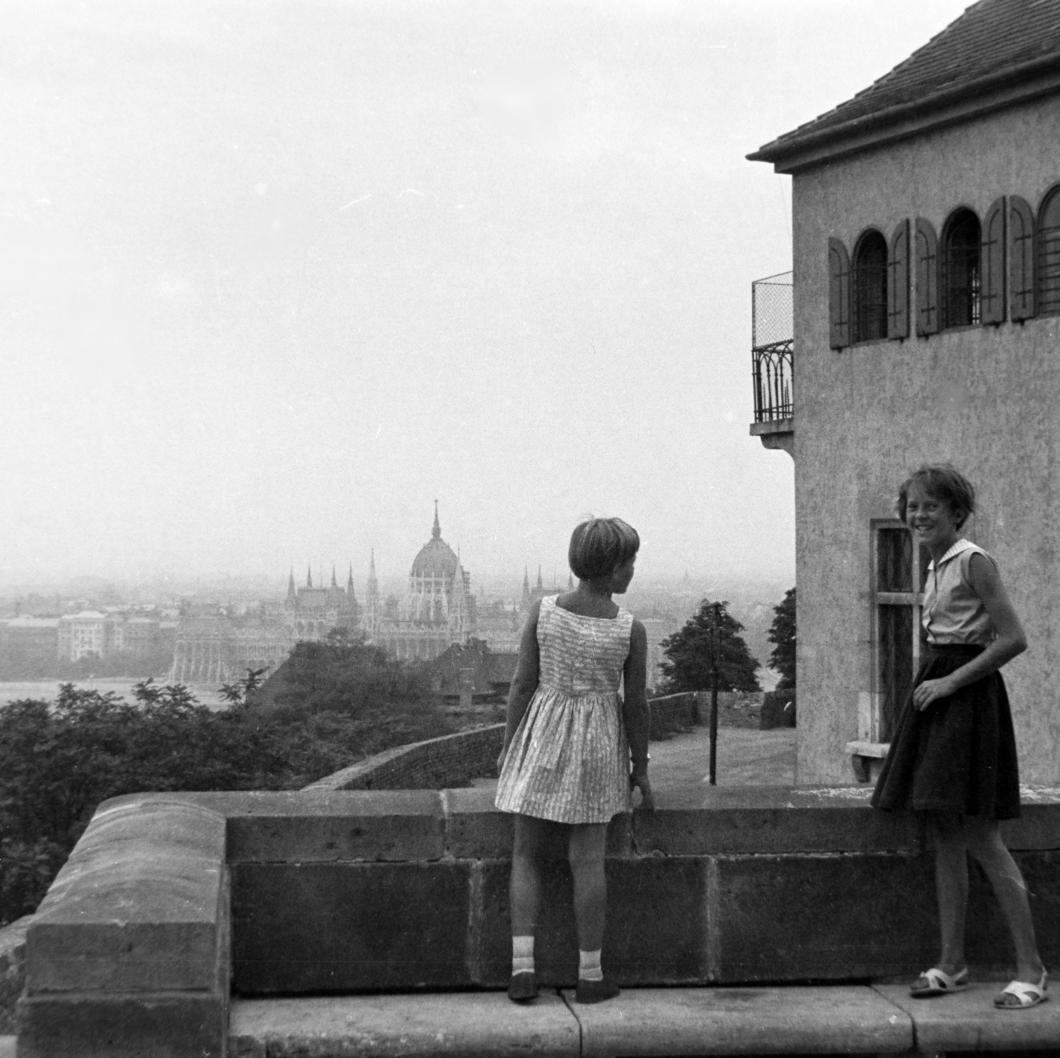
A 1959 view from the Vienna gate of Budapest’s Castle district
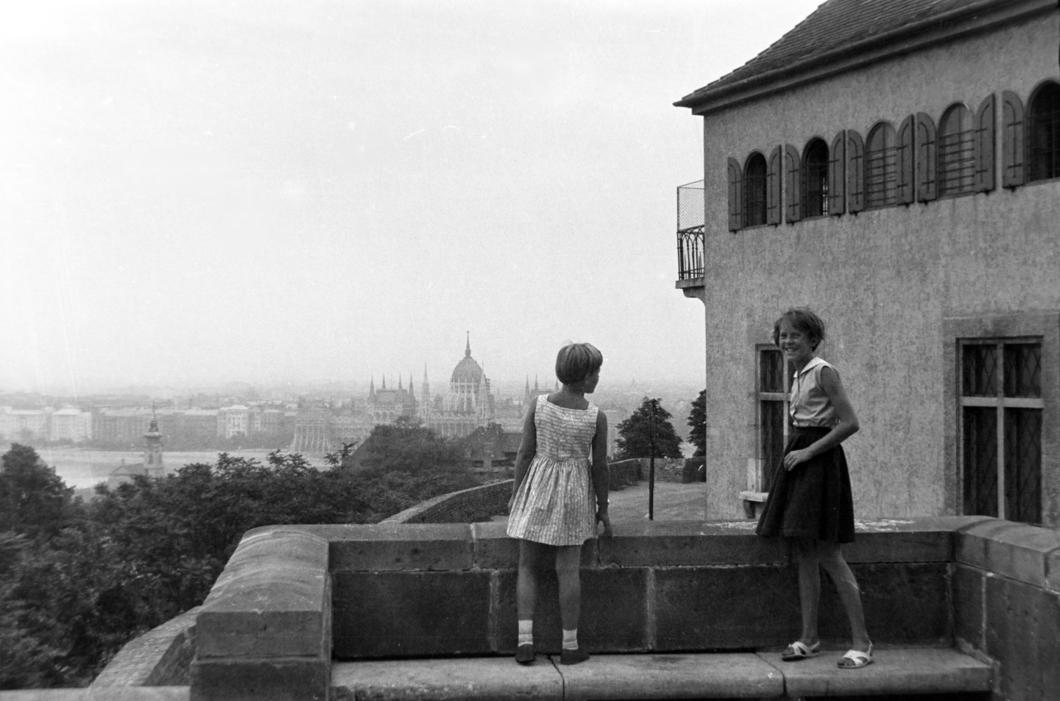
Taken in 1959, a photograph in the Fortepan archive shows two girls standing on the stone bench of the Vienna Gate — rebuilt in 1936 to mark the two-hundred-and-fiftieth anniversary of Buda’s liberation from the Ottomans.
Hungary’s domed neogothic Parliament Building sits in Pest on the opposite bank of the Danube in the distance, with the baroque spire of the Church of the Wounds of St Francis nearer on the Buda side of the river.
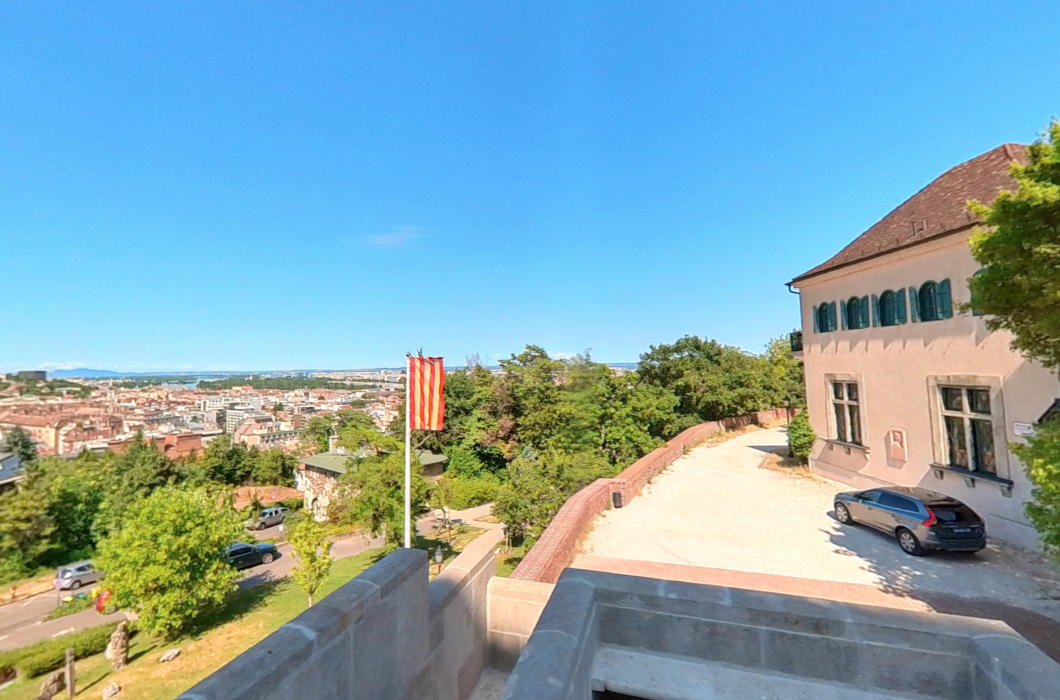
Sadly, this fine view can no longer be seen: the trees in the park below the Bastion promenade have been allowed to grow too tall. A somewhat superfluous flagpole bears the banner of Budapest’s 1st District.
The Hungarian government has invested a great deal of care and attention (not to mention investment) to the Castle quarter in recent years, so perhaps restoring this view could be added to their to-do list.
London Visitors
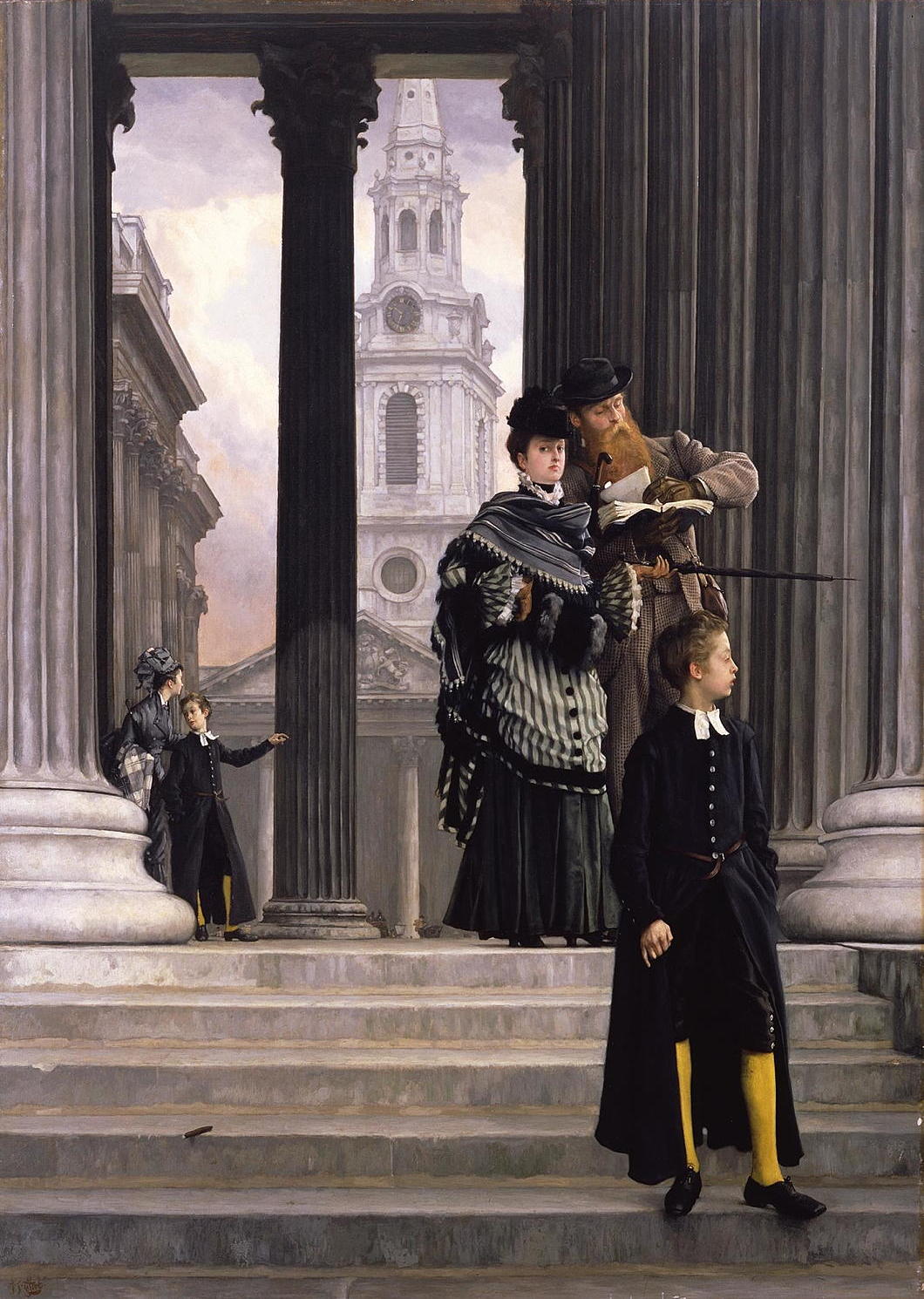
1874, oil on canvas, 63 x 45 in.
Happily, the Tudor-era uniforms are still in use there and are the hallmark of the school to this day.
The visiting couple are obviously in from the provinces, and the woman gazes daringly at the viewer.
I wonder if the cigar on the steps was left for a moment by the artist as he dashed to take this snapshot.
The threat to Bevis Marks
The Spanish & Portuguese synagogue at Bevis Marks in the City of London is well worth a visit. The last time my parents were in town we went for a tour given by an ebullient guide who was a big fan of Ben Disraeli and who taught us the story of the congregation and the building.
In Apollo magazine, Sharman Kadish has written a good summary of the ongoing threat to Bevis Marks from proposed overbearing office developments. (Dr Kadish also wrote a 2004 article on “The ‘Cathedral Synagogues’ of England” in Jewish Historical Studies.)
One planning application which would have almost completely cut off the synagogue’s natural light has been rejected but others loom on the horizon, one recommended for approval by the City’s planning czars.
London blog ‘Ian Visits’ visited Bevis Marks in 2019.
The synagogue is now temporarily closed to visitors for renovations but shabbat services continue to take place. Visiting information otherwise can be found on the congregation’s website.
Incidentally — given that November is the month of the dead — the name carved above the entrance of the synagogue is Kahal Kadosh Sha’ar ha-Shamayim, or ‘Holy Congregation of the Gates of Heaven’ which mirrors the Catholic cemetery where two of my grandparents are buried. (more…)
Yellowfin
Flying blind by seeing a play you have no idea about and haven’t read up on is obviously a game of chance, but accompanying two mates to see Marek Horn’s new play ‘Yellowfin’ at Southwark Playhouse last night was an unexpected and thoroughly enjoyable delight.
It might just be me, but if I had been told the play was about three U.S. senators interrogating a smuggler of illegal fish substances I would have turned off completely and missed this winner.
Set in the familiar but not-too-distant future, ‘Yellowfin’ is a slow-release capsule of a not-terribly-fussed world following an inexplicable ecological disaster that, as it happens, turns out to be perfectly manageable.
It takes long and confident strides veering towards nihilism without quite touching it but the real joy is its almost-titillating scepticism of the eco-reorganisationalism that is all the rage now.
If nothing else, ‘Yellowfin’ is a deeply subversive play.

Production Photos: Helen Maybanks
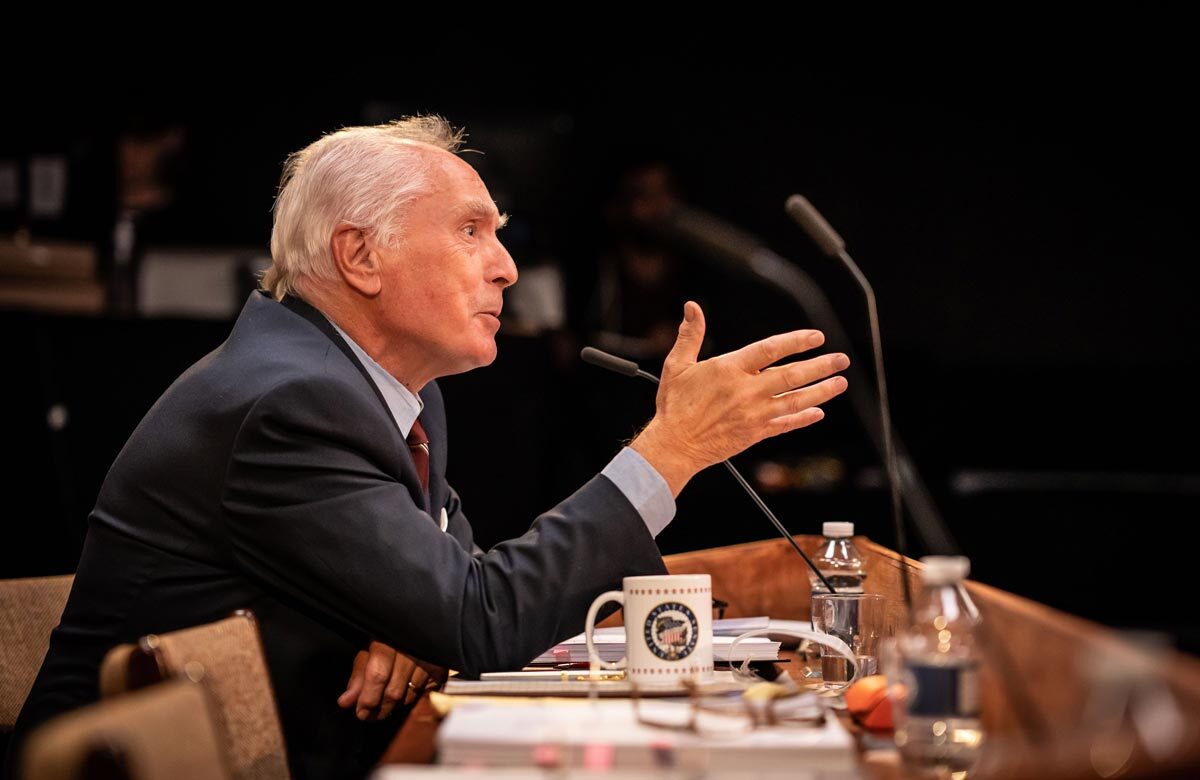
Nancy Crane masters the role of the committee chairwoman whose intelligence never quite matches her confidence. Beside her is Beruce Khan as the smug younger colleague.
Nicholas Day supplies delicious nuggets of comic relief as an elderly senator not entirely sure of his surroundings. (Parallels to the most recent U.S. Senate alum to move into the White House are tempting.)
Joshua James is the fish-smuggling object of their inquiry who breezily pops the bubble of sententious seriousness the senators attempt to bring to the matter at hand.
Good writing, well acted. Let the record show ‘Yellowfin’ is well worth it.
Production Photos: Helen Maybanks
Gut Wulfshagen
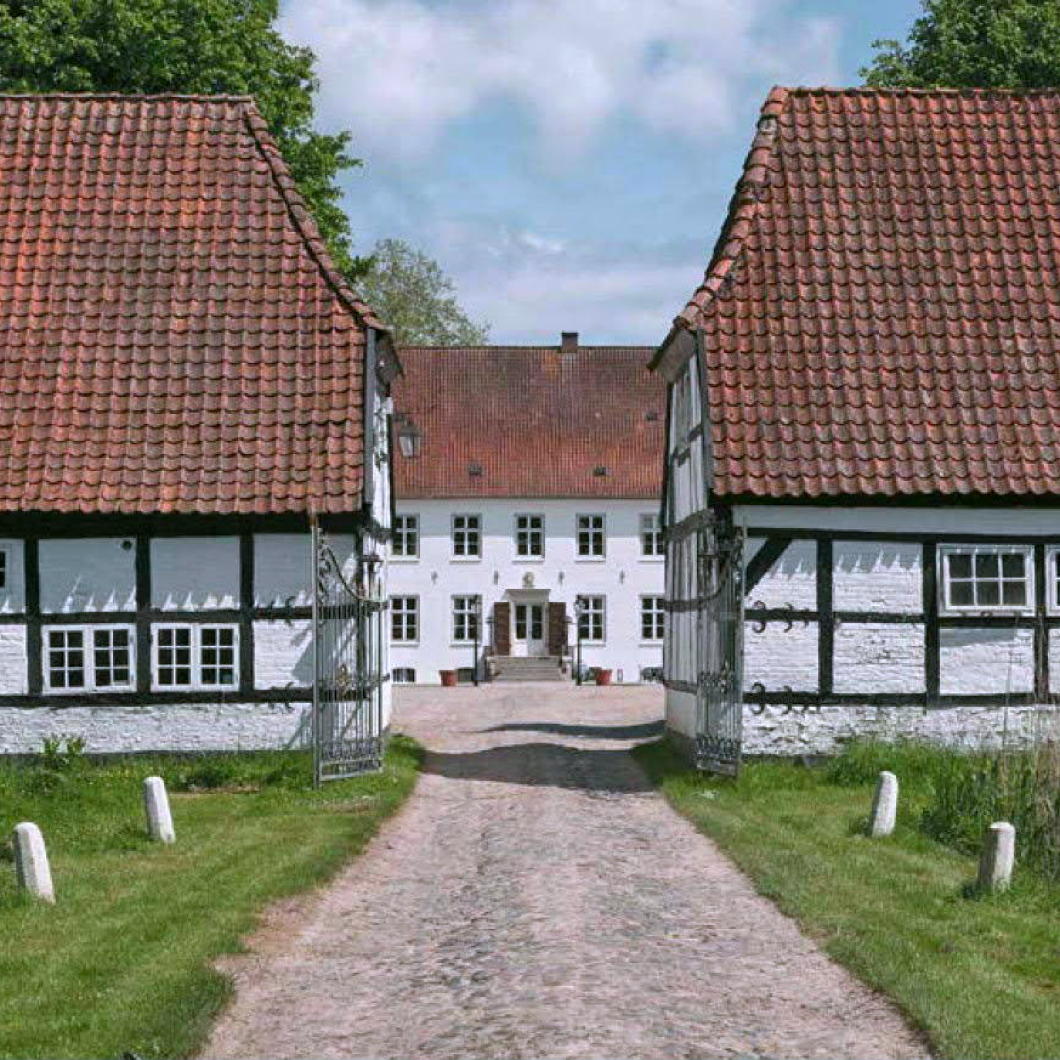
I love when a house is arranged with its farm buildings around a garth or a gaard or a hof.
At Gut Wolfshagen in Schleswig-Holstein the barns are arranged flanking a narrow pinch that gives just a hint of the manor house beyond, lending an air of baroque surprise.
This house was built by Andreas Pauli von Liliencron at the very end of the seventeenth century and was acquired by the von Qualen family in 1787.
When the last of the von Qualens here died childless in 1903 they bequeathed Gut Wulfshagen to the uxorial nephew Ludwig Graf zu Reventlow. (more…)
A Dwiggins Roundup
WE LOVE FEW things more than a talent rediscovered after decades of neglect, and in the realms of graphic design no one fits this bill better than William Addison Dwiggins (1880-1956).
This man was a type designer, calligrapher, illustrator, book designer, and commercial artist with a good eye and just the right level of whimsy.
Much of the revival of interest is thanks to Bruce Kennett and his book W. A. Dwiggins: A Life in Design which has done a great deal to spread the gospel of Dwiggins.
Here below are a series of links about the man and his work. (more…)
Northern Neogothic
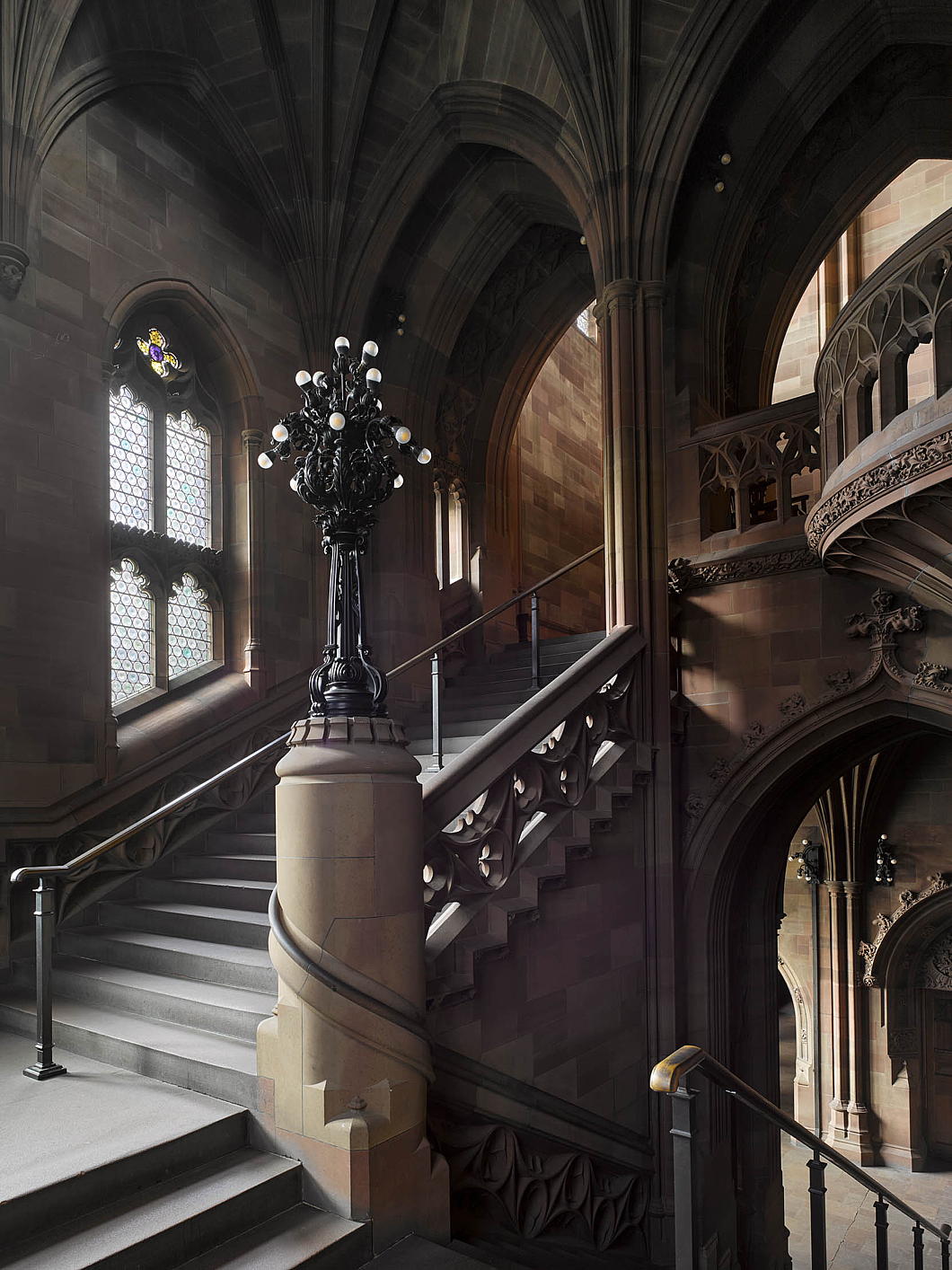
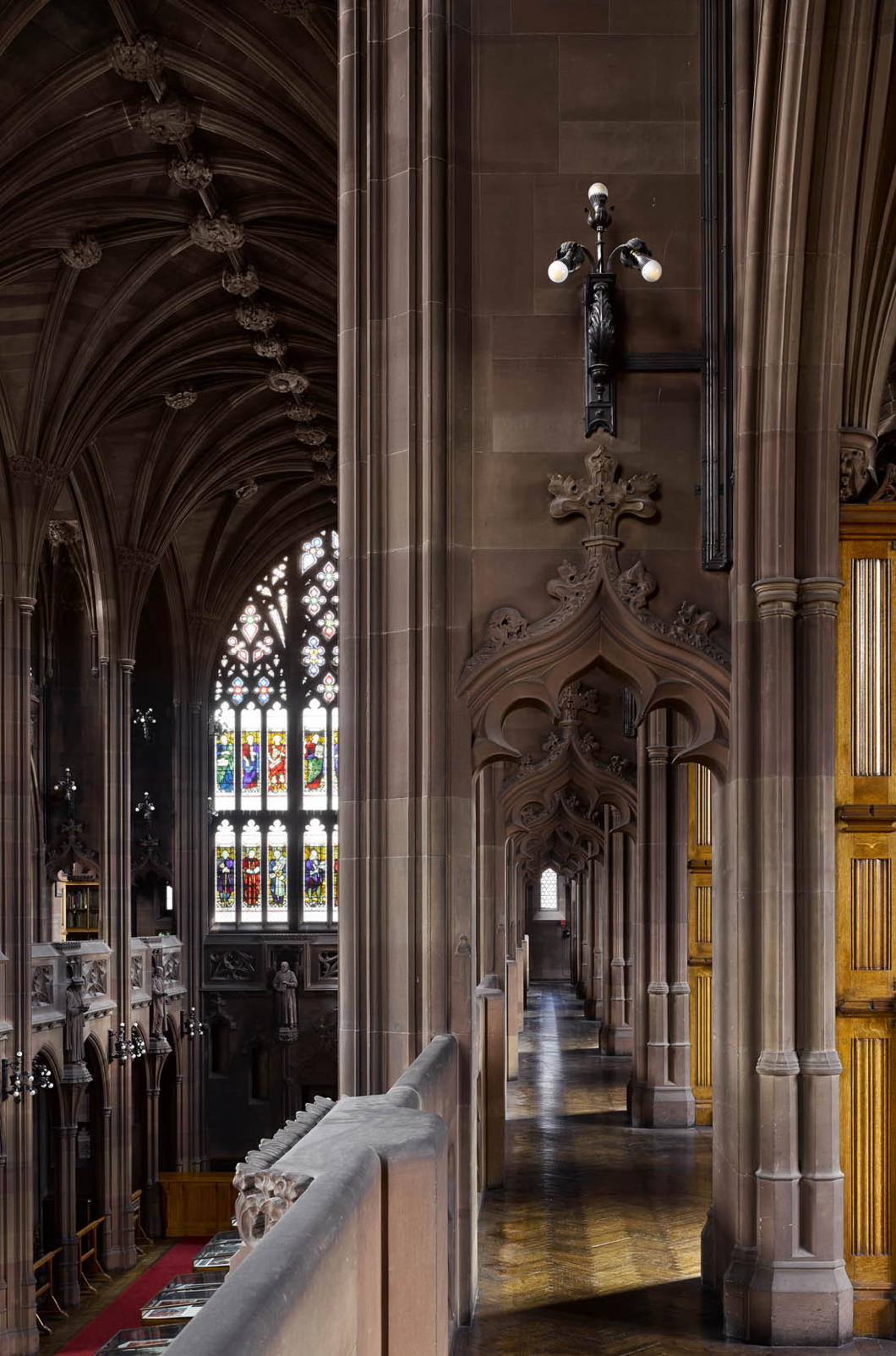
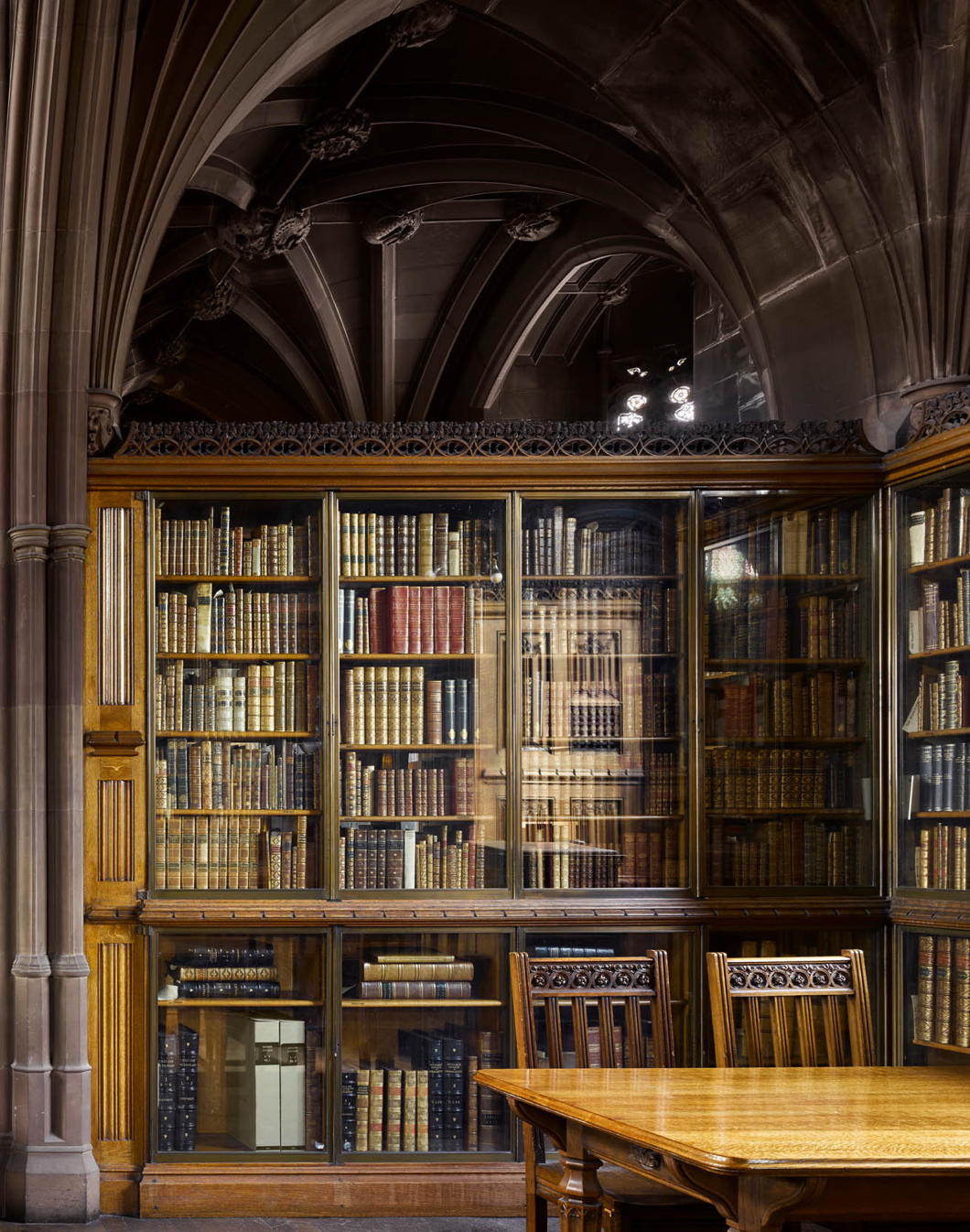
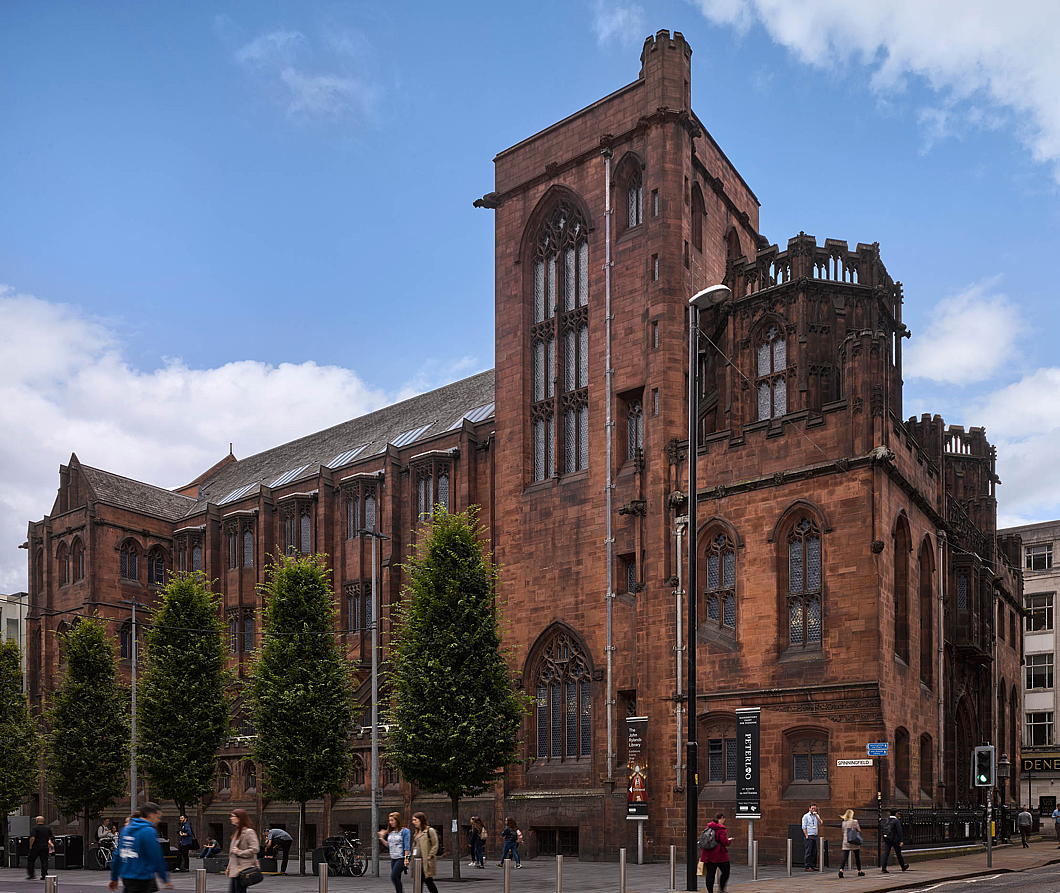
Will Pryce’s Photographs of the John Rylands Library
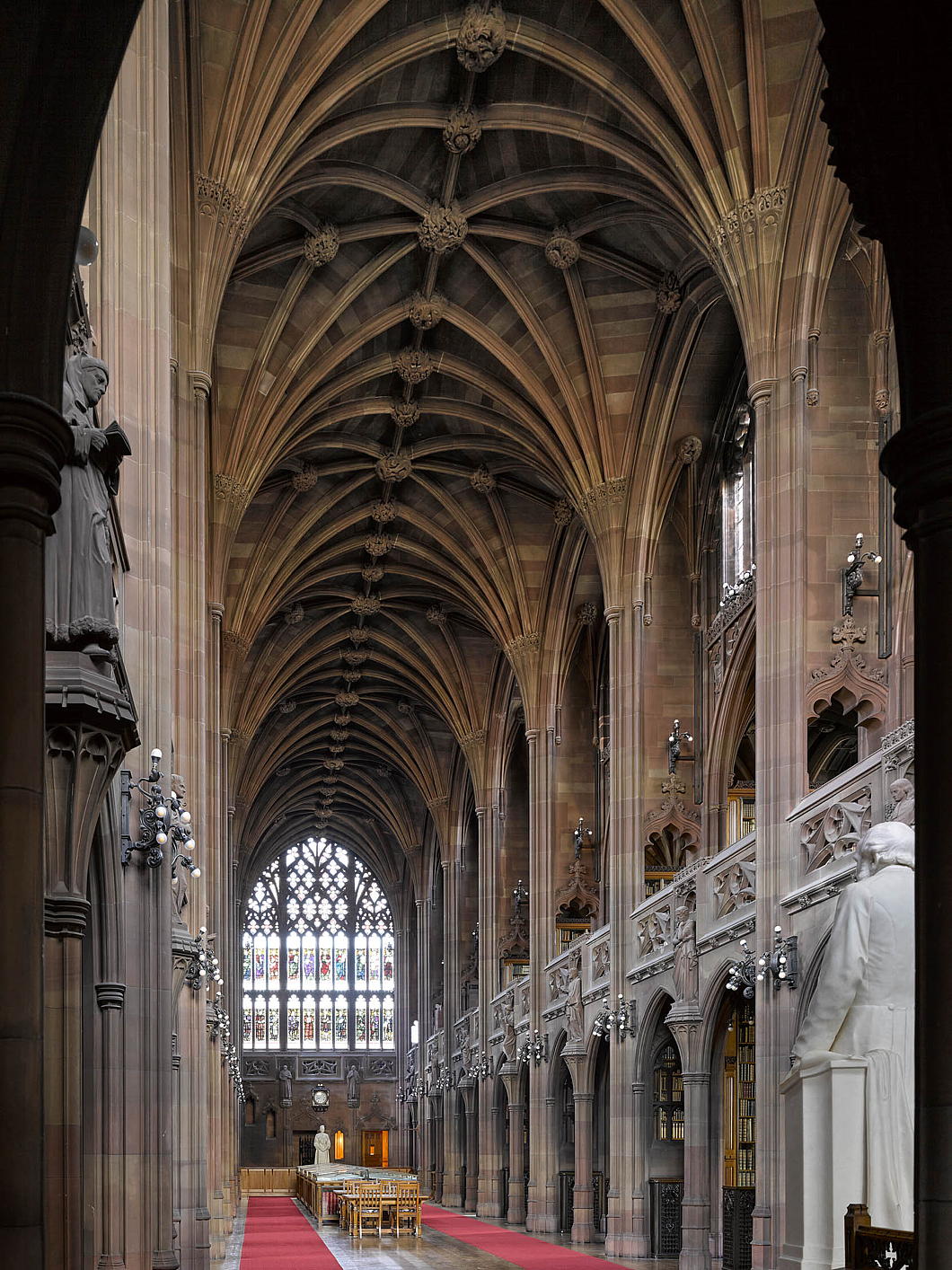
Will Pryce is one of the best architectural photographers out there and Country Life put him to good use for an article earlier this year about Manchester’s John Rylands Library.
The library was founded by the deliciously named Enriqueta Rylands in memory of her late husband, the merchant philanthropist John Rylands who became Manchester’s first multi-millionaire.
Manchester experienced a flowering of northern neogothicism in the nineteenth century, and the John Rylands Library is sometimes used as a film location standing in for Pugin’s Palace of Westminster, most recently in the 2017 film ‘Darkest Hour’. The city’s magnificent Town Hall fulfils this role even more often — c.f. the UK telly original of ‘House of Cards’. Scandalously, Manchester’s City Council no longer meet in their original council chamber, having decamped to the nonetheless handsome 1938 extension built next to it.
The John Rylands Library (and research institute) is here to stay though.
For more of Pryce’s work, see his website.
What Huxley’s Got on Orwell
Comparing dystopic visions of the English twentieth century
by ALEXANDER FRANCIS SHAW
Aldous Huxley wasn’t as good a writer as George Orwell but in several ways his Brave New World exceeds the prescience of 1984.
Huxley understood how society would respond if the laws of human ecology were to change. In a mechanised age, useless activity would become a necessity, while medical revolution and sexual deregulation in turn become the germ of totalitarianism. Orwell and just about everyone else since have had the opposite idea – that the libertines would be the liberators – and the fever-pitch of this very delusion forms the central tenet of Huxley’s dystopia.
Both visionaries describe state censorship, but in Huxley’s Brave New World one recognises eery pre-echoes of ‘Woke culture’ in an opiate-addled society which has to conceal its operational ethos from its own general consciousness in order to keep itself functioning smoothly.
With Orwell – the human struggle is represented as Man versus The State. Huxley recognised, as we are now encouraged not to, that society is the product of biology and, provided that people’s biology can be conditioned correctly, the state can foster grass-roots totalitarianism without the use violent coercion.
Neither dystopia has been fully realised – but in Orwell’s case this has been because progress has provided its own remedies (nobody could have imagined in the 1940s that telescreens would also be a conduit of private interaction for dissenters’ online discourse). One gets an unsettling feeling that Huxley’s medical dystopia is still developing in 2021 with no solutions in sight.
Rather than solve the riddle of human happiness, the citizens of Brave New World condemn those who fail to gloss over their displeasure with life through the mollifying comforts of sex and tranquillisers. Science becomes a branch of pragmatism, wielded by social engineers who can no more observe their own fields than look at their own eyeballs.
We are left with the question of how an outsider, possessed of higher directives than his own hedonism, might react to such a society?
Huxley answers this by introducing a Linda and her son, John, who live in a ‘savage reservation’ where medical advances have not been imposed. Traditional sexual morality is thus observed by the occupants along with – shudder! – family life and religious practices and other pursuits which lend meaning to their backward lives.
Linda arrived in the reservation by accident, having been born and acculturated in the ‘civilised world.’ She teaches her son how to read, but brings them both into disgrace with her promiscuity, so that John retreats into the comforts of a book which happens to be ‘The Complete Works of William Shakespeare.’ In Shakespeare, John finds the words that enable him to assert himself both on the reservation and – to the curiosity of his minders – when he finally returns to civilisation.
I sense that Orwell would have furnished John with a lowlier reference-point to human nobility and driven the same points home more poignantly with a dog-eared copy of Paris Match. But, as I said, Huxley was a better visionary than he was a wordsmith.
Once in the ‘civilised world’ John falls in love and faces a problem which, less than a century after Huxley’s work was published, defines what is perceived as a ‘crisis of masculinity’: how to court a woman who gives herself out to dozens of men regardless of merit. Unable to disabuse himself of his chivalric values – and unwilling to accept her worthless sexuality when she freely offers herself to him – John becomes what we would now call a proto-“incel” and dies, as the carnal realists of the toxic chatrooms might anticipate, on the end of a rope.
Smokescreens of happiness and delusion are maintained with a tranquilliser called Soma. Much as anti-depressants are a major feature of modernity – their use strongly suggesting that they are employed where artificial economies and casual sex are normalised – one senses that we have not yet perfected the Brave New World’s capacity for total bafflement. Nor has any welfare state or medical advancement completely collectivised the process of raising children.
This tranquillised social order is upheld by World Controller Mustapha Mond, Huxley’s benign analogue to Orwell’s Big Brother and on that account one of the few people in this dystopia who has achieved any kind of true satisfaction himself. Mond’s discourses bring Huxley to the place of scientific observation in the stable technological order:
‘once you start admitting explanations in terms of purpose – well, you don’t know what the result might be…’
In other words: Heaven forbid anyone should question the dogmas of settled science.
In terms of who may be allowed to see through the delusion, Mond likens the social hierarchy to an iceberg – with 10 per cent above the surface and 90 per cent below. Maverick, enquiring minds must either be sent to isolated communities or – like himself – shoulder the burden of everyone else’s delusion.
Despite Orwell’s predictions of people cowering under state tyranny and violence, Huxley’s work remains the creepier for its ability to get under the skin of the liberal society that we find familiar.
How much worse is it to read of a dystopia in which, by our own liberated will, we are complicit?
Search
Instagram: @andcusack
Click here for my Instagram photos.Most Recent Posts
- Brunel’s Unbuilt Capitol February 3, 2026
- Cricket at Fordham January 27, 2026
- Palacio Barolo Revisted January 14, 2026
- Learning to Love Liguria January 14, 2026
- Crux Alba No. 2 January 13, 2026
Most Recent Comments
Book Wishlist
Monthly Archives
Categories