Arts & Culture
About Andrew Cusack
 Writer, web designer, etc.; born in New York; educated in Argentina, Scotland, and South Africa; now based in London.
 read more
News
Blogs
Reviews & Periodicals
Arts & Design
World
France
Mitteleuropa
Knickerbockers
Argentina
The Levant
Africa
Cape of Good Hope
Netherlands
Scandinavia
Québec
India
Muscovy
Germany
Academica
The Greatest Building Never Built

LUTYENS’ SCHEME FOR the Metropolitan Cathedral of Christ the King, Liverpool is oft hailed as the greatest building to never have been built. Strictly speaking, this is not accurate, as the building was structurally finished, although not completely decorated, up to the crypt level. Nonetheless, had it been finished, the cathedral almost certainly would have been considered Sir Edwin Lutyens’ greatest work; though his hand (with Herbert Baker) in building the Indian capital of New Delhi, including the monumental Viceregal Palace, would certainly vie for the title. (more…)
A Morning’s Journey
I crossed the Harlem River into Manhattan today just as Patrick Leigh Fermor traversed the Danube in his brilliant book, A Time of Gifts, which has immediately become one of my favorite reads of all time. Settling into my seat on the train yesterday, I opened my knapsack to utter shock and surprise—I had left my reading at home. The Leigh Fermor and P.G.W.’s Cocktail Time were resting somewhere in my bedchamber while I stared into the compartment of my bag, bare but for a photocopied page from the Art Newspaper and two (already-read) issues of the Hungarian Quarterly. These are the times that try men’s souls. Getting out of the city late in the evening proved even harder, as the bridge carrying the railway over the river was actually up for once (“First time in my life, folks,” the conductor informed us), leaving a steady backlog of trains awaiting their northerly destinations.
But this morning there were no bridge-raising complications, and the sky was a delightful, clear blue (soon to change) as we entered Manhattan. Thankfully, I had my two books; a bit of Wodehouse while waiting in Bronxville station and then Paddy Leigh Fermor on the train. After crossing the river, the train stops at 125th Street (Harlem) before submerging at 96th, taking the passenger down to Grand Central, that well-kept remnant on 42nd Street, reminding us that we too were once civilized. There, after taking a stroll through the market (Nürnburger sausage! Kaiser ham! Norwegian salmon!) you switch to the subway and hop down just one express stop on the 5 train.
Just half a dozen steps after emerging from Union Square station I saw a speck of white fall from the sky, and then another, and another. So it began: the first snowfall of the year. And, I might add, a New York record for the latest snowfall. (January 10th? No, there was no white Christmas for us this year). Two children on the swings in the playground ecstatically proclaimed their approval at the opening of the heavens. Wandering through the farmer’s market in the square, I picked up an herb focaccia bread I thought might be particularly enjoyable, and it complimented the exceptionally tasty Tuscan vegetable soup I had for lunch. The snowflakes swirled above the square and fell down on all the market-goers and the folks walking on Broadway as I marched up to work. And yet, how fleeting! In the few steps from the front door to the elevator, the white snow had already melted and merged into the green of my loden coat. Very well, Mother Nature. Very well.
Argentina’s Henley
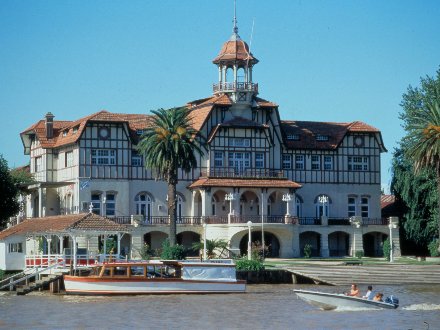
JUST NORTH OF Buenos Aires lies the city of Tigre. The city sits on the southern edge of the series of rivers, rivulets, islands, and eyots collectively known as the Parana Delta, after the Rio Parana which breaks up as it reachs the Rio de la Plata. The town’s riparian geography combined with its closeness to Buenos Aires—a mere twenty miles from the Obelisco—make Tigre a popular weekend and summertime getaway. Since the 1870s, however, it has also been the birthplace and focal point of rowing in the country—Argentina’s Henley. (more…)
Christmas
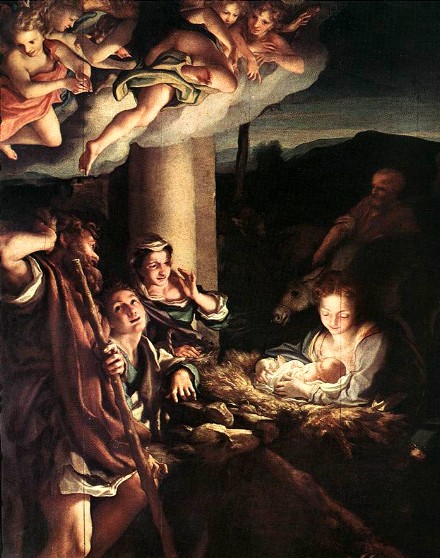
Corregio, Nativity
Oil on canvas, 101″ x 74″
1528-30, Gemäldegalerie, Dresden
Who with His life, the world to save,
All honor, power, glory, Thine,
and in Thy Heart our souls do bind.
a very merry and blessed Christmas.
Christmas Book List
Mr. and Mrs. Peperium over at Patum Peperium asked a few of their genial friends to come up with a Christmas book list, and we were more than happy to oblige. Interestingly enough, the only overlap was Guy Stair Sainty’s giant two-volume opus, which was both on my list and on Fr. M.’s list. I have reproduced my list below for your perusal.
 Well, first up, the books you can’t even get yet, not because they’re out of print but, rather, because they’re not exactly in print yet.
The Dangerous Book for Boys by Conn and Hal Iggulden has proved a roaring success amongst discriminating readers in the British Isles. The nifty book is basically a handbook for life, describing in detail how to win at conkers and learn the rules of cricket as well as providing information about major battles of history, NATO’s phonetic alphabet, the golden age of piracy, and that trickiest of all subjects:girls. The book’s out in Britain, Australia, and New Zealand, we North Americans will have to wait until May of next year.
Another book the Brits have already is Michael Burleigh’s Sacred Causes: The Clash of Religion and Politics from the Great War to the War on Terror, the sequel to Burleigh’s brilliant Earthly Powers: The Clash of Religion and Politics in Europe from the French Revolution to the Great War. In the first book, Burleigh brilliantly outlined the “long nineteenth century” as historians call it, depicting in detail the interplay between faith, reason, and power on the Mother Continent. Sacred Causes promises to bring us from the First World War all the way to the current so-called “War on Terror”, and we expect it will be done with the same precise, detailed, though occasionally light-hearted spirit which Burleigh has mastered. The book will be available on these verdant shores from March of next year.
While we’re traveling across the Atlantic, why not explore the British roots of our American society? In America’s British Culture, the late great Russell Kirk explores the Britannic foundations of the core of American culture and civilization. The book’s probably out of print, but can nonetheless be found here and there, and if not to purchase then there’s always the local library to try.
Far more perilous than a voyage cross the Atlantic is that most worrisome, tiresome, and pedantic of journeys: crossing the channel. To Belgium, or perhaps we should say “Belgium”, for after reading Flemish patriot Paul Belien’s A Throne in Brussels: Britain, the Saxe-Coburgs and the Belgianisation of Europe you will find the mere concept of “Belgium” repugnant. I picked up a copy of A Throne in Brussels and decided to give it a whirl despite finding the book’s title mostly uninteresting. After reading it, I also found the subtitle a little misleading. What Belien actually gives us is an overview of the history of “Belgium” which is both succinct and thorough, mostly focusing on the Belgian monarchy and its deep influence on the formation of this “nation” half-French and half-Dutch. It makes for a fascinating read of disgrace and debauchery as we’re told of the disgusting actions of, firstly the various kings of Belgium from the creation of the country ex nihilo in 1830, and then of astonishing Belgian cowardice and collaboration in the First and Second World Wars. However all this pales in comparison to the most telling, and the most disturbing, part of the book which tells us about modern, post-war Belgium. I will not reveal it’s contents but is truly, truly frightening. The point Belien posits as the crux of the book is this: I’ve told you about Belgium. Recall that the Eurocrats and their enthusiasts extol Belgium as the model for European unity; a single state in which communities of different blood and language live together in supposed harmony. If what I’ve written is true, then be afraid: be very afraid. And you will be.
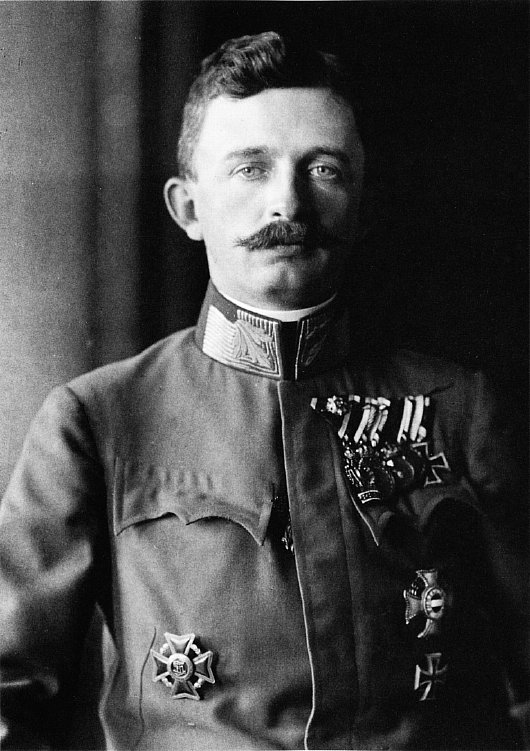
Moving across the Continent, we stumble upon dear old darling Austria. The late Gordon Brook Shepherd was a devoted admirer of the Austrian people and nation, and this is exhibited in a number of the fine, well-crafted books he wrote. The Last Hapsburg is a very good biography of the Blessed Emperor Charles of Austria-Hungary, the last to rule over that many-peopled realm. It reads as a chronicle of simultaneous hope and decline, and the chapters detailing the Emperor’s two attempts to regain his Hungarian throne are action-packed and read like a spy thriller. Prelude to Infamy, meanwhile, deals with that last great figure of Austrian tradition and reaction, Chancellor Engelbert Dollfuss. Brook Shepherd gives a splendid overview of Dollfuss’s early life and upbringing, his rise to power, and his eventual downfall at the hands of Hitler’s henchmen. Both these books are well worth reading, but I am also intrigued by the title alone of Brook Shepherd’s biography Between Two Flags: The Life of Baron Sir Rudolf von Slatin Pasha, GCVO, KCMG, CB, on which I have not yet been able to lay my hands.
Travelling deep within Europa’s belly are Patrick Leigh Fermor’s chronicles of his journey through Ruritania at the young age of twenty-two in the period between the wars when a great deal of the old order still remained. This meandering tramping trip, from London to Constantinople, is retold to us in Sir Patrick’s A Time of Gifts, considered a classic in the travel genre, and Between the Woods and the Water.
On his journey, Fermor came across a number of Europe’s aristocrats, nobility, and titled gentry. No doubt many-well, all really-of the honours and orders which bedecked their chests can be found in Guy Stair Sainty’s brand spanking new World Orders of Knighthood & Merit, out this year from Burke’s Peerage. The two volumes weigh in at twenty pounds imperial, containing two thousand pages and yours for a mere $375.
Cheaper, smaller, and infinitely more full of vim and moxie, however, is the delightful little picture book Simple Heraldry Cheerfully Illustrated by Sir Iain Moncrieffe of That Ilk, with truly cheerful illustrations by Don Pottinger. Both Moncreiffe and Pottinger served Her Majesty in the Court of Lord Lyon, Scotland’s heraldic authority, and the book is chock-full of delightful little explanations of the various aspects of heraldry, simplified and in digestible form.
But rememeber man that thou art dust and unto dust thou shalt return. If you’re lucky, that dust will be guarding the covers of the splendid Very Best of the Daily Telegraph’s Books of Obituaries which contains myriad tales of those individuals whose lives have been compacted onto the obituary page of Great Britain’s quality daily. Even more interesting is the more specific Daily Telegraph Book of Military Obituaries, containing various anecdotes of mess, ball, parade ground, and battlefield. How sad are the days when the only place one reads of class, dignity, and wit are the obituary pages! Or, as a friend puts it rather more alarmingly: every day more and more war veterans die off, while more and more products of government schools are unleashed into the world.
Yet our end ought to be a cheerful one, so catch up with that Grand Old Man who has since gone to join the Choir Invisible. The brilliant writings of Peter Simple are collected in a number of different volumes, most notably Peter Simple’s Century, which I warmly encourage the reader to purchase at the nearest opportunity. Better yet, make it two and forward one to me.

The Vicar’s Remorse
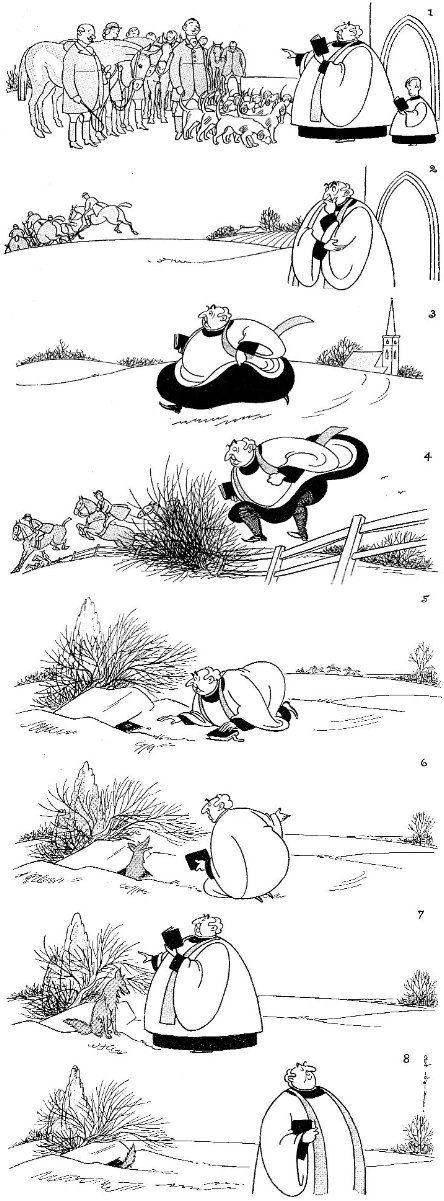
Previously: New York in November | The New Yorker Hunts | Tally Ho, Empire State!
Governors Island Revisited
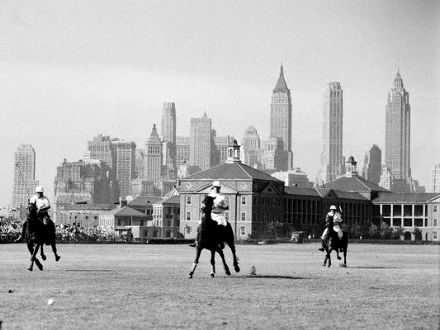
EVERY ONE OF THE myriad plans put forth for the ‘redevelopment’ of the venerable old Governors Island in New York Harbor has so far either stalled, been neglected, or otherwise poo-pooed. In this, we have something to rejoice. As I have often said, realistically speaking there is little that can be done to it which will not neglect or disgrace the island’s long military heritage. The officially-approved ideas put forth so far have been horrific: an amusement park, a casino, a ‘technology park’, as well as a number of other vapid proposals.
Naturally, we’d be enthused if it returned to its former role as swankiest post in the entire Army and the home of Army polo, but don’t hold your breath. West Point being the single exception, if it has even a touch of history, tradition, or class, Congress and the Department of Defense will do their best to get rid of it. After all, the National Guard has been pulled out of the Seventh Regiment Armory, the Navy has withdrawn all but a few institutions from Newport, and the Army has left the ancient Presidio of San Francisco; how long will it be until Fort Leavenworth’s foxhounds are brought out back and shot by the Monotony Monitors? (more…)
Peter Simple IV
Affairs of state bother us often, and they even intrude into the mind of such worthies as that grand old man, Peter Simple. These two columns, the fourth in our series attempting to introduce you to the most brilliant columnist who ever was, deal with precisely such subjects: one foreign, and one domestic. The first was written in 2002, as Paddy Ashdown, the former leader of the Liberal Democrats (ennobled as Baron Ashdown of Norton-sub-Hamdon) was appointed to the post of ‘High Representative for Bosnia and Herzegovina’, a sort-of viceroyship created by the United Nations to keep an eye on wayward Balkan peoples. In ‘Glory’, Mr. Simple reflects upon the prospect. Reprinted below that is another example of ‘What the Papers Say’, in which, speaking through the editorial pages of the Feudal Times and Reactionary Herald, Peter Simple implores us to take a serious look at House of Lords reform. As per usual, his proposals are right on target.
Glory
 THEY say that Paddy Ashdown, the great Liberal leader, is to be given high office in Bosnia, as governor, no less. It will not be long, we monarchists all hope, before he is offered the crown and ascends the throne of Bosnia as King Paddy the First. The last king of Bosnia, Steven VII Tomasevic, surrendered to the Turks and was beheaded in 1463. But times have changed, and this should not necessarily be a precedent.
Approached by a joint delegation of the Serb, Croat and Muslim communities, he will at first pretend to put the crown aside, then yield to their urgent pleas. How glorious, when in Sarajevo, at a ceremony with specially devised ecumenical rites (Catholic, Greek Orthodox, Muslim, Methodist, agnostic, humanist, Salvation Army), the Secretary-General of the United Nations, Kofi Annan himself, places the crown on his head.
Loud the people’s acclamations, loud the pealing organs and massed choirs with all the bells of Sarajevo ringing out as leaders of the three communities swear allegiance! Later, he inspects a guard of honour of the happily named Nato Dissuasion Force, then tours the city.
His piercing blue eyes, screwed up with almost intolerable sincerity, scan the remotest forests and reactionary mountains for signs of emerging liberalism. Peasants in their picturesque costumes have trooped in from the countryside, bearing traditional gifts: ornamental daggers, pots of honey, embroidered shawls, clotted cream and new-laid eggs.
Folk songs mingle with the strains of “He’s A Jolly Good Fellow”, “Follow The Van” and (an allusion to the new monarch’s Irish ancestry) “If You’re Irish, Come Into The Parlour”. Helicopter gunships and squadrons of fighter aircraft fly past as the King chats easily to his people. They laugh heartily at well-chosen anecdotes of his time as Liberal leader. Distant explosions mark pockets of resistance, to be mopped up by the Bosnian army. He orders the search for “war criminals” – slab-faced Mladic and tousle-headed Karadzic – to be intensified.
As night falls, dense fumes of slivovitz hang over the sleeping city. A sound of massed snoring comes from the Royal Palace, where King Paddy sits at ease, regaling his courtiers with extracts from his Liberal party conference speeches and statements of liberal ideals: the need for dialogue and for a determined but carefully considered step forward into the future.
What the Papers Say
In a thoughtful leader, the Feudal Times and Reactionary Herald discusses reform of the House of Lords: “Since the arbitrary and unlawful expulsion of most hereditary peers from the Lords, those of our readers who lost their seats, as well as those few who retain them, may be inclined to regard any further suggestions for ‘reform’ with indifference and contempt.
“Debates on this subject both in the Lords itself and in the Commons may indeed have exhibited a level of inanity unusual even for those sadly degenerate bodies. Yet their very persistence in ignoring the real issues should only strengthen our own determination to confront them.
“In a recent debate, some speakers favoured an Upper House entirely elected; some an Upper House entirely appointed; some a mixture of elected and appointed members. Others, typical adherents of the foaming radical and contumelious schoolteacher tendency, wanted to abolish the Upper House altogether.
“Not one single speaker in either house suggested that the best measure of ‘reform’ would be to scrap the present hybrid assembly, including those chimerical figures, the so-called ‘life peers’, and, by retaining the remaining 92 peers and bringing back the 600 so outrageously expelled, restore the House of Lords which existed so satisfactorily for hundreds of years.
“We believe that a firm, uncompromising assertion of the hereditary principle would not only dispose of further futile argument but would be greeted with relief and enthusiasm by the still sound majority of English people, who, we dare aver, remain true in their hearts to the old beliefs which made our country great, and our Parliament the wonder and envy of the world.”
A New Hall in the Classical Style
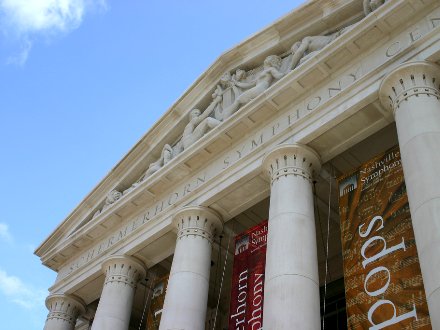
The Nashville Symphony recently built an entirely new concert hall named the Schermerhorn Symphony Center. While we decry ‘centers’—what’s wrong with a ‘hall’?—the name does hold some significance for us, because Schermerhorn is, of course, an old New York name. The Schermerhorns were one of the first families of New York and there are numerous places and things named after them throughout the city and state. This concert hall bears the name in honor of Kenneth Schermerhorn, born in the traditional Schermerhorn stomping ground of Schenectady, New York, and conductor of the Nashville Symphony from 1983 until his death in 2005. He had also previously conducted (during his military service in Germany) the symphony orchestra of the U.S. Seventhy Army and later the Milwaukee Symphony Orchestra, as well as serving as music director to the Hong Kong Symphony Orchestra and the American Ballet Theatre.

The new concert hall is built in an admirably traditional style, though if you look closely enough here and there you can see the craftsmanship still wasn’t quite up to snuff. Still, a step in the right direction, needless to say, and we decided to show you some photos for your general edification.
(more…)
An Evening at the Old Whitney
TO THE OLD Whitney Museum down on 8th Street, now home to the New York Studio School, which held a panel discussion to mark the twenty-fifth anniversary of the New Criterion. An interesting chat between Hilton Kramer, who left the New York Times to found the magazine in 1982, Karen Wilkin, one of our regular art critics, and James Panero, managing editor and art critic, all moderated by Michael J. Lewis of Williams College. The panel discussion covered myriad subjects related to art, from art criticism to the impossibility of an avant-garde in today’s culture of anything-goes to whether the New Criterion‘s ‘view’ of art can be considered part of any particular school of thought. Hilton had some particularly choice moments.
The building is a particularly nebulous one with many strange nooks and crannies, which can perhaps be explained by the fact that it is actually four townhouses gradually combined over a period of time. The Whitney Museum of American Art, of course, was founded in the 1930s by Gertrude Vanderbilt Whitney and was housed in these merged townhouses until moving to the specially-designed home at Madison and 75th in 1966 — widely agreed to be the ugliest building on the entire Upper East Side.
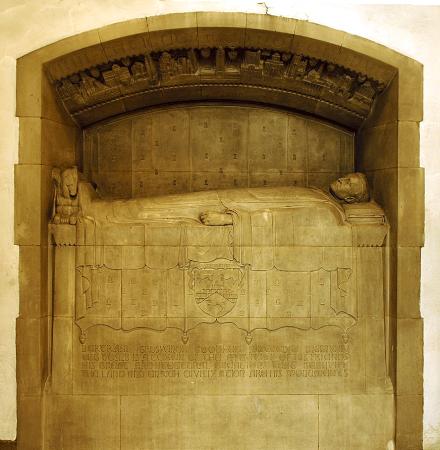
Among the nooks and crannies previously mentioned, Gertrude Vanderbilt Whitney’s former studio in the old mews building provided an excellent location for the dinner held afterwards, to which the participants, organizers, and a number of hangers-on (including yours truly) were invited. I sat between Gabbe, the New Criterion‘s former Editorial Assistant now working for the Studio School, and Joseph, an art student from outside Canterbury in Kent whose grandmother and grandfather both taught at the Studio School. Joseph and I discussed the beauty of the Somerset countryside, and I confessed I’d buy a cottage and move there in a second were it possible. The inimitable David Yezzi sat across the table and guided much of the conversation on our leg of the three tables, which had been arranged in a U-formation. A little later, I chatted with the artist seated to Gabbe’s left, who had been born in Latvia, with childhood spent in Baghdad, Italy, and England, before settling down in New York at the age of seven. We discussed the glories of Eastern Europe and the linguistic intricacies thereof. During dessert, however, I got on to architecture with the amiable Michael J. Lewis. I sung the praises of Audubon Terrace, one of my favorite spaces in all New York, which he (a Philadelphian) had only stumbled upon for the first time a month ago, and also of the nearby sculpted tomb of Bertram Grosvenor Goodhue, the greatest of all American architects.
Time waits for no man, however, and I managed to catch a late train back home from Grand Central. Alighting at Bronxville, I walked through the misty streets where the spherical streetlamps cast an eerie glow against the limestone façades of the shops. Home before midnight, and time for rest. Tommorrow, aside from being the feast of Saint Andrew, is Stefan Beck’s last day at the New Criterion. Needless to say, commemorative festivities are in order, and an alcoholic concoction known as ‘batch’ is to be brewed. It will not, I imagine, be for the faint of heart.
Elsewhere, the Austrian navy is no more.
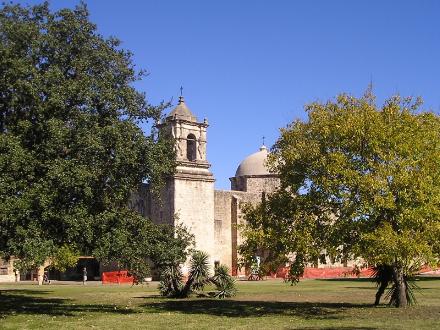
San Fernando Cathedral

SAN FERNANDO CATHEDRAL in San Antonio, Texas, named after the holy King Ferdinand III of Castile, is one of the oldest cathedrals in the United States. Indeed, there is considerably debate as to precisely which church is the oldest cathedral in the United States. The Baltimore Basilica, recently restored, was the first cathedral to be located in the political entity known as the United States. The Cathedral Basilica of Saint Augustine in the Floridian city of that name was founded in 1594 (making it the oldest parish in the U.S.) but the current structure was not built until 1793, and the church did not become a cathedral until 1870. The core of San Fernando was built from 1738 to 1750, but the nave was replaced in 1868 with one of a neo-Gothic design. It became a cathedral when the See of San Antonio was erected in 1874. So the Baltimore Basilica (or the Basilica of the National Shrine of the Assumption of the Blessed Virgin Mary, to give it its full name) was certainly the first cathedral in the United States, though not the oldest church serving as a cathedral. To add to the fray, the Cathedral of Our Lady of Peace claims that it is the oldest continuously operating cathedral in the United States, since the Baltimore Basilica is no longer the cathedral of Baltimore, but rather merely co-cathedral to the bizarre art-deco-gothic Cathedral of Mary Our Queen in that city. It’s all quite mad really. Suffice to say, San Fernando is old and it is a cathedral; it’s an old cathedral. (more…)
Empire State Beauty

THE BRIDGE AND TUNNEL CLUB site often features photographs of myriad places, scenes, and things all around New York and beyond. Recently, the Bridge-and-Tunneller made a sojourn to various sites up the Hudson, and thankfully decided to share his photos. We bring you a selection of them, which you can find in their original form on the B&TC website. (more…)
Children of a Common Mother
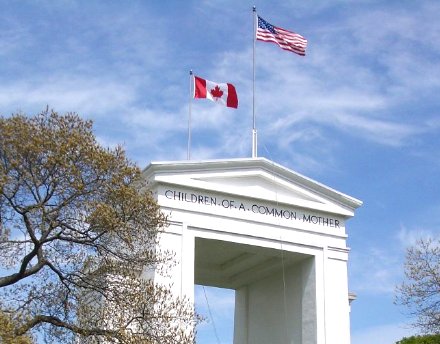
The 22-yard-tall Peace Arch stands between the city of Blaine in Washington state, and the city of Surrey in the province of British Columbia, demarcating the boundary between the United States of America and the Dominion of Canada. The monument, built in 1921, commemorates the 1814 Treaty of Ghent re-establishing peace between the United States and the British Empire.
Lions and Torches and Trees (Oh My!)
Or, What £40,000 Gets You in Today’s World


A
MONG THE MANY changes which the Rt. Hon. David Cameron MP has wrought in his ten months as leader of the Conservatives one of the most public is the change of the party’s emblem. The flaming torch is out and the solid oak is in, at a cost of £40,000 to Conservative Central Office (according to the Times). There are three slightly different designs of the tree for the UK-wide, Scottish, and Welsh parties. Previously, the national party used the ‘flaming torch of liberty’ logo while the Scottish party used a blue lion rampant and Wales had its rather comely red-white-and-blue dragon with fire pouring forth from its mouth. The former logo was the ‘flaming torch of liberty’, which only entered into usage in the 1980’s under Mrs. Thatcher. In its place, we find instead an oak tree with healthy greenery on its limbs and a trunk made out in the traditional Tory blue. (more…)
Old Dutch Gable
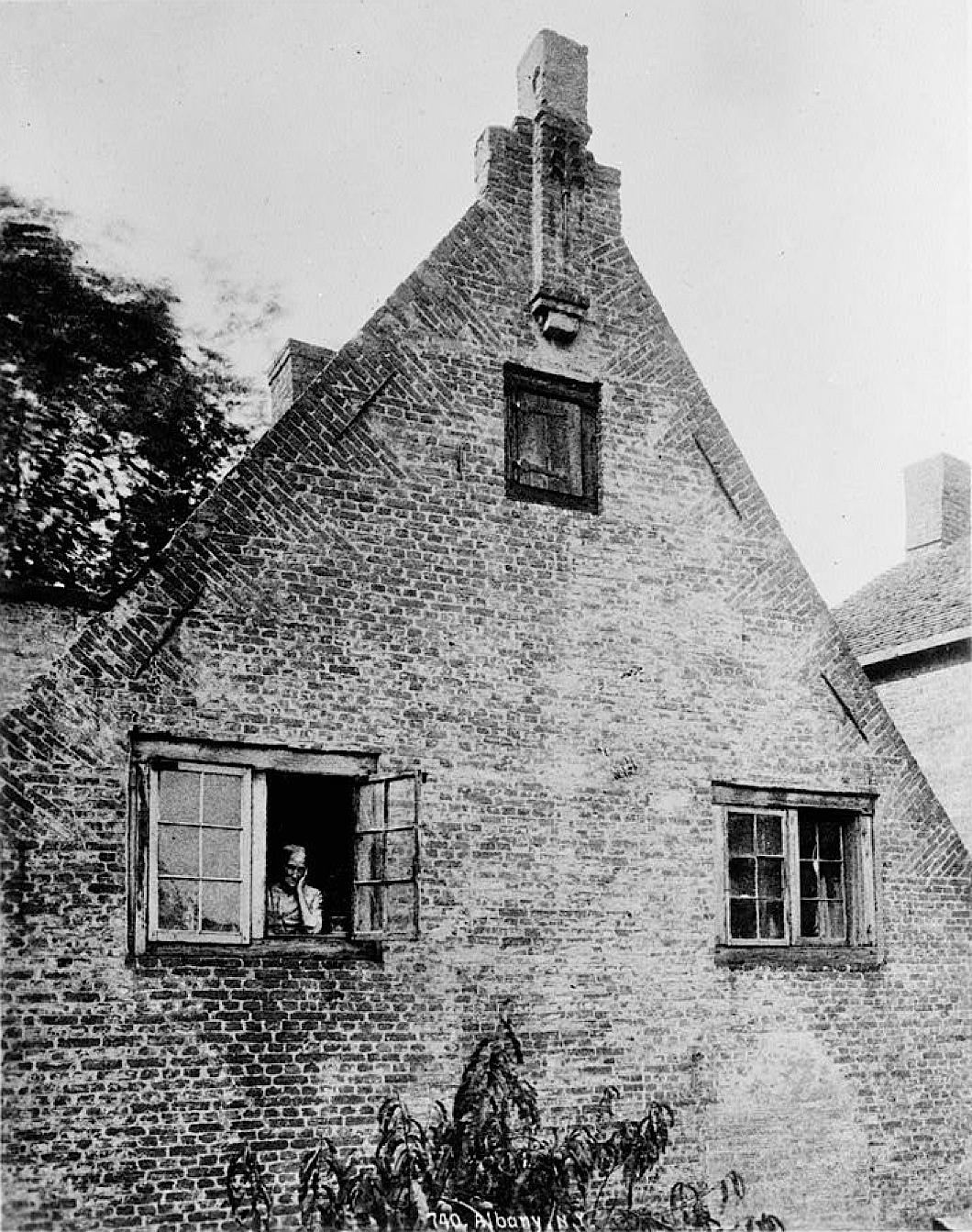
An old Dutch gable complete with old Dutch vrouw gazing miserably from the window. Albany County, New York, 1930’s.
The form of brick course on the gable is known as ‘mouse-tooth’ and is found primarily in Holland, East Anglia, and the Hudson Valley of New York, though also here and there in the American South.
Old Yale Boathouse Faces Wrecking Ball

AND SO, THE ONWARD march of progress continues. Yale University’s old Adee Boathouse on New Haven harbor is to face the wrecking ball to make way for traffic improvements to the Pearl Harbor Memorial Bridge which carries Interstate 95 across the Quinnipiac River. Despite some quite extraordinary plans to physically cut the building from the shore and float it across to the opposite side of the river, it now appears that the boathouse is to be demolished. (more…)
The Auld Scotsman
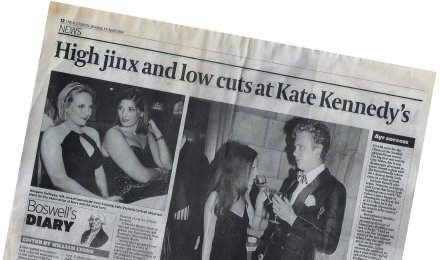
ONE THING WE greatly enjoyed about the Scotsman in its pre-tabloid days was that they often deemed St Andrews social events worthy of coverage in their august pages. It was a source of pride to see ‘the national newspaper’, a respectable broadsheet, covering events at the oldest university in the land (which we are proud to call our own). Naturally, once the conversion to tabloid size was complete, we were rarely heard of again, which was a little saddening. The Scotsman is not what it used to be —a beautiful, well-designed, informative respectable newspaper— but it still manages to print some thoroughly worthwhile articles which is more than can be said of any other Scottish daily. (One need only point out two articles by Prof. Haldane, c.f. here and here, recently posted on this site).
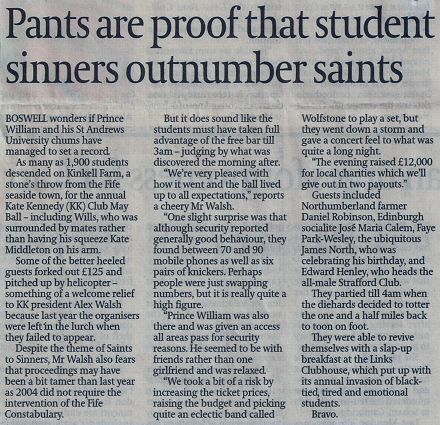
“…when the diehards decided to totter the one and a half miles back to toon on foot.” Sounds familiar.
Admittedly, most of the events covered were organised by the Kate Kennedy Club, which seems to take pride in the sheer vulgarity and tastelessness with which they advertise many of their events. (This is only slightly mitigated by their superb running of the annual Kate Kennedy Procession). Still, we enjoyed the Scotsman‘s coverage and wish it had continued. I only bought the Scotsman on occasion after the switch, but often gave the Common Room’s copy a browse when I lived in St. Salvator’s. (Its Sunday edition, Scotland on Sunday is worth buying for Gerald Warner alone).
Here are a few bits and pieces clipped from the Scotsman for your perusal:
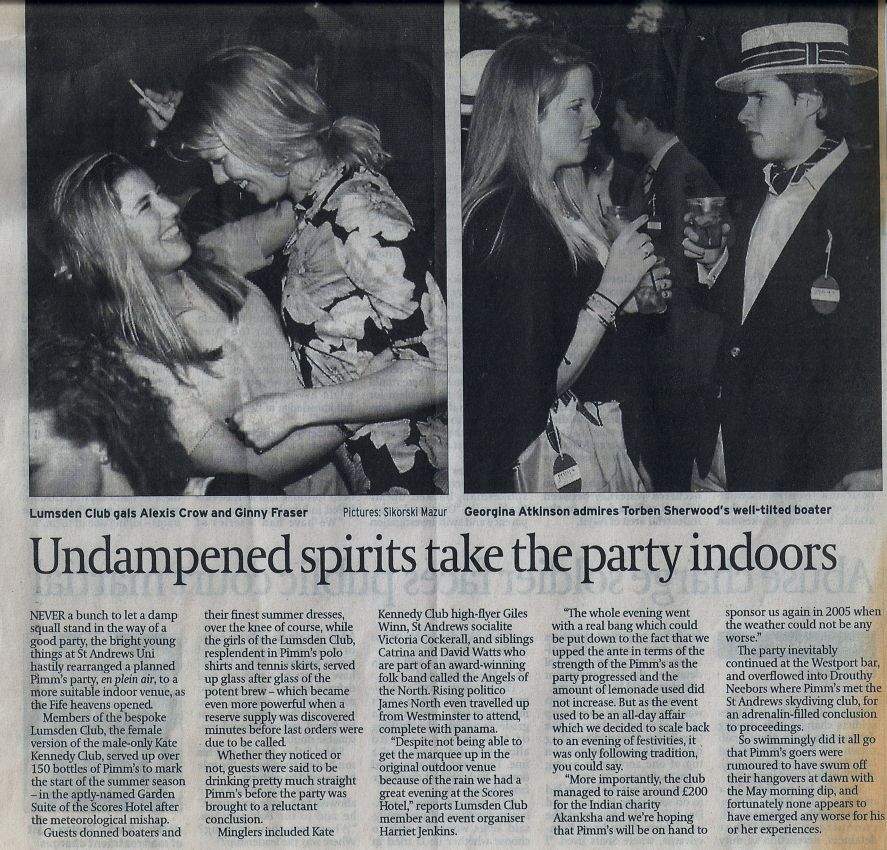
‘Undampened spirits take the party indoors‘ / Lumsden Club garden party moved indoors on account of the rain. (I didn’t go).
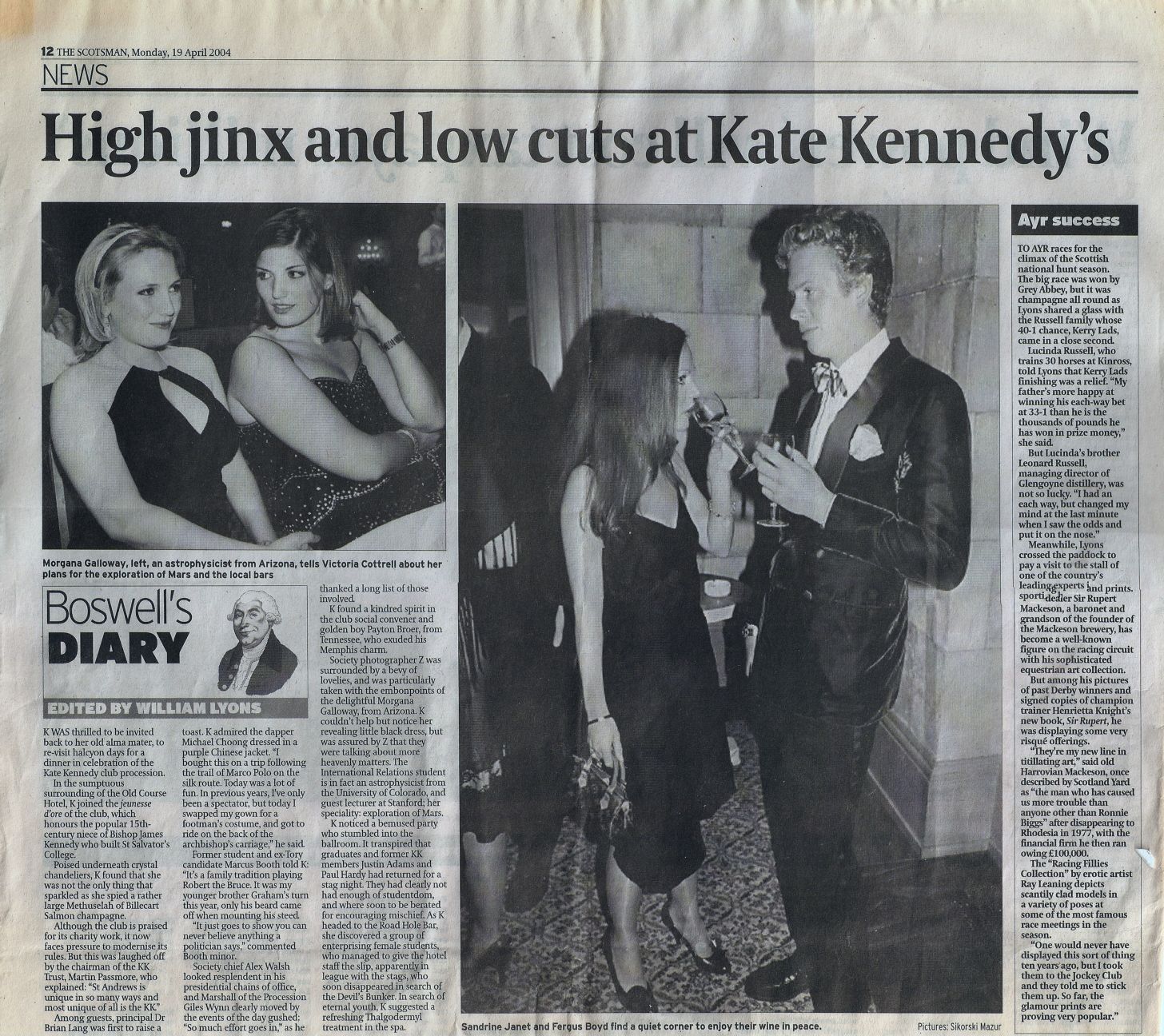
‘High jinks and low cuts at Kate Kennedy’s‘ / This covered the Kate Kennedy Procession dinner which takes place at the Old Course Hotel on the evening following the procession. This particular year I was in attendance myself and recall commiserating with Michelle Romero, that charming daughter of Venezuela, about the troubled state of her native land. I was their with our favorite Dane, Sofie von Hauch, and my flatmate, a member of the KK who wishes to remain unnamed on this site. Will Lyons couldn’t make the dinner himself, so he sent ‘K‘ up instead, accompanied by ‘society photographer Z‘ whom I ran into while we were on our way out.
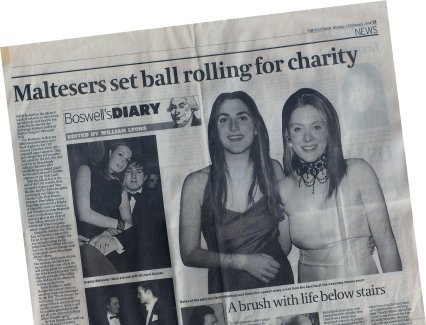
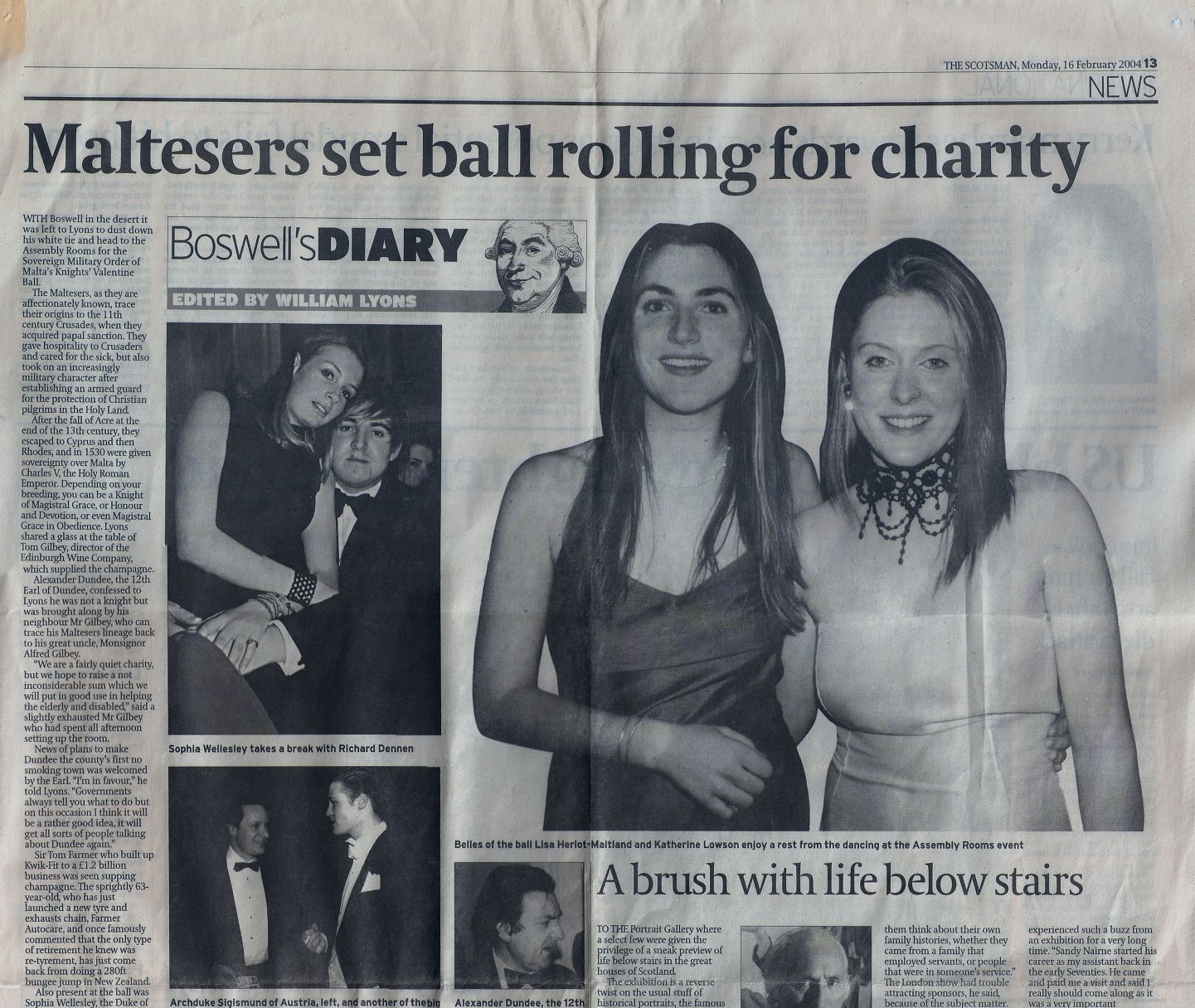
‘Maltesers set ball rolling for charity‘ / The 2004 Knights of Malta Ball, not covered by this website because it did not exist at the time. It was a good time, especially so because I had three friends over from the States. Yalie Adam Brenner was doing his semester abroad at St Andrews at the time, and fellow Old Thorntonian Clara de Soto popped over from Boston College for the weekend with her good friend Katie Cordtz of Atlanta. The four of us together with Michelle Romero and the aforementioned unnamed flatmate of mine piled into a cab and made the hour’s journey to Edinburgh for the soirée. Poor Adam, though. Towards the latter part of the evening Archie Crichton-Stuart, an exceptionally amusing Edinburgh student, and his friend Ramsay forced Adam to consume the significant remnants of a bottle of house red. It all went down swimmingly, but came back up on the cab ride back to Fife. Freddy McNair, who was recently nearly killed by an incompetent gurkha on a training ground, sat at the table next to ours, I recall. (Also, in the lower right-hand corner of the clipping you can spy the face of our good friend Ricky Demarco peering out from an unrelated article).
Previously: Another Broadsheet Bites the Dust

A Book to Remember
Chumley’s Launch Party for ‘Forgotten New York’ Book
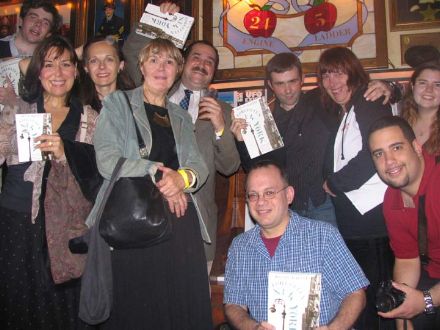
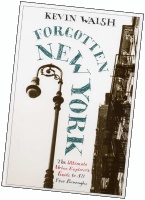
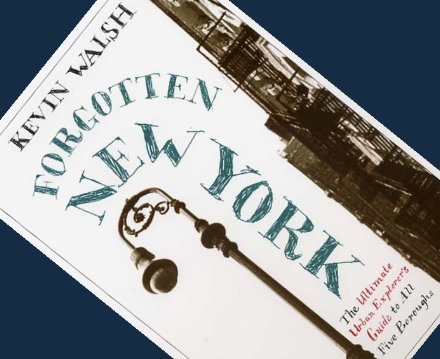
AS I GROW more and more cantankerous, my tolerance for evening trips down to Mannahatta declines, but on occasion there’s an event which would be a crime to miss. Last Thursday, Dawn Eden and I popped down to Chumley’s, the old speakeasy on Bedford Street in the West Village, for the shindig launching Kevin Walsh’s brilliant book, Forgotten New York: Views of a Lost Metropolis. (Kevin reports on the party here). I’ve been following Kevin’s Forgotten New York website for years now, and it has earned an unquestionable rank as one of my favorite sites ever (though, shamefully, I’ve never been on one of his legendary ‘Forgottentours’). The author himself was on hand, naturally, and I also enjoyed meeting a number of very kind people who are as fond of Forgotten New York as I am.
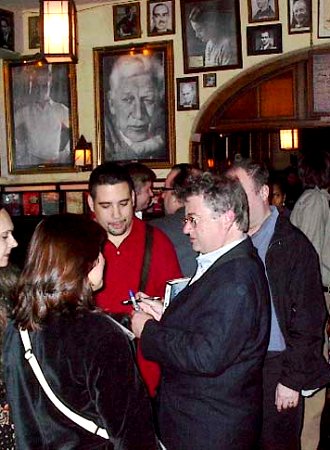
The Man of the Hour himself: Kevin Walsh (in glasses).
While Dawn and Kevin are familiar friends (she even gets a mention in the book’s acknowledgements), I had never before had the privilege of meeting this great chronicler of quinqueboronian miscellany. He is very much like his website: simple and brilliant. Happily, I got my complementary copy of the book personally inscribed, though I quite presumptuously upbraided him for only mentioning Audubon Terrace in passing (c.f. FNY: ‘I Can’t Drive 155’) while I believe it is worth a Forgotten page of its own. (Naturally, I have a post slowly developing on Audubon Terrace, which I believe is one of the most beautiful public spaces in all New York, as well as one of the most underappreciated).
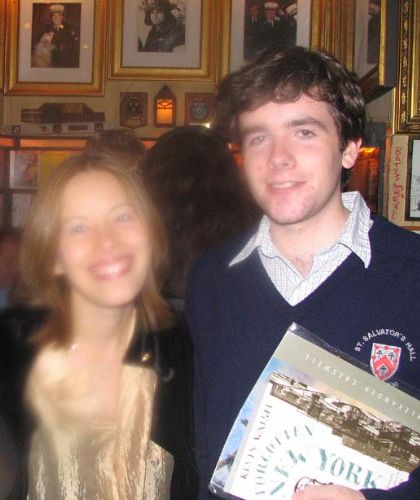
No, the camera isn’t smudged; an angelic haze follows Dawn wherever she goes.
But enough of the fun, how’s the book? Well I love it. It’s emphasis is on breadth rather than depth, since it’d be impossible to reproduce the entire contents of the encyclopedic website in a mid-sized paperback book. I view the book in two regards: first, as a handy basic guide referencing the variety of forgotten, unnoticed, and underappreciated sites around the Five Boroughs; and second, as a good jump-start companion to the more thoroughly informative website.
Take, for example, the Lent Riker Smith House out in Queens. Browsing through the book we see the entry on the ‘Lent Riker Smith Homestead’ which gives us two paragraphs of information. Enough to whet the appitite and plant the seed of intrigue, but when we check out the website’s entry on the house we get much, much more… and in color, to boot. I hope readers not yet familiar with the website will use the book as a springboard, but I also hope that we will be gifted with updated editions of the book in years to come, with added features.
Buy the book. Aficionados of forgotten-ny.com will appreciate a version of the familiar in dead-tree form, while the uninitiated will find it extremely useful as a foundation for appreciating Gotham’s numerous nooks and crannies. Kevin Walsh has done a great service to all those who have a love for the Big Apple.
Search
Instagram: @andcusack
Click here for my Instagram photos.Most Recent Posts
- Brunel’s Unbuilt Capitol February 3, 2026
- Cricket at Fordham January 27, 2026
- Palacio Barolo Revisted January 14, 2026
- Learning to Love Liguria January 14, 2026
- Crux Alba No. 2 January 13, 2026
Most Recent Comments
Book Wishlist
Monthly Archives
Categories