Arts & Culture
About Andrew Cusack
 Writer, web designer, etc.; born in New York; educated in Argentina, Scotland, and South Africa; now based in London.
 read more
News
Blogs
Reviews & Periodicals
Arts & Design
World
France
Mitteleuropa
Knickerbockers
Argentina
The Levant
Africa
Cape of Good Hope
Netherlands
Scandinavia
Québec
India
Muscovy
Germany
Academica
Von hier an blind
 The German band “Wir sind Helden” is a quartet purveying inoffensive pop rock, and recommended to us by one of our continental cronies. For their 2005 album cover, Von hier an blind, the band commissioned a group portrait in the ligne-claire style. The design is an obvious homage to Hergé’s Tintin. “Wir sind Helden” are little-known in the English-speaking world, though they have played three sold-out concerts in London, and are available from the iTunes Music Store.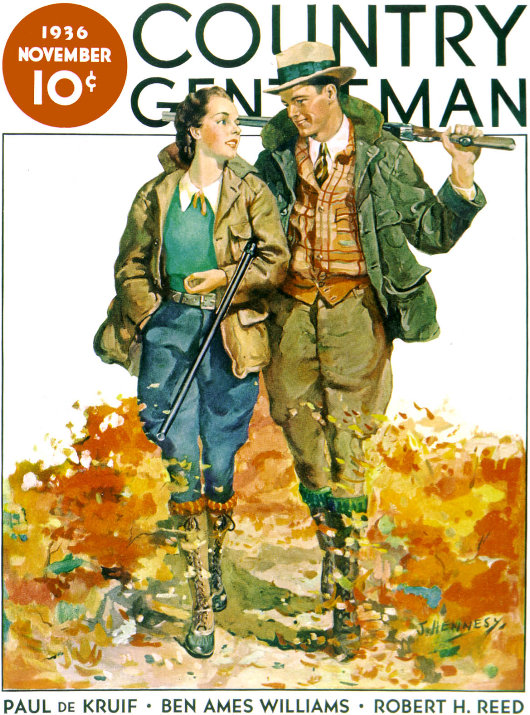
The Pester Lloyd
The Hungarian capital’s German-language newspaper has been “independent, pluralistic, steeped in tradition” since 1854
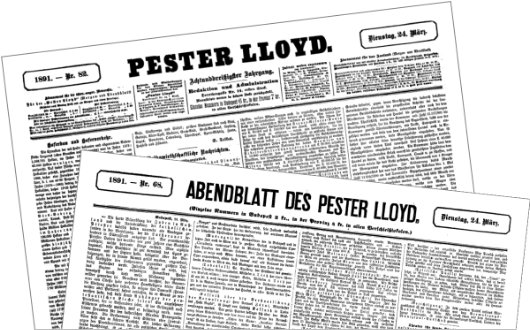
The fall of the Iron Curtain nearly twenty years ago after a half-century of Communist domination in Eastern Europe afforded an opportunity to revive many of the traditions and institutions which — while they had survived monarchy, republicanism, and fascism — were annihilated by the all-consuming Red totalitarianism. One such institution that has risen from the ashes is Hungary’s once-revered German-language newspaper, the Pester Lloyd.
 First appearing in 1854, when Buda and Pest were still two cities flanking the banks of the Danube, the Pester Lloyd was the leading German journal in Hungary. Printed daily with morning and evening editions, the “Pester” in the paper’s name refers to Pest, while “Lloyd” is in imitation of Lloyd’s List (the London shipping & commercial newspaper founded in 1692 by the eponymous properitor of Lloyd’s Coffee Shop and still going strong today). The paper first gained prominence under the editorial leadership of Dr. Miksa (Max) Falk, who had famously tutored the Empress Elisabeth in Hungarian and instilled in the consort a particular love for the Hungarian kingdom.
The Kaiser Karl Soldiers’ Homes
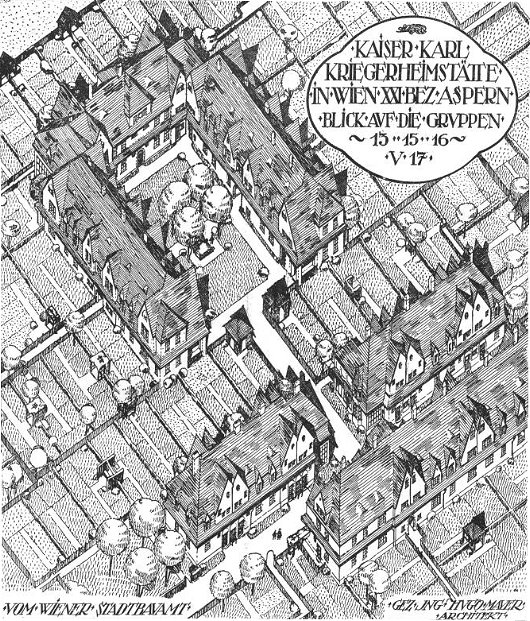
An unexecuted design. The architect later designed a number of housing projects during the First Austrian Republic.
Peter van Dongen
Dutch champion of the Ligne Claire style
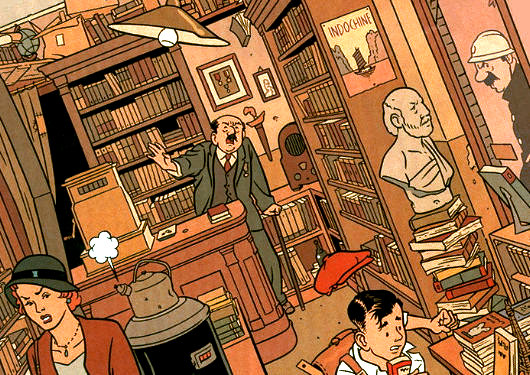
No doubt one of the most enjoyable aspects of Hergé’s great Tintin series of bandes desinées is the brilliant ligne claire style in which they are drawn; the most talented living exponent of which is surely Peter van Dongen. This Dutch striptekenaar (“comic-strip draughtsman”) first came to the attention of the comic world in his mid-twenties with Muizentheater (1990), a tale of two working-class Amsterdammers growing up during the Great Depression. As van Dongen despises clichés, it is one of the few books about Amsterdam that doesn’t feature a single canal. It was nearly ten years before van Dongen produced his second comic work, Rampokan, depicting the Dutch East Indies during their final years before independence. (On Rampokan, van Dongen collaborated with fellow ligne-clairist Joost Swarte, whose work is often seen in The New Yorker).
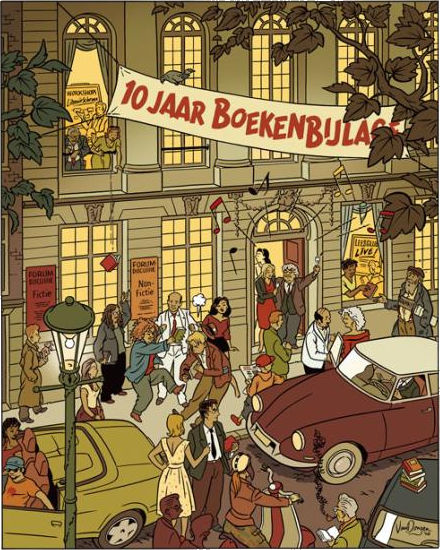
Van Dongen works as a commercial illustrator, and he often provides illustrations for NRC Boeken, the book review of the NRC Handelsblad. A celebration of the tenth anniversary of NRC Boeken was held at the Felix Meritis and is commemorated in the drawing above.
The New York Central Building
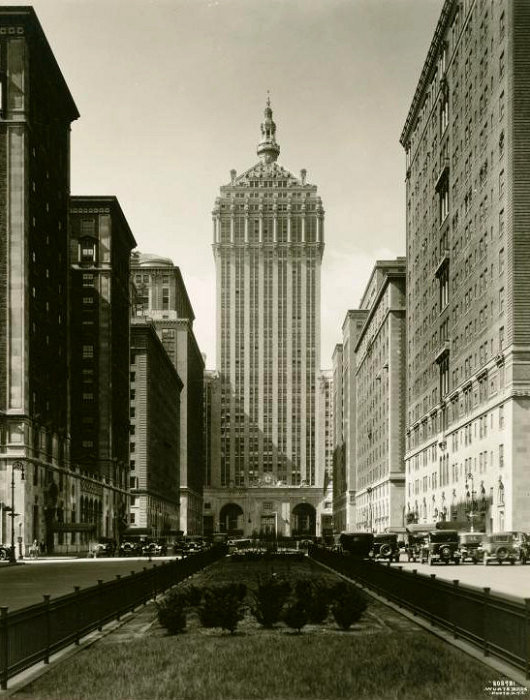
The New York Central building once presided majestically over an equally elegant Park Avenue, which is cleverly directed through the building from the south, emerging through the double arches on the north side. Sadly, while the tower (now known as the Helmsley Building) still stands, the view of it has been marred since 1963 when the Pan Am building was built between it and Grand Central Terminal. When it opened, the Pan Am building was the largest commercial office building in the world, and it was certainly one of the least graceful. The 1960s and 70s were not kind to Park Avenue on either side of Grand Central, and many of the traditional-style buildings have been demolished or re-clad in glass.

Russia Turns a Cinematic Page in History
Big-budget film celebrating anti-Communist hero & White Russian leader Admiral Kolchak is partly funded by Russian government

Here’s a film that has it all: naval battles, mutiny, revolution, civil war, brave men, beautiful women, sin, sacrifice, and betrayal on multiple levels. But “Admiral” («Адмиралъ»), which opened in Russia this month, is notable for another reason: this is the first major film depicting the tsarist White Russians as the good guys to receive at least part of its funding from the Russian government. The eponymous hero of the film is Alexander Kolchak, the naval commander and polar explorer who later led part of the White Army fighting the Bolsheviks during the Russian Civil War.
The Hanover Bank: A Classical Gem
No. 35, East Seventy-second Street
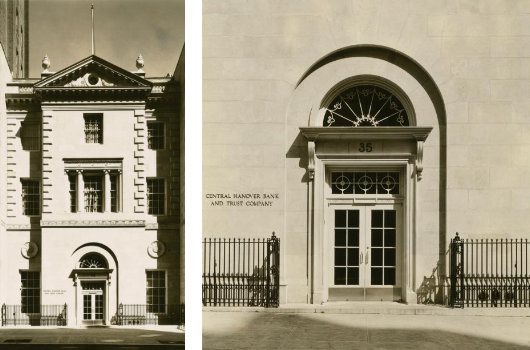
Passing by, as I sometimes do, the Chase branch bank at East 72nd St., I think to myself “There’s a fine establishment, in which I should keep my money”. The thought never jumps from theory to practice, however, as I am a patriot in everything but finance, and keep my florins safe with the Hongkong & Shanghai Bank instead. Nonetheless, it’s a handsome building, and the Central Hanover Bank & Trust Company should be commended for erecting it. Central Hanover merged with the Manufacturers Trust Company in 1961 to form Manufacturers Hanover (“Manny Hanny”), which was taken over by Chemical Bank in 1991, which was acquired by Chase Manhattan Bank in 1995, which merged with J.P. Morgan in 2000, and the consumer & commercial banking arm of J.P. Morgan Chase & Co. is now simply known as “Chase”.
While the original Chase National Bank was only formed in 1877, with all these mergers and acquisitions, “Chase” can now trace its lineage back to the foundation of the Bank of the Manhattan Company in 1799, the second oldest bank after the Bank of New York. But — would you believe it? — “Chase” is now headquartered not in the hallowed caverns of Wall Street but — wait for it — Chicago, Illinois!
Sorb Serf Story Shown on Silver Screen
Otfried Preußler’s retelling of old Wendish legend hits German cinemas
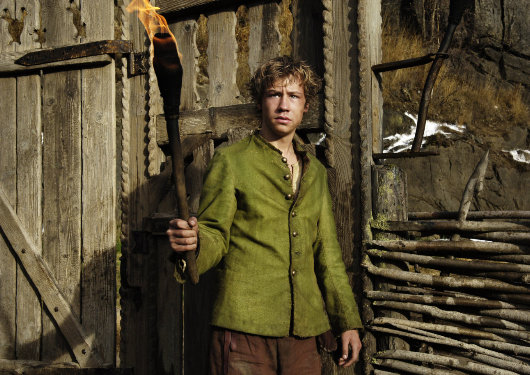
Follow your dreams! It may sound like a Hollywood cliché, but what’s a fourteen-year-old orphaned Sorb peasant to do? Currently showing in German cinemas, “Krabat” is the first film version of Otfried Preußler’s 1971 novel of an old Sorbian tale whose eponymous protagonist is a beggar boy in the eastern Saxony of the early 1700s. Krabat is plagued by dreams of an old watermill outside the tiny hamlet of Schwarzkollm, which seems to be operational though farmers never bring grain to be milled.
From the memoirs of Miklos Banffy
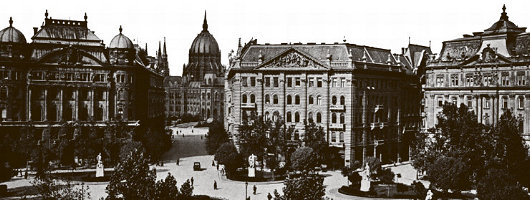
« After getting home I must admit that I slept soundly, although occasionally, when still half-asleep, I seemed to hear more rumbling of heavy lorries passing under my windows than on previous nights. However, since the street outside was the habitual route for deliveries to the market halls nearby, and the market cars had always rattled past noisily long before dawn, it did not seem to be different from any other night in the year.
It was only later that I heard what had happened early that morning. When my old valet called me he announced three things: my bath had been prepared, revolution had broken out, and Count Mihály Károlyi was now Minister-President. »
NRC, among others, gets it right
The Netherlands’ premier broadsheet has gone partly English online
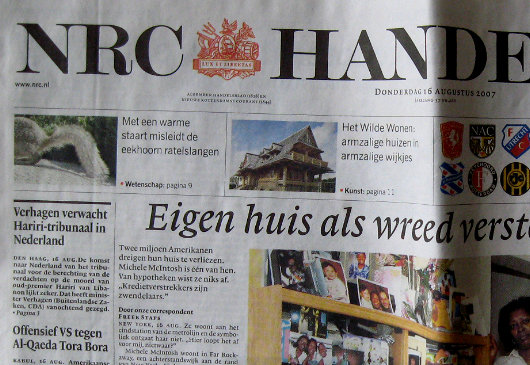
The moderate liberal Dutch broadsheet NRC Handelsblad is the latest of a series of European periodicals looking for a more international readership by translating part of their content into English for distribution on the world wide web. “NRC International” is partnered with the German weekly magazine Der Spiegel, itself a pioneer in featuring English content in an “international” section of its website. Aside from NRC and Der Spiegel, other news outlets now featuring web-only English-language content are Germany’s Die Welt and Hungary’s Heti Világgazdaság, while Eurozine features translated and original content from a broad spectrum of continental reviews and journals. Sadly, Sign and Sight recently had to reduce their “From the Feuilletons” — looking at the culture pages of German-language newspapers — from a daily to a weekly feature. Sign and Sight also features a weekly “Magazine Roundup” doing the rounds of a wide variety of European, Asian, and American magazines.
The move comes as print newspapers of the conventional variety across Europe and America are losing circulation. Some Manhattan newsstands have seen takers for the Sunday New York Times fall by as much as 80% in the past few years. The New York Times and Wall Street Journal both recently narrowed their page width in a move to save paper costs; the change, however, also means less room for advertising and a more ungainly appearance.
South Africa’s Herald, meanwhile, has bucked the gloomy trend and increased its readership by 14.5% in the past year. The Herald, the Eastern and Southern Cape’s regional broadsheet, attributes its success to a visual redesign and reorienting content to encourage readers to link up with the newspaper’s website. South Africa is also home to The Times (not to be confused with the older Cape Times), a new upmarket broadsheet newspaper launched as a daily extension of the century-old Sunday Times. The weekday Times was started a year ago and its circulation since just June has seen a 10.4% increase.
A major problem for the industry is that formerly high-end newspapers have driven down the quality of their product to a suicidal extent over the past decades. The middle market, for better or worse, is dead, and publishers have three alternatives to this disappearing sector: 1) go lowest-common-denominator — as The Times of London has done, with only moderate success; 2) go up-market — The Times and Sunday Times of South Africa have proved worthwile; or 3) go niche — the New York Observer is still in business after two decades of aiming towards Manhattan’s yuppie community.
Whichever path taken, integrating print and web operations is vital for the survival of print newspapers and other “dead tree” media. That European newspapers are providing at least part of their content in English is helpful in keeping up with events and ideas in countries like Germany, the Netherlands, and Hungary as our native English-language media are tightening their belts and cutting foreign correspondents and coverage. I hope more non-English papers follow this trend and help to permanentize it.
The Petit Séminaire de Québec
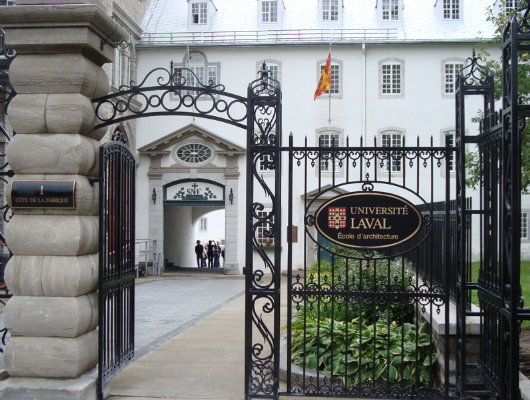
Adjoined to the ancient Cathedral Basilica of Notre-Dame in Quebec City is the Petit Séminaire. The Séminaire de Québec was founded in 1663 by the Blessed François Laval to train priests for the Vicariate Apostolic of New France, and the Petit Séminaire, its secondary school, was founded just five years later to teach both colonial French and native Indian youths. Among the school’s former pupils are four prime ministers of Québec, two lieutenant-governors (as the Queen’s viceregal representative in the province is known), and many other writers, politicians, and important figures of history. The Petit Séminaire survives today as a private Catholic secondary school.
Lewis of the Porcellian
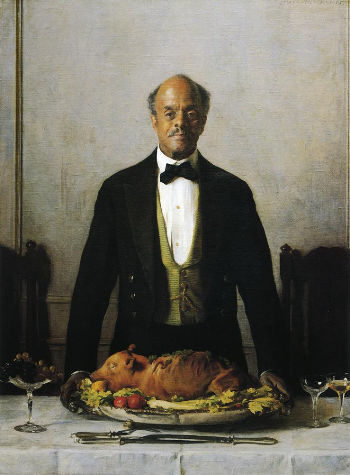
Oil on canvas, 54 in. x 40 in.
1919, the Porcellian Club
The Porcellian Club at Harvard University was founded in 1791 and McKean Gate, the entrance to Harvard Yard opposite the club’s quarters on Massachusetts Avenue in Cambridge, features a boar’s head in tribute. Digby Baltzell ranked the Porc (as it is colloquially known) as the most exclusive of Harvard’s “final clubs”, and Porcellian is known for having correctly turned its nose to Harvard seniors who later turned out to be no good: Joseph Kennedy was blackballed and Franklin D. Roosevelt described his failure to be elected to Porcellian as “the greatest disappointment of my life”.
‘The man who walked’
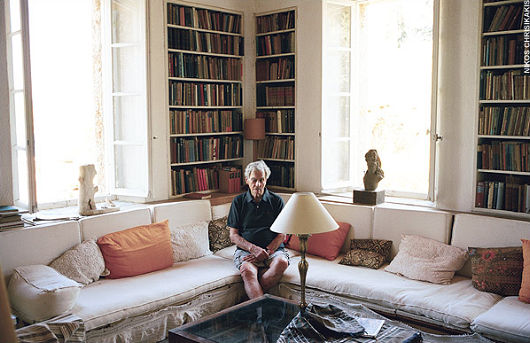
The Daily Telegraph — 6 September 2008
At 18 he left home to walk the length of Europe; at 25, as an SOE agent, he kidnapped the German commander of Crete; now at 93, Patrick Leigh Fermor, arguably the greatest living travel writer, is publishing the nearest he may come to an autobiography – and finally learning to type. William Dalrymple meets him at home in Greece
‘You’ve got to bellow a bit,’ Sir Patrick Leigh Fermor said, inclining his face in my direction, and cupping his ear. ‘He’s become an economist? Well, thank God for that. I thought you said he’d become a Communist.’
He took a swig of retsina and returned to his lemon chicken.
‘I’m deaf,’ he continued. ‘That’s the awful truth. That’s why I’m leaning towards you in this rather eerie fashion. I do have a hearing aid, but when I go swimming I always forget about it until I’m two strokes out, and then it starts singing at me. I get out and suck it, and with luck all is well. But both of them have gone now, and that’s one reason why I am off to London next week. Glasses, too. Running out of those very quickly. Occasionally, the one that is lost is found, but their numbers slowly diminish…’
He trailed off. ‘The amount that can go wrong at this age – you’ve no idea. This year I’ve acquired something called tunnel vision. Very odd, and sometimes quite interesting. When I look at someone I can see four eyes, one of them huge and stuck to the side of the mouth. Everyone starts looking a bit like a Picasso painting.’
He paused and considered for a moment, as if confronted by the condition for the first time. ‘And, to be honest, my memory is not in very good shape either. Anything like a date or a proper name just takes wing, and quite often never comes back. Winston Churchill – couldn’t remember his name last week.
‘Even swimming is a bit of a trial now,’ he continued, ‘thanks to this bloody clock thing they’ve put in me – what d’they call it? A pacemaker. It doesn’t mind the swimming. But it doesn’t like the steps on the way down. Terrific nuisance.’
We were sitting eating supper in the moonlight in the arcaded L-shaped cloister that forms the core of Leigh Fermor’s beautiful house in Mani in southern Greece. Since the death of his beloved wife Joan in 2003, Leigh Fermor, known to everyone as Leigh Fermor, has lived here alone in his own Elysium with only an ever-growing clowder of darting, mewing, paw-licking cats for company. He is cooked for and looked after by his housekeeper, Elpida, the daughter of the inn-keeper who was his original landlord when he came to Mani for the first time in 1962.
It is the most perfect writer’s house imaginable, designed and partially built by Leigh Fermor himself in an old olive grove overlooking a secluded Mediterranean bay. It is easy to see why, despite growing visibly frailer, he would never want to leave. Buttressed by the old retaining walls of the olive terraces, the whitewashed rooms are cool and airy and lined with books; old copies of the Times Literary Supplement and the New York Review of Books lie scattered around on tables between Attic vases, Indian sculptures and bottles of local ouzo.
A study filled with reference books and old photographs lies across a shady courtyard. There are cicadas grinding in the cypresses, and a wonderful view of the peaks of the Taygetus falling down to the blue waters of the Aegean, which are so clear it is said that in some places you can still see the wrecks of Ottoman galleys lying on the seabed far below.
There is a warm smell of wild rosemary and cypress resin in the air; and from below comes the crash of the sea on the pebbles of the foreshore. Yet there is something unmistakably melancholy in the air: a great traveller even partially immobilised is as sad a sight as an artist with failing vision or a composer grown hard of hearing.
I had driven down from Athens that morning, through slopes of olives charred and blackened by last year’s forest fires. I arrived at Kardamyli late in the evening. Although the area is now almost metropolitan in feel compared to what it was when Leigh Fermor moved here in the 1960s (at that time he had to move the honey-coloured Taygetus stone for his house to its site by mule as there was no road) it still feels wonderfully remote and almost untouched by the modern world.
When Leigh Fermor first arrived in Mani in 1962 he was known principally as a dashing commando. At the age of 25, as a young agent of Special Operations Executive (SOE), he had kidnapped the German commander in Crete, General Kreipe, and returned home to a Distinguished Service Order and movie version of his exploits, Ill Met by Moonlight (1957) with Dirk Bogarde playing him as a handsome black-shirted guerrilla.
It was in this house that Leigh Fermor made the startling transformation – unique in his generation – from war hero to literary genius. To meet, Leigh Fermor may still have the speech patterns and formal manners of a British officer of a previous generation; but on the page he is a soaring prose virtuoso with hardly a single living equal.
It was here in the isolation and beauty of Kardamyli that Leigh Fermor developed his sublime prose style, and here that he wrote most of the books that have made him widely regarded as the world’s greatest travel writer, as well as arguably our finest living prose-poet. While his densely literary and cadent prose style is beyond imitation, his books have become sacred texts for several generations of British writers of non-fiction, including Bruce Chatwin, Colin Thubron, Philip Marsden, Nicholas Crane and Rory Stewart, all of whom have been inspired by the persona he created of the bookish wanderer: the footloose scholar in the wilds, scrambling through remote mountains, a knapsack full of books on his shoulder.
The Municipalidad
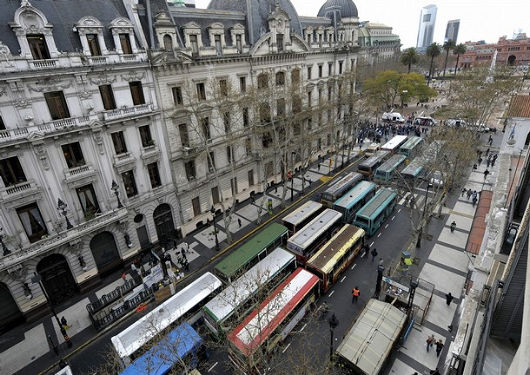
This news photo showing a protest (what else?) of bus drivers on the Avenida de Mayo in Buenos Aires gives a good view of the capital’s city hall. The municipal headquarters is located between the Plaza de Mayo and the former home of the newspaper La Prensa; the Casa Rosada, Argentina’s presidential palace (officially called Government House, Casa del Gobierno) can be seen in the distance at the end of the square.
I’ve long thought they should reduce the auto space by two lanes, one on each side, and double the width of the sidewalks — but that would probably make the bus drivers even more irate.
The Bad Shepherd
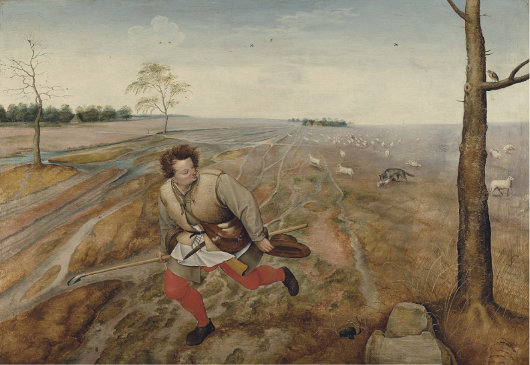
Pieter Brueghel II, The Bad Shepherd
Oil on panel, 29 in. x 41¼ in.
c. 1616, Private collection
With an original estimate of £1,000,000–£1,500,000, Pieter Brueghel the Younger’s The Bad Shepherd sold at a final hammer price of £2,505,250 at Christie’s in London this July. As the house lot notes state, it is “one of the most original and visually arresting of all images within the Brueghelian corpus of paintings”.
I am the good shepherd. The good shepherd lays down his life for the sheep. He who is a hireling and not a shepherd, whose own the sheep are not, sees the wolf coming and leaves the sheep and flees; and the wolf snatches them and scatters them. He flees because he is a hireling and cares nothing for the sheep.
It is significant that the distant horizon behind the sheep is broken only by a solitary church spire and a small farmstead. They seem to suggest that in abandoning his responsiblities the shepherd also rejects both the church and the community as he rushes headlong in the opposite direction. The mental anguish experienced by the shepherd is mirrored in a remarkable way by the barren landscape, shown from a dizzying bird’s eye perspective, stretching back into infinity. Interwoven only by vein-like tracks and ditches that lead the eye into the distance, the landscape is one of the artist’s most extraordinary achievements and very much a precursor to the psychological landscapes of the 20th century.
There is something arrestingly modern about this painting that fascinates me.
Subway riders, New York City, 1914
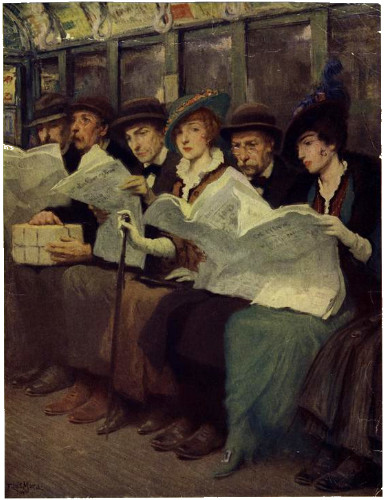
Francis Luis Mora, Subway riders, New York City, 1914
Print, 12½” x 9¼”
1914, New York Public Library
Search
Instagram: @andcusack
Click here for my Instagram photos.Most Recent Posts
- Brunel’s Unbuilt Capitol February 3, 2026
- Cricket at Fordham January 27, 2026
- Palacio Barolo Revisted January 14, 2026
- Learning to Love Liguria January 14, 2026
- Crux Alba No. 2 January 13, 2026
Most Recent Comments
Book Wishlist
Monthly Archives
Categories