Arts & Culture
About Andrew Cusack
 Writer, web designer, etc.; born in New York; educated in Argentina, Scotland, and South Africa; now based in London.
 read more
News
Blogs
Reviews & Periodicals
Arts & Design
World
France
Mitteleuropa
Knickerbockers
Argentina
The Levant
Africa
Cape of Good Hope
Netherlands
Scandinavia
Québec
India
Muscovy
Germany
Academica
NRC Handelsblad Goes ‘Compact’
Another broadsheet bites the dust
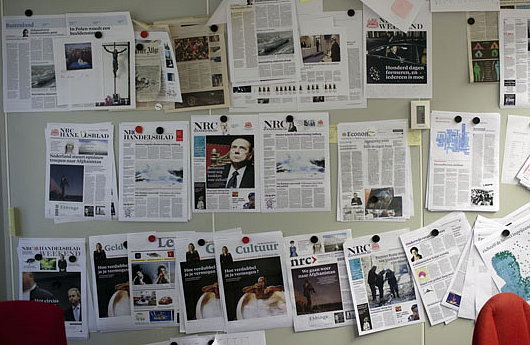
ONE OF THE most prominent newspapers in the Netherlands, NRC Handelsblad, switched from broadsheet to tabloid size this week. The newspaper claims it is returning to the ancestral format of its predeccesors, the Algemeen Handelsblad, the Amsterdam newspaper founded in 1828, as well as the Rotterdam Courant, founded in 1844. Those two papers merged in 1970 to form NRC Handelsblad, which is the seventh in circulation among the national newspapers of the Netherlands.
The evening newspaper has gained experience in tabloid-size printing since 2006 when it launched its morning compact edition, nrc.next, aimed at young, highly educated readers. Nrc.next has a Monday-Friday circulation of over 300,000, while NRC hovers around 240,000 on weekdays and 270,000 on Saturdays.
Canada’s Temporary Commons
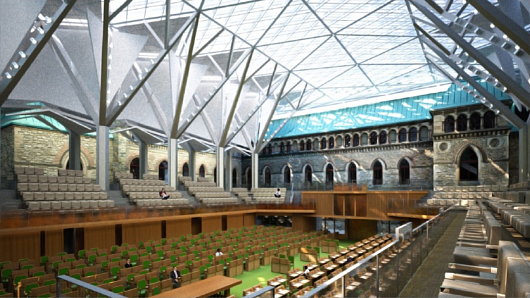
Canada boasts one of the most imposing parliamentary complexes in the world, presiding from a lordly bluff in the federal capital of Ottawa. While I think the city could do with an overall Hausmannisation, the government of the Confederation is undertaking significant efforts to renovate the buildings on Parliament Hill.
While the House of Commons chamber is renovated, the dominion’s lower house will meet in a new temporary chamber (above) constructed in the inner court of the West Block, one of a pair of high Victorian Gothic structures that flank the main parliament building. The restoration will take five to seven years, after which the temporary chamber will be converted into parliamentary committee rooms.
The Commons in the Lords
IT WAS THE NIGHT of 10 May 1941. For nine solid months the Luftwaffe had thrown everything it had at the people of London, as Hitler hoped to bomb the English into despair and surrender. By early May, the Nazis realised the campaign had failed, and resources had to be directed elsewhere. The Blitz had to end, but on its final night, it hit one of its most precious targets. Twelve German bombs hit the Palace of Westminster that night, with an incendiary striking a direct hit at the House of Commons. The locus of Britain’s parliamentary democracy was consumed by flame and completely destroyed. (more…)
The New Zealand Half-Crown
In the 1930s, New Zealand devalued its pound in relation to sterling and a whole new series of coinage and bank notes were introduced under the authority of the Reserve Bank of New Zealand. The government commissioned the accomplished English numismatic artist George Kruger Gray to design the dominion’s new coinage, which included this very handsome half-crown. It’s a splendid convergence between Maori and European design, two cooperating strains of New Zealand’s national culture. The country’s shield of arms is topped by a Tudor crown and flanked by indigenous motifs. (more…)
Mamarazza
The photographs of “Manni” Sayn-Wittgenstein-Sayn
IT’S A CRACKING photo; the sort of thing guaranteed to irk the puritanical and bring a smile to the good-humoured. The thirteen-year-old Yvonne Sayn-Wittgenstein-Sayn takes a swig from a bottle while her brother Alexander, just twelve, sits with a half-smoked cigarette. Taken aboard the yacht of Bartholomé March off Majorca in 1955, the photographer was Marianne “Manni” Sayn-Wittgenstein-Sayn — the mother of Yvonne and Alexander — who’s known by her photographic soubriquet of “Mamarazza”. (more…)
The South Kensington Museum
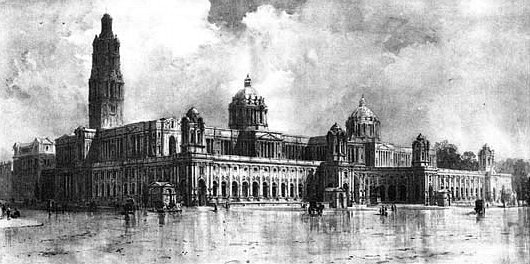
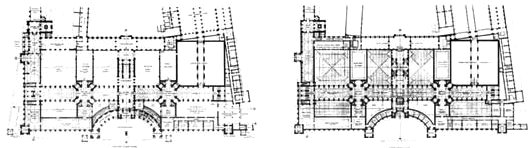
ANOTHER unbuilt project: this time a plan for completing the South Kensington Museum (or the Victoria & Albert as it’s now called) in the part of London which has become known as ‘Albertopolis’. The museum grew incrementally from its first foundation as the Museum of Manufactures after Prince Albert’s Great Exhibition of 1851. 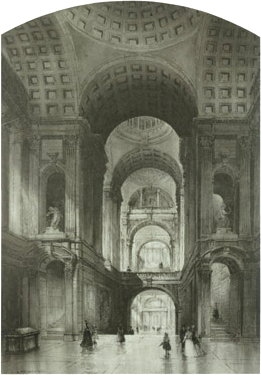 The first design for the museum at its current site was by Gottfried Semper, but the plan was rejected as being too expensive. And so over the years the facilities grew incrementally and according to to haphazard plans. In the 1890s, eight architects were invited to submit proposals for a grand scheme completing the site under a unified architectural plan.
The judges cited this plan, by John Belcher, as the most original of the eight submissions. It’s a splendid composition in high Edwardian neo-baroque. The duality of the main domes is a particular confident touch, and harks back to Greenwich. Belcher’s baroque conception was not just an external factor: his interiors featured vast, sweeping spaces that would have been impressively monumental and reflecting the power and influence of the British Empire at its presumed cultural zenith.
“Although unsuccesful in the competition,” writes Iain Boyd Whyte of Edinburgh University, “this project attracted considerable praise in the professional journals for the plasticity of the main street facade and for its grand, Michelangelesque domes.” While the judges appreciated Belcher’s design, they worried about the cost of its execution, and awarded first prize to Aston Webb instead. His scheme was inaugurated in 1899 by the Queen-Empress, who renamed the institution ‘the Victoria & Albert Museum’ simultaneously.
I wonder if Belcher’s design would have gone better with the neighbouring Brompton Oratory, or if the Oratory benefits from having the V&A in a differing, brick-based style.
Old Master Paintings at Sotheby’s
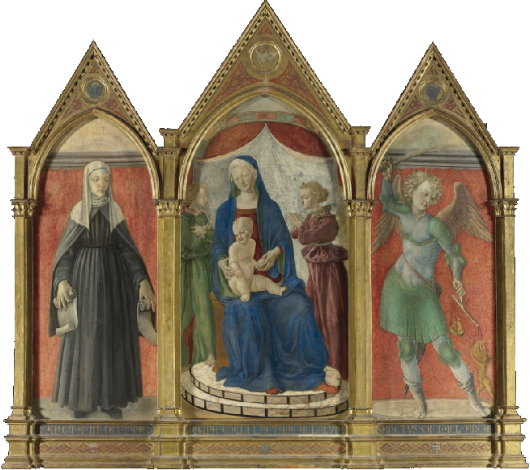
A Florentine Artist, The Madonna & Child Enthroned Flanked by Saints Bridget & Michael
1450; Tempera on panel, 72 in. x 85 in.
QUITE A FEW interesting pieces up for auction today as part of Old Master Week at Sotheby’s in New York. The above altarpiece has been attributed to various artists. For much of its life was called the Poggibonsi Triptych, but scholars now believe it to be the work of the Master of Pratovecchio. This attribution was supported by no less an authority than Roberto Longhi, who (as the catalogue notes point out) “considered him an artist of note who contributed to the Florentine transition from the early fifteenth-century serenity and intimacy of Fra Angelico and Filippo Lippi to the more dynamic forms found later in the century.”
The altarpiece, commissioned from a certain Giovanni di Francesco in 1439, was acquired by the J. Paul Getty Museum in California, which is now auctioning to raise funds for future acquisitions. (more…)
Christopher Rådlund
My first encounter with the art of Christopher Rådlund was through the website of a friend. Bill Coyle is a poet and translator whose knowledge of the Swedish language gives him an insight into the rich and ingenious Scandinavian world. His January 2010 New Criterion article on the Swedish “retrogarde” was a fascinating insight into what is arguably one of the most fruitful multi-disciplinary artistic movements in Europe today, left almost completely unreported upon in the English-speaking world. Bill’s website displays one of Rådlund’s painting.
Christopher Rådlund was born in Gothenburg, Sweden in 1970 and now lives and works in the Norwegian capital of Oslo. In muffled tones, his paintings exhibit a melancholic coldness, like a modern baring-down of Caspar David Friedrich. Here is a small selection of his haunting but beautiful work. (more…)
The City of Unexpected Charm
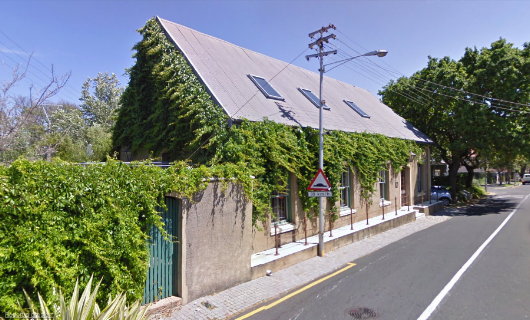
One of the things I like about Cape Town is its continual ability to surprise by throwing up surprisingly handsome buildings in unexpected places. To be honest, there is a great deal of mediocre architecture in the city, though I’d argue Cape Town’s mediocre architecture is better and more humane than, say, New York’s or London’s. But if you keep your eyes open to the world around you as you potter about the Cape, you can stumble across some happy little structures. This little building in Rondebosch is one such example. It sits on Rouwkoop Road, the street which takes its name from the old house that is no more. The N.G. Kerk Rondebosch is just down St Andrews Road one way, and St. Michael’s Catholic Church is just down Rouwkoop Road the other way. (more…)
Hail, Queen Europe!
The very name of Europe is feminine: Europa, the Phoenician princess of Greek lore, abducted by Zeus. From Strange Maps, we find this cartographic representation of Europe as a queen: Spain the crown, Germany the hearty bosom, Italy the graceful arm, and Sicily the Orb of Europe. The map was produced by Sebastian Munster in Basel in 1570 and was recently up for sale from Barry Lawrence Ruderman Antique Maps.
“During the late sixteenth century,” the map gallery writes, “a few map makers created these now highly prized map images, wherein countries and continents were given human or animal forms. Among the earliest examples is this map of Europa by Munster, which appeared in Munster’s Cosmography.”
Napier in the Overberg
NESTLED IN the Overberg, the little town of Napier owes its existence to a dispute between two neighbours. In the earlier part of the nineteenth century, as the little farm villages of the Cape became more firmly settled, the Dutch Reformed synod had to choose which towns were deserving of their own church. In 1833, the congregation in Swellendam decided to build a church further south to meet the needs of its members there, but couldn’t decide between two locations. Michiel van Breda wanted the church sited on his farm, Langefontein, while Pieter Voltelyn van der Byl wanted it built on his property, Klipdrift. Neither van Breda nor van der Byl would give way, so churches were built in both places, the town of Bredasdorp growing around van Breda’s church and the town of Napier founded around van der Byl’s church. (more…)
The Spott Estate, Dunbar
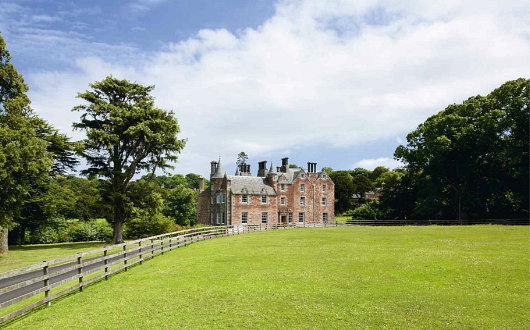
HERE IS A lordly demesne! In East Lothian, thirty-one miles from the centre of Edinburgh and three from the Royal Burgh of Dunbar, sits the Spott House and estate, now on the market from Knight Frank. The property is a whopping 2,463 acres in total, including 1,779 acres of arable land, 214 of pasture, and 356 acres of woodland. The estate has more than quadrupled in size in the past decade, under the ownership of the Danish-born Lars Foghsgaard, who bought just 600 acres in the year 2000.
As The Times wrote of Mr. Foghsgaard, “Clad in tweed jacket, plus fours and Hunter wellingtons, with several brace of partridge in his hand and his labrador at his side, he looks the very image of the country gentleman as he strides though his East Lothian estate.”
“The previous owner was very involved in the land,” Mr. Foghsgaard told the Times. “I am not a farmer, so I employed a farm manager: it’s crucial to have the necessary skills and connections in the area to do the job well, and as a foreigner I did not have those.” But the Dane does enjoy seeing the workings of the farm. “When I walk the dog, I always pass through the cowshed, where we have lambs being born each day — it’s such a joy to see.” (more…)
The Bozen Gate
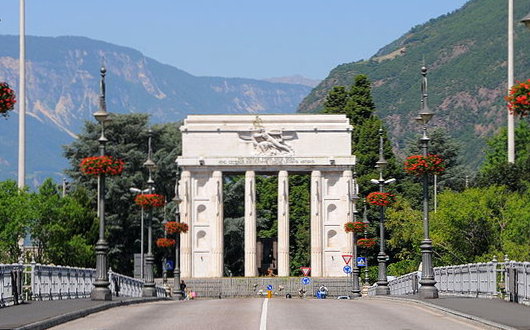
TRIUMPHALISM IN architecture is a double-edged sword. When done properly, it is glorious, like the Arc de Triomphe, standing majestically as avenues radiate forth from the stout, sculpted monument to Napoleon’s victories. The Italian monument at Bozen in Südtirol is the other end of the spectrum. The French emperor was wise enough to construct his triumphal arch in Paris, on his own turf, where it would prove relatively uncontroversial over the span of the years. Mussolini, meanwhile, had this gate celebrating the Italian victories of the First World War in Bozen, the capital of Südtirol, a region whose inhabitants are mostly German-speakers despite it being part of the Italian Republic. While the existence of a monument to Italian victories is acceptable, the placement and nature of this monument is a direct insult to the local population. (more…)
A Tale of Two Piazzas
My good friend Ian Corbin offers what he described to me as “a mere diversion” contrasting the brutality of Boston’s ‘Government Center’ with the beauty of Rome’s Piazza San Pietro.
David Goldblatt: Structures
“THE FIRST GROUP of photographs that I attempted of structures,” writes photographer David Goldblatt, “was a series made in 1961 on places of worship on the Witwatersrand. I came to this from two starting points. The first was a fascination with the idea of faith. Notwithstanding recurrent nightmares during childhood about the infiniteness of everlasting hellfire and uncertainty over the domicile of my unbaptised Jewish soul in the hereafter, arising from an otherwise happy primary school education by nuns, I don’t think I was ever able to believe in or pray to the deity with much conviction — except momentarily under extreme threat of imminent disaster. Neither nuns nor rabbi could ever enable me to transcend the banal with that leap of faith required of true believers. … I was — am — then, generally sceptical of believers’ beliefs but also in awe, and sometimes envious, of their ability to believe. If blind, unreasoning faith often repels me it sometimes moves and always intrigues.”
“Thus it was endlessly mysterious, even incredible to me that people — for the most part ‘ordinary’, ‘practical’ people, probably not much given to abstruse thought and discussion — should pour such effort and resource into the erection of structures devoted to so abstract an idea as God.” The photographer, understandably, doesn’t understand that, for we Christians, God is no less abstract than our father, mother, or neighbour down the street. “The ubiquity and persistence of the phenomenon, the immensity of humankind’s investment in God was to me quite awesome.”
“The second starting point for this early series of photographs of structures was an inchoate but growing awareness that whereas some structures seemed quite detached from this place, the Witwatersrand or, more broadly, South Africa, others grew almost viscerally from it. This seemed to have less to do with architecture than with indefinable qualities of ‘belonging’. I wanted to explore these notions and bring them into the light with the camera.” (more…)
Monument to the Latin Genius
The Palacio Barolo, Avenida de Mayo, Buenos Aires
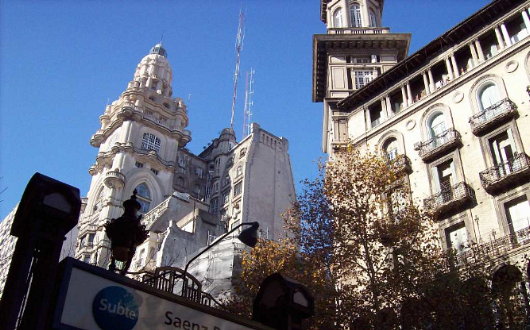
THE PROSPECT WAS horrifying. The year was 1919, and Europe had only just brought to an end an orgy of self-destruction lasting several years. The negotiations to conclude a peace treaty at Versailles were ongoing, but from abroad it looked as if the continent had descended into a trend of violence, decline, and destruction. That year, Luis Barolo, an Italian textiles manufacturer who had immigrated to Argentina, commissioned his fellow-countryman Mario Palanti to design a fascinating and mysterious structure as a monument to “the Latin Genius” Dante Alighieri — a repository in the New World for the poet’s legacy as the continent that gave him birth slid into oblivion. (more…)
An Aldermanian Skyscraper
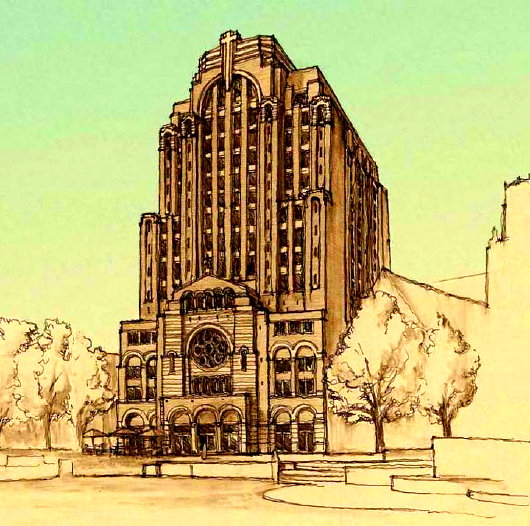
Good news from the Middle West: the Catholic chaplaincy at the University of Wisconsin at Madison announced plans for multi-use, high-rise structure in the city built in a traditional style. Matthew Alderman Studios served as the principal designer for the elevations of the St. Paul University Catholic Center, a 14-storey, $45-million structure in a Romanesque-Deco style that will include a chapel, meeting rooms, and student housing.
“Catholic life in Madison has undergone a remarkable renaissance under Bishop Morlino,” Matt Alderman says, “and St. Paul’s is one of the foundations of this resurgence. I can assert from personal experience that it is really heartening what is going on over there. St. Paul’s is molding a new generation of faithful, responsible, and joyfully serious young Catholics.”
Matt noted that the concept for the St. Paul Center is reminiscent of the skyscraper-church designs mooted during the first half of the twentieth century. In most of those proposals, however, the skyscraper factor tended to overwhelm the ecclesiastical visuality of the overall design. Matt has deftly avoided this in the St. Paul plans: from the perspective of the man on the street, the most prominent part of the façade is obviously ecclesiastical, and the many storeys above flow naturally, but unobtrusively, therefrom.
“It was important to impart an ecclesiastical character to the principal facade while at the same time asserting the building’s mixed-use status. In my own sketches, I drew on the work of Ralph Adams Cram at Christ Church Methodist in New York, a rugged urban ecclesiastical plant with a great deal of dignity and personality, and Bertram Goodhue’s slightly earlier St. Bartholomew’s, just down the street on Park Avenue.”
RDG Design and Planning of Omaha acted as principal architects of record. Matt Alderman is not yet an architect officially — the certification process in America is wisely prolonged — but as a design consultant he’s already serving up enough to whet our appetite. Diocesan chancelleries, parish boards, heck, anyone who wants to build anything: keep this guy in mind!
A Miscellany of Mexican Music
Juan Gutiérrez de Padilla was born in Malaga, Spain in 1590 but moved to New Spain in 1620, and was appointed choirmaster of Puebla Cathedral in 1628. His corpus is massive, with over 700 works surviving. His Stabat Mater is above, but you should also hear his Missa ego flos campi. (more…)
Ciudad de México
The Greatest City of the Americas
WITH A population of 20,000,000 people, Mexico City is the greatest city in the Americas — Tokyo and Seoul are the only metropolitan areas in the world that can claim a higher count of inhabitants. The old city of Tenochtitlan was founded by the Aztecs in the middle of a lake, 7,000 feet above sea level in 1325. According to legend, Huitzilopochtli — the Zeus or Jupiter of the Aztecs — indicated the site of the new capital through an eagle perched on a cactus with a snake in its beak. The city grew as the Aztec Empire augmented in size and strength, conquering hundreds of smaller surrounding tribes, enslaving their members, and offering their prisoners as human sacrifices. With great ceremony, vast numbers of prisoners were led one-by-one to the summit of the temples, where the priest would carve the living victim’s chest open with a blade of obsidian or jade, remove the still-beating heart and offer it to the appropriate god while the victim’s body was thrown down the steps of the temple. During the re-consecration of the city’s Great Temple in 1487, the Aztecs claim to have sacrificed 80,400 prisoners over the course of four days. It is not hard to imagine the relief of the conquered tribes when their liberation came at the hands of the Spanish. (more…)
A Forgotten Architectural Fantasist
Wilhelm Cornelis Bauer of the Netherlands
Boullée isn’t the only architect known more for the designs never built than for those that were. Wilhelm Cornelis Bauer (1862–1904) was a Dutch architect with a flair for the fantastic. He was born into an aesthetically minded environment in the Hague, where his father ran an interior decoration firm; his brother, the painter and engraver Marius Bauer, is better known. W.C. Bauer (sometimes known as Willem) studied at the Craft School before heading to the Royal Academy of Visual Arts and became involved in the circle of Dutch architects that included Berlage, Walenkamp, Kromhout and others.
Bauer had a very high opinion of himself, being convinced of his own genius, which often brought him into conflict with others, including potential patrons. The buildings of his that were constructed (such as a handful of houses in Bussum) were within the reasonable bounds of the Dutch contemporary vernacular, but Bauer was an inveterate dreamer with elaborate visions. Architectural competitions proved a perpetual draw, and while Bauer’s designs were often commended as highly artistic they usual brought simultaneous comments about impracticability. (more…)
Search
Instagram: @andcusack
Click here for my Instagram photos.Most Recent Posts
- Brunel’s Unbuilt Capitol February 3, 2026
- Cricket at Fordham January 27, 2026
- Palacio Barolo Revisted January 14, 2026
- Learning to Love Liguria January 14, 2026
- Crux Alba No. 2 January 13, 2026
Most Recent Comments
Book Wishlist
Monthly Archives
Categories