Art
About Andrew Cusack
 Writer, web designer, etc.; born in New York; educated in Argentina, Scotland, and South Africa; now based in London.
 read more
News
Blogs
Reviews & Periodicals
Arts & Design
World
France
Mitteleuropa
Knickerbockers
Argentina
The Levant
Africa
Cape of Good Hope
Netherlands
Scandinavia
Québec
India
Muscovy
Germany
Academica
An Evening at the Old Whitney
TO THE OLD Whitney Museum down on 8th Street, now home to the New York Studio School, which held a panel discussion to mark the twenty-fifth anniversary of the New Criterion. An interesting chat between Hilton Kramer, who left the New York Times to found the magazine in 1982, Karen Wilkin, one of our regular art critics, and James Panero, managing editor and art critic, all moderated by Michael J. Lewis of Williams College. The panel discussion covered myriad subjects related to art, from art criticism to the impossibility of an avant-garde in today’s culture of anything-goes to whether the New Criterion‘s ‘view’ of art can be considered part of any particular school of thought. Hilton had some particularly choice moments.
The building is a particularly nebulous one with many strange nooks and crannies, which can perhaps be explained by the fact that it is actually four townhouses gradually combined over a period of time. The Whitney Museum of American Art, of course, was founded in the 1930s by Gertrude Vanderbilt Whitney and was housed in these merged townhouses until moving to the specially-designed home at Madison and 75th in 1966 — widely agreed to be the ugliest building on the entire Upper East Side.
Among the nooks and crannies previously mentioned, Gertrude Vanderbilt Whitney’s former studio in the old mews building provided an excellent location for the dinner held afterwards, to which the participants, organizers, and a number of hangers-on (including yours truly) were invited. I sat between Gabbe, the New Criterion‘s former Editorial Assistant now working for the Studio School, and Joseph, an art student from outside Canterbury in Kent whose grandmother and grandfather both taught at the Studio School. Joseph and I discussed the beauty of the Somerset countryside, and I confessed I’d buy a cottage and move there in a second were it possible. The inimitable David Yezzi sat across the table and guided much of the conversation on our leg of the three tables, which had been arranged in a U-formation. A little later, I chatted with the artist seated to Gabbe’s left, who had been born in Latvia, with childhood spent in Baghdad, Italy, and England, before settling down in New York at the age of seven. We discussed the glories of Eastern Europe and the linguistic intricacies thereof. During dessert, however, I got on to architecture with the amiable Michael J. Lewis. I sung the praises of Audubon Terrace, one of my favorite spaces in all New York, which he (a Philadelphian) had only stumbled upon for the first time a month ago, and also of the nearby sculpted tomb of Bertram Grosvenor Goodhue, the greatest of all American architects.
Time waits for no man, however, and I managed to catch a late train back home from Grand Central. Alighting at Bronxville, I walked through the misty streets where the spherical streetlamps cast an eerie glow against the limestone façades of the shops. Home before midnight, and time for rest. Tommorrow, aside from being the feast of Saint Andrew, is Stefan Beck’s last day at the New Criterion. Needless to say, commemorative festivities are in order, and an alcoholic concoction known as ‘batch’ is to be brewed. It will not, I imagine, be for the faint of heart.
Elsewhere, the Austrian navy is no more.
The Neue Galerie
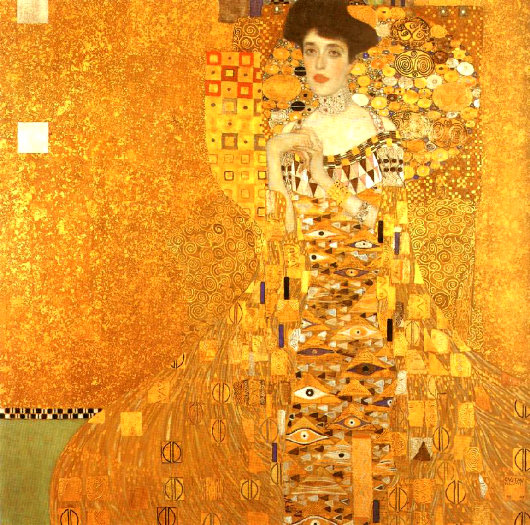
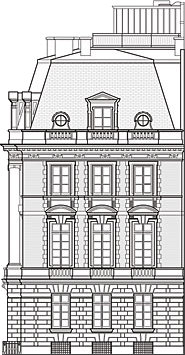 THE RECENT PURCHASE for the Neue Galerie of Gustav Klimt’s 1907 ‘Adele Bloch-Bauer I’ (above), alledgedly for a record-breaking price of $135,000,000, gives me the perfect opportunity to write a post on the eponymously recent addition to New York’s coterie of art museums. Since its 2001 opening, the Neue Galerie has resided in the handsome 1914 beaux-arts mansion on the corner of Fifth Avenue and 86th Street, designed by Carrère and Hastings (of New York Public Library fame) for industrialist William Starr Miller and later inhabited by Mrs. Cornelius Vanderbilt III. In the time since the construction of No. 1048, the rest of Fifth Avenue has undergone a lamentable transformation from a boulevard of beautiful townhouses and mansions to an avenue predominantly consisting of apartment buildings. While one appreciates the inoffensive design of the pre-war buildings on Fifth, there remain a number of thoroughly opprobrious modern interlopers which offend the graceful avenue. One can’t help but pine for Fifth Avenue before the mansions came down, but we can at least give thanks for holdouts like the Neue Galerie. (more…)
The Assumption

Nicolas Poussin, The Assumption of the Virgin
Oil on canvas, 22″ x 16″
1650, Musée du Louvre, Paris
Click here for a closer view.
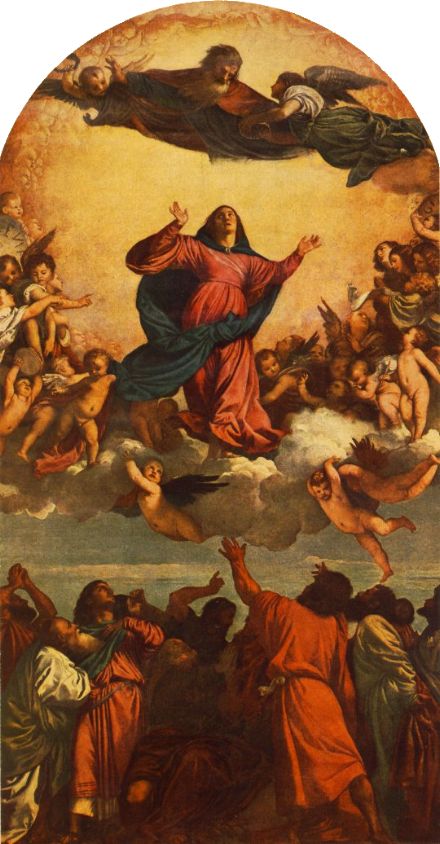
Titian, Assumption of the Virgin
Oil on wood, 272″ x 142″
1516-18, Santa Maria Gloriosa dei Frari, Venice
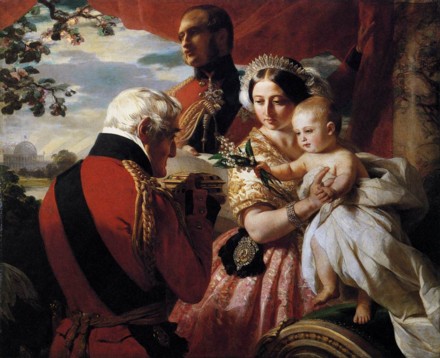
Resurrection
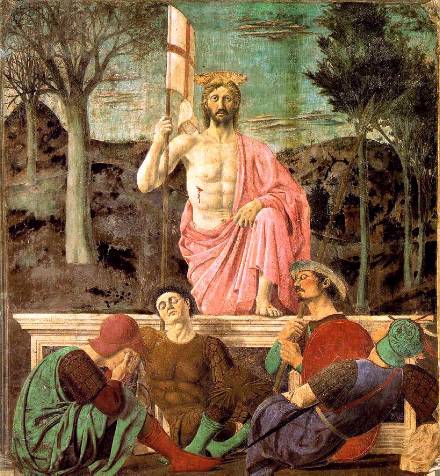
Piero della Francesca, Resurrection
Mural in fresco and tempera, 88″ x 86″
1463-1465, Sansepolcro
Glen Hansen’s Praha
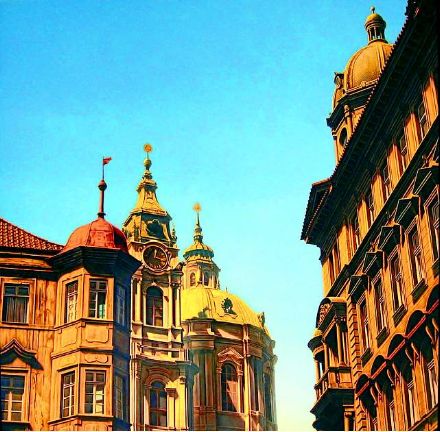
Glen Hansen, Praha – Church of St. Nicholas
Oil on panel, 32″ x 32″
2005, Fischbach Gallery

Glen Hansen, Praha – Trilogy (Homage to Agnes Martin)
Oil on panel, 24″ x 24″
2005, Fischbach Gallery
“Praha” is on display through Saturday, April 15 at the Fischbach Gallery, 210 Eleventh Ave., between 24th and 25th streets. Tue.–Fri., 10:00am–5:30pm, Sat, 10:00am–6:00pm, 212-759-2345, free.
Epiphany
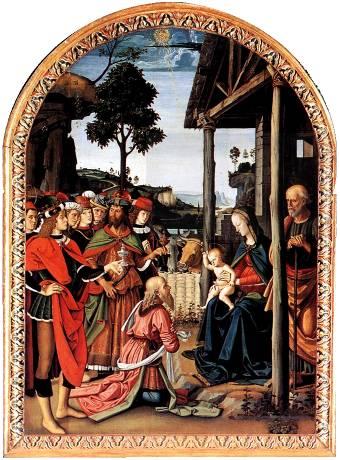
Pietro Perugino, Adoration of the Kings (Epiphany)
Oil on panel, 95′ x 70′
c. 1476, Galleria Nazionale dell’Umbria, Perugia
Soggy Manhattan
Ah, Manahatta. Even on a day as soggy as this, the Upper East Side still charms me. It also retains a fair number of buildings from the days when New York had higher tastes, mostly to be found between Fifth and Park Avenues. It is a fact to be mourned that we have probably destroyed most of what was good in New York’s built environment. Nonetheless, we should of course be glad for the beautiful things which remain from our great city’s golden age, and thankfully they are not a mere handful.
Stumbling down East 82nd Street this afternoon amongst puddle, gloom, and rain I emerged onto Fifth Avenue to see the beautiful mass of the Metropolitan Museum of Art revealed in all its glory. The façade of the Met has recently been cleaned and glancing at it today, despite the cloud and percipitation, one could almost imagine the year as 1902 when the wing designed by Richard Morris Hunt was completed. This is doubly so because the Metropolitan currently lacks her usual ungainly vexillic adornments pronouncing the exhibits shown in her distinguished galleries. These banners add nothing to the Met’s façade, and if there is a more clever and handsome way of announcing what is within without – and surely there must be – the Museum does not seem to have found it.
Still, the situation is not as reprehensible as across Central Park at the American Museum of Natural History. The AMNH enjoys two façades, one of which commands the view over Central Park West and the park itself beyond. The main portion of the Museum’s Central Park West front is a brilliant triumphal arch which is in fact the State of New York’s monument and memorial to Theodore Roosevelt, President of the United States and Governor of New York during his earthly life. Shamefully, the Museum disrespects this great monument to this great man by covering it in advertising banners akin to those which usually mar the Metropolitan. The American Museum of Natural History should be ashamed of itself for sullying such an august and dignified locale for the purposes of selfish marketing.
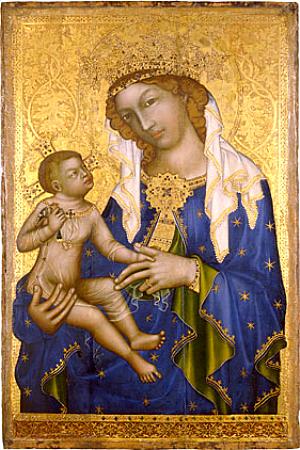
Tempera and gold on panel; 35′ x 23′
Deacon’s Office, Zbraslav/Koenigsaal/Aula Regia
(on loan to the National Gallery, Prague)
What brought me to plod up the splendid elevating staircase of the Metropolitan was to catch – just barely, for this was its last day – the special exhibition entitled Prague: The Crown of Bohemia 1347-1437. I had first gotten wind of this showing flipping through the mail whilst I was still interning at the New Criterion at the end of the summer and duly noted in my diary that though it opened while I was away in Scotland it would still be open upon my return for the Christmas holiday. Anyhow, I finally took advantage of it today and it was much enjoyed. What a remarkable land is Bohemia. The exhibit served only to augment my interest in the country and I must be sure to spend some time there sooner or later.
In addition to the Mother and Child above, the exhibit presented the tabernacle shown below (photographed in its actual home). There were also many, many reliquaries, some of which appeared to still have relics in them. One would have thought a museum’s interest in a reliquary was purely artistic and thus that the relics involved would be removed and handed over to those who would give them the care they deserve. Does the Museum have a consultant to advise on these cases, I wonder? Anyhow, I was sure to touch the glass and ask the saints to pray for us, just in case. The Bohemians clearly knew how to treat relics, would only that New Yorkers did – though to be fair I am told that the Tour of the Relics of St. Thérèse of Liseux which made its way to New York just a few years ago was well attended in the Metropolis and even up in Westchester round my neck of the woods. There is a relic of our dear Thérèse available for veneration in St. Patrick’s Cathedral which I occasionally drop in on when in the neighborhood.
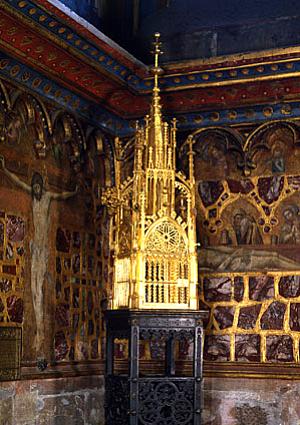
At any rate, had I attended Prague: The Crown of Bohemia 1347-1437 earlier I would’ve enjoined the reader to pay it a visit, but since it has finished its run I instead enjoin our dear readers to at least saunter down Fifth and stop to savor a glance of the cleaned-up Metropolitan sans banners. No doubt it will not be free of them for long — unless they who direct the Museum have had a moment of grace.
Previously: The Remarkable Hapsburgs | Brünn
Grande Journalerie
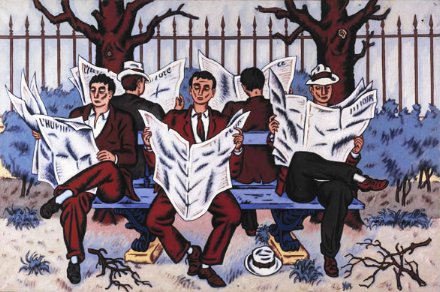
Jean Hélion, Grande Journalerie
Oil on canvas, 51″ x 76″
Robert Miller Gallery, New York
Old Men Playing Chess

Santiago de Chile, May 24, 2005. Photograph by Lucas de Soto.
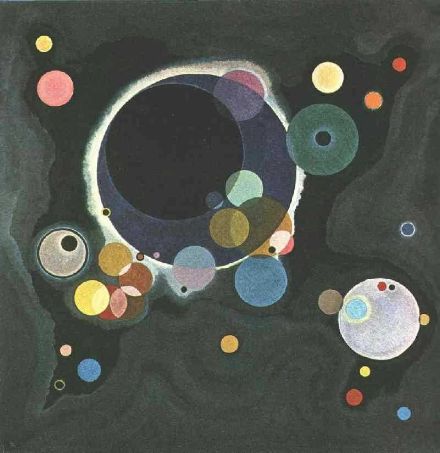
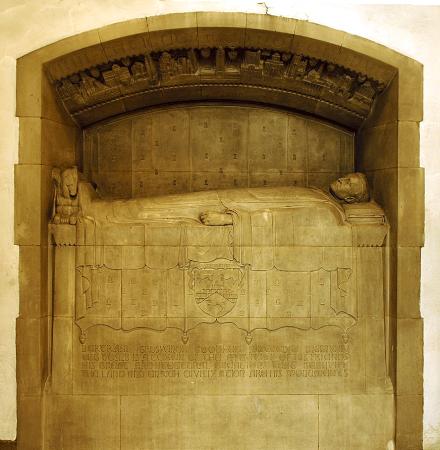


Stained-Glass Window
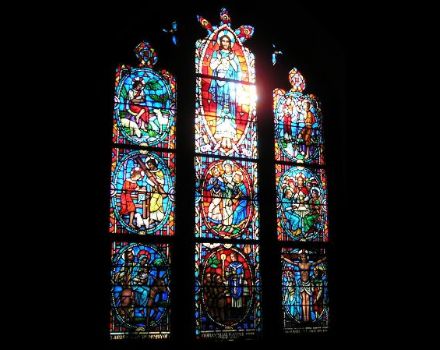
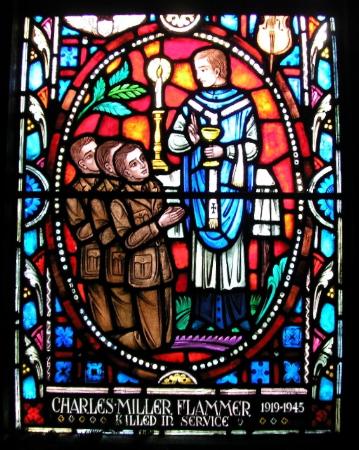
Here’s a window from the Goodhue-designed Christ Church Bronxville, with a close-up of one panel below.
Recent New York Art
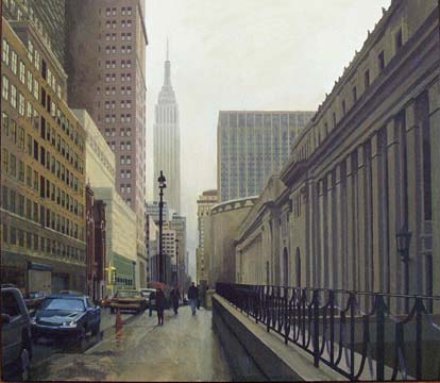
I am a philistine. The reason I am a philistine is because when it comes to art, I only like what I find beautiful. Today in the world of art, you’re supposed to appreciate art for the ideology and thought that goes behind it. If you only like what’s beautiful, then you are a philistine. I am quite happy being a philistine and hope I remain a philistine for the rest of my life.
Nonetheless, there have been a few recent works of art I felt I ought to show you. The common theme is New York. (more…)
The Dream of Christopher Columbus
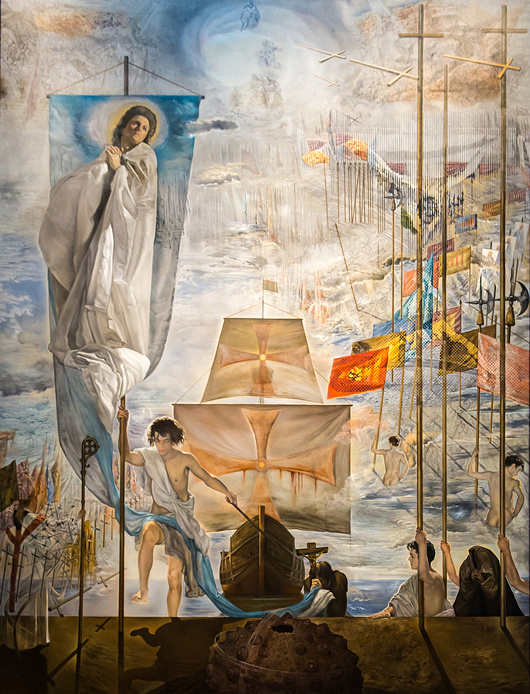
The Dream of Christopher Columbus, sometimes known as “Christopher Columbus Bringing Christianity to America”, by Dalí.
The two orbital paths in an armillary-like fashion around the sea urchin are taken to be a symbol for Man’s conquest of the Moon, which took place some years after the painting was finished.
Huntington Hartford commissioned the painting from Dalí for his Gallery of Modern Art which once stood in New York’s Columbus Circle.
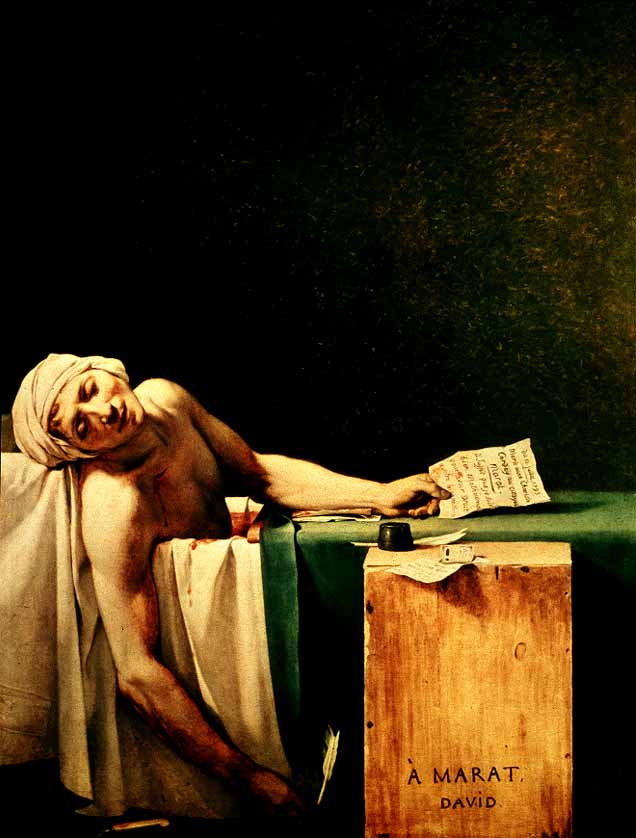
The Death of Marat
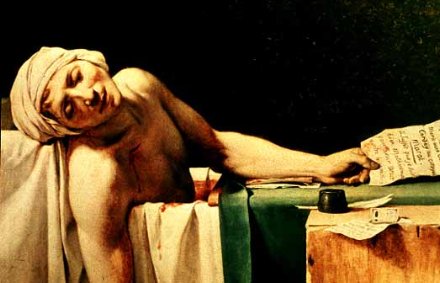
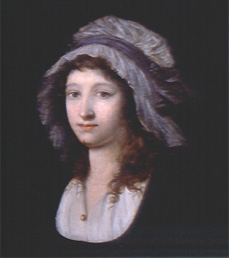
The thirteenth of July is also the day that the brave heroine of France, Charlotte Corday, killed the murderous revolutionary swine Jean-Paul Marat. Marat received his M.D. from St Andrews, and his villainy is remembered in the annual Kate Kennedy Procession, in which he is rightfully described as a “paranoid demagogue.”
The assasination inspired David to paint his famous depiction of the event. It is one of my favourite paintings, and a brilliant piece of propaganda portraying a bloodthirsty hatemonger as an angelic martyr.
Remembrance via the great Irish Elk.
Bo Bartlett, The Bride
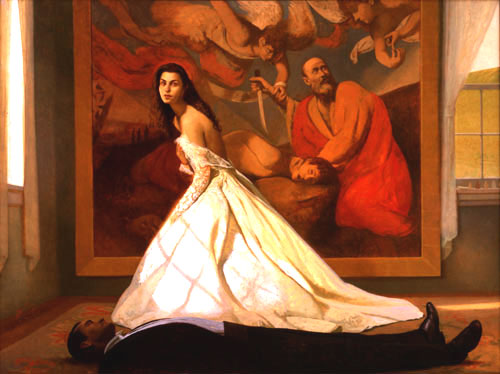
Bo Bartlett, The Bride
Oil on linen, 80″ x 100″
Private collection
Bo Bartlett, Leviathan
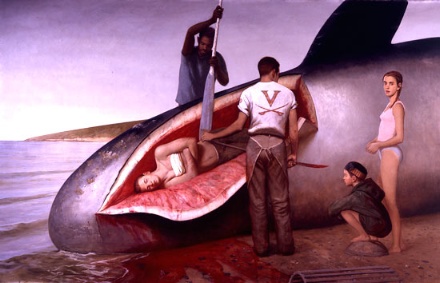
Bo Bartlett, Leviathan
Oil on linen, 89″ x 138″
Private Collection
Scott Fraser
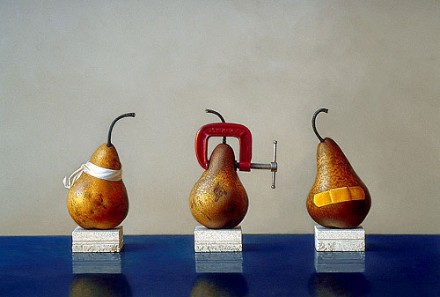
Scott Fraser, See No Evil, Hear No Evil, Speak No Evil
Oil on Board, 9″ x 17″
Private Collection
The University Maces
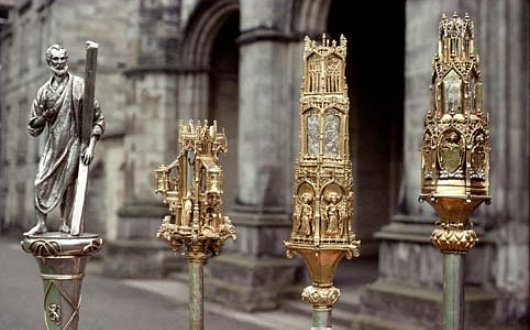
On my last day in St Andrews before summer break, Michelle Romero and I were lucky enough to finagle our way into a private showing of the University’s maces to the Kate Kennedy Club, organized by the Head Janitor & Bedellus, Jim Douglas, M.A. It was amazing. The metalwork on these maces (six in total) is so intricate and beautiful.
The late R.G. Cant said that if he had to put a value to the maces, Bishop Kennedy’s mace (made in 1461 in Paris) would be worth £10 million, and the mace of the Faculty of Arts would be £5 million, though in effect they are priceless. I have to admit it was nearly frightening to hold £10 million pounds in your hands.
It’s such a shame that the modern mace for the whole of the University (furtherst left in the photo) pales in comparison to the others, especially since it is the mace used at Chapel and thus the mace used most often. Mr. Douglas told us that the rod of the Rector’s mace (not pictured) is actually a broomstick painted black. Apparently, the Principal and Vice-Chancellor, Dr. Brian Lang, is going to have it replaced with a lengthened ebony rod.
Search
Instagram: @andcusack
Click here for my Instagram photos.Most Recent Posts
- Brunel’s Unbuilt Capitol February 3, 2026
- Cricket at Fordham January 27, 2026
- Palacio Barolo Revisted January 14, 2026
- Learning to Love Liguria January 14, 2026
- Crux Alba No. 2 January 13, 2026
Most Recent Comments
Book Wishlist
Monthly Archives
Categories