Architecture
About Andrew Cusack
 Writer, web designer, etc.; born in New York; educated in Argentina, Scotland, and South Africa; now based in London.
 read more
News
Blogs
Reviews & Periodicals
Arts & Design
World
France
Mitteleuropa
Knickerbockers
Argentina
The Levant
Africa
Cape of Good Hope
Netherlands
Scandinavia
Québec
India
Muscovy
Germany
Academica
The Dewey Arch
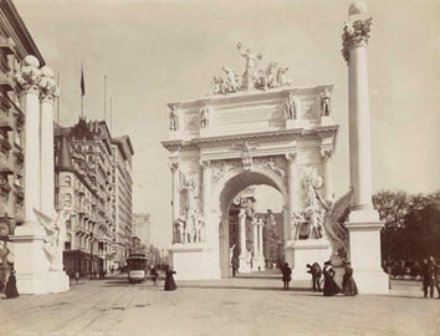
The Classical Values blog had a post back in October ’03 entitled A Classical Arch in New York, which makes mention of the triumphal arch built to comemmorate Admiral Dewey’s victory over the Spanish in the eponymous war between our two nations round the turn of the century.
The Dewey Arch was only a temporary structure built of a plaster-like material, and thus did not survive. A previous temporary wood-and-plaster triumphal arch was built to commemorate General Washington in Washington Square, and proved so popular that it was decided to replace it with a permanent stone version. Unfortunately, the more attractive beaux-arts Dewey Arch, which also featured a colonnade, was not made permanent as its location in Madison Square would have obstructed the flow of vehicles and required a rethinking of the traffic flow.
The only existing reminder of the Arch near the site is a bar and restaurant called Dewey’s Flatiron.
Nonetheless, here are a few photos of the lost arch.
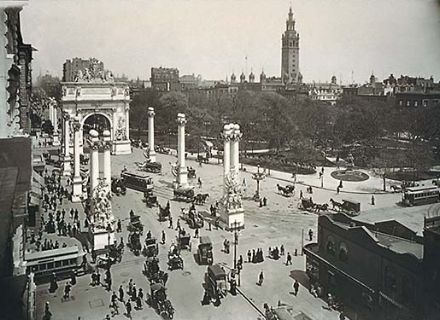
A view of the Dewey Arch, colonnade, and Madison Square, with Stanford White’s towered Madison Square Garden in the background. Broadway and its trolley line cross the colonnade’s axis. (more…)
University College Durham
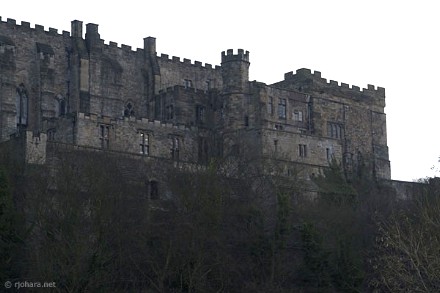
Dr. Robert O’Hara (who runs one of my favorite website) recently took it upon himself to visit the University of Durham and provided a few snapshots. Of most interest to me is University College Durham, situated in ancient Durham Castle. I think perhaps when I start my university our very first college might be partly modelled on this. (more…)
Wallabout Market

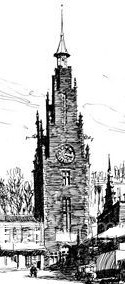 New York’s Wallabout Market was once the second-largest market in the world. From about 1884 onwards, vendors would gather in this district adjacent to Wallabout Bay in Brooklyn and sell their various wares. It was then that the market vendors had been banned from Fulton Street for making too much noise, and so took up their trades further down by the Wallabout Canal, next to the New York Naval Shipyard, more commonly known as the Brooklyn Navy Yard (founded 1801, decommissioned 1966).
The market featured permanent two-story brick structures designed in a nostalgic Dutch style, commemorating the Netherlandish origins of New York and Brooklyn, centered around an open plaza known as Farmers’ Square where stalls were erected. The centerpiece was a tall clock tower, seen at right and further below.
The market buzzed with activity from about midnight until just after dawn, by which time trading had died down. During the majority of the daylight hours the vast market stood empty. (more…)
St. Paul’s, Eastchester
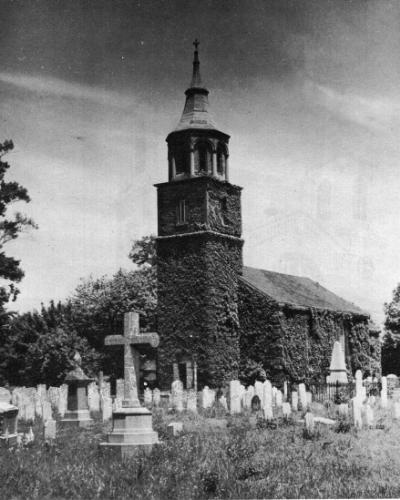
One of the hidden gems of our county is St. Paul’s Church, Eastchester. The church has been within the City of Mt. Vernon since the late 19th century, but was the original town church for Eastchester, situated on the village green. The first church building on the site, a simple wooden structure, was built in 1692. The current structure was built in 1763, with numerous additions and subtractions since that date. (more…)
L’Église de St. Jean Baptiste, New York
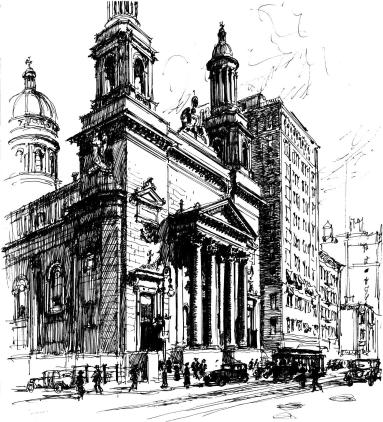
A comment of Mr. Hiss on Fr. Sibley’s blog mentioned the Church of St. Jean Baptiste on the Upper East Side. There are few churches in New York, let alone all America, which are as beautiful as St. Jean Baptiste (or “St. JB’s” as people ridiculously call it). A restoration only a few years ago brought the church back to its full splendour.
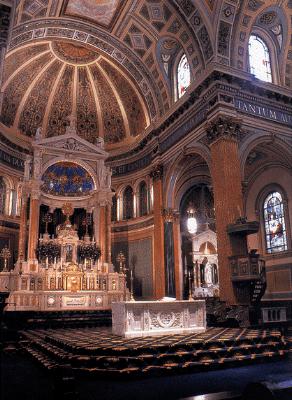
It used to be the national parish of the French Canadians in New York, hence the French name, and is now home to the National Shrine of St. Anne, formerly further downtown in what became St. Anne’s Armenian Catholic Cathedral (one of a few beautiful and very active church buildings being pawned off by the wretched bureaucrats who run the Archdiocese of New York).
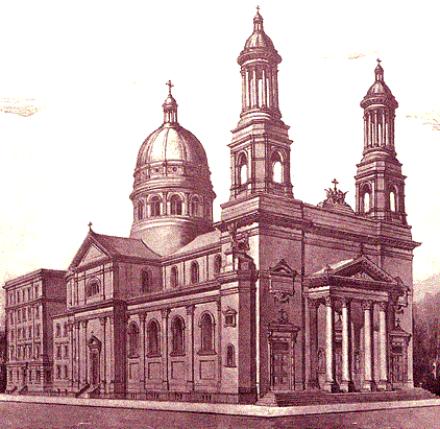
The church is open most of the day and definitely worth stepping into even if you only have a few minutes. Their parish website (link above) has a somewhat detailed history of the parish and the architecture of the church.
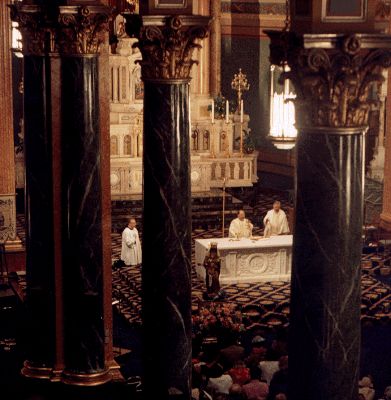
The parish and girls’ high school are now staffed by priests of the Congregation of the Blessed Sacrament as well as sisters from the Congrégation de Notre-Dame, and the Body of Christ is adored all day long except during Mass.
If London Were Like New York
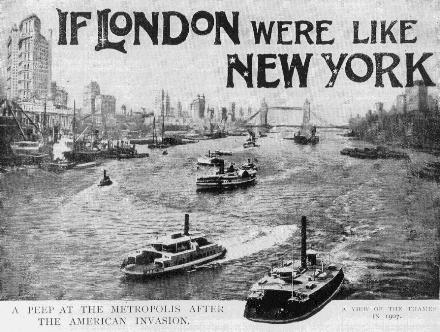
I stumbled upon this rather drole piece from 1902 about the prophesized New-Yorkification of London in Harmsworth’s Magazine. “If London Were Like New York: A Peak At The Metropolis After The American Invasion” is accompanied by some amusing illustrations of the anonymous authors vision of the future.
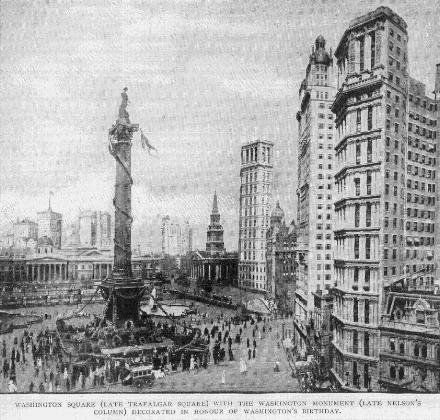
Trafalgar Square is rededicated to George Washington, and decorated to celebrate his birthday.
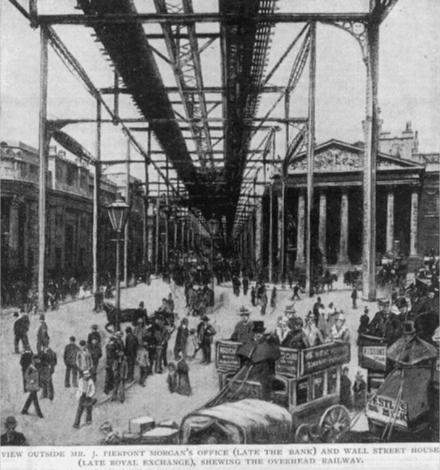
An el is built right through the heart of the City.
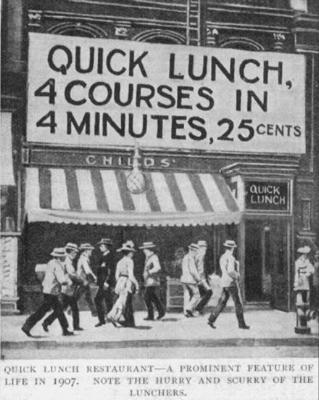
There’s even a precursor of our famous American fast food. Perhaps the most prophetic of the author’s predictions!
Les Halles Will Get a Makeover
For the architectaphiles in the audience, the designs for the complete do-over of les Halles (one of Paris’s urban eyesores) are out.
Le Figaro‘s take on it.
Images of the accepted design and rejected proposals from le Figaro.
The New York Times writes on it as well. (Registration might be required).
Back in Bronxville
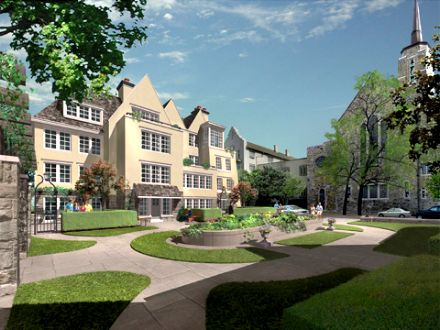
Robert A.M. Stern has apparently designed a proposal for the site of the old Gramatan garage in Bronxville, behind Christ Church. I have to admit that once the garage was torn down I began imagining the possibilities for the site. Christ Church, by Grosvenor Goodhue the Great (responsible for St. Vincent Ferrer and the Cadet Chapel at West Point among others), is such a beautiful building, and Stern’s design deftly fits into the context.
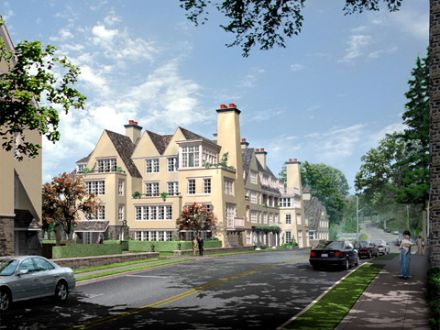
The design is along the lines of the nearby Kensington Gardens and the other courts of townhouses which are dotted around that area and elsewhere in Bronxville. It seems to be an apartment building, probably along the lines of the Avalon building (previously home to Emma, Lilly, and Momma Kate Haberl, and Roger Mahon too), though of a much better design.
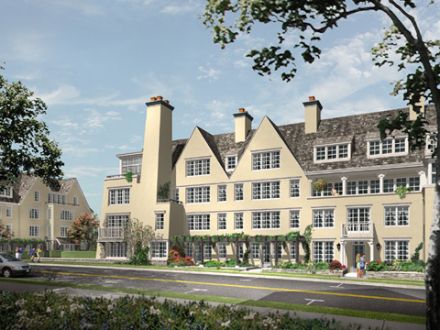
It is, however, a slightly odd mix of buildings that one finds surrounding Christ Church. Immediately to the north are the modern church house and a Spanish Mediterranean building, across Sagamore Road are brick neo-Tudor buildings, and up the road are mock English village structures of the ilk this design emulates. Still, altogether it somehow works, though Christ Church is oddly enough an arts-and-crafts reinterpretation of English Gothic with a Spanish-style courtyard featuring a statue of St. Francis of Assisi. Bizarre, but it all works somehow.
A Good Point
John Lukacs, in his A Student’s Guide to the Study of History, says in a footnote:
This is my essential point about architecture today. If one looks at the actual built quality of buildings by Duncan Stroik or Thomas Gordon Smith, one may appreciate the overall idea or effort but frown upon the execution, call it clumsy or whatnot. The point is that though these people may or may not be masters themselves, they are raising a new generation of architects who are in tune with the past and thus able to more readily plot a future of beauty and mastery. With any luck, within 50-100 years, architecture will have recovered from the uninspiring malaise in which it currently dwells.
The Remarkable Hapsburgs
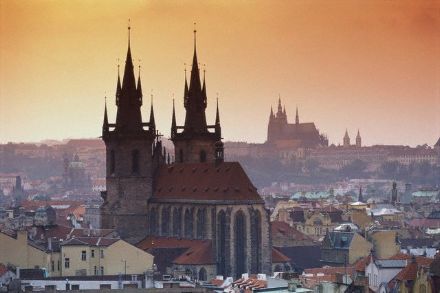
Last night, Fr. Emerson popped up from Edinburgh and gave a talk on the Hapsburg dynasty. It was tremendously interesting. I learned so much I hadn’t known before and it opened up a terrific number of avenues of information down which I have only begun to stroll.
I had no idea how remarkable a man Franz Ferdinand was. All they teach you in America is “This is the guy who got shot” instead of “This man would have been the savior of all that is good and holy in Europe.”
I have seen and read a lot of what Europe is today; Fr. Emerson gave us a glimpse of what Europe was yesterday, before the utter destruction of the social order of the continent by that moment in Sarajevo and everything that came after it. Knowing what Europe was, how depressing to see it now!
It also filled me with some optimism, oddly enough. I used to be partly in the school of thought that’s convinced that Europe is lost. If this is how Europe was, surely it could be again? Perhaps, perhaps not. (more…)
‘New Yorkism’

The latest edition of the City Journal presents a wonderful vision for Hell’s Kitchen, the Manhattan neighborhood which has been slated for a massive redevelopment. The Journal commissioned a number of the world’s leading classicists in the field of architecture to design skyscrapers that fit into the City Planning Commission’s recommendations for the new ‘Hudson Boulevard’ which is planned for the ‘Far West Side’ (the newest catchy rebranding for Hell’s Kitchen since ‘Clinton’ failed to take off).
Dutch Church, Kingston
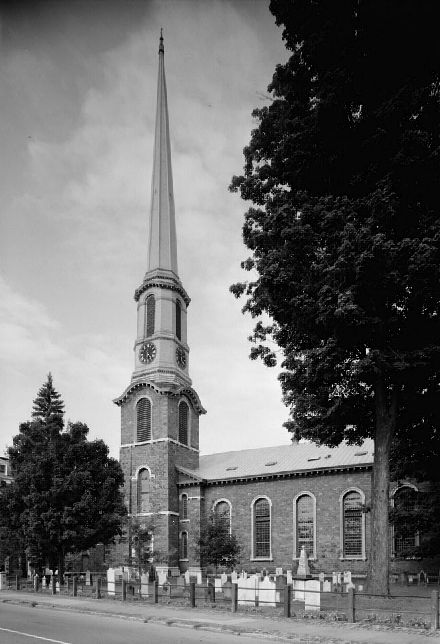
The Dutch Reformed Church in Kingston, New York.
The Maine Monument et cetera
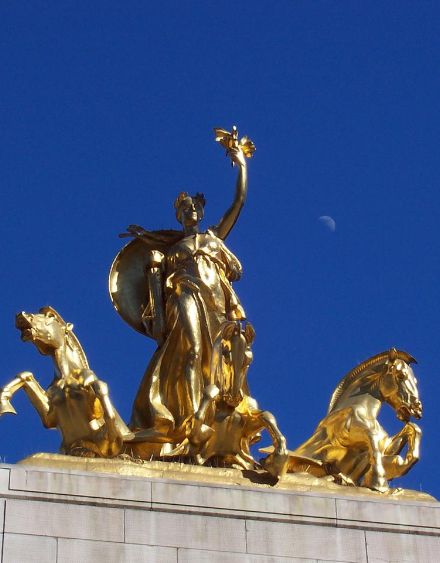
The Maine Monument has always been one of my favourite monuments in New York. It’s dedicated to the dead of the U.S.S. Maine incident and the Spanish-American War. The Monument is beautiful, not only due to its intriguing massing and beautiful sculpted work, but also because its placement in relation to Columbus Circle. It moves upward, encompassed in the lush greenery of Central Park behind it, and the bottom half projects itself forward into the Circle and creates a pleasing visual arrangement.
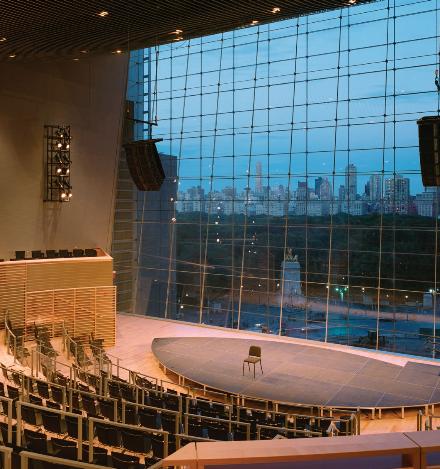
Above, as seen through the window of the Allen Room of the new Frederick P. Rose Hall at the AOL Time Warner Center. According to the review of opening night in the Sun, the Allen Room’s acoustics are amazing, and it looks as if Rose Hall will be an important addition to the cultural world of the City. (Note to Lucas and Adam: pencil this into your schedules).
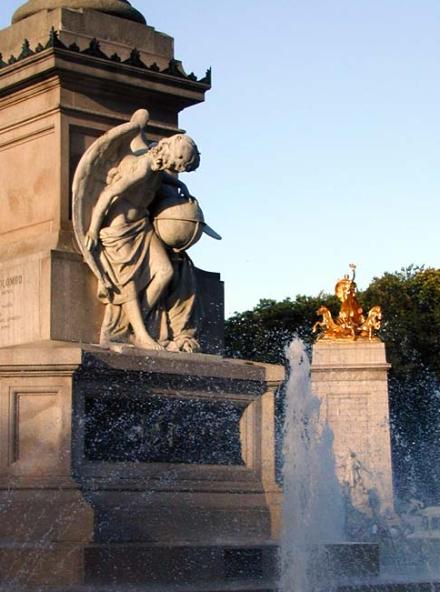
Above the Maine Monument is pictured with the base of the Columbus column in the middle of Columbus Circle. The Circle is currently undergoing a massive refurbishment to try to make it more accesible and parklike rather than just a glorified traffic circle.
Top photo by Corin Anderson
Albany
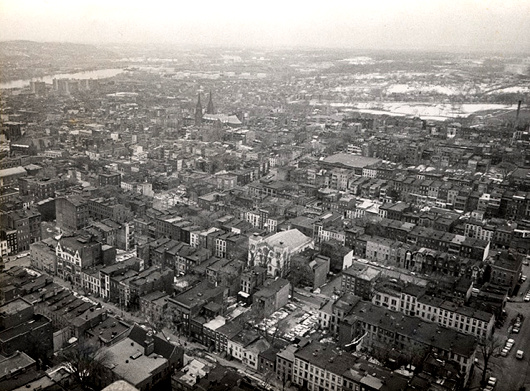
This photo of Albany, the capital of New York, from the 1950s shows a city that, if it weren’t for the straight streets, almost feels like a poverty-stricken Eastern European capital.
Unfortunately, it became even more like a poverty-stricken Eastern European capital when Big Brother decided to get rid of it all and replace it with a giant, heartless, government plaza.
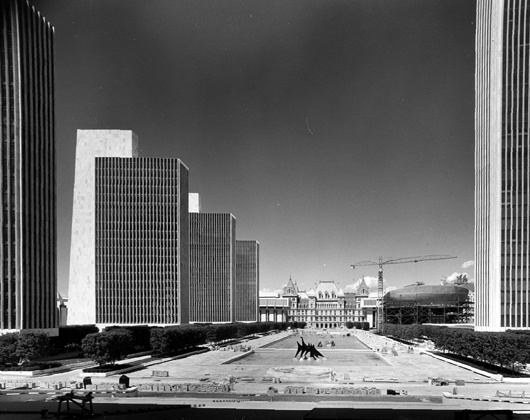
I wonder if Governor Rockefeller visited Brasilia and thought “Gee, I ought to get me one of them!” Empire State Plaza (or Governor Nelson A. Rockefeller Empire State Plaza as it is now officially known) involved the displacement of thousands of poor people, hundreds of small businesses, bad architecture, and the humongous cost – partly owing to the omnipresent use of marble instead of more economic stones.
The result was the destruction of a large community built on a human scale in favor of an expensive, espansive, inhospitable Communist dreamland on the Hudson. A crime.
Brooklyn Borough Hall
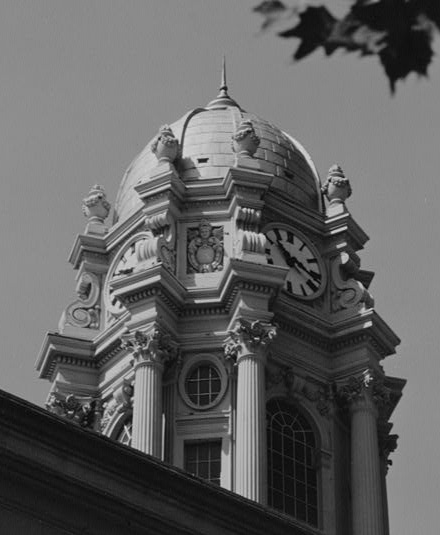
City Hall, now Borough Hall, in Brooklyn, from the Historic American Buildings Survey at the Library of Congress.
Downside
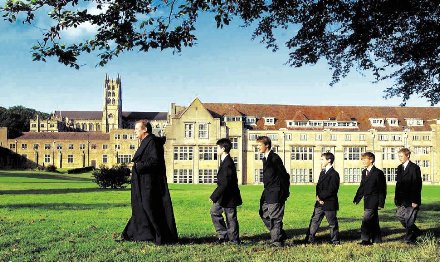
At the drinks party for bejants at Canmore the other night, my mind got wandering to whether there are any basilicas in the United Kingdom.
Rob mentioned the Basilica of Corpus Christi in Manchester, and we thought Westminster Cathedral might be a basilica, but it appears not.
Downside Abbey, however, is the Basilica of Saint Gregory the Great. Above can be seen Dom Antony Sutch, the former head of Downside, who had some very cogent criticisms of Labour education policy.
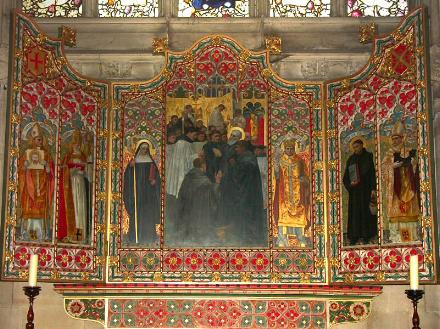
A splendid triptych from this site.

Splendid photo of an old rite mass courtesy of the Latin Mass Society of England and Wales.
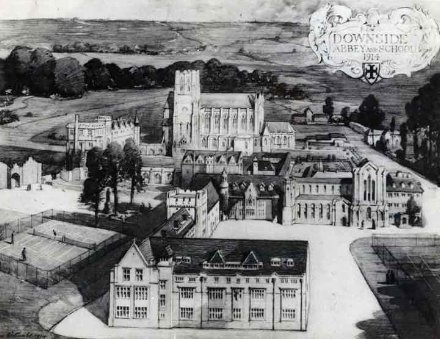
An early view, only partially executed to this plan.
If anyone knows of other British basilicas, do inform us.
Links:
Catholic Encyclopedia article
Official Abbey website
UPDATE: St. Chad’s Cathedral in Birmingham — a work of Pugin — is also a basilica.
The Shrine of the Blessed Sacrament
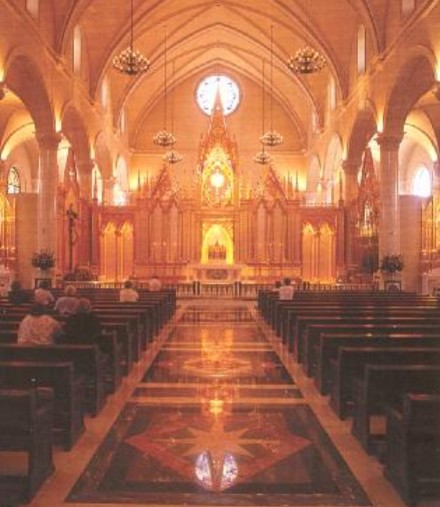
The Shrine of the Blessed Sacrament in Hanceville, Alabama (completed 1999).
NYU – Old & New
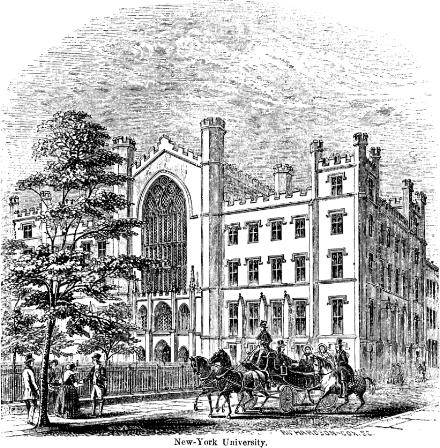
As we all know, New York University is a slighlty scattered urban institution based around Washington Square. It likes to bill itself as “having the city as your campus” which , of course, is a cheap cop-out for not having a real campus. Being ever-progressive, NYU has torn down all their historic buildings such as University Hall (seen above) on Washington Square.
What is not very well known is that New York University, founded as a bourgeois alternative to the then-aristocratic Columbia, decided to build a new university campus in the late 1890’s designed by McKim, Mead, and White. Columbia had just done the same thing, moving from Midtown around St. Patrick’s Cathedral to Morningside Heights, and NYU apparently felt the need to keep up with the Joneses. (more…)
The University Church, Dublin
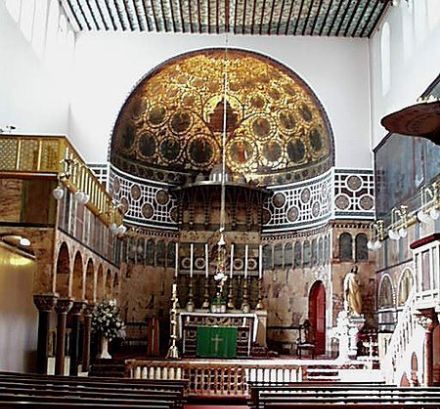
It is said that Newman was not a fan of the gothic revival. When he had this church built for his Catholic University of Ireland in Dublin (since then merged into the Royal University of Ireland which became the National University of Ireland, University College Dublin), he certainly made sure it was über-byzantine. Though beautiful on the inside, it has possibly the least imposing facade of any church I’ve ever seen. Perhaps that adds to its charm.
Going… Going…
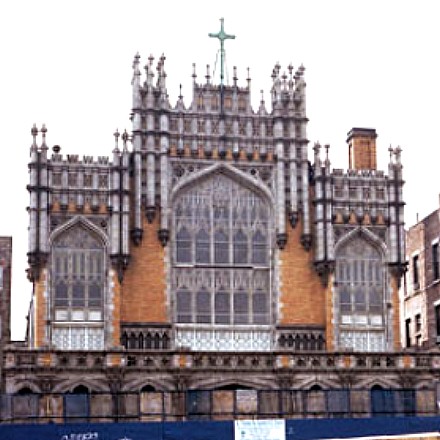
… not yet gone. Cardinal Egan and his abomination squad have begun demolishing the Church of St. Thomas the Apostle in Harlem. St. Thomas is one of New York’s architectural gems, especially known for its perpindicular gothic vaulted ceiling. It has been determined that the stained glass, the worth of which may reach into the millions, cannot be removed, and so will be lost with the rest of the church. The altar is already gone, although in honesty, it was the least attractive feature at St Thomas, a bit frilly.
Preservationist M.H. Adams: The church is “the most significant structure to be destroyed in the city since Penn Station.”
Anti-Abomination.com quips “At least the moneychangers didn’t try to sell the temple.”
Gabriel Meyer, the fourth generation at Mayer of Munich (the firm that made St. Thomas’s windows), told Cardinal Egan in a letter:
But it would seem that Egan’s bureaucracy will trump history, Christian charity, and appreciation for beauty. The property will not be sold, but will be replaced by apartments to bring revenue into the Archdiocesan treasury. Cardinal Egan has done much since he ascended to the episcopal throne of our great metropolis. By this, and many other actions, he has shown his allegiance, and it is not to Christ.
Search
Instagram: @andcusack
Click here for my Instagram photos.Most Recent Posts
- Brunel’s Unbuilt Capitol February 3, 2026
- Cricket at Fordham January 27, 2026
- Palacio Barolo Revisted January 14, 2026
- Learning to Love Liguria January 14, 2026
- Crux Alba No. 2 January 13, 2026
Most Recent Comments
Book Wishlist
Monthly Archives
Categories