Architecture
About Andrew Cusack
 Writer, web designer, etc.; born in New York; educated in Argentina, Scotland, and South Africa; now based in London.
 read more
News
Blogs
Reviews & Periodicals
Arts & Design
World
France
Mitteleuropa
Knickerbockers
Argentina
The Levant
Africa
Cape of Good Hope
Netherlands
Scandinavia
Québec
India
Muscovy
Germany
Academica
The English Tower and Kavanagh Building
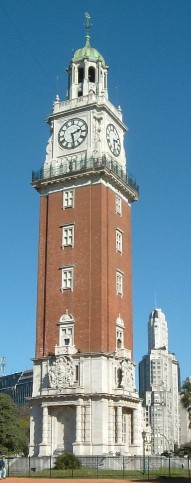 THE SAYING GOES that Argentines are all Italians who speak Spanish and want to be English, which is only just short of the truth. Whatever the quip’s verity, Argentina is a nation of the expatriated and for the centennial year of the 1810 May Revolution, the communities from each of the major mother countries — Spain, Italy, Germany, et cetera — built monuments in dedicated places both to commemorate the contributions their kinsman made to their adopted country as well as to celebrate peace and friendship between Argentina and the given motherland. The Plaza Italia, for example, lamentably bears a monument to the scoundrel Garibaldi, donated by the Italian community.
For their monumental contribution to the city of Buenos Aires, the English built a tower in the Edwardian style, rather cleverly as it was still the Edwardian period, and the depth of their cleverness was furthered by their naming it the English Tower (officially Torre de los Ingleses, or Tower of the English). Situated in the center of the Plaza Britannia (Britannia Square) at the junction of the San Martin and Libertador avenues, the Tower was designed by engineer Ambrose Poynter and built by Hopkins and Gardom completely (except for mortar) out of materials from England. Around the base are sculptural representations of the English rose, the Scottish thistle, the Welsh dragon, and the Irish shamrock. The dedication at the entrance to the Tower reads “Al Gran Pueblo Argentino. Los residentes británicos. Salud. 25 de mayo 1810-1910” or: “To the Great Argentine People, from the British residents: Salud. May 25, 1810-1910″. Towards the rear of the photo to the right you can see the Kavanagh building (Edificio Kavanagh).
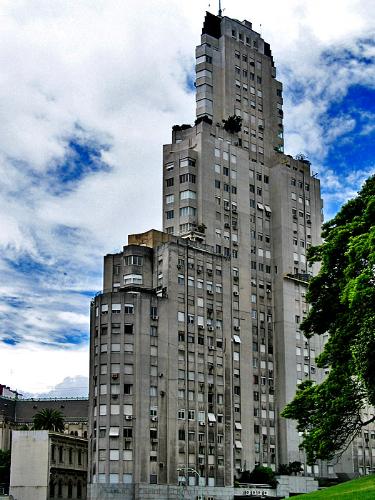
The Kavanagh building is situated on the Plaza San Martin across the avenue from the Plaza Britannia. This 29-storey apartment building was designed by the firm of Sanchez, Lagos, and de la Torre, and was the tallest building in Latin America when built in 1936. The sharp art deco design on an angulated plot is said to resemble a ship at sea, and of course Buenos Aires is a port city — its residents are called porteños after all.
The Kavanagh is unquestionably my favorite ‘modern’ building in Buenos Aires, but then modern architecture has not been kind to the city, at least not in the post-war period (c.f. the National Library). The structures built in the 1950’s were only drab and dull whereas the 60’s and 70’s bore the ill fruits of the ‘lets see how many things we can do with concrete’ trend and tended towards the insidiously hideous rather than the mundane. But no matter however irritating these later obtrusions are, at least Buenos Aires still has the Kavanagh.
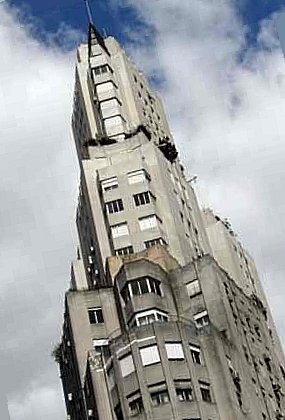
Despite the generations of immigration, investment, interbreeding, and cultural interchange, relations between Argentina and Great Britain were somewhat marred, shall we say, by the shameful attempt by the unhinged wing of the Argentine military to annex the Falklands and rename every geographical feature therein (seriously, I’ve seen the maps). When they were done renaming everything in the Falklands (or ‘Malvinas’ as they would have us believe) the craze apparently spread homewards to the capital. The Plaza Britannia was renamed the Plaza Fuerza Aerea Argentina (from Britannia Square to Argentine Air Force Square), while the Torre de los Ingleses was rechristneed the more ambiguous Torre Monumental. In an even more unfriendly move, the Memorial to the Fallen of the ‘Malvinas’ was built in Plaza San Martin facing the English Tower across the street. In the spirit of peace and friendship, especially regarding two countries which have such deep links as Britain and Argentina, the Memorial really ought to be removed and placed in some other suitable location in the city. Until that time, it remains the Plaza Britannia in my books, and as for the ‘Malvinas’, no such place exists.
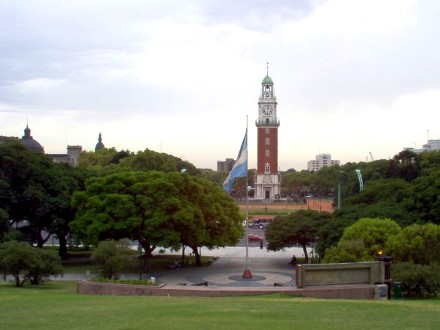
The ‘Malvinas’ memorial viewed from the rear, with the English Tower across the Avenue.
Hypothetical Chicago Church
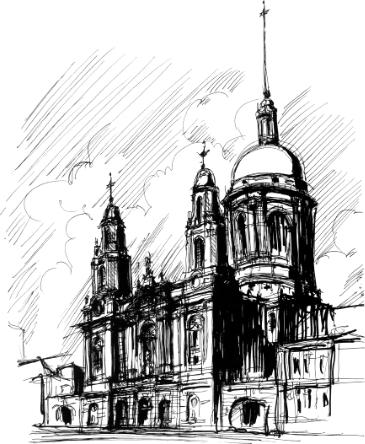
The clever kids over at Notre-Dame have struck again. Matthew Alderman (of Whapping fame) has published his hypothetical proposal for a church online and we thought we’d offer our most humble thoughts and comments upon the design. The Université de Nôtre-Dame du Lac over in South Bend, Indiana has arguably the best school of architecture in the country, if not all the Americas. Taking into account the state of most architecture schools these days, that isn’t saying much, but the School excels at teaching within the Western tradition of building, rather than inculcating the bland and soulless rejection of tradition which is modern architectural theory. You can see examples of the students’ works online at the School’s Student Gallery. (Of the rest, we found Lucas Hafeli’s art-nouveau mini-flatiron intriguing, as well as Erin Dwyer’s ferry terminal, and particularly enjoyed Brad Houston’s splendid arena). (more…)
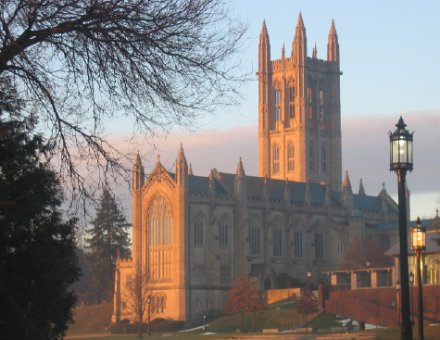
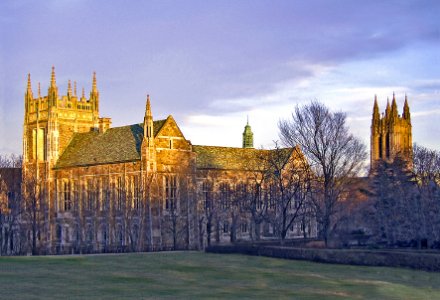
New York & St Andrews
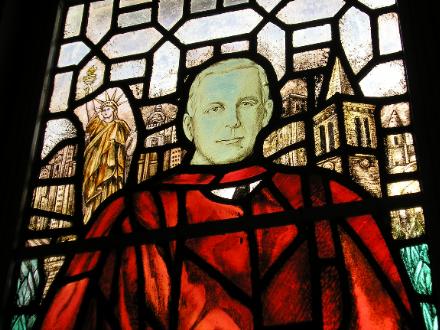
One of the interesting things about living in St. Salvator’s Hall is that one of the beautiful stained-glass windows in our wood-panelled dining hall is dedicated to Edward Harkness, and contains depictions of both the Big Apple and the Auld Gray Toon. Harkness was a benefactor of the University of St Andrews; in fact, he built St. Salvator’s Hall, as well as funding the renovation of the University Chapel (St. Salvator’s) and the restoration of the ruined St. Leonard’s Chapel. (more…)
The Great War Victory Arch
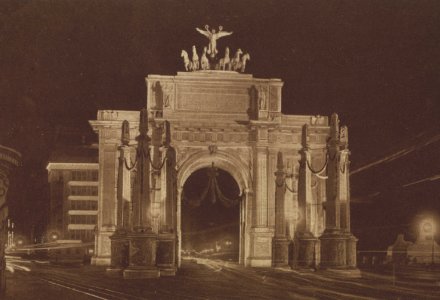
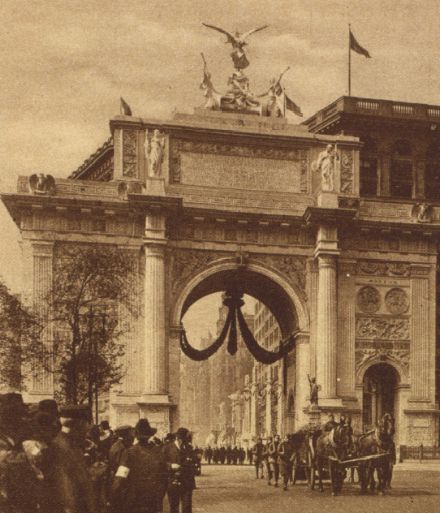
The intersection of Broadway and Madison Avenue sure is the popular place for temporary triumphal arches. After the little shootout with Spain we had a great victory parade and built the Dewey Arch for the triumphant American soldiers and sailors to march under. It also seems that we built a temporary arch for the troops returning from the First World War, photographs of which you can see above and below. The Dewey Arch is more pleasing, if you must know my thoughts upon it, but it’s still rather comely in its own right.
A View of Manhattan
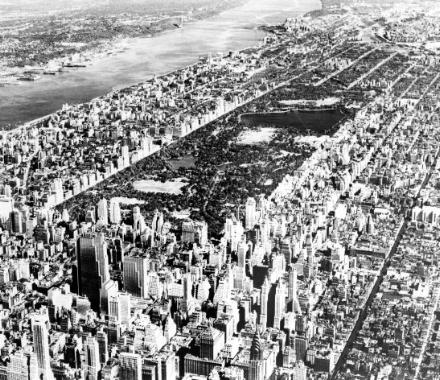
Wasn’t Manhattan more beautiful before the invasion of the glass boxes? I will tolerate Lever House and the U.N.; none further.
The New Shrine from Above
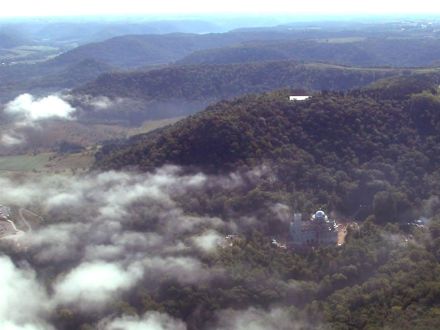
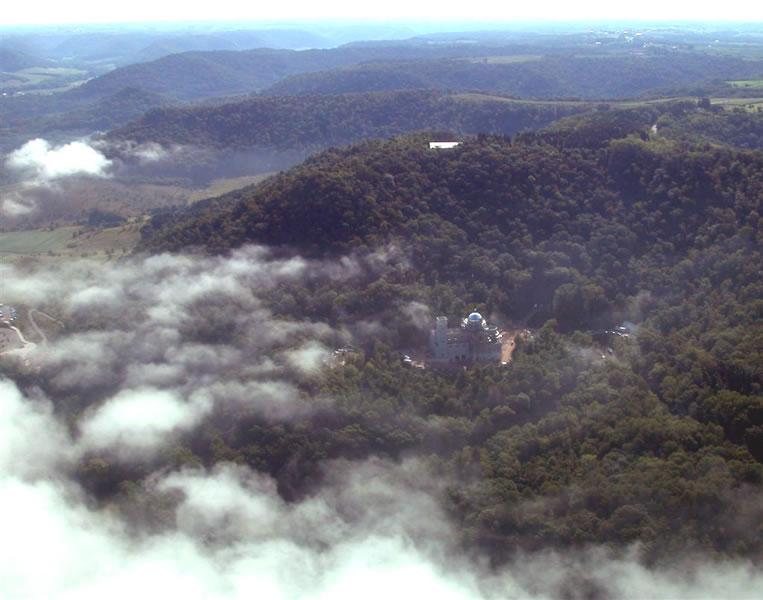
Via the Whapsters, we bring you this rather nifty shot of the Shrine of Our Lady of Guadalupe still under construction in the Diocese of LaCrosse, Wisconsin.
Previously: Patroness of the Americas
A Westchester Country House
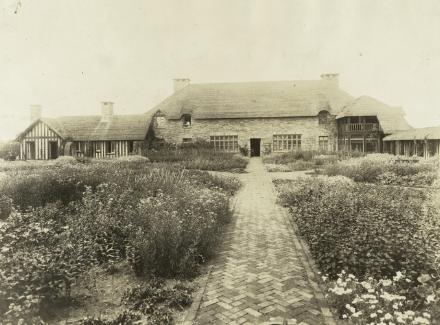
I’ve never heard of nor seen this house before. Unfortunately NYPL titles it merely as “A Westchester County Country House”. Not very helpful. I wonder if it’s still around. I rather like it. It has a nice simple, warm, cozy feel to it.
UPDATE: John Massengale informs us: “This is a house by Harrie T. Lindeberg. There’s a monograph of his work here. I haven’t looked at the book in a long time, but this might be the Stillman house in Pocantico Hills. Stillman was married to a Rockefeller, and the house is on the Rockefeller land there.”
The Church of the Intercession
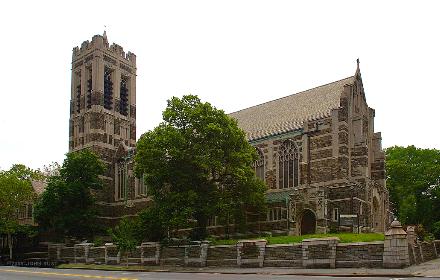
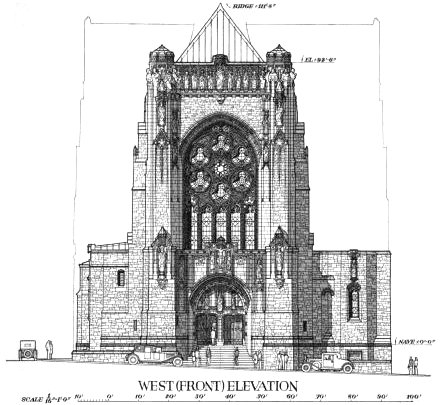
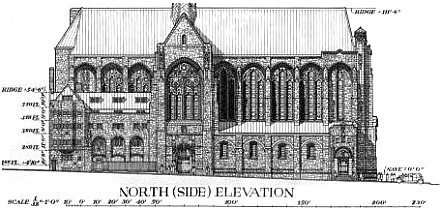
BERTRAM GROSVENOR Goodhue considered the Church of the Intercession at 155th Street and Broadway in New York his masterpiece. Being one of the greatest American architects ever, Goodhue knew what he was talking about, and the Church is undoubtedly one of his best. He was one of the last great American creators, a modern architect working within the great tradition. (Art deco, the style in which Goodhue’s award-winning Nebraska state capitol was built, was perhaps the last style within the tradition until a few post-modernists took their stab at reconnecting with the past). (more…)
Stanford White Palazzo
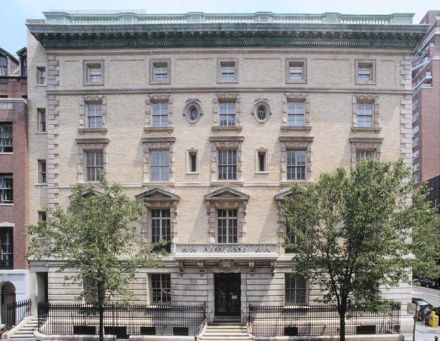
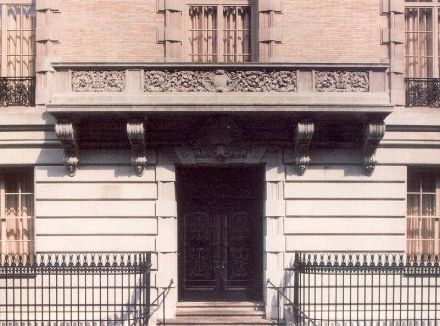
Got $50,000,000 to spare? Why not buy this Stanford White original on East 78th Street in Manhattan? Would be suitable for residence, offices, or club quarters. Even includes balcony from which fearless leader can make inspiring demagogic speeches. Who can resist? Contact Sotheby’s International Realty for details.
A Tower of Tradition in Suffolk
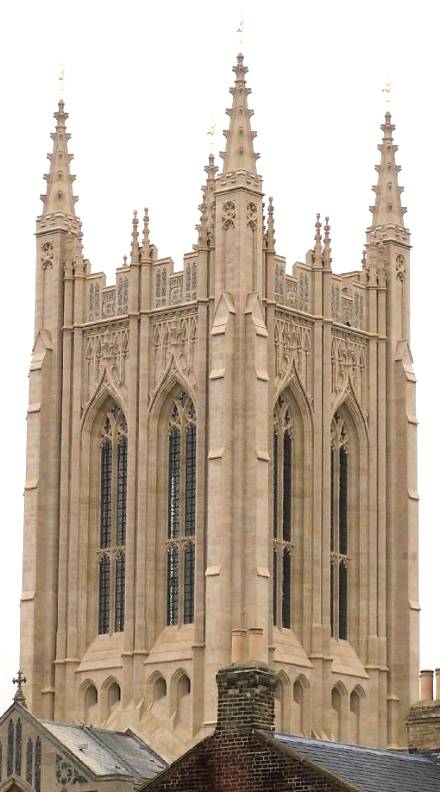
THE LAST UNFINISHED cathedral in the Church of England was finally finished this year with the completion of the crossing tower of St. Edmundsbury Cathedral. The tower was not only designed in the Suffolk perpindicular style but also constructed using traditional techniques. The brick and masonry spire is held together by lime mortar, without an inch of steel or concrete.
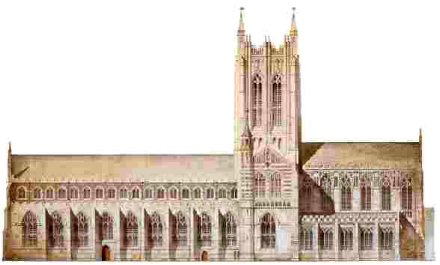
The Cathedral is built on the grounds which still contain the ruins of the great abbey of Bury St Edmunds. The site of the current cathedral has held a church since 1065, completely rebuilt on three or four occasions. The current chancel dated from 1865, while the nave was begun centuries before in 1503. (more…)
A Gothic Abbey in Virginia
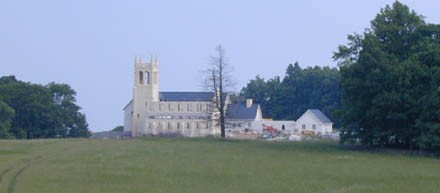
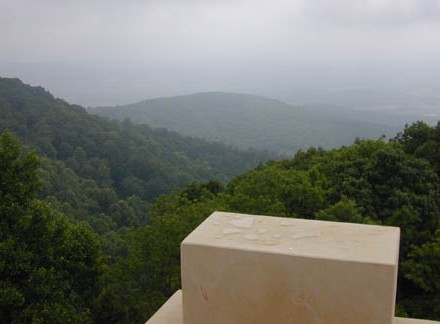
HDB/Cram and Ferguson has designed a Gothic abbey for an apparently schismatic Benedictine congregation in the mists of the Blue Ridge mountains of Virginia. It looks as if it will be very beautiful when finished but, alas, will not be open to the public as these Benedictines seem to greatly value their privacy. See the article, ‘In Virginia, a monastery rises in the mountains‘ (Associated Press, 2004).
Rye Gothic
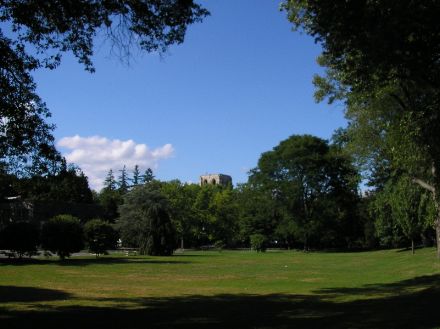
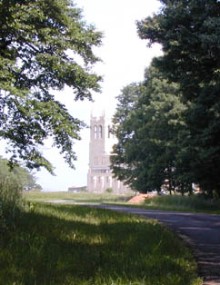
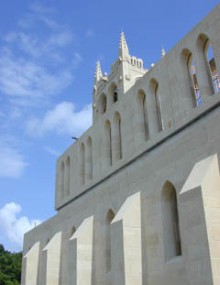
There’s a little portion of Rye on the Boston Post Road here in Westchester which is a veritable Gothic wonderland. From the south it begins on Rye High School’s beautiful campus with the track and playing field across a brook from the neo-Gothic middle and high school buildings, with sympathic additions covered in the same stone. Immediately to the north is the Victorian Gothic Rye Presbyterian Church, built in 1870 by architect Richard Upjohn, whose son and grandson designed two later additions, respectively. Just north of Rye Presbyterian is the Church of the Resurrection, and a little further north of that is Christ’s Church Rye, both of which are in the Gothic style.
The photo above shows the top of the crossing tower of the Church of the Resurrection, a 1930 structure built for Rye’s Catholic parish, viewed from Milton Road. I popped round to the area today and took a few photos, though I did not go inside Resurrection, as there was a wedding taking place. (more…)


The Church of St Agnes
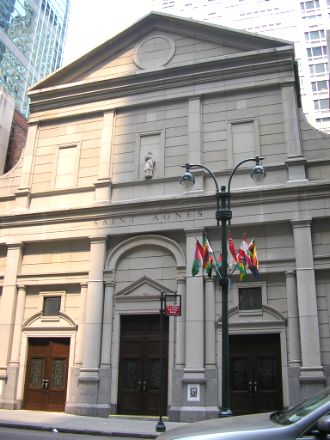
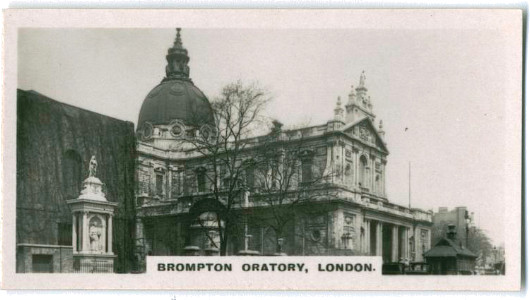
For those who have not seen St Agnes since it was rebuilt in a different style I thought I’d post a few photos I took after the 12:30 mass today. I don’t recall who the architect was; I believe it might be Thomas Gordon Smith. The reason for the vexilla-ed lampost is that East 43rd Street, in addition to being known as “Archbishop Fulton J. Sheen Place”, is also “U.N. Way” since the headquarters of that organisation terminates the vista eastwards. (more…)
Forty-fourth Street
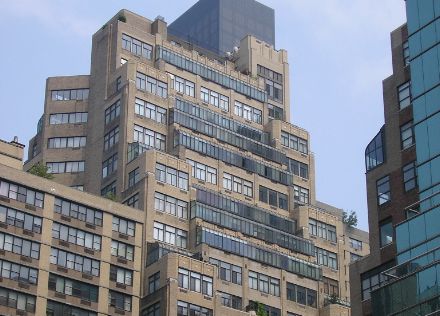
I caught this glimpse of an apartment building on 44th St today, and rather enjoyed the uniform appearance of the glassed-in terraces, later additions I imagine.
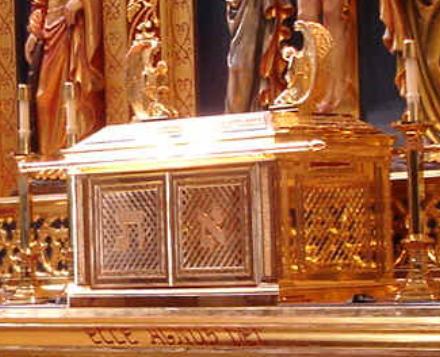
Walsingham Tabernacle

I had not noticed that the tabernacle in the brand new Church of Our Lady of Walsingham in Houston, Texas was a smaller replica of the Ark of the Covenant.
Rather appropriate, considering one of Mary’s titles is ‘Ark of the New Covenant’.
If London Were Like Venice
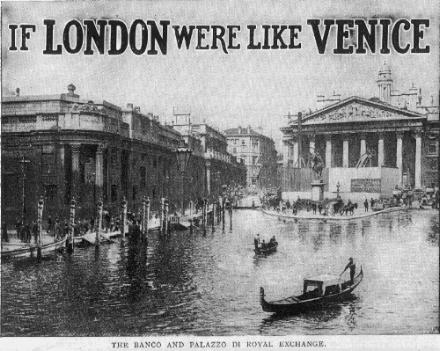
No doubt you remember If London Were Like New York, now we bring you If London Were Like Venice. A rather charming improvement, in my opinion. (more…)
Queens College
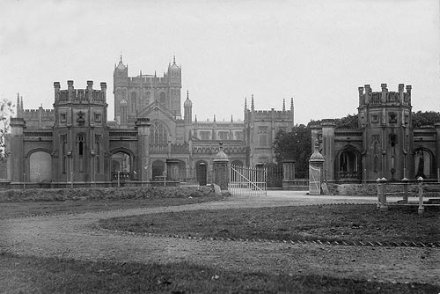
Queens College in Benares, India. Has a rather haunted feel to it in this photo.
Search
Instagram: @andcusack
Click here for my Instagram photos.Most Recent Posts
- Brunel’s Unbuilt Capitol February 3, 2026
- Cricket at Fordham January 27, 2026
- Palacio Barolo Revisted January 14, 2026
- Learning to Love Liguria January 14, 2026
- Crux Alba No. 2 January 13, 2026
Most Recent Comments
Book Wishlist
Monthly Archives
Categories