Architecture
About Andrew Cusack
 Writer, web designer, etc.; born in New York; educated in Argentina, Scotland, and South Africa; now based in London.
 read more
News
Blogs
Reviews & Periodicals
Arts & Design
World
France
Mitteleuropa
Knickerbockers
Argentina
The Levant
Africa
Cape of Good Hope
Netherlands
Scandinavia
Québec
India
Muscovy
Germany
Academica
Canada’s Temporary Commons
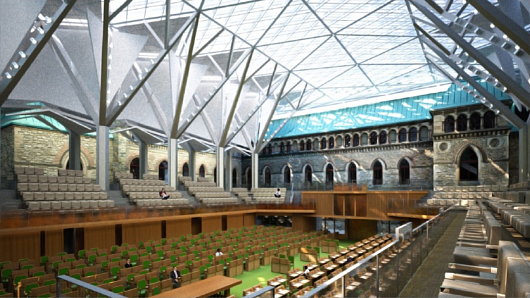
Canada boasts one of the most imposing parliamentary complexes in the world, presiding from a lordly bluff in the federal capital of Ottawa. While I think the city could do with an overall Hausmannisation, the government of the Confederation is undertaking significant efforts to renovate the buildings on Parliament Hill.
While the House of Commons chamber is renovated, the dominion’s lower house will meet in a new temporary chamber (above) constructed in the inner court of the West Block, one of a pair of high Victorian Gothic structures that flank the main parliament building. The restoration will take five to seven years, after which the temporary chamber will be converted into parliamentary committee rooms.
The Commons in the Lords
IT WAS THE NIGHT of 10 May 1941. For nine solid months the Luftwaffe had thrown everything it had at the people of London, as Hitler hoped to bomb the English into despair and surrender. By early May, the Nazis realised the campaign had failed, and resources had to be directed elsewhere. The Blitz had to end, but on its final night, it hit one of its most precious targets. Twelve German bombs hit the Palace of Westminster that night, with an incendiary striking a direct hit at the House of Commons. The locus of Britain’s parliamentary democracy was consumed by flame and completely destroyed. (more…)
The South Kensington Museum
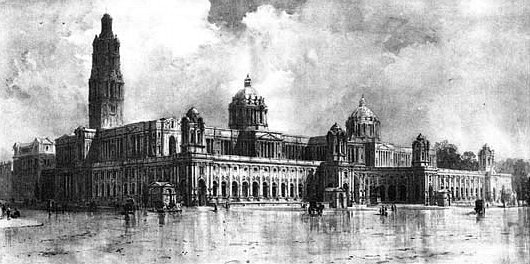
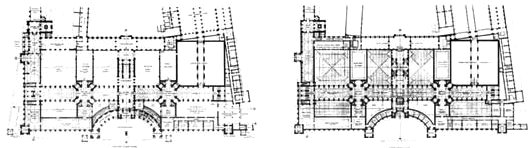
ANOTHER unbuilt project: this time a plan for completing the South Kensington Museum (or the Victoria & Albert as it’s now called) in the part of London which has become known as ‘Albertopolis’. The museum grew incrementally from its first foundation as the Museum of Manufactures after Prince Albert’s Great Exhibition of 1851. 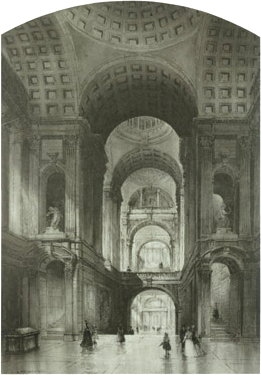 The first design for the museum at its current site was by Gottfried Semper, but the plan was rejected as being too expensive. And so over the years the facilities grew incrementally and according to to haphazard plans. In the 1890s, eight architects were invited to submit proposals for a grand scheme completing the site under a unified architectural plan.
The judges cited this plan, by John Belcher, as the most original of the eight submissions. It’s a splendid composition in high Edwardian neo-baroque. The duality of the main domes is a particular confident touch, and harks back to Greenwich. Belcher’s baroque conception was not just an external factor: his interiors featured vast, sweeping spaces that would have been impressively monumental and reflecting the power and influence of the British Empire at its presumed cultural zenith.
“Although unsuccesful in the competition,” writes Iain Boyd Whyte of Edinburgh University, “this project attracted considerable praise in the professional journals for the plasticity of the main street facade and for its grand, Michelangelesque domes.” While the judges appreciated Belcher’s design, they worried about the cost of its execution, and awarded first prize to Aston Webb instead. His scheme was inaugurated in 1899 by the Queen-Empress, who renamed the institution ‘the Victoria & Albert Museum’ simultaneously.
I wonder if Belcher’s design would have gone better with the neighbouring Brompton Oratory, or if the Oratory benefits from having the V&A in a differing, brick-based style.
The City of Unexpected Charm
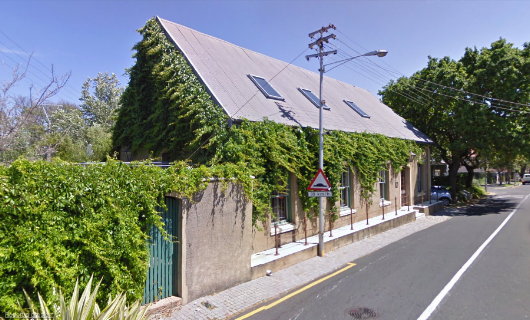
One of the things I like about Cape Town is its continual ability to surprise by throwing up surprisingly handsome buildings in unexpected places. To be honest, there is a great deal of mediocre architecture in the city, though I’d argue Cape Town’s mediocre architecture is better and more humane than, say, New York’s or London’s. But if you keep your eyes open to the world around you as you potter about the Cape, you can stumble across some happy little structures. This little building in Rondebosch is one such example. It sits on Rouwkoop Road, the street which takes its name from the old house that is no more. The N.G. Kerk Rondebosch is just down St Andrews Road one way, and St. Michael’s Catholic Church is just down Rouwkoop Road the other way. (more…)
Napier in the Overberg
NESTLED IN the Overberg, the little town of Napier owes its existence to a dispute between two neighbours. In the earlier part of the nineteenth century, as the little farm villages of the Cape became more firmly settled, the Dutch Reformed synod had to choose which towns were deserving of their own church. In 1833, the congregation in Swellendam decided to build a church further south to meet the needs of its members there, but couldn’t decide between two locations. Michiel van Breda wanted the church sited on his farm, Langefontein, while Pieter Voltelyn van der Byl wanted it built on his property, Klipdrift. Neither van Breda nor van der Byl would give way, so churches were built in both places, the town of Bredasdorp growing around van Breda’s church and the town of Napier founded around van der Byl’s church. (more…)
The Spott Estate, Dunbar
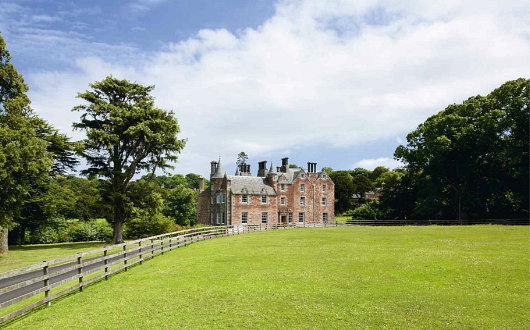
HERE IS A lordly demesne! In East Lothian, thirty-one miles from the centre of Edinburgh and three from the Royal Burgh of Dunbar, sits the Spott House and estate, now on the market from Knight Frank. The property is a whopping 2,463 acres in total, including 1,779 acres of arable land, 214 of pasture, and 356 acres of woodland. The estate has more than quadrupled in size in the past decade, under the ownership of the Danish-born Lars Foghsgaard, who bought just 600 acres in the year 2000.
As The Times wrote of Mr. Foghsgaard, “Clad in tweed jacket, plus fours and Hunter wellingtons, with several brace of partridge in his hand and his labrador at his side, he looks the very image of the country gentleman as he strides though his East Lothian estate.”
“The previous owner was very involved in the land,” Mr. Foghsgaard told the Times. “I am not a farmer, so I employed a farm manager: it’s crucial to have the necessary skills and connections in the area to do the job well, and as a foreigner I did not have those.” But the Dane does enjoy seeing the workings of the farm. “When I walk the dog, I always pass through the cowshed, where we have lambs being born each day — it’s such a joy to see.” (more…)
The Bozen Gate
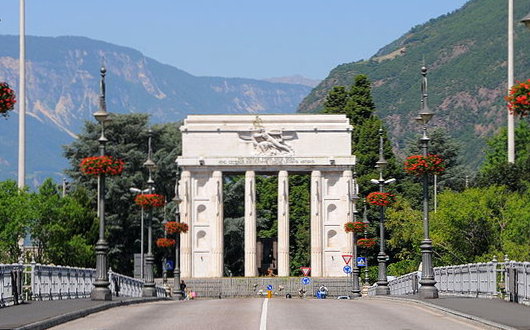
TRIUMPHALISM IN architecture is a double-edged sword. When done properly, it is glorious, like the Arc de Triomphe, standing majestically as avenues radiate forth from the stout, sculpted monument to Napoleon’s victories. The Italian monument at Bozen in Südtirol is the other end of the spectrum. The French emperor was wise enough to construct his triumphal arch in Paris, on his own turf, where it would prove relatively uncontroversial over the span of the years. Mussolini, meanwhile, had this gate celebrating the Italian victories of the First World War in Bozen, the capital of Südtirol, a region whose inhabitants are mostly German-speakers despite it being part of the Italian Republic. While the existence of a monument to Italian victories is acceptable, the placement and nature of this monument is a direct insult to the local population. (more…)
A Tale of Two Piazzas
My good friend Ian Corbin offers what he described to me as “a mere diversion” contrasting the brutality of Boston’s ‘Government Center’ with the beauty of Rome’s Piazza San Pietro.
David Goldblatt: Structures
“THE FIRST GROUP of photographs that I attempted of structures,” writes photographer David Goldblatt, “was a series made in 1961 on places of worship on the Witwatersrand. I came to this from two starting points. The first was a fascination with the idea of faith. Notwithstanding recurrent nightmares during childhood about the infiniteness of everlasting hellfire and uncertainty over the domicile of my unbaptised Jewish soul in the hereafter, arising from an otherwise happy primary school education by nuns, I don’t think I was ever able to believe in or pray to the deity with much conviction — except momentarily under extreme threat of imminent disaster. Neither nuns nor rabbi could ever enable me to transcend the banal with that leap of faith required of true believers. … I was — am — then, generally sceptical of believers’ beliefs but also in awe, and sometimes envious, of their ability to believe. If blind, unreasoning faith often repels me it sometimes moves and always intrigues.”
“Thus it was endlessly mysterious, even incredible to me that people — for the most part ‘ordinary’, ‘practical’ people, probably not much given to abstruse thought and discussion — should pour such effort and resource into the erection of structures devoted to so abstract an idea as God.” The photographer, understandably, doesn’t understand that, for we Christians, God is no less abstract than our father, mother, or neighbour down the street. “The ubiquity and persistence of the phenomenon, the immensity of humankind’s investment in God was to me quite awesome.”
“The second starting point for this early series of photographs of structures was an inchoate but growing awareness that whereas some structures seemed quite detached from this place, the Witwatersrand or, more broadly, South Africa, others grew almost viscerally from it. This seemed to have less to do with architecture than with indefinable qualities of ‘belonging’. I wanted to explore these notions and bring them into the light with the camera.” (more…)
Monument to the Latin Genius
The Palacio Barolo, Avenida de Mayo, Buenos Aires
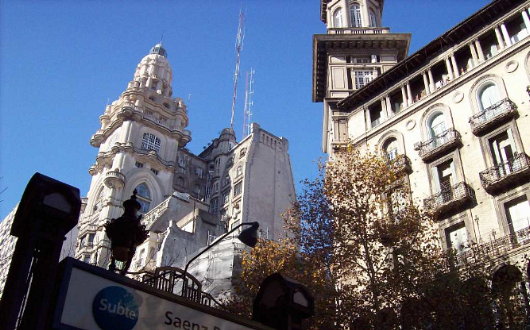
THE PROSPECT WAS horrifying. The year was 1919, and Europe had only just brought to an end an orgy of self-destruction lasting several years. The negotiations to conclude a peace treaty at Versailles were ongoing, but from abroad it looked as if the continent had descended into a trend of violence, decline, and destruction. That year, Luis Barolo, an Italian textiles manufacturer who had immigrated to Argentina, commissioned his fellow-countryman Mario Palanti to design a fascinating and mysterious structure as a monument to “the Latin Genius” Dante Alighieri — a repository in the New World for the poet’s legacy as the continent that gave him birth slid into oblivion. (more…)
An Aldermanian Skyscraper
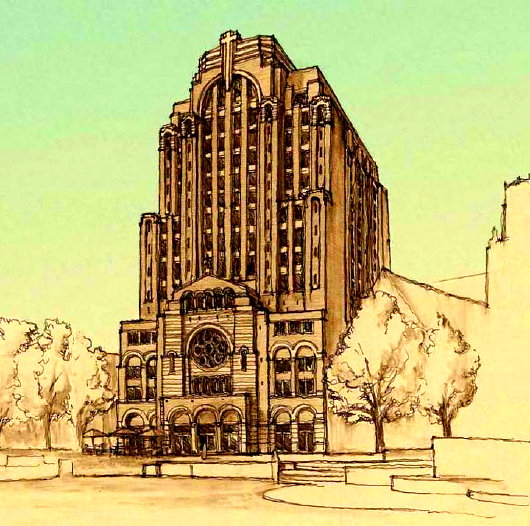
Good news from the Middle West: the Catholic chaplaincy at the University of Wisconsin at Madison announced plans for multi-use, high-rise structure in the city built in a traditional style. Matthew Alderman Studios served as the principal designer for the elevations of the St. Paul University Catholic Center, a 14-storey, $45-million structure in a Romanesque-Deco style that will include a chapel, meeting rooms, and student housing.
“Catholic life in Madison has undergone a remarkable renaissance under Bishop Morlino,” Matt Alderman says, “and St. Paul’s is one of the foundations of this resurgence. I can assert from personal experience that it is really heartening what is going on over there. St. Paul’s is molding a new generation of faithful, responsible, and joyfully serious young Catholics.”
Matt noted that the concept for the St. Paul Center is reminiscent of the skyscraper-church designs mooted during the first half of the twentieth century. In most of those proposals, however, the skyscraper factor tended to overwhelm the ecclesiastical visuality of the overall design. Matt has deftly avoided this in the St. Paul plans: from the perspective of the man on the street, the most prominent part of the façade is obviously ecclesiastical, and the many storeys above flow naturally, but unobtrusively, therefrom.
“It was important to impart an ecclesiastical character to the principal facade while at the same time asserting the building’s mixed-use status. In my own sketches, I drew on the work of Ralph Adams Cram at Christ Church Methodist in New York, a rugged urban ecclesiastical plant with a great deal of dignity and personality, and Bertram Goodhue’s slightly earlier St. Bartholomew’s, just down the street on Park Avenue.”
RDG Design and Planning of Omaha acted as principal architects of record. Matt Alderman is not yet an architect officially — the certification process in America is wisely prolonged — but as a design consultant he’s already serving up enough to whet our appetite. Diocesan chancelleries, parish boards, heck, anyone who wants to build anything: keep this guy in mind!
Ciudad de México
The Greatest City of the Americas
WITH A population of 20,000,000 people, Mexico City is the greatest city in the Americas — Tokyo and Seoul are the only metropolitan areas in the world that can claim a higher count of inhabitants. The old city of Tenochtitlan was founded by the Aztecs in the middle of a lake, 7,000 feet above sea level in 1325. According to legend, Huitzilopochtli — the Zeus or Jupiter of the Aztecs — indicated the site of the new capital through an eagle perched on a cactus with a snake in its beak. The city grew as the Aztec Empire augmented in size and strength, conquering hundreds of smaller surrounding tribes, enslaving their members, and offering their prisoners as human sacrifices. With great ceremony, vast numbers of prisoners were led one-by-one to the summit of the temples, where the priest would carve the living victim’s chest open with a blade of obsidian or jade, remove the still-beating heart and offer it to the appropriate god while the victim’s body was thrown down the steps of the temple. During the re-consecration of the city’s Great Temple in 1487, the Aztecs claim to have sacrificed 80,400 prisoners over the course of four days. It is not hard to imagine the relief of the conquered tribes when their liberation came at the hands of the Spanish. (more…)
A Forgotten Architectural Fantasist
Wilhelm Cornelis Bauer of the Netherlands
Boullée isn’t the only architect known more for the designs never built than for those that were. Wilhelm Cornelis Bauer (1862–1904) was a Dutch architect with a flair for the fantastic. He was born into an aesthetically minded environment in the Hague, where his father ran an interior decoration firm; his brother, the painter and engraver Marius Bauer, is better known. W.C. Bauer (sometimes known as Willem) studied at the Craft School before heading to the Royal Academy of Visual Arts and became involved in the circle of Dutch architects that included Berlage, Walenkamp, Kromhout and others.
Bauer had a very high opinion of himself, being convinced of his own genius, which often brought him into conflict with others, including potential patrons. The buildings of his that were constructed (such as a handful of houses in Bussum) were within the reasonable bounds of the Dutch contemporary vernacular, but Bauer was an inveterate dreamer with elaborate visions. Architectural competitions proved a perpetual draw, and while Bauer’s designs were often commended as highly artistic they usual brought simultaneous comments about impracticability. (more…)
Preservation is Not Enough
A Proposal for Enhancement
IT IS COMMONLY said of St Andrews that it is a place of beauty. This is often a compliment to its natural setting, with open skies arcing over the reaches of the bay, and ancient rock and cliff yielding to the changing rhythms of the waves. At the same time visitors are generally struck by the pleasing combination of natural and built environments: the ruined grandeur of the Cathedral and Priory standing bare to the elements; crowstep-gabled cottages gathered in against the wind; the broad thoroughfares interlinked with narrow cobbled lanes; and the church towers etched against the sky. There is also the scholarly dignity of Deans Court, the quizzical posture of the Roundel, the charm of the courtyards to the south of South Street, the sad ruination of Blackfriars juxtaposed with the aspiring frontage of Madras College, and other evocative sights besides.
Here and there within the midst of all of this stands, physically, historically, and socially, the University. Its contributions to the architectural distinction of the old town are obvious enough. They are, principally, the harmonious South Street complex of St Mary’s College (1593-41) to the west, Parliament Hall (1612-43) to the north, and the Library extension (1889-1959) – now the Psychology wing – to the east; and the North Street set of the Collegiate Church of St Salvator, Gate Tower and tenement (1450-60), and beyond it the west block (1683-90) containing the Hebdomadar’s Room, and to the east and north the College buildings (1829-31 and 1845-6, respectively). There are other smaller and oft-reworked jewels associated within the University: St John’s House in South Street (15th, 17th, 18th, 19th, and 20th centuries), St Leonard’s Chapel (remodelled c. 1512), and the ‘Admirable Crichton’s House’ (16th century), but the principal architectural benefactions of the University to the town are the North and South Street college complexes. I have not mentioned the Younger Graduation Hall (1923-9) and the Student Union (1972) and prefer to leave it for readers to determine what might be said of these.
It could hardly have passed unnoticed that the list of contributions dates mostly from the late middle-ages to the nineteenth century, and this fact raises two questions: first, whether in the second half of the twentieth century the University was sufficiently attentive to its role as principal architectural patron; and second, how it might now hope to enhance the built environment of St Andrews. (more…)
Fellowes Prynne in Johannesburg
A Rejected Proposal for St. Mary’s Anglican Church
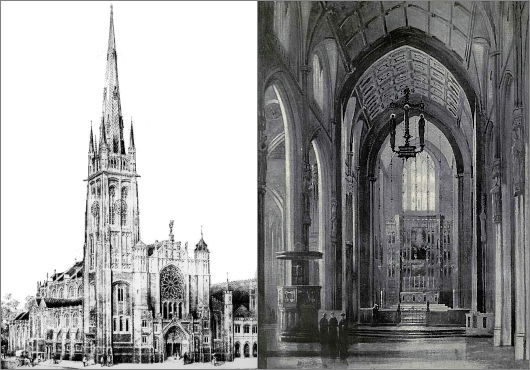
We rarely mention Johannesburg on this little corner of the web because our mother taught us that if you don’t have anything nice to say, don’t say anything at all. While ruffling through the archives the other day, however, I came across this design for the Johannesburg cathedral of the Church of the Province of South Africa. George Halford Fellowes Prynne (1853–1927) was an accomplished Gothic architect whose work is mostly found in the south of England. He’s notable for his rood screens in particular, worked in a variety of forms and materials (wood, stone, and metal), though this design employs a hanging rood. (more…)
Unbuilt St. Thomas
Lord & Hewlett’s Competition Entry for the Church of St. Thomas
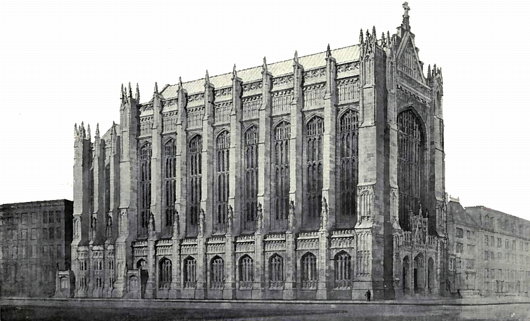
THE CHURCH OF Saint Thomas on the corner of Fifty-third Street and Fifth Avenue in New York is one of the artistic gems of the city: both as an architectural marvel designed by Ralph Adams Cram & Bertram Grosvenor Goodhue and as a musical paradise with its renowned choir of men & boys formerly under the tutelage of Gerre Hancock. (It’s foolish for anyone in the city during Advent to miss the Service of Lessons & Carols). The parish of the Episcopal Diocese of New York was established in 1834, and its first building was erected in the Gothic style on the corner of Broadway and Houston.
In 1870, after that neck of the woods became less fashionable, the congregation moved to its current location at 53rd & Fifth, to a new Gothic edifice by Richard Upjohn. That church hosted the marriage of Consuelo Vanderbilt to the 9th Duke of Marlborough. When it burned down in 1905, a competition was held to select the design of the new Church of St. Thomas, then perhaps at the peak of its high social status among Manhattan’s Protestant congregations. (more…)
The East Neuk of Fife
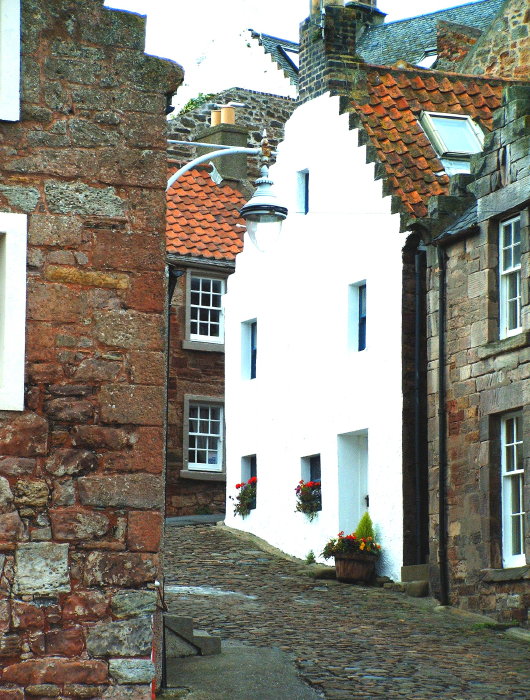
THE 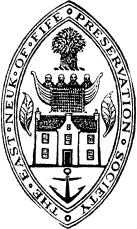 EAST NEUK of Fife is one of my favourite little corners of the globe, in what is definitely my favourite country in the world. Here are a set of almost unspoilt little fishing villages with a quite localised architectural style that makes them instantly recognisable. The name of this little regionlet signifies its location as the east ‘nook’ of the Kingdom of Fife, that juts out into the North Sea.
Those concerned for this part of the world might be interested in signing up for the East Neuk of Fife Preservation Society, which has completed admirable work all over the East Neuk, and is currently considering the restoration of the gatehouse of Pittenweem Priory.
The Lion’s Gate
VISITORS TO CAPE TOWN may be surprised that, given the beauty and multiplicity of animals in the vicinity, the ‘Mother City’ has no zoo. There is actually a popular zoo at Tygerberg, twenty-four miles from Cape Town and less than ten miles from Stellenbosch, which is the only zoo in the province. But centuries ago — around 1700 — a ‘menagerie’ was founded in the Company’s Gardens in Cape Town which survived for over a hundred years.
François Valentijn, in his visit of 1714, noted the menagerie boasted a pair of ‘rheen’ or ‘rheebokken’ (probably kudu), a black rhinoceros, an eland, a ‘rossen bok’ (possibly a hartebeest), a hippopotamus, two lions, and a zebra. In the 1770s, the Swede Anders Sparrman noted the presence of many springbok, a warthog, some ostriches, and even a cassowary. The selection varied widely through the years, and given Cape Town’s status as ‘The Tavern of the Seas’ central to the European route to the Indies and the Far East, the zoo included not only African beasts but also some (like the Papuan cassowary) brought from the Orient.
In 1777, the notorious rake William Hickey ventured to extoll it as “the finest menagerie in the world, in which are collected the most extraordinary animals and birds of every quarter of the globe”. Less than fifteen years later, however, Lt. George Tobin of the Royal Navy described it as “a menagerie of some extent. It was but poorly supplied, there being but a few ostriches and some different kinds of deer.” Decades later, in February 1825, a traveller noted the menagerie in the pages of the Montly Magazine of London:
At the end of the Grand Walk, which is nearly three-quarters of a mile long, is the Company’s Menagerie, which is worth seeing, on account of a good-natured old lion, supposed to be the largest ever taken into captivity, and a tiger of immense size and power; there are several other specimens of African animals: but those are infinitely the largest of their species I ever saw—we have nothing that comes near them in England.
A spiritually inclined passer-through, the Rev. Henry Martyn, Chaplain to the Honourable East India Company, stated in 1832 that the “lion and a lioness, amongst the beasts, and the ostrich, led my thoughts very strongly to admire and glorify the power of the great Creator.” It was around that time that Sir Benjamin d’Urban, Governor of the Cape, granted land next to the menagerie for the erection of a building for the South African College, the germ of what would become the University of Cape Town. This was the beginning of what is now called the Hiddingh campus of UCT, the institution’s first home which continues alongside the main campus built on the Rhodes estate on the slopes of Devil’s Peak. The menagerie was shut in 1838 and the first building of the proto-UCT went up the next year in an exotic Egyptian Revival style.
The lion gates, however, are from earlier. They were built in 1805, probably by Thibault, with the lions & lionesses sculpted by the architect’s frequent collaborator Anton Anreith, also responsible for the magnificent pulpit in the Groote Kerk. The lionesses on the UCT side are original but the lions on the other side, curiously, were removed in 1873. In 1958 they were restored when Ivan Mitford-Barberton — arguably South Africa’s greatest sculptor after Anreith — created new beasts for the old perches. The gates are still there if you walk up the Government Avenue that bisects the Company’s Gardens, beautiful in the eye of this beholder in their immaculate, white, classical elegance.
Interesting Things Elsewhere
This determined Celt is gunning for Thabo
Kevin Bloom | The Daily Maverick
Ireland’s 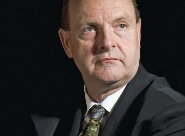 Paul O’Sullivan took over as head of security at South Africa’s airport authority in 2001, and discovered something was wrong from the start: why didn’t the policeman on duty want to take a statement about the attempted theft of his baggage? Since then, his life has been a series of bizarre events leading him ever deeper into the most complex criminal network of the post-apartheid era, including the recent the trial and conviction of former national police chief Jackie Selebi. But O’Sullivan’s determined quest to expose crookedness isn’t over yet, and he now has former president Thabo Mbeki in his sights. read more
The apparatus of state will simply ignore the government
‘Inspector Gadget’ | Police Inspector Blog
Police across England were told by the responsible minister of the democratically elected government that they must not chase performance targets any longer. “I can also announce today that I am also scrapping the confidence target,” said the Home Secretary, Theresa May, “and the policing pledge with immediate effect”. But the ‘senior management team’ of the West Yorkshire Police have stated they will go on no matter what the government says. read more
Has Christian Democracy reached a dead end?
Jan-Werner Mueller | Guardian.co.uk
The commentator completes a brief survey of the struggles of Christian Democracy in Germany and Europe today. The French leader Georges Bidault claimed that Christian Democracy meant “to govern in the centre, and pursue, by the methods of the right, the policies of the left”. But Christian Democracy’s brief French moment in the 1950s didn’t survive the return of de Gaulle, and Christian Democratic parties on the continent today face an existential crisis. read more
Also: Monsignor Ignacio Barreiro’s talk at the Roman Forum’s 2010 Summer Symposium, entitled The Problem of Christian Democracy will be made available online in audio form sometime in the coming months.
Deep in Shanxi, the most Catholic village in China
Anthony E. Clark | Ignatius Insight
Church after church dot the landscape and high steeples rise above small villages as they do in southern France. Passing through a narrow side road one arrives and is welcomed by three great statues at the village entrance: St. Peter holding his keys is flanked by Saints Simon and Paul. Thirty minutes before Mass the village loudspeakers, once airing the revolutionary voice of Mao and Party slogans, now broadcasts the rosary. Welcome to Liuhecun, the most Catholic village in China. read more
Look for me in the Cotswolds.
Dino Marcantonio
The apologists for modernist architecture have tried for a century to gain public acceptance of and appreciation for their horrors. While the elites have almost overwhelmingly been converted, the general populace around the world still sees that the Emperor has no clothes, and almost always prefers architecture that reflects the tried and true, the local and the natural. Alain de Botton, the Swiss essayist, ‘pop philosopher’, and former ‘writer-in-residence’ at Heathrow Airport, is the latest to give it a go, this time in the pages of the modernist Architectural Record. Dino Marcantonio provides a most useful fisking. read more
Canada is a French country
Andrew Coyne | Maclean’s
At the recent Canada Day celebrations on Parliament Hill, Canadian PM Stephen Harper spoke of “the steadfast determination and continental ambition of our French pioneers, who were the first to call themselves ‘Canadians.’” At other times he has spoken of Canada as having been “born in French,” of French as “Canada’s first language,” and, most famously, of Quebec City as “Canada’s first city,” its founding in 1608 as marking “the founding of the Canadian state.” While the sentiment may seen anodyne, moreover, the implications are radical. read more
A School Chapel on Long Island
St. Anthony’s High School, South Huntington, L.I.
“I have a general disgust for Catholic architecture since the 1950s,” says Brother Gary Cregan, the Franciscan friar who is principal of St. Anthony’s High School in South Huntington. The friar was quoted by the once-great New York Times in a 2008 article on the new chapel built by the Catholic school on Long Island, recently featured on the NLM blog. The Franciscans, according to the Times, “believe that the new chapel, with its soaring 30-foot ceilings, will teach teenagers that they are ‘worshiping God, not each other.'” Many of the chapel’s furnishings were bargain finds on eBay including the confessionals, the pews, a 110-year-old stained-glass window, and a century-old statue of St. Anthony. A new bell for the chapel’s tower would’ve cost $20,000, but Brother Gary (or “Mr. Cregan” as the newspaper referred to him) found an old one for $4,000. (more…)
Search
Instagram: @andcusack
Click here for my Instagram photos.Most Recent Posts
- Brunel’s Unbuilt Capitol February 3, 2026
- Cricket at Fordham January 27, 2026
- Palacio Barolo Revisted January 14, 2026
- Learning to Love Liguria January 14, 2026
- Crux Alba No. 2 January 13, 2026
Most Recent Comments
Book Wishlist
Monthly Archives
Categories