Architecture
About Andrew Cusack
 Writer, web designer, etc.; born in New York; educated in Argentina, Scotland, and South Africa; now based in London.
 read more
News
Blogs
Reviews & Periodicals
Arts & Design
World
France
Mitteleuropa
Knickerbockers
Argentina
The Levant
Africa
Cape of Good Hope
Netherlands
Scandinavia
Québec
India
Muscovy
Germany
Academica
Brunel’s Unbuilt Capitol
Marc Isambard Brunel was raised in the ambience of the late ‘Enlightenment’ just as the cold yet optimistic certainties it proclaimed were descending into bloodshed and terror. Born in Normandy in 1769, Brunel père (we should distinguish him from his illustrious son) was originally destined for the priesthood.
Instead, he joined the French navy and served on a corvette that took him as far as the West Indies. By the time his ship returned in 1792 and its officers and men were paid off, the kingdom was in tumult.
Ostensibly, France was intoxicated by reason, mechanics, and geometry: the idea that society itself might be rationally engineered was only on the cusp of being discredited by the horrors of the French Revolution.
Brunel was living in Rouen but in January 1793, while Louis XVI was on trial for his life, he made a visit to Paris. An astute observer of human affairs, Marc was unwise enough to enunciate his — accurate, it turned out — prediction that Robespierre and his gang would soon meet a bloody downfall. His comments were reported to the network of spies serving the Terror, leaving Brunel a marked man.
He returned to Rouen and lived in some level of danger until he finally managed to obtain an exit permit from the revolutionary authorities. On 7 July 1793 he boarded a ship that arrived in New York harbour on 6 September.
The United States of America offered safety, novelty, and the promise (perhaps exaggerated) that talent alone might be all a young engineer needed to succeed. Marc Isambard Brunel taught drawing, proposed inventions, advised on naval matters, and tried (with some limited success) to attach himself to government patronage. He was restless, ambitious, and acutely aware that the republic was inventing itself in real time.
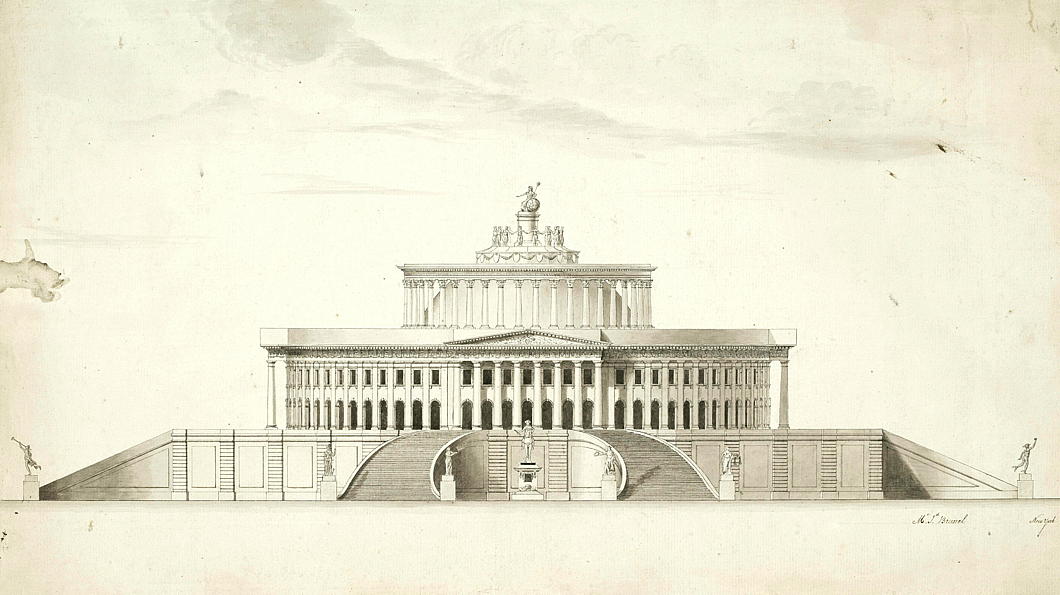
Just before Brunel’s arrival in America, the government put out a request for proposals for a permanent legislative building in the new federal city on the banks of the Potomac. Though the final schemes were already being worked upon, Brunel nonetheless decided to create his own proposal.
Washington in the 1790s was not yet the city of neoclassical monuments we know today — it was barely a city at all at that point — and the architectural language of the young nation had not yet been settled. Republican symbolism was valued, but no one quite agreed how it should look. The Atlantic colonies, in their domestic and public architecture, inherited a style of classicism from England that had developed into its own distinctive Anglo-American tradition.
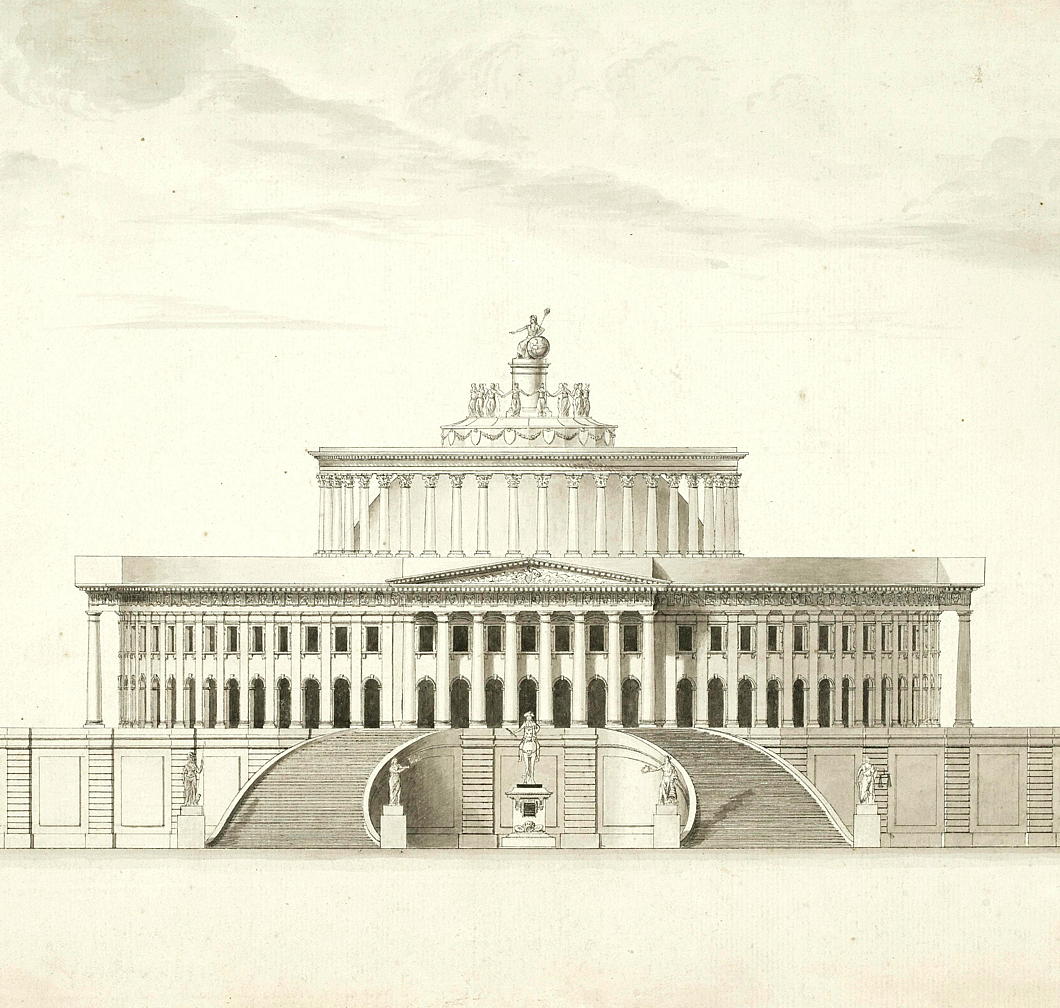
Into this uncertainty, Brunel offered a proposal that introduced something much more European. His proposal — only known to us through this sole surviving rendering later descriptions — centred on a vast circular form, a single dominant geometry intended to enclose the government within one unified space.
This was not the classicism of America’s recognised tradition but something else entirely. It owed little to the Georgian and less to Palladio. Its lineage ran instead through the paper architecture of Étienne-Louis Boullée, and, at an arm’s length, the built legacy of Claude-Nicolas Ledoux.
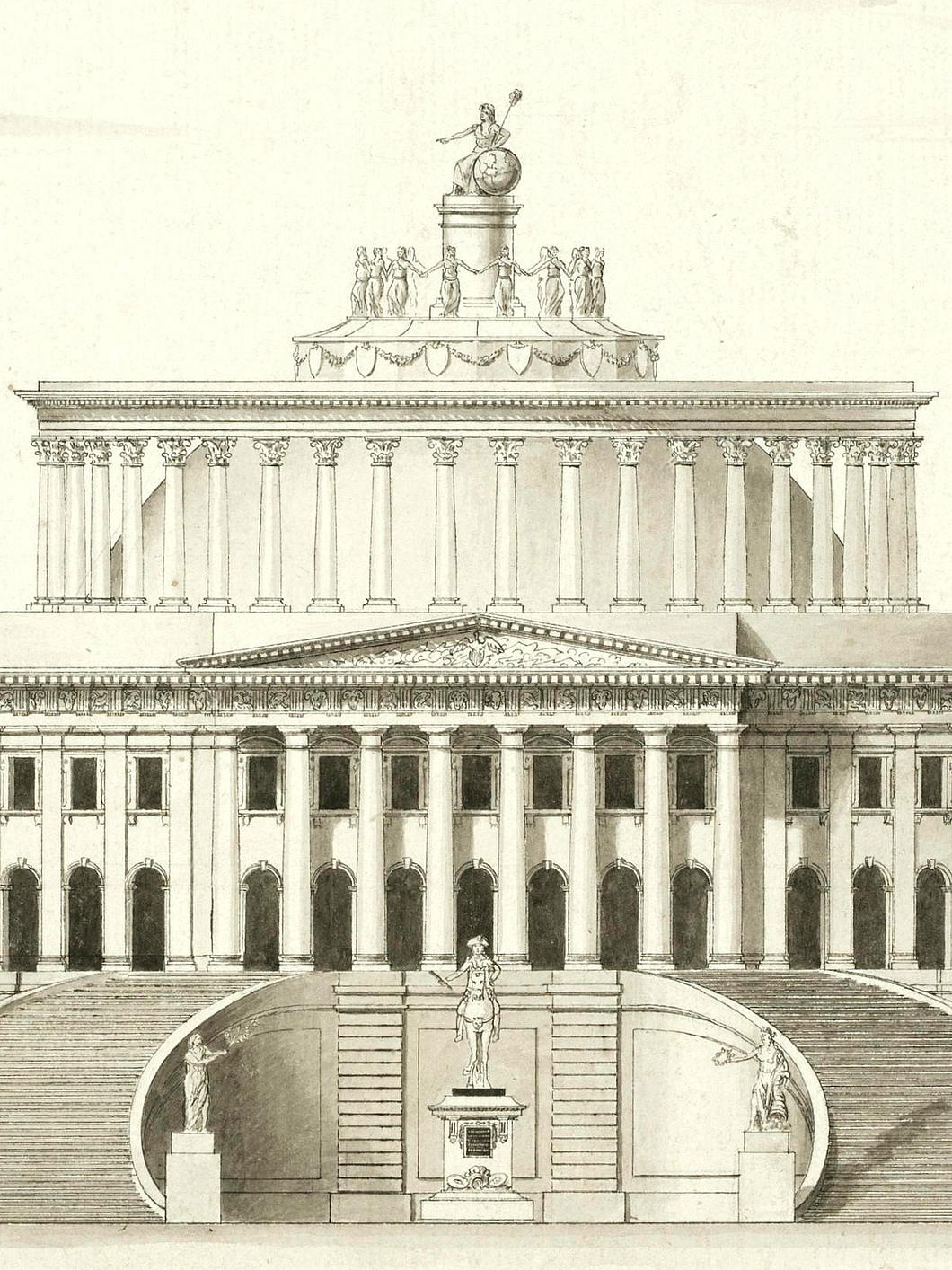
The influence is not subtle. Boullée’s great obsession was pure form — spheres, cubes, cylinders — deployed at overwhelming scale and laden with moral meaning. For Boullée, geometry was not decorative but ethical. The sphere promised unity, order, and universality. Brunel’s Capitol sits entirely within this tradition.
Without any surviving plans of the project we have no idea how Brunel proposed to arrange the House and Senate chambers and other aspects of the interior.
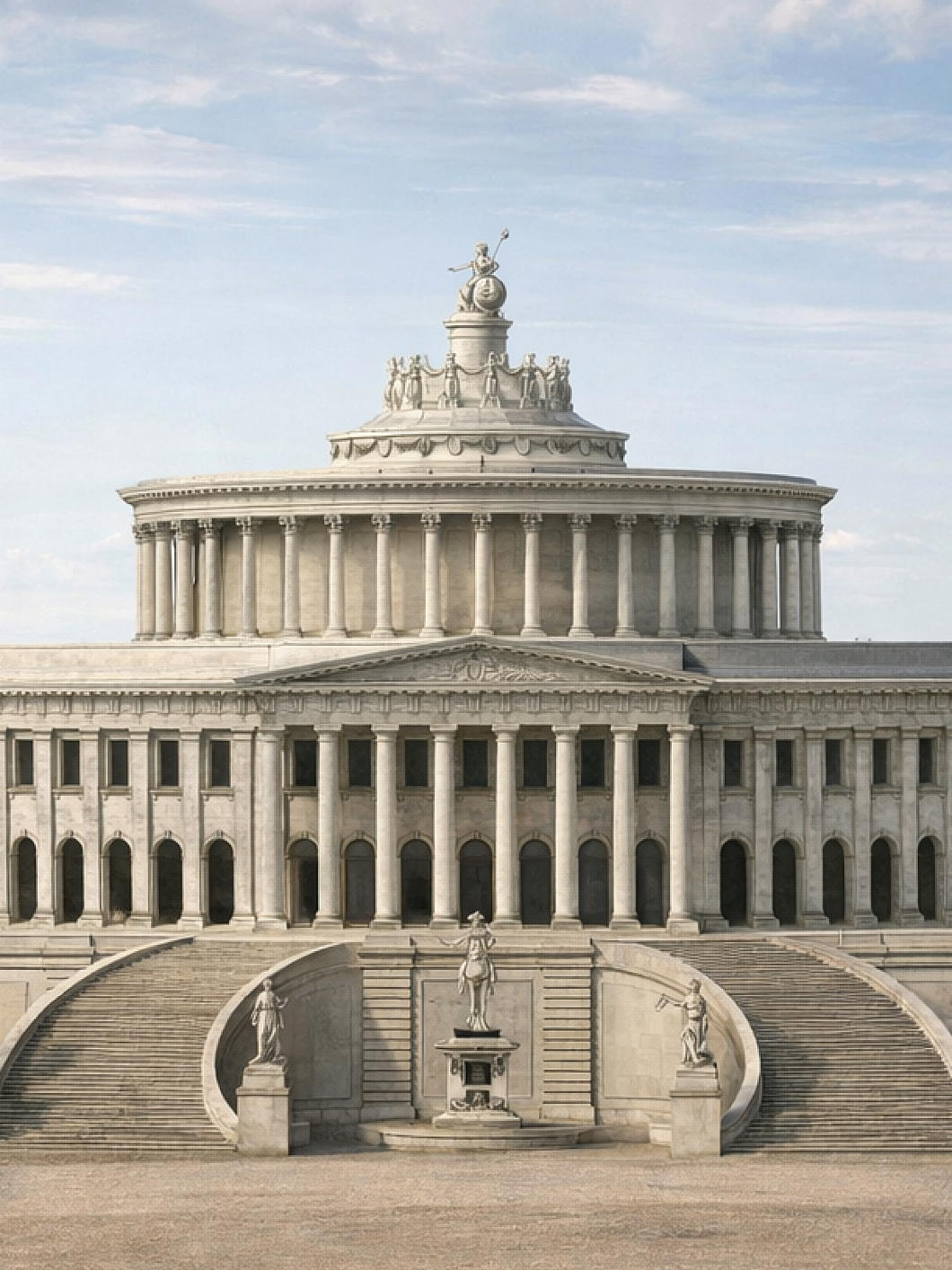
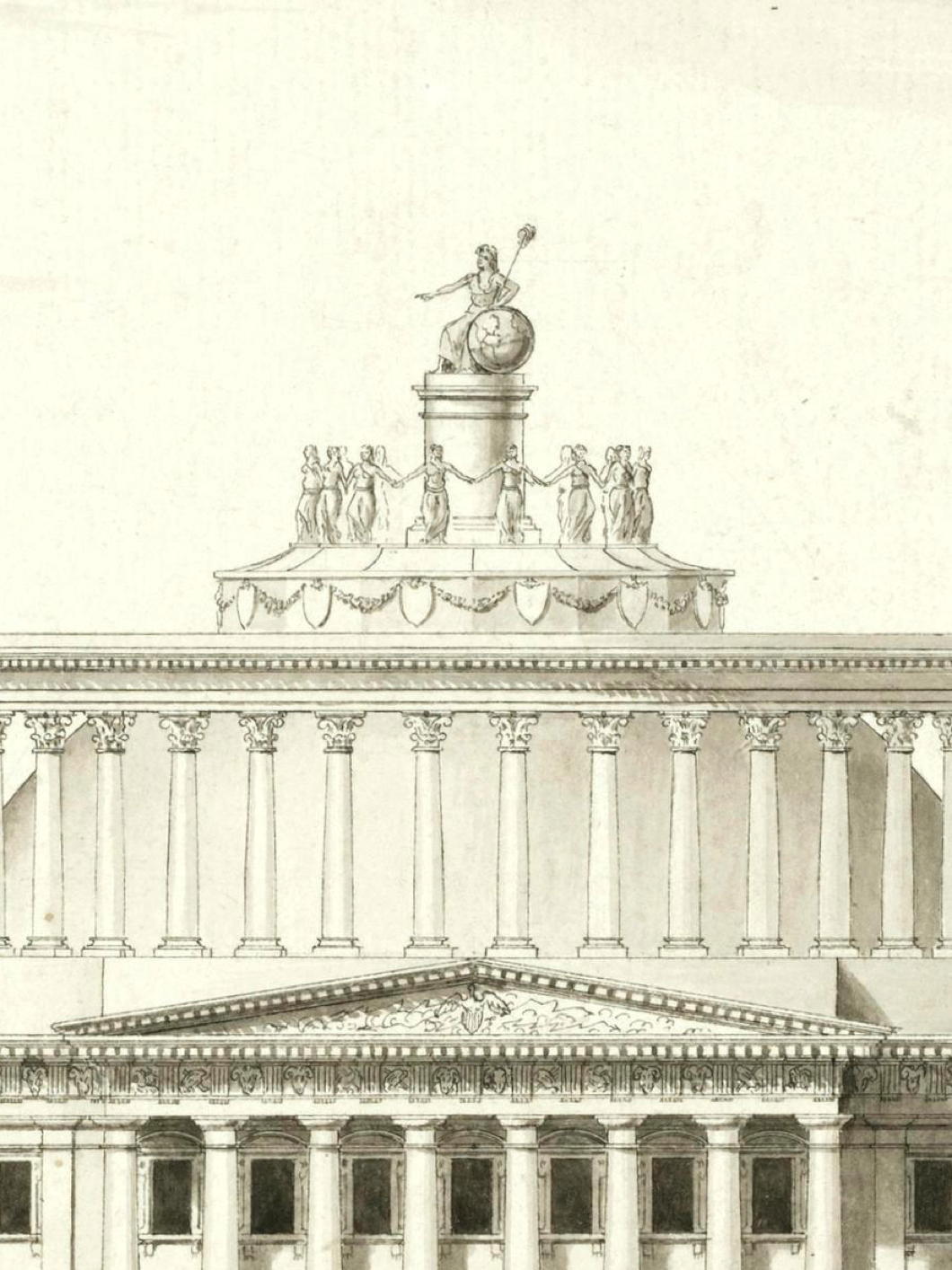
“It may seem surprising that a little-known twenty-seven-year-old alien could contend for the national shrine,” Paul Clements wrote in his biography of Marc Isambard Brunel, “but America was young, and the contestant was no brash backwoodsman.”
After all (Clements continues) Brunel “had sketched with minute detail the châteaux of Normandy, the civic buildings of Rouen, and much of the best Parisian architecture. He had, behind the artist’s eye, the brain of a mathematician, which could calculate the fit proportions of any buttress and subject visions to cold analysis. Above all, he had the craftsman’s innate understanding of materials.”
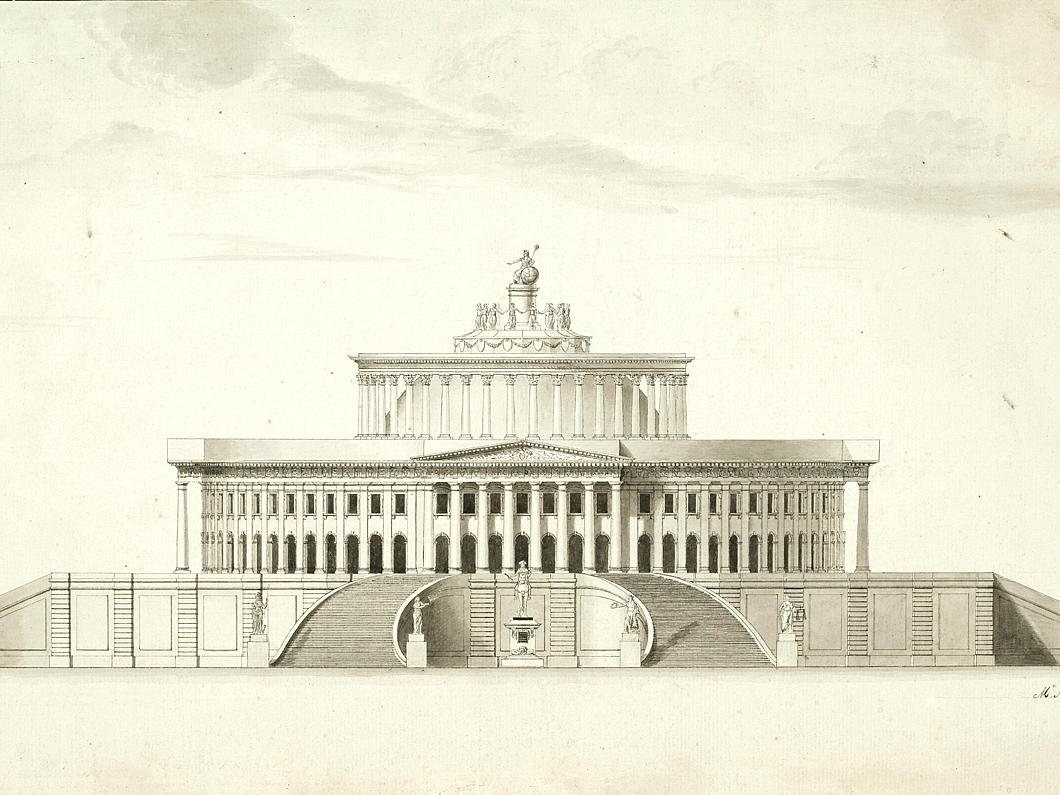
But what did the Americans make of it? “The judges pronounced it outstanding,” according to Clements, “and the intelligentsia of New York and Washington buzzed with delight. Unhappily the cost proved too high, even for Congress, and the plan was passed over.”
I am a little sceptical of these claims. Washington could hardly be described as having an ‘intelligentsia’ at this point and, despite his biographer’s assertion of accolades, the early American republic was wary of abstraction. It preferred architecture that could be read at a glance, that reassured by familiarity but with a sense of republican simplicity. The winning scheme by William Thornton (below), with Latrobe’s later refinements, wrapped the republic in an English interpretation of Roman dress.
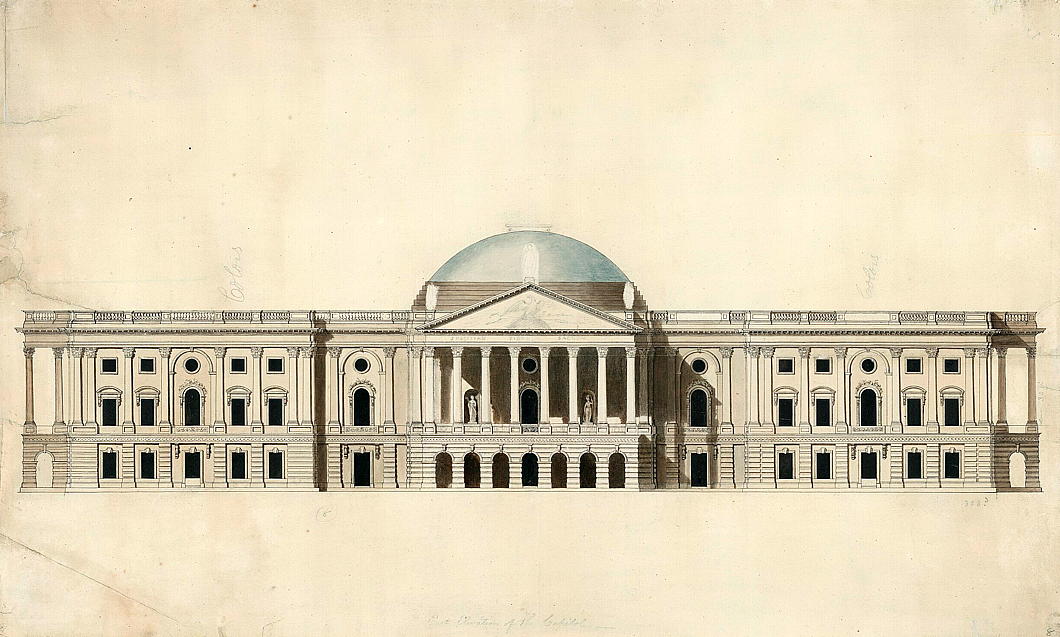
What’s more, no evidence has yet been discovered that Brunel even submitted his proposal to the deciding authorities. Researchers believe that most of the entries survive in the records of the Library of Congress and the Maryland Historical Society. As Brunel’s scheme is never mentioned in histories of the Capitol and the competition, it seems likely that the proposal lay forgotten for some time. This elevation was sold at auction in London for £10,625 in 2017 but the description makes no mention of its provenance.
That Brunel’s excellence lay elsewhere became clear soon enough. When he moved to Britain, it was engineering that he transformed rather than architecture, leaving behind docks, machinery, and tunnelling technologies that reshaped the industrial world. His son, Isambard Kingdom Brunel, took that inheritance and amplified it, building bridges, ships, and railways on a scale that matched the elder Brunel’s youthful appetite for grandeur.
Brunel had asked for the young republic to see itself not as ancient Rome reborn but as the Enlightenment rendered in stone. Congress’s decision to root itself in America’s inherited traditions, rather than pursue an ambitious experiment in geometric rationalism, proved a wiser course to set its future by.
Palacio Barolo Revisted
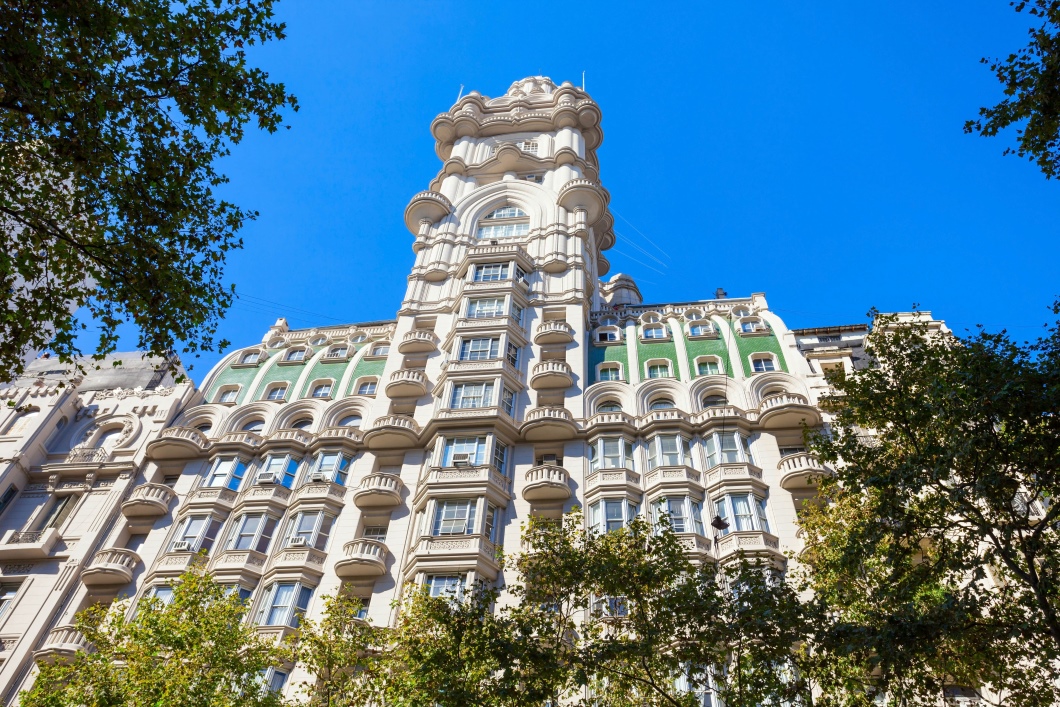
Assiduous readers may recall my posting about the Palacio Barolo, the mad Buenos Aires skyscraper that was conceived as a monument to the genius of Dante.
In a recent entry of Kit Wilson’s excellent Eclectic Letters, novelist (and recent ‘Foidcast’ guest) Thomas Peermohamed Lambert recalls this eccentric edifice:
Palacio Barolo is not my favourite building aesthetically — depending on my mood, that accolade might go to one of Le Corbusier’s Assembly building Chandigarh, or Westminster Cathedral, or the Duomo di Monreale, or the Nakagin Capsule tower — but no other building has lodged itself quite so firmly in my soul. I first visited it in 2018, while I was living in Buenos Aires. Someone mentioned to me that a few blocks from the drab neoclassical Congressional Palace resided the former tallest building in South America, designed by a mad Italian architect to accord with the cosmology of Dante’s Divine Comedy. I had to go.
Palacio Barolo is wonderful enough from the outside: it has a mad, Art Nouveau energy that reminds me, bizarrely, of Brussels. But its interior is even better. Its lobby is lit by orange-glowing pits that are meant to look like Hell’s lowest circles; there are statues of monsters, gargoyles, and pretty much every doorway has some kind of masonic symbol on it. Because labour is cheap in Buenos Aires, the place is also massively and confusingly over-staffed: there are uniformed people buzzing around you, ushering you into clanking iron lifts and up astonishingly decorated staircases whether you ask them to or not. At the top of the building is a completely pointless lighthouse beacon, included for the sole purpose of seeming divine and celestial, and one of the best views of Buenos Aires you’ll ever see.
Compact Grandeur in Genoa
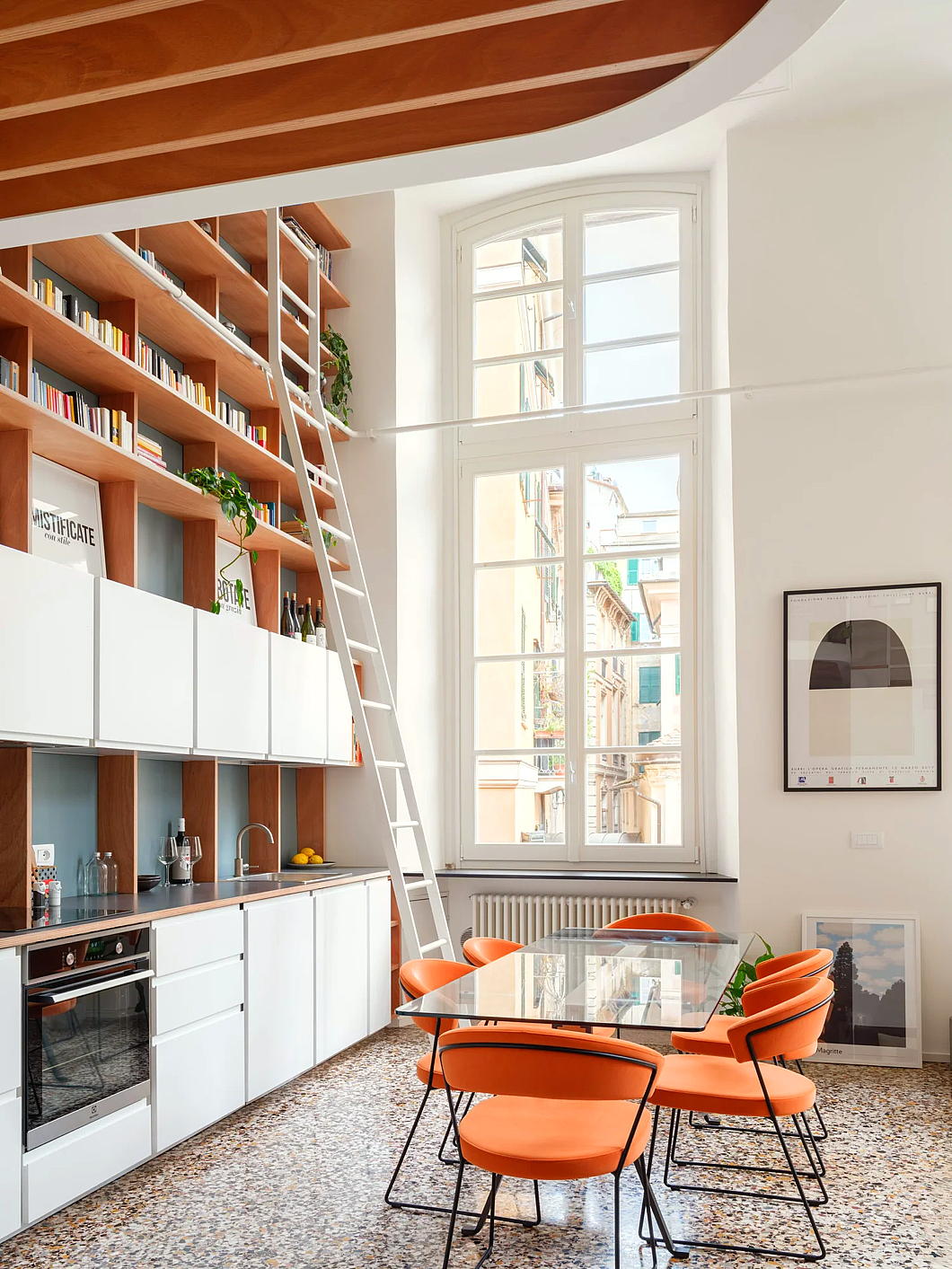
In the heart of Genoa, the corner apartment of an historic palazzo has been rescued from graceless subdivision and given back a measure of domestic dignity.
Once part of the great salon of a palace overlooking the Piazza San Giorgio, the space had suffered the usual indignities of time: partitions, mezzanines, false ceilings — all conspiring to diminish its height and its grace.
Architects Luca Scardulla and Federico Robbiano of llabb began by clearing away the clutter and restoring the luminous hall, whose three windows frame the churches of San Giorgio and San Torpete (where you can find St Thomas Becket in the altarpiece).
The owners — a couple whose work in communications and photography — asked for a space that could accommodate books, art, friends, and the occasional guest, and all within fifty-eight square metres.
The entrance hallway leads past a discreet utility room, bathroom, and bedroom before opening into a double-height living space that unites kitchen, dining, and sitting areas beneath the restored ceiling.
One wall is entirely given over to books: a towering library with a sliding aluminium ladder gliding along its rail. An open staircase turns upward to a mezzanine level with a desk for work and a bed-nook for guests. Beside the steps, a translucent glass screen allows daylight to reach the bedroom beyond.
“We like the apartment not to be completely revealed at one glance,” says Scardulla, “but to be discovered by moving through it”. The result is indeed a procession rather than a panorama — a space composed to unfold.
The architects allowed themselves a playful update: the missing corner of the ceiling’s stucco decoration was faithfully replicated, though the human figure of the other corners was replaced by a 3D-printed Lego man.
If I allow myself one quibble, it’s with the terrazzo flooring: Give me wood any day of the week, with a Persian carpet thrown atop when needed. That aside, this Genoese apartment stands as a model of intelligent adaptation: respectful of the past, confident in the present, and, like all good architecture, a pleasure to look at.
If the grand salons of Genoa were once the preserve of aristocratic families, here the scale is domestic but generous. Within its compact boundaries, this apartment restores the dignity of the palazzo to the measure of contemporary life — a little palace for two (and the occasional guest), quietly reborn among the twisting caruggi of this ancient noble port. (more…)
Swift’s Spire
An unbuilt cathedral in Monrovia, Liberia
Arthur Swift and the architectural partnership he founded have something of a mixed legacy. Established in London in 1953, Swift & Partners expanded quickly, opening offices in Dublin and Edinburgh.
Specialising in large-scale public housing and mixed-use urban development, Swift & Partners were firm believers in the utility of concrete, even when the public baulked at the harsh and uninviting cityscapes they created. In the Irish capital the partnership is primarily known for the Ballymun towers, the modernist housing estate that became synonymous with urban blight. (There were literal shouts of joy when the towers were demolished.)
Liberia, meanwhile, was in need of something less prosaic than housing: a new Protestant cathedral for the nation’s capital. From Ghana’s independence in 1957, one after another of Liberia’s neighbours achieved sovereignty from their former colonial rulers. Though Liberia had enjoyed a unique status as Africa’s only independent black republic for more than a century, it still shared in the wave of optimism that accompanied the birth of these new West African states.
The Protestant Episcopal Church in Liberia had been long established, American Episcopalians having consecrated one of their own as bishop for this part of West Africa in 1851. What better way for this smaller but socially prominent denomination to affirm its place at the heart of the republic than through a modern cathedral in the centre of the capital?
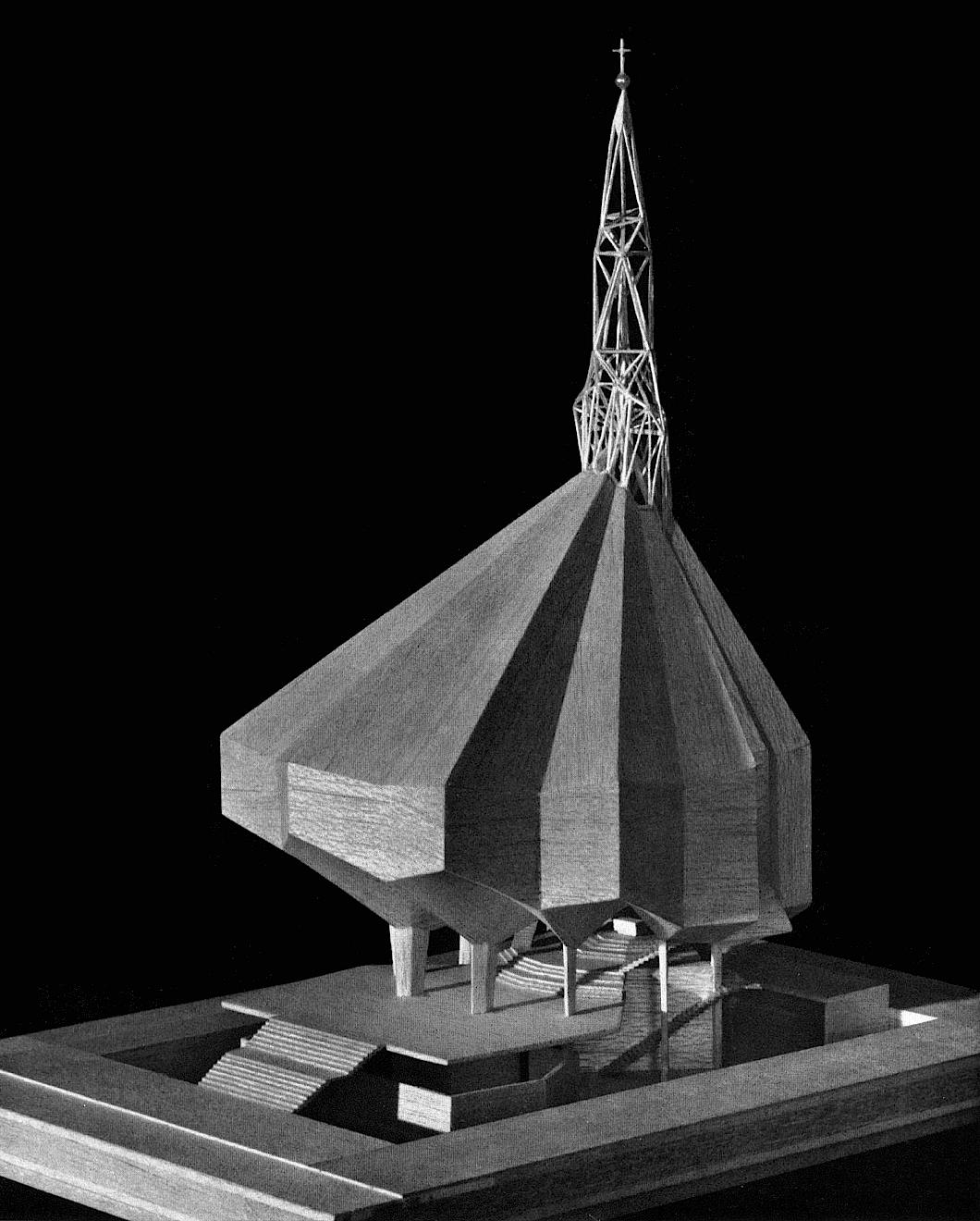
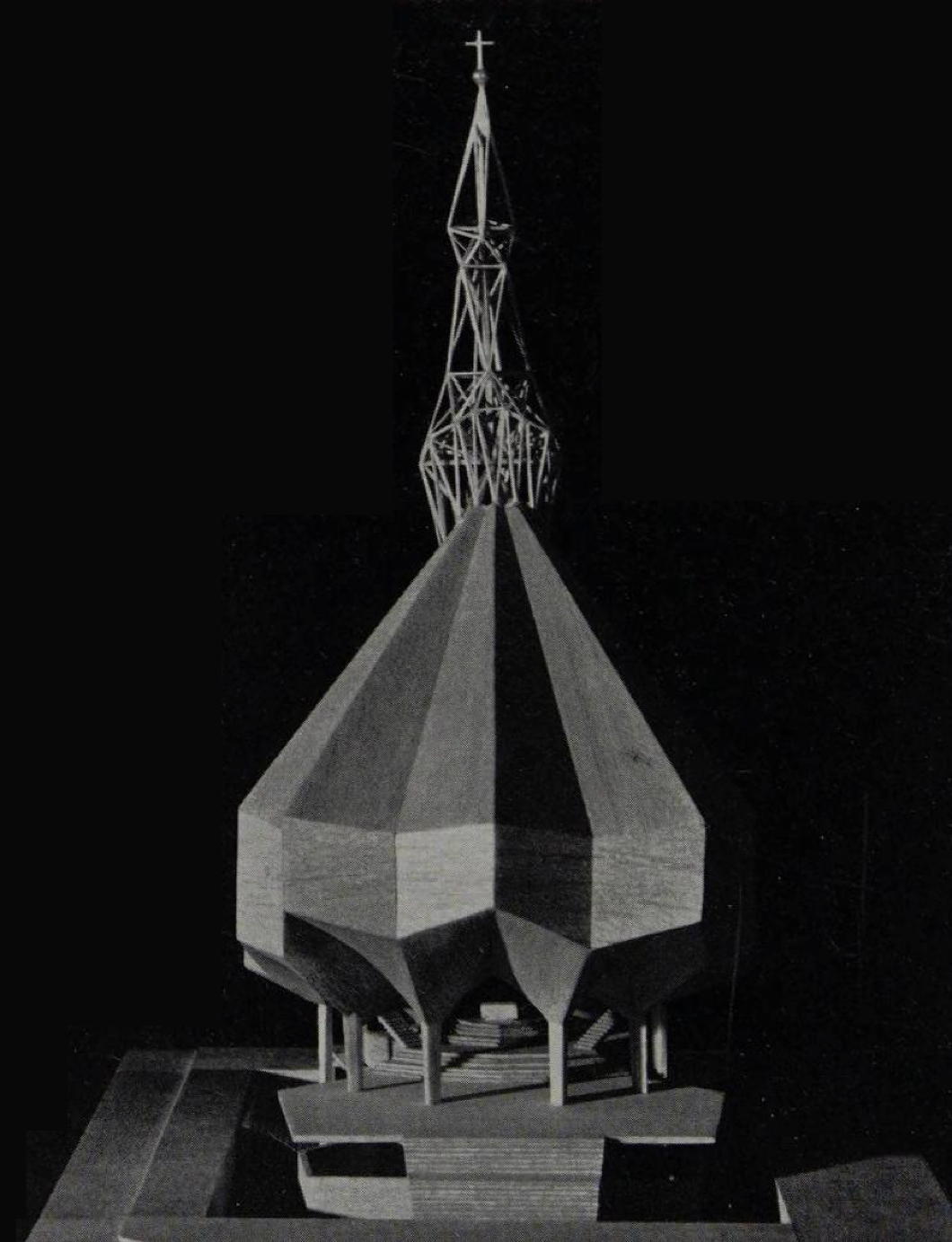
Swift & Partners delivered a striking and idiosyncratic proposal. The site was severely constrained — a mere eighty-two by one-hundred-and-thirty-two feet — yet they contrived a luminous polyhedral glass spire atop a many-sided concrete shell with raked, theatre-style seating for eight hundred worshippers. The main altar lay below, opening to a lower plane that could seat an additional two hundred, with the bishop’s throne and choir rising behind the altar.
The approach was suitably processional: a broadening flight of steps ascended over a reflecting pool. Beneath, a lower level would contain a chapel, baptistry, classrooms, and functional spaces for the clergy.
While the model accurately depicts the poured-in-place reinforced concrete exterior, there were also plans for tiled mosaics to decorate the exterior walls, while coloured glass in the spire would filter light down into the body of the church below.
The cathedral plan, with its congregation encircling the altar, translated into architecture the ideal of a united people worshipping under one roof — a civic theology for a republic that claimed to prize both progress and order.
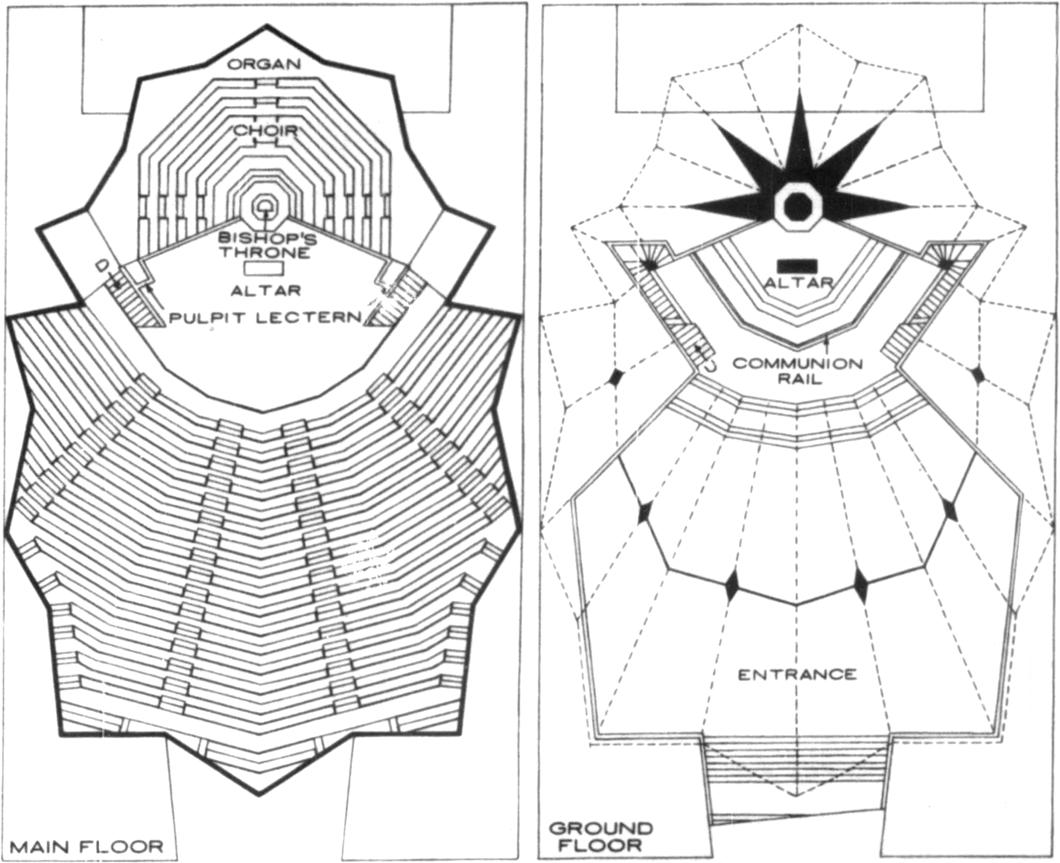
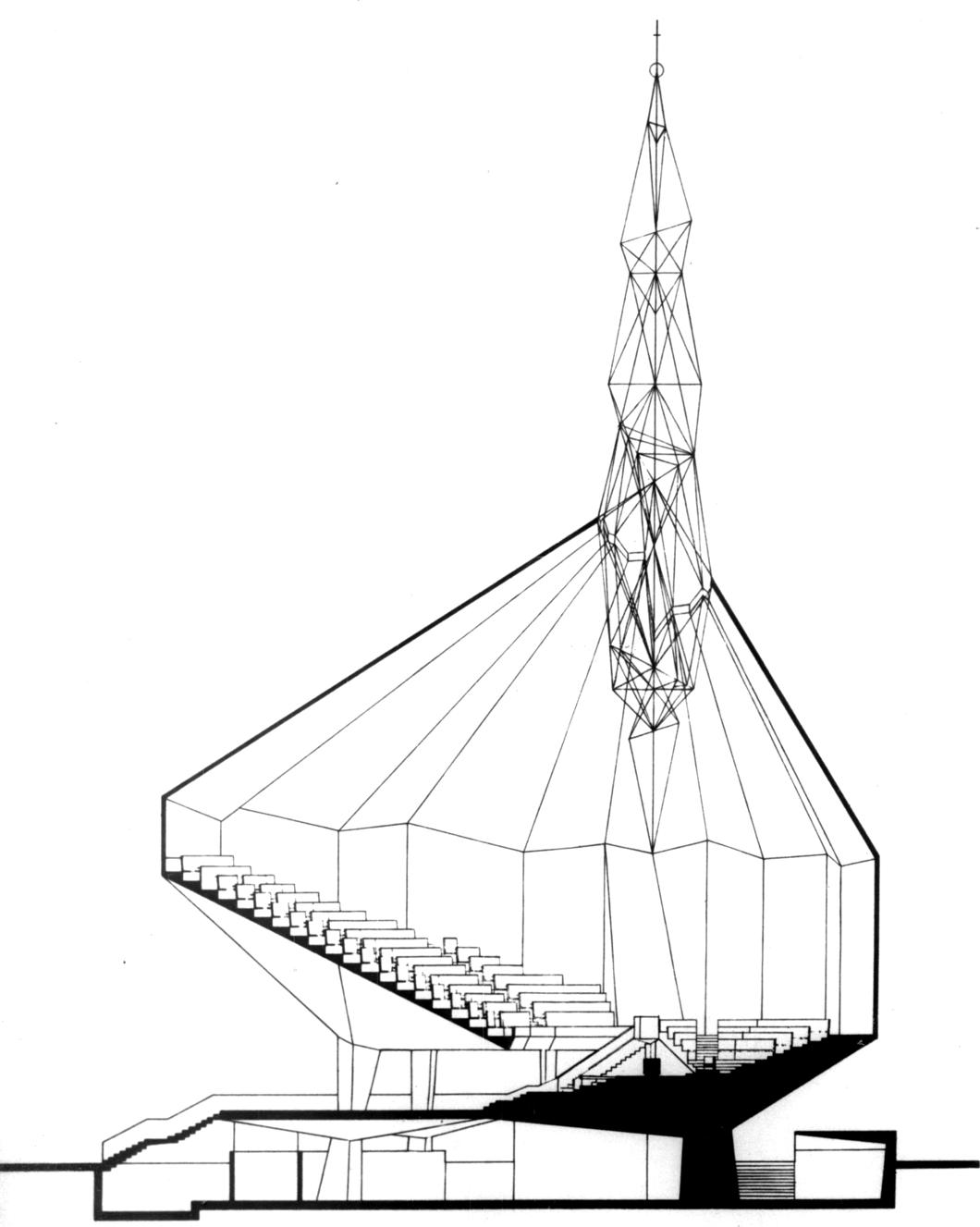
It is a striking and curiously beautiful design, but also too clever by half. The raked seating is immensely appropriate for a lecture hall or a theatre but less so for a church. In a place for liturgical worship it is less than ideal for the worshippers as a whole to look down on the altar of sacrifice where, as Anglican theology holds, God is made physically present.
While the African sun can be unrelenting, Swift & Partners’ proposal provides for natural light to reach the body of the church only through the coloured glass of the spire. There is no need for cathedral interiors to be bright — ideally there are rich gradations of light and shadow — but it strikes me this proposal would be unduly dark inside.
The architects explained they were inspired by words from Columbia University engineer Mario Salvadori that described the ideal church as “a jewel which represents the integration of feelings, of form, of structure, of all that makes for a complete expression of religious feelings in the materials of architecture”.
As it happened, Swift & Partners’ jewel remained uncut. Their proposal was set aside, and in its place came a new vision from within Liberia itself. Aaron Milton and Winston Richards — both Liberian architects — designed the church that was eventually built as Trinity Cathedral. Their work was more restrained: a rectilinear concrete frame that hints at Gothic precedent while retaining a trace of geometric abstraction. It retained the modernist idiom but translated it into something quieter, sturdier, and arguably more grounded in local sensibility.
I can’t help but like Swift’s plan, flawed though it is. The arboreal form of the design is delightful, but it would have served better as the Sheldonian of some West African Oxford than as a cathedral church of a diocese. A striking and beautiful modern work, but far from the ideal of a church.
A Gorgeous Tomb
Sir Thomas Gorges’ monument in Salisbury Cathedral

We all love a good funerary monument.
If you are wandering in Salisbury Cathedral you will inevitably stumble upon the beautiful tomb of Sir Thomas Gorges, bedecked with polyhedra.
Gorges was a bit of a character who managed to woo the somewhat saucy Swede Helena Snakenborg, who had become Marchioness of Northampton for a few months in 1571 before the Marquess rather suddenly dropped dead.
Sir Thomas fell for her and they were married in secret in 1576 to escape the wrathful gaze of the jealous usurper Elizabeth I.
He should not be confused for his relation, also Sir Thomas Gorges, who went to the New World to serve as deputy to William Gorges, the first governor of Maine before the province’s absorption by the Massachusetts-Bay Colony.
The proprietor of Maine, Sir Ferdinando Gorges, aimed to foster a neo-feudal community in New England based on the model of the West Country, and named his land New Somersetshire accordingly. (What a pity it failed, although Maine in summer is the very best of everything American.)
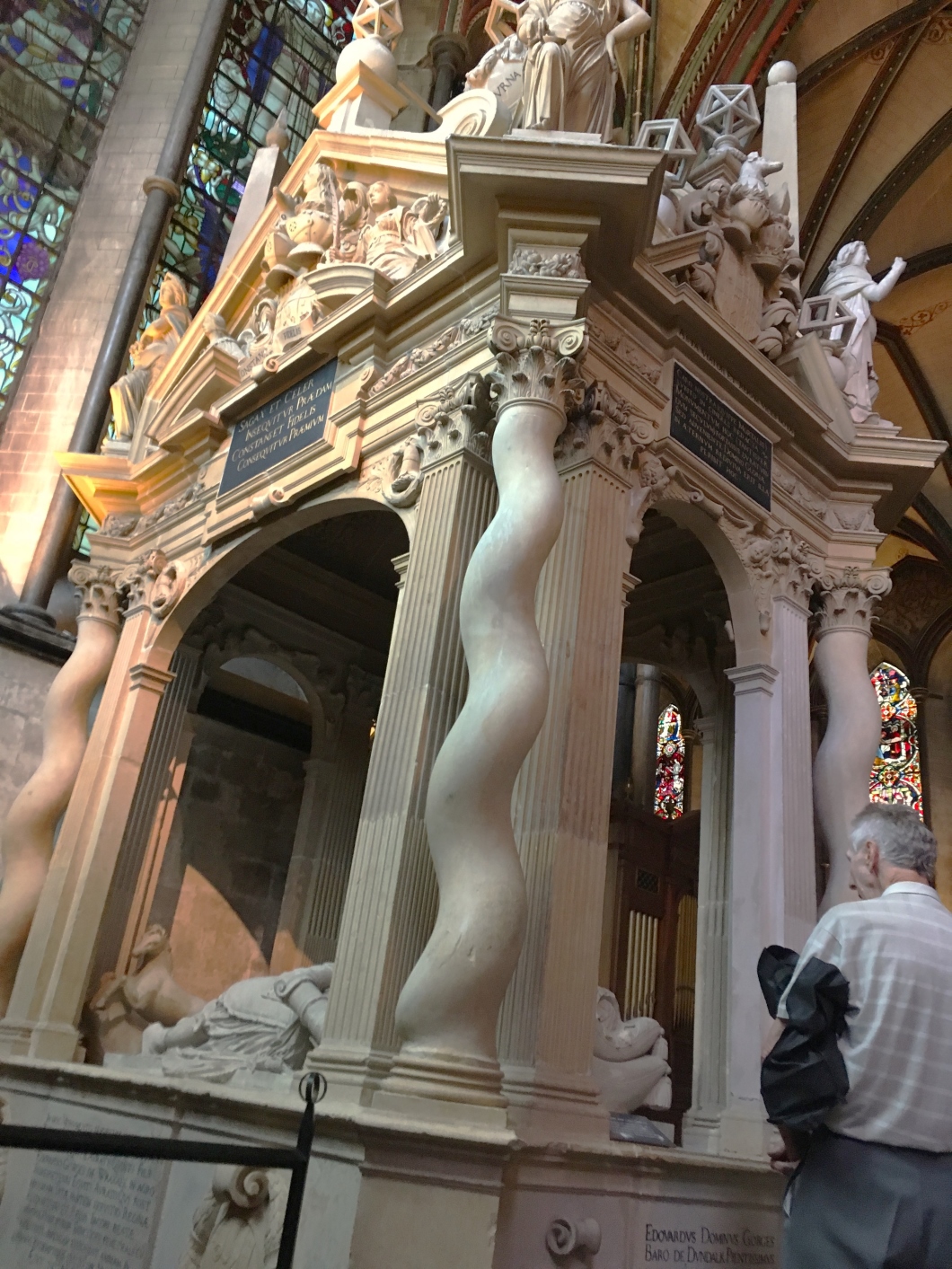
Our Sir Thomas, however, died in 1610 and this gorgeous monument was erected fifteen years later by son Edward. In addition to wonderful swirling sugarstick columns, the tomb is topped by a cuboctahedron, dodecahedron, and icosahedron (amongst others).
Not fifteen miles away in the Dorset church of Wimborne St Giles — much augmented by Sir Ninian Comper — you can find the lavishly ornate tomb of Sir Anthony Ashley and his wife. At Sir Anthony’s feet lies a truncated octahedron, indicating these geometric forms followed something of a deathly fashion.
You can even find a partially truncated rhombic dodecahedron at the final dwelling place of Sir Thomas Bodley — of Bodleian fame — in Merton College, Oxford.
The great majority of funerary polyhedra date from a period of about three decades during which, we are told, England and Europe “saw a resurgence of interest in quasi-mystical geometric symbolism”.
Copenhagen’s Courthouse

Photo: Finn Christoffersen
THE CURIOSITY of classicism in building is that its principals are universal and yet the way it is carried out in each land is so distinct. Scandinavian classicism embodies the beauty of restraint: clear lines, harmonious proportions, and a sober dignity in the northern light.
Pale façades and measured ornament convey a sense of calm order, neither ostentatious nor overly severe, with interiors bathed in colours that provide the warmth so dearly needed to keep life humane in a cold climate.
On Nytorv in the heart of Copenhagen stands a sober neoclassical edifice whose measured columns and austere pediment speak to the ideals of law and order: first built as the city hall of the Danish capital, today it is the Københavns Domhus, or city courthouse.
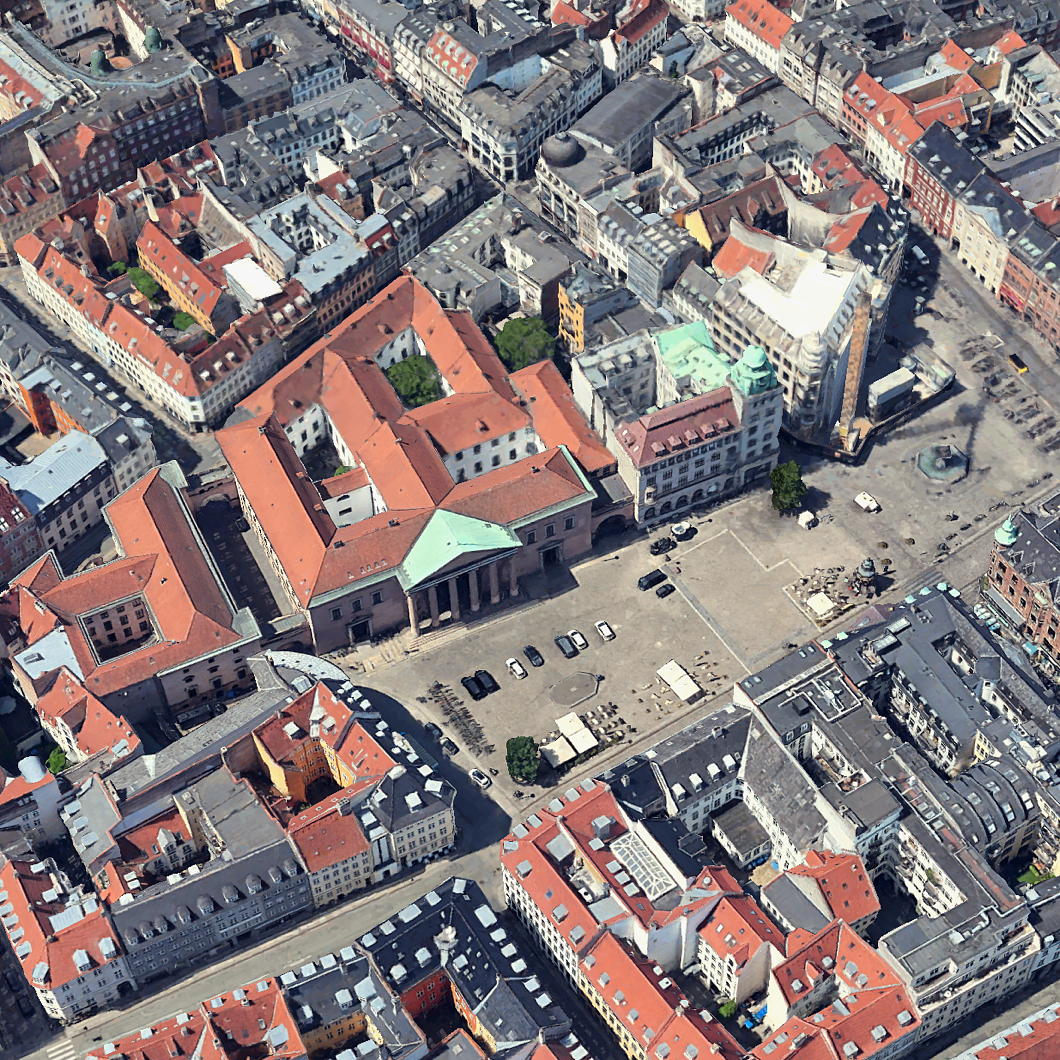
Its origins lie in the Great Fire of Copenhagen that swept through the old town hall in 1795, consuming not only the old town hall but also much of the city around it.
The destroyed building faced onto Gammeltorv — literally ‘old turf’, more colloquially ‘old square’ or ‘old market’ — with the new market of Nytorv behind it. The outline of that lost structure is marked in bright stone on the ground today.
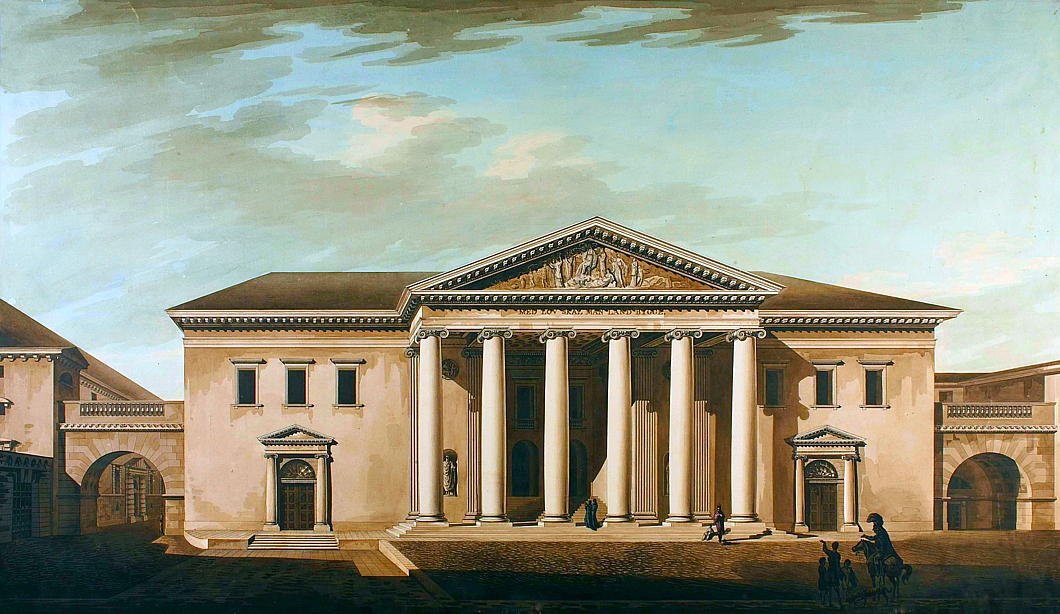
Judicial reforms introduced by the Lensgreve Struensee in the 1770s expanded the powers and responsibilities of the local courts, but the old town hall was already too cramped to house the newly important legal chambers.
Out of the ashes of the Great Fire, civic leaders resolved to raise a new structure, one that would gather both the municipal council and the judiciary under a single roof.
The charred remains of the old hall were levelled flat to join Gammeltorv and Nytorv into a single open space, while the old Royal Orphanage on Nytorv was cleared to build the new seat of civic authority.
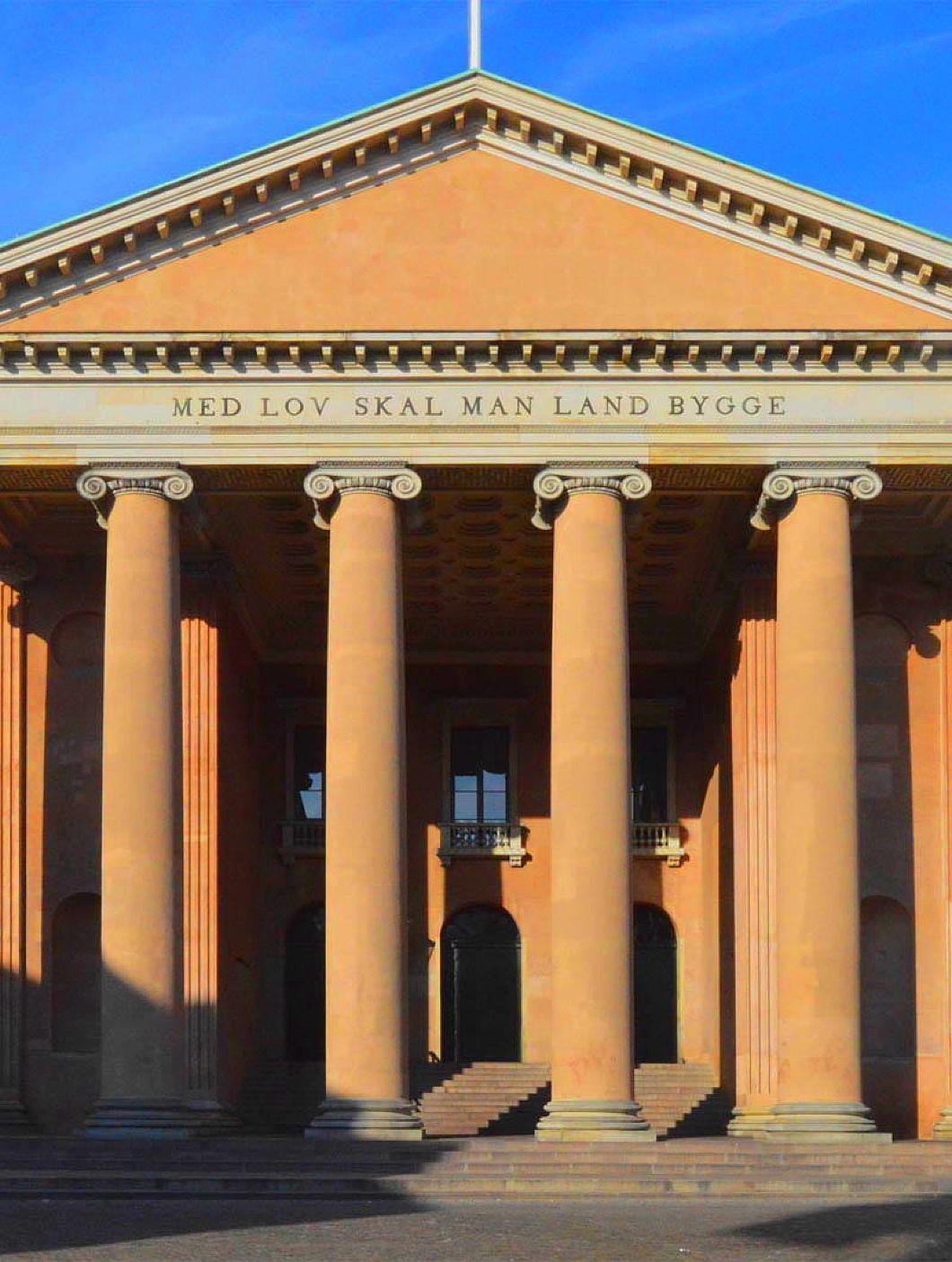
The task of designing the new city hall fell to Christian Frederik Hansen, the foremost Danish architect of his day. In this building and later commissions, Hansen’s neoclassical vision reshaped Copenhagen in the wake of the Great Fire of 1795 and the British Bombardment of 1807.
The restrained yet dignified façade expressed the height of modernity in its day, but across the frieze of the pediment were proclaimed the words MED LOV SKAL MAN LAND BYGGE — With law shall the land be built.
This mediæval maxim comes from the old Law of Jutland of 1271 (preserved in the Codex Holmiensis), rooting this up-to-date building in the ancient roots of Danish justice.
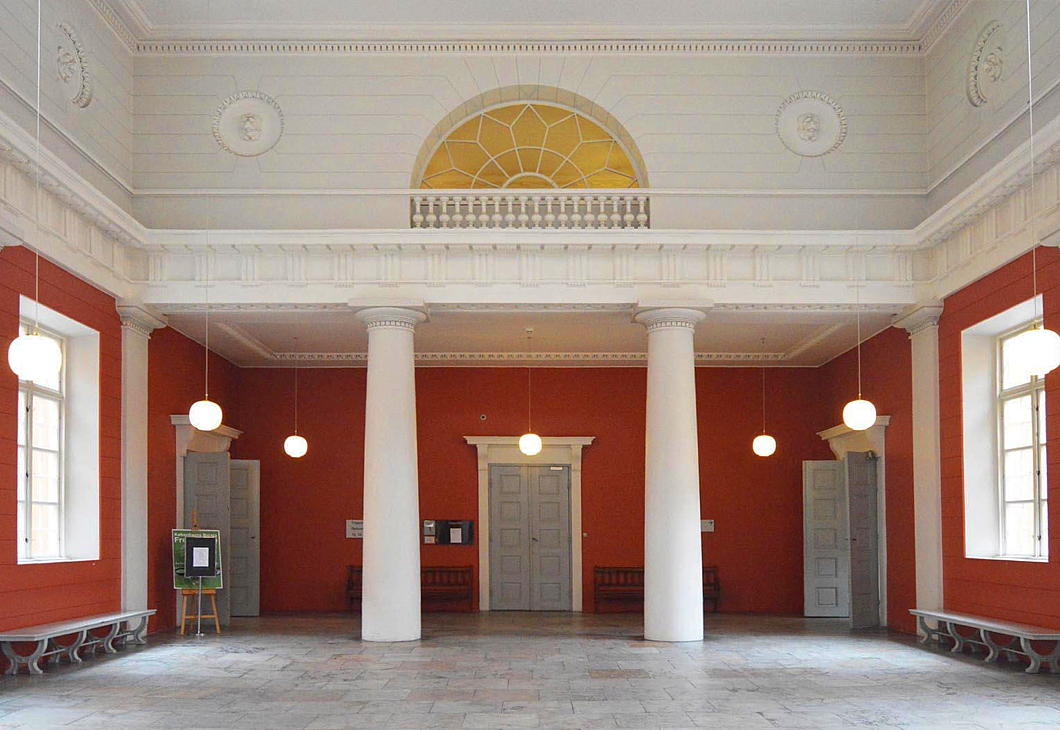
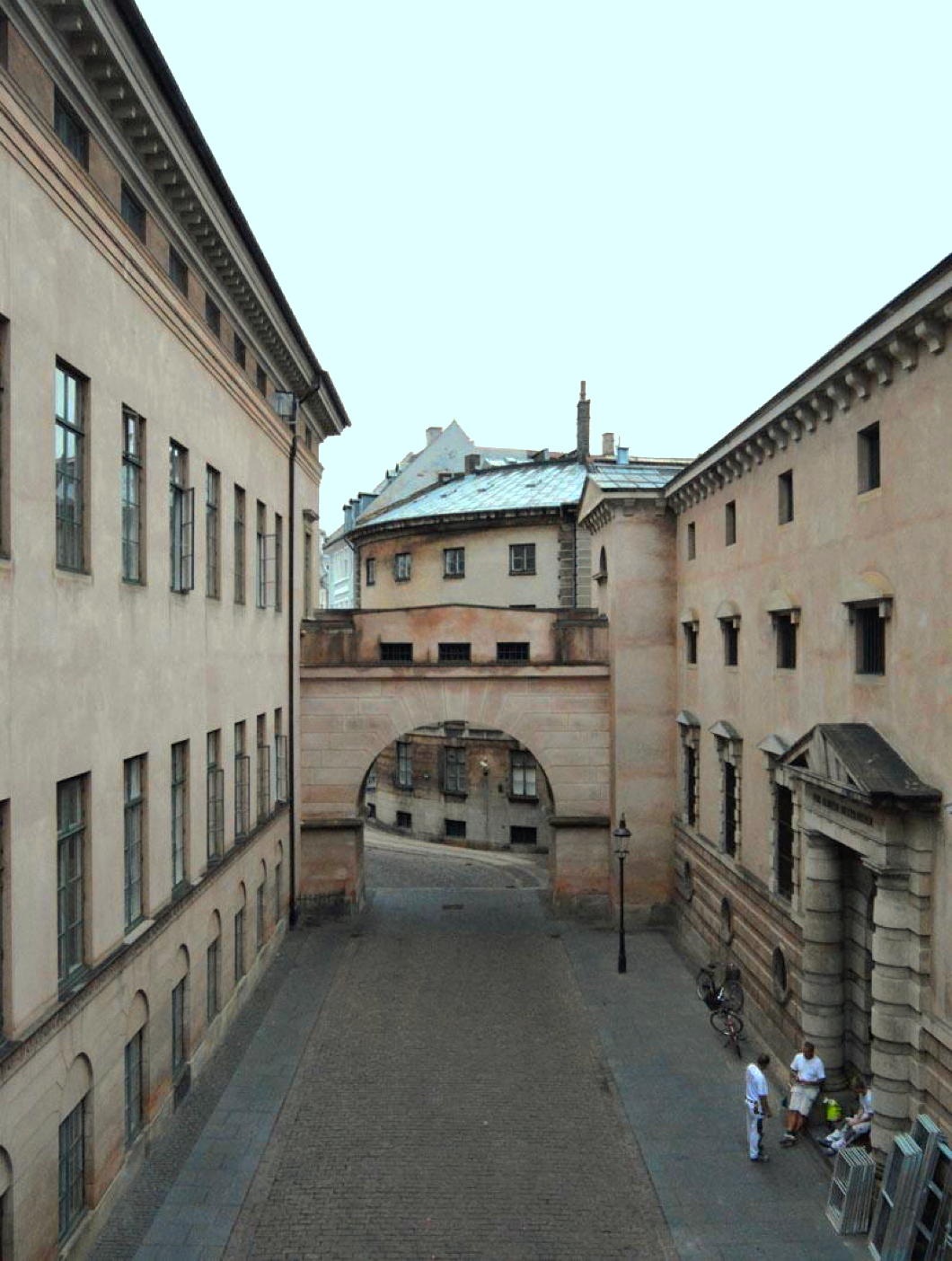
Hansen’s design created suitably dignified meeting rooms for Copenhagen’s city council as well as courtrooms, judges’ chambers, and a municipal lock-up joined to the building by arched bridges across an open lane to the side.
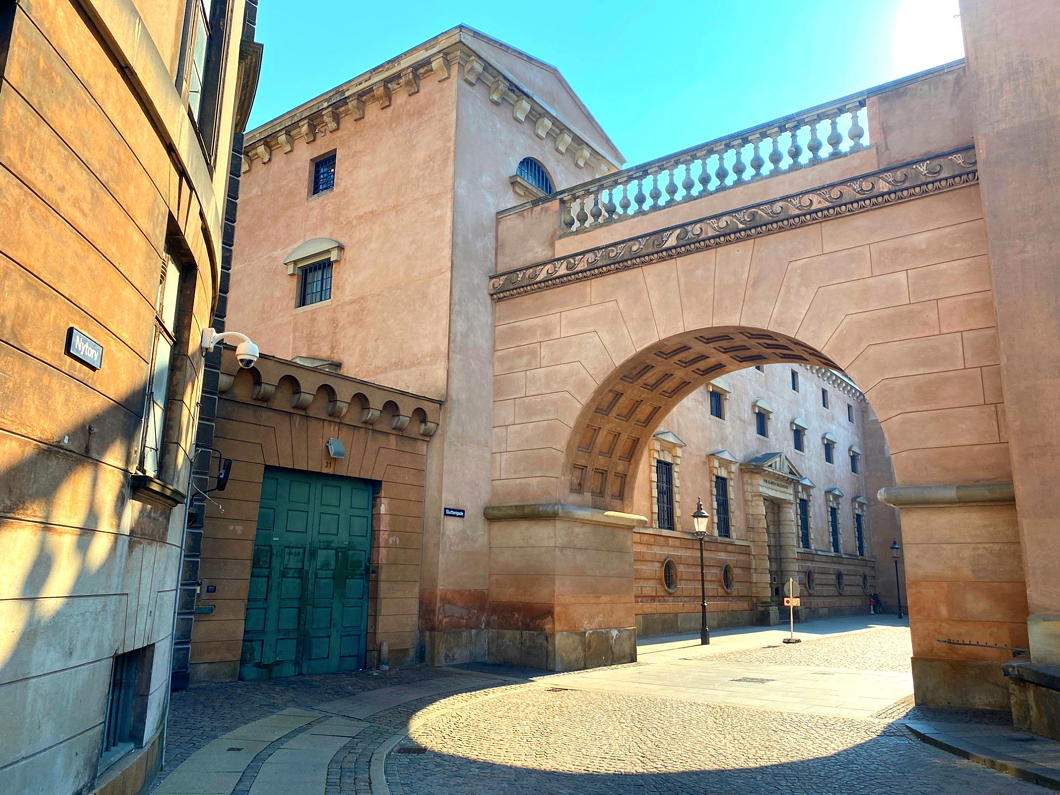
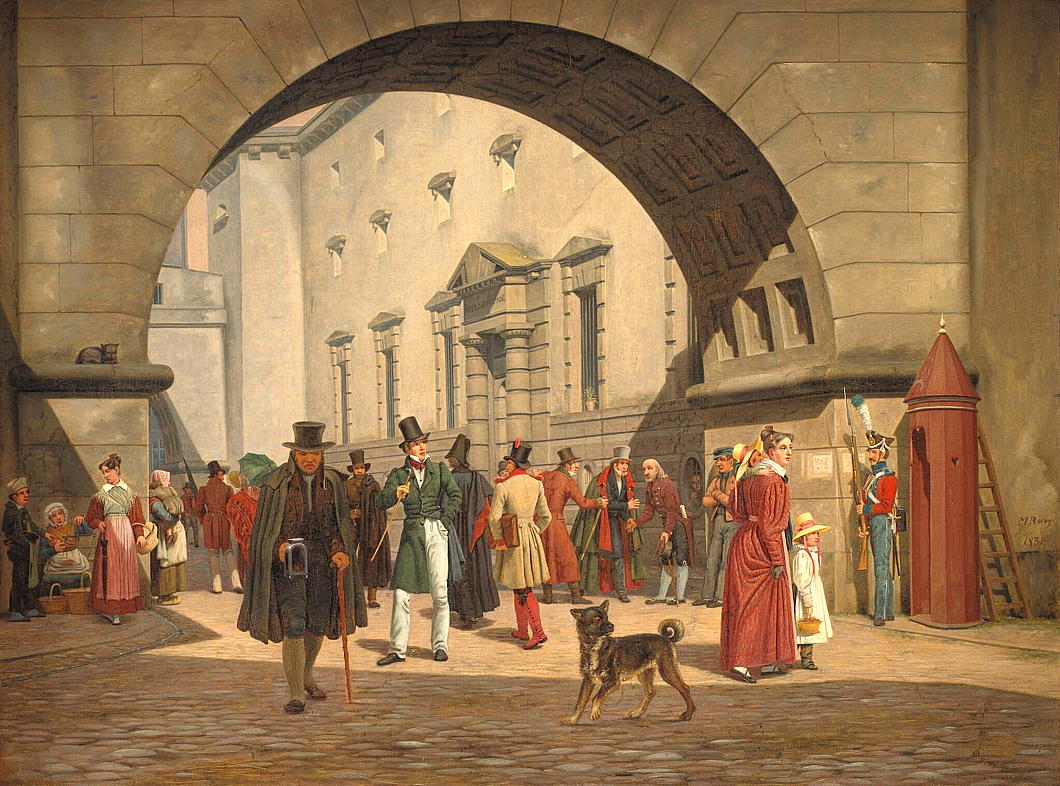
An 1831 painting by Martinus Rørbye depicts a lively street scene in the Slutterigade dividing the holding cells from the city hall.
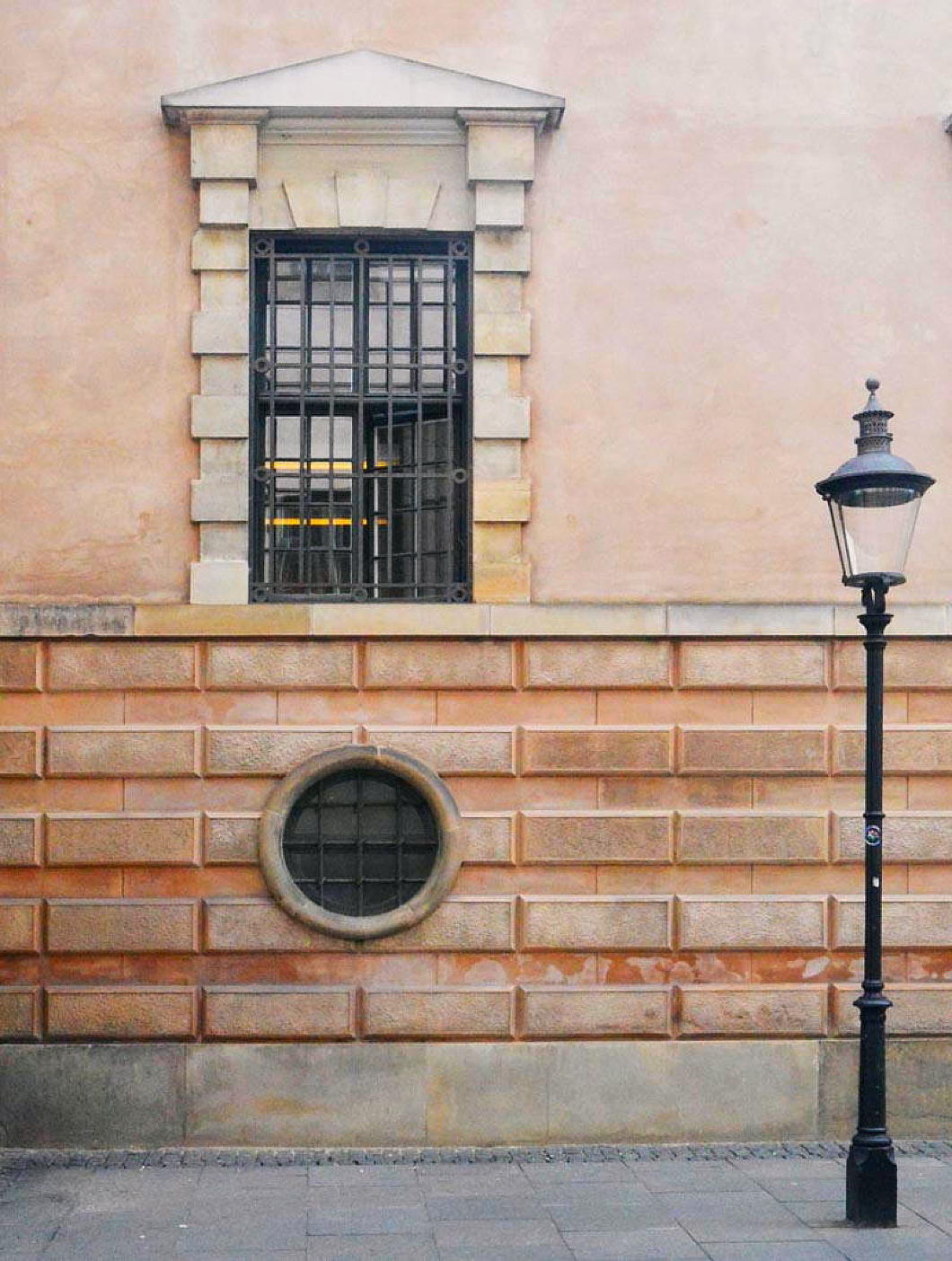
Construction began in 1805 but was soon beset by delay. The Napoleonic wars pressed hard upon Denmark, and the British bombardment of Copenhagen in 1807 — a strong demonstration to Britain’s allies of its commitment to defeat Buonaparte — left the city scarred anew.
Building materials were difficult to obtain and progress slowed to a crawl. Only after these crises subsided could Hansen’s design advance toward completion, and the new City Hall and Courthouse finally opened its doors in 1816.
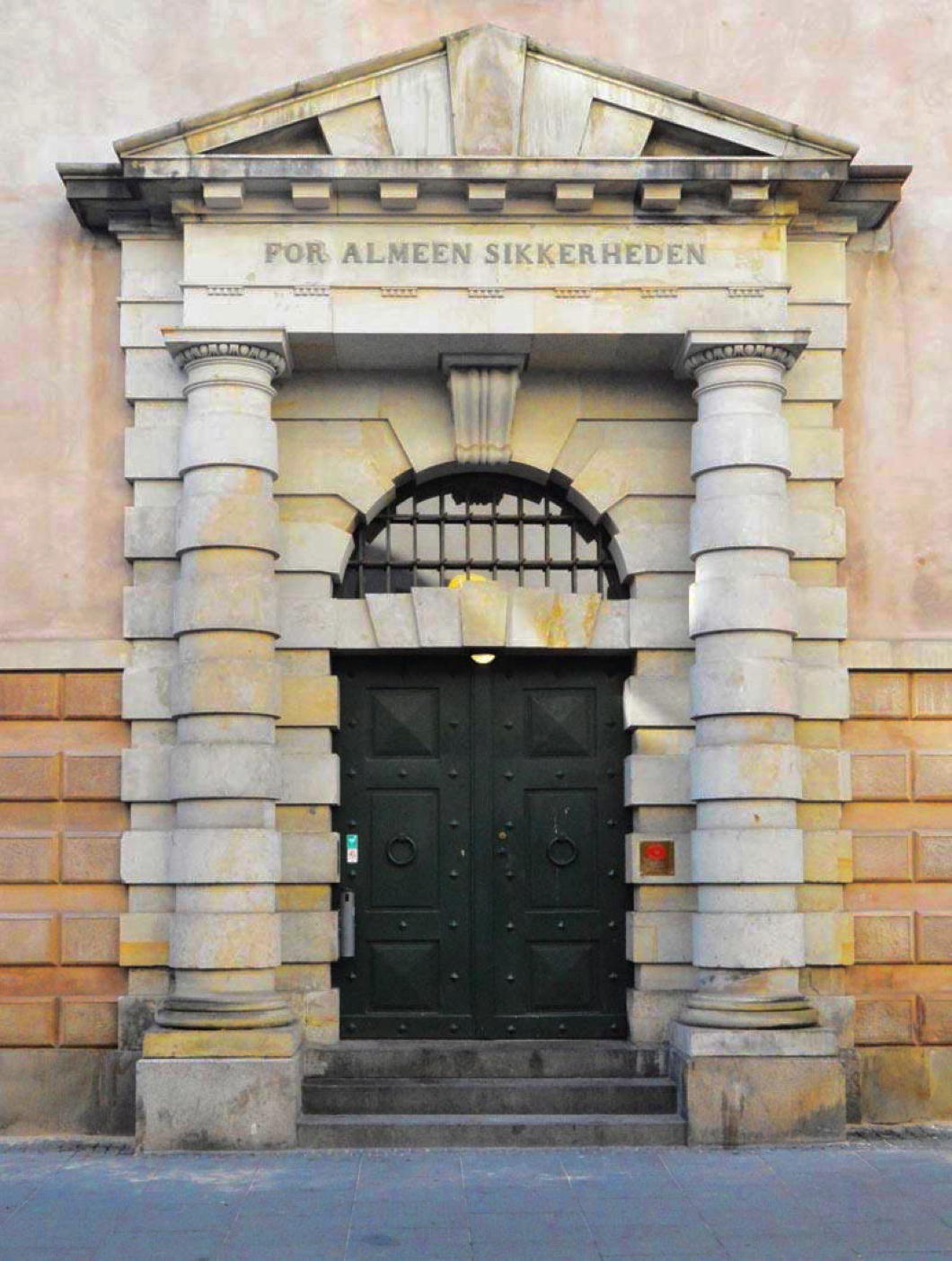
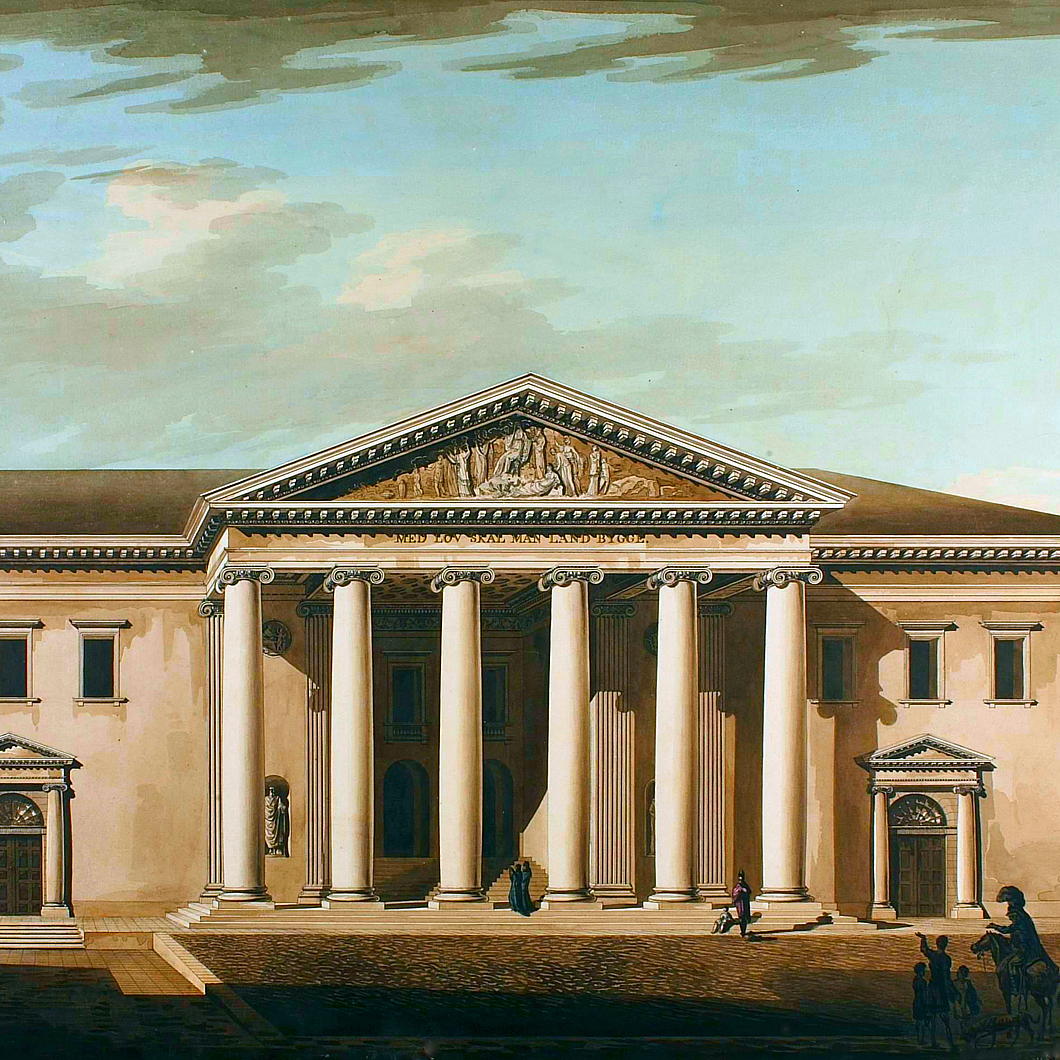
Thorvaldsen had submitted two different schemes for a sculptural relief in the pediment of the new building but although they are sometimes depicted in renderings of the building, neither was ever completed.
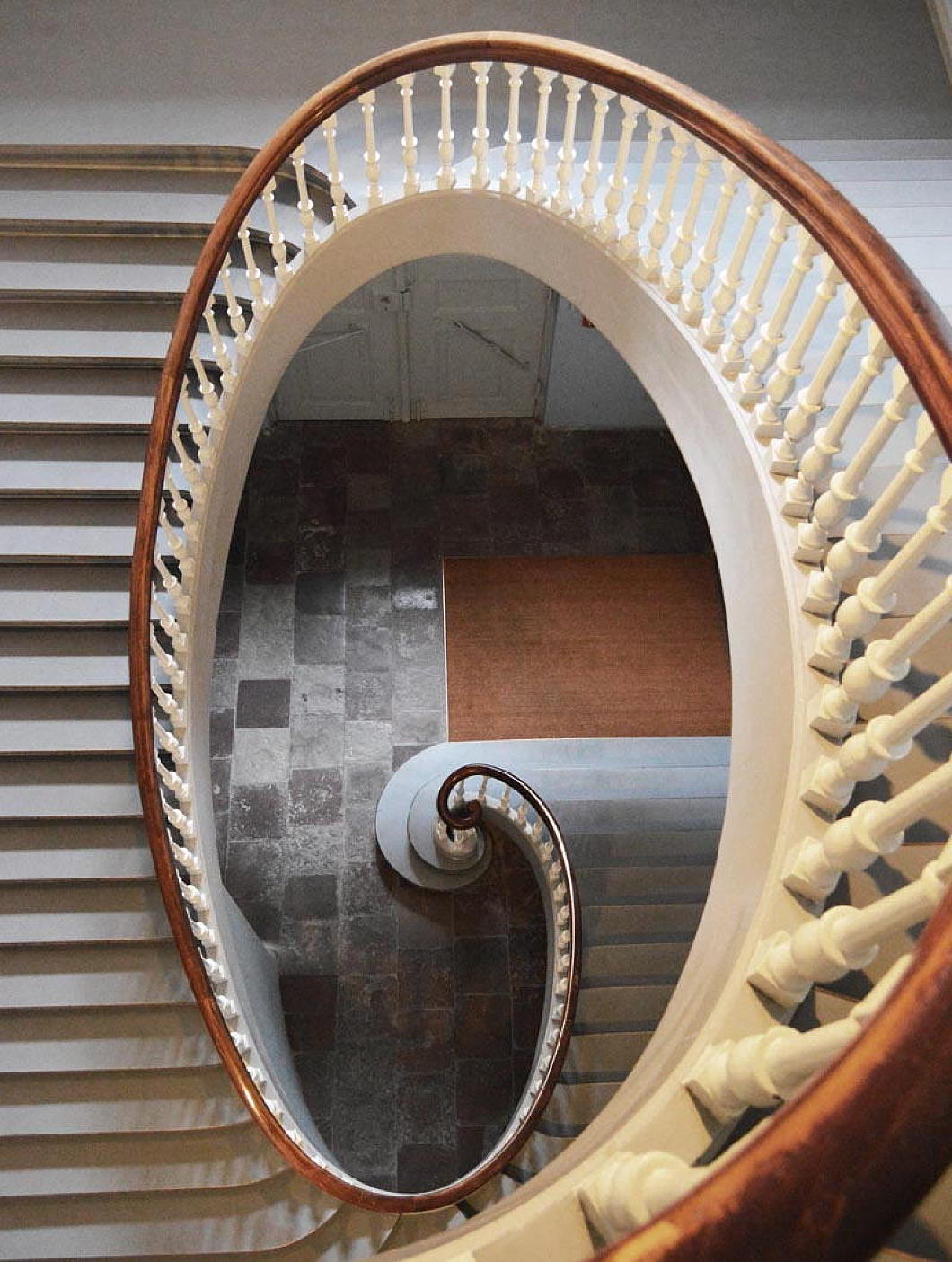
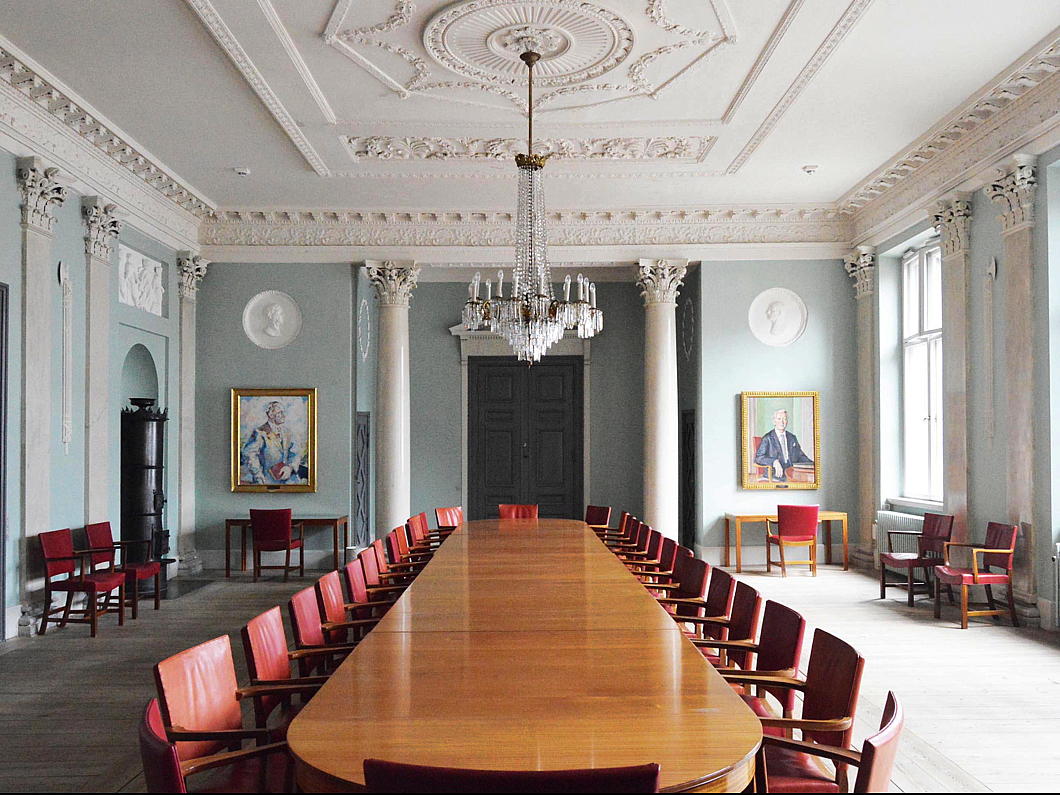
For nearly ninety years the building served its dual role until the city’s growing needs demanded a larger, more modern hall.
In 1905, the council moved to Martin Nyrop’s new City Hall on Rådhuspladsen, leaving Hansen’s work for the exclusive use of the courts.
More than two centuries on, the courthouse at Nytorv remains what Hansen intended: a monument to civic order, and the continuing home of Copenhagen’s judiciary.
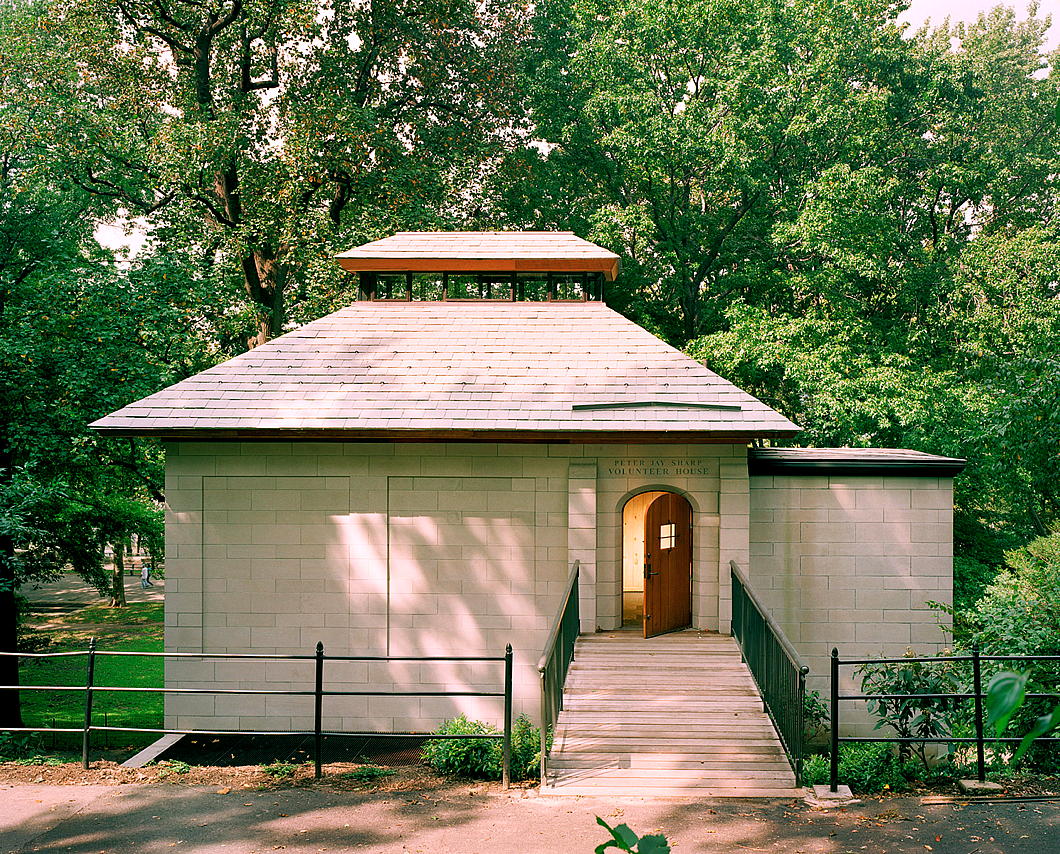
Riverside Park Volunteer House

Manhattan’s Riverside Park is one of the jewels of the island, with four miles of rustic beauty spilling down to the Hudson River (with, alas, the Henry Hudson Parkway in between).
These riparian grounds are under the charge of the Parks Department of the City of New York and entrusted to the care of the Riverside Park Conservancy.
Aside from their own employees, these make use of numerous volunteer gardeners to take care of the many trees, flowers, and other plants that grace this shoreline.
The nineteenth-century structure in which much of the equipment for these volunteers was stored — just inside the park at 107th Street — proved too small and unwieldy for ongoing use.
Expanding it outwards risked the need for felling trees, so in typical New York fashion the Conservancy decided the only way was up.
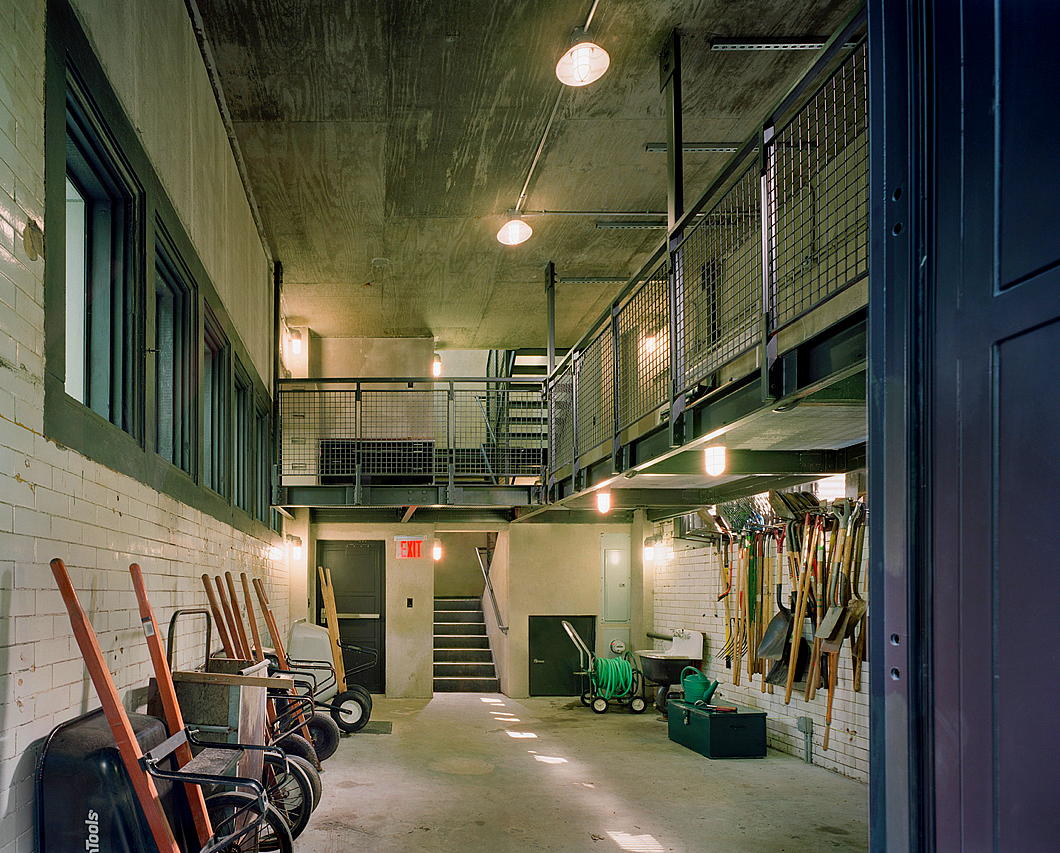
In 2003, the Peter Jay Sharp Volunteer House was opened: an elegant and multipurpose construction that triples the usable space of the previous derelict building.
We have Jeffrey Murphy of MBB architects to thank for this elegant building which fits effortlessly into its surroundings (and Peter Aaron for these photographs).

Sag Harbor Cinema
For a film fan, to grow up in an American town with a small cinema is to win the lottery of life.
In my childhood, we had the advantage of two little movie houses within walking distance: the three-screen Bronxville Cinema and just a little bit further afield by foot the single-screen Pelham Picture House.
Fittingly, these two are now run together as the somewhat pretentiously titled but no-doubt quite useful ‘Picture House Regional Film Center’.
Way out on the South Fork of Long Island, the old whaling village of Sag Harbor has the perfect little small-town American movie theatre.
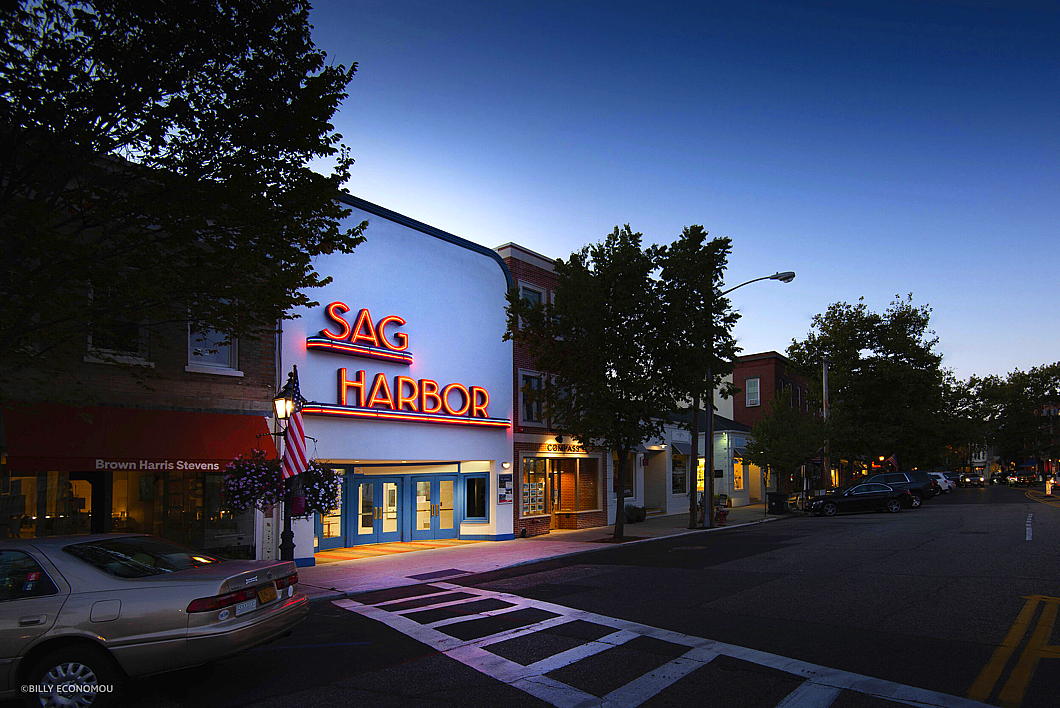
There is something just right about this cinema on the village’s Main Street — as Variety put it: “beloved for not only its obscure programming but also its 1930s red neon sign with the village name”.
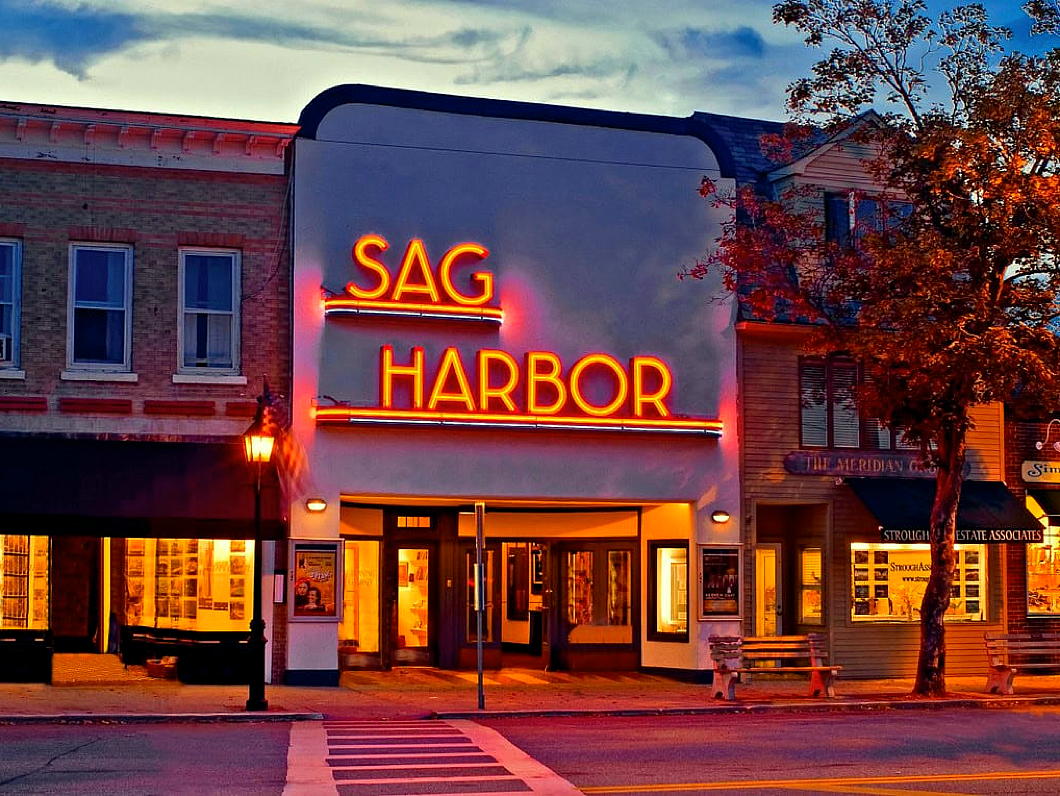
The single-screen cinema first graced the main drag of the village in 1936, the creation of architect John Eberson whose ‘atmospheric’ movie theatres are dotted across the United States and even as far as Australia.
Eberson designed two of greater New York’s five Loews ‘Wonder Theatres’: the Loew’s Paradise on the Grand Concourse in the Bronx neighbourhood of Fordham and the Loew’s Valencia in Jamaica, Queens.
This cinema was purchased by Gerard Mallow in 1978 who for nearly four decades preserved the Sag Harbor Cinema as an arthouse movie theatre with an eclectic offering.
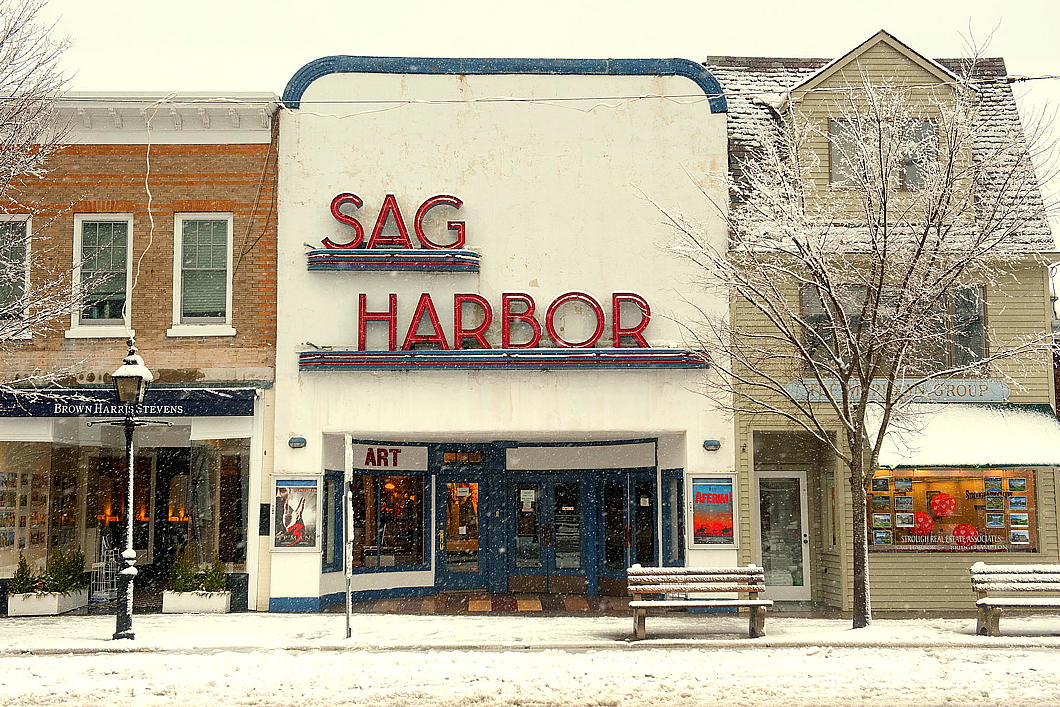
In December 2016, the cinema suffered a devastating early morning fire that destroyed most of the structure.
The iconic neon signage was salvaged by Chris Denon of North Fork Moving and Storage and the sculptor and ironworker John Battle.
Meanwhile, a community partnership that was already in discussions to purchase the institution from Mr Mallow came together to raise funds and oversee the rebuilding, including several improvements.
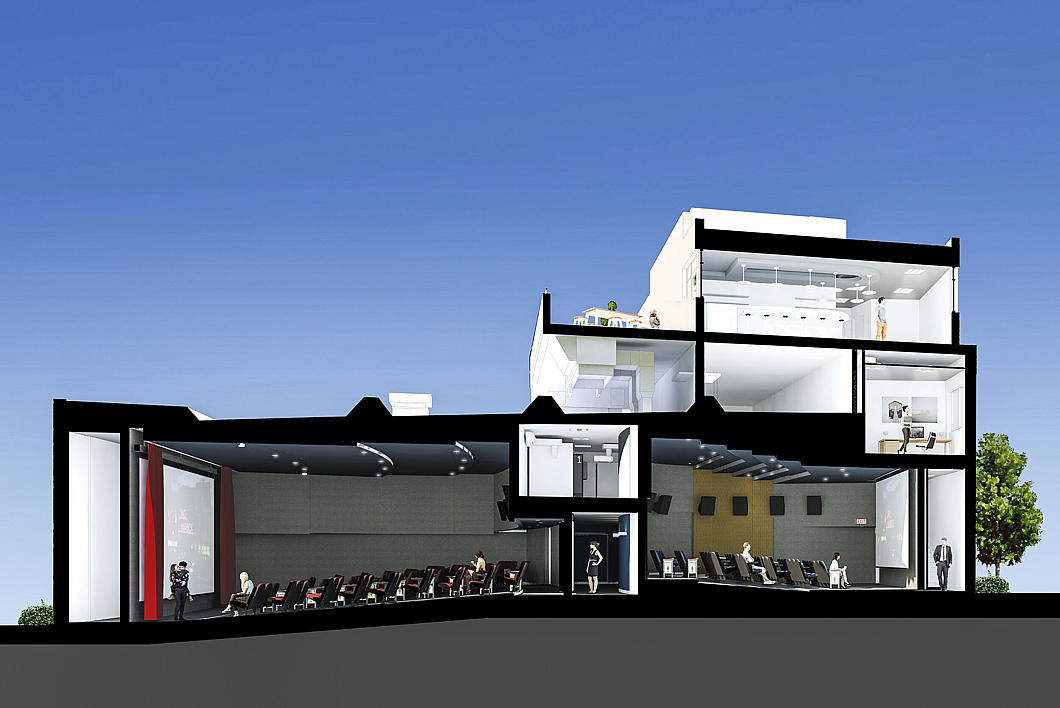
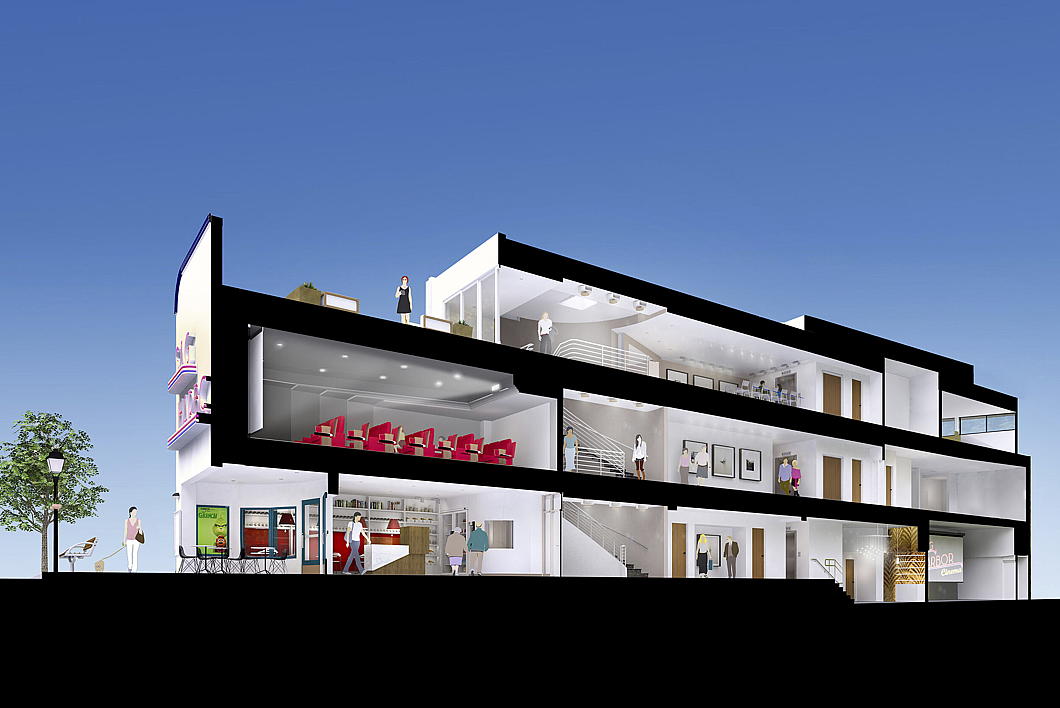
The main hall was divided between a large screening hall and a smaller one, along with a new screening room on the first floor (that’s second in American English) behind the iconic façade.
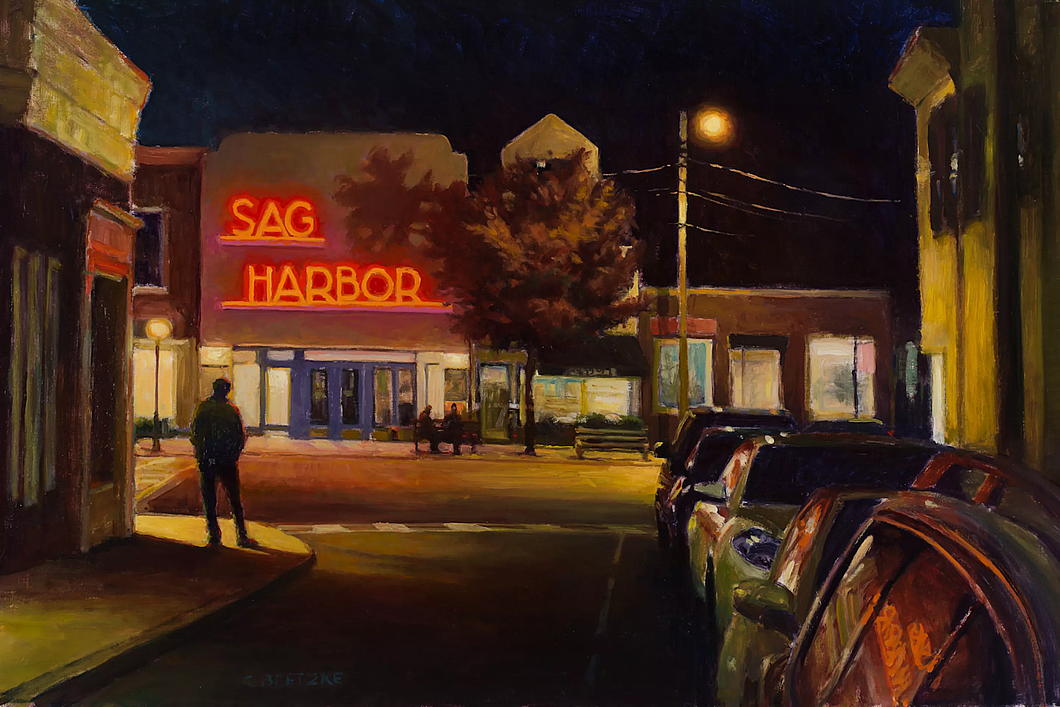
The artist Carl Bretzke captured Sag Harbor’s cinema in plein-air painted form.
Encouraged by the Grenning Gallery, Bretzke offered limited-edition prints of his painting, the proceeds of which helped to pay for reconstructing the movie theatre.

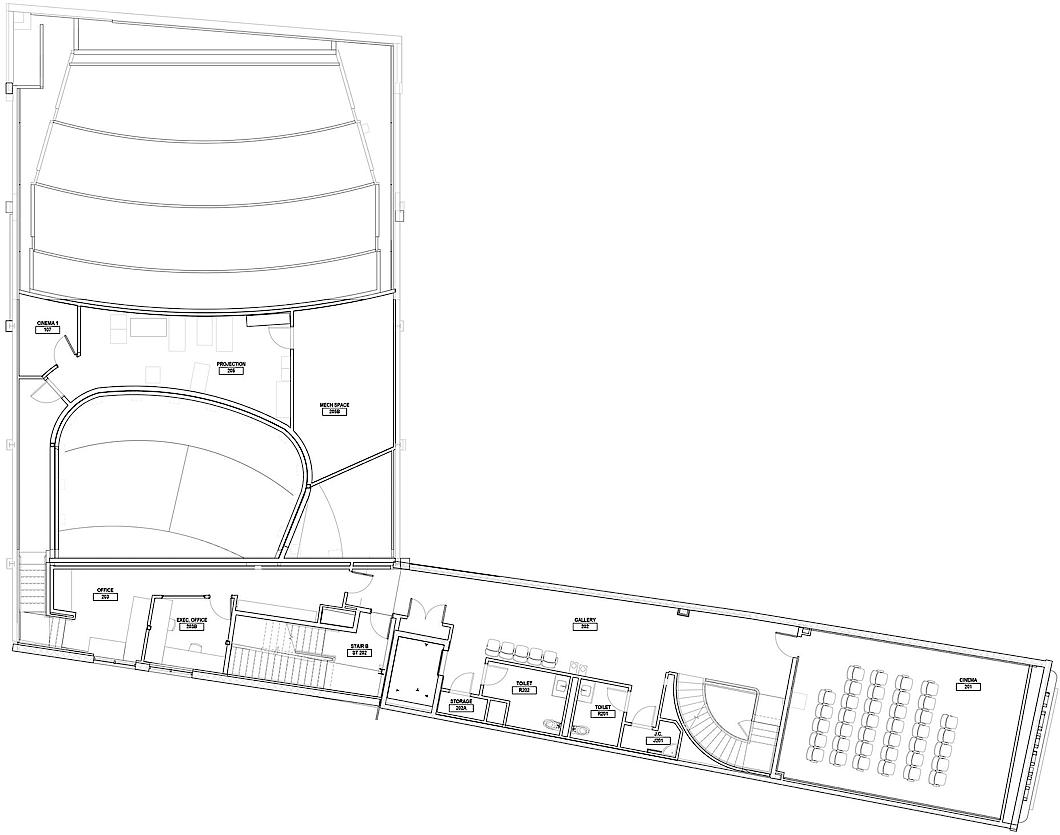

NK Architects also created a new bar and lounge, two roof terraces, an art gallery, and educational space within the original footprint of the cinema.
Following coronavirus-related delays, the new facility finally re-opened in June 2021.
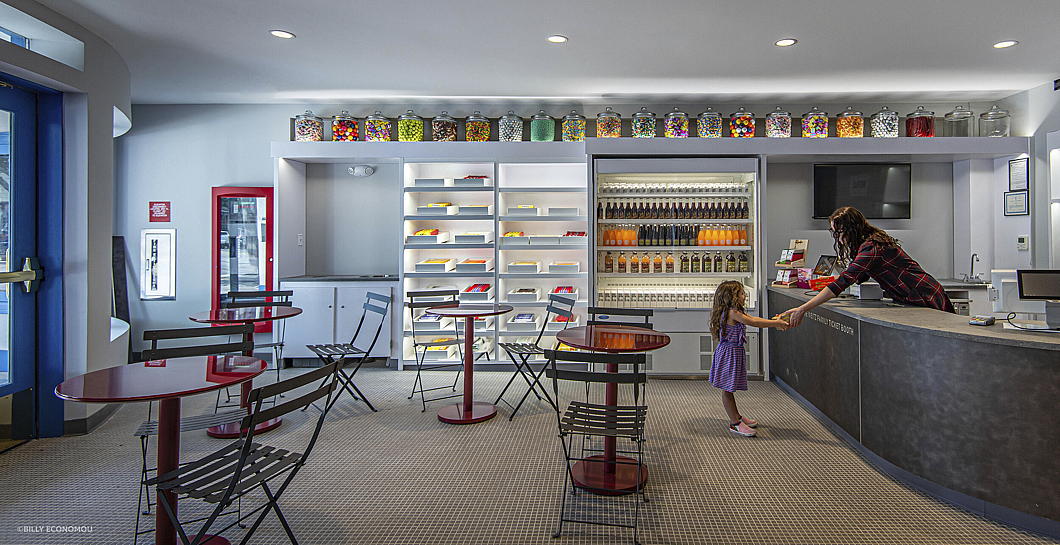
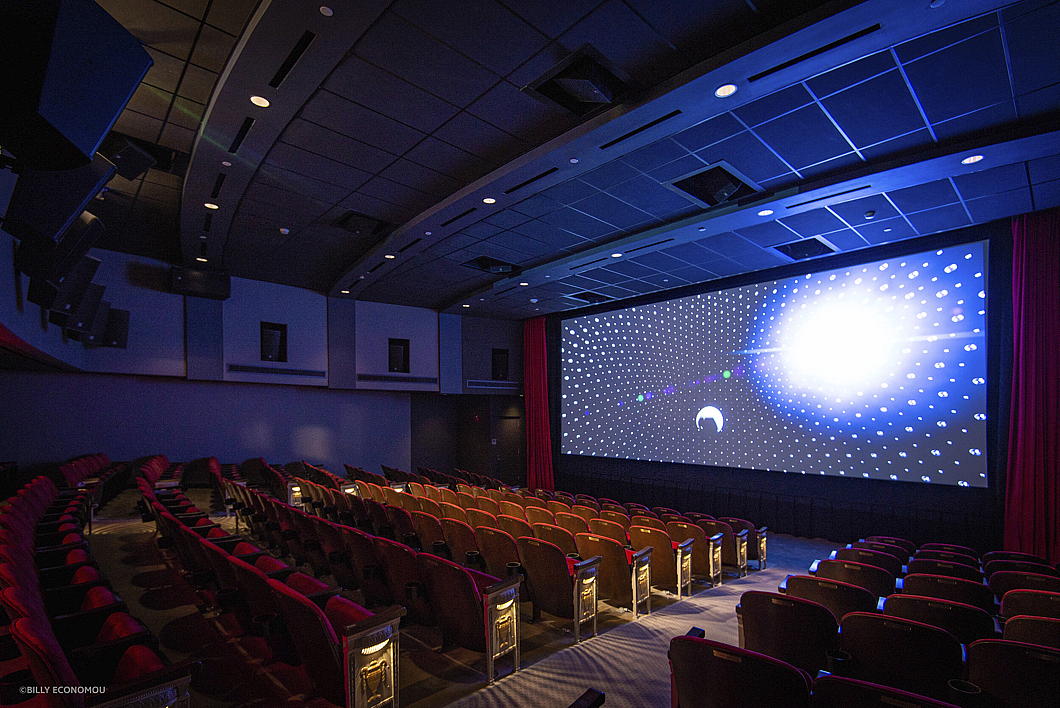
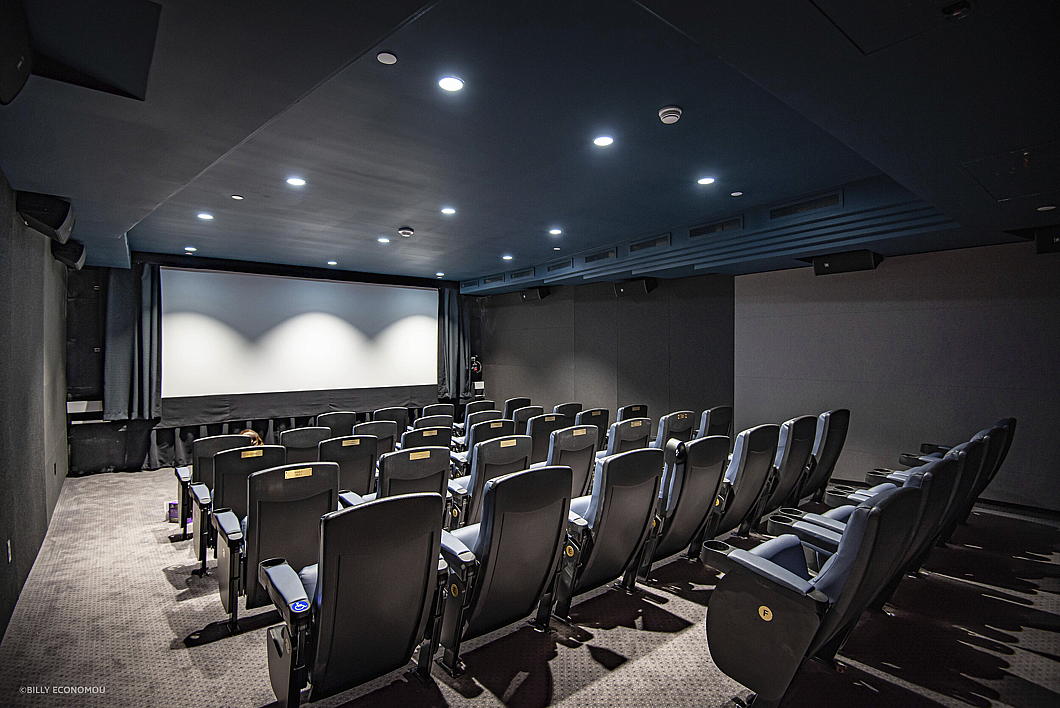
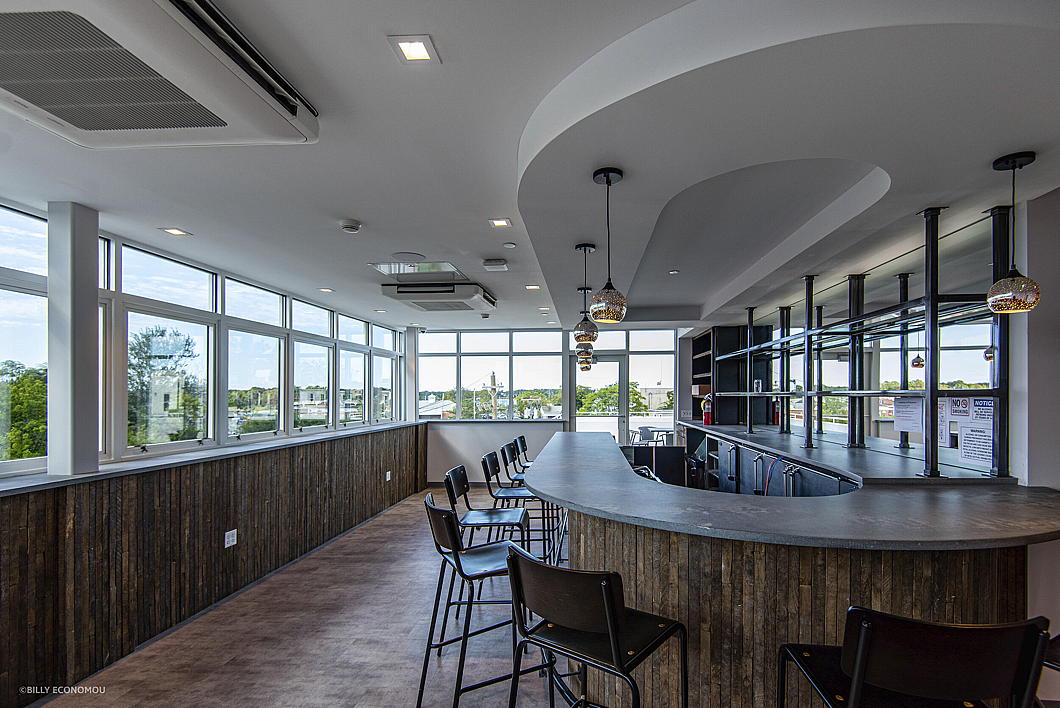
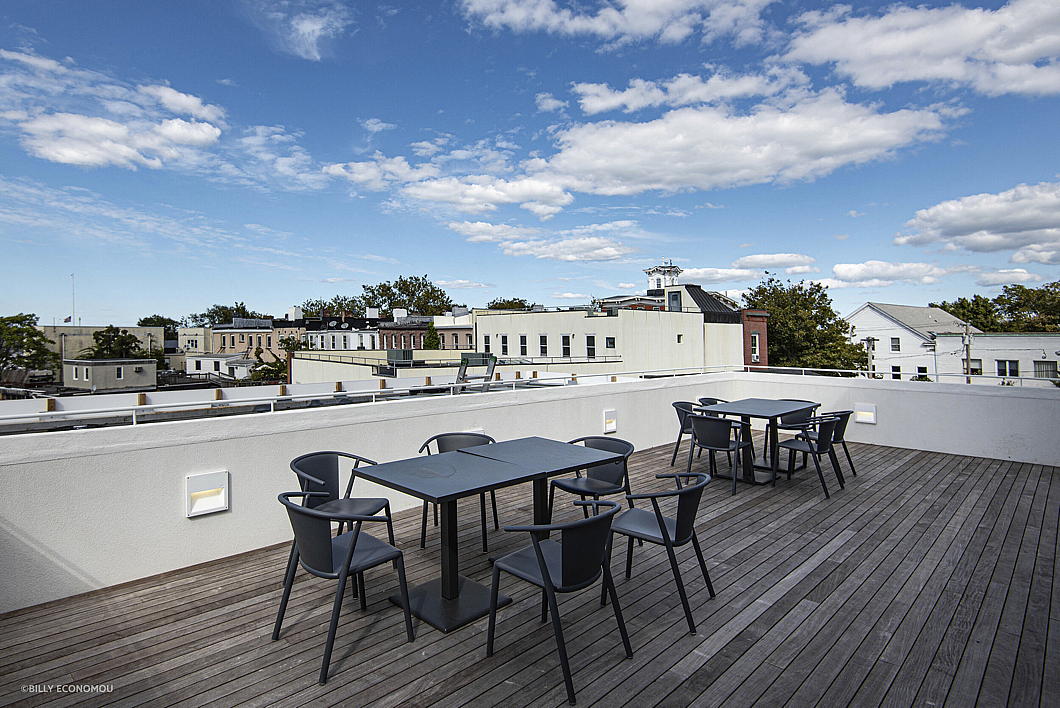
Given the improvement in the facilities, it seems like the Sag Harbor Cinema’s fire was the best thing to ever happen to it.
It is reassuring to know this little movie theatre will be gracing Sag Harbor’s Main Street for many moons to come.
In the Courts of the Lord

Well, not quite a lord, but a Vanderbilt — which in America is much the same. The indoor tennis courts at “Idle Hour” in Oakdale, L.I., were some of the grandest ever built in the United States.
The house itself, designed by Richard Howland Hunt for William Kissam Vanderbilt and completed in 1901, is unremarkable and not on the finer end of the spectrum. To me, it has all the glamour of a railway station serving a mid-sized town.
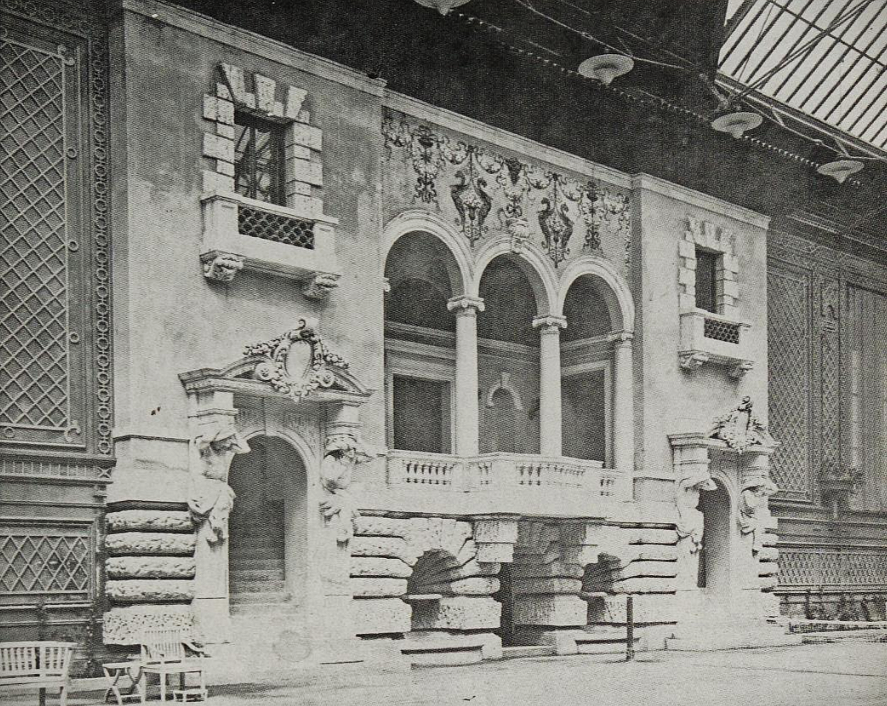
Just a year later, however, W.K. commissioned the architectural partnership of Warren & Wetmore — later famous for Grand Central Terminal — to design an extension that featured an indoor tennis court with adjacent guest quarters in a somewhat extravagant style.
As the polymathic Peter Pennoyer pithily put it in his The Architecture of Warren and Wetmore:
“The heavily rusticated stone of the gallery wall, exuberantly carved with atlantes and fanciful over-door sculpture and painted with scrolling frescoes, created a sculptural backdrop so surprising and original that it overwhelmed the vast open space of the court. For an ancillary building, the scale and energy of the architecture were tremendous.”
One can certainly imagine enjoying a refreshing summery gin-and-tonic on that loggia.
William Kissam Vanderbilt died in 1920. After a spell as an artists’ colony, in 1938 the estate was purchased by a cult called the Royal Fraternity of Master Metaphysicians, founded by a rogue named James Bernard Schafer who claimed he could raise an immortal child. (They also bought the old Gould stable on West 57th Street.) Schafer was jailed in 1942.
The National Dairy Research Laboratory took over the property and split the former tennis courts into lab space. Long Island’s Adelphi College bought Idle Hour in 1963 as an overflow campus which they later spun off into an independent institution, Dowling College, which shut in 2016.
For another indoor tennis court from the same period, see the old Astor place in Rhinebeck in the Hudson Valley.
American Exuberant

I have seen far too little of California, which is a shame because the confident freehand of American architecture between the wars reaches its greatest exuberance in the Golden State.
William Gayton began his eponymous Gaytonia Apartments in Long Beach, Ca., in 1929 and they were only midway complete before, as the characteristically colloquial style of Variety put it, Wall Street ‘laid an egg’ with the stock market crash.
This is a deliciously free California Gothic, unbothered by the pretensions of historicist verisimilitude. (A contrast to our still-much-appreciated academic friends on the East Coast.) Indeed, despite its castellar appearance it is mostly constructed of artfully handled stucco on wood disguising itself as stone.
And, true to the apartment house form, there’s even underground parking.

Jesuit Gothic
The Duane Library at New York’s Fordham University
Think of Jesuits and architecture and you probably think of the Baroque. At Fordham University, however, the SJs followed the American fashion and built in the Collegiate Gothic that gradually took hold of campuses across the continent from the middle of the nineteenth century onwards.
The first academic buildings in Anglo-America — like Harvard’s Massachusetts Hall and Yale’s Connecticut Hall — were in the vernacular Georgian style of the colonies. Robert Mills’ 1839 design for a library building at West Point was one of the first Collegiate Gothic buildings in America (and that institution’s first step on the road to going full Gothic). Some partisans will hold out for Old Kenyon as the first, others for Knox College’s Old Main. These, however, are survivors: the first Gothic university building in America was NYU’s University Hall on Washington Square, foolishly demolished in 1894.
Gothic is not solely an architectural style and it was a West Pointer, Edgar Allan Poe, who first crafted and popularised a distinctly American Gothic bailiwick in the republic of letters.
As Prof John Milbank put it the other day:
“[The] American gothic literary tradition contests the mainline American story. For the gothic perspective, the United States is a very old country: there since 1600, bearing medieval freight. Its exploring of frontiers will not open up hope, but encounter hidden horrors and horrifying potentials.”
“Far from having escaped Old Europe and started afresh and innocent, for the Gothic tradition it is rather that all the more extreme European demons (sects, cults, fears, fantasies) have fled to the New World where they always lurk, in league with its uncannily vast spaces.”
The architectural cornerstone of this Gothic chain of being linking both side of the Atlantic is St Luke’s Church in Newport, Virginia, built in the 1680s. Its pointed arches have sparked great bones of contention amongst architectural historians: is this an organic expression of a still-existing tradition from the Old World or a contrived and purposeful orchestration by colonial settlers? Gothic survival? Or Gothic revival?
I plump for the former: Gothic has always been a living tradition, even if somewhat neglected in certain generations. Ideology and architecture don’t mix well, whether it’s Pugin purporting that anything that is not Gothic is effectively pagan, or partisan modernists deriding any contemporary use of traditional forms as “pastiche”. The term “revival” is useful chronologically, but can obfuscate the breadth of an architectural, artistic, or literary style.
The brickwork tracery of Newport church renders the Gothic style in all its glories and shapes and forms an eternally valid option for the architecture of the New World. You can bauhaus all you want to, but American Gothic is real.
Thus whether unleashing ancient demons or — in the Jesuits’ case — slaying them, college presidents across the United States enthusiastically adopted the Collegiate Gothic style (while at the same time omnivorously crafting feasts of neo-classical, colonial, beaux-arts, and other styles).
Interwar American Gothic is some of the best Gothic of the twentieth century, and probably won’t be matched for centuries yet. Aside from excellent academic examples, just look at when the Gothic merges with the Art Deco as in the old GE Building by Cross & Cross at 570 Lexington Avenue.
Founded by the Jesuits in 1841, St John’s College found a home in the old manor of Fordham in the Bronx, granted to the Dutchman Jan Arcer (anglicised at John Archer) in 1671 by the provincial governor Francis Lovelace — brother to the poet Richard. Bishop John Hughes purchased the 106-acre Rose Hill estate to found a college and diocesan seminary. Eventually St John’s College took up the name of Fordham University by which it is known today.
Our old friend Edgar Allan Poe lived in a cottage in Fordham quite close by the college. He found his friends and neighbours the Jesuits “highly cultivated gentlemen and scholars, they smoked and they drank and they played cards, and they never said a word about religion”. It is claimed by some that the bell of ‘Old St John’s’, the Fordham University Church, helped inspire his famous poem ‘The Bells’.
The university grew slowly until the 1920s, a decade of expansion during which president Fr William J. Duane SJ was keen to build a suitable library for the college. The library that would one day bear his name was built 1926-1928 to a design by the Philadelphia architect Emile George Perrot, accomplished in his day but not now widely remembered. (Incidentally, Perrot later completed a building — White-Gravenor Hall — at America’s first Catholic and elder Jesuit university, Georgetown.)
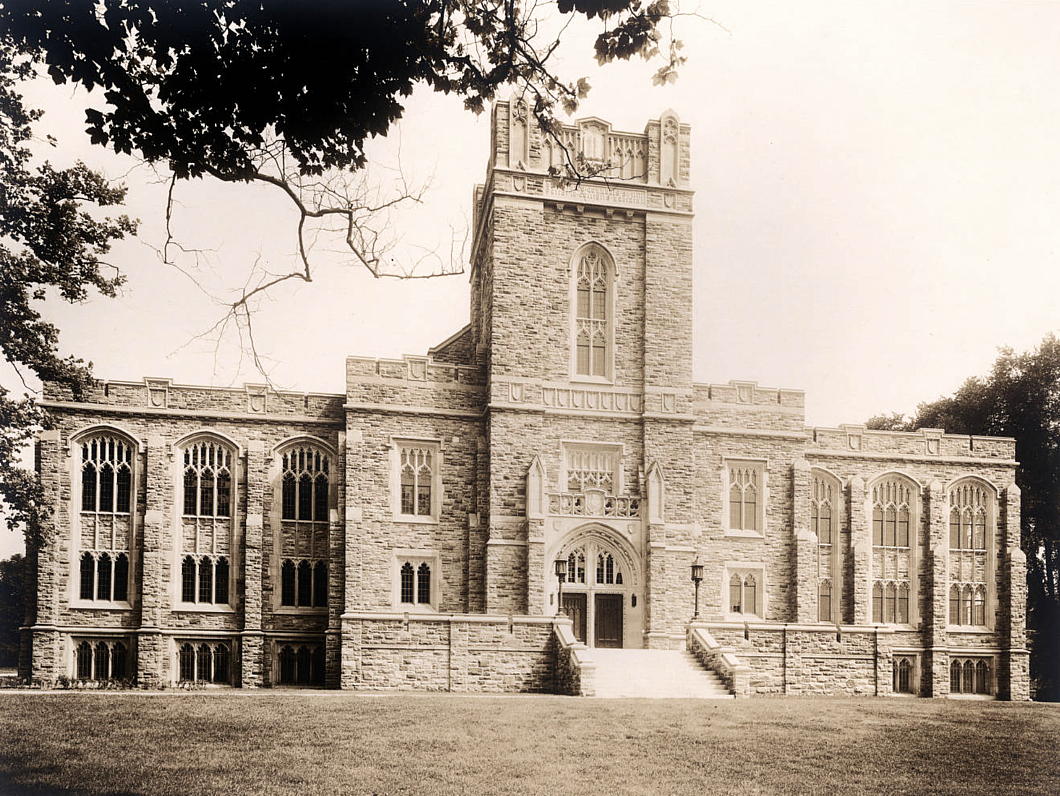
“Architecture,” Perrot wrote, “is the incarnation in stone of the thought and life of the civilization it represents.” If Duane Library is anything to go by, the thought and life were fine indeed.
Perrot provided a central block crowned with a tower, flanked by two pavilions. In front, a wide flight of steps ascends to a raised platform and, through a pointed arch, the reader is led via the entry portal up a further set of internal stairs to the principal floor of the library.
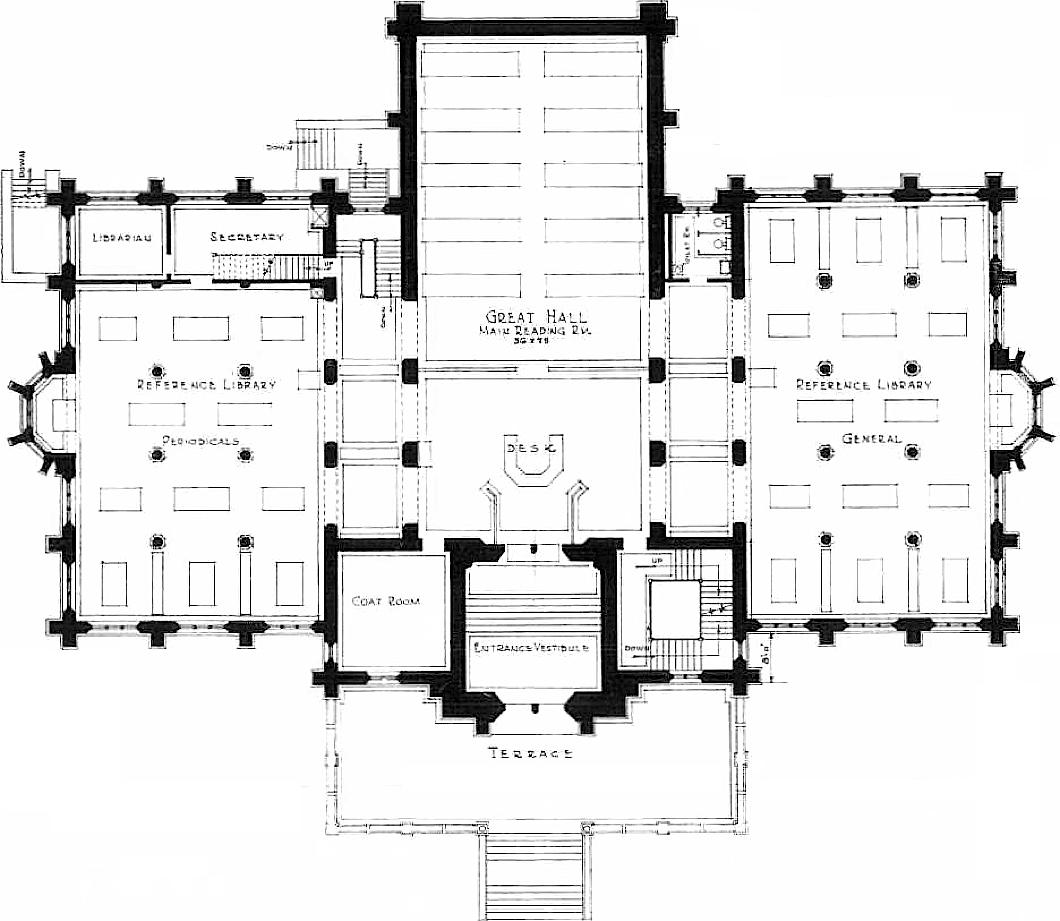
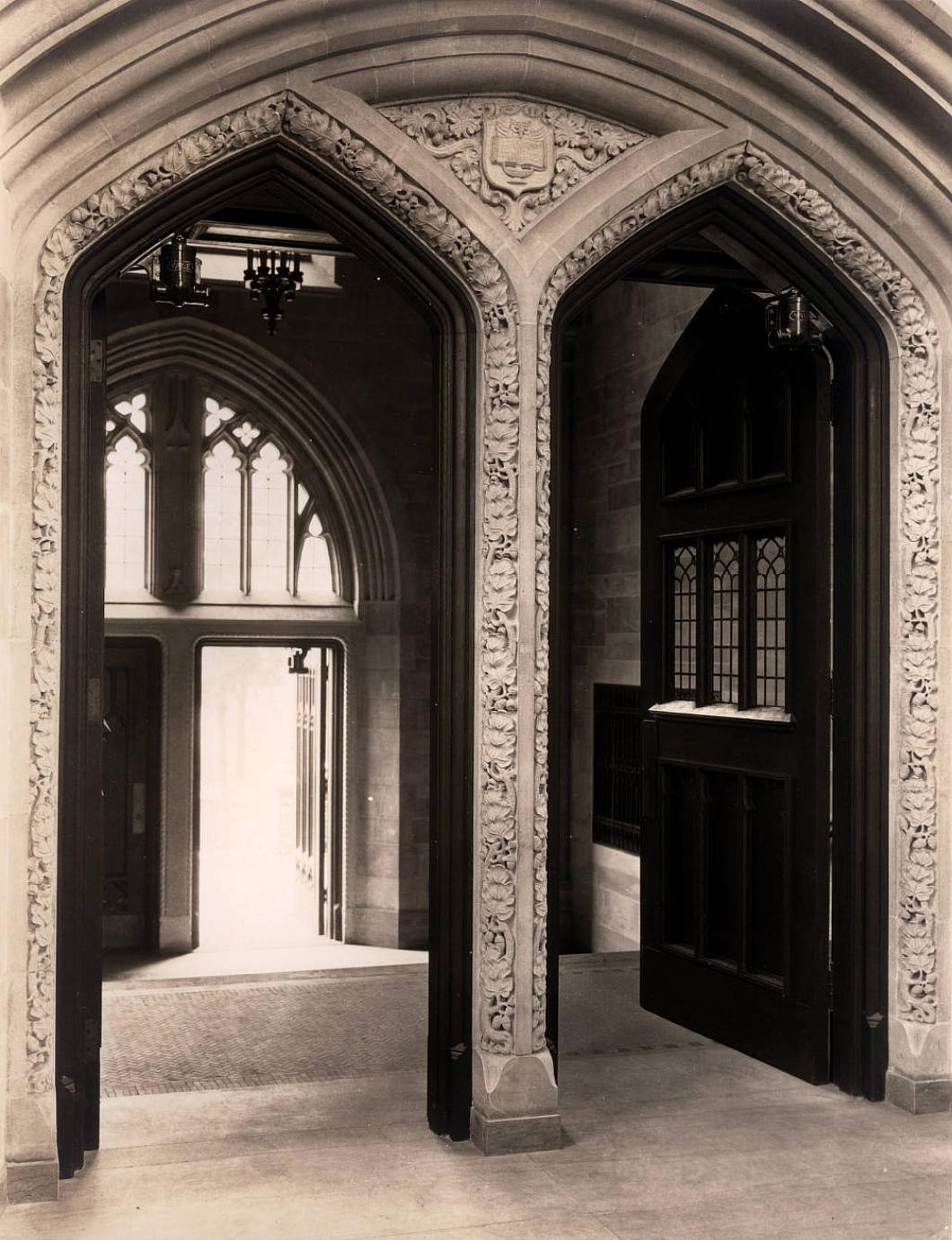
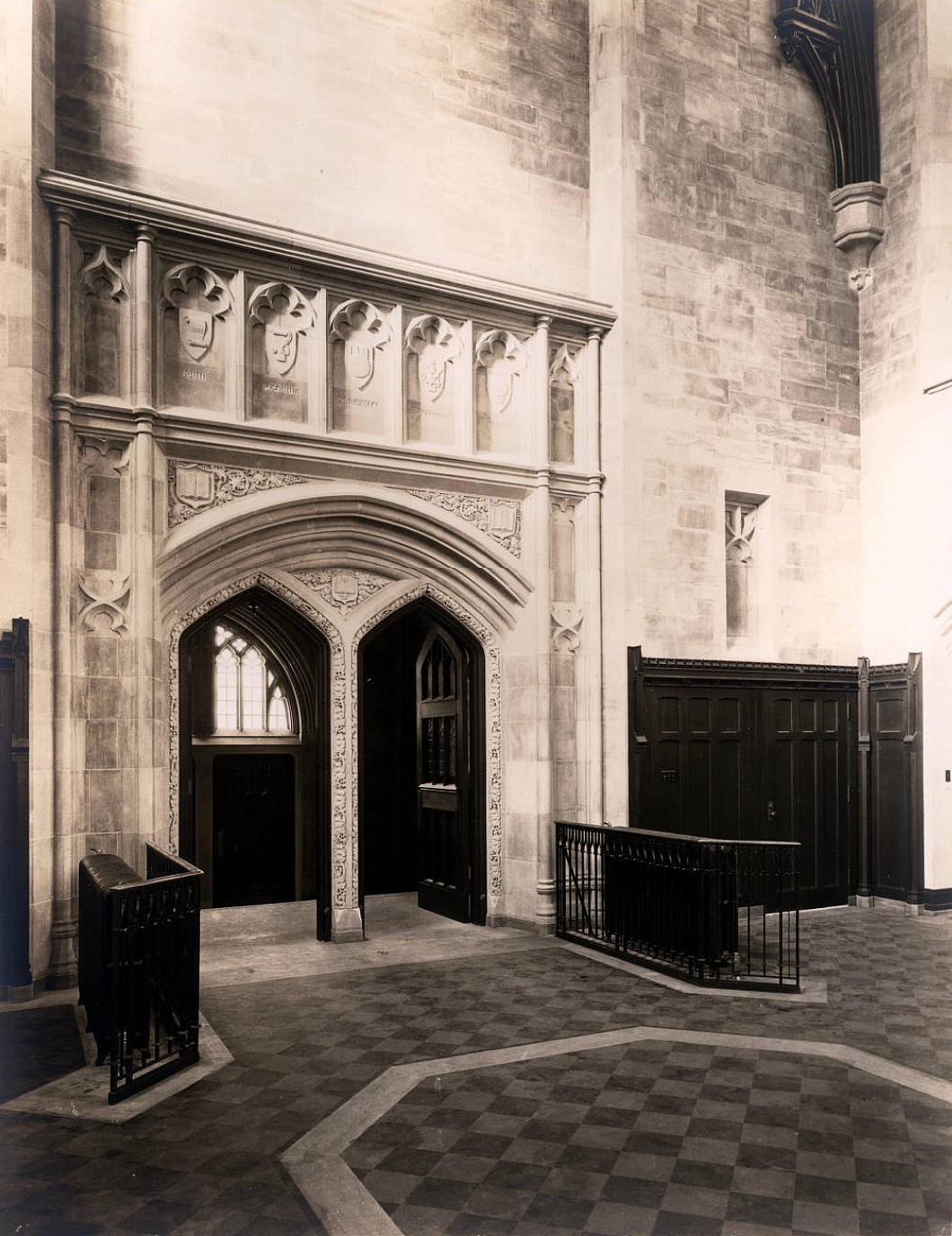
Through these doors with their intricately carved surrounds, the reader enters the great hall of the library, passing a circulation desk — housing no-doubt assiduous and eagle-eyed librarians preserving order and quiet — and onward through a carved wooden screen to the reading area beyond.
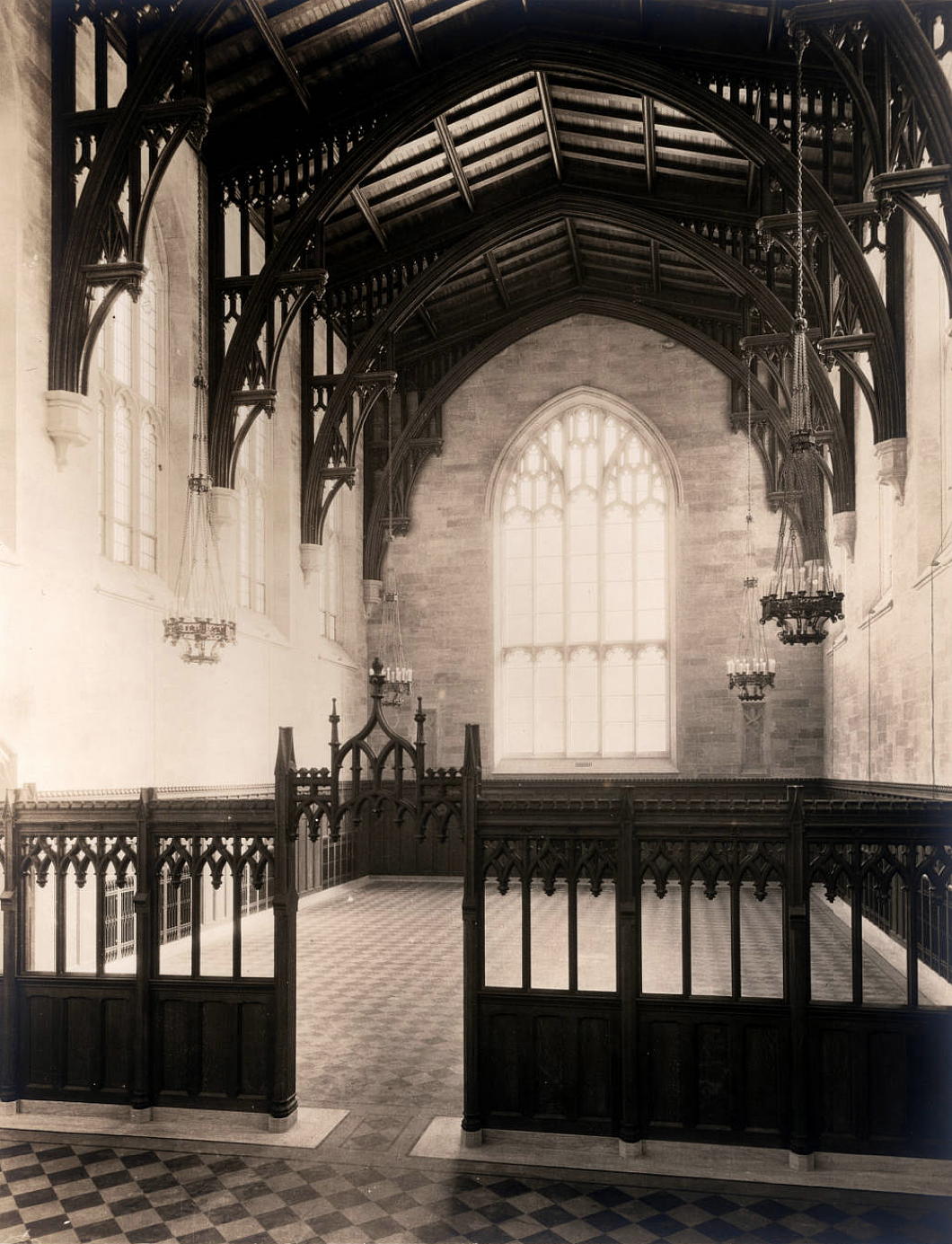
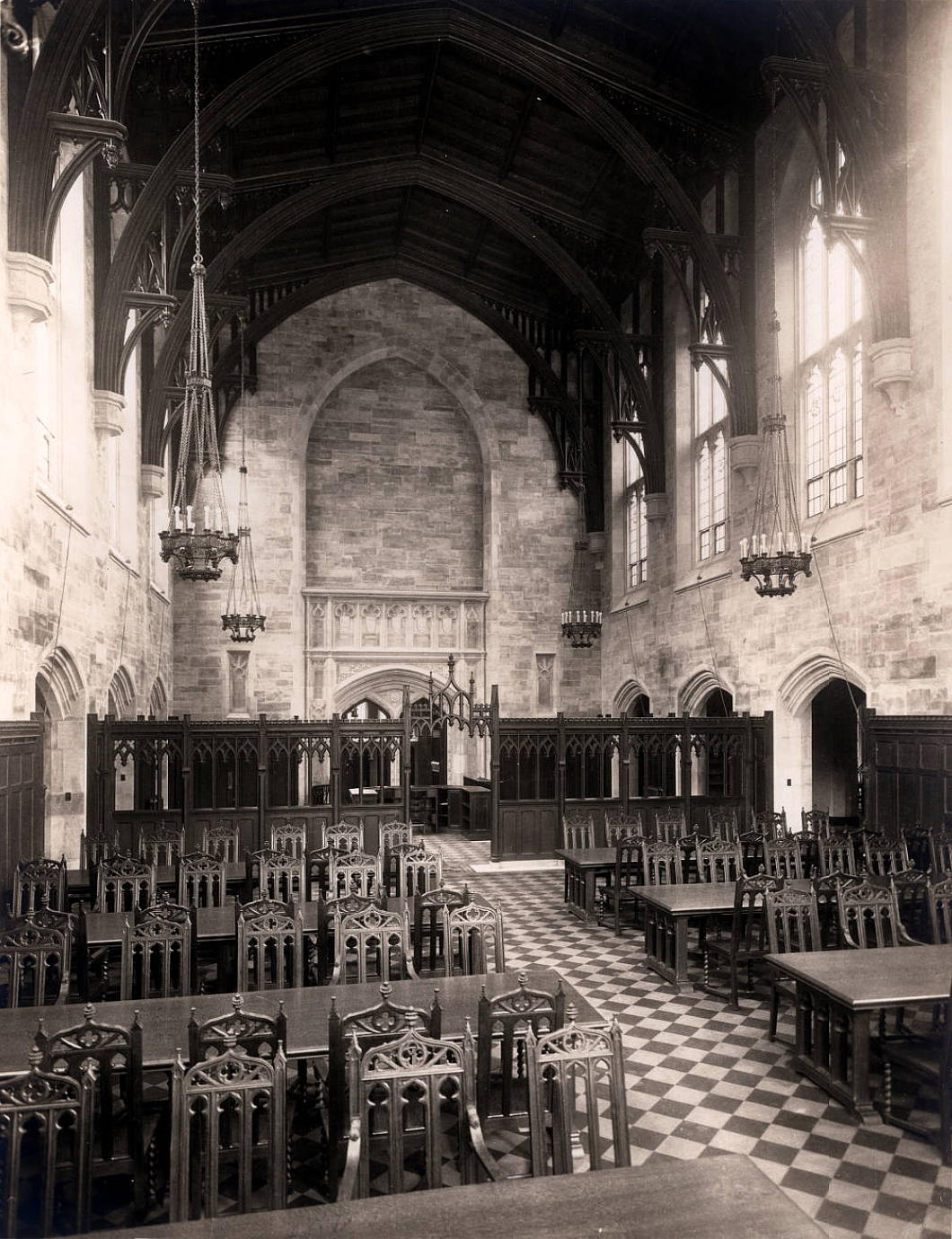
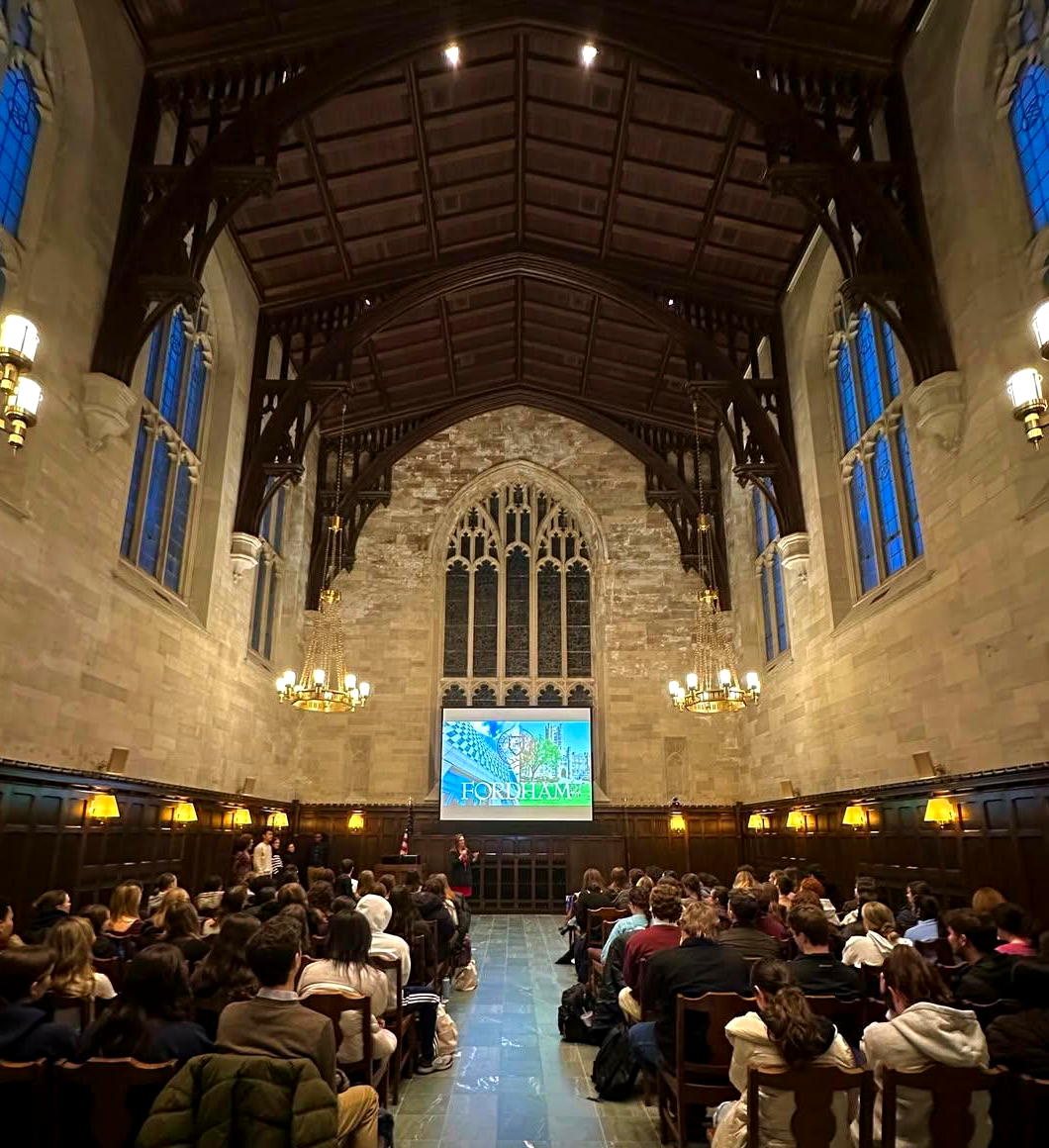
The main reading room is a fine space, and could easily have been the dining hall of an Oxbridge college or indeed a chapel dedicated to divine worship.
The tendency of interwar American architects to design libraries like cathedrals is well documented, with Yale’s Sterling Memorial Library leading the way.
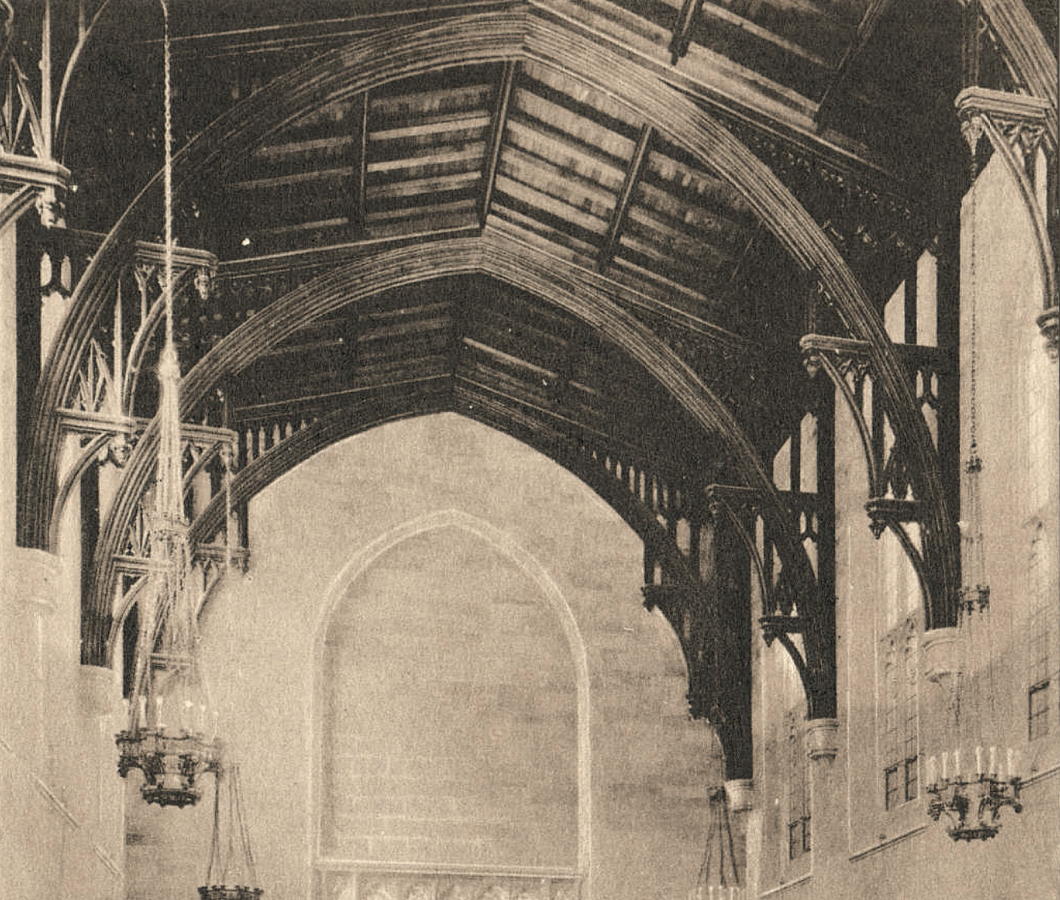
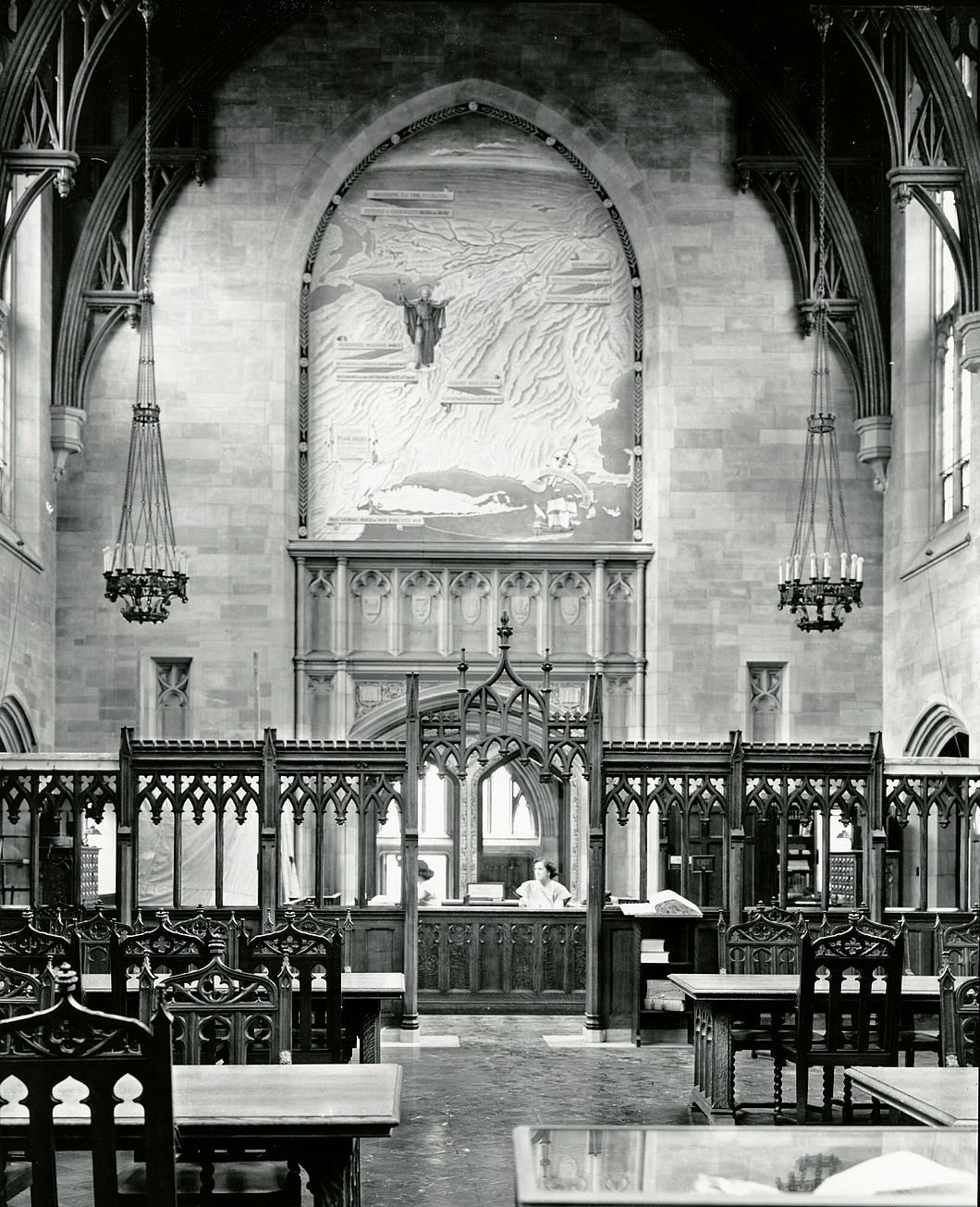
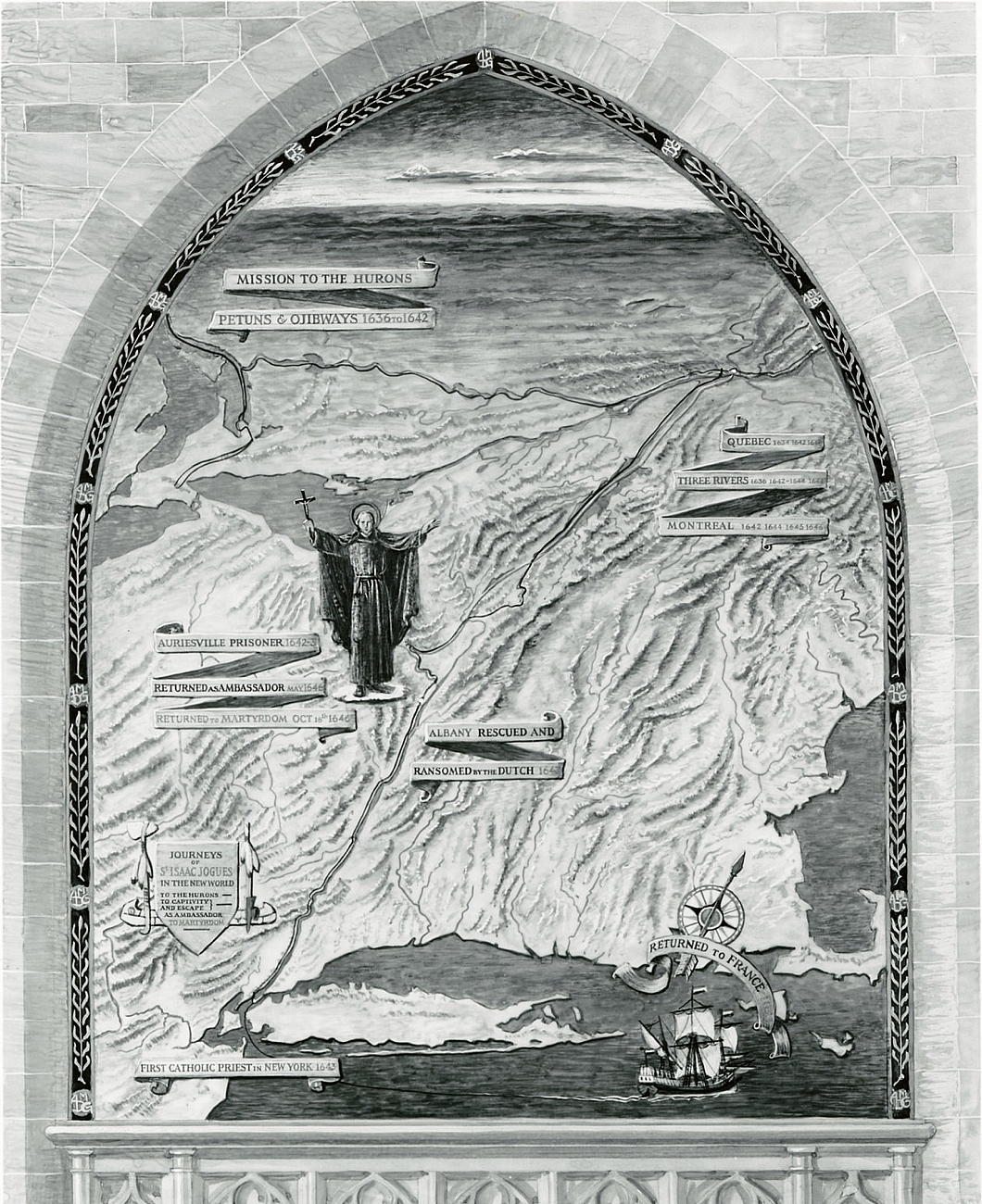
The sacral aura of the building was increased in 1949 when the mural ‘The Journeys of St Isaac Jogues in the New World’ was installed in the gothic arch of the reading room.
Jogues was the first Catholic priest to have visited the city of New York and did missionary work amongst many of the native tribes up the Hudson and beyond in New France before his martyrdom in 1646.
The muralist and designer Hildreth Meière designed this depiction of Jogues’s travels which was executed in casein and gesso relief by her collaborator Louis Ross. It was restored as part of the 2004 renovations to the building.
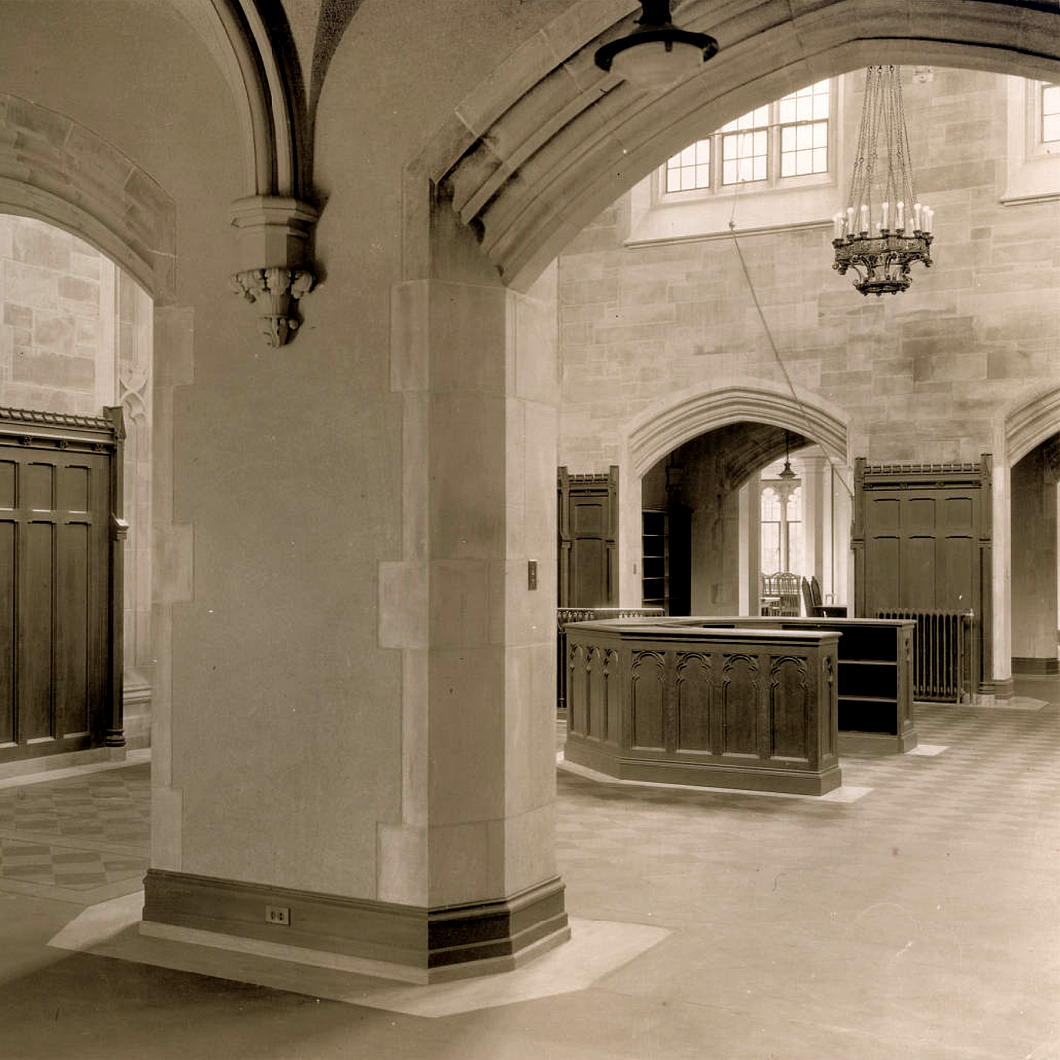
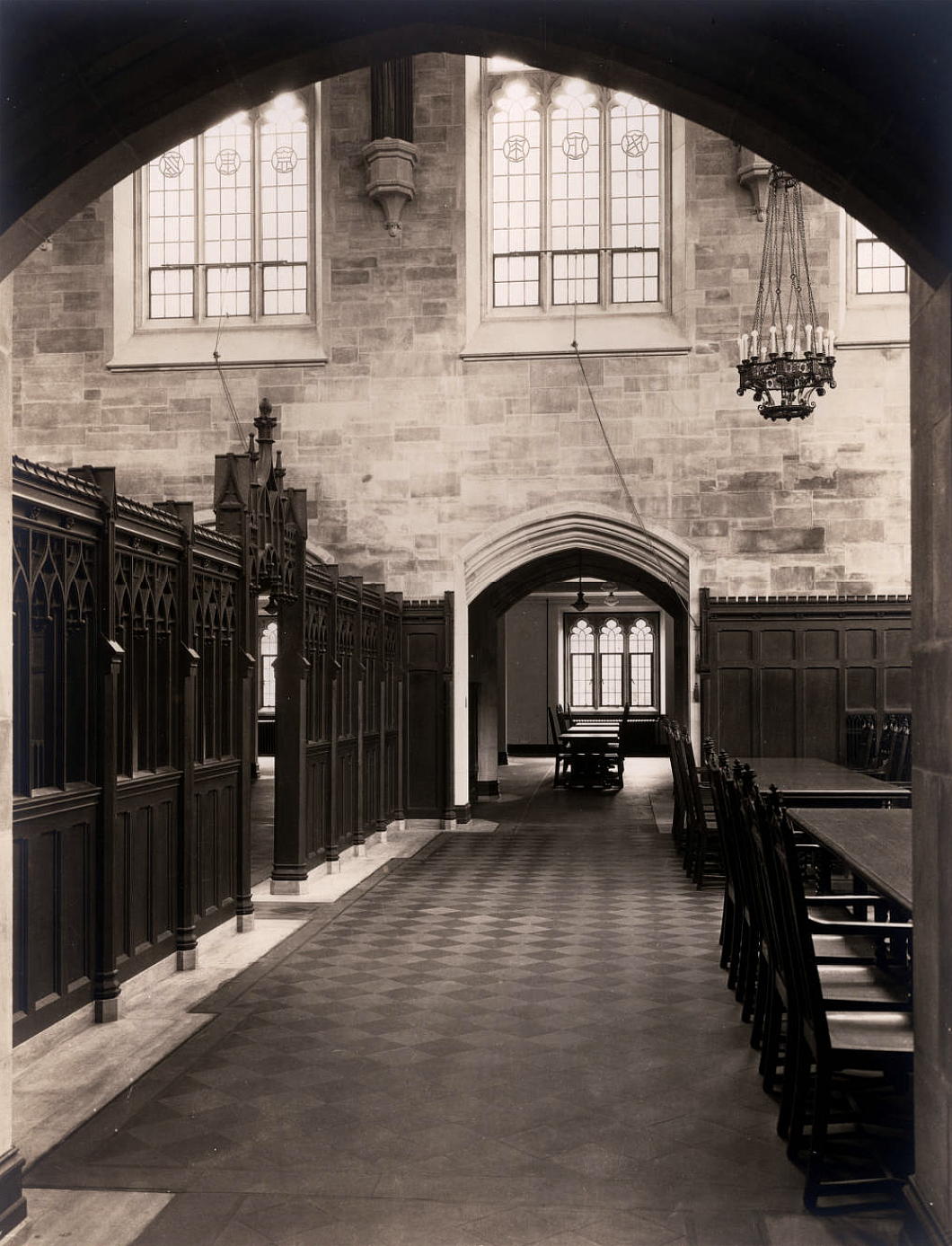
Circulation to the flanking wings of the library is through low arches that were frequently deployed in interwar American Gothic interior spaces, particularly in New York. (Viz. South Dutch Reformed Church [now Park Avenue Christian Church] in Manhattan, St Joseph’s Church in Bronxville, and elsewhere.)
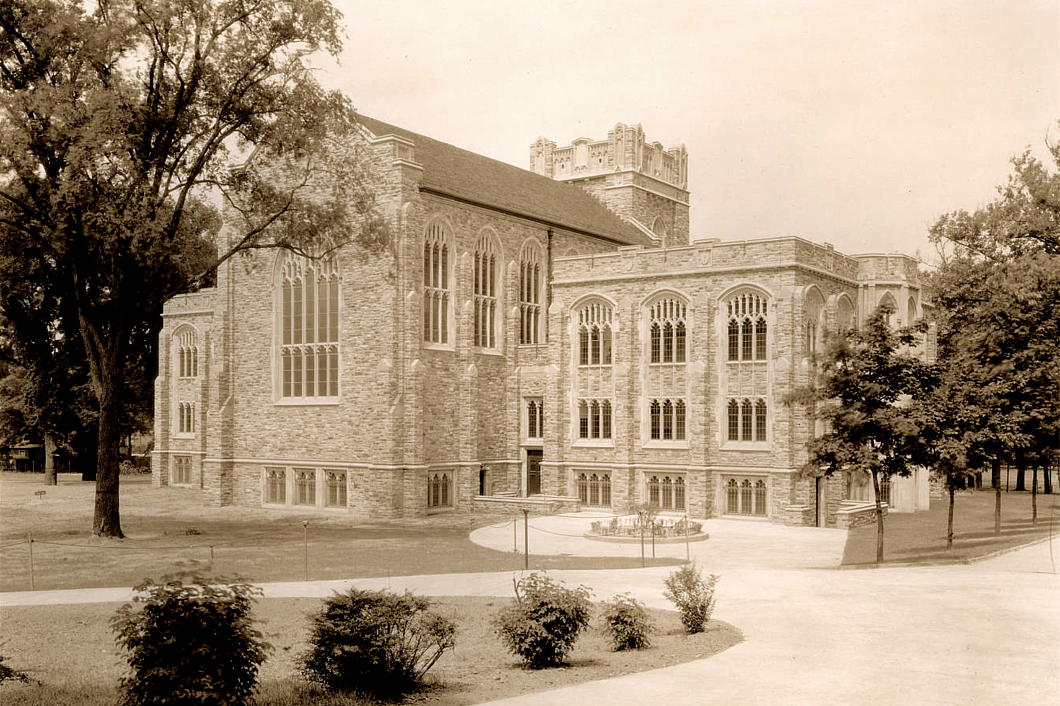
Perrot understood the ever-evolving nature of universities as academic communities and living organisms. The future of the Duane Library was not, despite its building materials, set in stone.
The architect planned the building so it could be expanded by later generations when the need arose — either outward by extending the wings or backward by building additions to the rear.
The fathers of Fordham umm’ed and ahh’ed but never got around to extending the library. Instead they crammed more and more volumes into the original footprint, adding layers of stacks that expanded into the great hall.
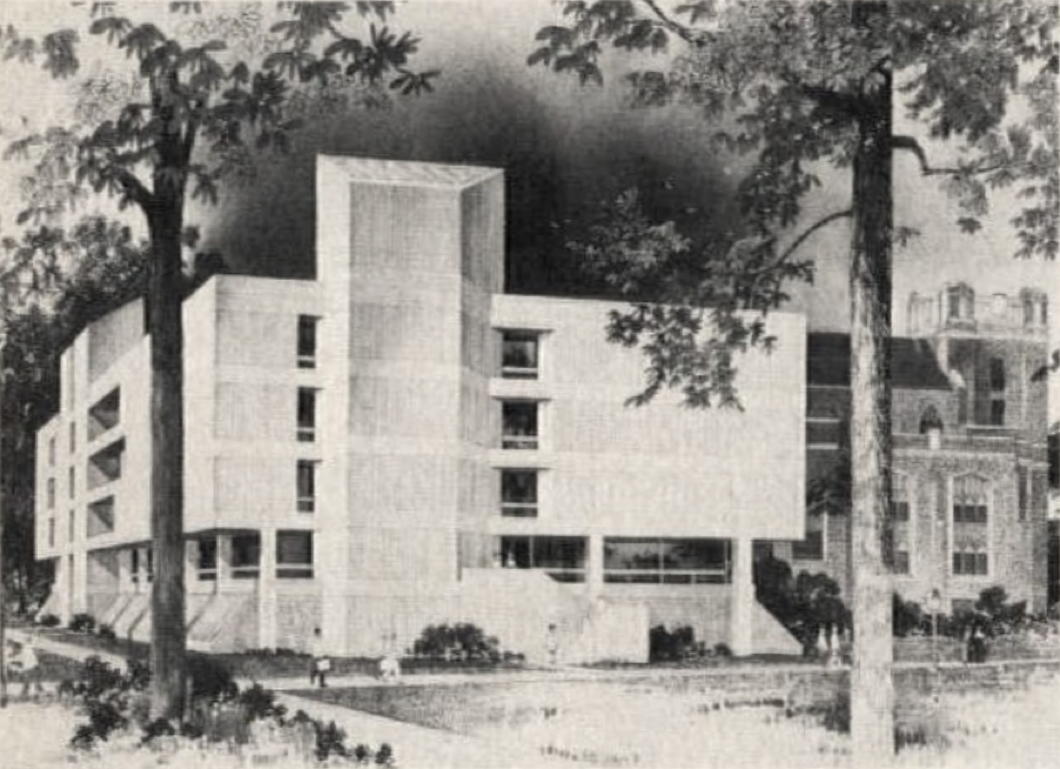
Schemes were devised, only to be shelved by economic downturns or other factors. Judging by the look of the 1968 proposal from DeYoung and Moskowitz (above), perhaps we should be glad.
In the 1990s, a massive new university library was constructed at the western corner of the campus and old Duane was left empty.
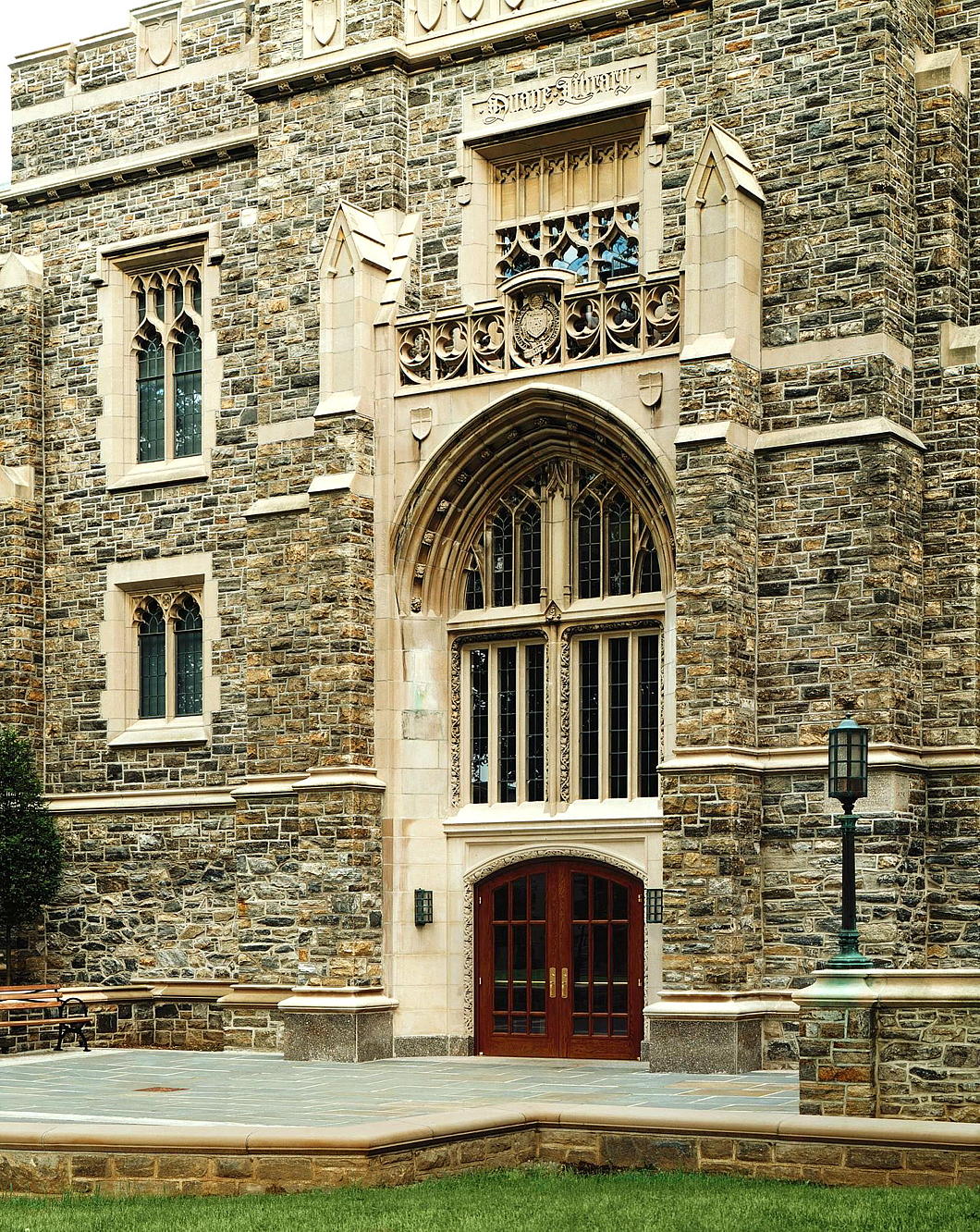
It wasn’t until 2004 that Fordham repurposed the Duane Library with a comprehensive renovation to serve as the Admissions Office and first port of call for prospective students, as well as home to the theology department.
The exterior staircase and terrace were removed and the entrance lowered to the ground level, allowing easier handicapped access but also increasing the utility of the lower level interiors.
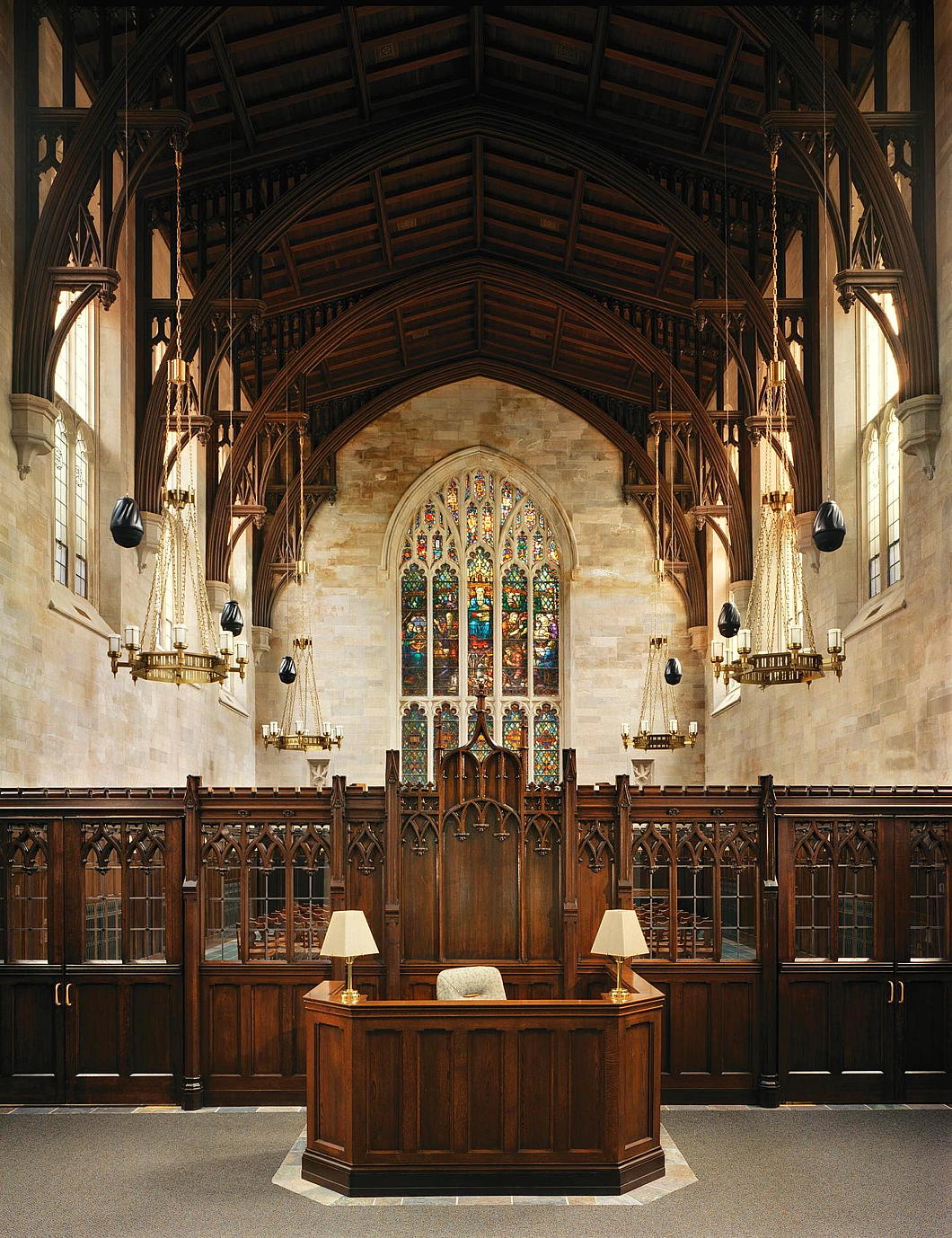
Restored to its former glory, the great hall is now used to welcome groups of visitors as well as a 140-seat performance or lecture venue.
The stained glass window was installed in 1929 as a gift from the Class of 1915, and depicts the study of philosophy, literature, astronomy, natural history, and geography.

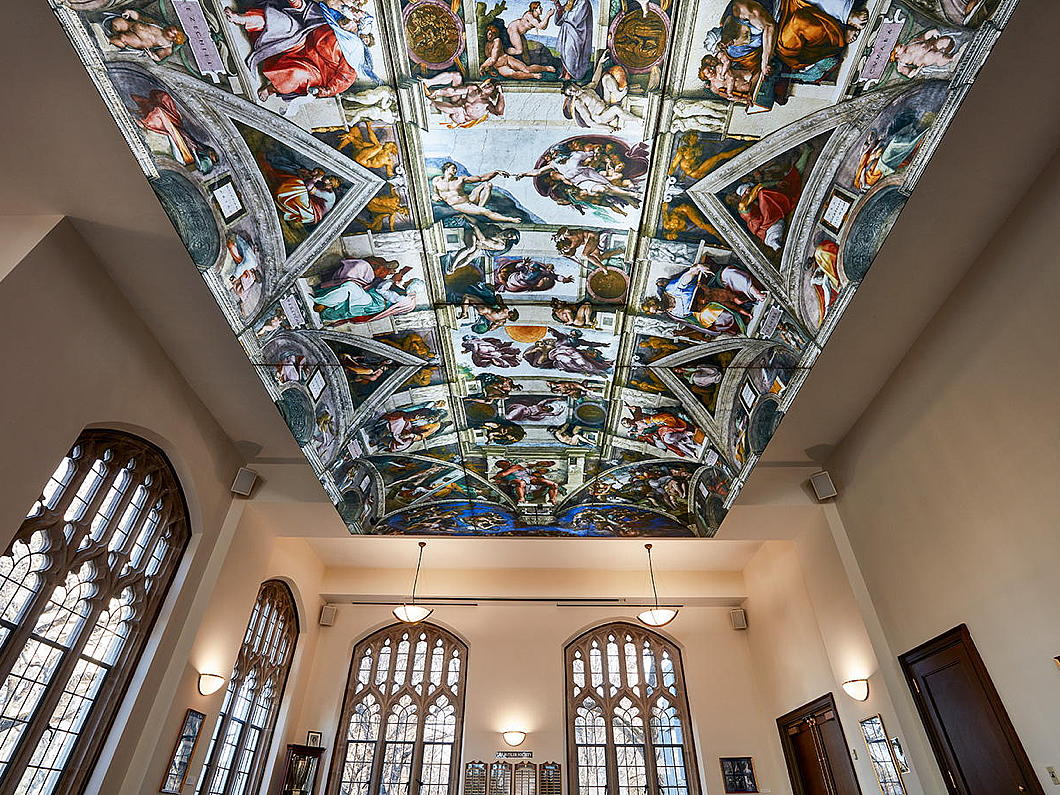
One of the recent additions to the Duane Library is a quarter-scale replica of the ceiling of the Sistine Chapel. It was created for the 2017 exhibition ‘Michaelangelo: Divine Draftsman and Desiner’ at the Metropolitan Museum of Art.
Fr Joseph McShane was visiting the exhibition alongside a Fordham trustee, his wife, the Fordham chair of art history, and a museum administrator and said as soon as he walked into the room he wondered if he could find a home for it at Fordham.
As chance had it, while viewing the exhibition they bumped into Dr Carmen Bambach, a Met curator specialising in Italian Renaissance art who had previously been an assistant professor at Fordham.
Following the tour, the group decided to propose that the university house the copy of the ceiling once the exhibition was finished. “Much to my surprise,” Fr McShane said, “we were informed a few weeks later that the Met approved our proposal.”
Taking inspiration from Prof Milbank’s earlier-mentioned comments about gothic literature, we could hardly visit the ancient manor of Fordham and the former library of its Gothic university without taking in a ghost story.
On a Sunday night before a final exam, an economics student was studying late in the Duane Library and was the last person left on the floor. Suddenly he heard the sound of footsteps and peeked outside his cubicle. He saw an old priest with a kindly face so he said hello to him.
The priest introduced himself as Father John Shea and asked what he was doing in the library so late. The student explained that he had an economics exam he was studying for. “Oh!” said the priest. “I used to teach economics here. But I haven’t taught in three years.”
The priest asked if the student would carry on to do a PhD but he said no, he was planning to go to law school instead and had already heard back from Georgetown. “Good school! I got my doctorate there,” the priest offered.
After a few minutes of pleasantries, the student ended the conversation and returned to his studies.
Following the exam the next day, he was in the economics department and, chatting with the departmental secretary, he mentioned that he had met Father John Shea the night before. The secretary told him he must be joking because Father Shea had been dead two or three years.
A look in an old departmental catalogue confirmed that the good father had indeed obtained his doctorate from Georgetown and a picture of Father Shea looked like the priest the student saw.
As luck would have it, in 2012 another Fr John Shea was appointed to Fordham College at Lincoln Center, making him the third Jesuit of this moniker at Fordham since John Gilmary Shea.
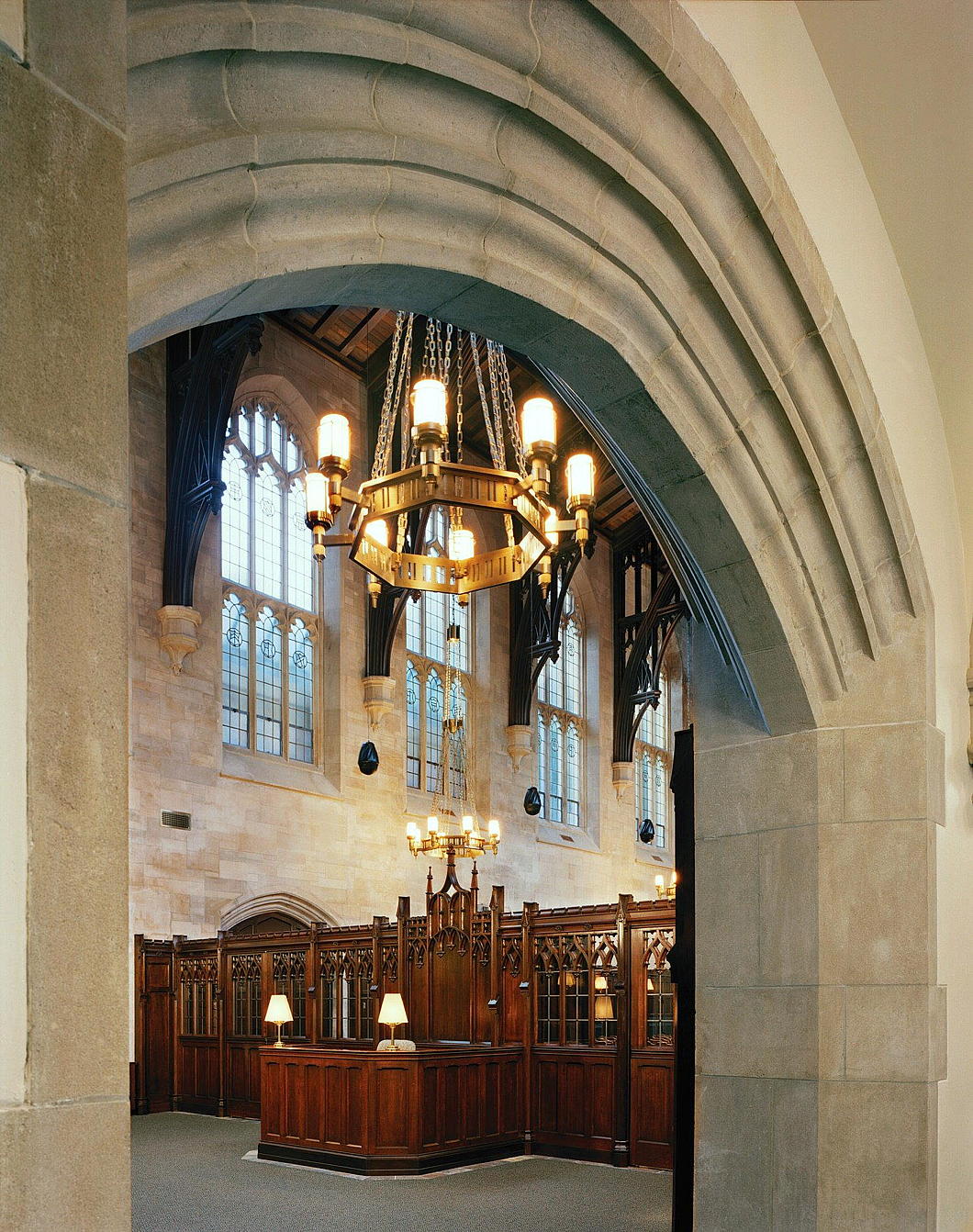
As the admissions office and theology school, any ghosts still haunting the Duane Library will have plenty of new visitors to meet as well as learned scholars to discourse with.
And while Fordham may be haunted, it is good to know its ghosts are friendly rather than fearsome.
Christ Church

Christ Church
Lancaster County, Commonwealth of Virginia
Nonetheless, this gem of the American Georgian building arts — designed by an unknown hand — is an almost miraculous survival.
It was built 1732-35 by Col. Robert “King” Carter, the planter and merchant lord who served as Speaker of the House of Burgesses, President of Virginia’s Privy Council (the Governor’s Council or Council of State), and eventually Acting Governor of the Dominion.
The regal moniker by which he was known reflected the wealth and power he obtained in the colony, and Christ Church was constructed to serve Carter’s country seat at Corotoman.
The substantial mansion had burned down in 1729 but Carter carried on, living in the dower house of the estate. Such was his wealth that the fire barely featured in his diary, though he much lamented the complete loss of the wine cellar.
Christ Church had no natural parish and the loss of supporting glebe lands after the Church of England was disestablished in Virginia in 1786 removed the main source of funds to maintain the church.
It was only intermittently used during the nineteenth century, but in 1927 the Association for the Preservation of Virginia Antiquities took charge of the site and began restoring Christ Church.
In 1958 that esteemed body erected the Foundation for Historic Christ Church which has devoted its attention and resources to the care of this Georgian treasure ever since.
This work has by no means been limited to architectural preservation: the Foundation promotes scholarly research on the Carters, the world of the Virginia plantations, and every aspect thereof, in addition to operating a museum on the site to explain Christ Church to visitors and travellers.
Thanks to the efforts of Edmund Berkeley Jr (1937-2020) — who carried on the work of his uncle Francis L. Berkeley (1911-2003) on Virginia’s colonial papers — the surviving diary, correspondence, and papers of “King” Carter are now in the care of the Historic Christ Church museum.
Most importantly, God is still worshipped in some form at Christ Church: the Episcopalian congregation in Kilmarnock, Va., holds Sunday morning services here from June through September according to ‘Rite One’ of the Protestant Episcopal Church’s Book of Common Prayer.
The church is best approached through the simple avenue of cedar trees that leads the visitor straight to Christ Church’s west door.
It looks particularly cozy in winter.

and Michael Kotrady via Wikimedia Commons (modified).
The Secret Chapel of Harkness Tower

Yale’s Harkness Tower is, by my estimate, the finest tower in the United States and its designer, James Gamble Rogers, one of the best American architects of his day. JGR is in the Pantheon of his craft, though not quite as highly appreciated as Bertram Grosvenor Goodhue or Ralph Adams Cram.
Harkness Tower is a monument to verticality: from the ground up at each and every stage you expect it could end right there in completeness and beauty — but then it goes another stage higher. Rogers was inspired by the “Boston Stump” of St Botolph’s Church in Lincolnshire but he took that form and creatively expanded and elaborated upon it.
The tower rises 216 feet — one foot for every year Yale existed by the time of its construction.

Yalies – “Elis” – are inveterate founders of drinking clubs which, in order to cultivate a deliberate air of inscrutable mystery, they call “secret societies”, even though many of them are (thankfully) nothing which might rightly be called such.
It was years ago on one of my occasional stays in New Haven for some convivial merriment organised by just such a cabal that my old friend A.B. and I were passing Harkness Tower and I was expounding upon its beauty.
“You know, of course,” A.B. alleged, “it has a secret chapel in it.” I had no such knowledge, and pressed for more information. “Well it’s not quite a chapel, but it feels like one. The university almost never lets anyone use it.”
Universities never do. Once a university has anything, they do their best to stop people using it. (Anyone at Edinburgh University: just try throwing an event in the Raeburn Room in Old College and find out.) (more…)
London’s Unbuilt University
The Bloomsbury Scheme of Sir Edwin Landseer Lutyens

The University of London is a curious institution that these days no one really knows quite what to do with. At its zenith it was an imperial giant, validating the degrees of institutions from Gower Street to the very ends of the earth.
University College was founded — as “London University” — by the rationalist faction in 1826, prompting the supporters of the Anglican church to establish King’s College with royal approval in 1829.
Neither institution had the right to grant degrees, which led to the overarching University of London being created in 1836 with the power to grant degrees to the students of both colleges — and the further colleges and schools that would be founded later or come within its remit.
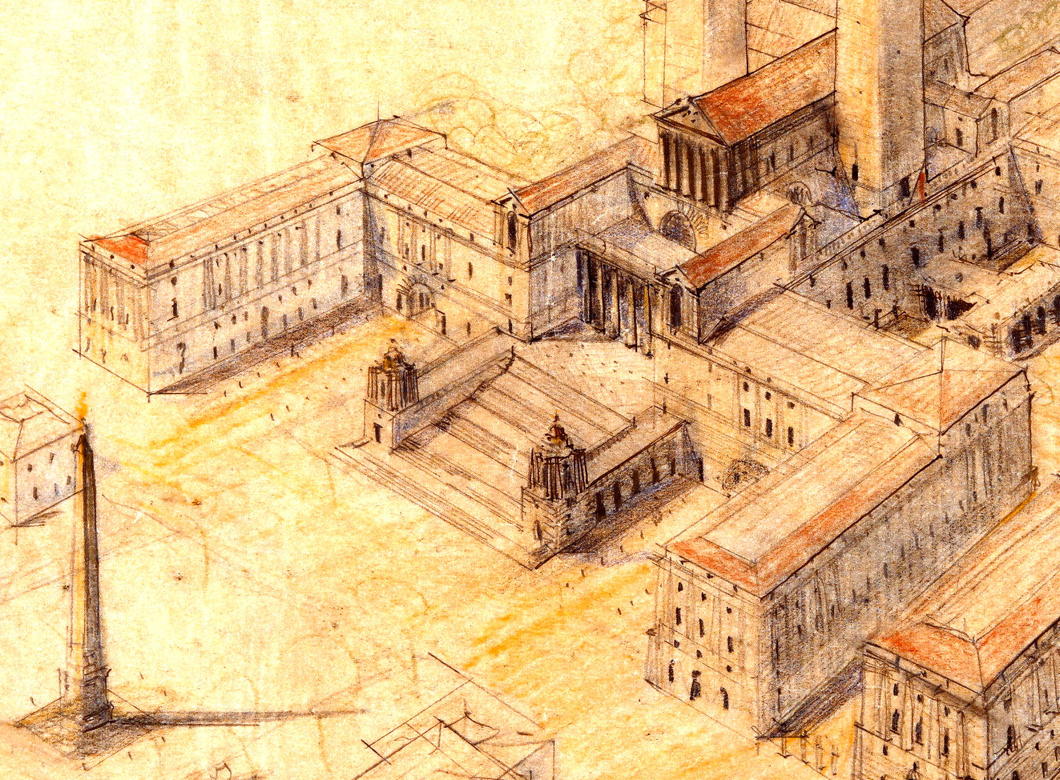
The University was run from the Imperial Institute in South Kensington but soon outgrew its quarters within that complex. The 1911 Royal Commission on University Education concluded that the University of London “should have for its headquarters permanent buildings appropriate in design to its dignity and importance, adequate in extent and specially constructed for its purpose”. But where?
Lord Haldane, the commission’s chairman, preferred Bloomsbury. University College was already there, as was the British Museum, and the Dukes of Bedford as the local landowners were happy to provide sufficient space to build a proper centre for the institution.
Charles Fitzroy Doll, the Duke’s own surveyor, designed a rather heavy classical scheme for academic buildings on the site north of the Museum but no progress was made before the Great War erupted.
Simon Verity: An Englishman in New York
An Englishman in New York
Not many people can claim with any accuracy to have crafted a Portal to Paradise, but Simon Verity was one. The master carver was born and raised in Buckinghamshire but made a significant contribution to the stones of New York.
At the Protestant Cathedral of St John the Divine in Morningside Heights — “St John the Unfinished” to many — tools had been downed following the Japanese attack on Pearl Harbor in 1941. When the Very Rev’d James Parks Morton became Dean in the 1980s he decided it was time to re-start work on the gothic hulk — one of the largest cathedrals in the world.
Morton commissioned the Englishman to come and become Master Mason at the New York cathedral based on his experience on the other side of the Atlantic. Verity tackled the main task of finishing the carvings on the great west portal of St John the Divine — the “Portal of Paradise” — training up a team of local youths in stonecarving to help with the job.
“Mr. Verity took the long-dead worthies of the Hebrew and Christian traditions and made them things of wonder for people in our own day,” the current Dean said following Verity’s death earlier this year.
Most memorable was his ostensible depiction of the destruction of the First Temple, which actually showed the Twin Towers and other familiar New York skyscrapers collapsing into ruin and fire.
Late in 2018 — after the collapse of the actual World Trade Center — an unknown vandal took it upon himself to smash the stone towers off the facade, but the Cathedral has since had them restored by Joseph Kincannon who carved the original depiction under Simon Verity.
Eventually the money ran out and the stonecarvers at St John’s had to down tools yet again so Verity returned to England, but he maintained close connections with New York. He was responsible for the carving and lettering in the British & Commonwealth 9/11 Memorial Garden in Hanover Square, for example.
When the trustees of the New York Public Library proposed clearing out the stacks from their glorious Bryant Park main building and moving the books to New Jersey — a truly criminal plan since, thankfully, abandoned — Verity drew a series of doodles in opposition, many depicting the iconic lions Patience and Fortitude who guard the Library’s entrance.
A few of the mentions of his death this summer are gathered here:
The Daily Telegraph — Obituary: Simon Verity
The Economist — Simon Verity Believed in Working the Medieval Way
The Guardian — Obituary: Simon Verity
Cathedral of St John the Divine — A Message from the Dean on Simon Verity

Amsterdam

Is die Amsterdamse stadsargitektuur die mees hemels in die wêreld? Winkels, huise, alles baie aangenaam. Burgerlik. (Ek moet teruggaan.)
Die Nederlanders het ’n samelewing met ’n semi-republikeinse mentaliteit maar met (amper) al die geseënde vrugte van ’n koninkryk. Beste van alle moontlike wêrelde…
Silver Jubilee
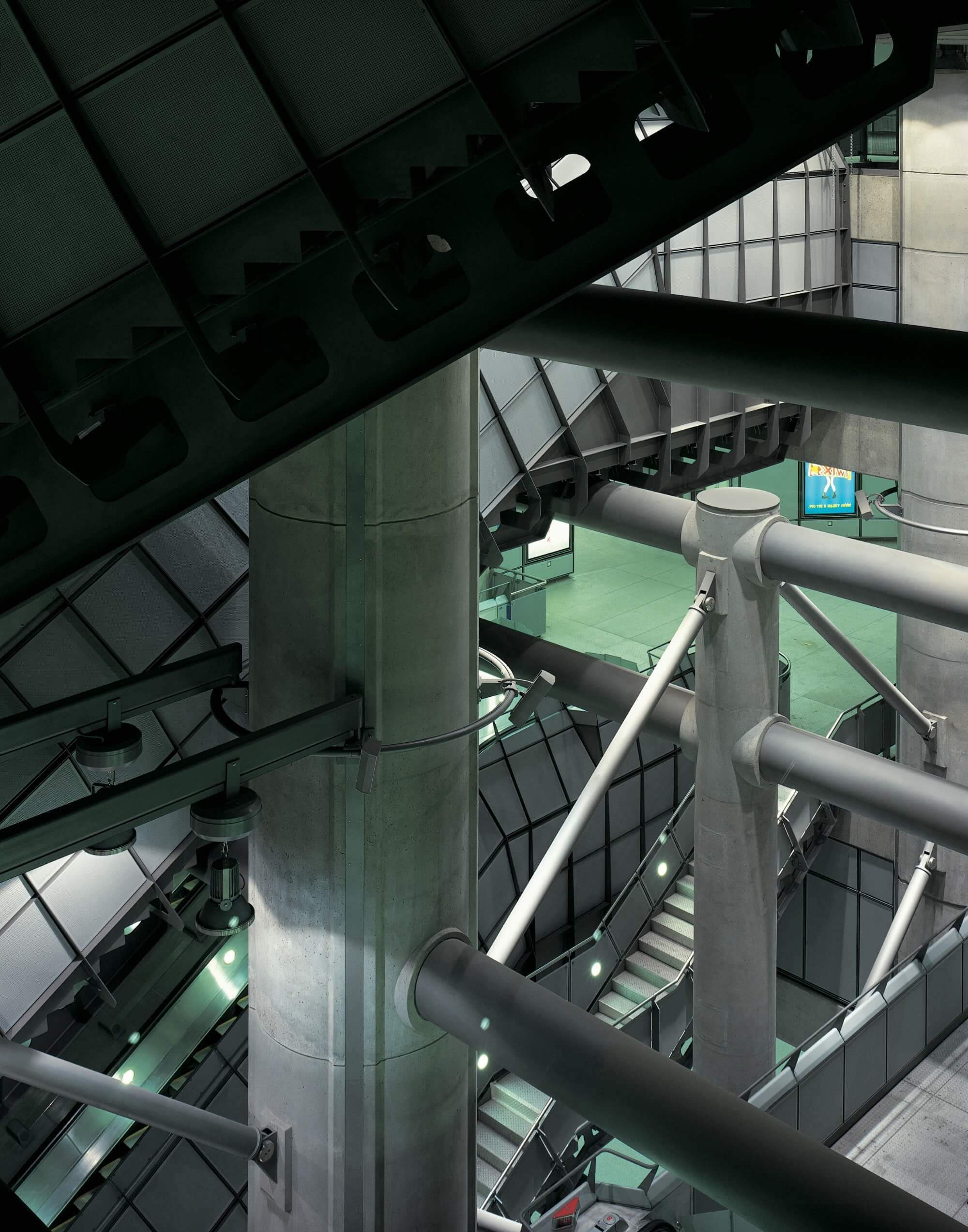
The Critic invited me to put together a few musings on the aesthetic, economic, and political impact of the JLE and the fundamentally Conservative vision that drove it. You can read it here:
■ The Half-Forgotten Promise of the Jubilee Line
Since it went up this morning, I received a kind email from Tom Newton, son of the late Sir Wilfred Newton who (as you can read in my piece) envisioned and managed the project:
You may be interested that as a family we well remember his intense frustration with the government of the time when they tried to cut back the cost of the project by reducing numbers of planned escalators across the new stations – he had to fight tooth and nail to keep the designs intact and indeed offered to resign over the matter and ultimately successfully defended the designs against cuts. He was very firm that he had no intention of building something which suffered the same capacity issues as the Victoria line resulting from similar reductions in capacity required by government during its construction. This was one of the very few times I ever saw him angry about anything.
He developed excellent relationships with railway engineers and architects whilst in Hong Kong and loved being involved in these large scale infrastructure projects – he was made an honorary member of the Royal Academy of Engineers as a result. He loved being involved in the JLE project very much. He was absolutely fascinated in how the engineers managed the risk of tunnelling across London without damaging other lines and keeping Big Ben standing.
He was asked to lead the construction of the new Hong Kong airport but decided it was time he had spent enough time in Hong Kong.
As a director of HSBC he knew Sir Norman Foster well from when he was the architect on the HSBC office building in Hong Kong. However, when he was asked by the HSBC board to oversee the building of the Canary Wharf office with Sir Norman as the architect, he was asked by the board to make sure Sir Norman was kept on a very tight leash on this build after the massive cost overruns on the Hong King building.
As regards the canopy at the JLE Canary Wharf station Dad had some robust conversations with Sir Norman about adjusting its design to make sure it would be possible to keep clean.
He always had an extraordinary ability to talk to anyone, cut through to the essentials of anything and take a very principled approach in dealing with people and problems.
Many thanks, Tom, for contributing this closer historical perspective of the Jubilee Line Extension’s construction.
Waarburg
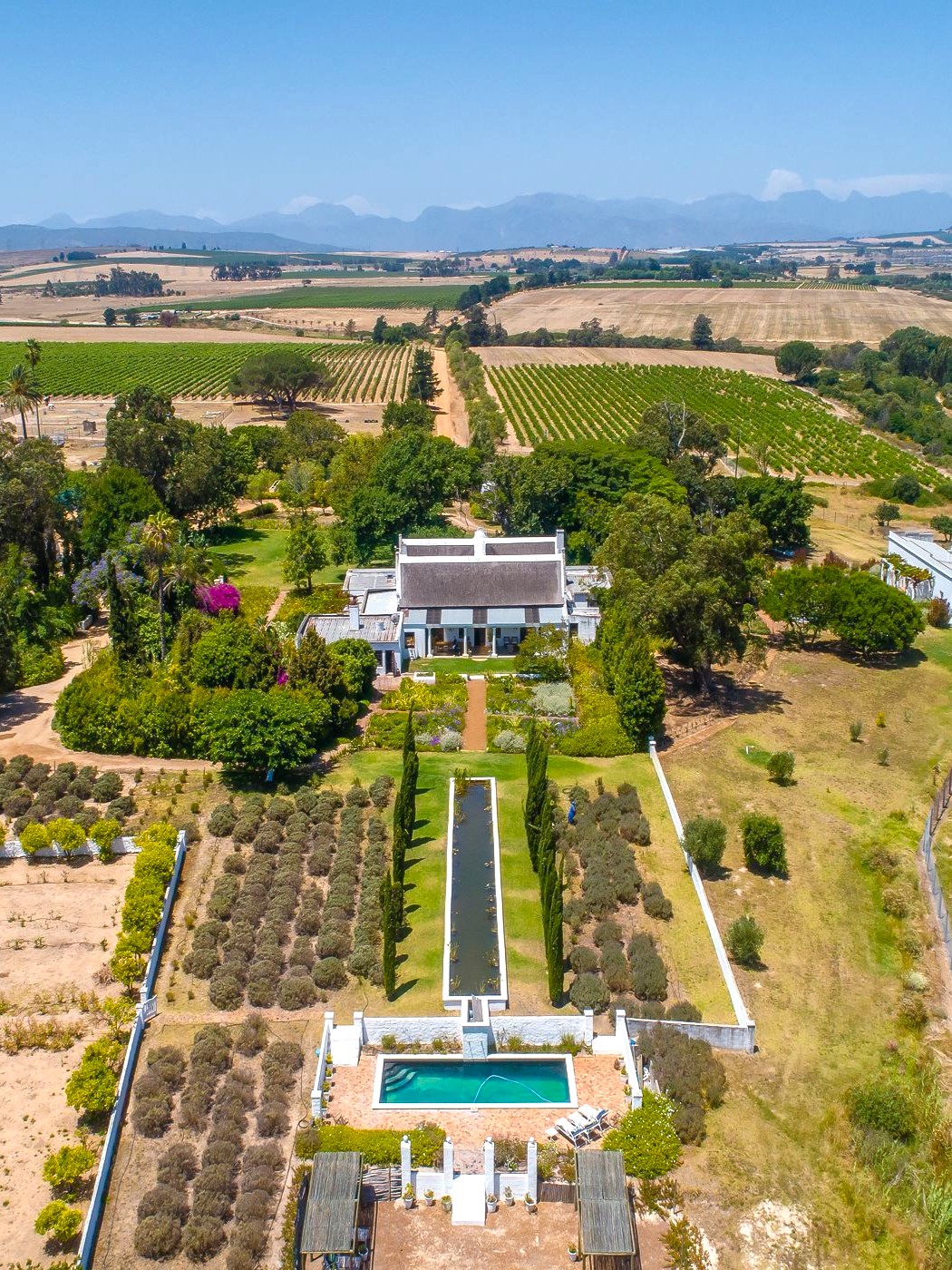
Hawksmoor House, Matjieskuil Farm, Wes-Kaap
Sometimes the perfect house meets the perfect owner: if so, then Hawksmoor House and its current owners, Mark Borrie and Simon Olding, have been an ideal match. The old manor house of Waarburg probably dates from the mid-eighteenth century and, after falling victim to neglect and unsympathetic updates, has been meticulously restored in the twenty-first century.
The history of this property, with its various names and numerous owners, now spans three centuries. In 1701, the Dutch governor of the Cape, Willem Adriaan van der Stel, granted sixty morgen of land at Joostenburg in the district of Stellenbosch to the dominee Hercules van Loon.
He was the predikant of the Reformed congregation in the “City of Oaks”, where he lived in a house on Dorpstraat just a few doors down from my former abode.
Occupied in town, van Loon also purchased farmland in the surrounding district, naming one Hercules Pilaar and another Waarburg, after the German castle of Lutheran lore.
The earliest surviving map of the property shows that there was a house here by 1704, but it is believed it was rarely used by the preacher who was occupied with his duties in town.
One day in that same year, Ds. van Loon rode from Hercules Pilaar towards Stellenbosch and, in a field outside the town, cut his own throat with a penknife. His flock were astonished and recorded that no-one knew why the preacher had killed himself.
Matilda Burden has argued that the existing house was built between 1758 and 1765 by the then-owner Jacobus Christiaan Faure. By 1826, Waarburg became known as Matjeskuil or Matjieskuil which it retained for most of its existence.


Articles of Note: 17 September 2024

31½ in. x 59 in.; (link)
The Lebanese banker, writer, journalist, and politician Michel Chiha postulated that Beirut was “the axis of a three-pronged propeller: Africa, Asia and Europe”.
The city’s current airport was inaugurated in 1954, towards the height of its golden years.
In L’Orient-Le Jour, Lyana Alameddine and Soulayma Mardam-Bey report on how Beirut Airport’s story reflects the highs and lows of Lebanon’s history. (Aussi en français.)
■ Another one bites the dust: this time it’s London’s Evening Standard — traditionally the most London of London’s daily newspapers — which recently announced it will move to a single weekly printed edition.
In its heyday there were several editions per day, with “West End Final” on rare occasions topped up by a “News Extra” edition.
Stuart Kuttner, a veteran of the Standard, wrote a beautiful paean to the paper published in the Press Gazette.
■ Samuel Rubinstein shows how historians’ war of words over the legacy of the British Empire tells us more about the moral battles of today than shedding actual light on the past.
■ Wessie du Toit explores the curious columnar classicism persistent across the full spectrum of South African architecture.
■ With union presidents speaking at America’s Republic party convention, Senator Josh Hawley explores the promise of pro-labour conservatism.
■ Also at the increasingly indispensible Compact, Pablo Touzon explores how the Argentine left created Javier Milei.
■ Closer to home, Guy Dampier argues that Britain’s public services, housing, and infrastructure have reached their migration breaking point and the new Government has zero solutions.
■ Meanwhile, five hundred academics have signed a joint letter urging the Labour government not to scrap university free speech laws as the Education Secretary announced they will do.
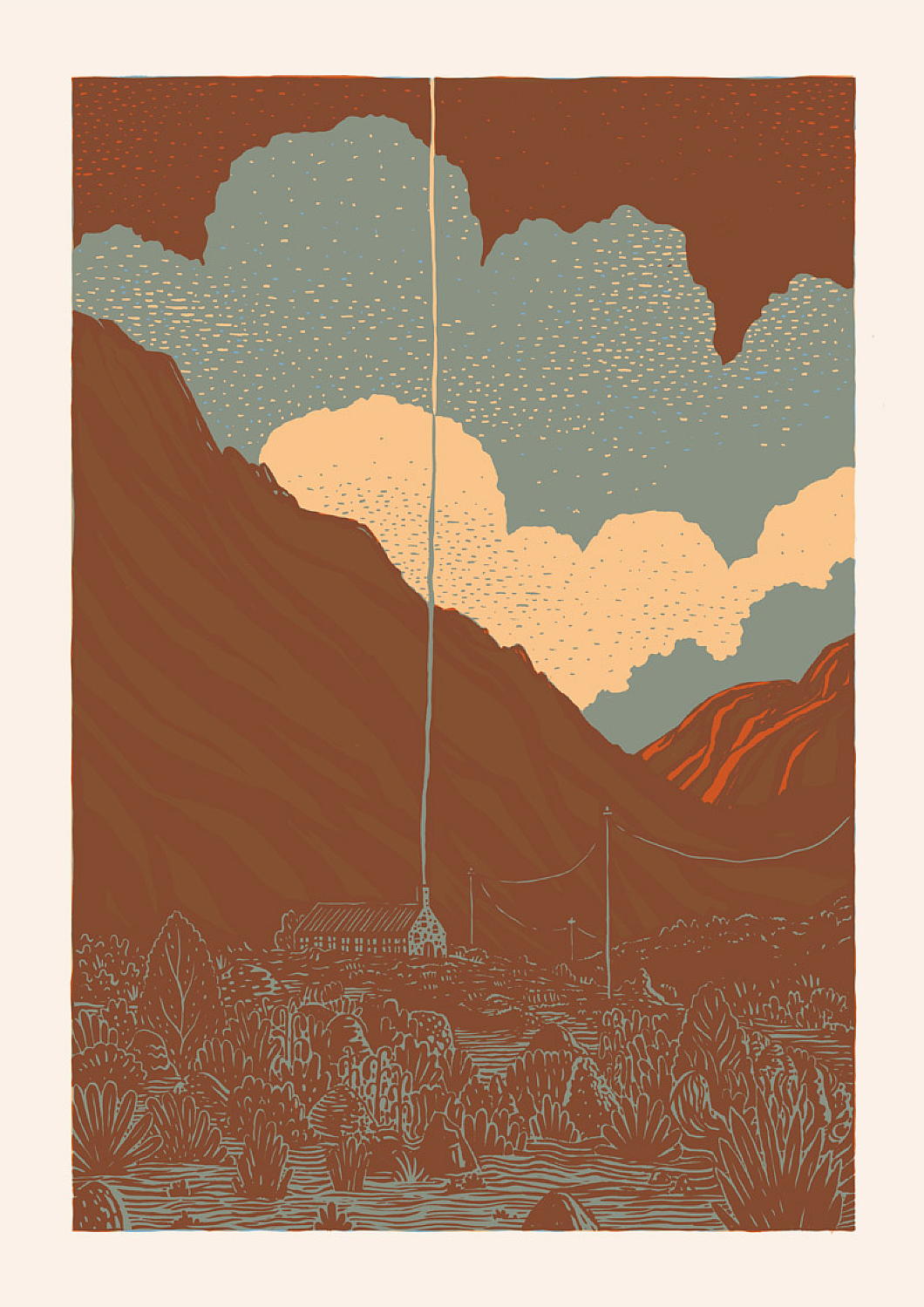
11½ in. x 16½ in.; (link)
Search
Instagram: @andcusack
Click here for my Instagram photos.Most Recent Posts
- Brunel’s Unbuilt Capitol February 3, 2026
- Cricket at Fordham January 27, 2026
- Palacio Barolo Revisted January 14, 2026
- Learning to Love Liguria January 14, 2026
- Crux Alba No. 2 January 13, 2026
Most Recent Comments
Book Wishlist
Monthly Archives
Categories