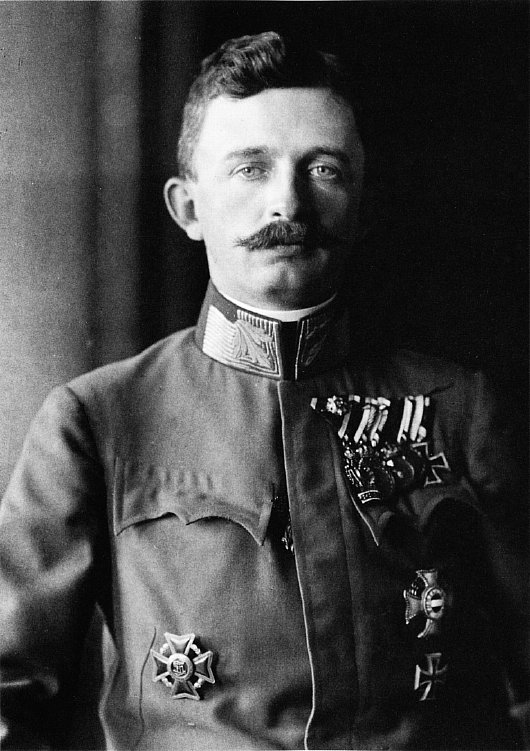
About Andrew Cusack
 Writer, web designer, etc.; born in New York; educated in Argentina, Scotland, and South Africa; now based in London.
 read more
News
Blogs
Reviews & Periodicals
Arts & Design
World
France
Mitteleuropa
Knickerbockers
Argentina
The Levant
Africa
Cape of Good Hope
Netherlands
Scandinavia
Québec
India
Muscovy
Germany
Academica
Mawdsley for MP
 The Telegraph today reports that James Mawdsley, the human rights activist thrice chucked into Burmese prisons for his pro-democracy campaigns, will be standing in the next general election as the Conservative candidate for Hyndburn.
Mawdlsey, a good Catholic and a friend of Jon Burke and Peter Cox, was only just married last month, spending his honeymoon in Rome where he and his wife Elizabeth were blessed by the Holy Father.
Best of luck to him, and I very much hope he wins. This moribnd parliament needs more ardent defenders of the right to life and civil liberties.
The Goodwin Mansion
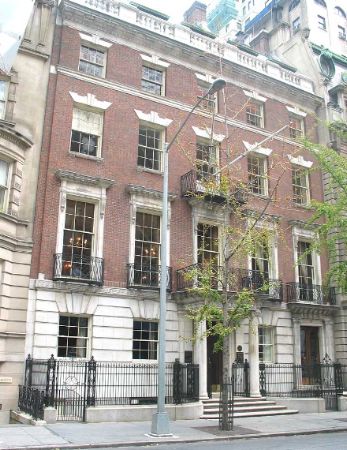
One of my favorite buildings in Midtown is the Board of Directors office of the U.S. Trust, at 9-11 West 54th Street. This fairly reserved wide neo-Georgian townhouse was designed by McKim Mead & White as a residence for Mr. James J. Goodwin when the West 50’s was full of beautiful townhouses instead of mediocre office buildings. (more…)
The Knights of Malta Ball 2005

Well, last night was magnificent. Fraulein Hesser and I travelled down to Edinburgh for the Knights of Malta Ball at the Assembly Rooms in George Street. Our party was organised by Mr. Gerald Warner whose visceral lashings in print of all the senior hubrisarchs of our day are published in weekly in Scotland on Sunday. Alas, Mr. Warner was exposed to mumps recently, and thus could not come for fear of spreading the contagion, but he very kindly gifted us two tickets, for which we are extremely grateful. We toasted his health. (more…)
Day of Whimsy
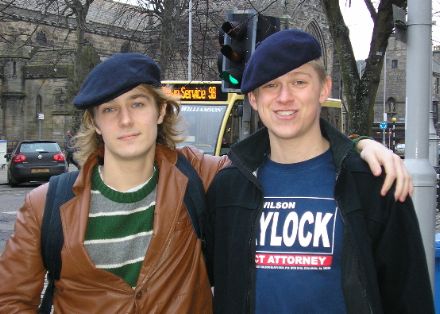
This afternoon Abby and I ran into Chicago’s unwanted child Jamie Branda and Alabama’s biggest liability Chris C. on South Street. They were having a “day of whimsy” and decided to purchase some fetching blue caps from Lord only knows where, and thus I felt compelled to record it for posterity.
Le retour d’Emelie

De temps en temps j’ai une excuse pour écrire une entrée en mon pauvre français, et la visite d’Emelie à St Andrews est une excuse par excellence. La merveilleuse Claire Dempsey était assez aimable pour accueillir un petit événement la nuit passée dans le aumônierie (Canmore).
Nous avons discuté des matières fascinantes comme des pommes de terre (ou “spuds” comme Clare les appelle), dommages du rugby d’Emelie, le fait que des fonctionnaires (civil servants) français sont payés pour ne faire rien, et avec précision quoi appeler la couleur de la chemise de Stefano. (Il s’est étendu des saumons à la fraise écrasée).
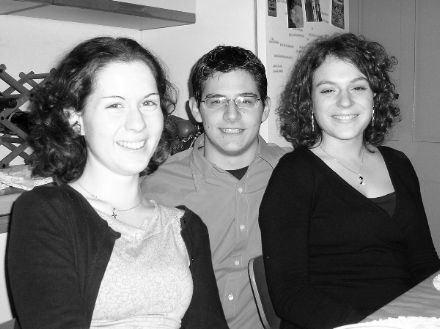
Clare, Stefano, et Emelie dans la cuisine de Canmore.
O.C.H., R.I.P.
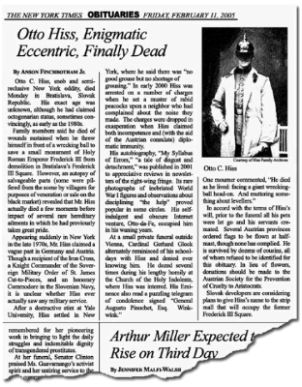
Alas, one of my favorite blogs has come to an end.
Country Life (Blowing Up Microwaves)
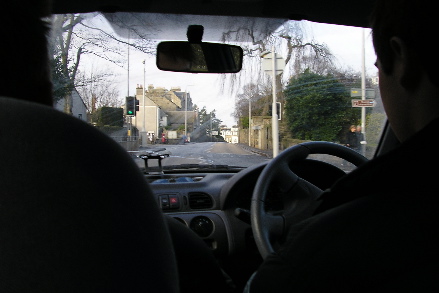
Some have said that the students of the University of St Andrews are pampered layabouts with nothing much to do. Today, we proved them wrong. We packed a microwave with butane-filled baloons and metallic materials and blew it up in a potato patch. And had a barbecue. (more…)
Andreanopolis
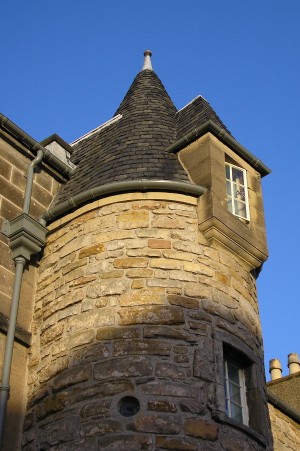
I have taken somewhat ill, so I thought in order to keep the loyal readers entertained, I’d show some photos I took just the other day when we actually had some decent sun. Above is the turret of the Old Union Building on North Street. The building, across Butts Wynd from St. Salvator’s College, was constructed in the medieval period and housed the Admirable Crichton during his student years. It was, from the mid-19th century until the 1960’s, home to the Student’s Union, which was run as a male-only gentleman’s club with billiard room, library, cafe, and such, with the Women’s Union located in the adjacent Georgian townhouses and a dining hall attached in an 19th century addition to the rear. (The Gymnasium used as a drill hall by the OTC further to the rear along Butts Wynd is now the computer center). The two organisations merged in the 60’s and moved into the functional greivous brutalist concrete Student Union building that nobody likes on St. Mary’s Place.
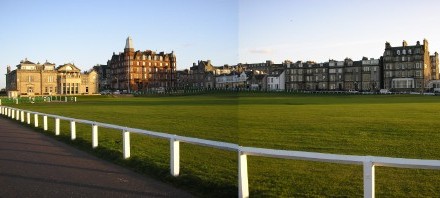
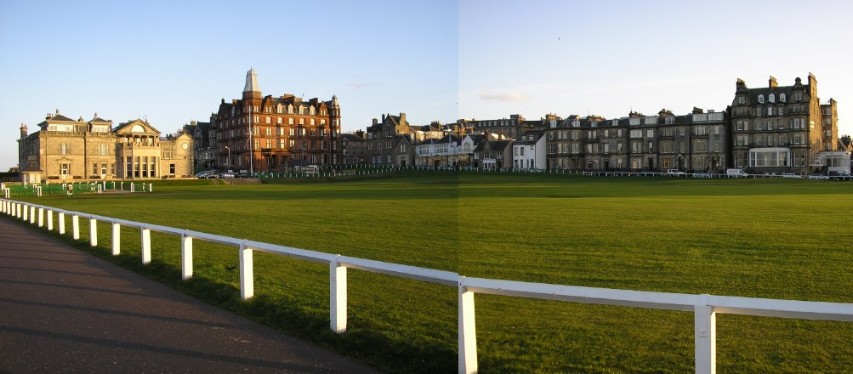
This photograph shows the 18th hole of the Old Course. On the far left is the Royal and Ancient Golf Club, then the red-brick Hamilton Hall (currently a University dormitory but being sold off), and at the far right is the Rusacks Hotel (in my opinion, the best in town). For a closer look at the photo, click here.
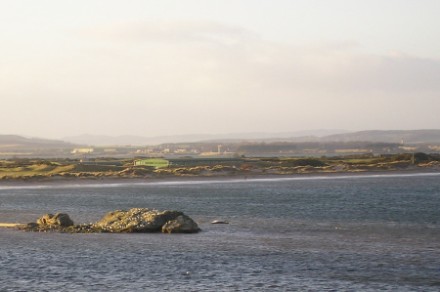
And this photo is taken from the Scores, looking across the bay towards the West Sands and beyond. At the very center of the photo you can just make out the control tower of RAF Leuchars.
Now I will go back to bed, being miserable, and reading about the Popular Front government in 1930’s France. (Boo! Hiss!).
Ash Wednesday
Well. We all had such a Shrove Tuesday that Ash Wednesday was made all the more penetential. The fast was made more endurable by the fact that I only finally rose from my bed about two hours past midday, and upon rising decided to shave off the previously mentioned beard which had seen fit to make its habitation upon my own grim visage.
On embarking upon the rail journey from Edinburgh’s Waverley Station, chance had it that my good friend Emma was in the same railway car, and the conversation made the trip pass much more quickly. Emma lives near Oxford, and had flown up to Edinburgh from Birmingham. Anyhow we discussed the troubles and travails of our measly student existences – finding places to live, grades, people, etc — and Nicholas Vincent was kind enough to pick us up from the barren surrounds of Leuchars rail station and transport us to the Royal Burgh of St Andrews itself.
Emma had to run but Nicholas and I then decided to avail ourselves of the very advantageously-priced Sunday luncheon on offer at the Oak Rooms. A decent lunch for a fiver, though the popularity of the offer meant we had to wait a short while for a table. Thus, a pint of Guinness accompanied our wait and we discussed Freddy St. Johnstone’s keeness on a United Nations career. This sparked me to go on one of my textbook tirades on U.N. corruption and fecklessness, though were I offered a U.N. job which involved freedom from parking violations, kids’ school fees paid, and the effective right to refuse to travel anywhere unless there is suitable accomodation of at least four stars, I wouldn’t refuse.
That evening I stopped into the Russell for a pint with Rob and Maria and was filled in on all the latest talk and chatter. They had, the evening previous, dined with a few friends of ours, Mr. Peter Blair (the convenor of the Debating Society) his belle, Miss Sarah Laurence Goodwin (previously mentioned in these pages), as well as California’s most eligible daughter, Fraulein Abigail Hesser, and Bristol City F.C.’s biggest fan north of the border, Mr. Jonathan Burke.
Monday morning played host to the first of my two courses, ‘France Since 1940: Politics, Culture, and Society’, with the ever capable Stephen Tyre (of last term’s ‘French Algeria 1830-1962’) at the helm. Without last term’s Fraser, I’m afraid that our discussions in pursuit of higher knowledge will no longer be steered towards banter regarding deep-seated Scottish football rivalries. I very much look forward to the rest of the course though. There are a few old faces amongst the other students in the course.
Tuesday, yesterday, was my other course for the term, ‘Art and Piety in Western Europe, 1400-1700’ lead by Dr. Bridget Heal, of whom “Ishmael” is an ardent admirer. Though a Modern History course, it leans somewhat towards Art History, which means that Matt Gorrie, one other fellow, and myself are the only chaps in a class of about fifteen. I look forward to hissing Calvinist iconoclasts and urging onwards Tridentine reformers. Margaret Breed, a Brearley girl who defeats the school’s stereotype by being interesting, engaging, and just plain generally endearing, is also in the course.
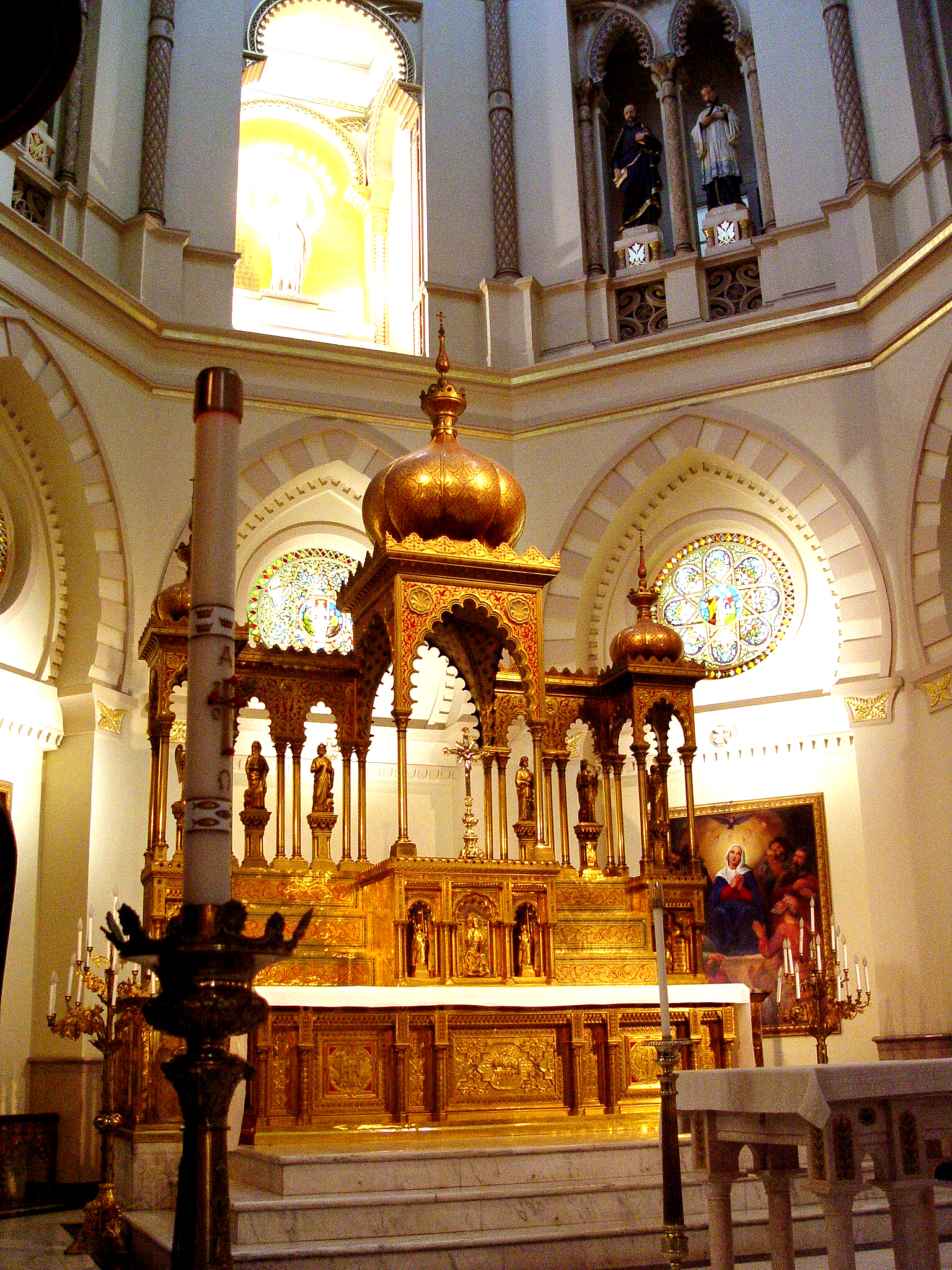
Mrs. Freeburn is introducing me to the fascinating world of Bollywood cinema. Cinema aside, the other day I was thinking what a glorious culture and civilization India has, and how magnificent it would be if it was conquered by the Faith. If orientalism in ecclesiastical architecture is to your taste, you might want to check out the Church of the Immaculate Conception in New Orleans, especially the beautiful altar.
Projected printing date of next Mitre: well, let’s hope Friday.
Facebook Comes to St Andrews

We had all heard talk and rumors of this crazy site from all our friends who are conventional enough to attend colleges and universities in the Motherland, but now thefacebook.com has arrived at St Andrews. This popular… well, what the heck does one call it? forum, I suppose, has ventured outside North America for the first time and made itself available to students at St A’s, Oxford, Cambridge, Trinity Dublin, and the American University of Paris.
I have to say, despite my inherent suspicion of all things new and technological, it’s quite a nifty thing. What you do is, you enter your official university e-mail address to verify you are a real student at a particular university and then you make a profile about yourself and your friends do the same and you add them as your official friends and before you know it you have a veritable network of confederates with photos, their birthdays, favorite books and movies, quotes, and everything. You can even poke people (and poking is one of our most formidable pasttimes).
One of my favorite bits is this nifty tally by which you keep account of your official friends at other institutions:
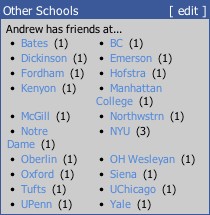
Heck, I just joined last night and I’ve already got twenty-nine of my friends officially friend-ed on Facebook. In terms of non-St-Andreans, NYU is currently in the lead with 3, the rest all have one, but once I get Will Moller added Kenyon will move to second place with 2. I’ve got seven or so St Andreans so far. Niftiness.
Candlemas
Down with the bays and misletoe
Down with the holly, ivy, all,
Wherewith ye dress’d the Christmas Hall
That so the superstitious find
No one least branch there left behind
For look, how many leaves there be
Neglected, there (maids, trust to me)
So many goblins you shall see.
Today, February 2, is Candlemas Day: the Feast of the Presentation of Jesus in the Temple. This is the day, forty days after the Nativity, when Mary brought Jesus to the Temple to offer a sacrifice for her purification after giving birth to a boy, as prescribed by the Mosaic law.
And behold there was a man in Jerusalem named Simeon: and this man was just and devout, waiting for the consolation of Israel. And the Holy Ghost was in him.
And he had received an answer from the Holy Ghost, that he should not see death before he had seen the Christ of the Lord.
And he came by the Spirit into the temple.
And when his parents brought in the child Jesus, to do for him according to the custom of the law, He also took him into his arms and blessed God and said
Now thou dost dismiss thy servant, O Lord, according to thy word in peace:
Because my eyes have seen thy salvation,
Which thou hast prepared before the face of all peoples:
A light to the revelation of the Gentiles and the glory of thy people
Israel.
And his father and mother were wondering at those things which were spoken concerning him.
And Simeon blessed them and said to Mary his mother:
Behold this child is set for the fall and for the resurrection of many in Israel and for a sign which shall be contradicted.
And thy own soul a sword shall pierce, that, out of many hearts
thoughts may be revealed.
And there was one Anna, a prophetess, the daughter of Phanuel, of the tribe of Aser. She was far advanced in years and had lived with
her husband seven years from her virginity.
And she was a widow until fourscore and four years: who departed not from the temple, by fastings and prayers serving night and day.
Now she, at the same hour, coming in, confessed to the Lord: and
spoke of him to all that looked for the redemption of Israel.
And after they had performed all things according to the law of the Lord, they returned into Galilee, to their city Nazareth.
The feast is often called Candlemas because it is the day which candles of beeswax are blessed, while reciting the antiphon ‘Lumen ad revelationem gentium et gloriam plebis tuæ Israel’ from the canticle of Simeon cited above.
In Scotland, the Protestant revolution did away with all that, but Candlemas remained as a legal quarter day. At St Andrews, the second semester is Candlemas term. There used to be trimesters, consisting of Martinmas, Candlemas, and Whitsun terms, but the semester system was introduced during the 1990’s and Whitsun term faced the axe. Some folks at St Andrews, however, refer to the part of the second semester after the two-week Easter holiday as Whitsun or Whitsunday term.
In America, the day evolved into Groundhog Day, the earliest recording of which dates from the diary of Pennsylvania storekeeper in 1841:
UPDATE: Dr. Curmudgeon & Co. have a good Candlemas post.
Candlemas:
Catholic Encyclopaedia
Wikipedia
Groundhog Day:
Wikipedia
Elliott Banfield
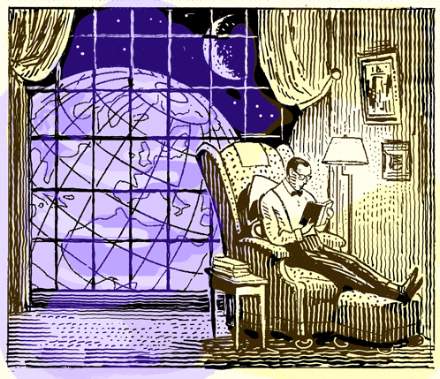
One of the best illustrators alive is Elliott Banfield. I have seen his work a few times in the New York Sun, but only managed to finally investigate him on the web this evening (thanks to the Irish Elk), and his website offers a plethora of wonderful retro illustrations that prove his skill and his worth. Why, if I ran a newspaper – one with a real budget I mean – I’d have this guy be the in-house illustrator and might be tempted to ditch photographs altogether.
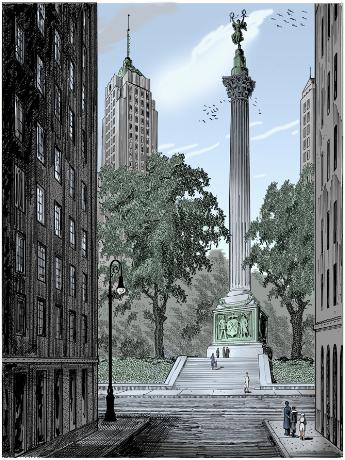
Mr. Banfield even gives us a wonderful impression of his proposal for a September 11 monument, inspired by critic Henry Reed. I love it. It oozes Gotham and reeks of Manhattan. I especially enjoy the use of New York’s civic arms on the base of the pillar, supported, appropriately, by a policeman and a fireman, rather than the official settler and native. The heraldic achievement of our city is, I’ll admit, somewhat provincial with its windmills and beavers, but all the more endearing for it, if you ask me.
Huzzah for Elliott Banfield!
Our Favorite Bishop Writes!
I have been ill the past four or five days, but there was nothing that could have made me feel better than having recently received the following email:
Thank you for the publication about my visit in your The Mitre of November I received here by our friend Carlos Colon. May God bless allways your work and apostolate among the students. I show your publication to our priests and youngmen as an example to be immitated.
With my best wishes and blessing.
Stained-Glass Window
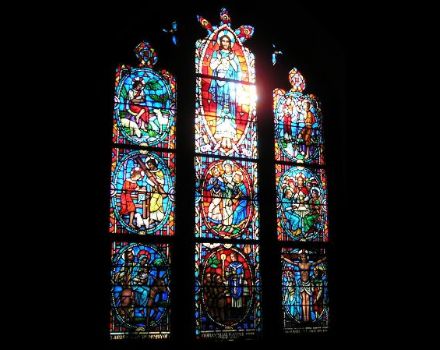
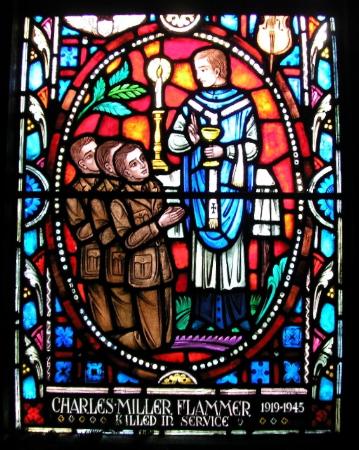
Here’s a window from the Goodhue-designed Christ Church Bronxville, with a close-up of one panel below.
To Yale and Back Again
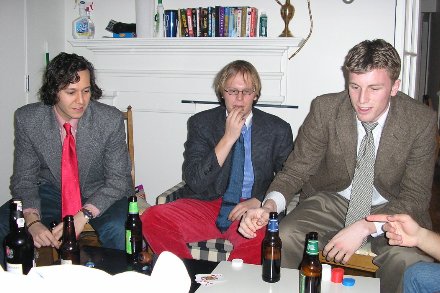
An altogether successful foray was made last night into the neighboring sovereign state of Connecticut, wherein resides a middle-aged (or perhaps even old, by our national standards) university which is named Yale, after the institution’s early benefactor. Said place of higher learning is also home to the burgeoning second chapter of the greatest society ever to have graced the University and Royal Burgh of St Andrews. It was in such a capacity that I was invited along to a moderately informal and very cheerful evening. (more…)
The Dewey Arch
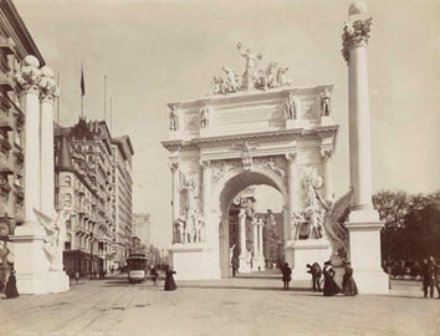
The Classical Values blog had a post back in October ’03 entitled A Classical Arch in New York, which makes mention of the triumphal arch built to comemmorate Admiral Dewey’s victory over the Spanish in the eponymous war between our two nations round the turn of the century.
The Dewey Arch was only a temporary structure built of a plaster-like material, and thus did not survive. A previous temporary wood-and-plaster triumphal arch was built to commemorate General Washington in Washington Square, and proved so popular that it was decided to replace it with a permanent stone version. Unfortunately, the more attractive beaux-arts Dewey Arch, which also featured a colonnade, was not made permanent as its location in Madison Square would have obstructed the flow of vehicles and required a rethinking of the traffic flow.
The only existing reminder of the Arch near the site is a bar and restaurant called Dewey’s Flatiron.
Nonetheless, here are a few photos of the lost arch.
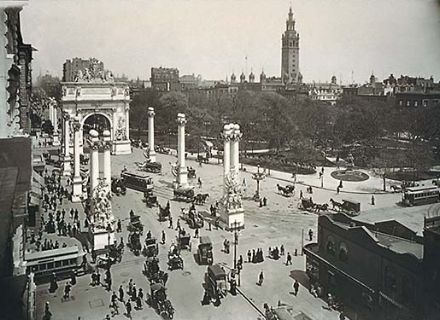
A view of the Dewey Arch, colonnade, and Madison Square, with Stanford White’s towered Madison Square Garden in the background. Broadway and its trolley line cross the colonnade’s axis. (more…)
New Eyewitness Goes Blind
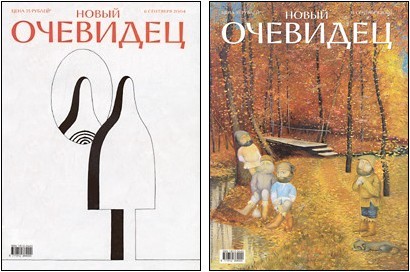
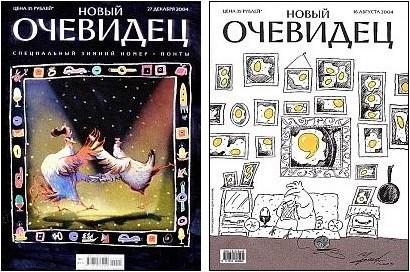
 Novy Ochevidets, Russia’s blatant imitation of the New Yorker is shutting down after only five months in operation, according to the Moscow Times.
Novy Ochevidets, which translates as the ‘New Eyewitness’, specially commissioned a Cyrillic font that fashioned after that of its mentor, and even had it’s own version (seen at right) of the New Yorker‘s classic fopp, Eustace Tilly.
I mourn for the New Yorker. It has yet to recover from Tina Brown’s years at the helm, and shows no signs of getting better. Indeed, quite the opposite, as was shown this past year when the magazine endorsed a political candidate for the first time in its history. (If you hadn’t already guessed, it was the man perenially described by James Taranto as ‘the haughty French-looking senator from Massachusetts who, by the way, also served in Vietnam’).
Via the indispensible Arts & Letters Daily.
The Death of an Intellectual
I have but one thing to say about the late Susan Sontag: Nearly every obituary of the intellectual reminds us that “she often described herself as a ‘zealot of seriousness'”. That someone would, in all seriousness, put themselves forth as a ‘zealot of seriousness’ makes it bordering on impossible for me to take her seriously.
Nonetheless, may she rest in peace.
Res Publica Nova Eboraci
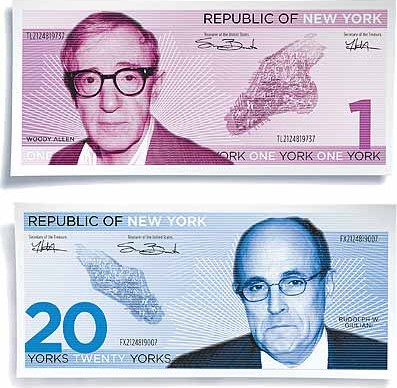
Gothamist picks up the idea of the City of New York seceding from either the State or the Country. Normally I’m in favor of anything seceding from anything else. However, the City and State have to stick together. I wouldn’t mind the State of New York regaining complete sovereignty, but I think we’d want to take Connecticut and northern New Jersey with us for the sake of geographic integrity.
New York currency illustrations from an article on secession in New York magazine.
Leisure
I AM BACK HOME in New York after having completed my Martinmas term examinations. This morning, my mother, sister, brother-in-law, and I went out for breakfast to celebrate my “triumphant return from another term at university.” (I suggested it might be wiser to wait until the casualty reports are released before we declare it a triumph).
Nonetheless, I now have three weeks of time almost entirely free from obligations to do whatever I please. It is perhaps how a man spends his free time that defines him, as free time is the foundation of civilization itself. Roger Kimball reflects on this in a recent Armavirumque posting, mentioning Josef Pieper and Leisure: The Basis of Culture, a book I was first introduced to by Robert O’Brien whilst still half-asleep at 7:30 in the morning waiting for a train at Leuchars station so we could attend the Tridentine mass in Edinburgh.
Leisure, by which we mean doing something merely for its own sake, is entirely different from mere pleasure. Unfortunately for the English language, we oft mistake the two for synonyms. It is leisure in that latter sense, of idleness and cheap pleasure, which our good friend Prof. Richard Demarco resoundly condemned in a lecture he gave at St Andrews. This kind of leisure, he stated, was leading to the destruction of Scotland, of Europe, and of civilization. Art today, according to Richard, is a collection of usually talentless kitsch which seeks merely to create an arrangement that is pleasing or clever. Art, in Richard Demarco’s world, should not aim to be pleasing, or to be clever, but should have as its essence the very highest that man can achieve: the sanctification of souls. In pursuit of pleasure rather than leisure, tourism is taking over entire countries; a false economy which can enslave the entire population of a given area.
It is certainly rampant in St Andrews. There are many good reasons to visit St Andrews. The third-oldest university in the English-speaking world, for example, or perhaps to see ruins of one of the greatest shrines in Christendom, bearing witness to the visceral damage wrought by the Protestant Revolution (we should refuse to dignify that revulsion with the name of ‘reformation’; it destroyed and replaced, not reformed). Most, however, come for the golf.
While niches once full remain empty from the holocausts of five centuries ago, the Scottish Parliament would prefer to spend its millions (which, you must never forget, are the people’s millions) on encouraging this pointless and ineffective idleness, Demarco pointed out. More recently, South Street, where I live, will soon be shorn of its beautiful trees, those which make it one of the most inviting and comely thoroughfares in the Royal Burgh. This must be done, we are told, to increase the number of parking spaces, the paucity of which might be driving away potential tourists. Perish the thought! Heaven forbid a town be run for the benefit of its inhabitants, for the benefit of itself (but surely by now they have already forbidden Heaven).
As Mr. Kimball points out, the opposite of the former leisure, the leisure which Pieper posits is the basis of culture, is busyness. Perhaps we can extend this to business, for it is the dollar, the pound, and the euro which enslave St Andrews to transient tourists. Without tourism, some say, St Andrews, or Oxford or Venice or wherever, would not survive. But at what price survival? And who defines this survival? That these places are still on the map and are inhabited is for sure. But in some sense have not these places, while encouraging tourism as a mode of survival, been so changed and transformed that in fact they have not survived. Decrepit and rundown, they may have been, but at least they had authenticity; at least they were themselves. Now most of the goods sold in St Andrews – saltires, fake kilts, tam o’shanters, and Scotland t-shirts – are in fact things that can be purchased in half the towns in Scotland, and now with the advent of the internet, you can purchase them while you remain at home. Their cheapness is only accompanied by the sentiment of being a souvenir in the original French sense of the word: to remember. But they are remembrances for short memories, and likely will be thrown out within a year, because we, and it all comes back to this, do not have the time for longer memories.
Thus one of the chief values of an education must be free time. St Andrews affords this, I am glad to say; especially if you are an arts student and are not aiming for a first. All too often friends of mine at universities in the States or at Oxbridge are busy. They are either busy with busywork, (assignments for school which must be done to stay in the university but have little graded value or academic merit) or else busy with social activity and other amusements which vary greatly as to whether one’s in a big city or not (most often the case with NYU students I find).
When I finally start my university, we must make sure that students have enough free time then, perhaps the greatest argument for not locating it in an overactive urban metropolis. Though of course a good part of education is that which transmits information and ideas and, more importantly, inculcates moral values, much must be left up to the student. There is an inherent value in reading not what is required but what is desired.
And so I will get on with my post-exam break, reading the Pickwick Papers, the Everlasting Man, and This Side of Paradise, hopefully with some time to browse through Haldane’s Faithful Reason: Essays Catholic and philosophical (which, on a typographical note, makes ample use of the Gill Sans font).
Search
Instagram: @andcusack
Click here for my Instagram photos.Most Recent Posts
- West Point July 30, 2026
- Brunel’s Unbuilt Capitol February 3, 2026
- Cricket at Fordham January 27, 2026
- Palacio Barolo Revisted January 14, 2026
- Learning to Love Liguria January 14, 2026
Most Recent Comments
Book Wishlist
Monthly Archives
Categories